An n number of possible languages use the same vocabulary; in some of them, the symbol library allows the correct definition a ubiquitous and lasting system of hexagonal galleries, but library is bread or pyramid or anything else, and these seven words which define it have another value. You who read me, are you sure of understanding my language?
–The Library of Babel (Borges Reference Borges, Yates and Irby1964, 57–58)
1. Introduction
In The Library of Babel, the Argentinian writer Jorge Luis Borges portrays a vast library consisting of filled with books having an identical format of four-hundred ten pages, forty lines per page, and eighty characters per line.
The Library is total and…its shelves register all the possible combinations of the twenty-odd orthographical symbols (a number which, though extremely vast, is not infinite): Everything: the minutely detailed history of the future, the archangels' autobiographies, the faithful catalogs of the Library, thousands and thousands of false catalogs, the demonstration of the fallacy of those catalogs, the demonstration of the fallacy of the true catalog, the Gnostic gospel of Basilides, the commentary on that gospel, the commentary on the commentary on that gospel, the true story of your death, the translation of every book in all languages, the interpolations of every book in all books. (Borges Reference Borges, Yates and Irby1964, 52)
The very idea of such a collection is mind-boggling. The library clearly contains great wisdom, but it is hidden amongst sophistry, lies, and above all, gibberish. Indeed, most of the volumes will contain vast stretches of meaningless prose; meaningless, anyway, in any given language. One might wonder what portion of the
 $\sim 2\times 10^{1,800,000}$
books (assuming 25 orthographic symbols) are truly random. Footnote 1 Which begs the question, what does it mean to say that a sequence of letters is random?
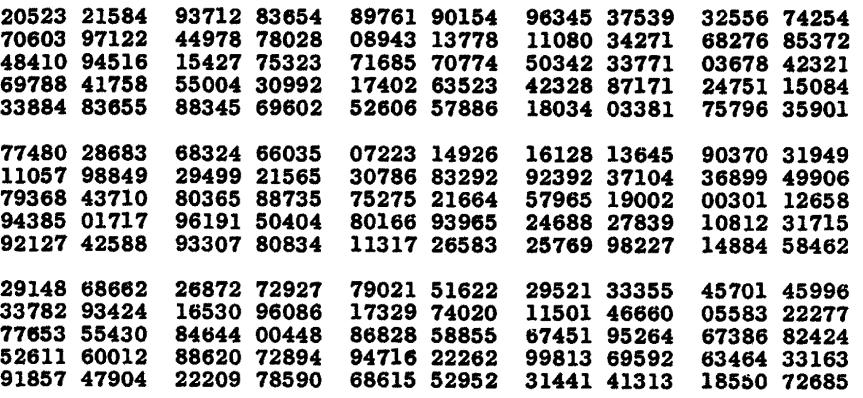
Were Borges's library constructed from an alphabet of numerals, rather than letters, a typical page from a typical book might well look something like Figure 1 (above). This is an excerpt from A Million Random Digits, by The Rand Corporation (Reference Corporation1955). Is there really a fact of the matter as to whether a given sequence is random? Is randomness objective? More generally, can we quantify the complexity of a string of symbols, or a physical object?
Excerpt from A Million Random Digits (Rand Corporation Reference Corporation1955, 17).

2. Shannon Information
The information theory of Claude Shannon (Reference Shannon1948) provides a method for quantifying the amount of information produced by an information source. For a source emitting strings made up of an alphabet of n discrete symbols, the associated Shannon information is defined to be

where p i is the probability of occurrence of the i'th symbol, and where the base of the logarithm is regarded as an arbitrary choice of units.Footnote 2 Sometimes called the entropy (because the expression for H is formally identical to the expression for the Gibbs entropy of statistical mechanics), this quantity is rightly said to represent the ‘surprisal’ of the source. That is, it tells us how much new information we obtain when we receive an additional character. Thus if our alphabet has two symbols, X and Y, and the source is such that X and Y are equally probable, we find that the information associated with the source is
 $H=-(\frac{1}{2}(\mathrm{log}\,_{2}\frac{1}{2}) +\frac{1}{2}) \mathrm{log}\,_{2}\frac{1}{2})) =1$
. On the other hand, if the probability of X is
 $\frac{3}{4}$
and the probability of Y is
 $\frac{1}{4}$
, then we find that
 $H=-(\frac{3}{4}(\mathrm{log}\,_{2}\frac{3}{4}) +\frac{1}{4}(\mathrm{log}\,_{2}\frac{1}{4})) \approx 0.81$
. The fact that the information content of the latter source is lower corresponds to the fact that there is less uncertainty in the value of the next symbol—it is more likely to be X than Y. The information is of course minimized if the probability is maximally concentrated on a single symbol; it is maximized if all symbols are equally likely. To the extent that one is inclined to regard a source with typical string XXXXX as ‘more ordered’ than a source in which a typical string has an equal number of Xs and Ys, low information content can be said to correspond to a high degree of structure.
As noted, however, the Shannon information H quantifies the information associated with a source, rather than with any particular string emitted by that source. Thus there is no way to assign a distinctive information content to a particular string, such as XXXXX. Information content is a property of sources, or more abstractly, of statistical ensembles which represent the probabilistically weighted possible outputs of the source. (The same goes for the statistical-mechanical entropy of Gibbs.) Thus we can assign a Shannon information content to the Library of Babel, but we can't assign a distinctive information content to each of the individual books.
3. Algorithmic Complexity and Objectivity
The algorithmic complexity theory of Kolmogorov (Reference Kolmogorov1965), Solomonoff (Reference Solomonoff1964), and Chaitin (Reference Chaitin1966) is an attempt to characterize the complexity of individual strings. In particular, it is claimed by some of its advocates and adherents to provide an objective characterization of randomness, where randomness is identified with maximal complexity. For example, Cover and Thomas (Reference Cover and Thomas1991) enthuse, “This definition of complexity turns out to be universal, that is, computer independent, and is of fundamental importance” (3). And we find Dennett (Reference Dennett1991) following suit, claiming that, “A pattern exists in some data—is real—if there is a description of the data that is more efficient than the bit map, whether or not anyone can concoct it” (34). Dennett's use of “real” here, and his emphasis on “there is,” suggests that he, too, has taken on board the idea that algorithmic complexity simpliciter is an objective property. We shall see that this is not the case.
The idea behind algorithmic complexity is simple: the complexity of a string of symbols is the length of the shortest program on a universal Turing machine (essentially a general-purpose computer) that will generate the string. Thus a string of 106 ones will generally have a very low algorithmic complexity insofar as one can generate it by a program which says, in essence, “print 106 ones and then stop.” On the other hand, a string X 1X 2…X n is regarded as random (maximally complex) if the only way to generate it is with a program of the form “print ‘X 1X 2…X n’ and stop.” In such a case, the length of the program is (for long strings) roughly the length of the string itself.
But this is all a bit quick, for the minimum length of the program required to generate a string depends on which universal Turing machine is available. In fact, for any finite string at all, one can always design a machine that will generate the string with a program length of 1! This is of course done by effectively building the description of the string into the machine table (the hardware). Thus the complexity of a particular string is only unambiguously defined with respect to a particular machine.
Now it is often pointed out in discussions of this limitation that the complexity of a given string S on one machine U 1 can vary by no more than a constant from the complexity on another machine U 2. Formally,

where K(U 1,U 2) is a constant that encodes the length of the shortest program that will emulate U 1 on U 2 (so that one may run the U 1 program on U 2). If this were an equality, rather than an inequality, we would be in business, because this would mean that both machines would rank all strings of a given length the same in terms of their algorithmic complexity, differing only by the overall constant K. Indeed, this is how the expression above is sometimes (mis)understood. For example, Caves (Reference Caves and Zurek1990) writes, “Algorithmic information is defined up to an additive constant, which depends on the choice of universal computer (92).” Were the above inequality an equality, this would be correct. But it isn't, and it isn't.
Sometimes one sees a similar but more qualified claim along these lines:
The constant [K] in the theorem may be very large. For example, [U 1] may be a large computer with a large number of functions built into the system. The computer [U 2] can be a simple microprocessor. The simulation program will contain the details of the implementation of all these functions, in fact, all the software available on the large computer. The crucial point is that the length of this simulation program is independent of the length of x, the string to be compressed. For sufficiently long x, the length of this simulation program can be neglected, and we can discuss Kolmogorov complexity without talking about the constants. (Cover and Thomas Reference Cover and Thomas1991, 148–149)
This is almost, but not quite, correct. Given two different machines, most suitably long strings will not differ significantly in their complexity, though this is only because most strings are maximally complex.Footnote 3 But this is not true of all suitably long strings, for one might have an extremely long string which has a complexity of 1 on machine U 1 and a complexity of
 $1+K$
on U 2. Furthermore, there will always be an infinite number of other machines which will assign an absolutely minimal complexity to any given string, no matter what the length.Footnote 4
The purportedly objective characterization of the complexity/randomness of a single string of symbols given by algorithmic information theory turns out to be objective only insofar as one specifies a Turing machine. Algorithmic complexity simpliciter is no more an objective property of a string than velocity is an objective property of a physical object. But “objective” has a variety of meanings (Lloyd Reference Lloyd1995) and so it behooves me to spell out what I have in mind.
When I call
 $C_{U_{1}}$
, the algorithmic complexity relative to a particular machine U 1, objective, I mean that it is unambiguous. It is thus objective insofar as two reasonable people could not differ on its value. Without specifying the machine, the context, a Mac user and a PC user might quite reasonably differ! What starts out as an ambiguous property, whose value depends on a certain context (the particular machine) is rendered objective by explicitly including the context and thereby removing the ambiguity.
The concept of algorithmic complexity is similar to the concept of velocity. Two people may reasonably differ on the velocity of an object, depending on their state of motion, or on what they presumed to be the appropriate reference frame. Velocity is thus not an objective property of an object, insofar as its ambiguity (velocity relative to what?) allows reasonable people to differ over its value. But relative velocity, the velocity of an object relative to some specific frame of reference, is of course objective, because the ambiguity has been removed, the context specified.
4. Thermodynamic Entropy
The concept of entropy arose in the context of thermodynamics, which is the study of physical systems having temperatures (no surprise here!), and thus well-defined equilibrium states. The state of a system in thermodynamics is given by specifying the temperature T and one or more state variables X, Y,…which are understood to be stable in time, and thus “in equilibrium.” These variables typically come in pairs, and satisfy one or more equations of state (hence the name ‘state variable’). Thus for a so-called ‘ideal gas,’ we have the equation of state
 $PV=NRT$
, where P and V are pressure and volume, N is the number of moles of gas, R is Boltzmann's constant, and T, of course, is the temperature. Neither N nor R are state variables (R is not even a variable), but P and V are, as they correspond to quantities which can be manipulated.
The change in entropy of a thermodynamic system is defined by
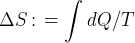 $\Delta S\thinspace{:}\thinspace =\int dQ/ T$
(where the integral is taken over a reversible path in the space of state variables). The entropy itself is expressible (up to a constant) as a function of the state variables. For example the entropy S of N moles of an ideal gas is given by

Thus if one holds the volume of N moles fixed and raises the temperature, the entropy increases. Or, if one maintains the temperature while allowing the volume to increase, the entropy increases.
Changes in entropy are subject to the second law of thermodynamics. One version of this law reads,Footnote 5
The entropy S of an isolated system cannot decrease.
“Isolated system” here means a system which receives no energy from the environment. According to the second law, the only way to reduce the entropy of a thermodynamic system is to do work on it (for example, by pushing on a piston) or to drain heat from it (cool it).
Now suppose the system is used to do work. For example, suppose our system is compressed air in a cylinder, which is allowed to push on a piston and thereby lift a weight. The work done corresponds to the increase in potential energy of the weight. It follows from the first and second laws that the work done W is related to the change in entropy ΔS by

Thus work done by an otherwise isolated system means an increase in entropy. Conversely, an isolated system whose entropy is constant can do no work.
While changes in entropy tell us something about how much work we can extract from a system, entropy itself is often said to characterize the amount of disorder in a system. Thus a system whose entropy is maximal is often understood to be maximally disordered or randomized. Having reflected on the objectivity and contextuality of algorithmic complexity, the question naturally arises as to whether these are features of entropy as well.
Here is a reason to think not. Since the possible changes in entropy quantify our ability to extract work from a system, there should be an objective fact of the matter as to the difference in entropy between two states of the system. In other words, entropy should be objective, in the sense of unambiguous, up to an additive constant. The idea here is that whether or not one can extract work from a system by, for example, removing a partition, must be an objective property of the system.
Consider a system consisting of a box filled with gas with a partition down the middle.Footnote 6 The temperature and pressure are identical on both sides of the partition, and the entropy should, as far as we know, be a function S(T,V). Now remove the partition. Is there a change in the entropy? It would seem not, and the equation above for the entropy of an ideal gas is in line with this. Removing the partition makes no real difference, and in particular there is no loss of ability to do work when the two sides mix. There was never any such ability to start with, as the initial and final states are both states of the same, maximal entropy.
Now suppose someone else is watching, and that this someone else has special glasses. To this person, the initial state is one in which the gas on one side of the partition looks red, and that on the other side looks green. This person will use a different entropy function S(T, V,C) which includes “color,” since this person can clearly see that there are two different gasses. This person will certainly say that the entropy increases after the partition is removed.
At this point, it seems ambiguous as to whether the system has undergone a change in entropy following the removal of the partition. But one might think that the individual with more complete knowledge, the one aware of the red-green distinction, has the true entropy. Further evidence for this might be thought to come from the fact that someone who is aware of the distinction could use this information to do work by inserting a piston made of material which is transparent to the green gas and opaque to the red gas. Such a piston would be driven by the pressure of the red gas, and this could be harnessed to lift a weight (for example). So it would seem that the true entropy is the entropy which takes in all of the physical quantities governing the behavior of the gas.
However compelling this idea may be, it is incorrect. There is no “true” entropy. Rather, there are, as Grad (Reference Grad1961) and Jaynes (Reference Jaynes1992) have argued, many different entropies.
Consider N moles of some liquid—it might be characterized simply by its temperature, pressure, and volume. But suppose that the molecules of the liquid have an electric dipole moment, as is the case with nitrobenzene.Footnote 7 In this case, one can change the polarization M of the liquid by manipulating an electric field E (this is how a Kerr cell works). Whereas before we had one equation of state
 $f(T,P,V) =0$
, there will now be two equations of state
 $f(T,P,V,E) =0$
and
 $g(T,M,E,P) =0$
. The additional state variables mean that entropy will now be a function S(T,V,M), rather than S(T,V), as before. Thus a sample of nitrobenzene which appears to be at maximum entropy with respect to V may or may not be at maximum entropy with respect to V and M. For instance, if there is no electric field, then the electrons will be unpolarized. If there is a (uniform) electric field, then they will tend to line up in the direction of the field. This configuration will have a lower entropy than the unpolarized liquid.
At this point, one might rightly point out that this is just the red-green example in a more realistic guise. One might further insist that this description, the one which invokes the polarization, is the true entropy. But the problem is that one can introduce further state variables as well, not only by discovering new sorts of properties, but by manipulating the same properties in finer detail (for example, by applying different electric fields to different regions of the sample). This process is limited only by the fact that, at extremely small scales, the system ceases to display equilibrium behavior. We do not expect the polarization of a single molecule to have a stable value, as that molecule is vibrating due to thermal fluctuations.
In conclusion, then, the entropy depends not only on the substance, but on the description of the substance, and there is no most-fundamental description. Which description is appropriate depends on which variables one is able to control, or interested in controlling. As is the case with algorithmic complexity and relative velocity, entropy can be contextualized, and entropy relative to a description can be considered an objective property of a physical system. But there is no most-fundamental description, just as there is no most-fundamental Turing machine or inertial reference frame.
5. Maxwell's Demon and the Objectivity of the Second Law
Let us now return to the second law. Given that entropy is only objective when contextualized, it would seem that the second law is in danger of losing its objectivity unless it is formulated in a way that incorporates this feature. This suggests the following reformulation:
The entropy S(T,X,Y,…) of an isolated system cannot be reduced by manipulation of the state variables (X,Y,…).
This version of the second law (akin to that of Jaynes (Reference Jaynes1992)) explicitly acknowledges the contextual aspect of entropy, its dependence on the thermodynamic description, and furthermore gives this physical content by making the connection between the description and the possible physical manipulations of the system.
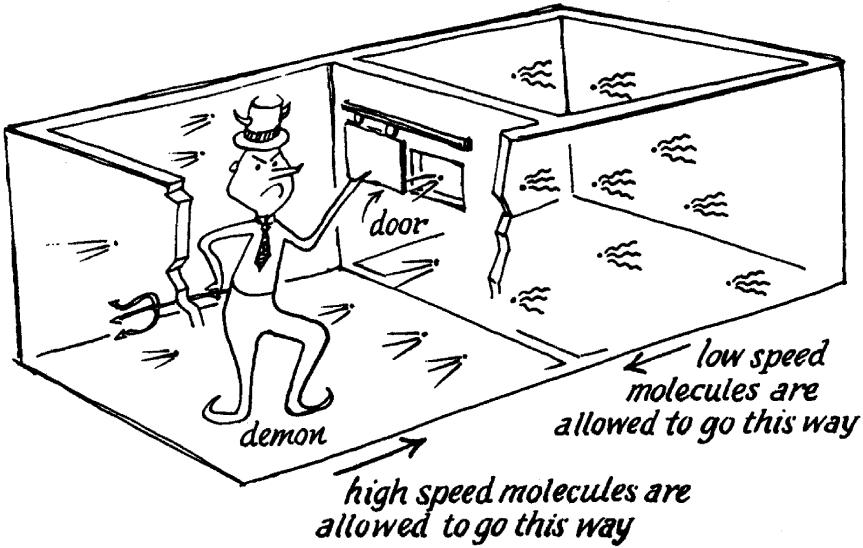
Perhaps the most important thing to note about this formulation of the second law is that it is a formulation which is immune to the threat of Maxwell's Demon (see Figure 2). Maxwell's demon is an imaginary creature who is able to take a box of gas at equilibrium and operate a trap door in a partition in the box, permitting (in one of the more popular versions) the fast molecules to go into one side and the slow ones to go into the other. This results in a decrease in entropy, in the sense that the pressure in one side goes up, and in fact one can use this entropy difference to do work. Coupled to a heat bath (an infinite source of heat to maintain the box of gas at constant temperature), this cycle can go on forever, creating what is called a ‘perpetual motion machine of the second kind.’
Maxwell's Demon from Angrist and Hepler Reference Angrist and Hepler1967; used by permission.

Much ink has been spilled attempting to “exorcise” the demon (see Leff and Rex Reference Leff and Rex1990), as it has seemed to many (though apparently not to Maxwell) to be a threat to the universal validity of the second law.Footnote 8 Most exorcisms work on the assumption that the demon must do work in order to reduce the entropy, thereby ensuring no net gain of work, and thereby precluding a perpetual motion machine. These exorcisms are quite problematic (Earman and Norton Reference Earman and Norton1998, Reference Earman and Norton1999), but from the perspective of this paper, they are completely beside the point. If the second law is formulated properly, the demon doesn't violate the second law. The demon is operating on a scale at which the second law does not apply, for he is manipulating the system on a microscopic level. The second law, properly understood, is a law of thermodynamics, and it should come as no surprise that its domain extends only to thermodynamic variables. The demon interacts with the gas on a scale at which the properties it is manipulating are constantly fluctuating.
To those who resist this conclusion, I would simply point out that we are not surprised that manipulations described by quantum mechanics give rise to phenomena which could not be achieved by classical manipulations. In fact, this is the primary appeal of the field of quantum computation: manipulating systems on a sufficiently small scale may allow us to compute things in polynomial time that could only be computed in exponential time on a machine whose behavior is governed by classical mechanics (Nielsen and Chuang Reference Nielsen and Chuang2000). To be sure, there remains a compelling question at the end of the day, which is, “Can one build a perpetual motion machine of the second kind?” However, if one could, it would not violate a properly formulated second law.
6. Conclusion
We have taken a brief tour through some measures of complexity, structure, and information. I have shown how two important measures, algorithmic complexity and thermodynamic entropy, can be thought of as objective properties of, respectively, strings of symbols and thermodynamic systems, only insofar as they are regarded as contextual. In one case, we contextualize to a Turing machine, in the other case, to a description. Once this is taken into account, the apparent paradox of Maxwell's demon disappears.