




No CrossRef data available.
CUBAN EXCEPTIONALISM: Group-based Hierarchy and the Dynamics of Patriotism in Puerto Rico, the Dominican Republic, and Cuba
Published online by Cambridge University Press: 11 March 2004
Abstract
This paper examined the interface between “racial” and national identity from the perspective of two competing theoretical frameworks: the ideological asymmetry hypothesis and the thesis of Iberian Exceptionalism. In contrast to previous results found in the United States and Israel, use of survey data from Puerto Rico, the Dominican Republic, and Cuba showed some support for both theoretical positions. Consistent with the asymmetry thesis, there was strong and consistent evidence of racial hierarchy within all three Caribbean nations. However, contradicting the asymmetry hypothesis and more in line with the Iberian Exceptionalism perspective, there was a general tendency for all “races” to be equally attached to the nation in both the Dominican Republic and Puerto Rico. Somewhat unexpectedly, Cuban Blacks tended to be slightly more positively attached to the nation than Cuban Whites. These results suggest that the precise interface between racial and national identity will be acutely influenced by the specific socio-political context within each nation.
Information
- Type
- STATE OF THE ART
- Information
- Copyright
- © 2004 W.E.B. Du Bois Institute for African and African American Research
The tragedy of September 11, 2001, has revitalized patriotism as a significant force in American politics and culture. However, this surge in patriotic fervor has also been greeted by a palpable sense of caution. The caution is provoked by the all too frequent historical examples of patriotism expressing itself in discrimination and violence against minorities. The World War II examples of the German Holocaust against the Jews and the American internment of Japanese Americans are clear expressions of what is an all too frequent association of patriotism with discrimination and violence against the “others.” In times of war, patriotism has often found its expression in violence against minorities, and in times of peace, patriotism has been associated with debilitating exclusion and discrimination. This history of patriotism begs the question: are patriotism and national attachment always conceived of in exclusionary terms, or are there opportunities for inclusionary forms of national attachment? In this paper, we will examine the cases of Cuba, Puerto Rico, and the Dominican Republic in order to explore the possibility of inclusionary forms of national attachment.
Ethnic/racial conflict has been one of the most ferocious and difficult problems of the twentieth century. Ethnic discord and widespread discrimination are common features of modern nations. In almost all of these cases the conflict arises from attempts to establish or reorganize a hierarchical set of relations among groups. Different groups are perceived to be either less or more a part of the nation in a way that generally maps onto their perceived place in the racial/ethnic order. Since the violence and discrimination directed against the “others” is usually framed in terms of their perceived “alieness” from the “nation” and the national project, their degree of attachment to the nation and sense of patriotism is expected to be less than that found among members of the dominant group. As the massacres in Bosnia, East Timor, and Rwanda attest, when groups are perceived to be incapable of fitting into the fabric of a single nation, some of the most ferocious intergroup violence can ensue. In extreme cases, subordinate groups may launch social movements demanding full rights of citizenship, or even make claims of national self-determination (Kryder 2000; McAdam 1999; Morris 1986; Plummer 1996).
However, many have argued that inter-ethnic relations need not follow this grim pattern. Some have described the situation in Latin American countries and in the Spanish Caribbean as a situation of racial democracy or Latin American Exceptionalism (see, e.g., Degler 1986; Freyre 1946, 1951; Harris 1974; Hoetink 1967; Pierson 1942; Tannenbaum 1947). These authors argue that in countries colonized by the Spanish and Portuguese no racial hierarchy exists, and all groups are equally and universally incorporated into the conception of the nation.
In this paper we test the theory of Latin American or Iberian Exceptionalism by examining respondents from three separate nations: Cuba, Puerto Rico, and the Dominican Republic. We will explore if, in contradiction to the assumptions of Latin American Exceptionalism, the regard in which the different “races” are held is hierarchically organized. We will then discuss the predicted implications of group-based hierarchy, or the lack thereof, on patriotism as specified by its literature. Thus, we will integrate research from two, heretofore unrelated literatures; the literature on Iberian Exceptionalism, and the literature on group-based hierarchy and patriotism.
While the literature dealing with the issue of patriotism has a long pedigree and is quite voluminous, a recent fragment of this research has begun to explore the relationship between patriotism and ethnicity (Citrin et al., 1994, 2001; de Figueiredo and Elkins, 2000; de la Garza et al., 1996; Hofstetter et al., 1999; Lambert et al., 1986; Peña and Sidanius, 2002; Sidanius et al., 1997; Sidanius and Petrocik, 2001; Sinclair et al., 1998; Smith 1991, 2000). The thrust of this new literature has been to examine how different social/political groups differ in their levels of patriotism and attachment to the nation.
Two competing theoretical perspectives have emerged from this most recent research: the social dominance thesis (e.g., Peña and Sidanius, 2002; Sidanius et al., 1997; Sidanius and Petrocik, 2001) and the multicultural/pluralist thesis (Citrin et al., 2001; de la Garza et al., 1996). Proponents of the social dominance approach support the view of many cultural studies scholars that patriotism is a dominance-related and exclusionary discourse (Gilroy 1991; Kuzio 2002; Peña and Sidanius, 2002; Sidanius et al., 1997; Sidanius and Petrocik, 2001; Sinclair et al., 1998). This perspective argues that because members of dominant groups have a sense of proprietary ownership of the nation and national identity, national identity and its extension, patriotism, will be conceptualized in ethnically exclusionary terms. Thus, not only will dominants have higher levels of patriotic attachment to the nation but also that patriotic attachment to the nation will imply positive attachment to their dominant ethnic groups and rejection of the subordinate ethnic “others.” Likewise, among subordinates, patriotic attachment to the nation will imply positive evaluations of the dominant group and negative evaluations of their own subordinate groups. Thus, patriotism itself is linked to dominance orientations, the positive evaluations of dominant groups, the negative evaluations of subordinate groups, and the willingness to use force against subordinate groups (Sidanius et al., 1997; Sidanius and Pratto, 1999). Social dominance theorists have referred to this cluster of expectations as the “asymmetry hypothesis” (see Peña and Sidanius, 2002; Sidanius et al., 1997; Sidanius and Petrocik, 2001).
Those who support the multicultural/pluralist theory argue that ethnic identity and social hierarchy do not necessarily produce an asymmetric patriotism. Using the case of Mexican Americans in the U.S., de la Garza et al. (1996) argue that, rather than there being a zero-sum relationship between national and ethnic identity among subordinates, these two identities will positively reinforce one another (see also Citrin et al., 2001; de Figueiredo and Elkins, 2000). Thus, those using the multicultural/pluralist perspective suggest that one's ethnic identity and egalitarian ideological elements within a patriotic discourse serve as a bridge to an incorporation into and an identification with the nation as a whole. The conflict between patriotism and ethnic identity posed by dominance theorists and cultural critics of nationalism is subverted by the aspirations of outgroups to embrace the inclusive ideals within national discourse and become an integral part of the nation.
Sidanius and Petrocik (2001) have also identified another normative perspective on this issue, the melting pot thesis. Some theorists see ethnic attachments as perilous to the project of national integration and the cause of ethnic conflict (Schlesinger 1992; Thernstrom and Thernstrom, 1997). They argue that all ethnic identities, and in particular subordinate ethnic identities in the U.S., are inversely related to their attachment to the nation. These theorists contend that the U.S. is sufficiently inclusive and that individuals (particularly minorities) can and should identify with the nation as individuals rather than as groups. In their formulation, no observable differences in national attachment based between people of different ethnic groups should exist. Thus, it is generally assumed that White Americans have no real ethnic attachment to speak of and the ongoing project of nation building is therefore an issue of new ethnic groups exchanging their particular ethnic identities for a broader sense of “Americaness.” In the area of Latin American studies, there has been an ongoing debate that parallels the literature on patriotism, the debate on Latin American Exceptionalism.
For many years social scientists have argued for a form of Iberian Exceptionalism in which racial politics are less ferocious in places colonized by the Spanish and Portuguese (Degler 1986; Freyre 1946, 1951; Hoetink 1967; Pierson 1942; Tannenbaum 1947). Proponents of this point of view suggest that because of the effects of Catholicism that granted people of African descent souls, the impact of the Moorish occupation, and the fact that the Portuguese did not import women or working-class Whites, racial politics in places colonized by the Spanish and Portuguese were less dichotomous and hierarchical as a result (Degler 1986; Freyre 1946, 1951; Hoetink 1967; Pierson 1942; Tannenbaum 1947). Iberian Exceptionalists point to the relative lack of racial violence, widespread intermarriage, and the lack of Jim Crow style segregation as evidence that those countries colonized by the Spanish and Portuguese have become racial democracies, where there is no race-based hierarchy and where social identity is primarily defined in national, rather than in racial or ethnic terms (Degler 1986; Freyre 1946, 1951). From this perspective, the ideology and practice of mestizaje or race mixing eliminates the possibility for race-based hierarchy and creates unique mixed race nations. In other words, Iberian Exceptionalism is the ultimate expression of a melting pot theory extending across boundaries of “race,” as well as ethnicity. For Iberian Exceptionalists all groups should share equally in attachment to the nation, and no ethnic or “racial” differences in patriotism or connection between patriotism and ideologies of group dominance should exist.
However, Iberian Exceptionalism has come under substantial criticism recently. Critics of this model argue that the notion of racial democracy is merely a hegemonic ideal used to mask racial hierarchy and to blunt the political mobilization of Blacks. Critics of Iberian Exceptionalism argue that slavery in Spanish and Portuguese colonies was often more deadly, and in many cases, continued longer than slavery in the U.S. Further, critics point to official government policies of “Whitening” when, following slavery, European immigration was encouraged in order to improve the “race” and help civilize the country (Helg 1990; Nobles 2000; Stepan 1991). While Blacks were still conceived of as an integral part of the national culture, it was broadly asserted that diluting their blood via miscegenation would help the nations move toward modernity (Hanchard 1994; Nobles 2000; Skidmore 1974; Stepan 1991; Wade 1997). In addition, critics of Iberian Exceptionalism have pointed to episodic and ferocious state-sponsored racial violence directed at Blacks who attempted political mobilization along racial lines in Cuba (Helg 1990, 1995) and the Dominican Republic (Sagás 2000; Torres-Saillent 1998a,b, 1999), among other countries, as proof that race relations were not as harmonious as they might have appeared. Social scientists have also begun to show how various informal forms of discrimination powerfully structure the life chances of those with dark skin, despite claims of racial democracy (Telles 1994).
Thus, rather than eliminating racism, critics of Iberian Exceptionalism argue that miscegenation has managed to maintain a hierarchical, though flexible, set of race relations based on skin color, where those with light skin are afforded higher status and privilege than those with dark skin. This is a system of racial privilege quite familiar to those with experience in the United States (e.g., Clark and Clark, 1940). Thus, the only thing that is “exceptional” about Latin America is the rhetoric of racial inclusion that is used to disarm and mollify what otherwise might be more explosive and contentious racial politics (Hanchard 1994; Marx 1998; Twine 2000). As a consequence, the general lack of a sense of a “linked fate” along racial lines distinguishes the politics of Blacks in Latin America from their U.S. counterparts, where a “linked fate” broadly structures Black political identity and participation (Dawson 1994). However, we can put the Latin American case into the context of other studies of patriotism and groups. The search for variables to explain differing levels of patriotism between groups has the promise of potentially revealing a great deal about types and forms of racial orders.
While the weight of the literature since the invention of Cuban Exceptionalism has begun to swing heavily against the thesis, a group of critics both in the academic arena and in policy circles have sought to reaffirm the Exceptionalist point of view. These critics have attacked authors like Hanchard and others, and argue that critics of Latin American Exceptionalism have tended to impose a U.S.-centric perspective on racial politics in Latin American by emphasizing similarities rather than the vastly more flexible racial terms in Latin American countries (Bourdieu and Wacquant, 1999). The debate has not concluded and hinges on the theoretical and empirical findings we intend to explore in this paper.
THE EMPIRICAL CASE
Empirical studies of these issues have produced mixed results. Within the U.S., inspection of the interface between ethnic and national identity among African Americans has largely supported the social dominance perspective and its asymmetry hypothesis, while the case of Mexican Americans has largely supported the multicultural/pluralist perspective (de la Garza et al., 1996; Sidanius et al., 1997; Sidanius and Petrocik, 2001). In Australia, Nesdale and Mak (2000) showed that attitudes about acculturation to the values of the host country were the most powerful predictor of identification with the host country. At the same time, positive treatment by Australians produced positive feelings of attachment toward the host country. Their involvement with minority ethnic groups produced negative attachment to Australia while strength of ethnic identity produced a negative attachment. This decidedly mixed set of results is reproduced in more comparative studies.
Comparative research using data from other nations has revealed an equally mixed set of results. Sidanius et al. (1997) found that the case of Arab-Israelis supported the group dominance perspective, while Dowley and Silver (2000) found support for both perspectives by examining data from the U.S.A., Bulgaria, Canada, Spain, and Latvia. This later study suggested the importance of context as well as perhaps the type of group being examined. Dowley and Silver (2000), like Sidanius and Petrocik (2001), suggested that there might be a profound difference between different types of subnational groups. They proposed, “Our work in general suggests the need for further investigation and more sensitive tests to discern differences between different types of subnational groups, i.e. voluntary immigrant, diaspora, subjugated peoples or native/indigenous peoples” (Dowley and Silver, 2000). This research posits that the case of Blacks subjected to slavery versus voluntary immigrants in the Americas perhaps explains the disparate findings between African Americans and Mexican Americans. Therefore, former slaves within a society, theoretically, are quite different from voluntary immigrants, despite both groups facing social inequality, discrimination, and violence. However, a subsequent study using data from the Dominican Republic observed that, despite a clear and consensual group-based hierarchy between Black and White Dominicans and a history of race-based slavery for people of African descent within the Dominican Republic, no discernible differences in levels of patriotism across racial groups existed (Sidanius et al., 2001).
In the Dominican Republic, Sidanius et al. (2001) showed a distinct group-based hierarchy across five racial groups, with Whites on the top of the hierarchy and Blacks at the bottom, but there were no group differences in patriotism. Despite the multiplicity of racial categories, there was a broad consensus on the structure of the group-based hierarchy. Additionally, the study showed no racial differences in explicit racism towards Blacks, and patriotism was not related to ideologies of dominance.
Furthermore, there were no significant racial differences in dominance orientations. The study contended that while the existence of a hierarchy and the salience of racial identity refuted the claims of Iberian Exceptionalism, the lack of an asymmetry in levels of patriotism pointed to something quite unique about Iberian racial politics, which may reflect the multicultural/pluralist model of ethnic relations rather than group dominance. The study identified what has been called a pigmentocracy, or a hierarchy based on shade gradations, rather than a binary system as found in the U.S. This Dominican study identified what was termed Inclusionary Discrimination, or the existence of discrimination and a group-based hierarchy in tandem with an inclusionary national self-perception that attenuates group dominance orientations (Sidanius et al., 2001).
In order to test further the SDT and Iberian Exceptionalism models, we have selected three Latin American countries—namely, the Dominican Republic, Puerto Rico, and Cuba—countries that share the common heritage of being Spanish colonies and a history of slavery, but also countries that have each taken quite a different path in the wake of that experience. In the context of these three cases, we can test the theoretical perspectives that we have discussed above. However, it is important to understand some of the potential historical differences in each country aside from their shared histories of colonization by the Spanish that might serve as a “national context.”
THE DOMINICAN REPUBLIC
The Dominican Republic was the first of these countries to achieve independence. The Dominican Republic (DR) was formed by Creole elites after living under the rule of Haiti for twenty-two years following the Haitian revolution (Moya-Pons 2000). The Dominican Republic was formed by Creole elites who had lived under the rule of Haiti (Moya-Pons 2000). The country was born as a way to distance itself from a Black republic and has frequently emphasized its Hispanic and Mestizo (Indian and Spanish) populace, and defined itself as racially distinct from its Black neighbor, Haiti. As Torres-Saillent (1998a,b) notes, “Negrophobia and negrophilia have historically coexisted in Dominican Society.” Haitians are perceived as Blacks and thus, have been relegated to the lowest levels of the labor market (mainly sugar cane cutters). Haitians are generally perceived to be doing work that is beneath Dominicans and remain in desperate poverty. In addition, they are often derided as sub-human in Dominican society (Sagás 2000; Torres-Saillent, 1998a,b).
U.S. intervention has played a major role in Dominican racial history. The U.S.-backed dictator Rafael Trujillo, in an attempt to fight political opposition and to identify the country as more “European” (Torres-Saillent 1998a,b), instituted laws making participation in African religious and cultural rites illegal. In 1962, a group of Blacks, who opposed the oppressive regime and sought to assert the cultural and religious spirit of maroons (the culture of runaway slaves) were violently repressed by the government. Following a period of upheaval and civil war after the death of Trujillo, with the aid of the oligarchy and the U.S., the dictator Joaquin Balaguer came to power in 1966. Balaguer encouraged a decidedly Eurocentric, Hispanicist definition of the Dominican nation (Howard 1999; Torres-Saillent 1998a,b).
Balaguer used his own light complexion and straight hair as a means of signaling the direction in which the Dominican Republic should go racially. The masses of people recognized some contribution of African heritage to their make-up, while the elites consistently argued that, in contrast to Haiti, the Dominican Republic is a “Caucasian, Western Nation.” Afro-Dominicans have never directly challenged these racist statements in an organized fashion. As Torres-Saillent (1998a,b) points out, “Balaguer has publicly proclaimed the mental and moral superiority of Whites and warned about the country's “Africanization” without ever needing to recant his racist statements.” The general belief that there is no racism in the DR has survived alongside these explicitly racist statements by the former leader of the nation. However, rather than stamp out Blackness in the Dominican Republic, Dominicans are asked to do their part via race mixture to improve the nation.1
For a similar juxtaposition of explicitly racist and egalitarian discourse in Brazil, see Twine (2000).
The Dominican culture still contains both a broad definition of “Dominicaness” (Dominicanidad) that includes notions of Blackness with a history and practice of Negrophobic and Europhilic discourses (Howard 1999). These discourses are a mixed set of discourses, yet the prevailing point of view is of the Dominican Republic as a racially mixed country with no clear racially dominant group, or at least where Whites are the dominant and prevailing group, without any perception that other groups are oppressed. The Dominican Republic remains, by the account of the Central Intelligence Agency (CIA), the country with the largest mixed race population in the Americas (CIA 2000). Data compiled by the CIA indicates a “racial” breakdown, with 16% of the population described as “White,” 11% “Black,” and 73% of “Mixed” race. Despite some racist discourse, many would take this fact, along with the lack of formal segregation and Black organization, as a case in which little or no racial hierarchy exists in the Dominican Republic. The Dominican nation, by its emphasis on mestizaje, casts itself in broadly inclusive terms that attempt to trump status differences between groups. The Dominican Republic is a society with a denial of racism and a dialogue of inclusion that exists alongside racist practices. At the same time, race has been a consistent part of Dominican discourse and has profound similarities and differences with the other Antilles nation of Puerto Rico.
PUERTO RICO
Puerto Rico is quite a different case. Like the Dominican Republic and Cuba, Puerto Rico experienced U.S. intervention. However, this intervention has been sustained and has transformed the island country into a colony of the United States.
Like the Dominican Republic and Cuba, Puerto Rico was colonized by the Spanish and enslaved large numbers of Africans to work on its plantations. In Puerto Rico in 1834, the census established that 11% of the population were slaves, 35% were colored freemen, and 54% were White (Santiago-Valles 1995). It was not until 1873, however, that slavery was finally abolished in Puerto Rico. Currently, there are over three million Puerto Ricans on the island. According to 2000 U.S. census figures, 80.5% identify themselves as White, 8% identify as Black, and approximately 10% identify as some mixture of races. If these figures are correct, Puerto Rico is the least miscegenated as compared to Cuba and the Dominican Republic. In the 1980's, a former governor of Puerto Rico delivered a controversial speech in which he described Puerto Rico as the Whitest country of the Greater Antilles (Santiago-Valles 1995). In contrast, Puerto Ricans have also lauded their inclusiveness and lack of racial problems. However, government commissions have occasionally pointed to economic and social disparities based upon race (Santiago-Valles 1995). Like the Dominican Republic, there has been little political organizing or conflict based upon race on the island, despite the proximity and experience of many Puerto Ricans to U.S. models of race relations, and the fact that objective reports indicate that racial inequality is a serious problem in the island.
Complicating the case of Puerto Rico is its connection to the United States. Puerto Rico is a territory of the U.S., and U.S. influence abounds. Puerto Ricans are citizens of the U.S. and have fought in every major war of the twentieth century. There is also a substantial migration to and from major cities in the U.S. Puerto Rican migrants flow freely to and from the island to major population centers like New York, New Jersey, Miami, Chicago, and Los Angeles following economic opportunities. If regarded as a state of the United States, Puerto Rico would rank near Mississippi as one of the poorest states in the Union. Thus, while Puerto Ricans think of themselves as a separate nation with an Iberian approach to race, many Puerto Ricans, including Black Puerto Ricans, are familiar and have substantial experience with U.S. models of race. In fact, U.S.-style segregation was maintained on the island in many contexts for U.S.-based tourists during the early part of the twentieth century in order to satisfy the tastes of U.S. tourists (Santiago-Valles 1995). Thus, Puerto Rico presents a unique opportunity to understand the durability of the Iberian approach because of the impact of prolonged contact with the United States. Puerto Rico has been a place of consistent denials of racism much like the other countries mentioned here, and there has been little organizing by Blacks based upon race (Santiago-Valles 1995). Puerto Rico has conceived Puerto Rican identity in broadly inclusive terms. This has occurred in spite of the impact of U.S. colonialism and a history of unequal treatment. Therefore, Puerto Rican patriots should be more inclusive rather than exclusive.
CUBA
The Cuban revolution lead by Fidel Castro has become internationally known for transforming race relations on the island and serving as an international stalwart against colonialism and racism. However, Cuban racial politics did not begin with the Cuban revolution, and there are important moments that frame the Cuban approach to race that occurred prior to the revolution.
Following “independence” in the early twentieth century, Cuba suffered under a bevy of U.S. puppet dictators who occasionally tolerated forms of U.S.-style Jim Crow in various localities and in private clubs (Moore 1995). The Cuban government also encouraged “Whitening” and immigration from Europe in order to whiten the population (De la Fuente 2001; Perez 1999). Cuba's educational system consisted primarily of dismal public schools and lavish private academies that were designated as White only.
This all came to an end when a young lawyer by the name of Fidel Castro led a small band of revolutionaries that toppled the U.S.-backed government in 1959. After sweeping into power as a nationalist, Castro soon announced the Marxist character of the revolution and later began to embrace the Soviet Union following increasingly aggressive U.S. positions towards the revolution (Dominguez 1978). Castro also announced an end to discrimination on the island and formalized subsequent constitutions making discrimination illegal. He also ended private clubs and schools where discrimination had most frequently been practiced (Moore 1995). Castro positioned the revolution as racially egalitarian on both substantive and symbolic grounds. He embarked upon programs that profoundly redistributed wealth and sought to universalize education and literacy (Dominguez 1978). Though Afro-Cubans remained at the bottom of the racial hierarchy, these reforms substantially improved life for Afro-Cubans (De la Fuente 2001) These moves caused a massive exodus of White elites, followed by the middle classes that opened up substantial opportunities for Black and mulatto Cubans (Dominguez 1978). Cuba was also purged of what was described by Castro as a White, racist, elite class who departed for the United States.
Fidel Castro supported an anti-racist struggle worldwide, openly criticized Jim Crow in the U.S., and attacked European colonization in Africa. He reached out and provided temporary and permanent asylum to African American radicals in the 1960s (Reitlan 1999). Cuba also committed massive troop mobilizations in support of the Angolan government against the South African-supported rebels in Southern Africa. During this period, Castro also provided financial, military, and logistical support to the African National Congress, and later was greeted as a most honored guest at the inauguration of Nelson Mandela. During this period in the 1980s Castro declared that Cuba was an “African Latin Nation” (De la Fuente 2001; Moore 1995).” Beyond that, Blacks reported unprecedented gains and by 1981 reached near parity with Whites with regard to life expectancy and education (De la Fuente 2001).
While Castro worked vigorously to reform institutions and support Black activism abroad, the Cuban government also moved aggressively against Black organizations and cultural practices in Cuba as divisive, backward, and counterrevolutionary (De la Fuente 2001; Moore 1995). The regime then declared the race questions “solved” in Cuba, and decided that discussion of the issue was divisive and dangerous to the revolution (Moore 1995; De la Fuente 2001).
Critics have continued to note that Blacks are underrepresented in the upper echelons of the government, military, and important ministries (Casal 1989). Further, they charge that the lack of a racial dialogue has allowed problems to fester. Since the fall of the Soviet Union, many argue that the tourist economy and reinstated capitalist policies have reintroduced racial disparities in income and life chances (De la Fuente 2001). The revolution has recognized potential problems but has done nothing in terms of concrete policies to resolve potential discrimination in tourist employment and income disparities.
Despite these significant questions, Cuba remains an international symbol of racial egalitarianism. While according to the 1990 U.S. Census, the Cuban American population is 93% White, the CIA factbook notes that Cuba is 51% Mulatto, 37% White, 11% Black and 1% Chinese (CIA 2000). This places the eleven million Cubans squarely between the Dominican Republic and Puerto Rico in terms of the presence of Blacks and miscegenation. However, Cuba is seen as the most inclusive nation in the Western hemisphere, and by many observers, the one that has come closest to achieving a truly egalitarian and inclusive nation.
Comparison of these three countries (Dominican Republic, Puerto Rico, and Cuba) offers us the opportunity to address a number of important questions, framed as specific hypotheses.
SPECIFIC HYPOTHESES
Social Dominance or the Ideological Asymmetry Hypothesis
The ideological asymmetry hypothesis, derived from social dominance theory (see Sidanius et al., 1997; Sidanius and Pratto, 1999), rests upon the basic assumption that the different “races” in the Caribbean can be regarded as forming a consensually agreed upon pigmentocracy or racial hierarchy, with Whites at the top, Blacks at the bottom, and mixed-race categories in between. Given this, the ideological asymmetry hypothesis assumes three other forms of asymmetry in the interface between “racial” and national attachment. First, the level of patriotic attachment to the nation should be related to the status of one's “racial” group. Given the greater social status of Whites compared to Blacks, Caribbean Whites should then be expected to have greater patriotic attachment to the nation than Caribbean Blacks. Second, there should be a relationship between ideologies of group dominance (e.g., classical racism) and patriotism that should increase with increasing levels of social status. Third, there should also be an asymmetrical relationship between racial identity and patriotism as a function of racial status. Among Caribbean Whites, the correlation between racial identification and patriotism should be greater than that found among Caribbean Blacks. Thus, Caribbean Whites should be simultaneously more patriotic and supportive of ideologies of group dominance than blacks, with patriotism increasing racial prejudice and social dominance.
Iberian Exceptionalism
If the Iberian Exceptionalism thesis is correct, then we expect to obtain a number of null conditions. First, across all three Latin-American countries, there should be no group-based hierarchy and no asymmetry in patriotism across groups. That is, no status differences among groups should exist, and all groups should be equally attached to the nation. Furthermore, patriotism should be an inclusionary concept with no positive association between patriotism and ideologies of group dominance for any groups.
Finally, the comparison of the interface between race and national identity across these three countries might have something to tell us about the distinction between “group type” vs. “national context.” In this study we hold group type constant but vary national context between the Dominican Republic, an independent country that has struggled to achieve democracy, Puerto Rico, a colony of the U.S., and Cuba, an independent Marxist-Leninist state. They are all countries with the same general Spanish heritage, but which have taken divergent paths through time. If either group type of a general Iberian Exceptionalism approach is the appropriate conceptual framework, then we should expect no differences in the nature of the interface between ethnic and national identity across these three countries. If, on the other hand, specific national and historical context is most important, then we should observe country-specific differences in racial hierarchy and the relationship between group identity and patriotism. That is, we should find the dynamics between variables to be quite different in each country, or, put another way, local variation in the form or type of racial order should exist.
METHOD
Respondents and Procedure
We sampled 254 respondents from the Dominican Republic (127 females, 114 males, and 13 had missing gender data), 251 from Puerto Rico (155 females and 96 males), and 336 from Cuba (167 females, 155 males, and 14 missing gender data). All respondents were recruited from each country's respective capital, Santo Domingo, San Juan, and Havana during the summer of 2000. The median age was 30 years for the Dominican Republic, 48 for Puerto Rico, and 40 for Cuba.
In order to get a broad cross-section of respondents from different economic strata, the capitals of Puerto Rico and Dominican Republic were divided into five Socio-economic Status (SES) clusters: Upper Class, Upper-Middle Class, Middle Class, Working Class, and Poor Class. We randomly sampled approximately equal numbers of participants from each of these clusters. The identification of the five SES regions was based on the consensual opinions of our native interviewers. This sampling procedure was used since no analogous census data on race and/or socio-economic status exist that we could check our sampling techniques against. The Dominican Republic and Cuba do not officially collect racial statistics, and Puerto Rico utilizes U.S.-based racial categories that grossly under-report Blacks and have not adequately accounted for the variations of mixed race populations. In Cuba, this was one of the first attempts to collect racial statistics and include standard measures of racial attitudes of the types frequently used in social science research. Thus, the data set is unique on several accounts, it is the first of its kind in Cuba, it is the first where analogous measures were used across the three Caribbean countries that can be compared to measures frequently used in the U.S. and abroad, and finally, it represents a unique attempt to gather statistics on racial identification that are not available at the level of detail collected within this study.
The native interviewers were trained and supervised for the data collection. The interviewers went door to door to the randomly selected households and asked the first person answering the door to participate in the study if they were above 18 years old. In cases where maids or servants answered, we requested to speak to the owners of the house. We had a 94% agreement rate in the Dominican Republic, and a 91% agreement in Puerto Rico. Due to the sensitivity of conducting race-related research in Cuba, a snow-ball sampling procedure was used for the Cuban sample. In Cuba, the snow-ball began with acquaintances of the interviewers, but quickly spread from there, and was crafted to achieve socio-economic balance. Respondents from all three nations were interviewed in their homes. All interviews were conducted in Spanish.
MEASURES
“Racial Classification”
In order to ascertain the particular “racial” categorization scheme utilized in each of the Caribbean-Latino countries, in situ focus groups were used. Each group consisted of six to eight natives. These informants disclosed that there were essentially six “racial” categories used in the Dominican Republic and Puerto Rico (i.e., Blanco, Trigueño, Indio, Mulatto, Moreno, and Negro), and six slightly different ones in Cuba (i.e., Blanco, Trigueño, Mestizo, Mulatto, Jabao, and Negro). As a result, the full-scale survey asked respondents to classify themselves into one of the six “racial” categories provided by the focus of the group of each country.
However, to make comparisons across the three nations, we subdivided the six categories into three general ones: Blancos, Mulatos, and Negros. In all three countries, Whites were those who self-identified as Blancos. In Puerto Rico and the Dominican Republic, Mulatos were those who self-identified as Trigueño, Indio, or Mulatto; Negros were defined as those who identified as either Morenos or Negros because the focus groups identified the Moreno category as a euphemism for Negro, especially if the person is a friend, a respected figure, or has middle to high socio-economic status. In Cuba, the Mulatto category consisted of all those who identified as Trigueño, Mestizo, Mulatto, Jabao, while Negros were those who identified as Negros. This resulted in 137 Blancos, 104 Mulatos, and 10 Negros in Puerto Rico; 60 Blancos, 142 Mulatos, and 50 Negros in the Dominican Republic; and 142 Blancos, 127 Mulatos, and 64 Negros in Cuba.
Patriotism
Largely based on previous research (e.g., Kosterman and Feshbach, 1989; Sidanius et al., 1997; Sidanius and Petrocik, 2001), we used a three-item measure of patriotism. The items read: 1) “Every time I hear the national anthem, I feel strongly moved.” 2) “I have great love for my country.” and 3) “I am proud to be Dominican (Puerto Rican / Cuban).” Cronbach's Alpha reliability of the patriotism scale was 0.41 in the Dominican Republic, 0.63 in Puerto Rico, and 0.86 in Cuba; overall the patriotism scale was considered adequate (α = 0.79).
Anti-Black Racism
Anti-Black racism was indexed by use of the following three items: 1) “Dark skin Puerto Ricans (Dominicans / Cubans) are less intelligent then other groups.” 2) “Dark skin Puerto Ricans (Dominicans / Cubans) are lazier than other groups.” 3) “Dark skin Puerto Ricans (Dominicans / Cubans) are less capable then other groups.” Cronbach's Alpha reliability of the overall scale was 0.82. The scale's reliability in the Dominican Republic, Puerto Rico, and Cuba was 0.69, 0.87, and 0.82, respectively.
Racial Identification
Racial identification was measured by the three items: 1) “My destiny is tied to the to the destiny of those of my same skin color.” 2) “I identify much more with those who have my same skin color.” 3) “I often think about my skin color.” (α = 0.53 of the overall scale; α = 0.39 in the Dominican Republic, α = 0.68 in Puerto Rico, and α = 0.40 in Cuba).
“Racial” Status
The respondents were asked to rate the perceived social status of each of the six “racial” categories mentioned above. The specific question read: “There are many people who believe that the different racial groups enjoy different amounts of social status in this society. You may not believe this yourself, but if you had to rate each of the following groups as most people see them, how would you do so?” The response alternatives ranged from “1-Very low status” to “6-Very high status.” For the purpose of conducting cross-national comparisons we collapsed the six racial-target groups into three, as defined in the racial classification section.
Socio-economic Status (SES)
To assess levels of socio-economic status in the three Caribbean-Latino countries, we ascertained the respondents' income, educational level, and the quality of the neighborhood in which they resided. Income was the dollar amount they received as work compensation (Dominican and Cuban pesos were converted into their dollar equivalent). Education level was assessed by asking respondents' level of education completed, and then categorizing it as ‘1-Very-low’ if respondents completed up to junior high school, ‘2-Low’ if completed up to high school, ‘3-Moderate’ if completed up to associate or technical degree, ‘4-High’ if completed up to college, and ‘5-Very-high’ if completed up to graduate school. For the Dominican Republic and Puerto Rico, the quality of the neighborhood was assessed using the socio-economic cluster the respondent resided in (‘1-Poor,’ ‘2-Working Class,’ ‘3-Middle Class,’ ‘4-Upper-Middle Class,’ and ‘5-Upper Class’). In Cuba, a focus group of eleven native Cubans was asked to rate the neighborhoods sampled for this study on a ‘1-Not very good’ to ‘5-Very good’ scale given that the socio-economic terms were not easily understood by our Cuban informants. Socio-economic status was then computed by standardizing all three measures (education, income, and quality of neighborhood), and taking their average.
RESULTS
The Issue of Racial Hierarchy
Our first substantive question concerns whether or not there was any evidence of a group-based racial hierarchy in the Caribbean Latino countries. Given the high level of miscegenation in Puerto Rico, the Dominican Republic, and Cuba, and the general thesis of “racial democracy,” we should find little or no evidence of a consensually held racial hierarchy.
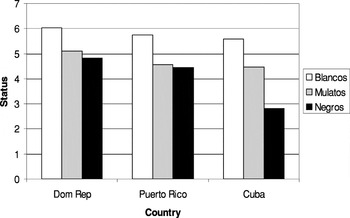
To explore this issue, we first examined the average social status ratings given to each of the three “racial” groups (see Figure 1). Contrary to the “racial democracy” thesis, the different “racial” groups were perceived as having different levels of social status. Use of a one-way repeated measures, Analysis of Variance (ANOVA), disclosed that these perceived status differences were highly significant and relatively strong in each of the three countries (F(2, 494) = 87.19, p < 10−3, η2 = .33 for PR; F(2, 492) = 122.40, p < 10−3, η2 = .26 for DR; and F(2, 662) = 388.22, p < 10−3, η2 = .54 for CU). Furthermore, inspection of the nature of these social status differences between “racial” groups seems to support the notion of a racial hierarchy. In other words, Blancos (i.e., Whites) were perceived to have the highest level of social status, with progressively darker “racial” categories receiving progressively lower social status ratings. In addition, the use of planned comparisons between all adjacent “racial” categories disclosed that there was a statistically significant social status difference between all adjacent groups along the status continuum.

Perceived social status of the three “racial groups” (high numbers indicating high social status).
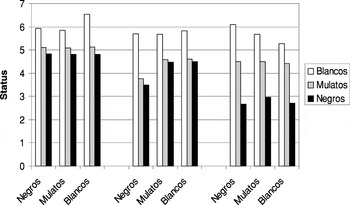
To illustrate the nature of this cross-group consensus in the simplest possible manner, in Figure 2 we see that regardless of the respondent's own “racial” classification, the respondents still had the same general rank order of “racial” groups. Caribbean-Latinos of European background were rated as having relatively high social status, Caribbean-Latinos of African background were rated as having low social status, while “Mulatos” Caribbean-Latinos were perceived as having intermediate social status.

Perceived social status of the three “racial groups” as a function of one's own ‘racial’ classification (high numbers indicating high social status).
The Interface Between Ethnic and National Attachment
If results from both Israel and the United States are generalizable to the Latino-Caribbean nations (see e.g., Peña and Sidanius, 2002; Sidanius et al., 1997; Sidanius and Petrocik, 2001), we should also expect to find an asymmetrical relationship between “racial” and national attachment. As mentioned above, this asymmetry should express itself in at least three ways. First, the degree of patriotic commitment to the nation should increase as a function of “racial” status. Second, the relationship between national attachment and racial identity should vary as a function of “racial” status. Thus, the relationship between national attachment and “racial” identity should become systematically more positive as one moves up the racial status hierarchy. Third, and finally, we should find an asymmetrical relationship between national attachment and ideologies such as racism. Thus, among dominants (i.e., “Blancos”) there should be a significantly more positive correlation between Dominican patriotism and racism than among subordinates (i.e., “Negros”).
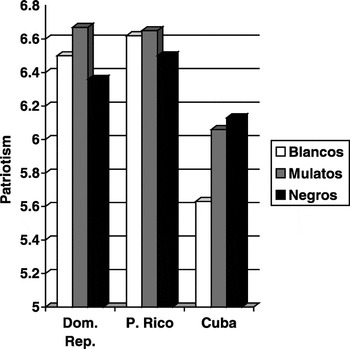
We explored the first issue by use of a two-way analysis of covariance in which patriotism was the dependent variable, “race” and nation were the two independent variables, and age and SES served as the covariates. The results showed a significant effect for nation (F(2, 795) = 20.55, p < .001, η = .22), and planned contrasts showed that respondents in both Puerto Rico and the Dominican Republic were significantly more patriotic those in Cuba (p < .001 respectively). The results of the COANOVA also revealed a slight, but statistically significant effect for “race” (F(2, 795) = 3.09, p < .05, η = .09). In general, “Mulatos” appeared to be slightly more patriotic than either “Negros” or “Blancos” (i.e., m = 6.46 vs. m = 6.33, and m = 6.25, respectively).
However, inspection of Figure 3 reveals that the effect of “race” appears to be moderated by country (interaction effect: F(2, 795) = 2.43, p < .05, η = .11). Thus while Negros had slightly lower lowers of patriotic attachment to the nation than either Blancos, or Mulatos in Puerto Rico and the Dominican Republic, the exact opposite was found in Cuba. We further explored this phenomenon within each nation and, using planned contrasts, found that Negros were significantly less patriotic than Mulatos in the Dominican Republic (p < .01), while “Negros” were significantly more patriotic than Blancos in Cuba (p < .05). There were no significant “racial” differences in Puerto Rico.

Patriotism as a function of “race” and nationality.
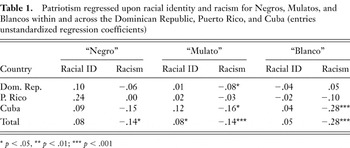
We examined the second and third features of the asymmetry hypothesis by regressing patriotism on both racial identity and racism within each “race” and across all three countries (again controlling for the effects of SES and age; see Table 1). In general, the results of these relationships appeared to be fairly similar within each “race” and across each nation, and showed little evidence of asymmetry. In contrast to the findings from the both the United States and Israel, there were no significant relationships between patriotism and “racial” identification for any “race” within any country. Furthermore, when polling the “races” across countries, the positive association between “racial” identification and patriotic attachment to the nation was only statistically significant for Mulatos (i.e., b = .08, p < .05).
Patriotism regressed upon racial identity and racism for Negros, Mulatos, and Blancos within and across the Dominican Republic, Puerto Rico, and Cuba (entries unstandardized regression coefficients)

More impressively, and in great contrast to the asymmetrical results found in both the United States and Israel, there was a slight yet general tendency for patriotic attachment to the nation to be negatively associated with racism within all three “racial” groups and within all three countries. Furthermore, these negative relationships appeared to be particularly negative in Cuba, and in even greater contrast to results in the U.S.A., the relationship was particularly negative among “Blancos” in Cuba (b = −.28, p < .001). Pooling the results for each “race” across countries, we see that the negative relationship between patriotism and racism was statistically significant for within each “racial” group (b = −.14, p < .05; b = −.14, p < .001; b = −.28, p < .001 among “Negros,” “Mulatos,” and “Blancos” respectively).
DISCUSSION
The fact that these results are not drawn from true nationwide probability samples restricts us to drawing only tentative conclusions. However, some findings appear to fit distinct and observable patterns. Despite our compression of a more complex racial landscape into three categories, we can draw some important inferences from the data.
Consistent with the basic assumptions of social dominance theory (Sidanius and Pratto, 1999), all three countries showed evidence of a distinct racial hierarchy. In each country, groups that were coded as White, had higher perceived social status than all other groups. In Cuba and the Dominican Republic, Mulatos, had significantly higher levels of social status than Negros. The only minor exception to this broad pattern of pigmentocracy was found in Puerto Rico where there was no significant difference between the perceived social status of Negros and Mulatos (perhaps due to the small number of Negros in our sample). In addition, the status rankings were consensual across groups. The rank-order of the status associated with each “race” was the same across all countries and all “races.” Therefore, despite the three categories and widespread miscegenation, there are clear and consensually held status differences between groups. These status differences place a premium on having more European heritage.
Thus these data are clearly at odds with the Latin American version of the melting pot thesis, Iberian Exceptionalism. These societies are clearly structured as skin-color hierarchies (i.e., “pigmentocracies”), despite the very high level of miscegenation within all three countries. It is worth noting that not only did the very high levels of miscegenation fail to eliminate race-based social hierarchy, but this high level of miscegenation also appeared to have little effect on the severity of the pigmentocracy. Thus, the Dominican Republic, with the highest level of miscegenation, appears no less hierarchical than Puerto Rico, with the lowest level of miscegenation. In addition, more than forty years of Marxism has also failed to eliminate this pigmentocracy; Cuba also demonstrated a clear racial hierarchy, despite its history of communist policies and ideology.
While the unambiguous presence of racial hierarchy and status asymmetry clearly undermines the basic assumption of Iberian Exceptionalism, the nature of the interface between “race,” racism, and national identity were quite different in the Caribbean as compared to the United States or Israel. In distinct contrast to the asymmetrical findings in the United States (see Sidanius et al., 1997; Sidanius and Petrocik, 2001),2
For an apparent contradiction of these Sidanius et al. findings, see Citrin et al. (2001). However, for an apparent of this apparent conflict see Ashmore et al. (2001).
Also, in rather stark contrast to North American results, in the three Caribbean nations there was no consistent evidence that patriotic attachment to the nation was positively associated with racial prejudice within any ethnic group. Quite the contrary, to the extent that racism was significantly associated with patriotic attachment to the nation, these relationships tended to be negative rather than positive. This is to say that in the Caribbean and in contrast to the United States, using almost identical measures of national attachment (see Peña and Sidanius, 2002; Sidanius et al., 1997; Sidanius and Petrocik, 2001),3
While the work of de Figueiredo and Elkins (2000) might seem to contradict this generalization about findings in the United States, there is strong reason to believe that this contradiction is more apparent than real. This is principally because de Figueiredo and Elkins (2000) partly defined patriotism as devotion to the nation's founding principles, such as pride in the “country's fair and equal treatment of all groups in society.” Given the ideological manner in which patriotism was partly defined, it is then not surprising that these researchers found a negative association between American patriotism and measures of bigotry. In contrast, Sidanius and his colleagues defined “patriotism” in an ideologically neutral manner as simply love of country and its symbols.
These Cuban trends stand in very marked contrast to what has been found in the United States and Israel. While the interface between “racial” and national identity was clearly symmetrical in both the Dominican Republic and Puerto Rico, the Cuban case was somewhat of an exception. Thus far, Cuba is the first country observed in the Americas in which the asymmetrical interface between “race” and national attachment is the reverse of that found in the United States. In other words, “Negros” were the most patriotic, Whites were the least, and Mulattos were in between. Furthermore, the relationship between patriotism and ideologies of racial and group domination were also found to be in stark opposition to what is found in the United States. This suggests that the rhetoric and policies of the Cuban revolution may have had a broad effect on Cuban racial attitudes, and may render Cuba an exceptional case. Further, the relative comparison of the current regime to the previous regime or to the racial order in the United States, may play a powerful symbolic function in determining the Cuban interface between race and national attachment.
Overall, however, all three countries appear to have pulled off a rather neat trick. Racial hierarchy is maintained while preserving rather similar levels of system loyalty and patriotic attachment to the nation among both dominant and subordinate “races.” Clearly then, one of the early hypotheses suggested by Sidanius et al. (1997) must be re-thought. Systematic asymmetries in racial status and power do not necessarily reflect themselves in asymmetries in national attachment. Even if the construct of “the nation” is an inherently ethnic project (see Smith 2000), devotion to this notion does not necessarily imply relative preference for one “race” over the other, or endorsement of racialist ideology.
It is now painfully clear that the manner in which racial and national attachment intersect one another has yet to be understood comprehensively. Specifically, it is not at all clear when we should expect symmetrical or asymmetrical relationships between these two types of identities. Furthermore, the specific circumstances under which devotion to the nation should be associated with ideologies of racial/ethnic domination or ideologies of inclusion are not clear at all.
While the Iberian societies of the Caribbean are not “exceptional” in the sense of being free of “racialized” social hierarchies or “pigmentocracy,” these societies are clearly “exceptional” in the sense that all “races” in these Iberian societies are considered equally genuine participants in the national project. The fact that Blacks in the Iberian Caribbean are participants in the national projects to a degree that North American Blacks are not, might well be due to differences in the manner in which “race” and “Blackness” are construed within the two cultures. While “Blacks” might well be considered a culturally/biologically distinct and essentially alien “other” in North America, the very high rate of miscegenation and polychromatic families in the Iberian Caribbean might result in “Blacks” being considered a less prestigious, but equally genuine, member of the national family. While this thesis seems quite plausible, we will not be able to take it terribly seriously until we have a much firmer purchase on the differential ways in which “race” and “Blackness” are construed in Anglo- and Iberian-America. Comparison to the U.S. may play a key symbolic role in patriotism among Blacks when they are clearly aware of their place at the bottom of the racial hierarchy. Thus, the language of Iberian Exceptionalism may play a key symbolic role in preventing asymmetry in levels of patriotism. One could then explore the degree to which exclusionary versus inclusionary models of the “Nation” were systematically related to these differential construals of “race.”
On top of this Iberian model of the “Nation,” the particularly inclusionary conception of the Cuban nation implies that elite discourse and political policy matter. The aftermath of the Cuban revolution and its subsequent and consistent anti-racist discourse and activities on the world stage might well have transformed the interface between race and national attachment in Cuban society. If this interpretation of the Cuban case is correct, then one should expect this inclusionary construction of the State to attenuate once the presence and power of Marxist discourse dissipates, and the power and influence of the Market and American culture begin to reassert themselves in Cuba once again. It might also change if the less progressive Cuban American community were to return to power. This glimpse into the Cuban revolution is a look at Cuban domestic politics through the lens of public opinion that has rarely, if ever, been seen before. It can only be hoped that greater access to Cuba will allow greater understanding of the broad effects of the Cuban revolution and its successes and failures.
For the time being, however, Latin American race relations appear to permit the type of connection between patriotism and racism not available for people of African descent in the United States, Israel, the former Yugoslavia, and perhaps several other nations around the world. While Latinos are an exception in the United States, it is more likely that a broader understanding of the theoretical implications of group type must be explored in order to examine how hierarchy affects patriotism across national context, and for different types of groups. By holding the group constant—i.e., people of African descent—we can clearly state that national context is extremely important.
The Latin American case seems to present a case where all “racial” groups can stake an equal claim of ownership over and pride in the nation, partially confirming the Iberian Exceptionalism thesis. While this is a much more optimistic finding than social dominance theorists would have initially predicted, we fall far short of finding societies without racial divisions as suggested by melting pot theorists.
In conclusion, the cumulative evidence clearly suggests that the dynamics governing the exact interface between national and racial identity are much more complicated than initially envisioned. At least two if not three specific types of racial order appear to exist. The first is the social dominance variety, where racial hierarchy is related to asymmetry in patriotism, and patriotism is related to ideologies of racial dominance among people in the dominant group. The second type is the inclusionary discrimination form of racial order where a racial hierarchy exists with equal levels of patriotism across groups, but no relationship between patriotism and group dominance ideologies exists. Finally, the Cuban case represents a variant of inclusionary discrimination, or a possibly distinct variant where racial hierarchy exists with groups at the bottom holding greater attachment to the nation. In this variant, for dominants, attachment to the nation reduces ideologies of group dominance. Differences in symbolic politics and policies appear to drive the differences between these two (perhaps three) forms of racial politics.
In future research we will not only need to pay much greater attention to the precise manner in which “race” and racial discourse is constructed and racial policy enacted within each nation, but we will also need to observe this interface across a much broader sampling of cultures and nations so that we have firmer idea of just how much complexity there is to explain. While we cannot adjudicate these matters here, we can affirm one important fact about racism: context matters, and peculiarities of national history, national myths of origin, state action, and racial discourse are all likely to be quite powerful in formulating inclusive national identities.
References
REFERENCES
Ashmore, Richard D.,
Lee Jussim,
David Wilder, and
Jessica Heppen
(2001).
Toward a social identity framework for intergroup conflict. In
Richard D. Ashmore,
Lee Jussim, and
David Wilder (Eds.),
Social Identity, Intergroup Conflict, and Conflict Reduction,
(Rutgers Series on Self and Social Identity, Volume 3), pp.
213–249.
New York:
Oxford University Press.
Bourdieu, Pierre and
Loic Wacquant
(1999)
On the cunning of imperialist reason.
Theory, Culture and Society,
16:
41–58.Google Scholar
Casal, L.
(1989).
Race relations in contemporary Cuba.
The Cuba Reader.
New York:
Grove Press.
CIA
(2000).
World Factbook 1999.
Washington, DC:
Central Intelligence Agency.
http://www.odci.gov/cia/publications/factbook/index.html.
Citrin, Jack,
Ernst B. Haas,
Christopher Muste, and
Beth Reingold
(1994)
Is American nationalism changing? Implications for foreign policy.
International Studies Quarterly,
38:
1–31.Google Scholar
Citrin, Jack,
Cara Wong, and
Brian Duff
(2001).
The meaning of American national identity: Patterns of ethnic
conflict and consensus. In
Richard D. Ashmore,
Lee Jussim, and
David Wilder (Eds.),
Social Identity, Intergroup Conflict, and Conflict Reduction,
(Rutgers Series on Self and Social Identity, Volume 3), pp.
71–100.
New York:
Oxford University Press.
Clark, Kenneth B. and
Mamie P. Clark
(1940)
Skin color as a factor in racial identification of Negro preschool
children.
Journal of Social Psychology,
11:
159–169.Google Scholar
Dawson, Michael
(1994).
Behind the Mule: Race and Class in African American Politics.
Princeton, NJ:
Princeton University Press.
de Figueiredo, J. P. R., Jr. and
Zachary Elkins
(2000).
Are patriots bigots? An inquiry into the vices of in-group pride.
Paper delivered at the meetings of the International Society of
Political Psychology, Seattle, Washington, July 1–4.
Degler, Carl
(1986).
Neither Black nor White: Slavery and Race Relations in the United
States and Brazil.
Madison, WI:
University of Wisconsin Press.
De la Fuente, A.
(2001).
A Nation for All: Race, Inequality and Politics in
Twentieth-Century Cuba.
Chapel Hill, NC:
The University of North Carolina Press.
de la Garza, Rodolfo,
Angelo Falcon, and
F. Chris Garcia
(1996)
Will the real Americans please stand up: Anglo and Mexican-American
support of core American political values.
American Journal of Political Science,
40:
335–351.Google Scholar
Dominguez, J. I.
(1978).
Cuba: Order and Revolution.
Cambridge, MA:
The Belknap Press of Harvard University Press.
Dowley, Kathleen M. and
Brian D. Silver
(2000)
Subnational and national loyalty: Cross-national comparisons.
International Journal of Public Opinion Research,
12:
357–371.Google Scholar
Freyre, Gilberto
(1946).
The Masters and Slaves.
New York:
Alfred A. Knopf.
Freyre, Gilberto
(1951).
Brazil: An Interpretation.
New York:
Alfred A. Knopf.
Gilroy, Paul
(1991).
Ain't No Black in the Union Jack: The Cultural Politics of
Race and Nation.
Chicago:
University of Chicago Press.
Hanchard, Michael G.
(1994).
Orpheus and Power: The Moevimento Negro of Rio de Janeiro and
São Paulo, Brazil, 1945–1988.
Princeton, NJ:
Princeton University Press.
Harris, Marvin
(1974).
Patterns of Race in the Americas.
New York:
Norton Library.
Helg, Aline
(1990).
Race in Argentina and Cuba, 1880–1930: Theory Policy and
Popular Reaction.
The Idea of Race in Latin America 1870–1940.
Austin:
University of Texas Press.
Helg, Aline
(1995).
Our Rightful Share: The Afro-Cuban Struggle for Equality,
1886–1912.
Chapel Hill, NC:
The University of North Carolina Press.
Hoetink, Harry
(1967).
Caribbean Race Relations.
London:
Oxford University Press.
Hofstetter, C. Richard,
Ivo K. Feierabend, and
Martina Klicperova-Baker
(1999).
Nationalism and ethnicity: A community study.
Paper presented at the Annual Meeting of the International Society
for Political Psychology, Amsterdam, The Netherlands, July 17–21,
1999.
Howard, David
(1999).
Race and Ethnicity in the Dominican Republic.
Doctoral Dissertation.
Oxford University.
Kosterman, Richard and
Seymour Feshbach
(1989)
Toward a measure of patriotic and nationalistic attitudes.
Political Psychology,
10:
257–274.Google Scholar
Kryder, Daniel
(2000).
Divided Arsenal: Race and the American State During World War II.
New York:
Cambridge University Press.
Kuzio, Taras
(2002)
The myth of the civic state: A critical survey of Hans Kohn's
framework for understanding nationalism.
Ethnic and Racial Studies,
25:
20–39.Google Scholar
Lambert, Wallace E.,
Lambros Mermigis, and
Donald M. Taylor
(1986)
Greek Canadians' attitudes toward own group and other Canadian
ethnic groups: A test of the multiculturalism hypothesis.
Canadian Journal of Behavioural Science,
18:
35–51.Google Scholar
Marx, Anthony W.
(1998).
Making Race and Nation: A Comparison of the United States, South
Africa and Brazil
(First ed.).
New York:
Cambridge University Press.
McAdam, Douglas
(1999).
Political Process and the Development of Black Insurgency
1930–1970
(Second ed.).
Chicago:
University of Chicago Press.
Moore, C.
(1995).
Afro-Cubans and the Communist Revolution. In
C. Moore,
T. R. Sanders, and
S. Moore (Ed.),
African Presence in the Americas.
Trenton, NJ:
African World Press.
Morris, Aldon
(1986).
The Origins of the Civil Rights Movement: Black Communities
Organizing for Change.
New York:
Free Press.
Moya-Pons, F.
(2000).
Dominican National Identity and Return Migration.
(Occasional Papers #1).
University of Florida, Gainesville:
Center for Latin American Studies.
Nesdale, Drew and
Anita S. Mak
(2000).
Immigrant acculturation attitudes and host country identification.
Journal of Community and Applied Social Psychology,
10:
483–549.Google Scholar
Nobles, Melissa
(2000).
Shades of Citizenship: Race and the Census in Modern Politics.
Stanford, CA:
Stanford University Press.
Peña, Yesilernis and
James Sidanius
(2002)
American patriotism and ideologies of group dominance: A tale of
asymmetry.
Journal of Social Psychology,
142:
782–790.Google Scholar
Perez, L. A.
(1999).
On Becoming Cuban: Identity, Nationality and Culture.
Chapel Hill, NC:
University of North Carolina Press.
Pierson, Daniel
(1942).
Negroes in Brazil: A Study of Race Contact at Bahia.
Chicago:
University of Chicago Press.
Plummer, Brenda G.
(1996).
Rising Wind: Black Americans and U.S. Foreign Affairs,
1935–1960.
Chapel Hill, NC:
University of North Carolina.
Reitlan, Ruth
(1999).
The Rise and Decline of an Alliance: Cuba and African American
Leaders in the 1960's.
East Lansing, MI :
Michigan State University Press.
Sagás, Ernesto
(2000).
Race and Politics in the Dominican Republic.
Gainesville, FL:
University Press of Florida.
Santiago-Valles, K.
(1995).
Puerto Rico. In
Minority Rights Group (Ed.),
Afro-Latin Americans Today: No Longer Invisible.
London:
Minority Rights Publication.
Schlesinger, Arthur M._Jr.
(1992).
The Disuniting of America.
New York:
Norton.
Sidanius, Jim,
Seymour Feshbach,
Shana Levin, and
Felicia Pratto
(1997)
The interface between ethnic and national attachment: Ethnic
pluralism or ethnic dominance?
Public Opinion Quarterly,
61:
103–133.Google Scholar
Sidanius, Jim,
Yesilernis Peña, and
Mark Sawyer
(2001)
Inclusionary discrimination: Pigmentocracy and patriotism in the
Dominican Republic.
Political Psychology,
22:
827–851.Google Scholar
Sidanius, Jim and
John R. Petrocik
(2001).
Communal and national identity in a multiethnic state: A
comparison of three perspectives. In
R. D. Ashmore,
L. Jussim, and
D. Wilder (Eds.),
Social Identity, Intergroup Conflict, And Conflict Reduction,
(Rutgers Series on Self and Social Identity, Volume 3), pp.
101–129.
New York:
Oxford University Press.
Sidanius, James and
Felicia Pratto
(1999).
Social Dominance: An Intergroup Theory of Social Hierarchy and
Oppression.
New York:
Cambridge University Press.
Sinclair, Stacey,
Jim Sidanius, and
Shana Levin
(1998)
The interface between ethnic and social system attachment: The
differential effects of hierarchy-enhancing and hierarchy attenuating
environments.
The Journal of Social Issues,
54:
741–757.Google Scholar
Skidmore, Thomas E.
(1974).
Black into White: Race and Nationality in Brazilian Thought.
New York:
Oxford University Press.
Smith, Anthony D.
(1991).
National Identity: Ethnonationalism in Comparative Perspective.
Reno, NV:
University of Nevada Press.
Smith, Anthony D.
(2000).
The Nation in History: Historiographical Debates about Ethnicity
and Nationalism.
Hanover, NH:
University Press of New England.
Stepan, Nancy L.
(1991).
The Hour of Eugenics: Race, Gender, and Nation in Latin America.
Ithaca:
Cornell University Press.
Tannenbaum, Frank
(1947).
Slave and Citizen.
New York:
Alfred A. Knopf.
Telles, Edward E.
(1994)
Industrialization and racial inequality in employment. The
Brazilian example.
American Sociological Review,
59:
46–63.Google Scholar
Thernstrom, Stephan and
Abigail Thernstrom
(1997).
America in Black and White: One nation, indivisible.
New York:
Simon and Schuster.
Torres-Saillent, Silvio
(1998a)
Creoleness or Blackness: A Dominican dilemma.
Plantation Society in the Americas,
5:
29–40.Google Scholar
Torres-Saillent, Silvio
(1998b).
The Dominican Republic. In
Minority Rights Group (Ed.),
Afro-Latin Americans Today: No Longer Invisible.
London:
Minority Rights Publication.
Torres-Saillent, Silvio
(1999).
Introduction of Dominican Blackness.
Dominican Studies Working Paper Series, 1.
New York:
City College of New York.
Twine, Francine Windance
(2000).
Racism in a Racial Democracy: The Maintenance of White Supremacy in
Brazil.
New Brunswik, NJ:
Rutgers University Press.
Wade, Peter
(1997).
Race and ethnicity in Latin America.
London:
Pluto Press.
Perceived social status of the three “racial groups” (high numbers indicating high social status).
Perceived social status of the three “racial groups” as a function of one's own ‘racial’ classification (high numbers indicating high social status).
Patriotism as a function of “race” and nationality.
Patriotism regressed upon racial identity and racism for Negros, Mulatos, and Blancos within and across the Dominican Republic, Puerto Rico, and Cuba (entries unstandardized regression coefficients)
 You have
Access
- 20
- Cited by