


Introduction
Antimicrobial resistance (AMR) is a major public health threat according to the WHO 1 and is associated with increased morbidity, mortality, and healthcare costs. In 2019, AMR directly caused an estimated 1.27 million deaths worldwide and was associated with 4.95 million deaths. Reference Murray, Ikuta and Sharara2 In Europe, antimicrobial-resistant infections are estimated to cause more than 35,000 deaths per year and over one million disability-adjusted life years (DALYs). 3
Inappropriate antimicrobial use, including incorrect choice, excessive duration, and unnecessarily broad-spectrum therapy is a major driver of multidrug resistance. Reference MdA, MdY and Salam4 Antimicrobial stewardship programs (ASPs) aim to optimize antimicrobial therapy, improve clinical outcomes, minimize adverse effects, and ensure the cost-effective use of antimicrobials. Reference Rodríguez-Baño, Paño-Pardo and Alvarez-Rocha5
Multidisciplinary ASP teams use strategies such as prospective audit and feedback, dose adjustment according to renal or hepatic function, therapeutic de-escalation, treatment discontinuation, and sequential therapy. Reference Rodríguez-Baño, Paño-Pardo and Alvarez-Rocha5,Reference Dellit, Owens and McGowan6 Their implementation has been shown to improve prescribing quality and to reduce the incidence of infections caused by multidrug-resistant (MDR) microorganisms, without compromising clinical outcomes. Reference Baur, Gladstone and Burkert7,Reference Davey, Marwick and Scott8 In Spain, the National Plan against Antibiotic Resistance (PRAN) has promoted their development, consolidating them as a strategic axis in the fight against AMR. 9 More recently, national standards for the certification of hospital ASP teams have provided a common framework for their organization and implementation, recognizing different levels of development according to available resources and organizational capacity. 10
Despite the demonstrated effectiveness of ASPs, Reference Baur, Gladstone and Burkert7 their implementation may be particularly challenging in community hospitals, where limited staffing, infectious diseases expertise, and dedicated stewardship resources can hinder implementation. Reference Wagner, Filice and Drekonja11 Nevertheless, ASPs have been successfully implemented in community hospital settings Reference Ohl and Dodds Ashley12 using different models of multidisciplinary collaboration, including prospective audit and feedback Reference Anderson, Watson and Moehring13 and telehealth stewardship interventions. Reference Avent, Walker and Yarwood14,Reference Shively, Moffa and Paul15
The impact of these interventions, however, depends partly on the degree of acceptance of the recommendations by the prescribing physician. Recent studies have reported variable acceptance rates, ranging from 60% to 91%, highlighting the variability associated with multiple factors such as the experience of the prescriber, the type of recommendation, the type of infection, and the clinical service. Reference Anderson, Watson and Moehring13,Reference Langford, Nisenbaum, Brown, Chan and Downing16 Moreover, acceptance of ASP recommendations has been associated with improved clinical outcomes. Reference Schuts, Hulscher and Mouton17 Understanding factors associated with acceptance is therefore essential to optimize stewardship strategies, particularly in community hospitals where evidence remains limited. This study aimed to evaluate the acceptance of stewardship recommendations in a community hospital and to identify factors associated with their acceptance.
Methods
This study was conducted at a 113-bed community hospital, where a multidisciplinary ASP team comprised physicians with infectious diseases expertise (internal medicine and preventive medicine and public health); a hospital pharmacist; and a clinical microbiologist. ASP activities were performed as part of the team members’ routine clinical duties, without specifically allocated protected time. Other ASP activities during the study period included annual antimicrobial consumption reports, cumulative antibiograms, and initiatives to optimize surgical antimicrobial prophylaxis. A local antimicrobial treatment guideline was also under development.
This retrospective observational study evaluated routine ASP interventions performed by the multidisciplinary team. The study period included ASP interventions recorded between July 2021 and February 2024 (2 years and 8 months), during which ASP interventions were systematically recorded in the structured database. ASP activities were conducted from Monday to Friday.
The study population included hospitalized patients of all ages and with different clinical diagnoses who were receiving or considered for antimicrobial treatment. As part of a prospective audit and feedback strategy, patients receiving antimicrobial therapy were systematically identified through the electronic prescribing system and reviewed by the multidisciplinary ASP team. Antimicrobial therapy was assessed considering its indication, appropriateness, duration, dosing regimen, and opportunities for treatment optimization. Potential ASP interventions were identified during the review process based on pharmacotherapeutic, microbiological, or clinical triggers.
They could be of the following types:
-
• Clinical: fever, C-reactive protein (CRP), or leukocytosis.
-
• Microbiological: isolation of microorganisms of clinical or epidemiological relevance to the ASP, based on their identification, antimicrobial susceptibility profile, resistance mechanism, and local epidemiology; including both MDR organisms and non-MDR organisms with therapeutically relevant resistance mechanisms (eg, ESBL or AmpC production). MDR was defined as acquired non-susceptibility to at least one agent in three or more antimicrobial categories, according to the international consensus definition proposed by Magiorakos et al. Reference Magiorakos, Srinivasan and Carey18
-
• Pharmacotherapeutic: antimicrobial therapy considered inappropriate according to available evidence and guidelines; excessive treatment or duration; inappropriate dose or dosing regimens, and pharmacokinetic monitoring.
Potential interventions were discussed by the multidisciplinary ASP team through remote or face-to-face case discussion. Once an intervention was agreed upon, the recommendation was communicated to the responsible clinical team, and its subsequent implementation was assessed through review of the electronic medical prescription.
Data on ASP interventions were prospectively recorded using a structured electronic database created by Epi Info® software and completed by members of the multidisciplinary ASP team.
The following variables were recorded:
-
• Patient identification data: sex, age, date of hospital admission, bed location, and clinical service.
-
• Patient clinical data: main admission diagnosis, source of infection, and clinical parameters (temperature, renal function, CRP, white blood cell count).
-
• Microbiological data: Whether a microbiological culture had been requested at the time of ASP intervention, date of culture collection, microorganisms isolated, and the presence of MDR microorganisms. Microbiological findings were interpreted considering the type and quality of the clinical specimen and the patient’s clinical context to distinguish, whenever possible, between infection, colonization, and contamination.
-
• Pharmacological data: date of antimicrobial initiation, type of antimicrobials used, indication (empirical, targeted, or prophylaxis), and route of administration.
-
• ASP intervention data: type and date of recommendation (antimicrobial dose adjustments, discontinuation or withdrawal of antimicrobial therapy, treatment change, and antimicrobial escalation or de-escalation), as well as information on whether they were accepted or not by the clinical team responsible for patient management, and any further observations.
Recommendations were communicated by telephone, in person, or by means of a report in the medical record. Recommendations were considered accepted when the proposed change was implemented by the responsible physician in the patient’s therapeutic plan as documented in the electronic medical record, whereas rejected interventions were not implemented. Acceptance was subsequently recorded by a member of the ASP team. The collected data were analyzed retrospectively using Stata® v15.1. Categorical variables were described using frequencies and percentages, and continuous variables using medians and interquartile ranges (IQRs). The number and percentage of interventions accepted by the clinical team were determined.
A bivariate analysis was performed to evaluate differences in the acceptance of recommendations according to clinical and care-related variables. Categorical variables were compared using the χ2 test; Fisher’s exact test was used when the assumptions of the χ2 test were not met. Continuous variables were compared using the two-sample Wilcoxon rank sum (Mann–Whitney) test.
Subsequently, a multivariable analysis was performed using binary logistic regression to identify variables associated with the acceptance of the recommendation. Variables were selected based on their clinical relevance to recommendation acceptance and included age, clinical service, antimicrobial indication, and type of ASP recommendation. Clinical service and type of ASP recommendation were grouped into broader clinically meaningful categories to reduce sparse data and improve the stability of model estimates. Clinical services were grouped as medical services, ICU, or surgical services, and ASP recommendations as dose/PK optimization, treatment withdrawal, or treatment modification. Results were expressed as adjusted odds ratios (ORs) with their corresponding 95% confidence intervals (95% CI). Because a single patient could have more than one intervention, standard errors were adjusted using robust estimators with clustering at the patient level to account for within patient correlation. The discriminative ability of the model was assessed using the area under the ROC curve (AUC), and its calibration using the Hosmer–Lemeshow test.
Only interventions with available information on acceptance were included in inferential analyses (complete-case analysis). Interventions with unrecorded acceptance data were excluded from the bivariate and multivariable analyses.
Time intervals were calculated in days (difference between the date of the subsequent event and the date of the initial event): time from admission to culture collection for microbiological analysis, to antimicrobial treatment initiation and to ASP intervention; time from culture collection to antimicrobial treatment initiation; and time from antimicrobial treatment initiation to ASP intervention.
Ethics
The study received a favorable opinion from the Ethics Committee for Medical Research at the University Clinical Hospital of Valencia (reference no. 2026/336; August 10, 2026), following submission with a request for exemption from informed consent. Data were anonymized before analysis and handled in accordance with applicable data protection regulations.
Results
A total of 437 ASP interventions were analyzed, corresponding to 352 patients, with a mean of 1.24 interventions per patient. Most patients were men (57.4%), with a median age of 74 years (IQR, 61–81). The clinical services with the largest number of interventions were Internal Medicine (37.5%), General Surgery (GS, 24.5%), and Orthopedic and Trauma Surgery (OTS, 22.0%), followed by Intensive Care Unit (ICU, 9.2%). The most frequent main admission diagnoses were gastrointestinal (25.2%), musculoskeletal (20.4%), respiratory (19.7%), and genitourinary diseases (11.4%). The source of infection was mainly respiratory (20.4%) and urinary (13.0%), while surgical prophylaxis accounted for 20.4% of interventions. At the time of ASP intervention, a microbiological culture had been requested in 57.2% of cases, with a positive isolation in 61.2% of these. A total of 196 bacterial isolates were identified, with more than one microorganism possible per intervention. Escherichia coli (18.4%) and Pseudomonas aeruginosa (10.2%) were the most frequently identified microorganisms. Among interventions with a positive culture, 47/153 (30.7%) corresponded to MDR organisms. The indication for treatment was mainly empirical (67.7%), followed by prophylaxis (22.2%) and targeted treatment (10.1%). Of the 97 prophylaxis-related interventions, 89.7% occurred in GS or OTS, and 71.1% involved discontinuation because of prolonged duration. Regarding antimicrobial therapy, most interventions involved a single antimicrobial agent (66.1%), administered mainly by the intravenous route (380/436; 87.2%). The most frequently used antibiotics were cefazolin (16.7%), meropenem (15.3%), amoxicillin–clavulanate (12.1%), ceftriaxone (7.3%), and piperacillin–tazobactam (6.2%).
The median time from admission to culture collection for microbiological analysis and to antimicrobial treatment initiation were both 0 days (IQR: 0–3 and 0–1, respectively). The time elapsed between culture collection and antimicrobial treatment initiation was also 0 days (IQR: 0–1). The median time from admission to the ASP recommendation was 3 days (IQR: 1–6), while the median time from antimicrobial treatment initiation to the ASP recommendation was 2 days (IQR: 1–4).
The most frequent ASP interventions were treatment discontinuation due to prolonged duration (31.6%), dose adjustment (16.5%)—of which 27.8% were due to impaired renal function—de-escalation (14.0%), and treatment discontinuation due to lack of indication (13.7%). The distribution of recommendation types across clinical services is shown in Supplementary Table 1. Prolonged treatment duration accounted for 72.9% of ASP interventions in OTS. Acceptance was documented for 343 of 437 interventions (78.5%); 94 interventions (21.5%) had unrecorded acceptance. Among interventions with documented outcomes, 264/343 (77.0%) were accepted.
In the bivariate analysis (Supplementary Table 2), the association between different clinical and microbiological variables and the acceptance of ASP team interventions was assessed, excluding unrecorded data. Statistically significant associations (P <.05) were observed with the clinical service, source of infection, microbiological culture, indication of antimicrobial treatment, type of ASP recommendation, and some continuous variables such as age and white blood cell count.
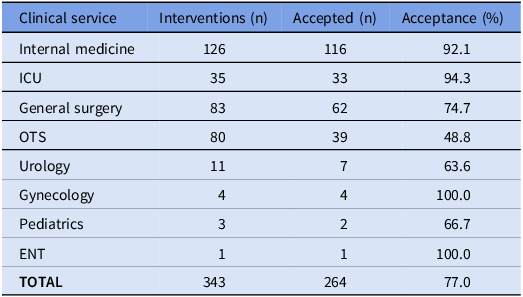
Table 1 shows the number of interventions by clinical service and their level of acceptance. A statistically significant association was observed between these two variables (Fisher’s exact test, P <.001). Acceptance was 92.1% in Internal Medicine, 94.3% in the ICU, 74.7% in General Surgery, and 48.8% in OTS.
Acceptance rate of antimicrobial stewardship recommendations by clinical service. OTS, orthopedic and trauma surgery; ICU, intensive care unit; ENT, otorhinolaryngology

Table 1. Long description
The table presents data on the number of interventions, accepted interventions, and acceptance percentages across various clinical services. It includes eight rows and four columns. The columns are labeled ‘Clinical service’, ‘Interventions (n)’, ‘Accepted (n)’, and ‘Acceptance (%)’. The clinical services listed are Internal medicine, ICU, General surgery, OTS, Urology, Gynecology, Pediatrics, and ENT. The table shows the following data: Row 1: Internal medicine, 126 interventions, 116 accepted, 92.1 percent acceptance. Row 2: ICU, 35 interventions, 33 accepted, 94.3 percent acceptance. Row 3: General surgery, 83 interventions, 62 accepted, 74.7 percent acceptance. Row 4: OTS, 80 interventions, 39 accepted, 48.8 percent acceptance. Row 5: Urology, 11 interventions, 7 accepted, 63.6 percent acceptance. Row 6: Gynecology, 4 interventions, 4 accepted, 100 percent acceptance. Row 7: Pediatrics, 3 interventions, 2 accepted, 66.7 percent acceptance. Row 8: ENT, 1 intervention, 1 accepted, 100 percent acceptance. The total row shows 343 interventions, 264 accepted, and 77 percent acceptance.
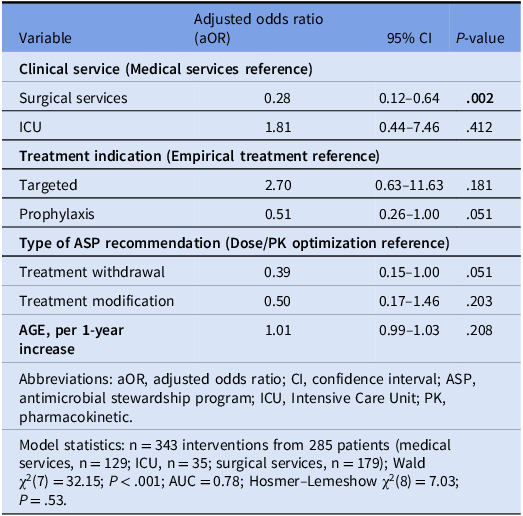
The multivariable logistic regression included all 343 interventions with documented acceptance, corresponding to 285 patients (Table 2). Among variables included in the model, clinical service was the only variable independently associated with acceptance of ASP team interventions. Compared with medical services, interventions in surgical services had lower odds of acceptance (aOR, 0.28; 95% CI, 0.12–0.64; P =.002).
Multivariable logistic regression analysis of factors associated with acceptance of antimicrobial stewardship recommendations

Table 2. Long description
A table with 343 interventions from 285 patients, comparing adjusted odds ratio, 95% confidence interval, and P-value for various variables. The table has 11 rows and 4 columns. Column headers are Variable, Adjusted odds ratio (aOR), 95% CI, and P-value. Row labels include Clinical service, Treatment indication, Type of ASP recommendation, and AGE, per 1-year increase. Notable values include Surgical services with an aOR of 0.28, ICU with an aOR of 1.81, Targeted treatment with an aOR of 2.70, Prophylaxis with an aOR of 0.51, Treatment withdrawal with an aOR of 0.39, Treatment modification with an aOR of 0.50, and AGE with an aOR of 1.01. The table also includes model statistics with n = 343 interventions from 285 patients, Wald χ²(7) = 32.15, P < .001, AUC = 0.78, and Hosmer-Lemeshow χ²(8) = 7.03, P = .53.
No significant differences in acceptance were observed between the ICU and medical services (aOR, 1.81; 95% CI, 0.44–7.46; P =.412). The other variables included in the model (antimicrobial indication, type of ASP recommendation, and age) showed no independent association with acceptance after multivariable adjustment.
The discriminative ability of the model was good, with an AUC of 0.78. The Hosmer–Lemeshow test showed no evidence of poor calibration (χ2 = 7.03; P =.53).
Discussion
The present study evaluated acceptance of ASP interventions in a community hospital over a period of nearly three years and factors associated with their uptake. The most frequent interventions focused on key ASP quality-of-prescribing indicators, namely treatment discontinuation due to prolonged duration, dose adjustment, and de-escalation. The main finding of this study was that acceptance of documented ASP recommendations varied according to the prescribing clinical service. After adjustment, surgical services had lower odds of acceptance than medical services. These findings suggest that stewardship strategies should be tailored to individual clinical services to maximize their impact.
Among interventions with documented acceptance data, 77.0% were accepted, a proportion consistent with those previously reported in the literature for ASP. In the review by Leache et al., acceptance rates between 70% and 97% were reported, Reference Leache, Aquerreta, Aldaz, Idoate and Ortega19 whereas Chung et al., in a review of programs based on prospective audit and feedback, described acceptance rates of 62.8%. Reference Chung, Wu, Yeo, Chan and Hsu20 Similarly, more recent studies, such as that by Langford et al., report service-specific acceptance rates between 70% and 86%. Reference Langford, Nisenbaum, Brown, Chan and Downing16 The multidisciplinary nature of the ASP team provides different and coordinated clinical perspectives and reinforces the soundness of the recommendations. In addition, the community setting may favor greater cohesion among clinical teams and more direct communication with prescribers. These factors may facilitate the implementation of ASP-type strategies in community settings. Reference Wang, Buljac-Samardžić, Van Wijngaarden and Van De Klundert21
In our study, most antibiotic optimization interventions (84%) were concentrated in the Internal Medicine and surgical services, probably related to the profile of admitted patients and to the high use of antimicrobial therapy associated with surgery. Specifically, in the surgical setting, antibiotics are widely used as perioperative prophylaxis, and there is robust evidence that optimizing duration improves patient safety without increasing adverse events at the surgical site. Reference de Jonge, Boldingh and Solomkin22 In our study, 90% of prophylaxis-related interventions occurred in GS or OTS, and 71.1% involved discontinuation because of prolonged duration, which highlights the need for ASPs to correct these deviations in clinical practice.
In our setting, ASP activities were performed within routine clinical duties without protected stewardship time, reflecting the resource constraints faced by smaller hospitals and the importance of multidisciplinary collaboration when dedicated infectious diseases resources are limited. Reference Van Dort, Carland and Penm23 Beyond human resources, organizational and technological barriers add to these limitations, such as the lack of specific software or the absence of integration between existing systems (prescribing, laboratory, and electronic medical records). Similarly, limited prompt access to diagnostic test results poses an additional challenge in smaller hospitals. Reference Van Dort, Carland and Penm23 In this regard, several studies have highlighted that the success of ASP interventions depends not only on the type of strategy implemented, but also on how it is applied, by whom, in which clinical context, and at which stage of the prescribing process. Reference Pouly, Coppry, Rogues and Dumartin24
Cefazolin and meropenem were the antimicrobials most frequently involved in ASP interventions. Cefazolin may be related to its role as the first-line agent for surgical prophylaxis, Reference Bratzler, Dellinger and Olsen25 an important target of ASP interventions in our study. Prolonged antibiotic prophylaxis has not been shown to improve clinical outcomes after surgery and, conversely, is associated with an increase in adverse events and in the selection of resistance. Reference Bratzler, Dellinger and Olsen25 Meropenem, in turn, is a broad-spectrum carbapenem reserved for severe infections or suspected MDR microorganisms; Reference Boşnak, Fındık and Atay26 the high number of interventions therefore focused on avoiding its unnecessary use and on the need for therapeutic de-escalation, the third most frequent intervention (14.0%). Reference Schuts, Hulscher and Mouton17,Reference Tabah, Bassetti and Kollef27 These results are in line with European studies on antimicrobial management that highlight the optimization of carbapenem use as a key objective of ASP interventions. Reference Poline, Postaire and Parize28
In addition, systematic reviews and recent studies have identified several determinants—such as the setting, the multidisciplinary team and the integration of digital tools—that drive differences in behavior toward the appropriate use of antibiotics. Reference Amor-García, Chamorro-de-Vega, Rodríguez-González, Iglesias-Peinado and Moreno-Díaz29,Reference Cortés Sánchez, Salazar González, Gómez Portolés, Giménez Castellanos and Climente Martí30 In our study, the strong association between clinical service and acceptance may reflect differences in local prescribing dynamics, clinical service organization, and trust in the ASP team, Reference Pulia, Redwood and May31 although these factors were not directly assessed in our study. Understanding these contextual factors is essential to tailor ASP implementation strategies to each clinical service and to improve the effectiveness of ASP interventions. For surgical services, potential strategies include closer ASP involvement, jointly agreed prophylaxis protocols, feedback on prophylaxis duration, and stewardship interventions integrated into perioperative workflows.
This study has several limitations. First, the study was conducted in a single community hospital, which may limit the generalizability of the findings to different settings. Community hospitals usually face specific structural challenges, such as limited human resources, since the multidisciplinary ASP team often combines this task with clinical care duties that may compromise attention to certain interventions. Second, it should be considered that data analysis was performed retrospectively from a database completed by different members of the ASP team. Although a structured form was used to standardize data recording, the involvement of multiple observers may introduce a degree of inter-observer variability and a subjective component in the classification of certain interventions or in the assessment of their acceptance. Furthermore, the lack of records of acceptance in a significant proportion of interventions (21.5%), with missingness not uniformly distributed across clinical characteristics, may have introduced selection bias in the estimated acceptance rate. In addition, potentially relevant determinants of acceptance, including the mode and timing of communication, the professional delivering the recommendation, length of stay, and individual prescriber characteristics, were not systematically recorded. Finally, the observational design allows identification of associations but does not establish the mechanisms underlying differences in acceptance between clinical services.
In conclusion, acceptance of ASP recommendations in a community hospital varied substantially according to the prescribing clinical service, with significantly lower acceptance in surgical services. Clinical service remained independently associated with acceptance after adjustment for age, indication, and type of recommendation. These findings support the development of service-specific stewardship strategies, including closer multidisciplinary collaboration and targeted optimization of surgical prophylaxis, to improve the uptake of ASP recommendations in community hospitals.
Supplementary material
The supplementary material for this article can be found at https://doi.org/10.1017/ash.2026.10934
Data availability statement
The data underlying this article are not publicly available because they derive from routine clinical care and are subject to institutional and data protection restrictions. Anonymized data may be made available by the corresponding author on reasonable request, subject to institutional and, where applicable, Ethics Committee approval and applicable data protection regulations.
Acknowledgments
The authors have no acknowledgments to declare.
Author contributions
Carlos José Cortés Sánchez (Conceptualization, Methodology, Data curation, Formal analysis, Investigation, Visualization, Writing — original draft, Writing — review and editing). Eduardo Tejedor Tejada (Conceptualization, Methodology, Investigation, Data curation, Writing — review and editing). José María Gómez Portolés (Investigation, Methodology, Validation, Writing — review and editing). Mónica Abdilla Bonías (Investigation, Validation, Writing — review and editing). Arantxa Valdivia Piqueres (Investigation, Validation, Writing — review and editing). Cornelio Núñez Lozano (Investigation, Validation, Writing — review and editing). Josefina Giménez Castellanos (Methodology, Supervision, Validation, Writing — review and editing). Mónica Climente Martí (Methodology, Supervision, Validation, Writing – review and editing).
Financial support
This research received no specific grant from any funding agency in the public, commercial, or not-for-profit sectors.
Competing interests
The author(s) declare that there are no conflicts of interest.
Data access statement
Carlos José Cortés Sánchez had full access to the anonymized study data set used for the analyses. Access was limited to data authorized for the purposes of this study and remains subject to institutional data governance requirements.


 Open access

