Introduction
Dementia is a major cause of suffering among elderly people. Even though cognitive impairment is the hallmark of dementia, virtually all persons with dementia experience neuropsychiatric symptoms (NPS) at some time over the course of the dementia disorder, regardless of the type of dementia (Steinberg et al., Reference Steinberg2008). NPS are associated with earlier institutionalization, increased costs, and a higher level of caregiver burden (Banerjee et al., Reference Banerjee, Murray, Foley, Atkins, Schneider and Mann2003; Gaugler et al., Reference Gaugler2011). NPS are particularly prevalent among patients in nursing homes and these symptoms are often treated with psychotropic drugs in spite of the lack of precise knowledge of their clinical effect and a considerable risk of serious adverse consequences (Schneider et al., Reference Schneider, Dagerman and Insel2006; Ballard et al., Reference Ballard2009).
Longitudinal studies of NPS in population-based (Steinberg et al., Reference Steinberg2004) and clinical samples (Aalten et al., Reference Aalten, de Vugt, Jaspers, Jolles and Verhey2005) have reported conflicting results. A number of cross-sectional studies have examined NPS in nursing homes, but only a few longitudinal studies with up to two years of follow-up have been conducted (Ballard et al., Reference Ballard2001; Wetzels et al., Reference Wetzels, Zuidema, de Jonghe, Verhey and Koopmans2010b; Bergh et al., Reference Bergh, Engedal, Roen and Selbaek2011). To inform treatment decisions, studies demonstrating the course of NPS over longer periods are needed (Wetzels et al., Reference Wetzels, Zuidema, Jansen, Verhey and Koopmans2010a).
In Norway, approximately 39,000 people live in nursing homes. Around 80% of them have dementia, but only 24% of the nursing-home beds are in special care units for persons with dementia (Kirkevold et al., Reference Kirkevold, Eek and Engedal2012).
We present data from a 53-month follow-up study of a large sample of nursing-home patients with dementia followed longitudinally. In line with the cross-sectional data of this sample on the association between the level of dementia and the prevalence of NPS (Selbaek et al., Reference Selbaek, Kirkevold and Engedal2007), we hypothesized that more prevalent and severe psychotic symptoms, agitation, and apathy would be associated with increasing severity of dementia over the follow-up period, and that the prevalence and severity of other types of NPS would be stable over the follow-up period.
Methods
Study design
This is a longitudinal study of Norwegian nursing-home patients. The study included patients from 26 nursing homes in 19 municipalities in 4 of 19 counties. The nursing homes were selected in order to be representative of the entire nursing-home population in the four counties, in terms of its distribution between small, medium, and large municipalities. All nursing-home patients with a minimum of 14 days of stay were considered eligible for the study. The cohort was examined four times over a 53-month period. The baseline assessment took place in 2004–2005.
Data collection was done by registered nurses with wide experience of working in old-age psychiatry. They used a standardized set of assessment scales. All assessors received two days, one day, four hours, and four hours of training prior to the first (A1), second (A2), third (A3), and fourth assessments (A4), respectively. The training was conducted by the project leader (first author). The same group of assessors conducted all four assessments. The assessors were able to contact the project leader throughout the assessment periods.
Participants
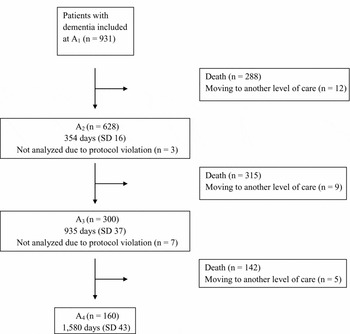
In all, 1,165 patients were approached. Two patients or their next of kin declined participation, leaving 1,163 patients for inclusion. Of these, 932 patients had dementia at baseline, signified by a score of one or more on the Clinical Dementia Rating (CDR) scale. One patient had more than 20% missing data on the Neuropsychiatric Inventory Nursing-Home Version (NPI-NH) and was excluded, leaving 931 patients. Data on the included patients, attrition, and follow-up time from the first (A1) to the fourth (A4) assessment are presented in Figure 1. Three patients were excluded from the analysis at A2 and A3, and another four patients were excluded from the analysis at A3, due to protocol violation (not assessed within the predefined time frame). These patients were included in the analysis at A4. In total, 771 persons (83%) left the study between A1 and A4: 745 because of death and 26 because of moving to another level of care; i.e. they moved out of the nursing home either because of changes in the organization or because they no longer were in need of nursing-home care because of improvement in their health state. Follow-up data from the second assessment (A2) have been presented in a previous publication (Selbaek et al., Reference Selbaek, Kirkevold and Engedal2008a).
Flow chart describing attrition from A1 to A4.

Assessments
NPS were assessed with the NPI-NH (Cummings et al., Reference Cummings, Mega, Gray, Rosenberg-Thompson, Carusi and Gornbein1994), as an interview with the primary caregiver of each patient. The Norwegian version of the NPI-NH has shown high inter-rater reliability (Selbaek et al., Reference Selbaek, Kirkevold, Sommer and Engedal2008b). The NPI-NH assesses the frequency (0–4) and severity (0–3) of 12 psychiatric and behavioral symptoms. An item score is generated by multiplying frequency and severity (0–12). In this paper, we use the sum score of only the first ten items of the NPI-NH (0–120), because the last two items (night-time behavior and appetite disturbance/eating change) primarily capture vegetative symptoms.
In line with previous research, an item score of four or higher was defined as a clinically significant symptom (CSS; Margallo-Lana et al., Reference Margallo-Lana2001). The analysis and discussion regarding prevalence data in this paper are based on the occurrence of CSS.
Based on data from a previous principal component analysis of this sample (Selbaek and Engedal, Reference Selbaek and Engedal2011), subsyndromal scores on agitation (aggression/agitation + disinhibition + irritability; range 0–36), psychosis (delusion + hallucination; range 0–24), and affective symptoms (depression + anxiety; range 0–24) were generated. Apathy (range 0–12) was analyzed on its own.
The level of dementia was assessed by means of the CDR (Hughes et al., Reference Hughes, Berg, Danziger, Coben and Martin1982). The total score of this six-item instrument may be produced using an algorithm giving precedence to memory. A score of 0, 0.5, 1, 2, and 3 indicates no dementia, questionable dementia, mild dementia, moderate dementia, and severe dementia, respectively. In the analysis, we also present the CDR “sum of boxes,” which has proved to be highly correlated with the CDR total score in previous studies (O’Bryant et al., Reference O’Bryant2008). In the baseline sample (n = 931), the Spearman's correlation between the CDR score and the CDR sum of boxes was 0.91.
The level of functioning was assessed with the Physical Self-Maintenance Scale (Lawton and Brody, Reference Lawton and Brody1969), a six-item scale that produces a sum score ranging from 6 to 30, with higher scores denoting more severe functional impairment. Physical health was rated with the General Medical Health Rating (GMHR) scale (Lyketsos et al., Reference Lyketsos1999), a one-item global rating scale with the categories good, fairly good, poor, and very poor.
Demographic data and the use of regular medications were collected from the patients’ medical records. Psychotropic drugs were grouped according to the Anatomical Therapeutic Chemical index (WHO Collaborating Centre for Drug Statistics Methodology, 2007).
Data analysis
Data were analyzed using the Statistical Program for Social Sciences (SPSS) v.20.0 and SAS v.9.3.
Normality of continuous parameters was assessed graphically by inspection of the histograms. Continuous variables were described by mean (standard deviation (SD)) and median (first (Q1) and third (Q3) quartiles). Categorical variables were presented as percentages of total sample size. Differences between those who completed and those who dropped out prior to A4, were analyzed with independent sample t-tests or Mann–Whitney U-test, depending on the distribution of the data. Correspondingly, differences in proportions were analyzed with the χ2 test. Differences between assessments were examined by regression models for repeated measurements with random effects for intercepts: linear mixed model (SAS MIXED procedure) for continuous (CDR) and logistic regression (SAS GLIMMIX procedure) for dichotomous (NPI symptoms) outcome variables. Such models take into account possible correlations occurring due to repeated measurements on the same patients and might prevent false significant findings. Moreover, it handles unbalanced (missing some of responses) data.
Prevalence, incidence, and persistence between each of the four assessments were analyzed. Point prevalence, cumulative prevalence, incidence, cumulative incidence, and persistence rate for each of the 12 items of the NPI was calculated. Point prevalence is the proportion of patients with a CSS at each assessment, and cumulative prevalence is the proportion of patients with a CSS at least one of the four assessments. Incidence is the proportion of patients who had a symptom at one assessment relative to the number of those who were symptom free at the previous assessment. Cumulative incidence is the proportion of patients among those who were symptom free at baseline but developed a CSS at one of the following assessments. Persistence is the ratio of residents with CSS at follow-up to residents with CSS at the previous assessment.
To assess the change in the severity of subsyndromes (agitation, psychosis, affective symptoms, and apathy), a linear mixed model with random effects for intercept and slope was estimated by the SAS MIXED procedure. Furthermore, the estimated change was adjusted for CDR score. The interaction between time and the CDR score was estimated when significant. A model fit was assessed by examining marginal and conditional residuals. Conditional residuals were satisfying for all the necessary requirements for a well-fitting model. A modest skewness of marginal residuals, we believe, is compensated by a large sample size. A logarithmic transformation usually used for symmetrizing data could not be applied because of possible zero values in subsyndrome scores.
All significance tests were two tailed. The level of significance was set at 5%.
Ethical and legal considerations
The patient and their family members were informed about the study. Explicit consent was not required for enrolment, but the patients or their next of kin were informed that they could refuse to participate at any stage in the study. This procedure was in line with the Norwegian jurisdiction when this study was initiated and was approved by the Regional Ethics Committee, the Data Inspectorate, and the Directorate for Health and Social Affairs.
Results
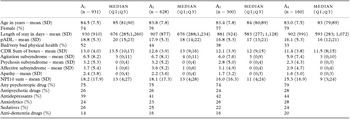
At baseline, the mean (SD) age of the entire sample was 84.5 (7.5) years, the median (Q1, Q2) length of stay was 676 (285, 1,260) days, and 74% were women. Mild (CDR = 1), moderate (CDR = 2), and severe dementia (CDR = 3) was present in 25%, 33%, and 42% of the sample, respectively. Other baseline characteristics for the patients who completed the first (A1), second (A2), third (A3), and fourth (A4) assessments, respectively, are presented in Table 1.
Baseline measures in patients completing one (A1), two (A2), three (A3), and four assessments (A4)

pADL = personal ADL as measured by the Physical Self-Maintenance Scale; CDR = Clinical Dementia Rating scale; NPI = Neuropsychiatric Inventory.
A comparison of baseline data of those who completed A4 with those who dropped out prior to A4 showed that those who completed A4 were younger (t = −2.80, df = 929, p = 0.005), had a higher level of functioning (t = −7.23, df = 927, p < 0.001), enjoyed better physical health (χ2 = 27.13, df = 1, p < 0.001), had less severe dementia according to the CDR sum of boxes (Z = −5.41, df = 930, p < 0.001), less affective symptoms (Z = −2.07, df = 930, p = 0.04), less psychosis (Z = −2.37, df = 930, p = 0.02), less apathy (Z = −2.88, df = 928, p = 0.004), and a lower total NPI score (Z = −2.51, df = 930, p = 0.01) than those who dropped out prior to A4. Finally, a larger proportion of those who completed A4 used anti-dementia drugs at baseline than those who dropped out prior to A4 (χ2 = 6.9, df = 1, p = 0.009).
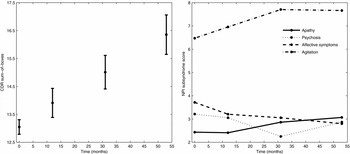
According to the mixed linear model, the CDR sum of boxes increased on average (95% CI) from 13.0 (12.8, 13.3) at A1 to 13.9 (13.4, 14.4) at A2, further to 15.0 (14.4, 15.6) at A3 and reached 16.4 (15.7, 17.1) at the end of the study at A4 (Figure 2). The intercept and regression coefficients were all significantly different from zero at the level of <0.001.
Change in cognition (mean and 95% CI) and NPS subsyndromes (mean) during the follow-up period.

Prevalence
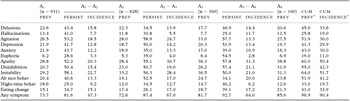
The point prevalence of individual CSS is presented in Table 2. Apathy, irritability, and agitation/aggression were the three most prevalent CSS at A1, A2, and A3, whereas apathy, disinhibition, and irritability were the most prevalent CSS at A4. Euphoria, hallucinations, and changes in eating habits were least prevalent at A1, whereas euphoria, hallucinations, and night-time behavior were least prevalent at A2, A3, and A4.
Prevalence, persistence, and incidence of clinically significant symptoms A1 to A4 (%)

Prev = Prevalence; Persist = Persistence; Cum = Cumulative; Ab mot behav = aberrant motor behavior; Night-time behav = night-time behavior.
*Proportion among those who completed A4.
Anxiety and night-time behavior became less prevalent throughout the observation period, with odds ratios (ORs) (p-value) for every 10-month increase in time of, respectively, 0.92 (0.038) and 0.91 (<0.001). The prevalence of apathy, disinhibition, and changes in eating habits and having at least one CSS increased throughout the observation period. The ORs for every 10-month increase in time were 1.13 (<0.001) for apathy, 1.11 (0.005) for disinhibition, 1.09 (0.018) for eating change, and 1.17 (<0.001) for having at least one CSS. Other CSS remained stable in the observation period. The cumulative prevalence of any CSS was 96.9% in those who completed A4.
Persistence/resolution and incidence of symptoms
The persistence and incidence of individual symptoms are presented in Table 2. Resolution is not shown as this is the inverse of persistence.
Agitation/aggression, irritability, disinhibition, and apathy showed persistence rates of ≥50% at all three intervals, depression at the two last intervals, and aberrant motor behavior at A2−A3. Irritability and apathy (three intervals), agitation/aggression, disinhibition, and aberrant motor behavior (one interval) were the symptoms that showed the highest incidence rates (≥20%). The cumulative incidence of any CSS was 90.4% in those who completed A4.
Change in the severity of the symptoms
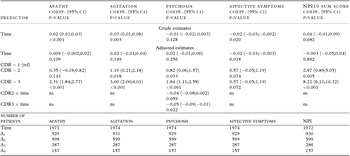
Based on a previous publication, we aggregated individual symptoms into three subsyndromes of the NPI: agitation, psychosis, and affective symptoms (Selbaek and Engedal, Reference Selbaek and Engedal2011). Apathy was analyzed on its own. According to a linear mixed model presented in Table 3 and Figure 2, there was a significant increase over time for apathy (p < 0.001) and agitation (p = 0.003), and a significant decrease in affective symptoms (p = 0.020). There were no significant changes in psychosis or in the total NPI-10 score. The CDR score was a significant predictor for all but one subsyndrome; affective symptoms were not associated with the CDR score. Adjusting for the CDR score did not alter the relationships markedly for affective symptoms, while a change in apathy and agitation subsyndromes of NPI became insignificant. The interaction term was only significant in the model for psychosis, suggesting that there was a significant increase in psychosis score for those with a CDR score of 1 and an approximately parallel reduction in psychosis score for those with CDR score 2 or 3.
Subsyndromes and total score of the NPI. Crude and adjusted (for CDR score) regression coefficients (Coeff) from linear mixed model with corresponding 95% confidence intervals (CI) and p-values

CDR = Clinical Dementia Rating scale; NPI = Neuropsychiatric Inventory.
There were 38 patients with CDR = 0 or CDR = 0.5 excluded from these analyses (25 at A2, 11 at A3, and 2 at A4).
Discussion
We present the results of the largest long-term longitudinal study of the course of NPS in nursing-home patients with dementia conducted so far. When investigating proportions (prevalence, persistence, and incidence) we have focused on CSS, whereas the discussion concerning the change in symptom severity (item scores) has included data on all levels of NPS.
Prevalence
In line with previous research, our study shows that virtually all the nursing-home patients with dementia experience clinically significant NPS (CSS), with a cumulative prevalence of 97% among those who completed A4. Irritability and apathy were the individual symptoms with the highest cumulative prevalence, while hallucinations and euphoria the lowest. These findings are largely in line with results from two recent longitudinal studies of nursing-home patients with dementia, applying the NPI (Wetzels et al., Reference Wetzels, Zuidema, de Jonghe, Verhey and Koopmans2010b; Bergh et al., Reference Bergh, Engedal, Roen and Selbaek2011). These studies had a shorter total follow-up time, shorter intervals between the assessments, and the prevalence estimates were based on completers. The most striking difference between the two Norwegian samples and the Dutch sample is a considerably higher prevalence of delusions and depression in the two Norwegian samples. This may be caused by differences in the level of dementia or the type of care or psychotropic drug prescription. All the patients in the Dutch sample lived in special care units, a larger proportion had severe dementia, and they used more antipsychotic drugs and less antidepressant drugs than the patients of the two Norwegian samples. Other cross-sectional nursing-home studies applying the NPI confirm the findings that apathy, irritability, and agitation/aggression are the most prevalent CSS (Margallo-Lana et al., Reference Margallo-Lana2001; Zuidema et al., Reference Zuidema, Derksen, Verhey and Koopmans2007).
Apathy, disinhibition, and eating changes, as well as having one or more CSS, became more prevalent during follow-up. These findings partly confirm our initial hypothesis and are in line with our earlier published cross-sectional data (Selbaek et al., Reference Selbaek, Kirkevold and Engedal2007) where these symptoms were more prevalent with increasing severity of dementia. However, in contrast with our hypotheses, we did not find an increase in the prevalence of delusions, hallucinations, or agitation/aggression. Also, in line with our results, a large cohort study with a four-year follow-up of community-dwelling Alzheimer's disease patients found that the prevalence of CSS of hyperactivity and apathy subsyndromes increased significantly during the follow-up while the prevalence of affective and psychotic subsyndromes did not (Gonfrier et al., Reference Gonfrier, Andrieu, Renaud, Vellas and Robert2012).
Persistence of symptoms
Our study shows that agitation symptoms at CSS level (agitation/aggression, disinhibition, irritability, and aberrant motor behavior) and apathy were the most persistent symptoms. Depression had low persistency in the first year, but became more persistent later in the follow-up period. Anxiety and delusions showed low persistency at all intervals. Bergh et al. (Reference Bergh, Engedal, Roen and Selbaek2011) found in a recently published 16-month follow-up study in Norwegian nursing homes that agitation/aggression, irritability, disinhibition, and aberrant motor behavior, as well as delusions and depression, were the most persistent CSS. These findings are partly confirmed in our study. However, the Bergh et al. study showed considerably higher persistence rates for most symptoms than found in our study. This is probably caused by a shorter time span between the assessments in the study by Bergh et al. In a Dutch nursing-home study with five assessments over a two-year follow-up period, agitation/aggression and aberrant motor behavior were the symptoms showing highest persistence, which is in line with our study (Wetzels et al., Reference Wetzels, Zuidema, de Jonghe, Verhey and Koopmans2010b). However, they found that apathy was less persistent than in our study. Their findings that depression was highly persistent early, but became less persistent later in the follow-up period contrasted with our study where depression became more persistent later in the follow-up period. A nursing-home study in the UK with a one-year follow-up found that agitation symptoms (agitation/aggression and aberrant motor behavior) were most persistent (Ballard et al., Reference Ballard2001). Aalten et al. (Reference Aalten, de Vugt, Jaspers, Jolles and Verhey2005) reported in their two-year follow-up study with assessments every six months including outpatients with dementia that apathy and aberrant motor behavior were the most persistent CSS, whereas in a population-based study with an 18-month follow-up period depression and delusions were the most persistent CSS (Steinberg et al., Reference Steinberg2004). One might conclude that agitation symptoms and apathy seem to be the most persistent CSS in clinical samples whereas the only longitudinal population-based study shows a somewhat different pattern. This may indicate that one should be less expectant when evaluating treatment options and, furthermore, that efforts should be made to prevent the symptoms from occurring, as they seem to be particularly persistent once they have become established.
Change in symptom severity
Based on previously published data concerning the clustering of NPI symptoms (Selbaek and Engedal, Reference Selbaek and Engedal2011), we assessed change in the severity of subsyndromes of the NPI: agitation, psychosis, affective symptoms, and apathy. We found that the severity of agitation and apathy increased, whereas the severity of affective symptoms decreased over time. There was no change in the severity of the symptoms of psychosis or the NPI sum score. Analyzing the score of individual items of the NPI, Wetzels et al. (Reference Wetzels, Zuidema, de Jonghe, Verhey and Koopmans2010b) found a similar decrease in affective symptoms (anxiety and depression) but they failed to find any change in the severity of the symptoms of agitation or apathy. Furthermore, they found a decrease in NPI total score, which was not found in our study. Bergh et al. (Reference Bergh, Engedal, Roen and Selbaek2011) found no change in the severity of individual symptoms. The discrepancies between our findings and these two studies may be due to the fact that our study employed statistical methods including information about all the patients available at each assessment, whereas the two other studies included only completers in the analysis. Furthermore, our study had a longer follow-up period and a larger sample size.
When adjusting for CDR score, the increase in the severity of apathy and agitation was no longer significant. This suggests that the increasing severity of these symptoms may be explained by the progression of the dementia. It is plausible that the increasing brain damage caused by the disease process contributes to a psychomotor slowing down, easily interpreted as apathy. Another explanation might be that patients with dementia become more vulnerable to delirium with the progression of the disease. Delirium manifests itself both as hyperactive and hypoactive states, thereby possibly mimicking both apathy and agitation. Delirium superimposed on dementia is highly prevalent (Landreville et al., Reference Landreville, Voyer and Carmichael2013) and a recently published study including institutionalized patients with dementia reports that symptoms of delirium and multiple NPS overlap and, furthermore, that the presence of delirium indicates a poor prognosis (Holtta et al., Reference Holtta2011). Unfortunately, our study did not include a specific measure of delirium, but the associations between the course of delirium and NPS in nursing-home patients with dementia deserve closer inspection.
The assessment of depression and psychotic symptoms relies on the observed patients’ ability to express feelings verbally. This does not matter so much for agitation or apathy. Aphasia is a prominent feature of dementia in severe stages of dementia and this may have contributed to our findings. This finding is supported by the opposite directions of the change in psychosis scores in mild versus severe dementia, i.e. increasing psychosis score in mild dementia and decreasing psychosis score in severe dementia. Overall, we did not find any significant change in the severity of psychosis symptoms. Even though a number of studies have demonstrated an association between psychosis and dementia severity/cognitive impairment, this has not been evident in nursing-home studies (Ballard et al., Reference Ballard2001; Wetzels et al., Reference Wetzels, Zuidema, de Jonghe, Verhey and Koopmans2010b). This may be due to the fact that a majority of nursing-home patients already have moderate or severe dementia at inclusion in longitudinal studies, as is the case also in our study.
Finally, it is notable that the courses of depression and apathy take opposite directions. This underscores the results of several earlier studies indicating that apathy and depression are distinct clinical entities (Starkstein et al., Reference Starkstein, Ingram, Garau and Mizrahi2005). Another explanation of this may be that more severe dementia diminishes the patients’ ability to report depressive symptoms, so that they may be interpreted as apathy by the nursing-home carers.
Limitations
The NPI relies on information from a care worker who has observed the patients over the past four weeks. These results may be influenced by the attitude of the carer. However, patients with severe dementia would rarely be able to describe their own symptoms over a particular time period. To minimize this limitation, all the assessors received training in the use of the NPI prior to each assessment and the same group of assessors did all the assessments.
We have relied on the CDR for identifying patients with dementia, as well assessing the level of dementia. Ideally, a dementia diagnosis should have included an examination of the patients. However, several studies have shown that CDR staging based solely on an informant interview is a valid substitute (Waite et al., Reference Waite1999; Nygaard and Ruths, Reference Nygaard and Ruths2003).
We have chosen 0.05 as the level of significance. However, to reduce the risk of false positive findings due to multiple tests, findings with levels of significance above 0.01 should be interpreted with caution.
The large drop out, mainly because of death, may restrict generalization of the results. There are differences in the baseline measures between those who completed the last assessments and those who dropped out earlier. However, this problem is inherent to most longitudinal nursing-home studies, reflecting that we are dealing with a frail group of people. Furthermore, we have applied statistical methods handling unbalanced data sets and in this way we are able to include information on all patients at each assessment, also from those who left the study prior to the last assessments or did not respond at one of the assessments.
The time span between assessments is relatively long and the intervals between assessments are not constant. The long time span may have caused us to underestimate both the cumulative prevalence and incidence of CSS. We have adjusted for the varying time span between assessments in our analysis.
Drug prescription might influence the course of NPS. We did not include data on drug prescription at the follow-up points. However, earlier studies have shown that the course of symptoms is little influenced by psychotropic drug use in nursing-home patients with dementia (Ballard et al., Reference Ballard2001; Selbaek et al., Reference Selbaek, Kirkevold and Engedal2008a).
The main strengths of our study are its large sample size, the application of the same structured interview at each assessment by trained research nurses, the fact that we have been able to follow the course of all the patients included at baseline, whether they completed all the assessments or dropped out during the study period, and finally the use of a statistical method that allows for inclusion of information from patients who drop out of the study during follow-up.
The close relationship between dementia progression and symptom severity in our study may have important implications for the care planning. Staff working in wards with patients with severe dementia should receive specific training in how to prevent and treat agitation and apathy, and the care environments for patients with severe dementia should be organized to the patients’ needs in order to prevent agitation, e.g. small units, enhancing orientation, avoiding sensory overstimulation, providing a homely atmosphere, giving access to an outdoor area (Day et al., Reference Day, Carreon and Stump2000).
Conclusion
The present study shows that the course of clinically significant NPS fluctuates. However, virtually all the patients did experience some type of clinically significant NPS during the study period. Agitation symptoms and apathy were the most persistent symptoms. The severity of affective symptoms tended to decrease, whereas agitation and apathy became more severe during the follow-up period. The increasing severity of agitation and apathy disappears when we adjust for the change in dementia severity. These findings may have important implications for the observation and treatment of patients with dementia in long-term care settings.
Conflict of interest
The study was funded by unrestricted grants from the South-Eastern Norway Regional Health Authority and Innlandet Hospital Trust.
Geir Selbæk has given lectures on conferences sponsored by Lundbeck and Novartis. He is currently receiving post doc grants from the South-Eastern Norway Regional Health Authority and Innlandet Hospital Trust.
Knut Engedal. None.
Jūratė Šaltytė Benth. None.
Sverre Bergh is currently receiving a post doc grant from the South-Eastern Norway Regional Health Authority.
Description of authors’ roles
G. Selbæk had the main responsibility for planning, designing, and carrying out the study. He took part in the statistical analyses and wrote the paper. K. Engedal and S. Bergh participated in the planning of the study, statistical analyses, and the writing of the paper. J. Benth was responsible for the statistical design of the paper and participated in the writing of the paper.