Introduction
China's rapid economic development has helped to raise the international status of Mandarin. One prediction is that ‘in ten years, Mandarin will be as important worldwide as English’ (Trudgill, Reference Trudgill2014: 387). Another even greater change resulting from China's economic growth is the increasing popularity that English enjoys in China (Hu, Reference Hu2004, Reference Hu2005; Hu, Reference Hu2009; Zhang, Reference Zhang2012; Werner, Reference Werner2014). English is now used in a wide range of fields and contexts throughout the country. This is not surprising given the dominance of the English language on a global scale. English, now increasingly employed together with Chinese to combine global with local appeal, functions ‘as an index of modernity, progress, internationalism and globalization, a symbol of success, sophistication and projection into the future’ (Vettorel, Reference Vettorel2013: 262). One indicator illustrating this phenomenon is the widespread use of public signs in both Chinese and English. Some authors argue that this use of bilingual signs has resulted in the creation of ‘an attractive linguistic landscape’ in China (Yang & Liu, Reference Yang and Liu2008:79). Accordingly, research on bilingual public signs has, in recent years, become ‘a hot area in the translation field’ (Zou et al, Reference Zou, Man and Meng2011:27), attracting the attention of a growing number of scholars (e.g. Dai & Lü, Reference Dai and Lü2005; Song, Reference Song2013; Chen, Reference Chen2014).
One common Chinese sign, whose literal translations are frequently regarded as ‘inappropriate’, ‘wrong’ or instances of ‘pragmatic failure’ by many Chinese researchers, is a park sign about ‘taking care of grass’. This paper, based on a survey, will discuss the ‘appropriateness’ of the sign's literal and indirect translations.
The ‘grass sign’ translation
Signs are ‘public notices, indications, instructions, warnings and symbols as well as any written information and pictures closely related to human lives, work as well as ecological aspects’ (Dai and Lü, Reference Dai and Lü2005:38). In China, signs are almost everywhere. One of the signs often seen in public places, particularly in parks where grass is planted to beautify the environment, is ‘小草微微笑,劝君绕弯道’ (xiao cao wei wei xiao, quan jun rao wan dao) which, as can be seen, contains a rhyme.
The sign has a poetic and metaphoric effect, as it sounds beautiful and rhythmical. The literal translation of the sign is ‘The grass is smiling. Please walk on the path’ (Translation 1, T1 for short). This translation, however, is disapproved of by many Chinese researchers (e.g. Zhao Reference Zhao2006; Tang Reference Tang2009; Guo Reference Guo2010; Song Reference Song2013). All these researchers adhere to the view that this is a case of ‘pragmatic failure’ as it looks obscure and too Chinese, deviating from the principle of conventional signs in Western culture. The more appropriate translation, in their view, should be ‘Keep off the grass’ (Translation 2, T2 for short), which follows the conventional English norm.
The author was curious to know how international and other Chinese readers view the two translations and whether they share the negative view of the above-mentioned researchers. Before discussing the appropriateness of sign translations, she reports a survey conducted in an attempt to find out the attitudes of the participants from different linguistic and cultural backgrounds towards T1 and T2.
Survey
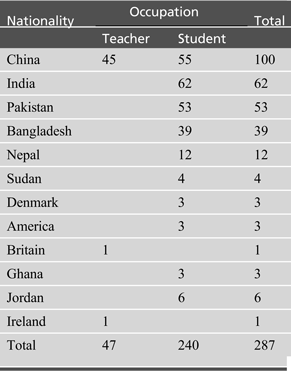
China Three Gorges University (CTGU), where the author works, is an international university which has around 1,000 non-Chinese students, mainly from Asia, with a small number from Europe, America and Africa. In total, 287 participants (286 from CTGU and 1 from Ireland) completed the survey. 100 of the respondents were Chinese native speakers while the remaining 187 were of different nationality (teachers and international students). See Table 1 below.
Information about the participants

The survey comprised the following questions:
1 Do you understand the sign ‘The grass is smiling. Please walk on the path’? (a literal translation from ‘小草微微笑,劝君绕弯道’.) What does it mean?
2 Here are two translations for the sign:
Translation (1) The grass is smiling. Please walk on the path.
Translation (2) Keep off the grass (the general meaning of the sign).
If you were asked to put one up in a park, which of the two translations would you choose? And why?
As Question 2 suggests the answer to Question 1, it was only put to the participants after Question 1 had been answered and their answers had been collected. Participants did not have the opportunity to change the answer to Question 1 after it had been completed. This ensured the survey's reliability and validity.
Results and discussion
Answers to Question 1
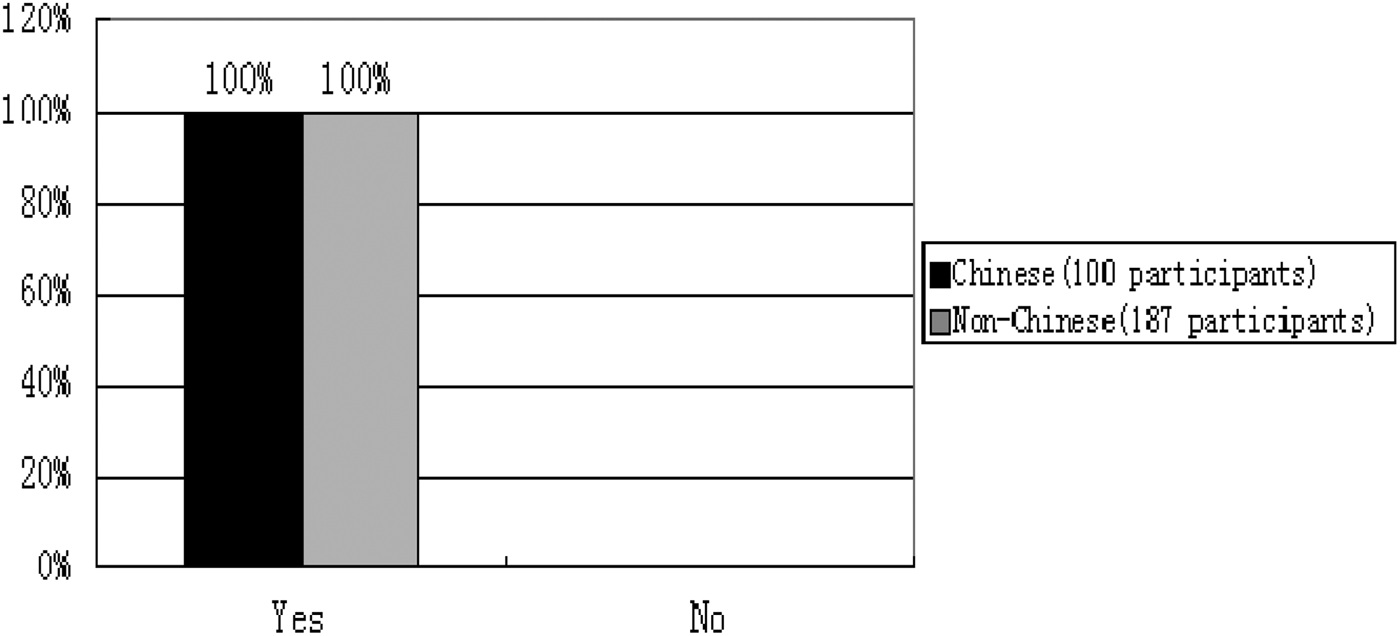
The results for this question indicate all 100 Chinese native speakers and all 187 non-Chinese speaking participants understand the sign in English. See Table 2 and Figure 1.
Do you understand the sign ‘The grass is smiling. Please walk on the path’?
Do you understand the sign ‘The grass is smiling. Please walk on the path’?
As for the question ‘What does it mean?’, all the participants wrote down such answers as ‘Take care of the grass’, ‘Keep off the grass’, ‘Don't stamp/walk on the grass’, ‘Don't do any harm to the grass’, etc. Their replies demonstrate that the sign's core message is clear and unambiguous.
Answers to Question 2
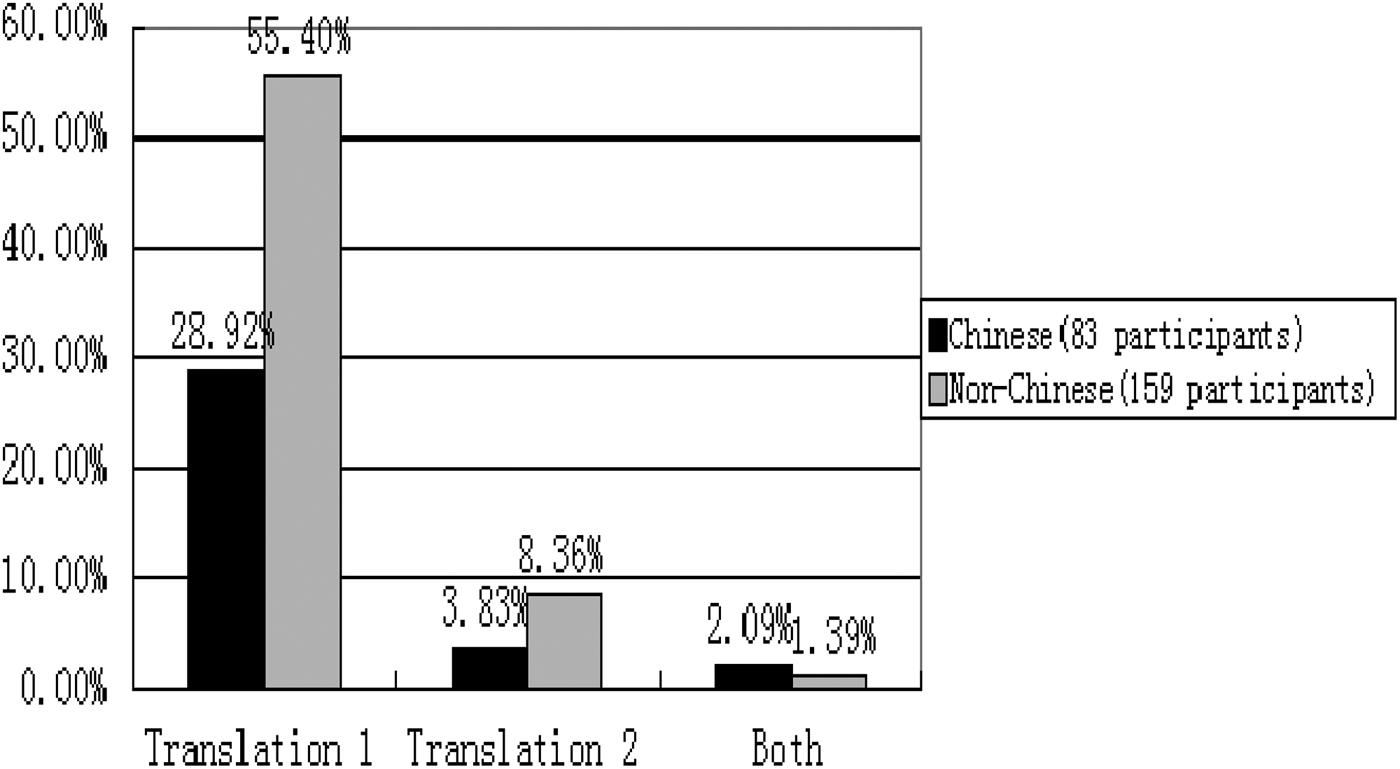
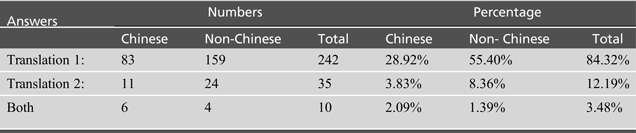
The responses to Question 2 show a clear preference for the literal translation ‘The grass is smiling. Please walk on the path’ (‘The grass is smiling’ for short). See Table 3 and Figure 2 below.
Which of the two translations would you choose for the park sign?
Which of the two translations would you choose for the park sign?
What is in ‘The grass is smiling’?
The reasons why the participants chose T1 vary. The two reasons cited most often in the comments of the participants are linguistic and cultural ones. It is argued that the following ‘Chinese elements’ can be representative of the participants’ explanations for their preference.
Rhetorical style
In T1, ‘The grass is smiling’ is a rhetorical means of personification that likens grass to people. This translation metaphorically attributes human feelings to grass. This style is more vivid and lively. The indirect translation ‘Keep off the grass’, however, is an imperative, rule-like sentence that implies “a potential threat of ordering you around” (Brown & Levinson, Reference Brown and Levinson1987: 71). It may offend viewers and be perceived as a threat. This interpretation is supported by the comments made by a Pakistani student:
T1 is more polite and well mannered so more acceptable to human mind. It shows the grass is a living thing and we should give respect to other living things which are created by God. Sometimes people do not follow the signs because of their aggressive meanings. If somebody tell other people to do something politely, they might do it more willingly as compared to the harsh one.
A Bangladeshi student goes along with this:
We have seen through our experiences that whenever there is a sign read ‘don't …’ Or ‘Keep off…’, we feel ‘pissed off’! People love to spoil things when it is being said ‘No’ to them. ‘Forbidden things are attracted’. Moreover, there is a gravity in the translation: the grass is a living thing and the clear and powerful message is conveying that.
An American girl expressed a similar view, arguing that T1 was kindly expressed, interesting, and likely to prevent rebellious anger on the part of people who would otherwise go on the grass.
Metaphor is regarded as a basic means for humans to recognize and perceive the world. Its essence is understanding and experiencing one thing in terms of another (Lakoff & Johnson, Reference Lakoff and Johnson1980: 5). Good use of metaphor in signs may provide the reader with a vivid picture which can exert a positive effect on the reader and allow public signs to function more powerfully. An Indian student has this to say:
It makes us feel grass is like our children and wants to talk to us. It shows the beauty of nature so we should keep nature beautiful. If we keep grass undamaged, it will keep smiling at us. This translation emphasizes more on the beauty of the grass, which will let the people have a double thought before crossing the grass…
Amusingly, a Nepalese student is even more imaginative after reading the sign:
This translation also means the youth, those who are full of energy and have ability to make society better and happier. When the young do something good, inspire them, help them, take care of them and give them a good environment.
Also, there is much Chinese style politeness in T1. Instead of asking visitors not to walk on the grass directly, the sign uses a euphemism which sounds more tentative, and therefore more polite. Lying in eastern Asia, China is located in relatively enclosed geographical surroundings, which facilitated the independent development of the ancient Chinese culture, free from the impact of foreign cultures and thus leading to introverted thinking. In China, great importance is attached to ‘harmonious human relations’, so if one expresses one's thoughts directly and frankly, this is considered to reveal a lack of good manners. This makes Chinese people inclined to indirectness and politeness in their relations with others. The present survey fully bears this out; the word ‘polite’ is the most frequently mentioned by most of the participants to account for their preference for T1.
English, now a lingua franca used as a tool to represent varieties of cultures, should be exploited in order to convey cultural traditions of China in the Chinese context, part of whose tradition is the uniqueness in Chinese people's mode of communication which is so vividly shown in T1 but not found at all in Inner Circle Englishes.
Communication mode
This indirect associative way of thinking is, as was seen earlier, characterized by frequent use of metaphors. The Chinese enjoy using metaphors for meaning beyond the language in literature, in daily lives and public discourses, which have an enormous impact in communication. A typical example of a metaphor: ‘somebody is a 绣花枕头 (xiu hua zhen tou)’ literally meaning ‘somebody is a flowery pillow’ (the pillowcase is beautifully embroidered, but the filling of the pillow may be of useless material) implying ‘is good-looking but good-for-nothing’. This widespread use of metaphor raises the issue of translation. What norms and standards should be adopted? The key point is ‘appropriateness’. Appropriateness is a matter of the use of language in particular communities and in particular contexts, but unfortunately it is ‘generally interpreted as relating to primary social communities of native-speaker users and not to communities of practice which cut across the native-non-native distinction’ (Seidlhofer, Reference Seidlhofer and Jenkins2006, cited in Jenkins, Reference Jenkins2009: 212). In consequence, ‘Keep off the grass’ is regarded as a more appropriate translation because it conforms to the Western norm. But ‘what is appropriate effectively should depend on what is normally produced in contexts’ (ibid). The current situation is that with its emergence as a world power, and its increasing integration into the world system, China will need English to project its own presence onto the international scene. Undoubtedly, this changed circumstance calls for a rethinking of established ideas. In the Chinese context, Chinese pragmatic norms and cultural values should be incorporated in translation as long as the texts remain intelligible, native speaker norms being quite inappropriate and irrelevant.
Strong support for this came from one of the participants, a British linguist working at CTGU:
I think the Chinese version is preferable. It aims to make the passerby think and appeals to their feelings and appreciation of nature. Discourage is the operative word. Rules are never enforced in China and for that reason no one takes any notice of them; just like No smoking notices, Keep off the grass would be completely disregarded. Appealing to one's better nature would have more effect. I am curious to know if there are other Chinese ways of discouraging people from walking on the grass. Or is this just a fixed formula?
Yes, many. The author has compiled a list in the course of her travels around the country. A few are shown below:
(1) 少一个脚印,多一片绿茵 (Fewer footprints, more green)
(2) 小草在睡觉,请君勿打扰 (The grass is sleeping, please do not disturb)
(3) 已有阳光大道,何必另辟蹊径 (There is already a sunny road, why make another path?)
(4) 青青的草,怕你的脚 (Green grass fears your feet)
With parallel structures and rhymes, poetic-style signs are usually more welcomed by Chinese readers and easier for them to read and to remember. In fact, the sign ‘Keep off the grass’ is rarely seen in Chinese ‘请勿践踏草坪’ as it sounds rude and offensive! In China, very direct and imposing signs are not well received (Wang & Chen, Reference Yang and Liu2004:83); this was rightly surmised by one participant, the author's Irish friend, who has never been to China:
At first glance, I think “Keep off the grass” is more acceptable, although in Ireland and possibly the UK, we would prefer ‘Please keep off the grass’. However, everything depends on the context. If an English-speaking person were to see this in China, I think it would actually be more acceptable because it translates more than just the words, but a cultural attitude too.
Philosophical Meaning
Part of that ‘cultural attitude’ indicated in the sign is Chinese people's attitude towards the relation between human beings and nature. ‘The grass is smiling’, in the eyes of a Jordanian student, ‘is not only understandable, it also has “mystery” that attracts readers to think’. The precisely chosen word ‘mystery’ reveals a philosophical concept, namely, ‘nature and humans are one’, which is a familiar statement in traditional Chinese ideology. The first ancient Chinese work of philosophy, The Book of Changes, also the first book to bring nature and human beings together, laid a foundation for Chinese traditional synthetic thinking which was developed by Taoism and Confucianism during the Spring and Autumn Period (770-221BC). Confucianism made nature humanized, and Taoism made humans naturalized, but they both emphasize the oneness of humans and the natural world (Yao, Reference Yao2009: 21). Instead of dictating to nature, we should hold nature in awe and gratitude.
Why is nature so important to humans? Living in a continental and agrarian country, keeping in contact with nature and making their living by agriculture, the ancient Chinese regarded their land as the whole world. They thus admired and loved nature, and it was this that led to the development of Chinese philosophy (Taoism and Confucianism). According to ancient philosophers, what belongs to nature is the source of human happiness. Therefore, grass, a part of nature, as it adds much to the beauty of the environment and cleanness of the air, should be treated as well as a human being. Any harm done to it like stamping, sitting and walking on it will break the harmony between humanity and nature simply because it has a life like human beings do. The park sign vividly and metaphorically shows this philosophical view.
‘Nature and man are related to each other like hands and feet; united they give the finished physical form, so that neither of them may be dispensed with’ (Fung, Reference Fung and Zhao2012:529). In the light of this philosophical view, Chinese people have developed an associative way of thinking that prefers to explore truth by form and beauty closely related to nature. This tendency is fully reflected in the Chinese language. One prominent feature of Chinese is the frequent metaphoric use of plants and animals to refer to human beings and things, such as 水蛇腰 (snakelike waist, describing a female with an s-shaped slender figure), 马脸 (horse face, horse-faced, meaning a long face), 面包车 (bread-like, loaf-shaped vehicle: minibus or van), 蝴蝶结 (butterfly-like tie, bow tie), 蜗居 (snail's shelter, very small and narrow dwelling), 龙凤胎 (dragon & phoenix twins: boy and girl twins; for Chinese, dragon refers to male and phoenix to female), etc. Another feature of Chinese culture is that many Chinese people are named after natural things such as animals, plants, seasons, the sun, the moon, stars, mountains, seas, rain, clouds, snow, light, etc. The two most internationally famous Chinese Kung Fu (martial arts) stars, Bruce Lee and Jackie Chan, for instance, have Li Xiaolong (Small Dragon Li) and Cheng Long (Dragon Chan) as their respective Chinese names.
Reflections and conclusion
In the survey, only 12.20 % of the participants preferred T2. Their reasons for this preference may be summarized as follows:
(1) T2 is more ‘direct and simple’; it directly and forcefully tells people what to do whereas T1 sounds too philosophical in meaning and is too much to ‘Chinese taste’.
(2) T2 is more internationally used, and especially more acceptable in the West.
It is true that in places like highways, subways, railway stations, airports, etc., where people come and go in haste, signs are expected to be ‘direct and simple’ and understood at a glance. Parks, however, are places where people go to relax and enjoy themselves. Translated signs in parks then should function as a channel to present local cultures and values to visitors. ‘Good translation can stimulate visitors’ curiosity and motivate them to explore more in the new culture’ (Yang, Reference Yang2007:109). So the implied meanings or pragmatic metaphors in the original text must be kept in the translation rather than be ‘confiscated’ or cancelled. ‘Keep off the grass’ is ‘direct and simple’, but ‘the poetic appellative function’ (Nord, Reference Nord2006:40) gets lost. What is left is only ‘an inappropriate cold rule’, ‘terse and clear, but mandatory and boring’, which might spoil the positive image of parks and make visitors ‘uncomfortable’. T2 completely ‘confiscates’ its implied metaphoric meaning, its ‘mystery’, its beautiful emotional and philosophical associations. Rubdy (Reference Rubdy2001: 352) metaphorically refers to Singlish as ‘glue’, and Chinese style English should also become the ‘glue’ that binds Chinese people into a distinct group that can be identified as a unique and special speech community in its own right. It is extremely inappropriate or even wrong that a different kind of glue should be used on Chinese simply because that glue is closer to the so-called ‘Western standard’.
That ‘glue’ is the transmission of ‘authenticity’. Transfer from the mother tongue is a necessary and integral feature when L1 culture and values are to be conveyed through the L2. The pragmatic implications of the original texts are something that the author attempts to convey to their readers. Responsible translators should consider it a duty to faithfully transmit this attempt into the target language. In cases like park signs, the languages presented both in L1 and L2 should be ‘authentic’, that is, “the kind of language that is ‘really used’ for communication, by real people in real settings for real purposes (Seidlhofer, Reference Seidlhofer and Jenkins2006, cited in Jenkins, Reference Jenkins2009: 207). ‘Keep off the grass’ for ‘小草微微笑,劝君绕弯道’ in this sense, is not ‘authentic’ because it deviates too far from ‘real meanings and real purposes’. There is then really no justification for doggedly persisting in describing ‘the grass is smiling’ as ‘inappropriate’ if the vast majority understand it and enjoy it. Vividness and indirectness are the two prominent features of Chinese signs. Never will English in signs in China become ‘an attractive linguistic landscape” unless it promotes and spreads Chinese culture and values; in other words, only when it is used as a natural badge of cultural and ethnic identity. This is something that ‘Keep off the grass’ can never be.
BETSY HU XIAOQIONG is professor in the College of Foreign Languages, Three Gorges University, China. More than forty of her papers have been published in a variety of Chinese and international journals focusing on applied linguistics, sociolinguistics and intercultural communication studies. Her special interest is China English studies in the ELF context. Email: huxiaoqiong@aliyun.com