


1. Impetus and Motivation
Over the past three decades, central banks in Western economies have sought to maintain a low and stable level of inflation, as measured by relevant price indices. By and large, this aspiration was successful until the year following the outbreak of the COVID-19 pandemic in 2020. From roughly the second half of 2021, price inflation in Europe, the US, the UK and many other nations exhibited a sharp increase. Price inflation reached its peak in 2022. Though it has since reduced significantly, an increasingly volatile geopolitical climate and restrictions on free trade are seeing a reversal of this trend.
With certain exceptions (e.g. general or punitive damages), the aim of a general insurance claim is to rectify a financial loss. As such, general economic or price inflation can be expected to have a significant impact on the level of claim pay outs. This impact, however, can vary markedly between line of business and territory and may temporally lag, or precede periods of significant change in general economic inflation.
Given the link between price inflation and claim payments, periods of supernormal economic inflation have the potential to impact the solvency of general insurance firms through under-provisioning, under-pricing or under-capitalising. The Prudential Regulation Authority (PRA) of the UK thus listed inflation’s effect on financial resilience as a key focus of general insurance supervision in their letter to CEOs in January 2023 (PRA, 2023) and it remained a supervisory priority into 2024 (PRA, 2024). Although inflation is no longer noted as a supervisory priority for 2025 (PRA, 2025), it still receives mention. In particular, the PRA caution that “the full extent of claims inflation in long-tailed lines may not yet be visible.”
Prompted by these concerns, a group of similarly interested actuaries came together at the beginning of 2023 to discuss approaches to managing the impact of inflation uncertainty, as it pertains to general insurance. The resulting discussions indicated a lack of definitive and easily comprehensible guidance as to the nature of this problem. As such, the individuals formed an actuarial working party on the subject.
The aim of the Claims Inflation Working Party is to produce a variety of practical and digestible guidance papers, each dealing with an individual aspect as to how to manage inflation uncertainty, from the perspective of actuarial work in general insurance.
As a side note, the career experiences of the Working Party members have been predominantly focussed in the London Market, albeit across a wide spectrum of functions and organisations. Although we consciously strive to produce guidance of wide application, this London Market focus may subconsciously colour our thinking.
2. Introduction
2.1. Overview
The working party was convened at the beginning of 2023, with the aim of producing practical guidance on the management of inflation uncertainty. It was recognised from the outset that inflation volatility or a period of inflationary instability would have impacts across the spectrum of general insurance actuarial activity. However, before addressing questions as to how to best account for inflationary change or volatility in provisioning, pricing or capital-setting, it was first deemed necessary to ascertain precisely what levels of inflation for which to allow.
This conundrum is considered in two respects, namely:
-
1. What level of inflation exists in the historical data for the claim cohort of interest
-
2. What is the link between this claim inflation and observable levels of external inflation (as measured by relevant indices)?
The first question was largely addressed in the working party’s 2023 research, presented at the 2023 UK GIRO conference and to be found in our paper on that subject (Creedon et al., Reference Creedon, Bargate, Lenney, Schofield and Stock2024) as well as the additional sources noted therein. By and large, this topic is considered to have been suitably covered for our purposes.
Considered in concert with the first question, a thorough consideration of the second question will enable practitioners to identify the core drivers of claims inflation for a given cohort, as can be measured externally (i.e. through indices). This will enable the use of more accurate inflation assumptions in actuarial practice. The working party began to undertake research into this area in 2024 and expects to advance it in 2025.
In parallel with the research undertaken into linking externally measured inflation with internally estimated claims inflation, however, the working party also commenced its assessment of the practical impacts of inflation volatility in 2024. Consideration was given to the area of provisioning or reserving under the working assumption that the reserving actuary is reasonably confident in their views of the inflation parameters. This then forms the question of interest for this paper, namely:
During a period of inflation volatility, how can a practitioner most accurately estimate provisions for claim liabilities?
2.2. Outline
The goal of the working party is to produce practical and digestible guidance. Accordingly, we endeavour to be as clear and concise as possible when discussing techniques and concepts, with as many examples provided as is feasible.
In Section 1 we outline our understanding of the term “claims inflation.” This topic was covered in our previous paper (Creedon et al., Reference Creedon, Bargate, Lenney, Schofield and Stock2024) and, accordingly, will be covered reasonably perfunctorily here.
Next, we discuss the data used in the estimation research we conducted, as well as the assumptions and approach used to generate those data. Full information on the data generation approach is deferred to the appendix. We also discuss how we used these data to create a variety of “scenarios” under which claims provisions were estimated. The data and scenarios used for this research are precisely the same as those used in our previous paper on claims inflation estimation (Creedon et al., Reference Creedon, Bargate, Lenney, Schofield and Stock2024). This continuity has been advantageous to the Working Party.
Following on from this, we describe a variety of potential approaches that may be employed in setting or adjusting claims reserves during periods of inflationary volatility. By and large, these are the methods put forward by the Corporation of Lloyd’s in their various guidance issuances of 2022, such as their GIRO presentation (Lloyd’s of London, 2022a) and their Reserving Guidance paper (Lloyd’s of London, 2022b).
As with our previous paper on inflation estimation, each of the approaches described will be evaluated using our generated scenario data (using the same scenarios as in the previous paper). This evaluation will include a comparison of “known” (i.e. as generated) ultimate and incurred but not yet reported (IBNR) positions against best estimates as at the latest position of the triangle.
Following the primary scenario evaluation, we extend the analysis to consider the additional impact of uncertainty in the inflation parameter itself. A simplified simulation framework is employed to explore how different approaches to estimating inflation interact with both the choice of reserving approach and the prevailing inflationary environment.
Although the approaches described and evaluated in these sections of the paper were those most commonly employed in the London Market in recent years (with the Cashflow Uplift method being highlighted by Lloyd’s as a “good approach,” (Lloyd’s of London, 2022b); other approaches to general insurance claim provisioning assume greater prominence elsewhere. In particular, as noted in the Casualty Actuarial Society’s June 2024 reinsurance conference (Casualty Actuarial Society, 2024), there are a variety of reserving methods whose status had been relatively ubiquitous in Australia (though more rarely employed in the UK and USA) considerably prior to the post-pandemic supernormal inflation and which require the user to explicitly consider inflation, both past and future. Section 9 provides a concise discussion of these methods, as well as a brief evaluation versus the Cashflow Uplift approach.
Section 10 considers some of the ancillary issues which arose during the provisioning work; their practical implications; and ways to manage them.
Finally, we consider the next steps and areas of research for the Working Party.
3. Definition of Claims Inflation
3.1. General
Before proceeding further, it is worth noting that the term “claims inflation” may be understood quite differently by different practitioners in general insurance. As such, it is considered worthwhile to define what is meant by claims inflation for the purposes of this discussion. Given that much of the working party’s experience is in the London Market, we have chosen to adopt the definition provided by Lloyd’s of London (Lloyd’s of London, 2022), namely to define claims inflation as “the change in claims cost of a like for like policy over time.”
Here, the term “claims costs” incorporates all costs associated with settling a (re)insurance claim, including claims handling/allocated loss adjustment expenses.
Claims inflation can be further broken down into the sum of its economic and excess components. The economic component can be thought of as the element of inflation captured by relevant, published economic indices (noting there is no prescribed “correct” index for any line of business or territory). Excess inflation is then the difference between this published index component and total inflation.
“Social” inflation is a term that has returned to use relatively recently (within the last decade or less) when discussing claims inflation. It is encompassed within the excess inflation element and, more specifically, per Lloyd’s of London, “narrowly pertains to claims inflation as a result of societal trends.”
It should be noted that the overall definition of claims inflation provided above encompasses both frequency and severity effects i.e. an increased incidence of claims can be considered claims inflation (when considering a cohort of claims in their aggregate); just as an increase in claims costs with no change in incidence rate can be also.
Reserving is, in principle, an exercise in setting an overall, aggregate level of provisions to be held to meet claims liabilities. As such, inflationary effects will also often be considered in aggregate. However, such simplifications may lead to a degree of distortion in provision setting, as will be discussed in Section 8.
3.2. Words of Caution
The caveat put forth in our previous paper (Creedon et al., Reference Creedon, Bargate, Lenney, Schofield and Stock2024), though hackneyed, applies equally here; namely that change is a constant. Insurance is, in essence, a business that reacts to the wider environment, with both that environment and the business of insurance itself existing in perpetual states of flux.
Within an insurance entity, a cohort of business will alter over time, even from the action of internal stimuli alone, through changes in mix, terms and conditions, technology, case reserving philosophy, etc. Externally, the environment in which that cohort operates will equally not remain static.
One of the subjects of this paper has been to evaluate reserving approaches on a number of pseudo-data scenarios. In providing these worked examples, we have endeavoured to strike a balance between realism and achieving sufficient simplicity such that the workings of the various methods used are readily apparent.
In practice, however, inflation will be one of but many sources of uncertainty in estimating claims provisions. Separate excogitation of frequency and severity trend is certainly considered to be of significant import in a reserving exercise. Equally, the authors hold to the maxim that collaboration and communication across the breadth of an organisation are pivotal. By way of an aside, this principle on the necessity of internal collaboration (and the dangers presented by internal dissociation) formed a key focus of the author’s lecture on actuarial professionalism in May 2025 (Creedon, Reference Creedon2025).
At its heart, provisioning is an exercise in using experience from mature temporal cohorts to inform judgement on those less mature. However, without an appreciation of how these cohorts differ from each other, the provisioning exercise will be inherently flawed.
4. Data Used in Estimation Work
4.1. Overview
The data used to assess a variety of approaches to reserving during inflationary change are the same as those used in our previous analysis of inflation estimation methods (Creedon et al., Reference Creedon, Bargate, Lenney, Schofield and Stock2024). For the sake of completeness, however, the description of said pseudo-data and inflation scenarios is briefly repeated here.
For our purposes, it was desirable to create a dataset that was at once easy to work with, easy to reproduce, and reasonably representative of “real world” data. Accordingly, a tool was constructed in Excel/VBA to generate claims for a pseudo class of business. More pertinently, the use of data considered to be “representative” of the real world, rather than drawn directly from it, affords the advantage of control. In other words (and as alluded to above), inflation is the key variable of consideration in our work and we need not worry that changes in business mix, exposure, claim handling philosophy, etc. will have an unduly distorting effect.
Claims derived using our tool would be generated over a number of simulated years in each given trial, with inflation and development applied to construct pseudo-real triangulations of individual claims, which would then be combined into aggregate triangles. The parameters used in generating the data were originally based on real-world data, but with anonymity of origin retained throughout all publications.
The workbook used to generate the data may be provided upon request.
4.2. Generation Method
VBA was used within Excel to generate:
-
• Fifty simulated years of individual claims-type claims per trial, with…
-
• A random number of claims in each accident (equivalently underwriting) year, and…
-
• Each claim having a random size.
These claims were initially generated on an ultimate basis without inflation. Inflation was then applied on an incremental development basis to obtain a set of ultimate, inflated claims and claim triangles.
Functionality was provided in the tool to allow for three different inflation indices, which we dubbed “economic,” “excess” and “social.” The inflation parameters specified in each index were then summed in any given year to produce a total inflation value. Although this summation step is effectively equivalent to using a single index, we found that the split aided in conceptualisation and in discussing the scenarios of interest.
A full description of the generation method may be found in Appendix A.
4.3. Chosen Assumptions and Parameters of Generated Pseudo-Data (Common to All Scenarios)
The data generation tool was used to construct pseudo-real datasets used to gauge the efficacy of inflation estimation methods under various scenarios. It was desired to keep the majority of the parameters and assumptions unchanged across all scenarios, with only the inflation parameters varying. This section of the paper summarises these common parameters and assumptions.
Although the parameters chosen were selected with reference to real data, it is stressed that they are entirely artificial in nature. Readers may well have differing views as to the appropriateness of these parameters. As such, a copy of the generation workbook and worked examples may be provided on request for readers to conduct their own experimentation.
For each scenario, claims’ frequency was assumed to follow a Poisson distribution with mean 50. This frequency was selected to provide a reasonable volume of claims in each simulated year of data.
Severity was assumed to follow a single-parameter Pareto distribution with an observation point of 1,000,000 units and an alpha parameter of 2.5. These values were chosen on the basis of being “comfortable, round numbers,” rather than for any other particular reason. However, we note that this choice of alpha parameter will represent a comparatively volatile (high coefficient of variation) distribution. Equally, a single-parameter Pareto distribution with alpha parameter below two will, effectively, have an undefined variance. Essentially, an alpha parameter greater than two is required for convergence.
The frequency trend was typically kept at 100% (i.e. nil negative or positive trend) barring specific scenarios. The random seed was set to 123,456.
Variability in the inflation and development draws (i.e. standard deviations of mixing distributions) were both set at 15%. It was decided to employ these parameters to again better approximate “real-world” data. Claims development, for instance, does not consistently follow a “nice” pattern in real life.
Claims were assumed to follow the development pattern shown below. It was adjusted to be fully developed after ten years, for ease of analysis.
It should be reinforced that the data used for both the inflation estimation (Creedon et al., Reference Creedon, Bargate, Lenney, Schofield and Stock2024) study and this exercise are artificially generated. Although the stochastic generation method will engender a significant degree of variability – in line with real-world claims – the data are free from non-inflationary, systemic effects, such as change in business mix, change in reserving philosophy/practice, changes in breadth of cover etc.
5. Scenarios of Analysis
5.1. Overview
Our goal is, on a practical basis, to evaluate the various methods that may be used to accurately estimate claim provisions during periods of inflation volatility. To do so, we apply these techniques to a variety of inflation scenarios of increasing complexity and assess their performance in each. Each scenario adds an incremental element to its predecessor, barring the final scenario.
As described above, our data generation tool allows for (additive) inflation loads in economic, social and other/shock categories; as well as a trend of increasing/decreasing frequency. These inputs were used in setting the various scenarios and this section of the paper briefly describes each of the scenarios under which inflation estimation methods were tested.
5.2. Scenario Descriptions
5.2.1. Scenario A – Constant, Stable Inflation
For this scenario, a constant rate of 4% economic inflation of claim values was assumed for all years. This, in effect, represents the “theoretical ideal” consistent level of economic inflation scenario.
5.2.2. Scenario B – Emerging Social Inflation
Scenario B represents the emergence of social inflation. We start with the parameters used in Scenario A (i.e. 4% constant economic inflation in all years) and to this we add an additional 2% social inflation load in origin years 5 to 10 (inclusive). Thus, total inflation of claim amounts is 4% for years 1 to 4 and 6% for years 5 to 10, as well as in future years thereafter (beyond the latest position of the triangle).
This scenario is designed to represent a trend of social inflation that is not initially present, but which manifests itself over time.
5.2.3. Scenario C – Sudden Shock Inflation
This scenario is identical to Scenario B, but with the addition of a “shock” inflation factor of 6% in year 9 and 4% in year 10. Thus, total inflation of claim amounts is set at 4% for years 1 to 4; 6% for years 5 to 8; 12% in year 9; and 10% in year 10. Future years’ (beyond the latest point of the triangle) inflation is then assumed to gradually revert to 6% (i.e. it is assumed that social inflation will persist) five years after the endpoint of the triangle.
Scenario C was designed to represent something of the state in which Casualty classes may have been argued to have found themselves shortly following the COVID-19 pandemic. In other words, inflation was reasonably stable historically, was said to be impacted by rising claim costs due to social inflation in the recent past, and has (in theory) been subject to additional supernormal economic inflation in very recent years.
5.2.4. Scenarios D1 and D2 – Non-Inflationary Frequency Trends
Scenarios D1 and D2 represent both sides of the frequency trend coin. Both used the same inflation parameters as Scenario C. However, in D1 a trend of 5% decreasing mean frequency was assumed and 5% increasing for D2. In other words, claims frequency for scenario D1 was assumed to follow a Poisson distribution with mean of 50 in year one (base parameter), 47.5 in year two, 45.125 in year 3, etc.
These scenarios represent a world where claims costs (i.e. severity) will be rising, but other external factors will be acting to increase or decrease the likelihood of claim occurrence over time. For instance, increased use of parking sensors, maximum speed limit reductions and increased police speed checks are all likely to reduce the frequency of motor claims. Equally, economic downturns (for example) and cuts to police spending may result in an increase in crime rates and associated claim frequencies (though some lines, such as Motor, may exhibit lower claim frequency during an economic downturn owing to increased costs of driving, reduced social activity, etc.). All the while, general economic inflation will be acting to increase the cost of such claims when they do occur.
5.2.5. Scenario E – Unknown (to Analyst) Inputs
For the final scenario, one of the working party members set the inflationary and frequency trend inputs (other parameters remained the same as per the other scenarios), while for the purposes of the original estimation exercise a second analyst carried out the estimation work “blindly.”
The chosen parameters were:
-
• Constant economic inflation of 5.5% in all years
-
• Social inflation factor of 1% in years 1–4, 2% in years 5–8 and 3% in years 9 and 10
-
• First inflationary shock which emerges at 3% in year 1, peaks at 4% in year 2 and falls to 2% in year 3, before dissipating
-
• Second inflationary shock which emerges at 2% in year 9 and rises to 8% in year 10.
Total inflation parameters across all years are, thus, as follows:
In addition to these inflationary parameters, a negative frequency trend of 10% per annum was also applied to the Poisson mean frequency parameter.
Scenarios A through D2 formed the primary focus of the investigation. For each of these scenarios, reserving methods were compared with the generated ultimate/IBNR values to assess accuracy under the assumption that the “input” inflation was known to the user. However, in conducting the estimation study (Creedon et al., Reference Creedon, Bargate, Lenney, Schofield and Stock2024) we further assessed how these methods would perform using the best estimate of the “unknown” inflation parameters from the original estimation exercise.
6. High-level Methods for Incorporating Changing Inflation into Claims Reserve Estimates
6.1. Scene Setting
A wide variety of methods exist for the determination of best estimate claims reserves, with the topic having received extensive coverage in actuarial academic literature. That said, a handful of reasonably simplistic methods are pervasively employed in the setting of the overwhelming volume of reserves in the UK and London Market, namely:
-
A. The chain ladder (CL) method
-
B. A priori (i.e. “initial expected”) methods
-
C. The Bornhuetter-Ferguson (BF) method – being, in essence a credibility-weighted blend of A and B.
It is expected that the reader will be reasonably familiar with these methods, though detailed descriptions may be found in many sources, such as the Institute and Faculty of Actuaries’ (IFoA) Claim Reserving Manual (Faculty and Institute of Actuaries, 1997). These approaches are typically used in concert during a reserving (or even pricing) exercise, with the choice of method typically depending on the maturity of a temporal cohort (origin year).
Although familiarity with these quotidian approaches is liable to be universal, it is worth reminding readers of one of the chain ladder method’s salient features; namely that the chain ladder inherently factors inflation into the setting of ultimate claim positions under the implicit assumption that future inflation will mirror that historically observed in the experience data. As such, the triumvirate of CL, BF and a priori reserving techniques can be reasonably expected to sufficiently factor inflation into the best estimate under the proviso of stable inflation.
In listing these three methods, we do not assert that no other approaches to estimating claims reserves are in use within the London Market (or more widely in the UK and other jurisdictions). However, it is equally not unreasonable to note that the use of these approaches in setting claim reserves is highly ubiquitous.
Bearing this point in mind, we now list four approaches identified by the Corporation of Lloyd’s (Lloyd’s of London, 2022, Reserving Guidance – Allowing for Inflation; Lloyd’s of London, 2022, Claims Inflation – What are Lloyd’s Doing?) to incorporating inflation volatility in best estimate claims reserving; methods that can be incorporated alongside existing techniques with relative ease. Each method will receive a brief description in this section and they are:
-
• A priori estimate uplift
-
• Inflation-adjusted chain ladder method (IACL)
-
• Cashflow uplift
-
• Explicit management loading
In the CL, inflation is implicitly factored in and hence no explicit assumption of claims inflation is required, provided inflation is believed to be highly stable. However, as will be noted below, a feature of inflation-adjusted methods is that they necessitate not only an estimate of historical claims inflation, but also a judgement as to its forecast. Accordingly, the need to both accurately estimate inflation present in an historical claim cohort and the relationship of this inflation with external drivers attains a considerable degree of importance.
6.2. A Priori Estimate Uplift
As mentioned, the BF and a priori methods are commonly used to set best estimate claim ultimate positions for temporal cohorts considered to be “insufficiently” mature vis à vis use of the CL method. What constitutes sufficient maturity will be a matter for the practitioner’s judgement. The a priori reserving method, in essence, is (ipso facto) the selection of an ultimate position without reference to the actual experience of that temporal cohort.
Typically, the a priori approach takes the form of a claims metric scaled to the exposure for that cohort. More specifically, the most common application of the a priori approach is to apply an estimated loss ratio to the ultimate premium estimate for the cohort to determine an estimate of ultimate claims. Hence, the a priori method is often referred to as the initial expected loss ratio (IELR) method.
A variety of augural approaches may be taken to selecting the a priori estimate. Most common, however, will be the use of historical experience (either directly from the cohort of interest or from a relevant benchmark dataset), suitably on-levelled, to inform the selection.
Although the on-levelling of historical experience to inform the a priori selection will incorporate inflation, it is crucial to note that the application of this on-levelling will be on the basis of origin year (e.g. accident or underwriting), with the inflation associated with a given origin year being a weighted average of the inflation in future settlement years for claims of that origin year. The weights themselves will be determined by the payment or settlement pattern of that cohort. Accordingly, the inflation assumption for a given origin year will, by definition, be a blend of observed inflation in historical calendar years and assumed future calendar year inflation. This point is discussed in more detail in our previous paper (Creedon et al., Reference Creedon, Bargate, Lenney, Schofield and Stock2024).
With this in mind, it is arguable that a priori estimates or initially expected loss ratios ought to be adjusted over time to reflect observed calendar-year inflation and revised views on future calendar-year inflation. This approach is described by Lloyd’s (Lloyd’s of London, 2022) as an “explicit loading applied to IELRs based on analysis of how inflation is expected to impact ultimate loss ratios.” The word “loading” here was employed in their 2022 guidance letter on the basis that supernormal inflation was being experienced at that time and revision of originally estimated IELR was likely to be significant.
6.3. Cashflow Uplift
Uplifting cashflows is a reasonably straightforward approach to quickly factoring a loading for an abrupt inflationary change into claim reserve estimates. As such, the approach was viewed favourably by Lloyd’s in their 2022 responses to the sudden emergence of supernormal inflation, following decades of stability (Lloyd’s of London, 2022).
The salient advantage of the cashflow method is its relative simplicity and its comfortable marriage with whatever existing approaches are used by an organisation to estimate the ultimate claim positions/provisions. The essence of the approach is to recognise the implicitness of an inflation assumption within the CL (and by some extension BF and a priori) method; express a judgement as to what this implicit inflation is; and apply an uplift according to the difference between this future inflation forecast the estimate of the implicit historical assumption.
For a given cohort, the practitioner first produces a best estimate reserve position and the associated future cashflow pattern of those reserves. The individual cashflow values are then uplifted by an inflation factor (compounded over time) set with reference to the perceived difference between implicit historical inflation and judged forecast inflation.
A necessary extension of this method will be to determine the level of difference between average implicit (in CL) historical inflation and future inflation at the individual origin year level; and to apply a differential uplift to the cashflow associated with each origin year. Equally, this method should take into account any changing views on future inflation. For example, if we expect future inflation to revert to the historical average, this should be taken into account in the projected cashflow uplifts.
6.4. Management Uplift
As the COVID pandemic began to recede in concern and supernormal inflation began to garner significant media attention in late 2021 and early 2022, (re)insurers in the US and Europe perceived as pressing a potential for provision paucity. Reserving processes may not universally be (or have been at that time) sufficiently flexible as to be able to adapt to a phenomenon not seriously experienced in many decades. As such, a rapid solution to the risk of supernormal inflation resulting in reserve inadequacy was often considered to be an explicit, high-level loading – either to be held within the best estimate position or as an additional loading above the best estimate. We refer to such explicit additional provisions as “management loadings.”
The phrase “management loading” is naturally ambiguous. Unlike the three previously mentioned approaches, there is no hard and fast rule for setting an additional inflationary loading to be applied to any claims’ provisions (either within or on top of the stated best estimate). However, it is reasonable to assume that the aim of any such provision should be to reflect, with reasonable accuracy, the impact of the emergence of supernormal inflation (or, indeed, inflation volatility). As with the general principle of setting provisions on a best estimate basis, too low a value puts claimants at risk and too high a value risks being uncompetitive.
Accordingly, for the purposes of method evaluation, the Working Party considered the management uplift method to be, in essence, a simplification of the cashflow uplift method, namely:
-
a) Calculate the best estimate provisions as normal, under the assumption of unchanged inflation
-
b) Calculate or estimate the duration or mean time to payment of the total best estimate provision
-
c) Apply an uplift to the best estimate provision (a) equal to the difference between assumed forecast and historical inflation, compounded by the duration (b).
In essence, this method can be seen as a simplified variant of the cashflow uplift approach. Rather than uplifting each individual cashflow (including by origin year), we apply a single uplift to the overall provision. The simplicity of this approach means it can be employed with rapidity and with minimal assumptions.
6.5. Inflation-Adjusted Chain Ladder
As mentioned, the CL, BF and a priori form a trio of commonly and concertedly used reserving techniques. Incorporating inflation adjustments into a priori assumptions will assist in ensuring that immature cohorts (i.e. those to which the IELR method is applied) more accurately reflect changing inflation, as well as going some way towards improving the accuracy of BF-utilising cohorts. However, a priori changes will have no impact on reserves set using the CL and only partial impact on those set using the BF (which blends CL and a priori).
Accordingly, if practitioners do not wish to disregard the CL method entirely, it will be necessary to employ additional means to reflect varying inflation (when it is believed to be in occurrence). The inflation-adjusted chain ladder method is a commonly cited approach here. This is by no means a novel technique, first appearing in 1980 (Richards, Reference Richards1981) and thoroughly described in the Institute of Actuaries’ reserving manual (Faculty and Institute of Actuaries, 1997), as well as featuring in various syllabi for actuarial qualifications. The technique was also noted by Lloyd’s in 2022 (Lloyd’s of London, 2022) as a means of reflecting supernormal inflation in loss reserve estimates.
Being so thoroughly documented in various literature, we will not devote significant time to describing the technique here. In essence, the technique can be summarised (in contrast to the basic CL) as follows:
-
a) Obtain the incremental form of the claim triangle of interest
-
b) Inflate the incremental values of this triangle according to the as-at date of the data
-
c) Rebase the inflated incremental triangle on a cumulative basis
-
d) Perform the basic CL on the inflated cumulative triangle
-
e) Obtain all incremental claim amounts (past and future)
-
f) Inflate these incremental values in accordance with the chosen calendar year inflation index, including assumed inflation in future calendar years
-
g) Calculate the adjusted IBNR equal to the sum of future, inflated incremental values.
The IACL has the advantage of being a reasonably simplistic modification to existing, widely used CL methods. In addition, it can painlessly be incorporated into the BF (with inflation-adjusted a priori assumptions). Furthermore, it works directly with a calendar-year inflation index, rather than needing to map such an index to an origin year basis.
7. High-level Method Evaluation
In this section, we discuss the results of applying the inflation-incorporating reserving methods mentioned in Section 6 against each of the scenarios of analysis considered. Firstly, though, we give some additional information on the practical steps we employed in our empirical evaluation.
7.1. A Note on Our Application of the Methods Described Above
Considering again, briefly, the generated data used in this work, we note that for each scenario fifty simulations were run. For each simulation within each scenario, the four provisioning approaches were applied.
A general chain-ladder/BF approach was applied across all projection methods, with the BF method used for origin years considered to be under 70% developed. Chain ladder link ratios were calculated under both ten and four-year volume-weighted horizons.
Specific notes on the application of the four methods are as follows:
-
A. A Priori Uplifts: This method applies a combination of CL and BF to the claim development data, where the BF prior assumptions are loaded, as described above. No adjustment is made to the standard CL approach. The BF method is selected for years where development is greater than 70%.
-
B. Cashflow Uplift: This method again begins with the approach described in (A), but with the Cashflow Uplift method applied to the IBNR cashflow amounts.
-
C. Management Uplift: The application of this method is identical to that of (B), but with the Management Uplift method (rather than the slightly more involved Cashflow Uplift method) applied to the total IBNR provision.
-
D. IACL: Here, we follow the same method as in (A), above, but with the chain ladder ultimate positions produced via the IACL, as opposed to the standard CL approach.
A crucial point is that methods B, C and D (per list above) were performed in tandem with the a priori uplift. The essential logic here is that any given origin year will be projected using a pure chain ladder method, pure IELR (a priori) method, or credibility-weighted blend of the two (BF method). Adjusting IELR for changing inflation will, therefore, only “correct” the element of any origin years which use them.
Accordingly, methods B and C above were applied only to the cashflows that arose from a “pure” chain ladder approach. The resulting cashflows were then aggregated to form inflation-adjusted ultimate estimates and blended with the inflation-adjusted a priori estimates to form final, inflation-adjusted ultimate positions. The approach to employing the IACL follows a similar logic.
For each scenario, a relatively large number of reserve estimates are produced (estimated per simulation per method per link ratio approach). In each of the sections discussing the results for each scenario, we accordingly show a scatter plot comparing the estimated total incurred but not reported (IBNR) provision per simulation versus the known, simulated IBNR. Each point on the scatter plot will represent the error for an individual simulation. Lines on the plot will also show the average over all fifty simulations and a range of one standard deviation either side of this average (the inter-tertial range, approximately).
This plot will be shown only for the method that produced the lowest average error across all fifty simulations. These scatter plots comprise Figures 1–6 in respect of Scenarios A, B, C, D1, D2 and E, respectively
Scenario a: A priori method IBNR error.

Scenario B: A priori method IBNR error.

Scenario C: Management uplift method IBNR error.

Scenario D1: Management uplift method IBNR error.

Scenario D2: IACL method IBNR error.

Scenario E2: Cashflow uplift method IBNR error.

In addition to the scatter plot of individual simulation results for the “best-performing” method, we show a summary table of the average error (over all simulations) for all four approaches.
Furthermore, we show the average error under a “do nothing” approach. By this we mean the average level of reserve mismatch (redundancy/deficiency) if a user were to make no explicit allowance for changing inflation and, instead, continue to apply the chain-ladder and BF methods under the assumption of 4% annual inflation in perpetuity.
Although the techniques were applied on two link ratio bases, as mentioned, we will show results on the “volume 4” basis only. The rationale here is that if a practitioner is aware of a change to the inflationary environment, they will likely reduce their reliance on more mature cohorts of data. Results have been produced on both link ratio bases, as well as on the basis of ultimate (as opposed to IBNR) deficiency/redundancy.
Whilst the full range of results and outputs are not displayed in this paper, the Working Party are very happy to provide these to the interested reader upon request.
7.2. Results and Commentary by Scenario
7.2.1. Scenario A – Constant, Stable Inflation
Under the most basic scenario, all methods are, essentially, functionally equivalent, and produce comparable results. Of perhaps some interest, however, is the observation that the level of error in any individual simulation can be quite significant. Although the average level of error across all fifty simulations is close to zero across all methods (see Table 6), process error at the individual simulation level can lead to notable reserve deficiency/redundancy.
Large claim development pattern

Table 1. Long description
The table presents the development pattern of large claims over ten development years. It has one row labeled ʼLargeʼ and eleven columns labeled ʼDY1ʼ through ʼDY10ʼ. The column headers represent the development years, and the row label indicates the incurred pattern. The values in the table are as follows: Row 1: DY1, 4 percent; DY2, 24 percent; DY3, 43 percent; DY4, 57 percent; DY5, 66 percent; DY6, 73 percent; DY7, 79 percent; DY8, 84 percent; DY9, 90 percent; DY10, 100 percent.
Total inflation values assumed for Scenario A

Table 2. Long description
A table comparing inflation values for Scenario A across calendar years. The table has 2 rows and 10 columns. The first row contains the column headers: Calendar year and Input. The second row contains the values for each year. Row 1: Calendar year, 2014, 2015, 2016, 2017, 2018, 2019, 2020, 2021, 2022, 2023. Row 2: Input, 4.0 percent, 4.0 percent, 4.0 percent, 4.0 percent, 4.0 percent, 4.0 percent, 4.0 percent, 4.0 percent, 4.0 percent, 4.0 percent.
Total inflation values assumed for Scenario B

Table 3. Long description
The table presents total inflation values assumed for Scenario B from the year 2014 to 2023. It consists of 2 rows and 10 columns. The first row contains the column headers: Calendar year and Input. The second row lists the calendar years from 2014 to 2023. The third row shows the corresponding input values in percent for each year. The input values are 4.0 percent from 2014 to 2017 and 6.0 percent from 2018 to 2023.
Total inflation values assumed for Scenario C

Table 4. Long description
A table comparing inflation values for Scenario C across different calendar years. The table has 2 rows and 10 columns. The first row contains the column headers: Calendar year and Input. The second row lists the values for each year. Row 1: Calendar year, 2014, 2015, 2016, 2017, 2018, 2019, 2020, 2021, 2022, 2023. Row 2: Input, 4.0 percent, 4.0 percent, 4.0 percent, 4.0 percent, 6.0 percent, 6.0 percent, 6.0 percent, 6.0 percent, 12.0 percent, 10.0 percent.
Total inflation values assumed for Scenario E

Table 5. Long description
The table presents total inflation values assumed for Scenario E across various calendar years. It consists of 2 rows and 10 columns. The first row contains the column headers: Calendar year and Input. The second row lists the calendar years from 2014 to 2023. The third row provides the corresponding inflation values in percent. Row 1: Calendar year, 2014, 2015, 2016, 2017, 2018, 2019, 2020, 2021, 2022, 2023. Row 2: Input, 9.5 percent, 10.5 percent, 8.5 percent, 6.5 percent, 7.5 percent, 7.5 percent, 7.5 percent, 7.5 percent, 10.5 percent, 16.5 percent.
Scenario A: Average IBNR error by method

Table 6. Long description
A table comparing IBNR deficiency or redundancy by method. The table has six rows and two columns. The columns are labeled ʼIBNR deficiency (-) or redundancy (+)ʼ and the row labels are ʼA priori upliftʼ, ʼIACLʼ, ʼCashflow upliftʼ, ʼManagement upliftʼ, and ʼNo Inflation adjustmentʼ. Each row shows a value of -0.6 percent.
Scenario B: Average IBNR error by method

Table 7. Long description
A table comparing IBNR deficiency or redundancy by method. The table has five rows and two columns. The columns are labeled ʼIBNR deficiency (–) or redundancy (+)ʼ and the corresponding percentage values. The rows are labeled with different methods: A priori uplift, IACL, Cashflow uplift, Management uplift, and No Inflation adjustment. The values in the table are as follows: Row 1: A priori uplift, 3.3 percent. Row 2: IACL, 4.4 percent. Row 3: Cashflow uplift, 3.3 percent. Row 4: Management uplift, 3.3 percent. Row 5: No Inflation adjustment, negative 1.8 percent.
Scenario C: Average IBNR error by method

Table 8. Long description
A table comparing average IBNR error by method. The table has five rows and two columns. The columns are labeled ʼIBNR deficiency (-) or redundancy (+)ʼ and percentages. The rows are labeled with different methods: A priori uplift, IACL, Cashflow uplift, management uplift, and No inflation adjustment. The values in the percentage column are 3.8 percent, 11.0 percent, 2.4 percent, 1.5 percent, and 5.6 percent respectively.
Scenario D1: Average IBNR error by method

Table 9. Long description
A table titled ʼScenario D1: Average IBNR error by methodʼ with two columns and five rows. The columns are labeled ʼIBNR deficiency (-) or redundancy (+)ʼ and the corresponding percentage values. The rows are labeled with different methods: A priori uplift, IACL, Cashflow uplift, Management uplift, and No inflation adjustment. The values in the table are as follows: Row 1: A priori uplift, 22.0 percent; Row 2: IACL, 27.6 percent; Row 3: Cashflow uplift, 19.1 percent; Row 4: Management uplift, 17.6 percent; Row 5: No inflation adjustment, 12.5 percent.
Scenario D2: Average IBNR error by method

Table 10. Long description
A table comparing IBNR deficiency or redundancy by method. The table has five rows and two columns. The columns are labeled ʼIBNR deficiency (–) or redundancy (+)ʼ and the corresponding percentage values. The rows are labeled with different methods: A priori uplift, IACL, Cashflow uplift, Management uplift, and No inflation adjustment. The values are as follows: Row 1: A priori uplift, 8.3 percent. Row 2: IACL, 4.7 percent. Row 3: Cashflow uplift, 10.5 percent. Row 4: Management uplift, 11.5 percent. Row 5: No inflation adjustment, 15.3 percent.
Scenario E input inflation parameters and blind parameter estimates

Table 11. Long description
A table comparing input inflation and user estimated inflation from 2014 to 2023. The table has 2 columns and 10 rows. Column headers are Input inflation and User estimated inflation. Row labels are years from 2014 to 2023. Row 1: 2014, Input inflation 9.50 percent, User estimated inflation 10.00 percent. Row 2: 2015, Input inflation 10.50 percent, User estimated inflation 6.00 percent. Row 3: 2016, Input inflation 8.50 percent, User estimated inflation 7.00 percent. Row 4: 2017, Input inflation 6.50 percent, User estimated inflation 7.00 percent. Row 5: 2018, Input inflation 7.50 percent, User estimated inflation 6.00 percent. Row 6: 2019, Input inflation 7.50 percent, User estimated inflation 6.00 percent. Row 7: 2020, Input inflation 7.50 percent, User estimated inflation 8.00 percent. Row 8: 2021, Input inflation 7.50 percent, User estimated inflation 8.00 percent. Row 9: 2022, Input inflation 10.50 percent, User estimated inflation 10.00 percent. Row 10: 2023, Input inflation 16.50 percent, User estimated inflation 10.00 percent.
Scenario E: Average IBNR error by method

Table 12. Long description
A table comparing average IBNR error by method. The table has 5 rows and 2 columns. The columns are labeled IBNR deficiency or redundancy and percentage. The rows are labeled A priori uplift, IACL, Cashflow uplift, Management uplift, and No inflation adjustment. Row 1: IBNR deficiency or redundancy, 5.5 percent. Row 2: IBNR deficiency or redundancy, 12.1 percent. Row 3: IBNR deficiency or redundancy, 0.5 percent. Row 4: IBNR deficiency or redundancy, 1.7 percent. Row 5: IBNR deficiency or redundancy, 3.2 percent.
Whilst it may be rather trite, this observation reminds us that a best estimate reserve position (typically) represents the mean of a probability distribution of possible outcomes and even with perfect knowledge of the form and parameters probability distribution, the final result will be unknowable and potentially subject to considerable process variability.
7.2.2. Scenario B – Emerging Social Inflation
In Scenario B, all methods, on average, estimate a greater level of IBNR than the true quantum. Scenario B is, again, a relatively simple case where inflation exhibits a persistent increase part-way through the period of analysis.
As one would expect, a failure to make any allowance for this inflation increase leads to a modest reserve deficiency. However, by utilising a relatively short averaging period in the CL method, we effectively take account of this change already.
All adjustment methods lead to relatively close estimates and small levels of redundancy. The IACL overestimates to a slightly greater degree.
7.2.3. Scenario C – Sudden Shock Inflation
Scenario C represents a slightly more extreme view of inflation compared with Scenario B. Accordingly, the level of reserve deficiency when a practitioner makes no allowance for changing inflation is even more significant.
All adjustment methods are shown to overestimate the true level of ultimate. The cashflow and management uplift methods come closest to the correct result and are within a percentage point of each other. These methods reflect the practitioner’s assumed knowledge that the inflation spike has been reached, and inflation is expected to trend downwards in future calendar years (i.e. after the youngest origin year for reserving). A pure, a priori uplift, by contrast, overeggs the outcome to a slightly greater extent.
The IACL method, however, overestimates the true level of ultimate to a much more significant extent. We have found this overestimation to be reasonably ubiquitous across all scenarios. Due to this, we judge IACL to be inadequate at compensating for inflationary reversals following an inflationary spike. In essence, the IACL is poorer at compensating for the fact reversion of inflation to a lower level, following a spike. However, we consider this to merit further study.
7.2.4. Scenario D1 – Decreasing Frequency Trend
Unsurprisingly, all methods overestimate the true level of IBNR in the case of falling frequency. In this scenario, even a naive approach that makes no allowance for changing severity inflation leads to reserve redundancy, with this effect amplified for the methods that do attempt to adjust for rising inflation. As with Scenario C, the Management and Cashflow Uplift methods produce broadly equivalent results.
7.2.5. Scenario D2 – Increasing Frequency Trend
Conversely to Scenario D1, all approaches lead to a certain level of reserve deficiency in the case of increasing annual mean claim frequency, with broad equivalence of the Management and Cashflow Uplift methods. Here we observe that the IACL adjustment leads to the closest match relative to true ultimate position. However, as alluded to previously, this is considered to be an artefact of a degree of prudence/bias in the method (or our application thereof) rather than an inherent ability to account for increasing claims frequency.
7.2.6. Scenario E – Inflation Inputs Unknown During Estimation Exercise
For each of the previously described scenarios – scenario A through to D2 – analysis was performed on the basis of perfect knowledge of the inflation present in the historical data and that anticipated in the future. However, our original work on inflation estimation included a scenario in which the analyst performing the estimation exercise had no knowledge of the input parameters.
It was desirable to include a similar “unknown” scenario in our investigation on reserving approaches (Creedon et al., Reference Creedon, Bargate, Lenney, Schofield and Stock2024). As such, for Scenario E, inflation-adjusted reserving methods were conducted not with reference to the input inflation parameters, but rather the “most accurate” (as scored subsequently) estimate of inflation achieved by the analyst during that exercise.
Our objective here was to investigate how well the various reserving methods would perform in a scenario more akin to that of the real world. In other words, a scenario in which an analyst has far from perfect knowledge of the true level of claims inflation and is, instead, working with their best guess. Put another way, what is the compounding impact of parameter error?
As a reminder, below is a comparison of the inflation parameters used to generate the data for this scenario, versus those estimated by a user with access to the data, but no knowledge of input parameters. These estimates are a slight expansion of those presented in our previous paper (Creedon et al., Reference Creedon, Bargate, Lenney, Schofield and Stock2024), in that the “blind” user has used the Severity Trend method to determine an annual index (as opposed to period average).
As with previous results, we again observe close correspondence between the Management and Cashflow Uplift methods, in terms of average error level. What is perhaps surprising, however, is that all methods (barring the IACL, as per previous) and even an unadjusted approach achieve a result within circa 5% of the true estimate.
Whilst at first glance the closeness of the various methods (not to mention the unadjusted approach) may seem surprising, it is more understandable when we consider the specific features of the scenario. Although the input inflation parameters used to generate the data are extreme, there is a significant offsetting impact of the 10% per annum negative frequency trend. It is considered that there would be merit in extending this exercise to a variety of additional scenarios, to better gauge the “parameter error” effect.
7.3. Overall Commentary
In general, we have observed that the various adjustment methods perform well with regards adjusting provisions to reflect a pure change in inflation. In particular, should there be an increase in claims’ inflation vis à vis prevailing history; failing to make any allowance will lead to reserve deficiency, as opposed to applying specific adjustments. In general, though, the IACL was found to overstate the impact of rising inflation – either as an artefact of the method generally, or a nuance in our application thereof.
It should be noted that considerable variation was observed between the results at an individual simulation level. This can be seen in the charts which accompany each scenario, as well as in Figure 7 below, which shows the range of IBNR error across all simulations for the “best performing” (lowest average IBNR) method in each scenario. This observation serves to remind us that inflation is but one source of uncertainty inherent in a provisioning exercise.
Scenario A to D2: Simulation comparison for best performing method.

Crucially, however, adjustment methods that purely aim to deal with a change in inflation to claim quanta will naturally fail to account for any additional change in claim frequency. Although this result is to be expected, the impact is shown to be notable, even with modest frequency trends.
The preceding analysis has effectively been conducted under the assumption of perfect knowledge of both historical and future inflation parameters. Whilst this assumption is useful for isolating the performance characteristics of the various reserving methods, it is clearly not reflective of the real world, in which the reserving actuary will, at best, possess an imperfect estimate of the inflation applicable to a given cohort.
Accordingly, it was considered desirable to extend this line of enquiry and assess the additional impact of uncertainty in the inflation parameter itself. The objective of Section 8 is to investigate how reserve estimates respond to plausible variation in inflation assumptions, whilst distinguishing this effect from the uncertainty arising from the reserving approach employed.
8. Sensitivity to Inflation Parameter Uncertainty
8.1. Overview
In each of Scenarios A through C, the various reserving adjustment methods were applied under the assumption of perfect knowledge of both historical and future inflation parameters. Whilst useful for isolating the performance characteristics of the methods themselves, this assumption is clearly not reflective of practice, where the reserving actuary must estimate future inflation based on available information and judgement.
To assess the impact of inflation parameter uncertainty, a simplified simulation framework was constructed in which the true inflation path is known, but the inflation assumption supplied to the reserving method is estimated. This allows the additional reserve distortion arising from inflation estimation error to be isolated from that arising from the reserving approach itself.
The framework was applied across a range of inflation environments, including Scenarios A to C from the primary analysis and two additional exploratory inflation scenarios. Three alternative approaches to estimating inflation were considered and their impact on reserve estimates assessed relative to the true inflation path within each scenario.
8.2. Inflation Estimation Approaches
For each inflation environment, 200 simulation runs were performed. Results presented in this section represent average outcomes across the simulation set.
8.2.1. Approach A – Flat Inflation Assumption
Approach A assumes a single, constant rate of inflation across all historical and future calendar years. It serves as a simple benchmark against which more responsive estimation approaches may be compared.
8.2.2. Approach B – Linear Trend Estimation
Approach B fits a linear trend to the observed inflation data, allowing the estimated inflation rate to increase or decrease systematically over time. It captures broad directional trends but cannot fully reflect non-linear features such as abrupt shocks or regime changes.
8.2.3. Approach C – Spline-Based Estimation
Approach C fits a smooth spline curve to the observed inflation data, allowing the estimate to respond to structural shifts, accelerations and reversals in the inflation environment. It is the most flexible of the approaches considered, although this flexibility may increase sensitivity to short-term fluctuations in the data.
8.3. Scenario Results
8.3.1. Scenarios A to C
8.3.1.1. Scenario A – Constant, Stable Inflation
Scenario A represents a stable inflation environment in which inflation remains constant throughout the historical and projection periods. Under these conditions, all three inflation estimation approaches produce estimates close to the true inflation assumption and therefore generate minimal additional reserve distortion.
This result is unsurprising, as the absence of trend, structural change or inflation shocks means that even simple estimation approaches are sufficient to capture the prevailing inflation environment. Parameter uncertainty is therefore negligible across all reserving methods. See Figure 8.
Scenario A – Stable inflation: Inflation estimation and reserve distortion.

8.3.1.2. Scenario B – Emerging Social Inflation
Scenario B introduces a sustained upward shift in inflation, intended to represent the emergence of social inflation. In this environment, the flat inflation assumption systematically understates future inflation, resulting in reserve underestimation across most reserving methods.
The linear trend approach captures the upward movement but tends to extrapolate the trend into the future, producing a degree of over-reserving. The spline-based approach adapts more effectively to the structural change and generally produces results that are closer to the true inflation benchmark.
The results demonstrate that reserve outcomes become increasingly sensitive to inflation parameter uncertainty when the inflation environment undergoes a genuine regime shift. See Figure 9.
Scenario B – Emerging social inflation: Inflation estimation and reserve distortion.

Figure 9. Long description
Panel A: The line graph shows inflation curve estimation with calendar year on the horizontal axis and inflation percentage on the vertical axis. It includes multiple lines representing true historical, true future, observed, flat (mean), linear fit, and spline fit. The graph illustrates a step-change in inflation from 4 percent to 6 percent from 2018 onwards. Panel B: The bar graph displays parameter error by inflation estimator with different estimators on the horizontal axis and additional IBNR error in percentage points on the vertical axis. The estimators include true, flat, linear, and spline, with corresponding error values. Panel C: The bar graph shows parameter error by reserving method across inflation estimators with reserving methods on the horizontal axis and parameter error in percentage points on the vertical axis. The methods include A Priori, Cashflow, Management, and IACL, with bars representing true, flat, linear, and spline estimators.
8.3.1.3. Scenario C – Sudden Shock
Scenario C represents a sharp inflation shock followed by a gradual return towards more normal inflation levels. This scenario is intended to mimic a temporary inflationary spike rather than a permanent change in inflation regime.
The flat inflation assumption smooths the shock and therefore tends to underestimate inflation during the projection period. By contrast, the linear trend estimator interprets the shock as evidence of a persistent upward trend and consequently produces significant over-reserving. The spline-based approach partially captures the temporary nature of the shock and generates materially lower reserve distortion than the linear alternative.
These results highlight the risk of extrapolating short-term inflation shocks into long-term inflation assumptions. See Figure 10.
Scenario C – Sudden inflation shock: Inflation estimation and reserve distortion.

8.3.2. Additional Inflation Environments
8.3.2.1. Prolonged Elevated Inflation
This environment considers a gradual build-up in inflation to a sustained elevated level, followed by a slow moderation towards longer-term levels. Unlike the sudden shock environment considered previously, the transition occurs progressively over multiple years.
Reserve distortions were generally smaller than those observed under abrupt inflation shocks. The results suggest that gradual inflation transitions are materially easier to accommodate than temporary shock events, regardless of the reserving approach (and adjustment for volatile inflation) employed. See Figure 11.
Prolonged elevated inflation environment: Inflation estimation and reserve distortion.

Figure 11. Long description
Panel A: The line graph shows inflation estimation over calendar years from 2014 to 2028. The x-axis represents the calendar year, and the y-axis represents inflation in percent. The graph includes multiple lines representing true historical, true future, observed (1 draw), flat (mean), linear fit, and spline fit. The true historical and future data points are marked with different symbols. The graph shows a gradual build-up to sustained high inflation around 9 percent, followed by a slow moderation. Panel B: The bar graph shows the parameter error by inflation estimator. The x-axis lists different estimators (true, flat, linear, spline), and the y-axis represents the additional IBNR error in percent. The true estimator shows no error, while the flat, linear, and spline estimators show varying levels of additional error. Panel C: The bar graph shows the parameter error by reserving method across different inflation estimators. The x-axis lists different reserving methods (A Priori, Cashflow, Management, IACL), and the y-axis represents the parameter error in percent. The graph uses different colors to represent true, flat, linear, and spline estimators. The true estimator shows minimal error across all reserving methods, while the flat, linear, and spline estimators show varying levels of error.
8.3.2.2. Gradual Disinflation
In this scenario, the flat inflation assumption remains anchored to the historical average and consequently overstates future inflation. The linear and spline-based approaches both capture the downward trend and generate reserve estimates materially closer to the true inflation benchmark.
The results demonstrate that inflation estimation error can arise not only when inflation increases unexpectedly, but also when inflation declines from previously elevated levels. See Figure 12.
Gradual disinflation environment: Inflation estimation and reserve distortion.

8.4. Overall Commentary
Several themes emerged consistently across the inflation environments considered.
-
• Structural inflation changes were generally easier to estimate than temporary inflation shocks. Reserve distortions were greatest where short-term inflation events were extrapolated into the future.
-
• Reserving methods that explicitly project future cashflows appeared particularly sensitive to inflation estimation error, as inaccuracies in inflation assumptions compound through the projected payment stream.
-
• The IACL method generally produced relatively stable reserve estimates within the framework tested, although a tendency towards overestimation was observed in several scenarios.
-
• More responsive inflation estimation approaches were generally better able to capture changing inflation environments, although no single approach performed best under all conditions.
-
• In many cases, the choice of reserving method and associated inflation adjustment method appeared to have at least as much influence on reserve outcomes as the inflation estimation approach itself.
Whilst uncertainty in inflation assumptions was shown to influence reserve outcomes, the results also suggest that the choice of reserving approach can be equally important. Section 9 will consider lesser-used (in the London Market and UK) provisioning methods that make explicit allowance for inflationary trends.
9. Additional Methods
9.1. Overview
The main focus of this paper thus far has been on a relatively small number of approaches to address problems around inflation volatility/inflationary change in estimating loss provisions. The motivation for focussing on these approaches has been both due to their relative ease of implementation and that they have been specifically highlighted in market guidance. They also form relatively straightforward augmentations to the most ubiquitous reserving practices in the London Market. However, a variety of other approaches could feasibly be employed to better account for inflationary change in a reserving exercise.
Broadly speaking, we consider methods falling into two camps:
-
A. Stochastic or multivariate models with specific calendar year variables
-
B. Frequency/severity methods incorporating claim counts.
Multivariate stochastic reserving models have been the subject of much discussion in actuarial literature. Probabilistic trend family models also fall into this category. Owing to their relative complexity, they shall not be considered in explicit detail in this paper. However, the interested reader is encouraged to review Bohnert’s 2015 paper, which explicitly considers these models from an inflation-risk perspective (Bohnert et al., Reference Bohnert, Gatzert and Kolb2015). Shi and Meyers have also penned several papers on the subject of multivariate stochastic reserving models, of which their 2014 paper, which explicitly considers calendar year effects (such as inflation), may be of interest (Shi et al., Reference Shi, Basu and Meyers2012).
By contrast, methods incorporating claim count data can be performed with relative ease. These approaches are comparatively uncommon in the London Market/US but see widespread use elsewhere, particularly in Australia. This was noted both in a 2024 presentation to the Casualty Actuarial Society, specifically considering inflationary challenges (Casualty Actuarial Society, 2024); and in a discussion of these methods at the IFoA 2013 GI Pricing Seminar (Claughton, Reference Claughton2013). The latter presentation in particular offers interesting insights into the differences in approach and philosophy with regards provisioning in Australia versus the UK/US.
In the remainder of this section, two such frequency-severity methods – commonly employed in Australia – will be discussed in further detail, namely:
-
1. The Payment per Claim Incurred (PPCI) method
-
2. The Payment per Claim Finalised (PPCF) method
Of these, the PPCI method is perhaps best known in the UK. It is described in some detail in the IFoA manual on claim reserving (Faculty and Institute of Actuaries, 1997) where it is termed the “Bennett Taylor” method. It is also suggested by Lloyd’s as a method for incorporating changing inflation into best estimate reserves (Lloyd’s of London, 2022) under this name. The PPCF method can be considered an extension and refinement of the PPCI method. A concise description of these methods is provided below. They are discussed in much greater depth by their original proponent in Taylor (Reference Taylor2000). The most striking feature of these methods (from our perspective) is that, unlike the CL method where inflation is implicitly allowed for, inflation allowances in these methods are always explicit.
It should be noted that the PPCI and PPCF methods require the availability of reliable claim count triangulations and, in the case of the PPCF method, claim count finalisation/settlement triangulations. These data may not necessarily be readily available in a practitioner’s organisation. Equally, the reliability of these data and their value in estimating loss provisions are not unquestioned. These points are considered by Taylor and Xu in their paper, which specifically considers the merits of incorporating claim count data in loss-reserving (Taylor & Xu, Reference Taylor and Xu2017).
9.2. Description of Australian Methods
9.2.1. Payment per Claim Incurred
A salient feature of both the PPCI and PPCF method is the use of the incremental claim payment triangle, with each incremental value first inflated to the as-at date of the data. This step is performed as the methods do not natively build inflation into ultimate estimates, unlike the CL.
In broad terms, the PPCI method is performed as followed:
-
A. Estimate ultimate claim count by origin year (e.g. via CL, BF, etc.)
-
B. Calculate the ratio of inflated, incremental payments at each point in the paid claims’ triangle to the ultimate claim count estimate for the applicable origin year
-
C. Determine a selected (e.g. simple/weighted average similar to CL) ratio of those calculated in (B) per development period
-
D. Complete the “rectangle” of the incremental, inflated paid triangle by multiplying the selections in (C) by the ultimate counts in (A)
-
E. Inflate the future payments calculated in (D) to time of settlement.
9.2.2. Payment per Claim Finalised
The PPCF can be considered an extension of the PPCI method. The method goes further in that it explicitly considers settlement (finalisation) rates (also known as “operational time,” per (Reid, Reference Reid1978)), with the logic being that the bulk of a (non-structured) claim payment is paid at time of settlement. It requires a triangulation of settled claim counts.
Broadly, the PPCF method is performed thusly:
-
A. Estimate origin year claim count ultimate as per PPCI;
-
B. Calculate the ratio of cumulative claims settled in any cell of the settlement count triangle to ultimate count estimate by origin year;
-
C. Determine a selected settlement ratio of finalisations per development year (B);
-
D. Complete the “rectangle” of future finalisations by calculating the products of (A) and (C);
-
E. Calculate the ratio of inflated, incremental payment at each point in the paid claims’ triangle to the incremental number of finalised claims in that same period (cell);
-
F. Determine the selected ratio of payment per claim finalised per (E) by development period;
-
G. Complete the “rectangle” of the incremental, inflated paid triangle by multiplying the selections in (F) by future incremental finalisations (D); and
-
H. Inflate the future payments calculated in (G) to time of settlement.
9.3. Assessment of Australian Methods
9.3.1. Quantitative Assessment
In their paper assessing the merits of claim count and finalisation count in determining loss reserves (Taylor & Xu, Reference Taylor and Xu2017), Taylor and Xu perform a thorough assessment of the PPCI and PPCF methods versus the CL against a variety of real-company data taken from the “Meyers-Shi” dataset (Meyers & Shi, Reference Meyers and Shi2011). The assessment is highly rigorous and accompanied by detailed commentary around choice of dataset and model implementation.
The aim of that paper was to establish whether the use of claim count and claim settlement (finalisation) data via the PPCI and PPCF methods led to a superior fit, vis à vis the CL method. Although this proved to be the case in 80% of the datasets used, the focus of the paper was not explicitly on the impact of volatile inflation on loss reserve estimates. Accordingly, we performed a brief assessment of the application of the Cashflow Uplift method to the CL results derived in this paper, with the goal of ascertaining if this approach improved the fit of the basic CL method.
Note that the BF method could not be performed, owing to exposure data not forming part of the dataset. Equally, as we did not originally generate claim count triangulations in the pseudo-data used in our own exercises, the PPCI and PPCF methods cannot be performed on the data used to assess the four approaches described in the main body of this paper.
In order to perform the Cashflow Uplift exercise, it was first necessary to estimate the historical inflation levels present in the various company datasets provided. This was undertaken via a combination of the IACL and Separation methods approach described in our previous work (Creedon et al., Reference Creedon, Bargate, Lenney, Schofield and Stock2024). The results of this estimation exercise are shown in Figure 13.
Estimates for historical claims inflation by company.

Figure 13. Long description
A line graph showing the origin year inflation rate percentages for eight companies from 1988 to 1997. The horizontal axis represents the years from 1988 to 1997, and the vertical axis represents the origin year inflation rate in percent, ranging from -6 percent to 8 percent. The graph includes eight lines, each representing a different company. Company 1 is represented by a red line, Company 2 by a dark gray line, Company 3 by a light gray line, Company 4 by a very light gray line, Company 5 by a light blue line, Company 6 by a dark blue line, Company 7 by a maroon line, and Company 8 by a black line. Each line shows the trend of the inflation rate for the respective company over the years. Company 1 shows a generally increasing trend from around 0 percent in 1988 to about 4 percent in 1997. Company 2 fluctuates between -2 percent and 2 percent. Company 3 shows significant fluctuations, peaking at around 6 percent in 1990 and dropping to -4 percent in 1991. Company 4 has a relatively stable trend around 0 percent. Company 5 shows a decreasing trend from around 2 percent in 1988 to -2 percent in 1997. Company 6 fluctuates between -2 percent and 2 percent. Company 7 shows a generally increasing trend from around 0 percent in 1988 to about 2 percent in 1997. Company 8 shows a fluctuating trend between -2 percent and 4 percent.
As can be seen, there is considerable variation in the empirically estimated claims inflation between each company. The estimates within an individual company are also often quite volatile. This volatility may well be an artefact of the fitting process, which was carried out on reasonably limited data.
Given these estimates of historical inflation, we next selected an uplift factor to be applied in the Cashflow Uplift method, based also upon a judgement of future inflation. Figure 14 then compares the level of total redundancy/deficiency (negative values) in the total (overall years) estimated reserves for the various company datasets assessed by Taylor and Xu, using their original CL, PPCI and PPCF methods against our Cashflow-Uplifted CL method.
Reserve redundancy/deficiency (−) in Original versus Cashflow Uplift Method by Company.

With the exception of Company 8, the additional Cashflow Uplift is found to modestly improve the fit vis à vis the basic chain ladder (in terms of absolute error). However, barring Company 5, either the PPCI or PPCF outperform the CL with Cashflow Uplift. The observed inflation for Company 5 is characterised by an uptick in the final origin years, which may perform well under the Cashflow Uplift method.
As mentioned above, our assessment here is reasonably brief and we do not intend it to be an exhaustive nor conclusive statement as to the relative merits of the claim count methods versus CL with Cashflow Uplift; in particular due to exposure data being unavailable for this exercise. That said, varying inflation is a feature of each of the company datasets investigated and the Cashflow Uplift approach is shown to have improved the fit over the basic CL in almost all cases. Although methods incorporating claim count (either PPCI or PPCF) are still superior for the data above, it is questionable as to whether this is a result of incorporating the impact of variable inflation, or simply due to the additional predictive power achieved from incorporating claim count data.
We are enormously grateful to Dr. Taylor for providing us with the (neatly formatted) data and results used in his and Dr. Xu’s paper.
9.3.2. Qualitative Assessment
The PPCI method, though infrequently used, is not unknown in the London Market, as mentioned above. The PPCF further refines the PPCI, through explicit consideration of settlement speed (operational time). Both methods are somewhat similar to the IACL in their approach to dealing with claims inflation. This is in the sense that they explicitly allow for known (estimated) historical and expected/judged future inflation on a calendar year basis.
Any additional predictive power associated with the PPCI/PPCF methods (versus the four main adjustment methods discussed in this paper) may thus be postulated not to arise from a more accurate treatment of changing inflation, but rather from the additional information in the count/finalisation data. That said, the separate consideration of frequency/severity effects can readily be seen to be highly powerful. Failing to directly account for these, for instance, led to a high degree of inaccuracy in Scenarios D1 and D2 of our primary analysis.
Equally, it is a well-known feature that the presence of an excess or deductible in a (re)insurance coverage will distort the impact of claims inflation (Sheaf et al., Reference Sheaf, Forster and Brickman2005). In the (reasonably common) case that loss amounts (i.e. claim severity) follow a Pareto distribution, however, it has been shown that severity in excess of this deductible remains unchanged in the presence of ground-up claims inflation (Brazauskas et al., Reference Brazauskas, Jones and Zitikis2009). In effect, the impact of the additional severity for claims “already” in excess of the deductible/excess point is offset by the additional frequency of claims previously below the deductible being “pushed” above it.
Although severity inflation will be flat in this case, there will be a noticeable trend in aggregate claims. However, an assessment of inflation levels present in excess (or non-proportional reinsurance) business that purely considered severity would miss this effect. Accordingly, the PPCI and PPCF methods may be a preferred approach by virtue of their separate consideration of frequency and severity.
Broadly speaking, there are two significant drawbacks to the PPCI and PPCF methods. Firstly, they hinge upon the availability of reliable count and finalisation triangulations.
Secondly, the methods are designed to be used in conjunction with incremental paid claim triangulations. Accordingly, these methods neglect the useful information that is found in case estimates for open claims. This drawback could potentially be circumvented through the use of the incremental incurred (as opposed to paid) triangle. However, incremental claim payments very neatly lend themselves to the application of historical and future inflation on a calendar year basis. Incurred increments do not, as each incurred increment will represent a blend of payments and expected future payments.
Accordingly, the Projected Case Estimate (PCE) method also sees regular use in Australia. This method is briefly described in Appendix B, with a more thorough overview provided by Taylor (Reference Taylor2000). The PCE approach behaves similarly to the CL applied to incurred claims, but differs in that it separately considers the case estimate (outstanding) component of the incurred position from the paid component. The method automatically produces projected payments, which are inflated to time of settlement. It does not, however, incorporate count data, unlike the PPCI and PPCF.
10. Ancillary Considerations
10.1. Temporal – What Inflation to Apply?
This issue was discussed in some detail in our previous paper (Creedon et al., Reference Creedon, Bargate, Lenney, Schofield and Stock2024) but merits further consideration here, as it has significant implications for the application of loss reserving methods. In essence, claims provisions will invariably be calculated on an accident or underwriting year (collectively origin year) basis. However, inflation will manifest itself in the wider economy and be measured on a calendar year basis.
Claims occurring from a given origin year cohort will be paid over a variety of future calendar years. As such, the inflation associated with an origin year can be thought of as a weighted average of future calendar year inflation. These weights should be set equal to a payment, settlement or reporting pattern, as best judged by the practitioner.
We provide a brief illustration of this point in Figure 15. Consider a class of business with a ten-year payment pattern for a given origin year triangle. The pattern implies a mean time to payment of circa 6.6 years, so the tail is not overly extreme.
Example payment pattern (10Yr).

Let us imagine that we are performing an on-levelling exercise as at 31/12/2023 and have obtained settlement year inflation estimates for the 2023 and prior settlement years. Figure 16 then illustrates the proportion of inflation in each origin year attributable to historical settlement year inflation (i.e. “known” estimates) versus prospective settlement year inflation (i.e. “unknown” and “unknowable” estimates).
Origin year inflation attributable to past/future settlement year inflation.

As can be seen, for each of the five most recent origin years, no more than 25% of the inflation assumption used to on-level data can be attributed to known inflation estimates. This result is entirely independent of the inflation estimates themselves and is purely a function of the payment pattern.
An implication of this thesis is that the inflationary change from one origin year to another represents the expectation of inflation in future calendar years. In uplifting a priori assumptions, as per the suggested provisioning adjustment technique, we are revising this expectation to reflect the actual calendar year inflation emergence and revised views of future calendar year inflation.
Similarly, any application of the Cashflow or Management Uplift methods (to uplift CL or BF estimates) should take into account the following:
-
• Level of development and hence weighting applied to a priori assumptions in BF method (if used)
-
• Whether a priori assumptions are considered/have been amended to reflect future/emerged calendar year inflation
-
• Level of inflation assumed to be implicit in a given origin year CL ultimate vs. the assumed “true” inflation for that origin year.
In essence, this points to a more complex Cashflow Uplift approach, whereby each origin year will need a separate uplift factor. The Management Uplift approach, though simpler, should also take this consideration into account in setting its uplift factor, even if performed heuristically.
As can be seen from the above, the popular (in London Market) trinity of CL, BF and a priori methods applied to incurred triangulations lead to a considerable degree of complexity when attempting to adjust for changing inflation, owing to this temporal point. Methods that avoid this complexity, such as the IACL (particularly applied to paid data) and Australian approaches, which directly work with incremental payments strongly, merit consideration in such a case.
10.2. Is Inflation Reflected in the Case Reserves Already?
Outstanding claim provisions or case estimates represent the expectations of future payments in respect of known claims. Case reserving practice and philosophy will vary heavily from firm to firm. For instance, it may be inadvisable for a (re)insurer to hold a reserve in respect of an advisory matter that has not yet been reported as a claim, for fear of adversely prejudicing final settlement. However, in theory, an individual case reserve should constitute the best estimate of liability for a claim reported to a (re)insurer.
Accordingly, an argument may be made that outstanding positions are already reflective of future inflation to time of claim settlement. In practice, the extent to which this is true may be questionable, as individual claim case estimates are likely to be updated only when there is a direct change in the status of that particular claim (e.g. receipt of a medical professional’s assessment) and not necessarily in response to an external change in the inflationary environment. Equally, a move to revalue claims for changing inflation may be considered to introduce an unnecessary degree of uncertainty into these data.
In carrying out a provisioning exercise, practitioners should, however, be aware of the potential for double counting to occur. Careful consideration as to the makeup of reserves in terms of provision for claims yet to be reported (incurred but not yet reported or IBNYR) versus provisions for underestimation of reserves on known claims (incurred but not enough reserved or IBNER) can assist here. Of greater importance is communication with the relevant claims function to ascertain the extent of any possible double-count with inflation-adjusted provisioning methods.
10.3. Inflation Dampening Policy Terms
10.3.1. Overview
This section pertains rather narrowly to Casualty Reinsurance. This line of business is characterised by the use of a number of policy terms that can act to dampen the effect of a rise in inflation on loss reserves. These terms include swing-rated premiums, sliding-scale commissions, and loss corridors on proportional business, as well as indexation clauses on non-proportional business. Sliding scale commissions and loss corridors are a feature of proportional business for lines other than Casualty; but they are particularly impactful (in respect of inflation) for longer-tailed lines.
A thorough description of policy features that may act to dampen unexpected inflation increases is found in the 2006 “Reinsurance Matters!” Working Party paper on Reinsurance Pricing (Flower et al., Reference Flower2006). The purpose of this section is to highlight the challenges such features pose in provisioning, hence only a very brief description is provided here. We split the policy features into two camps: indexation clauses and the others.
Swing-rated premiums, variable commissions and loss corridors all function in slightly different ways. However, the general principle associated with all of them is that as the performance of a reinsurance contract with such features deteriorates, said features will either act to increase the net (of commissions) premium payable to the reinsurer or to reduce the losses paid by the reinsurer. The effect will be to (typically modestly) moderate the effect of an inflationary increase on the net (of commissions) loss ratio for that contract.
Indexation clauses function quite differently and feature in non-proportional reinsurance only. They appear commonly in Casualty (and Motor) reinsurance contracts in the UK and London market but feature less heavily elsewhere. Indexation clauses will either be “full” or “severe.” In either case, an independent, third-party index (e.g. CPI) is specified at time of writing the contract.
In the case of a fully indexed contract, the original policy limit and attachment are indexed in line with this benchmark from time of inception to time of underlying claim settlement, with the indexed limit and attachment then applied in determining reinsurance recoveries. Severe indexation clauses will further have a cumulative percentage assigned to them (e.g. 20%, 30%). The limit and attachment of the contract remain as-at inception until the cumulative value of the benchmark exceeds this percentage, at which the full level of indexation applies from then on.
10.3.2. Allowance in Reserving
An unexpected, significant uptick in the inflation applicable to a line of business (such as the supernormal economic inflation experienced in 2021 and 2022) will necessitate an upward adjustment to best estimate claim provisions, as has been noted. Equally, it may be surmised that the level of such an upward adjustment may be lessened by the existence of aforementioned policy terms and conditions in a portfolio. In the particular case of a severe indexation clause, the likelihood and speed of it being triggered may increase dramatically.
Although the above two points are reasonably without dispute, the question of how to allow for the benefit of policy terms and conditions when applying an uplift for inflationary increase poses challenges. Setting claim provisions is an exercise invariably carried out across a cohort of exposures. For a cohort of casualty reinsurance business, however, there will be a wide variety of terms and conditions in place. For a given cohort, the presence of such terms will vary from contract to contract, as will the precise formulation of such terms.
For example, a carrier who writes a substantial UK Motor excess of loss account might reserve these contracts as a single cohort on the basis of their homogeneity. However, individual contracts within this cohort will likely contain a mixture of indexation clauses (full versus severe at different thresholds). Equally, there will be differing order percentages, limits, and attachments across contracts. All of this will mean that a simple calculation of the effect of inflation-dampening features is unlikely to be possible.
Owing to the difficulty and uncertainty in calculating the benefit of such terms, it may be posited that giving credit for them in any best estimate provision would be unduly imprudent. However, there is still merit to attempting the calculation, to assist management in decision making and to better inform (and potentially reduce) any management loadings held in excess of the best estimate. Furthermore, the cynical observer might question the point of bothering to have a severe indexation clause to begin with, should a reserving function fail to give credit for its presence.
Two potential approaches could be adopted to achieve an approximation of the effect of these features: top-down or bottom-up. Both approaches will depend on possessing an accurate and systematic record of such terms.
A top-down approximation might proceed as follows:
-
• Determine the best estimate reserves for the cohort and associated adjustment for inflationary change or volatility
-
• Perform an exercise to allocate the IBNR element of the claims ultimate to individual policy, split between unadjusted best estimate and inflationary load
-
• Calculate the reduction to inflationary load at individual policy level based on this allocation
-
• Aggregate these reductions over all policies to determine the revised inflationary load for the cohort.
This may be a highly onerous series of calculations for a carrier to perform. Each policy term will act to dampen the inflationary adjustment in a different manner and so require its own formulation.
A bottom-up approach may instead take the following form:
-
• Estimate the proportion of IBNR applicable to policies with each relevant feature (fully indexed, swing-rated, etc.) across the entire cohort
-
• Perform a sample calculation to estimate the reduction in inflationary load for a test policy for each feature
-
• Scale up in accordance with the estimate proportions.
This approach has the advantage of being reasonably transparent and simple to perform. The various judgements involved may also be flexed to provide a range. Naturally, though, the bottom-up approach is heuristic and not wholly rigorous. However, if the goal of the exercise is to provide a high-level view of the benefit of such policy features in reducing inflationary loads, this lack of rigour may be acceptable.
11. Conclusion
The purpose of this paper has been to assess techniques used to reflect changing or volatile inflation when estimating claim provisions. Given the preponderance of the Chain Ladder, Bornheutter-Ferguson and A Priori methods (most typically applied to incurred, rather than paid claim triangulations) in the London Market, our focus has been on a number of approaches proposed by Lloyd’s of London in 2022 to address this problem.
Our assessment of these techniques found that their application requires a considerable degree of care and judgement. In particular, all techniques require an estimate of both the inflation applicable historically to a given cohort and a forecast of future applicable inflation. While it has been mentioned more than once in this paper, it merits reiterating that the inflation parameter associated with a given origin year (and which is used in on-levelling) is a blend of inflation over subsequent calendar years to time of claim finalisation.
Accordingly, the rate change and inflation assumptions used in on-levelling will necessitate revision, as our knowledge of historical and prospective calendar year inflation (vis à vis a given origin year) evolves over time. It was found that adjustment of a priori assumptions (in effect, IELR) went a considerable degree in producing estimates that matched the “true” levels of provisions across our various scenarios analysed. The practice of continuously updating these prior assumptions for refined understanding of inflation may be a departure from existing practice for certain firms.
However, this is perhaps the most salient observation/recommendation and merits reiteration: a priori parameters are derived under assumptions of future inflation. Unless these parameters are updated to reflect actual inflation emergence and revised understanding of future inflation, inaccuracies will quickly develop in the technical provisions.
We note that, in the majority of our scenarios, we possessed perfect knowledge of historical and future inflation, permitting adjustments to provisioning techniques to be made with relative safety. The real-world practitioner will never have such knowledge and so the additional impact of parameter error (as per Scenario E) merits further research.
In addition, the simplified framework for assessing the inflation parameter uncertainty goes some way towards addressing this need. This is considered through investigating the sensitivity of reserve estimates to inflation parameter uncertainty across a variety of inflationary regimes and estimation approaches. The analysis indicates that, although the approach to estimating the prevailing inflation is of importance, it is secondary to the methods used to adjust for varying inflation in the historical claim cohorts. Structural inflation changes were found to be materially easier to capture than transient shock environments, and cashflow-style methods exhibited notable sensitivity to inflation assumption error – effectively creating reserve leverage to inflation expectations.
Alternatives to the four reserving inflation adjustment approaches proposed by Lloyd’s were also considered in this paper. A variety of more complex methods exist that can directly incorporate inflation assumptions into the provision estimation process. These were not explored in any depth in this paper, but the interested reader is directed to consider them.
Briefly, we also discussed two frequency-severity methods commonly used in Australia. The PPCI and PPCF techniques directly incorporate historical and future claim inflation parameters when setting provisions. Similar to the IACL, these techniques operate on a calendar year basis and, through their application to paid claim triangulations, elegantly circumvent the need to “allocate” calendar year inflation to origin year. Through separate consideration of frequency and severity, these methods can also more easily deal with disparate trends in these two components of claim provisions. However, although the PPCI and PPCF methods appear to be highly meritorious, they are not without drawbacks in their requirement for additional data and reliance on the paid triangulation.
That said, it was found that our methods to adjust provisions for varying (severity) inflation failed to capture the additional impact of frequency trend. To put it bluntly, it was akin to trying to fit a square peg in a round hole. Whilst widespread adoption of PPCI and PPCF techniques is not our unequivocal recommendation, it is clear that attempts at provisioning (particularly for long-tailed classes) will suffer if the potential for changes in frequency is not considered.
Inflation volatility or a significant change to the inflationary environment in which a class of business operates introduces additional challenges and uncertainty in setting best estimate claim provisions. A variety of reasonably efficacious techniques have been discussed to address this uncertainty. However, these techniques themselves require additional judgements and assumptions versus provision-setting during stable inflation.
The key additional assumptions needed are around the inflation parameters themselves and are largely common across all methods. The choice both of method and parameters can result in significant variations to the estimated provisions. More pertinently, inflation volatility, though continuing to be topical in 2025 remains but one source of uncertainty in determining provisions; as hinted at when we also begin to consider frequency trends.
If anything, our work has highlighted the extreme importance of an in-depth understanding of a given cohort of exposure or line of business. Without such an understanding, practitioners will consistently fail to provision accurately (through failing to recognise factors that may influence frequency, such as mix change or external effect). Achieving such an understanding is not without challenges, as individual practitioners may work across multiple reserving lines, change roles, etc. Inflation aside, the greatest asset in improving accuracy of provisions may rather be a culture of open communication and professional challenge across the key stakeholders of claims, underwriting and the actuarial function.
11.1. Future Research
A key question yet to be fully addressed by the Working Party is around the relationship between the observed inflation of claims for a given cohort (e.g. class of business) and externally tracked metrics or indices (e.g. components of price inflation). Establishing a relationship between cohort claims inflation and external metrics should permit a more rapid and more accurate revision of that claims inflation and hence better inform actuarial work around provisioning and pricing.
Although the relationship between claims inflation and external metrics will likely be highly bespoke to an individual line of business and geography, it is our hope that empirical investigations of these relationships may lead us to uncover some general principles on the subject also. We will look to continue this avenue of research in 2026.
Furthermore, we are keen to expand upon the general theme commenced in this paper of the impact of changing inflation on day-to-day work. Whilst this paper addresses (in part) this query from the perspective of provisioning (arguably the starting point for much actuarial work in general insurance), there are key questions to address in pricing. We hope to consider such questions and the associated impact of failing to account for inflationary change in our future research.
The simplified framework developed to assess inflation parameter uncertainty also suggests several avenues for further investigation. In particular, future work could explore more formal approaches to modelling inflation uncertainty, including regime-switching processes, stochastic inflation models and alternative techniques for estimating future inflation parameters. Further analysis could also consider how inflation parameter uncertainty interacts with reserving risk and capital modelling over longer time horizons.
Acknowledgements
The working party are immensely grateful to the following individuals for their help in producing this paper and the analysis which underpinned it:
-
• José Gómez Mena (Marcuson)
-
• Greg Taylor (University of New South Wales)
-
• Dave Clark (Munich Re)
-
• Kate Bible (Aon, Australia)
-
• Dimitris Papachristou (Aon, UK)
-
• Mairi Russell and colleagues at the IFoA.
Appendix A. Description of Claim Generation Tool
In this appendix, the Excel based tool used to generate the pseudo loss data used in the analysis is described. Some sections of the code are included in this appendix where relevant to the discussion, but the full code is not included within this paper for sake of brevity. The tool (which includes the VBA code) is available on request.
A.1. Rationale for Constructing a Tool
There are multiple options for generating pseudo loss data to investigate claims inflation techniques from a variety of software packages. The goal of this paper is to ensure the work presented can be replicated by all interested readers without the requirement for specialised software licences. The tool has been built in Excel/VBA as this was a common medium that all within the Working Group used. The tool has been built using as few internal Excel functions as possible to enhance portability of the approaches and analysis to other scripting languages, such as python or R.
A.2. Random Seed
In addition to the requirement of an application available to all in the Working Party, the tool required the ability to generate the same set of outputs for each user. This was achieved by including an input for the random seed to be used for generation of the random numbers used in the simulations. The generation of random numbers is a complex task and many applications and coding languages currently use more complicated methods than used in the tool, which is based on a Linear Congruential Generator (LCG). The parameters used in the tool are based on those used by Microsoft historically. A fully defined LCG has been used in the interests of portability.
Function rand_num(RdSeed)
a = 214013
c = 2531011
m = 2 ^ 32
rd_num = (a * RdSeed + c)
int_div = Int(rd_num/m)
rand_num = rd_num – int_div * m
End Function
A.3. Use of Excel/VBA as Simulation Tool
Whilst Excel is incredibly flexible and allows the provision of detailed information, its use as a tool to simulate a large volume of random variables can be a slow process. To assist with the timeframe required to generate the results required for this paper, two methods were employed. Firstly, the number of simulations was set at 10, with a mean frequency 50 individual claims to ensure a range of results that did not overwhelm the number of calculations required. Secondly the distributions of the aggregate attritional claims and the frequency and severity of the individual large claims are calculated as empirical tables at the outset of each set of simulations. These tables are then referenced during each simulation as the derivation of these tables is only required once per set of simulations.
A.4. Generation of Pseudo Claims
The claims generated are split between the aggregated attritional claims and individual large claims.
A.5. Attritional Claims
These are modelled as annual totals for each simulation, therefore there is only one entry in the tables for a given simulation. The value for these claims is generated using the random number generated and the empirical distribution table, based on user inputs. The output table includes a value for the total attritional claims amount with no inflation applied as well as a total value following application of the input development pattern and inflationary impacts from each development year. Where future development extends beyond the last year of claims inflation input, the last value for claims inflation is used.
A.6. Large Individual Claims
These are modelled in a similar manner to the attritional claims, with an intermediate step which determines how many claims should be generated within the simulated year. Once this frequency is known, each claim is generated within a given year within a simulation. The presentation of the results from the simulation for individual claims follows the attritional claims described above, with a total uninflated amount, a total amount after inflation and a cumulative amount in each development year. Once generated, the large individual claims are aggregated to year and simulation number level, to allow aggregate claims inflation methods to also be applied.
Appendix B. Projected Case Estimate Method
Below is a brief overview of the application of the PCE method:
-
(i) Obtain the triangulation of case reserve estimates and uninflated, cumulative (as distinct from PPCF and PPCI methods which use inflated incremental) triangulation of paid claims
-
(ii) Calculate the ratios of change in cumulative payment (i.e. incremental payment) to the opening outstanding position, i.e.
 $P{O_{i,j:j + 1}} = \left( {{P_{i,j + 1}} - {P_{i,j}}} \right)/O{S_{i,j}}$
for each applicable cell in the two triangles
-
(iii) Determine a selected paid to outstanding ratio (PO) per development period increment from (B)
-
(iv) Determine a triangle of case estimate development (CED) factors as the ratio of the cumulative incurred point in a triangle cell less the outstanding in the previous development period to the cumulative paid in the previous development period
$CE{D_{i,j:j + 1}} = \left( {{P_{i,j + 1}} + O{S_{i,j + 1}} - O{S_{i,j}}} \right)/{P_{i,j}}$
-
(v) Determine a selected CED ratio per development period increment from (D)
-
(vi) Set the future incremental payment amount in each cell as the product of the outstanding case estimate in the previous development period with the selected paid to outstanding ratio from (D) i.e.,
${P_{i,j + 1}} = O{S_{i,j}}*P{O_{i,j:j + 1}}$
-
(vii) Set the future (projected) case estimate in any cell equal to the product of the case estimate for the previous development period with the selected case estimate development ratio (E) less the incremental paid for that period i.e.,
$O{S_{i,j + 1}} = O{S_{i,j}}*CE{D_{i,j:j + 1}} - {P_{i,j + 1}}$
-
(viii) Inflate the future payments calculated in (F) to time of settlement.


The PCE method does not make use of claim count data and hence does not explicitly consider frequency trends, unlike the PPCI and PPCF methods. In addition, its use of case estimate development (CED) ratios engenders a degree of implicit inflation in the approach, like the basic CL method.

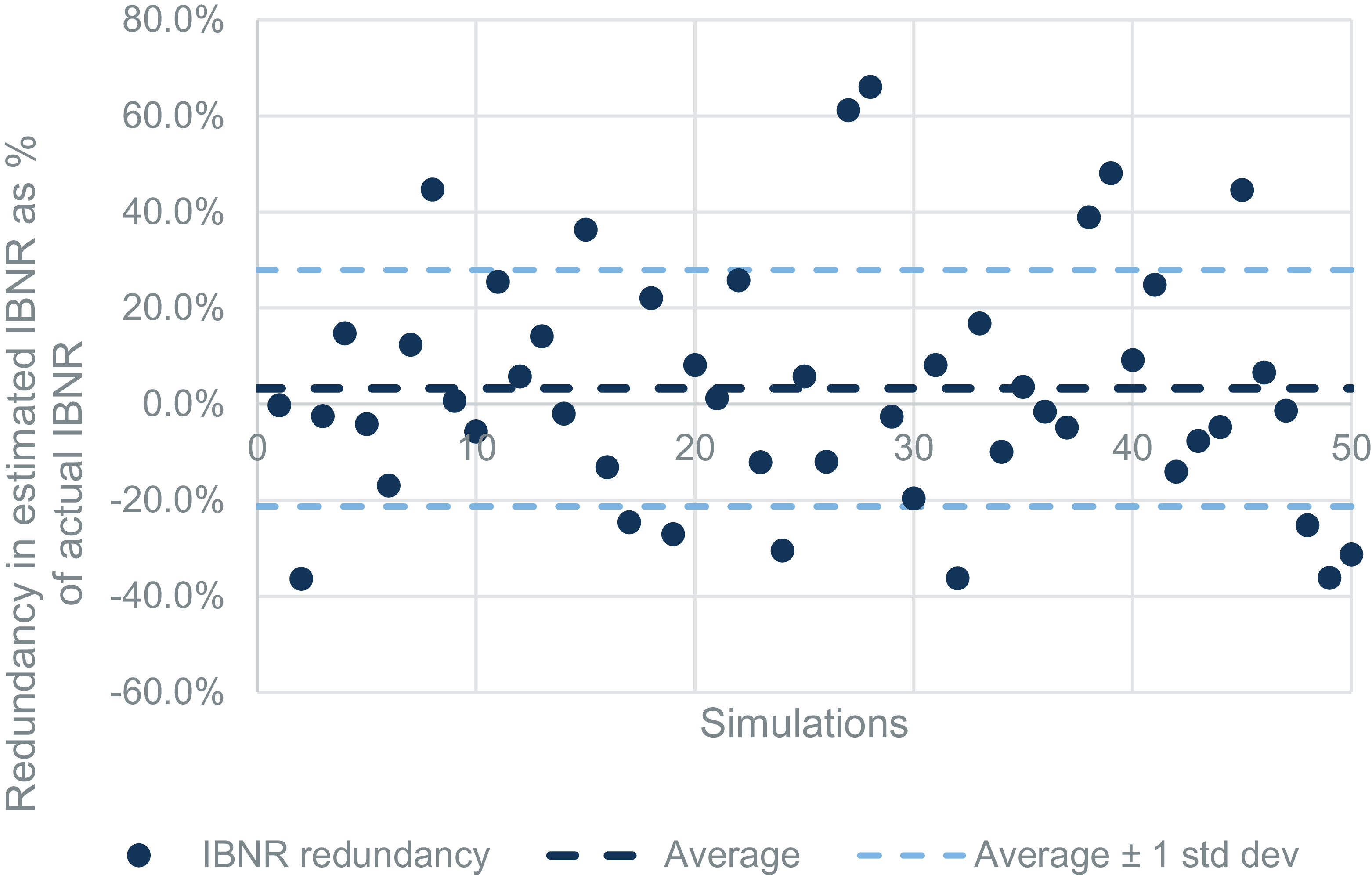
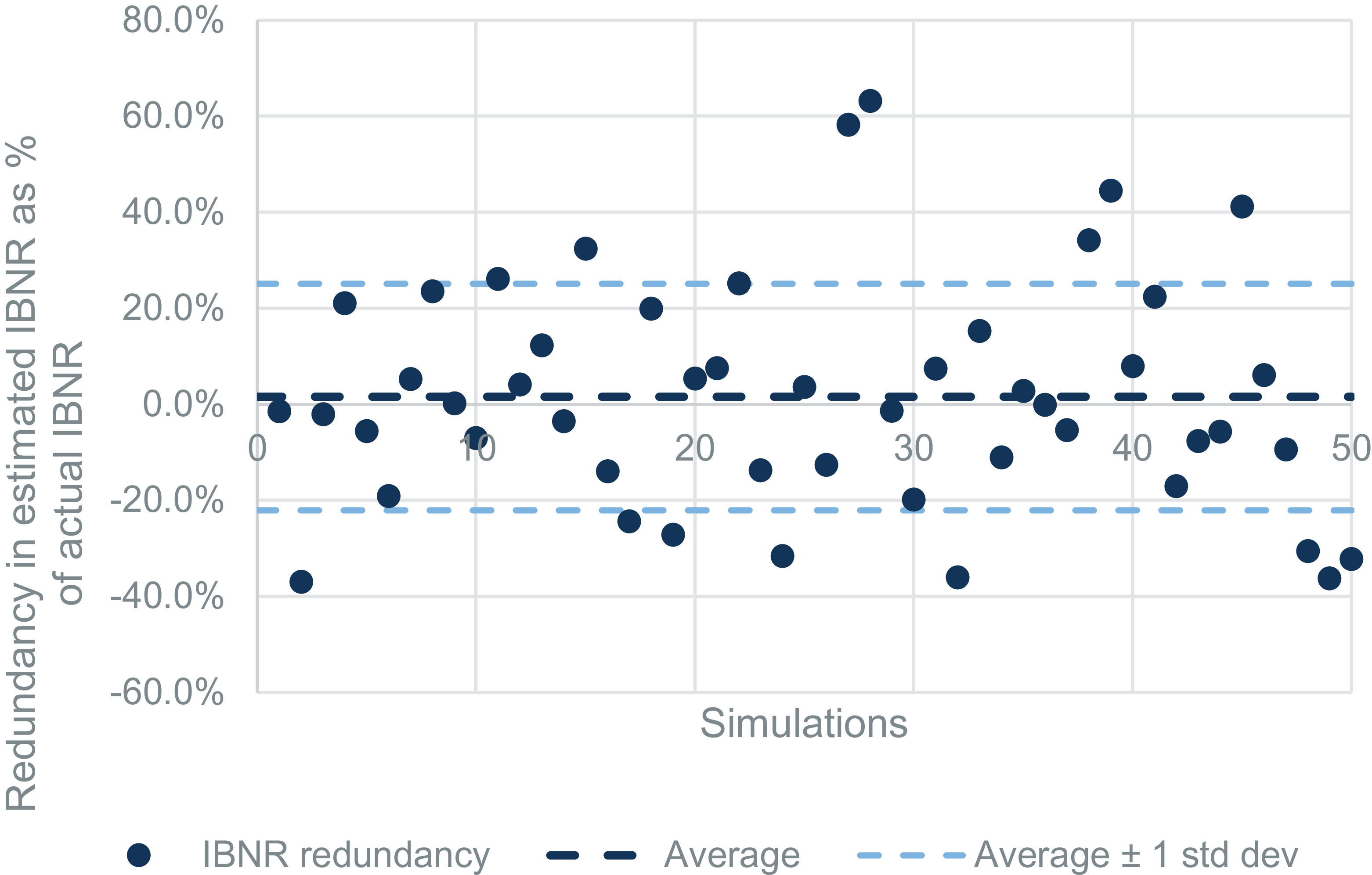






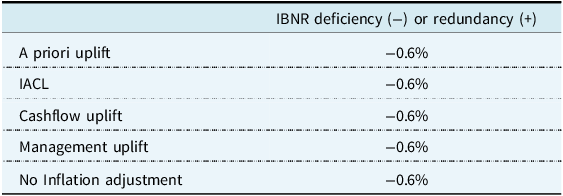
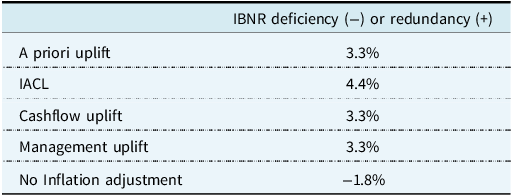
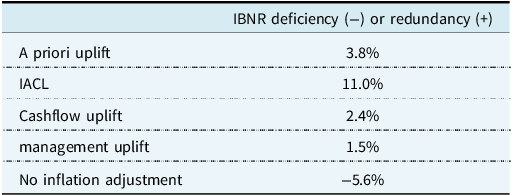
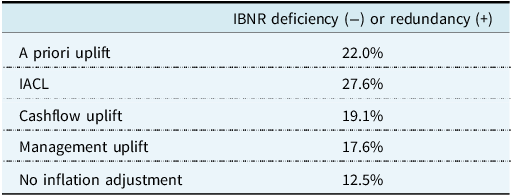


 Open access

