Introduction
While childlessness is not a new phenomenon, its nature has changed in recent decades. In contemporary developed societies, an increasing number of men and women consciously choose to have no offspring (Rowland, Reference Rowland2007), and childbearing has become a deliberate choice rather than a natural developmental stage (Miller, Reference Miller1983; Morgan & King, Reference Morgan and King2001). The question of whether people want to have children and the topic of voluntary childlessness have thus become highly relevant.
The researchers who initially explored this issue distinguished between involuntary (related to infertility) and voluntary childlessness (Somers, Reference Somers1993; Kelly, Reference Kelly2009). The distinction referring solely to the biological limits of reproduction has proven to be problematic, however. It is difficult to categorize a couple who did not seek any medical assistance when they had trouble conceiving. Similarly, it is not clear whether a fertile but single woman should be included in the ‘childless by choice’ category. In response to these problems, other divisions appeared in the literature that did not refer to a biological component. In recent years, a number of scholars have started to differentiate between childless and child-free individuals (Tanturri & Mencarini, Reference Tanturri and Mencarini2008; Basten, Reference Basten2009), and have raised the question of whether a lack of children is congruent or incongruent with individual attitudes (Koropeckyj-Cox, Reference Koropeckyj-Cox2002). The focus of this approach is on the values, motives and desires that underlie people’s fertility choices and on the way people experience childlessness (Letherby, Reference Letherby2002). Is childlessness a desired state for them, and, if so, to what extent?
In the early 1990s, Warren Miller formulated a theoretical framework for analysing childbearing behaviours in which the desire to reproduce and motives to have children are key components (Miller, Reference Miller1994). In the model, a reproductive behaviour is conceptualized as an outcome of the motivational sequence that starts with childbearing motives. According to Miller (Reference Miller1994, Reference Miller2011a, Reference Millerb), motivational traits (motives, motivations) are biologically based dispositions that can be described as a readiness to react favourably or unfavourably to various aspects of childbearing. These dispositions – combined with specific individual characteristics, psychological attributes and life course developments – underpin the desire to have a child. Next, as a person weights his or her desire and considers the available options and resources, the desire may transform into an intention. Intentions represent what a person actually plans to do, and are thus ‘desires constrained by reality’ (Miller, Reference Miller1994, p. 228). Finally, childbearing intentions lead to actual reproductive actions. This sequence is referred to as the Traits–Desires–Intentions–Behaviour (TDIB) sequence.
In Miller’s model, childbearing motives are basic factors that underlie the whole process. These motivational dispositions are assumed to be genetically determined and shaped in the course of individual development (Miller, Reference Miller1994, Reference Miller1995, Reference Miller2011b). They can be seen as cognitive schemas that are non-conscious, although a person might become aware of them through self-observation (Miller, Reference Miller2011b). Miller conceptualized two independent dimensions of childbearing motives: positive motives are dispositions to react favourably to various aspects of childbearing, while negative motives are dispositions towards unfavourable reactions. For a desire to have a child to be activated, it is necessary for positive motives to prevail. Importantly, Miller also developed the Childbearing Questionnaire (CBQ) to assess the positive and negative motives for childbearing (Miller, Reference Miller1995). Studies in the US have proved the reliability and validity of the questionnaire (Miller, Reference Miller1995; Van Egeren, Reference Van Egeren2003; Jagannathan, Reference Jagannathan2006) and good psychometric properties have also been shown for adaptations of the questionnaire or scales modelled on it in Italy (Sina et al., Reference Sina, ter Meulen and Carrasco de Paula2010), Honduras (Kennedy, Reference Kennedy2005) and Iran (Pezeshki et al., Reference Pezeshki, Zeighami and Miller2005).
The works of Warren Miller offer an attractive framework for studying people’s reproductive choices and an important tool to do so – the questionnaire. Previous research has found that childbearing motives (both positive and negative) are important predictors of individual’s desire to have a child (Miller, Reference Miller1995; Pezeshki et al., Reference Pezeshki, Zeighami and Miller2005). Their impact on reproductive behaviour has also been documented. Individuals showing more positive motives have been found to be more likely to take actual steps to have a baby (Miller, Reference Miller1995) and less likely to seek abortion in the case of an unplanned pregnancy (Jagannathan, Reference Jagannathan2006). The TDIB model has also been useful in investigating infertile couples’ choices regarding the use of assisted reproductive technology (Miller et al., Reference Miller, Millstein and Pasta2008).
Miller’s theoretical approach has hardly been applied to address the issue of voluntary childlessness explicitly. Interestingly, the early works of Miller – before the model was formulated – touched upon this topic (Miller, Reference Miller1981). Several previous studies included childless respondents (e.g. Miller & Pasta, Reference Miller and Pasta1993; Miller, Reference Miller1995), but they did not focus on permanent childlessness and its motivation. The model seems particularly appealing in this respect, however. It builds around the motivational component and links positive and negatives childbearing motives to reproductive desires and intentions. It thus invites a more in-depth investigation of how childbearing choices are shaped by psychological dispositions. At the same time, since the genetic basis of these dispositions is emphasized (Miller et al., Reference Miller, Bard, Pasta and Rodgers2010; Miller, Reference Miller2011b), the model offers a comprehensive view on human reproduction (and childlessness), encompassing biological, developmental and psychological perspectives. Importantly, the model defines childbearing motivation as a continuum. Consequently, it is possible to assess how strongly childlessness is wanted instead of looking at the issue in a simplistic way, distinguishing only between voluntary and involuntary lack of offspring.
To implement the TDIB framework for studying voluntary childlessness it is necessary to verify whether for childless individuals their reproductive choices are indeed resulting from the postulated motivational sequence. This is where the current study contributes. Its aim was to verify the first three steps of the theoretical sequence – traits (motives), desires and intentions – in a sample of childless Poles aged 30–39. To analyse the complete TDIB sequence and include behavioural outcomes in the model, longitudinal data would be required, collected over a long time span to cover all individuals that never become parents. Unfortunately, such data were not available. Nevertheless, looking into how motives translate into desires and intentions constitutes an important first step towards understanding people’s choices to remain childless. This is especially true if analyses focus on the age range when this choice becomes highly relevant, i.e. when the individuals are ‘most actively grappling with the parenting decision’ (Park, Reference Park2005, p. 395), as was the case in this research. The sample in this study was limited to men and women aged 30–39, which is the oldest age group with a relatively high intensity of first birth. The intensity declines sharply for older individuals. In 2014, only 0.7% of all first births occurred to mothers aged 40 or more in Poland (Central Statistical Office, 2015). Consequently, a meaningful share of the respondents in the analysed sample were likely to remain permanently childless.
This study investigated how childbearing motives shape fertility desires and intentions of childless individuals, who have reached the age when the final decision for or against reproduction has to be taken. Its general aim was to document the potential of the TDIB model for studying childlessness and its voluntary–involuntary character as a continuum. To this end, Structural Equation Modelling (SEM) was used to verify the theoretical sequence (motives–desires–intentions) in a Polish context. As reliable and valid measures are essential to allow for further studies on childlessness within Miller’s framework, the goodness of measurement of the three theoretical concepts was assessed. Consequently, the study aimed to validate the theoretical model as well as the adaptation of the Childbearing Questionnaire in the new research context.
Methods
Measurement of childbearing motives: the Childbearing Questionnaire
To measure childbearing motives, the Polish version of the Childbearing Questionnaire (CBQ-PL) was employed. The questionnaire, developed originally by Miller (Reference Miller1995), consists of two scales. The first scale measures positive childbearing motives (PCM). For this, a respondent is given a list of potentially desirable consequences of having children and asked to evaluate how desirable they are for him or her. The second scale measures negative childbearing motives (NCM) and similarly, a respondent is given a list of potentially undesirable consequences of having children and asked to evaluate how undesirable they are for him or her. For each consequence, a respondent uses a four-point scale to evaluate how desirable or undesirable the consequence would be (from ‘not at all’ to ‘very’). The questionnaire has versions for men and women and there are 28 potentially positive and 21 potentially negative consequences listed in each of them (for content of all items, see Miller, Reference Miller1995).
The Childbearing Questionnaire was translated into Polish and a back-translation was discussed with Warren Miller to ensure that the original meaning of items had not been distorted. One item (‘Having my child provide me with companionship and support later in life’) was divided into two separate ones in the Polish scale, since qualitative research in Poland showed that ‘old age support’ is mainly understood in practical terms in this context, while companionship has predominantly an emotional meaning (Mynarska, Reference Mynarska2009). Moreover, two questionnaire items designed to measure the childbearing motives of respondents who were already parents (i.e. their motives for having an additional child) were excluded from the analyses. Consequently, the scales analysed in this study consisted of 28 positive and 20 negative motives. The psychometric properties of the CBQ-PL were tested in a pilot study on 203 childless individuals aged 20–40, which indicated satisfactory levels of reliability and validity (Mynarska & Rytel, Reference Mynarska and Rytel2014).
Measurement of childbearing desires and intentions
To verify the relationship of childbearing motives with childbearing desires and intentions, measures of the two latter variables were constructed. The format and content of the questions were inspired by Miller’s approach (Miller, Reference Miller1995) as well as by the previous qualitative work (Mynarska, Reference Mynarska2009). The desire to have children was measured using a scale consisting of three items: (1) How much would you like to have a child? (2) How important is it for you to have a child? (3) How happy would you be if you had a child? The childbearing intention scale consisted of two items: (1) Considering your attitude towards children, but also your life situation and other plans for your future life, are you intending [planning] to have a child within the next three years? (2) In your opinion, how likely is it that you will have a child within the next three years? For each of the above questions, the participants marked their answers on a scale from zero to 10. The reliability and validity of these measures were also verified in the aforementioned pilot study (Mynarska & Rytel, Reference Mynarska and Rytel2014).
Participants
The analytic sample in the current study consisted of 314 childless individuals (159 females and 155 males; 50.6% and 49.4%, respectively). The participants were between the ages of 30 and 39 (mean=34.1, SD=2.8). They were recruited by the external research company ARC Rynek i Opinia in three regions of Poland, in September 2013. Since the sample was purposive, aiming at childless individuals in the age range when childbearing choices are highly relevant, the research company used their database of respondents and then a snowball method to recruit participants. The sample was heterogeneous with respect to place of residence (municipality size), educational level and marital status.
Participation in the study was voluntary and anonymous. Each respondent was approached individually. After providing some basic socio-demographic information, he or she completed the questionnaire on the provided laptop. The computerized procedure ensured the respondent’s privacy and was beneficial for data quality (e.g. the risk of data entry mistakes was minimized, and the problem of missing data was avoided as the software did not allow the respondents to omit questions).
Data analysis
The main aim of the study was to verify whether in the specific sample of Polish, childless individuals, positive and negative childbearing motives (PCM and NCM) were related to childbearing desires and intentions, as postulated in Miller’s theoretical model (Miller, Reference Miller1994). Structural Equation Modelling (SEM) was used to investigate the structural effects of positive and negative childbearing motives on childbearing intentions, as mediated by childbearing desires. Since the measurement level of the observed variables (items in the CBQ) is ordinal (from 1 to 4), one of the robust diagonally weighted least squares estimators (DWLS) was applied. Polychoric correlations were used as an input and a weighted least squares mean-and-variance-adjusted estimator (WLSMV) was applied to establish the goodness of fit of the tested model. Many simulation studies have shown that the DWLS approach is the most suitable for analysing categorical variables with fewer than five categories (see Finney & DiStefano, Reference Finney and DiStefano2013, for a review). Following the recommendations of Schweizer (Reference Schweizer2010), different fit indices were applied: the χ 2/df ratio, the comparative-fit-index (CFI), the Tucker-Lewis index (TLI) and the root mean squared error of approximation (RMSEA). A good fit was indicated when χ 2/df<3.00, TLI and CFI>0.90 and RMSEA<0.08.
Rather than a single-phase, all-in-one analysis a two-phase strategy was adopted (Mueller & Hancock, Reference Mueller and Hancock2008). In the first step, the CFA was used to test the measurement portion of the model (i.e. the part that links each of the indicators to the four designated latent constructs). In the second step, the SEM analysis was conducted in order to estimate the parameters of the structural portion of the model (i.e. the part that specifies the relations between the four latent constructs).
Convergent and discriminant validity of the constructs was examined by the following indexes: Composite Reliability (CR), Average Variance Extracted (AVE), Maximum Shared Squared Variance (MSV) and Average Shared Squared Variance (ASV). Convergent validity signifies that a set of indicators represent one and the same underlying construct, which can be demonstrated through their unidimensionality. To verify that this was the case, the Average Variance Extracted (AVE) was used as a criterion of convergent validity (Fornell & Larcker, Reference Fornell and Larcker1981). An AVE value equal to or larger than 0.50 indicates sufficient convergent validity, which means that a latent variable is, on average, able to explain at least a half of the variance of its indicators. To evaluate discriminant validity, the AVE for each construct must be greater than 0.50 and exceed the values of MSV and ASV. Moreover, the composite reliability (CR) should not be lower than 0.60 and standardized factor loadings should be higher than 0.70 (they should not be smaller than 0.40 at least).
The model was run for the whole sample, as the numbers were too small for separate models for men and women to converge. Men and women were compared for all analysed variables in order to verify whether such an approach was justified. The variances of the two samples were compared using Levene’s test, while the t-test was used to compare the means.
Before the SEM results are presented, some basic psychometric characteristics of the scales are provided. The internal consistency of, and correlations between, scales were assessed to verify the goodness of measurement of the analyses variables before they were entered into the model. The characteristics were computed for men and women separately, as well as for the whole sample.
The R package ‘lavaan’ (Rosseel, Reference Rosseel2012; Beaujean, Reference Beaujean2014) was used to perform the SEM. All the remaining statistics were computed using the IBM SPSS package.
Results
Reliability, correlations between scales and gender differences
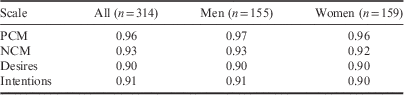
To verify whether the four theoretical concepts were measured accurately in the study, the core psychometric properties of the employed scales were assessed. The reliability coefficients were computed for all subjects, as well as for men and women separately. The internal consistencies were excellent. Cronbach’s α coefficients for all scales were equal to or greater than 0.90 (see Table 1).
Cronbach’s α coefficients for the analysed scales for Polish men and women aged 30–39, 2013

PCM: positive childbearing motives; NCM: negative childbearing motives.
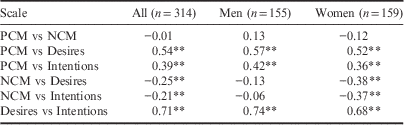
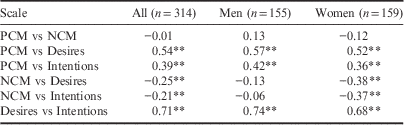
Next, to confirm the validity of the scales, the relationships between PCM, NCM, childbearing desires and childbearing intentions were calculated using Pearson’s correlations. The results are presented in Table 2. The directions and magnitudes of correlations were generally in line with the theoretical model. Desires and intentions correlated positively with positive motives and negatively with negative ones. The correlations were stronger between motives and desires than between motives and intentions. Overall, childbearing desires and intentions correlated to a much smaller degree with negative motives than with positive ones, especially among men. In the male sample, the correlations between NCM and desires and intentions were found to be statistically insignificant, although in the assumed direction. On the whole, the pattern of correlations was similar to the one that had been revealed in the original works of Miller (Reference Miller1995).
CorrelationsFootnote a between positive and negative childbearing motives, desires and intentions of Polish men and women aged 30–39, 2013
a Pearson’s r coefficients.
PCM: positive childbearing motives; NCM: negative childbearing motives.
*p<0.05; **p<0.01.
Moreover, in line with the theoretical expectations, the analyses showed that positive and negative childbearing motives are largely independent. The correlation between PCM and NCM turned out to be non-significant. However, it should be noted that the correlation coefficients for men and women, even though both were close to zero and insignificant, had opposite signs: the correlation was positive for men but negative for women. This effect might be random or it might occur due to the sample specificity, but it clearly requires further research. Apart from this difference, the pattern of correlations was similar for men and women.
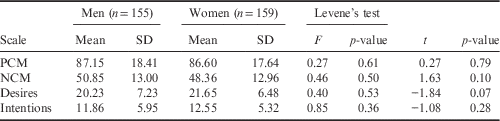
In the next step, men and women were compared on all analysed dimensions to additionally verify whether it would be justified to model the relations between motives, desires and intentions for both sexes jointly. The results confirmed that the sample could be considered homogenous. For all analysed variables, no significant gender differences were found (see Table 3).
Comparisons between Polish men and women aged 30–39 on the four analysed scales

PCM: positive childbearing motives; NCM: negative childbearing motives.
Modelling of the Motives–Desires–Intentions sequence
In the final step, the pattern of the relationship between the theoretical concepts was analysed using Structural Equation Modelling (SEM). In the first step, the CFA was used to assess the measurement portion of the model. The results indicated an adequate fit to the data: χ 2(1319)=2840.88, p<0.0005; normed χ 2=2.15; CFI=0.91; TLI=0.91; RMSEA=0.061; RMSEA 90% CI=[0.058; 0.064].
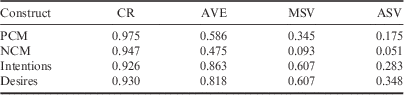
The measurement portion of the model allowed also for calculating additional reliability and validity coefficients. It additionally documented the psychometric properties of the applied measures of the theoretical concepts (see Table 4). The composite reliability (CR) values were above 0.90 for all of the constructs, indicating high internal consistency across the items in all scales. The highest consistency was related to the PCM items (0.975), and the lowest consistency was related to the items that measured Intentions (0.926). The standardized factor loadings of the CBQ items were over 0.60 in most cases. The factors loadings ranged from 0.615 to 0.893 for the PCM scale, and from 0.423 to 0.822 for the NCM scale. In the NCM scale, the factor loading was relatively low for one item only (0.423) and satisfactory for two others (0.557 and 0.565). The reminding factor loadings were above 0.60. For items related to Intentions and Desires the standardized factor loadings were above 0.80.
Measurement model: composite reliability and validity (convergent and discriminant)

PCM: positive childbearing motives; NCM: negative childbearing motives. CR: Composite Reliability; AVE: Average Variance Extracted; MSV: Maximum Shared Squared Variance; ASV: Average Shared Squared Variance.
As for the convergent validity, the results indicated that AVE values were above the acceptable threshold level (0.50) for most of the constructs, which means that the latent constructs accounted for 50% or more of the variance in the observed variables. Only the value for NCM was slightly below 0.50. However, since AVE is a more conservative measure than CR, it has been argued in the literature that a researcher may rely on the CR value alone and consider the convergent validity of the construct to be adequate, even if AVE is below the suggested threshold (Malhotra & Dash, Reference Malhotra and Dash2011). Regarding discriminant validity, all MSV and ASV values were less than AVE indicating that all constructs were correlated to their own indicators to a higher degree than to other constructs.
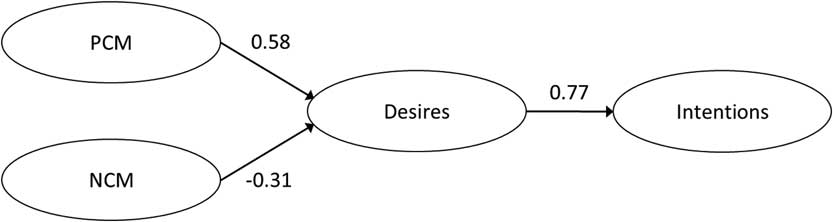
Once the goodness of measurement of all concepts was verified, the final verification of the motives to desires to intentions sequence was performed. The hypothesized model tested by SEM (the structural part) achieved a relatively good fit: χ 2(1321)=2826.84, p<0.0005; normed χ 2=2.14; CFI=0.91; TLI=0.91; RMSEA=0.060; RMSEA 90% CI=[0.057; 0.063]. The standardized path coefficients for the model are shown in Fig. 1 (the values of all of the coefficients were significant; p<0.0005).
The standardized path coefficients for the Motives–Desires–Intentions model. PCM: positive childbearing motives; NCM: negative childbearing motives.
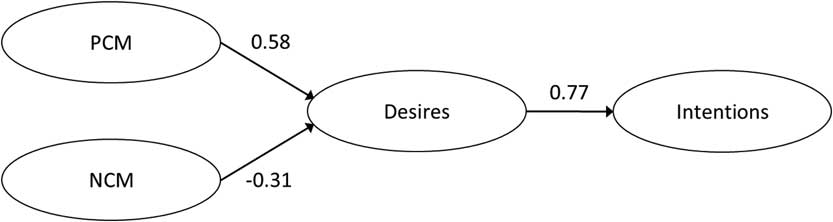
The results confirm that for childless individuals, in the analysed specific age range, childbearing desires are good predictors of reproductive intentions. The precise fertility plans are declared by those who strongly desire to have offspring. If the desire is low, individuals are more reluctant to formulate such plans. Moreover, fertility desires are shaped by positive and negative motives for childbearing, as postulated in Miller’s model (Miller, Reference Miller1994, Reference Miller1995, Reference Miller2011a, Reference Millerb). Notably, the effect of positive motives appears to be stronger than that of negative motives.
Discussion
If demographic developments of the last century are considered, in Europe as well as in the United States or Australia, the lowest levels of childlessness have been reported for women born in the 1940s, and rising again in younger cohorts (Rowland, Reference Rowland2007; Sobotka, Reference Sobotka2017). The increasing share of childless women has generated new research and a heated debate on the causes and consequences of having no offspring (Kreyenfeld & Konietzka, Reference Kreyenfeld and Konietzka2017). As Somers (Reference Somers1993, p. 643) noticed, prior to 1968 childlessness was listed only as a cross-reference to ‘sterility’ in the literature. However, as modern contraceptives became widely available and sexual as well as gender norms started to change, voluntary childlessness was put at the centre of research interests (e.g. Houseknecht, Reference Houseknecht1978; Veevers, Reference Veevers1980; Callan, Reference Callan1984; Gillespie, Reference Gillespie1999, Reference Gillespie2000; McAllister & Clarke, Reference McAllister and Clarke2000).
Nowadays, researchers continue to distinguish between ‘voluntary’ and ‘involuntary’ childlessness, even though they acknowledge that unequivocal definitions of these categories remain problematic (see: Basten, Reference Basten2009, or Berrington, Reference Berrington2017, for a summary of the various concerns regarding this issue). Consequently, several scholars have suggested that the two categories should be treated as extremes of a continuum and that researchers should determine to what extent childlessness is voluntary instead of whether it is voluntary or not (Miller, Reference Miller1981; Monach, Reference Monach1993; McAllister & Clarke, Reference McAllister and Clarke2000; Letherby, Reference Letherby2002). These suggestions have rarely been followed in empirical analyses, however, as it is difficult to operationalize and measure such a continuum. In the best case, the researchers distinguish between three categories, adding the middle one of individuals who are ambivalent (e.g. Carmichael & Whittaker, Reference Carmichael and Whittaker2007) or who are not strongly against childbearing but continuously postpone reproduction until it becomes too late (e.g. Berrington, Reference Berrington2004). In this paper, it is argued that the TDIB model of Warren Miller (Reference Miller1994) provides a valuable framework and good tools to study the continuum of voluntary–involuntary childlessness in a truly continuous way.
In the model, childbearing motives, desires and intentions are all considered as continuous variables. But the biologically based positive and negative motives that underpin the whole decision-making process seem particularly appealing for understanding childlessness. First, their measurement allows for capturing the motivational forces at the most basic level, which further influences childbearing desires and intentions. While the motives are shaped in the course of individual development, they are strongly determined by genetic predispositions and family background and thus are expected to be relatively stable in adult life (Miller, Reference Miller2011b). Consequently, they may turn out to be good predictors of permanent childlessness, even in a long-term perspective. Second, the Childbearing Questionnaire allows for analysing the content of these motives, and not only their strength. Already the distinction between positive and negative motives is appealing. For instance, it could be verified whether low positive or high negative motivation matters more for a decision to remain permanently childless. In fact, the former could be suggested based on the presented analyses, given the magnitude of the structural effects in the model. Moreover, the PCM and NCM scales have several subscales (Miller, Reference Miller1995), which could provide a far more nuanced perspective on childbearing motives. Such a perspective has been highly advocated based on qualitative findings on voluntary childlessness (Park, Reference Park2005).
Unfortunately, no data are yet available to verify the complete TDIB sequence in relation to permanent childlessness. Nevertheless, the current study has shown that childbearing motives indeed matter for the childbearing desires and intentions of childless individuals who are of the age when the final decision for or against parenthood has to be taken. Analyses of the initial three stages of the motivational sequence in such a specific sample confirm the potential of the theoretical model for studying the voluntary–involuntary childlessness continuum. In a broader view, the study provides support for the theoretical framework of Warren Miller, documenting its applicability in the new research context: in the new cultural setting and in a specific subpopulation.
An additional value of the present study is that it has verified the psychometric properties of the Polish version of the Childbearing Questionnaire (CBQ-PL). The results demonstrated that the scales of positive and negative motives for childbearing, as well as scales used to measure desires and intentions, are highly reliable. The findings also provide evidence on the validity of the applied measures. Consequently, the availability of the verified measurement scales makes it possible to further exercise the potential of the TDIB theory postulated above.
The biggest challenge for future research on voluntary–involuntary childlessness will be to collect a proper longitudinal data base to test the actual stability of the childbearing motives in adulthood and to verify the complete TDIB sequence. In fact, the process of such data collection has already been started in the Polish context. In 2016, over 2000 young childless men and women completed the Childbearing Questionnaire and approximately half of them provided their contact details and gave permission to be contacted again. With the subsequent waves of the study, it will be possible to test at least the stability of childbearing motives in the relatively near future. However, to verify how the motivational sequence influences actual reproductive behaviour, a longer and more extensive study is needed.
Acknowledgments
This study was financed by the National Science Centre (Poland), grant number 2011/03/D/HS4/05358. The authors would like to express their sincere gratitude to Warren Miller for his invaluable support and advice.