Despite focused prevention efforts, healthcare-associated infections (HAIs) remain common. A recent point-prevalence survey estimated that on any given day, 1 in 25 hospitalized patients in the United States has an HAI.Reference Magill, Edwards and Bamberg 1 HAIs increase the length of hospital stay, risk of mortality, and cost of hospital stay.Reference Carey, Saiman and Polin 2
Sepsis causes serious morbidity among children, and studies suggest that hospital-onset vs community-onset sepsis may be associated with an increased risk of mortality.Reference Weiss, Fitzgerald and Pappachan 3 , Reference Levy, Artigas and Phillips 4 Recent pediatric-specific collaboratives aim to improve outcomes of children who develop sepsis.
Little is known about the relationship between HAI and hospital-onset sepsis although these preventable conditions may be linked. Many children with chronic medical conditions require frequent hospitalizations and rely upon medical devices. These same children are at highest risk for sepsis-related death.Reference Odetola, Gebremariam and Freed 5 , Reference Hartman, Linde-Zwirble, Angus and Watson 6 Despite significant morbidity and mortality, the epidemiology of severe sepsis/septic shock associated with HAI remains poorly characterized. In this study, we aimed to determine the epidemiology of pediatric HAI-associated sepsis (HAI sepsis).
METHODS
We conducted a retrospective observational study of patients ≤21years old with a confirmed HAI incident between February 2012 and July 2013 at a tertiary care pediatric hospital with institution-wide HAI surveillance using all 43 Centers for Disease Control and Prevention (CDC) HAI definitions. 7 Severe sepsis and septic shock were defined using international consensus definitions.Reference Goldstein, Giroir and Randolph 8 HAI sepsis was defined as new-onset severe sepsis or septic shock within 2 days of HAI identification. We collected demographic, clinical, and infection characteristics using institutional registries and electronic health records. We used an ICD-9-CM (International Classification of Diseases, 9th Revision, Clinical Modification) code-based diagnostic classification system to identify complex chronic conditions.Reference Feudtner, Christakis and Connell 9 Summary statistics are presented as medians and proportions; data were compared using Wilcoxon rank sum and χ2 tests.
RESULTS
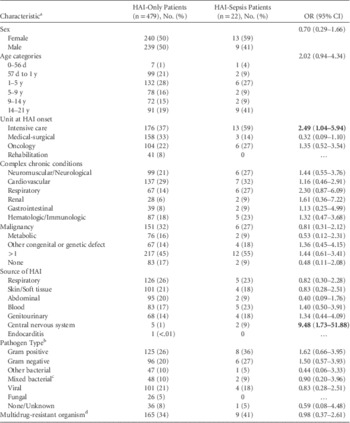
We identified 501 patients with HAIs (overall incidence rate, 2.2 HAIs per 1,000 patient days). Of these patients, 479 (95.6%) were categorized as HAI only and 22 (4.4%) were categorized as HAI sepsis (Table 1). Approximately 50% of all patients had >1 complex chronic condition. The groups did not differ by age, sex, number or type of complex chronic condition, or hospital length of stay (LOS) prior to HAI (data not shown). Patients with HAI sepsis were more likely to be in the intensive care unit (ICU) at HAI onset compared with patients in the HAI-only group (odds ratio [OR], 2.49; 95% confidence interval [CI], 1.04–5.94).
Patient and Infection Characteristics

NOTE. HAI, hospital-associated infection; OR, odds ratio; CI, confidence interval; IQR, interquartile range)
a Summarized as no. (%) or median (IQR).
b Some HAIs had >1 organism isolated.
c Mixed bacterial included (1) >1 type of bacterial organism; (2) bacterial+fungal organism; and (3) bacterial+viral organism.
d Multidrug-resistant organisms were defined as resistant to one or more drugs in ≥3 antibiotic classes to which the organism should be susceptible.
The most common HAIs were respiratory (n=131; 26%), skin/soft tissue (n=105; 21%), and abdominal (n=97; 19%). Bacterial pathogens were the most common cause of infection for both HAI-sepsis patients (77%) and HAI-only patients (63%) (OR, 1.75; 95% CI, 0.64–4.84). HAI-sepsis patients had higher odds of central nervous system (CNS) infections but similar odds of a bloodstream or respiratory infection (Table 1). Atypical pathogens were the cause of both CNS HAI-sepsis infections (Bacillus and Providencia spp.), while common skin commensal organisms were the cause of all CNS HAI-only infections. All CNS HAIs were related to indwelling ventricular fluid drainage systems.
All patients with HAI-sepsis were admitted to the ICU for care related to sepsis. Patients with HAI sepsis had longer median post-HAI hospital LOS (26 days [interquartile range (IQR), 14–53] vs 14 days [IQR, 6–34; P=.04]) and increased 30-day mortality (OR, 10.85; 95% CI, 3.75–31.40). The unadjusted odds of death were greater for patients in the ICU at the time of HAI-sepsis onset (OR, 6.07; 95% CI, 2.20–16.74).
DISCUSSION
To our knowledge, this is the first report to describe the intersection of HAI and hospital-onset sepsis in children. We found that the proportion of pediatric patients with HAIs who developed associated sepsis was relatively low. Infections that caused HAI only and HAI sepsis were similar, except that patients with CNS infections were more likely to have HAI sepsis. The unadjusted mortality and post-HAI LOS among HAI-sepsis patients was significantly greater than for patients with HAI only.
HAI and hospital-onset sepsis continue to be important targets for pediatric quality improvement and patient safety initiatives. It is unclear how efforts to prevent HAI and to speed recognition and response to hospital-onset sepsis have impacted the current risk of HAI sepsis. Despite the apparent low risk associated with it, HAI-sepsis might represent a future target for both HAI and sepsis improvement efforts. While we were unable to define the precise temporal association between HAI and hospital-onset sepsis, these may represent a failure to rescueReference Silber, Williams, Krakauer and Schwartz 10 through the early recognition and effective initial management of HAI.
Bacterial pathogens were the most common causes of both HAI-only and HAI-sepsis infections, and approximately 40% were multidrug-resistant organisms. We observed that the increased risk of HAI sepsis among patients with CNS infections seemed to be associated with the recovery of atypical pathogens. We hypothesize that a mismatch between the expected and actual pathogens recovered from HAI might be associated with an increased risk of HAI sepsis due to delayed initiation of optimal antibiotic coverage. Future studies will be needed to further evaluate this possible risk factor.
While the crude post-HAI LOS and risk of death was greater for patients with HAI sepsis than patients with HAI only, the small number of HAI-sepsis cases prevented us from adjusting for the severity of illness at HAI onset. Therefore, we are unable to assess the attributable impact of HAI sepsis on post-HAI LOS and 30-day mortality. This study was conducted at a tertiary-care, academic children’s hospital and may have limited generalizability. Finally, our use of retrospective data may have led to misclassification bias, which may have prevented us from assessing the precise temporal relationship between the onset of HAI symptoms and sepsis.
While HAIs were uncommonly associated with hospital-onset sepsis, additional studies are needed to define the temporal relationship between these conditions and identify potential prevention opportunities.
ACKNOWLEDGMENTS
Financial support: The study was supported in part by the CDC Prevention Epicenters Program (grant no. U54-CK000163).
Potential conflicts of interest: All authors report no conflicts of interest relevant to this article.