1. INTRODUCTION
Our experience of acousmatic music, like all other music, is fundamentally through time.Footnote 1 Whilst we listen to an acousmatic work our perception of time passing is affected by the auditory events we hear, our understanding of their relations to one another, and our expectations (based upon our past experiences and learnt schemas) as to what might happen next. Time, as experienced, is therefore personal and depends ‘upon the Umwelt of the subject’ (Rowell Reference Rowell1996: 87).
This article proposes a framework that will cover our perception of time by examining our engagement in the present and how this is fundamentally related to our past experiences and future expectations. The framework, outlining the temporal listening experience of acousmatic music, will therefore be segmented into five distinct parts: the distant past and the recently experienced (both of which concern our listening memory and the schemas built from our experiences); the predicted imminent and the remote future (related to our anticipations in the immediate future and larger expectations as to how a piece might evolve); and finally, the anchor for this framework, the attending present (which considers our perception in the present and the temporal flux).
2. SCHEMAS AND MEMORY
Schemas and memory are grouped since these are the tools used to form coherence of incoming auditory events during attentive listening. For Levitin (Reference Levitin2006: 114) schemas are ‘an extension of memory’, used to identify auditory events and groupings previously heard either in the same piece or a different one. A schema’s function is to simplify the listening experience by ‘compressing information’, allowing listeners to think ‘at more abstract levels of representation’ in order to anticipate upcoming auditory events and potential structures (Kendall Reference Kendall, Emmerson and Landy2016: 40). Of course different listeners can share a repertoire of musical concepts and practices leading to the categorisation and understanding of musical styles (Snyder Reference Snyder2000: 102), whilst also having ‘divergent opinions’ (Delalande Reference Delalande1998: 13) on how to groups sounds, based on personal schemas. Schemas are therefore an evolving set of memories based on a listener’s experience of a certain type of music and their ever-changing understanding of the rules of groupings, either related to the category of music, or the style of the composer. Schemas are separate from what Bregman (Reference Bregman1994: 401) refers to as ‘primitive processes’, which are a listener’s innate (as opposed to learnt) ability to group similar sounds, through Gestalt principles, either sequentially into auditory streams or vertically due to their shared spectral properties:
Schemas are learned, whereas primitive processes appear to be present in new-born babies and are therefore said to be innate. A schema selects from the evidence in an asymmetrical way, whereas primitive processes partition sensory evidence equally (and symmetrically). Primitive processes utilise short-term properties of sensory data, while schema-based selection involves looking at relations over a longer time span. (Hirst Reference Hirst2008: 13)
Snyder (Reference Snyder2000: 45) outlines two types of schemas that are used, and constructed, during the listening process: those that are learnt during the listening of a particular piece, and those that are formed by listening to many pieces of a certain style.Footnote 2 This article will refer to these schema sets as piece-specific and style-specific schema respectively. The third and final important schema set, particularly in acousmatic music,Footnote 3 is that of the particular style of a composer and the musical rhetoric they employ within their works – composer-specific schema. The schemas that are learnt from listening to a particular piece of music are of course added to the ever-evolving repertoire of schema sets within our long-term memory. Equally information from the style-specific schema informs the listening habits of the auditor and plays a fundamental role in how they will decipher, group and ultimately construct new piece-specific schema during attentive listening.Footnote 4 Likewise new auditory event groupings experienced in a new work, by a known composer, are added to the composer-specific schema. The processes of all three are entirely co-dependent and evolve in tandem as the listener experiences new auditory event groupings, especially those that challenge the schema being applied in that moment.
The use of schemas and the memory of past auditory events allow listeners to gain an understanding of a work’s form. After all ‘form embraces characteristics of global shaping and its relationship to shot-term clusters of events – gestures, phrases and the dynamic that exists between them’ (Young Reference Young, Emmerson and Landy2016: 59). However, a listener’s memory of the overall shape and internal details of a work can never be completely accurate. As auditory events pass from the short-term memory of the recently experienced into the long-term memory of the remote past, our recollection of events becomes ever more vague. Long-term memories of auditory events are not as vivid as those we have just experienced (Levitin Reference Levitin2006: 115). What remains are traces of auditory event clusters formed during the act of attentive listening. Such groupings cannot be automatically recalled in the same time order in which the auditory events occurred (Snyder Reference Snyder2000: 215) as we often have to ‘construct external reference systems to find particular events in the past’ (ibid.: 216). These memory traces can be cued (recalled) throughout a composition, particularly when recurrent musical events are experienced.
Our memory of auditory events and groupings are not fixed: as previously stated they are traces, and traces can be redrawn. After all ‘long-term memory is not at all static’ and ‘our memories constitute who we are, and who we are is always changing’ (ibid.: 71). While a piece progresses, our initial impressions of a sound or a group of sounds can adjust as new auditory events and information provide more context with which to judge and understand a past event’s significance:
[M]emory is in a continuous flux because conscious life is in constant flux and is not merely fitted member by member into the chain. Rather, everything new reacts on the old; its forward-moving intention is fulfilled and determined thereby, and this gives the reproduction a definite coloring. An a priori, necessary retroaction is thus revealed here. The new points again to the new, which, entering, is determined and modifies the reproductive possibilities for the old, etc. (Husserl Reference Husserl and Sherover1975: 493)
If a prior memory of an auditory event or grouping is cued into the present it is viewed within that window of consciousness. The original anticipations and expectations that were predicted when first experiencing the events are no longer. Indeed, the listener might have new information or evolved schema which alter his or her anticipations and exceptions in the present and the cued past events are therefore understood in this new context.
Of course not all sounds experienced are retained within the long-term memory. A function of our attentive listening habits is that we try to find ways to reduce the mental load of incoming events. ‘How we perceive any particular moment depends on the distinctiveness and memorability of previous and surrounding events, or whether there is a recognisable pattern in the morphology of change that may give us a sense of syntactical coherence’ (Young Reference Young, Emmerson and Landy2016: 65). If an auditory event does not fit within an immediate grouping (determined by the piece-specific, composer-specific or style-specific schema) then, unless it is particularly memorable, it will be considered redundant and the attention will remain on those events that share a clear connection.Footnote 5 Kendall (Reference Kendall2010a: 68) does remark that listeners can maintain a ‘gist of what they hear, even when the details are too complex to follow’. ‘Gist’s job of prioritising one sound while ignoring others is the most effective way of managing limited resources’ (Kendall Reference Kendall, Emmerson and Landy2016: 39) in order to keep up with the new incoming auditory events. Therefore, a general sense of an auditory event grouping (its contour, texture, dynamics, etc.) is stored as a trace whilst the listener’s primary focus is on another auditory stream deemed to be more important. How one determines the importance of an auditory event grouping in relation to others is again dependent on one’s application of schema in that instance. Auditory event groupings that conform to a listener’s learnt schema will generally take precedent over those that do not.
3. ANTICIPATION AND EXPECTATION
I wish to draw a distinction between the concept of anticipation and expectation. Although interchangeable in other domains, within this article the definition of anticipation is used to refer to the prediction of auditory events in the predicted imminent and is thus concerned with the succession of recently experienced events and the rhetoric surrounding their progression and potential closure. Expectation in this context deals with assumptions of larger structural changes in the evolution of a work beyond the predicted imminent towards the remote future. Since one can never be entirely sure of the high-level changes in a piece, certainly in the remote future, expectation is much more malleable and can evolve as the piece progresses and new auditory events and groupings provide new information.
Anticipation of proceeding auditory events can only occur when the listener is attending their arrival. As Bregman (Reference Bregman1994: 398) suggests, our attention to a musical passage is ‘under the control of an inner process that is trying to find some particular pattern in our sensory input’ and therefore schemas are what determine our voluntary attention. When auditory patterns are detected, the schema ‘enters a state in which it is primed to detect later elements’ (Bregman Reference Bregman1994: 403).
The listener continuously develops more or less specific readinesses (anticipations) for what will come next, based on information he has already picked up. These anticipations—which themselves must be formulated in terms of temporal patterns, not of isolated moments—govern what he will pick up next, and in turn are modified by it. Without them, he would hear only a blooming, buzzing confusion. (Neisser Reference Neisser1976: 27)
It is for this reason that anticipation has a direct correlation with the recently experienced auditory events, their groupings, and one’s short-term memory. The piece-specific schema that has been amassed through attentive listening will have the closest relation to the predicted imminent, particularly if the listener is currently in the process of experiencing a grouping of auditory events as they unfold. Style-specific schema can also help build an understanding of the potential closure of such a grouping (if the rhetoric of the closure is not a recurrent theme used in the composition previouslyFootnote 6) whilst providing an indication of the potential destination of the remote future.
Unlike tonal music where anticipation is led by predictions in melody, harmony and metre,Footnote 7 anticipation in acousmatic music concerns the connection and spectromorphological evolution of gestures and textures. It is therefore important to outline the principles of what might constitute the archetypal auditory events in acousmatic music and how their qualities might affect our anticipation of their development:
Like other musics, electroacoustic music has its expectation patterns, and I have already suggested that these are based on our wide cultural acquaintance with the perceived spectral changes of a wide variety of sounds. During listening we attempt to predict the directionality implied in spectral change. We might ask ourselves, for example, where a gesture might be leading, whether a texture is going to continue behaving in the same way, whether change is likely or not, whether change is likely to be concerned with gradual merging or sudden interruption, and so on. (Smalley Reference Smalley1997: 114)
Smalley’s (Reference Smalley1997: 115) onset, continuant and termination terminology within spectromorphology and Kendall’s (Reference Kendall2010a: 66) event schema both provide a process and framework to discuss an auditory event’s progression in acousmatic music. Hirst (Reference Hirst2011: 44) argues that ‘Smalley’s notion of spectromorphological expectation is really an elaboration on “gesture”’, and that ‘gesture is an “energy–motion trajectory”, with a start point, an end point, and an implication of some expectation along the way’. Gestures are particularly important in a listener’s understanding of an auditory event’s evolution since its spectromorphological attributes point towards an agent (a human) who ‘excites the sounding body’ (Smalley Reference Smalley1997: 111). The complication comes through the concept of gestural surrogacy (Smalley Reference Smalley1997: 112) in acousmatic music as understanding arrives not only from the spectromorphology of the auditory event, but also its significance related to its perceived source cause.Footnote 8 Acousmatic music can also contain other gestural auditory events one could describe as utterances. Smalley (Reference Smalley1996: 86) refers to utterances as an ‘essential vehicle of personal expression and communication’ as they are a gesture linked to the human body.Footnote 9 As with gestures, utterances are articulated and understood through the concept of the energy–motion trajectory. Finally, Smalley (Reference Smalley1997: 113) suggests that if a gesture is too long or slow in its spectromorphological evolution, the plausibility of a human agent is lost and thus the auditory event becomes a texture. Schaeffer (Reference Schaeffer2017: 198) explains ‘disproportionately long objects, even when they are well formed, cannot be grasped in their entirety by the ear’ and thus a listener has to break the object up into ‘slices’ in order to grasp their spectromorphological qualities. This creates a change in the listening focus as ‘the ear seeks to concentrate on inner details’ of a sound (Smalley Reference Smalley1997: 113). ‘A texture may be said to consist of countless inscrutable gestures. They are like the one-celled bacteria which are perceptible only in masses or cluster formations’ (Schafer Reference Schafer1977: 159). There of course is a fine line between what could be considered a gesture, a texture or perceived changes within a texture, which Emmerson (Reference Emmerson2008) refers to as the Ambiguous Event.Footnote 10 How one determines whether an auditory event is a gesture, texture or a collection of small events that form a Gestalt unit entirely depends on his or her listening habits and the context in which the sounds are presented. Indeed, understanding a sound’s spectromorphological qualities in part comes from our brain’s desire to compare it with other auditory events in close proximity (in relation to both time and spectral qualities). This desire to form coherence primes the listener to predict incoming auditory events based on what they have just experienced.
From an understanding of the archetypal acousmatic auditory events, and a listener’s anticipation of their spectromorphological evolution, we can move towards event groupings and the concept of acousmatic music’s syntax and tropes. After all, listeners are not only interested in the spectromorphological progression of auditory events, but also how sounds are grouped within a composition (Kendall Reference Kendall2010a: 65). Theorists and analysts, such as Roy (Reference Roy2003: 342) and his Grille fonctionnelle Thoresen and Hedman’s (Reference Thoresen and Hedman2007) work, including Thoresen’s subsequent investigations (Reference Thoresen2009, Reference Thoresen2010), work in adapting Schaeffer’s (Reference Schaeffer2017: 289) Typo-morphology and Smalley’s Spectromorphology frameworks into a notion system with structural relations,Footnote 11 have done most of the ground work in providing an indication of the archetypal auditory event relationships within acousmatic music. If a listener is aware of the archetypal event relationships within acousmatic music, then he or she has a ‘key’ to begin to understand the music (Landy Reference Landy1994: 57). These frameworks can be applied as schema in order to anticipate auditory events in the predicted imminent and form reasonable assertions as to the high-level structuring of the piece in the remote future. Beyond the two mentioned previoiusly, there are of course other frameworks listeners can use. In addition, by immersing themselves within a particular music style, listeners can develop their own style-specific schema, which can be referred to when listening to new pieces.
Without a relevant schema related to a work’s syntax or rhetoric, a listener will not be able to reasonably predict upcoming auditory events in the predicted imminent, particularly if they do not perceive any relationships with those held in the short-term memory of the recently experienced. This makes it much harder for the listener to group auditory events together into memory chunks,Footnote 12 and those not organised into chucks might be deemed redundant unless they are particularly memorable. If there is nothing the listener can anticipate, then they might enter a listening style akin to meditation since the music leaves them with ‘nothing but the present to focus on’ and nothing to engage long-term memory (Snyder Reference Snyder2000: 235). Considering this one can reasonably argue that what inexperienced listeners of acousmatic music struggle with is the lack of a perceived connection between auditory eventsFootnote 13 rather than the sonic material itself. Snyder (Reference Snyder2000: 236) argues that ‘uncategorizable events’Footnote 14 cannot be easily grouped for retention in the long-term memory and that only ‘determined listeners’ might be able to create a schema after listening to a piece many times. Of course there does exist an archetypal syntax and rhetoric for acousmatic music as previously outlined, but many new listeners will of course be unaware of these. The experienced acousmatic listener, however, will be well-accustomed to the formation of the music, giving rise to nuanced meanings as they draw from their schemas built up from listening to many different composers which act as ‘exemplars of the genre’s idioms’ (Kendall Reference Kendall, Emmerson and Landy2016: 31). Without a compatible schema to decode the music, the listener has no means to form any expectation, and without that the listener is left with nothing but the present. Of course if the process of structural organisation lies outside the esthesic considerations of the composer, then there is little from the music’s arrangement that can guide the listener. As Landy (Reference Landy1994: 51) suggests ‘most listeners are more interested in what they can hear. If the listener is unable to perceive an algorithm, what is the point of focusing on it in terms of programme information?’ However, I would argue that there is burden of responsibility on the part of the listener, particularly if he or she is new to acousmatic music, to suspend their disbelief when encountering auditory events and relationships they are not accustomed to. Given acousmatic music’s propensity to challenge our assumptions of an auditory event’s spectrum and, indeed, spatiomorphological (Smalley Reference Smalley1997: 122) qualities, it does require them to ‘relax the tight grip of plausibility to accommodate potential artistic meanings that arise from unexpected or novel spatial relationships’ (Kendall Reference Kendall2010b: 229). In doing so, they open themselves up to a whole plethora of learning possibilities and the creation of new personal schema with which to enjoy such musics.
When a piece is experienced on numerous occasions our anticipation and expectations shift.Footnote 15 No longer is the listener trying to predict all the incoming auditory events through piece-specific, composer-specific or style-specific schemas. Instead, the listener has a mental representation of the composition’s form through the memory traces created upon previous listenings. The more we listen to a work, the more accurate our mental representation comes to the original (Snyder Reference Snyder2000: 101). However, it should be stated that on repeated listenings we tend to focus on the same auditory streams and engage in the same listening patterns (Kendall Reference Kendall, Emmerson and Landy2016: 39). Of course listeners can change their listening habits as they develop a better understanding of a piece, particularly when they return to a piece with a new array of schema developed from experiencing other acousmatic works.Footnote 16
4. THE PRESENT AND LISTENING ATTENTION
Since this article is focused on psychological time and not clock time, the concept of the present concerns more than the mathematical accurate moment of the now. As Royce (Reference Royce and Sherover1975: 403) remarks when we refer to the present we never mean the ‘indivisible now of an ideal mathematical time’ since in this ‘indivisible time-instant, nothing could happen, or endure, or genuinely exist’. Instead the present in this article will refer to what James (Reference James and Sherover1975) terms the specious present: ‘In short, the practically cognised present is no knife-edge, but a saddle-back, with a certain breadth of its own on which we sit perched, and from which we look in two directions into time’ – a ‘duration-block’ (James Reference James and Sherover1975: 371). This duration-block’s length varies depending on listening circumstances, but is never smaller than a fraction of a second and never more than a few seconds in length (Royce Reference Royce and Sherover1975: 399). As Snyder (Reference Snyder2000: 60) suggests ‘the front edge of consciousness is always moving forward in time, the time limit of short-term memory forms a continuously moving window’. Our immediate experience of the attending present is therefore always between, and dependent upon, the recently experienced and the predicted imminent:
An attentive listener cannot experience only a durationless instant that travels through time without having the mind wander through the recent past and search rapidly for relationships between events and for changes in textures and timbres. Without the experience of the specious present that allows an immediate process of comparison, we would not be able to apprehend and appreciate these relationships and states of events as they occur in a musical context and therefore we would be unable to comprehend a musical composition. We would also be unable to understand the meaning of phrases and words, as these would be perceived as series of incomprehensible phonemes. (Pasoulas Reference Pasoulas2011: 26)
What we conceive as the present is fleeting, as in trying to place ourselves in it, in the now, it immediately becomes a memory of a moment and slips by into the past. Therefore the listener’s mind, if in an attentive state, is always looking for potential event relationships in the predicted imminent based on what they have just experienced. Those auditory events and relationships deemed to be of importance, through the use of schema, will be organised into chunks and memorised as memory traces for retrieval later (if needed). Understanding the specious present is important for composers who want to create clear immediate structural relations between auditory events. For example, if two events are separated by a long silence, then the potential perceived connection between them becomes ever weaker.
Of course, listening to a single succession of auditory events one after the other reduces the burden of mental activity for the listener. When more auditory events are sounding at the same time the brain attempts to either bind them, or separate them. If there are shared spectromorphological commonalities, they can bind to form a single Gestalt unit.Footnote 17 Conversely, if the auditory events are recognised as distinct entities, then they are placed within separate auditory streams: ‘Streaming is responsible for our ability to hear several different kinds of sounds simultaneously and to identify them as coming from separate sources’ (Snyder Reference Snyder2000: 144). As with all mental activity, there is a limit to the amount of simultaneous auditory information we can attend to at once. Landy (Reference Landy1994: 52) suggests that the attention limit is four distinct sound types and James (Reference James and Sherover1975: 373) surmises that this is dependant on the duration of the auditory information in each stream: ‘very few if they are long bits, more if they are extremely short, most if they come to use in compound groups, each including smaller bits of its own’.
A listener’s attending focus, particularly when there are multiple auditory streams, can vary. What a listener deems to be the most salient events of a work can largely be informed by their style-specific schema and, if listening to a known composer, the composer-specific schema (especially when experiencing a work for the first time). As we listen to a work, our focus on a particular stream might change depending on our engagement with the auditory event groupings. Our attention can be fickle and require frequent stimulation in order to be maintained. Changes in auditory event groupings that challenge a listener’s assertions of what will happen in the predicted imminent is one way of maintaining this attention. A sudden change in a secondary auditory stream might bring it to the forefront of our perception if the one being focused on at that time becomes too predictable. After all ‘musical novelty attracts attention and overcomes boredom, increasing memorability’ (Levitin Reference Levitin2006: 259). Ultimately, the focus of the listener dictates the hierarchy of incoming auditory streams. Only a gist of those considered to be secondary to the main auditory stream will be remembered.
Often the joy of listening to music is having our expectations subverted (within a reasonable degreeFootnote 18) by introducing new material or sudden changes in the relationships between auditory events. The most engaging music often sets up patterns of expectation in order to deviate from them ever so slightly to reduce predictability and therefore maintain the listener’s attention (Snyder Reference Snyder2000: 115). Importantly, each listener will have different tolerances for subversion, as ‘some of us are more open to experimentation than others’ (Levitin Reference Levitin2006: 239). Subverting expectations engages the listener in a mental activity where the piece-specific schema, built throughout the listening process, is put into question and thus has to evolve and adapt to account for these new and unique experiences.
5. THE EBB AND FLOW OF THE TEMPORAL FLUX
Our experience of time passing is not accurate with physical time and can fluctuate depending on the events we are experiencing. Schaeffer (Reference Schaeffer2017: 194) referred to this phenomenon as the time-duration anamorphosis. ‘Psychological time flow is elastic; we use expressions like “time drags” or “time flies” in order to describe our perception of time passing. Durations can only be estimated or “felt” when compared with other remembered durations’ (Pasoulas Reference Pasoulas2011: 30). Our sense of time is linked with our experiences in the attending present, particularly those that instigate change. Sherover (Reference Sherover1975: 350) argues that our sense of time is linked with change and that without some sense of changing content we would have no sense of time passing. Therefore, ‘awareness of change is thus the condition on which our perception of time’s flow depends’ (James Reference James and Sherover1975: 375). Without events to fill time we are less stimulated and our sense of time passing is much longer. Thus our perception of time in the attending present is on a continuum, alternating between being faster or slower than physical time. Within his thesis, ‘The Perception of Timescales in Electroacoustic Music’, Pasoulas (Reference Pasoulas2011: 36) provides the haste/languor continuum to illustrate the time-duration anamorphosis phenomenon.
As with all areas regarding perception the experience of time passing is different for each person. Those listeners who are engaged with incoming auditory events in the predicted imminent are in a state of attending and will most likely experience the passing of time quicker than those who are not. As Snyder (Reference Snyder2000: 214) suggests ‘our expectations (schema) are a factor in our sense of duration’ and in attending future events our sense of time can vary over the course of a piece.
In his investigation into the phenomenon of time-duration anamorphosis, Schaeffer (Reference Schaeffer2017: 196) presented subjects with the same sound played forwards and backwards. He noted that listeners experienced different durations of time for the same sound due to the suspense perceived by the delayed attack when reversed: some felt it was longer, others shorter. What is happening here is the energy–motion trajectory of sounds enact embodied senses of changing durations through their spectromorphological development: ‘We experience musical events as fast or slow, rising or falling, creeping or leaping, pausing and stopping’ (Johnson Reference Johnson2007: 225). As adults we ‘conceptualise time via deep, systematic spatial-movement metaphors in which the passage of time is understood as relative motion in space’ (ibid.: 28). In his chapter ‘Spectromorphology in 2010’, Smalley (Reference Smalley and Gayou2010: 92) suggests that one could consider the onset–continuation–termination structural functions as ‘expressions of image schemas related to symbolic meaning, in this case the schema of body movement’. However, he does follow by stating:
I start out with a simple spectromorphological archetype and in no time at all we become immersed in the philosophy of space and time in relation to image schemas: that is what happens with spectromorphology and why it is too simple to confine it to the seemingly pragmatic world of just describing sound shapes and structures. Once in search of signification we are quickly led into other domains of thinking. (Smalley Reference Smalley and Gayou2010: 92)
There is a clear connection between our sense of time and music-embodied cognition, particularly how it pertains to gestures and textures within the acousmatic paradigm. The metaphors we employ to describe the auditory event’s constituent elements only confirm this connection (highlighted by the onset–continuation–termination terminology). It is through the metaphor of movement that these embodied experiences can occur as we follow a sound’s progression, particularly when it conforms to our understanding of physics. What we need is a better understanding of this phenomenon and its effect on the temporal flux, particularly in acousmatic music.
Our memory of time passing can be very different to what we experience within the attending present. ‘In general, a time filled with varied and interesting experiences seems short in passing, but long as we look back. On the other hand, a tract of time empty of experiences seems long in passing, but in retrospect short’ (James Reference James and Sherover1975: 377). This is the same for music since ‘a time period filled with novel and unexpected events will be remembered as longer than an identical (in clock time) period filled with redundant or expected events’ (Snyder Reference Snyder2000: 213). When we recall a section of a work that contained a lot of activity, it generally seems longer due to the amount memory traces stored in our long-term memory. Those sections of an acousmatic piece where we are engaged in the attending present are more memorable, and therefore more memory traces are created compared to when we are not engaged or lose interest in the work.
6. THE TEMPORAL LISTENING FRAMEWORK OF ACOUSMATIC MUSIC
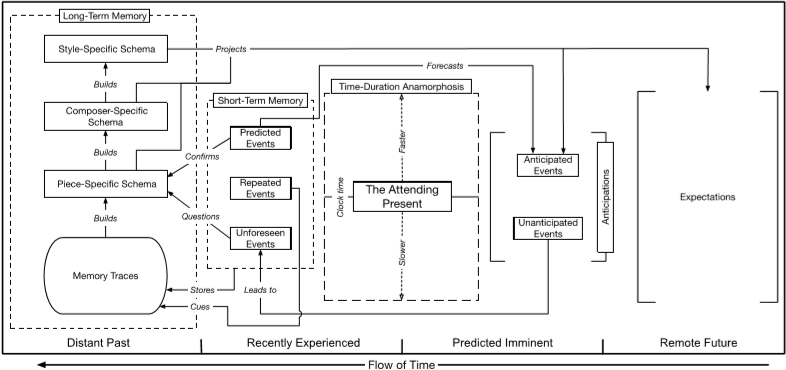
Figure 1 is the overview of the proposed temporal listening framework outlined in the previous sections. The attending present rests in the centre and straddles both the recently experienced and predicted imminent following the concept of the specious present. It also contains the time-duration anamorphosis to account for changes in the temporal flux in the experience of a work with clock time at the centre.
The temporal listening framework of acousmatic music.

Moving towards the left of the diagram, we find both the short-term and long-term memory sets. Within the short-term memory section we have three archetypal experiences: predicted, repeated and unforeseen events.Footnote 19 These remain for a few moments in the short-term memory before being stored as memory traces within the long-term memory.Footnote 20 If predicted events are experienced, then these confirm the piece-specific schema, whereas unforeseen events challenge what was expected and thus the schema evolves to account for this variance. If a listener experiences a repeated event, this can cue the relevant memory trace.
There is a hierarchy in the long-term memory since piece-specific schemas are a subset of composer-specific schema, which is also a subset of the wider style-specific schema. All these are used to project expectations in the predicted imminent and remote future. Finally, if predicted events are experienced and held in the short-term memory, the listener can continue to forecast future anticipated events in the predicted imminent.
7. IMAGO
Trevor Wishart’s Imago (Wishart 2002) has been chosen as an exemplar for this article to demonstrate the importance of memory, expectation and the temporal flux in acousmatic music for a number of reasons. First, like many of Wishart’s other pieces, it follows the genre of ‘morphic’ form, which Young (Reference Young, Emmerson and Landy2016: 66) describes as ‘the potential of electroacoustic music to develop materials through processes of continuous transformation of sound identity and timbre’. Within the first 15 seconds, the listener is introduced to the very basic concept of the entire piece; it is a work built from a single auditory eventFootnote 21 less than a 1/10th of a second in duration. ‘The essential feature of the piece is the gradual metamorphosis of one sound or soundscape into another’, which Wishart hopes is ‘clearly audible’ to the listener (Wishart Reference Wishart2012a: 102). Since only one sound is used to produce all the different auditory events within the piece, and because of the compositional choices to make this apparent at the beginning, listeners with a keen earFootnote 22 and relevant personal schema will understand this and thus form reasoned expectations of how the work might evolve. However, Wishart does subvert these potential expectations by breaking this seemingly steady metamorphic progression by introducing new mimetic materials so far removed from the original sound source that listeners might question whether they are not simply recordings of other sounds.Footnote 23
A compositional function of these mimetic events are as structural markers, which not only provide a ‘memory-trace’ (ibid.: 102), due to their recognisability, but also a ‘sense of expectation’ (ibid.: 109) by foreshadowing what is to come in the remote future. For example, extracts of the gamelan section are presented at numerous times throughout the pieceFootnote 24 before it is given an entire section to develop at 20′10″. To ensure these auditory events were not too prominent within the work, and to ensure they functioned as ‘soft echoes’, Wishart obscured the sounds and their recognisability by applying audio processes such as spectral blurring (ibid.: 109). By doing so he provides attentive listeners with memory traces of the upcoming auditory events in the remote future. This allows the listeners to form expectations even though these might not accurately predict exactly when the mimetic events might reoccur. When they do the listener can cue the relevant memory traces for the recurrent mimetic events.
Wishart (ibid.: 105) was also interested in creating ‘spectral sequences’ of successive auditory events in which a sound would gradually transform into another, a technique he likened to modulation in traditional tonal music. The complexity of these spectromorphological changes meant that Wishart needed to find a way of clearly separating the transforming auditory streams from others. By separating sounds spatially he was able to ‘characterise individual musical streams in counterstreamed sections’ having found that motion, or lack of motion, helped to differentiate one auditory stream from another (ibid.: 104). Furthermore, as part of the creation of new sonic material, Wishart (ibid.: 105) created ‘harmonic stacks’ to form new auditory events that would be understood as a ‘single percept’ (ibid.: 104). He therefore understood the potential issues of perceived spectral binding when one sound from another auditory stream would slowly transform.
Throughout Imago, Wishart provides assistance to maintain engagement through compositional choices. The internal structures illuminate the concept of the work, providing opportunities for the listener to anticipate and form expectations, whilst at the same time challenging these to maintain interest.
8. CONCLUSIONS
The temporal listening framework, presented in this article, provides a set of identifiers for those wishing to describe one’s listening experience of acousmatic music. It documents the interconnection between one’s memories of past events and how these inform our predictions of those to come. The framework highlights the importance of a listener’s personal schema in forming such predictions and how they are constantly evolving when new auditory events and auditory event groupings are experienced. It demonstrates the fragility of our memory and how our memory traces of past event clusters are also subject to change when recalled within a new context. Our perception of time in the listening flux is also accounted for, along with our experience of the present following the concept of the specious present. The framework does not, however, account for when a listener is not attending incoming events, either due to a lack of available schema or engagement with the work. In these instances most auditory events experienced will not be remembered since memory clusters cannot be formed. Singular auditory events cannot challenge a listener’s schema if there is no perceived connection to other events within a work.
In truth we cannot ever accurately predict how a piece might evolve upon first listening. We project expectations about the future, based on our present and past experiences of the piece. Considering the wealth of musical possibilities in acousmatic music (especially when compared to traditional tonal music), there are a lot of opportunities to play with the concept of anticipation and expectation. For the experienced listener the range in which one might be able to challenge his or her presumptions as to how a work might develop can be rather wide. However, if an acousmatic composer would want to enable a neophyte the opportunity to engage with his or her work, then they should consider some of the compositional techniques employed within Imago. Foreshadowing and clear links between auditory events allow listeners who might lack style-specific schema the ability to build their own understanding from just engaging with the work itself. After all, musical syntax and rhetoric are born from schemas, and our personal schemas inform our active listening habits.