In the realm of faith, doubt is an elusive concept. A modern working definition might sit in a tight circle with uncertainty, scepticism and unbelief, the non-existence of faith. Yet doubt can also be a result of deep engagement with belief. The combination is one reason why in recent years doubt and its close neighbour ‘unbelief’ have been the subject of lively discussion among medieval historians.Footnote 1 This essay is intended as a further contribution to that discussion, pursuing the location and treatment of doubt in a new context.
Among the many stimulating approaches to belief and doubt, three works in particular triggered this essay. At the beginning of the 1990s, in a lecture to the Royal Historical Society, Susan Reynolds further undermined the already ailing ‘Age of Faith’, with its assumption of credulity and the ‘incapacity for atheism, of the medieval mentality’. She warned against the homogenizing tendencies of scholars who, in seeking to understand the past, took the existence of different but all-encompassing ‘social mentalities’ not as a potential deduction emerging from their research but as an unargued premise.Footnote 2 To this she objected that ‘even in the most untouched and traditional societies’, anthropologists have found that ‘[s]ome people . . . seem, even if only privately, to doubt or question practices which reflect generally accepted beliefs and do so in a way that implies some kind of common-sense rationalism’.Footnote 3 Applied to the Middle Ages, this led her to argue that, although ‘most people probably accepted the Church's teachings without agonizing over them’, it would be difficult to maintain rationally ‘that [theologians] were unaware of the possibility of unbelief or unworried about it. They clearly knew about unbelief and regarded it as dangerous.’Footnote 4 In place of an ‘Age of Faith’ Reynolds offered different degrees of faith, with people of all social classes making the choices Christianity requires, some believing, others doubting, yet others hardly believing at all. She recognized that all three choices might entail hardship: faith could be difficult, piety ebbed and flowed, unbelief was sometimes dangerous.Footnote 5
The astuteness of Reynolds's approach was acknowledged fifteen years later by John Arnold in an extended examination of belief and unbelief among the late medieval laity.Footnote 6 Using a wide spectrum of evidence, Arnold explored levels of belief through the lenses of acculturation, community, selfhood and dissent, concluding that ‘there was no one medieval lay faith, but a spectrum of faith, belief and unbelief’. He proposed, furthermore, that ‘quite a bit of disbelief existed'.Footnote 7 Like Reynolds, in using ‘unbelief’, Arnold had in mind both complete disbelief and those practices which diverged from official norms and might be deemed superstitious or heretical by Church leaders, but which we might now interpret as expressions of belief.Footnote 8
The combined impact of the insights of Reynolds and Arnold and those on whose research they were building has, I believe, been very fruitful and it is one reason for the focus on doubt in this volume.Footnote 9 A third historian, Dorothea Weltecke, illustrates how the discussion has been taken further. Weltecke has regretted the use of the English word ‘unbelief’ as a poor translation of infidelis, with connotations of individualism and emancipation inappropriate to the Middle Ages. For Weltecke, like Reynolds and Arnold, there is no question of reinstating any idea of religious unity, which ‘was and is a fiction’.Footnote 10 But the way historians have categorized ‘unbelief’ is unconvincing, a ‘soft conceptual substitute to designate “atheist” phenomena’.Footnote 11 ‘Atheism’, as she observes, is an early modern concept, though its precise historical contours are not yet agreed.Footnote 12 She takes as her core evidence scholastic debates about whether God existed, arguing – surely rightly – that when medieval scholars used proofs of the existence of a God they did not do this to oppose God-deniers, but rather to prove ‘the truth of Christianity in dispute with other religions’ (and, I might add, to win arguments with their academic peers).Footnote 13 So, she concludes, ‘we learn nothing of the reality of thinking about the non-existence of God from this sort of text’.Footnote 14
Weltecke's target is the historical anachronism of arguing for a modern category of God-deniers in the Middle Ages. Her twin purposes seem to have been to challenge historians of the inquisition who do not distinguish sin from justiciable crime, and to propose a distinction between courtly, learned and other uses of the language of belief and doubt. As well as objecting to the use of learned texts as sources for modes of thinking outside the schools, she thus suggests that the vernaculars for ‘doubt’ – the medieval forerunners of the modern German Zweifel – are still more unsuitable than ‘unbelief’ as a category of analysis. The meanings of Zweifel encompassed secular as well as spiritual, intellectual or emotional modes and might be used in very different circumstances to render ideas such as fickleness, suspicion, unreliability and conflict.Footnote 15
There is a disciplinary divergence in the purposes and approaches of these three writers. Reynolds was exploring social relations and the gap between mentalité and the individual. Arnold was testing, and seeking to establish, the agency of the laity. Both argued for the feasibility and indeed the inevitability of doubts and unbelief. Weltecke's interest lay in the intellectual history of concepts used in the Middle Ages, which is one reason why she found modern uses of ‘unbelief’ or the umbrella term ‘doubt’ problematic. In their place, she has sought to distinguish emotional uncertainty and intellectual doubt and to underline the differences of treatment in diverse textual genres.Footnote 16 Thus she too has sought to offer new strategies for critiquing constructions of a ‘believing Middle Ages’.Footnote 17 As she put it in a recent handbook essay, pace the continuing objections of many scholars, the idea is gaining ground that it makes sense to approach our sources with the existence of religious doubt, indifference or absence of faith in mind.Footnote 18
Continuing attention needs nonetheless to be paid to the language used to express doubt and the distinctions intended. In the Latin texts discussed below, both epistemological doubt (uncertainty about means of knowing), and doubt about matters of faith are conveyed using verbs, adverbs and adjectives such as dubito and haesito, dubius, incertus and their opposite certus sum or the judicious use of a negative (non certus). The meaning is communicated (and analysed) through syntax, not just technical terminology. The extent to which historians can contextualize the use of this sort of language to grasp the reality of ideas about doubt or unbelief is one aspect of what will be tested here.
* * *
My title, ‘Doubting John’, is not a mistake. It is intended to conjure up Doubting Thomas, a familiar figure in biblical ideas on this theme, who, according to John 20: 24–31, declared that he needed to see and poke his finger into Christ's wounds and side in order to believe. But I will argue that John the Baptist is another, fundamentally more important, biblical doubter. Doubting Thomas appears in a single, short biblical text and his lack of conviction is quickly resolved. The proofs – sight and touch – are clear, and so the textual (and visual) echo is relatively focused, generating thought-provoking but relatively unproblematic resonances.Footnote 19 Indeed the exemplary potential of Thomas's swift realization of the truth made excellent material for sermons. John the Baptist, by contrast, is a protagonist of the gospels, a harbinger of Christ himself, making a ‘doubting John’ a much more challenging figure. Any resolution of his doubt is also much less clear. The Baptist's status as a doubter thus features prominently in so-called dispute texts, directed by twelfth- and thirteenth-century Catholic polemicists against the teachings of heretics, real or imagined. Reading these texts is what awoke my interest in ‘Doubting John’, and discussion of some of the ideas they tackle will form the end point of what follows. Two ways of understanding my title should thereby emerge into view: on one hand, John himself as a doubter; on the other, those who for this reason, amongst others, doubted John's virtue.
* * *
The medieval reception of John the Baptist was many-headed. After sketching his gospel story and its visual echoes, the discussion will concentrate on the episode where John might be deemed to be doubting, examining first the late antique biblical exegetes whose writings framed later thinking. It will then fix the focus on the years around 1200 in northern Italy, where John was both politically and visually significant. As Véronique Rouchon Mouilleron has noted, the Baptist was omnipresent in the visual repertoire of the peninsula, a reflection of his integration into both the political and the religious self-image of the Italy of the communes.Footnote 20
The Biblical Baptist and Visual Representations
The Baptist appears prominently in three clustered episodes all mentioned in more than one Gospel. The first of these clusters treats his preaching, prophesying and the baptism of Jesus (Mark 1: 2–11; Matt. 3: 1–17; Luke 3: 1–22; John 1: 26–40). The second is his question from prison about Jesus, with Jesus's reply and praise of John (Matt. 11: 2–15; Luke 7: 18–30), and the third is his death (Mark 6: 14–29; Matt. 14: 1–12). Luke does not include John's execution, but does refer to Herod's perplexity when he hears about Jesus, wondering whether he is John risen from the dead (Luke 9: 7–9). The narrative of John's conception and birth, on the other hand, appears only in Luke 1, while the Gospel of John offers further details not found elsewhere, such as John's denial that he is either Christ or Elijah (John 1: 19–27). The biblical John is a precursor of Christ, a prophet who knows the Messiah even in the womb, and later becomes a locust-eating, camel-hair wearing ascetic, a light burning in the desert. He is a preacher of repentance and baptizer at the river Jordan who again recognizes Christ, calls him the Lamb of God, and hears the voice of the Father: ‘This is my beloved son, in whom I am well pleased' (Matt. 3: 17; cf. Luke 3: 22; Mark 1: 11).Footnote 21 There is some confusion of the Baptist with Christ and a question as to whether he can be identified with the Old Testament prophet Elijah. But the key passage for our purpose is the description of the Baptist in prison, before being executed by Herod, posing a question about Jesus.
The visual representation of John the Baptist reflects this written version, with added details stemming from the New Testament Apocrypha. Until the twelfth century it was the Byzantines who produced most images of the Baptist, but already by the eleventh century he had become a common figure in Italian painting and sculpture.Footnote 22 In non-narrative images he appears in one of three guises: as a priest; as a shepherd wearing a camel- or other animal-hair coat, sometimes with a red cloak to symbolize his martyrdom; and, increasingly from the eleventh century, as an ascetic, naked, with long, unkempt hair, an image which may be associated with the new religious movements of the central Middle Ages. When portrayed as a prophet, he carries a banderole with the words Ecce agnus dei, ‘Behold the Lamb of God' (John 1: 29, 36), one of the most familiar prophetic exclamations of the Bible and not only because of its resonance with the Agnus Dei of the liturgy. In the late twelfth and above all the thirteenth century, narrative cycles developed in the West in which the two most frequently repeated scenes link John directly to Christ: the Baptism in the river Jordan and the Visitation of Mary and Elizabeth, when John leaps in the womb, recognizing the Messiah. Rouchon Mouilleron points out that these narratives became increasingly prominent on the facades of cathedrals or (particularly in Italy) on baptisteries, ‘monumental symbols of city cohesion’.Footnote 23 She also reminds us of the link with the emergence of the mendicants, both in the way that Francis of Assisi was equated not only to Christ but also to John and in the growing visual stress on John's preaching role, a defining activity of the friars.Footnote 24 The Baptist was, furthermore, one of only three biblical figures celebrated with a feast for his nativity, the others being Mary and Jesus. Moreover, in thirteenth-century Florence, he was claimed as a figure under whose name the city was governed, his image impressed on the reverse of coins, though he became an episcopal patron only in the 1300s.Footnote 25 In brief, by the thirteenth century, John the Baptist was a prominent urban image. His reputation and status were entwined with the world of the Italian communes and with the new religious orders associated with them.
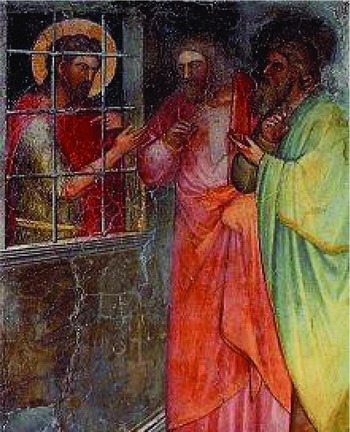
Whereas a common element in narrative cycles is the decapitation of John, his head often extended through the window of Herod's prison, the earlier episode of John in prison talking with his disciples appears less prominently in the iconography than it does in the Bible. A striking exception is the fresco painted by Giusto de’ Menabuoi in the baptistery of Padua, c.1378 (Fig. 1). One of the biblical texts which this scene evokes is Matthew 11: 2–3, known by the operative phrase, Cum audisset [Johannes]: ‘Now when John had heard in prison of the works of Christ, he sent two of his disciples, And they said unto him, Art thou he that should come, or do we look for another?’ To this question Matthew has Jesus answer (verses 4–6): ‘Go and show John again (euntes renuntiate Iohanni) those things which you see and hear: the blind receive their sight, and the lame walk, the lepers are cleansed and the deaf hear, the dead are raised up and the poor have the gospel preached to them. And blessed is he, whosoever shall not be offended in me.’ Once the messengers have gone, Jesus turns to the crowd and praises John, explaining that he is greater than the other prophets, greater than any other man born of woman, but that the least in the kingdom of God is greater than he. The same episode is narrated in Luke 7: 18–28 with slight variations, one of which underlines that John is the source of the question, since his disciples specifically inform Jesus that John had sent them to ask.
Giusto de’ Menabuoi, The Baptist in prison debates with his disciples, Padua, Cathedral Baptistery. Reproduced by courtesy of the Museo Diocesano Padua.

Early Exegesis
In the historical, literal method of reading the Bible – the starting point for biblical exegesis – the episode of John's question from prison poses a problem. Why did the prophet need to ask whether Jesus was the one? Had he forgotten his own earlier teaching and actions? Was he doubting Christ's role as the Messiah? And why, in Giusto de’ Menabuoi's image – in so far as it portrays this moment – is it the disciples who are looking uncertain, if not doubtful, facing a finger-pointing, masterful Baptist behind bars?
To begin to answer these questions and understand what approaches to John the Baptist can tell us about doubt in central and late medieval Italy, we need first to probe the writings of the patristic exegetes whose ideas so often worked their way into medieval texts, whether or not they were explicitly acknowledged. For all of them, the suggestion that John doubted was troubling, but Tertullian (d. 220) appears to be the only one who took the Cum audisset passage in Matthew to mean that John doubted Jesus's messianic status.Footnote 26 For Tertullian, in a treatise composed against the teachings of Marcion of Pontus (whose ideas are known only through the writings of opponents), John's change of mind followed the transition to Jesus of that part of the Holy Spirit (portionem spiritus sancti) which had animated him as a prophet. Jesus needed it while preaching on earth. So the Baptist, now a common man of the crowd, became a doubter – up to a point: ‘No-one will have doubts (haesitabit) about someone he knows not to exist and of whom he has neither hopes nor understanding. . . . Plainly it is easier for him to have doubts about one whom, though he knows he exists, yet he does not know whether this is the man himself’.Footnote 27 Jesus's ensuing reference to those offended in him therefore applies to John but, by reminding the Baptist of his miracles, Jesus proves that he has really come, rescuing the prophet from his uncertainty.
Tertullian uses both haesito and dubito to describe John's predicament, but confines its scope by emphasizing what the Baptist did know: ‘he was certain (certus erat) that no one was God except the Creator’. Any doubt is tightly circumscribed. Even in this restricted form, however, Tertullian's interpretation appears to be an outlier. Whether or not they were writing to counter heretical views, the patristic exegetes whose ideas were picked up later narrow the implications of John's question, not accepting that John himself doubted, but at most arguing that he may have sent the question because he lacked information about the details of Christ's advent.
The teacher and ascetic, Origen of Alexandria, writing in the 240s, was the first to suggest that John's question perhaps had something to do with the descent into hell: John recognizes Jesus as the Messiah, but is asking if he is to go down into the underworld.Footnote 28 The belief that Christ spent the time between his death and resurrection in the underworld was a regular feature of early Christian teaching.Footnote 29 Linking it to John's question was an idea with a long future, as was another, more obvious theme picked up by Origen: the didactic role of the Baptist. In a homily on Luke, Origen described John having a conversation with his disciples during which a question arose, so he sent his disciples to ask because he could not go himself.Footnote 30
A century later, Hilary, earliest recorded bishop of Poitiers (d. 367/8), who spent much of his career opposing Arianism, again portrayed John as a teacher and explicitly located the difficulty in the minds of his disciples.Footnote 31 In his first work to circulate, a commentary on Matthew, Hilary wrote:
Accordingly John asked (consulit, literally, ‘took counsel') not for his own example but because of the ignorance of the disciples; since he had preached that [Christ] was to come in remission of sins. But he sent his disciples so that they would know that he had not preached another [and] so that [Christ's] works would be understood, would confirm the authority of his [the Baptist's] words and no other Christ would be expected than the one whose works bore witness.Footnote 32
Here John is certain; it is his disciples who need reassurance.
Two generations or so later, in 390 or 391, Ambrose, bishop of Milan (d. 397) completed his Exposition on the Gospel according to Luke, which – as his near contemporary Jerome was only too keen to point out – depended heavily on Origen.Footnote 33 For Ambrose, a literal reading of the passage would appear to suggest that John, who had previously known Christ, no longer recognized him. But he dismissed this reading: ‘So great a prophet as John cannot be suspected of such an error’. The bishop of Milan thereby introduced a core concept, ‘error’, which underlines the weight of the problem of a doubting John.Footnote 34 But having established that a simple interpretation is contradictory (conpugnat), Ambrose took refuge in the spiritual meaning, suggesting that by sending his disciples to ask the question, the Baptist, earlier identified as himself representing the Law, was now ensuring that in Christ his disciples received the fullness of that Law. The bishop added that John had sent them because deeds are more effective than words, and drew similarly on the image of Thomas's fingers, introduced as a form of proof: ‘But we too have seen in John, with our eyes we have seen the Apostles, and we have examined with our hands in the fingers of Thomas’.Footnote 35 For Ambrose, John's doubt that the one who was to come was to die arose not from want of faith, but out of love or devotion (pietate dubitavit). Thus he was like Peter, who doubted when he protested the suffering of Christ (Matt. 16: 22).
Ambrose's critic, Jerome, likewise offered an explanation of John's question, including it in a commentary on Matthew completed in just two weeks in 398, an effort of speed-writing which – like the works of Hilary and Ambrose – was to give rise to a standard reference work for the Middle Ages and beyond.Footnote 36 Jerome, too, used Origen as a major source, pointing out that when John put his question, ‘he did not say “Art thou he who has come”, but “Art thou he who is to come?”’ For Jerome, the meaning of this is: ‘Command me, since I am about to descend to the lower world, whether I should announce you there . . . Or does it not befit the Son of God that he should taste death? Are you to send another to carry out these mysteries?’Footnote 37
Jerome again explained away any possibility that John was doubting Christ. At most the Baptist was uncertain about how the mystery of salvation was to be completed. Nonetheless the presence of doubt about Christ did not entirely dissolve. Having begun by affirming that John did not ask his question out of ignorance, Jerome explained that the Baptist ‘sends his disciples to Christ, so that on this occasion, when they see the signs and miracles, they may believe in [Christ] and, with their teacher asking, learn for themselves’. Signs and miracles would resolve any outstanding questions. Moreover, for Jerome, the crowd around Jesus was explicitly struggling to understand: they were ‘not aware of the mystery of [John's] question’ and ‘thought that John was in doubt about Christ, whom he himself had presented (demonstraverat)’.Footnote 38 Doubt moved from John to the crowd. Jesus's subsequent sermon was therefore understood as a means to correct their misunderstanding.
Three other patristic exegetes require mention before turning to how these ideas were picked up in the central and late Middle Ages. John Chrysostom, preaching at the end of the fourth century, almost certainly in Antioch, attacked Origen's interpretation head-on.Footnote 39 He used a form of language which underlines epistemological rather than faith-based grounds for the doubt expressed. First Chrysostom affirmed that ‘[John] did not send because himself disputing (ἀμφιβάλλων), nor did he ask in ignorance.’Footnote 40 ‘For it does not belong to John to dispute this, nor to any ordinary person, nor even to one extremely foolish and frenzied'. So why did John send his disciples to ask? Chrysostom's answer drew on analysis of other elements in the biblical context: John's disciples were jealous of Jesus, who was baptizing and attracting crowds, ‘and wanted to find some handle against him’. They did not yet know who Christ was, imagining Jesus to be a mere man, and John greater than man, so they were ‘vexed at seeing the former held in estimation’ while ‘their own master was now diminishing’. Their jealousy was ‘blocking access’ to Christ. As long as John was with them, he had been trying to persuade them, without success. Now on the point of dying, he feared that they would remain apart from Christ. According to Chrysostom, if John had said, ‘Go to Him, He is better than I’, he would still not have persuaded them,
as he would have been thought to be saying this out of modesty, and they would have been all the more attached to him; or if he had said nothing, again nothing would have been gained.. . . Accordingly he waits to hear from them that Christ is working miracles, and sends two (whom he perhaps knew to be more teachable than the rest), so that the inquiry could be made without suspicion, in order that from Jesus's acts they might learn the difference between Jesus and himself. Thus he says, Go, and say, ‘Art thou he who should come, or do we look for another?’ Christ, knowing John's purpose, did not say, I am He; for this would again have offended the hearers, though it is what it would have been natural for him to say; instead he leaves them to learn it from his acts . . . when they were come to him, then ‘He cured many’.Footnote 41
Having set out his own extended interpretation, Chrysostom summarily rejected the views of those who suggested that John asked his question because he was in ignorance, that he knew that Jesus was the Christ, but not whether he was also to die for humankind. For Chrysostom this was ‘not tenable; for John was not ignorant of this’; after all, he had preached: ‘Behold the Lamb of God who takes away the sins of the world'. So Chrysostom dismissed as unsustainable the idea that John's question related to the descent into hell, and scorned its implications for sin as the doctrine of ‘old wives tales’ and ‘Jewish fables’. Chrysostom's John is psychologically acute, as a prophet needs to be. He does not experience doubt, but recognizes it in his disciples and acts to ensure that they follow Christ.
A generation later, Augustine (d. 430), incidentally the first witness to a feast of John the Baptist, celebrated on 24 June, again built on the pattern of interpretation of his predecessors. In his De consensu evangelistarum (Harmony on the Gospels), Augustine's main concern was to show that there was no real contradiction in the different gospel accounts of John, although he admitted that he could not reconcile the precise sequence of events in relation to John sending his disciples to ask Jesus a question.Footnote 42 In a sermon on the Cum audisset passage, however, Augustine began by observing that ‘[the Gospel] has set before us a question touching John the Baptist’. He then adopted the by now traditional view that John sent his disciples to resolve their uncertainties, not his own. First he described the virtues and actions of John and observed that ‘when he [John] saw the Lord, he . . . pointed his finger toward him and said, “Behold the Lamb of God, who takes away the sins of the world”, “behold, here he is”’.Footnote 43 We will return to the significance of the pointing finger, an image also used by Jerome. What is more, Augustine imagined the words John used, having John himself deny his doubting:
Go then, ask him: not because I doubt, but that you may be instructed (non quia ego dubito, sed ut uos instruamini). Go, ask him, hear from him himself what I am in the habit of telling you; you have heard the herald, be confirmed by the judge. Go, ask Him, ‘Art thou he who should come, or do we look for another?’ So they went and asked; for their own sake, not for John (propter se, non propter Ioannem).Footnote 44
Finally, Gregory the Great (d. 604) touched on the subject of John's question in his sixth Homily on Ezekiel, and expanded his interpretation in a Homily on the Gospels.Footnote 45 In the latter, Gregory began, like Augustine, by drawing attention to the question raised by a literal reading: ‘It must be asked, dear brethren, why John asked . . . as if he did not know whom he had prophesied and baptized'.Footnote 46 For Gregory, following Origen and Jerome, John did not ask because he doubted that Jesus was the Redeemer of the world, but so as to know whether the one who had come into the world would descend into hell and, as the one who had announced Jesus in this world, he should do the same in hell. But Gregory also invited his listeners to think about the change of location, observing:
the question can be quickly resolved if we think about the order of events: on the river Jordan, John had stated that [Jesus] was the Redeemer of the world, but now in prison, he poses the question – not because he doubted that this was the Redeemer of the world (non quia ipsum esse mundi Redemptorem dubitat), instead, he asks that he may know whether he who, in his own person had come into the world, would in his own person descend also to the world below.Footnote 47
For Gregory, location and context modified John's thinking, which was focused on Christ's actions.
In sum, these Church Fathers, Latin and Greek, acknowledged that a literal reading raised the possibility that John was a doubter, for why else did he ask a question? The extent of many of their responses – barely hinted at here – indicates that the question was troubling. It is not surprising that they minimized the possibility that this was doubt in faith, arguing that the Baptist was either requesting information about his own future role or asking so as to instruct his jealous disciples. They imagined the encounter and, in the case of Augustine, enlivened the exchange by putting words into John's mouth. Doubt on the part of the Baptist himself, if acknowledged at all, was about means. Apart from Tertullian, doubting John was acknowledged only as a phantom to be argued away, usually by assigning the doubt or uncertainty to his disciples, or, less often, to the crowd listening to Jesus. The means to dissolving these doubts were then supplied: seeing and hearing, signs and wonders, as well as, in Ambrose, the virtual touching experienced through Thomas.
Medieval Echoes 1: Biblical Exegesis
The Ordinary Gloss (Glossa Ordinaria) as developed in the central Middle Ages relied heavily on patristic scholarship as well as on early medieval exegetes, particularly Bede, for whose contribution there is insufficient space here. Begun in the late eleventh century as a teaching tool at the school of Anselm in Laon, the gloss was completed in Paris by c.1175, taking a more or less stable, though never entirely fixed, form.Footnote 48 The treatment of Matthew's Gospel was among the earliest, produced in Laon. As Lesley Smith has recently reminded us, the gloss was the work which in the late Middle Ages ‘gave the simple [Bible] text its voice’.Footnote 49 It was the key most scholars would have encountered. On John's question it offered a series of familiar points: John, who was to be killed by Herod, asked the question, but not because he doubted or disputed (non quia dubitet) what he himself had said and heard elsewhere (with a reference to ‘Behold the Lamb of God' [John 1: 29], and ‘This is my beloved son’ [Mark 1: 11; Matt. 3: 17; Luke 3: 22]). Rather, John asked his question ‘so that the messengers seeing the signs should believe in the miracles of Christ, lest another Christ be expected'. This was needed because John's disciples had shown pride against, and envy of, Christ. Again echoing earlier commentators, the glossator explained the grammatical nuance to be understood in the question, ‘Art thou he who is to come?’, pointing out that John did not use ‘who came’. John was therefore to be understood as asking whether, as the one who announced Christ on this earth and was about to descend to hell, he should announce Christ below. In short, ‘is it appropriate for the son of God to die, or are you to send another to this sacred [task]?’Footnote 50
In summing up earlier learning, the Ordinary Gloss was by no means an end point: scholars continued to produce commentaries which drew on, clarified and added to its content. In the 1230s and early 1240s, for example, the earliest major mendicant commentator, the Dominican Hugh of Saint-Cher (d. 1263), completed a commentary based on his teaching in Paris, the Postilla in totam bibliam. It was intended as a supplement to the Ordinary Gloss and some 420 manuscripts have so far been located, with the peak of circulation in the two decades to c.1260.Footnote 51 In the longer gloss on Matthew, completed c.1239, the Postilla made explicit use of earlier writers, including Gregory and Hilary. It introduced no new arguments: once more the disciples doubted, not John. The structure of the gloss may nonetheless reflect what was uppermost in the writer's mind: it opened by asserting that John, knowing he was about to die, asked his question because he wished ‘to remove from the hearts of his disciples all doubt about Christ (omnem dubitationem amovere . . . de Christo)’.Footnote 52
The other thirteenth-century commentary which cannot be passed over in silence is the Catena Aurea of a still more famous Dominican, Thomas Aquinas (d. 1274). A compilation of the writings of the Fathers arranged around gospel passages, the Catena was composed in 1263.Footnote 53 On Matthew 11: 2–5 Aquinas drew the Fathers into a virtual conversation, in a format designed to be memorable. Thus he quoted Gregory's emphasis on the need to investigate the passage and establish whether John knew Christ, and answered this with Ambrose's argument that John doubted, though not in faith. To Ambrose, Chrysostom was made to respond critically: to think that John could have doubted seemed hardly reasonable, since John was not in ignorance of Christ's death, having been the first to preach it. The conversation continued with further passages from Gregory, Ambrose and Chrysostom and from Hilary, Jerome and the Ordinary Gloss. It concluded with mystical interpretations which go beyond the historical, literal reading which is of concern here.
A primary purpose of works such as the Ordinary Gloss, Hugh's Postilla and Aquinas's Catena was to guide students. The Dominican Aquinas presumably had in mind the preaching friars of his own order, but many other university students would have been heading towards careers in the Church outside the religious orders and were increasingly anticipating that they would preach. So we might expect to find echoes of the biblical commentaries in sermons produced in this period. The pericope including Matthew 11: 2, Cum audisset Iohannes, was, conveniently for our purposes, the gospel reading for the second or third Sunday of Advent. A quick exploration of the Biblioteca Nazionale in Florence for manuscript collections containing sermons on this pericope or for the feast of the Baptist that were produced or widely circulated in thirteenth- and early fourteenth-century northern Italy turned up eight: those of the Franciscans Luca de Bitonto (fl. before 1255) and Bonaventure (d. 1274), the Dominicans Aldobrandinus de Toscanella (fl. 1287–92), Giordano da Pisa (d. 1311), Hugo da Prato florido (d. 1322) and Giovanni da San Gimignano (c.1260–c.1333), a Servite, Luca da Prato, and an eighth which remains anonymous.Footnote 54 Like biblical commentaries, these sermons made use of patristic writers. Of the latter, as we have seen, Augustine, Gregory the Great and John Chrysostom, whose sermons or homilies were widely copied, had all preached on the Matthew passage and the question it raised. Moreover, as in the late antique period, so in thirteenth-century Italy, heresy was a key concern in the extant writings of learned believers, both clerical and lay. Three of this small sample of thirteenth- or early fourteenth-century sermons on the Baptist used the pericope Cum audisset. Yet doubt seems to have made its way into only one, that of Aldobrandino da Toscanella, who spent most of his career as a lector in Dominican studia, communicating Thomist teachings to younger friars.Footnote 55
The holdings of the Florentine Biblioteca Nazionale are by no means a complete guide to Italian sermon collections. There may well be a bundle of thirteenth-century sermons on the Baptist and doubt in another library. It would probably be possible to expand this brief list by looking at published editions. But it would remain risky to push this sort of argument any harder, given the fragmentary evidence we have for mostly oral events. If most of the preachers identified knew at least the Glossa Ordinaria on Cum audisset, with its implications of a doubting or at least uncertain prophet, why did this quality not make it into their sermons on the Baptist?
One immediate explanation for the silence on doubting John lies in the purpose of sermons, and in particular of the sermon collections consulted. They were intended to assist other preachers, perhaps to demonstrate the learning of the writer, but above all to promote firm belief, in the wake of the Fourth Lateran Council of 1215 and its opening constitution, Firmiter credimus.Footnote 56 As numerous modern writers have made plain, however, not all Christians were required to perform or demonstrate the same level of firm belief.Footnote 57 For Aquinas, full understanding of faith, cognitio, was expected of the maiores, the clergy, responsible for teaching the minores, the laity.Footnote 58 Was there any benefit in raising the problematic question of his doubt or uncertainty when preaching to the laity about the Baptist? As the list in note 55 illustrates, there were after all, other useful pericopes to which a preacher could turn.
Medieval Echoes 2: Dispute Literature
Arguments from silence are never very convincing, so let us move to firmer ground, and texts where we do find an emphasis on doubting John: the dispute literature. A genre which returned to prominence in the central Middle Ages, in part as a result of disputation in the Schools, these texts engaged directly with the teaching of various groups, including dualists whom modern historians tend to call Cathars but whose followers called them ‘good men’ or ‘good women’.Footnote 59 Eckbert von Schönau (d. 1184) and Alain de Lille (d. 1202) produced two of the early classics. The patristic dialogue form also continued: Gerhard Rottenwöhrer has catalogued a large number of anti-heretical polemics constructed in the form of debates with heretics which were not infrequently written by converts to orthodoxy.Footnote 60 Of the dispute texts probably produced in Italy, one of the earliest to refer to John the Baptist as a doubter was the Summa contra haereticos of Pseudo-Prepositinus of Cremona, written in the late twelfth century and extant in ten thirteenth- or fourteenth-century manuscripts.Footnote 61 The structure of the text as a dispute allowed the anonymous writer to distinguish clearly between the arguments attributed to the voice of the Catholicus and to the Cathari. For Cathars, who denied the humanity of Christ, John's role as a prophet had to be refuted because it formed part of the narrative of the redemption of humanity through Christ's birth, death and resurrection.Footnote 62
Pseudo-Prepositinus is one of just two writers who did more than briefly assert the heretical view of John as a doubter:
Again, in the same gospel of Matthew it is said (11: 2–3): ‘Now when John had heard in the prison the works of Christ, he sent two of his disciples, And said unto him, Art thou he that is to come, or should we look for another?’ See, here it is held that John had doubts about Christ (dubitavit de Christo); therefore he did not believe he exists; therefore he did not have his faith; therefore he did not please God; because (cf. Hebrews 11: 6): ‘without faith it is impossible to please God'; thus therefore he was evil, and consequently to be damned.Footnote 63
Doubt here is immediately equated to lack of belief and to absence of faith, indeed to a failure to believe that Christ exists at all. Lack of faith justifies damnation.
Pseudo-Prepositinus's counter-arguments derived from texts or ideas that we have already come across, placing doubt in the heads of John's disciples, and insisting on the need to learn in faith:
To the first [point], let us reply by interemption [i.e. by total destruction of the argument], saying that John did not doubt, but rather, since his disciples were doubting, he sent them to Christ, wishing to teach them in faith, so that hearing and considering his words and miracles, they would be instructed and believe. For how could doubts about Christ have been held by the man who not long before had pointed him out with his finger (digito demonstraverat), saying (John 1: 29): ‘Behold the Lamb of God, Behold he who takes away the sins of the world?’Footnote 64
Like Augustine and Jerome, when Pseudo-Prepositinus referred to a standard proof that John knew who Christ was, in the phrase ‘Behold the Lamb of God', he used a visual, gestural image, a pointing finger. This language did not derive from the biblical account of the Baptist. Instead, in imagining John pointing, it both stemmed from the commentary tradition and matched contemporary iconography, where John was often shown pointing, a mark of certainty and of knowledge, with a strongly epideictic function.
The interplay between written and visual modes of argument is no surprise. In a sermon on the resurrection for the first Sunday after Easter, Pope Innocent III (1198–1216) drew on visual evidence, for example, when considering the various questions that might be asked about Christ's resurrection. The questions included why Jesus appeared to women first rather than to men, why he appeared ten times and whether his resurrected body was clothed. To answer the last of these queries, the pope supplied passages from the New Testament to demonstrate that the resurrected Christ was dressed and then added: ‘and this is proven not just from new paintings in churches but also from old ones, which claim their origin from the primitive Church’.Footnote 65 There can be no certainty about which images Innocent had in mind, although there are many candidates: perhaps a scene of Christ's life in the nave of Old St Peter's;Footnote 66 or the resurrected Christ in the Christological cycle in the eighth-century oratory of John VII in the same basilica, which housed the Veronica, an icon dear to his heart;Footnote 67 or perhaps something heard about or remembered from earlier travels, such as the mosaic of Christ appearing to the Apostles, at Sant’Apollinare Nuovo in Ravenna (c.520). Innocent was happy to exploit the power of both text and image as proof. The same sermon also introduced another allusion to the power of the visual: ‘Indeed, lest anyone could doubt this (ne quis posset super hoc aliquatenus dubitare), [Christ] kept the signs of the wounds on his body, one reason for which was to confirm the faith of the apostles more strongly’.Footnote 68 For Innocent, as for his contemporaries, visual evidence could be a powerful tool.
Another dispute text produced in Italy in the late twelfth century originated as the confession of Bonacursus, a convert from the Cathars, to whose words were later added materials intended for the rebuttal of unorthodox doctrines. On John, the resulting composite text stated simply that the Cathars
. . . condemn John himself, than whom none is greater, according to the word of the Lord. Why? Because the Lord says in the Gospel, ‘He that is the lesser in the kingdom of God is greater than he’ and because he had doubts about Christ (dubitavit de Christo) by saying ‘Art thou he who is to come, or do we look for another?’Footnote 69
The response was furnished later in the text and gathered together biblical texts explaining John's virtues without directly tackling the question of doubt.Footnote 70
Judging from the numbers extant, the production of dispute texts in northern Italy seems to have grown in the early thirteenth century. The Disputatio inter Catholicum et Paterinum haereticorum written by an otherwise unidentified layman called Georgius has been dated to c.1210–34 by its recent editor, Carola Hoécker. It was among the most successful northern Italian texts against heresy, surviving in more than fifty manuscripts and widely copied. This time the text attributed to the Manicheus (by this date a generic term) links John's doubt with the timing of his death. John doubted when he sent two of his disciples to ask Jesus, ‘“Art thou he who is to come or do we look for another?” Moreover on their return he had [already] been seized by death and died in doubt and thus he is damned.’Footnote 71 In constructing his response, Georgius adopted multiple approaches, turning first to the words of Jesus, with a summary of his sermon to the crowds after John's disciples had left. He also offered a clue to his tactic of reading verse-by-verse down the page of a biblical text so as to construct his argument:
Catholicus [addressing the Manicheus]: Jesus Christ gives much better witness of [John] after the departure of these disciples than you suggest, saying of him to the crowds ‘What went ye out into the wilderness to see? A reed tossed by the wind?’ As though he were saying ‘No’, to which he adds, ‘A man clothed in soft raiment?’ No, [Matt. 11: 7–8]. . . . And below (Et infra)Footnote 72 he calls him ‘More than a prophet’ [Matt. 11: 9]. . . . Because [John] had been his angel on earth, he wanted to be his angel in hell. In fact therefore [John] doubted the passage of Christ to hell and asked him about it. ‘Art thou he who should come . . .’
Having explained John's question, Georgius then addresses the ‘most wicked ones’ with a fuller discussion of doubt itself:
Not every doubt is damning and deadly . . . And even if this doubt of John's were damaging, you do not have it from the Gospel that he died in doubt. More correctly: his messengers could have returned and reported to him. For if, as you say, he had already been seized by death, then Jesus instructed them poorly when he said: Ite, renunciate Iohanni [Matt. 11: 4], because he ordered something impossible; and his yoke there would not be easy [Matt. 11: 30], but ‘grievous to be borne’ [Matt. 23: 4] because he died before he could renounce. It is evident, therefore, that your teaching is false, because you condemn one praised by the Lord, and turn the teaching of Christ into the vice of impossibility.Footnote 73
For Georgius – like the Fathers – the type of doubt was to be differentiated. Doubt about Christ as the Messiah would surely have been ‘damning and deadly’. Georgius acknowledged that John's doubt might have been damaging, but did not accept that he died in doubt.
In case his first arguments did not convince, Georgius went on to introduce the familiar idea that it was John's disciples who doubted Christ and did not believe John: ‘Therefore, lest they should remain in this doubt, he sent them to Jesus, so that Jesus himself should proffer witness of himself as a good prophet.’ In conclusion, Georgius again tried to downplay the significance of John's question. To prove that putting a question need not imply that the one asking did not know the answer, he referred to Christ's exchange with the Pharisees about paying tribute to Caesar: ‘Nor does it follow [that “because] he asked, therefore he doubted.” Take for example (instantia): Christ [who] asked, saying, “Whose is this coin?” [cf. Matt. 22: 29]. “Therefore, he doubted”, is not true’.Footnote 74
Whoever Georgius was, his is a sophisticated, multi-layered reply: grammatically aware, deploying the language of scholastic disputation, careful about the potentially diverse meanings of doubt and drawn from biblical commentary, but also based on direct perusal of the relevant gospel passages. Hoécker convincingly concludes, nonetheless, that he was a layman, and probably a notary.
Another work which originated in a lay context was the Liber Suprastella (Book of the Higher Star) by Salvus Burci, a notary in Piacenza, on the river Po south of Milan. Burci wrote his treatise in 1235 and chose the title, he explained, to differentiate it from a book by heretics entitled ‘Star’. His other reason for the title was that, ‘just as the stars show the way to those travelling at sea and bring them to harbour, so this book shows the way of the true faith and leads to the port of salvation’.Footnote 75 The modern editor of the Liber, Caterina Bruschi, proposes that Burci had probably been involved as a notary in episcopal inquisitions which had been taking place in Piacenza. Part at least of his reason for taking up his pen may have been to prove the innocence of the patrons in whose house he was writing, a family linked to some of those accused of heretical beliefs in the preceding years.Footnote 76
Burci's text is less orderly than some of the other dispute texts and his method – like that of Georgius – stems as much from his training as a notary and the ars dictaminis as from biblical commentary. In the same manner as other writers of dispute texts, he first sets out the arguments of the heretics, often quoting biblical passages, and then gives his answer, the Catholic viewpoint, again using biblical passages and arguments drawn from them. The Liber dedicates a whole chapter to John the Baptist, including the assertion that heretics believe that John is ‘most false, because he was a liar and doubted the advent of Christ’ and, if he was not actually a demon, he at least came from the devil.Footnote 77 The case for John the doubter is further tied to particular groups among contemporary heretics. According to Burci, the Concorezzenses – one of the Cathar groups identified by inquisitors in northern Italy – argued that John doubted Christ on the simple grounds that he sent his disciples to put the question, ‘Are you the one?’ ‘So, he doubted the advent of Christ, therefore he is evil'. So far, so familiar. But Burci then puts the following words in the mouths of the heretics: ‘Oh Church of the devil which is called Roman, be still! Why? Because you believe John to be a member of Christ, but he is a member of the devil'.Footnote 78
Demonizing heretics as the body of the devil, contrasted to Catholic Christians as the body of Christ, is a topos in anti-heretical polemics.Footnote 79 It therefore might seem appropriate to set aside the heat of Burci's imaginative ventriloquizing as the rhetorical flourish of a writer seeking to underline his own and his patrons’ orthodoxy by denigrating his opponents’ extreme tone. But the pitch is equalled by the voice Burci adopted to explain his own, orthodox viewpoint: ‘I respond, “Oh, hopeless heretics not understanding Scripture, when will you sustain the punishment for such great blasphemy . . . ?”’Footnote 80 Heat is matched by heat.
Among the further arguments listed, Burci then analyses the syntax of John's words in a manner which echoes his training as a notary as much as it does earlier biblical commentary. He separates the sentence into two halves, the first of which, in his view, is not to be read as a question (non legatur interrogative):
And note that John did not say, ‘Are you (es tu), the one who is to come?’ Rather he said, ‘You are (tu es) the one who is to come’. That is, to judge (ad judicandum) . . . But then what follows is to be read as a question, ‘Or do we expect another?’ That is, to judge? As though he were saying we are not ‘expecting another’. The heretics would perhaps say, ‘Why did he send his disciples to Jesus if he did not doubt?’ I reply: ‘note that John sent them at a time when Christ was doing miracles, therefore he sent them because John wanted [to ensure that] his disciples would believe firmly (crederent firmiter) in Jesus Christ, without any doubt, as he foresaw that he would have to be separated from them because he was to be decapitated.Footnote 81
Addressing the ‘snake-like heretics’, Burci asks whether they wish to see openly (videre aperte) that John did not doubt, noting as his evidence that when John sent his disciples, Jesus started praising him immediately, ‘which he would not have done so quickly had John doubted, instead he would have censured, not praised [him]’. This opens the path to a discussion of the similitudines which Christ used in praising John, who was not like ‘a reed, moved by the wind' (cf. Matt. 11: 7–8). Rather, it is as though Jesus was saying that John was ‘certain about Christ, without any doubt’ (firmus de Christo sine dubitatione aliqua). Earlier in this passage Burci focused on the phrase ‘more than a prophet’, observing: ‘The prophets, in truth, prophesied Christ's advent, this [prophet] however pointed with his finger, saying “Behold the Lamb of God”, etc.’ Burci then explained the meaning of the pointing finger: ‘If he pointed with his finger then he was not doubting (Si digitto ostendit ergo non fuit dubius), as the ignorant heretics say, therefore in consequence [he was] good.’Footnote 82
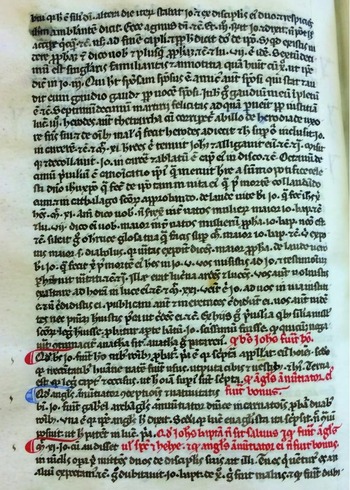
As with the biblical commentaries and the sermons, there are too many details in the argument and too many dispute texts to do them justice here. A few final works cannot, however, be ignored. The first is a Summa contra haereticos dated to c.1235 and attributed to the Dominican Peter of Verona (d. 1252), who had grown up among heretics.Footnote 83 In Peter's Summa, as in Burci's Liber Suprastella, a whole chapter is dedicated to John the Baptist (Fig. 2). As proof that John was a doubter, the heretic proffers the timing of Christ's reply to the disciples: he tells them to go and tell John what they had seen, but John was dead before they got back to him, so could not have known the truth. Moreover Christ's reference to the blessed who are not scandalized is to be understood as an explicit allusion to John, who was. To this, the Catholic answers that the doubt was not John's but that of his disciples, and he sent them so that oculata fide (‘with the confidence of eye-witnesses’), they could see what they were doubting. John acts in the manner of a good schoolmaster (more boni magistri). The Catholic also adds that for Christ to send the disciples back would have been otiose had the Baptist been already dead, and that thinking such a thing of Christ is wicked.Footnote 84
BNCF conventi soppressi A 9 1738, fol. 39v, an elegant, rubricated example of the format of these dispute texts, allowing the reader to track and easily separate arguments and counter-arguments. Note the final rubric: ‘Quod Iohannes Baptista non sit saluus . . .’

Another work attributed to a friar, the Summa contra hereticos written by a Franciscan, Pseudo-James of Capelli c.1240–60, provides an almost identical statement: it was John's disciples who doubted, not John himself.Footnote 85 The more famous writings of Moneta of Cremona, a Dominican (d. after 1238) who again dedicated a chapter to John the Baptist in his Adversus Catharos et Valdenses, or Andreas Florentinus, who wrote another Summa between 1270/80 and 1300, add refinements to these dispute texts.Footnote 86 Moneta elegantly reworks existing arguments, asserting that John ‘never doubted of Christ’ (nunquam dubitavit de Christo) and instead that ‘[his] disciples doubted and were even unbelieving’ (Constat ergo Johannis discipulos dubitasse de Christo & etiam fuisse incredulos). So, once again, ‘John asked on behalf of his disciples’ (Licet ergo quaesiverit Johannes per discipulos, non tamen dubitavit).Footnote 87 Andreas, on the other hand, pointing out how to read the passage and explaining the correct understanding of the punctuation, suggests that John ‘wanted to make his disciples certain about Christ, because he recognized that they were doubting’ (de Christo certificare discipulos voluit, quia sensit eos dubitare).Footnote 88 Other texts could be added, but they would not change the figure of a doubting John.
Defending John from Doubt
In her 1991 Royal Historical Society lecture, Susan Reynolds observed that ‘[r]ecent work by medievalists suggests that differences in the content and processes of thought can better be approached through seeing how particular groups of people develop quite specific elements of thought and considering the methods of transmission both within the group and from it to society at large.’Footnote 89 This essay has sought to illustrate some of the content of thought about John the Baptist and how it was transmitted. It has shown how the figure of a ‘doubting John’, perceptible in a biblical story, was acknowledged, perpetuated, reinterpreted or denied. For the early exegetes, other than Tertullian, John's question revealed uncertainty about the means of salvation, but not about Christ's message. Yet even this uncertainty was distanced from John, and located instead in his disciples or the crowd listening to Jesus. The Fathers wrote about this in both commentary and sermon and did so in a context of often heated discussion, both with heretics such as Marcion of Pontus and with each other. For Ambrose, that John might have doubted acquired the connotations of an impossible ‘error’. In twelfth- and thirteenth-century northern and central Italy, where the Baptist enjoyed particular prestige, the contours of the discussion relied heavily on the teachings of the Fathers. As Aquinas's Catena Aurea neatly reminds us, these were sufficiently familiar among the learned that they might even be read in a decontextualized, sequential mode similar to the scheme necessarily adopted here. But the dispute texts suggest more direct wrestling with the problem of unbelief. Learned polemicists, both clerical and lay, portrayed heretics as constructing a doubting John on biblical grounds: heretics doubted his virtue and his status as a prophet. One of the means used to articulate the case was the literal, historical reading of the gospel account of John sending a question, a reading which would have been familiar to Jerome, Augustine or Gregory. Sometimes the heretics were ventriloquized into pushing this further, suggesting that John was a demon, beyond redemption because he died in doubt. In response, Catholic polemicists again drew on a repertoire of longstanding arguments, underlining the distinction between uncertainty and doubt. ‘Not all doubt is damning and deadly’, was how Georgius put it. Dorothea Weltecke is right to emphasize that different genres determined where different sorts of discussion could and did take place – in this case dispute literature – and others where it was more often avoided – in this instance, perhaps, sermons to the laity on the subject of John the Baptist. The figure of a doubting John was acknowledged in dispute texts in order to allow the counter-argument full play. The extent to which it was avoided in sermons on the Baptist deserves further investigation.
As Reynolds also argued, theologians considered a failure to believe to be dangerous.Footnote 90 Learned lay writers such as Georgius and Salvus Burci articulated the same view. The numbers of extant manuscripts show that a few of the dispute texts discussed here circulated widely. It would be hard to prove that they had an extensive lay audience, but some of the concern they evinced was surely prompted by anxiety about the possibility that Cathars were preaching and by the debates with heretics that we know took place, such as that between Bartolomeo da Breganza, bishop of Vicenza, and Petrus Gallus, a Cathar bishop, in the 1260s.Footnote 91 On the other hand, the biblical story of John the Baptist encompassed an element which, as Aquinas might have put it, made it simpler to restrict the discussion to the maiores.
Visual representations are not straightforward as evidence for doubt, though the use of gestures – particularly prominent in the visual representation of John – offer one technique for constructing a clear message.Footnote 92 Whether or not Giusto de’ Menabuoi or his patrons were aware of the debates about doubting John when planning his fresco for the baptistery in Padua, or were even paying attention to its likely viewers, I hope it is now evident why the disciples, not John, were the ones who needed to be portrayed looking uncertain. It is also, I hope, evident that the debates which took place in the Schools resonated in very particular ways beyond their benches.