INTRODUCTION
Intercropping of legumes with cereals has been a common cropping system in short-season rainfed environments, especially due to its increased productivity and sustainability (Papastylianou, Reference Papastylianou2004). The multifunctional profile of intercropping allows it to play many other roles in the agroecosystem, such as improved product quality, high competitive ability against weeds and reduced negative impact of the arable crops on the environment (Caballero et al., Reference Caballero, Goicoechea and Hernaiz1995; Fernandez-Aparicio et al., Reference Fernandez-Aparicio, Emeran and Rubiales2010).
Crop species, seeding ratios and competition between mixture components may affect yield and quality of forage produced by intercrops (Caballero et al., Reference Caballero, Goicoechea and Hernaiz1995). The most common cereals used in intercrops are barley (Hordeum vulgare L.) and oat (Avena sativa L.) (Thomson et al., Reference Thomson, Rihawi and Nersoyan1990; Qamar et al., Reference Qamar, Keatinge, Mohammad and Khan1999). In Europe, barley is one of the most profitable cereals and the six-row barley is cultivated for both grain and forage production (Eurostat, 2011). As forage, barley has higher nutritive value than oat, triticale (x Triticosecale Wittmack) or winter wheat (Triticum aestivum L.) in intercropping systems (Cherney and Martin, Reference Cherney and Martin1982; Ross et al., Reference Ross, King, O'Donovan and Spaner2004). Carr et al. (Reference Carr, Horsley and Poland2004) also reported that barley forage had higher digestible DM, lower acid detergent fibre concentration and higher CP concentration than oat.
Faba bean or horsebean (Vicia faba L.) is grown world-wide as a protein source for food and feed, but at the same time it contributes to the sustainability of cropping systems via biological N2-fixation reducing fossil energy consumption in plant production (Jensen et al., Reference Jensen, Peoples and Hauggaard-Nielsen2010). Most faba bean crops in the industrialized countries are sole cropped, but in other parts of the world intercropping of faba bean with cereals is a common practise (Zhang et al., Reference Zhang, Shen, Li and Liu2004). Improved varieties of faba bean might be more promising than field pea (Pisum sativum L.) and common vetch (Vicia sativa L.), mainly used in intercropping combinations, because they provide higher protein concentration and higher stem strength (Strydhorst et al., Reference Strydhorst, King, Lopetinsky and Neil Harker2008). Hauggaard-Nielsen et al. (Reference Hauggaard-Nielsen, Jørnsgaard, Kinane and Jensen2008), comparing intercropping of faba bean or field pea with barley on two soil types, found that faba bean was a better choice than field pea, due to better spatial or temporal complementarity with the barley companion crop.
Corn poppy or common field poppy (Papaver rhoeas L.) has been frequently reported worldwide as a common weed in winter cereals and legumes (Duran-Prado et al., Reference Duran-Prado, Osuna, De Prado and Franco2004; Mitich, Reference Mitich2000). Effective corn poppy control in these crops is mainly based on herbicides, but a major disadvantage of herbicides has been the rapid development of resistant biotypes (Duran-Prado et al., Reference Duran-Prado, Osuna, De Prado and Franco2004). In Europe, corn poppy populations resistant to herbicides have been recorded in Spain, Italy, Greece and United Kingdom (Duran-Prado et al., Reference Duran-Prado, Osuna, De Prado and Franco2004; Kaloumenos and Eleftherohorinos, Reference Kaloumenos and Eleftherohorinos2008).
Many studies indicated that intercropping is more effective than monocropping for weed suppression, but its effectiveness varies greatly (Saucke and Ackermann, Reference Saucke and Ackermann2006; Shah et al., Reference Shah, Shroff, Patel and Usadadiya2011). Generally, adding a cereal to the grain legume highly improves the crop ability to suppress weeds, but compared with a cereal sole crop, weed suppression is often less in an intercrop (Corre-Hellou et al., Reference Corre-Hellou, Dibet, Hauggaard-Nielsen, Crozat, Gooding, Ambus, Dahlman, Fragstein, Pristeri, Monti and Jensen2011; Fernandez-Aparicio et al., Reference Fernandez-Aparicio, Sillero and Rubiales2007; Hauggaard-Nielsen et al., Reference Hauggaard-Nielsen, Jørnsgaard, Kinane and Jensen2008). However, the crop/weed competition in intercropping systems based on cereals has taken a valuable place in recent years. This fact is amplified by herbicide resistance and negative environmental effects of herbicides, which have focused attention towards sustainable agricultural approaches of weed control such as intercropping (Fernandez-Aparicio et al., Reference Fernandez-Aparicio, Sillero and Rubiales2007; Shah et al., Reference Shah, Shroff, Patel and Usadadiya2011). So, intercropping of faba bean with cereals may be an efficient management tool to control weeds, particularly if no appropriate herbicides are available or where herbicides cannot be used, such as in organic farming systems (Hauggaard-Nielsen et al., Reference Hauggaard-Nielsen, Jørnsgaard, Kinane and Jensen2008).
Althought faba bean-cereal intercropping is promising for farmers, research data regarding the effect of seeding ratio and the crop arrangement on forage and CP yields of faba bean-cereal intercrops grown in competition with weeds are limited. Thus, the objectives of this study were to evaluate (i) the forage and CP yields of barley and faba bean cultivated as intercrops at three seeding ratios and two crop arrangements, (ii) the competitive ability of these intercrops against corn poppy, one of the most important winter broadleaved weeds in Greece (Damanakis, Reference Damanakis1983) and (iii) the competition indices, which are used in intercropping systems, in order to determine the most appropriate mixture for maximising forage yield with high and balanced nutritive value in short-season environments.
MATERIALS AND METHODS
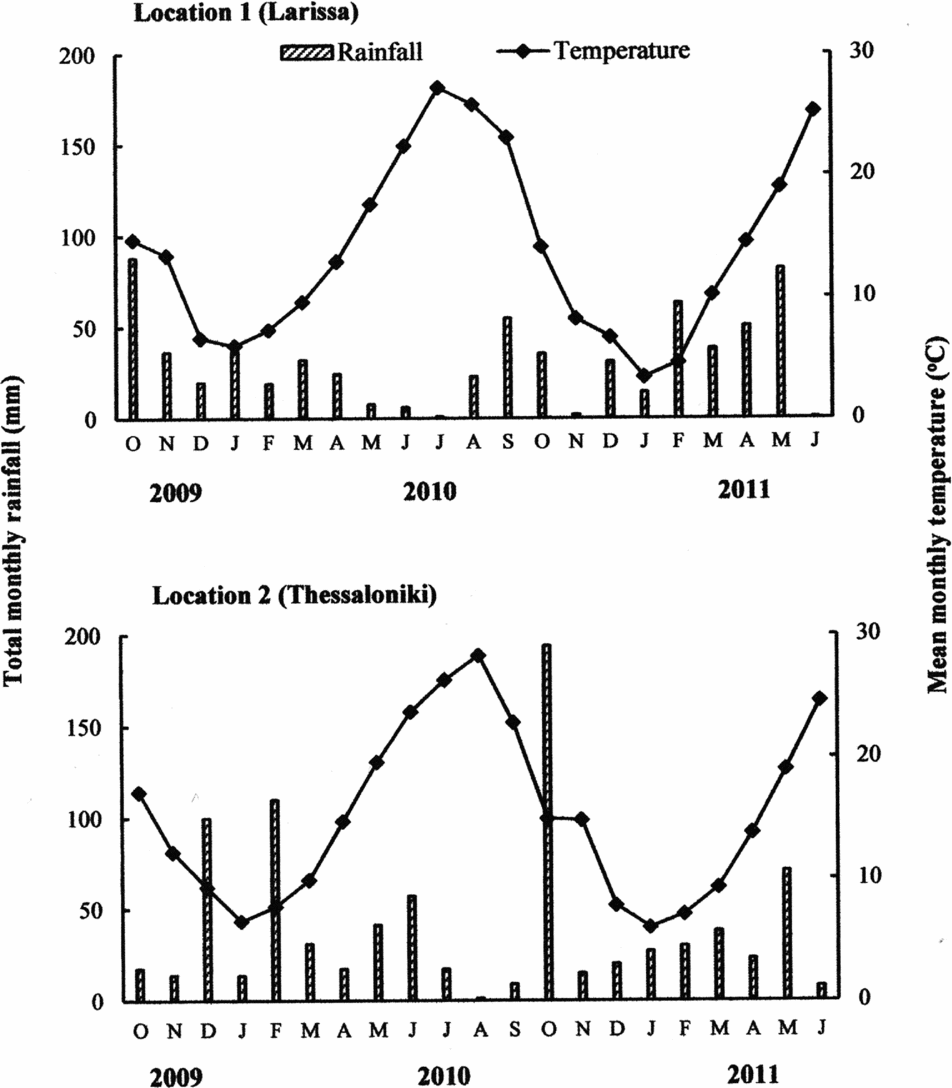
Two field experiments were conducted in 2009/10 (year 1) and repeated in 2010/11 (year 2) to determine the forage and CP yields of faba bean-barley intercrops, under the presence or absence of corn poppy competition. The first experiment (location 1) was conducted at the Technological Educational Institute Farm of Thessaly in central Greece (longitude 22°22′48″ E, latitude 39°37′25″ N, altitude 81–82 m), while the second experiment (location 2) was conducted at the Technological Educational Institute Farm of Thessaloniki in northern Greece (longitude 22°44′10″ E, latitude 40°37′06″ N, altitude 0–1 m). The experiment in location 1 was established on a sandy clay loam (Vertic Chromoxerent) soil with sand 509 g kg−1, silt 200 g kg−1, clay 291 g kg−1, organic C content 6 g kg−1 and pH (1:2 Η2Ο) 7.5. The experiment in location 2 was established on a sandy loam (Typic Xeropsamment) soil with sand 644 g kg−1, silt 280 g kg−1, clay 76 g kg−1, organic C content 5 g kg−1 and pH (1:2 H2O) 7.6. Preplant soil analysis was conducted in the middle of September. Random soil samples were taken at 0–30 cm soil depth from the whole experimental areas, air dried and then sieved through a 2 mm openings sieve. Nitrate analysis showed that initial nitrate content ranged from 86 to 90 and 75 to 83 mg kg−1 of soil in location 1 and location 2, respectively. In location 1, the previous crop was common vetch, while for location 2 it was chickpea (Cicer arientinum L.). The climate in location 2 (Thessaloniki, northern Greece) is characterized as typical Mediterranean with cool humid winter and warm dry summer, while in location 1 (Larissa, central Greece) is characterized by a more continental climate with colder winter, hotter summers and lower precipitation throughout spring. Mean monthly temperature and rainfall data recorded near the experimental locations (over a distance of approximately 400 m) are shown in Figure 1.
Total monthly rainfall and mean monthly temperature during the experiments.

Crop management and experimental design
In mid November, the experimental areas in both locations were cultivated with a mouldboard plough and harrow disk to incorporate the fertilisers. Fertilisers of 60 kg N and 30 kg P per ha as diammonium thiophosphate (20-10-0) were broadcast prior to cultivation. In location 1, the six-rowed barley variety ‘Byzantio’ and the faba been variety ‘Polycarpe’ were grown. The corresponding varieties grown in location 2 were the six-rowed ‘Athenaida’ and the faba been ‘Tanagra’. These faba bean and barley varieties are widely cultivated in Greece and were selected on the basis of their adaptability to these locations. In both years, crops were seeded by hand in late November.
A split-plot arrangement of treatments employed in a randomized complete block design with four replicates was used. Main plots consisted of the barley and faba bean sole crops, as well as the six faba bean-barley intercrops (3 seeding ratios × 2 crop arrangements) with plot size of 2 m × 6 m. All main plots were separated by 2 m wide alleys. In particular, barley and faba bean were seeded as sole crops at a seeding rate of 170 (468 seeds m−2) or 100 (51 seeds m−2) kg ha−1, respectively, reflecting the seeding rates commercially used in these regions. Faba bean-barley intercrops at three seeding ratios (38:151, 25:250 or 13:351 seeds m−2 corresponding to 75:25%, 50:50% or 25:75%, respectively, of the full seeding rates per ha) were also included. The sole crop and intercrop treatments were established in rows spaced 20 cm apart within the 2 m × 6 m plots; the intercrops of faba bean with barley were seeded in two crop arrangements (alternate or mixed rows) with the same row spacing. Ten crop rows were included in each plot. Faba bean seeds were not inoculated with rhizobia to encourage biological N2-fixation, because legumes had been recently grown in these fields and visual examination of their root systems indicated satisfactory nodulation.
Each main plot was divided into two 2 m × 3 m subplots (with or without corn poppy competition). One day prior to faba bean and barley seeding, the weedy subplots were over seeded with enough corn poppy seeds (2 g m−2) to achieve the desired density of 100 plants m−2. The density of 80 to 120 plants m−2 is equal to that typically observed in Greek legume and cereal fields (Damanakis, Reference Damanakis1983). Corn poppy seeds were harvested from a local source in the year previous to the experiments and were stored at a temperature of 3 to 5 °C until use. The germinability of corn poppy seeds was determined in a growth chamber at 15 to 18 °C. Winter wild oat [Avena sterilis spp. ludoviciana (Durieu) Gill & Magne] and wild mustard (Sinapis arvensis L.) in both weedy and weed-free subplots were hand-removed during the experiments.
Crop and weed measurements
At 10 weeks after seeding (WAS), faba bean and barley stand in the four central 3 m rows in each subplot, as well as corn poppy plant number in the three central 3 m interrows were assessed. At 20 WAS, light interception was determined using a 1-m-long line quantum sensor connected to a plant canopy analyser (AccuPAR model LP-80, PAR/LAI Ceptometer, DECAGON DEVICES, INC., 950 NE Nelson Court, Pullmn, WA 99163, USA). The probe was used to measure the amount of incident photosynthetically active radiation (PAR) at the top of the canopy (full sunlight) and at soil levels (below the canopy). Readings below the canopy were determined at five randomly selected locations within each subplot at regular intervals in a diagonal transect among the centre rows. The plant canopy analyser calculated the leaf area index (LAI) based on the above and below-canopy PAR measurements along with other variables (zenith angle and leaf area distribution parameter) that relate to the canopy architecture and position of the sun. For each subplot, the average of the five readings was calculated.
In both locations, faba bean stem and barley shoot number, as well as fresh and dry weights were determined in a 3.0 m × 0.4 m area in two rows of each subplot at 17 and 21 WAS. Plants were cut about 3 cm from the ground level with manual shears and separated by hand. This period corresponds with the critical period of competition between weeds and winter crops (Zimdahl, Reference Zimdahl2004). At these samplings, corn poppy plant number, as well as its fresh and dry weights were also assessed. Finally, plants in sole crops and intercrops were harvested (cutting) on May 10, 2010 (24 WAS) and May 15, 2011 (25 WAS) at location 1 or on May 20, 2010 (25 WAS) and May 25, 2011 (25 WAS) at location 2, when about 80% of faba bean pods had reached the typical length (BBCH-scale 78–79) and approximately at early to soft dough stage of barley (BBCH-scale 41–43) (Meier, Reference Meier2001). Forage yield (total fresh weight) was determined by harvesting the two centre 3 m rows of each subplot. Plants were cut about 3 cm from the ground level with manual shears and separated by hand to determinate the fresh weight of each species. After cutting, random samples of 1 kg biomass for both species from each subplot were dried at 65 °C for 72 h to determine the DM yield. Then, CP content was evaluated in these samples in order to determine the CP yield. In particular, the samples were ground with a Wiley mill to pass a 1 mm screen and analysed for nitrogen content. Total N was determined using a near infrared reflectance (NIR) spectrometer (Model SpectraAlyzer, ZEUTEC OPTO-ELEKTRONIK GmbH, Rendsburg), which was calibrated for horsebean-barley intercrop biomass by samples analysed using the Kjeldahl method. The CP based on DM was calculated by multiplying the N content by 6.25 and, finally, protein was expressed as protein yield per hectare.
Competition indices
The AWC and AC of sole crops and intercrops were calculated according to Watson et al. (Reference Watson, Derksen and Van Acker2006). The AWC was calculated as AWC = 100 (Ywp/Ywfp), where Ywp is the forage yield from the weedy subplot and Ywfp is the forage yield from the weed-free subplot. The AC was calculated as AC = 100 – [(bw/bt) 100], where bw is the fresh weight of corn poppy and bwt is the total fresh weight (crop and corn poppy) evaluated at the critical period of competition (21 WAS).
Intercropping advantage and competition effects between faba bean and barley in intercrops were calculated according to Willey and Rao (Reference Willey and Rao1980). In particular, the land equivalent ratio (LER) (relative land area under sole crops that is required to achieve equivalent yields in intercropping) indicates the efficiency of intercropping in using the environment resources, compared with that of the sole crops. Generally, LER values significantly greater than unity indicate that intercropping per unit area is more productive than monoculture. The LER was calculated as total LER = (LERfababean + LERbarley). In particular, LERfababean = (Yfb/Yf) and LERbarley = (Ybf/Yb), where Yfb and Ybf are the DM yields of intercropped faba bean and barley, respectively. Similarly, Yf and Yb are the DM yields of faba bean and barley sole crops, respectively.
The competition ratio (CR) is another index that assesses the effect of competition between two species in an intercropping system. The CR represents simply the ratio of individual LERs of the two intercropped crops and takes into account the proportion of the crops in which they are initially seeded. The CR was calculated as CRfababean = (LERfababean/LERbarley) (Zbf/Zfb) and CRbarley = (LERbarley/LERfababean) (Zfb/Zbf), where Zfb and Zbf are the seeding proportions of intercropped faba bean and barley, respectively. When the CR is below one there is a positive benefit and the species can be grown in a mixture; whereas if the CR is above one there is a negative effect.
Statistical analyses
For corn poppy, faba bean and barley a combined analysis over years and locations (ANOVA) was performed for all measured parameters (except the competition indices AC and AWC) using a split-plot factorial design (sole crops and intercrops x corn poppy competition). The homogeneity of variances was examined with the Bartlett's test.
A combined analysis over years and locations was also performed for the competition indices (AWC and AC). All indices were calculated separately for each sole crop/intercrop replicate. In all equations, the replicate biomass values were used for the numerators; however, the mean sole crop/intercrop values across all replicates were used for the denominators in order to improve normality and homogeneity of variances of the data.
The statistical package MSTAT (MSTAT-C, 1988) was used to conduct the ANOVAs.
RESULTS
Weed response
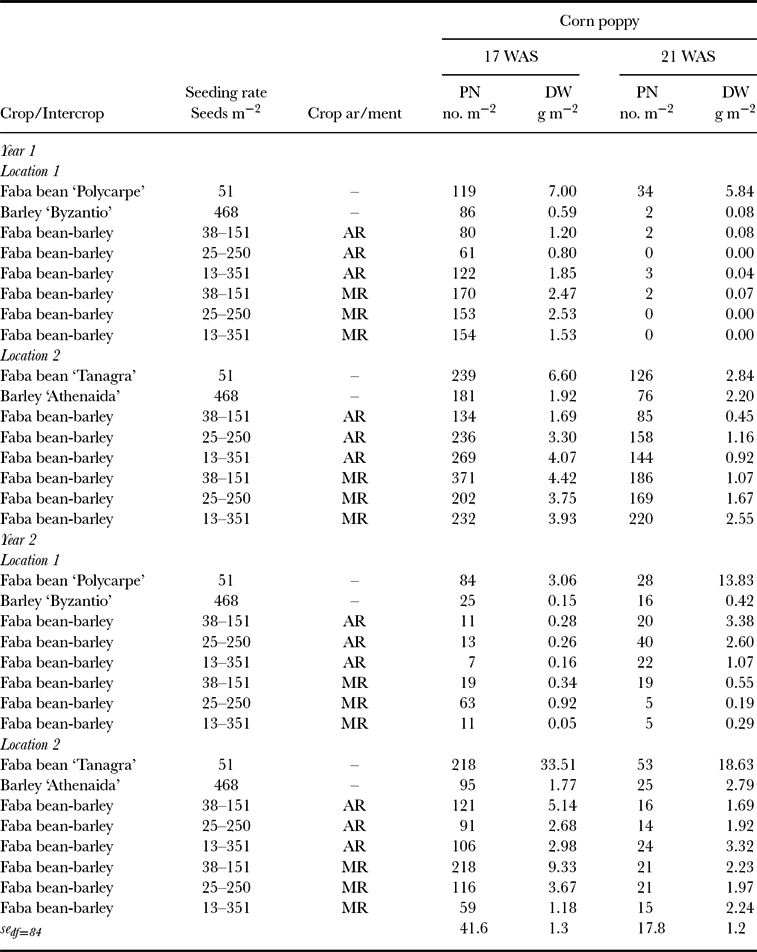
In both locations, the ANOVA indicated that corn poppy plant number 10 WAS was not significantly affected by treatments and was, in most plots, about the desirable density of 100 plants m−2 (data not show). However, the corn poppy plant number and biomass at 17 and 21 WAS were in most cases significantly affected by year × location x intercropping interaction (p < 0.001). So, the interaction means of corn poppy plant number and dry weight are presented in Table 1. Corn poppy fresh weight data are not presented because they follow the same trend with the dry weight data.
Plant number and dry weight of corn poppy grown at Larissa (location 1) and Thessaloniki (location 2) with faba bean and barley sole crops or their intercrops at three seeding ratios and two crop arrangements in 2009/10 (year 1) and 2010/11 (year 2).

Note: AR, alternate rows; MR, mixed rows; WAS, weeks after seeding; PN, plant number; DW, dry weight; Year 1, 2009/10; Year 2, 2010/11.
At location 1, corn poppy plant number and dry weight decreased in most cases as time went by (from 17 to 21 WAS) (Table 1). Indeed, this reduction was greater in year 1 than in year 2. In both years, the greatest weed density and dry biomass were observed in faba bean sole crop, while barley sole crop caused corn poppy suppression similar with most of the faba bean-barley intercrops. In year 2, the mixed rows intercropping caused slightly greater weed suppression than the intercropping in alternate rows.
At location 2, corn poppy density increased from 10 to 17 WAS, but then, weed plant number and dry weight decreased as time went by (from 17 to 21 WAS). However, this reduction was lower than that recorded at location 1 and was lower in year 1 as compared with that in year 2 (Table 1). In both years, the greatest weed density and dry biomass were observed in faba bean sole crop, while in most cases barley sole crop caused corn poppy suppression similar with most of the faba bean-barley intercrops. In both years, crop arrangement and seeding ratio did not significantly affect in most cases weed suppression by the intercrops.
Crop response
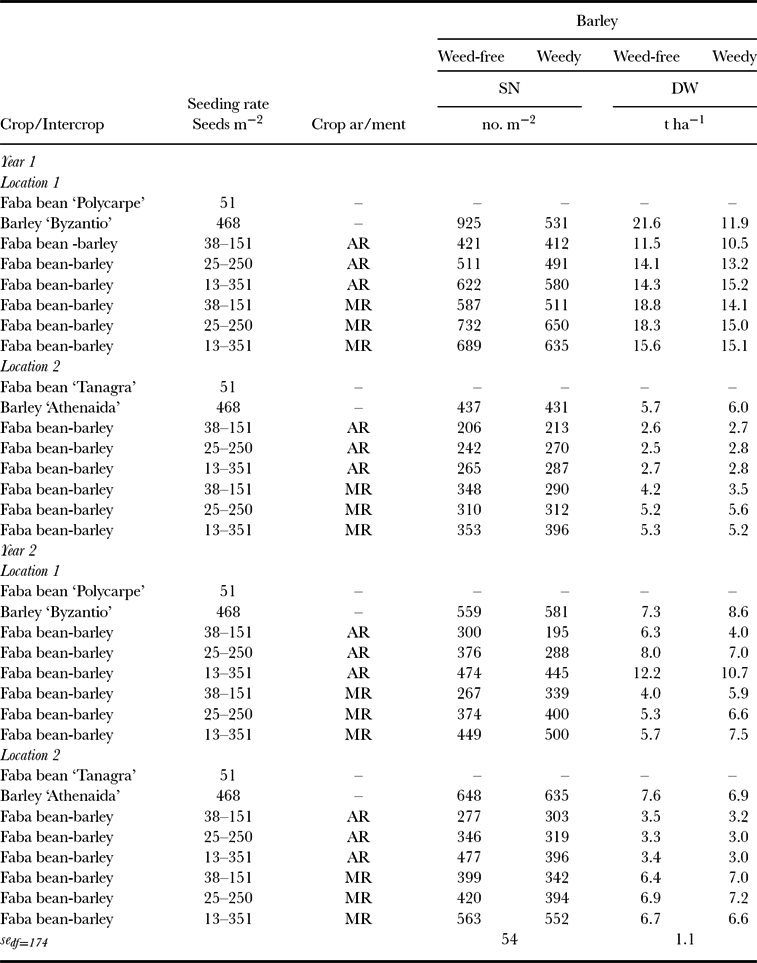
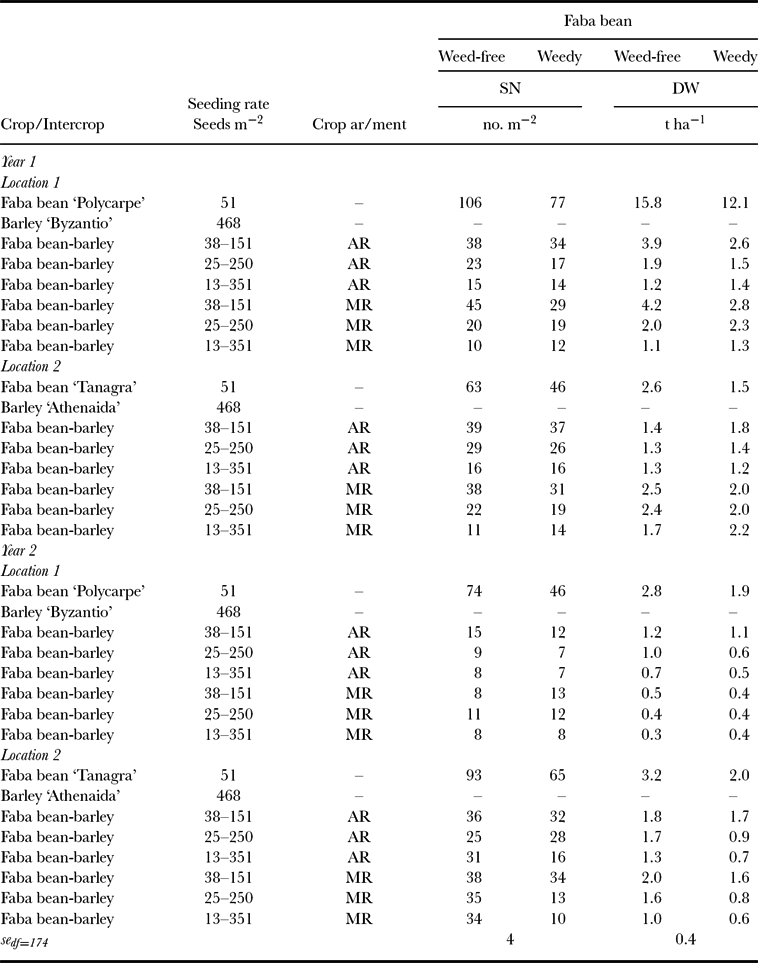
At both locations, faba bean and barley plant numbers at 10 WAS were accordance with the seeding rates used (data not shown). The ANOVA performed for both crop species data collected at 17 and 21 WAS, as well as yield data at harvest, indicated that the interactions among years, locations and intercropping were in most cases significant (p < 0.01). So, the intercropping means in each year and each location are presented in Tables 2, 3 and 4. Crop fresh weight data are not presented because they follow the same trend with the dry weight data.
Shoot number and dry weight of barley (21 WAS) grown at Larissa (location 1) and Thessaloniki (location 2) as sole crop or intercropped with faba bean at three seeding ratios and two crop arrangements, with or without corn poppy competition in 2009/10 (year 1) and 2010/11 (year 2).

Note: AR, alternate rows; MR, mixed rows; WAS, weeks after seeding; SN, shoot number; DW, dry weight; Year 1, 2009/10; Year 2, 2010/11.
Stem number and dry weight of faba bean (21 WAS) grown at Larissa (location 1) and Thessaloniki (location 2) as sole crop or intercropped with barley at three seeding ratios and two crop arrangements, with or without corn poppy competition in 2009/10 (year 1) and 2010/11 (year 2).

Note: AR, alternate rows; MR, mixed rows; WAS, weeks after seeding; SN, stem number; DW, dry weight; Year 1, 2009/10; Year 2, 2010/11.
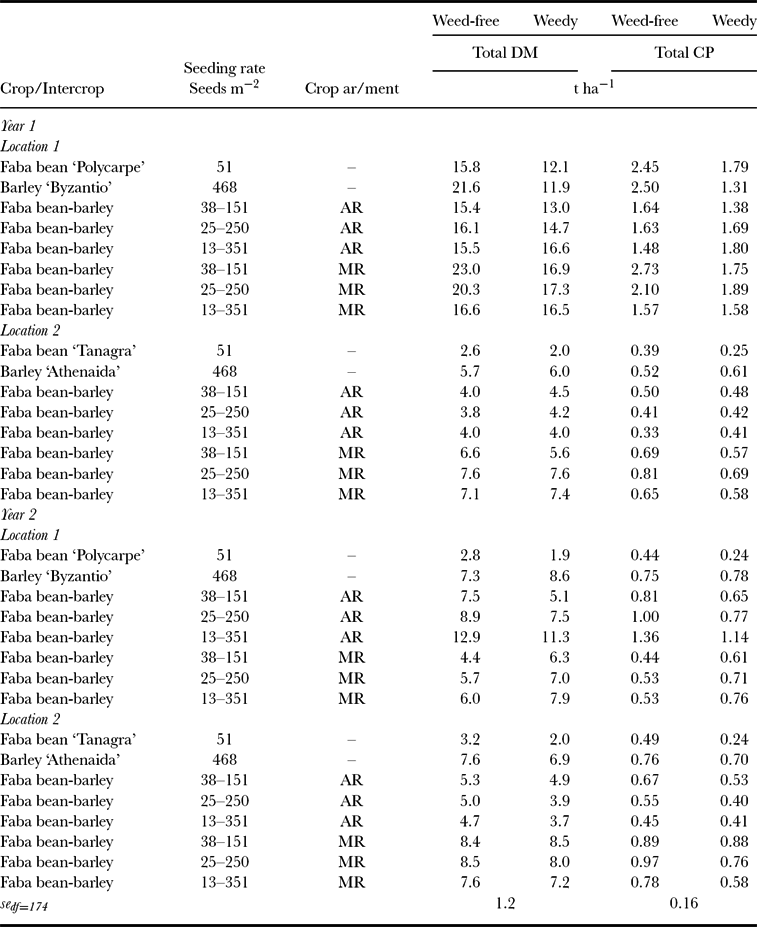
Total dry matter and total crude protein yields of faba bean and barley (harvest) grown at Larissa (location 1) and Thessaloniki (location 2) as sole crops or intercrops at three seeding ratios and two crop arrangements, with or without corn poppy competition in 2009/10 (year 1) and 2010/11 (year 2).

Note: AR, alternate rows; MR, mixed rows; WAS, weeks after seeding; DM, dry matter; CP, crude protein; Year 1, 2009/10; Year 2, 2010/11.
In both locations, barley SN and DW were greater in sole crop than those in most intercrops (Table 2). Among intercrops, the 75:25% faba bean-barley seeding ratio provided lower SN and DW than the other two seeding ratios. In most cases, barley SN and DW had not been affected by corn poppy competition.
In both weedy and weed-free conditions, faba bean SN and DW were greater in faba bean sole crop than those in its intercrops with barley (Table 3). In intercrops, faba bean provided the greatest SN and DW in the 75:25% seeding ratio faba bean-barley intercrop. In most cases, crop arrangement did not affect the faba bean SN and DW. Similarly to intercropped barley, in most cases corn poppy competition did not affect the intercropped faba bean SN and DW, but reduced these values in faba bean sole crop.
In year 1, sole crops and intercrops at location 1 provided greater total DM and CP than those at location 2, but in year 2 sole crops and intercrops provided similar yields at both locations (Table 4). Corn poppy competition did not affect the productivity of intercrops, but caused a 45–48% total DM and CP reduction in barley sole crop in year 1 and at location 1. At both locations, corn poppy competition significantly decreased faba bean sole crop total DM and CP yields. Intercrops arranged as mixed rows provided in most cases greater total DM and CP yields than the alternate rows. Intercrop productivity was similar with or greater than those of barley and faba bean sole crops. However, there was not any clear difference among intercrop seeding ratios regarding total DM and CP productivity.
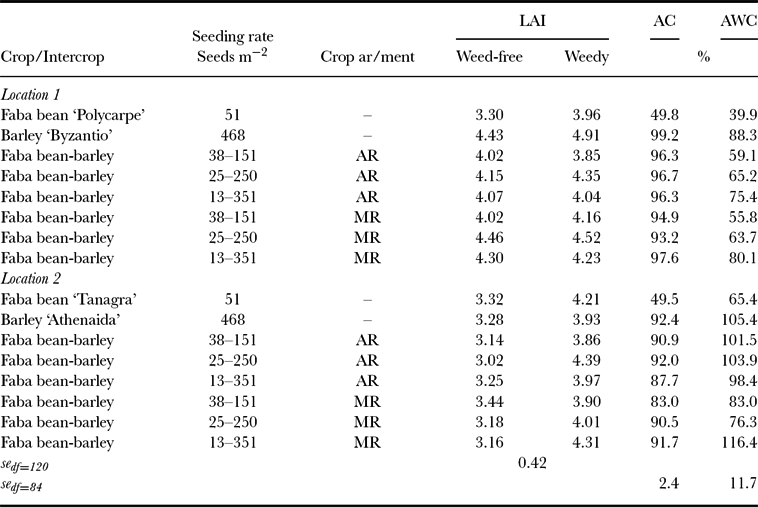
At location 1, the LAI did not differ among sole crops and intercrops or between weed-free and weedy conditions (Table 5). However, at location 2, the LAI was slightly lower in weed-free conditions than those in weedy ones. In most cases, the LAI was not affected by seeding ratios or crop arrangement.
. Leaf area index (LAI), ability to compete (AC) and ability to withstand competition (AWC) of faba bean and barley grown at Larissa (location 1) and Thessaloniki (location 2) as sole crops or intercrops at three seeding ratios and two crop arrangements, with or without corn poppy. Means are averaged across two years.

Note: AR, alternate rows; MR, mixed rows; LAI, leaf area index; AC, ability to compete; AWC, ability to withstand competition.
Competition indices
The ANOVAs performed for the competition indices data indicated that the interactions among years, locations and intercropping were not significant. So, the values presented in the Tables 5, 6 and 7 are averaged across two years.
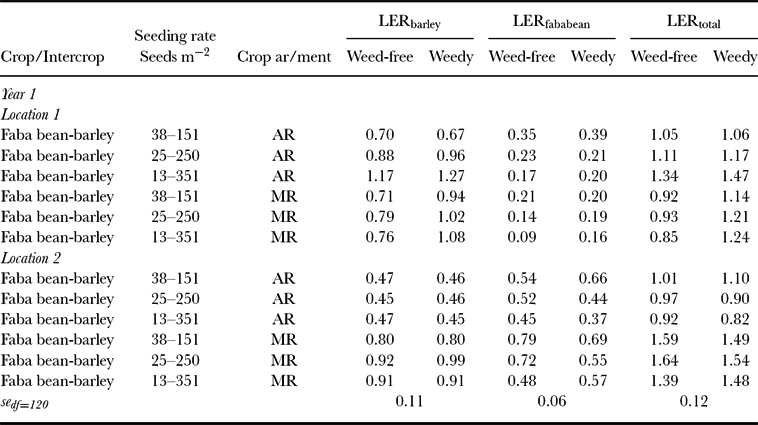
Land equivalent ratio (LER) of faba bean-barley intercrops grown at Larissa (location 1) and Thessaloniki (location 2) at three seeding ratios and two crop arrangements, with or without corn poppy competition. Means are averaged across two years.

Note: AR, alternate rows; MR, mixed rows; LER, land equivalent ratio.
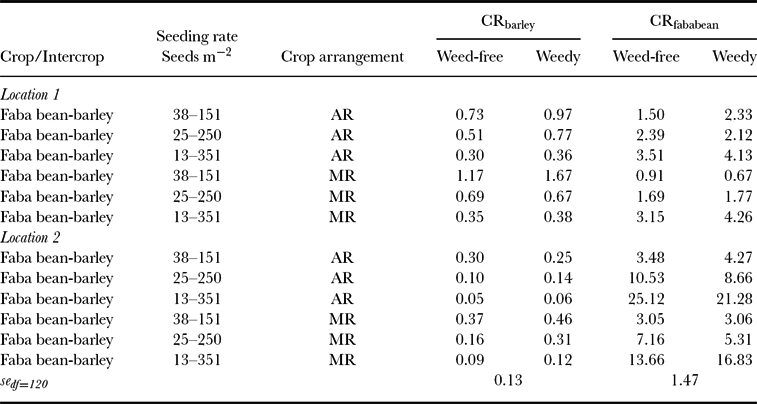
Competition ratio (CR) of faba bean-barley intercrops grown at Larissa (location 1) and Thessaloniki (location 2) at three seeding ratios and two crop arrangements, with or without corn poppy competition. Means are averaged across two years.

Note: AR, alternate rows; MR, mixed rows; CR, competition ratio.
At both locations, the abilities of barley sole crop and faba bean-barley intercrops to compete (AC) the corn poppy were greater than that of faba bean sole crop, without differences among barley sole crop and intercrops (Table 5). Similarly, the abilities of barley sole crop and faba bean-barley intercrops to withstand competition (AWC) of corn poppy were greater than that of faba bean sole crop. However, barley sole crop had greater AWC than most of the faba bean-barley intercrops.
At location 1, the LER for barley intercropped with faba bean was greater than 0.5, while the corresponding LER for faba bean intercropped with barley was lower than 0.5, in both weed-free and weedy conditions (Table 6). The seeding ratio and crop arrangement did not in most cases affect the barley LER, but the 25:75% faba bean-barley seeding ratio at alternate rows provided slightly greater barley LER than the other intercrops. In both weed-free and weedy conditions, the total LER was significantly greater than 1.0 only at the 25:75% faba bean-barley seeding ratio in the alternate rows arrangement. At location 2, both barley and faba bean LERs were greater than 0.5 in mixed rows, in both weed-free and weedy conditions. The total LER was significantly greater than unity in the mixed rows without significant differences among seeding ratios. Also, total LERs in mixed rows were greater than those in alternate ones.
At both locations, the CR of barley significantly decreased as the proportion of barley increased, in both weed-free and weedy conditions (Table 7). However, the barley CR values were greater at location 1 than those at location 2. Similarly, the faba bean CR significantly decreased as the proportion of faba bean increased. In contrast to barley CR, the faba bean CR values were lower at location 1 than those at location 2. The crop arrangement did not in most cases affect the CR of faba bean and barley.
DISCUSSION
Weed response
Corn poppy plant number at location 2 (Thessaloniki) was greater than that in location 1 (Larissa). This fact could be attributed to more favourable conditions (greater rainfall and mean temperature) recorded during autumn and winter in location 2, which may have resulted in increased corn poppy germination in late winter (Figure 1) (Kumar et al., Reference Kumar, Singh, Manohar and Shukla2006).
At both locations, corn poppy density and biomass were greater in faba bean sole crop compared with barley sole crop and their intercrops. Similarly, Bulson et al. (Reference Bulson, Snaydon and Stopes1997) and Haymes and Lee (Reference Haymes and Lee1999) found that the winter wheat sole crop was more competitive against weeds than the faba bean sole crop, while the faba bean-winter wheat intercrop at 25:75% seeding ratio was either similar or more competitive against weeds than the winter wheat sole crop. Mohammadi et al. (Reference Mohammadi, Pirdashti, Yazdani and Abbasian2012) found that intercropping barley with fenugreek (Trigonella foenum-graecum L.) increased the crop productivity and reduced the weeds interference. The higher efficiency of intercropping on weed growth could be attributed to greater LAI, as well as to more solar radiation intercepted by spatial arrangements of crops in an intercropping system canopy and transmitted through the canopy (Elijah, Reference Elijah2001).
At both locations, the seeding ratio and the crop arrangement did not in most cases affect the competitive ability of faba bean-barley intercrops against corn poppy, possibly due to similar LAI achieved by the six intercrops. This intercropping suppression ability on corn poppy was at best comparable, but often less than that in barley sole crop in agreement with Corre-Hellou et al. (Reference Corre-Hellou, Dibet, Hauggaard-Nielsen, Crozat, Gooding, Ambus, Dahlman, Fragstein, Pristeri, Monti and Jensen2011), Hauggaard-Nielsen et al. (Reference Hauggaard-Nielsen, Jørnsgaard, Kinane and Jensen2008) and Fernandez-Aparicio et al. (Reference Fernandez-Aparicio, Sillero and Rubiales2007) who have reported that adding a cereal to the grain legumes highly improves their weed suppressive ability. Also, a possible allelopathic ability of barley varieties could additionally be counted for this weed suppression (Dhima et al., Reference Dhima, Eleftherohorinos and Vasilakoglou2000; Vasilakoglou et al., Reference Vasilakoglou, Dhima, Lithourgidis and Eleftherohorinos2009).
Crop response
At both locations, no significant differences were observed among intercrops regarding the LAI, indicating no differences in PAR absorption. Similarly, Ross et al. (Reference Ross, King, O'Donovan and Spaner2004) and Vasilakoglou and Dhima (Reference Vasilakoglou and Dhima2008) found that the PAR at the soil level did not differ among intercrops of berseem clover (Trifolium alexandrinum L.) with barley.
The greater total DW of faba bean and barley grown as sole crops or intercrops at location 1 compared with their total DW at location 2 could be attributed to differences in growth rate among faba bean and barley varieties used at the two locations (Larissa and Thessaloniki). The greater DW of faba bean and barley grown at location 1 as sole crops or intercrops in year 1, compared to their DW in year 2, could be mainly attributed to milder temperatures recorded during November 2009 to March 2010, compared with the corresponding period in year 2 (Figure 1).
At both locations, the total DM and CP yields of barley and faba bean grown as intercrops in weed-free or weedy conditions were in most cases not significantly affected by seeding ratio, but mixed rows provided greater total DM and CP yields. However, Martin and Snaydon (Reference Martin and Snaydon1982) and Jensen (Reference Jensen1986) found no differences in spring faba bean and wheat yields when they were cultivated as intercrops in mixed rows, alternate simple rows or alternate double rows.
The total DM and CP yields of barley varieties grown as sole crops in both weed-free and weedy conditions were similar in most cases to corresponding yields of all intercrops studied. Strydhorst et al. (Reference Strydhorst, King, Lopetinsky and Neil Harker2008) found that faba bean-barley, lupin-barley and field pea-barley intercrops provided higher protein yields than the barley sole crop. The lack of differences in DM of barley sole crop or faba bean-barley intercrops grown in weed-free and weedy conditions could be attributed to their high weed suppressive ability and consequently to decreased competition effects of corn poppy on crops (Egbe, Reference Egbe2010).
The greater total DM and CP yields provided by faba bean-barley intercrops, as compared with those of faba bean sole crop, is in agreement with results reported by Lithourgidis and Dordas (Reference Lithourgidis and Dordas2010) who found that the faba bean-rye (Secale cereale L.) intercrops provided higher CP yield than the faba bean sole crop. Dhima et al. (Reference Dhima, Vasilakoglou, Keco, Dima, Paschalidis and Gatsis2014) also found that faba bean-oat intercrops provided higher total DM and CP yields than the faba bean sole crop, but lower or similar to those of oat sole crop. Carr et al. (Reference Carr, Horsley and Poland2004) found that forage yield and quality of field pea can be enhanced by intercropping with barley or oat. Berkenkamp and Meeres (Reference Berkenkamp and Meeres1987) also reported that the inclusion of legumes with high protein content increased the protein level in mixtures with cereals increasing the value for intensive feeding operations.
Competition indices
At both locations, the greater AWC and AC provided by barley sole crop and their intercrops as compared with faba bean sole crop could be attributed to their vigorous and faster growth. When crops grow vigorously, complete their canopy earlier than weeds. This fact has as result the strong competition for light and consequently the weed suppression (Zimdahl, Reference Zimdahl2007).
The LER of faba bean intercropped with barley was in most cases lower than 0.5; however, it significantly decreased as the proportion of barley increased. On the contrary, the LER of barley in most intercrops was higher than 0.5, indicating that there was an advantage for barley when intercropped with faba bean, while a disadvantage for faba bean. The total LER of intercrops did not significantly exceed unity in most cases indicating that there was not a clear advantage over sole crops in terms of the use of the environmental resources for plant growth (Mead and Willey, Reference Mead and Willey1980). This result is in agreement with the previously reported LAI data and with the results reported by Vasilakoglou and Dhima (Reference Vasilakoglou and Dhima2008) who studied berseem clover intercropped with barley. However, Bulson et al. (Reference Bulson, Snaydon and Stopes1997) found that the LER values for the faba bean-winter wheat intercrops were significantly greater than 1.0 when both species were seeded at 75% of the recommended rate, indicating different key morphological features like plant height (Haymes and Lee, Reference Haymes and Lee1999).
At both locations, the CR for the intercropped barley was positive, but in most cases lower than unity, indicating that there was a positive benefit and this species can be intercropped with faba bean; however, CR significantly greater than unity in most faba bean intercrops indicated that there was a negative effect on barley grown with faba bean (Willey and Rao, Reference Willey and Rao1980).
CONCLUSIONS
The production of great forage and protein yield without herbicide application, as well as the production of forage with balanced chemical composition and high nutritive value are very important for producers and livestock enterprises. The results of this study indicated that, in both environments (locations), faba bean-barley intercrops effectively suppressed corn poppy and provided high forage and protein yield, without differences, in most cases, among seeding ratios, while the mixed rows arrangement tended to be more productive than that of alternate rows one. Hence, faba bean-barley intercrops are a viable option for producers in the Mediterranean region, compared with faba bean or barley sole crops.
Acknowledgements
This research was supported financially by the Technological Educational Institutes of Thessaly and Thessaloniki.