In line with his empirically grounded theory that interpretations of other people's minds do not follow scientific principles, Knobe hypothesizes that our judgments of the intentional nature of side-effects depend on the side-effect's assumed moral status.
I conducted a study involving 150 participants which challenges this hypothesis (Brogaard Reference Brogaard2010b). The participants were divided into four groups of 25, and the subjects in each group were randomly assigned a vignette featuring either an economically or eudaimonistically negative side-effect or a positive side-effectFootnote
1
; plus I had two of these groups of 25 test the last vignette of the target article (hence totaling 150 subjects). Each of the first four groups received one of the following different vignettes:
(1A) The famous stand-up comedian Rob's personal assistant went to Rob and said, “We are thinking of changing your medication. It will help your popularity immensely by completely treating your stage fright, but it will also hurt you by causing morning headaches.” Rob answered, “I don't care at all about having morning headaches. I just want to be as popular as possible. Let's switch to the new medication.” Sure enough, Rob suffered from morning headaches.
(1B) […] “It will help your popularity immensely by completely treating your stage fright, and it will also help you by curing your morning headaches.” Rob was cured of his morning headaches.
(2A) The famous stand-up comedian Rob's personal assistant went to Rob and said, “We are thinking of hiring a new PR assistant. It will help your popularity immensely, but it will also harm your financial situation.” Rob answered, “I don't care at all about my financial situation. I just want to be as popular as possible. Let's hire the new PR assistant.” Sure enough, Rob's financial situation was harmed.
(2B) […] “It will help your popularity immensely, and it will also help your financial situation.” Rob's financial situation was helped.
Of the participants in the group that received vignette (1A), 84% judged that Rob intentionally harmed himself; 76% in the group receiving (1B) judged that Rob didn't intentionally help himself; 88% of the group that got (2A) judged that Rob intentionally hurt his financial situation; and 76% of the group that got (2B) judged that Rob didn't intentionally help his financial situation.
In these vignettes, the side-effects have no direct bearing on morality. But the vignettes are akin to Knobe's in describing an agent with undesirable personality traits. The agent is either greedy and self-centered (the chairman), or superficial (Rob).
I found that these personality traits figured in participants' answers to follow-up questions. When asked to “describe Rob's personality traits,” 88% replied with one of the following words: “shallow,” “superficial,” “stupid,” “flaky,” “irresponsible,” or “careless.”
Participants given the vignettes (1A) and (1B) were also asked whether Rob deserved to suffer from headaches or economically, given the decision he made. Here, 98% checked the options “yes” or “leaning towards ‘yes’.” When asked to justify their answers (“Rob deserves/does not deserve to suffer from headaches/economically because:”), 72% of the participants who replied “yes/leaning towards ‘yes’ ” used descriptive terms such as “superficial,” “stupid,” and “irresponsible.”
The results indicate that the driving force behind rendering the negative side-effects in (1A) and (2A) as intentional is a feeling that Rob deserves to suffer because of his undesirable personality traits.
I hypothesize that whether a (moral or non-moral) negative outcome is considered intentional depends on whether the agent is believed to deserve the outcome or (moral or non-moral) blame associated with it. If the agent is greedy, selfish, or superficial, he is thought to deserve the bad outcome or the blame. Consequently, the outcome is considered intentional.
This hypothesis explains why the chairman in Knobe's original cases is judged to have intentionally harmed the environment but not to have intentionally helped it. Because the chairman is considered greedy and selfish, he is thought to deserve potential blame associated with harming the environment. Accordingly, the outcome is considered intentional.
To further test this hypothesis, I arbitrarily assigned one of two other vignettes, similar to Knobe's in the target article, to 50 participants:
(3A) The vice-president of a company went to the chairman of the board and said, “We are thinking of starting a new program. It will help the environment, and it will also hurt our profits.” The chairman of the board answered, “I don't care at all about profits. I just want us to help the environment. Let's start the new program.” They started the new program. Sure enough, the company's profits decreased.
(3B) […] “It will help the environment, and it will help us increase profits.” … Sure enough, the company's profits increased.
Here, 92% said the chairman in (3A) did not intentionally hurt the company, and 72% said the chairman in (3B) did not intentionally help the company.
The first result confirms our hypothesis. The chairman in (3A) has desirable personality traits: He cares about the environment, not profits. So, the subjects infer that he does not deserve the potential blame associated with having intentionally brought about a decrease in profits, and hence, that he did not intentionally bring about the side-effect.
The results in (3B) indicate that for an agent to intentionally bring about a positive side-effect, he or she must not only deserve the outcome or the potential praise associated with it, he or she must also aim at bringing it about.
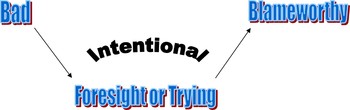
In conclusion: The results of my study are in agreement with Knobe's suggestion that people's judgments of side-effects do not rely on scientific methods, but the results disagree with Knobe concerning the underlying principles driving these judgments. Knobe (Reference Knobe2006) proposes a model for how moral assessments affect judgments of intentional action. In his original cases, we are confronted with the side-effect, harmed environment. We determine that the side-effect is morally bad and that the chairman showed foresight. We then employ the principle “If the side-effect is morally bad, and the agent showed either trying or foresight, then the side-effect is intentional” and infer that the chairman intentionally harmed the environment and is to blame for his behavior (see my Fig. 1).
Figure 1.
Knobe's model of the mechanisms of the side-effect asymmetry. The identification of a morally bad side-effect triggers a selective search for features that are sufficient to judge the side-effect as being brought about intentionally.
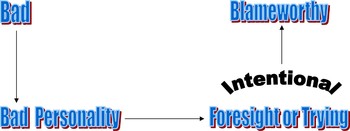
My study suggests a different model for the attribution of intentionality. When we are confronted with a side-effect (e.g., harmed environment, harmed self, or harmed financial situation), we determine whether the side-effect is negative. We then assess the agent's personality in order to determine whether he or she deserves the bad outcome or the potential blame associated with it. Finally, we employ the principle “If the side-effect is negative, and the agent showed trying or foresight, and he or she deserves the side-effect or the potential blame associated with it, then the side-effect is intentional” and infer that the agent intentionally harmed the environment, him/herself, or his/her financial situation and therefore is to blame for his or her behavior (see my Fig. 2).
Figure 2.
New model of the mechanisms of the side-effect asymmetry. The identification of a morally bad side-effect triggers an assessment of personality traits, and the identification of undesirable personality traits triggers a search for features that are sufficient to judge the side-effect as being brought about intentionally.
In a second IRB-approvedFootnote
2
project involving 1,500 participants, currently in progress (Brogaard Reference Brogaard2010a), we seek to determine the correlation among positive side-effects, undesirable personality traits/good fortune, and intentionality. Initial results indicate that an agent's bad personality traits, a history of undeserved success, or good fortune leads us to judge that the agent did not intentionally bring about the positive side-effect and hence does not deserve praise. In a pilot study preceding this larger project, participants were presented with vignettes featuring positive side-effects but differing in terms of whether the agent had good or bad personality traits or had a history of undeserved success or failure. Agents with bad personality traits or a history of undeserved success were judged not to have intentionally brought about the positive side-effect, whereas the opposite was true for agents with good personality traits or a history of undeserved failure.





 You have
Access
In line with his empirically grounded theory that interpretations of other people's minds do not follow scientific principles, Knobe hypothesizes that our judgments of the intentional nature of side-effects depend on the side-effect's assumed moral status.
I conducted a study involving 150 participants which challenges this hypothesis (Brogaard Reference Brogaard2010b). The participants were divided into four groups of 25, and the subjects in each group were randomly assigned a vignette featuring either an economically or eudaimonistically negative side-effect or a positive side-effectFootnote 1 ; plus I had two of these groups of 25 test the last vignette of the target article (hence totaling 150 subjects). Each of the first four groups received one of the following different vignettes:
(1A) The famous stand-up comedian Rob's personal assistant went to Rob and said, “We are thinking of changing your medication. It will help your popularity immensely by completely treating your stage fright, but it will also hurt you by causing morning headaches.” Rob answered, “I don't care at all about having morning headaches. I just want to be as popular as possible. Let's switch to the new medication.” Sure enough, Rob suffered from morning headaches.
(1B) […] “It will help your popularity immensely by completely treating your stage fright, and it will also help you by curing your morning headaches.” Rob was cured of his morning headaches.
(2A) The famous stand-up comedian Rob's personal assistant went to Rob and said, “We are thinking of hiring a new PR assistant. It will help your popularity immensely, but it will also harm your financial situation.” Rob answered, “I don't care at all about my financial situation. I just want to be as popular as possible. Let's hire the new PR assistant.” Sure enough, Rob's financial situation was harmed.
(2B) […] “It will help your popularity immensely, and it will also help your financial situation.” Rob's financial situation was helped.
Of the participants in the group that received vignette (1A), 84% judged that Rob intentionally harmed himself; 76% in the group receiving (1B) judged that Rob didn't intentionally help himself; 88% of the group that got (2A) judged that Rob intentionally hurt his financial situation; and 76% of the group that got (2B) judged that Rob didn't intentionally help his financial situation.
In these vignettes, the side-effects have no direct bearing on morality. But the vignettes are akin to Knobe's in describing an agent with undesirable personality traits. The agent is either greedy and self-centered (the chairman), or superficial (Rob).
I found that these personality traits figured in participants' answers to follow-up questions. When asked to “describe Rob's personality traits,” 88% replied with one of the following words: “shallow,” “superficial,” “stupid,” “flaky,” “irresponsible,” or “careless.”
Participants given the vignettes (1A) and (1B) were also asked whether Rob deserved to suffer from headaches or economically, given the decision he made. Here, 98% checked the options “yes” or “leaning towards ‘yes’.” When asked to justify their answers (“Rob deserves/does not deserve to suffer from headaches/economically because:”), 72% of the participants who replied “yes/leaning towards ‘yes’ ” used descriptive terms such as “superficial,” “stupid,” and “irresponsible.”
The results indicate that the driving force behind rendering the negative side-effects in (1A) and (2A) as intentional is a feeling that Rob deserves to suffer because of his undesirable personality traits.
I hypothesize that whether a (moral or non-moral) negative outcome is considered intentional depends on whether the agent is believed to deserve the outcome or (moral or non-moral) blame associated with it. If the agent is greedy, selfish, or superficial, he is thought to deserve the bad outcome or the blame. Consequently, the outcome is considered intentional.
This hypothesis explains why the chairman in Knobe's original cases is judged to have intentionally harmed the environment but not to have intentionally helped it. Because the chairman is considered greedy and selfish, he is thought to deserve potential blame associated with harming the environment. Accordingly, the outcome is considered intentional.
To further test this hypothesis, I arbitrarily assigned one of two other vignettes, similar to Knobe's in the target article, to 50 participants:
(3A) The vice-president of a company went to the chairman of the board and said, “We are thinking of starting a new program. It will help the environment, and it will also hurt our profits.” The chairman of the board answered, “I don't care at all about profits. I just want us to help the environment. Let's start the new program.” They started the new program. Sure enough, the company's profits decreased.
(3B) […] “It will help the environment, and it will help us increase profits.” … Sure enough, the company's profits increased.
Here, 92% said the chairman in (3A) did not intentionally hurt the company, and 72% said the chairman in (3B) did not intentionally help the company.
The first result confirms our hypothesis. The chairman in (3A) has desirable personality traits: He cares about the environment, not profits. So, the subjects infer that he does not deserve the potential blame associated with having intentionally brought about a decrease in profits, and hence, that he did not intentionally bring about the side-effect.
The results in (3B) indicate that for an agent to intentionally bring about a positive side-effect, he or she must not only deserve the outcome or the potential praise associated with it, he or she must also aim at bringing it about.
In conclusion: The results of my study are in agreement with Knobe's suggestion that people's judgments of side-effects do not rely on scientific methods, but the results disagree with Knobe concerning the underlying principles driving these judgments. Knobe (Reference Knobe2006) proposes a model for how moral assessments affect judgments of intentional action. In his original cases, we are confronted with the side-effect, harmed environment. We determine that the side-effect is morally bad and that the chairman showed foresight. We then employ the principle “If the side-effect is morally bad, and the agent showed either trying or foresight, then the side-effect is intentional” and infer that the chairman intentionally harmed the environment and is to blame for his behavior (see my Fig. 1).
Knobe's model of the mechanisms of the side-effect asymmetry. The identification of a morally bad side-effect triggers a selective search for features that are sufficient to judge the side-effect as being brought about intentionally.
My study suggests a different model for the attribution of intentionality. When we are confronted with a side-effect (e.g., harmed environment, harmed self, or harmed financial situation), we determine whether the side-effect is negative. We then assess the agent's personality in order to determine whether he or she deserves the bad outcome or the potential blame associated with it. Finally, we employ the principle “If the side-effect is negative, and the agent showed trying or foresight, and he or she deserves the side-effect or the potential blame associated with it, then the side-effect is intentional” and infer that the agent intentionally harmed the environment, him/herself, or his/her financial situation and therefore is to blame for his or her behavior (see my Fig. 2).
New model of the mechanisms of the side-effect asymmetry. The identification of a morally bad side-effect triggers an assessment of personality traits, and the identification of undesirable personality traits triggers a search for features that are sufficient to judge the side-effect as being brought about intentionally.
In a second IRB-approvedFootnote 2 project involving 1,500 participants, currently in progress (Brogaard Reference Brogaard2010a), we seek to determine the correlation among positive side-effects, undesirable personality traits/good fortune, and intentionality. Initial results indicate that an agent's bad personality traits, a history of undeserved success, or good fortune leads us to judge that the agent did not intentionally bring about the positive side-effect and hence does not deserve praise. In a pilot study preceding this larger project, participants were presented with vignettes featuring positive side-effects but differing in terms of whether the agent had good or bad personality traits or had a history of undeserved success or failure. Agents with bad personality traits or a history of undeserved success were judged not to have intentionally brought about the positive side-effect, whereas the opposite was true for agents with good personality traits or a history of undeserved failure.