

The United States has experienced tremendous social change over the last several decades, transforming from a nation with White non-Hispanics accounting for 84% of its population in 1970 to a society, in 2020, whose population consists of just 60% White non-Hispanics. Diversity also increased greatly across the states during this period. In 1970, in only four states did Blacks and Latinos each comprise at least 5% of the population, and in no states did Black, Latino, and Asian populations each reach 5%. By 2020, 26 states met the 5% threshold for Blacks and Latinos, and in eight states, Black, Latino, and Asian populations all surpassed the 5% threshold. Five states reached majority–minority status by 2019 (Manson et al. Reference Manson, Schroeder, Van Riper, Kugler and Ruggles2020). Thus, considerable variation exists in the racial/ethnic contexts in which residents form fundamental political orientations such as partisan identities and the alignment between partisanship and ideology – key foundations for the negative consequences of partisan polarization.
Given social diversity’s potential link to racialized partisan-ideological alignment (or social sorting) at the national level, and the partisan nature of state politics and party control steering states’ growing role in policymaking, states present substantively important and theoretically and empirically appropriate units of analysis for examining the role of social diversification on social sorting. Plentiful long-standing research demonstrates substantive implications for democracy associated with Whites’ reactions to state-level diversity, leading to more Republican and conservative orientations (cf. Abrajano and Hajnal Reference Abrajano and Hajnal2015; Blalock Reference Blalock1967; Fellowes and Rowe Reference Fellowes and Rowe2004; Giles and Evans Reference Giles and Evans1986; Giles and Hertz Reference Giles and Hertz1994; Hero Reference Hero1998; Hill and Leighley Reference Hill and Leighley1999; Key Reference Key1949; Soss et al. Reference Soss, Schram, Vartanian and O’Brien2001; Wager Reference Wager2024). Moreover, the confluence of racialized partisanship and alignment of partisan and ideological identities coupled with the geographic dispersion of partisan factions raises important concerns for scholars of both US domestic politics (Abramowitz Reference Abramowitz2018; Mason Reference Mason2018) and democratic decline and partisan conflict across the world (Denny and Walter Reference Denny and Walter2014; Kleinfeld Reference Kleinfeld2021; Levitsky and Ziblatt Reference Levitsky and Ziblatt2018; Walter Reference Walter2022). Yet, few studies examine how political identities vary by state and the degree to which racial/ethnic group heterogeneity in partisan-ideological alignment observed in national-level studies emerges from the distinct social contexts of the states (Enders and Thornton Reference Enders and Thornton2022; White and Laird Reference White and Laird2020).
As they engage in policies beyond traditional arenas such as criminal justice, social welfare, and education, and into arenas such as health care, abortion, cultural, environmental, LGBTQ+ rights, and voting rights policies, states have become key policymaking venues, influenced by the political orientations of their residents and elected officials (Erikson, Wright, and McIver Reference Erikson, Wright and McIver1993; Grumbach Reference Grumbach2018; Reference Grumbach2022). Since state-level public opinion is in part a function of relative racial/ethnic group size and groups’ partisan orientations, linking diversity and group preferences provides a more nuanced understanding of state, and national, politics, especially if groups differ in their responses to diversity, generally, and to in/out-group size, specifically. That is, neither a simple “racial conflict” model, predicting White movement to Republican orientations shifting states to the right, nor demographic change, where prevailing orientations among increasingly large populations of minority voters move states to the left, adequately captures political development in diverse states, or the nation. And, if this is the case, the racial/ethnic context may condition partisan polarization as racial groups sort along partisan identities (cf. Abramowitz Reference Abramowitz2018; Mason Reference Mason2018) and explain, in part, the observed divergence in partisan and ideological alignment across racial/ethnic groups at the national level (Enders and Thornton Reference Enders and Thornton2022, Reference Enders and Thornton2023; Zingher Reference Zingher2023). State public opinion, with consequences for electoral politics and policy as well as the racialized underpinnings of political polarization, more broadly requires a fuller understanding of how multiple racial/ethnic groups’ political orientations interact in the diverse contexts of the states.
In this study, we address the implications of the vast social change in the United States by employing a distinct approach that leverages variation in state-level diversity to evaluate the contextual factors of partisan identity and sorting for all four major racial/ethnic groups – Whites, Blacks, Latinos, and Asians. Moreover, we specify which elements of the racial/ethnic context, that is, the proportions of Black and/or Latino and/or Asian in the states, correlate with individual-level political identities. By going beyond standard approaches in the research that identify contextual effects of a single dimension of racial/ethnic context on a single racial/ethnic group, our approach provides a baseline for understanding state-level mass partisan identity as manifested in an array of groups and in a variety of racial/ethnic contexts. In doing so, we revisit and reconsider arguments that racial diversity holds a central role in American state politics, not only in the South (Key Reference Key1949) but also across the 50 states (Hero Reference Hero1998), extend the empirical literature on the role social context plays in key elements of polarization, and build on recent work identifying racial/ethnic group heterogeneity in partisan-ideological sorting (Enders and Thornton Reference Enders and Thornton2022, Reference Enders and Thornton2023; White and Laird Reference White and Laird2020; Zingher Reference Zingher2023). In short, our goal is to examine the degree to which broad patterns of political identities associate with racial/ethnic diversity across the states and the extent to which those associations diverge across racial/ethnic groups.
The findings produce several notable conclusions by using a multilevel model accounting for state- and county-level effects to analyze the individual-level cumulative 2012–22 Congressional Election Study (CES) (Kuriwaki Reference Kuriwaki2023). First, states’ social contexts relate to both partisanship and partisan-ideological sorting independent of substate and individual-level factors, confirming the significance of states as a consequential unit of analysis for understanding mass partisanship and polarization. Second, racial/ethnic groups generally diverge in the direction and/or significance of this relationship. Specifically, Whites tend to be stronger Republicans and/or are more highly sorted in racially/ethnically diverse states. Blacks, Latinos, and Asians, on the other hand, are less elastic to state racial/ethnic contexts in their partisanship and partisan-ideological alignment. We also contribute to the literature on heterogeneous effects of county- and individual-level correlates of partisanship and partisan-ideological sorting across racial/ethnic groups – both confirming and undermining several recent findings. Combined, the results support the contention that racial/ethnic diversity partially drives asymmetrical mass polarization in the United States, independent of local contexts and individual-level factors. Moreover, sparse links to the rates of social change portend a longer-term, yet geographically varied, manifestation of racialized partisan-ideological alignment and partisan conflict than theories presuming a reaction solely to rapid social change.
State racial context, partisanship, and sorting
Political polarization rests, in part, on the foundation of partisan-ideological sorting (Mason Reference Mason2018; Mason and Wronski Reference Mason and Wronski2018). As partisan identities align with ideological identities, stronger partisan attachment emerges along with greater degrees of affective partisanship and polarization. Moreover, multiple overlapping social identities, such as race combined with partisanship and ideology, amplify these effects. One potential cause for the rise of partisan and ideological identity alignment is a racially/ethnically diversifying social context and its accompanying racialized partisan orientations, with Whites orienting to the Republican Party as well as aligning their ideological orientations with party identities (or vice versa) to a greater extent over the last five decades (Enders and Thornton Reference Enders and Thornton2022; Zhirkov and Valentino Reference Zhirkov and Valentino2022; see also Levendusky Reference Levendusky2009; Mason Reference Mason2018). Yet, other racial/ethnic groups elude similar shifts in partisan alignment and social sorting at the national level, primarily African Americans (Enders and Thornton Reference Enders and Thornton2022; Philpot Reference Philpot2017; White and Laird Reference White and Laird2020). This pattern results in heterogeneity in the degree of partisan-ideological identity alignment and asymmetric racialization of partisan attachments, creating distinct national party coalitions (Grossman and Hopkins Reference Grossman and Hopkins2015).
Moreover, scholars link the shift in White partisan-ideological alignment to the racialized nature of partisan coalitions (Westwood and Peterson Reference Westwood and Peterson2022; Zhirkov and Valentino Reference Zhirkov and Valentino2022). Evidence that Southern White realignment and sorting coincide with the national Democratic Party’s adoption of Civil Rights policies, and pre-date sorting outside of the South, suggests state social contexts are a potential source of some portion of post-Civil Rights era polarization (Enders and Thornton Reference Enders and Thornton2022; Hill and Tausanovitch Reference Hill and Tausanovitch2018). Nevertheless, studies of partisanship and social sorting rarely examine state-level contexts as a factor, nor do they examine multiple racial groups from both in-group and out-group perspectives. Yet, ample reasons exist to address both elements, given the extensive literature on the role of racialized partisan politics and policymaking in the states.
From early studies of Whites’ reactions to Black population size in the Southern states (Key Reference Key1949), to broader conceptualizations of diversity that recognize the contemporary significance of varied multiracial/ethnic contexts across all the states (Hero Reference Hero1998), policy and politics in states with larger racial/ethnic populations generally reflect a racial-threat mechanism. In states with larger minority populations, White public opinion is more conservative ideologically and associated with stronger Republican Party affiliation compared to homogenously White states (Abrajano and Hajnal Reference Abrajano and Hajnal2015; Giles and Evans Reference Giles and Evans1986; Giles and Hertz Reference Giles and Hertz1994). Scholars generally associate the alignment of these phenomena with White Democrats’ reactions to the Democratic Party’s embrace of civil rights in the 1960s, particularly in former Confederate states (Carmines and Stimson Reference Carmines and Stimson1989). State-level analyses also link the racial context in diverse states to a variety of policies undermining minority interests (cf. Fellowes and Rowe Reference Fellowes and Rowe2004; Grogan and Park Reference Grogan and Park2017; Hero Reference Hero1998; Preuhs Reference Preuhs2001, Reference Preuhs2007; Schildkraut Reference Schildkraut2001; Soss et al. Reference Soss, Schram, Vartanian and O’Brien2001; Wager Reference Wager2024).
Much of this prior research assumes that individuals within the dominant group – Whites, almost exclusively – react negatively to larger, and growing, minority populations due to the (perceived) threat to their political, social, and economic power. The individual-level reaction by Whites presumably explains state-level variation in public policy and state political orientations, which in turn implies that as states continue to diversify, policies and institutions maintain a trajectory that confronts minority power. Yet, states did not uniformly follow this path. Some states, like California, experienced initial backlash, primarily toward Latinos and Latino immigrants, but pure numbers accompanied by a solidifying of Latino support for the Democratic Party shifted it to a reliably Democratic state over the last two decades. Texas, on the other hand, maintains a stronger conservative policy orientation and Republican dominance despite its similar non-White population. Southern states deepened their conservative orientation despite consistent Black populations. In short, models suggesting more diverse contexts uniformly lead to more conservative or Republican orientations fall short of explaining why diversifying states follow a variety of partisan and policy paths.
Previous studies’ focus on Whites and their orientations relative to another single group in a state (i.e., Black population size in the South), and in a few cases, Whites’ reactions to multiple racial/ethnic minority groups, or constructing state-level aggregate public opinion measures (Caughey and Warshaw Reference Caughey and Warshaw2016; Erikson, Wright, and McIver Reference Erikson, Wright and McIver1993), linking public opinion to state policy, more generally, may partially explain this puzzle. When scholars estimate multiple racial/ethnic groups’ partisanship or ideology at the state level, the data reveal relatively low, or nonsignificant, positive between-group correlations for partisanship and ideology (Norrander and Manzano Reference Norrander and Manzano2010); however, this study did not examine the determinants of group opinion, leaving open the question of whether racial/ethnic context effects vary by group, or affect political orientations in any way. This leaves open the question of whether diversification manifests in partisan polarization and racial sorting within the states in the way scholars attribute polarization, in part, to a diversifying national context (Abramowitz Reference Abramowitz2018; Hacker and Pierson Reference Hacker and Pierson2020).
Diversity in the state context, partisanship, and sorting suggests the need to look beyond a dyadic relationship between dominant or in-group partisan identities and the racial context of a single minority or out-group and examine how individual-level opinion is shaped by the context of multiple groups. Doing so more proximately addresses the (potential) connection between context and political identity and allows for a better understanding of the dynamics of aggregate political orientations and racial partisan sorting across the states. Moreover, evidence suggests a variety of relationships across groups as they respond to divergent racial/ethnic contexts, or draw on different cues (Enders and Thornton Reference Enders and Thornton2022; Hajnal and Rivera Reference Hajnal and Rivera2014; Hopkins Reference Hopkins2010; Kaufman Reference Kaufman2003; Kim Reference Kim1999; McClain et al. Reference McClain, Carter, DeFrancesco Soto, Lyle, Grynaviski, Nunnally, Scotto, Kendrick, Lackey and Cotton2006; Philpot Reference Philpot2017; White and Laird Reference White and Laird2020; Zingher Reference Zingher2023), which may result in greater partisan-ideological alignment among Whites and consequences for heighted party conflict without shifting the overall orientation of party control within a state. In short, dyadic conceptions or aggregate estimations may mask relationships that potentially lead away from a downward spiral of negative dominant group reactions to minority populations or result in a more liberal electorate as minority group size overcomes a shrinking dominant group’s aligned orientations.
In analyzing the relationship between the racial/ethnic context and individual-level partisanship and partisan-ideological alignment across racial/ethnic groups, our approach departs from previous scholarship. Instead of focusing on opinions regarding specific policy issues (e.g., immigration or social welfare), we explore partisan identities and partisan-ideological sorting, which are profound in their overall impact, as foundations for vote choice, a wide variety of specific policy preferences, and an array of other political behaviors, including affective partisanship (Dias and Lekles Reference Dias and Lekles2022; Graham and Svolik Reference Graham and Svolik2020; Mason Reference Mason2018).
Theories and hypotheses
This study broadens the focus of racial/ethnic intergroup relations beyond dyads to include the largest racial/ethnic groups in the states, thus capturing more fully associations between demographics and state politics and partisan cleavages and the potential for heterogeneous context effects across racial/ethnic groups. We thus explore models leading to general expectations of group response to a state’s social context while also accounting for several models that suggest racial/ethnic minority groups draw from distinct cues to establish partisanship and partisan-ideological sorting (Enders and Thornton Reference Enders and Thornton2023; Philpot Reference Philpot2017; Zingher Reference Zingher2023).
The “group conflict” or “racial threat” model reflects the long-standing and dominant approach to understanding why racial/ethnic population size correlates with state mass partisan orientations and policy outputs (Allport Reference Allport1954; Blalock Reference Blalock1967; Giles and Evans Reference Giles and Evans1986). Here, intergroup power is viewed by individuals within a group as zero-sum. Large out-group size poses a greater threat to the in-group; thus, in-groups prefer political dispositions, institutions, and public policy that undermine the interests of out-groups with the intention to maintain or gain power. Researchers predominantly apply this model to White political orientations vis-à-vis a single minority group, most often the Black population size (e.g., Giles and Evans Reference Giles and Evans1986), but also Latina/o population size (see Abrajano and Hajnal Reference Abrajano and Hajnal2015; Hopkins Reference Hopkins2010). Indirectly, states with large(r) minority populations implement more restrictive policies in the areas of criminal justice and social welfare (cf. Fellowes and Rowe Reference Fellowes and Rowe2004; Preuhs Reference Preuhs2001; Soss et al. Reference Soss, Schram, Vartanian and O’Brien2001; Wager Reference Wager2024).
Scholars infrequently apply the racial threat approach to inter-minority group relations in state-level contexts. Yet, the “social identity” perspective, suggesting that groups lack sympathy for other minority groups as well as react to group-size threat, serves as a proximate model (Branscombe, Schmitt, and Harvey Reference Branscombe, Schmitt and Harvey1999; Hurwitz, Peffley, and Mondak Reference Hurwitz, Peffley and Mondak2015; Tajfel and Turner Reference Tajfel, Turner, Austin and Worchel1979). In multiracial/multiethnic contexts, minority groups compete over resources with other minority groups and foster stronger Republican Party and conservative identities, given generally understood orientations toward government intervention, (re)distribution of resources, and equity, as out-group size increases. Blacks in the Old South holding more anti-Latino sentiments as a response to the increase in Latino immigration in the 1990s and early 2000s illustrate this process (McClain et al. Reference McClain, Carter, DeFrancesco Soto, Lyle, Grynaviski, Nunnally, Scotto, Kendrick, Lackey and Cotton2006). In general, the group threat hypothesis suggests that an individual’s political orientation is related to the size of each out-group, with larger out-groups associated with stronger Republican affiliation or greater partisan-ideological sorting.
The general group conflict model, as noted, lacks widespread empirical grounding other than Whites’ responses to Black or Latino populations, and then in limited local-level zero-sum policy contexts (cf. Fouka and Tabellini Reference Fouka and Tabellini2022; Kaufman Reference Kaufman2003). Recent evidence pointing to inter-minority group cooperation among national-level elites and a long-standing general orientation among minority groups to favor the Democratic Party to a greater degree than Whites regardless of ideological orientations suggests that other factors drive partisanship and ideological alignment among minority groups (Enders and Thornton Reference Enders and Thornton2022, Reference Enders and Thornton2023; Green, Palmquist, and Schickler Reference Green, Palmquist and Schickler2002; Hajnal and Lee Reference Hajnal and Lee2011; Kuziemko and Washington Reference Kuziemko and Washington2018; Masuoka and Junn Reference Masuoka and Junn2013; Philpot Reference Philpot2017; White and Laird Reference White and Laird2020; Zingher Reference Zingher2023). Moreover, Latinos’ and Blacks’ lower levels of ideological polarization (Jefferson Reference Jefferson2024; Lasaka et al. 2021) and other non-White groups’ lower levels of partisan ideological sorting (Enders and Thornton Reference Enders and Thornton2022; Levendusky Reference Levendusky2009; Zingher Reference Zingher2023) suggest that beyond localized political interactions, coalitions of minority groups likely form for reasons beyond multiracial contexts (Hero and Preuhs Reference Hero and Preuhs2013; see also Grossman and Hopkins Reference Grossman and Hopkins2015). This phenomenon resembles the common in-group identity model in which minority groups not only view in-group members as disadvantaged but also sympathize with all disadvantaged minority groups as commonalities in subordinate status drive multiracial coalitions. Moreover, large out-group populations may cue the use of schemas that orient Whites to the Republican Party as they assume general patterns of group partisan orientations are at play in the state (Zhirkov and Valentino Reference Zhirkov and Valentino2022). In more diverse settings, the racial/ethnic divisions across parties should be more apparent as the composition of state-level parties adds another geographic level to cue citizens of the party that best reflects their in-group (or indicates which party is the party of the out-group). While voters may incorrectly estimate the exact proportions of each party that share their racial/ethnic background (Ahler and Sood Reference Ahler and Sood2018), state demographics should coincide with variation in those perceptions to some degree.
Given a party system reasonably described as consisting of “ideological Republicans” and “group interest Democrats” (Abramowitz Reference Abramowitz2018; Grossman and Hopkins Reference Grossman and Hopkins2015; Noel Reference Noel2016), Whites may identify with the Republican Party to a greater extent in diverse states, as the juxtaposition of racial context and partisan composition is clear. Non-Whites, however, may exhibit less elasticity in partisan identities across levels of state diversity as the Democratic Party is consistently the option for minority group interest advocacy, regardless of ideological orientations. Partisan-ideological sorting would follow a similar pattern, with Whites sorted to a greater degree in diverse states as they align ideological identities with in-group co-partisans. Non-Whites, however, lacking an alternative to the Democratic Party, bring greater variation in ideological identities to their partisan orientations and feel less pressure from out-group co-partisans to align their ideological identities, given a wider mix of racial/ethnic groups reflected in the party. This leads to a second testable hypothesis: In diverse states, Whites more closely identify with the Republican Party while non-Whites’ partisan identities are not associated with state-level diversity. Moreover, state racial/ethnic diversity is associated with greater White partisan-ideological sorting, while null or negative relationships are found among non-Whites.
While our focus remains the linkage between state context and individual-level political orientations, a variety of other sources of heterogeneous state context effects across racial/ethnic groups exist. Group contact theories suggest that intergroup contact can increase intergroup understanding and commonality (cf. Allport Reference Allport1954; Wagner et al. Reference Wagner, Christ, Pettigrew, Stellmacher and Wolf2006), or conversely, increase hostility (Blalock Reference Blalock1967; Bobo Reference Bobo1999; Gay Reference Gay2006), or reinforce existing negative stereotypes (Dixon and Rosenbaum Reference Dixon and Rosenbaum2004; Huddy and Sears Reference Huddy and Sears1995; Kinder and Sears Reference Kinder and Sears1981). Further, these effects often vary by the geographic level (Oliver and Wong Reference Oliver and Wong2003). Given the variation of geographic contexts within the states, we also note that partisan and partisan sorting may not result from state context at all once smaller geo-political units are accounted for in an empirical model.
Finally, a growing body of research posits that minority group members draw from different sources for their partisan and ideological identities. For instance, in-group expectations and localized social pressure lead to greater attachment to the Democratic Party among Blacks beyond what ideology or other individual-level traits might suggest (Jefferson Reference Jefferson2024; White and Laird Reference White and Laird2020). Moreover, the role of social groups, such as religious organizations or unions, induces differential effects on partisanship across all racial/ethnic groups (Philpot Reference Philpot2017; Zingher Reference Zingher2023) and a general tendency of minority groups to hold lower levels of partisan-ideological sorting than Whites (Enders and Thornton Reference Enders and Thornton2022; Jefferson Reference Jefferson2024). These factors lie beyond the state context in which an individual resides and potentially overwhelms any state-level context effects on partisanship or partisan-ideological sorting. In short, heterogeneous sources of partisan and partisan-ideological identities may result in differential effects of state context, not because of group threat or in-group identity, but due to the vastly different cues White, Black, Latino, and Asian citizens use to determine partisan and ideological orientations. While distinct hypotheses for each of these factors fall outside the scope of our main analyses, generally, the expectation is that social organizations (Philpot Reference Philpot2017; White and Laird Reference White and Laird2020; Zingher Reference Zingher2023) and individual-level effects (Zingher Reference Zingher2023) lead Whites and non-Whites to diverging partisan and partisan-ideological orientations. In addition, since the existing evidence of a threat mechanism emerges primarily from substate contexts, substate racial contexts will exert independent, and potentially heterogeneous effects across groups. While focusing on the correlates of state context and individual-level partisanship and ideological sorting, we address these factors in both our empirical model and briefly in the analysis of results.
Data and analysis
To evaluate the degree to which the racial/ethnic context in the states is associated with the partisan orientations of individuals from the four major racial/ethnic groups, the analysis draws on the cumulative 2012–22 CES. The CES provides a large nationally representative sample of 265,294 respondents for complete models of partisan identification and 286,347 for models of partisan-ideological sorting over six even-year surveys. Sample size variation occurs due to the inclusion of third party and “don’t knows” in our partisan-ideological sorting measure. In all, group sample sizes range from 31,444 to 35,076 Black respondents, 20,946 to 23,162 Latinos, 6,436 to 6,933 Asian or Pacific Islanders, and 206,468 to 221,176 Whites for PID and partisan-ideological sorting models, respectively. Total state samples ranged from 499 in Wyoming to over 24,811 in California. All models limit respondents to citizens of the United States.
The analyses rely on two key dependent variables. First, we employ the straightforward 7-point partisan self-identification variable (PID), with the highest value assigned to those identifying as strong Republicans. Second, partisan-ideological sorting captures the degree to which individuals are sorted on partisanship (PID) and a traditional self-reported 5-point symbolic ideology measure. Conceptually, we view partisan-sorting on a continuum such that strong Republican (Democrat) and very conservative (liberal) respondents reflect well-sorted political orientations while respondents reporting strong Republican (Democratic) affiliations, and very liberal (conservative) ideologies are the least sorted. Those that hold middle ground identities on both values, such as moderate independents, are not as well-sorted as very conservative Republicans, but are more sorted than very liberal Republicans, for instance. To capture this continuum, we depart modestly from previous approaches. First, we center PID and ideology to zero and standardize each. Each indicator is then multiplied. Conflicting PID and ideology result in negative values, while conforming indicators result in positive values. We code moderates, independents, and those responding “don’t know” or “not sure” to either PID or ideology questions as zero in this scheme to reflect our broader conceptualization. Partisan sorting thus ranges from −1 to 1, with 1 capturing highly sorted respondents. Alternative measures of partisan-ideological sorting, such as a measure following Mason (Reference Mason2018) and others (cf. Enders and Thornton Reference Enders and Thornton2022) and a multiplicative measure of partisanship and ideology, produced results comporting with those reported here (see the Supplementary Material for full results).
The use of symbolic ideology as a component of a partisan-ideological sorting measure may limit its power as a predictor of partisan affect and hostility. For instance, partisan-ideological sorting is lower for some minority groups relative to Whites (Enders and Thornton Reference Enders and Thornton2022, Reference Enders and Thornton2023; Jefferson Reference Jefferson2024), minority groups tend to exhibit lower correlations between ideology and partisanship (a finding replicated below), and Black respondents are less likely to understand the ideological scale employed (Jefferson Reference Jefferson2024). Nevertheless, such studies uniformly find some linkage between ideology and partisanship across all groups in our study, cannot explain away the independent impact of race on sorting with alternative models, and rely on substantially smaller sample sizes than employed here (as small as approximately 1/280th of this study’s sample). Practically, the CES’ large sample comes at the cost of inconsistently observed policy preference questions across surveys, limiting the ability to construct policy indicators. In short, while potential alternatives exist, the CES provides the necessary sample size and reasonable measures of the quantities of interest.
Our approach to evaluating the relationship between a state’s racial/ethnic context and individual-level political orientations parallels studies examining a single racial group’s response to a state’s racial context (cf. Abrajano and Hajnal Reference Abrajano and Hajnal2015). The key contextual independent variables are the proportions of the state population that are Black, Latino, Asian, and Foreign-Born. In addition, given some empirical evidence that White partisan and policy orientations are responses to changing social contexts (Hopkins Reference Hopkins2010), the analyses include the four-year rates of change in proportions of the population for each group.Footnote 1 The inclusion of rates of change provides the additional benefit of parsing out cultural shock versus power or cuing models – if power or the nature of a partisan coalition drives political identities, then rates should be weakly, or not at all, associated with political identities and sorting.
The analyses employ full interactive multilevel models that include additional state-level controls, county-level controls to capture substate contexts that may affect the results, a set of individual-level variables that are commonly associated with partisanship and partisan-ideological sorting (including a bank of measures to capture social identities such as religiosity and union membership), and random effects at both the state and county levels. Multilevel models offer the benefit of accounting for variation within each contextual level (here, states and counties) to capture unobserved variation that may affect the dependent variables. Controls for state and county-level contexts include the racial/ethnic population sizes and rates of change as noted above, population density, percentage of the population with a bachelor’s degree or higher, percent unemployed, a Gini coefficient of income inequality, and median household income. State population is also included. Individual-level controls include self-reported ideological identity (in models of partisan identity only), age, gender, education level, binary variables for Protestant, Catholic and Evangelical affiliates, religious attendance, importance of religion, union household, whether the respondent was married, if they are a parent, unemployment status, household income, and the level of news interest. Models also add a dichotomous variable to capture the unique nature of Southern states and yearly binary variables to capture national temporal effects. These variables provide a substantial set of controls with which to evaluate the relationship between state racial/ethnic context and an individuals’ political orientations. Moreover, the individual-level controls allow for the replication of several studies focusing on the intersectionality of determinants of PID and partisan sorting. The Supplementary Material contains variable descriptions, summary statistics, and the full unconditional estimates of each model. Conditional slope coefficients for the full models of PID and partisan-ideological sorting are reported in Table A1 in the Appendix.
Partisan identity
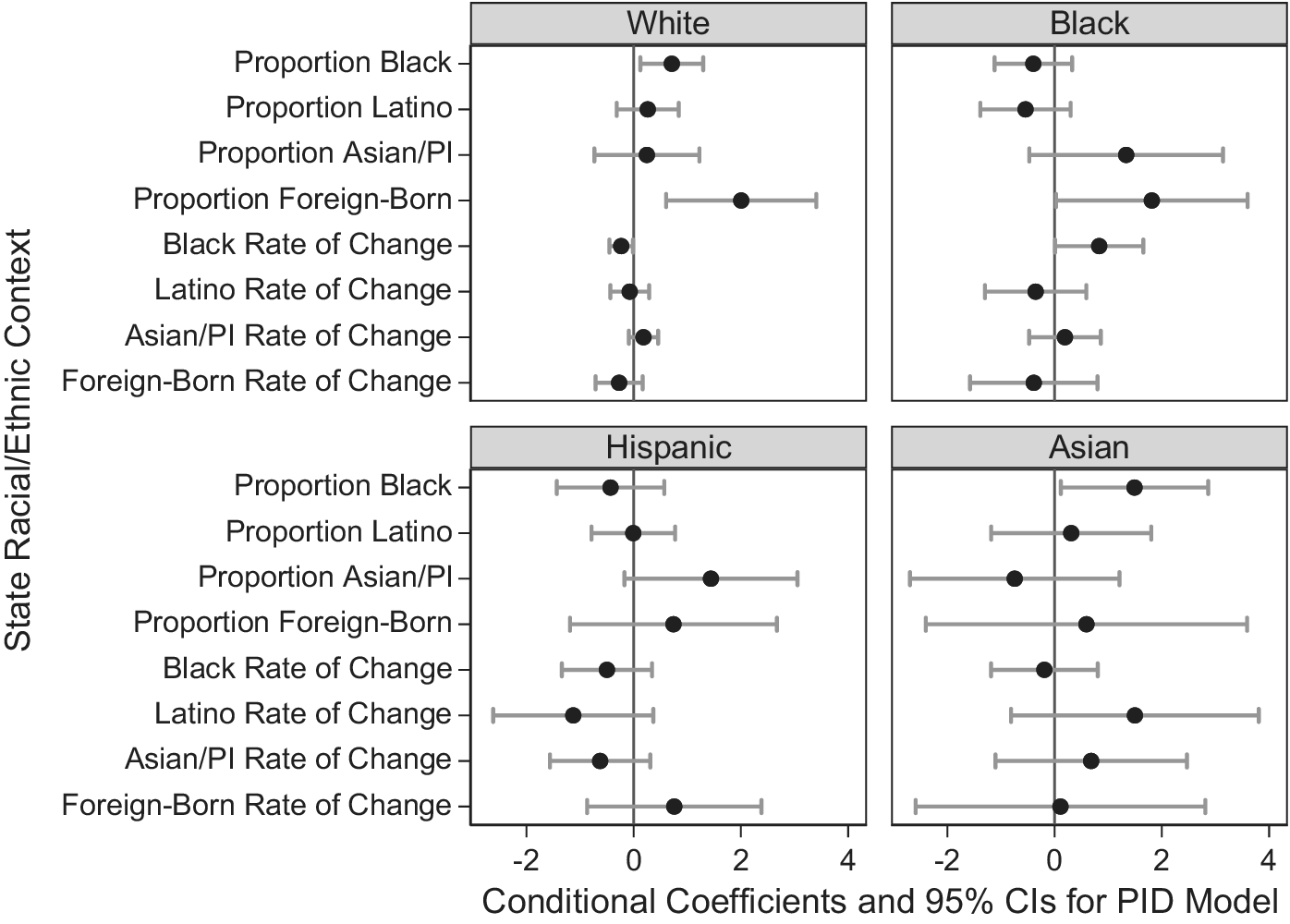
We begin by examining the state demographic correlates of PID. Figure 1 presents the conditional coefficient plots for the results of interest from the model of PID for each of the four racial/ethnic groups (Table A1 presents the full results). The results reveal initial evidence that state context is correlated with PID conforming to previous findings regarding Whites but also illustrating the divergent nature of partisan identities and state variation in mass partisanship. Overall, Whites tend to identify with the Republican Party more strongly in states with larger Black and Foreign-Born populations, and slower growth in the Black population.
Conditional coefficient plots for the relationship between racial/ethnic contexts and partisan identification, by race/ethnicity of respondent.
Note: Conditional coefficients and 95% confidence intervals are reported from a multilevel model of Partisan Identification with full interactions between the race/ethnicity of the respondent and all other independent variables. The multilevel model accounts for random effects at both the state and county levels. Full results, including state-, county-, and individual-level controls, are presented in Table A1, with unconditional coefficients reported in the Supplementary Material.

State social diversity generally remains uncorrelated with PID for non-Whites. The exceptions are Asians’ and Blacks’ tendencies toward the Republican Party in states with larger Black and Foreign-Born populations, respectively. No other state context emerged as a correlate of other racial/ethnic groups’ partisan identities.
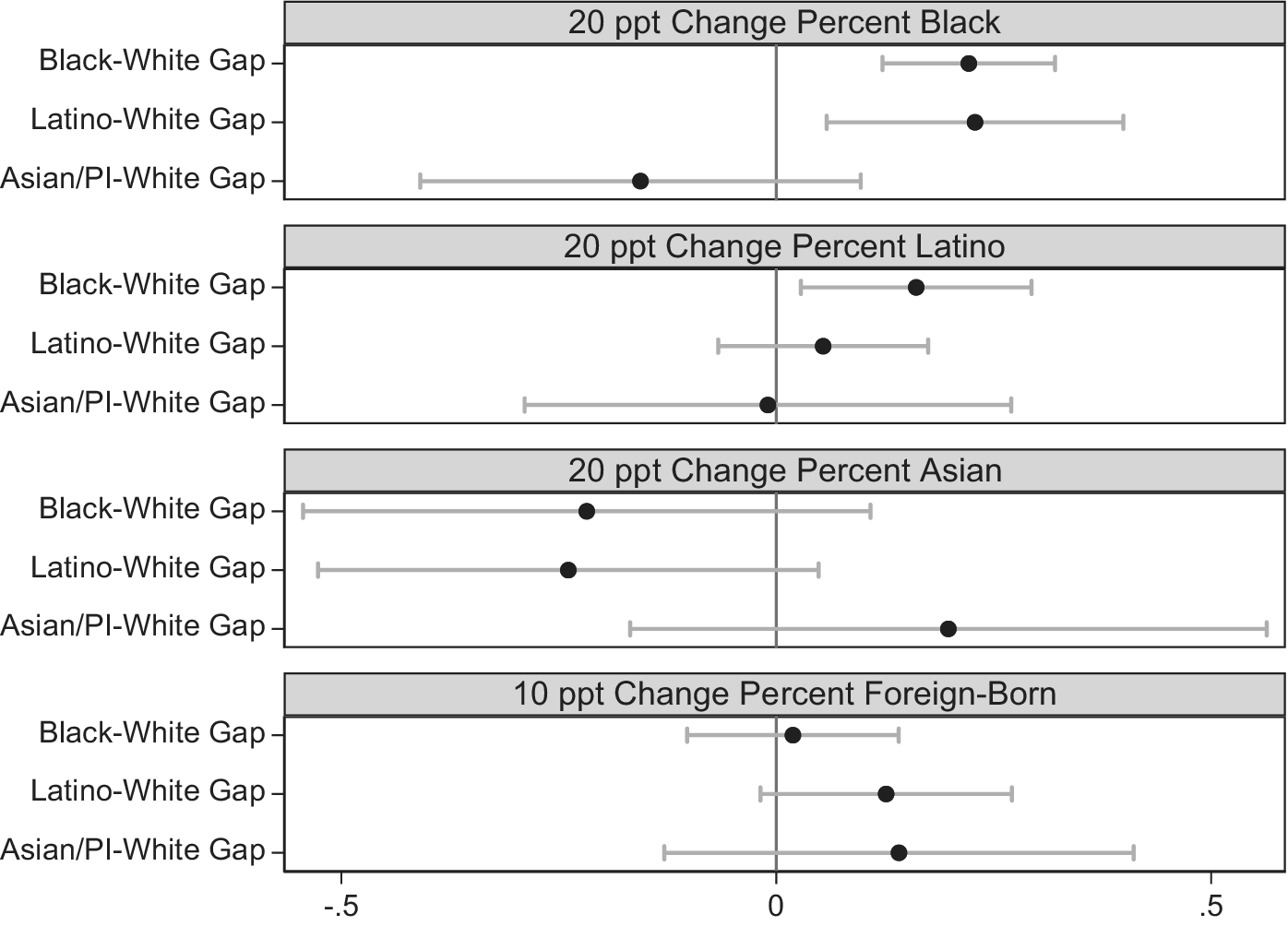
The results reveal several context coefficients that differ in direction across racial/ethnic groups, suggesting that while within-group variation may not be apparent, cross-group variation in the PID-context link exacerbates the racialized partisan divide. To investigate this possibility, Figure 2 presents the estimated difference in the minority-White PID gap attributable to a 0.20 change in the proportions of Black, Latino, or Asian populations and a 0.10 change in the Foreign-Born population. Positive point estimates (and confidence intervals [CIs]) signify larger gaps in partisan orientations between each minority group’s respondents and White respondents across changing contexts. The results indicate that states with large Black or Latino populations exhibit wider Black–White partisan divides than states with more homogenously White populations, and the Latino–White partisan divide is greater in states with larger Black populations. Thus, while White PID primarily responds to Black and Foreign-Born population size, accounting for heterogeneity in the relationships across racial/ethnic groups unveils diversity’s partial role in racial/ethnic gaps in partisan orientations across the country.
Estimated change in racial/ethnic PID gap across state racial/ethnic contexts.
Note: Points and 95% confidence intervals represent the difference (increase or decrease) in the PID gap between White respondents and each racial/ethnic group attributed to a change in state racial/ethnic group or Foreign-Born populations. Calculated from the full interactive model of PID presented in the Supplementary Material.

Partisan-ideological sorting
The analysis now turns to associations between context and partisan-ideological sorting across racial/ethnic groups. Models use the partisan-ideological sorting variable as the dependent variable, and include all independent variables included in the PID models except for the self-reported 5-point ideology measure, which serves as a component of the dependent variable.
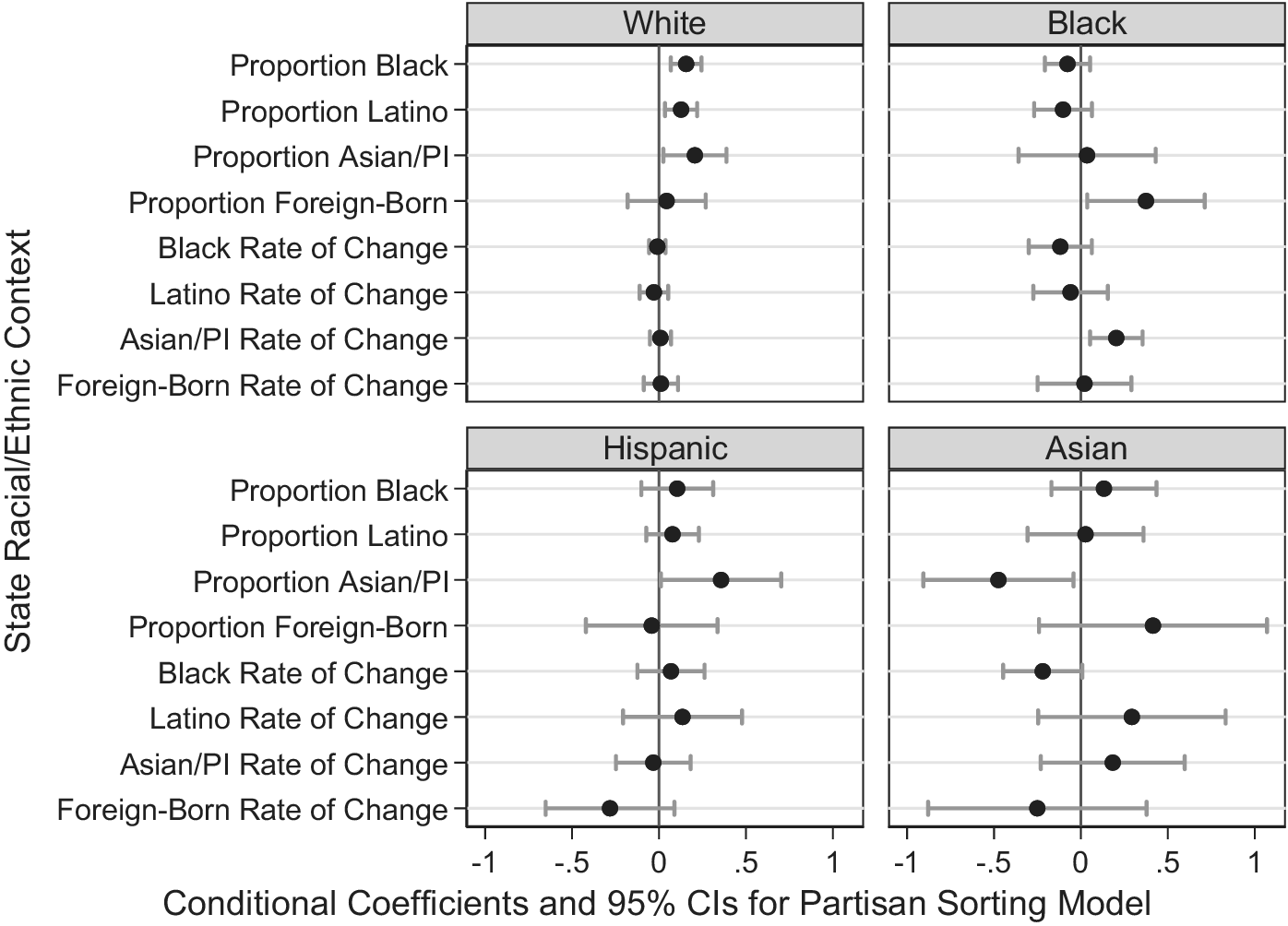
Figure 3 plots the estimated conditional coefficients and 95% CIs for the state racial/ethnic context variables (full results in Table A1). In general, Whites living in states with higher proportions of Black, Latino, and/or Asian residents are more politically sorted than those living in states with less diversity. Latinos exhibit stronger partisan-ideological sorting in states with larger Asian populations. This contrasts with Asians’ lower level of sorting in similar states. Black sorting increases in states with larger Foreign-Born populations and higher rates of change in the Asian population. The remaining context measures were not associated with partisan sorting within each group. These diverging relationships between partisan-ideological sorting and states’ racial/ethnic contexts indicate the presence of racialized partisan coalitions that vary across the states. In general, we find that individuals residing in more diverse states, regardless of racial/ethnic background, experience a mass party system in which racial/ethnic groups sort to a greater degree than in less diverse states.
Conditional coefficient plots for racial/ethnic contexts’ relationships with partisan-ideological sorting for White, Black, Latino, and AAPI respondents.
Note: Conditional coefficients and 95% confidence intervals are reported from a multilevel model of Partisan Sorting with full interactions between the race/ethnicity of the respondent and all other independent variables. The multilevel model accounts for random effects at both the state and county levels. Full results, including state-, county-, and individual-level controls, are presented in Table A1, with unconditional coefficients reported in the Supplementary Material.

These results, however, potentially mask context-specific asymmetric sorting across partisans (Grossman and Hopkins Reference Grossman and Hopkins2015). Diverging partisan identities across groups, particularly Black respondents’ attachment to the Democratic Party (but also Democratic tendencies among Latinos and Asians; and Republican orientations among Whites), and national-level ideological consistency among White Republicans requires controlling for partisanship within racial/ethnic groups to evaluate partisan asymmetries.
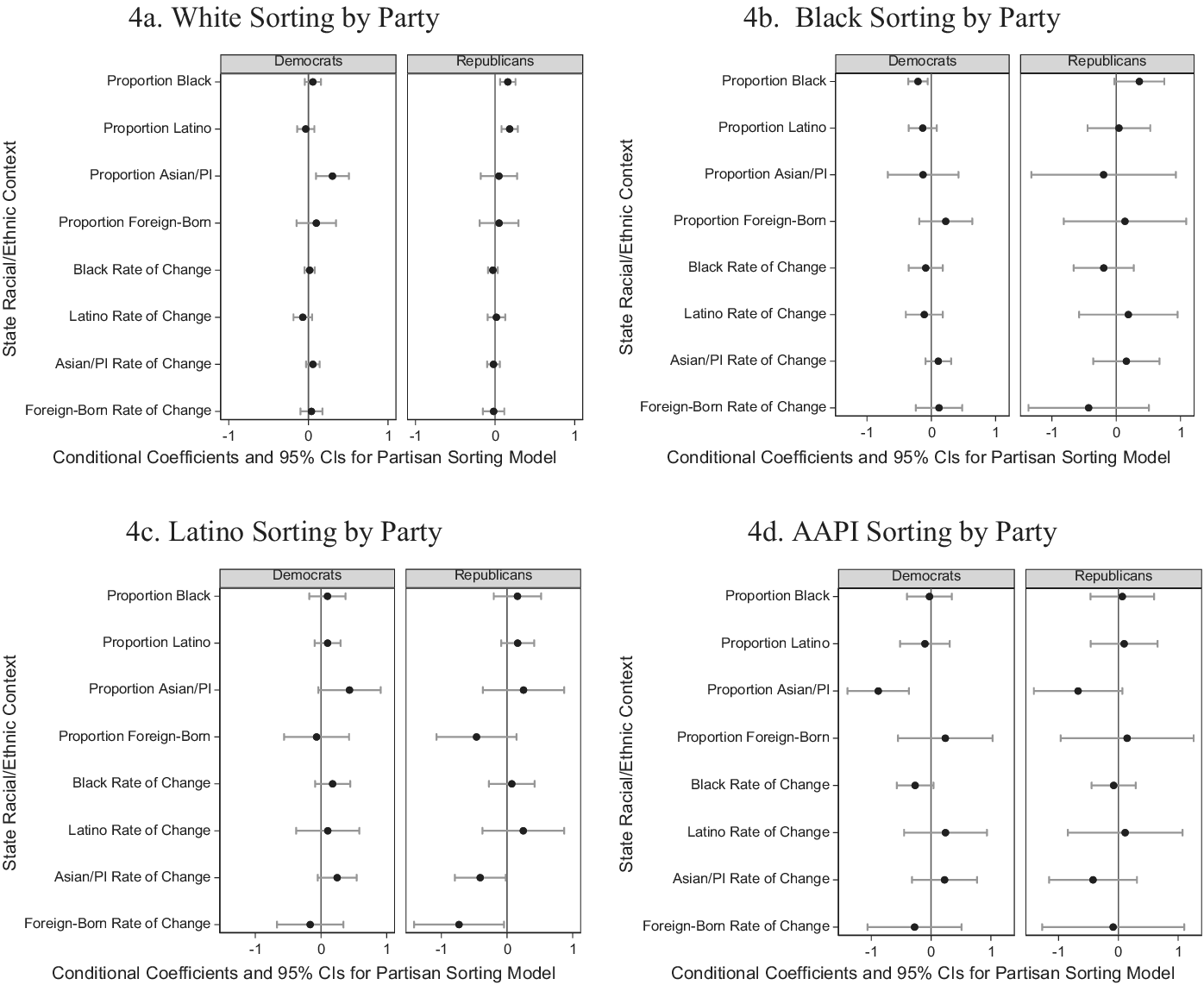
Figure 4 presents the results for each racial/ethnic group’s subsamples of Democratic and Republican respondents (including leaners) for the eight state-level contextual variables (full results reported in the Supplementary Material). Clear partisan asymmetries emerge among White respondents (Figure 4a). White Republicans tended to align partisan and ideological orientations to a greater degree in states with larger Black and Latino populations. White Democrats are not immune to contextual associations as they hold more highly aligned partisan-ideological orientations in states with larger Asian and Pacific Islander (AAPI) populations. Noteworthy is the lack of positive and significant indicators of Foreign-Born population size or any rates of change (at either the state or county levels).
Conditional coefficient plots for racial/ethnic contexts’ relationships with partisan-ideological sorting for White, Black, Latino, and AAPI split samples, for Democrats and Republicans.
Note: Conditional coefficients and 95% confidence intervals are reported from a multilevel model of Partisan Sorting for split samples for each racial/ethnic group with full interactions between all independent variables and a Republican/Democratic party dichotomous variable. The multilevel model accounts for random effects at both the state and county levels. Full results, including state-, county-, and individual-level controls, are presented in the Supplementary Material.

The analyses uncover few instances of variation in non-Whites’ partisan-ideological alignment across state-level social contexts and are often contrary to patterns for Whites. Black Democrats tend to have lower levels of sorting in states with larger Black populations (Figure 4b). Asian Democrats were less sorted in states with larger Asian populations (Figure 4d). In states with higher rates of change in Foreign-Born or Asian populations, Latino Republicans exhibited lower levels of sorting (Figure 4c). Overall, non-Whites tended to be less sorted in more racially/ethnically diverse states – a pattern at odds with White respondents.
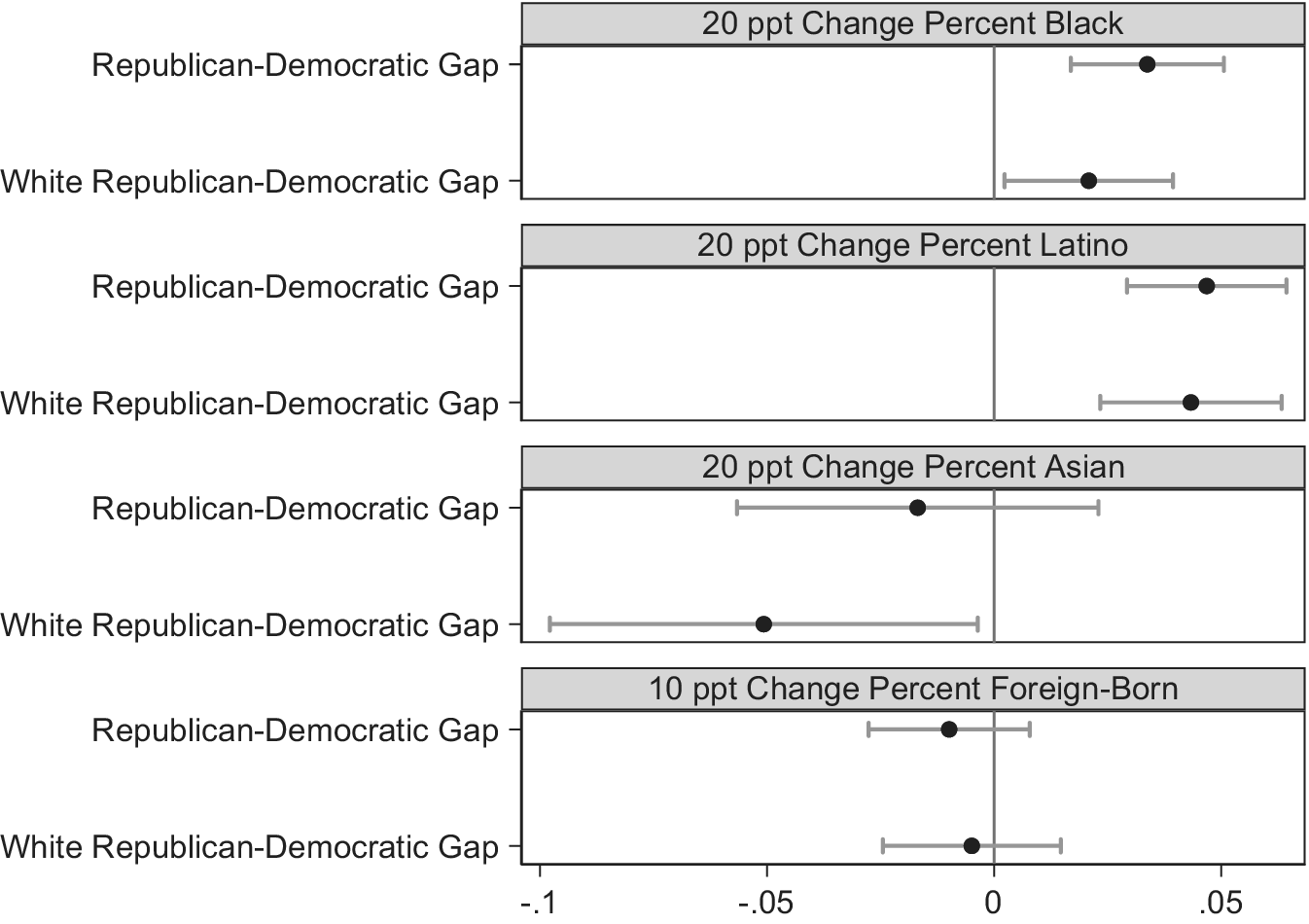
The link between partisan-ideological alignment and the racial context of the states holds broader implications for the asymmetric nature of alignment across the parties. Figure 5 presents the estimated difference in alignment gaps between Republicans and Democrats, generally, and only White partisan identifiers, for changes in the four main racial/ethnic contexts based on full interactive models reported in the Supplementary Material. Combined with the results above, the difference in partisan-alignment gaps indicates that a state’s mass party structure varies with racial diversity within the state, particularly in terms of the relative size of the state’s Black or Latino populations. Sorting among White Democrats increases the partisan gap in sorting as the Asian population increases, but this is offset in overall sorting gaps by shifts among other members of the Democratic coalition. Following from the previous findings, these results support the claim that a state’s mass partisan-ideological alignment varies across racial/ethnic contexts, even when controlling for a variety of county- and individual-level factors.
Estimated change in partisan sorting gap across state racial/ethnic contexts.
Note: Points and 95% confidence intervals represent the difference in the Partisan-Ideological Sorting Gap between Republicans and Democratic respondents or White Republicans and White Democratic respondents over the indicated change in state racial/ethnic group or Foreign-Born populations. Calculated from the full interactive model of Partisan-Ideological sorting presented in the Supplementary Material.

Intersectionality findings
As noted above, the breadth of factors examined in this study allows an opportunity to revisit recent findings related to the heterogeneous nature of partisanship and sorting (Enders and Thornton Reference Enders and Thornton2022; Jefferson Reference Jefferson2024; Philpot Reference Philpot2017; White and Laird Reference White and Laird2020; Zingher Reference Zingher2023). Table A1 presents the full conditional coefficients for the main PID and Sorting models. In general, the evidence of heterogeneous effects emerges across both models. Of the 49 factors included in the PID models, and 48 in the partisan sorting models, over 33 factors exhibited heterogeneity across racial/ethnic groups in either significance, magnitude, or direction of the relationship and thus supporting the general supposition that groups differ in their response to contexts and individual traits. While it is beyond the scope of this study to examine each factor, a few points from these findings merit mention. Ideology is significantly correlated in the same direction with PID across all groups. While the magnitude of this relationship is substantially lower among Blacks, it is far from irrelevant, as implied by some previous research. Individual-level variables indicate that the PID gender gap is smallest among Whites, while a gap in sorting exists across all groups. African Americans and Whites experience effects of religion in different ways, with White Protestants and Catholics more closely aligned with the Republican Party, while the opposite relationship emerges among Black respondents. Whites who attend religious services tend to be more sorted than others, while similar Blacks, Latinos, and Asians exhibit less sorting. Opposite effects of religious importance are found between Whites and Blacks as well (Philpot Reference Philpot2017). Similarities also merit acknowledgement. Higher income levels tend to produce stronger Republican-leaning identities and greater sorting across White, Black, and Latino respondents. News interests is positively correlated with sorting across all groups. Finally, organizational ties such as living in a Union household draw both Whites and Latinos to the Democratic Party, while Asians and Blacks exhibit less sorting in those same households. In sum, the results point to utility in a symbolic ideology measure across all groups, clear and divergent links to religious affiliation and religiosity, yet consistency across racial/ethnic groups in the effects of other social factors such as union membership and economic class. Overall, these ancillary findings suggest a clear need for future research to continue to examine the differing causal processes underlying the heterogeneity across groups reported here.
Robustness checks
We conducted several additional specifications of the partisan identity and partisan-ideological sorting models to ensure the robustness of the findings. The results are summarized and presented in full in the Supplementary Material. For all robustness checks, the main findings of the relationships reported remained substantively intact. First, alternative measures of partisan-ideological sorting, one following Mason (Reference Mason2018) and others and a second simple product of standardized PID and ideology, confirmed robustness across varied conceptions of the measure. Second, given some unique state contexts (i.e., Florida’s Cuban-American population, California’s Latino and Asian populations, and Hawaii’s Asian population), models removing respondents from (California, Florida, and Hawaii) from the analyses were estimated in addition to those presented here. Finally, to demonstrate that the phenomenon of context-driven partisan sorting is not simply an artifact of Southern racism, we replicate the partisan-sorting models for White respondents in non-Southern states. In all, the results are robust to these plausible alternative specifications.
Discussion and conclusion
The increasing racial/ethnic diversity within and across the US states marks one of the most significant political developments in the last half-century. While a long line of studies focuses on White reaction to increasing diversity within states, we know little about how social diversity relates to other groups’ political identities. Despite this, scholars link diversity to mass polarization at the national level, with few recognizing the potential for an asymmetrical response to diversification that may form the basis for even stronger ties to one’s political identity. The results of this study thus expand our knowledge of the associations between diversity and state mass partisan identities and sorting, which, in turn, provides a deeper understanding of the linkages between racial/ethnic diversity and politics and policy.
The correlation between in-group and out-group populations varied across racial/ethnic groups, with Whites more strongly affiliating with the Republican Party in states with larger Black and Foreign-Born populations. Non-White respondents’ PID varied to a lesser degree, with Asians and Blacks likely to be more Republican-oriented in states with large Black, and Foreign-Born populations, respectively. These patterns result in greater racial/ethnic partisan divides between Whites and Blacks or Latinos in more diverse states. Thus, residents of diverse states tend to engage in more racialized partisan politics – adding a layer of racialized sorting that accentuates the power of partisan identities – than other citizens and voters.
Partisan-ideological alignment is also related to diverse contexts, even outside of the South. The positive correlations between a state’s Black, Latino, and Asian population sizes and political sorting among Whites comports with the increasing polarization among Whites and is reflective of a threat mechanism. The results also reveal heterogeneity in the context effects across groups, producing larger gaps in partisan-ideological sorting in more diverse states. Context, then, may explain the degree to which largely White ideological Republicans came to dominate the party, while the Democratic Party remains less ideologically aligned. The results fall in line with individuals taking both partisan and ideological cues from the mass party in the states, as each group aligns party and ideological strength based on perceptions of how well they fit with the party’s demographic composition. The Democratic Party’s composition in diverse states, combined with heterogeneity in the effects of individual-level factors, means multiple crosscutting identities may mitigate pressure to align party and ideology.
Partisan-ideological sorting holds additional implications for politics and policy. In states with more sorted partisans, partisan affect, emotional politics and a lack of policy-driven preferences may emerge. Coupled with a racialized component of partisan-ideological sorting, the implications can range from more conflictual politics (Mason Reference Mason2018) to civil conflict (Walter Reference Walter2022). Given that this phenomenon is most pronounced among Whites, the implication is that residents of diverse states interact in a political context that is more racially factional, with both racialized sorting along partisan lines and partisan-ideological sorting among Whites.
The greater degree of racial partisan sorting observed in diverse states likely reinforces the in-group versus out-group partisan identities that actuate negative partisanship, heighten emotional responses to party and policy cues, and seemingly lie at the heart of a broad swath of the negative effects of mass-level political polarization in the United States (Mason Reference Mason2018). In other words, diverse states display the foundational elements of problematic partisan identities and polarization to a greater degree than experienced in more homogenous states. Combined with increasing state policy responsiveness to party control of state governments (Grumbach Reference Grumbach2018), this sorting portends large and contentious interparty rifts and growing inequality in democratic responsiveness. The consistency in associations with levels of minority population size, even after controlling for change in minority population size, also implies that these rifts may not subside as diversification within the states stabilizes. These complexities in state politics found in multiracial contexts are a clear extension of the prominence of racial and ethnic context as main features and factors in state politics.
Supplementary material
The supplementary material for this article can be found at http://doi.org/10.1017/spq.2025.10005.
Data availability statement
Replication materials are available on SPPQ Dataverse at https://dataverse.harvard.edu/dataset.xhtml?persistentId=doi:10.7910/DVN/Q7S7H4 (Preuhs and Hero Reference Preuhs and Hero2025).
Funding statement
The authors received no financial support for the research, authorship, and/or publication of this article.
Competing interests
The authors declared no potential competing interests with respect to the research, authorship, and/or publication of this article.
Robert R. Preuhs is a Professor and Chair of the Department of Political Science at the Metropolitan State University of Denver.
Rodney E. Hero is a Research Professor in the School of Politics and Global Studies at Arizona State University and Professor Emeritus at the University of California, Berkeley.
Appendix
Conditional slope coefficients for partisan identification and partisan sorting models for White, Black, Latino and Asian/PI respondents (Bold indicates p<|.05|, two-tailed z-test)