1 Introduction
As language teacher educators we have an on-going professional and investigative interest in the reflective practices (RP) of our student teachers (STs). For this reason we have been examining the types of RP activities in which they engage in order to better understand the type and depth of reflection that occurs and how various modes and tools influence the process. The ultimate goal is always to use evidence and data-based approaches to inform (and improve) our professional practices in language teacher education (LTE). The conceptual framework for reflecting on professional practice began formally with Dewey, and was defined by him as the “Active, persistent, and careful consideration of any belief or supposed form of knowledge” (Dewey Reference Dewey1933: 16). Since that time, and with the influential work of Schön (Reference Schön1991), it has been integrated in very real ways in LTE and teaching contexts. Typically on pre- and in-service education programmes, reflection happens in a number of ways, for example: reflective journals (Richards, Sylvester & Farrell, Reference Richards, Sylvester and Farrell2005); personal stories and pair/group co-operative discussions (Edge, Reference Edge2002, Reference Edge2010); professional development portfolios (Farr, Reference Farrforthcoming); and blogs and electronic portfolios (Pryor & Bitter, Reference Pryor and Bitter2008). As a social activity it marries easily with the emergence of electronic social media over the last ten years, the influence of which can be seen in various ways. The use of social media in LTE contexts seems to be expanding exponentially, and research regarding their integration is beginning to emerge more consistently. This paper aims to add to that body of research by examining the technologies of online chat, discussion forums and blogs, in terms of their suitability and affordances as reflective media. It begins by examining positional survey data gathered from STs who have used these social media over a period of time. Following this it focuses on one of the desired outcomes of RP, the construction of a teacher identity as part of the process of becoming a professional. The construction of identity through the mediational tool of language used across these modes is examined through a corpus linguistics lens. Collections of language produced during RP activities are analysed as a corpus in quantitative and qualitative ways. These complementary sources of data in a mixed-methods approach provide some insights into the technologies and their potential in an LTE context.
2 Background and context
2.1 Online tools in teacher education
Employing technology in TESOL teacher education (TE) is becoming increasingly more supported and widespread (see for example the technology standards for teachers and language learners developed by Healey, Hegelheimer, Hubbard, Ioannou-Georgiou, Kessler & Ware, Reference Healey, Hegelheimer, Hubbard, Ioannou-Georgiou, Kessler and Ware2008). This is important because when technologies are used in TE programmes, they are said to promote reflection (Pryor & Bitter, Reference Pryor and Bitter2008), interaction and collaboration (Hughes, Reference Hughes2007), and nurture communities of practice (CoP) (Hanson-Smith, Reference Hanson-Smith2006). This section discusses three online tools we use in this study (chats, discussion forums, and blogs) and their application in TE.
Firstly, chat or Internet Relay Chat (IRC) is a mode that allows people to talk to each other online in real time. Chat discussions are deemed useful for education because they can be logged easily, the transcripts provide data for the study of written text, and the fact that the mode is synchronous makes for interaction that is similar to spoken discourse (Lamy & Hampel, Reference Lamy and Hampel2007). However, it is also suggested that the synchronous mode is messy as a result of lags in turn-taking and participants going off topic (Meskill, Reference Meskill2009), which does not tend to happen in asynchronous modes. In pedagogical contexts, for example, Chen, Chen and Tsai (Reference Chen, Chen and Tsai2009), using content analysis, investigated synchronous online chat to examine social cues, interaction patterns, cognitive as well as metacognitive skills, and the variation of postings over time. Perceptions of the synchronous environment were also investigated. The participants included 61 school teachers enrolled in an online teacher professional development course in mathematics. Their analysis is based on six synchronous discussions of 3,600 messages, although other forms of interaction were also used. The authors highlighted that the functions of this mode, as perceived by the teachers, were to share experiences for social engagement, information exchange, and intellectual development. Their overall findings demonstrated that the teachers dominated the discussions; social cues were most frequent in the first and third posting periods, and they therefore suggest that the main function of online synchronous chat was relationship building for the teachers. Further findings include that the teachers often went off topic, although specific questions were asked; more indirect than direct messages were posted; cognitive and metacognitive skills were low (27.7%) and were at a surface level; and most teachers thought it was an effective process. Of more relevance to this paper, in a study using online synchronous interactions with a group of engineering students, evidence of increased identity formation with the profession of engineering was revealed (Duemer, Fontenot, Gumfory, Kallus, Larsen, Schafer & Shaw, Reference Duemer, Fontenot, Gumfory, Kallus, Larsen, Schafer and Shaw2002), in that over time the students became more confident when talking about the engineering profession and aligning themselves with it.
The second tool drawn on in the present study is discussion forums, which have been identified as ‘semi-public writing areas, as opposed to e-mail, which is a private and more informal CMC medium’ (Blake, Reference Blake2008: 72). It has been revealed that forums were adopted easily from an early stage as they are not too technologically demanding for teachers and students alike (Lamy & Hampel, Reference Lamy and Hampel2007: 107). For example, because teachers often work alone, and may have little chance to collaborate with teachers outside of their own institutions, Romano’s (Reference Romano2008) study focuses on discussion forums to enable collaboration between teachers. Romano’s work involved ten first year teachers, and the analysis demonstrated high and low interactivity during the timeframe of the online sessions. She also found that the teachers were of the opinion that they were benefiting from each others’ discussions as they were encouraging reciprocal reflection and advice.
In addition to this, a study investigating higher-order thinking skills through online forums was conducted by McLoughlin and Mynard (Reference McLoughlin and Mynard2009), who draw on content analysis of forum postings under the Garrison, Anderson and Archer (Reference Garrison, Anderson and Archer2000) model of critical thinking (the Community of Inquiry Framework). Their participants were female Bachelor of Education students preparing to be English teachers, thus the study consists of a 20-week course for these STs, who took two modules, namely pedagogical grammar and the principles of the Cognitive Academic Language Learning Approach. Online forums (five prompts for each course) were included in both courses to encourage them to reflect, interact and discuss areas related to the course. In total, 102 ST postings were analysed, and without delineating the specific categories of each posting, they did reveal evidence of higher-order thinking skills. What they suggest is that the more confident STs dominated the regular classes; the online forums provided an outlet for them to reflect on what they would say before posting, and the researchers hold that this may have reduced the feeling of anxiety for the more reserved users.
The final tool of relevance here is blogs. A blog or a weblog is a website that contains posts, presented in reverse chronological order. For a number of years now blogs have been attracting interest from the educational arena (Ray & Coulter, Reference Ray and Coulter2008), because, for example, the expressive nature of the blog makes it a very appealing academic resource (Deng & Yuen, Reference Deng and Yuen2011). Language students and teachers have also utilised this tool for the purposes of reflection, community building, self-expression, and the enhancement of reading and writing skills (Murray & Hourigan, Reference Murray and Hourigan2006; Murugaiah, Azman, Yaacob & Thang, Reference Murugaiah, Azman, Yaacob and Thang2010), while attending to both knowledge construction and RP (Luehmann, Reference Luehmann2008; Elliott, Reference Elliott2009). As a blog is, in fact, a journal, this tool appears to situate itself well within TE, and it has been long agreed that the use of journals for STs can foster reflection and identity formation (Bailey, Reference Bailey1990; Johnstone, Reference Johnstone2004). This therefore facilitates a natural transition from written journals to online blogging.
In terms of TE, online mentoring has been facilitated by blogs (McLoughlin, Brady, Lee & Russel, Reference McLoughlin, Brady, Lee and Russel2007), and CoP formation has been enhanced, which can result in teachers expressing tensions and emotions, voicing their feelings, and consequently bonding as a group (Murugaiah et al., Reference Murugaiah, Azman, Yaacob and Thang2010). Furthermore, blogs can promote RP for STs (Ray & Coulter, Reference Ray and Coulter2008), and the sharing and disseminating of knowledge and professional discourse (Luehmann, Reference Luehmann2008). More closely related to our context is a study implemented by Yang (Reference Yang2009) detailing the use of a collaborative blog for RP with 43 EFL STs stemming from two TE programmes. Within his study, the course instructors set up the blog and the STs were required to reflect weekly on their teaching experiences. They were also encouraged to comment on one another’s posts to promote collaboration. When analysing the blog contents, he sorted the postings into the following five categories: theories of teaching; instructional approaches and methods; teaching evaluation methods and criteria; self-awareness; and questions about teaching and requests for advice (Yang, Reference Yang2009: 15), which are somewhat similar to those outlined by McLoughlin et al. (Reference McLoughlin, Brady, Lee and Russel2007). Yang’s (Reference Yang2009) findings suggest that the STs were often more descriptive in their reflections than critical; however, he asserts that the instructors played a role during the process in that they posted questions in order to encourage more critical deliberations.
Of particular interest to us is the point made that general blogs “are increasingly becoming on-line identities of their authors”, because “compared to topic-centred or community centred online discussions, a weblog often provides a narration of someone's feeling, thinking, reading, and experiencing”, and therefore “a weblog author’s personality and values […] emerge between her or his words” (Efimova & Fiedler, Reference Efimova and Fiedler2004: 492). A final study to note involves the use of a collaborative blog with ICT Initial Teacher Training Postgraduate Certificate of Education (PGCE) students during their off-campus placements. Using discourse analysis, the authors examined genre, pronoun usage and lexis (Irwin & Boulton, Reference Irwin and Boulton2010). In terms of genre, they extrapolated a number of different message types within the posts, which were coded as Introduction, Re-introduction, Messages of Encouragement, Requests for Help, Emotional Catharsis, Resource Sharing, Detailed Report, Solicitation of Experiences, and Short Status Report (similar to Yang, Reference Yang2009). On their examination of pronoun usage (we and us), the most salient finding was that the STs were using we/us to refer to themselves as STs. However, in the second semester there was evidence of enhanced usage of the pronouns referring to themselves as professional teachers, therefore suggesting they were identifying more strongly with the teaching community over time. Regarding the lexis used within the blogs, they noted evidence of subject specific discourse, lexis surrounding education in general, and teacher and student roles. There was also evidence of a shared knowledge of academic discourse (student discourse), however, and coinciding with findings on pronoun usage, once they became more immersed in teaching, there was a move to discourse associated with secondary-level education (teacher discourse). In semester one, they noted that a lot of discourse depicted the STs in their roles as students of the university, but more professional teaching discourse (teacher role) emerged in semester two; however, towards the end of semester two (near exam time), the STs reverted back to the more academic-oriented discourse (student role). So while these STs began by being detached from professional discourse, within a few weeks of teaching, there was a more teacher-focused identity evident in their discourse, which then reverted back to student/academic-oriented discourse during exam time (Irwin & Boulton, Reference Irwin and Boulton2010).
We chose to integrate both synchronous and asynchronous modes of communication for our STs to offer them variety in terms of interaction and participation. As seen later, synchronous and asynchronous CMC have different affordances; for example, the asynchronous mode is flexible, offering more reflection and deliberation on postings, while the synchronous mode offers more in terms of community building and social support. As Hrastinski (Reference Hrastinski2008: 54) notes:
synchronous communication makes it possible to monitor the receiver’s reaction to a message, making the receiver feel more committed and motivated to read it. When communicating asynchronously, however, the receiver has more time to comprehend the message, since the sender does not expect an immediate answer. Thus, synchronous e-learning increases arousal and motivation, while asynchronous e-learning increases the ability to process information.
We believe this combination of synchronous and asynchronous CMC should offer the STs a number of avenues for discussion, collaboration, RP and identity construction.
2.2 Identity construction
Identity, in the context of LTE, has been referred to as “the differing social and cultural roles teacher-learners enact through their interactions with their lecturers and other students during the process of their learning” (Richards, Reference Richards2008: 167), and it is in these interactions that our interest lies. Teachers and their identities are gaining much more prominence in TE today (Vásquez, Reference Vásquez2011), and in particular, we examine the discourse of communities of STs and their identity construction via electronic communication in our study, because identities unfold during discursive practices (see Haugh, Reference Haugh2008). In fact, it has been noted that “how people perform, ascribe and resist identity, and how what it means to ‘have an identity’ is produced in talk and texts of all kinds” (Benwell & Stokoe, Reference Benwell and Stokoe2006: 4). This thus highlights the importance of discourse for the projection of identities, as it allows people to shape, reshape and make sense of their identities (Johnstone, Reference Johnstone2008). Accordingly, Haugh (Reference Haugh2008) makes reference to the communication theory of identity (see also Hecht, Warren, Jung & Krieger, Reference Hecht, Warren, Jung and Krieger2005), which is based on the premise that identities are not independent of discourse, but are realised via discursive practices. Within this theory, there are four layers of identity construction: firstly, the personal identity, which is the individual’s self-image or self-concept, and secondly, the enacted identity, which is the performance of a specific identity in a discourse setting. The third layer refers to the co-constructed realisation of an identity via negotiation with others, namely the relational identity, and the fourth layer is the communal identity, which includes identities stemming from groups (see Haugh, Reference Haugh2008).
Of particular relevance to our context, professional teacher dialogue has been advocated for the facilitation of understanding, reflection and identity formation (Mantei, Reference Mantei2011). We therefore believe that a focus on identity construction is of significance for STs, who are beginning their trajectory in teaching, and are constantly negotiating their identities. Similar to our experiences, it has been noted in TE contexts that STs arrive on a programme of study as trainees, but aim to leave as professionals, and therefore “through the year they need to undergo a transformation so by the end of the year they identify with being a teacher, and less with being a student” (Irwin & Boulton, Reference Irwin and Boulton2010: 23), which is precisely what we aim to investigate. Before moving on to the analysis, the following section outlines the data and methodology for the present research.
3 Methodology
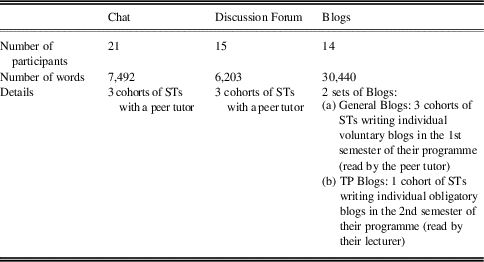
Our data was collected in a third-level TE setting, namely from a one-year MA in TESOL programme (pre-service) and consists of STs engaging in a range of reflective discussions about teaching in a variety of contexts. The corpus used for the present analysis amounts to approximately 44,200 words, and consists of data from three online modes. A one-hour chat session was held with each MA cohort over three years between STs (on a voluntary basis) and a peer tutor (also one of the authors of this paper). The peer tutor initiated topics of discussion regarding language pedagogy (language systems, and the theory and practice of language teaching). A total of 21 STs participated, and discussions amounted to approximately 7,500 words. With the same three cohorts of STs and the peer tutor, a two-week long discussion forum was held. Four questions (relating to theories of learning and teaching methodologies) were posted over the two weeks to allow time for reflection and contribution, and in order to sustain motivation and encourage participation. Fifteen STs participated in this activity, which makes up 6,200 words of the corpus. For the analysis that follows, the data from the peer tutor is disregarded and only discourse from the STs is considered in order to provide a more accurate reflection of their interactions. The Blogs sub-corpus consists of two sets of blogs, the first of which comprises 18,220 words from the same three cohorts of STs who participated in the chat and forums. These were used as private blogs by individual STs for the purposes of general reflections on teaching and their TE programme, and were only read by the peer tutor (General Blogs sub-corpus). The three cohorts of STs using chat, discussion forums and the aforementioned set of blogs were predominantly female (80%), and although there was a spread of ages, ranging from 20 to 59, they mainly fell into the 20–29 category. Also, their teaching experience ranged from no experience to ten years’ experience, with the majority having no experience (27%) or one to eight months’ experience (24%). The second set of blogs are individual and written by a later cohort of STs as an obligatory weekly reflection on their own practice lessons, and comprise 12,220 words (TP Blogs sub-corpus). This group of STs was an all-female group of five participants with little or no teaching experience. They were primarily in their 20s except for one mature ST who was in her late 40s. All STs were at the early stages of their training in that the three cohorts of STs working with the peer tutor did the online activities in the first semester of their course (ranging from weeks 6 to 12 of a fifteen-week semester), and the STs who wrote the obligatory blogs did so in the second semester of their programme (from weeks 3 to 10). Table 1 summarises the data.
Data for analysis
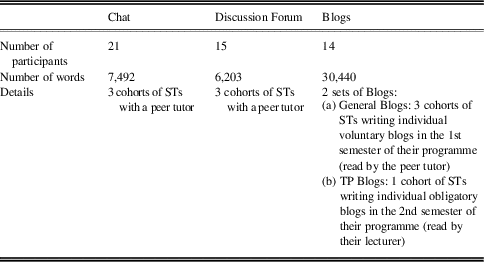
Once all STs had completed their tasks/activities, a corpus was compiled, following the criteria set out by Farr, Murphy and O’Keeffe (Reference Farr, Murphy and O'Keeffe2004) for the Limerick Corpus of Irish English (L-CIE), and was analysed using WordSmith Tools (Scott, Reference Scott2004). The remainder of this paper turns to the findings emerging from the analyses of these datasets.
4 ST perceptions
For one part of the dataset which has been described above (the data with the recurring three cohorts of STs), the STs were interviewed about their experiences of using blogs, chat and forums, and before moving onto the corpus-based discourse analysis, the first section here examines this group of STs’ perceptions of the modes in question.
4.1 Mode preferences
Of the sixteen participants interviewed (not all participants attended interviews), each was asked which tool (blog, chat or discussion forum (DF) they preferred, the results of which can be seen in Figure 1. Each ST in the interviews was asked the same questions, after which the interviews were transcribed. Before findings could be categorised into relevant areas, we read, coded (for themes, topics) and re-read the transcripts.
Diagram showing mode preferences for participants

When reported on individually, of the eleven STs who participated in the chat discussion (and attended the interviews), ten noted that they enjoyed using this tool, with the other reporting that “it wasn’t my type of thing entirely”. This reflects a previous study by Kern (Reference Kern1995: 469), who discovered that 93% of the language learning students surveyed were in favour of chatroom interactions, and 70% felt it gave them the opportunity to collaborate with others, and they experienced a feeling of camaraderie. Furthermore, in the same study 55% acknowledged the difficulties with using the tool, and in this present study, although the vast majority of STs liked the chat mode, the advantages and disadvantages were also apparent to them, one of the main disadvantages being the overlap in turn-taking. On the other hand, the ten students who participated in the discussion forum in the present study all reported that they enjoyed using this tool, and satisfaction with the asynchronous modes was also found by Arnold and Ducate (Reference Arnold and Ducate2006) where 83% of their STs enjoyed asynchronous environments. Of the eight STs who completed blogs, all of them liked the tool, and no disadvantages were suggested for this mode. Similarly, a study using blogs in a UK third-level institution with second-year German language students was implemented by Dippold (Reference Dippold2009) to encourage peer collaboration, and the feedback gained from tutors and students also demonstrated how the interaction afforded by blogs was favoured by all.
As seen in Figure 1, the majority of STs interviewed favoured the blogs, which is followed by chat and those with no preference, and the remaining 9% preferred the forum. It is of note that while most of the activities were interactive and collaborative, the blogs were private and only read by the peer tutor. This may imply that, as well as working in collaborative groups, the STs enjoyed having a private space to discuss or reflect. The following section discusses more specifically the STs’ perceptions of the opportunities for reflection.
4.2 Facilitating reflection
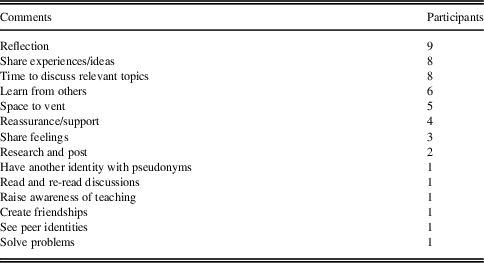
All of the STs agreed that they had the chance to reflect throughout the discussions across the modes. They commented on a number of relevant issues. The discussions seemed to prove useful because they revisited topic areas covered in the programme of study, and they encouraged them to reflect on their own practice, as well as others’ practices through sharing opinions and experiences. The online discussions allowed them to read, research and reflect before posting. However, one ST commented that he did not reflect much on his teaching but reflected merely on a personal level, which may be one of the consequences of the fact that the tasks were unassessed. Another ST aptly pointed out that those who fully participated might be those who reflect more anyway. When asked in the final interviews what the benefits of the discussions within the project were, out of the sixteen STs interviewed, fourteen felt they benefited, while only two were unsure; Table 2 summarises the reasons they outlined.
Benefits of using online modes for reflection
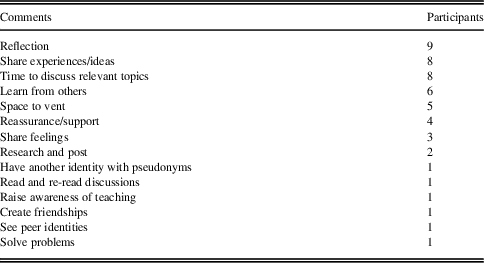
Clearly, reflection emerges as the most frequently cited benefit, as well as sharing ideas and feelings, having the time to discuss relevant topics, learning from others, having a space to vent, and gaining support and reassurance from each other. In relation to having time to discuss relevant issues, it has been noted that “one way that technology can serve to enhance the learning process is by offering an environment […] available outside classroom time where students continue to reflect and discuss topics learned during class time” (Szabo & Schwartz, Reference Szabo and Schwartz2011: 79). For this reason, online communication is an effective method of promoting professional development, without time and space restrictions. As well as reflection, other important aspects mentioned include that the STs often did some research before replying in the online modes; the interactions created friendships; and they helped them to solve problems. Another advantage as perceived by the STs was being able to have another identity online and see each others’ online identities, which demonstrates the STs’ awareness of their roles, and their online voices. We have seen that, in a general sense, there was overall satisfaction in that the online modes gave the STs space to reflect and that there was a preference for doing this through blogs. The next part of the analysis looks at the linguistic representation of those reflections in each of the modes through the lens of keywords, clusters and some discrete item analysis.
5 Corpus-based analysis
This section offers results from corpus-based analysis of the datasets. We have previously analysed identity emerging from ST narratives (Riordan & Farr, Reference Riordan and Farrforthcoming) in a more qualitative discourse-analytical manner; however, for the purposes of this paper we begin our analysis with more quantitative corpus linguistic methods
5.1 Keywords across the modes
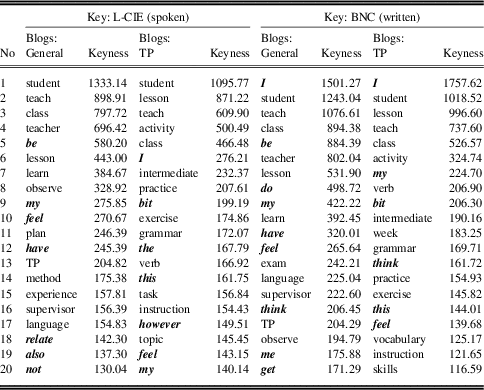
Given the potential hybrid nature of blogs as a genre closely aligned with writing but with affordances for informal conversational features due to the online social space in which they find themselves as artifacts, it is appropriate to compare them to both spoken and written data for the production of keyword lists – words which are significantly more (or less) frequent than in a reference or comparison corpus. The two columns on the left-hand side of Table 3 show the items which occur with relatively higher frequency in the blogs than in the spoken one-million-word L-CIE (Limerick Corpus of Irish English, Farr, Murphy & O’Keeffe, Reference Farr, Murphy and O'Keeffe2004).Footnote 1 The two columns on the right show the higher frequencies relative to a large written corpus in the form of the BNC Sampler (one million words of written English).
Top 20 Keywords in the Blogs corpus (lemmatised)
In general, keywords will include items which are specific to the genre, the context or the topic under investigation. In this case we see numerous instances of content words relating to teaching practice in language teaching and its context, for example, student, class, teacher, TP, lesson, language, observe, learn, plan, activity, grammar, vocabulary and others. This reassures us that the discourse is generally on topic and focused in a way that was intended when setting the blog writing tasks. In other words, the STs are talking about their teaching and their teaching practice rather than about unrelated or irrelevant topics. If we strip these topic-specific items from the keyword results, some interesting insights can be gleaned, as presented in the highlighted cells in Table 3.
The remaining items fall into a number of categories, with potential overlap when undifferentiated in terms of function. We find words which either do or show strong potential to fall into the following groupings broadly based on Biber, Johannson, Leech, Conrad and Finnegan (Reference Biber, Johannson, Leech, Conrad and Finnegan1999):
∙ Personal pronouns (my, I)
∙ Other deictic references (the, this)
∙ Narrative verbs (be, do, have)
∙ Cognitive verbs (think, feel)
∙ Stance markers (not)
∙ Discourse markers of contrast and addition (however, also)
∙ Interrogatives (do)
The evidence suggests that in a relatively more frequent manner, the STs are narrating and describing events (through the use of personal pronouns and other references, and narrative verbs). As part of these descriptions there are strong indications that the writers are engaged in cognitive and/or emotional processing (through the use of cognitive verbs) and evaluation (through the use of stance markers). Rationalisations through comparisons and additions in the arguments are suggested by words like however and also, and these along with interrogatives point towards a level of critical thought and engagement at a deeper level than mere description. In effect, even by looking at this component of the keyword lists we have a reasonably strong indication that the STs are producing discourse congruent with the three types of reflection demarcated by Jay and Johnson (Reference Jay and Johnson2002): descriptive, comparative and critical. Indeed, in other discourse analytical work on the blogs datasets (see Riordan & Farr, Reference Riordan and Farrforthcoming), we found similar evidence of the functions highlighted above, which support the corpus-based findings presented here. A more detailed quantitative and qualitative analysis of some of these discrete items in the next section will shed further light on these links.
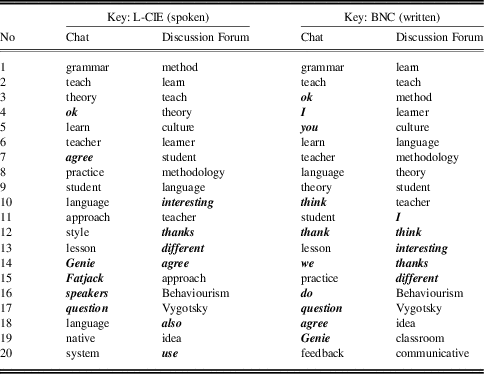
Before this, Table 4 depicts the keywords (lemmatised) in the chat and discussion forums compared again to the L-CIE and the BNC Sampler corpus. When compared to the findings in Table 3, again evidence of topic-specific discourse emerges (items highlighted are those which fall outside this categorisation). There are similarities of other functions to those in the blogs data, for example: personal pronouns (I, you, we); discourse markers (also, ok); interrogatives (do, question); cognition (think), and stance/evaluation (different, interesting). Two interesting points to mention include the lack of narrative devices in the chat and forums compared to the blogs, which highlights the preference for narration in the blog mode. Also, something evident in chat and discussion forums and not in blogs is an affective function with items such as agree and thanks. This is interesting because these online modes are interactive, and therefore participants need to show their awareness of their interlocutors in terms of showing agreement (agree), and acknowledging response (thanks), which possibly needs to be explicit due to the lack of visual cues online. Therefore, the exclusivity of the speech act verb agree could be indicative of the interpersonal tones and politeness within the modes, while thanks, which has been referred to as “polite speech-act formulae” (Biber et al., Reference Biber, Johannson, Leech, Conrad and Finnegan1999: 1098), appears to confirm suggestions in previous research regarding students who, due to a lack of visual cues, use certain and explicit means of demonstrating social functions or social presence (Chen et al., Reference Chen, Chen and Tsai2009). From the keyword analysis, we therefore see that blogs appear to offer spaces for narration and reflection, while the chat and forums offer spaces for discussion, and relationship building, something which has not been shown in an evidence-based way in any previous literature to the best of our knowledge. Using this type of data-based approach within studies relating to any type of RP encounters and activities has been strongly advocated in the literature (see for example, Mann & Walsh, Reference Mann and Walsh2013). To further investigate this, the following section moves on to a deeper analysis of some highly relevant discrete items and how they function in the corpus.
Top 20 Keywords in the Chat and Discussion Forum corpora (lemmatised)
5.2 Discrete item analysis
This section focuses on a more detailed analysis of some of the statistically significant and indicative items concerning the ways in which the represented STs construct their identities in the online modes. The personal pronoun I is an obvious example and has been cited in the literature as providing a useful way into the exploration of identity construction: “Consistent with current conceptualizations of identity in the relevant literature, we define a teacher’s professional identity as constituted in any utterances which include first person reference to one’s activities, knowledge, beliefs and attitudes related to teaching” (Urzúa & Vásquez, Reference Urzúa and Vásquez2008: 1937). This is the starting point in the following three sub-sections and will be followed by an investigation of the lexical item teacher, which is the ultimate attainment point of the identity construction process, and by a more granular examination of interrogative pronouns (how and why), in order to examine the STs’ processes of rationalisation and interrogation.
5.2.1 Personal pronoun “I”
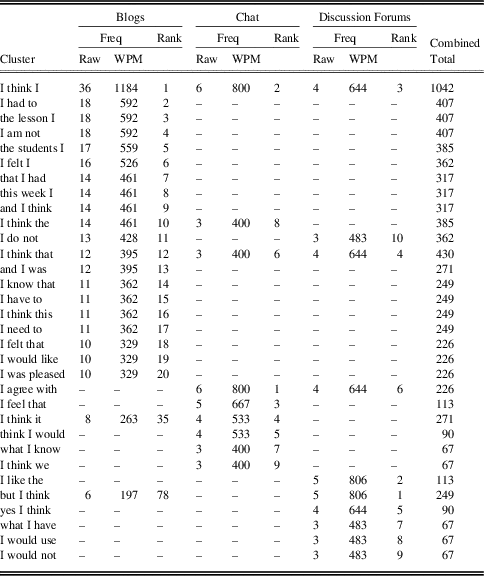
The way in which STs articulate their identity around the pronoun I is one lens into the cognitive and psychological processes at play in the complex activity that is identity construction. This is especially the case if we are to assume they are articulating their thoughts in a bona fide way, although there are some concerns relating to this issue. As a starting point for the analysis of I, for each of the modes we extracted up to the 20 most frequent three-word clusters with a minimum frequency of three occurrences. The results are presented in Table 5 (both raw frequencies and words per million (WPM) have been calculated, for reasons of comparison).
Top 20 three-word clusters with “I”
Given the relatively low word counts for the chat and discussion forums, it is difficult to reach any significant conclusions as they produce so few clusters within the search parameters. Focusing on the clusters present in the blogs (both Blogs sub-corpora have been combined for the analysis of discrete items), immediately obvious is the collocation of I with think in a number of syntactic variants. From analysis of the concordances, this appears to be the cognitive think as well as think used as a hedge for pragmatic or strategic reasons. We also see a number of clusters typically used in descriptive narrative accounts, for example, and I was, the lesson I, and this week I. Clusters in negative structures (I am not, I do not) signal critical accounts of events or a lack of surety in assertions and beliefs. Novice positioning is also apparent in modal structures such as I have to, I would like and I need to, pointing to the requirement for modified behaviour, as a result of the expression of opinions and evaluations (signalled, for example, by clusters such as I was pleased, I agree with, I like the, I felt that). Here we see the dilemma of the STs, depicting themselves as knowledgeable novices as is required by their role in this context. This comes through in the discourse where we can see them engaged in description and reflection as iterative processes but with a certain lack of confidence (see also Riordan & Farr, Reference Riordan and Farrforthcoming). This assumed identity may be genuine or it may be the result of them playing a role which they feel is demanded of them by their status as novices. In either case, this is part of the identity they construct through the language they use. The following section examines the item teacher across all modes in order to shed further light on the interactions in question.
5.2.2 Teacher
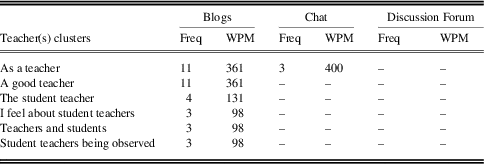
Table 6 presents the most frequent clusters of between three and five words for teacher(s) (with a minimum of three occurrences) in each sub-corpus.
Three–five-word clusters with “teacher”
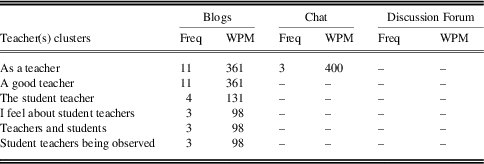
In terms of identity, the novice role they play as STs is apparent through the clusters the student teacher, I feel about student teachers, and students teachers being observed, but the more knowledgeable voice emerges via the cluster a good teacher, which points towards them displaying knowledge of what it takes to be a fully fledged teacher. In terms of self-perceptions, and an emergence of a professional identity, what is of interest to us is the cluster as a teacher, and the concordance (extracted from the entire corpus) in Figure 2 depicts this in further detail.
Concordance of “as a teacher”
From the examples we can trace a number of trends, namely that the STs see themselves as teachers (lines 1, 3, 4, 5, 6, 10, 12, 13, 15), and as teachers with reservations or needs (lines 2, 11, 14), but lines 7 and 9 outline the distinction the STs make in terms of being a professional teacher and an ST at the same time. Again, we see the tension between the two. By examining the concordances from the corpus as a whole of the cluster a good teacher, we see the results in Figure 3.
Concordance of “a good teacher”
Firstly, the STs are discussing their opinions of what a “good teacher” should be, or generic teacher qualities (lines 2, 3, 5 and 11); their opinions of themselves as a “good teacher” (line 10) or not a “good teacher” (lines 4, 6, 7 and 9); and their evaluations of other teachers (lines 1 and 8). Clearly, the most prevalent are their opinions of a good teacher and negative self-reflection, which demonstrates their knowledge and appreciation of those working in their field, and their increasing understanding of good teacher qualities. There is a dichotomy between evaluating themselves as either confident or insecure with their teaching skills, the latter of which occurs more frequently, due to their novice positions. Most notably, the one occurrence of evaluating themselves as a good teacher is in fact hedged, with the verb think, for example: I think I’m a good teacher, and I’ve had lots of feedback from students. Therefore while this is the only example of positive evaluation on teaching ability, the ST in question has still not fully committed, again depicting her position as novice not wanting to portray herself as overly confident. The STs’ use of evaluation here depicts their shared views of themselves as novice teachers striving to become more experienced and confident. Other features worth exploring are the wh-words/interrogatives (based on the Biber et al., Reference Biber, Johannson, Leech, Conrad and Finnegan1999 terminology) how and why so we can get a better picture of the STs’ rationalisation processes, which may assist us further in examining identity construction.
5.2.3 Reflecting on the hows and whys
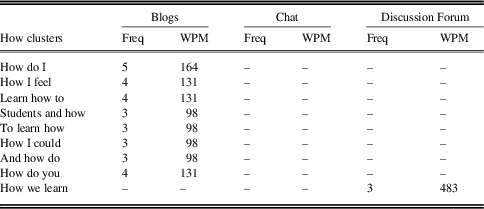
To examine the item why, three-word clusters in all modes were extracted (with a minimum of three occurrences), the results of which can be seen in Table 7.
Three-word “how” patterns across the modes
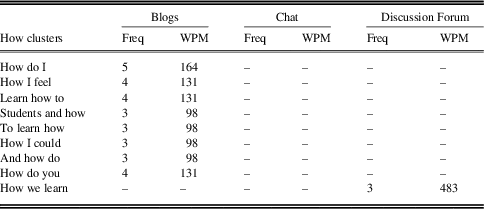
Here, we can see that the wh-words/interrogatives allow the STs to reflect in a cognitive/practical manner (how do I, learn how to, students and how, how we learn, to learn how, how I could, and how do, how do you) but also in an affective/emotional manner (how I feel), which possibly highlights the cognitive and reflective nature of the process of learning to be a teacher, and the students’ related emotional states. Moving on to the token why, the only recurring cluster across all modes from the STs is is why I, therefore we decided to examine the total occurrences of why, the results of which can be seen in Figure 4.
Concordance of “why” across all modes
Again some interesting patterns emerge here in that the STs are asking real questions in relation to teaching and learning (lines 3, 4, 5, 6, 8, 11 and 15), thus indicating both introspection and reflection, but on a more professional and cognitive level, they are also rationalising their own actions and opinions (lines 1, 2, 7, 9, 10, 12, 13, 14, 16, 17, 18, 19, 20, 21, 22, 23, 24 and 25), which is what we would expect STs to be able to do. This suggests once again that the online modes are creating spaces for the STs to reflect on their cognitive but also emotional states during their training. Thus far we have shown evidence of reflection and introspection on teaching (particularly from the blogs), and also a tension in maintaining a novice identity while also crossing the boundaries into the arena of professional identity. As was noted, this corpus-based analysis is supported by more qualitative research using discourse analysis techniques and examining the narratives present within the blogs (see Riordan & Farr, Reference Riordan and Farrforthcoming).
5.3 Tracing patterns over time
In theory, the ability to reflect more effectively and strategically should develop in a temporal way as STs gain more knowledge and experience on their LTE programme. We tested this hypothesis using an extended dataset. As part of a larger study, the online modes with the three cohorts of STs were integrated with two face-to-face group discussions, and the narratives (in the Labovian sense)Footnote 2 within the data were tagged for levels of reflection based on Jay and Johnson’s (Reference Jay and Johnson2002) framework of descriptive, comparative and critical reflections. The first dimension, Descriptive Reflections, “involves the intellectual process of setting the problem” (Jay & Johnson, Reference Jay and Johnson2002: 77), where the ST outlines the issue (a feeling, an experience). The next dimension, Comparative Reflections, concerns deliberating the issue from a number of perspectives in order to better understand it. The final dimension, Critical Reflections, is the end result of thinking about issues, whereby “one makes a judgement or a choice among actions, or simply integrates what one has discovered into a new and better understanding of the problem” (Jay & Johnson, Reference Jay and Johnson2002: 79). The face-to-face (F2F) and online modes, with the exception of chat, contained some narratives, and within these the instances of all three levels of reflection were tagged and counted, and the results can be seen in Figure 5. The horizontal dimension represents the time at which each of the activities took place during the first fifteen-week semester of the MA programme.
Graph showing reflection over time
There are, overall, more descriptive reflections within the data, which illustrates that the STs are presenting and describing issues in their narratives. However, it has been suggested that “just because reflection is not critical does not mean it is unimportant or unnecessary” (Brookfield, Reference Brookfield1995: 8), and therefore it is surmised that descriptive reflections are worthwhile and possibly a necessary precursor to other types of reflection. There is evidence that the STs reach other levels of reflection in the eighteen occurrences of comparative reflection, and 41 of critical reflection. The highest number of comparative reflections lies within blogs, and this is because the STs have the space and time to deliberate actions and events from different perspectives when writing blogs, something which is not afforded in face-to-face settings. If we examine trends over time, there is an escalation in descriptive and critical reflection, especially in the face-to-face mode, which shows that the STs are increasingly engaging with deeper levels of reflection over time. This, along with findings presented earlier, shows us that the face-to-face and online modes, particularly blogs, allow spaces conducive to different types of reflective engagement, where identities are considered over time.
6 Conclusion
This paper examined various technologies (chat, discussion forums and blogs) in terms of their suitability and affordances as reflective media. What our findings suggest is that blogs, in particular, are preferred by STs, and they are also rich in language items which can depict cognition, reflection, and the expression of identities. That is not to say that the chat and forums are not worthwhile, as they appear to offer spaces for emotional engagement, which may be equally if not more important for individual teachers or as a contributing variable to professional development. Blogs depict relatively high instances of narrative and reflective discourse, and within these reflections, the STs experience tension in the fulfilment of their identities. They do this by both portraying themselves as novices, but also expressing a more professional identity. Also of utmost importance is the trend that over time, RPs appear to move to the more critical domain, which is what we would expect of STs during their training. Thus, the practical applications here are twofold, namely these results should encourage teacher educators to include a range of modes of interaction in their LTE programmes, and as a result, the STs may use these in various, integrated and complementary ways for their own professional development, learning, and identity formation. Further studies to build on this work could include the implementation of Biber’s (Reference Biber1988) Multi-Dimensional approach in order to statistically examine linguistic variation across the modes. While we believe that corpus linguistics offers evidence-based approaches to our understanding of ST discourse and identity formation, in future studies, we aim to further integrate discourse analytical techniques with corpus-based techniques (Corpus-Assisted Discourse Studies) to support and enrich the findings presented here (see Riccio & Venuti, Reference Riccio and Venuti2009; Partington, Reference Partington2010).