Statistical learning offers a compelling new account of the nature of children's learning. Broadly speaking, statistical learning refers to the process through which regularities in the input are uncovered; this term was coined by Saffran, Aslin, and Newport (Reference Saffran, Aslin and Newport1996) in the description of their seminal studies of lexicon formation. In this now classic research, 8-month-old infants’ sensitivity to the likelihood of co-occurrence of syllables allowed them to extract “words” from an artificial language. The power of the statistical learning mechanism has been demonstrated across otherwise separate domains, such as learning about auditory (Saffran, Johnson, Aslin, & Newport, Reference Saffran, Johnson, Aslin and Newport1999; Saffran, Reeck, Niebuhr, & Wilson, Reference Saffran, Reeck, Niebuhr and Wilson2005), visual (Fiser & Aslin, Reference Fiser and Aslin2001, Reference Fiser and Aslin2002), and tactile (Conway & Christiansen, Reference Conway and Christiansen2005) stimuli (for a review, see Perruchet & Pacton, Reference Perruchet and Pacton2006). The present study is designed to test the explanatory power of statistical learning in its most challenging domain: learning about meaning.
A primary area of current debate lies in the types of learning that can be explained by a statistical learning mechanism. There have been multiple demonstrations of statistical learning of surface features of stimuli. Evidence of statistical learning of co-occurrence of letters is one such example (e.g., Treiman & Kessler, Reference Treiman and Kessler2006; for demonstrations in other domains, see Gómez, & Gerken, Reference Gómez, Gerken, Tomasello and Bates2001). It has recently been suggested that the power of statistical learning might be limited to such surface features (Peña, Bonatti, Nespor, & Mehler, Reference Peña, Bonatti, Nespor and Mehler2002). It is far more contentious as to whether statistical learning can account for learning at higher levels, specifically in terms of grammar (e.g., Saffran, Reference Saffran, Colombo, McCardle and Freund2009; Seidenberg, MacDonald, & Saffran, Reference Seidenberg, MacDonald and Saffran2002). Morphemes are considered to be the foundational and universal building blocks; they are the units on which grammar is based. Testing learning in the morphological domain offers a unique test of the power of statistical learning.
In the study of spelling development, it has long been argued that learning about higher-order dimensions, specifically morphology, involves learning rules. According to several theories, it takes several years for children's spellings to reflect morphemic regularities that exist in the orthography (~age 8), progressing through stages as they do so (e.g., Frith, Reference Frith, Patterson, Coltheart and Marshall1985; Henderson, Reference Henderson1985). The prediction is that children learn rules when these exist (Nunes, Bryant, & Bindman, Reference Nunes, Bryant and Bindman1997). As an example, Nunes and her colleagues showed that children first spell past tense verbs phonetically (making mistakes such as *walkt), before using -ed consistently to represent past tense. Henderson went on to suggest that children first become sensitive to morphological regularities for inflectional morphology and later for derivational morphology, which involves more substantive changes between words. All such models predict protracted learning for the acquisition of rules.
The substantial evidence that even very young writers’ spellings reflect the morphemic structure of words (e.g., Treiman & Cassar, Reference Treiman and Cassar1996; Treiman, Cassar, & Zukowski, Reference Treiman, Cassar and Zukowski1994) contradicts the predictions of a rule-based model. For example, Treiman and her colleagues showed that young children are more likely to include the spelling of the penultimate sound in a word when the sound is a part of a root than when it is not (e.g., in comparing /n/ in rained and in brand; see also Kemp, Reference Kemp2006). Similarly, Deacon and Bryant (Reference Deacon and Bryant2005) demonstrated that young children are better able to spell the initial portions of two-morpheme than one-morpheme words (e.g., turn in turning and turnip; see also Deacon, Reference Deacon2008; Deacon & Bryant, Reference Deacon and Bryant2006a, Reference Deacon and Bryant2006b; for a review, see Pacton & Deacon, Reference Pacton and Deacon2008). These differences emerge across whole-word spelling tasks, choice tasks, and completion tasks (e.g., Deacon, Reference Deacon2008; Deacon & Bryant, Reference Deacon and Bryant2005; Treiman & Cassar, Reference Treiman and Cassar1996; Treiman et al., Reference Treiman, Cassar and Zukowski1994). It seems that even young children are better at identifying or generating the correct spellings for sections of words when these spellings are morphological determined than when they are not. This evidence counters a rule-based approach in its findings that children's spellings are influenced by the morphological structure of words at an age at which rule-learning models predict that spelling should be entirely driven by phonological regularities.
Perhaps even more problematic for rule-based approaches are the findings that adult spellers do not rely on simple morphological rules when it is possible to do so. The clearest demonstration of this emerges in a study of spelling of the plural in pseudowords. Following rules would lead adults to spell pseudowords ending in the /z/ sound that are presented as plurals with an s; instead, it seems that adults’ spelling reflects sensitivities to the multiple regularities that underlie print. Kemp and Bryant (Reference Kemp and Bryant2003) showed that both child and adult spellers were twice as likely to use -s to spell pseudowords presented as plurals when the penultimate sound was a consonant than when it was a long vowel (e.g., preens vs. smees). The substantial variation in performance based on the adjacent sound (or letter) shows that even mature spellers do not rely on a rule such as “spell plurals with an s.” The pattern of results is consistent with statistical learning of letter patterns because -s follows consonants far more frequently than long vowels in English (for comparable findings in French and Dutch, respectively, see Pacton, Fayol, & Perruchet, Reference Pacton, Fayol and Perruchet2005; and Sandra, Frisson, & Daems, Reference Sandra, Frisson and Daems2004). There was some evidence of sensitivity to the role of plurality in determining the use of -s; university-educated adults and better spelling children were more likely to use -s when the long-vowel pseudowords were presented as plurals rather than as nonplurals (e.g., “those smees” vs. “that smeese”). The clear effect of the adjacent sound on pseudoword spelling suggests that this sensitivity to morphological structure is not underpinned by knowledge of a rule.
Statistical learning offers an alternative account as to how children might learn about the morphological basis of spelling, particularly as to why we see evidence of sensitivity to morphological structure in the spelling of very young children. Specifically, it is suggested that children are sensitive to the co-occurrence of sound, letters, and meaning (or of phonology, orthography, and semantics, respectively; Pacton & Deacon, Reference Pacton and Deacon2008; Pollo, Treiman, & Kessler, Reference Pollo, Treiman, Kessler, Grigorenko and Naples2008; Seidenberg & Gonnerman, Reference Seidenberg and Gonnerman2000). Children might, for example, become sensitive to the regularity that plurality in English is generally marked with an s, despite different pronunciations (/s/ and /z/, as in cats and dogs), as a result of the co-occurrence of these sounds, with the letter s and the meaning of plurality. To take an example from derivational morphology, the words teach and teacher are likely to appear together in text, and the overlap of the initial letters teach and the sound /ti:t∫/ along with the meaning “instruct” could lead to a strong association between these forms. Similarly, children might see -er and hear /ər/ often in combination with the meaning “someone who does something.” These co-occurrences in real words in a language could lead children to use consistent spellings for these units (-s, teach, and -er), even at a young age.
Statistical learning approaches would also predict sensitivity to other dimensions of print, such as simple orthographic regularities. Several studies, including that of Kemp and Bryant (Reference Kemp and Bryant2003), demonstrate children's and adults’ sensitivity to the frequency of letter patterns and of meaning patterns (see also e.g., Pollo, Kessler, & Treiman, Reference Pollo, Kessler and Treiman2009; Treiman & Kessler, Reference Treiman and Kessler2006). The emergence of these effects in studies with pseudowords shows their independence from the frequency effects of any one individual word. Statistical learning approaches would predict sensitivity to the frequency of letter- and meaning-based patterns in print.
In the present study, we identified morphological patterns in English in which there is natural variability in the frequency of the semantic and orthographic patterns. We tested the impact of these patterns on children's performance on a spelling choice task. This offered a test of the hypothesis that the frequency with which children are exposed to morphological regularities should impact spelling acquisition.
First, we examined the effects of the frequency of meaning of specific morphemes. The letter pattern -er can be an inflection or a derivation (as in the comparative -er in warmer and the agentive -er in teacher). There are far more derivational than inflectional words ending in -er: a total of 156 derivational forms across the whole language in comparison to only 53 inflectional forms. The same pattern occurs when one looks at the frequency of occurrence of a word in young children's books; there are 65 derivational forms and 33 inflectional forms ending in -er with a frequency at Grade 2. These tallies are from an analysis of the children's frequency database (Zeno, Reference Zeno1995) that is considered to be the most representative of available databases (Lee, Reference Lee2003). Although there are clearly far more derived than inflected forms across adult and child language, average frequencies of these instances are remarkably similar (e.g., log Grade 2 frequencyFootnote 1 values of 1.27 vs. 0.98 for inflected and derived forms, respectively, p > .05). This means that children are exposed to far more instances of words ending in -er that are derived than inflected. Spelling choices for derived and inflected words ending in -er will be contrasted to those for -er in control words for which there is no semantic basis (such as corner); the difference between choices on morphologically related and control forms is taken to reflect sensitivity to morphological structure in spelling (e.g., Deacon & Bryant, Reference Deacon and Bryant2006a; Treiman et al., Reference Treiman, Cassar and Zukowski1994). If children rely on statistical extraction of morphological spelling regularities, then repeated exposure to a specific meaning in combination with a letter pattern and a sound pattern should affect children's spelling choices; we should see children demonstrating sensitivity to the morphological basis of the spelling of the derivational affix -er earlier than for the inflectional affix -er. This offers a test of the impact of the frequency of occurrence of specific meanings.
Second, we examined the effects of the frequency of the orthographic pattern. In terms of the derivation used to form nouns, -er is far more frequent than the -or allomorph. There are more derived words that end in -er than in -or (e.g., teacher and actor); in the Zeno (Reference Zeno1995) database there are 156 derived forms ending in -er and only 73 ending in -or. This difference in frequency also emerges when one considers just the forms to which young children are likely to be exposed; there are 65 -er derived forms and 28 -or ones with a frequency at Grade 2. As with the inflectional and derivational items ending in -er, these two allomorphs are of similar frequency (e.g., log values of 0.98 vs. 0.81 for -er and -or forms, respectively, p > .05). Children are exposed to far more instances of derived words ending in -er than in -or. If children rely on statistical extraction of morphological spelling regularities, then repeated exposure to a specific spelling in combination with a specific meaning and sound should affect children's spelling choices; children should demonstrate sensitivity to the morphological basis of the spelling of the -er derivational allomorph earlier than the -or allomorph. Spelling choices in these two cases will be contrasted to that of the endings of control words for which there is no semantic basis (such as corner and tractor), with the difference taken to reflect sensitivity to morphological structure in spelling. This contrast tests the impact of the frequency of occurrence of specific spellings.
These contrasts also test the predictions of a rule-based approach. According to this approach, only older writers’ spellings (likely those of children age 8 years and up) would reflect the morphological structure of words. In the context of this study, only children aged 8 years and up should demonstrate greater accuracy in choosing the correct spelling for -er when it is a morpheme (in words such as warmer) in contrast to when it is not (in words such as corner). Henderson's (Reference Henderson1985) further specification of the rule-based model suggests that children might learn about the influence of morphological structure on spelling first for inflections and only later for derivations. There is some evidence that this is the case; children demonstrate sensitivity to the role of morphological structure in spelling inflections at a far younger age than they do for derivations (e.g., Carlisle, Reference Carlisle1988; Deacon & Bryant, Reference Deacon and Bryant2005; Sangster & Deacon, Reference Sangster and Deacon2011; Sterling, Reference Sterling1983). To our knowledge, no study has been able to control for the spelling difficulty of the inflectional and derivational suffixes. The contrast of -er as an inflection and a derivation offers a novel test of Henderson's prediction in a manner that precisely balances the spelling difficulty of the letter patterns.
To summarize, we contrast children's spelling choices for words ending in -er and -or to evaluate predictions of statistical and rule-based explanations of spelling development. This extends prior tests of the potential influence of statistical learning on spelling by manipulating the semantic and orthographic frequency of an individual spelling. We asked 6- to 10-year-old children to choose endings for inflected, derived, and control words that ended in -er. These sets of words were balanced for token frequency. We also asked these children to choose endings for derived and control words ending in -or. A statistical learning approach would predict that the type frequency of the specific meaning or letter pattern should influence even young children's spelling choices. More frequent patterns (such as -er as a derivation) should be acquired earlier than less frequent patterns (such as -er as an inflection or -or as a derivation). A rule-based approach would predict that only older children's spelling choices should be sensitive to morphological regularities and that this sensitivity should emerge first with inflections and later with derivations. This experiment tests these diverging predictions.
METHOD
Participants
We recruited both younger and older elementary school–aged children. Our group of younger participants included a roughly equal number of children in each of Grades 1 and 2 (29 in Grade 1 and 28 in Grade 2; total n = 57; age: M = 7.03, SD = 0.07), and our group of older participants included a roughly equal number of children in each of Grades 3 and 4 (18 in Grade 3 and 20 in Grade 4; n = 38; age: M = 9.01, SD = 0.09). There were 95 participants in total (48 boys). The children were recruited from urban schools and after-school centers drawing on a range of socioeconomic areas. All of the children spoke English as their first language. Scores from the children's performance on the Test of Word Reading Efficiency (TOWRE; see Materials Section for more details) show that the children's scores were within the normal range, though at the upper end, for their age. Mean standard scores for the children in Grades 1 and 2 were 109.23 (SD = 13.60) and for the children in Grades 3 and 4 they were 109.03 (SD = 14.44).
Materials
Spelling choice task
We identified the initial pool of words by searching for all words ending in -er or -or in The Educator's Word Frequency Guide (Zeno, Reference Zeno1995). This database provides grade-level word frequencies. We then removed all words that did not have a frequency at Grade 2 according to Zeno (Reference Zeno1995). Final selection was conducted based on frequency balancing described in detail below.
We identified 36 target words ending in the sound /ər/ for the spelling choice task. All of these items are presented in Appendix A. We chose items so that half (18) ended in the letter pattern -er and the other half ended in -or. There were three types of words ending in the letter pattern -er: six one-morpheme words (e.g., corner), six two-morpheme inflected words (e.g., longer), and six two-morpheme derived words (e.g., singer). There were two types of words ending in the -or letter pattern: nine one-morpheme words (e.g., tailor) and nine two-morpheme derived words (e.g., actor).
The words in each of the above conditions were chosen so that they were of similar Grade 2 frequencies retrieved from Zeno (Reference Zeno1995). The average frequencies of the one-morpheme, inflected, and derived words ending in -er were similar (p = .80). The average frequencies for the one-morpheme and derived words ending in -or were similar (p = .98). The average frequency for the words ending in -er was higher than for the words ending in -or (38.83 and 9.39, respectively) owing to natural variability in the language.
Spelling choice tests were constructed so that the first parts of the words (e.g., corn and long, respectively) were presented on the worksheet. For each item, the ending choices (-er, -r, and -or) were positioned in a column to the right of the first part of the word. The option -er was placed on the top, -r in the middle and adjacent to the first part, and -or on the bottom. We retained consistency in order of the responses to keep the task simple for the children. This type of choice method has been used successfully in other studies of children's spelling development (e.g., Sangster & Deacon, Reference Sangster and Deacon2011; Treiman et al., Reference Treiman, Cassar and Zukowski1994; see Discussion Section for further detail). As half of the total number of words ended in -er and the other half ended in -or, it was correct to choose the -er ending half of the time and the -or ending the other half of the time. This design countered possible effects of response bias. The items were presented in two fully randomized orders, each given to approximately one half of the participants in each age group.
TOWRE
The TOWRE (Torgesen, Wagner, & Rashotte, Reference Torgesen, Wagner and Rashotte1999) was included to evaluate word and pseudoword reading levels. The children were asked to first read real words (the sight word efficiency subtest) and then pseudowords (the phonological decoding efficiency subtest) as quickly and as accurately as they could from a sheet of paper. Participants had 45 s to read as many words or nonwords as possible in each list.
Procedure
In the spelling choice task, the children were asked to circle the ending that they thought was correct to complete each of the target words (e.g., -er, -r, or -or to complete warm). The experimenter read each word on its own, in a sentence, and then on its own again (e.g., Warmer. I wear a hat to be warmer. Warmer.). The children were given two practice words before beginning the test. The spelling choice task was administered in small groups (between two and five children). The experimenter ensured that all children completed each item before moving on to the next one. The TOWRE was administered according to standardized instructions. The spelling choice task and the TOWRE were administered within a larger battery of tasks. The spelling choice task was administered first, followed by the TOWRE, and the remaining tasks.
RESULTS
Children's answers were scored as correct or incorrect. For the words ending in -er, each child contributed three sets of scores (each out of a maximum of six): one score for the one-morpheme control words, one for the inflected, and another for the derived words. For the words ending in -or, each child contributed two sets of scores (each out of a maximum of nine): one from the one-morpheme control words and the other from the two-morpheme derived words.
Analyses showed reasonable reliability (α = 0.82) for the spelling choice task. Inspection of the data revealed six outliers. Following the guidelines set out in Howell (Reference Howell1992), we applied Winsorizing techniques to the few identified outliers; these ensured that all data could be included in the analysis without allowing undue influence from the outliers.
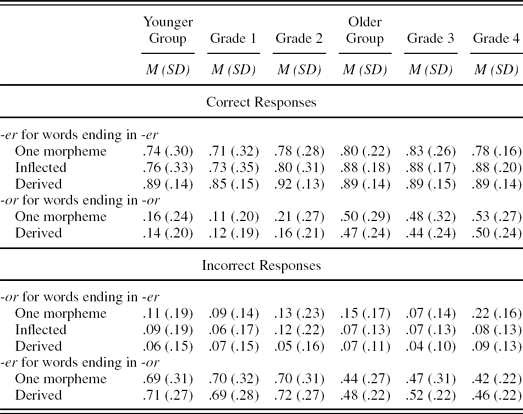
We present mean proportion correct in each of the conditions for the younger and older children separately in Table 1. Results for each grade are also reported here. We analyzed these results with two separate analyses of variance, both of which evaluated proportion scores for the younger and older children.
Mean (standard deviation) proportion of -er and -or choices for the one-morpheme, inflected, and derived words ending in -er (out of a maximum of 6) and for the one-morpheme and derived words ending in -or (out of a maximum of 9)

Note: The remaining responses reflect choice of -r.
To examine our first question about the influence of the semantic frequency, we analyzed the data from the words ending in -er. These were analyzed using a mixed analysis of variance (ANOVA) with word type (one-morpheme, inflected, or derived) as the within-subjects factor and group (younger and older) as the between-subjects factor. There was a main effect of word type, F (2, 186) = 10.83, p < .001, and an interaction between word type and group, F (2, 186) = 3.60, p = .05. We examined the word type effect at each grade to understand the interaction between word type and group. There were significant word type effects both for the younger, F (2, 112) = 10.50, p < .001, and for the older groups, F (2, 74) = 5.17, p < .01. Paired-sample t tests with Bonferroni corrections were conducted. The younger children were significantly choosing the correct spelling for the derived more often than for both the one-morpheme words, t (56) = 4.57, p < .001, d = 0.45, and the inflected words, t (56) = 3.57, p < .001, d = 0.30. Their scores for the inflected words did not differ from those for the one-morpheme words, t (56) = 0.20, p = .84. The older children were more likely to choose -er (correctly) as the spelling for the endings of both the inflected words, t (37) = 2.55, p = .01, d = 0.38, and the derived words, t (37) = 2.90, p < .01, d = 0.42, than for the endings of the one-morpheme words. Their scores for the inflected and derived words did not differ, t (37) = .00, p = 1.00.
To examine our second question as to the influence of frequency of the orthographic pattern, we contrasted likelihood of correct performance with the derived and one-morpheme control words for the -er and -or data. We analyzed data for the correct responses with a mixed ANOVA with ending type (-er or -or) and word type (one-morpheme or derived) as the within-subjects factors and group (younger and older) as the between-subjects factor. There was a main effect of group, F (1, 93) = 37.62, p < .001, showing that the older children performed better than the younger children. There were significant main effects of ending type, F (1, 93) = 2.171, p = .001, and word type, F (1, 93) = 10.67, p < .01, which were qualified by an interaction between the two variables, F (1, 93) = 24.87, p < .001. There was no three-way interaction between the three variables. The two-way interaction arose because there was clearly a difference in the effect of word type in each case. As we uncovered earlier, children's spelling choices were more accurate with derived words than with control -er words, t (94) = 6.27, p = .001, d = 0.52. There was no such difference for the -or words, t (94) = 1.20, ns.
We confirmed our pattern of results in several ways. We conducted analyses of the -er choices with analyses by items. In these analyses, as in those by participants, scores tended to be higher for the derived condition than for the one-morpheme control condition, for both the younger and the older children (ps = .04 and .09, respectively). For the older children, scores for the inflected items tended to be higher than those for the one-morpheme control condition (p = .10). Only significance in the analyses by participants is required to reject the null hypothesis given the high degree of selection of the items into conditions (Raaijmakers, Schrijnemakers, & Gremmen, Reference Raaijmakers, Schrijnemakers and Gremmen1999). It is not unusual for significant results in analyses by participants to emerge as trends in analyses by items, given the substantial reduction in power observed when conducting analyses across items. Further, inspection of Table 1 suggests that the patterns observed in the groups (each collapsed across two grades) are similar to those observed in the grades that make up each of the groups.
Given our use of a spelling choice task, we contrasted mean performance for each group in each condition against chance, and we examined performance for individual children. Mean correct choices for each group in each condition were significantly different than chance (0.33; ts > 3.60, ps ≤ .001). Both the younger and the older children's choice of -er in the -er conditions was above chance levels, with only seven individual children in the younger group and none of the older children performing at or below chance. For the -or task, choice of -or by the younger children was below chance, with 43 children performing at or below chance, and by the older children the choice was above chance, with 10 performing at or above chance. Extending this examination to incorrect choices, we see that both the younger and the older children were less likely than chance to choose -or in the -er conditions (ts > 8.95, ps ≤ .001), with only five individual children in the younger group and none of the older children performing at or above chance. This pattern parallels their greater than chance likelihood to choose the correct answer, -er. For the -or task, choice of -er by both the younger and the older children was above chance (ts > 2.65, ps ≤ .015), with 52 of the younger children and 29 of the older children choosing this option at or above chance. Results for the -or task show that the younger children were more likely than chance to choose -er and less likely than chance to choose -or. The older children were more likely than chance to choose both -er and -or.
Given the dominant choice of -er for the items ending in -or, we examined whether children's choices of this option differed on the basis of the morphological status of the words. We conducted a mixed ANOVA with Word Type (one-morpheme or derived) as the within-subjects factor and Group (younger and older) as the between-subjects factor. Only a main effect of group emerged, F (1, 93) = 19.83, p < .001, with no main effect of Word Type, F (1, 93) = 1.36, ns, or interaction between Word Type and Group, F (1, 93) = 0.52, ns.
DISCUSSION
This study was designed to test the diverging predictions of theories of children's learning of morphological spelling regularities. We asked younger and older elementary school aged children to choose the correct endings for words that varied in their morphological structure. These children spoke English as a first language, and they were typically developing in their reading abilities. We tested the impacts of semantic frequency by including three types of words ending in -er: derived and inflected forms, the first of which are far more frequent across the language, and one-morpheme control forms. We tested the impacts of orthographic frequency by contrasting children's spelling choices for two derived allomorphs (-er and -or) and comparison one-morpheme forms. The frequency of individual items included in the spelling choice task was balanced across conditions. Results suggest clear effects of both semantic and orthographic frequency on children's sensitivity to morphologically based spelling regularities. We interpret children's spelling choices within the context of prior experimental studies of children's spelling choices, completions, and dictation, and in the context of theories of spelling development.
In terms of the impacts of semantic frequency, we found that the frequency of -er as an inflectional or derivational ending appeared to affect children's sensitivity to the accurate spelling of this letter pattern in morphologically complex words. Younger children, specifically those in Grades 1 and 2, were more likely to choose the correct ending for derived forms over one-morpheme control words. There was no such difference for inflected forms. Further, correct scores for the derived forms were greater than those for the inflected forms. This pattern is somewhat surprising, given the prior evidence that children tend to acquire inflectional forms earlier than derivational forms in oral language (e.g., Anglin, Reference Anglin1993; Berko, Reference Berko1958; Clark, Reference Clark1993) and in written language (e.g., Sterling, Reference Sterling1983). One explanation for this pattern lies in the differential frequency of -er in specific morphological forms in the language as a whole, with -er serving as a derivation far more commonly than as an inflection. The older children (those in Grades 3 and 4) were more likely to choose the correct spelling for the endings of both inflected and derived words than for one-morpheme forms. There was no difference in correct choices for the inflected and derived forms. Increased exposure to the letters, sounds, and meanings that make up a written morphological form might increase children's sensitivity to the consistency in the orthographic representation of this specific pattern. We think that this is a plausible explanation for the earlier emergence of sensitivity to the consistent orthographic representation of the derivational form -er.
In terms of the impacts of orthographic frequency, the frequency of occurrence of a specific orthographic representation for an allomorph, -er and -or in this case, affected children's spelling choices. Both younger and older children were more likely to be accurate in choosing the correct spelling for -er as a derivation than as an ending in control words. There was no difference in choice of -or for the derived and one-morpheme words ending in -or for either group. Further, the frequency of -er is reflected in the greater than chance choice of this option for both groups. There was no trend toward differential choice of this option for two-morpheme versus one-morpheme items at either group level. It seems that, at least in Grades 1 to 4, frequency of spelling of allomorphs affects children's spelling choices. Here, as with our examination of semantic frequency, we see an impact of the frequency of orthographic sequences.
The findings reported here confirm and extend prior research in several ways. The evidence of the impact of morphological structure on young children's spelling choices fits with prior findings with both spelling and spelling choice tasks (e.g., Deacon & Bryant, Reference Deacon and Bryant2005; Treiman & Cassar, Reference Treiman and Cassar1996; Treiman et al., Reference Treiman, Cassar and Zukowski1994). Our study offers a critical extension of this work by examining the impacts of both semantic and orthographic frequency. Our findings of the clear effects of orthographic frequency confirm prior findings of the impacts of the frequency of letter co-occurrence (e.g., Kemp & Bryant, Reference Kemp and Bryant2003; Pacton, Perruchet, Fayol, & Cleeremans, Reference Pacton, Perruchet, Fayol and Cleeremans2001; Pollo et al., Reference Pollo, Kessler and Treiman2009; Treiman & Kessler, Reference Treiman and Kessler2006). Our study shows that these effects can emerge when contrasted within the same sound–meaning pairing (as is the case with derivation examined here). To our knowledge, this is the first study to investigate the impact of the frequency with which children are exposed to specific meanings of a letter pattern. As we noted at the outset, it is this meaning domain in which statistical learning is most contentious (e.g., Seidenberg, MacDonald, & Saffran, Reference Seidenberg, MacDonald and Saffran2002). Together, these findings converge to reflect children's remarkable sensitivity to the frequency of both the semantic and the orthographic patterns in the input to which they are exposed.
These findings from our spelling choice task are somewhat difficult to reconcile with rule-based models of children's spelling development for several reasons. First, we saw impacts of morphological structure on spelling choices even in our young spellers, at a time when their spelling choices should be dominated by phonological dimensions. Second, the emergence of impacts of derivational morphology on spelling choices earlier than those of inflectional morphology, at least within our focus on -er, are directly contrary to the predictions of an extension of the rule-based approach (Henderson, Reference Henderson1985). We see changes in the impacts of morphological structure across the age range studied here, but the pattern does not follow the predictions of classic rule-based approaches. Instead, the evidence of the impact of semantic and orthographic frequency on children's spelling choices fits well with the statistical learning approach. This model would predict that the frequency with which children are exposed to meanings and letter patterns would affect children's spelling accuracy. The sound (/ər/) for which we examined children's spelling choices in this study was constant across conditions. It seems that the frequency with which a sound is matched with a meaning and letter pattern affects children's spelling choices. Children's learning appears to be driven by the frequency of the input.
These findings might leave us wondering about the status of morphology. The effects of semantic and orthographic frequency suggest that children are not treating morphemes as discrete units. Children instead appear to be sensitive to the frequency of subtle features of the language and print systems. This is reminiscent of a suggestion made by Gonnerman, Seidenberg, and Andersen (Reference Gonnerman, Seidenberg and Andersen2007), that “Morphology reflects structure present in the world: Language input contains patterns that are discovered by language learners” (p. 342). The discovery of these patterns appears to be driven, at least in part, by the frequency of their occurrence in the written language input.
There are several limitations to this study that need to be considered in line with its implications. First, we might consider the influence of general literacy attainment on the results. The children's average reading ability was slightly above what we might expect for their age. This, along with the differences uncovered between our younger and older participants, leads us to encourage further explorations of this finding with other samples of children. However, we note that their mean reading score was within the average range. Second, we might consider features of the target words themselves. All words had a frequency at the Grade 2 level in Zeno (Reference Zeno1995), leading us to be reasonably confident that the children were familiar with the words. Nevertheless, even with careful balancing between conditions for frequency, we cannot rule out the possible influences of oral and written knowledge of the individual words on results. It would be useful for future studies to include measures of children's morphological awareness, either in general or for the target words in particular. An alternative would be to design pseudoword tasks. It is not clear that such tasks are possible for the contrast between the allomorphs -er and -or, but such tasks would be possible and useful in contrasting the inflectional and derivational -er. Sample- and method-based extensions would be of interest.
We also need to consider the advantages and disadvantages of the method choice: a spelling choice task. First, as a strength, this simpler task opens the door to working with younger children, such as the Grade 1 children included here. Spelling choice tasks have been used in prior studies with this age group to examine representation of suffixes (e.g., Sangster & Deacon, Reference Sangster and Deacon2011) and of portions of roots (Treiman et al., Reference Treiman, Cassar and Zukowski1994). Second, analyses against chance clearly show that children's choices are not random. Third, multiple studies have shown parallel patterns of results in spelling choice or completion tasks as in standard dictation tasks (Deacon, Reference Deacon2008; Treiman & Cassar, Reference Treiman and Cassar1996; Treiman et al., Reference Treiman, Cassar and Zukowski1994). Our task involved the presentation of word parts (e.g., butch__ followed by three spelling options for -er in butcher). This is similar to the presentation in Treiman et al's investigation of the spelling of flaps (e.g., contrasting dirty and duty presented as dir_y and du_y followed by the d and t choices) and in Treiman and Cassar's study of consonant clusters (in which children saw bra__ and tu__ for brand and tuned, respectively). The emergence of the same pattern of results in these studies regardless of whether the children wrote or chose parts or whole words suggests similarity in the processes examined by the slightly different tasks. Further, Deacon (Reference Deacon2008) showed that morphemic effects, greater spelling accuracy for letter patterns when these are roots than when these are not, emerge to precisely the same extent regardless of whether children are spelling parts or wholes of words (e.g., ___ing or _______ for turning). All these factors give us some confidence in interpreting results from this spelling choice task within the framework of spelling choice, spelling completion, and spelling dictation tasks and interpreting them within models of spelling development.
There are also several concerns raised by the use of a choice task. First, it is possible that some types of one-morpheme words might be particularly problematic in this paradigm, because some do not contain whole words as initial segments (as is the case for duty in Treiman et al., Reference Treiman, Cassar and Zukowski1994). In our own study, this problem occurred only for the -or forms (e.g., alligat for alligator); all of the -er one-morpheme forms contain a smaller word (e.g., butcher). Nevertheless, it is unlikely that this concern is responsible for the absence of morphemic effects in the -or condition. If anything, the absence of a smaller word for the one-morpheme forms should have reduced accuracy for these items, thereby increasing the likelihood of finding a morphemic effect. Further, contrasting across Deacon and Bryant (Reference Deacon and Bryant2006b; also Deacon, Reference Deacon2008) and Treiman et al. (Reference Treiman, Cassar and Zukowski1994), we see that morphemic effects emerge both when the presence of smaller words is controlled in the one-morpheme forms and when it is not. We suspect that the absence of morphemic effects in this case is more likely to be the result of low frequency of the -or words in language. Second, we need to remain open to the possibility that choice tasks draw on slightly different processes than more traditional spelling tasks. Accordingly, we encourage the investigation of these learning processes across multiple task dimensions.
Several interesting next steps for research emerge from considering the theoretical implications of this work. First, we might want to follow on the work in the lexical domain by Gonnerman and her colleagues (Reference Gonnerman, Seidenberg and Andersen2007). Specifically, it would be useful to the extent of young learners’ sensitivity to frequency by examining more graded differences in frequency. Second, it would be useful to work to distinguish the complex web of overlapping written and oral language frequencies. Our effects of orthographic frequency are likely to be more purely a result of exposure in the written domain, given that they ended in the same sound. It would be useful for future research to develop ways of contrasting oral and written language exposure for other features, particularly semantic ones. Third and finally, it would be intriguing to develop paradigms to test the impact of these features on adult processing, perhaps through priming methodologies.
The findings reported here suggest that young children are sensitive to the semantic and orthographic frequency of the input to which they are exposed. This sensitivity is at odds with the predictions of rule-based models of spelling development and it is congruent with the statistical learning account. Beyond the world of children's spelling, these findings force us to revisit the power of the statistical learning mechanism. Our findings suggest that the frequency of the input has clear impacts on children's spelling of morphemes. This suggests that statistical effects emerge in domains beyond the lower or surface level features of languages. Statistical learning might offer a powerful mechanism that operates across the multiple domains in which children learn (e.g., Fiser & Aslin, Reference Fiser and Aslin2002; Saffran et al., Reference Saffran, Johnson, Aslin and Newport1999).
APPENDIX A
List of words for the spelling choice task and their frequencies
ACKNOWLEDGMENTS
We are grateful for funding of this research from the Social Sciences and Humanities Research Council of Canada and the National Sciences and Engineering Research Council of Canada. This research would not have been possible without the support of the teachers, parents, and children at Halifax Independent School, Creative Kids Academy, Sacred Heart School, Armbrae Academy, Halifax Christian Academy, and the after school programs at Chestnut Daycare and Peter Green Hall.