Introduction
The earthquakes, which occurred in Türkiye at 04.17 local time on February 6, 2023, in Kahramanmaraş Pazarcık district as the epicenter with a magnitude of 7.8 and lasting for 65 seconds, and in Kahramanmaraş Elbistan district with a magnitude of 7.6 and lasting for 45 seconds, resulted in many life and property losses in 11 provinces. The death toll rose to 50,096 and the casualties to 107,204 people in this earthquake. 1 In the 2023 earthquake, a total of 17.406 people died and 71.866 people were injured, including 4.879 deaths and 9.243 injuries in Kahramanmaraş, 2.141 deaths and 11.563 injuries in Gaziantep, 304 deaths and 4.663 injuries in Şanlıurfa, 212 deaths and 899 injuries in Diyarbakır, 408 deaths and 7.450 injuries in Adana, 3.105 deaths and 11.778 injuries in Adıyaman, 289 deaths and 7.300 injuries in Malatya, 878 deaths and 2.224 injuries in Osmaniye, 5.111 deaths and 15.613 injuries in Hatay, 74 deaths and 754 injuries in Kilis, and 5 deaths and 379 injuries in Elazığ.Reference Südaş 2 , 3
According to the diagnostic criteria of the Diagnostic and Statistical Manual of Mental Disorders, Fifth Edition (DSM-V), a traumatic event is “a case of facing actual or threatened death, serious injury, or sexual violence, which has been directly experienced or directly witnessed, or that has happened to a family member or close friend, or that has been experienced professionally.” The definition of traumatic events in DSM-V also includes natural disasters.Reference Şahin 4 Due to their effects, they are considered a critical traumatic event in human life, both in terms of the destruction they cause in people and their impact on normal life with their sudden emergence. The loss of life and property caused by Kahramanmaraş earthquakes and the negative experiences seen after the earthquake indicate that the effects of the earthquake will last for a very long time. Although the psychological problems caused by earthquake trauma rarely manifest themselves at the time of the trauma, they may appear more frequently and repeatedly in the future. The reactions observed include intense panic, anxiety, hopelessness, and unhappiness. Since a traumatic event is an occurrence outside of normal human experiences, it has a structure that tests people in every way and changes the person.Reference Kardaş and Tanhan 5 In addition, natural disasters affect many people at once and cause some health problems.Reference Kardaş and Tanhan 5 , Reference Günlü, Asıcı and Çetinkaya 6 Traumatic events reduce people’s sense of security in their current location, remind individuals of the reality of death, and have direct negative effects on mental health.Reference Günlü, Asıcı and Çetinkaya 6
Cardiovascular problems, respiratory diseases, and the severity of many existing diseases in earthquake victims increase, infectious diseases develop, and mental health disorders such as depression and anxiety are observed.Reference Bilici, Tufan and Turhan 7 Post-traumatic stress disorder (PTSD), one of the mental health disorders, is the most common health problem.Reference Cankardaş and Sofuoğlu 8 It includes persistent remembering of the traumatic event, avoidance of trauma-related stimuli, negative changes in cognition and mood related to the traumatic event, and a major increase in arousal or response to the traumatic event.Reference Coşgun and Tarı Cömert 9 However, PTSD is not the only mental health disorder observed after earthquakes. Anxiety disorders also represent a significant psychological consequence among earthquake survivors.Reference Yu, Lee and Hyun 10 , Reference De and Thamarapani 11
Another psychiatric problem frequently observed following an earthquake is anxiety. Generalized anxiety disorder (GAD) is characterized by excessive and persistent worry about specific events or activities, accompanied by the expectation that negative outcomes will occur.Reference Kaçkin 13 Studies have shown that the incidence of GAD increases among earthquake survivors.Reference Dube, Moffatt and Davison 14 Psychological trauma experienced after earthquakes can have long-lasting consequences for mental health, with adverse effects that may persist throughout an individual’s life. Evidence indicates that these mental health consequences can endure for many years; for example, one study found that psychological effects were still evident among students eight years after an earthquake.Reference Kukuoğlu 15 Without adequate psychological support and effective stress-coping strategies, survivors may develop a wide range of mental health disorders, and these psychological difficulties may also adversely affect the people around them.Reference Kurt and Gülbahçe 16
Despite the growing evidence on the long-term psychological consequences of earthquakes, research focusing specifically on university students who have experienced earthquake-related trauma remains limited. There are very few studies investigating post-earthquake trauma-related stress, post-traumatic stress disorder,Reference Sönmez, Nazik and Pehlivan 17 anxiety, or hopelessness levelsReference Kardaş and Tanhan 5 , Reference Kurt and Gülbahçe 16 among university students who are earthquake survivors. Therefore, this study was conducted to examine the relationship between trauma level, anxiety, stress, and coping with stress in university students who are earthquake survivors.
Materials and Methods
Type of the Study
This is a descriptive and correlational study.Reference Özdamar 18
Research Questions
-
1. What are the anxiety and trauma levels of the students?
-
2. What are the students’ strategies for coping with earthquake stress?
-
3. Is there a relationship between the students’ trauma level, anxiety, stress, and coping with stress?
-
4. Is there a relationship between the students’ sociodemographic characteristics and trauma level, anxiety, stress, and coping with stress?
The Setting of the Research
This study was conducted among university students who experienced the Kahramanmaraş-centered earthquakes that occurred in Türkiye on February 6, 2023, and were affected by them. Data were collected online between May 15, 2023, and September 15, 2023, after obtaining ethics committee approval and the necessary institutional permissions.
Population and Sample
The population of the study consisted of university students who were victims of the Kahramanmaraş earthquake. The sample size was calculated using the formula for an unknown population. Based on this formula, the minimum required sample size was calculated as 384. A total of 389 university students participated in the study and were included in the analysis.
Participant Recruitment and Eligibility Criteria
Participants were recruited on a voluntary basis using an online questionnaire created with Google Forms. The survey link was shared electronically with university students who met the inclusion criteria. The questionnaire was available only in Turkish, and completion of the online survey indicated informed consent to participate in the study.
Inclusion Criteria
-
• University students who were victims of the Kahramanmaraş earthquake.
-
• Students who voluntarily agreed to participate in the study.
Data Collection
The questionnaire was developed by the researchers following a review of the relevant literature. Data was collected using an online questionnaire created with Google Forms. Participants completed the questionnaire in approximately 10 minutes.
Sociodemographic Questionnaire
The questions were created following a review of the literature.Reference Kardaş and Tanhan 5 , Reference Bülbül 19
The Beck Anxiety Inventory
This scale was developed by Beck et al. It is a self-rating scale used to determine the frequency of anxiety symptoms experienced by individuals. It has a Likert-type scale consisting of 21 items. Total scores range between 0 and 63. A high total score indicates that the level of anxiety experienced by the person is high. Total test scores are interpreted as follows: 0-7, minimal anxiety; 8-15, mild anxiety; 16-25, moderate anxiety; 26-63, severe anxiety. The validity and reliability study of the scale in Turkey was conducted by Ulusoy et al.Reference Beck, Epstein and Brown 20 , Reference Ulusoy, Şahin and Erkman 21
The Post-Earthquake Trauma Level Determination Scale (PETLDS)
This is a 5-point Likert-type scale (1 = never-5 = always) consisting of 5 sub-dimensions and 22 items. It was developed and tested for validity and reliability by Tanhan and Kayri. It is used to measure the stress level experienced by individuals following an earthquake. The lowest score that can be obtained from the scale is 20, and the highest is 100. High scores on the scale indicate high levels of earthquake impact on the individual. As a result of the reliability analysis of the scale, Cronbach’s alpha internal consistency coefficient was found to be 0.64 for the first subscale, 0.75 for the second subscale, 0.61 for the third subscale, 0.68 for the fourth subscale, and 0.70 for the fifth subscale. The internal reliability coefficient (Cronbach’s alpha) calculated for all items of the PETLDS was found to be 0.87.Reference Tanhan and Kayri 22
The Strategies of Coping With Earthquake Stress Scale (SCWSS)
Yöndem et al. developed this scale and performed its Turkish validity and reliability study in 2016 in the same study. The scale is used to reveal strategies for coping with earthquake stress. It has a 4-point Likert scale (1 = never–4 = always) and 16 items. Scores on the scale vary from 16 to 64. A high score on a dimension indicates that the individual uses that coping strategy more, while a low score indicates the use of that coping strategy less. The subscales are religious coping, positive reappraisal, and seeking social support, which are the most commonly used strategies in response to earthquake stress. Each item is scored between 1 and 4. Religious coping has 5 items (2-8-9-10-11) (5-20 points), positive reappraisal has 6 items (5-12-13-14-15-16) (6-20 points), and seeking social support has 5 items (1-3-4-6-7) (items 3 and 7 are reverse scored) (5-20 points). A high score on a subscale reflects the use of this coping strategy more. In the validity and reliability study of the scale, Cronbach’s α internal consistency coefficient was found to be 0.85 for religious coping, 0.69 for positive reappraisal, and 0.74 for seeking social support.Reference Yöndem and Eren 23
Ethical Aspects of the Research
Written permission from the authors was obtained for the scales used in the research. Institutional permission was obtained from the schools where the research data would be collected. Data were collected on a voluntary basis. Written consent was obtained from the participants before data collection was initiated. Ethics committee permission was obtained (27.04.2023/60).
Data Analysis
The study data were analyzed using SPSS 22.0 statistical software. Frequency and percentage analyses were used to determine participants’ descriptive characteristics, and mean and standard deviation statistics were used to examine the scale. Parametric methods were used to analyze the data. Differences between the ratios of categorical variables in independent groups were analyzed with Chi-square and Fisher’s exact tests. The relationships between the dimensions that showed the scale levels of the participants were examined with Pearson correlation and linear regression analyses.Reference Tabachnick and Fidell 24 Independent-samples t-test, one-way analysis of variance (ANOVA), and post hoc (Tukey, LSD) analyses were used to examine the differences between scale levels according to participants’ descriptive characteristics. Cohen (d) and Eta squared (η2) coefficients were used to calculate the effect size.Reference George and Mallery 25
Results
Results regarding the descriptive characteristics of the participants are listed below.
Of the participants, 278 (71.5%) were female, 115 (29.6%) were second-year students, 255 (65.6%) were living in a province at the time of the earthquake, and 153 (39.3%) stated the province of residence as “other.” According to the findings, 342 (87.9%) of the participants had not moved to another place from their place of residence following the earthquake; 379 (97.4%) had not lost any family members; 250 (64.3%) had not lost any relatives; 203 (52.2%) had not lost any friends; the houses of 350 (90.0%) had not been destroyed; the houses of 210 (54.0%) had been damaged; the house of 285 (73.3%) was slightly damaged; 377 (96.9%) had not been trapped under debris during the earthquake; 362 (93.1%) had not been injured; 238 (61.2%) had been staying in their own homes following the earthquake; 335 (86.1%) had not participated in rescue operations; 235 (60.4%) had never experienced a natural disaster before; 249 (64.0%) had not received disaster-related training before. The mean age of the participants was found to be 22.242±4.815(Min = 18; Max = 56) (Table 1).
Distribution of the participants according to their descriptive characteristics

Table 1. Long description
The table is organized into three columns: Groups, Frequency n, and Percentage.
* Gender: Male 111 (28.5 percent), Female 278 (71.5 percent).
* School year: Year 1 (27.8 percent), Year 2 (29.6 percent), Year 3 (15.4 percent), Year 4 (27.2 percent).
* Residence during earthquake: Province (65.6 percent), County (28.8 percent), Village (5.7 percent). Top provinces include Diyarbakir (10.8 percent) and Gaziantep (9.0 percent).
* Post-earthquake movement: 12.1 percent moved, 87.9 percent did not.
* Personal loss: 2.6 percent lost a family member, 35.7 percent lost a relative, and 47.8 percent lost a friend.
* Housing impact: 10.0 percent had houses collapse, 54.0 percent had damage. Damage levels were Little (73.3 percent), Medium (12.3 percent), and Heavy (14.4 percent).
* Personal safety: 3.1 percent were trapped under debris, 6.9 percent were injured.
* Post-earthquake residence: 61.2 percent stayed in their own home, 22.4 percent in a relative’s house.
* Experience and training: 13.9 percent participated in rescue operations, 39.6 percent had previous disaster experience, and 36.0 percent had disaster training.
* Earthquake measures: 45.8 percent did not take any measures. The most common measure was preparing an emergency kit (25.4 percent).
* Age: Mean 22.242 with an S D of 4.815.
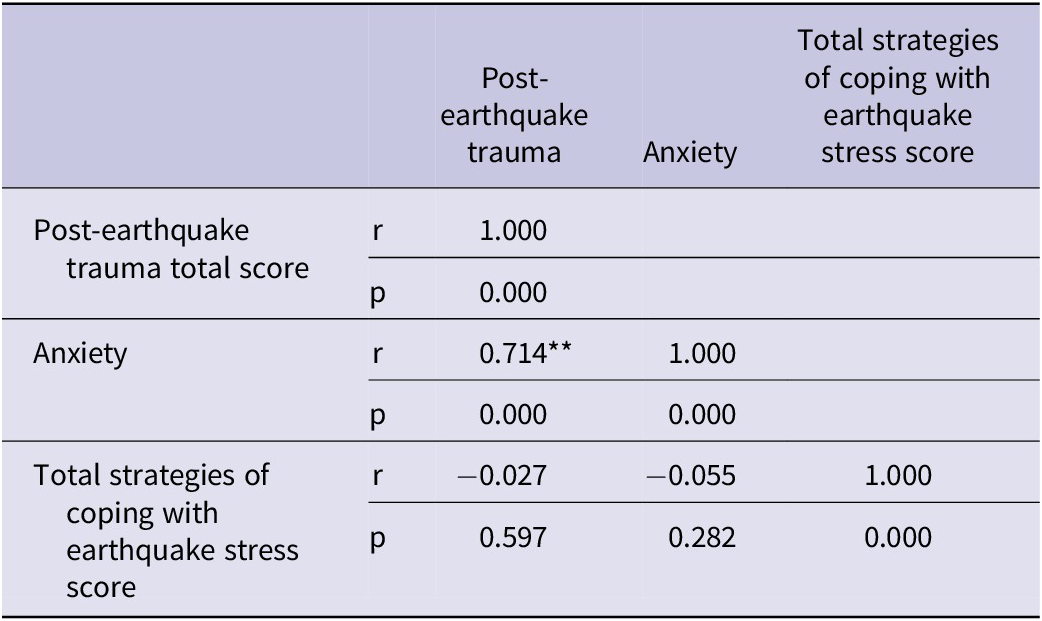
The examination of the correlations between the total post-earthquake trauma score, anxiety score, and the total strategies of coping with earthquake stress score indicated that there was a high level, positive(P = 0.000 < 0.05) correlation(r = 0.714) between the anxiety and the total post-earthquake trauma scores. Correlations between other variables were not statistically significant(P > 0.05) (Table 2).
Correlation analysis between anxiety, post-earthquake trauma, and strategies of coping with earthquake stress scores

Table 2. Long description
The table presents a correlation analysis with three main variables.
1. Post-earthquake trauma total score:
- Correlation with itself: r = 1.000, p = 0.000.
2. Anxiety:
- Correlation with Post-earthquake trauma: r = 0.714, p = 0.000. This indicates a strong positive correlation significant at the 0.01 level.
- Correlation with itself: r = 1.000, p = 0.000.
3. Total strategies of coping with earthquake stress score:
- Correlation with Post-earthquake trauma: r = -0.027, p = 0.597.
- Correlation with Anxiety: r = -0.055, p = 0.282.
- Correlation with itself: r = 1.000, p = 0.000.
Notes indicate that double asterisks denote significance at p < 0.01 and single asterisks at p < 0.05.
Notes. *<0.05; **<0.01; Pearson correlation analysis.
In our study, the mean scores of male participants on the total post-earthquake trauma(x = 55.532) were found to be lower than those of females(x = 61.669) (t = −3.187; P = 0.002 < 0.05; d = 0.358; η2 = 0.026). The mean scores of males on the total anxiety scale (x = 18.640) were found to be lower than those of female participants (x = 23.504) (t = −2.819; P = 0.005 < 0.05; d = 0.316; η2 = 0.020). In the study, participants’ total post-earthquake trauma scores differed significantly according to where they lived during the earthquake (F = 4.205; P = 0.016 < 0.05; η2 = 0.021). Participants’ mean scores on the total post-earthquake trauma scale differed significantly according to which city they were in when the earthquake occurred (F = 5.513; P = 0 < 0.05; η2 = 0.116). Their anxiety scores, too, differed significantly according to which city they were in when the earthquake occurred (F = 3.339; P = 0.001 < 0.05; η2 = 0.073). Also, the total scores of the participants on the Strategies of Coping with Earthquake Stress Scale differed significantly according to which city they were in when the earthquake occurred (F = 3.429; P = 0 < 0.05; η2 = 0.075). The total post-earthquake trauma scores of those who had moved from the city of residence following the earthquake(x = 70.277) were found to be higher than the scores(x = 58.494) of those who had not (t = 4.470; P = 0 < 0.05; d = 0.695; η2 = 0.049). The anxiety scores of those who had moved from the city of residence following the earthquake(x = 28.106) were found to be higher than the scores(x = 21.292) of those who had not(t = 2.851; P = 0.005 < 0.05; d = 0.443; η2 = 0.021). The total post-earthquake trauma scores(x = 78.300) of those who had lost a family member were found to be higher than the scores(x = 59.433) of those who had not (t = 3.441; P = 0 < 0.05; d = 1.102; η2 = 0.030). The anxiety scores of those who had lost a family member(x = 44.200) were found to be higher than the scores of those who had not(x = 21.533) (t = 4.685; P = 0 < 0.05; d = 1.501; η2 = 0.054). The post-earthquake trauma total scores were found to be higher in participants who had lost a relative in the earthquake(x = 65.914) than in those who had not(x = 56.584) (t = 5.253; P = 0 < 0.05; d = 0.556; η2 = 0.067). The anxiety scores were higher in participants who had lost a relative(x = 25.540) than in those who had not (x = 20.212) (t = 3.288; P = 0.001 < 0.05; d = 0.348; η2 = 0.027). The total strategies of coping with earthquake stress scores were lower in those who had lost a relative(x = 43.777) than in those who had not (x = 45.680)(t = −2.359; P = 0.019 < 0.05; d = 0.250; η2 = 0.014). The total post-earthquake trauma scores were found to be higher in participants who had lost a friend in the earthquake(x = 65.688) than in those who had not (x = 54.631) (t = 6.615; P = 0 < 0.05; d = 0.671; η2 = 0.102). The anxiety scores were higher in participants who had lost a friend (x = 27.328) than in those who had not (x = 17.340) (t = 6.695; P = 0 < 0.05; d = 0.680; η2 = 0.104). The total strategies of coping with earthquake stress scores were lower in those who had lost a friend (x = 44.167) than in those who had not (x = 45.764) (t = −2.060; P = 0.039 < 0.05; d = 0.209; η2 = 0.011). In our study, the total post-earthquake trauma scores of those whose houses had been destroyed in the earthquake (x = 73.539) were found to be higher than the scores of those whose houses had not been destroyed (x = 58.400) (t = 5.349; P = 0 < 0.05; d = 0.903; η2 = 0.069). The anxiety scores were found to be higher in those whose houses had been destroyed in the earthquake (x = 32.539) than in those whose houses had not been destroyed (x = 20.954) (t = 4.536; P = 0 < 0.05; d = 0.766; η2 = 0.050). The total strategies of coping with earthquake stress scores were found to be lower in participants whose houses had been destroyed in the earthquake (x = 41.564) than in those whose houses had not been destroyed (x = 45.383) (t = -2,979; P = 0.003 < 0.05; d = 0,503; η2 = 0,022). The total post-earthquake trauma scores of those whose houses had been damaged in the earthquake (x = 64.957) were found to be higher than the scores of those whose houses had not been damaged (x = 54.006) (t = 6.529; P = 0 < 0.05; d = 0.664; η2 = 0.099). The anxiety scores were found to be higher in those whose houses had been damaged in the earthquake (x = 25.019) than in those whose houses had not been damaged (x = 18.710) (t = 4.080; P = 0 < 0.05; d = 0.415; η2 = 0.041). The total strategies of coping with earthquake stress scores were found to be lower in participants whose houses had been damaged in the earthquake (x = 44.019) than in those whose houses had not been damaged (x = 46.151) (t = −2.756; P = 0.007 < 0.05; d = 0.280; η2 = 0.019). In our study, participants’ total post-earthquake trauma scores (F = 26.184; P = 0 < 0.05; η2 = 0.119), anxiety scores (F = 13.349; P = 0 < 0.05; η2 = 0.065), and strategies of coping with earthquake stress scores (F = 6.863; P = 0.001 < 0.05; η2 = 0.034) differed significantly according to the level of damage to the house. The total post-earthquake trauma scores of those who had been trapped under debris during the earthquake (x = 76.250) were found to be higher than the scores of those who had not (x = 59.398) (t = 3.356; P = 0.001 < 0.05; d = 0.984; η2 = 0.028). The total post-earthquake trauma scores of those who had been injured in the earthquake (x = 70.482) were found to be higher than the scores of those not injured (x = 59.130) (t = 3.321; P = 0.001 < 0.05; d = 0.663; η2 = 0.028). The anxiety scores of those injured in the earthquake (x = 32,000) were found to be higher than the anxiety scores of those who had not been injured (x = 21.379) (t = 3,483; P = 0.001 < 0.05; d = 0,695; η2 = 0,030). The total post-earthquake trauma scores (x = 65.611) of those who had participated in rescue operations during the earthquake were found to be higher than the scores of those who had not (x = 59.000) (t = 2.618; P = 0.009 < 0.05; d = 0.384; η2 = 0.017). In our study, the total post-earthquake trauma scores of the participants who had received disaster-related training (x = 56.179) were found to be lower than the scores of those who had not (x = 62.020) (t = −3.225; P = 0.001 < 0.05; d = 0.341; η2 = 0.026). The total strategies of coping with earthquake stress scores of those who had received disaster-related training (x = 46.343) were found to be higher than the scores of those who had not (x = 44.245) (t = 2.609; P = 0.009 < 0.05; d = 0.276; η2 = 0.017) (Table 3).
Differentiation of anxiety, post-earthquake trauma, and strategies of coping with earthquake stress scores by descriptive characteristics

Table 3. Long description
The table presents Mean plus or minus S D for three psychological measures across various demographic and experiential categories.
* Gender: Females (n=278) scored significantly higher than males (n=111) in Post-earthquake trauma (61.669 vs 55.532, p=0.002) and Anxiety (23.504 vs 18.640, p=0.005).
* School Year: No significant differences were found across years 1 through 4 for any measure.
* Place of Residence: Significant differences in trauma scores (p=0.016) were noted, with Province residents (61.408) scoring higher than Village residents (51.409).
* Province of Residence: Significant differences (p=0.000) across 10 regions, with Diyarbakır (69.071) and Adıyaman (68.905) showing high trauma scores compared to Adana (52.482).
* Earthquake Impact: Significant increases in trauma and anxiety were found for those who moved following the earthquake (p=0.000), lost a family member (p=0.000), lost a relative (p=0.000), or lost a friend (p=0.000).
* Property Damage: Those whose houses collapsed or were damaged showed significantly higher trauma and anxiety scores (p=0.000). Heavy damage correlated with higher trauma (70.804) compared to little damage (56.316).
* Personal Experience: Being trapped under debris (p=0.001), getting injured (p=0.001), or participating in rescue operations (p=0.009) significantly increased trauma scores.
* Training: Those who received disaster-related training had significantly lower trauma scores (56.179 vs 62.020, p=0.001) and higher coping scores (46.343 vs 44.245, p=0.009).
F: ANOVA test; t: Independent-samples t-test; Post hoc: Tukey, LSD.
Discussion
The examination of the relationships between post-earthquake trauma, anxiety, stress, and strategies for coping with stress showed that there was a positive correlation (r = 0.714) between anxiety and total post-earthquake trauma scores (P = 0.000 < 0.05). The findings of this study indicate that the earthquake had a substantial psychological impact on university students, as reflected by increased post-earthquake trauma and anxiety scores. 26 , 27 The results of this study suggest that individuals’ quality of life may decrease due to trauma and anxiety that develop following an earthquake. Many studies have shown that earthquakes bring on some psychological symptoms, such as depression, anxiety, and stress,Reference Sabuncuoğlu, Çevikaslan and Berkem 28 , Reference Uğur, Kartal and Mete 29 reveal post-traumatic stress disorders, and affect individuals’ well-being.Reference Du, Ma and Ou 30
The trauma and anxiety scores of women who were earthquake victims were higher than those of men. Some studies in the literature, similar to our study, have shown that women who are earthquake victims have higher anxiety and trauma scores,Reference Bilici, Tufan and Turhan 7 , Reference Kurt and Gülbahçe 16 , Reference Sönmez, Nazik and Pehlivan 17 , Reference Alisic, Zalta and van Wesel 31 –Reference Nobakht, Ojagh and Dale 34 while others have indicated that there is no difference between genders.Reference Önsüz, Topuzoğlu and İkiışık 35 These inconsistent findings suggest that gender differences in post-earthquake psychological outcomes may vary according to individual, cultural, and contextual factors. However, it has been shown that personal characteristics are more effective in this regard than the general opinion. In general, it has been reported that anxiety is observed more frequently in women at all periods of their lives, and in adulthood in men and decreases after the age of 50.Reference Kurt and Gülbahçe 16
In this study, the anxiety and trauma scores of those whose houses had been damaged or destroyed in the earthquake were found to be high. In some studies in the literature, while the anxiety scores of those whose houses were damaged or destroyed in an earthquake were high,Reference Zhou, Liang and Tong 12 , Reference Önsüz, Topuzoğlu and İkiışık 35 , Reference Morishima, Usami and Ando 36 in one study, trauma scores were found to be higher.Reference Bilici, Tufan and Turhan 7 Based on these findings, it can be thought that the likelihood of anxiety and trauma will be higher if one’s house is damaged or destroyed in an earthquake. The loss of or damage to one’s home may increase feelings of insecurity, displacement, and uncertainty, thereby contributing to greater psychological distress following a disaster. At the same time, individuals whose houses are damaged are seen in the risk group for trauma in the literature.Reference Tan 37 Therefore, this is an expected finding.
While the post-earthquake trauma and anxiety levels of those who had moved from their city of residence following the earthquake were found to be high, this finding suggests that relocation after the earthquake may have been associated with greater psychological distress among the participants.Reference Solak, Özsaydı and Tan 38 Relocation may have resulted from multiple earthquake-related experiences, including the loss of housing, disruption of daily life, and separation from familiar social environments. However, the underlying reasons for this association were not investigated in the present study and should therefore be interpreted with caution.
The anxiety and trauma scores were found to be high in those who had lost a family member, friend, or relative. Similarly, according to the study conducted by Önsüz et al.,Reference Önsüz, Topuzoğlu and İkiışık 35 the anxiety scores of individuals who lost their relatives were high, while some studies showed that individuals’ trauma scores were higher.Reference Kurt and Gülbahçe 16 , Reference Sönmez, Nazik and Pehlivan 17 These findings suggest that the loss of a loved one may intensify the psychological burden experienced after an earthquake. Bereavement, combined with exposure to the disaster itself, may increase emotional distress and contribute to higher levels of trauma and anxiety.Reference Mamun, Huq and Papia 39
In this study, the anxiety scores of participants who had been injured in the earthquake were found to be high, while the total trauma scores of those who had been trapped under debris were high. There are studies in the literature that support this finding.Reference Kurt and Gülbahçe 16 , Reference Önsüz, Topuzoğlu and İkiışık 35 This finding may be explained by the fact that direct exposure to life-threatening experiences, such as being injured or trapped under debris, can intensify psychological distress and increase the risk of trauma following an earthquake.Reference Bıçakçı and Okumuş 40
In our study, the total trauma scores of those who had been trapped under rubble during the earthquake were found to be statistically higher than the scores of those who had not, while their anxiety and coping with earthquake stress scores were lower. Studies have shown that the anxiety level of those who have experienced trauma before is significantly higher than the level of those who have not.Reference Goenjian, Najarian and Pynoos 41 –Reference Oflaz, Hatipoğlu and Aydin 43 At the same time, there are studies on coping with post-traumatic stress, anxiety, and depression following earthquakes in the past.Reference Ehring, Razik and Emmelkamp 44 , Reference Fan, Zhang and Yang 45
The total post-earthquake trauma scores of those who had participated in earthquake rescue operations were found to be higher than those who had not. A study conducted after the Marmara earthquake showed that post-traumatic stress disorder led to a risk for participating in search and rescue operations.Reference Önsüz, Topuzoğlu and İkiışık 35 In a study with people who had experienced an earthquake in Pakistan and had participated in rescue operations, Bilici et al. determined the rate of post-traumatic stress disorder as 42.6% and depression and anxiety as 20%. In a study conducted with adolescents after an earthquake in China, PTSD and anxiety were found to be 15.8% and 40.5%, respectively.Reference Bilici, Tufan and Turhan 7 These findings suggest that participating in rescue operations may increase exposure to traumatic events, which could contribute to higher levels of post-earthquake trauma among rescuers. This interpretation is consistent with the literature indicating that trauma may result not only from direct exposure to a disaster but also from witnessing traumatic events or providing assistance to affected individuals.Reference Korucu and Özer Kaya 46
It was found that the post-earthquake trauma scores of participants who had received disaster-related training were lower than the scores of those who had not, and the scores for coping with earthquake stress were higher among those who had received training. These findings suggest that disaster-related education may help individuals better cope with the psychological consequences of earthquakes. An earthquake is a natural disaster and cannot be prevented. However, its psychological, social, and material consequences can be mitigated through disaster preparedness and education. In addition to theoretical knowledge, the analysis of the physical or psychological effects of earthquakes on individuals can also be achieved through training.Reference Türksoy, Karabulut and Gürbüz 47 Consistent with our findings; a study conducted in the Marmara region showed that the most important factor determining the behavior of taking precautions against earthquakes was education.Reference Akalın, Şakiroğlu and Tunç 48
Conclusions
As a result of this research, it was found that there were significant relationships between the participants’ post-earthquake trauma level, anxiety, stress, and stress coping strategies. Serious interventions are needed for students following traumas. Preventive and health-promoting programs should be carried out to reduce stress and stress-related problems in participants. For this reason, psychoeducational programs may be recommended in schools. Studies can be carried out to inform students both in schools and the public before a disaster and during the disaster preparation process to reduce the negative effects of natural disasters on health. Disaster preparedness plays a critical role in reducing the negative health effects of natural disasters. Preparedness efforts range from individual-level activities (such as first aid training) to household actions (such as stockpiling equipment and supplies), community efforts (such as training and field exercises), and government strategies (such as early warning systems, emergency plans, evacuation routes, and public information). Perceived risk, disaster preparedness knowledge, previous disaster experiences, and some sociodemographic characteristics, such as gender, age, education, and family income, have the potential to influence an individual’s emergency preparedness and related behaviors.
Limitations
This study has some limitations. First, its cross-sectional design precludes causal inferences between trauma, anxiety, stress, and coping. Second, the use of self-reported measures may have introduced response bias. Finally, because the study was conducted at a single university, the findings may not be generalizable to all university students affected by disasters. Future longitudinal and multicenter studies are recommended to confirm and extend these findings.
Acknowledgments
We thank those who participated in the study.
Author contributions
Study conception and design: NE, NK, CN; Data collection: NE, NK, CN; Data analysis and interpretation: NE, NK, CN; Drafting of the article: NE, NK, CN; Critical revision of the article: NE, NK, CN.
Competing interests
None.