Introduction
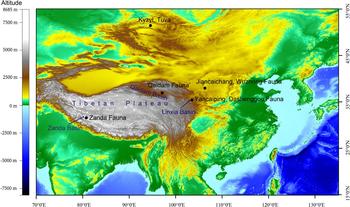
Bohlin (Reference Bohlin1937) reported the ‘Qaidam (= Tsaidam) Fauna’ from the Qaidam Basin (Fig. 1) in the northern part of the Tibetan Plateau. Among the fossil assemblages in the early paleontological history of China, this fauna is distinctive in the occurrence of various specialized bovids that are seldom recovered elsewhere (i.e., Olonbulukia Bohlin, Reference Bohlin1937, Qurliqnoria Bohlin, Reference Bohlin1937, Tossunnoria Bohlin, Reference Bohlin1937, and Tsaidamotherium Bohlin, Reference Bohlin1935a). The most specialized bovid, Tsaidamotherium, which has a very odd horncores (Bohlin, Reference Bohlin1935a; Shi, Reference Shi2014), was attributed to Ovibovinae or Urmiatheriinae, and its phylogenetic position has been substantially debated (Köhler, Reference Köhler1987; Gentry, Reference Gentry1992; Bibi et al., Reference Bibi, Bukhsianidze, Gentry, Geraads, Kostopoulos and Vrba2009; Chen and Zhang, Reference Chen and Zhang2009). Other taxa were grouped as presumed with Caprinae (Gentry, Reference Gentry, Vbra and Schaller2000), and were recently changed to Caprini based on both morphological and molecular evidence (Bibi et al., Reference Bibi, Bukhsianidze, Gentry, Geraads, Kostopoulos and Vrba2009; Hassanin et al., Reference Hassanin, Delsuc, Ropiquet, Hammer, Jansen van Vuuren, Matthee, Ruiz-Garcia, Catzeflis, Areskoug, Nguyen and Couloux2012). Qurliqnoria is hypothesized to be the ancestor of the extant Tibetan antelope or chiru, Pantholops hodgsonii (Abel, Reference Abel1826) (Gentry, Reference Gentry1968, Reference Gentry, Vbra and Schaller2000; Deng et al., Reference Deng, Wang, Fortelius, Li, Wang, Tseng, Takeuchi, Saylor, Säilä and Xie2011). Tossunnoria pseudibex Bohlin, Reference Bohlin1937 seems to be related to the extant Himalayan tahr, Hemitragus jemlahicus (Smith, Reference Smith, Griffith, Smith and Pidgeon1826), or goats (Capra spp.) (Bohlin, Reference Bohlin1937; Gentry, Reference Gentry1971, Reference Gentry, Vbra and Schaller2000). Therefore, ‘Qaidam Fauna’ bovids could represent an early radiation of endemic stem Caprini on the Tibetan Plateau. Except for the above-named taxa, there are still several types of horncores with relatively unspecialized morphology, which Bohlin (Reference Bohlin1937) referred to as ‘Antilope gen. et sp. indet.’ I–IV. However, these unnamed taxa have been inadequately noticed by subsequent researchers (but see Bibi and Güleç, Reference Bibi and Güleç2008).
Topology of eastern Asia with related fossil localities in the present article, emphasizing the Tibetan Plateau. The map was downloaded from the public source, General Bathynetric Chart of the Oceans (https://www.gebco.net/).

The ‘Qaidam Fauna’ was considered the earliest Hipparion fauna in northern China, because of the occurrence of early hipparions, early tetralophodont gomphotheres, an early Acerorhinus, and some primitive cervids (i.e., Lagomeryx Roger, Reference Roger1904 and Dicrocerus Lartet, Reference Lartet1837) that were thought to be middle Miocene relicts (Qiu et al., Reference Qiu, Ye and Jiang1987). Recently, Wang et al. (Reference Wang, Xie, Li, Qiu, Tseng, Takeuchi, Wang, Fortelius, Rosenström, Wahlquist, Downs, Zhang and Wang2011) studied Bohlin's field records and investigated the stratigraphy of the fossiliferous region; consequently, they recognized two fossil assemblages in the ‘Qaidam Fauna,’ the late middle Miocene Olongbuluk Fauna (ca. 15–12.5 Myr) and early late Miocene Tuosu Fauna (ca. 12–10.5 Myr). Therefore, the ‘Qaidam Fauna’ was a fossil assemblage complex, and we refer to the ‘Qaidam Fauna’ using quotation marks.
Recently, we discovered a horncore of Olonbulukia tsaidamensis Bohlin, Reference Bohlin1937 and possibly stem Caprini dental material from the Wuzhong Building Material Plant (Jiancaichang locality, Wuzhong), Ningxia Province, China (Fig. 1) from the early late Miocene Ganhegou Formation. This is the first report of Olonbulukia outside of the Qaidam Basin. This locality was previously reported by Qiu et al. (Reference Qiu, Ye and Jiang1987), with the discovery of Qurliqnoria cheni Bohlin, Reference Bohlin1937. The occurrence of O. tsaidamensis and Q. cheni, with recent palaeomagnetic data of the Ganhegou Formation (ca. 10 Ma, see Shen et al., Reference Shen, Tian, Ding, Wei, Chen and Chai2001), proves that the fossil assemblage from the Jiancaichang locality (denoted herein as the Wuzhong Fauna) is comparable to the classic Tuosu Fauna. In the same period, fossils were rarely discovered from northern China. Therefore, an in-depth study of the bovid assemblages of these two faunas is helpful in understanding the radiation of caprines, which are very important members of today's dry and cold Holarctic habitats (Geist, Reference Geist and Lovari1987).
Materials and methods
Horncore biometric study and 3D models
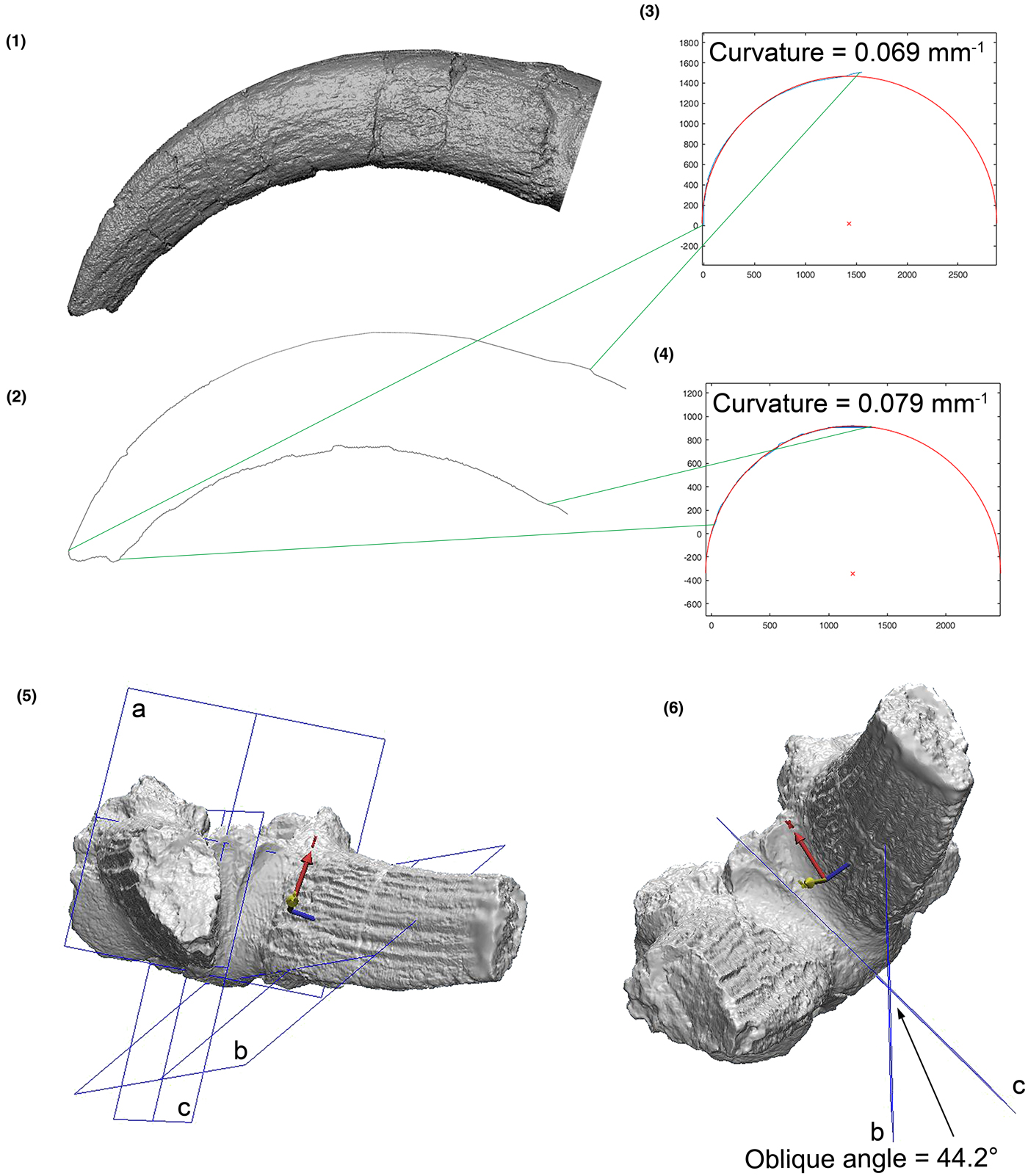
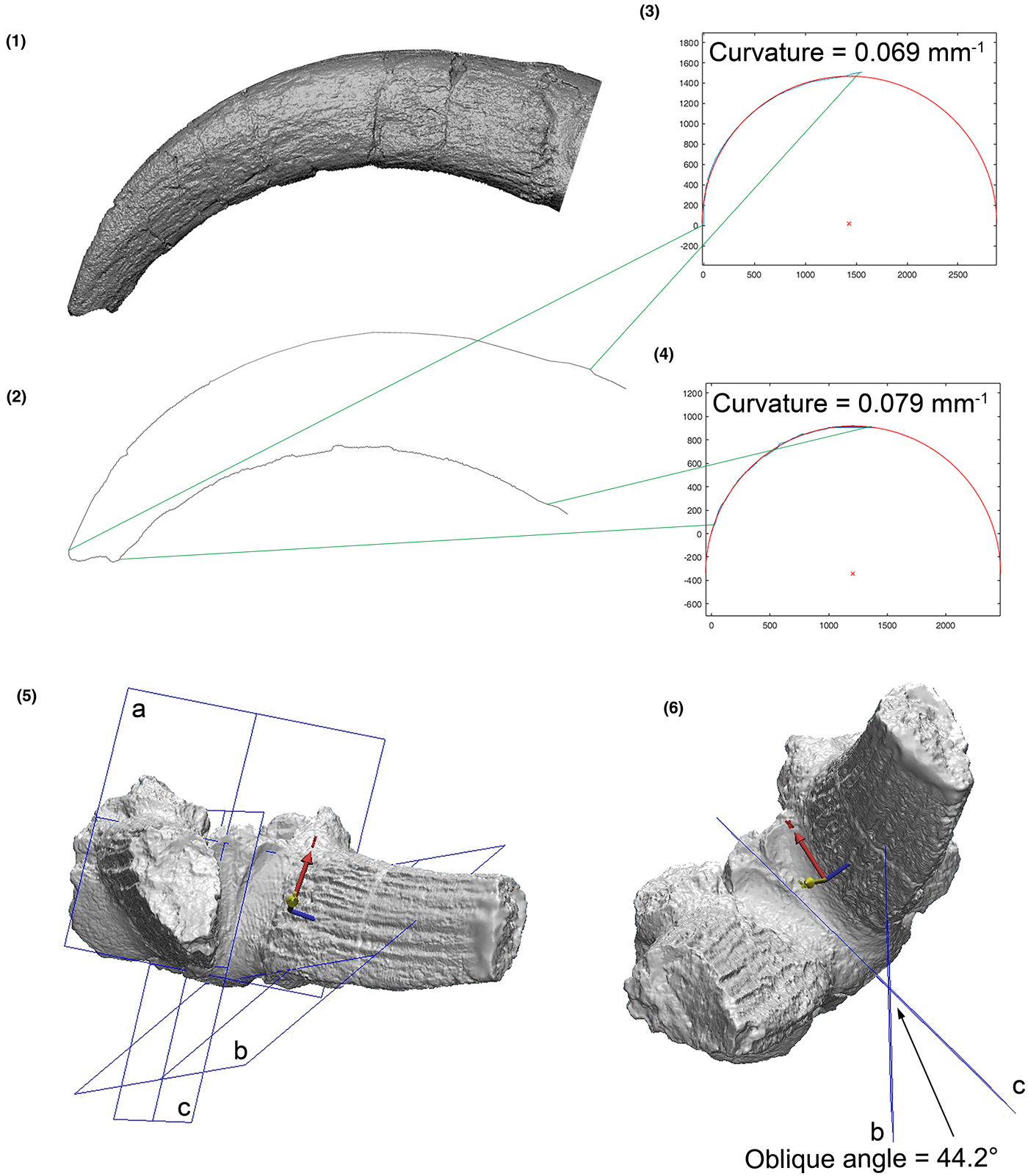
We used three biometric parameters to characterize horncore morphology. (1) Mediolateral compression was inferred by basal anteroposterior diameter (DAP)/transverse diameter (DT); data were measured using calipers. (2) Curvature (unit / mm) was represented by the mean curvature of horncore anterior and posterior edges; to obtain these data, we took photographs of the direct lateral view of the horncore (Fig. 2.1) and extracted the outlines of the anterior and posterior edges (Fig. 2.2); then, we used the least-squares method to fit a circle by the sample points of the outlines, and calculated the curvature of the regressed circle (Fig. 2.3, 2.4). Calculation was performed using a set of self-programmed MATLAB (MathWorks, Inc.; ver. R2016a) codes. (3) Oblique angle was represented by the angle between the medial sagittal plane and the vertical plane that passes through the long axis of the pedicle; to obtain these data, we acquired the 3D surface digital models of the horncores using an Artec 3D Spider scanner and measured the angle on the 3D models using the Materialise 3-matic program (ver. 9.0) (Fig. 2.5, 2.6). All of the 3D models (see Supplemental data SI 1–17) are available in the public online repository Dryad. Other biometric data were measured using calipers.
Horncore biometric data acquisition: (1) photo of a horncore (Olonbulukia tsaidamensis, IVPP RV37008, taken from 3D digital model) in lateral view; (2) outlines of the horncore in Figure 2.1; the green lines denote the sections of anterior and posterior edges; (3, 4) circle fitting of the anterior (3) and posterior (4) edges of the horncore; the blue lines denote the horncore ontlines and the red lines denote the fitted circles; (5) sectioning plane on the 3D digital horncore model (Qurliqnoria cheni, IVPP RV37100); a = horizon plane, b = vertical plane through the pedicle long axis, c = medial sagittal plane; (6) oblique angle measurement, or the angle between the b and c planes. The red, blue, and yellow arrows represent the X, Y, and Z coordinates that were arbitrarily generated by the 3-matic program; the arrowhead of the blue arrow is hidden by the 3D model of the horncore body.
One-way ANOVA
Student's t-tests were performed to test the statistical significance of differences in horncore curvature and oblique angle between Olonbulukia and Qurliqnoria, and mediolateral compression between O. tsaidamensis and Olonbulukia sp. Equal variance was hypothesized, and differences were considered significant if the double-tailed test was < 0.05.
Repositories and institutional abbreviations
IVPP = Institute of Vertebrate Paleontology and Paleoanthropology, Chinese Academy of Sciences, Beijing (IVPP RV is the prefix for the specimens that were previously published under informal numbering systems); NGM = Ningxia Geological Museum, Yinchuan, Ningxia, China. All of the specimens examined here are housed in IVPP, except one from NGM. Comparative materials were from previous publications. Ruminant tooth terminology follows that used by Bärmann and Rössner (Reference Bärmann and Rössner2011).
Systematic paleontology
Order Artiodactyla Owen, Reference Owen1848
Family Bovidae Gray, Reference Gray1821
Subfamily Antilopinae Gray, Reference Gray1821 (sensu Kingdon, Reference Kingdon1982)
Genus Olonbulukia Bohlin, Reference Bohlin1937
Type species
Olonbulukia tsaidamensis Bohlin, Reference Bohlin1937.
Diagnosis
Medium-sized bovid with mediolaterally compressed horncore that possesses an anterior keel. The horncore has a weak spiral structure with strong posterior bending (curvature 0.04–0.10/mm). The oblique angle of the pedicle is small (15–30°). The top of the cranium is vaulted, and the profile of the dorsal cranium is curved dorsally instead of straight, resembling that of Protoryx Major, Reference Major1891. (Revised from Bohlin, Reference Bohlin1937.)
Occurrence
Qaidam Basin and Wuzhong regions, China; middle Miocene and early late Miocene (late Tunggurian and early Bahean, Chinese Land Mammal Age), which were correlated to MN 6–9.
Olonbulukia tsaidamensis Bohlin, Reference Bohlin1937
Figure 3.1–3.3; Table 1
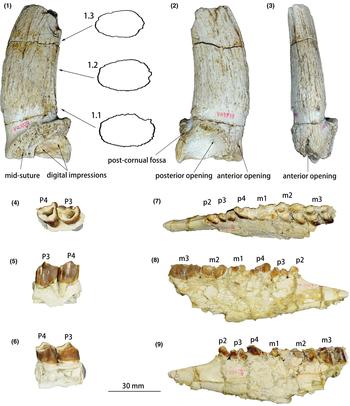
Stem caprines from the Jiancaichang locality, Wuzhong (Wuzhong Buliding Material Plant), China, Bahean age (ca. 10 Ma), late Miocene: (1–3) Olonbulukia tsaidamensis, IVPP V23373, right horncore with fragmentary frontal bone remains, in medial (1), lateral (2), and anterior (3) views (anterior at left and lateral at top), with cross sections at 0 (1.1), 37.8 (1.2), and 59.1 (1.3) mm distal to the pedicle; (4–6) Antilopinae gen. indet. sp. indet., NGM WJCCD-10-N-006, right P3 and P4, in occlusal (4), buccal (5), and lingual (6) views; (7–9) Antilopinae gen. indet. sp. indet., IVPP V23374, right hemimandible with p2–m3 tooth row, in occlusal (7), lingual (8), and buccal (9) views. Notes: M/m = upper/lower molar; P/p = upper/lower premolar.

Holotype
IVPP RV37008 [Bohlin's (Reference Bohlin1937) field no. 356], a brain case with both horncores; the ventral surface is deeply weathered.
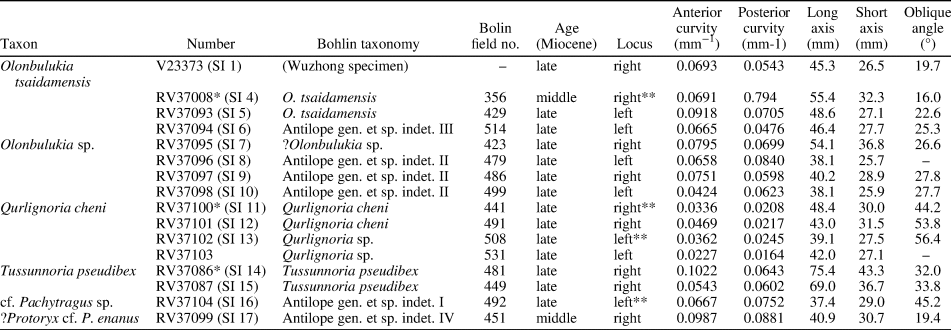
Information and biometric data of the horncores discussed in this study. * = type specimen; ** = both horncores preserved.

Diagnosis
The horncore is strongly compressed with DAP/DT 1.6–1.9 (at the horncore base). Otherwise as for the genus.
Occurrence
Bohlin Camp (BB, 165), Qaidam Basin, basal red beds (Olongbuluk Fauna), middle Miocene, ca. 15 Ma (Wang et al., Reference Wang, Xie, Li, Qiu, Tseng, Takeuchi, Wang, Fortelius, Rosenström, Wahlquist, Downs, Zhang and Wang2011).
Description
The right horncore (Fig. 3.1–3.3) is strongly lateromedially compressed. The horncore cross section at the base is a compressed oval. This shape is retained throughout the preserved length, and only becomes slightly smaller distally (Fig. 3.1.1–3.1.3). The long axis of the cross section at the right horncore base is slightly oblique to the midsuture of the frontal bone by an angle of 19.7°, suggesting that the two long axes of horncore cross sections posteriorly diverge by ~40°. No less than 1/3 of the distal part of the horncore is broken. In lateral and medial views, the preserved horncore portion shows a posterior curvature. In anterior and posterior views, the horncore is slightly laterally oblique. The horncore is slightly homonymous. Strong furrows are present along the entire length of the horncore. An anterior keel is present, but is not as sharp as that of the type specimen. The pedicle is moderately long, with the anterior edge longer than the posterior edge. The anterior opening of the supraorbital channel is small and located at the proximal base slightly lateral to the anterior edge of the pedicle, which is relatively close to the midsuture of the frontal bone. No groove surrounds the supraorbital foramen. The postcornual fossa is weak and close to the horncore base.
The remaining frontal bone can be subdivided into three surfaces. (1) The cerebral surface is anterodorsally bordered by the midsuture of the frontal bone and posterodorsally bordered by the frontal-parietal suture; it is triangular and deeply concave with many digital impressions. The midsuture of the frontal bone is half-crescent-shaped. The anterior part is strongly thickened, extends posterodorsally, and thins. The frontal-parietal suture forms a right angle. (2) The orbital surface is located laterally. However, the thin orbital rim was broken. This surface is smoothly concave. The posterior opening of the supraorbital channel is located at the deepest point of the orbital surface and is almost at the same level as the anterior opening. (3) The frontal sinus surface is small; it is located at the anteroventral part of the bone. The frontal sinus is irregular and shallow on the surface. However, we do not know whether the excavation of the frontal sinus in the horncore is present.
Materials
IVPP V23373, a right horncore with partial frontal bone; the distal part of the horncore is broken.
Locality and age of the new material
The Wuzhong Building Material Plant (Jiancaichang locality), Northeast Quarry (IVPP no. NXWZ201502), 37°49'50.46”N, 106°07'12.08”E, 1169.0H (Fig. 1), early late Miocene Ganhegou Formation, Bahean, correlated to ~MN 9.
Remarks
Olonbulukia tsaidamensis is a stem caprine species with relatively specialized horncores for its age. The horncore is remarkably laterally compressed with strong posterior curvature. The holotype is from the Bohlin Camp (BB, 165) of the Olongbuluk Fauna, Qaidam Basin, ca. 15 Ma of the middle Miocene (Wang et al., Reference Wang, Xie, Li, Qiu, Tseng, Takeuchi, Wang, Fortelius, Rosenström, Wahlquist, Downs, Zhang and Wang2011). This age is very early, even for stem caprines. Olonbulukia tsaidamensis also occurred in the early late Miocene Tuosu Fauna but was never found outside of the Qaidam Basin prior to this study. The newly discovered horncore from the Wuzhong Fauna displays almost identical morphology with the holotype, except for smaller dimensions, possibly due to a younger ontogenetic stage. The Jancaicheng site of the Wuzhong Fauna is ca. 10 Ma, very close to and probably slightly later than the Tuosu Fauna of the Qaidam Basin. The new horncore is the first report of O. tsaidamensis outside of the Qaidam Basin.
Antilopinae gen. indet. sp. indet.
Figure 3.4–3.9; Table 2
Description
The P3 and P4 (Fig. 3.4–3.6) are moderately worn. In occlusal view (Fig. 3.4), the P3 is semicircular with a straight labial wall and a rounded lingual wall. The labial cone is relatively anteriorly positioned. The anterior style is also strong, labially protruded. The posterior style is relatively blunt. The fossa is strongly anteriorly positioned. It is fabaceous with a small central fold on the posterolingual crista. The dentinal area of posterolabial and posterolingual cristae is very large, and a shallow posterior fossa is developed on the posterolingual crista. This fossa is narrow and cuts through the posterior wall of the tooth enamel at the lingual side of the posterior style. In buccal view (Fig. 3.5), the labial cone is high and sharp. The ribs of the labial cone and anterior style are strong and columnar-like, and are close to each other. The rib of the posterior style is weak.
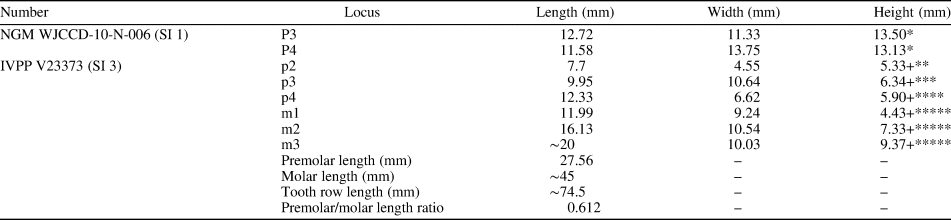
Tooth measurements of Antilopinae gen. indet. sp. indet. from the Jiangcaichang locality. Measured at: * = lingual cone; ** = mesolabial cone; *** = mesolingual cone; **** = anterior cone; ***** = metaconid cone.

In occlusal view (Fig. 3.4), the P4 is shorter and wider than the P3, and its width is greater than the length. The labial cone is medially positioned. The anterior and posterior styles are equally developed, and both labially protrude. The fossa is also anteriorly positioned like that of P3, and the shape of the fossa is inverted trapezoid. The lingual cone is relatively anteriorly positioned and displays a strong posterolingual crista. A small, shallow posterior fossa that cuts through the posterior enamel wall is also present, but this fossa is much smaller than that of the P3. In buccal view (Fig. 3.5), the buccal cone is also high and sharp, as is the posterior style (the top of the anterior style is broken). The ribs of the anterior and posterior styles are strong and columnar-like. The rib of the labial cone is also columnar-like, but it is relatively weak.
The left hemimandible is deeply weathered (Fig. 3.7–3.9). The tooth row is almost complete except regarding the third lobe of the m3. However, the tooth row is deeply worn. The premolar row is moderately long relative to the molar row (Table 2). The p2 is small. The anterolabial cristid is hook-like and extends from the mesolabial conid. The mesolingual conid is juxtaposed with the mesolabial conid, and a thin posterolingual cristid extends from the mesolingual conid. The posterolabial and posterolingual conids are interconnected.
The p3 is longer than the p2. The anterior conid and anterior stylid are fork-like, and link to the mesolabial conid by the anterolabial cristid. The transverse cristid is posteriorly oblique and connected to a slightly inflated mesolingual conid. A thin posterolingual cristid is also present. There is a groove between the mesolabial and posterolabial conids. The posterolabial and posterolingual conids are deeply worn and interconnected.
The p4 is much larger than the p3. However, morphology of the two teeth is very similar, except for the stronger mesolingual and posterolingual conids of the p4.
The m1 is so deeply worn that nearly all of the enamel is worn down. The shape is relatively quadrate, which is the only character that can be observed.
The two m2 lobes are of equal dimensions. The metaconid is more lingually prominent than the entoconid. The mesostylid and metastylid are weak, but this feature might be due to the deep wear. The entoconid protrudes posteriorly. The protoconid and hypoconid show rounded labial walls. A small ectostylid is present. The anterior cingulid (goat fold) is absent. No ribs can be seen on the lingual wall.
The third m3 lobe is broken. The anterior two lobes are narrower than the two lobes of the m2. Both metaconid and entoconid are slightly inflated. The mesostylid and metastylid are slightly protruded. The protoconid and hypoconid also have rounded labial walls, and a very small ectostylid occurs between the two conids. The anterior cingulid cannot be observed. As in the m2, no lingual ribs can be observed.
Materials
IVPP V23374, a left cheek tooth row (p2–m3) with broken hemimandible, from the Jiancaichang locality, Northeast Quarry (IVPP no. NXWZ201502, coordinates as above); NGM WJCCD-10-N-006, right P3 and P4 with partial bone of the upper jaw, also from the Jiancaichang locality, coordinates not recorded.
Remarks
The teeth remains from the Jancaicheng site, Wuzhong Fauna, coincide in morphology with Miocene stem caprines (Bohlin, Reference Bohlin1935b). At this site, two stem caprines have been reported, Olonbulukia tsaidamensis and Qurliqnoria cheni (Qiu et al., Reference Qiu, Ye and Jiang1987). However, teeth of these two species are yet unknown to us. The new material might belong to either of the two species, or another uncovered one. Here we refer these teeth to Antilopinae gen. indet. sp. indet.
Results
Comparisons
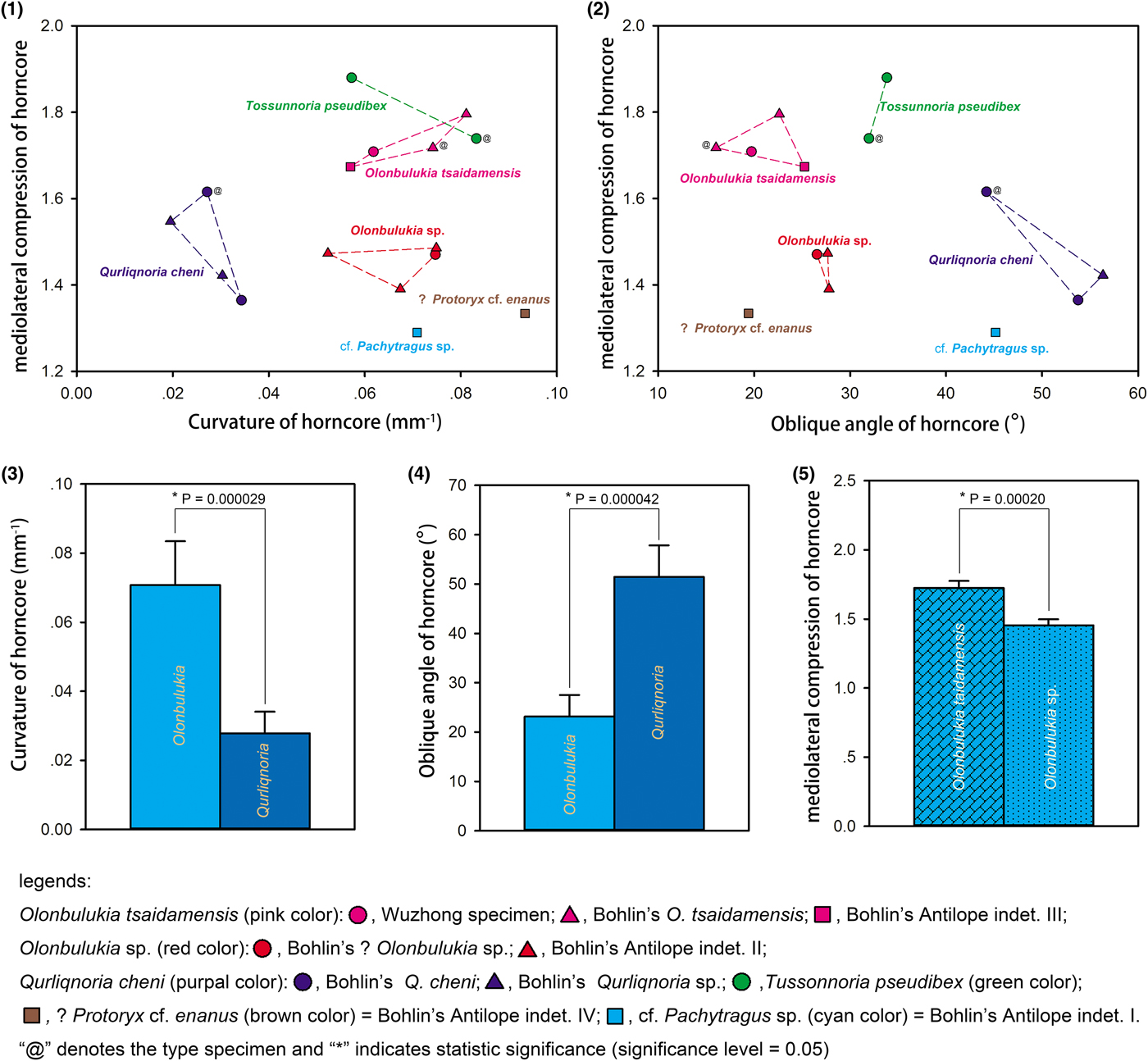
The newly discovered horncore from the Jiancaichang locality (Wuzhong Fauna) shows great similarity to that of the type specimen of Olonbulukia tsaidamensis from the Qaidam Basin (Bohlin, Reference Bohlin1937). Previous studies showed that horncore growth generates at the tip (Dove, Reference Dove1935; Janis and Scott, Reference Janis and Scott1987). It seems that a constant development velocity is retained and maintains a constant horncore curvature. The horncore body is vertically erect, and the vertical plane that passes through the long axis of the pedicle is close to the medial sagittal plane with an angle between the two planes (oblique angle of the pedicle) of 19.7° (16.0° in the type specimen) (Fig. 4.2). The pedicle is moderately long, and the supraorbital foramen is close to the elongation line of the anterior edge of the horncore body. These features are distinct from those of other stem caprine genera. For example, in Qurliqnoria, the DAP/DT ranges 1.364–1.616, curvature ranges 0.020–0.034/mm, and the oblique angle of the pedicle ranges 44.2–56.4° (Table 1). These biometrics are greatly distinct from Olonbulukia. Furthermore, in Qurliqnoria, the pedicle is relatively low, and the supraorbital foramen is more laterally remote to the horncore elongation line. In Tossunnoria, the horncore is very short and thick, and the two horncores greatly diverge, which substantially differs from that of Olonbulukia.
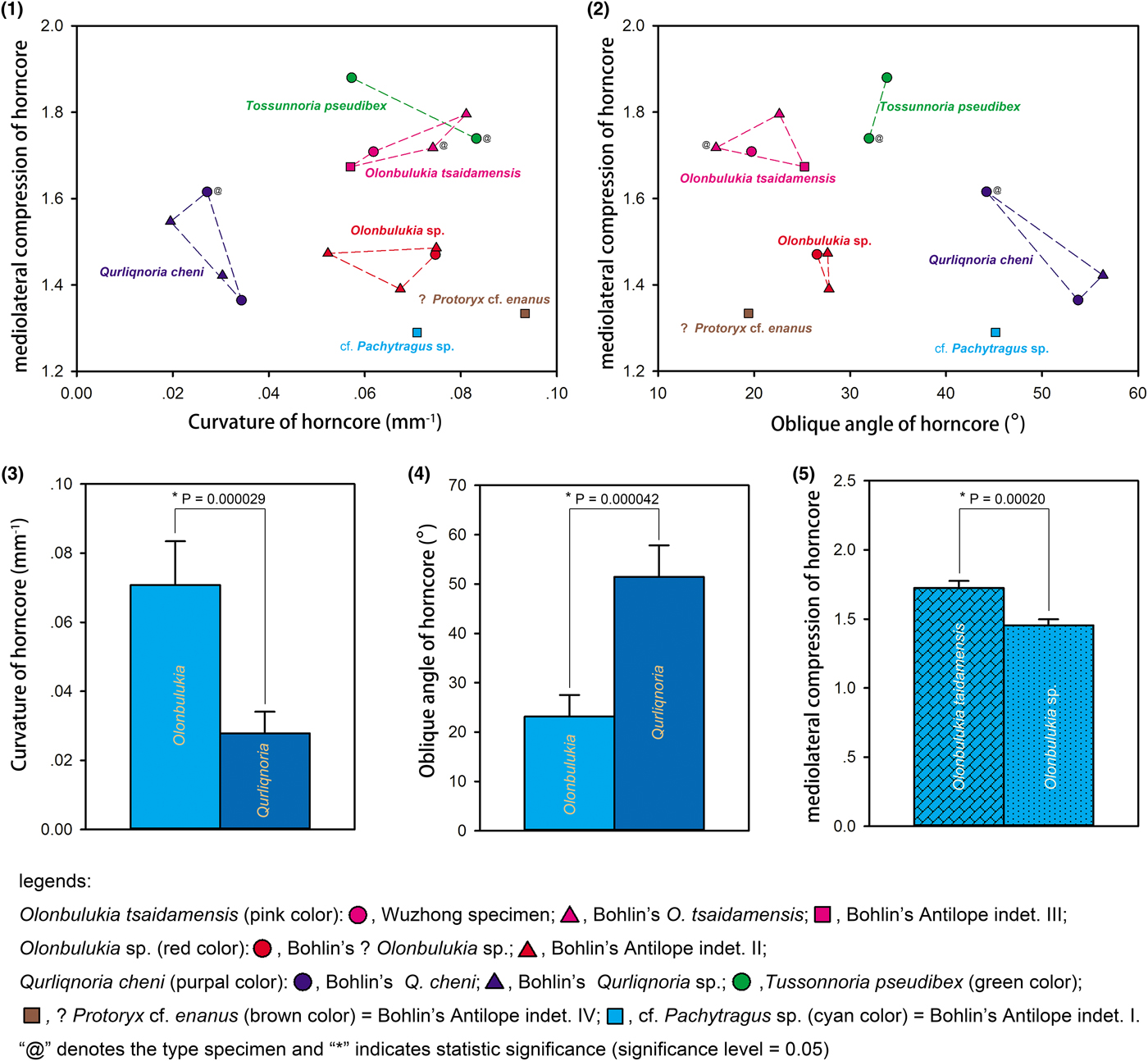
Biometric data and statistics of stem caprine horncores from Wuzhong and Qaidam Basin: (1) bivariate plot of curvature (average curvature of the anterior and posterior edges of horncore) vs. mediolateral compression (DAP/DT); (2) bivariate plot of oblique angle (angle between the medial sagittal plane and the vertical plane passing through the long axis of the pedicle) vs. mediolateral compression; (3–5) arithmetic mean (bars) and standard deviation (errors) of curvature (3), oblique angle (4), and mediolateral compression (5) between two groups; in addition, student's t-tests were performed on each pair.
One difference between the Wuzhong specimen and the type specimen is that the Wuzhong specimen is smaller. All of the biometric differences are proportional, which is easily interpreted as a result of ontogeny. The Wuzhong specimen is comparable in size to some referred specimens from the ‘Qaidam Fauna,’ as described below. Furthermore, the postcornual fossa in the Wuzhong specimen is smaller and less clear than that of the Qaidam specimens. As a result, we are confident that the Wuzhong specimen belongs to Olonbulukia tsaidamensis.
Biometric study of horncores from the ‘Qaidam Fauna’
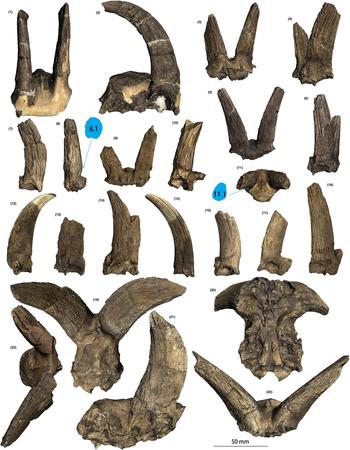
Stem caprine remains from the ‘Qaidam Fauna’ reported by Bohlin (Reference Bohlin1937) (Fig. 5) represent the most abundant material from this group during the middle and early late Miocene of northern China. Bohlin (Reference Bohlin1937) reported a total of nine taxa based on the horncores. Except for the named Olonbulukia tsaidamensis (Fig. 5.1, 5.2, 5.13), ?Olonbulukia sp. (Fig. 5.14), Qurliqnoria cheni (Fig. 5.3, 5.4, 5.18), Qurliqnoria sp. (Fig. 5.5, 5.6), and Tossunnoria pseudibex (Fig. 5.19–5.22) with relatively specialized horncore morphology, other unnamed taxa (i.e., “Antilope gen. et sp. indet.” I [Fig. 5.9–5.11], II [Fig. 5.15–5.17], III [Fig. 5.12], and IV [Fig. 5.7, 5.8]) have relatively unspecialized horncores. This rigorous classification seems to inadequately account for individual variation, especially for elucidating ontogeny. Qiu et al. (Reference Qiu, Ye and Jiang1987) considered Qurliqnoria cheni, and Qurliqnoria sp. to be the same species.
Stem caprines published by Bohlin (Reference Bohlin1937), from the Qaidam Basin (photos taken on 3D digital models): (1, 2) Olonbulukia tsaidamensis, IVPP RV37008 (type specimen), brain case with both horncores, Bohlin's field no. 356 (also below), middle Miocene Olongbuluk Fauna (MMOF), in anterior (1) and lateral views (2); (3, 4) Qurliqnoria cheni, IVPP RV37100 (type specimen), both horncores with frontal remains, no. 441, late Miocene Tuosu Fauna (LMTF), in anterior (3) and lateral views (4) (the distal part of both horncores has been lost, but were figured by Bohlin, Reference Bohlin1937, pl. 3, figs. 6, 7); (5, 6) Q. cheni, IVPP RV37102, both horncores with frontal remains, no. 508, LMTF, in anterior (5) and lateral (6) views; (7, 8) ?Protoryx cf. P. enanus, IVPP RV37099, right horncore with frontal remains, no. 451, MMOF, in lateral (7) and anterior (8) views, with cross section at the base (8.1) (anterior at top, lateral at right); (9–11) cf. Pachytragus sp., IVPP RV37104, both horncores with frontal remains, no. 492, LMTF, in anterior (9), lateral (10), and dorsal (11) views, with cross section at the base (11.1) (anterior at top, lateral at left); (12) O. tsaidamensis, IVPP RV37094, left horncore with frontal remains, no. 514, in lateral view, LMTF; (13) O. tsaidamensis, IVPP RV37093, left horncore with frontal remains, no. 429, in lateral view, LMTF; (14) O. sp., IVPP RV37095, right horncore with frontal remains, no. 423, in lateral view, LMTF; (15) O. sp., IVPP RV37096, right horncore, no. 479, in lateral view, LMTF; (16) O. sp., IVPP RV37097, right horncore with frontal remains, no. 486, in lateral view, LMTF; (17) O. sp., IVPP RV37098, left horncore with frontal remains, no. 499, in lateral view, LMTF; (18) Q. cheni, IVPP RV37101, right horncore with frontal remains, no. 491, in lateral view, LMTF; (19–22) Tossunnoria pseudibex, IVPP RV37086 (type specimen), brain case with both horncores, no. 481, in dorsal (19), lateroventral (20), ventral (21), and anterior (22) views, LMTF; (23) T. pseudibex, IVPP RV37087, fragmentary brain case with both horncores, no. 449, in anterior view, LMTF.

We further studied the taxonomy of all groups in this fauna based on biometric analyses. In curvature vs. mediolateral compression plane (Fig. 4.1), the sample points are distributed in three regions. Qurliqnoria samples cluster at the left half of the plane, which indicates straighter horncores in Qurliqnoria than in other taxa. In the upper right part of the plane are the Olonbulukia tsaidamensis samples, which include the Wuzhong specimen and Antilope gen. et sp. indet. III., and the Tossunnoria pseudibex samples, indicating that these taxa have curved and strongly compressed horncores. In the lower right part of the plane are samples of the other taxa. It is noticeable that Antilope gen. et sp. indet. I and IV are located at the lowest right part of the plane, which indicates relatively rounded horncores with strong curvatures.
In oblique angle vs. mediolateral compression plane (Fig. 4.2), the Qurliqnoria samples cluster in the right half with Antilope gen. et sp. indet. I, which indicates strongly oblique horncores. Tossunnoria pseudibex samples are located at the middle-upper part of the plane, indicating that the horncore oblique angle of Tossunnoria is intermediate between those of Qurliqnoria and Olonbulukia. Other samples are in the right part of the plane and are separated into the upper O. tsaidamensis and Antilope gen. et sp. indet. III, and lower O. sp. and Antilope gen. et sp. indet. II, which is like curvature vs. mediolateral compression plane. Also as in curvature vs. mediolateral compression plane, Antilope gen. et sp. indet. IV is in the lower left corner of the plane and is relatively distant from the Olonbulukia sp. and Antilope gen. et sp. indet. II samples.
Based on the biometric analysis and morphological comparison of stem caprine horncores from the ‘Qaidam’ and Wuzhong faunas, we recognize the following groups:
(1) Tossunnoria pseudibex (Fig. 5.19–5.23; SI 14, 15) shows the most specialized horncore morphology. The horncore is very short and thick (this feature is not reflected in our biometric analysis) with strong mediolateral compression.
(2) All Qurliqnoria specimens (Fig. 5.3–5.6, 5.18; SI 11–13) had straight horncores that are very oblique to the middle sagittal plane, which differs substantially from the other groups. We agree with the assertion of Qiu et al. (Reference Qiu, Ye and Jiang1987) that Bohlin's Q. cheni and Q. sp. represent ontogenetic or individual variation and belong to one species.
(3) Bohlin's Antilope gen. et sp. indet. III, a complete left horncore (Fig. 5.12; SI 6), can be grouped with Olonbulukia tsaidamensis (Fig. 5.1, 5.2, 5.13; SI 4, 5). Bohlin (Reference Bohlin1937) also stated that this horncore is very similar to that of Olonbulukia, and might be a young individual. This horncore differs from the type specimen based on the more rapid tapering and shorter pedicle. As we discussed above, the horncore elongates from the bone tissue at the tip. In this process, curvature is maintained. The shorter pedicle can also be interpreted as a younger ontogenetic stage.
(4) Bohlin's ?Olonbulukia sp. (Fig. 5.14; SI 7) and Antilope gen. et sp. indet. II (Fig. 5.15–5.17; SI 8–10) are similar based on biometric analysis. This group has similarly curved but less laterally compressed horncores than Olonbulukia tsaidamensis. The anterior keel of these horncores is relatively blunt relative to O. tsaidamensis. Bohlin's ?Olonbulukia sp. is larger than Antilope gen. et sp. indet. II. However, this difference can be interpreted as a result of ontogeny. In the present paper, we refer to this group as Olonbulukia sp.
(5) Bohlin's Antilope gen. et sp. indet. I (Fig. 5.9–5.11; SI 16) shows clearly distinct morphology from Olonbulukia and Qurliqnoria. The horncore oblique angle is large, close to that of Q. cheni, and the horncore curvature is strong and like that of Olonbulukia. The cross section displays an approximate round-cornered triangle (Fig. 5.11.1). A deep groove runs longitudinally along the posterior surface of the horncore. The morphology seems consistent with the diagnosis of Pachytragus Schlosser, Reference Schlosser1904 from Samos, Greece (Schlosser, Reference Schlosser1904) and is very similar to that of P. crassicornis Schlosser, Reference Schlosser1904 (Schlosser, Reference Schlosser1904; Kostopoulos, Reference Kostopoulos2005), but the specimen is smaller. Bibi and Güleç (Reference Bibi and Güleç2008) suggested that this specimen might belong to Caprotragoides Thenius, Reference Thenius1979 or Tethytragus Azanza and Morales, Reference Azanza and Morales1994. In our opinion, although the dimensions of the cross section fall into the range of the Caprotragoides-Tethytragus-Gentrytragus group (Bibi and Güleç, Reference Bibi and Güleç2008, fig. 8), the subtriangular shape of the cross section and strong obliquity of horn pedicle differ from those in Caprotragoides and its affinities with an oval cross section and less obliquity (Köhler, Reference Köhler1987; Azanza and Morales, Reference Azanza and Morales1994; Bibi and Güleç, Reference Bibi and Güleç2008). Because of the incompleteness of the specimen, we prefer to assign this specimen to cf. Pachytragus sp. rather than to Caprotragoides or Tethytragus.
(6) Bohlin's Antilope gen. et sp. indet. IV (Fig. 5.7, 5.8; SI 17), an incomplete right horncore, also displays morphology distinct from Olonbulukia and Qurliqnoria. The horncore cross section is oval (Fig. 5.8.1) and more rounded than any Olonbulukia and Qurliqnoria specimen and have more backward bending. It is also anteriorly positioned relative to the orbit. This specimen occurred in the middle Miocene Olongbuluk Fauna, which is geologically older than most of the other Olonbulukia samples, except for the type specimen (Fig. 6). The horncore morphology is like that of the middle Miocene Protoryx enanus Köhler, Reference Köhler1987 from western Turk (Köhler, Reference Köhler1987), although the generic attribution of the P. enanus sample has been questioned (Gentry, Reference Gentry, Vbra and Schaller2000). The cross-sectional dimensions of Bohlin's Antilope gen. et sp. indet. IV also fall into the ranges for P. enanus (see Köhler, Reference Köhler1987). Alternatively, this specimen is also like Caprotragoides and Tethytragus, but is larger. Nevertheless, Köhler (Reference Köhler1987) considered that T. langai Azanza and Morales, Reference Azanza and Morales1994 = C. potwaricus (Köhler, Reference Köhler1987), P. enanus, and P. solignaci (Robinson, Reference Robinson1972) belong to the same lineage. Here, we refer this specimen to ?P. cf. P. enanus because of the sample limitations.
We performed one-way ANOVAs to test if there are statistically significant differences in the biometric data between Olonbulukia and Qurliqnoria, and species within Olonbulukia. The results showed that the horncore curvature and the pedicle oblique angle differed strongly and significantly between the two genera (p < 0.05 for both traits; Fig. 4.3, 4.4). Therefore, these two characters efficiently discriminate these two genera. Horncore mediolateral compression also strongly significantly differed between O. tsaidamensis and O. sp. (p < 0.05; Fig. 4.5).
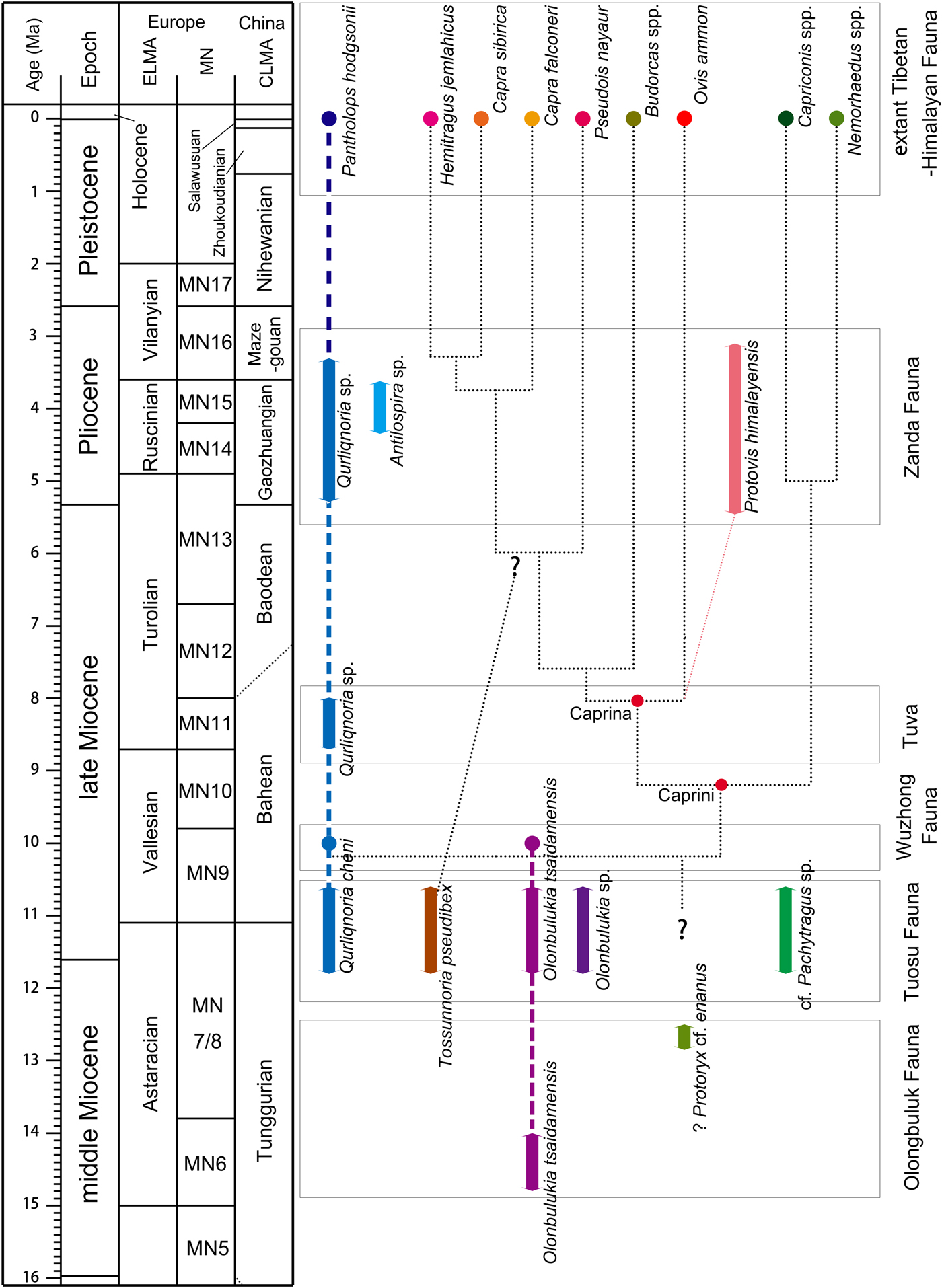
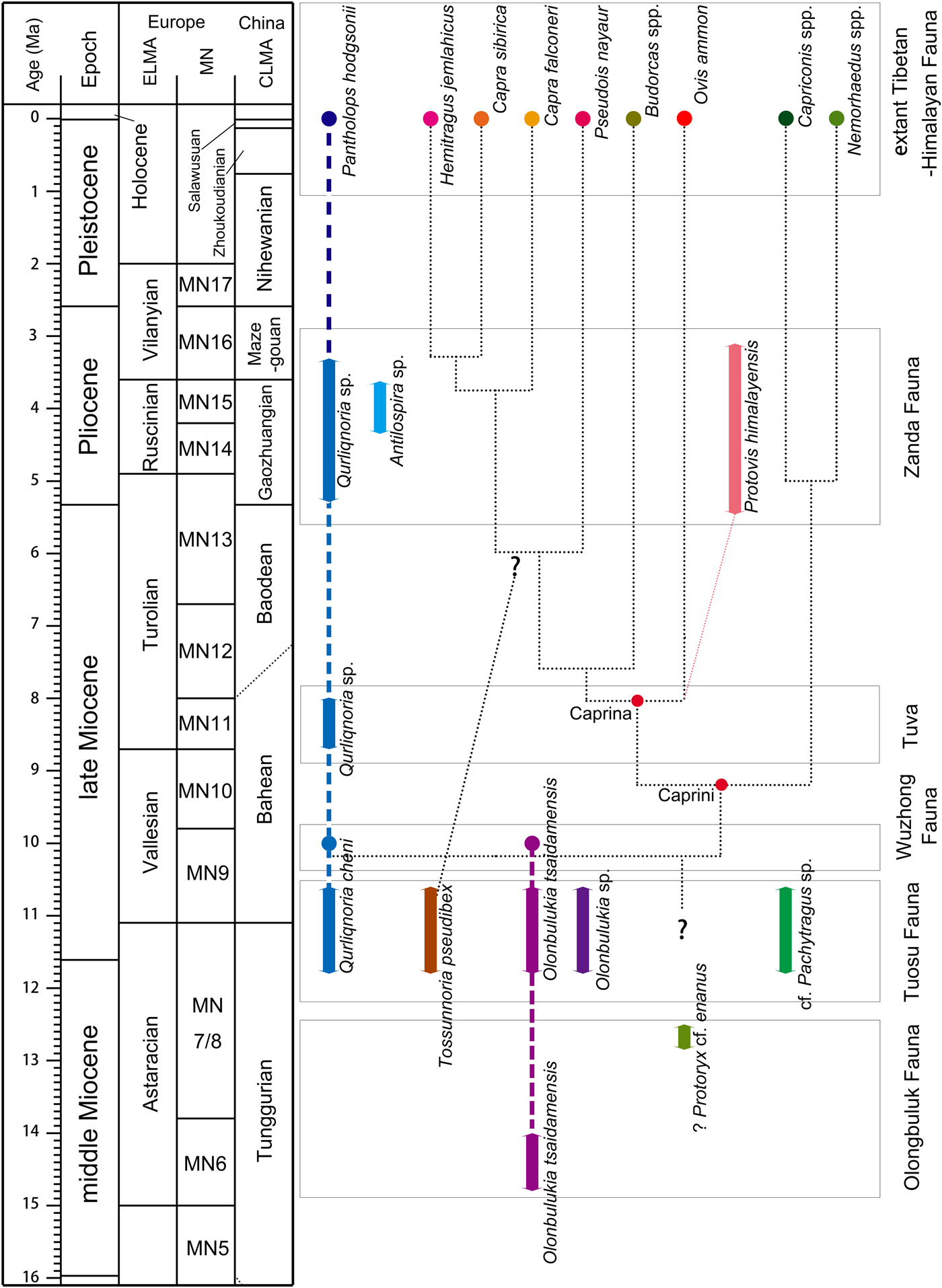
Stem and crown Caprini succession in the pan-Tibetan region and their possible phylogenetic relationship. Extant Tibetan-Himalayan caprines after Castelló (Reference Castelló2016). Phylogeny and differential ages after Bibi (Reference Bibi2013) and X.M. Wang et al. (Reference Wang, Zong, Yang, Sun, Li, Shi, Yang, Ye and Wu2016). CLMA = Chinese Land Mammal Age; ELMA = European Land Mammal Age; MN = European Mammal Neogene System.
Discussion
The Wuzhong specimen is the only Olonbulukia record aside from specimens from the type locality, the Qaidam Basin (Fig. 1). In the Qaidam Basin, the type specimen is from the middle Miocene Olongbuluk Fauna (ca. 15–12.5 Myr, see Wang et al., Reference Wang, Xie, Li, Qiu, Tseng, Takeuchi, Wang, Fortelius, Rosenström, Wahlquist, Downs, Zhang and Wang2011; Fig. 6); whereas most of the other specimens are from the early late Miocene Tuosu Fauna (ca. 11–10 Myr, see Wang et al., Reference Wang, Xie, Li, Qiu, Tseng, Takeuchi, Wang, Fortelius, Rosenström, Wahlquist, Downs, Zhang and Wang2011). The age of the Wuzhong Fauna is ca. 10 Ma, which corresponds to the beginning of the Ganhegou Formation (Shen et al., Reference Shen, Tian, Ding, Wei, Chen and Chai2001; S.Q. Wang et al., Reference Wang, Zong, Yang, Sun, Li, Shi, Yang, Ye and Wu2016) (Fig. 6). Therefore, O. tsaidamensis is probably one of the earliest stem caprines (if both the attribution and dating are correct) and crossed the middle/late Miocene boundary. Another stem caprine, Qurliqnoria cheni, was also reported in the Wuzhong Fauna (Qiu et al., Reference Qiu, Ye and Jiang1987). However, we did not see this specimen. The sympatry of Olonbulukia tsaidamensis and Qurliqnoria cheni indicates a close relationship of the Tuosu and Wuzhong faunas, and the age of the two faunas should be very similar. Nevertheless, mammalian fauna from ca. 10 Ma is rare in northern China (Qiu et al., Reference Qiu, Ye and Jiang1987). Another very specialized genus from the Tuosu Fauna, Tsaidamotherium, was also reported from the Yangcaiping locality, Linxia Basin (Shi, Reference Shi2014) (Fig. 1). This locality was attributed to the Dashenggou Fauna. Therefore, further studies should be carried out to examine whether Olonbulukia and/or other stem caprine genera also existed in the Wuzhong and Dashenggou faunas.
The stem caprine assemblage from the ‘Qaidam’ and Wuzhong faunas displays a mixed appearance. Although Olonbulukia seems to have no modern descendants, Gentry (Reference Gentry, Vbra and Schaller2000) proposed that Olonbulukia could be related to Protoryx carolinae Major, Reference Major1891 from the Pikemi fauna (Turolian) of Greece. Protoryx is an unspecialized Turolian caprine that is widely distributed across eastern Europe, northern Africa, western and central Asia, and even China (Bohlin, Reference Bohlin1935b; Gentry, Reference Gentry1971, Reference Gentry, Vbra and Schaller2000; Köhler, Reference Köhler1987; Dmitrieva and Serdyuk, Reference Dmitrieva and Serdyuk2011). Two other taxa—cf. Pachytragus sp. and ?Protoryx cf. P. enanus—display strong morphological similarity to the western analogues Pachytragus crassicornis and Protoryx enanus from the late and middle Miocene of the Mediterranean region (Schlosser, Reference Schlosser1904; Köhler, Reference Köhler1987), which also indicates an exchange of caprine related groups between the Mediterranean and eastern Asian regions during this period. ?Protoryx cf. P. enanus might be very closely related to the ancestor of the Caprini-Hippotragini-Alcelaphini clade, because it is very similar to Tetrytragus and Caprotragoides, as discussed by Gentry (Reference Gentry, Vbra and Schaller2000) and Bibi et al. (Reference Bibi, Bukhsianidze, Gentry, Geraads, Kostopoulos and Vrba2009).
Alternatively, Qurliqnoria survived longer, as was reported from Kyzyl, Tuva (MN 11, 12; Dmitrieva and Serdyuk, Reference Dmitrieva and Serdyuk2011) and the Zanda Basin (MN 13–15; Deng et al., Reference Deng, Wang, Fortelius, Li, Wang, Tseng, Takeuchi, Saylor, Säilä and Xie2011; Wang et al., Reference Wang, Li, Xie, Saylor, Tseng, Takeuchi, Deng, Wang, Hou, Liu, Zhang, Wang and Wu2013) (Fig. 1). This genus was considered the ancestor of the extant Tibetan antelope (Pantholops hodgsonii) (Gentry, Reference Gentry1968, Reference Gentry, Vbra and Schaller2000; Deng et al., Reference Deng, Wang, Fortelius, Li, Wang, Tseng, Takeuchi, Saylor, Säilä and Xie2011). Tossunnoria pseudibex was also thought to be related to the extant Himalayan tahr (Hemitragus jemlahicus) or goats (Capra spp.) (Bohlin, Reference Bohlin1937; Gentry, Reference Gentry, Vbra and Schaller2000). Qurliqnoria and Tossunnoria records are restricted to eastern Asia and the Tibetan Plateau. Therefore, the presence of Qurliqnoria and Tossunnoria from the Tuosu Fauna might indicate an early endemic radiation of stem caprines that eventually adapted the cold and dry habitats induced by the rising Tibetan Plateau.
Deng et al. (Reference Deng, Wang, Fortelius, Li, Wang, Tseng, Takeuchi, Saylor, Säilä and Xie2011) demonstrated a scenario in which the Pliocene Zanda fauna on the Tibetan Plateau (Zanda Basin, Figs. 1, 6) had pre-emptively adapted to cold weather, and then expanded to the northern tundra during the Pleistocene Ice Ages. In this fauna, one taxon—Protovis himalayensis Wang, Xie, and Takeuchi, Reference Wang, Xie and Takeuchi2016 (5.24–3.10 Myr)—was shown to be a direct ancestor of worldwide species of Ovis Linnaeus, Reference Linnaeus1758 (X.M. Wang et al., Reference Wang, Zong, Yang, Sun, Li, Shi, Yang, Ye and Wu2016) (Fig. 6). Based on a calibrated molecular phylogeny, Ovis is the most basal taxon in the clade Caprina, which consists of at least Ovis, Ammotragus Blyth, Reference Blyth1840, Pseudois Hodgson, Reference Hodgson1846, Hemitragus Hodgson, Reference Hodgson1841, and Capra Linnaeus, Reference Linnaeus1758. The occurrence age of Caprina is ca. 8 Ma (Bibi, Reference Bibi2013). Ropiquet and Hassanin (Reference Ropiquet and Hassanin2004) demonstrated that caprines might have originated in the isolated mountains of the Mediterranean mega-archipelago; however, this is somewhat debatable. In our opinion, the Tibetan Plateau, with the formation of isolated mountainous terrains, is a more likely area for caprine origin than the Mediterranean mega-archipelago. Based on the occurrence of Protovis Wang, Xie, and Takeuchi, Reference Wang, Xie and Takeuchi2016 on the Tibetan Plateau, the common ancestor of Caprina could have evolved ca. 8 Ma on and/or around the rising Tibetan Plateau (except for the Indian subcontinent). The stem caprines in the Tuosu and Wuzhong faunas ca. 10 Ma provide ideal precursors of Caprina, because there are both small temporal and spatial gaps (Fig. 6). Olonbulukia tsaidamensis seems a bit too specialized to be the ancestor of Caprina because of the substantially compressed horncore. Although Tossunnoria was thought to be related to Hemitragus and/or Capra, it also displayed a specialized horncore, which weakened its potential as an ancestor of Caprina. Alternatively, nonspecialized horncores (e.g., ?Protoryx cf. P. enanus, cf. Pachytragus sp., and Olonbulukia sp. in the present study) are ideal candidates for elucidating the origin of Caprina.
According to Deng and Ding (Reference Deng and Ding2015), the Tibetan Plateau reached a relatively high elevation during the middle Miocene, which hindered megamammalian faunal exchange between southern and northern sides along the Tibetan Plateau. Simultaneously, a stem caprine assemblage (as we see in the ‘Qaidam’ and Wuzhong faunas) was shaped along the northern Tibetan Plateau and lasted until at least the early late Miocene. This stem caprine assemblage shows a composite appearance of two groups. One relatively specialized group includes at least Qurliqnoria cheni and Tossunnoria pseudibex, which are related to some endemic Tibetan taxa; the other even group perhaps includes ?Protoryx cf. P. enanus and cf. Pachytragus sp., possibly with Olonbulukia sp., pertaining to the common caprines that spread across Eurasia and Mediterranean regions in the Turolian. In particular, certain members might have given rise to the extant Caprina, which is an interesting issue and should be studied further.
Conclusions
(1) The new horncore from Jiancaichang locality, Wuzhong, northern China is similar to Olonbulukia tsaidamensis that also occurred in the ‘Qaidam Fauna.’ With the occurrence of Qurliqnoria cheni, the Wuzhong Fauna shows high similarity to the Tuosu Fauna and is similar in age.
(2) The stem caprine horncores from the ‘Qaidam Fauna’ can be divided into the following groups based on biometric analyses. Tossunnoria pseudibex is the same as Bohlin's definition; Qurliqnoria cheni includes Bohlin's Q. cheni and Q. sp.; Olonbulukia tsaidamensis consists of Bohlin's O. tsaidamensis and Antilope gen. et sp. indet. III; Olonbulukia sp. includes Bohlin's ?O. sp. and Antilope gen. et sp. indet. II; Bohlin's Antilope gen. et sp. indet. IV can be attributed to ?Protoryx cf. P. enanus; and Bohlin's Antilope gen. et sp. indet. I can be attributed to cf. Pachytragus sp.
(3) The stem caprine assemblages from the ‘Qaidam Fauna’ show a combined appearance. Qurliqnoria and Tossunnoria are probably related to some extant Tibetan endemic caprine species. Other taxa belong to other Turolian caprine species and might have given rise to the extant Caprina. These results indicate a pan-Tibetan origin of Caprina and indicate a pan-Tibetan evolutionary pattern of some megafaunas prior to dispersal from Tibet.
Acknowledgments
We thank Z. Qiu and T. Deng for useful discussion of the study. We thank M. Eckstut, from Liwen Bianji, Edanz Editing China (www.liwenbianji.cn/ac), for editing the English text of a draft of this manuscript. This work was supported by the Chinese Academy of Sciences (grant nos. XDB26000000, XDA20070203, QYZDY-SSW-DQC022), the National Natural Science Foundation of China (grant nos. 41430102, 41372001), the Natural Science Foundation of Ningxia (grant no. NZ17227), the Special Research Program of Basic Science and Technology of the Ministry of Science and Technology (grant no. 2015FY310100-14), and All China Commission of Stratigraphy Project (grant no. DD20160120-04).
Accessibility of supplemental data
Data available from the Dryad Digital Repository: http://doi.org/10.5061/dryad.736cj0j.
SI 1. Olonbulukia tsaidamensis, IVPP V23373, right horncore with fragmentary frontal bone remains.
SI 2. Antilopinae gen. indet. sp. indet., NGM WJCCD-10-N-006, right P3 and P4.
SI 3. Antilopinae gen. indet. sp. indet., IVPP V23374, right hemimandible with p2–m3 tooth row.
SI 4. Olonbulukia tsaidamensis, IVPP RV37008 (type specimen, Bolin's field number [same below], no. 356), brain case with both horncores.
SI 5. Olonbulukia tsaidamensis, IVPP RV37093 (no. 429), left horncore with frontal remains.
SI 6. Olonbulukia tsaidamensis, IVPP RV37094 (no. 514), left horncore.
SI 7. Olonbulukia sp., IVPP RV37095 (no. 423), right horncore with frontal remains.
SI 8. Olonbulukia sp., IVPP RV37096 (no. 479), right horncore.
SI 9. Olonbulukia sp., IVPP RV37097 (no. 486), right horncore with frontal remains.
SI 10. Olonbulukia sp., IVPP RV37098 (no. 499), left horncore with frontal remains.
SI 11. Qurliqnoria cheni, IVPP RV37100 (type specimen, no. 441), both horncores with frontal remains.
SI 12. Qurliqnoria cheni, IVPP RV37101 (no. 491), right horncore with frontal remains.
SI 13. Qurliqnoria cheni, IVPP RV37102 (no. 508), both horncores with frontal remains.
SI 14. Tossunnoria pseudibex, IVPP RV37086 (type specimen, no. 481), brain case with both horncores.
SI 15. Tossunnoria pseudibex, IVPP RV37087 (no. 449), fragmentary brain case with both horncores.
SI 16. cf. Pachytragus sp, IVPP RV37099 (no. 492), right horncore with frontal remains.
SI 17. ?Protoryx cf. P. enanus, IVPP RV37104 (no. 451), both horncores with frontal remains.