Introduction
Pancreatic cancer and biliary tract cancer (pancreatobiliary cancer) are some of the most lethal malignancies. Despite substantial improvements in survival rates for other major types of cancer, the survival rate for pancreatobiliary cancer has remained relatively unchanged for many decades. In Japan, the 5-year survival rate for patients diagnosed in 2009–2011 was 8.5% for pancreatic cancer and 24.5% for biliary tract cancer (Center for Cancer Control and Information Services, 2020).
Due to its poor prognosis, many patients experience difficulty in having a positive outlook toward treatment, which subsequently leads to serious psychological distress (Holland et al., Reference Holland, Korzun and Tross1986; Zabora et al., Reference Zabora, BrintzenhofeSzoc and Curbow2001; Saluja et al., Reference Saluja, Dudeja and Banerjee2016). Among various cancers, pancreatobiliary cancer is thought to have one of the highest rates of concomitant depressive disorders (Passik and Breitbart, Reference Passik and Breitbart1996; Zabora et al., Reference Zabora, BrintzenhofeSzoc and Curbow2001; Massie, Reference Massie2004). Furthermore, a previous study showed that approximately 15% of pancreatic cancer patients were diagnosed with depression or anxiety, as based on psychiatric diagnostic criteria (Akizuki et al., Reference Akizuki, Shimizu and Asai2016). Patients often experience significant physical symptom burden, treatment side effects, and psychosocial burden leading to depression and anxiety (Sohal et al., Reference Sohal, Mangu and Khorana2016). Some experience loneliness, uncertainty, depression, unmet informational needs, and may need support to handle these challenges.
On the other hand, a cancer diagnosis also inflicts a substantial emotional burden on people caring for patients (most commonly, partners, relatives, or friends) and has a detrimental effect on caregivers’ quality of life, which can persist even after diseased passes away (Stenberg et al., Reference Stenberg, Ruland and Miaskowski2010). Previous studies (Locher et al., Reference Locher, Robinson and Bailey2010; Sherman et al., Reference Sherman, McGuire and Free2014; Engebretson et al., Reference Engebretson, Matrisian and Thompson2015) have shown that caregivers of people with pancreatobiliary cancer experience an emotional crisis and are heartbroken at the time of the person's diagnosis. They also have difficulties in providing supportive care, including finding appropriate ways to provide adequate nutrition. Many caregivers also report finding it difficult to understand important information and serve as a conduit of illness-related information to other family members. The lack of opportunity to de-stress, given the multiple tasks required and the rapidly declining health of the person with cancer, can also be burdensome for caregivers.
Social support has been identified as an important contributor to general well-being, buffering the impact of stressful experiences, including those related to physical illness (Schaefer et al., Reference Schaefer, Coyne and Lazarus1981; Cohen and Wills, Reference Cohen and Wills1985). The effect of social support to help individuals adjust and cope with a cancer diagnosis has been well documented (Broadhead and Kaplan, Reference Broadhead and Kaplan1991). Peer support is a common form of social support and provides patients with the opportunity for experiential empathy (Macvean et al., Reference Macvean, White and Sanson-Fisher2008). Peer support reportedly decreases patients’ sense of isolation, increases knowledge about the cancer experience, improves self-efficacy, and provides a sense of hope (Schover et al., Reference Schover, Jenkins and Sui2006; Ussher et al., Reference Ussher, Kirsten and Butow2006; Weber et al., Reference Weber, Roberts and Yarandi2007; Hoey et al., Reference Hoey, Ieropoli and White2008). It has also been suggested that peer support can help improve psychological adaptation to a cancer diagnosis and treatment, or help patients reframe their appraisals of their situation and improve coping responses (Hoey et al., Reference Hoey, Ieropoli and White2008). For patients with advanced cancer, they showed a higher need for peer support in the social/religious/spiritual support and practical domains (Park et al., Reference Park, Kim and Kim2019). Coping with advanced cancer means living with uncertainties and doubts. Moreover, as cancer progresses, economic problems or conflict between partners, and family members or friends may increase. In such a case, peers can provide relationship advice based on their own experiences.
However, most studies of peer-support interventions focused on specific types of cancer, such as breast or prostate cancer (Hoey et al., Reference Hoey, Ieropoli and White2008). In daily clinical practice, peer-support programs are conducted for patients with advanced cancer, but their effectiveness is not sufficiently examined (Walshe and Roberts, Reference Walshe and Roberts2018). Additionally, with the recognition of caregivers’ contribution to patients’ care and the burden that they endure, research to better support caregivers has become a high priority area within cancer care, sufficient evidence is lacking (Rankin et al., Reference Rankin, Butow and Price2011; Treanor et al., Reference Treanor, Santin and Prue2019), as there are only few studies on caregivers for patients with advanced cancer, or on the effects of peer support for caregivers.
In Japan, the most common unmet needs among patients with advanced cancer are the psychological domain (Uchida et al., Reference Uchida, Akechi and Okuyama2011; Sakamoto et al., Reference Sakamoto, Takiguchi and Komatsu2017). Caregivers also suffer strong psychological distress. However, to our knowledge, there are few studies on psychosocial support for Japanese patients with advanced cancer and their caregivers. In the field of pancreatobiliary cancer treatment in Japan, some medical professionals run peer-support groups at their own facilities for psychosocial support for pancreatobiliary cancer patients and their caregivers (Sakamoto et al., Reference Sakamoto, Ikeda and Ozaka2020). The National Cancer Center Hospital Japan also conducted a peer discussion group intervention called “the pancreatobiliary cancer salon” as part of daily clinical practice since 2016. Patients with pancreatobiliary cancer and caregivers talk to each other, exchange information, and share their feelings in this salon. However, so far, the effectiveness of peer-support groups has not been verified at any facility. Therefore, the purpose of this feasibility study was to examine the impact of “the pancreatobiliary cancer salon” on psychological distress among pancreatobiliary cancer patients and their caregivers.
Methods
Study design and participants
A within-group pre–post comparison design was implemented in this study. Participants were patients with pancreatobiliary cancer and their caregivers. We recruited participants from “the pancreatobiliary cancer salon,” which was conducted as part of daily clinical practice at the National Cancer Center Hospital Japan from April 2017 to August 2018.
Eligibility criteria for patients in this study were (1) age ≥18 years, (2) clinical diagnosis of pancreatic cancer or biliary tract cancer, (3) awareness of their diagnosis of pancreatic cancer or biliary tract cancer, (4) current or past treatment at the National Cancer Center Hospital Japan, (5) ability to speak and read Japanese, (6) sufficient health to participate in “the pancreatobiliary cancer salon” (the ECOG scale of Performance status ≤grade 2), and (7) absence of cognitive impairment. Eligibility criteria for caregivers in this study were (1) age ≥18 years; (2) caring for a patient with pancreatic cancer or biliary tract cancer undergoing or who had undergone treatment at the National Cancer Center Hospital Japan, (3) ability to speak and read Japanese, and (4) absence of cognitive impairment.
Procedures
Patients with pancreatobiliary cancer and their caregivers were invited to “the pancreatobiliary cancer salon” by announcements posted in the hospital and on the hospital's website. Hepatobiliary and pancreatic oncologists also invited outpatients and caregivers to participate in “the pancreatobiliary cancer salon.” The researchers confirmed in advance whether the prospective participants in “the pancreatobiliary cancer salon” would meet the eligibility criteria for the study. Then, we recruited patients and caregivers who could be the study subjects during “the pancreatobiliary cancer salon.” After obtaining written informed consent from eligible study participants, they were asked to complete a questionnaire before the salon started (pre-intervention) and to complete a questionnaire immediately after “the pancreatobiliary cancer salon” (post-intervention).
This study was approved by the institutional review board and the Ethics Committee of the National Cancer Center (2015-256). It was conducted in accordance with the Helsinki Declaration.
Pancreatobiliary cancer salon
“The pancreatobiliary cancer salon” was a peer discussion group intervention. Its goal was to provide emotional support and held in the hospital every 2 months. We confirmed the participants’ medical records and information from the attending physician in advance, and grouped them according to cancer type and treatment status. Each group consisted of four to five patients or caregivers. Assuming that cancer patients and caregivers have conflicts with each other, and that there are topics that they want to share only from their respective positions (Park et al., Reference Park, Kim and Kim2019), we divided patients and caregivers into different groups for discussion.
Hospital staff members (physician, nurse, pharmacist, or nutritionist belonging to the Department of Hepatobiliary and Pancreatic Oncology, and a psychologist and medical social worker assigned to many pancreatobiliary patients) facilitated a group discussion. Facilitators observe the following policies according to the facilitator's manual: (1) facilitators were instructed to encourage patients to help each other: the “helper-therapy” principle is considered a key principle for peer discussion groups (Spiegel and Yalom, Reference Spiegel and Yalom1978; Rosenberg, Reference Rosenberg1984; DeVita et al., Reference DeVita, Hellman and Rosenberg1989; Lieberman, Reference Lieberman1993), (2) facilitators were told to promote feelings of acceptance and encourage the expression of positive and negative feelings and problem confrontation (Spiegel and Yalom, Reference Spiegel and Yalom1978; Spiegel et al., Reference Spiegel, Bloom and Kraemer1989; Lieberman, Reference Lieberman1993), but to avoid letting groups deteriorate into complaining sessions, and (3) facilitators were instructed to take a positive approach by encouraging members to learn something from the experience. Facilitators could not provide unsolicited information to the group but could respond to participants’ questions and correct misinformation. Before “the pancreatobiliary cancer salon,” facilitators gathered to discuss their attitude and role as facilitators based on the manual. In addition, after “the pancreatobiliary cancer salon,” facilitators gathered for a debriefing and confirmed the facilitator role, and how to proceed with the group.
Group members determined the content of the discussion. Themes that frequently come up in conversation include treatment (e.g., standard treatment, clinical trials, supplements, and nutrition), side effects, advance care planning, and communication with the physician, family members, and friends. Participants began by introducing themselves and talked freely on their own topics for 1 h.
Measurements
Demographics
Data on demographic characteristics and clinical variables were obtained by reviewing the patients’ medical records.
Impressions of the pancreatobiliary cancer salon
We surveyed the participants’ impression of “the pancreatobiliary cancer salon” using original questions developed by the investigators. Participants were asked to what degree do they agree with the following statements: (1) I am satisfied with listening to other patients’ stories, (2) I am satisfied with talking about my story, (3) I feel anxious about participating in “the pancreatobiliary cancer salon,” (4) I think participating in “the pancreatobiliary cancer salon” is worthwhile, and (5) I would like to participate in “the pancreatobiliary cancer salon” again. Response options for question were: 1, strongly disagree; 2, slightly disagree; 3, neither agree nor disagree; 4, slightly agree; and 5, strongly agree.
Psychological condition
The Profile of Mood States 2nd Edition-Adult Short Form (POMS 2-AS; Heuchert and McNair, Reference Heuchert and McNair2012) was used to assess the participants’ psychological condition. The POMS 2-AS questionnaire consisted of 35 questions divided into 7 dimensions: Anger-Hostility, Confusion-Bewilderment, Depression-Dejection, Fatigue-Inertia, Tension-Anxiety, Vigor-Activity, and Friendliness. Each item is rated on a scale of 0–4, with the following values: 0, not at all; 1, a little; 2, moderately; 3, quite a bit; and 4, extremely. Scores for each of the seven dimensions can range from 0 to 20. A higher score indicates a higher degree of the emotion. The total mood disturbance (TMD) score is derived by adding scores from the five negative scales (Anger-Hostility, Confusion-Bewilderment, Depression-Dejection, Fatigue-Inertia, and Tension-Anxiety) and subtracting the Vigor-Activity subscale score. TMD scores can range from −20 to 100, with higher scores indicating greater distress. A T-score transformation produces a normal distribution with a mean of 50 and a standard deviation of 10. Yokoyama and Watanabe (Reference Yokoyama and Watanabe2015) presented tables to transform raw POMS scores into T-scores based on norms for a healthy adult population. A T-score >60 was considered to indicate high levels of mood disturbance on the POMS 2-AS, as recommended by the developers of this scale (McNair and Heuchert, Reference McNair and Heuchert2005; Yokoyama and Watanabe, Reference Yokoyama and Watanabe2015). The POMS 2-AS was chosen because it is sensitive to subjective levels of stress (Walton et al., Reference Walton, Pugh and Gelderloos1995) and mood disturbance (Beck et al., Reference Beck, Rush and Shaw1979). The validity and reliability of the Japanese version of the POMS 2-AS has been confirmed (Yokoyama and Watanabe, Reference Yokoyama and Watanabe2015).
Data analysis
The necessary sample size was calculated using G*power (Faul et al., Reference Faul, Erdfelder and Lang2007). In each group, 27 participants were needed to detect a moderate standardized effect (d = 0.50) in the primary outcomes with a power of 0.70 and two-tailed α < 0.05.
Some participants completed the questionnaire many times because they were frequent participants in the pancreatobiliary cancer salon. For data quality control, we only analyzed the data from first-time participants in this study.
Due to the nonparametric distribution of the sample, the Wilcoxon signed-rank test was used for comparisons between the participants’ psychological condition before and after the pancreatobiliary cancer salon. P < 0.05 was considered statistically significant. The effect size was calculated using the formula r = Z/√N as suggested by Rosenthal (Reference Rosenthal1994), where Z is the z-value of the Wilcoxon signed-rank test and N is the number of participants. Effect size was interpreted as small if r = 0.10, medium if r = 0.30, and large if r = 0.50 (Cohen, Reference Cohen1988). The McNemar test for paired comparisons was used to determine whether the proportion of participants with high levels of mood disturbance on the POMS 2-AS was significantly lower after versus before the salon. The following descriptive statistics were calculated: proportion, mean and standard deviation, or median and range. Data were analyzed using SPSS version 26.0 (IBM SPSS Statistics, Armonk, NY, USA).
Results
Sample characteristics
We held “the pancreatobiliary cancer salon” nine times between April 2017 and August 2018. Of the 144 potential participants (patients: 92, caregivers: 52) who participated in “the pancreatobiliary cancer salon,” a total of 118 (patients: 80, caregivers: 38) consented to participate and answered the questionnaire. In this study, we focused on the evaluation of the first time at “the pancreatobiliary cancer salon,” therefore the second and subsequent responses of the same subjects (patients: 37, caregivers: 10) were excluded from analysis. Of the 71 (patients: 43, caregivers: 28) first-time salon participants, 2 (patients: 1, caregivers: 1) were excluded because they could not complete the questionnaire. Participant characteristics at the time of the survey are outlined in Table 1.
Demographic characteristics of patients and caregivers

IQR, interquartile range (25th–75th).
Thirty-five patients (83.3%) had pancreatic cancer. Thirty-one patients (71.4%) had unresectable pancreatobiliary cancer and 14 patients (33.3%) were being treated with second-line or third-line chemotherapy at the time of the survey. Twenty-two patients (52.4%) participated in the salon within 6 months after diagnosis. Most participating caregivers were the patient's spouse/partner (51.9%) or child (34.6%).
Impressions of the pancreatobiliary cancer salon
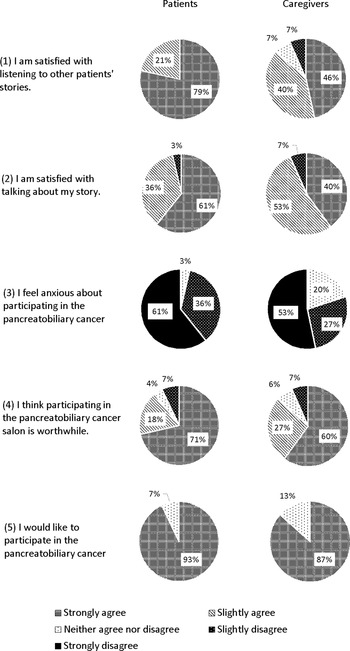
Participants were asked to choose one of four responses that best summarized their impression of the salon. As depicted in Figure 1, most participants were satisfied with listening to other patients’ stories and talking about own story. No one felt anxiety about participating in the salon. Almost all participants thought participating in the salon was worthwhile and hoped to participate in the salon again.
Impressions of the pancreatobiliary cancer salon. Figures on the left side showed the patients’ impression of the pancreatobiliary cancer salon. Figures on the right side showed the caregivers’ impression of the pancreatobiliary cancer salon. Compared with these figures, both of the patients and caregivers had good impression of the pancreatobiliary cancer salon and hoped to participate in the salon again.

Impacts of the peer discussion group intervention on psychological condition
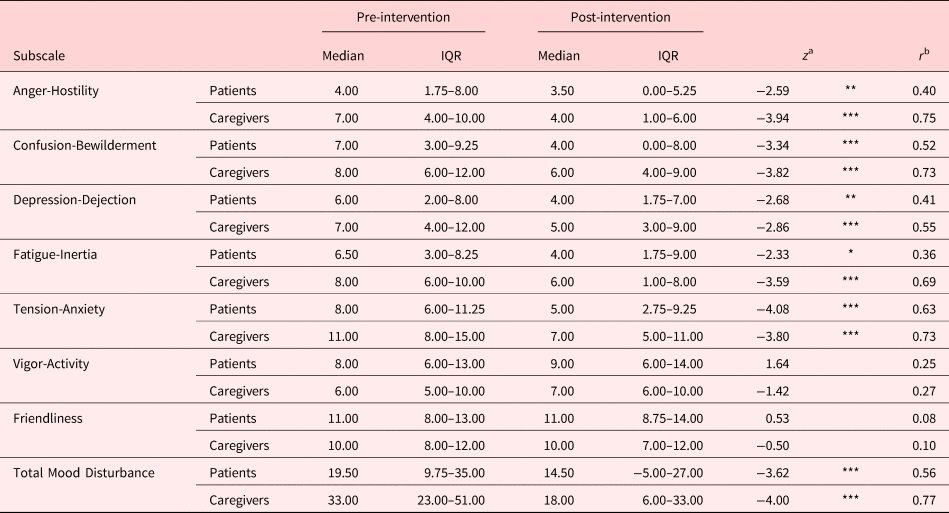
Regarding patient POMS 2-AS scores, the Wilcoxon signed-rank test for paired data indicated that there were significant differences in Anger-Hostility (z = −2.59, p < 0.01, r = 0.40), Confusion-Bewilderment (z = −3.43, p < 0.001, r = 0.52), Depression-Dejection (z = −2.68, p < 0.01, r = 0.41), Fatigue-Inertia (z = −2.33, p < 0.05, r = 0.36), Tension-Anxiety (z = −4.08, p < 0.001, r = 0.63), and TMD (z = −3.62, p < 0.001, r = 0.56) (Table 2). Caregiver POMS 2-AS scores were similar. The Wilcoxon signed-rank test for paired data indicated that there were significant differences in Anger-Hostility (z = −3.94, p < 0.001, r = 0.75), Confusion-Bewilderment (z = −3.82, p < 0.001, r = 0.73), Depression-Dejection (z = −2.86, p < 0.001, r = 0.55), Fatigue-Inertia (z = −3.59, p < 0.001, r = 0.69), Tension-Anxiety (z = −3.80, p < 0.001, r = 0.73), and TMD (z = −4.00, p < 0.001, r = 0.77) (Table 2). For both patients and caregivers, there were no significant differences in Vigor-Activity or Friendliness.
Comparisons of pre-intervention and post-intervention POMS 2-AS raw scores among patients and caregivers

IQR, interquartile range (25th–75th).
a Wilcoxon signed-rank test.
b Effect size.
* p < 0.05.
** p < 0.01.
*** p < 0.001.
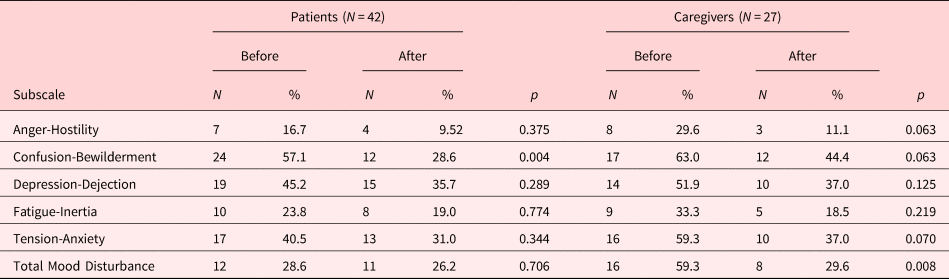
Table 3 shows the percentage of participants with a POMS 2-AS T-score >60: 57.1% of patients had a high Confusion-Bewilderment score, 63.0% of caregivers had a high Confusion-Bewilderment score, 51.9% of caregivers had a high Depression-Dejection score, and 59.3% of caregivers had high Tension-Anxiety and TMD scores prior to the start of the intervention. The McNemar test showed a significant difference between the proportion of participants with high levels of mood disturbance before and after the intervention, among patients based on the Confusion-Bewilderment dimension (p < 0.01) and among caregivers based on TMD (p < 0.05).
Number of participants with high levels of mood disturbance (T-score >60) on the POMS 2-AS

Discussion
To our best of knowledge, this is the first study to examine the impacts of a peer discussion group intervention on psychological distress among pancreatobiliary cancer patients and their caregivers in Japan. In terms of the psychological distress, both patients and caregivers had high levels of distress before the intervention. Especially, the proportion of caregivers with a POMS 2-AS T-score >60, indicating a high level of mood disturbance, was higher than the proportion of patients with a T-score >60. These results are in accordance with earlier research by Janda et al. (Reference Janda, Neale and Klein2017) who reported that patients with pancreatic cancer and their caregivers experience elevated levels of anxiety and depression and that a considerably higher proportion of caregivers compared with patients experienced anxiety. Other studies have also indicated that caregivers report more negative emotions than patients (Clark et al., Reference Clark, Loscalzo and Trask2010; Hagensen et al., Reference Hagensen, London and Phillips2016). Even though caregivers are confused by the rapid changes in pancreatobiliary cancer patient's condition, they provide support to patients at many levels (Engebretson et al., Reference Engebretson, Matrisian and Thompson2015), including emotional support, as well as more practical functions, such as contributing to treatment decisions, accompanying patients to treatment appointments, taking notes during medical appointments, and relaying information from medical appointments to friends and family. A higher degree of negative emotions among caregivers suggests an unmet need for better education, communication, and support services tailored to caregivers, as well as a great deal of confusion about the rapid progression of pancreatobiliary cancer.
The results of this feasibility study suggest that a peer discussion group intervention addressing psychological distress among both patients with pancreatobiliary cancer and their caregivers is well-received and can benefit this population. Need for peer support has long been questioned in Japan because Japanese people are considered less likely to share their experience with others (Ohnuki-Tierney, Reference Ohnuki-Tierney1984). But a previous study among Japanese cancer patients suggests that peer support for social-spiritual needs is sought less than support from family and friends (Umezawa et al., Reference Umezawa, Fujisawa and Fujimori2015). In fact, our study showed that both patients and caregivers were very satisfied with sharing thoughts and feelings and wanted to join “the pancreatobiliary cancer salon” again. There were many patients with metastatic or relapsed cancer. About 33% of patients in “the pancreatobiliary cancer salon” had received second- or third-line treatment, and despite sensitive topics such as advance care planning, they did not feel anxiety about participating in the salon. Recently, in Japan, not only for medical professionals and researchers, but also for the general public, thinking about how to live life and the end of life has become a familiar topic (e.g., “ending notes” and “end of life plan”) (Sumita, Reference Sumita2015). In addition, especially at our hospital, we have been providing palliative care and advance care planning topics for pancreatobiliary cancer patients and their caregivers since early treatment stages (Mori et al., Reference Mori, Okusaka and Ooba2020). Therefore, it may have been easier for participants in this study to talk about such serious topics. Dennis (Reference Dennis2003) described emotional, informational, and appraisal support as core attributes of peer support, with mutual identification, shared experience, and sense of belonging developed through peer support thought to improve psychological outcomes. Helgeson et al. (Reference Helgeson, Cohen and Schulz2000) pointed out that peer-support groups are thought to be beneficial because they compensate for deficits in one's naturally occurring network. Since the time from diagnosis to death is overwhelmingly short (Conroy et al., Reference Conroy, Desseigne and Ychou2011; Vogel et al., Reference Vogel, Römmler-Zehrer and Li2016), patients with pancreatobiliary cancer and their caregivers have difficulty accepting the disease and managing physical and mental burdens. They also have insufficient opportunities for meeting others in the same situation and receiving multidimensional support. Since patients with pancreatobiliary cancer and their caregivers are put in such a difficult situation, it may be very useful for patients and caregivers to get a glimpse into other patient's or caregiver's lives, to learn that I am not alone, to realize that someone is suffering just like me, and to share many feelings through the peer discussion group intervention. As many peer-support studies are aimed at patients with a good prognosis, our findings imply that peer support may also be effective for patients with a poor diagnosis as a role to share experience with each other and support each other's fight against illness.
From the perspective of managing a peer discussion group intervention, we think there are some advantages. First, this peer discussion group is particularly accessible to caregivers. There is a time constraint behind the difficulty of providing psychosocial support to caregivers. In addition to caring for the patient, caregivers have various tasks such as their own jobs and housework, so it is difficult to make time for themselves (Engebretson et al., Reference Engebretson, Matrisian and Thompson2015). In this intervention, patients and caregivers were simultaneously supported by different groups, so the access barrier to the caregiver could be reduced. Second, this peer discussion group intervention is easily manageable for healthcare professionals. The facilitator only needs using the facilitator manual and attend meetings before and after the intervention. Since it does not require advanced psychological skills and training like group psychotherapy, medical professionals could easily implement it. In particular, the multiple occupations of facilitators had the advantage of the different viewpoints on how to understand and respond to the various problems faced by patients and caregivers. On the other hand, a future task is to secure the number and time of medical staff involved in the operation of the peer discussion group intervention.
The main limitation of this study is the sample size. Due to the small sample size, we did not assess the impact of the intervention with respect to demographic factors such as cancer type, treatment status, sex, and relationship to the patient. It is very important that differences in demographic factors be considered in future research. Second, we did not assess long-term effects; thus, our findings are only relevant to the possible short-term impact of the group intervention. Third, we did not assess the effect of the number of the interventions. Our salon included many repeat participants. We need to investigate the effect of the number of sessions attended on psychological distress. Fourth, without randomized controls, we cannot provide sufficient evidence for the effects of the intervention. But our study targeted patients with pancreatobiliary cancer with poor prognosis. Therefore, it may be unethical to deprive or delay potentially helpful treatment to people with a very limited lifespan. Therefore, we believe that our results are still worthy of attention.
In conclusion, the present findings imply that a peer discussion group intervention has potential to benefit for patients with pancreatobiliary cancer and their caregivers. Since both patients and caregivers have high levels of psychological distress, it is necessary to provide them with opportunities for emotional, informational, and appraisal support.
Acknowledgments
We are grateful to all patients and caregivers who participated in this study. We also thank all clinical staff involved in the development and implementation of the pancreatobiliary cancer salon.
Funding
This research received no specific grant from any funding agency, commercial, or not-for-profit sectors.
Conflict of interest
The authors have no conflicts of interest to declare.