




No CrossRef data available.
Citizenship, Same-Sex Marriage, and Feminist Critiques of Marriage
Published online by Cambridge University Press: 16 June 2005
Abstract
The debate over same-sex marriage in the United States is fundamentally a disagreement about the nature of democratic citizenship and the meaning of full inclusion of adult citizens in the polity. The facts that marriage has both private and public dimensions, and is described by policy makers as natural and unchanging even as they write laws to define it create confusion among those who publicly contest same-sex marriage. The feminist critique of marriage provides insight on the issue; its critique, along with the questions raised by same-sex marriage, indicates a need to rethink many aspects of the legal regulation of families and intimate life as they affect democratic citizenship.Jyl Josephson is an associate professor of political science and director of women's studies at Rutgers University, Newark (jylj@andromeda.rutgers.edu). She is coeditor, with Sue Tolleson-Rinehart, of the second edition of Gender and American Politics; coeditor, with Cynthia Burack, of Fundamental Differences: Feminists Talk Back to Social Conservatives, and author of Gender, Families, and State: Child Support Policy in the United States. The author thanks Jennifer Hochschild for her editorial guidance. Thanks also to the three anonymous reviewers, and to Cynthia Burack, David Foster, and Stacy VanDeveer, whose questions helped me to clarify my arguments.
Information
- Type
- Research Article
- Information
- Copyright
- © 2005 American Political Science Association
When President Bush endorsed a federal constitutional amendment to prohibit same-sex marriage, he confirmed an electoral strategy of using “gay marriage” as a wedge issue in the 2004 election.1
Amanda Paulson and Seth Stern, Christian Science Monitor, November 19, 2003.
Language and terminology are crucial in the women's movement and in feminist theorizing, as they are in the movement for theorizing about civil rights for gay, lesbian, bisexual, and transgender people. When I am talking about the overall movement, I usually use LGBT, though if it is historically more accurate to use gay and lesbian, I use this terminology. I use the term “queer” when talking about the activists and theorists who use the term; I generally do not use it to describe the movement as a whole, since many in the movement and the academy do not see the term as descriptive of themselves or their work. Finally, the movement for marriage for transgender persons has additional complexities that I do not address here (See Currah 2001). Note that the trans advocacy community is very concerned about any changes to marriage law that might define male and female in discriminatory ways.
Alan Cooperman, Washington Post, July 31, 2003; Toner and Pear 2004.
The focus by the advocacy community on achieving the right to same-sex marriage might seem puzzling. After all, polling data in the United States have consistently shown that the American public supports same-sex marriage less than many other goals of the movement, such as nondiscrimination in employment. This has remained true even as hostility toward gays, lesbians, and bisexuals has abated over the past decade.4
Wilcox and Wolpert 2000, 412–13.
Citron 2003; Mitchell Landsberg and John M. Glionna, Los Angeles Times, June 27, 2003.
The 2003 majority opinion of the Massachusetts Supreme Judicial Court made this connection between marriage and citizenship explicit, both in its original decision and in its advisory opinion: “The Massachusetts Constitution affirms the dignity and equality of all individuals. It forbids the creation of second-class citizens.”7
The court further states that “[t]he dissimilitude between the terms ‘civil marriage’ and ‘civil union’ is not innocuous…. It is a considered choice of language that reflects a demonstrable assigning of same-sex, largely homosexual, couples to second-class status.”8Pamela Belluck, New York Times, February 5, 2004, A1.

Advocates of same-sex marriage compare their quest to those of other social movements, particularly the civil rights movement, that sought equal status as citizens before the legal institutions of the state. Comparisons are frequently drawn, for example, between the effort to eliminate state bans on interracial marriage and the quest for same-sex marriage. The comparisons have been controversial in the African American community and are rejected by some leaders who nonetheless oppose constitutional amendments banning same-sex marriage.9
African American LGBT groups have also organized in support of same-sex marriage. On the politics of sexuality in the African American community see Boykin 2000; Cohen 1999; Cole and Guy-Sheftall 2003; Collins 2004. A recent study by the National Black Justice Coalition and the National Gay and Lesbian Task Force found that African American same-sex households would particularly benefit from access to the benefits of marriage. See Dang and Frazer 2004.
Advocates of same-sex marriage are less likely to make reference to the movement for women's rights, which has historically seen marriage as a tool of oppression, and reform of the institution as a crucial feminist goal. Feminist political and legal theorists have critiqued the institution of heterosexual marriage as harmful to women's status as citizens; for many feminists, the flaws of the institution are deeply embedded in its reinforcing of inequality, gender roles, gender hierarchy, and male power. Indeed, those within the LGBT community who are critical of the marriage quest frequently invoke feminist arguments.
The current debate raises important questions about the role of the state in the lives of its citizens, democratic participation, and political rights in contemporary democracies. How will same-sex marriage affect LGBT citizenship? Will it, as some advocates claim, help to make the institution of marriage more egalitarian, or will it reinforce society's conservative ideas of family? Will citizenship continue to be circumscribed by the state's definition of acceptable and unacceptable relationships, or will the dialogue on same-sex marriage permit a broader understanding of families, family relationships, and public life? What are the implications for our understanding of contemporary democratic citizenship?
What is Marriage?
As Nancy Cott notes, marriage is central to ideas of citizenship in U.S. history, even though its “monumental public character … is generally its least noticed aspect.”10
Cott 2000, 1.
Cott argues that nineteenth-century disputes over marriage—for example, over polygamy among the Mormons—were really about who should be included as full citizens in the polity. The irony is that marriage is often seen as a coveted realm of privacy in a world where little is private. Marriage establishes the right to a realm of privacy—a right not accorded to those who do not or may not marry. Thus marriage is a public institution that creates a right to private sexual relations, and yet is defined by public policy. Little wonder, then, that public discussion of same-sex marriage reflects confusion about what exactly is being discussed.
Public officials propagate this confusion in their discussions of marriage: “Legislators … tried to have it both ways with marriage in political discourse—picturing it as a rock of needed stability amidst eddies of change, while also acting to define and redefine marital obligations.”11
Cott 2000, 219.
This dual feature of marriage—that it is both constructed by state law and policy and understood as “natural” and prepolitical—is partly what leads to confusion about the institution among feminist theorists, conservative opponents of same-sex marriage, and gay and lesbian activists. Indeed, if marriage were merely “natural,” a “pre-Christian institution written into the human psyche,”13
The statement was made by Diane Knippers, president of the Institute on Religion and Democracy, as quoted in Alan Cooperman, Washington Post, July 31, 2003, A1.
Although politicians sometimes mystify marriage,14
The Defense of Marriage Act (DOMA) was passed at the federal level in 1996; it declares it a matter of federal law that marriage is between one man and one woman. DOMA forbids the provision of the benefits of marriage to same-sex couples. To date, nearly forty states have passed laws with similar provisions. Surely these proponents of DOMA did not intend to provide confirmation of Carole Pateman's (1988) critique of social contract theory, though their arguments seem to suggest the continuing vitality of the (hetero)sexual contract.
Construing marriage in terms of public policy does not, of course, preclude diverse beliefs about the meaning of marriage. But in a pluralistic democratic society, all of these beliefs need not be shared by all who participate in the institution, or by all members of the polity. This is the point that advocates of same-sex marriage make in arguing that they seek civil, not religiously sanctioned, marriage.16
But what is marriage? And what are its public functions? For traditionalists, marriage serves the public function of creating social stability and a hospitable setting for raising children.17
Many also see it as the fulfillment of religious mandates. But even those who see gender equality in marriage and inclusion for same-sex couples as politically desirable have no need to start from scratch. Scholars of family law have been discussing this question for several decades, as family relationships and institutional features of marriage have been changing.18 Some have questioned whether the law on marriage has been transformed from status-based to contract-based, and whether alternative views on marital law are needed.19Cohen 2002, 180–203; Glendon 1989; Minow and Shanley 1996.
Cohen 2002; Cornell 1998; Fineman 1995; Minow and Shanley 1996; Shanley 2001; Shanley et al. 2004; Struening 2002.
For some queer critics of the same-sex marriage quest, the current heterocentric vision of marriage inappropriately associates the public granting of a privacy privilege with adult citizenship for those professing lifelong, monogamous sexual relationships. Their objection is not so much to the fact that same-sex couples wish to have such relationships recognized, but rather to privileging this form of sexual relationship above all others.21
If married couples—opposite or same-sex—are provided greater social, economic, and political privileges than nonmarried individuals, the result will be secondary exclusions and reinforcement of an undesirable link between a particular form of intimate association and adult citizenship.22Marriage is a public institution whose current form in the United States results from political choices made by state and federal public officials over a long period. It is also a fundamentally conservative institution: marriage posits a specific desirable form for intimacy and family life—despite contemporary reality—and reinforces that form through legal, economic, political, and social privileges. In the current debate over same-sex marriage, democratic theorists should encourage a broad discussion about whether this public place for marriage is warranted or desirable.
Citizenship and Same-Sex Marriage
Although some efforts to advance same-sex marriage in the United States began in the 1970s, it was not until the 1990s that the gay and lesbian advocacy community began to back the cause.23
What surfaced in the 2004 political debates as a two-sided issue has many more facets.Advocates of same-sex marriage, LGBT skeptics of this quest, and social conservative opponents of same-sex marriage all agree that fundamental questions of citizenship status are at stake in this debate. They disagree on whether same-sex marriage will end second-class citizenship for same-sex couples—and whether that is a desirable goal. These groups have different views on citizenship and different views on the effects that same-sex marriage would have on citizenship and on the polity. Recent scholarship on the nature of citizenship in the United States can help us put the matter into perspective. Rogers Smith's documentation of an ascriptive tradition of citizenship that developed alongside republican and liberal versions is helpful, particularly considered in concert with those who have taken up this work for somewhat different purposes, including Shane Phelan, Catherine Holland, and Bonnie Honig.24
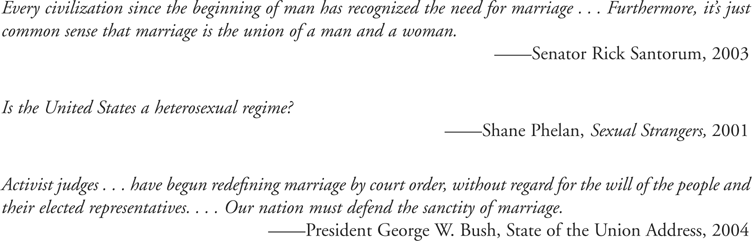
Phelan's argument, for example, that the United States is a heterosexual regime suggests that heterosexuality is a necessary ascriptive characteristic for full citizenship status. For Phelan, this is evident in a number of policies related to citizenship, including the “don't ask, don't tell” policy for gay and lesbian members of the military, heterosexual marriage, and continuing employment discrimination against LGBT individuals, which is still legal in most jurisdictions. Phelan fears that even proposals to change some forms of heterosexual privilege may inadvertently reinforce the policies they seek to change by inscribing a delimited form of citizenship for sexual minorities. For example, provision of same-sex marriage may exclude those who are single, who do not wish to be married, or whose families of choice do not conform to the marriage model.
This is just one example; the parties to the debate on same-sex marriage are numerous, and below I map a few of these positions. The point I wish to emphasize is that these groups' positions and arguments with respect to the desirability (or undesirability) of same-sex marriage are related to views of democratic citizenship. Some parties hold an ascriptive, nationalist view of citizenship; others, a more egalitarian view. But some of the comparisons are surprising.
For members of the Christian Right,25
I refer here specifically to those Christian organizations and believers that identify their opposition to greater inclusion for gay, lesbian, bisexual, and transgender persons as central to their political and social agenda. This includes organizations such as Focus on the Family, the Traditional Values Coalition, and Concerned Women for America.
For the Christian Right and other social conservatives, then, restricting marriage to heterosexuals preserves an ascriptive version of citizenship, one that ensconces a particular form of intimate relationship as the state-recognized norm. This ascriptive status is not based on race or national origin, but on heterosexual identity and willingness to participate in and benefit from the state-sanctioned institution of marriage. The quest for a federal constitutional amendment establishing heterosexual marriage, and the state ballot initiatives that provide for similar state-level constitutional change confirm social conservative and Christian Right agreement that heterosexual marriage is central to their understanding of democratic citizenship. For these groups, same-sex marriage is a fundamental threat to the republic as a whole.
This view of citizenship is nationalist, inegalitarian, and ascriptive. The justifications for the Federal Marriage Amendment imply that heterosexuality and marriage are required for full adult citizenship. Proponents of constitutional amendments apparently feel aggrieved by the prospect of same-sex marriage because legally sanctioned same-sex marriage would harm their “privileged” place as Christian citizens.
Curiously, conservative gay advocates of same-sex marriage share much of this vision of ascriptive, inegalitarian, and nationalist citizenship. Andrew Sullivan, for example, argues that marriage has a civilizing influence on men and should be supported by conservatives; marriage, he asserts, should be the primary—indeed the only—goal of the gay rights movement.28
Indeed, this is the point made by advocates such as Jonathan Rauch, who maintain that access to marriage will create a more mature gay culture since, in his view, marriage leads to a fulfilled adult life that connects love, sex, and responsibility.29Rauch 2004, 55–71.
Although many of the most prominent advocates of same-sex marriage are conservative gay men, some lesbian feminists also argue that same-sex marriage is necessary to assure full citizenship. Cheshire Calhoun argues that obtaining same-sex marriage is central to the status of nonheterosexuals (and in particular, of lesbians) as citizens:
[T]he gain takes the form of a unique citizenship status that grounds heterosexuals' claims to special state solitude for their private lives, a partial insulation of their legal privileges from liberal principles, and special entitlement to influence the evaluative commitments of future generations.31
Calhoun 2000, 128.
While Calhoun may not agree with the ascriptive view of citizenship, she suggests that this view may be too entrenched to alter. Advocates of full equality for LGBT citizens must, in Calhoun's view, seek access to marriage as it exists today.
Of course, some advocates of same-sex marriage do not share, or do not wish to accede to, this ascriptive view of citizenship. Many are legal scholars, and their approach to the issue reflects their concern with legal and constitutional arguments that might persuade court decision making. They see citizenship in egalitarian terms and argue that providing access to marriage for same-sex couples is a matter of equality.32
Although these scholars disagree on the specific legal justification for same-sex marriage and on the best institutional venue to use, most of their arguments are equality-based, hinging on equal protection against discrimination or some other legal basis.Many legal arguments focus on the real, serious, material harms experienced by LGBT individuals and their families due to the lack of recognition under the law. These manifold harms are not about access to the word “marriage,” as the dissenting opinion of the Massachusetts Supreme Judicial Court so dismissively asserts.33
Justice Sosman's dissent to the Supreme Judicial Court's opinion to the Massachusetts Senate on the question of whether civil unions would satisfy the Court's verdict in Goodridge states in part, “[W]e have a pitched battle over who gets to use the ‘m’ word. This does not strike me as a dispute of any constitutional dimension whatsoever….” (SJC-09163, 1211).
For the most ardent advocates of same-sex marriage, however, material benefits are not the whole picture. If they were, then the provision of alternative legal (for example, registered partnerships or legal contracts) and political means for accomplishing these ends might suffice.35
These advocates for same-sex marriage also argue that lack of access to marriage constitutes unequal status as citizens, and that this denial of full citizenship is tantamount to denigration of gay, lesbian, and bisexual identity. Thus advocates are making citizenship claims that are echoed in the majority opinion of the Massachusetts court decision cited above.Eskridge, for example, argues that “Defenders of same-sex marriage are alumni of gay people's politics of recognition and consider equal marriage rights … to be the ultimate recognition of gender and sexual minorities as equal citizens.”36
Eskridge 2002, 202.
Kaplan 1997, 206.
Yuval Merin explicitly compares separate-but-equal doctrine to second-class citizenship:
The fact that the models are self-consciously separate from marriage renders them inherently unequal to opposite-sex marriage; “separate but equal” in this context instantiates the same constitutional evil that led the U.S. Supreme Court to condemn this doctrine in the racial domain. This is yet another reason why marriage substitutes constitute second-class marriage. The only remedy for the existing discrimination against same-sex couples would be their inclusion in the institution of marriage.38
Merin 2002, 279.
By comparing the case for same-sex marriage with Loving v. Virginia (1967) and to Brown v. Board of Education (1954), Merin clearly argues for equal status as citizens through access to the institution of marriage.39
Eskridge (2002) rejects the comparison of non-marriage alternatives with separate but equal doctrine, even though he sees civil unions as “different but equal” (pp. 128–39). Merin, in making his separate but equal argument, lumps feminists and other critics of same-sex marriage together (despite significant differences in their focus and concerns) and calls their arguments against marriage “unpersuasive, flawed, and incoherent” (pp. 300–301).
These citizenship arguments are also made by nonacademic members of the gay, lesbian, and bisexual community. As Jeffrey Weeks, Brian Heaphy, and Catherine Donovan note, quoting one of the ninety-six participants in their study, “[I]t is ultimately a question of equal citizenship: ‘it's about being a citizen. It's about having full rights as a citizen really, and other citizens—every citizen has the right to certain things you know.’”40
Most of the participants in their study would not choose to exercise the right to marry, and many were critical of the marriage quest, since they did not see the institution as worthy of imitation. Still, most subjects want the right to marry; many saw the lack of access to marriage as a mark of antigay discrimination. Certainly the thousands of same-sex couples who received their marriage licenses in San Francisco, New Paltz, and Portland felt that they were participating in the movement for LGBT rights and staking a claim for equal citizenship, even if the document they received did not accord them any legally enforceable benefits.Once the LGBT movement began investing resources in the marriage quest, especially after the victory in the Hawaii court decision in Baehr v. Lewin, it became more difficult to dissent from the goal of same-sex marriage.41
This was the first of a series of cases with respect to same-sex marriage in Hawaii. The Hawaii Supreme Court remanded the case back to the circuit and required that the court apply a constitutional strict scrutiny standard in deciding the case. As a result of this decision, opponents of same-sex marriage successfully amended the state constitution in 1998 to limit marriage to heterosexual couples.
The debate within the queer community in the United States over marriage as a worthy goal began in earnest in 1989, with essays by Tom Stoddard and Paula Ettelbrick that argued, respectively, for and against advocacy groups taking up the challenge. Ettelbrick linked the feminist critique of marriage to the quest for gay and lesbian liberation.44
As Warner (1999) notes, at the time this was more of a theoretical debate; activists were not anticipating the events of the 1990s surrounding the issue of same-sex marriage and civil unions. See also Ettelbrick 1997; Polikoff 1993; Stoddard 1997; Wolfson 1994.
Lehr 1999, 139–67.
Many lesbian feminists argue that the heteronormativity of marriage will not be easily overcome, given its role historically in the enforcement of compulsory heterosexuality.46
Rich 1986, Lehr 1999, Robson 1992, Ettelbrick 1997.
Some critics, such as Michael Warner, also focus on the conservative nature of many arguments for marriage, suggesting that the marriage quest directly contradicts the history of the gay rights movement. For Warner, the most prominent arguments for marriage merely respond to the desire to not seem too different from mainstream heterosexuals. Marriage, he maintains, will exclude anyone who is not part of a committed long-term monogamous relationship or who is not willing to have his or her relationship subject to the state authority that accompanies legal status. Warner argues that the oppositional energy of the gay rights movement has been diluted by expending resources on the same-sex marriage issue. Though not opposed to any effort to end the prohibition against same-sex marriage, any such effort, Warner argues, must be made with queer sensibility and with broader goals, such as access to health care and rights with respect to immigration regardless of relationship status. And it should be “responsive to the lived arrangements of queer life, and articulated in queer publics.”48
Warner 1999, 146.
Warner's radically democratic and egalitarian view of citizenship is shared by Shane Phelan and Lisa Duggan.
Phelan makes the clearest connection between issues of citizenship as they relate to sexual minorities and same-sex marriage. She charges that the marriage quest creates a set of exclusionary practices by the gay community against nonnormative members. That is, many in the queer community would be further marginalized by the normalizing effects that marriage may bring to those in the community who are most like heterosexual married couples.50
Julie Abraham, for example, suggests that conservative marriage advocates want marriage to change queers, not queers to change marriage.51 But why, she and others ask, should material benefits—or equal respect as citizens—be tied to long-term, monogamous, committed relationships? They do not suggest that LGBT people should wait until universal health care is available to have these benefits; nor, for the most part, do they argue that people who want to get married should not be able to do so. Rather, they are making a political argument about the privatization of citizenship rights that, in their view, the marriage quest endorses. They also share a serious concern that same-sex marriage will establish a new form of ascriptive citizenship that appears to include sexual minorities, but in fact excludes most LGBT persons.52 Yet Phelan agrees with people like Andrew Sullivan and William Eskridge that a significant aspect of the exclusion of gay and lesbian individuals lies in their nonrecognition as full citizens. In one sense, then, queer critics of same-sex marriage agree with the advocates: heterosexual and heteronormative marriage diminishes the citizenship of people who are members of sexual minority groups.These disagreements over the marriage quest revolve around the issues of what access to marriage would accomplish with respect to the problem of exclusion, the nature of citizenship as membership, and the meaning of full inclusion for LGBT individuals. Critics fear that providing gay, lesbian, and bisexual people access to marriage without fundamental social and political change regarding marriage, gender roles, and sexuality will result in full citizenship for only a privileged few, not for all sexual minorities. Thus, critics see arguments for same-sex marriage as part of a larger agenda that threatens the potential for progressive, egalitarian citizenship, whereas some marriage advocates see the critique of same-sex marriage in defense of a more radical queerness as itself a step backward in the quest for equality and civil rights—just as the greater visibility of drag queens than gay businessmen in pride parades is seen as counterproductive and a poor representation of the LGBT community.
The internal critique has not dampened the quest for marriage. Perhaps this is because critics and advocates alike within the queer community see access to marriage so clearly in terms of citizenship; even same-sex couples who choose not to get married agree that the Massachusetts decision means that “a significant barrier to our full citizenship has fallen.”53
But citizenship means very different things to different parties, as we have seen.Citizenship and marriage are deeply tied in U.S. political practice. Unfortunately, the focus on citizenship by all parties discussed above has shifted too much attention away from the role of the state in marriage; our gaze is on citizenship and equality, and marriage has become the black box whose contents remain unexamined. The very symbolism of marriage as the ultimate end of adult citizenship and the fulfillment of private desires and purposes may be the reason that little attention is paid in the current debate to the details of the institution. And it is here that feminist critiques of the institution may be helpful. Will access to same-sex marriage really provide equal citizenship to LGBT persons? The feminist critique of marriage suggests that there are reasons to be circumspect.
Feminist Critiques of Marriage and Citizenship
Will the presence of same-sex couples transform the institution of marriage? Can the gender hierarchy that is reinforced by heterosexual-only marriage be altered by the existence or the practice of same-sex marriage? These questions have both empirical and theoretical components. Despite the marriage critics' radical view of citizenship, their picture of marriage as an institution is rather flat in most arguments. They leave little room for the possibility that marriage as an institution will be influenced by the presence of married same-sex couples. Whether or not it proves to be the case is, of course, a matter to be settled by future social historians.
The most useful place to look for theoretical guidance is in the feminist critique of marriage. Empirical social science can help us analyze the changes in heterosexual marriage and family relations over the past several decades in the United States and provides evidence on same-sex couples and same-sex parenting. Below, I focus mostly on the theoretical aspect of this issue, but also draw on some empirical evidence.
Feminist critiques of marriage in the United States are well known: inegalitarian marriage has historically given women a status as different kinds of citizens than men.54
Many feminist scholars argue that the cultural and social remnants of these barriers have not disappeared, even for women who hold political office.55 These differences persist not because of legal barriers related to marriage, but rather because of the set of gender-role expectations that have historically been, and for some—for example, the conservative opponents of same-sex marriage—continue to be, attached to the legal institution of marriage.56 In this view, marriage denies women access to equal status and recognition as citizens by controlling women's bodies and sexuality, and by denying access to key aspects of “social citizenship” as outlined by T. H. Marshall (1950). Women were marked by the institution of marriage as sexual beings in need of control, so that paternity can be definitively established. This function of marriage was seen as so crucial to social order historically that it justified intimate and physical control of women by their husbands. That marriage pertained to social control of, in particular, white women's sexuality is most evidenced by the fact that in the United States enslaved women were treated differently with respect to marriage and paternity. Not only were African American women not allowed to marry, but paternity was legally irrelevant to their children, whose status followed their mother's—clearly serving the economic interest of slaveholders.57The inegalitarian, white, heteronormative institution of marriage in this view also has a number of secondary effects on women's status as citizens, both for white women and women of color. These effects include the economic disadvantages that are both a direct result of women's marital status and a consequence of social and economic factors related to inegalitarian marriage, such as job stratification and lower pay. Inequality creates barriers for women's access both to economic and political life, and to full inclusion in the polity, since their “dependent” status contradicts the qualities of independent judgment required of citizens.58
Thus, the denial of political rights to women was accompanied by, and reinforced through, a system of legal regulation that had its nexus in the marriage contract.59In addition, feminists have critiqued the racial assumptions of marriage. Partly this critique has to do with the lack of access during the period of enslavement to the status afforded by white heteronormative marriage for women of color, particularly African Americans.60
Baca Zinn and Dill 1994; Collins 1990; Hurtado 1989. Cott (2000) notes the eagerness of freed African American slaves to marry and the normalizing functions that this was intended to serve, even as it was also rightfully seen as an important aspect of inclusion in the rights of citizenship (see chapter 4).
Cott 2000, chapter 4.
All of these critiques are intertwined, as part of an overall feminist discourse on marriage and its role in denying all women access to full status as public persons. In this view, then, the ascriptive arguments of those who support a Federal Marriage Amendment are deeply connected to notions of citizenship that see not just marriage, but gender-unequal marriage, as central to citizenship.65
Feminist critiques of marriage are relevant to the same-sex marriage debate for several reasons. The critique of rigid gender roles and hierarchy in marriage—and of their negative consequences for women—is also a critique of patriarchal heteronormativity, which oppresses not only women, but also members of the LGBT community. Has the feminist critique of marriage, along with the changes in women's roles during the past several decades, brought about any change in gender hierarchy and the subordination of women via marriage? If so, how significant are these changes?
Feminist scholarship suggests that the connections among marriage, gender hierarchy, citizenship, and sexuality have not disappeared. For example, kinship laws still establish married men's paternity through marriage, not through their biological relationship with children. By this means, women are equated with nature and their relationship to children is biological, whereas men's relationship to children is established politically through the law of marriage.66
Stevens 1999, 222–33.
Stevens 1999, 231–33.
Despite legal and social changes to the institution, marriage is still a central instrument in the denial of women's status as full citizens. Household division of labor, for example, has been affected only very gradually by changes in women's roles in the labor force.70
Regardless of the method employed to collect data on how couples divide household labor, studies indicate that men do at most 35 percent of household labor.71 There is a relationship between men's attitudes and the amount of housework their wives perform: men with more egalitarian ideas about gender are married to women who do less housework than do other married women. Yet these men do not necessarily increase their own share of housework.72Shelton and John 1996, 306.
Feminist critics of marriage see the institution's history, and the present social and political practices that are remnants of this history, as creating significant barriers for women achieving full citizenship. They have argued for major changes in the legal, political, social, and economic structures that reinforce heteronormative, gender-role differentiated marriage.77
Some, notably Martha Fineman and Ruthann Robson, argue that women would be better served by abandoning the institution of marriage in favor of new forms of legal regulation of nuclear kinship. Changes that have resulted from institutional remedies like, for example, no-fault divorce have not favored women.78Josephson 1997; Williams 2001. No-fault divorce was primarily the result of advocacy by divorce attorneys to change a system that required many couples to invent an at-fault partner in order to obtain a divorce.
Feminist critiques of marriage are key to understanding the limited potential for same-sex marriage to change the status of LGBT citizens and the nature of the institution itself. The feminist critique of marriage underscores the fact that a privileged citizenship status is conferred to heterosexuals via marriage, though unequally to men and women. Arguments for same-sex marriage that fail to recognize the flawed nature of heterosexual marriage's institutional structure and history tacitly accept a version of family and intimate life that is based on hierarchy and social exclusion.
Will same-sex marriage change marriage? There will be some effects. Perhaps the presence of publicly recognized same-sex relationships will raise questions for some people about the necessity of a gendered division of labor in marriage. Perhaps same-sex marriage will change some people's attitudes about LGBT individuals. The fact that the Massachusetts marriage license, for example, now refers to “Party A” and “Party B,” rather than to “husband” and “wife,” may affect how people think about marriage and how legal institutions respond to marital couples. And the visibility of same-sex married couples going about their daily lives just like their heterosexual neighbors may likewise alter attitudes and cultural practices regarding lesbian, gay, bisexual, and transgender people. The lesson of changes in heterosexual families and marriage, however, is what most social scientists would predict: the interaction between individual social actors and the institutions that they inhabit is two-way. Individuals will be affected, to some extent (even if they do not wish to be) by the institutions in which they participate as well as vice versa. For example, if the tax system continues to favor one-earner couples, are middle and upper class same-sex couples, newly eligible to file joint tax returns, likely to continue to divide wage labor and caring labor equally, or are they more likely to take on the roles of traditional heterosexual marriage, particularly if they are also raising children?79
See Gina Bellafante, New York Times, January 12, 2004.
In one sense, the arguments of progressive critics of same-sex marriage are institutionalist: that is, given the history and structure of this institution, there is no way to easily alter the institution and its meaning, however good our intentions. The quest for equality for gay, lesbian, bisexual, and transgender persons and their families, just as for heterosexual women in families, will need to take place in multiple arenas and through multiple means of political engagement. Access to marriage, or even transformation of the institution, will not by itself make women and sexual minorities free and equal citizens. Yet critics are right to be concerned about the simple privatization of intimate association that same-sex marriage might bring. A broader discussion of the links between intimate association and citizenship is needed.
Such a discussion will require an expansive understanding of the meanings and potential of Lawrence v. Texas (2003). In this case constitutional privacy doctrine was expanded to declare state sodomy laws unconstitutional. The majority opinion articulates a vision of human relationships in which physical intimacy is an important element, one that should be respected by courts and protected from unnecessary state regulation as long as it occurs in private between consenting adults. This means the end of state sodomy laws. It may mean, in addition, the end of state laws that criminalize the sale of sexual aids intended for the private use of consenting adults.80
It could even lead to a broader conversation in a wide range of policy-making arenas, from corporate boardrooms to state legislatures, about an inclusive understanding of adult citizenship, intimate relationships, and nontraditional family structures.81In some ways this discussion has begun, although participants frequently talk past one another. Feminists argue that inegalitarian marriage harms women's citizenship. Advocates of same-sex marriage believe that heteroexclusive marriage harms sexual minority citizenship, and that sexual minority citizens must be given access to marriage along with its accompanying material benefits. For critics of same-sex marriage within the gay community, heteroexclusive marriage, heteronormativity, and homophobia harm queer citizenship, but access to marriage will only benefit straight-acting gays; the secondary exclusions experienced by nonnormative LGBT individuals will be exacerbated. For conservative opponents of same-sex marriage, permitting gay marriage would harm the nation.82
It is not incidental that conservative opponents of LGBT rights use the term “homosexual” whenever they refer to the LGBT community, nor is it incidental that many refer to same-sex marriage as “so-called gay marriage”. To many in these groups, “homosexual” designates someone who experiences same-sex attractions but is struggling against these desires. Someone who adopts the label “gay,” “lesbian,” or “bisexual” is “choosing” to identify according to their sexual orientation. Focus on the Family, in their Love Won Out workshops, emphasizes that it is possible to be Christian and homosexual, but not Christian and gay, lesbian, or bisexual. These groups treat people who identify as transgender differently, as they are seen as having gender identity disorder.
Marriage and Citizenship
For as surely as rights to marriage and to adoption and, indeed, to reproductive technology ought to be secured for individuals and alliances outside the marriage frame, it would constitute a drastic curtailment of progressive sexual politics to allow marriage and family, or even kinship, to mark the exclusive parameters within which sexual life is thought.83
Butler 2002, 40.
Judith Butler notes that whether one argues for the normalcy of same-sex couples or for the inherently disruptive quality of queer identity, both arguments accept the existing framework for thinking about marriage and kinship. This framework, I have proposed, yields an inegalitarian understanding of citizenship by providing those who are in long-term, committed, and state-sanctioned relationships with greater recognition and status than those who are not. How can we disrupt this understanding while still pursuing achievable political goals that seem to require small moves away from the status quo? This is the dilemma that same-sex marriage poses for LGBT and feminist activists.
In her essay on American citizenship, Judith Shklar argues that citizenship as status focuses on what is denied to certain groups as a means of maintaining their outgroup status.84
In the quest for the right to vote, for example, it is not the actual exercising of that right, but access to it that is important. Thus once the right to vote is won, people may or may not feel obliged to vote and may not see the benefits of voting. Similarly, for many advocates of same-sex marriage, it is the availability of marriage, not its exercise, that is important. This helps to explain the respondents in the Weeks, Heaphy, and Donovan study who wanted the right to marry but would not necessarily exercise it themselves. It also helps explain the concerns of those who criticize the marriage quest: once this symbolic victory is achieved, those in the community who have the most power because they are the most mainstream may see little reason to engage in further activism to achieve rights for less mainstream community members.The feminist critique of marriage and the arguments of LGBT skeptics and of some advocates of same-sex marriage share a commitment to a broader, more radical politics of citizenship in relation to sexuality and intimate association. But what, specifically, might such a politics entail? Cathy Cohen imagines the possibility of coalitions between “punks, bulldaggers, and welfare queens,”—that is, between low-income women of color, whose sexuality has also been subject to intense scrutiny, and LGBT activists.85
What if the politics of sexual shaming that has created punitive policies toward poor women based on racial and ethnic stereotypes of sexual depravity were challenged in public discussion of renewal of the 1996 welfare law?86 What kinds of coalitions would be required to create a politics conducive to such a discussion? Groups who are subjected to the politics of sexual shaming and those subjected to the policies that enact that shaming—for example, low-income single mothers and same-sex couples—must find common cause. This would require extensive political and community organizing and coalition building of a kind that is difficult but not unprecedented, as evidenced by some of the state-level organizing in opposition to the 2004 anti-gay ballot measures.87Less reported than the eleven state ballot measures on same-sex marriage were the fourteen states where LGBT advocacy groups were able to prevent such questions from being placed on election day ballots. In many states this was done by forming coalitions with other groups, and because of long-term grass roots organizing done by state level groups. This kind of organizing led to enactment of an equal employment law in Illinois in January 2005 after two decades of lobbying. In 1997 these state-level organizations formed the Equality Federation. Further information is available at www.equalityfederation.org.
The political and social barriers to such coalitions are daunting. Spirited and democratic public discussion regarding sexual shaming may be too much to ask, desirable as it might be, in the current political climate,88
but we certainly might hope for more extensive discussions regarding the public purposes of marriage.89More immediately, in specific policy terms, what should follow from this broadened conception of marriage and citizenship? Certainly, public policies should not demand or require that people marry or have a specific sexual orientation in order to be accorded rights and benefits. But the working out of such a goal requires a great deal of advocacy on a state-by-state, company-by-company basis. For example, New Jersey's new domestic-partner law applies to same-sex couples and to opposite-sex couples who are over 62 years of age. But private employers are not required to provide benefits, and local government entities can also choose not to provide benefits to domestic partners. New Jersey's largest city, Newark, has to date chosen not to provide these benefits to its employees.
Even obtaining the right to marriage does not mean that same-sex couples will automatically be afforded the same status and rights as heterosexual couples. This has become clear in some employers' reactions to the advent of same-sex marriage in Massachusetts. Cumberland Farms, for example, has announced that it will not be providing health benefits to legally married same-sex couples.90
Kristen Lombardi, “Gay-Marriage Benefits: Inconvenience Stores,” Boston Phoenix, July 9–15.
The issue of political strategy is especially important, given the additional barriers to same-sex marriage that emerged in 2004 through state constitutional amendments. The LGBT advocacy community has been approaching the issue of marriage state-by-state, primarily through courts. Indeed, part of their argument against the Federal Marriage Amendment is that this is an area of law traditionally governed by the states, not the national government. The state-by-state strategy does seem to be the best approach, in part because federalizing family law has significant drawbacks and in part because this is more likely to lead to some policy victories for the LGBT community as well as to draw more citizens into the discussion. Daniel Pinello has shown that gay and lesbian claimants tend to be significantly more successful in state court claims than in federal courts.91
Of course, with Lawrence v. Texas, federal courts may become more favorable venues as well.Conservative opponents of same-sex marriage have decried the use of the courts rather than the legislatures by advocates of same-sex marriage, frequently invoking arguments of an imperial judiciary. And some advocates of same-sex marriage, such as William Eskridge and John D'Emilio, have suggested that the LGBT advocacy community needs to build public support by working through legislatures rather than through courts. Of course, there are good reasons that the framers of the Constitution did not leave basic civil liberties up to popular vote—reasons evident in the 2004 ballot initiative votes in many states.92
Kristen Lombardi, “A Sheep in Wolf's Clothing?” Boston Phoenix, July 9–15.
Thurgood Marshall and his allies had a careful strategy of litigation that led up to the Brown v. Board of Education decision; the NAACP built it up over nearly two decades of state and federal cases. See D'Emilio 2004.
Some changes sought by LGBT activists require political, social, and cultural outreach. The National Gay and Lesbian Task Force's “Equality Begins at Home” initiative encouraged and funded local- and state-level activist and advocacy groups since so many decisions regarding discrimination, hate crimes, and access to civil rights protections are made at those levels. My own experience as an activist on local ordinance and state legislative issues in the Midwest is that building relationships with local officials can be effective over time. I often found that the argument that LGBT people are “normal” and everywhere (even in rural America) was most persuasive with local officials. Public officials learned that they did not necessarily have to share the goals of the LGBT movement to vote in favor of inclusion and nondiscrimination ordinances. But passage of these measures took many years and the support of many community organizations.
Lawrence v. Texas is not about same-sex marriage or even, as the Bowers majority put it, the “right to homosexual sodomy.”94
Bowers v. Hardwick (1986) was the Supreme Court decision that upheld Georgia's sodomy statute, and that was explicitly overturned in Lawrence.
To be a member of an oppressed group is to be treated by those with political power as subjects who are acted upon, not as persons capable of political action.96
Conservative opponents believe that LGBT citizens should not be accorded the same rights as heterosexuals. Thus the effort to claim public recognition of same-sex relationships is a claim to political personhood—a claim to being political actors. As Cott puts this point with respect to same-sex marriage:
The exclusion of same-sex partners from free choice in marriage stigmatizes their relationship, and reinforces a caste supremacy of heterosexuality over homosexuality just as laws banning marriages across the color line exhibited and reinforced white supremacy.97
Cott 2000, 216.
Full status as citizens for all persons marked as sexual “deviants” will require major changes and a wide-ranging conversation that addresses the nature of citizenship. Those who seek to denigrate the citizenship of sexual minorities make their public claims as though there were no other moral position. Such claims must be challenged by those who seek full inclusion for women and sexual minorities in the polity. Ultimately, the current public dialogue must be cast aside in favor of one that lets us all think about sex, gender, sexuality, sexual orientation, and gender identity very differently than seems possible now.98
The point must be continuously made by advocates that the question is not whether to permit gay and lesbian couples to live in marital arrangements but how the state treats those who already do so. Ultimately, the contest over same-sex marriage is a political contest over citizenship, that is, over multiple “stories of peoplehood” for sexual minority communities and for the nation as a whole.99References
Abraham, Julie.
2000.
Public relations: Why the rush to same-sex marriage? And who stands
to benefit?
Women's Review of Books
17 (8):
12–14.Google Scholar
Ackelsberg, Martha, and
Judith Plaskow.
2004.
Why we're not getting married.
Common Dreams News Center, June 1.
http://www.commondreams.org.
Albelda, Randy, and
Chris Tilly.
1997.
Glass ceilings and bottomless pits: Women's work, women's
poverty.
Boston:
South End Press.
Baca Zinn, Maxine, and
Bonnie Thornton Dill.
1994.
Women of color in U.S. society.
Philadelphia:
Temple University Press.
Berlant, Lauren, and
Michael Warner.
1998.
Sex in public.
Critical Inquiry
24 (2):
547–66.Google Scholar
Bowers v. Hardwick.
478 U.S. 186
(1986).
Boykin, Keith.
2000.
Where rhetoric meets reality: The role of black lesbians and gays
in “queer” politics. In
The politics of gay rights, ed.
Craig Rimmerman,
Kenneth Wald, and
Clyde Wilcox,
79–96.
Chicago:
University of Chicago Press.
Briggs, Laura.
2002.
Reproducing empire: Race, sex, science, and U.S. imperialism in
Puerto Rico.
Berkeley:
University of California Press.
Brown et al v. Board of Education of Topeka et al.
347 U.S. 483
(1954).
Burack, Cynthia.
2003.
Getting what “we” deserve: Terrorism, tolerance,
sexuality, and the Christian right.
New Political Science
25 (3):
329–49.Google Scholar
Butler, Judith.
2002.
Is kinship always already heterosexual?
Differences
13 (1):
14–44.Google Scholar
Cahill, Sean.
2003.
Family policy issues affecting gay, lesbian, bisexual, and
transgender families.
Paper presented at the annual meeting of the American Political
Science Association, Philadelphia, PA.
Calhoun, Cheshire.
2000.
Feminism, the family, and the politics of the closet: Lesbian and
gay displacement.
New York:
Oxford University Press.
Citron, Jo Ann.
2003.
Slow going. Review of Equality Practice, by William
Eskridge.
Women's Review of Books
20 (4):
7–8.Google Scholar
Cohen, Cathy.
1997.
Punks, bulldaggers, and welfare queens: The radical potential of
queer politics?
GLQ: A Journal of Lesbian and Gay Studies
3 (4):
437–65.Google Scholar
Cohen, Cathy.
1999.
The boundaries of blackness: AIDS and the breakdown of black
politics.
Chicago:
University of Chicago Press.
Cohen, Jean.
2002.
Regulating intimacy: A new legal paradigm.
Princeton:
Princeton University Press.
Cohen, Philip N., and
Matt L. Huffman.
2003.
Occupational segregation and the devaluation of women's work
across U.S. labor markets.
Social Forces
81 (3):
881–908.Google Scholar
Cole, Johnnetta, and
Beverly Guy-Sheftall.
2003.
Gender talk: The struggle for women's equality in African
American communities.
New York:
Ballantine Books.
Collins, Patricia Hill.
1989.
A comparison of two works on black family life.
Signs: The Journal of Women in Culture and Society
14 (4):
875–84.Google Scholar
Collins, Patricia Hill.
1990.
Black feminist thought: Knowledge, consciousness, and the politics
of empowerment.
New York:
Routledge.
Collins, Patricia Hill.
2004.
Black sexual politics: African-Americans, gender, and the new
racism.
New York:
Routledge.
Cornell, Drucilla.
1998.
At the heart of freedom: Feminism, sex, and equality.
Princeton:
Princeton University Press.
Cott, Nancy.
1977.
The bonds of womanhood: “Woman's sphere” in New
England, 1780–1835.
New Haven:
Yale University Press.
Cott, Nancy.
2000.
Public vows: A history of marriage and the nation.
Cambridge:
Harvard University Press.
Currah, Paisley.
2001.
Queer theory, lesbian and gay rights, and transsexual
marriages. In
Sexual identities, queer politics, ed.
Mark Blasius,
178–99.
Princeton:
Princeton University Press.
Dang, Alain, and
Somjen Frazer.
2004.
Black same-sex households in the United States.
New York:
National Gay and Lesbian Task Force.
D'Emilio, John.
2004.
The campaign for same-sex marriage: Why now? Why not?
Distinguished Lecture Series, Institute for Research on Women,
Rutgers University, New Brunswick, NJ, November 18.
Dietz, Mary G.
2002.
Turning operations: Feminism, Arendt, and politics.
New York:
Routledge.
Duggan, Lisa.
2003.
The twilight of equality? Neoliberalism, cultural politics, and the
attack on democracy.
Boston:
Beacon Press.
Elshtain, Jean Bethke.
1981.
Public man, private woman: Women in social and political
thought.
Princeton:
Princeton University Press.
Eskridge, William N., Jr.
1996.
The case for same-sex marriage: From sexual liberty to civilized
commitment.
New York:
Free Press.
Eskridge, William N., Jr.
2002.
Equality practice: Civil unions and the future of gay rights.
New York:
Routledge.
Ettelbrick, Paula.
1997.
Since when is marriage a path to liberation? In
We are everywhere: A historical sourcebook of gay and lesbian
politics, ed.
Mark Blasius and
Shan Phelan,
757–61.
New York:
Routledge.
Fineman, Martha Albertson.
1995.
The neutered mother, the sexual family, and other twentieth-century
tragedies.
New York:
Routledge.
Galston, William A.
1991.
Liberal purposes: Goods, virtues, and diversity in the liberal
state.
New York:
Cambridge University Press.
Gavanas, Anna.
2002.
The fatherhood responsibility movement: The centrality of marriage,
work and male sexuality in reconstructions of masculinity and
fatherhood. In
Making men into fathers: Men, masculinities, and the social politics
of fatherhood, ed.
Barbara Hobson,
213–42.
New York:
Cambridge University Press.
Gerstmann, Evan.
2004.
Same-sex marriage and the Constitution.
Cambridge:
Cambridge University Press.
Gilens, Martin.
1999.
Why Americans hate welfare: Race, media and the politics of
antipoverty policy.
Chicago:
University of Chicago Press.
Glendon, Mary Ann.
1989.
The transformation of family law.
Chicago:
University of Chicago Press.
Goodridge et al v. Department of Public Health.
440 Mass. 309
(2003).
Grossberg, Michael.
1985.
Governing the hearth: Law and the family in nineteenth-century
America.
Chapel Hill:
University of North Carolina Press.
Hochschild, Arlie.
1989.
The second shift.
New York:
Viking.
Holland, Catherine.
2001.
The body politic: Foundings, citizenship, and difference in the
American political imagination.
New York:
Routledge.
Honig, Bonnie.
2001.
Democracy and the foreigner.
Princeton:
Princeton University Press.
Hurtado, Aida.
1989.
Relating to privilege: Seduction and rejection in the subordination
of white women and women of color.
Signs
14 (4):
833–55.Google Scholar
Ingraham, Chrys.
1999.
White weddings: Romancing heterosexuality in popular culture.
New York:
Routledge.
Irvine, Janice M.
2002.
Talk about sex: The battles over sex education in the United
States.
Berkeley:
University of California Press.
Jakobsen, Janet R., and
Ann Pellegrini.
2003.
Love the sin: Sexual regulation and the limits of religious
tolerance.
New York:
New York University Press.
James, Susan.
1992.
The good-enough citizen: Female citizenship and
independence. In
Beyond equality and difference, ed.
Gisela Bock and
Susan James,
48–65.
New York:
Routledge.
Josephson, Jyl J.
1997.
Gender, families, and state: Child support policy in the United
States.
Lanham, MD:
Rowman and Littlefield.
Josephson, Jyl J., and
Cynthia Burack.
1998.
The political ideology of the neo-traditional family.
Journal of Political Ideologies
3 (2):
213–31.Google Scholar
Kaplan, Morris.
1997.
Intimacy and equality: The question of lesbian and gay
marriage. In
Playing with fire: Queer politics, queer theories, ed.
Shane Phelan,
201–30.
New York:
Routledge.
Koppelman, Andrew.
2002.
The gay rights question in contemporary American law.
Chicago:
University of Chicago Press.
Lawrence and Garner v. Texas.
539 U.S. 558
(2003).
Lehr, Valerie.
1999.
Queer family values: Debunking the myth of the nuclear
family.
Philadelphia:
Temple University Press.
Lehr, Valerie.
2003.
Relationship rights for a queer society: Why gay activism needs to
move away from the right to marry. In
Child, family, and state, ed.
Stephen Macedo and
Iris Marion Young,
306–44.
NOMOS XLIV. New York:
New York University Press.
Leonard, Madeleine.
2001.
Old wine in new bottles? Women working inside and outside the
household.
Women's Studies International Forum
24 (1):
67–78.Google Scholar
Loving et ux. v. Virginia.
388 U.S. 1
(1967).
Marshall, T.H.
1950.
Citizenship and social class and other essays.
Cambridge:
Cambridge University Press.
Merin, Yuval.
2002.
Equality for same-sex couples: The legal recognition of gay
partnerships in Europe and the United States.
Chicago:
University of Chicago Press.
Mink, Gwendolyn.
2003.
From welfare to wedlock: Marriage promotion and poor mothers'
inequality. In
Fundamental differences: Feminists talk back to social
conservatives, ed.
Cynthia Burack and
Jyl Josephson,
207–18.
Lanham, MD:
Rowman and Littlefield.
Minow, Martha, and
Mary Lyndon Shanley.
1996.
Relational rights and responsibilities: Revisioning the family in
liberal political theory and law.
Hypatia
11 (1):
4–29.Google Scholar
Moran, Rachel F.
2001.
Interracial intimacy: The regulation of race and romance.
Chicago:
University of Chicago Press.
Neubeck, Kenneth J., and
Noel Cazenave.
2001.
Welfare racism: Playing the race card against America's
poor.
New York:
Routledge.
Okin, Susan Moller.
1989.
Justice, gender, and the family.
New York:
Basic Books.
Pateman, Carole.
1988.
The sexual contract.
Stanford:
Stanford University Press.
Phelan, Shane.
2001.
Sexual strangers: Gays, lesbians, and dilemmas of
citizenship.
Philadelphia:
Temple University Press.
Pinello, Daniel.
2003.
Gay rights and American law.
Cambridge:
Cambridge University Press.
Polikoff, Nancy.
1993.
We will get what we ask for: Why legalizing gay and lesbian marriage
will not “Dismantle the legal structure of gender in every
marriage.”
Virginia Law Review
79 (7):
1535–50.Google Scholar
Rauch, Jonathan.
2004.
Gay marriage: Why it is good for gays, good for straights, and good
for America.
New York:
Times Books.
Regan, Milton.
1999.
Alone together: Law and the meanings of marriage.
New York:
Oxford University Press.
Rich, Adrienne.
1986.
Compulsory heterosexuality and lesbian existence. In
Blood, Bread, and Poetry,
23–75.
New York:
W. W. Norton.
Roberts, Dorothy.
1997.
Killing the black body: Race, reproduction, and the meaning of
liberty.
New York:
Pantheon.
Robson, Ruthann.
1992.
Lesbian (out)law: Survival under the rule of law.
Ithaca, NY:
Firebrand Books.
Romney, Governor Mitt.
2004.
Preserving traditional marriage: A view from the states. Testimony
of Governor Mitt Romney before the U.S. Senate Judiciary Committee, June
22.
http://www.mass.gov/portal/govPR.jsp?gov_pr=gov_pr_040622_WMR_gay_marriage_testimony.xml
Rose, Stephen J., and
Heidi I. Hartmann.
2004.
Still a man's labor market: The long-term earnings gap.
Washington, DC:
Institute for Women's Policy Research.
Santorum, Rick.
2003.
Americans must preserve institution of marriage.
USA Today, July 9.
Senior, Jennifer.
2004.
Everything a happily married Bible Belt woman always wanted to know
about sex but was afraid to ask.
New York Times Magazine, July 4.
Shanley, Mary Lyndon.
1989.
Feminism, marriage, and the law in Victorian England,
1850–1895.
Princeton:
Princeton University Press.
Shanley, Mary Lyndon.
2001.
Making babies, making families.
Boston:
Beacon Press.
Shanley, Mary Lyndon,
et al.
2004.
Just marriage.
New York:
Oxford University Press.
Shelton, Beth Anne, and
Daphne John.
1996.
The division of household labor.
Annual Review of Sociology
22 (1):
299–322.Google Scholar
Shklar, Judith.
1991.
American citizenship: The quest for inclusion.
Cambridge:
Harvard University Press.
Smith, Anna Marie.
2001.
The politicization of marriage in contemporary American public
policy: The Defense of Marriage Act and the Personal Responsibility
Act.
Citizenship Studies
5 (3):
303–20.Google Scholar
Smith, Rogers.
1997.
Civic ideals: Conflicting visions of citizenship in U.S.
history.
New Haven:
Yale University Press.
Smith, Rogers.
2003.
Stories of peoplehood: The politics and morals of political
membership.
New York:
Cambridge University Press.
Snyder, R. Claire.
2003.
Neopatriarchy and the antihomosexual agenda. In
Fundamental differences: Feminists talk back to social
conservatives, ed.
Cynthia Burack and
Jyl J. Josephson,
157–71.
Lanham, MD:
Rowman and Littlefield.
Stacey, Judith.
1990.
Brave new families: Stories of domestic upheaval in
late-twentieth-century America.
New York:
Basic Books.
Stevens, Jacqueline.
1999.
Reproducing the state.
Princeton:
Princeton University Press.
Stoddard, Tom.
1997.
Why gay people should seek the right to marry. In
We are everywhere: A historical sourcebook of gay and lesbian
politics, ed.
Mark Blasius and
Shane Phelan,
753–56.
New York:
Routledge.
Struening, Karen.
2002.
New family values: Liberty, equality, diversity.
Lanham, MD:
Rowman and Littlefield.
Sullivan, Andrew.
1995.
Virtually normal: An argument about homosexuality.
New York:
Alfred A. Knopf.
Thomas, Sue.
2005.
Cracking the glass ceiling. In
Gender and American politics,
2nd ed., ed.
Sue Tolleson-Rinehart and
Jyl Josephson,
242–63.
Armonk, NY:
M.E. Sharpe.
Toner, Robin, and
Robert Pear.
2004.
Ban on gay marriages leads list of proposals.
New York Times, January 21.
U.S. General Accounting Office (GAO).
1997.
Letter to Committee on the Judiciary Chairman Henry Hyde from Barry
R. Bedrick regarding the Defense of Marriage Act, January 31.
GAO/OGC-97–16.
http://www.gao.gov/archive/1997/og97016.pdf.
Vogel, Ursula.
1994.
Marriage and the boundaries of citizenship. In
The condition of citizenship, ed.
Bart van Steenbergen,
76–89.
Thousand Oaks, CA:
Sage Publications.
Warner, Michael.
1999.
The trouble with normal: Sex, politics, and the ethics of queer
life.
New York:
Free Press.
Weeks, Jeffrey,
Brian Heaphy, and
Catherine Donovan.
2001.
Same-sex intimacies: Families of choice and other life
experiments.
New York:
Routledge.
Weston, Kath.
1991.
Families we choose: Lesbians, gays, kinship.
New York:
Columbia University Press.
Wilcox, Clyde, and
Robin Wolpert.
2000.
Gay rights in the public sphere: Public opinion on gay and lesbian
equality. In
The politics of gay rights, ed.
Craig Rimmerman,
Kenneth Wald, and
Clyde Wilcox,
409–32.
Chicago:
University of Chicago Press.
Williams, Joan.
2001.
Unbending gender: Why family and work conflict and what to do about
it.
Oxford:
Oxford University Press.
Williams, Linda.
2003.
The constraint of race: Legacies of white skin privilege in
America.
University Park, PA:
Pennsylvania State University Press.
Wolfson, Evan.
1994.
Crossing the threshold: Equal marriage rights for lesbians and gay
men, and the intra-community critique.
New York University Review of Law and Social Change
21:
567–615.Google Scholar
 You have
Access
- 41
- Cited by