Introduction
A subjective memory complaint (SMC), preferably corroborated by an informant's report, is a diagnostic criterion of mild cognitive impairment (MCI; Petersen et al., Reference Petersen, Smith, Waring, Ivnik, Tangalos and Kokmen1999; Winblad et al., Reference Winblad2004). An SMC is used as a gauge of memory change that occurs prior to the individual's first clinical presentation (Petersen, Reference Petersen2004). It is unclear how SMCs relate to the clinicopathological etiology of dementia of the Alzheimer's type (DAT) or whether they correlate with objective memory impairment. Objective memory impairment is a prominent feature of MCI (Gauthier et al., Reference Gauthier2006) and is considered to be the primary diagnostic consideration for MCI over and above that of the memory complaint (Petersen, Reference Petersen2004). This is because a close relationship exists between cognitive impairment and neuropathology in MCI due to prodromal Alzheimer's disease (AD) and early DAT (Jack et al., Reference Jack2010). For instance, the pattern of brain volumetric changes from healthy elderly individuals to patients with DAT has been paralleled with the neuropathological distribution of τ reported by Braak and Braak (Reference Braak and Braak1991). The relationship between cognitive impairment and brain amyloid deposition, as measured by 11C-Pittsburgh Compound B positron emission tomography (PiB-PET) imaging (Rowe et al., Reference Rowe2010), is less clear as amyloid deposition occurs years before cognitive symptoms arise (Jack et al., Reference Jack2010).
Evidence is equivocal as to whether SMCs are predictive of the development of DAT (Jonker et al., Reference Jonker, Geerlings and Schmand2000). Studies have associated SMCs with putative biomarkers for AD such as apolipoprotein E ε4 allele (APOEε4) carrier status (Clarnette et al., Reference Clarnette, Almeida, Förstl, Paton and Martins2001), brain atrophy (Chételat et al., Reference Chételat2010), and β-amyloid deposition (Rowe et al., Reference Rowe2010). SMCs in the healthy elderly are also strongly associated with depression (Clarnette et al., Reference Clarnette, Almeida, Förstl, Paton and Martins2001; Lautenschlager et al., Reference Lautenschlager, Flicker, Vasikaran, Leedman and Almeida2005; Glodzik-Sobanska et al., Reference Glodzik-Sobanska2007; Ginó et al., Reference Ginó2010), leading some researchers to suggest that they are, for the most part, affectdriven.
Most studies consider memory complaints as categorical, but important information can be lost when dichotomizing responses. Thus, we examined memory complaints as a continuous severity measure. Our aim was to examine the contributions of objective memory, affect, and AD biomarker variables to complaint severity in the Australian Imaging, Biomarkers and Lifestyle (AIBL) Study of Aging (Ellis et al., Reference Ellis2009). We wanted to examine the differential patterns of prediction in healthy elderly individuals and those with mild cognitive impairment (MCI).
Methods
Participants
All volunteers provided written consent before participating in the study. The methods of recruitment and asses-sment have been published elsew- here (Ellis et al., Reference Ellis2009). The study commenced in November 2006. The Human Research Ethics Committees of Austin Health and St. Vincent's Health in Victoria and Hollywood Private Hospital and Edith Cowan University in Western Australia approved the AIBL study. Exclusion criteria at baseline included excessive alcohol consumption, current diagnosis of a dementia other than AD, history of epilepsy or stroke(s), history of other neurological conditions likely to affect cognition (i.e. hypoxia, head injury), current diagnosis of clinical depression satisfying DSM-IV criteria for major depressive disorder, or a score on the Geriatric Depression Scale (GDS) above 5, or insufficient proficiency in English to complete cognitive tests. A diagnostic review panel of neurologists, geriatricians, old age psychiatrists, and neuropsychologists, chaired by DA, made a diagnosis of MCI, when appropriate, according to the diagnostic criteria initially developed by Petersen and colleagues (Reference Petersen, Smith, Waring, Ivnik, Tangalos and Kokmen1999) and revised by Winblad and colleagues (Reference Winblad2004). The measure of a memory complaint was based on a single question of: “Do you worry about your memory, yes or no?” They reviewed all available data, barring the PiB results. MCI participants could not fulfill dementia criteria according to the DSM-IV-TR or ICD-10. If MCI participants were referred by a clinician to the AIBL study with a clinical diagnosis of MCI, they had to demonstrate a score 1.5 SD below the relevant normative mean on at least one neuropsychological task within the AIBL psychometric battery for their study status to be considered as MCI. Individuals who initially volunteered as healthy controls (HCs) had to score 1.5 SD below the normative mean on at least two neuropsychological tasks in addition to reporting a memory complaint in order to gain an MCI diagnosis for study purposes. See Ellis et al. (Reference Ellis2009) for full details. Participants were included in this study if they responded to the mail-out memory assessment clinics self-rating questionnaire (or the MAC-Q).
Study design
Cognitive assessment
Participants were seen every 18 months. They were sent various questionnaires to fill in before their neuropsychological assessment (see Ellis et al., Reference Ellis2009 for details). The MAC-Q was added to the AIBL clinical protocol at the 18-month follow-up, thus this was considered to be the baseline time point for data collection of SMC severity. Details of the MAC-Q items can be found in Appendix A (available as supplementary material attached to the electronic version of this paper at http://www.journals.cambridge.org/ipg). All participants were assessed with a standard neuropsychological battery, which took approximately 2 hours to administer (for details and mean scores see Ellis et al., Reference Ellis2009). Cognitive assessors at both the Melbourne and Perth sites performed neuropsychological testing.
In the current study, a subset of measures collected at the 18-month follow-up was analyzed: complaint severity was measured via the MAC-Q total score (the summation of six Likert-scale items to a total maximum of 35) and was the dependent variable (Crook et al., Reference Crook, Feher and Larrabee1992). Verbal memory was assessed using both a list learning and story learning task i.e. the California Verbal Learning Test–Second edition (CVLT-II) immediate and delayed recall measures (Delis et al., Reference Delis, Kramer, Kaplan and Ober2000) and the Wechsler Memory Scale Logical Memory (WMS LM; Story A only) immediate and delayed recall measures (Wechsler, Reference Wechsler1945). Non-verbal memory was assessed via the Rey Complex Figure Test (RCFT) 3 and 30 minute delayed recall (Meyers and Meyers, Reference Meyers and Meyers1995). The affective variables used were the GDS (Yesavage et al., Reference Yesavage1983) and the Hospital Anxiety and Depression Scale (HADS; Snaith and Zigmond, Reference Snaith and Zigmond1983).
Image acquisition
The AIBL imaging protocol (including image acquisition and analysis) has been outlined previously (Chételat et al., Reference Chételat2010; Rowe et al., Reference Rowe2010). HCs who underwent PiB-PET imaging were preferentially recruited with the intent that approximately 50% should be APOEε4 carriers.
11C-PiB PET scanning
The index used for measurement of amyloid burden in the brain was the standardized uptake value ratio (SUVR), which involved creating a ratio between the regional SUVR of interest (neocortical regions, i.e. the frontal, superior parietal, lateral temporal, lateral occipital and anterior and posterior cingulate regions) and the SUVR for a control region with characteristically low amyloid burden, usually considered to be the cerebellar cortex. In the current study, the SUVR index was considered as a continuous variable.
Magnetic resonance imaging (MRI)
T1- and T2-weighted MRIs were delineated into gray matter (GM), white matter (WM), and left and right hippocampal (Hi) volumes for each participant (for process, see Rowe et al., Reference Rowe2010). These volumes were then normalized comparative to the intracranial volume.
Statistical analyses
Analyses were conducted using PASW Version 18.0. We wanted to identify whether there were selection biases in the study by comparing responders and non-responders to the MAC-Q. We used independent t tests and χ2 tests of independence to determine if there were differences between the groups in terms of age, education level, sex, cognitive variables (list learning memory, non-verbal memory, and discourse), and affective variables (see Appendix B available as supplementary material). The t tests and χ2 analyses were also used to identify any differences between those who responded to the MAC-Q and participated in the PiB-PET imaging substudy and those who responded to the MAC-Q but did not receive brain scans (see Appendix C available as supplementary material). Cronbach's α was calculated using the MAC-Q indices in order to determine the reliability of the MAC-Q measure. Objective memory tests were factor analyzed using principal components analysis with an orthogonal rotation in order to extract memory structures from the data. After the factor analysis of the objective memory variables, a multiple hierarchical regression model was used to determine the influence of all variables on the dependent variable, complaint severity (as measured by the MAC-Q total score). This model was chosen so as to be able to control for covariates such as age, group membership, years of education, and whether the participant was a carrier of the APOEε4 allele. All MAC-Q respondents' memory scores and affective scores were used to identify predictors of memory complaints. A separate multiple hierarchical regression model was analyzed post hoc in order to determine whether different variables related to the MAC-Q in HCs. The MCI group had a small sample size (N = 65), and therefore a Pearson correlation was performed to determine what variables were associated with memory complaint severity. Those who also participated in the PiB-PET imaging study were analyzed further to determine whether amyloid loading related to complaint severity.
Results
A total of 773 participants (HC = 692, MCI = 81) were available at 18-month follow-up. In the current study, we included 740 participants (HC = 674, MCI = 66), as not all participants returned their MAC-Q questionnaire. Furthermore, analyses involving the measurement of β-amyloid deposition via PiB-PET imaging data incorporated a smaller sample size (those who responded to the MAC-Q: HC = 130, MCI = 19), as funding only permitted about a quarter of all participants to be scanned at baseline and 18-month follow-up.
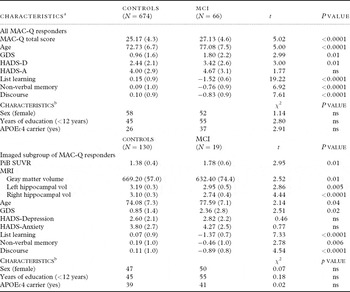
In HCs, there was no significant difference in mean age between those who did (M = 72.74 years, SD = 6.7, range = 33 years, N = 674) and did not (M = 72.74 years, SD = 8.8, N = 19) respond to the MAC-Q, t(689) = 3.63, p = ns (see Appendix B available as supplementary material). We found no significant age difference between the MCI participants who responded to the MAC-Q (M = 77.08 years, SD = 7.5, range = 33 years, N = 66) and those who did not (M = 80.38 years, SD = 7.5, N = 17). PiB imaged HCs had a lower proportion of females than the rest of the AIBL cohort, χ2(1, N = 817) = 6.51, p < 0.01, and had a higher proportion of APOEε4 positive participants, χ2(1, N = 817) = 9.57, p < 0.01 (see Appendix C available as supplementary material). The mean and standard deviations of each measure for the all MAC-Q responders and the subgroup of MAC-Q responders who were imaged are shown in Table 1. The MCI group had a higher complaint severity (M = 27.13, SD = 4.6) than HCs (M = 25.17, SD = 4.3), t(738) = 5.02, p < 0.0001, Cohen's d = 0.63. The MAC-Q had high internal consistency, Cronbach's α = 0.82.
Demographics, cognitive performance, affective score, and APOEɛ4 status for the AIBL participants who responded to the MAC-Q

aData reported as mean, SD; bdata reported as %.
MCI = Mild Cognitive Impairment; MAC-Q = Memory Assessment Clinics Self-Rating Questionnaire; GDS = Geriatric Depression Scale; HADS = Hospital Anxiety and Depression Scale; APOEɛ4 = apolipoprotein E ɛ4; SUVR = standard uptake value ratio; GM = Gray matter.
Factor analysis
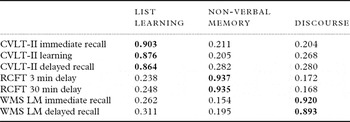
We performed data reduction on seven memory variables using factor analysis. We extracted three factors which accounted for 92.9% of the variance explained: they were labeled list learning, non-verbal memory, and discourse. The list learning memory structure involved the three CVLT-II variables, the non-verbal memory structure comprised the two RCFT variables, and the discourse structure incorporated the two WMS LM variables. The loadings of these variables onto each factor can be found in Table 2.
Memory structures extracted from exploratory factor analysis.

CVLT-II = California Verbal Learning Test-Second edition; RCFT = Rey Complex Figure Test; WMS LM = Wechsler Memory Scale Logical Memory.Numbers in bold refer to the variables that load highly (>0.8) on each factor.
Interactive effects of age and group membership on complaint severity
Using a one-way ANCOVA, we found a significant interaction between group membership (i.e. HC vs. MCI) and age (considered as a covariate) on complaint severity, F(1, 736) = 4.15, p = 0.04. Age was also considered to have a significant main effect on complaint severity, F(1, 736) = 12.12, p = 0.001, and therefore age and the interaction term were included in the linear model.
Memory and affective relationships with complaint severity
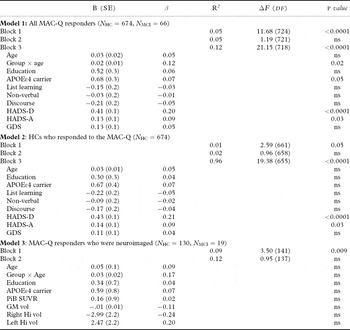
Initial analyses of the hierarchical multiple regression indicated no violation of normality, linearity, multicollinearity, or homoscedasticity. We entered covariates (age, the interaction between group membership and age, years of education, and APOEε4 carrier status) into the model first, which explained 4.9% of the variance in complaint severity. We did not include group membership as a main effect as it violated assumptions of multicollinearity. Cognitive factors entered the model next, but failed to make an additional contribution to the explained variance, [F change(3, 721) = 1.06, ns]. The last block involved the affective variables (GDS, HADS-D, and HADS-A). These explained a further 7.7% of the variance [F change(3, 718) = 21.15, p < 0.0001], effect size f 2 = 0.15. The total model accounted for 13% of the variance in complaint severity. In the final model, four measures contributed to complaint severity, the interaction variable, HADS-Depression, HADS-Anxiety, and APOEε4 carrier status (see Table 3, Model 1). The HADS-Depression score recorded the highest β value (β = 0.20, p < 0.0001) followed by the interaction variable (β = 0.12, p = 0.016), the HADS-Anxiety score (β = 0.09, p = 0.03), and APOEε4 carrier status (β = 0.07, p = 0.05).
The coefficients and model fit indices for all three hierarchical regression models with subjective memory complaint severity representing the outcome variable

APOEɛ4 = apolipoprotein E ɛ4; HADS = Hospital Anxiety and Depression Scale; GDS = Geriatric Depression Scale; SUVR = standard uptake value ratio, GM = Gray matter, Hi vol = Hippocampal volume.
Differential relationships with complaint severity in healthy controls and MCI participants
To examine the differential relationships with complaint severity between HC and MCI participants, we performed a hierarchical multiple regression analysis on the HC group. The model explained 9.6% of the overall variance in the total complaint severity score, effect size f 2 = 0.11. The addition of cognitive measures did not result in additional contribution to the model, (F(3, 658) = 0.96, ns), but the inclusion of affective variables accounted for an additional 9.3% of the variance in complaint severity (F(3, 655) = 19.38, p < 0.0001). Two measures contributed significantly to this model, HADS-Depression (β = 0.21, p < 0.0001) and HADS-Anxiety (β = 0.09, p = 0.027; see Table 3, Model 2).
A Pearson correlation revealed a significant correlation between total MAC-Q score and age in the MCI group, r(66) = 0.33, p = 0.006. There was also a borderline significant correlation between MAC-Q score and HADS-D score, r(66) = 0.25, p = 0.046. There were no other significant correlations between total MAC-Q score and other variables in the MCI group (see Appendix D available as supplementary material).
The effect of biomarkers on complaint severity in controls and MCI
We also used hierarchical multiple regression to assess how biomarkers (PiB SUVR, GM volume, right and left Hi volume, and APOEε4 status) related to total MAC-Q score in the imaged subgroup. Again, there was no violation of assumptions. The first block contained the covariates (age, the interaction between group membership and age, and years of education) which explained 8% of the variance in complaint severity. The addition of AD biomarker variables did not contribute significantly to the model, (F change (4, 142) = 1.121, ns), with the overall model explaining only 10.9% of variance in complaint severity (see Table 3, Model 3). Dichotomizing the sample into PiB positive (PiB SUVR ≥ 1.5) and negative (PiB SUVR < 1.5; Rowe et al., Reference Rowe2010) subgroups did not alter the overall contribution of PiB retention to complaint severity, with the model explaining only 11.2% of variance in complaint severity.
Discussion
This is the first study that examines the effects of AD biomarkers, memory, and affect on memory complaint severity treated as a continuous measure. As expected, MCI patients were more concerned about their memory than HCs, and this finding produced a moderate effect size. We argue that this stands as a validation of the MAC-Q measure because it mirrors the diagnostic criterion for MCI. It also supports similar findings in the literature (Reisberg and Gauthier, Reference Reisberg and Gauthier2008). Having a memory complaint does not preclude the possibility of being a healthy control and, as an informant's complaint can be substituted, is not a necessary criterion for a diagnosis of MCI. Gauthier and colleagues (Reference Gauthier2006) suggested that an SMC should not be necessary for a diagnosis of MCI because many individuals with MCI symptomatology can present without a complaint. Our finding suggests that although both groups have potential to be concerned about their memory, memory complaints become more severe when an individual is mildly cognitively impaired. Some researchers argue that the level of awareness of cognitive deficits is variable in MCI and may impair one's ability to appraise one's cognitive acuity accurately (Roberts et al., Reference Roberts, Clare and Woods2009). Our results present a counter-position and support findings of Greenop and colleagues (Reference Greenop2011) that showed individuals with cognitive impairment but no dementia (CIND) do exhibit an awareness of cognitive decline. This group differentiation, therefore, strengthens the argument that subjective memory complaints are emanating from an insidious onset of cognitive change that individuals are noticing.
This difference in complaint severity seems to be driven by different processes. The main contributors to SMC severity were depressive symptomatology and the interaction between classification (HC vs. MCI) and age. In MCI patients, the sole contributor to SMC severity was age, while in HCs the main contributors were anxiety and depression. Objective memory impairment was not associated with SMC severity, which aligns with previous literature.
Influence of biomarkers on subjective memory complaints
The influence of the interaction of age and diagnosis on SMC severity mirrors the same interaction effects on brain amyloid burden. First, age is consistently reported as a risk factor for both a diagnosis of DAT and the accumulation of AD neuropathology such as β-amyloid. Rowe and colleagues (Reference Rowe2010) found that the prevalence of amyloid plaques increases with age regardless of diagnosis. Other studies also show that “older-old” individuals with and without dementia (>85-years-old) often are neuropathologically indistinguishable at postmortem, in terms of both neuritic plaques and neurofibrillary tangles. Thus, as individuals increase in age, so does the risk of displaying neuropathological features such as neuritic plaques (or brain amyloid burden ante mortem). Second, β-amyloid deposition can also be differentiated according to whether an individual is healthy or has an MCI or AD diagnosis. Previous studies suggest that MCI patients have significantly higher neocortical PiB retention and decreased global gray matter volume than HCs (Chételat et al., Reference Chételat2010; Jack et al., Reference Jack2010). This disparity in PiB retention between HCs and MCI patients is also significant in the current study (see Table 3). Furthermore, research from our collaboration also shows that being a carrier of the APOEɛ4 allele produces a stronger correlation between age and PiB retention than non-carriers (Rowe et al., Reference Rowe2010), and is argued to induce an earlier initiation of the AD pathological cascade (Jack et al., Reference Jack2010). We were able to support this relationship. Together, these findings demonstrate that an interaction between age and classification influences the AD pathophysiological process. We therefore suggest that a similar pathological etiology for memory complaints cannot be discounted as we found a significant interactive effect of age and diagnosis on SMCs. One caveat is that no direct association between neuroimaging variables and SMCs was found.
Influence of mood on SMC severity
Mood and anxiety symptomatology as measured by the HADS was a highly significant contributor to complaint severity in healthy elderly controls. Mood often amplifies cognitive complaints in other clinical populations such as clinically depressed individuals (Plotkin et al., Reference Plotkin, Mintz and Jarvik1985). The group means for HADS-Depression and HADS-Anxiety fell below clinical levels suggesting that affective variations in our sample were subclinical. Reid and colleagues (Reference Reid2011) showed similar findings using the MAC-Q although their sample was considerably younger (66% between 35 and 49 years of age) and predominantly male (at least 97%). Other findings have shown that symptoms of depression and anxiety influence SMCs particularly in individuals below 75 years of age (Abdulrab and Heun, Reference Abdulrab and Heun2008; Elfgren et al., Reference Elfgren, Gustafson, Vestberg and Passant2010). Age is a strong risk factor for AD pathology. Jonker et al. (Reference Jonker, Geerlings and Schmand2000) therefore argued that a complaint in the “younger” elderly was unlikely to be driven by organic brain changes. They also suggested that a complaint from an “older than old” individual should be taken more seriously due to their increased risk of dementia. The healthy elderly controls in the current study were significantly younger than the MCI patients (and had a significantly lower mean PiB SUVR) and therefore align with the argument of Jonker and colleagues (Reference Jonker, Geerlings and Schmand2000).
Strengths and limitations
Most studies consider memory complaints as categorical, but important information can be lost when dichotomizing responses. A key strength of this study is to extend on previous literature by examining the relationship of the full spectrum of SMC severity rather than dichotomizing this complex phenomenon. This study also has the advantage of involving a large and well-characterized sample of participants who have undergone detailed assessments (Ellis et al., Reference Ellis2009). It is a convenience community-based sample which relied partly on volunteer recruitment and partly on medical referral. This sample, therefore, is not representative of the population. This may have produced bias results as Jonker et al. (Reference Jonker, Geerlings and Schmand2000) have argued that negative mood correlates with SMCs predominantly in these types of samples. Another caveat may be that by the 18-month follow-up, some participants may have adjusted their memory concerns according to their perceived performance at baseline. Simply participating in, and successfully completing, a neuropsychological assessment may have allayed fears and therefore reduced cognitive concerns.
Conclusion
Our study is the first to examine the continuum of SMC severity in relation to AD biomarkers, memory, and affect. We found that SMCs in the cognitively healthy elderly were related to mood and, in MCI patients, were correlated with age. There was no relationship between AD neuroimaging biomarkers and memory complaint severity, although the influence of the APOEɛ4 genotype and age provides support for a clinicopathological connection, as a similarity can be drawn with the contributors to brain amyloid burden. SMCs are inherently complex and involve a multi-faceted etiology, as evidenced by the continued debate about their antecedents, which depends primarily on both the age of the individual and their cognitive status.
Conflict of interest
None.
Description of authors' roles
Rachel Buckley carried out the statistical analysis and wrote the paper. Michael Saling oversaw the analysis. David Ames and Kathryn Ellis oversee and coordinate the AIBL study. David Ames also chairs the AIBL diagnostic panel, on which Nicola Lautenschlager, Greg Savage, Cassandra Szoeke, and Kathryn Ellis also serve. Nicola Lautenschlager and Greg Savage serve on the leadership group of the Clinical and Cognitive Stream of the AIBL study; Nicola Lautenschlager also assisted with the development of the research question. Lance Macauley and Tim O'Meara represented CSIRO on the management committee. Ralph Martins and Colin Masters oversee the AIBL study, sit on the management committee. Ralph Martins leads the Perth arm of the AIBL study. Chris Rowe leads the AIBL imaging arm, serves on the AIBL management committee. Victor Villemagne also oversaw the imaging component. Cassandra Szoeke represented CSIRO at management committee meetings from 2009–2011. All authors critically reviewed drafts of this paper.
Acknowledgments
CSIRO and the Science and Industry Endowment Fund supported this research. The AIBL study also received support from NHMRC and Pfizer. We thank all the participants who took part in the study and the clinicians who referred MCI participants to the study.
Supplementary material
The supplementary material that is mentioned in this paper can be found at http://www.journals.cambridge.org/ipg attached to the electronic version of this paper.