Introduction
Parents play a critical role in shaping the future of their children and parenting factors have been linked to a wide range of child outcomes. These include physical and mental health, cognitive development and educational attainment, substance misuse, unemployment and juvenile offending (Davidov & Grusec, Reference Davidov and Grusec2006; Davis-Kean, Reference Davis-Kean2005; Repetti, Taylor, & Seeman, Reference Repetti, Taylor and Seeman2002). For instance, the reciprocal nature of the parent–child relationship means that there is often a strong interactional effect between parents’ psychological and physical wellbeing and children's socio-emotional functioning. Parent psychological distress (e.g., depression) is associated with children's psychological distress and problematic behaviour (Field, Reference Field2010). Also, a number of studies have identified a link between a parent's sense of confidence or competence in parenting and children's wellbeing (Giallo, Cooklin, Wade, D'Esposito, & Nicholson, Reference Giallo, Cooklin, Wade, D'Esposito and Nicholson2014; Jones & Prinz, Reference Jones and Prinz2005). Given the strength of these associations between parent factors and child wellbeing, it is important to understand how today's parents are faring in terms of their mental and physical wellbeing, in order to have a clear picture of the extent of support needs in these domains.
Further, parenting plays an important role in determining how the broader social environment influences a child's healthy development (Armstrong, Birnie-Lefcovitch, & Ungar, Reference Armstrong, Birnie-Lefcovitch and Ungar2005). Research indicates that stressors, such as socio-economic disadvantage, may produce psychosocial effects in parents in terms of limited control, perceived inequality, increased stress and exclusion, which may reduce parents’ capacity to provide safe, stable and enriched environments for their children (Garbarino, Bradshaw, & Kostelny, Reference Garbarino, Bradshaw, Kostelny, Luster and Okagaki2005; Petrill, Pike, Price, & Plomin, Reference Petrill, Pike, Price and Plomin2004). Furthermore, good parenting can be a protective factor, shielding children from the negative effects of adversity. For instance, the quality of the home environment has been found to explain some of the variance in the effects of family income in early childhood on later behaviour problems (Votruba-Drzal, Reference Votruba-Drzal2006).
As a consequence of this increasing knowledge about how parents act as determinants of child functioning, supporting parents in their parenting role is being recognised as a powerful way of improving childhood wellbeing, health and educational outcomes, and ultimately reducing social disadvantage (Keating & Hertzman, Reference Keating and Hertzman1999; McCain & Mustard, Reference McCain and Mustard1999; Shonkoff & Meisels, Reference Shonkoff and Meisels2000). Indeed, the supports available to parents play a vital role in the link between parent functioning and child functioning. Within the empirical literature, accessibility to social support has been linked to positive parenting (e.g., higher rates of parenting warmth and lower rates of child maltreatment) and to parent wellbeing (Garbarino et al., Reference Garbarino, Bradshaw, Kostelny, Luster and Okagaki2005; McLoyd, Reference McLoyd1990). Less is known empirically about the psychology of parental help-seeking, that is, the reasons why services are used or not used, parents’ views about services in terms of their helpfulness, and parents’ feelings of being valued, judged or blamed by service providers.
In light of the gaps in our knowledge about parenting, and the desire to expand upon existing evidence about the influences on and effects of parenting, the Parenting Research Centre (PRC), with support from the Victorian Government Department of Education and Training (DET) conducted the Parenting Today in Victoria (PTIV) survey in 2015–2016. The survey was designed to explore the contemporary parenting experiences and service utilisation of a large and representative sample of parents. PTIV provides a unique opportunity to obtain accurate and current information about parents’ attitudes and behaviours, their concerns, and their patterns of help-seeking, collected in a rigorous way from a large proportion of the Victorian parenting population. Some Australian States have conducted small surveys of parents to capture information about the parenting experience, for example, the “Queensland Parenting Survey” (Sanders, Reference Sanders1999), and the “Western Australia Parenting Perceptions Report” (Anglicare Western Australia, 2013). A larger survey of Queensland families, published in 2014, included only parents of children 4–7 years of age (Morawska, Ramadewi, & Sanders, Reference Morawska, Ramadewi and Sanders2014). Prior to 2016, there have been no large-scale representative surveys focused primarily on measuring Victorian parents’ experiences. Furthermore, the majority of existing data sets available focus on assessing trends in child health and development, and collect little or no information about parenting; examples in this regard are the National Assessment Program – Literacy and Numeracy (Australian Curriculum Assessment and Reporting Authority, 2016) and the Australian Early Development Census (2014). Where parenting information has been collected, this has related to general demographic information and behaviours, for example, the Longitudinal Study of Australian Children (Australian Institute of Family Studies, 2014; Zubrick, Lucas, Westrupp, & Nicholson, Reference Zubrick, Lucas, Westrupp and Nicholson2014) and provided little insight into the relationship of parents’ attitudes and behaviours to help-seeking and concerns.
The aim of PTIV was to build understanding of parenting attitudes, behaviours and practices, concerns, and help-seeking, as well as develop a survey that could be repeated at intervals to measure and understand contemporary parenting experiences across Victoria over time. The project findings are intended to be used by decision-makers to inform policy and improve the service system in Victoria. This article outlines the development and conduct of the PTIV survey.
Method
Survey Administration
A range of survey delivery options were considered, including: mail out, face to face interview, Computer Assisted Telephone Interview (CATI), individual online, online panel and school panel formats. Survey delivery options were examined across the following four criteria: (1) representativeness of the data collected, (2) quality of the data collected, (3) timeliness of the data collected, and (4) cost of administration. The CATI method of survey administration was selected to enhance the representativeness of the study sample (through the use of a quota for parent gender and mid-way stratification), to minimise data entry errors and missing data, and ensure timely data collection.
Sample Design
The sampling frame adopted aimed to achieve a sample that represented Victorian parents of children aged from birth through 18 years, across both metropolitan and non-metropolitan areas. A single cohort cross-sectional sample design was deemed most appropriate to the aims of this study. The parent was the sampling unit of interest. A quota was applied to sample recruitment so that fathers constituted approximately 40% of respondents. As the survey was conducted in English only, the sample therefore excluded individuals who did not speak English fluently. Similarly, parents who did not have a landline or mobile phone number (potentially some homeless families, new migrants and refugees) could not be sampled. An appropriate sample size of 2600 participants was estimated, based on consideration of a range of research questions of interest and the need for sufficient sample size across sub-groups of interest (different age groupings and gender of children), and allowing for a margin of error of 10%, a 10% non-response rate, power at 80% and a 95% confidence interval.
The survey was initially conducted using a sample of randomly selected landline telephone numbers. The representativeness of the study sample was monitored (across regional areas and child age groups) and a mid-way sample stratification was applied to include a random sample of mobile telephone numbers. This successfully increased the representation of younger parents (and therefore also younger children) who are more likely to only have a mobile telephone.
Survey Development
Literature review
A systematic literature review informed the development of the PTIV survey. Examination of previous research identified gaps in the existing literature as well as parenting attributes found to be associated with child and parent outcomes and help seeking – to inform the prioritisation of survey items. A systematic search of 10 academic databases was conducted to identify systematic reviews and meta-analyses. Papers published in the year 2000 onwards that were written in English were included in the review. Content area experts were also asked to recommend key papers to be included in the review. Through this process, 195 systematic reviews were identified that met the inclusion criteria.
Domain identification
Five parenting domains were identified as priorities for inclusion in the survey, informed by the systematic review and consultation with project stakeholders including personnel from the government department that funded the survey, a Project Board and content area experts. These domains are as follows: parent engagement with children's learning, parent help-seeking, parent coping and support, the parent–child relationship, and parent monitoring and children's use of electronic devices. Information about family context and demographic characteristics were also included.
Principles for item selection
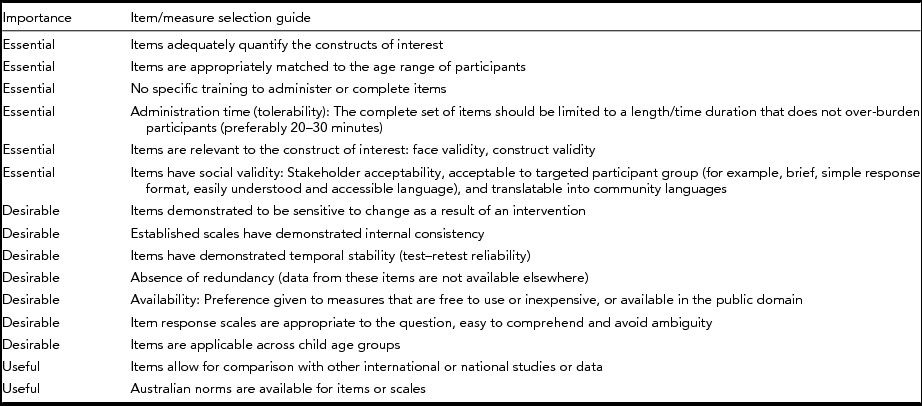
Potential survey items were selected in line with the recommendations of DeVellis (Reference DeVellis2012), and the survey design principles employed in the development of the Longitudinal Study of Australian Children (Zubrick et al., Reference Zubrick, Lucas, Westrupp and Nicholson2014). The principles presented in Table 1 were used as a hierarchical guide to survey item selection, with criteria graded by level of importance (essential, desirable and useful), acknowledging that it was not possible to identify items that met all of the criteria.
Item selection principles.

Item selection procedure
Items from previously validated surveys and scales were adopted where possible, as is considered good practice in survey development (Thayer-Hart, Dykema, Elver, Schaeffer, & Stevenson, Reference Thayer-Hart, Dykema, Elver, Schaeffer and Stevenson2010). The approach to item selection involved the following three steps: (1) examination of existing large-scale surveys of parents, (2) consideration of existing scales and measures of specific constructs of interest, and (3) creation of new items.
A total of 43 potentially relevant Australian and international surveys were located; surveys were excluded that were child-focused, but did not include information about parent attitudes or behaviours; that did not relate to children (for example, focused on couple's conflict); had a cost associated with their use; or where the items could not be located in the public domain. Items were retained from nine surveys (including Growing Up in Ireland (http://www.esri.ie/growing-up-in-ireland/questionnaires/) Growing Up in Scotland (https://growingupinscotland.org.uk/), Growing Up in Australia (http://www.growingupinaustralia.gov.au/), and the International Parenting Survey (https://pfsc.psychology.uq.edu.au/project/international-parenting-survey)) for inclusion in an online pilot of the survey. Survey items were adapted for the Australian context when necessary (for example, help-seeking options), or to ensure that their content was contemporary (for example, internet use options).
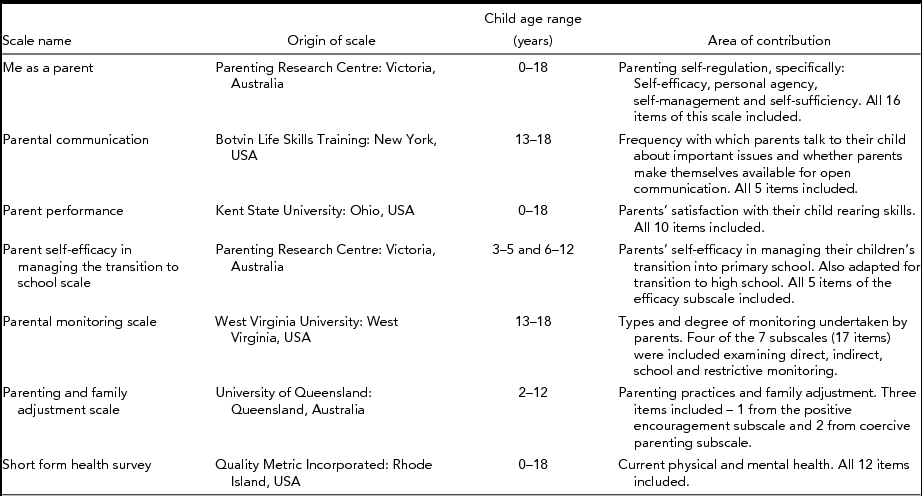
In addition, 31 parenting scales were located for potential inclusion. Scales that had no or poor reliability and validity, or that overlapped in content with another scale/survey which had better reliability/validity, were excluded. Seven scales or subscales were retained for inclusion in the pilot survey (see Table 2).
Scales or subscales contributing to the pilot survey.

Ethics
This study was approved by the PRC Human Research Ethics Committee (NHMRC EC00437).
Item Refinement
A multi-phase pilot and stakeholder consultation process was conducted to refine the survey items and interview procedure.
Stakeholder consultation
The items were pre-piloted with a small sample of eight participants who provided feedback on the content of the survey, including the acceptability and clarity of the individual survey items. This information was used to refine and reduce the total number of items for the pilot survey.
Online pilot
An online pilot of 130 items was then conducted. Participants were recruited online via advertisement on the Raising Children Network website (http://raisingchildren.net.au/) and the distribution of emails throughout the researchers’ professional networks. A total of 160 parents of children aged from birth to 18 years completed the online pilot survey. The average time taken to complete it ranged from 35 minutes (for parents of children aged 0–2 years) to 60 minutes (for parents of children aged 6–12 and 13–18 years), as the number of questions varied according to the age of the child.
Technical expert consultation
Content and technical experts in survey methods were consulted, and it was recommended that, in order to maximise participant response rates and engagement, the survey should take no longer than 30–40 minutes to complete. Further refinement of the survey items was therefore deemed necessary. There were three main criteria outlined for the removal of items: (1) when items on the same topic were highly related one of the items would be removed; (2) if item responses were highly skewed (everyone agreeing or everyone disagreeing with an item); and (3) if there was a large amount of missing data in response to a single item or a scale. Respondents also provided feedback regarding the length of the survey, the order of questions and the appropriateness of specific items and scales.
CATI pilot
The CATI provider, Ipsos, an independent market research company, provided feedback on the appropriateness of the final survey format for CATI delivery. In December 2015, the Ipsos CATI team piloted the survey with 100 parents to review the clarity and wording of the CATI script, items and response prompts, and question skip logic. Adjustments were made as necessary before conducting the survey.
The Parenting Today in Victoria Survey
Data for the PTIV survey were collected over a six-week period from 6 February 2016–21 March 2016.
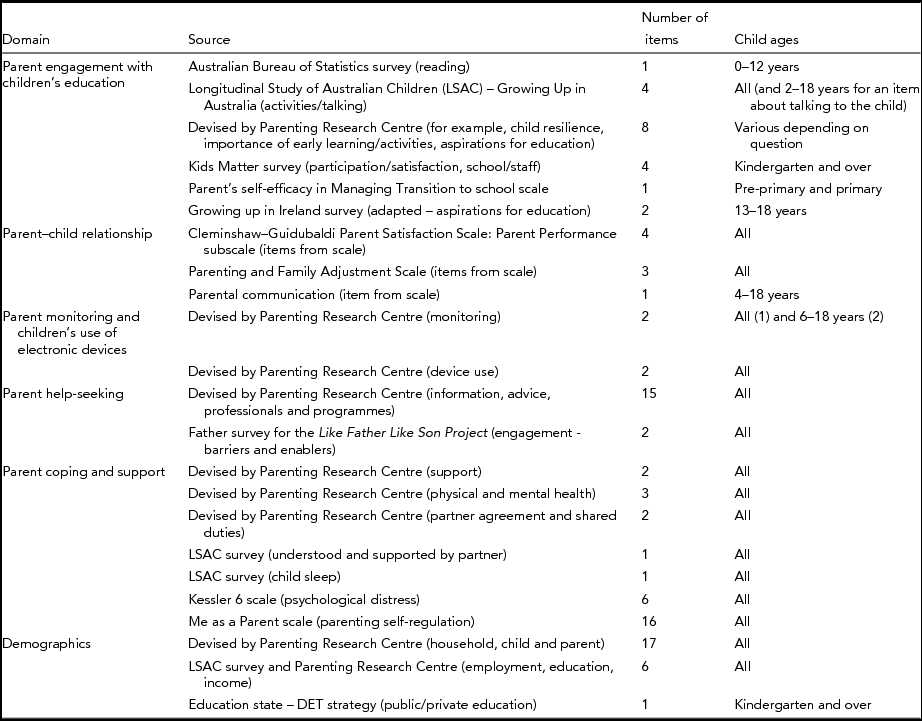
The final survey comprised 102 items across 6 domains as well as 7 introductory questions that established participant eligibility and quota inclusions. All participants were asked questions in every domain, although the total number of questions varied according to the age of the child. Table 3 shows the source of the final survey items and applicability across child age groups for each of the survey domains.
Source of final items included in the Parenting Today in Victoria survey.

Parent engagement with children's education
Items included in this domain addressed how parents engaged children with learning outside early childhood education and school (for example, ‘How often does someone in your family spend time reading to the child’), aspirations for their children's education (for example, ‘How important is it to you that your child continues on to further study after school?’), their feelings about their ability to manage school transitions (for example, ‘I feel confident that I can support my child well during their transition to Primary/High School.’), and parents’ concerns about absenteeism from school. This domain included single items adopted from existing surveys and scales, and new items devised by the PTIV team when existing measures did not capture an area of interest as intended by the research team.
Parenting confidence/skills and the parent–child relationship
Items in this domain measured parents’ confidence in their parenting skills (for example, ‘My parenting skills are effective’.) and their concerns (for example, ‘I wish I gave my child more individual attention’.), as well as parenting actions related to child discipline. This domain included single items from the Parent Performance subscale of the Parent Satisfaction Scale (Guidubaldi & Cleminshaw, Reference Guidubaldi and Cleminshaw1985), the Parenting and Family Adjustment Scale (Sanders, Morawska, Haslam, Filus, & Fletcher, Reference Sanders, Morawska, Haslam, Filus and Fletcher2013) and the Parental Communication scale (Botvin, 2007).
Parent monitoring and children's use of electronic devices
The items in the monitoring domain asked parents to reflect on whether they know where their children are when not at school, and if they had rules and set limits about where their children go in their free time. Items relating to internet use and use of electronic devices were about how much time children spend using electronic devices and the methods of restriction that parents used. The questions in this domain were new items, devised by the PTIV team.
Parent help-seeking
This domain included items about parents’ preferences for help seeking (for example, ‘How do you prefer to get information or advice about parenting?’), formal supports accessed, experiences of the help received, as well as reasons why parents had used (or not used) services. This domain included new items, devised by the PTIV team, as well as two items from a survey of fathers for the Like Father Like Son Project (https://www.likefatherlikeson.com.au) regarding barriers to service use.
Parent coping and support
Items relevant to parent social and emotional wellbeing, and informal supports received from family and friends (for example, ‘If I was having problems in my life, there is someone I could trust that I could turn to for advice’.) were included in this domain. This domain included the Kessler-6 scale (K6; Kessler et al., Reference Kessler, Andrews, Colpe, Hiripi, Mroczek, Normand and Zaslavsky2002) and the Me as a Parent scale (MaaPs; Hamilton, Matthews, & Crawford, Reference Hamilton, Matthews and Crawford2014), which both demonstrated good internal consistency in this sample (K6 total score, α = .80; MaaPs Total score, α = .87; MaaPs subscales, α = .68–.83). This domain also included single items adopted from the LSAC survey and new items developed by the PTIV team.
Demographic characteristics and context
Items in this section of the survey included demographic information about the age, gender, education, income and working arrangements of parents. It also asked parents about their own and their child's physical health. Parents were asked for details about their living arrangements (how many adults and children live in the family home), and parent access to the child. This domain included single items adopted from the LSAC survey (http://www.growingupinaustralia.gov.au/studyqns/index.html), new items developed by the PTIV team, and a single item proposed by the Victorian Government DET regarding child attendance at a Government or Non-Government school.
Interview Procedure
The CATI conducted by Ipsos, involved a trained interviewer administering the survey over the phone by reading out the items to each respondent. The interviewer followed a script that listed the items and the possible response options and allowed the interviewer to provide prompts when necessary. The CATI team made initial contact with potential respondents over the phone. If respondents requested an alternate time to complete the survey, the CATI team sent a text message reminder to mobile phone users before calling them again to complete the survey. Decisions about when phone calls were made, and the number of call attempts to establish contact were made by the CATI service, in line with their standard research protocols.
Informed consent
The CATI interviewers sought verbal informed consent from potential participants who indicated they were a parent or care giver with a child in the eligible age range. Participants were asked whether they would like to take part in this survey, if they understood who the survey was being conducted for and why, and if they understood that information collected from them would be anonymous.
Participant screening
Potential participants, who had given informed consent, were asked a series of seven screening questions to determine if they were eligible to participate in the study, in line with the sample selection criteria and quota inclusions. The screening questions included the following: parent gender, parent age above 16 years, postcode of residence, live with child full time, days spent with child, number of children and sex of child.
Interview duration
The time taken to complete the survey ranged from 14 to 56 minutes, with an average (median) duration of 24 minutes.
Response Rate
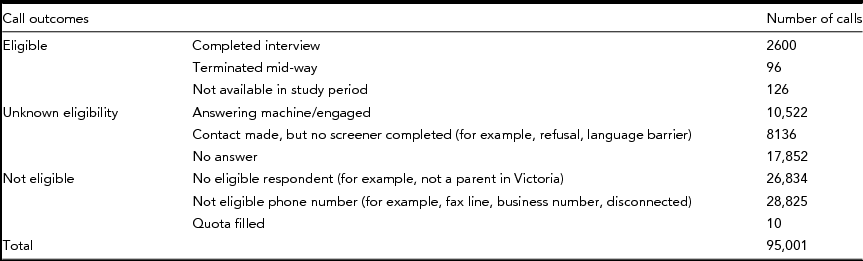
The response rate is the estimated proportion of all eligible people in the sample population who completed the survey, and is useful when considering how representative data is. The American Association for Public Opinion Research (AAPOR) Standard Definition guidelines (The American Association for Public Opinion Research, 2016) were used to inform the categorisation of calls (see Table 4) and calculation of response rate. Contact was made with 2822 individuals that were eligible to participate (parents living in Victoria who had a child aged 0–18 at the time of the survey), and 92% of these individuals completed the survey. Taking into account the number of cases of unknown eligibility, the resulting estimated response rate for this study was 57%. This figure compares well to other population-level surveys involving parent respondents. For example, the recent Australian Child and Adolescent Survey of Mental Health and Wellbeing reported a response rate of 55% (Lawrence et al., Reference Lawrence, Johnson, Hafekost, Boterhoven De Haan, Sawyer, Ainley and Zubrick2015).
Number and outcomes of calls made through the Parenting Today in Victoria project.

Sample Representativeness
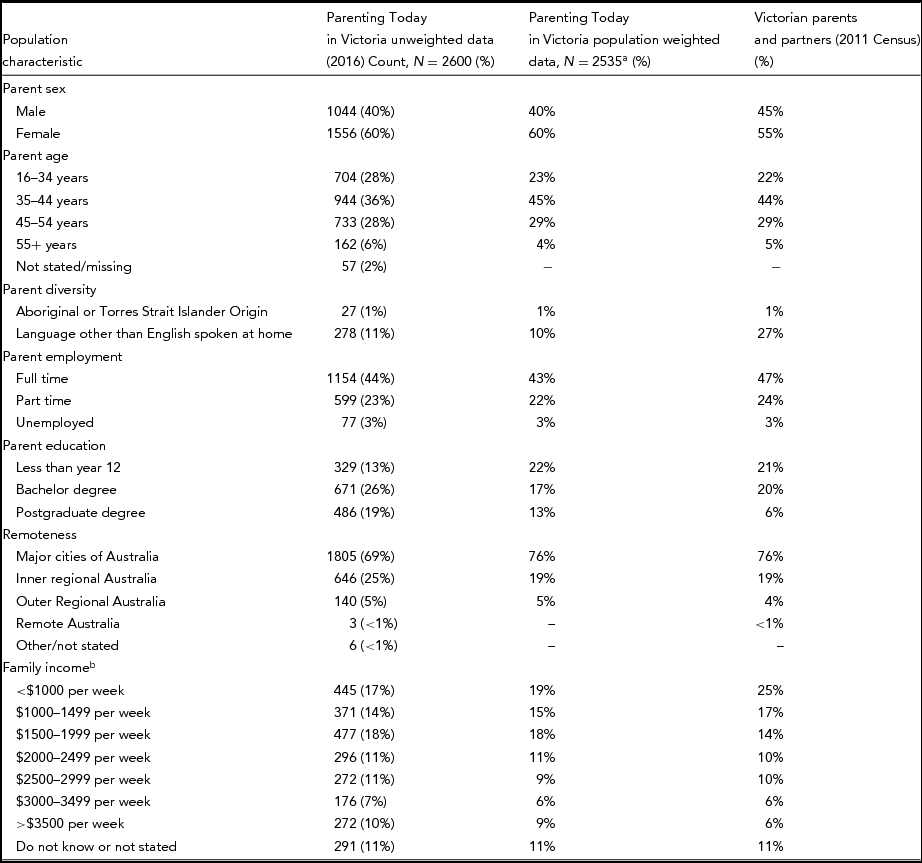
To examine to what extent the parents who completed the PTIV survey are representative of the broader population, key demographic characteristics from this sample are presented in Table 5, relative to Australian Bureau of Statistics (ABS) (2011) Census figures for parents (and their partners) of children aged 0–18 years in the state of Victoria.
Demographic characteristics of the Parenting Today in Victoria sample compared to the 2011 census.

Notes. Wording of some ABS and PTIV response items varied.
a Weighting the data resulted in 2535 usable cases (where there was no missing data for weighting variables).
b Weekly income expressed in Australian dollars. Family income is presented by family composition in the 2011 census, this population figure includes families with children (age not specified), one parent families and ‘other families’. Families without children were excluded from this calculation.
While the distribution of key demographic characteristics of the PTIV sample closely matched the distribution of parents in the 2011 census for the majority of characteristics examined, variables with a discrepancy of 5% or more were considered for weighting, with consideration of appropriateness of each relevant variable for weighting also influencing the final calculation of weights (for example, while the proportion of parents who speak a language other than English at home is underrepresented in the current sample, this is related to sampling methodology as survey participation required individuals to complete the interview in English; therefore, it is not appropriate to apply a weight to enhance the representation of this sub-group of parents). Consequently, data were weighted on respondents’ age group, educational level and type of residential location – metropolitan or regional, with associated percentage values for this weighted data also included in Table 5. The applied weightings changed the remoteness, parent education and parent age proportions, with all other changes due to weighting being minimal (two percentage points or less).
Discussion
The PTIV survey makes available rigorously collected, accurate and up-to-date information from a large representative sample of Victorian parents. This was the first parenting survey of its kind for Victoria and provides vital new insights to inform policy decision making, service planning and future research that is aimed at understanding parents’ attitudes and behaviours, their concerns and their patterns of help-seeking. As such, these data will deliver vital information for government to ensure that parenting supports and policies are evidence-informed and appropriately directed.
Findings from the survey will be shared publicly though peer-reviewed publications, policy briefs and other fora in the coming months. It is anticipated that these findings will be a valuable contribution to existing evidence about how contemporary parents are faring in relation to their own mental and physical health, their support needs and preferences and their interactions with their children and with parenting support providers. Up to date information about the extent, influences and impact of parent wellbeing and support needs is important, given evidence of associations between parent wellbeing, parenting confidence, parenting behaviour and child functioning (e.g., Armstrong et al., Reference Armstrong, Birnie-Lefcovitch and Ungar2005; Field, Reference Field2010; Giallo et al., Reference Giallo, Cooklin, Wade, D'Esposito and Nicholson2014).
In particular, it is anticipated that the survey results will provide novel information about a comparatively understudied aspect of parent support – help-seeking behaviour. Greater knowledge about how parents think about help-seeking when they have concerns about their children will provide vital information to service providers and service planners, and will add significantly to the evidence base. Psychological aspects of help-seeking decision making were explored in depth in the PTIV survey, with items addressing the extent parents felt valued, judged or blamed by service providers.
Notwithstanding the strengths of the survey, including the randomised approach to sample recruitment and a high response rate, there is one limitation worth noting: the sampling method adopted meant that some groups of parents may not be well represented. Specifically, parents who understand or speak limited English may not have been recruited at representative levels, and parents who did not have a landline or mobile number (e.g., potentially some homeless families, new migrants and refugees) were not sampled. Future iterations of this survey will seek to eliminate these sampling issues.
Implications for Practice, Application and Policy
The PTIV survey will establish a baseline measure of the experiences of Victorian parents. Repeated delivery of this survey will allow ongoing understanding of contemporary parenting experiences, as well as the opportunity to monitor trends in parenting strengths and needs over time. It will provide a useful benchmark for better understanding the population of parents who are seeking and using state-funded parenting support services as well as the outcomes that are being achieved with those families.
Acknowledgements
Special thanks to the parents who participated in Parenting Today in Victoria. The invaluable support of project team members (Hau Nguyen, Faye Forbes, Gina Sartore and Michelle Macvean) and members of the Project Board is acknowledged. Thanks also to David Bennett, John Toumbourou, David de Vaus and Christine Millward for their technical advice. The authors also acknowledge the Victorian Government Department of Education and Training for funding the survey development and administration, and the team at Ipsos who conducted the parent interviews.