Introduction
Delirium is an acute neuropsychiatric disorder characterized by fluctuating inattention, other cognitive deficits, altered arousal, and psychosis. It affects more than one in five hospital inpatients (Bellelli et al., Reference Bellelli2016). When delirium occurs in someone with dementia, it is referred to as delirium superimposed on dementia (DSD). Dementia is a major risk factor for delirium, and thus many patients with delirium also have comorbid dementia, with figures ranging from 22% to 89% depending on the setting and population (Fick et al., Reference Fick, Agostini and Inouye2002).
When compared to delirium alone, DSD is associated with worse outcomes including increased walking dependence, institutionalization and mortality (Morandi et al., Reference Morandi2014) along with worsening of existing cognitive decline (Gross et al., Reference Gross2012; Davis et al., Reference Davis2017). Delirium may be the first or only sign that someone with dementia is unwell. Therefore, the timely investigation and management of the serious underlying causes of the delirium relies upon the rapid recognition and documentation of DSD. Assuming that the impairment is due to pre-existing dementia may result in diagnoses of potentially reversible conditions being missed. There is considerable uncertainty regarding the assessment of DSD (Richardson et al., Reference Richardson2016) and, partly as a consequence of this, it is often not recognized, particularly in acute medical admissions (Collins et al., Reference Collins, Blanchard, Tookman and Sampson2010; Jackson et al., Reference Jackson2017). In the absence of specific tools (Morandi et al., Reference Morandi2012), DSD is currently evaluated with instruments used for diagnosing delirium alone. This is problematic given that many of these tools rely on cognitive tests, which may be abnormal in both dementia and delirium (Meagher et al., Reference Meagher, Leonard, Donnelly, Conroy, Saunders and Trzepacz2010; Tieges et al., Reference Tieges, Brown and MacLullich2014).
Abnormal level of arousal and a patient's inability to focus, sustain and shift attention toward environmental stimuli are relatively specific to delirium (Brown et al., Reference Brown2011b; Chester et al., Reference Chester, Beth Harrington and Rudolph2012; Tieges et al., Reference Tieges, McGrath, Hall and Maclullich2013). Importantly, in patients with abnormal arousal (above the level of coma), the inability to engage in cognitive testing or interview is considered severe inattention for the purposes of delirium diagnosis (European Delirium Association and American Delirium Society, 2014). Thus, arousal and attention are effectively part of the same spectrum, and both need to be assessed as part of delirium assessment (American Psychiatric Association, 2013). However, there is a lack of research on how best to combine arousal and attention tests in delirium assessment, particularly in DSD, as highlighted in a recent review (Morandi et al., Reference Morandi2016).
Arousal is not usually impaired in dementia, even in the advanced stages (Brown et al., Reference Brown, Fordyce, Zaghdani, Starr and MacLullich2011a). The Observational Scale of Level of Arousal (OSLA) has been shown to specifically identify delirium (Tieges et al., Reference Tieges, McGrath, Hall and Maclullich2013), but has not previously been evaluated in the context of DSD. This measure is appealing as it is brief, observational, and does not require formal testing of cognition.
Multiple tests of attention have been studied in the context of delirium diagnosis (Meagher et al., Reference Meagher, Leonard, Donnelly, Conroy, Saunders and Trzepacz2010; Brown et al., Reference Brown, Fordyce, Zaghdani, Starr and MacLullich2011a; Tieges et al., Reference Tieges, Brown and MacLullich2014; Tieges et al., Reference Tieges2015). However, there is a relative lack of research specifically addressing the role of attentional tests in recognizing delirium in patients with dementia. This is an important issue as attentional deficits may already be present in dementia, particularly when it is severe, and also because many of the tools test multiple cognitive domains affected in dementia alongside attention (Tieges et al., Reference Tieges, Brown and MacLullich2014). This suggests the need for a test of vigilant attention that could identify delirium, yet be simple enough to remain possible for those with dementia (Leonard et al., Reference Leonard2016).
This study aimed to evaluate existing tools to detect inattention (a vigilance task) and altered arousal (OSLA) in patients with DSD by comparing their individual and combined performances in four groups of older inpatients: no delirium, no dementia; delirium, no dementia; no delirium, dementia; delirium and dementia. We hypothesized that a combined arousal and attention testing procedure would more accurately detect DSD than the arousal or attention tests alone.
Methods
Subjects and design
A convenient sample of patients over the age of 70 years admitted to five acute or rehabilitation hospitals in Italy, Ireland, Portugal, and Switzerland were invited to take part in the study. The study protocol was approved by the ethics committee of each clinical center. The following exclusion criteria were applied: presence of aphasia; history of major stroke; coma at the time of admission as defined by a Richmond Agitation and Sedation Scale ≤−4; poor vision or hearing. Informed consent was obtained from all participants, or their next of kin when the participants were not capable of giving informed consent because of delirium or other cognitive impairment.
Dementia and delirium diagnosis
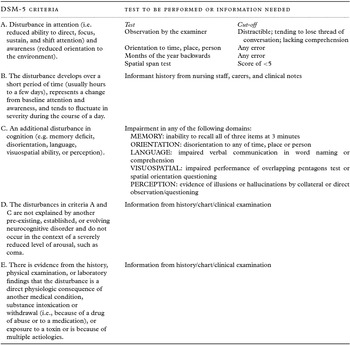
Demographic data were collected and participants were then assessed for delirium and dementia by experienced delirium clinician–researchers (A Morandi, DM, WH, JC, GB). The diagnosis of delirium was made according to DSM-5 criteria by using a standardized procedure (Table 1) combining specific tests, information from nurses, carers and next of kin, and review of the medical records. This information was supplemented by the assessor's judgment regarding subjective features and a final diagnosis made.
Operationalization of the DSM-5 criteria for delirium

The diagnosis of delirium was made according to DSM-5 criteria by using the standardized procedure described in the table. The final diagnosis of delirium was made based upon the information obtained from the specific tests, from nurses, carers, and next of kin, review of the medical records, and the assessor's judgment regarding subjective features.
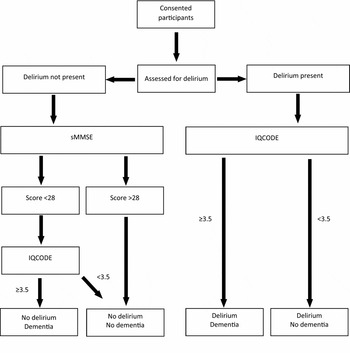
In non-delirious patients, a standardized MMSE (sMMSE) (Molloy and Standish, Reference Molloy and Standish1997) was completed in the local language. If the sMMSE score was <28, or if the participant had delirium, pre-existing dementia diagnosis was ascertained using the Informant Questionnaire on Cognitive Decline in the Elderly (IQCODE) in the local language with a cut-off of ≥3.5 used to indicate likely dementia (Jorm et al., Reference Jorm, Scott, Cullen and MacKinnon1991). Following these assessments, participants were divided into the following four groups: no delirium, no dementia (control group); delirium, no dementia; no delirium, dementia; delirium, dementia (Figure 1).
Flowchart demonstrating methods used to categorize participants. Participants were divided into four groups based on whether delirium was present or not according to DSM-5 criteria and then whether cognitive impairment was present or not, based upon the standardized Mini-Mental State Examination (s-MMSE) (Molloy and Standish, 1997) or the Informant Questionnaire on Cognitive Decline in the Elderly (IQCODE) (Jorm et al., 1991).

Attention test
Attention was measured using a vigilance task, with participants signaling each time an “A” was heard when the sequence of ten consecutive letters “S-A-V-E-A-H-A-A-R-T” was read out, each letter 3 seconds apart. As per previous studies using this test, errors were counted when a patient failed to signal on the letter “A” or when a patient signaled on any letter other than “A” (Ely et al., Reference Ely2001). There was no published cut-point for the attention test, so the best-performing cut-point was used.
Level of arousal
Arousal was measured using the OSLA (Tieges et al., Reference Tieges, McGrath, Hall and Maclullich2013). The OSLA provides a total score ranging from 0 (awake and normal response) to 19 (unresponsive) composed of five items: eye opening, eye contact, posture, movement, and communication (Figure 2). Previously derived OSLA cut-point of 3/4 was used (Tieges et al., Reference Tieges, McGrath, Hall and Maclullich2013).
Observational scale of level of arousal. The OSLA (Tieges et al., 2013) was used to measure level of arousal. It provides a total score ranging from 0 (awake and normal response) to 19 (unresponsive) composed of five items: eye opening, eye contact, posture, movement, and communication.

Statistical analysis
Differences in characteristics of people with delirium, dementia, neither, or both were assessed using χ 2 tests for proportions and non-parametric equality-of-medians tests for skewed continuous variables. Attention and level arousal scores were summed to derive a total score of 29 (S-A-V-E-A-H-A-A-R-T out of 10, OSLA out of 19), with cut-points for the combined scores derived from the point at which the highest proportion of participants were correctly classified. Diagnostic test accuracy was assessed using receiver operating characteristic (ROC) curves to yield sensitivity, specificity, positive, and negative likelihood ratios and area under the ROC curve (AUROC), along with 95% confidence intervals. All statistical procedures were carried out in Stata 13.1 (StataCorp, Texas).
Results
Patient characteristics
The sample included 114 people (Basel n = 15; Coimbra n = 26; Cremona n = 21, Limerick n = 28, Monza n = 24); six patients were excluded for refusal of informed consent. Table 2 describes the characteristics of these participants. Mean age was 82 years (SD 7) and 54% (n = 62) were female. Dementia alone was present in 25% (n = 28), delirium alone in 18% (n = 21), DSD in 27% (n = 31), neither in 30% (n = 34). 53% (31 of 59) of those with dementia had delirium on admission.
Patient characteristics

Abbreviations used in Table 2: CCI: Charlson co-morbidity index (Charlson et al., Reference Charlson, Pompei, Ales and MacKenzie1987).
DSD: Delirium Superimposed on Dementia.
IQR: interquartile range.
SD: standard deviation.
s-MMSE: Standardized Mini-Mental State Examination (Molloy and Standish, Reference Molloy and Standish1997).
IQCODE: Informant Questionnaire on Cognitive Decline in the Elderly (Jorm et al., Reference Jorm, Scott, Cullen and MacKinnon1991).
Arousal–attention were assessed in n = 109 (96%). OSLA was scored in 114 participants (100%) and the vigilance task in 109 (96%). Of the five participants without scores for the vigilance task, three did not consent to testing and two were missing; these two had OSLA scores = 0.
Level of arousal
The OSLA scores ranged from 0 to 14/19 (median = 2, interquartile range 0, 6). Using OSLA with the previously derived cut-off of 3/4 (Tieges et al., Reference Tieges, McGrath, Hall and Maclullich2013), 83% of participants with delirium were correctly identified (sensitivity 85%, specificity 82%, AUROC 0.92). Of those with dementia, delirium was correctly identified in 85% (sensitivity 74%, specificity 96%, AUROC 0.93).
Attention test
Errors ranged from 0 to 8/10 (median = 5, interquartile range 1, 7). With a cut-off 3/4, the attention task correctly classified 76% (sensitivity 90%, specificity 64%, AUROC 0.80) of participants with delirium. Of those with dementia, delirium was correctly identified in 79% (sensitivity 84%, specificity 73%, AUROC 0.79) at a cut-off of 6/7.
Combined test
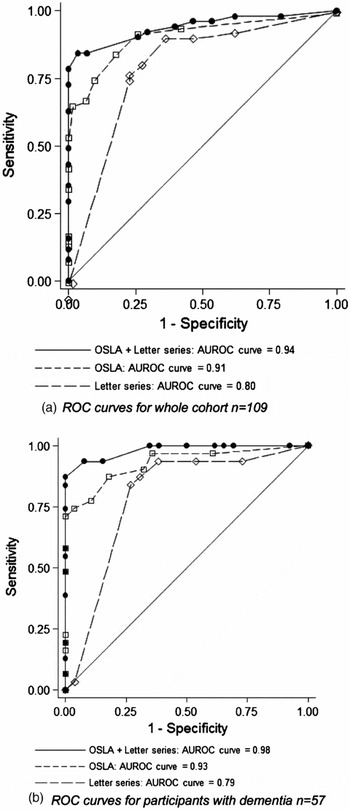
Combining scores (cut-off 9/10) correctly classified 91% (sensitivity 84%, specificity 97%, AUROC 0.94) (Figure 3(a)). Even in those with underlying dementia (n = 59), the diagnostic accuracy for combining OSLA and attention tasks was very high, with 93% correctly classified (sensitivity 94%, specificity 92%, AUROC 0.98) (Figure 3(b)).
(a) ROC curves for whole cohort, n = 109. (b) ROC curves for participants with dementia, n = 57. The combined attention–arousal testing procedure performed better than either tool individually when used to detect delirium. This was true in all participants studied (Figure 3(a)) and continued to perform well when examining just those participants with dementia (Figure 3(b)). (OSLA: Observational Scale of Level of Arousal (Tieges et al., 2013)).

Discussion
The main finding in this study is that combining simple bedside assessments of arousal and attention sensitively and specifically identified delirium in patients with and without dementia. Moreover, a single score representing the sum of the two tests performed better than the two tests individually.
Despite previous studies exploring methods of measuring level of arousal (Chester et al., Reference Chester, Beth Harrington and Rudolph2012; Tieges et al., Reference Tieges, McGrath, Hall and Maclullich2013; Han et al., Reference Han2015), there was little consensus among delirium experts in a recent survey focusing on current clinical and research practice in DSD (Richardson et al., Reference Richardson2016). Our study provides further validation of the OSLA, a tool specifically designed for use in delirium (Tieges et al., Reference Tieges, McGrath, Hall and Maclullich2013), and supports the view that measuring level of arousal using the OSLA has good specificity and sensitivity for delirium when used on admission to hospital, even in those with dementia.
Our findings support previous work which showed that vigilance, measured using a similar letter recognition test used in this study, distinguished patients with delirium from those with dementia alone, though there was some overlap in the scores (Leonard et al., Reference Leonard2016). A limitation of measuring attention using any tool is that it is not possible to assess all participants as a minimum level of arousal is required in order to complete the task. In this study, delirium experts were able to complete an assessment of vigilant attention in 96% of participants. An assessment of level of arousal using the OSLA is by its observational nature always possible in all participants; the function of the OSLA here is to provide additional gradation of arousal beyond simply stating that the patient was “untestable.” We highlight the utility of combining the two tests in order to include a purely observational measure which supports previous work by Voyer et al. concluding that “one size does not fit all” and the use of a single cognitive test is not the best option in people with cognitive impairment (Voyer et al., Reference Voyer2016).
Other studies have examined alternative measures of vigilance and sustained attention and have reported comparable results (Brown et al., Reference Brown, Fordyce, Zaghdani, Starr and MacLullich2011a; Chester et al., Reference Chester, Beth Harrington and Rudolph2012; Han et al., Reference Han2015; Tieges et al., Reference Tieges2015). Our work extends previous work by examining consecutive patients on acute admission to hospitals across four European countries demonstrating the reproducibility of the tools and their generalizability. Delirium assessments were performed by experts in the field according to the DSM-5 criteria using a standardized procedure. We did not exclude patients unable to communicate because of reduced arousal. Study limitations include the cross-sectional nature of assessment on admission, and so only prevalent delirium was examined. Although there was very little missing data, the sample size as a whole was relatively small, despite being larger than previous studies. This is particularly true when considering each site in turn. Incorporation bias is also difficult to avoid where there is a single assessor. This study did not evaluate the performance of this combined arousal–attention assessment in the context of different dementia severities and subtypes. Eliciting the best methods to measure both arousal and attention in these contexts should provide the focus of future work. The feasibility of such tools in untrained assessors requires evaluation along with validating its use in other settings, e.g. intensive care or care homes. Inter-rater reliability was not tested as the multicenter design of the study made this logistically challenging. However, the vast experience of those collecting the data along with the standardized approach for data collection ensured that the data were collected consistently between centers.
Our findings have direct clinical applicability. Currently, DSD is usually diagnosed through obtaining a collateral history, but often there is a lack of informant who can report an acute change from baseline. This may delay diagnosis or result in delirium being missed, resulting in worse outcomes (Kakuma et al., Reference Kakuma2003). Therefore, combining simple and brief assessments of attention and arousal in order to sensitively and specifically identify DSD is appealing in this setting where time is limited and an informant is not always immediately available. Further work may explore other non-cognitive assessments of delirium including those that assess simple motor tasks. A recent study (Bellelli et al., Reference Bellelli, Speciale, Morghen, Torpilliesi, Turco and Trabucchi2011) has proposed a non-cognitive measure such as the assessment of motor fluctuations as a possible tool to distinguish DSD from advanced dementia. Individuals with DSD may have greater perturbation in motor agitation and retardation than those with dementia alone but better descriptions of motor disturbance are required.
This combined arousal–attention assessment to detect DSD was brief yet demonstrated high diagnostic accuracy even in dementia. Such an approach could have major clinical utility for diagnosing DSD.
Conflict of interest
None.
Description of authors’ roles
Study conception and design was done by all the authors except S. Richardson, who joined the team after this stage. Acquisition of data was done by G. Bellelli, D. Meagher, A. Morandi, W Hasemann, and J. Cerejeira. Data analysis was done by A. Morandi, D. Davis, and S. Richardson. Interpretation of results was done by all the authors. Manuscript was drafted by S. Richardson. Critical revision and final approval of the manuscript was done by all the authors.
Acknowledgments
David Meagher is supported by a research project grant from the Health Research Board in Ireland (HRA 2011/48). Sarah Richardson is funded by the Alzheimer's Society as a Clinical Training Fellow (239 (AS-CTF-14-001)). Daniel Davis is funded by the Wellcome Trust as an Intermediate Clinical Fellow (WT107467).