Kawasaki disease is an acute self-limited vasculitis characterised by auto-inflammation, which stresses the robust nature of the innate immune response that causes both systemic inflammation and damage to the coronary arterial wall. The overlap between the clinical presentation of Kawasaki disease and the prominent features of the periodic fever syndromes (characterised by episodic fever, cutaneous rashes, lymphadenopathy, mucosal ulcerations, ocular findings, abdominal complaints, serositis, and musculoskeletal involvement) reveals that Kawasaki disease has an auto-inflammatory origin.Reference Marrani, Burns and Cimaz1 Also, in case of Kawasaki disease recurrence, the disease presents a high probability of coronary artery involvement which is the most significant indicator of systemic vasculitis. These features indicate that Kawasaki disease has common components with rheumatologic and immunologic diseases. This association can be attributed to shared genetic linkages influenced by environmental factors. Therefore, periodic fever syndromes are worth considering the differential diagnosis of patients with a history of recurrent Kawasaki disease.
Coronary artery involvement is not confined to Kawasaki disease and is known to occur in other vasculitides. Also, clinical features of primary rheumatologic diseases associated with vasculitis closely resemble Kawasaki disease particularly in the initial stages. Due to similarities in these clinical presentations, diagnosis may be delayed. Therefore, multiple courses of intravenous gamma-globulin, which are given in case of Kawasaki disease recurrence, would be potentially delaying therapy in this subset of patients who need to be treated more aggressively. Thus, it is essential to differentiate patients with vasculitis associated with rheumatic diseases from patients with Kawasaki disease in the earlier stages to apply an appropriate therapy.
Patient presentation
A 4-year-old boy, who previously had a healthy development, had presented to the emergency department with complaints of high-grade fever and rash for 7 days. Because of oropharyngeal hyperaemia, diffuse maculopapular rash in the body, bilateral non-purulent conjunctivitis, leucocytosis with neutrophil, moderate anaemia, hypoalbuminemia, sterile pyuria, and elevated acute phase reactants, incomplete Kawasaki disease was diagnosed, and coronary involvement was not seen in echocardiography. According to international guidelines, intravenous gamma-globulin (2 g/kg/day infused over 12 hours) was administered and aspirin with anti-aggregant dose (5 mg/kg/day) was started. His fever and rash subsided on the same day, and acute phase reactants decreased after 3 or 4 days. As there was no cardiac involvement, he was discharged to use aspirin for 6 weeks. After two weeks, echocardiography was normal, and he had no complaints.
A year after the diagnosis of incomplete Kawasaki disease, he presented to the emergency with erythematous, urticarial rashes all over the body and fever of 39.6 °C which lasted for 4 days. Clarithromycin was started with the presumed diagnosis of scarlet fever, and ceftriaxone was given on the following day when the rash was getting severe, and his fever persisted. The patient was admitted to our emergency department with a progressive rash and a 6-day history of high-grade fever.
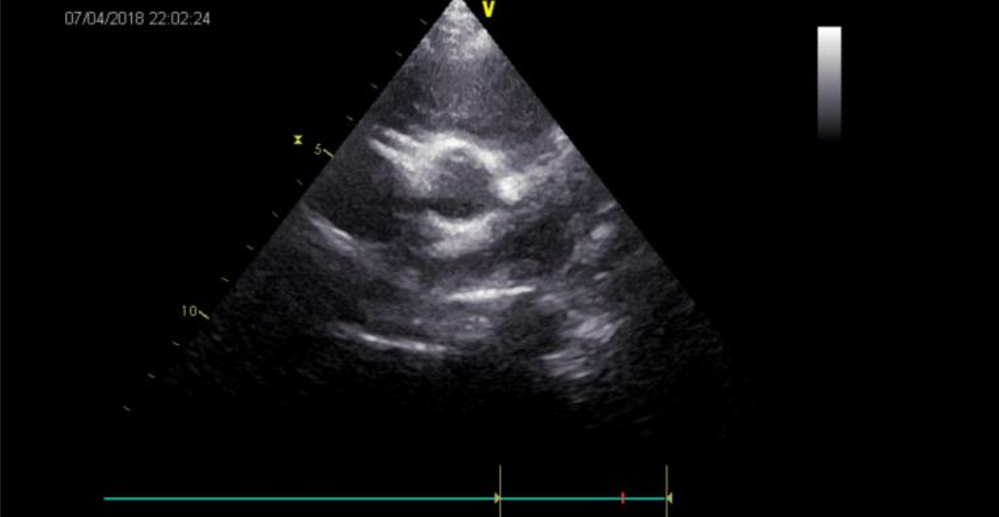
His physical examination revealed bilateral non-purulent conjunctivitis, bilateral anterior cervical lymph node 1 cm × 1.5 cm, and sparse macular polymorphic rashes on the proximal of the right leg. Laboratory findings indicated leucocytosis, moderate anaemia, hypoalbuminemia, thrombocytosis, moderate elevation in liver function tests, and elevation in acute phase reactants. Culture and serology results in blood and urine samples revealed no viral or bacterial agent detected. N-terminal brain natriuretic peptide was 983 pg/mL (10–51 pg/mL). Echocardiography revealed right coronary artery ectasia and perivascular echogenicity (see Fig 1). The diameter of the right coronary artery was 3.2 mm (Z score, 3.11), and the diameter of the left anterior descending artery was 2.5 mm (Z score, 1.43). Considering these results, Kawasaki disease with coronary involvement was diagnosed, and he was hospitalised for treatment. Intravenous gamma-globulin (2 g/kg/day infused over 12 hours) was administered for 2 days, and aspirin 100 mg/kg/day as an anti-inflammatory dose was started. In the follow-up, fever, rash, and conjunctivitis disappeared. After a week, in the control echocardiography, the right coronary artery size was normal, and echogenicity was increased. He was discharged to use aspirin for 6 months. Due to the investigation of the underlying rheumatological diseases, auto-inflammatory panel analysis was performed in the genetic laboratory. p.ser52Asn (c.155 G > A) homozygous mutation in the mevalonate kinase gene and p.arg202Gln (c.605 G > A) homozygous mutation in Mediterranean fever gene were reported. Thus, colchicine therapy was started.
The increased diameter of the right coronary artery (Z score, 3.11) and perivascular echogenicity.

Discussion
Kawasaki disease is an acute self-limited vasculitis which is a leading cause of acquired heart disease in children. In case of recurrence, the disease presents a high probability of coronary artery involvement. It is shown that almost half of the cases with cardiac sequelae at the initial episode of Kawasaki disease also exist sequelae after the second episode of the disease.Reference Nakamura, Oki, Tanihara, Ojima and Yanagawa2 In addition to that, coronary artery aneurysms or ectasia can develop in 15–25% of untreated children which may lead to myocardial infarction, ischaemic heart disease or sudden death.Reference Kato, Sugimura, Akagi, Sato, Hashino, Maeno, Kazue, Eto and Yamakawa3 Therefore, an initial echocardiogram should be performed as soon as the diagnosis is suspected. Since treatment with intravenous gamma-globulin in the acute phase of the disease reduces the risk of coronary involvement to 5%,Reference Galeotti, Bayry, Kone-Paut and Kaveri4 initialisation of treatment should not be delayed by the timing of the study. In our case, because of the early administration of intravenous gamma-globulin, right coronary artery diameter returned to normal in a week.
Clinical features of auto-inflammatory diseases, characterised by episodic fever, cutaneous rashes, lymphadenopathy, mucosal ulcerations, ocular findings, abdominal complaints, serositis, and musculoskeletal involvement closely resemble Kawasaki disease, particularly in the early stages. Also, coronary artery involvement has been reported in other vasculitides (microscopic polyangiitis or polyarteritis nodosa),Reference Mavrogeni, Manoussakis and Karagiorga5 systemic-onset juvenile arthritis,Reference Kumar, Vaidyanathan, Gayathri and Rajam6 and periodic fever syndromes.Reference Broderick, Tremoulet, Burns, Bastian and Hoffman7 Because of the overlap between the prominent features of primary rheumatologic diseases associated with vasculitis and the clinical presentation of Kawasaki disease, clinicians may have difficulty in diagnosing. Before investigating the underlying causes in patients with symptoms supporting Kawasaki disease, immunoglobulin therapy should not be delayed because of cardiac manifestations. On the other hand, in case fever and the other symptoms recur, after the diagnosis and treatment of Kawasaki disease, vasculitis or other auto-inflammatory syndromes should be considered to prevent delay in the treatment of underlying causes and avoid inappropriate interventions. Broderick et al. reported that four patients, who presented with classical symptoms of Kawasaki disease, were successfully treated with intravenous immunoglobulin, and later experienced a re-appearance of inflammatory symptoms in a pattern consistent with a periodic fever syndrome.Reference Broderick, Tremoulet, Burns, Bastian and Hoffman7 They noted that the association of these syndromes within the same patient suggests that some patients may have a genetic propensity towards altered immune responses and auto-inflammatory syndromes.
One of the periodic fever syndromes is hyperimmunoglobulin D syndrome, which presents with recurrent self-limited febrile attacks. Like our case, a patient was diagnosed with mevalonate kinase deficiency based on the tests in the molecular genetics laboratory and reported on suspicion of auto-inflammatory disease. The case presents the recurrence of fever after diagnosed Kawasaki disease with coronary artery involvement.Reference Thors, Vastert and Wulffraat8 The basic difference with our case is that the first attack of the patient occurred at the age of 4, and the fever repeated 1 year later. In this condition, findings did not comply with the characteristics of hyperimmunoglobulin D syndrome, which are almost always seen in infancy, and the fever repeated every 4–6 weeks. On the other hand, symptoms can vary greatly by individual, and clinical courses of hyperimmunoglobulin D syndrome are generally considered benign. Also, hyperimmunoglobulin D syndrome-associated mutations are not associated with the severity of the disease, the onset of symptoms, and the number of attacks per year.Reference Cuisset, Drenth and Simon9 When we investigated our patient’s variant (c.155 G > A) detected in the mevalonate kinase gene with the PROVEAN online tool, we observed that this variant is predicted to have a “neutral” effect (score, 1.10). Please note that although this mutation is not predicted to be disease-causing, our understanding of genetic lesions is evolving. Therefore, concluding this mutation does not contribute to the disease can be misleading. On the other hand, in a published case report, a 6-year-old boy with a heterozygous form of the same mutation developed severe symptoms of hyperimmunoglobulin D syndrome.Reference Çeliksoy, Berdeli, Comba, Çaltepe and Yıldıran10 The fact that a heterozygous mutation shows such a severe phenotype confirms that there is no correlation between the severity of the disease and the mutation. It is now clear that auto-inflammatory syndromes can result from various pathogenic mechanisms caused by various pathogenic mutations. Even so, genetic causes of hyperimmunoglobulin D syndrome are limited in the literature, and diagnosis of hyperimmunoglobulin D syndrome is based on clinical assessment.
Familial Mediterranean fever is the most common periodic fever syndrome. Several reports revealed that Mediterranean fever mutations are associated with different types of systemic vasculitis such as Behcet’s disease, Henoch–Schonlein purpura, and polyarteritis nodosa.Reference Ozen, Bakkaloglu and Yilmaz11 This suggests that Mediterranean fever gene mutations result in a broader spectrum of vasculitis and affect the clinical features of inflammatory diseases. However, it is reported that Mediterranean fever gene variants in Japanese patients were not related to the development of Kawasaki disease or coronary artery lesion formation,Reference Yamaguchi, Ikeda, Ihara, Takada, Kusuhara and Hara12 and hyperimmunoglobulin D syndrome is thought to be responsible for the attacks rather than the familial Mediterranean fever. Even so, Mediterranean fever gene mutation can still be involved in enhanced inflammatory responses and severity in auto-inflammatory disorder. Our patient’s variant (c.605 G > A) detected in the Mediterranean fever gene is not predicted to be disease-causing when researched with the PROVEAN online tool (score, 0.30). However, previous studies have reported that this mutation can be a cause of illness in homozygous form and should be included in routine molecular diagnosis of Familial Mediterranean Fever patients.Reference Cankaya, Bora, Torun, Ulgenalp, Kavukcu, Turkmen and Soylu13
Recently, reaching more reliable data by molecular genetics to explain the aetiopathogenesis of this group of diseases has been made rendered possible. Prospectively, similar cases that will be presented in the future can contribute to the genetic pool and can guide of novel mutations to be determined. Although many epidemiologic and laboratory studies have been carried out on the linkage of Kawasaki disease to an aetiology, none of these relations have been proved.
Conclusion
We detected a homozygous mutation in the mevalonate kinase and Mediterranean fever genes, responsible for two of the periodic fever syndromes, in a patient diagnosed with recurrent Kawasaki disease. In the literature, mevalonate kinase mutation has been reported only in a similar case, and no other cases have been found. The overall goal of the study is to emphasise the importance of investigating periodic fever syndromes in patients with recurrent incomplete Kawasaki disease findings. The study promotes the development of a multi-system approach.
To the best of our knowledge, this is the first report of a case detected mutations in the mevalonate kinase and Mediterranean fever genes in recurrent Kawasaki disease with coronary artery dilatation. The pathogenesis behind these findings is unclear.
Summary
We determined homozygote mutations in mevalonate kinase and Mediterranean fever genes in a recurrent Kawasaki disease with coronary involvement, which can foreshadow vasculitis or other auto-inflammatory syndromes.
Acknowledgements
The authors thank the members of Department of Pediatric Cardiology, Faculty of Medicine, Ege University for their assistance and support for this project. The authors also thank the reviewers and Baki Berkay Yilmaz for their constructive comments and suggestions.
Financial support
The authors have indicated they have no financial relationships relevant to this article to disclose.
Conflicts of interest
The authors have indicated they have no potential conflicts of interest to disclose.
Contributors’ statement
Dr Turk designed the study, drafted the initial manuscript, and revised the manuscript.
Dr Aydin and Dr Dogan collected data, carried out the initial analyses, reviewed, and revised the manuscript.
Dr Levent and Dr Kutukculer supervised the study and the data collection, and critically reviewed the manuscript.
All authors approved the final manuscript as submitted and agreed to be accountable for all aspects of the work.