Introduction
Palliative care (PC) seeks to improve the quality of life of gravely ill patients and alleviating their suffering and that of their families and caregivers. It is intended to effectively complement curative treatment by its early introduction in the illness trajectory (Roth and Canedo, Reference Roth and Canedo2019). PC is offered by an interdisciplinary team who offer support to medical, psychological, social, spiritual care, and practical issues. It is provided in different settings: home, ambulatory practice, acute hospital, nursing homes, community-based facilities, and hospices. Hospice care, a form of PC, focuses on the care, comfort, and quality of life of the person when approaching the end of life and where curative attempts are no longer available (Finney Rutten et al., Reference Finney Rutten, Hesse and St Sauver2016).
According to reports from the Center to Advance Palliative Care (Center to Advance Palliative Care, n.d.), as more Americans are living with serious illness, there has been a greater development of PC services. Also, trends the practice indicate that assistance to people with serious illnesses and the earlier involvement of PC in care have increased (Schoenherr et al., Reference Schoenherr, Bischoff and Marks2019). However, the US healthcare delivery system still does not meet the needs of patients and families: more than 90 million Americans endure life-threatening illnesses and approximately 6 million of them are in need of PC, a number expected to continue increasing (Morrison et al., Reference Morrison, Augustin and Souvanna2019).
PC has shifted its focus from end-of-life care to a comprehensive and supportive care approach for patients throughout the trajectory of serious illnesses (Hui and Bruera, Reference Hui and Bruera2020). However, within the public, there is still a conception that PC equals hospice care (Adjei Boakye et al., Reference Adjei Boakye, Mohammed and Osazuwa-Peters2020). This inaccurate notion constitutes one of the barriers to access PC encountered from the viewpoint of the patients and families, while others include reluctance to receive PC, fear, ignorance and lack of awareness of resources, worrisome on inferior survival, and communication difficulties (Shen and Wellman, Reference Shen and Wellman2019). Cheng et al. (Reference Cheng, Wangmo and Hauser2019) and Huo et al. (Reference Huo, Hong and Grewal2019) analyzed data from the Health Information National Trends Study (HINTS 5, Cycle 2), a nation-wide survey examining perception and knowledge about PC and other health issues. The authors found that 42.5% of participants automatically associated death with PC, and 31.7% equated PC with hospice care. Also, a lesser proportion of participants considered PC to be incompatible with curative treatments, that accepting PC was a form of “giving up,” and that PC required the discontinuation of other treatments. These beliefs varied within socio-demographic groups.
About one in three American individuals have any knowledge about PC and only 10% report having enough knowledge of PC to be confident to explain it to others. Being younger, male, having less education, and having a regular source of care have been associated with less PC knowledge (Cheng et al., Reference Cheng, Wangmo and Hauser2019; Huo et al., Reference Huo, Hong and Grewal2019; Taber et al., Reference Taber, Ellis and Reblin2019; Ogunsanya et al., Reference Ogunsanya, Goetzinger and Owopetu2021). This low level of knowledge of PC found in the HINTS survey of 2018 is more concerning if compared to the results of the 2011 Public Opinion Research on Palliative Care that showed that 70% of Americans did not have any knowledge of PC at the time, indicating that the low level of knowledge about PC has remained stable over the years (McInturff and Harrington, Reference McInturff and Harrington2011).
Huo et al. (Reference Huo, Hong and Grewal2019) also found misconceptions regarding PC among respondents who had self-reported knowledge of PC and that they tend to be overconfident on their knowledge of PC. Another analysis of this dataset conducted by Taber et al. (Reference Taber, Ellis and Reblin2019) examined whether self-assessed level of awareness of PC (i.e., knowing a little vs. enough to explain it) was associated with the relative likelihood of having accurate/positive beliefs, inaccurate/negative beliefs, or responding “don't know” to questions about PC. The authors found that those who perceived themselves knowledgeable about PC were often no less likely to report inaccurate knowledge or negative beliefs (vs. accurate and positive, respectively). Findings suggest an urgent need to improve awareness and attitudes about PC.
Knowledge, beliefs, and attitudes toward PC are intrinsically related and have been found to constitute altogether a barrier to access PC (McIlfatrick et al., Reference McIlfatrick, Hasson and McLaughlin2013; Shah et al., Reference Shah, Qaisar and Azam2020; Stal et al., Reference Stal, Nelson and Mobley2021). Patients and caregivers unaware of the existence and goals of PC are less likely to ask for a PC consultation or even agree to one when offered. Also, insufficient knowledge is associated with misconceptions and misbeliefs as indicated earlier (Cheng et al., Reference Cheng, Wangmo and Hauser2019; Huo et al., Reference Huo, Hong and Grewal2019; Adjei Boakye et al., Reference Adjei Boakye, Mohammed and Osazuwa-Peters2020), which in turn may prevent patients and caregivers from seeking or accepting this type of health approach (Grant et al., Reference Grant, Back and Dettmar2021). Negative attitudes and stigma also limit the use of PC (Shen and Wellman, Reference Shen and Wellman2019; Grant et al., Reference Grant, Back and Dettmar2021), particularly when it is related to giving up hope or with the proximity of death. Misbeliefs and inadequate knowledge about PC may diminish the probability of defining advance directives and preparing for death, while increasing the odds of unnecessary or aggressive treatment options (Brinkman-Stoppelenburg et al., Reference Brinkman-Stoppelenburg, Rietjens and van der Heide2014). On the other hand, the early integration of PC increases quality of life and other patient outcomes (Brinkman-Stoppelenburg et al., Reference Brinkman-Stoppelenburg, Rietjens and van der Heide2014; Vanbutsele et al., Reference Vanbutsele, Pardon and Van Belle2018; Roth and Canedo, Reference Roth and Canedo2019). Thus, determining and overcoming the different existing barriers to access PC is relevant. In this sense, identifying a variety of factors influencing attitudes, beliefs, and knowledge regarding PC is necessary to better comprehend barriers, target-specific populations, and propose interventions.
As stated before, some socio-demographic characteristics have been associated with lower PC knowledge and inaccurate beliefs (Cheng et al., Reference Cheng, Wangmo and Hauser2019; Huo et al., Reference Huo, Hong and Grewal2019; Taber et al., Reference Taber, Ellis and Reblin2019; Ogunsanya et al., Reference Ogunsanya, Goetzinger and Owopetu2021). Other more susceptible to change variables have also been found to impact on health care, such as self-efficacy. Self-efficacy is concept derived from the social learning theory of Bandura and entails the individual's confidence in his or her ability to obtain specific results or outcomes followed by his or her behaviors (Bandura, Reference Bandura2010). Derived from this conceptualization, self-care self-efficacy is defined as a person's confidence in being able to perform relevant self-care behaviors in a particular situation (Lev and Owen, Reference Lev and Owen1996). It has been found to be a mediating variable between chronic health conditions and positive health outcomes. It influences self-care behaviors including the effort invested in caring for one's health, and related aspects such as treatment adherence, perseverance, resiliency, stress, and decision-making processes (Kara Kaşikçi and Alberto, Reference Kara Kaşikçi and Alberto2007; Mystakidou et al., Reference Mystakidou, Tsilika and Parpa2010; Qian and Yuan, Reference Qian and Yuan2012; Finney Rutten et al., Reference Finney Rutten, Hesse and St Sauver2016).
Particularly, confidence in self-care could be linked to health seeking strategies, such as seeking information related to PC in the face of a chronic condition and be willing to accept this care approach. However, to date, no studies have examined the relationship between patient self-efficacy with self-care in the context of PC and the research on self-efficacy has largely remained circumscribed to healthcare providers (Landers and Wilkinson, Reference Landers and Wilkinson2021). On the other hand, few studies have focused on the relationship between knowledge, beliefs, and attitudes toward PC and none has examined how they relate to self-care self-efficacy. Consequently, the present study sought to examine the relationship between self-care self-efficacy, knowledge, beliefs, and attitudes toward PC in the general public of the United States. We hypothesized that:
-
H0. Knowledge and beliefs do not mediate the relationship between self-care self-efficacy and attitudes toward PC.
-
H1. Self-care self-efficacy predicts attitudes toward PC through the partial mediation of knowledge and beliefs.
-
H2. Self-care self-efficacy predicts attitudes toward PC through the total mediation of knowledge and beliefs.
Materials and methods
This cross-sectional study analyzed the National Health Information Trends Survey (HINTS) 5, Cycle 2 of the National Cancer Institute (NCI) of the year 2018 (Nelson et al., Reference Nelson, Kreps and Hesse2004). Each year, HINTS collects nationally representative data on the use of cancer-related information in the United States through a mail-in survey offered in English or Spanish. The HINTS target population is non-institutionalized and includes civilian adults (≥18 years) living in the United States. Using an address sampling frame, the HINTS data groups the addresses into areas with low and high concentrations of minority populations. The survey also increases the precision of estimates for minority subpopulations by oversampling high-minority strata (Nelson et al., Reference Nelson, Kreps and Hesse2004).
In addition, the HINTS 5, Cycle 2 survey used a two-stage sampling strategy design. The first stage consisted of selecting a stratified sample of addresses from a file of residential addresses. In the second and final stage, one adult is selected from each household in the sample (Winston, Reference Winston2021). To derive population-level point estimates, the sample weights included in the household-level base weights are calibrated to the person-level weights at the population counts. HINTS 5, Cycle 2 was unique; it was the first HINTS dataset to date to capture information related to PC. HINTS 5, Cycle 2 data were collected from January to May 2018 and has information collected from 3,504 respondents (National Cancer Institute, n.d.)
Instrument
All participants responded to the item “How would you describe your level of knowledge about palliative care?” Those who indicated “Never heard of them (1)” (n = 2,283, 70.2%) were not asked follow-up questions to assess beliefs and attitudes about PC. Participants who selected one of the other two answers (n = 1,162; 28.4%) — “I know a little about palliative care (2)” or “I know what palliative care is and could explain it to someone (3)” — answered the follow-up questions, who were considered for this research. Knowledge of palliative care was represented dichotomously with those who answered options two and three. They evaluated the following points with a Likert-type scale that included five categories: (1) strongly agree, (2) somewhat agree, (3) somewhat disagree, (4) strongly disagree, and (5) don't know. Respondents’ beliefs about the goals of PC were assessed with four statements: (1) helping friends and family cope with the patient's illness; (2) offer social and emotional support; (3) control pain and other physical symptoms; and (4) give patients more time at the end of life. This measure refers to an adequate internal consistency omega coefficient (ω = 0.81). Respondents’ attitudes toward PC (which refer to a set of emotions, beliefs, and behaviors relating to PC) were assessed with four statements: (1) accepting palliative care means giving up; (2) if you agree to hospice care, other treatments must be stopped; (3) palliative care is the same as hospice care; and (4) when I think of “palliative care,” I automatically think of death. This variable reports an adequate internal consistency omega coefficient (ω = 0.75). This HINTS survey reported another attitude item “it is the doctor's obligation to inform all cancer patients about the option of palliative care,” which was not included in the analysis since it is focused on PC in patients with cancer and may present discrepancies in understanding given the general study sample that may not have any direct or indirect experience with such a cancer diagnosis (Flieger et al., Reference Flieger, Chui and Koch-Weser2020). The three variables related to palliative care used in the present investigation were based on a previous study (Stal et al., Reference Stal, Nelson and Mobley2021).
Self-care self-efficacy was assessed using one item: “In general, how confident are you in your ability to take care of your health?” Participants’ responses were first scored using a 5-point Likert scale, with higher scores suggesting lower self-efficacy. Reversing the scores, the new scale ranged from 1 (not at all confident) to 5 (completely confident) (Finney Rutten et al., Reference Finney Rutten, Hesse and St Sauver2016).
The sample size used for the SEM is greater than the minimum number of participants (518) required for the analyses of multiple direct and indirect effects that use such methodology (Sim et al., Reference Sim, Kim and Suh2022). Likewise, it also meets the requirements according to the number of observable and latent variables, the statistical power (0.95) and the expected minimum effect (0.20) that are reported in previous investigations of statistical mediation (Ramos-Vera et al., Reference Ramos-Vera, Ampudia and Barrientos2021; Granot et al., Reference Granot, Srulovici and Granovsky2022).
Analysis of data
Descriptive statistics of the study variables and internal consistency values of the two latent study variables were performed. The SEM methodology was used to represent the direct and indirect effects of the proposed statistical mediation model, given the non-normality of the multivariate data and the use of Likert scale items, for which the ULS estimate was considered for SEM multiple mediation models with national secondary data (Rijnhart et al., Reference Rijnhart, Twisk and Chinapaw2017). The global fit was considered from several indices: relative chi-square (χ 2/gl), Root Mean Squa2/gl), Root Mean Square Error of Approximation (RMSEA), Confirmatory Fit Index (CFI), and Standardized Root Mean Square Residuals (SRMR). Values of χ 2/gl with a difference ≤5 refer to a good fit of the model. Likewise, RMSEA ≤ 0.06, CFI > 0.90 or more desirable ≥ 0.95 and SRMR ≤ 0.08 indicate good compliance with the goodness-of-fit indices in SEM models, as reported by previous studies (Ayandele et al., Reference Ayandele, Ramos-Vera and Iorfa2021; Olapegba et al., Reference Olapegba, Chovwen and Ayandele2021; Ramos-Vera et al., Reference Ramos-Vera, Serpa Barrientos and Calizaya-Milla2022).
These parameters allow testing the validity of the model, as indicated by Hu and Bentler (Reference Hu and Bentler1999). To assess the factor loadings of the latent variables, a cutoff score >0.40 was considered, as indicated by Kline (Reference Kline2015).
Two models were tested: one using a partial mediation (including a direct effect path of self-care self-efficacy on beliefs) and another using a total mediation (including only indirect effects). Both models were tested using the chi-square test difference and Akaike's Information Criterion (AIC), expected Cross-Validation Index (ECVI) and Sample Size-Adjusted Bayesian Information Criterion (SSABIC) values to select the best fit.
To demonstrate the validity of the significant results, the Bootstrapping method (5,000 samples) was considered. The respective statistical analyzes were performed with the free access statistical program JASP (version 16.1; includes the R package).
Results
Table 1 shows socio-demographic data of participants. Variables included gender (female and male), age, education level, marital status, employment (yes or no), and ethnicity (white, African American, Hispanic, and others), and use of health care.
Socio-demographic characteristics of the HINTS 2018 data regarding knowledge of palliative care (n = 3,450)

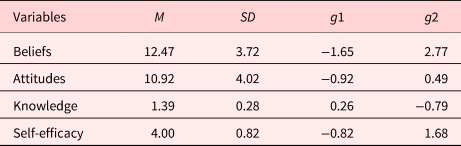
Table 2 refers to the respective descriptive data of the study variables that refer to a non-normal distribution of the data regarding beliefs and self-efficacy of care management. The beliefs and attitudes variables presented internal consistency indices according to the omega coefficient of 0.81 and 0.75, respectively, which indicate a good reliability of such measures
Descriptive data of the study variables

Notes: M, mean; SD, standard deviation; g1, asymmetry; g2, kurtosis.
The standardized estimates of the SEM model refer to acceptable goodness-of-fit indices for the data: χ 2/df = 3.49, CFI = 0.983, TLI = 0.976, RMSEA = 0.046 [90% CI: 0.037–0.056], SRMR = 0.038. The latent variables with multiple indicators presented factorial loads between 0.50 and 0.88, which refer greater consistency to the latent structure of the variables of beliefs and attitudes favorable to palliative care.
The fit of the fully mediated model was acceptable according to the data: χ 2/df = 3.49, CFI = 0.983, TLI = 0.976, RMSEA = 0.046 [90% CI: 0.037–0.056], SRMR = 0.038, AIC = 30,014.53, SSABIC = 30,057.81, ECVI = 0.212. We then proceeded with the partially mediated model that included the direct path from self-care self-efficacy to beliefs. The partially mediated model showed a very good fit to the data χ 2/df = 3.49, CFI = 0.984, TLI = 0.977, RMSEA = 0.045 [90% CI: 0.036–0.055], SRMR = 0.037, AIC = 30,011.24, SSABIC = 30,056.40, ECVI = 0.209. Therefore, the fit values of the partially and fully mediated models were found to be acceptable. With respect to the chi-square test difference the direct path made a significant contribution to the model (Δχ 2 = 5.33, gl = 1, p = 0.021). These results are confirmed by the fact that the AIC, SSABIC, and ECVI values of the partial model were lower compared to the full model. Consequently, the partial model was preferred and thus, hypothesis 1 (H1) was accepted. The latent variables with multiple indicators presented factorial loads between 0.50 and 0.91, which indicate greater consistency of the latent structure of the beliefs and attitudes toward PC variables.
The significance of the partially mediated model was tested using the Bootstrapping adjusted bias-corrected estimation procedure (bootstrapped sample of 5,000 was specified). The indirect effects obtained were significant for the mediating variables of beliefs and knowledge in the association of self-care self-efficacy with favorable attitudes toward PC. Specifically, four indirect pathways were found: knowledge-beliefs-attitude (β = 0.098, p < 0.001), self-care self-efficacy-beliefs-attitude (β = 0.028, p = 0.046), self-care self-efficacy-knowledge-attitude (β = 0.011, p = 0.002), and self-care self-efficacy-knowledge-beliefs-attitudes (β = 0.018, p = 0.002), respectively. The attitudes latent variable had an explained variance of 0.269 considered a moderate effect size (0.25 ≥ R2 ≥ 64), which is above the minimum recommended value of practical significance in clinical research (R2 = 0.04) (Ferguson, Reference Ferguson2009). The latent measure of beliefs also met this parameter with a coefficient of determination of 0.056, providing further causal predictive validity.
Discussion
The present study sought to examine the relationship between self-care self-efficacy, PC knowledge, beliefs, and attitudes in a nationally representative survey conducted in the US. Previous studies have explored the relationship between knowledge, beliefs, and attitudes toward PC, but to date none has examined how the person´s confidence in self-care (self-care self-efficacy) relates to the mentioned variables.
Knowledge or awareness about PC has been found to be largely low in the general public and in caregivers in different contexts as well as in the US (McIlfatrick et al., Reference McIlfatrick, Hasson and McLaughlin2013; Westerlund et al., Reference Westerlund, Tishelman and Benkel2018; Adjei Boakye et al., Reference Adjei Boakye, Mohammed and Osazuwa-Peters2020; Patel and Lyons, Reference Patel and Lyons2020; Shah et al., Reference Shah, Qaisar and Azam2020). Limited knowledge usually coexists with misconceptions, and both constitute barriers to access PC, as they relate to negative attitudes toward this health approach (Klinger et al., Reference Klinger, Howell and Zakus2014; Patel and Lyons, Reference Patel and Lyons2020). These barriers are also found in healthcare providers, along with personal and professional lack of experience with PC (Karacsony et al., Reference Karacsony, Chang and Johnson2015; Achora and Labrague, Reference Achora and Labrague2019; Ogunsanya et al., Reference Ogunsanya, Goetzinger and Owopetu2021) and low self-efficacy (Pfister et al., Reference Pfister, Markett and Müller2013).
Even though the advantages of integrating PC into regular care have been long evidenced and efforts have been made to increase public awareness about the objectives of PC and its positive impact on quality of life and other outcomes, many access challenges persist from the viewpoint of patients and caregivers (Brinkman-Stoppelenburg et al., Reference Brinkman-Stoppelenburg, Rietjens and van der Heide2014; Aldridge et al., Reference Aldridge, Hasselaar and Garralda2016; McLean et al., Reference McLean, Lennon and Glare2019; Roth and Canedo, Reference Roth and Canedo2019). To help bridge this access gap, it is required to target-specific populations within the US to which direct efforts to increase PC knowledge and to promote more accurate and positive attitudes.
Female gender, being married, having a college degree, and having a higher frequency of healthcare utilization predict an adequate level of PC knowledge, according to the results of Ogunsanya et al. (Reference Ogunsanya, Goetzinger and Owopetu2021) Also, a higher socioeconomic status, older age, working in healthcare organizations or having close contact with someone that has used a PC service are associated with a higher knowledge of PC (McIlfatrick et al., Reference McIlfatrick, Hasson and McLaughlin2013; Westerlund et al., Reference Westerlund, Tishelman and Benkel2018). In our study, we decided to include self-efficacy with self-care in addition to other commonly examined variables related to attitudes toward PC such as beliefs and knowledge. The results of the structural model obtained indicate that self-care self-efficacy predicts knowledge and beliefs about PC, which in turn are related to each other; as well, these variables altogether predict positive attitudes toward PC. In other words, individuals who are more confident in caring for their own health indicate having more knowledge and less misconceptions about PC; in turn, those considering more knowledgeable of PC and having less misconceptions predicts more positive attitudes regarding PC (Figure 1).
Structural model.

The relationship between knowledge about PC, beliefs, and attitudes has been extensively reported in the literature. Previous analyses of the HINTS survey also found a relationship between knowledge and beliefs about PC, as expected. Among respondents with self-reported knowledge about PC, Huo et al. (Reference Huo, Hong and Grewal2019) found that only 15% of them considered that PC meant giving up or stopping other treatments, less than one-third did not differentiate between PC and hospice care, while 40% associated PC with thinking about death. Taber et al. (Reference Taber, Ellis and Reblin2019) concluded that, although knowledge and beliefs about PC are linked, not necessarily those who consider themselves more knowledgeable of PC have accurate or positive beliefs about PC.
As mentioned earlier, self-care self-efficacy refers to the confidence an individual has in caring for his or her own health. Previous research has found that higher levels of self-efficacy are observed among patients reporting more positive patient-centered communication, particularly among those with increased burden due to a chronic illness (Finney Rutten et al., Reference Finney Rutten, Hesse and St Sauver2016) while low self-efficacy has been linked to anxiety in caregivers of patients in PC (Mystakidou et al., Reference Mystakidou, Parpa and Panagiotou2013) and in patients themselves (Mystakidou et al., Reference Mystakidou, Tsilika and Parpa2010). Also, self-care self-efficacy has been associated with the patient's educational level, seeking knowledge, and health literacy (Qian and Yuan, Reference Qian and Yuan2012); and a relationship between self-efficacy, beliefs, and knowledge has been found in chronic health conditions, which combined enhance self-care behaviors and altogether have an impact on health outcomes (Mackey et al., Reference Mackey, Doody and Werner2016). Finally, confidence in self-care is linked to decision-making processes in healthcare (Finney Rutten et al., Reference Finney Rutten, Hesse and St Sauver2016), an issue relevant to defining the integration of PC into care and discussing advanced directives and end-of-life care options.
Thus, understanding the relationship between self-care self-efficacy, knowledge, and beliefs, and how they predict positive attitudes regarding PC is relevant, not only for targeting-specific populations, but to designing novel and timely strategies to improve access and adherence to PC in the face of a growing population in need of this approach.
Funding
This research did not receive any specific grant from funding agencies in the public, commercial, or not-for-profit sectors.
Conflict of interest
The authors indicate not to have any conflict of interest.