INTRODUCTION
Our previous studies have shown that dietary carbohydrates which differ in their fermentability have a significant influence on the establishment, localization and fecundity of established infections of the nodular worm Oesophagostomum dentatum (Petkevičius et al. 1999, 2000, 2001, 2003a) in the large intestine of pigs. Diets with carbohydrates resistant to fermentation in the large intestine provided favourable conditions for the establishment and fecundity of O. dentatum. However, carbohydrates that were non-digestible in the small intestine but highly fermentable in the large intestine (inulin and sugar beet fibre (SBF)) decreased the establishment and fecundity of nodular worms. Recent results have shown that inclusion of 16% inulin as a single component in a normal barley flour based diet reduced established O. dentatum infection in growing pigs by 97% (Petkevičius et al. 2003a). Inulin is recognized as a prebiotic, which escapes digestion in the upper intestinal tract and is utilized selectively in the large intestine by a restricted group of micro-organisms that are associated with certain health-promoting properties (Bornet et al. 2002). Other than our studies there are no other reports on the negative influence of inulin on the gastrointestinal parasites.
It is well documented that Oesophagostomum and Trichuris have the same predilection site inhabiting the colon and caecum of the pig (Beer, 1973). The whipworm Trichuris suis (Shrank, 1788) is a widely occuring intestinal nematode parasite of pigs (Pattison et al. 1980; Morris et al. 1984) and has an economic importance in young and growing pigs due to its effects on growth rate, feed efficiency, utilization and retention of nutrients (Stewart and Hale, 1988). Recent results indicate that the mixture of fermentable carbohydrates (inulin and SBF) does not affect the establishment of T. suis in naïve pigs, but results in earlier expulsion and reduced growth of the established worms (Thomsen et al. 2005). The present study investigated whether fermentable carbohydrate inulin can affect both the establishment of a new infection and an already established whipworm infection in growing pigs.
MATERIALS AND METHODS
Experimental diets
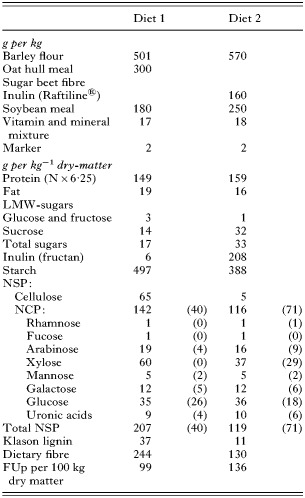
Two experimental diets were formulated based on barley flour with added insoluble fibre from oat husk (standard diet – Diet 1) and on barley flour with a pure inulin (16%) supplementation (inulin diet – Diet 2). Both diets were supplemented with soybean meal, synthetic lysine, vitamins and minerals to balance the concentrations of essential nutrients (Table 1). The diets were not specifically analysed but, based on results from our previous study (Petkevičius et al. 2003a), they can be expected to contain 0·99 and 1·36 Feed Units for pigs (FUp) per kg dry matter, respectively. The pigs were fed the same amount of digestible energy (DE) per day divided into 2 daily meals according to weight development. The average intake of dry matter per day during the entire study period was 2·37 kg for Diet 1 and 1·98 kg for Diet 2, and the amount of digestible protein per day was 322 g and 316 g for Diet 1 and 2, respectively.
Table 1. Composition of the plant material and chemical composition of experimental diets (LMW sugars, low molecular weight sugars; NSP, non-starch polysccharides; NCP, non-cellulosic polysaccharides; FUp, Feed Units for pigs. Values in parentheses are soluble NSP.)

Experimental design
Twenty-eight pigs of Landrace/Yorkshire Danish crosses (females, castrates) were divided by stratified random sampling according to weight, sex and litter into 4 groups (1–4) with 7 pigs in each group. All experimental pigs were infected by oral inoculation with 2000 infective T. suis eggs after 3 weeks of feed adaptation.
Groups 1, 3 and 4 were fed Diet 1 and Group 2 was fed Diet 2 (inulin). Seven weeks p.i. Groups 1 and 2 were slaughtered and Group 4 was changed to Diet 2. Nine weeks p.i. Groups 3 and 4 were slaughtered.
The pigs were weighed on arrival, then every other week, and at slaughter. The pigs were weighed at the same time of the day relative to feeding time. The average live weight (standard deviation, S.D.) of the pigs at the start of the experiment was 26.0 kg (2.3). The pens were thoroughly disinfected and dried prior to introduction of the pigs and excreta were removed twice daily. The pigs were kept without bedding and had free access to water via drinking nipples.
Parasitological assays
Faecal samples were collected from the rectum for T. suis egg counts the day after arrival, the day before inoculation, and twice a week after week 6 p.i. Faecal egg counts were determined using a modified McMaster technique (Roepstorff and Nansen, 1998) which has a lower sensivity of 20 eggs per gram (EPG) faeces. At slaughter the entire large intestine was immediately removed and separated from the mesenteries. The large intestine was divided into the caecum (Ce) and 4 segments of the colon (Co1-0–20%, Co2-21–40%, Co3-41–60%, and Co4-5-rectum-61–100%). For recovery of T. suis the mucosa of the large intestine sections were rinsed several times and looked through carefully for the presence of worms. The suspension of intestinal contents and intestinal wall washings was washed through a 212 μm sieve. Trichuris suis worms were collected and counted. The sex of T. suis was recorded.
Statistical analysis
Parasitological data were analysed using the SAS software package (Version 8.2, SAS@ Institute Inc.). Differences between groups were tested using analysis of variance.The effect of diet on faecal egg counts was assessed using log10 (EPG +1) transformed counts for each pig. The pig-to-pig variation in EPG in a given week was described using a 95% reference interval, roughly covering 95% of egg counts from pigs in each group. The comparisons made were (a) inulin (Group 2) versus normal diet (Groups 1, 3 and 4) in week 7 p.i. and (b) a diet change to inulin (Group 4) versus continued normal diet (Group 3) from weeks 7.5 to 9 p.i.
The effect of diet on T. suis worm burdens was contrasted for each intestinal section and analysed using log10 (worm burden +1) transformed counts. The basic data were the number of female and male worms in a given intestinal section of a given pig. The log10-transformed worm counts were thus classified according to diet group, pig, section and sex, allowing for the simultaneous assessment of the influence of these factors. The sex ratio (females/males) was calculated from this model by anti-log transformation of worm sex estimates.
The mean position of the T. suis worms along the large intestine in each pig was calculated according to Petkevičius et al. (1995) using the section number (1–5) as a proxy for geometrical position along a line. Worm fecundity was defined as the number of eggs excreted (EPG) divided by the number of female worms per pig at week 7 or week 9.
Ethical consideration
The experiment was designed not to cause a higher parasite load in the animals than under average natural conditions. The infection course was subclinical. The experiment was approved by the Danish Animal Ethical Committee (Experimental Animal Permission License: 2000/561-321). Meetings were held with the agricultural and laboratory technicians to explain the purpose of the experiment and what was required from the persons handling the pigs.
RESULTS
Animal health and performance
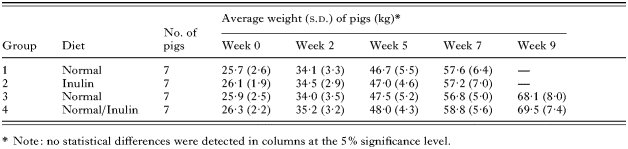
There were no clinical signs of parasitic disease in any of the pigs during the experiment. All pigs had normal appetites during the experiment (daily feed allowance was completely consumed), and weight gains and general appearance was similar in all diet groups. There were no significant differences in the weight gain of pigs between two diet groups or the sex of the pigs. In all experimental groups, the average weight (S.D.) of pigs increased gradually at 2, 5, 7 and 9 weeks p.i. and reached weights of 34·5 kg (3·2), 47·3 kg (4·9), 57·6 kg (6·0) and 68·8 kg (7·7), respectively (Table 2).
Table 2. The average weight gains of pigs fed normal and inulin diet and infected with Trichuris suis (S.D., standard deviation.)

Parasitological findings
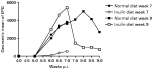
Eggs were observed in the faeces of most pigs from week 6 and onwards (see Fig. 1); levels were similar until week 7 p.i., when the geometric mean EPG was significantly lower in pigs fed with the inulin diet compared to the pigs in the remaining groups that were fed with the standard diet (P<0·0001) (Table 3). At week 7 this amounted to an 87% lower EPG in the inulin group (Group 2) compared to pigs fed with a normal diet (Group 1).

Fig. 1. Geometric mean Trichuris suis egg counts of pigs 7 weeks fed Diet 1 (○), 7 weeks fed Diet 2 (○), 9 weeks fed Diet 1 ([squf ]) and 7 weeks changed Diet 1>Diet 2 (□).

In Group 4, T. suis egg counts started to decline immediately after the diet switch and remained at a nearly constant, low level (<1000 EPG) from week 7·5 until slaughter, while in the matched control pigs continuing on the normal diet (Group 3), EPGs remained at a high level until week 8 at which time they declined in 3 out of 7 pigs. As a result, the egg excretion level in Group 4 was reduced significantly (P<0·05) compared to Group 3 in weeks 7·5, 8 and 8·5, but not at slaughter (P>0·10) (see Table 3). Inclusion of inulin in the diet resulted in a reduction in EPG of at least 65%, depending on week post-infection, compared to a normal diet.
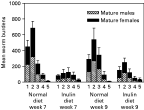
In each group, adult T. suis were distributed over the 5 sections of large intestine as shown in Fig. 2. To ‘normalize’ residual variation in worm burdens in the statistical analysis, section 5 (which contained only a minor fraction of the total number of worms per pig) was excluded from the analysis, as well as sections without worms. The number of worms recovered at week 7 from pigs fed with an inulin diet (Group 2) was reduced significantly by 71% compared to control pigs in Group 1 (P<0·0001), see Table 3. At week 9, worm recovery in inulin-fed pigs (Group 4) was reduced by 47% compared to control pigs in Group 3 (P<0·01) (Table 3). This smaller reduction at week 9 p.i., compared to week 7, was most likely due to an increased variation in worm counts in Group 3 at slaughter, as can be seen from the 95% reference interval in Table 3. In pigs fed inulin for 7 weeks (Group 2) worms were located more distally in the large intestines (P<0·01, Table 3) compared to pigs in any of the other groups.

Fig. 2. The mean location of Trichuris suis worm burdens in the intestine of pigs slaughtered 7 and 9 weeks post-inoculation. Sections of the large intestine: 1-Ce-caecum; 2-Co1-0–20%; 3-Co2-21–40%; 4-Co3-41–60% and 5-Co4,5-61–100%.
The T. suis sex ratio was not influenced by diet or diet change (Table 3), and did not differ significantly from 1.
Inulin had a statistically significant effect on female worm fecundity. Fecundity was reduced significantly in inulin Groups 2 and 4 at week 7 p.i. (P<0·001), compared to normal diet Groups 1 and 3, (Table 3). Furthermore, fecundity in inulin-fed pigs at week 7 p.i. (Group 1 versus 2) or at week 9 p.i. (Group 3 versus 4), was reduced statistically significantly (P<0·001) (Table 3).
DISCUSSION
This experiment demonstrated that the highly fermentable carbohydrate inulin has a significantly negative effect on the establishing and on the already established T. suis infection in growing pigs. These results extend our previous findings that this carbohydrate can markedly reduce patent infections of another pig parasite O. dentatum ( Petkevičius et al. 2001, 2003a). In previous experiments we demonstrated that diets containing 16% inulin caused pigs to expel 97% of their O. dentatum worm burden and the fermentative activity of the microflora of the large intestine was suggested to play an important role in this anti-parasitic effect (Petkevičius et al. 2003a). Inulin is a glycosidic fructan (Phelps, 1965) which, because of its chemical characteristics, resists digestion by the small intestinal enzymes of monogastric animals and humans (Bach Knudsen and Hessov, 1995), thus becoming available as a substrate for microbial fermentation in the large intestine (Cummings et al. 1997). Inulin occurs as a reserve material in roots, stems and leaves of a variety of plants (Robertfroid et al. 1998). Because pigs harbour a more active microflora in the stomach and small intestine, the recovery of inulin at the end of the small intestine is consequently lower, with recoveries at the terminal ileum of approximately 60% (Bach Knudsen, 2001). Other than our studies there are no reports on anti-parasitic effects of highly degradable carbohydrates (inulin and SBF) on the gastrointestinal parasites.
Whipworms in the caecum and colon are known to reduce daily live weight gain and feed conversion efficiency at low levels of infection in pigs and can cause mortalities at higher levels (Stewart and Hale, 1988). T. suis is very similar to the human whipworm T. trichuria (Holland, 1987), therefore experimental whipworm infection in the pig is considered to be a model for T. trichuria in humans, a parasite which infects at least one billion people worldwide (Crompton, 1999). Most of the studies related to the whipworm-nutrition interactions in relation to the host's nutritional status were designed to investigate the population biology of T. suis. It was estimated that a low dietary level of iron (Pedersen, 2002) and decreased content of protein/energy (Pedersen and Saeed, 2002) in the diet increases the severity of T. suis infection in pigs, while a marginal vitamin A status leads to earlier worm loss (Pedersen, 2002). The use of diets high in dietary fibre was associated with an increased risk of T. suis infection and it was concluded that dietary fibre intake (particularly in form of insoluble fibre) for growing pigs provide favourable conditions for T. suis infection in pigs (Pearce, 1999). In a recent study we have shown that a mixture of fermentable carbohydrates (inulin and SBF) do not affect the establishment of T. suis in naïve pigs, but result in earlier expulsion and reduced growth of the established worms (Thomsen et al. 2005). In this study only the prophylactic effect of inulin and SBF was investigated. In the present study it was shown that inulin had a significant anti-worm effect on new and on patent infections of T. suis in growing pigs. Those results on T. suis are in concert with data on the influence of carbohydrates on O. dentatum, which have shown that dietary carbohydrate source and time of intervention is very important. In our previous study (Petkevičius et al. 2003a) it was estimated, that the inclusion of inulin to pig diets had a significantly higher effect on the establishment and on already established experimental O. dentatum infections compared to that of SBF or a mixture of inulin and SBF. In addition, it was demonstrated that diets containing 16% inulin caused pigs to expel 97% of their O. dentatum worm burden (Petkevičius et al. 2003a) and in the present study the number of T. suis worms was reduced by 71%. The higher anti-worm effect of inulin could be explained by the fact that nodular worms spent most of their entire life in the lumen of the large intestine, whereas whipworms are connected to the mucosa by the embedded anterior end, and may therefore be better protected against luminal changes due to fermentation.
It is well established that the main metabolic products from the microbial fermentation of inulin in the large intestine are short-chain fatty acids (SCFA) and lactic acids (LA) (Sobotka et al. 1997; Bach Knudsen, 2001). Recently, we demonstrated that the caecal infusion of SCFA and LA into the caecum of cannulated pigs in amounts and proportions that mimicked the caecal level (150 mmol/kg digesta SCFA and 60 mmol/kg digesta LA) in inulin-fed pigs (Bach Knudsen et al. 2003) has a strong anti-worm effect on the established O. dentatum infection, as reflected by highly reduced egg excretions, worm burdens and female fecundity (Petkevičius et al. 2004). These data are thus supporting our conclusion that rapid degradation of carbohydrates and thereby accumulation of LA in the caecum and raised SCFA concentration (>150 mmol/kg digesta compared to a normal level of 100–130 mmol/kg digesta) throughout the length of the large intestine is a key factor controlling O. dentatum infection (Petkevičius et al. 2001, 2003a). The marked increase in levels of SCFA and LA also decreased the pH of digesta to 5·0 in the caecum and to 5·5 in the proximal colon (Petkevičius et al. 2003a). The specific mode of action of fermentation products in regulating whipworm populations is not yet clear, but the parallel effects of infusion of SCFA and LA (Petkevičius et al. 2004) to that obtained with inulin diets on nodular worms (Petkevičius et al. 2003a), also suggest that there are direct effects of SCFA and LA on worm physiology, especially the females. The close association between increased levels of SCFA and LA and low pH with expulsion of worms suggests that the alteration of pH has a major role in the SCFA and LA and inulin effect on nodular worms creating an unsuitable environment for mature and immature helminths. The same mechanism also seems to be applicable to whipworm infections. This provided suport to the hypothesis raised in our earlier papers (Petkevičius et al. 1995, 1997, 1999, 2000, 2001, 2003a; Thomsen et al. 2005), that the strong anti-worm effect of dietary inulin is the result of the production of fermentation products produced by the microflora in the large intestine.
The combination of helminth infections and highly fermentable dietary carbohydrates affected the mucosal architecture, the epithelial cell proliferation and mucin secretion of the large intestine in pigs (Petkevičius et al. 2003b). It is claimed that whipworms are rather immunogenic in pigs causing strong protective and acquired immunity (Powers, 1959; Pedersen and Saeed, 2001), resulting in short-term infections and expulsion of worms. In our study, it is likely that inulin exhibited higher negative impact on the establishment of whipworm infection compared to the established infection due to parasite expulsion in some pigs. However, host defence functions are responsive to carbohydrate composition in the diet (Kelly-Quagliana et al. 2003) and an enhanced intestinal immune response has been attributed to the dietary inulin (Meyer et al. 2001).
In conclusion, the results from this study indicate that inulin which is highly and rapidly fermentable in the large intestine has a significant anti-worm effect on patent and new infections of T. suis in pigs. These results are in concert with our previous findings on nodular worms and strongly suggest that such dietary carbohydrates have potential value for parasite control for both conventional and ecological pig production systems, especially for the control of troublesome whipworm infections. The results also show that there were no significant differences in live-weight gain between the pigs on inulin and standard diets, an important consideration in production. Future investigations should assess the influence of potential factors such as the intestinal microflora composition, mucosal barriers and inulin effects directly on host immune responses to large intestinal parasites. The data obtained on the influence of inulin on T. suis infection in pigs should also be of interest to those dealing with human whipworm control as a potential nutritional approach adjunct to drug treatment.