Brand to Lord Woolton, 15 April 1941
Typescript
Dear Lord Woolton,
I am very much obliged by yourFootnote 1 kind letter of March 20 with its enclosure confirming my appointment as Head of the Food Mission here and containing a memorandum of terms of reference of the Mission. I appreciate very sincerely the confidence you have shown me in asking me to be Head of the Mission.Footnote 2 I need not say that I shall do my very utmost to fulfil this task satisfactorily as well as to carry out the duties involved in my membership of the British Supply Council in Washington. The problems arising out of the Lend-Lease Act, with which the Council has to deal, are novel and some important ones still await solution.
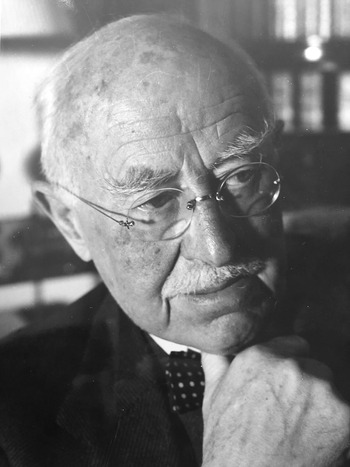
Robert Brand, probably in the 1940s. Courtesy of John Polk.

It is quite clear to me that the work of the Food Mission itself will be very important. Everything points towards the United Kingdom being driven more and more to look to North America for supplies, both of cereals and other foodstuffs, and I look upon our task here to be to arrange with the United States Government, and in consultation with the Canadian Legation here, all means of meeting your demands. Fortunately, so far as dairy products are concerned as well as certain other foodstuffs, that we should make heavy demands has actual advantages for this country in the eyes of the Department of Agriculture. And fortunately, too, there is still time, at this moment, to step up future production. It is, therefore, important, it seems to me, that we should use our imagination now as to all possible demands we may have in the next year to make on this country, as it is now that steps have to be taken which will determine what can be produced.
I will only refer very briefly to questions of personnel. Sir Quintin HillFootnote 3 and Maurice HuttonFootnote 4 arrived, I am glad to say, a few days ago and Mr. McLean has arrived this morning. Mr. Reid-Adam has also come from Sir Owen Chalkley's staff at the Embassy to be Secretary of the Mission.
I was, as you know, somewhat concerned that the Ministry proposed to publish a notice as to my staff without giving me time for previous consultation; particularly I was uncertain what was the exact position in relation to my Mission that Mr. Van Zwanenberg was expected to hold.Footnote 5
I did not know whether the Ministry had in mind that he should come at once or not come until later, or whether, when he came, he was supposed to replace anyone else. I was afraid that the Ministry might have in mind that when Mr. Van Zwanenberg arrived I should be able to release Mr. Hutton. I did not want any misunderstanding to arise on this point. I am quite sure that I shall have to ask that Mr. Hutton should stay here. In a small staff like mine, particularly where personal relationships with the American authorities are very important, continuity is essential and it would be a great mistake to have to start again. Mr. Hutton gets on very well with the officials of the Department of Agriculture and his services will be invaluable to me and Sir Quintin Hill. On the other hand, Sir Quintin Hill and Mr. Hutton speak highly of Mr. Van Zwanenberg and I am sure his services also would be useful. I should therefore be glad if he could come whenever convenient to yourself.
I do not want to build up a larger staff than is necessary but as against this it is absolutely essential to have a fully adequate staff. In the case of illness or absence from any other cause, it would be impossible quickly to make replacements from England, and communications may grow worse rather than better.
I should like to add that Mr. J. G. Hopkins, Director of A. J. Mills & Company, Inc., New York, who is also on the staff, has been very useful to me since I came here. He is highly spoken of by the British Purchasing Commission in New York, whom he has assisted for a good many months. I have found him very hardworking, competent and willing.
If I require further help I shall not fail, according to my terms of reference, to make recommendations to you as to what appointments I regard as necessary and as to the type of persons to be employed.
We are still in great difficulties about proper office accommodation. Washington is full to the brim, both as regards office and residential space, but in a few weeks we hope to be decently housed.
I feel it to be very important, if we are to do our work well and see that no opportunities are neglected, that we should be kept in touch with general conditions at Home both as regards shipping and as regards the Ministry's programmes for purchases in other countries, particularly the Dominions, and so forth. If we possess a knowledge of the general picture at Home, we shall be greatly helped to look ahead here and to form judgments and to give advice worth having. We shall be communicating with the Ministry on this matter.
I may add that we have the intention of setting up in a more formal manner soon a joint committee of ourselves and representatives of the Department of Agriculture. This, I am sure, will be found useful.
I will not say anything about the war position; I am afraid things are by no means satisfactory but all one can do is to hope for the best.
Yours sincerely,
[Source: Bodleian Library, Oxford, Robert Brand Papers, Brand 196/1, B. Correspondence 1941–4 British Food Mission folder.]
Brand (British Food Mission, Washington DC) to Lord Beaverbrook, 21 August 1941
Typescript
Private
Dear Lord Beaverbrook,
As youFootnote 6 have to settle the appointment of a successor to Purvis,Footnote 7 I wanted to put one aspect of the position here before you, which perhaps does not strike anybody till they have been here for some time.
Apart from old contracts which are of course very important still, the work of the Head British official is not any longer that of buying hundreds of millions of dollars of munitions and other commodities, placing orders, controlling contractors, settling prices and so on, i.e., it is not what it was in the first year or 18 months of war. There should not be required in time anything like so large a staff. In fact it is a totally different job. The American Departments do all the work of placing orders, fixing prices, controlling contractors, etc. If I had to do this for Food, I should want a staff of hundreds. As it is I have a staff of 25 people. Everything depends on the work of the few people at the top. This applies also to the [British Supply] Council's work, i.e., the central work outside the particular Missions. In fact it applies still more. The Chairman's work is not that of controlling a great purchasing organisation. It is far more of a sort of semi-diplomatic job, requiring qualities not only of energy and vigour, but of very wide-spread experience, knowledge of conditions in the U.K., ability to appreciate the strategical and military side, ability to influence the U.S. people by having this knowledge and experience. You want a man who through the possession of these qualities and also wide experience is able to carry out with success this semi-diplomatic job, a man whose success will be determined by his capacity to make the Americans at the very top do what you want, not by his capacity to control contracts. I am not in any case a candidate. So I can speak freely.
His work is not that of controlling Missions. For instance, I am responsible to Woolton. Neither Purvis nor anyone else could tell me how to run this show. You cannot have divided responsibility and, in any case, the Chairman could not have the knowledge. Of course each Head of a Mission must cooperate to the full in any common aims or duties under the leadership of the Chairman.
The Chairman must, it is true, or should – together with the [British Supply] Council – control all common functions, staff conditions, buildings, etc. But that is, so to speak, a side-show. His real and by far the most important work is, with the British Military, Naval, Air and Supply Heads, to weld the British strategical and general war case together in such a way as to persuade or convince the American authorities, both at the top and down the line, that they must do for us what is necessary to win the war, that they must always bear in mind – what they often do not – that it is the fighting nation which has to win the war. Fighting is the real consideration for the whole Lend-Lease Act.
It is the wide experience and ability needed to do that which is necessary in a Chairman.
Yours sincerely,
R. H. Brand
[Source: Bodleian Library, Oxford, Robert Brand Papers, Brand 196/1, A. Mr Brand. British Food Mission. Correspondence 1941–2.]
Brand to Twentyman and Hutton, 4 May 1944
Typescript
Personal
After discussion with AndersonFootnote 8 and LlewellinFootnote 9 I came to conclusion that for more than one reason it was undesirable I should attempt to combine jobs of Head of B.F.M. [British Food Mission] and Treasury Representative. Outcome has been therefore that I shall leave B.F.M. and become Treasury Representative. I greatly regret parting from B.F.M. and above all leaving my personal friends and admirable colleagues there. I hope still to get much help from them. Publication of my Treasury appointment will be made here in a few days and meanwhile above is confidential to you.Footnote 10
[Handwritten addition:]
I expect to be back very shortly.
[Source: Bodleian Library, Oxford, Robert Brand Papers, Brand 195/2, A. Treasury Appointment of R.H.B. folder.]
Brand to Sir David Waley (Treasury), 15 June 1944
Typescript
Dear Waley,
HarmerFootnote 11 will by now have returned to your fold, I imagine and will be able to tell youFootnote 12 how we are getting on here. I was exceedingly sorry to lose him, as a few days were sufficient to show me how well he has done his work here. However, I hope and believe he will be very useful to us on your side. Particularly, I hope you will give him a free hand in arranging what documents and information to send here. It is vital to us, as I may repeat to you, that we should know all you are thinking [on] the other side, and almost who thinks what! Anyhow the more background knowledge we have, the better for us.
My immediate reason in writing you this letter is to pass on to you some opinions made to me two days ago by a banker of whom I have a very high opinion. This is Jeidels,Footnote 13 formerly the German banker, the most important partner in the Berliner Handels Gesellschaft. I know him very well, mainly because he was for all the years ’31 to ’38 or so, the leading representative of the German banks at the annual Standstill meetings in Berlin. Every banker who was present there would agree as to the remarkable ability he showed in these negotiations.
Jeidels is now a managing-director of the Bank of America in San Francisco. It is, I believe, the second bank in size in the United States. He was in the East recently and came down to see me in Washington. Next day, I may say, he was to make a speech to the Michigan bankers in Detroit on the International Monetary Fund of which, he tells me, he is the sole supporter among American bankers.
Without saying anything as to what were either the British or the American Government's views on the future value of the mark, I asked him what rate he would fix for the mark when the armies entered Germany, if he had the decision. He had a very decided view on the matter. He considered that the rate should not be higher than four or five marks to the dollar. The vital point in his view was to fix the rate which coincided with existing conditions in Germany, and to do this the value of the mark should not, he thought, be fixed lower than the above. It would he agreed, be necessary for the Supreme Commander, before he entered Germany, to notify all Germans that the Allies intended to employ by means of the German authorities, government and banking, all existing systems of control, particularly price, rationing and imports. In his opinion while, if Germany collapsed there might be confusion and chaos for a few days, the Germans would readily react to control. Of course if military operations within Germany were long, the situation would be more difficult, but even then order in the parts of Germany conquered would be a good example for the rest of the country. What would be fatal in his opinion would be to cause chaos as he thought had been done in Italy by fixing an extremely depreciated rate which would alter all economic and financial conditions in the country and lead the Germans to a belief that this depreciation was a mere instalment of what happened in the last war.
He admitted, in fact he thought it certain, that the mark, like the currencies of other European countries, would have later to be adjusted to some new rate according to conditions then existing. He emphasised that a larger depreciation of the German currency would, in his opinion, lead to a similar depreciation in Holland and other countries bordering on Germany. It was vital, therefore, that their opinion should be taken as to the rate to be fixed.
The Bank of America, as you know, has been built up by the Italo-American Giannini.Footnote 14 It is therefore particularly closely in touch with Italian affairs and has a very large Italo-American clientele. Jeidels was insistent on the mistake the Allies made in fixing a too depreciated rate for the lira. This had, in his opinion, quite unnecessarily upset economic conditions in Italy and this upset would now be communicated also unnecessarily to all other parts of Italy, as and when they were freed. He tho[u]ght that the very high pay that the depreciated lira allowed to foreign troops, particularly American, was a definite additional cause of inflation. I thought these remarks by a man of experience who has, of course, an intimate knowledge of Germany, might be of interest to you.
We have not yet heard anything further from [Harry Dexter] White on this matter but everything in my opinion supports Keynes’ view that White's ideas are iconoclastic.
Yours sincerely,
R. H. Brand
[Source: Bodleian Library, Oxford, Robert Brand Papers, Brand 196/2, F. Diary Letters (Treasury) 1 January–30 April 1945 (Treasury) folder.]
Brand to Sir Richard Hopkins (Treasury), 15 June 1944
Typescript
Private and Confidential
Dear Hopkins,
In the absence of yourFootnote 15 colleagues over here, you may like to have a few general observations from me.
We have all been very busy here. I propose to talk to Eady about certain staff questions while he is here. I was exceedingly sorry to lose Harmer. He did very well here. He has a wide knowledge, a very good brain, a good manner, and got on very well with the Americans. I should regard him also as a man of judgment. While I was very sorry to see him go, he should be useful to us in London as he knows our needs.
I have seen [Treasury Secretary Henry] MorgenthauFootnote 16 and [Harry Dexter] White on several occasions but have not discussed any general questions with them. At present, as you know, the [Edward] StettiniusFootnote 17 approach to the Ambassador is what we are taking up. I hope the Ambassador and I may be able to see Stettinius again this or next week. I am more than ever convinced since I have been back [of the necessity] of educating the Administration and everyone else as to the British position and the lessons to be drawn from it. Even suppose that could be done, there remains Congress and public opinion. I have put a paper explanatory of our position before the [British] Supply Council at yesterday's meeting and we shall discuss it next week. The first step I thought was to explain the general position confidentially to the British side. I hope the Stettinius negotiations will enable us to go further with the Administration, but this in itself will take time, and there is in addition Congress and public opinion.
One difficulty as regards the administration is that the Treasury are on bad terms with the State Department, the Federal Reserve Board, the bankers, and, I imagine, the F.E.A. [Foreign Economic Administration] also. Morgenthau is extremely jealous in preserving what he regards as his own territory and yet it is quite certain that to rely on the Treasury alone to deal with one's case and put it through would be to rely on a broken reed. One must discuss these matters with the State Department as well and with F.E.A. But in so doing I may antagonise M[orgenthau]. I am presented, therefore, with something like a jigsaw puzzle in knowing how to go to work. I understand from OpieFootnote 18 that they criticise PhillipsFootnote 19 for going so much to the State Department. But to get ahead at all one has to take risks and it is certainly impossible not to take advantage of the opportunity that Stettinius has offered us.
The central baffling Washington problem faces one here too, namely that there is no cabinet to deal with.
I myself feel that at the present stage of the war too much secrecy about our financial position is a mistake. Facts are facts, and knowledge of them is not going to affect the course of the war. Indeed, the broad facts are very well known in some quarters and published although they are not of course entirely correctly stated. I enclose for instance a recent copy of the National City Bank Circular. The more we keep our position highly confidential and secret, the less are we able to educate Congress and American public opinion. And yet it is on this that we shall depend for proper treatment. We should not, of course, merely say that our position is very difficult. We want to bring somehow home to the public and Congress that American interests also are vitally concerned. We want to make them feel that it is highly important to them, if the world is to be the sort of world they want, that we should not be forced to abandon cooperation with them for a Brave New World; to go by necessity in a completely opposite direction and to develop a wicked old world in a manner which will be extremely distasteful and injurious to them. We want the fact to sink in that the cards are not all in their hands, but that if we are driven to use our bargaining power, we can no doubt get through but by means that will cut across a policy for the world acceptable to the United States. This is a concept that we let Americans develop to other Americans so that it can partially permeate opinion. But the ones who understand cannot begin to educate those who do not, unless they know the facts. I am not ready with any concrete suggestions in this direction except that I should like to educate about half a dozen bankers who really matter. I shall hope to begin this with [Randolph] Burgess,Footnote 20 whom I know well, at Bretton Woods.
One cannot go too far in all these matters and it is too early days to my mind to ask the U.S. Government how they propose to help us after the end of the war. That would have to wait at least till after the election, though by what we tell them we ought to implant in their minds that there is a serious question here which they must think about. The first thing to get settled is the Lend-Lease position during Stage II. In doing so we shall, of course, have to indicate the problems that will face us at the end of Stage II and broadly the different kind of solutions that we see open to us. But to get Stage II settled should now be our first aim. The American Departments are preparing all sorts of plans, I believe, for Stage II, and that is why it is important to begin our discussions soon. Otherwise, we may be presented with something akin to a fait accompli.
Yours,
R. H. Brand
[Source: Bodleian Library, Oxford, Robert Brand Papers, Brand 196/2, E. Correspondence June 1944–August 1944 (Treasury) folder.]
Brand to Keynes (Atlantic City, NJ), 26 June 1944
Typescript
Dear Keynes:
1. I have now had a chance of re-reading the final version of your admirable and illuminating memorandum and want to repeat what I said in London, namely, how much we must all feel indebted to you for so clear and comprehensive an exposition of our whole position.Footnote 21 It may, and no doubt does, conceal a large number of snags in the carrying out of all the plans you suggest or any modifications of them which may be found necessary. But at any rate, it gives a clear starting point for the practical consideration of our future action. I do not wish to burden you further at Atlantic City,Footnote 22 but I have one or two comments of detail and one general comment to make that you might consider at your leisure.
2. I do not understand the last part of paragraph 5 where you say that an increase over pre-war of 50% in the volume of our exports means an increase of at least three times the pre-war value of our exports. I thought export prices were only up by 30%, or in other words that with an increase of 50% in volume we should only have to double our pre-war value, namely to increase it from £500 millions to 1,000 millions. If you are right that our post-war imports will be £1,150 millions, even this seems more than adequate with after a year or two perhaps £200 millions of invisible exports to enable us to more than balance our position (without any repayment of debt).
I may, however, be quite wrong and perhaps export prices have increased by far more than 30% and that this may be the answer to my question.
3. In paragraph 15 you say that sterling balances of 2,000 millions of the sterling area are an exact measure of the favourable balance which they had placed at our disposal. It would be very interesting to know how much of these favourable balances arose out of dollars, i.e. how much we have been able to spend in the United States beyond what would otherwise have been possible by means of dollars we have taken from the other members of the sterling area. Perhaps no figure for this is available.
4. My general comment is the following. I am concerned at the entirely different attitude which we adopt towards the United States (and I suppose Canada too) as regards war debts, and that we adopt towards all the other United Nations. We take the view that, in any case during the war, it is inconsistent with Lend-Lease principles that we should incur a war debt towards the United States. Even after the war we should like, and we feel very much justified in asking, them to continue Lend-Lease partially, to meet our obligations arising out of the war. Nevertheless, we have followed exactly the opposite course with all other United Nations and have already incurred huge debts towards them and daily go on incurring them at the same moment as we are proclaiming to the Americans that as between partners, war debts should not exist.Footnote 23 You say in paragraph 23 that in the case of these other nations “to repay capital instalments is bad enough when no asset corresponds to the loan. But it is honourable having received assistance in kind to return the equivalent as time and opportunity permit.” We do not, however, admit that the sentiment in this last sentence is applicable at all to the United States.
I can see, of course, certain arguments one could use to justify what might be considered this glaring inconsistency on our part:
(a) I exclude, of course, all neutrals ex hypothesi. I suppose we have to assume that they are not interested in the war, and we have to treat assistance in kind from them more or less as a commercial debt.
(b) India and Egypt, I suppose, can argue that they do not want the liberty that we say we have been fighting for and that we propose to give them after the war.
(c) All of them perhaps can argue that they have not the economic or financial strength and a sufficient surplus to enable them to accept the obligations involved in any pooling of the lend-lease system. But I do not see that this necessarily applies to some of our paying allies or, for instance, Australia and South Africa, any more than to Canada. It may, however, apply to the Crown Colonies, Norway, Greece, etc.
(d) We may further argue that a large portion of the debt represents normal working balances and currency reserves. Nevertheless, it seems to me just as the currency reserves have been built up because of the exports of these countries, so they may be diminished in the future by their imports.
(e) We can argue further that the war debts to these countries which are likely to take our exports are different from war debts to the United States which takes few exports from us.
Perhaps you can add further and more effective arguments to the above. But so far as my arguments are concerned, they seem to me not wholly adequate to explain the difference between the pooling principle as we apply it to America, and the war debt principle as we apply it to the rest of the world. It is perhaps particularly the case in respect to the liberated areas which will end without a war debt as against our enormous burden. I cannot help feeling that it would be difficult over the course of years to explain the position that the British people, having saved the world, should be so vastly more burdened than any other country just because they happened to have been able in relation to the size of the country to make such an immense manpower efforts towards victory for which they get no credit on the other side. I admit the difficulty of finding a principle because every case is different. I admit also that to owe large quantities of sterling may help us sometimes in encouraging our exports. But I feel less optimistic than you that we shall find it anything but very difficult to stimulate our export trade sufficiently to meet our own minimum requirements and to repay large capital debts.
If the world, on the contrary, goes badly, and we have to struggle to keep our exports beyond what we had before the war, I do not see how we can in addition solve our debt problem.
5. As regards the United States, it may well be that they will not raise this matter at all. Nevertheless it weakens to my mind our insistence on the principle that war should not lead to war debts.
6. The Ambassador has arranged a meeting with Stettinius to-morrow afternoon.
Yours,
R. H. B.
[signed]
R. H. Brand
[Source: Archive Centre, King's College, Cambridge, Keynes Papers, Private Papers, JMK/L/B/1/93-95.]
Brand to the chancellor of the exchequer, Sir John Anderson, 23 August 1944
Typescript
PERSONAL
Dear Chancellor,
I am writing you a line on what you may think is somewhat outside the sphere of the work of the Treasury Delegation, but which is not really so at all. When we come to negotiate some large settlement of our financial problems with the United States our path will be made either more difficult or easier, according to the estimate which the American nation have of our accomplishments in the war. The ordinary Englishman has a well justified conviction that not only has his country thrown everything, without regard to the future, into the war, but that British soldiers and sailors have all over the world accomplished wonders during the last five years, notwithstanding various serious misfortunes to start with.
I should say that the ordinary American view would be that the British have made enormous efforts over a much longer period than the Americans, that they have stood up with wonderful courage and fortitude against bombing, that they showed no weakening of morale in the Dunkirk days, but that for some reason or other, and with the exception of the 8th Army's prowess in North Africa, British armies have done surprisingly little in the war compared to American armies, and compared to Dominion armies. I would say that the ordinary American would think that whether in the North African landing, or in the Italian campaign, or in Burma, or certainly in Normandy, the British have showed up very little. In the last few weeks one might have thought that there were very few British in France, and that they had done very little. The papers are filled with nothing but the dramatic advances of the American forces. The result of all this is that the American nation is becoming convinced of its enormous economic power and unparalleled production of arms, ships, etc. and in the actual field the American soldier is better than the British, that the British know how to defend themselves, but somehow it does not go a great deal further than that.
I will give you two examples. The other night Harry HopkinsFootnote 24 told me that earlier on in the war he thought we had made a great mistake by boosting the feats of the Dominions in certain cases, as compared to those of the British, and that this was one influence in the general feeling against the British from the U.K. Whether the facts are as he thought I do not know, but this is his opinion.
The other day General MacreadyFootnote 25 and I were seeing Harry Hopkins together. Macready asked Hopkins to make an estimate of what he thought was the part being played by the different troops under Stilwell's command. H. [Harry] replied that his guess would be for every 100 Chinese soldiers there were 6 Americans and no British. Macready said that the true figures were 30,000 Chinese, 20,000 white British soldiers from the U.K., and 3,000 Americans. If these figures are correct they would astound the American public, who make the general assumption that Stilwell's army is an American army. There may be good reasons why the facts cannot be told, but this has unfortunate effects in this country.
You may say that all this does not matter very much, since history will show the truth, and that a speech, or let us hope a book, by the Prime Minister revealing all that the British armies have done will put things right. I fear that this will not be so. It is now that the American public opinion is being formed day by day. It is now that the water is flowing under the bridge and will never return. I do not know to what extent the British nation are convinced and never will be convinced of anything else, except that they won alone the battle of Waterloo. Perhaps those few hundred thousands who read history may be affected by the true histories which we hope will appear, but American public opinion as to the part played by the British Army in the war is being settled now.
In this country it is not debates in Congress, or even speeches by the President, which dominate the public opinion. Congress is not the grand assize of the nation as Parliament is. Ministers cannot go before Congress and explain their policy or the facts in debate as they can in England. Congress and the Senate work through at least 100 committees, and while anything dramatic in those committees will be reported in the Press, neither they nor debates in the House or Senate themselves have any great influence on opinion over this vast land. I confess I find it a task of the utmost difficulty to follow and to grasp what Congress is doing. For instance, in your sphere, the Secretary of the Treasury produces his budget and his tax bill, reads a short address, then says that his general counsel is there to answer any questions, and goes off next day to North Africa. Congress, the day after, throws out his bill, and proceeds through its own tax experts to put together over months in committee a new tax bill. There is no budget speech, as you make, and no debate afterwards which the public as a whole read. This is merely given as an example.
The moral I wish to press on you from all this is that it is the press that forms public opinion in this country more than any other agency. Moreover, there are no national newspapers. The country is too large. The New York Times is read throughout a widish radius around New York, but reaches no further. The important opinion-forming elements in the press as regards foreign affairs are the American correspondents abroad and the columnists here, whose syndicated articles appear in from 600 to 800 papers throughout the country; e.g. Walter LippmannFootnote 26 to take the best, and Drew Pearson,Footnote 27 to take the worst! The American correspondents abroad are many of them exceedingly good, but when it comes to such a campaign as the Normandy campaign they naturally tend to concentrate on the doings of the U.S. Army to the exclusion of any other. Everything in this country requires to be a drama, or a “story”, and naturally stories about the Americans are worth more than any other. If we had wished to make any dent at all upon American public opinion as to the doings of the British or Canadian armies, we should have had to make very special care that American correspondents were attached to those armies. I gather four-fifths of the news in the Canadian papers, for instance, comes through American papers, and that therefore the Canadians, like the British here, hear nothing practically about the doings of their soldiers, and that they feel this very badly. The odds are so much against us that it is only by a very special effort that we could overcome them. I feel sure Brendan has made such an effort,Footnote 28 and that everything that could be done in that way has been done. Nevertheless the results, in my view, have not been satisfactory. Of course the difficulties have been added to by the fact that however vital were the functions of the British and Canadian Armies, they were, from the point of view of this country not dramatic, and therefore, to establish a full understanding of their importance, American correspondents with these armies would have had to make a special effort. Possibly in asking for something like this I am crying for the moon!
I remember in the last war very striking maps showing the density of the German troops opposite the British Army in the Hindenburg lines, as against the German troops opposite the French and American armies. If the same sort of picture could have been shown for the Caen area, as compared with the rest of the Normandy line, it would have had a very salutary effect here. Even in the papers like the New York Times maps showed one Union Jack opposite the Caen area, and perhaps ten or more Stars and Stripes over the rest of the country.
I have ventured to write to you saying how important I think this aspect of affairs is because this Government and particularly all the departments of the Government are more directly and immediately influenced by public opinion than any other Government in the world. The members of the Government are not, as I have said, able to go and defend themselves in Congress. Therefore they, or more generally their subordinates, have to go and be cross-examined possibly in private, possibly in public, before endless committees, and are, in consequence, terrified. It is a matter of daily occurrences almost for departmental officials to tell us how embarrassed they will be before some such committee if we insist on pressing some point or another. Thus when we come to a really important discussion of our financial problem and if the President cannot put something over in one fell swoop, as he did Lend-Lease, the Administration's attitude, and certainly Congress's attitude, is bound to be affected by whether they are full of admiration of our part in the war and of our feats of arms, or whether they are more or less in doubt, and put our fighting qualities a long way below theirs. The same arguments in my opinion apply in other fields, I feel sure that it is of the greatest importance that we should be able to educate public opinion as to the tremendous sacrifices we have made in relation not only to the present, but the future, in all fields. It is particularly important that we should educate the Americans as to the unexampled effort we have made in connection with our man and woman power. I would say the same thing about the sacrifice of our export trade, and the distortion of our economy for the sake of the greatest possible war effort. Indeed, speaking generally, while this may not be the exact moment for a public statement of our whole financial position (our external indebtedness has already been made public), I am sure we must convince not only the Administration, not only Congress, but also general public opinion, of the immense problems we face, brought about regardless of all our sacrifices solely by our determination to hold back nothing for the sake of victory.
What we want the American people to feel is that the British and the American nations are like two comrades, who have fought a good fight together. That one is badly wounded and fainting from loss of blood. The other is unwounded, by a blood gift to his comrade the latter can restore him quickly and in a few hours not feel the loss of the blood he has given. It is help given in such an hour that brings friends together. I hope and believe this is how the American and British armies will feel towards one another. The American nation – a generous nation – will feel it. But the intensity of feeling and their willingness to aid will certainly be less or more according to whether they are ignorant or not of the true part played by the British fighting men all over the world.
Therefore I could plead that unless security reasons still forbid, which I can hardly believe, the utmost publicity should be given to their doings.
Very sincerely yours,
R. H. Brand
[Source: Bodleian Library, Oxford, Robert Brand Papers, Brand 197/1, C. folder.]
Brand (3001 44th Street, DC) to Keynes, 10 September 1944
Handwritten
Dear Maynard
I am going to North Carolina for a week's holiday to-day. I feel the need of it. Like you, if I continue over a long period to do too much, my mechanism begins to show signs of revolt. But a few days does wonders. I hope I shall not be disturbed. We have had quite a strenuous time of late.
I am always turning over in my mind our great problems + I confess I do not feel much encouragement from doing so. I saw my friend H.H. [Harry Hopkins] yesterday. He said there were strong influences in high places, who were extreme nationalist and who, had they not been in uniform, would have been America Firsters. They were influential and required a lot of stopping. That is why education is so necessary. But suppose they are stopped, as I am sure they will be, we must wait till November before we know with whom we shall be dealing and possible [possibly] till January before much can be begun. But apart from such minor difficulties we shall not get gifts after [the] wars are over. Therefore we must presumably take loans. I only hope we shall manage to service our requirements to the least possible proportions. The thought of being wholly dependent on this country to anyone who has gone through the last 4 years here is certainly equivalent to the iron entering into one's soul. If we must, however, then your plan of settling redemption terms after, say, 10 or 15 years (if we can't get longer) seems to me the best thought up till now plus the smallest possible interest rate.
But for all this we must come forward with the most specific programme of our own as to what we intend to do. Yet how can we do that, if everything depends on the extent to which we can increase our exports. Who can say? No one. It depends on our own efforts but also on an expanding world. Thus we really cannot tell what we shall want from the U.S. And if we were to ask and get a lot, I think the worst would happen, namely, that we should run through it without making the necessary efforts and our last state would be worse than our first.
Thus my view would be that in so far as possible we should contemplate borrowing from others and still more bilateral arrangements with others rather than be greatly dependent on this country. Our whole position will be altered here if we can say to them, however difficult it may be, we can get on without you. The way we do it you may not like, but we must learn to live by our own efforts and “needs must” etc. In other words, if once there is an alternative to just begging, our case with the Administration, Congress and public is different. Apart from emotional spasms I should say that the tendency here to despise and kick those who are weak, [sic] is strong. They won't let you die, but they will want you to know it is good of them to keep you alive. Therefore I think it is highly important London should work out as far as possible what doing without help from here means. It may well be impracticable. I suppose it is. But a wild hope springs up sometimes in my mind that it may not be. Anyhow, if it is impracticable for the first few years, it is vital to our whole position in the world to see that it isn't after that. Can we really, Govt, industry and people, set to to see we give ourselves the greatest possible chance as regards exports?
Yours,
R. H. Brand
[Source: Archive Centre, King's College, Cambridge, Keynes Papers, JMK/L/B/1/130-133.]
Brand to Keynes, 8 December 1944
Typescript
[Note at top of first page:]
I agree with §3 of the letter of Dec. 8. K 19.1.45.
PRIVATE AND SECRET
Dear Maynard:
1. You will have seen that since you left big changes have been announced in the State Department, Dean Acheson being the only Assistant Secretary of the old lot left.Footnote 29 And his position does not appear clear, since the papers merely say that he is to be liaison officer between the State Department and Congress, and is also to be, it appears, the professional organiser and runner of international conferences. However, he is still there. As I told him yesterday he appeared to typify “The boy who stood on the burning deck etc.” Will Clayton will, I suppose, take over most of his economic work, be responsible for Article VII,Footnote 30 and so forth. I like Clayton very much and have a high opinion of him. He is likely to bring a practical mind to bear on Article VII, which in my view is all to the good. Generally speaking, I think the changes are in our favour and will help us. They indicate that Stettinius intends to build up a competent set of people around him, though I cannot think that the State Department will gain much from having Archie MacLeish as Assistant Secretary, admirable as he no doubt is in many ways. Meanwhile Ed's first public announcement about the Sforza appointment has not been happy.Footnote 31 I gather from one who knows that he fully recognises that himself.
I intended to see Morgenthau to-day to thank him for all he did for us. I feel this is worth doing, even though you may yourself have written him a letter of thanks. Nobody seems to know whether you did so or not. Anyhow I shall say that you asked me when we were in Canada together to renew your thanks to him. He, however, is away till next week. I should like also to have a general word with him as to how he regards future plans and timing. But, as you know, one may not get much out of a discussion of this kind with him. I think it best to see him first before getting in touch with Harry White, Oscar Cox,Footnote 32 or others. I hope also to see Harry Hopkins before long. I believe that before very long he is going to the Pacific. But this should be kept quite private.
I think Oscar Cox has in mind beginning at once to make preparations for the next stage, i.e. introducing in addition to the repeal of the Johnson Act some measure enabling the Administration to grant credits to countries that need them, which presumably would include ourselves. If this is so it is important that we should know what is in the wind, so that measures should not be introduced into Congress which do not suit us. There is, of course, also the Lend Lease Act to be renewed.Footnote 33 It seems to me that any discussions relating to Stage III before Congress has passed such an Act, which I take it will be some time in the Spring, would have to be of an exceedingly private nature. It is, of course, very likely that in any event the question of what happens after the Japanese war is over, so far as we are concerned, will be raised by Congress during the Lend Lease discussions. Nevertheless I feel sure it would be wise to get a new Lend Lease Act through without Congress having any suspicion that any further steps were already under discussion. Furthermore, of course, it is still uncertain when Stage III will begin.
It seems to me indeed that the Allies are running a great risk of having taken on too much at one time, and of falling therefore between two stools as regards finishing either war. Just when we contemplated – certainly the U.S. did – reconversion on a large scale, we find the scale of all warlike operations, particularly in the Pacific, extending immensely. This may create at least temporarily serious difficulties as regards shipping. Europe is likely to go extremely short, while we may have great difficulty over our own import programme. To extend so immensely the Pacific war before finishing the German one may prove very dangerous and delaying. Thus all our ideas of an early discussion of Stage III might be premature.
Nevertheless there remains much to be said for getting the proper ideas simmering in the minds of the Administration and of the leaders of opinion here, and continuing the process of education which has, no doubt, still far to go.
2. The Ambassador [Halifax] told me yesterday that Jim Forrestal had been to see him on some other matter.Footnote 34 He had taken occasion, knowing, as he told F[orrestal], that he had been critical of your negotiations,Footnote 35 to ask him, was he still critical? F[orrestal] replied that he thought things had gone all right. On the other hand he considered there was no little danger in the British coming again here before long pressing further claims. He himself was whole-heartedly of the opinion that it was in the higher interests of the U.S. that the U.K. and the British Commonwealth should be as strong partners as possible. He was all in favor of anything necessary to this end, but if the recent negotiations were to be followed up shortly by others he thought it would be better that some responsible and first line Americans should go to London and try and settle common principles there, rather than that negotiations should again be in Washington. The Ambassador asked whether this would not mean that, if any agreement was to come which might be regarded as favourable to us, the American negotiators would not be supposed to have been “out-smarted” by us with unfortunate results. Forrestal admitted this possibility, but still maintained his opinion.
3. The above is merely to give you some gossip. The other point one has to remember about Stage III is that it is bound to be political as well as financial. If financial assistance runs into large figures, Congress will certainly expect a quid pro quo – perhaps joint bases or the ‘freedom of the British Empire’!
Yrs,
R. H. B.
[Handwritten addition:]
I hope you are both well + resting a bit. I got up to-night to N.Y. to dine with Clarence Dillon, Leffingwell, Dulles + others.
[Source: Archive Centre, King's College, Cambridge, Keynes Papers, JMK/L/B/1/134-135.]
Brand to Keynes, 9/10 January 1945
Typescript
[Page 1 dated 9 January; page 2 dated 10 January.]
PERSONAL
Dear Maynard,
1. I have seen and talked to a good many people lately, including Morgenthau, Baruch,Footnote 36 White, McCloy,Footnote 37 Lippmann, Pasvolsky,Footnote 38 Oscar Cox, Goldenweiser,Footnote 39 etc. I have not seen Harry Hopkins. Dick Law has monopolised him since he arrived.Footnote 40 But I hope to see him before long. Clayton is not yet at the State Department. At present Ed[ward Stettinius] is having it all painted, as an indication of its new spirit. I should say Clayton will take a leading role there in all that concerns us. What exactly Pasvolsky's role as regards Art. VII, etc. is, is not quite clear to me yet. Pasvolsky dined with me a night or two ago with [John] Magowan (Redvers [Opie] being ill), and we talked around all sorts of subjects. Pasvolsky told us that, while not an Assistant Secretary, he was an A.S.'s “equivalent” in rank and authority. This is a means of evading Senatorial approval. He sits next to Jimmy Dunn,Footnote 41 and is responsible for Dumbarton OaksFootnote 42 and all pertaining thereto. Jimmy Dunn is, I understand, responsible for European affairs. These two sit on the important 2nd floor, while Clayton, Pasvolsky thought, was to be on the 3rd. Dean's [Acheson] room is being taken over by Ed for his own staff. You will no doubt see Redvers’ account of a conversation with Pasvolsky which has gone to Jebb at the Foreign Office.Footnote 43 What I deduce from it all is that in the economic sphere Clayton is intended to be on top. Orchard, late of F.E.A. is to look after what is called Clayton's “correspondence”. Dean, I should think, is upset by the changes, but his work still covers a lot of ground, rather unpleasant ground, it must be confessed, i.e. looking after Congress and International Conferences.
The appointment of Ed [Stettinius] is universally assumed to mean that the President intends to conduct his own foreign policy and does not want a Secretary of State, whom he has to persuade and with whom he has to argue.
2. Anglo-American relations have been going through a very hard phase, and Sforza, Greece and Poland gave an obviously welcome opportunity to an extraordinarily mixed bag to burst out about the British.Footnote 44 I need not tell you that it takes a lot at any time to keep this traditional anti-British feeling suppressed. This we must recognise to be a permanent element in our relations with the U.S. McCloy, Lippmann and others have expressed to me alarm at this outburst, which drew into a single camp, isolationists, idealists, Irish, Poles, Greeks, Italians, and everyone indeed attributes to us an inherently wicked Imperialism, and who thinks there is something called “power politics” that we always indulge in, and the Americans never. Thus there appeared to be an enormous up-surge of the old hatred of being drawn with and by us once again into European entanglements. Americans in general don't think about these problems, they feel and their feelings are very often not very adult. They swing violently one way and another to a much greater extent than we do. Their press, radio, pictures, dramatization, advertising, and high-pressure salesmanship of everything down to or up to politics and religion, encourages mass emotion, which I think, in any case, the climate also encourages. Of course, such states of mind are disturbing. But we should not be too alarmed. Changes of opinion come and go rapidly. What is dangerous is that the country should not be led, and that the Government itself should not have a policy. I wrote a line to the Chancellor on this aspect.Footnote 45
Maynard Keynes January 10, 1945
F.E.A people think that all this will lead Congress to inquire critically into our Lend Lease programmes. I think this is true. But I do not think they will not pass them, which is the main point. Nevertheless, we have to be cautious not to give our enemies anything more than we can help to catch hold of. This is what I had in mind in my recent cable about cocoa and tea, about which I have written you today.
3. Pasvolsky is somewhat gloomy about the [International Monetary] Fund's prospects. He was also critical, particularly of the scarce currency clause.Footnote 46 He thought them unnecessary and likely to provoke very serious opposition. On the other hand, I feel sure the Administration will make the greatest effort to pass both Fund and Bank. Goldenweiser said the F.R.B. [Federal Reserve Board], was going to support them but he hadn't persuaded them yet to write a considered document in their favour.
4. Pasvolsky urged again that we should not be chary about borrowing in Stage III just because we didn't know that we should be able to repay, though I may say he absolutely disclaimed any idea of minimising the gravity of our problem. The great thing was to get going. I don't think the danger of over-caution which Pasvolsky fears is a very serious one. He thought we ought to realise that if we give this country much of an opportunity by waiting too long, it will be only too ready to adopt all kinds of reactionary measures, subsidies, etc. I have no doubt that this is so. He thought that there was no alternative before us but the high road of multilateralism. He contended that experience showed that bilateral arrangements always limited trade between the two parties to a low level. We should never be able to increase exports sufficiently by that alternative. I told him that naturally we would only follow that path, if all else failed. But I wasn't sure, if we had to, that we could not live. We had to live somehow. It depended largely on the rest of the world how we should live. He, like other people here, is very anxious to know what lines our commercial policy is to follow in the transitional, which in his view must largely determine what we do in the post-transitional period. It is during this first period that he is nervous about reactionary developments here.
5. Jack McCloy, you may be interested to hear, thought there had been a certain reaction in Washington which had to some extent spread in the country, as a result of our stressing our great poverty in the recent negotiations. Nobody, he said, much likes a friend who begins by saying how poor he is, before he asks you for your money. But this is unavoidable. I would agree that now we have told all the facts, we should stress that with the necessary temporary aid we feel confident we can meet our difficulties. Similarly Baruch said he thought it was very dangerous to tell the American people that the “British Empire” was bust. They like successful, not down and out, people. Therefore he would like to make some speeches in England, saying how rich the British Empire was and how confident the British should be. Such speeches would do good in the U.S. also. Morgenthau, however, to whom I mentioned Baruch's idea, would not view at all with favour his making speeches in England, since, as he said, he would be regarded as F.D.R.'s representative.
Baruch, I may add, is no economist at all. Like most Americans, he makes no distinction between the U.K. and B. E. [British Empire].
[Source: Bodleian Library, Oxford, Robert Brand Papers, Brand 196/2, H. R. H. Brand Diary Letters (Treasury) 1 January–30 April 1945 (Treasury) folder.]
Brand to Sir Wilfrid Eady, 29 March 1945
Typescript
SECRET & CONFIDENTIAL
Dear Eady,
I returned three or four days ago from my holiday, which was very pleasant and restful to find a great accumulation of letters etc. here. I am trying to catch up and particularly to answer at the earliest possible moment your very interesting and instructive letter of 10th of March, for which I am most grateful. I shall try to make my letters as regular as I can.
First of all I will make some comments on the various matters you discuss:
1. Bretton Woods:
(a) I read with interest all you say about the High Commissioner for South Africa. I need only say that I have “let sleeping dogs lie”. I have heard nothing from Naude,Footnote 47 and I think the best course is to do nothing more, unless he or his Minister forces me to see him.
(b) I note all you say about the discussions between the Chancellor and the Parliamentary groups. Perhaps I might ask whether, when you refer on the top of page 4 of your letter, to abrogating “our trade agreement with the United States” you mean Article VII or whether you refer to an existing U.S.-U.K. trade agreement. I suppose the latter, and that it has M.F.N. clauses in it?Footnote 48 I am not at all up on these commercial arrangements.
(c) I don't believe I can say anything further very useful about Article VIII 2(a) and Article VIII 4.Footnote 49 You may or may not have had your mind clarified by the memoranda from Opie and me which I sent you. I do not myself think that any further discussion by me here with BernsteinFootnote 50 or White will bring the American Treasury closer to what I understand to be Maynard's views on these two Articles. Bernstein, as you will see, took strongly the view that I gather you are inclined to hold, namely that we must assume the Fund will be reasonable and that in any case we can continue non-convertibility more or less as long as we like, and even enter upon a conditional convertibility reserving the right to return to inconvertibility, if things get too hot.
It may be that this whole matter may at some moment cause very great embarrassment. On the other hand we may be saved from that by the Fund not being passed unconditionally by Congress, or indeed not being passed at all. In either case there would have to be further discussions and presumably in the end another conference when the whole thing could be again thrashed out. I think myself that the odds are on one or the other happening, but changes of opinion and circumstances can be lightening [?lightning] here and it is impossible to tell. I understand the Treasury are concerned as to the attitude of the House Banking & Currency Committee, but think that the House itself would be favourable to the scheme. It is however going to be a long drawn-out affair. The Committee does not re-commence its hearings till April 16th, and I should say it would be well on into June or July before the Senate finishes with it. I have no sound reason for this view except a hunch that the proceedings are likely to take a long time. Meanwhile I suppose I shall hear from you as to whether you wish anything further to be done about Article VIII.
(d) Now as to the management of the Fund. I think I said in a letter to Maynard that what I am told the bankers fear above all is that the Fund will be run by Harry White himself. But I should like to touch on a more fundamental aspect of the question than whether the management consists of practical people or not. In my view there is another question which is merely one aspect of the fundamental difficulty underlying all world international organisations. I don't know how to explain briefly my view (when it is based on many years discussion with my Round Table friends),Footnote 51 but I will try to do it in this way. With the same language, roughly the same racial origins, the same traditions and ideals, the nations of the British Commonwealth have never managed to go one inch towards creating a common “organic union” consisting of a common Parliament, or whatever you may like to call it, and a common executive, in a word a Government with impact on and authority over the individual instead of merely a co-operative system between States. All they have achieved is a shadowy Imperial Conference and a method of constant communication so as to keep each other fully informed and be able to co-operate closely. It is therefore hopeless to suppose that at San Francisco the world at large will do anything more than create what one might call a world Imperial Conference system. It may look quite different, and it will have a set of rigid regulations under which it will be supposed to work, but in fact in essence it will be the same. There will be nothing whatever in the form of a world Executive Government because this is wholly impossible. So far as administration is concerned there will merely be an international secretariat. Whether the thing works at all will depend on whether the nations concerned, and particularly the big nations, want, apart altogether from the written constitution which is no more no less than a treaty between 44 states, to co-operate in the same close manner as the nations of the British Commonwealth have done. Stassen made a speech here recently calling on the American people to be ready to abridge their sovereignty for the sake of a world institution.Footnote 52 I commend his aims, but in one sense I think he was talking nonsense. You cannot cut off a bit of sovereignty from one sovereign power and give this bit to some other authority without thereby creating another sovereign power composed of all the bits of sovereignty that each nation has divested itself of. But this new sovereign power is not going to be created because it is hopelessly impossible. If he means that each sovereign power has got to show itself more accommodating in support of its national aims towards other powers, and to forego perhaps some of its dearest aspirations and most sacred traditions in order to ensure peace, then I fully support this. In other words, this is the only way by which any world Imperial Conference can work.
All this is meant to lead up to the way in which I regard the Fund and the Bank. We are here in fact trying to create executive world organisations without there being any executive world power to which they will be responsible. The administrations of these organisations are therefore a law unto themselves, except insofar as they are governed by the charter and regulations under which they work. This is an entirely new experiment in the world. If the administration were to turn out to be exceptionally competent and cause no hard feelings in any country, it might acquire great authority and influence. If it was obviously incompetent and inefficient and made a hopeless mess, then all the Governments of the world would have to get together and see what could be done. I suppose you may say that these organisations were tied up to the San Francisco organisation, and that the administrations of both may be made responsible to the World Assembly. But this will be a curious body to be responsible for such technical but highly important executive organisations. Or possibly they might be made responsible to the Economic and Social Council, and through it to the World Assembly, but that would not be much better, possibly worse. The best we can hope for in my opinion is that anyhow the chief and most influential governments will appoint the best men possible and leave them as free as they can to conduct the business. But their functions are so important that I cannot believe that these Governments or other Governments will not take the greatest interest in their work, even if ostensibly they are a part of the General San Francisco World Organisation. The governments putting up the biggest amount of money will naturally be more concerned than any others that the organisations should be efficiently managed. Particularly I am afraid that there is no hope that the Washington Administration will not take an active interest in watching how the organisations work and securing that regular reports should be made to Congress, and no doubt to all other legislative assemblies in the world. The fact that they will or may be located in Washington will add to the difficulty. It will be a constant struggle to keep them out of U.S. politics, particularly if they creak in their working. I agree therefore that the sonorous words that got inserted are very important. In my opinion there is every reason to think that they will be required in future and that it is only gradually that the different nations, and particularly the American nation, will understand what is implied by a world international organisation.
(e) The Ambassador saw Bob Boothby.Footnote 53 I gather he will be very careful to say no more about Bretton Woods. Probably the Ambassador will be writing himself to London about his interview, and I shall therefore say no more. Boothby is, I believe, seeing Opie. He has not asked to see me, though I know him quite well, and I shall not take any steps on my side to encourage him to come and see me. He is, I am sure, seeing a great many Americans.
2. As to multilateralism (see your page 4) I note you and Maynard are coming to the conclusion that multilateralism probably suits us best. I thought you had come to this conclusion already. Personally that is my conclusion, although it all depends on what the United States is prepared to do, how far they are prepared to make it possible for us, and whether they are going to order their affairs reasonably well in the future. These are very important “ifs” and the last one unfortunately we shall not be sure about, till long after we have decided the course which we must take.
3. I was very glad to have a record of your talk with Rosenman.Footnote 54 I shall try to see him when he returns. [Charles] Denby has suddenly come back, I understand because F.E.A. felt the need of him in view of the likelihood of considerable difficulties in Congress. Frank Lee lunched with him to-day. I gather Denby is intensely concerned, and rightly, about the condition of Europe.
4. As to Reparations;[sic] Maynard wrote me a short note and I have said a few words in reply, but I assume it is dangerous to reply refer [correction inserted] to any actual decisions. I understand the Chancellor's paper is in the Embassy and I am asking the Ambassador to let me see it. I am also going to read the Yalta discussions.Footnote 55 Little as I know about Reparations in 1945 I am sufficiently acquainted with Reparations in 1919 to know how enormously difficult the present problem must be. It seems to me indeed to be vastly more threatening than in 1919. If we got to the point of accepting that reparations in fact meant slavery, we should have gone back a long way in history, perhaps to the captivity. Any discussions I have must be quite informal, as I understand that the Embassy take the view that they are not in a position even to talk to the State Department about it all. But I will ask the Ambassador what he thinks about it. Perhaps I could get something out of Jack McCloy and Dean Acheson, as well as the Treasury. Harry White is still camping in Bretton Woods. I inquired to-day and was informed that he hopes every question unless of an urgent and vital character would be discussed with Frank Coe.Footnote 56
I am going to Virginia for two days to-day (Good Friday) with the Halifaxes and shall have an opportunity to talk to the Ambassador there.Footnote 57
5. You will have received the cables about dollar balances and investments that we are sending to-day. We shall no doubt hear from you before you get this, and therefore I will not expatiate upon the subject now. I expect we may be sending you a further cable after another meeting to-day.
6. We have had our first meeting with O.L. [Oliver Lyttelton]Footnote 58 and J.J.L. [Llewellin] and they saw the President to-day. I pressed strongly that their best course was to try to get Byrnes put in the same position in relation to their discussions as Morgenthau was in relation to the Keynes’ discussions. This I understand from O.L. the President agreed this morning, but he is, I think, going away to-day for a fortnight and it is a question whether he will pass any instruction down the line. I expect however this arrangement will stick, although I believe Byrnes is extremely reluctant to get into this particular mess at all. Harry Hopkins, unfortunately will not be back for a fortnight, although I believe he is asking that all the papers should be sent to him.
Yours,
[Source: Bodleian Library, Oxford, Robert Brand Papers, Brand 197/1, Correspondence with Sir Wilfrid Eady 1944–6.]
Brand to Keynes, 5 April 1945
Typescript
Dear Maynard,
Stage III
Thanks for your letter of March 22nd. I have read your memorandumFootnote 59 with the greatest interest and appreciation. It is very clear, and considering the magnitude of the subject, very concise. I have already read Eady's comments to you in his letter of 27th of March.
The problem is a perplexing and baffling one and has so many sides that I shall limit my comments almost entirely to those which concern this country. On the other hand, while it is perplexing, one simple fact stands out, that we have to be given or borrow large sums from somewhere, and yet we have to restrict our total borrowings to what we think, using a large admixture of optimism in out thought, that we can stand. I have not shown your memorandum to anyone else or discussed it with anyone. My comments are as follows:
1. The problem, as I see it, divides itself into three heads –
(a) Our Eastern and Far Eastern expenditure after the war. I take it the utmost efforts will be made to reduce this, but that in any case it must be very considerable. I take it further that this will not be financed in any event out of dollars, but that we shall make arrangements by means of which it is met through additional sterling borrowings.
(b) Dollars required immediately by holders of sterling balances in addition to their current earnings of dollars. From what you say (see page 16)Footnote 60 I imagine you think that if a quarter of our sterling balances were left liquid the equivalent of $2 million [?billion] might be shortly remitted to the United States. My own feeling is that countries like Egypt and India, unless pressure were put upon them, would certainly try to transfer as large a sum as possible to this country [the United States].
(c) Lastly there is the gap between our imports and exports. This I take it you would propose to cover so far as dollars are used:
(i) By any balance of the $3 million [should be billion] gift not absorbed by our sterling creditors;
(ii) By drawing on the $5 billion credit;
(iii) Presumably out of such amount of our gold and dollars balances as we could spare.
If the above analysis is wrong, perhaps you would let me know
2. Your proposals are quite rightly based on Justice. Clearly it is Justice that we should be relieved from a large part of our intolerable burden. But in a situation like this I feel that the saying of the nigger that “There ain't no justice nowhere” is amply justified. What you propose that the United States should do for us may well be Justice on the assumption that she ought to have come into the war when we did. But this will never be a popular argument here or one which is desirable to stress or one we can carry far without provoking serious reactions. We can say that what you propose the United States should do, is, taken as a whole, something like Justice to us, and that as for the part we assign to the U.S. we ask it from her not because it is just but because she is rich and well able to do so, and because it is very much in her interests. My point in saying all this is that I doubt whether it will be wise to stress to the American people that what we propose is not only Justice to us, but also Justice for them. There can be and would be endless arguments about this. I asked Fred Eaton, the General Counsel of W.P.B. [War Production Board], a night or two ago, why we could not emulate Congressional Committees and before giving reciprocal aid appoint a Select Committee of the House of the Commons which should investigate American witnesses and demand figures of their gold holdings and investments in the U.K. that U.S. citizens had, so as to see whether we were really justified in giving the U.S. any reciprocal aid. This would be a very unfortunate argument to use. I asked why? He said because the cases were not the same. All Americans knew that they had saved the United Kingdom from absolute destruction, whereas the opposite was not the truth, and this made the two cases not in the last comparable.
While therefore we can justify ourselves on the grounds that our burden is intolerable, and that for our part in the war we are fully entitled to be given a helping hand, I myself think it unwise to base our case on what the Americas would consider was the assumption that they had not played their full part in the war. The American leaders might well put a scheme forward before their own people as an act of Justice to us, but we could not do so, however true it might be.
3. For these reasons I do not think it will be easy to get a free grant of money as a sort of restitution on the lines suggested by you at the top of page 20.Footnote 61 If they were to give it, the Americans would certainly regard it as an act not of Justice, but of generosity. For this reason I should have preferred something that looked a little less like a free gift. Have you abandoned altogether the idea that the U.S. might take over a portion of our sterling balances? Supposing they were to take over $3 billions of them, this in fact would be not very different from our scheme, but their generosity would be mixed up as between ourselves and the holders of the equivalent sterling balances. The Americans might find it easier to be generous to others rather than ourselves, and personally I think it is largely a question of dressing up. Many Americans seem exceedingly nervous about the effect of our huge sterling balances on our and their exports respectively, and certainly their exporters might well be pleased with such an arrangement. It would go far in any case to solve that part of our problem I refer to section 1 (b) of this letter. Or possibly the U.S. might take over $3 billion of sterling balances and make a grant of $1 billion free to us.
4. There would then remain the import-export gap under section 1 (c) of this letter. I take it you intend the borrowing facility of say $5 billion at one per cent with a one per cent sinking fund after ten years to be utilised for this purpose. I do not know how far you calculate that we may have to call on this, or whether you have in mind possible other credit arrangements with other countries which might absolve us from the necessity of borrowing very largely in dollars. I would have thought myself that, if we borrow from North America after the war for means of payment of current imports, we should have to use a very considerable part of this facility, on the assumption that the rest of the sterling area would take at least $2 billion of your $3 billion referred to in above paragraph 3.
I don't know what estimates there are now as to the gap between external payments and receipts, but surely it must very large to start with. Are there any figures which you take as a basis?
I recognise all the difficulties of borrowing elsewhere. From that point of view the world is a very small place. What one would wish would be that the countries supplying our bulk imports would be those which would finance them for us. For them to be able to do this they must, I fear, be prepared to give us long-term credit at exceptionally low rates, and they must be able to do so, i.e. their balance of payments situation should be such as would enable them to do so. They would also be countries to whom we already owe a lot and with whom we must suppose we had just entered on some arrangement as regards existing debt in the manner described by you. This would hardly be an auspicious start to new borrowing. Nevertheless times are abnormal and our bargaining power in respect to imports should be, one might hope, considerable, though competition from Europe might diminish it for the time being. My detestation of borrowing huge sums from this country is so great that I would hope that the problem might be mitigated to some degree by borrowing elsewhere. But I am free to admit the difficulties are no doubt great. Nevertheless would not, for instance, Australia and New Zealand be able to do something considerable?
5. You must bear in mind that, notwithstanding your statements here about our $12 billion indebtedness, this country as a whole is entirely ignorant of the immensity of our problem. The Administration knows the facts from all the information that we gave them at Stage II negotiations, but no one else does, and there would certainly have to be a lot of education, before the plan you suggest would get general approval here. Milo PerkinsFootnote 62 was telling me today that the vast propaganda campaign for Bretton Woods in his opinion is convincing the public that, if Bretton Woods passes, all is finished, and our problem, like everyone else's, is solved.
6. It is difficult for various reasons to make any very definite recommendation about timing and method of approach. I do not dissent from your view that in a matter of this importance the first approach may have to be from the Prime Minister to the President, but it is quite certain that the President would immediately pass it on to Morgenthau and, I suppose, the State Department. The President is immensely overburdened and he is ill. Harry Hopkins is ill. The latter may be back in about three weeks, but how well he will be then, I do not know. If he is back in three weeks, I think myself it would be a good thing if I were to sound Harry as to what he regarded as the best method of procedure. One could do that without indicating the nature of the plan. What is, of course, highly important, is that any negotiations with the President and his advisers should be absolutely secret.
The difficulties O.L. [Lyttelton] and J.J.L. [Llewellin] are finding at this moment in discovering anyone at all to deal with except Crowley is symptomatic of a serious disease in Washington. If the President get worse and not better, the disease cannot but spread.
As to timing, my own view remains that, subject to your preparations being sufficiently complete, we should broach the subject not too long after the end of the German war. There is one big uncertainty in this. Your figures are, I gather, based on the assumption that the Japanese war ends at the beginning of 1946. It may end then or earlier or, in my opinion, a good deal later. If the Japanese are really going to fight to the death, it might well be a good deal later. Personally I have never yet seen any worked-out strategic plan for the final defeat of Japan. Admiral LeahyFootnote 63 was emphasising to us the other day what an immense task was the invasion at 6,000 miles distance of Japan proper against say an army of 3 million Japanese stationed there.
7. I believe you are right that the United States will recognise that it is in its highest interests to help us on the road to financial and economic recovery, but the growing immensity of demands on it from abroad is certainly beginning to affect opinion here. You know what the psychology of the business world is. It is no good saying you can easily afford from the point of view of your exchange all this. What troubles them is the size of the national debt. About this they get more and more apprehensive, and will continue to do so, as long as the Japanese war continues. On the other hand at some point the question of unemployment will enter on the other side. All this may be an argument for our getting facilities we determine upon before public opinion gets more alarmed about the burden of the debt than it is now. But on timing no Englishman's view would be anything like as good as H.H.'s [Harry Hopkins's].
Yours,
R. H. Brand
[Source: JMK CW, XXIV, pp. 306–310.]
Brand to Eady, 9 April 1945
Typescript
SECRET AND PERSONAL
Dear Eady,
Thanks for your letter of 27th of March, and for the enclosures which I have read with great interest. I enclose copy of the letter I have sent Maynard relating to his memorandum.Footnote 64 I must confess I feel very barren of ideas about this great problem. There isn't really a great scope for alternatives. Nevertheless, I cling to the idea that we should examine from every point of view how we can borrow only what is unavoidable from this country, and a total figure of $5 billions, even as a facility, after being granted $3 billions, is certainly going some! Not that I do not fear we may not want in total sums vastly larger than we should like. The difficulties of borrowing elsewhere, and particularly from the sterling area, may be insuperable, but I think they ought to be carefully examined. Anything is better than owing this country a huge sum, the service of which we find we cannot manage.
I might add that I agree with you the Americans will bring up commercial policy at once, and I believe you must be prepared to discuss it. What is going to happen here after the war is so unpredictable that I feel strongly myself we must have a “safety” clause or a fire-escape of some kind. Whether you could get down it in time when the fire begins is another matter! An atmosphere, as Maynard says, of “incorrigible ignorance” is not a suitable one for solving the great problems which will certainly face this country in post-war days. It is a case of not being able to do with her or without her.
Maynard rightly says that the main objection to the whole “Temptation” set-up lies not in details but in its being an outrageous crown and conclusion to all that has happened.Footnote 65 I wholly agree with him and have always held this view. But if it is outrageous injustice to us, who are the beneficiaries of the injustice? Not only this country and Canada, but all the United Nations, particularly all those holders of sterling balances who may be assumed to have gained by victory not going to the Axis powers? Maynard proposes justice in their case by requesting them to agree to the cancellation of a quarter of the debts due to them and by funding half, or if they refuse this, by funding the whole.Footnote 66
I would like to think that justice could be done without our bargaining for it. One would like somehow or other to see the United Nations themselves recognise how outrageous it would be if our small island were saddled with so enormous a burden. If we are going to ask the United States for large assistance, might it not be possible for them somehow to tell the world that they thought such a result of the war would be outrageous, that since they were rich they were prepared to go far in helping us, but that the end desired could not be achieved by their action alone. It would require the other United Nations and Allies to whom victory was also a huge benefit, but who themselves had not given Lend Lease, becoming creditors and “mercenaries” instead, should also take their fair share in achieving justice. Perhaps this is visionary and I do not see exactly how it could be done, but it seems to me that, if any such procedure were possible, we should be relieved of the odium of demanding relief for ourselves rather than getting it freely offered by others, and possibly we might get a settlement better even than Maynard suggests.
It may be though[t] that all I say about sentiment in this country is against any idea of such a step being possible. If however an occasion were to present itself, the U.S. might like to play some such role of a nation that has done much and is ready to do more, if others were equally generous.
It would be the comparison between British and German Reparations, Reparations for having made victory possible, equal to Reparations for having been the authors of this vast calamity, which would be so telling.
Yours
[Source: Bodleian Library, Oxford, Robert Brand Papers, Brand 197/1, Correspondence with Sir Wilfrid Eady 1944–6.]
Brand to Eady, 21 April 1945
Typescript
Dear Eady,
I wanted to send you a word about my plans for coming over sometime. Frank Lee is very anxious to go in May for quite a short visit, and I think it would be best to get this visit over. I shall have Goschen and McCurrach here and CroweFootnote 67 still I hope, although he wishes very much to get away. How to replace him seems still to present a very difficult problem. As regards myself, for personal reasons I would like to come over before long. But this is mainly to see my relations and to try to make up my mind what to do, for instance, about my home, Eydon Hall. I am very much attached to it and JimFootnote 68 was at least as much attached. I therefore intended not to sell it. Now I don't know what to do. I can hardly live there alone. At least I think not. But I find it very difficult to come to any decision at the present moment. Perhaps coming to England would enable me to get a clearer mind. Nor do I know yet what I shall do about how to occupy myself in such years as remain, as I must do somehow. These however are personal matters.
But as regards my duty to the Treasury, i.e. to give you advice as to things here, what advice could I possibly give worth having at this particular moment? Nobody knows how the new President is going to work or with whom. Possibly in two months or so we might have some better idea of what changes are to take place in the Administration, and how Truman might regard these great problems which we have to settle with the United States. I fear however this may be optimistic. Maynard's plan of going to F.D.R., and Harry Hopkins in the first instance has gone with F.D.R.'s death. How any approach, when it is made, is to be made now I certainly do not yet see clearly. Morgenthau is said to be going to remain, and the accounts in the Press of the President having asked him to remain are, I understand, true. If he does remain and has the full support of the President, then I feel we should still treat him as our first friend. I am going to see him and generally have a talk with him, not on Stage III, but, if I can, to find out how he views the future. He rang me up to-day and said he would like to see me next week. This was in response to my asking to see him. I dined with the FrankfurtersFootnote 69 alone last night. They both thought M. might not wish to stay very long. His wife is not at all well.
So far as our problems are concerned I think Morgenthau (if he stays) plus Harry White, plus Clayton would be our main contacts.
On the other hand I should imagine Truman is a man who would like a direct approach on any matter, which was of first-class importance. He is a direct man. It might turn out that that would be the best way. But I know of no Truman Harry Hopkins to help. Harry, I am told, looks dreadfully ill. He came out of hospital for a day for the White House F.D.R. ceremony but went back, I believe.
Monnet in his recent negotiations enlisted support everywhere; State Department, Treasury, F.E.A., McCloy at the War Department, and so on. He got through what was from his point of view a very good agreement, but the question is whether it will stick. One or two capable people have informed me that they think it will stick, and that there is general feeling that he got more than he ought to have. He himself has some apprehension I think, and intends to stay on in Washington, and certainly not go to San Francisco, in order that he may plug up any holes that may appear in the dam he has built. When he got his agreement it was not apparent that the German war would end very quickly. If it does end very quickly, the American side feels I believe that he may have great difficulty in getting anything like what he has been promised.Footnote 70
In the above circumstances it seems to me that I must stay here for a short time to see whether I can get any clearer view at all as to our future line before coming over. But I would very much like to have your views on this matter. This is my object in writing to you.
Yours,
R. H. Brand
P.S. Maynard recently wrote me [13 April] that he thought Sept. early enough to think of opening discussion. I think so too myself. I hope to write further on this question shortly.
[Source: Bodleian Library, Oxford, Robert Brand Papers, Brand 197/1, Correspondence with Sir Wilfred Eady 1944–6 folder.]
Brand to Keynes, 25 April 1945
Dear Maynard,
Thanks for your letter of April 13th just received, which I have read with the greatest interest.Footnote 71 The timing of Stage III is a subject which is always in my mind, and I see no other course but to write to you from time to time putting the matter, as I see it, at any particular moment, but with possibly very changing views. If one waits, till one has some firm opinion on this extremely difficult matter, one may wait forever. I therefore send some of my present thoughts. The main matters I want to touch on are: (a) the scope of any agreement with the U.S.; (b) procedure; (c) timing. I may say here that in general I fully support the main lines of your plan, subject to certain qualifications I made in my letter of April 5th. I feel myself that the only possible solution is a sort of general reconstruction plan. Even under “Starvation Corner” we should have to carry out ourselves perhaps unilaterally a still more drastic reconstruction, so far as our sterling creditors are concerned. We have got to convince the world that what we are asking for is not generosity, for which we ought to feel undying gratitude, but only justice. But to put that over requires a vast deal of education, at least in this country, and I imagine not less in India and Egypt.
2. As regards (a), i.e. scope, I might perhaps start by saying that I have often thought particularly recently that to get a full and satisfactory agreement for the redistribution of the cost of the war, which you quite rightly think is necessary, we ought not to hurry negotiations, and that there might be merit even in fixing up some temporary interim arrangement to carry us on for a year or more after lend lease, during which time we should have more leisure to make our full position understood by the world at large. So very few people in this or in any other country appreciate this now, or understand at all that, as you say, we might face a burden after the war of the same sort of order of magnitude as the Russians, for instance, would like to place on Germany, or that we should pay over many years the same reparations for winning the war as they would for losing it. The success of any negotiations here would be so much easier, if the impossibility from our point of view of settlements of a kind which might now be thought reasonable by many reasonable but ignorant people, was fully recognised by all concerned. Any such process of enlightenment and education would take quite a time, rapid as are the high pressure methods of “selling” any ideas under the sun to this nation at any rate. Possibly when we start our negotiations with the Americans this idea of a temporary arrangement to give us more time, might be worth pursuing. I put it forward for what it is worth. A further advantage in not being in too great a hurry to come to a financial settlement would be that we should know more clearly what our total position was likely to be by the end of the Japanese war. I should add a still further advantage. That it should become quite clear to American exporters, e.g. of cotton, tobacco, etc. that left to ourselves, the last place from which we should be able to buy such products would be the U.S., would be extremely salutary. Pressure groups would without question begin to press very hard. But it wants a little time for all this to sink in sufficiently deeply.
If however we proceed to try and fix up the whole matter at one blow, then the scope of the first negotiations will have to be very wide. I limit myself to this country. It seems to be that a plan like yours may be compared to the drastic reconstruction of a company, and the putting in of new money. Even if they get a prior lien chargeFootnote 72 the parties who put in the new money are always concerned with the whole new set up since it is important to them that the company should be sufficiently cleared of all old dead wood, so that it can make its way in the future. But in this case the party putting up the new money is certainly not getting a prior lien charge; indeed exactly the opposite for the first $3 billion, and then only ranking equally with other creditors for the balance. The U.S. are therefore, or at least should be, and, I think, will be vitally concerned, particularly in view of their commercial policy ideas, in seeing that our reconstruction as a whole enables us at some reasonable date to return to convertibility, and generally makes it possible for us to face the economic and financial future; in fact that the reconstruction plan should be a good one. I should imagine therefore that the U.S. Government would not agree to any such plan as yours without knowing what we should be able to do with all our sterling creditors. In fact I would hope that they might bring in some way or other very great pressure to bear on the sterling creditors to accept a reasonable plan, in the same way in which those putting in new money into a company usually act towards old creditors (though ours are not very old!) It seems to me more than likely that the U.S. Government will want to say to Congress “We have told the British we will do this and that, if all the rest of the world will do so and so.” Otherwise they might be in the position in which we may be, as you say, with regard to Germany, of putting money in on one side and leaving the Russians to take it on the other. You will remember that I have always thought that at some moment the U.S. and Canada will say “Why hasn't the rest of the British Empire given at any rate to the utmost of their power lend lease like the U.S. and Canada have? Why should they expect to get all their money back when it apparently assumed that we shan't get any of it back at all?” This makes the attitude that I describe above still more likely. I recognise that separate negotiations will be required with each sterling creditor, and therefore no general plan can be imposed upon them all. But it may well be that we shall not be able to complete our U.S. arrangements, before we have tied up our other creditors and that the U.S. may ask – for our benefit – that they should accept certain conditions which otherwise we might find it difficult to impose upon them.
In another respect the scope of the negotiations must, it seems to me, to be very wide. I cannot conceive that the financial negotiations will be altogether divorced from the commercial negotiations. We are likely, therefore, to find ourselves in discussions which cover the whole both of our financial and economic policy in all quarters of the globe.
3. I now come to (b) – procedure. The advent of a new President, of course, changes the picture a great deal. His personality and background and his relative lack of experience, all indicate that the role of Congress will be very important. It would have been important even with the old President. It is likely to be much more important now. We have therefore to consider how to educate Congress, and also how to educate the public, since public opinion will greatly affect Congress. But before I come to that I should like to take up the question of how we broach the matter in the first instance. Your original plan was to go to F.D.R. and Harry Hopkins. Hopkins may still be of importance. (I enclose you a copy of a letter I received from him today.Footnote 73 I hope to see him shortly.) But how close he will be to Truman is still entirely unsettled. Morgenthau and White seem to be certain to be in office, at least until Bretton Woods is over, although many good judges doubt Morgenthau lasting indefinitely. The matter is of such importance that I would suggest that it would still have to be broached in the first instance somehow right at the top. Nevertheless we must assume that Truman would naturally immediately refer the whole thing to his advisers, and in this case the ones we should do best to rely upon seems to be Morgenthau, Harry White, and Clayton. Crowley, if he stays, might have, I fear, to come in also to some extent.
Presumably the procedure would then be to have: (i) confidential discussions with the U.S. Administration; (ii) broad agreement on a plan; (iii) a campaign to “sell” the plan to Congress and the country. This would be following the procedure now being adopted with regard to Bretton Woods.
It is with this last point, and still more with what (if anything) should precede it that I am concerned. We cannot put over Stage III in the private sort of way Monnet put over his lend lease negotiations. A great reconstruction plan for the U.K., a redistribution of the cost of the war, so far as we are concerned, all tied up as they are likely to be with commercial policy, will necessarily provoke wide discussion here, and a lot of education will be needed. We shall not get firm support for such a plan without a full public debate in Congress and in the Press in which our whole position will be canvassed, including our external sterling debt. This may have awkward repercussions, but I do not see how it is to be avoided. Our sterling creditors will necessarily get a clearer idea of our whole position than they have ever had before – for good or ill. If this is accompanied by a reasonable settlement with the U.S. and Canada, this should in the end do good.
Meanwhile should we do anything more to educate the completely ignorant public? I think we should, insofar as, in doing so, we do not embarrass ourselves. When you were at Bretton Woods you let out the amount of our external sterling debt. The main question, which remains to my mind, is whether we should say things, or allow other people to say things, which indicate the sort of order of magnitude of our adverse balance of payments in the first few years of the transition period. You will have seen I was very careful in dealing with this point in my speech to the Bond Club,Footnote 74 though anyone who took trouble to read it carefully could gather a good deal. It is this point, plus the external expenditure, which we are necessarily incurring in fighting Japan, which are the important ones. It is also important to explain at this juncture that if the Bretton Woods plans go through this does not wholly solve all U.K. problems. This is a very generally held opinion. I should like to have the Treasury's views and yours on how far one can go in these directions.
If the idea of some education now in the facts is agreed to, my idea would be to get some article written in, say, Foreign Affairs, Atlantic Monthly, Yale Review, etc., which will indicate to those who can easily understand the character of our problems. If the elite understand, the knowledge will fairly soon begin to trickle down over a wide area covering many of those who make public opinion. A more ambitious line would be to have a really good article, say, in Life. In addition one could stimulate Walter Lippmann and a few others to take the right road, and take steps to see some leading Congressmen and Senators.
4. Lastly there is (c) i.e. timing. We must certainly wait till after Bretton Woods, San Francisco and Lend Lease Appropriations. The attitude of Congress with regard to these latter will give a good indication as to their present very uninformed attitude. Their general idea appears to be that with the end of the German war lend lease practically comes to an end. Who can blame them much, since they know nothing of our story at any rate? It may well be that the situation will not be a very favourable one for beginning the conversations even as early as September. I do not think we can decide at the moment. But I would say now that anything before September is likely to be too early. A good deal will depend on how Congress behaves in the next few months. The Administration is very jittery, but it always is at this time of year. Nevertheless the accumulation of claims on the U.S. gives them some ground for nervousness.Footnote 75 They have to face Bretton Woods, Export/Import Bank, lend lease for still more countries, UNRRA, Military Relief (Germany and Italy in particular), Russian and Chinese reconstruction, and the Japanese war. The position is all the more awkward, since we shall as far as possible be limiting our liabilities, while still expecting to be full partners, e.g. Military Relief. It is thus a bad time to come forward with additional huge demands. This is an additional reason why I have turned over in my mind some temporary carrying over of the position.
In the same connection I would like to ask you a question. I take it you do not see any great difficulty in opening negotiations because of the indefiniteness of the end of the Japanese war? Clearly we are going to be involved still in immense expenditure abroad as long as that war lasts, and we shall have to get more and more in debt, at any rate with part of the sterling area, while it continues. We shall not know therefore what our whole position is going to be at the end of the war. On the other hand it remains true that even when we do know the end of the war is near we shall not know what our whole position during the next two or three years after that will be. So perhaps waiting till we know the whole story is a hopeless quest. I note you make a certain provision as regards our sterling indebtedness for the Japanese war going on, but whether it is enough, heaven only knows! However I hope to write you some further comments on your amended plan itself shortly
As against the above I understand Stettinius has committed himself to call an International Trade Conference this year, though whether this means 1945 or within a year from now, I do not know. If I am right that we cannot settle commercial policy without knowing how we stand in surmounting the transition period, this commits us to beginning discussion of this latter problem before very long.
5. All this is pretty tentative. To some extent everything seems to me to depend on how long we can continue our rake's progress of getting facilities from lots of countries and crediting them with blocked sterling. On this I have no opinion worth anything. If we cannot, that would change everything. If, as I am inclined to assume, we can, provided the Japanese war does not go on too long, there is something to be said for continuing the rake's progress and merely making the final bust-up bigger, just as a banker, living on his credit, has to continue in his too big house and travel first-class, when he knows he can't afford it. We are certainly in a very difficult situation here to negotiate, when we continue to spend oceans of money in the Far East, when we continue to pose in occupying Germany, Italy, in looking after Saudi Arabia, etc. etc., as equal partners with the U.S. and U.S.S.R., but have to tell the former we can't pay our bills.
Yours,
R. H. Brand
[Source JMK CW, XXIV, pp. 318–323.]
Memorandum by R. H. Brand, 4 May 1945
Sixth Lend Lease Appropriations All Figures in $ million
1. We understand that Mr. Crowley may seek to argue that the arrangements which he proposes do not in fact involve any breach of the Stage II understandings, since with the help of certain adjustments there will, in his view, be provision adequate to meet our needs as set out at the time of the Stage II discussions.
2. Presumably Mr. Crowley reaches this conclusion by using the following arguments. The total British Commonwealth requirements as set out at the time of the Stage II discussions were 2906. But certain of the major requirements listed therein have in the meantime been financed form the 5th Lend Lease appropriation. The more important are coastal vessels 140, temporary houses 50, and Indian rolling stock 35. On the basis our Stage II requirements would be reduced to 2681. In so far as provision for silver was included (to the extent of 58 for India) in the original total of 2906, Mr. Crowley proposes to take care of this separately. Thus the figure of our requirements would become 2623, as compared with a proposed Lend Lease provision of 2200. This leaves a deficit of 423, which Mr. Crowley presumably thinks will be available from the £ “excess” funds of £500 million available for us from the previous appropriations.
(The figures in respect of the cost of oil transferred to the U.S. forces do not come into the above picture, since the figures are net throughout.)
3. There is, however, little ground for believing that we shall be able to secure benefit from the “excess” funds to anything like $500 million especially when regard is had to (i) restored essential requisitions from the 5th Lend Lease appropriation which must be financed from the above sum (ii) the fact that funds must be obligated by contract action before the 30th June 1945.
4. Moreover, Mr. Crowley's argument would be based on the assumption that our Stage II needs, as set out at the time of the November agreements, represented a maximum which would in no circumstances be increased but which would be decreased if any part of the programme were financed from the 5th Lend Lease appropriation [in 1944]. But that of course is not a tenable assumption. It in effect assumes that our needs in Stage II fell, because of the prolongation of the war in Europe for over two months. We must insist that our needs must be looked at realistically and not by reference to a total which was the best estimate which we could produce in November but which is not necessarily valid now, having regard to the continuance of the war in Europe, the emergence of new needs (e.g. in the Far East), and the fact that certain stock assumptions made at the time of the Stage II discussions no longer hold good. We must point out to Mr. Crowley that his letter to Morgenthau of the 5th December 1944 recognised (in paragraph 3) the necessity of presenting to Congress the above figures adjusted “in the light of changing circumstances”. This is confirmed by Mr. Davidson's statement before the Senate Committee on Foreign Relations on the 28th March which was as follows:–
“Mr. Davison: It must be understood, of course, that the estimates we made of the amount of Lend Lease aid, which the British Empire would require in the first year of Stage II were mainly for the purpose of having a guide for advance planning. They are rough estimates and may have to be revised in the light of changes in the military or supply situation which occur between the time the estimates were made and the time when Germany is actually defeated.”
Treasury Delegation
4 May 1945
[Source: Bodleian Library, Oxford, Robert Brand Papers, Brand 195/1, B. Financial Papers 1945. Anglo-American financial agreement folder.]
Brand to Keynes, 14 May 1945
Typescript
Dear Maynard,
1. We have been so full up with 6th Lend Lease Appropriation troubles that I have not had any time to give to your letter of April 24th.Footnote 76 You will have seen all the cables about those troubles, and you will be well aware that we have had a very difficult time with Crowley. We hope we have got to a point where our requirements will be covered, and that the arrangements come to will stick, but it all depends on F.E.A. having really available $700 million or so out of their 5th Lend Lease or earlier money. They say they have, although a very short time ago they said they were entirely out of money – for us at any rate. We shall do our best to get the situation clarified as soon as possible. Frank Lee, who leaves in a few days, will be able to tell you the story.
But you will also no doubt have seen another difficulty on the munitions side connected particularly with the air programme. It appears that the late President gave an instruction that lend lease programmes (presumably only munitions) should be referred, before executive action was taken, to the Office of War Mobilisation, i.e. Vinson. Thus we have still another authority introduced cutting across the Morgenthau Committee.Footnote 77 Therefore Somervell has now appealed to Vinson to get a ruling on future action.Footnote 78 I do not believe there is anything we can do on our side until Vinson replies, but, if the reply is inconsistent with or dangerous to the Stage II conclusions, we must go to Morgenthau.
2. Coming to your letter of April 24th, I am much obliged to you for the clarification that you give, particularly on the question of convertibility. I should, no doubt, have assumed you were referring to Bretton Woods convertibility, but the fact that you expected to lose on balance the equivalent of say $2 billion made me think that “convertibility” meant a still wider freedom to transfer from sterling into dollars.Footnote 79 I understand that apart from technicalities what you have in mind is the following. Sterling area countries would be free to convert into dollars any part of “freed” sterling balances remaining to them in total, say £750 million, provided that the money was required to finance current transactions, e.g. for locomotives or any other imports India wanted to make. Thus to this extent the U.S. would be giving money via us to the rest of the sterling area, we being released from an equivalent amount of sterling indebtedness. In so far as the dollar gift to us was used for this purpose, it would not be available towards the debit on our – i.e. the U.K. balance of payments. Meanwhile you contemplate that the sterling dollar area pool would for the time being continue, so that taking the rest of the area as a whole, the use of the gift of dollars would, as you say, be measured by the adverse balance of the rest of this area with the U.S. on current account.
I suppose you have in mind the $3 billion gift would be a strong prop to the sterling area dollar pool. That is that any sterling area country would have to accept the scheme as a whole and could only exchange its free sterling balances for dollars, if it at the same time continued to support the dollar pool. Otherwise I should imagine the stronger countries, e.g. India, would like to have the use of any and all dollars they earn as well as their proportion of the $3 billion. I am not clear whether you contemplate admitting their right to their own dollars if they feel strong enough to do away with all exchange control.
I might add that I hope as much as you do that our gold and dollars balances will be at $2 billion at the beginning of Stage III. We shall have to struggle to get them there. We may have increasing attacks on them, unless of course the Jap war changes today's sentiments.
3. Generally I appreciate the strong arguments you use for a free gift as against a transfer to the U.S. of some part of the sterling balances. It will, however, as I say, require a very happy concatenation of circumstances to be within the bounds of realisation.
The $3 billion free gift is indeed the crux of the problem, and the core of the whole plan, although you do indeed contemplate with reluctance that it could not be obtained as free retrospective lend lease, it might have to be accepted on the same terms as the $5 billion. My own feeling is that a free gift will in any circumstances be extraordinarily difficult to obtain. At any rate it would require an atmosphere totally different from anything like the present one. I do not say such a psychological moment might not arise, since as you know and say, the ups and downs of temperature in Washington are extreme! But it would require a sort of inner appreciation of our position and what would be in our case “justice” in the minds of the American public, and of course Congress, which they are very far from possessing now. Today the atmosphere is unfavourable. There is a reaction since the death of the President. The German war is over, and with it it was generally supposed that lend lease would disappear or be enormously reduced. Instead the demands of the outside world seem to be constantly rising. I need not enumerate them, as you know them well. At one of our meetings the other day Crowley said that if Congress found external demands totalling in all something between $25 and $30 billion, they would throw them out. He added that, if lend lease came to an end, the U.K. and Russia for instance had to have more money which could be found, say, from the Export/Import Bank, they would be well advised not to put their demands to start with above, say, $1 or $2 million [?billion], and, if that was not enough, go later for more. I made no comment on this, because it would have been useless to begin explaining to him that loans bearing the sort of interest he had in mind would be no good to us. Nevertheless it is clear he thinks of the Export/Import Bank as the machinery we should use.
I might add that the U.S. will look much more closely at Russian demands in future. I understand that Averell Harriman,Footnote 80 who has just been here, has been giving advice to, I believe, a large meeting of the military that the U.S. has to be tough with the Russians in future and give them nothing without close examination. There is a growing anti-Russian feeling, or at least a growing feeling that the Russians are going to be extremely difficult people to co-operate with. The less reliance the U.S. place on Russia the more, of course, they will look in a political sense to us as allies. (N.B. Since I wrote this the announcement about stopping of Russian lend lease has appeared in the papers.)
4. The course of the Japanese war will, of course, be the most important influence in the near future. If it turns out to be short, we should be driven to make some plans very quickly. There is here a very optimistic feeling that the Japanese are likely to try to make peace very shortly, and this is leading people, like Crowley, to wonder what we intend to do in that case, if lend lease comes to an end very quickly. That we must do something sticks out a mile, and even Crowley and Bill Griffin obviously now see it. The Japanese war may, on the other hand – and this is the view I incline to – last a good long time. If it proves a difficult business, and still more if Russia does not come in, the Americans are likely to value our co-operation in it much more highly than they do now, and this would reflect itself, I should imagine, in a greater willingness to help us. But it is certainly not the case at present that they are actively looking for ways and means to help us. I put the question about a favourable time for Stage III talks to Harry White today. He said “most definitely not now”. He thought possibly in two or three months’ time.
We are in the next day or two going to discuss with F.E.A. some aspects of the problem, which would present itself if the Jap war finished suddenly. Frank Lee will be able to report to you. If the war looks like being fairly short we shall undoubtedly be driven more and more to discuss problems pertinent to Stage III with F.E.A. and I expect others. We may well, therefore, be driven towards discussing some interim arrangements preparatory to a wider negotiation.
5. The gist of all this is that I have to repeat my advice that this would be a bad moment either to start formal negotiations, still more, of course to come out into the open about Stage III. For either we want a change of atmosphere. This is not to say that we might not take a favourable opportunity to indicate something of our plans in secret to a few in authority here, but you know how difficult it is to keep things secret here, and how dangerous it would be to risk premature exposure. How any secret negotiations are to be conducted here I am not yet clear. I believe myself it is likely that we shall see Byrnes at the head of the State Department before long. Apart from the President, I suppose we should then have to rely on Morgenthau and Harry White at the Treasury, and Byrnes and Clayton at the State Department. The other way of commencing, which I have mentioned before, is to have some very private talks in London with one or two leading Americans. Clayton told me the other day he is going over to London in July, I suppose for the UNRRA meeting. It might be advisable to open up with him to a certain extent. He is an entirely reliable man. Conceivably Harry White might be induced to go about the same time. If we pressed this, we would have to explain to Morgenthau that it was for the purpose of discussing our general situation. If they both came, you might expose to them as much as was thought wise of your ideas. The atmosphere here is not sufficiently favourable for any such negotiations to lead very far at the moment, but they might be worth while, following on the Canadian discussions you are going to have. I hope to be over in July also.
6. What I cannot get out of my head is that Stage III will not be a case merely of agreeing a plan with high-ups and then just putting it over. Jean Monnet's recent agreement is an example of the U.S. side being pushed to agree to something and quickly repenting before they even get to Congress. We cannot incur that danger. There must be a period when the U.S. public becomes used to the idea of what has to be done; if possible a period when circumstances convince them as to what has to be done. We might have to wait for that period of education to begin till after the Jap war has ended. There must be at some stage such a period of education and enlightenment here, though it may well be that the enlightenment and propaganda ought not to be in the vague but connected with some particular plan, as in the case of Bretton Woods. My general feeling is that the great plan of redistributing the costs of war cannot really be put through till both wars are over. It must, so to speak, “top-up” the whole of the fighting period. It must come when peace or such peace as might then exist reigns, when the dust has cleared a bit, and when things can be seen more or less in their real proportions, i.e. what the U.K. has done in the two wars on the one side, and the outrageous burden on her on the other.
7. Meanwhile we should do what we can to put ourselves in some sort of bargaining position. Maurice Hutton tells me he has written to J.J.L. [Llewellin] about making plans to get as much food as possible from outside the U.S. I am in favour of this course. This means in the main, I suppose, Canada, Australia, New Zealand, and Denmark. We shall rely greatly on pressure from exporting interests here, particularly farmers, and they won't at all like the idea we can go to other markets. The more we can reduce our dependence on this country the better.
8. Have you taken into consideration how far any dollar facilities we get here are to be tied to purchases here by us or the rest of the sterling area? If the sterling area is included, the U.S. would certainly expect that the great bulk of the money would be tied.
Yours,
R. H. B
[Source: JMK CW, XXIV, pp. 331–335.]
Brand to Keynes, 17 May 1945
Personal
Dear Maynard,
I am sending you the attached address by an American in Toronto which may interest you.Footnote 81 If only there were more who could say the same thing in this country!
It might interest you to know that I heard today that Jesse Jones is trying to buy the Washington Times Herald.Footnote 82 He is said to be ready to offer any price. As he could not possibly be worse than the McCormick-Patterson people, by whom, together with the Chicago Tribune and the New York Daily News, it is run as a definitely anti-British paper, I hope Jesse Jones will succeed.
R. H. B.
[handwritten]
[Source: TNA, T236/31, OF19/39/1.]
Brand to Keynes, 23 May 1945
Typescript
Dear Maynard,
1. I should like to send a few more comments [supplementary to Brand's 14 May message above] on your Stage III memorandum to continue the process of feeling sure that I understand your ideas correctly. In para. 24 you estimate that the accumulated deficit on the U.K. balance before we reach equilibrium is not likely to be less than £2 billion, or calculated in dollars – $8 billion.Footnote 83 You give no details of how you arrive at this figure, and no doubt it would be difficult to do so. Presumably it takes account of the £500 million or so of additional sterling balances to be included in the settlement, which are supposed to be sufficient to clean up the immediate post-war situation in the Middle East and India etc. I suppose it includes the $2 billion which you calculate the rest of the sterling area will call on us to provide by our allowing them to convert into dollars their “freed” sterling balances of £750 million referred to in para 51.Footnote 84 That would leave £1,500 million, or $6 billion as representing the U.K.'s own cumulative deficit which seems to me on all that you say a very moderate figure. I presume you anticipate that this cumulative deficit would be financed partly out of gold and dollar balances, partly out of moneys obtained in the United States and Canada under your plan (of which $2 billion would have been ex hypothesi absorbed by the rest of the sterling area), and partly by obtaining credit through the post-war increase of sterling balances, which you anticipate, or by facilities obtained from other countries who supply us with their exports.
As I calculate, if we were to get our $3 billion, and if, which is doubtful, we end the Jap war with $2 billion gold and dollar balances, and if, further, the rest of the sterling area use $2 billion while we intend to keep $1½ billion as a reserve, we are left with $1½ billion for the U.K. itself plus any drawings on the $5 billion plus any credits we can pick up elsewhere. It seems to me we should have to be very lucky not have to draw very largely on the $5 billion.
2. In your letter of April 24th, page 2, you say that everything would proceed as at present, except that there would be no pressure from us on the rest of the sterling area to refrain from any purchase in the U.S. which they considered themselves rich enough to make.Footnote 85 I take it to the extent they wished particularly to buy American goods they would certainly consider themselves rich enough to make such purchases to the extent of the £750 million sterling balances which will have been freed, as that is free money for which they have neither to “toil nor spin”. I gather this is your view also by means of which you arrive at the figure of $2 billion. In addition there would be the dollars that the rest of the sterling area would earn currently.
3. I take it further that what you have in mind, if your plan went through and sterling was convertible for current transactions, is that the sterling area would run more or less as before the war, we being its bankers and providing each country with dollars or other currencies, as it wanted. How the system worked then I am not clear. In fact I am not clear how the U.K. found the dollars to meet its own very heavy annual deficit as against the U.S.
4. With sterling convertibility I assume that there would be no pressure from us not only on the rest of the sterling area but also on any other country, e.g. the Argentine, to refrain from selling sterling for dollars. Ought we not therefore to add to the $2 billion any dollars we should have to find for these countries also? As long as we have exchange control we might, it seems to me, even when shipping and supplies get more plentiful, continue more or less to force the primary products countries to give us credit, because their desire to sell to us may be stronger than their dislike of having blocked sterling. But of course, when sterling is fully convertible, they have the initiative and not we, and the amount of credit they give us is entirely a voluntary act on their part. On the other hand as you point out in your letter of April 24th, convertibility may lead to some of these countries leaving sterling in London, and thus go some way in terms of the U.K. adverse balances with the outside world to make our net loss less than $2 billion. But with the return of convertibility goes entirely our ingenious war-time plan, which you described so graphically to the State Department, of raising large sums of money without the lenders knowing what was happening. Our only two ways of getting external credit then must be (a) for any country concerned to leave some of its sterling voluntarily in London; (b) for us to make with it definite arrangements for long or short term loans. The amount of the latter that we would wish to arrange would necessarily I think be very limited.
Thus, as indeed is self-evident, convertibility depends entirely on some such plan as yours, or in other words everything in the end depends on getting what is sufficient for successful convertibility from North America, with perhaps something else thrown in from elsewhere. Eady described the plan as “all or nothing” and it certainly seemed to me that this describes it so far as the question of convertibility is concerned. We are like a man with a very high temperature, who tells the owner of a very strong drug that, if he will give it to him, he promises to go back at once to normal, and be able to work with and for him. But whether the drug is strong enough to keep us normal I don't feel the least able to say. But if the drug is only available on condition that we undertake to return to normal at once, there is no doubt a great temptation not to resist accepting the offer.
The only other alternative before us is, no doubt, a wholly different one, namely to start by seeing to what extent we could possibly supply ourselves with imports from outside North America, or certainly from outside the United States. I believe that from the point of view of supplies there should be no great difficulty with the bulk of our requirements and that we could reduce our demands on this country, though no doubt with some austerity, to something quite small. But that still leaves out the question whether the rest of the sterling area would want to follow us. We may ourselves[,] I should imagine from the political outlook[,] find extreme austerity very difficult. Will the rest of the sterling area be prepared to practise equal austerity and limit their purchases from the U.S. merely for our sake? It seems to me very likely that this course would lead to the complete break-up of the sterling area, since in view of their hunger for goods, the countries with dollars would be likely to break away and go entirely on their own. This danger however does not to my mind rule out the question whether we should in the next few months not insure ourselves as far as possible against the situation which would arise if the Japanese war came suddenly to an end, and lend lease supplies stopped, by making whatever long term arrangements we can now for the supply, particularly of foodstuffs, from other countries. I have been talking recently to Maurice Hutton on this matter, and he has been cabling to Jay Llewellin about it. In the normal course of nature we should, after a short time, buy very few foodstuffs from this country, unless the U.S. were prepared to subsidise them very heavily. In any case the U.S. could not blame us for making long term arrangements with other countries, when they are warning us every day that lend lease is coming to an end. There seems much to be said therefore for making such arrangements as we can over a considerable period with the food supplying countries, to step up their production against an undertaking by us to buy so much, even if we do not see clearly at present how we shall finance the purchases. The danger that under convertible sterling this would give them an increased call on dollars is not very different from the danger of having in the alternative to find our own dollars for actual U.S. purchases. The risk, I suppose, is that if we were to diminish very greatly our call on U.S. food supplies they might be less disposed to give us the dollar facilities which we should want. I suggest, however, that you ought to consider whether we should not put ourselves in a better bargaining position as regards having an alternative with which to face the U.S. by securing as far as we can our future food supplies. If in the end we could not make any arrangements with the U.S. the food producing countries would presumably prefer to sell their supplies to us, partly against sterling exports, and partly against sterling balances, rather than not sell them at all.
5. I regard the statement in para. 13 that the Middle East-India expenditure is wholly responsible for our financial difficulties as extreme.Footnote 86 If it did not exist we would have a great problem in filling the gap which will yawn before us when lend lease and mutual aid stop.
Yours,
R. H. Brand
[Source: JMK CW, XXIV, pp. 335–338.]
Brand to Keynes, 23 June 1945
Typescript
Private and Secret
Dear Maynard,
Stage III
I have been thinking further over the way to put your plan to the American side. I may, in what I say now, repeat myself, but the best course seems to me to express my thoughts to you from time to time as they occur to me.
1. The whole plan in its outcome, if we are successful in persuading the U.S. Government to support it, can be defended here as justice to the U.K. in the sense that it is just –
(a) that the U.K. should be relieved largely of its war debt burden and
(b) not forced to incur additional very large post-war debt which in essence will be a war debt.
What we cannot put to the American people is that it is justice that they should give us a free grant on the ground that they should have entered the war before they did and that therefore they owe us the $3 billion we spent here [in the United States].
2. There is no reason why, if we “sell” the plan thoroughly to the U.S. Government, they should not use such an argument in their own way, if they dared. That would then be for them to decide. But it would be fatal for us to do so. This is all the more so, since the U.S., no doubt, would claim that since they came into the war, they with Lend Lease have seen that justice was done to us far more than all the nations which had merely lent us money.
3. The only argument we can use is that there is no way by which we can have justice done to us except by the U.S. helping on the largest possible scale out of its superabundant wealth, simply because there is no one else able to do it. The rest can play their part in foregoing claims but they cannot provide the free cash needed. Moreover, since the whole scheme has for its object to put the U.K. on an even keel, it would be foolish to provide us with the means to do so on terms which would prevent this from happening by re-imposing a burden on us certain to prove intolerable.
4. We could, in addition, of course, use all our arguments about the psychological effect on our sterling creditors, about the immense benefit to the U.S. from our joining the ranks of the convertible and so on. At very small cost they would be making a new world.
5. I dislike, I confess, putting forward a request such as this. Whatever we may say, the Americans will always regard it in the future as a great act of generosity on their part, for which we must always be grateful. There may be in fact little difference between a gift and a loan on exceedingly easy terms, but it will always be considered that there is a difference. Therefore, I think that the proposal cannot be pressed, if the U.S. authorities are against it. We have to get the U.S. authorities to support the plan whole-heartedly and it is they who must put it forward as their own idea and support it with all their strength.
6. If, of course, the U.S. Government were to accept the plan whole-heartedly, a very strong case can be made; and on their side the U.S. Administration might equally assist us to make a very strong case with the sterling creditors. They could show it was of vital interest to the U.S. if they did put up a lot of money for us, that concessions by others should be sufficient to restore us to something like normal and so that we should be strong enough to be able to sustain convertibility and generally act as a good partner.
7. The vital question, therefore, is whether the idea can be thoroughly “sold” to the Administration before any knowledge of it reaches the public. It wants to be thrashed out in absolute privacy with the people at the top and then that they should persuade the President. From all I hear, he wants orderly arguments presented to him by those whom he trusts. If those arguments are convincing, it might not take long to convince him.
8. The great leap in the dark seems to me to be the immediate return to convertibility. The more one thinks of it, the more the advantages this has against the transitional period. Inconvertibility during that period means, if I am right, forcing inconvertibility on all other parts of the sterling area. The temptation for them then would be to break away. If we had to buy as much as we could from them on credit and on the assumption that we cannot provide more than a proportion of their imports, they would themselves have to borrow dollars to buy imports from the U.S. and elsewhere. Thus against a sterling obligation from us they would enter themselves into dollar obligations to the U.S. This would not be at all a tempting prospect for them.
With convertibility for all current transactions what would matter would be the overall balance of payments of the whole sterling area with the rest of the world outside the U.K. Insofar as there were a deficit we should see sterling to an equivalent amount sold to provide dollars and other currencies. Thus the exports from the rest of the sterling area into the U.S. would be a matter of the greatest moment to us. Thus convertibility would be the very best means of keeping the sterling area together.
You in London, however, can judge much better than I what our chances are of maintaining convertibility. I should take it to be a gamble, even if the world goes moderately well. If it goes badly, the chances surely would be greatly against us. Nevertheless clearly the promise of convertibility at once would be an enormous inducement to the U.S. to fall in with our proposals. How would it react on our internal economic policy, Beveridge plans, housing, very large reconstruction schemes and so on is another matter. We should have to walk on a tight rope. We must have our exports. That, I feel, is the first sine qua non. But we must also, to get them, have industrial reconstruction and beyond that is the necessity for “homes for heroes”, security for all, etc. It will be a tremendous undertaking, requiring presumably lavish expenditures.
9. I enclose you a cutting from the Washington Post of today, which has a bearing on all this. I should assume that what John Williams says comes from himself, and that what Taft says comes from Baruch. I can at least say that nothing whatever of this kind has been said outside this office by any member of the Treasury Delegation.Footnote 87
[Handwritten addition:]
I would regard as what was said by Taft as encouraging except that he is so often, in fact nearly always, wrong.
Yours sincerely,
R. H. Brand
[Source: Archive Centre, King's College, Cambridge, Keynes Papers, JMK/L/B/2/252-255.]
Brand (UK Treasury Delegation) to Keynes, 23 June 1945
Typescript
Dear Maynard,
You will know by now that Charles Denby has left F.E.A. If there were not ten righteous men in F.E.A., there was at least one. But whether that will save it is doubtful. Frank Lee thinks, and I should certainly support his view, that Charles Denby would very much appreciate a letter from you expressing your regret and sympathy.
I think you saw a good deal of him during the autumn. He is a first-class fellow and will be certainly a very great loss to F.E.A. and to us and other nations who are interested in the good working of F.E.A. I hope, therefore, that you will send him a nice letter.
I believe that you can take it that the letter will not reach the newspapers. I would suggest that you send it to the Treasury Delegation to be passed on, as I do not know what his address will be.Footnote 88
Yours sincerely,
R. H. B.
[handwritten]
R. H. Brand
Treasury Representative
[Source: TNA, T247/49, OF272/47.]
R. H. Brand memorandum, 14 August 1945
Typescript
[Written in London: Brand flew to Britain on 10 July and returned by aeroplane on 27 August 1945.]
Sir Wilfrid Eady
Lord Keynes
[for their attention]
Stage III
1. I should imagine that remembering their 1931 experience the present Government would be particularly concerned to feel convinced that convertibility or “expendability” was a safe policy to adopt.Footnote 89 We have not had much discussion of this, and I understand there are differences of opinion in the Treasury on it. I suggest we should have a further discussion. The future is so obscure in any case that it is very largely a matter of judgment as to differing risk, which can hardly be measured. I make an attempt to set out below very shortly the pros and cons, as I see them.
2. What is the sterling to be converted?Footnote 90 Firstly the £250 million of free sterling balances counterbalanced by the $1 billion. Secondly any post-zero-hour sterling balances accumulated by the sterling area countries, whether as a result of currency advanced to meet our Government expenditure in those countries or as a consequence of our unfavourable balance of payment with them. Thirdly such existing sterling balances of other countries e.g. Argentine, Brazil, etc. which remain after our negotiations with them. Fourthly any post-zero-hour sterling balances that any country outside the sterling area may accumulate from its favourable balance of trade with us.
Presumably it does not include sterling arising out of sterling credits or loans given either by the Government or by U.K. banks, etc. after zero hour, since these would, I assume, be tied to credits.
Thus expendable sterling would mean sterling accumulated by the rest of the world here, as a result of current transactions or loans to us arising out of our military expenditure etc.
The drain on our resources outside the £250 million would therefore come from:
(a) the dollars we had to find to pay for our U.S. imports and the imports from other countries which might insist on immediate payment in dollars.
(b) the conversion into dollars of any sterling accepted by countries in payment of imports or other services, except in so far as they voluntarily left in London the sterling they had earned and did not use it to increase current purchases elsewhere.
(c) sterling arising out of our unavoidable Government expenditure abroad if converted into dollars.
(d) if there were an adverse balance in the rest of the sterling area as a whole against the rest of the world, the drain on our dollar pool to meet it.
(e) after 4 years the drain caused by an undertaking to free annually a further $50 millions of our pre-zero-hour balances.
3. It is clear that the whole success of convertibility would depend on the ability which we showed (a) to reduce our Government expenditure abroad to a minimum, (b) to close the gap in our balance of payments. If we spend dollars quickly by continuing to buy heavily in N. America; if in addition we increase our indebtedness to the sterling area and other countries either by continued expenditure on a huge scale and by a failure to increase exports sufficiently, these countries will see that we shall quickly run through our resources; confidence in sterling will be lost and they might well rather increase their current purchases elsewhere than hold sterling, unless we can secure their co-operation in their own self-interest in supporting sterling. (I am not able to judge how far sterling will be held by non-Government holders. It is these classes particularly which would try to protect themselves). [Sir Richard] Clarke has given reasons why countries will not wish to spend their balances rapidly.Footnote 91 In a case of a lack of confidence I am not sure how far they operate.
Another uncertain factor is how far many of our customers abroad will at first be able to pay for our exports in cash. We are likely to have a great many demands for credit. This would be equivalent for the time being to an increased unfavourable balance.
If we saw the tide going against us, we should have to take measures long before our resources were dissipated. The sterling area as a whole would be presumably greatly interested in maintaining sterling and would perhaps co-operate in drastic control of imports rather than see a break-up. But again whether we were then to be successful would depend on our own capacity to reach equilibrium.
5. Equilibrium is dependent so much on developments outside our control in the rest of the world that it must be quite uncertain whether we shall succeed before we run our resources down to a point beyond which we will not go without protective measures. In other words, clearly we may well not be able to maintain convertibility. The question then arises whether, so to speak, it is “better to have loved and lost than never to have loved at all.”
It seems to me that convertibility helps us to succeed, if we are able by our efforts and by circumstances to get anywhere near succeeding, but to add to our difficulties and hasten our downfall, if we show ourselves not to be succeeding.
The question to my mind of the greatest importance to determine is whether to return to convertibility and then fail is more harmful to the maintenance of the sterling area than the present controls subject to relaxation as we improve our position. I myself would like to hear the views of the Bank of England on this point.
6. I presume even with convertibility we should retain control of imports and induce other sterling countries to retain such control too. I presume further that if our resources were slipping away too fast, we could take further measures without requiring the consent of the [International Monetary] Fund. Capital control will, I suppose, involve also the control of proceeds of current exports.
It is perhaps a truism to say that convertibility is dangerous or not, in so far as we show the world we are likely to reach equilibrium before our reserves give out. If we look like succeeding convertibility will help us, since it will encourage confidence in sterling and the maintenance of other countries’ reserves in London, and therefore will diminish the pressure on dollars.
If we look like failing, other countries will, as stated already, be tempted to increase their current expenditure abroad rather than risk holding sterling. Therefore the Government should understand that acceptance of convertibility means that the aim of all policy must be to secure equilibrium.
If we had to abandon convertibility and impose stringent import restrictions, and even if we managed to carry the rest of the sterling area with us in this policy, we should still be not much nearer our goal until we found the means of increasing our exports, since exports are fairly inelastic. By what means this could be done, and whether our exchange rate would require alteration, one cannot tell. Nevertheless, if we can get sufficient help from the U.S., and if the sterling area countries were to indicate they would support us if we had to retrace our steps eventually, the balance of advantages would seem in favour of convertibility. But it does not seem possible to make a final judgment until we are much farther on with the negotiations.
R. H. B.
14th August 1945
[Source: T236/437, OF110/39/55B.]
Brand to Eady, 30 August 1945
Typescript
PERSONAL AND SECRET
Dear Eady,
I had a fairly good journey over, only a few hours late, and spent a pleasant morning, first of all, on the beach near Pool because something happened to our plane as it was landing at Foynes [Ireland] on the way back to the U.K. However, the damage was soon repaired. I sincerely hope you are having some of the wonderful sun that shines on us. It is said it is going to be between 90 and 100 today, and I must confess I find some warmth pleasant.
We have been busy since I arrived, particularly on what I am to say to Crowley. I was surprised to find that, contrary to what I understood to be our conclusions in London, you and Keynes had come round to accepting an ordinary 3(c) credit for a limited amount, if nothing better could be obtained.Footnote 92 My own feeling was for saying we would pay up to a limited amount in cash if forced to do so, and all subject to future negotiations, rather than accept a credit.
I shall, of course, do my best to get Crowley to accept our general undertaking to purchase, on terms to be agreed when the Mission arrives, but, of course, he will ask what the position is if terms are not agreed. I must then say that of course the British Government will then pay cash. Without such an undertaking our offer to purchase would mean nothing whatever. With such an undertaking he ought to be content. We would merely be asking him to accept the guarantees of the British Government for a short period. I think, myself, however, it is almost certain he will say that the terms for us must be the same as for everybody else – either cash or 2-3/8 [2⅜ per cent]. We held a meeting of the Dominions yesterday, and it was clear that they all were inclined to pay cash rather than take a credit. I have just sent my letter over to Crowley, but no doubt he will not accept it as it stands, and we shall have to have a discussion. The most likely outcome, to my mind, will be that he will insist on a credit on his terms which we must try to limit, say to September deliveries. We, here, think a limitation of time – e.g. a month – is preferable to a limitation of amount.
I have not had time to see many people, but I am trying to see Vinson and Harry White today, and I hope to see Clayton before I go to Canada on Sunday morning. Dean Acheson, I believe, is away.
The following are some comments on the situation which you may take as more or less correct:
At the fateful meeting at the White House, Vinson and others left before the end and the final decision was taken by the President with Crowley and, I believe, Byrnes present. Vinson had, I understand, argued at length and strongly that notice should be given to each country and that there should be discussion with each as to the exact procedure according to their circumstances. When he left the meeting he believed that this course had been accepted by the President. It turned out, however, otherwise.
The Prime Minister's statement certainly got great attention throughout the country though, I think, only in very few papers was it printed in full.Footnote 93 There was, I understand, at first more criticism than understanding. But there was also a considerable amount of criticism at the abrupt termination of Lend-Lease even before V-J Day. I am told on good authority that the President and Byrnes were furious at the Prime Minister's statement. If so, the fury must have arisen very largely from a bad conscience. One must, however, remember that they are both probably entirely without understanding of the true difficulties of the U.K. position. They were thinking only of Congress and, I am told, feel convinced they were right because they got so many letters of approbation from Congressmen. In the last two or three days the press has come out with a good many articles showing much more understanding of our position. I remained convinced, myself, that it was a very good thing to have made the statement. The American public will have much greater understanding of our difficulties.
We have good friends to rely on. I feel sure Vinson will be a good friend, and I am sure of Harry White too. Dean Acheson and Clayton will also be good friends, and there are plenty of others down the line. But F.E.A. is now very weak. Oscar Cox has left, or is just leaving, and Crowley rules supreme with a poor organisation.
I am told on very good authority that what [the US] Treasury have been talking about is a 2 or 3 billion credit without interest, repayable in 50 years, or, presumably, over 50 years. Some proposition of this kind seems to me very likely indeed.
I will write you anything more I find out in the next few days.
Yours sincerely,
R. H. Brand
P.S. Since writing the above I had a talk with Harry White this afternoon. He was more than cordial and spoke freely “off the record”. It was quite clear from what he said that the Treasury at least had no sympathy with the action taken about Lend-Lease. They feel that it has added to their difficulties. H.W. went so far as to say that in his opinion there was no real political difficulty of extending Lend-Lease to us for, say, 2, 4, 6, 8 or even 12 months longer. It would never do for this expression of opinion from him to get outside the Treasury. Therefore, please be very careful how you use it. He said that he was engaged at that very moment in connecting possible plans for meeting our problems.
I asked him what machinery he was contemplating for our negotiations and told him of the talks we had with Clayton.Footnote 94 He said he thought that probably on their side the negotiations would be in the hands of a Sub-Committee of the National Committee set up under the Bretton Woods Act, of which you know. He intimated very clearly that he expected the Treasury to be the center [sic] of the negotiations, the more so as the Secretary of the Treasury was Chairman of the National Council. I told him that this was very satisfactory from our point of view. I said, however, that I supposed the whole of the winding up of Lend-Lease would have to be discussed with F.E.A. He said he was not sure of this; that if I read the Bretton Woods Act I would see that the functions of the Council were quite wide.
I said further that Clayton had made it clear to us that the State Department laid great stress on commercial negotiations, and I presumed that this would be in the main a matter for the State Department. Harry White said that it might be so. On the other hand, he was not sure how far commercial discussions would go. There were plenty of people with 19th century ideas who paid enormous attention to the enunciation of principles which were quite out of line with the conditions ruling in such a country as the U.K., and it might be that when the end came very little would emerge on the commercial side. It was pleasant to hear this, but I think he underestimates the sections of the State Department in this particular sphere. If Harry White is correct as to the machinery on the American side, I think it will be what we would have wished for. I ended by expressing a hope that he certainly was going to remain in the Treasury. He evidently felt inclined to do what Oscar Cox has done and get a chance to look after his own interests outside Government service, but he will undoubtedly stay to deal with forthcoming negotiations and there was no indication on his part at all that in his view he was not in Vinson's full confidence. Monnet told me a day or two ago that in his view Harry White had enormously improved since the departure of the late Secretary.
[Source: Bodleian Library, Oxford, Robert Brand Papers, Brand 197/1, Correspondence with Sir Wilfred Eady 1944–6.]
Brand to Eady, 9 October 1945
Typescript
PRIVATE AND CONFIDENTIAL
Dear Eady,
Excuse this wretched paper. This letter is to excuse myself for not having written to you lately. This is deliberate – it has seemed to me better to let Maynard do all the writing and cabling. You don't want a diversity of voices and all his financial communications have been discussed with the Ambassador and me before they are sent. I may write you my ideas soon, but they do not differ from those Maynard has expressed.
I have a feeling that Ministers and you are disappointed that we have reported that an outright grant-in-aid is impossible and that even a wholly interest free loan may prove to be so too. As you know, I have always thought a grant-in-aid would be immensely difficult and I was not nearly so optimistic as Maynard when we all met the inner Cabinet at that evening meeting.Footnote 95 It is still conceivable that a part of the facilities given might take the form of a grant, but I doubt it. Vinson keeps his own counsel, and Clayton, I think, regards it as out of the question. Harry White, I feel sure, would contemplate an interest free loan, but his influence, he says, is not what it was. I have not had the advantage of being present at the talks which the Ambassador and Maynard have had with the two chief American protagonists, but all such knowledge as I have would lead him to confirm what they have reported. We are driven back, therefore, to deciding what is the maximum sum annually for interest and redemption, to which we can put our signatures, and also when we should begin to have to pay it. I lunched with Clayton yesterday. He said there would be no difficulty about 5 years. I said it ought to be 10. That in my opinion would make a great difference – Clayton however didn't like 10. He argued that at the end of 5 times would be good, whereas at the end of 10 he expected there would be a slump. My vision doesn't extend as far as that!
What influences me strongly is that I do not think there is any Plan II which is conceivable or practicable. If we really want $5 billions, as I think we do, I can't conceive how we could get on with nothing. It is true we might let the negotiations break down and allow the situation in the U.K. to develop till we reached a point of helplessness and super-austerity and misery, at which American help became absolutely necessary to all the world and every American. But that would be very dangerous and might destroy all our influence in the world and have untold re-actions. If, therefore, there is any tolerable settlement we can come to, it would be the path of wisdom to accept it. But, of course, it must be tolerable. We cannot say now what we can do 10 years hence, even 5 years hence. If the world goes badly, perhaps very little. If it goes well, possibly more than we think now. Having supported to the best of my ability the last War Loan Settlement by BaldwinFootnote 96 and NormanFootnote 97 I feel gun shy now and am perhaps always inclined to be pessimistic. To increase our exports to 150% is an immense task anyhow; to pay interest and redemption on great sums in addition a still greater one. Nevertheless the difficulty is not met at all – just the reverse – by letting ourselves fall into the mud. Moreover we cannot take the line that we are, so to speak, finished for good, and that we can never pay anything. If international trade does not recover or increase, we shall be in the queue with all other distressed debtors. If there is an extreme scarcity of dollars, it will hit others beside ourselves. We cannot, I think, but assume that there is going to be a recovery and that we shall share in it
In any case I come back to what I started with. We must make the best possible – and a tolerable – settlement of what in our best judgment now we think tolerable. If it sets us a hard task, we have to remember that the alternative is a desperate one. I hope you are in good form.
Yrs
[signed]
R. H. Brand
I should be glad if you would let Edward Bridges see this.
[Source: Bodleian Library, Oxford, Robert Brand Papers, Brand 197/1, Correspondence with Sir Wilfrid Eady 1944–6.]
Brand to Eady, 30 October 1945
JSM Washington to Cabinet Offices Telegram NABOB 235
For Eady from Brand
1. Having been closely in touch with American opinion throughout last war debt controversy and seen the serious consequences in the relations between the two countries I cannot refrain from saying how strongly I support views expressed in NABOB 232.Footnote 98 I cannot believe that any trouble arising out of a waiver could possibly equal that which would be caused by another default. If we were ever forced to it. We may, it seems, have to undertake an obligation to U.S. alone this time to an amount approximately equal to old war debt. It is true world prices are far higher now, but their future course cannot be predicted. Moreover our balance of payments problem is far greater now than it was then and in addition we have to contemplate very heavy obligations to the rest of the world.
2. From the point of view of pride I see no difference between asking for grant-in-aid or interest free loan and accepting waiver. Americans feel obliged to ask for interest, but their readiness to consider waiver is genuine and sincere attempt on their part to meet our views of what is just and fair. It seems to me that this is most reasonable way open for both parties of reconciling very different national sentiments and of securing in early period of loan after five years grace that British people are not too hardly pressed. If after their efforts in this war they feel themselves too heavily burdened by restrictions necessary to enable them to meet obligations not only to U.S. but to whole world, before they have recovered prosperity, they may kick over traces. For this reason I should have thought waiver clause would be welcomed by British public.
3. Waiver has additional advantages:
(a) of making it easier for us to accept five-year moratorium rather than press for ten-year and
(b) of justifying our acceptance of annual commitment higher than the 100 million dollars which we hitherto declared as the maximum possible without the waiver
[Source: TNA, FO 371/45706, UE5224/1094/53.]
Brand to the chancellor of the exchequer, Hugh Dalton, 27 November 1945
JSM Washington to Cabinet Offices Telegram NABOB 405
For Chancellor of the Exchequer from Brand
At this critical moment in these very difficult negotiations I should like, as having been long resident in Washington, to express my appreciation of position. I believe we are presented at this moment with most favourable opportunity we can hope for to settle whole business but that this opportunity may well fade away unless we seize it. If, moreover, you were to accept our recommendations in NABOB 404Footnote 99 you will, I also believe, give us best chance we are likely to have of securing full amount of 4½ billions including Lend-Lease. I would strongly urge, therefore, that we should not lose this favourable moment.
[Source: TNA, FO 371/45711, UE5831/1094/53.]
Brand to Eady, 27 November 1945
Typescript
Private
Dear Eady,
You may be interested in seeing a letter I wrote a day or two ago to Baruch, who is an old friend of mine from the last war, and who has been making a great nuisance of himself about our loan. I had a long conversation with him the other day, trying to put him right, and I do not believe he will give a great deal of trouble. Possibly the Chancellor and Edward Bridges might care to see the letter.Footnote 100
Yours ever,
R. H. B.
Attached:
Brand to Baruch (Shoreham Hotel, Washington), 23 November 1945
Typescript
PRIVATE
Dear Bernie,
You asked me what figures I could supply you with the other day. We are preparing the fullest possible figures which we are giving to your Government, but they are not yet complete. These will no doubt be published, when we come to agreement. But for the purpose you and I discussed I think there is only one figure that is important, and that is the amount we need in order to finance the deficit on our balance of payments over the next three years or so, taking into account what we can borrow from other countries. After taking into account of all this and what we can find out of our own resources, we are left, exclusive of settling Lend-Lease pipeline and inventories, etc., with a minimum need of about $4 billions if we are to take on the commitments as regards freeing sterling, etc., which both you and I no doubt agree are desirable. As you will understand, all such figures must contain a lot of guess-work. But that we regard as a fairly optimistic guess on our part. If we get a loan from the United States, it is for this that your money will be used. We must have imports to feed, clothe and employ our people. Since we have not the exports needed – this is a direct result of our abandonment of our export trade during the war which Lend-Lease and other external aid made possible – we must necessarily borrow meanwhile to meet the gap. Our problem is how to finance this deficit during the next three to five years, during which we hope to restore our export trade from its present very low level to what is sufficient to enable us to balance our position.
We must somehow secure the means of buying what we want from you, from Canada, from the Sterling Area countries and, indeed, from all the other countries from whom we must get our imports. If we can't borrow from you and have no dollars, we must look elsewhere to secure what credit we can. Even if we get what we want from you, we hope that Canada will finance everything that we require to buy in that country, and we hope to be able also to persuade certain countries within the British Commonwealth to help us finance Government expenditure, in the next year or so, particularly in the Middle east, India and the Far East, which arise directly out of the war. For the rest, we want to borrow from you partly in order to buy directly from you what we get from here, e.g. cotton, tobacco, films, foodstuffs, raw materials and so on, and partly in order to be enabled to buy what we must have in the way of food, raw materials, etc., from other countries who are not in a position to let us have them on a long-term credit.
It is true that other countries have, during the war, provided us with a lot of their exports against payment in sterling balances – i.e., on credit. They have done so by going very short of imports which they would otherwise have wished to have. Their austerity in this respect was helped, no doubt, by the great shortage of product available and also the great shipping shortage. Now, however, both supplies and shipping are more abundant; these countries are starved for goods; we can only supply a small part of their needs immediately, and we can hardly expect that they will go on starving themselves indefinitely in order to give us their exports without return and, therefore, depriving themselves of the imports they desperately need.
Moreover, it is in the interest of the whole world, including the United States, that these countries should not go on restricting their imports needlessly, but buy freely and so stimulate international trade in general.
Thus, we should use a considerable part of any loan we got from you for buying supplies from third countries, they then being in possession of dollars would buy exports from you, and by this method of triangular trade international commerce would be greatly benefitted. We should, of course, be going into debt to you to enable this triangular system to work, and this is, naturally, not a method we would wish to continue for a day longer than we must. But the direct effect of the war upon our economy leaves us no option at present. It would be an absolute travesty of the truth for people to think we like borrowing from you or from anyone else. It is hateful to us, and only dire necessity drives us to it. Two great wars, in both of which we alone of all countries in the world have fought from the first day to the last, have brought us to the position of being the greatest borrower from being the greatest lender. You have taken our place in the latter role. Believe me, it is a far preferable one.
You experienced the fear, as I understood, that you might find yourself exporting too much from large loans to us and other countries, and this process would bring inflation. But such loans, the use of which would be spaced over a series of years, represent an exceedingly small percentage of your potential production. I would think your danger is the opposite one, and that without such exports you will not be able for more than a short time to keep your industries busy or your people fully employed. I have much greater faith than you seem to have in your immense productive capacity.
Many people seem to think that the loan we are asking for is a commercial transaction, the money to be used for reconstruction or for productive purposes and to provide an income out of which we shall be able to repay it. In fact, it is merely for the purpose of meeting, so to speak, our weekly household bill till we can earn an income again.
In any case we shall, unfortunately – also alone of nations in the world – be repaying something like two generations[’] vast debts incurred to the rest of world for the part we played in this war. In this respect we shall be vastly worse off than the countries we liberated and, indeed, than the countries we have helped to conquer. We must accept this position, since it is inevitable, and do our utmost to redeem any debt we undertake. But to pay interest and sinking fund on huge sums, the proceeds of which have been wholly squandered in war, whether during war or to meet its immediate and direct after-effects, is no easy job, and must impose on us restrictions and sacrifices for many years. Even so, our capacity to fulfil our obligations must depend not wholly on us but in very large part on how international trade goes in general, and that in turn depends on political security and peace and freedom from fear. We do not feel that blame attaches to us for the position in which we find ourselves. The British people certainly did not indulge in “riotous living” in this war. Our debts will be entirely from having put forward every ounce of our strength and, indeed, far beyond it.
I know you agree, because you were emphatic on this point when we talked, that it is very important for the United States that the British Commonwealth, and particularly the United Kingdom, should be a strong ally in the dangerous times ahead. We can be a strong ally, and you can rely on us. But we have an extremely difficult period to go through in again making our livelihood. We are just like a man who has abandoned his business to go off to the wars: Kind friends have enabled his family to live during the war, but have withdrawn support now that he has returned, and before he has begun to re-establish his business and income.
Signature of the American Loan to Great Britain, at the Department of State, 6 December 1945. (Front: left to right) John Maynard Keynes, Lord Halifax, James Byrnes, Fred Vinson. (Back: left to right) R.H. Brand, Sir Henry Self, Sir Edward Bridges, Professor Lionel Robbins, Sir Percivale Liesching, Dean Acheson, William L. Clayton, Thomas B. McCabe, Stuart Symington. (Photo by Hulton-Deutsch/Hulton-Deutsch Collection/Corbis via Getty Images)

Ours is a special case. We shall be indebted to almost the whole world, and in turn the whole world will have improved its external position by being a creditor of ours. By means of that indebtedness we have helped to liberate occupied countries and prevented others from being occupied. None of these will have incurred external debts during the war.
If you cannot help us, or if you can only help us on terms which we feel certain we cannot fulfil and, therefore, which we must decline, we shall be left, of course, with an immensely difficult problem which will necessitate immediately extreme austerity on the part of our population and our being compelled at once to enter into all sorts of trading and financial arrangements with other countries, which are bound to be most distasteful to the United States. We must cease to buy anything from you if we can possibly help it, and we must look to all other countries in the world to help us over the stile. For the time being the only alternative before us would be to borrow or starve. Thus we should be forced inevitably to enter on a path of special agreements, bilateral arrangements, and so on, with other countries, simply in order to exist. That course we could not then avoid. But you would regard it as “ganging up” against you.
We should then be heading for exactly the situation which both you and I would deplore. Not only would the relations between our two countries be greatly endangered, but we should be forced back from co-operating in the world at large with you, to thinking only of our own internal concerns and retiring from the international scene wherever that involved us in obligations which we saw no way of meeting. Like Russia after the last war, we might have to disappear for the time being, in order to devote all our efforts towards making our own livelihood. Who can tell what might be the consequences in the next few years if events were to develop in this direction?
Yours sincerely,
R. H. Brand
[Source: T236/438, OF110/39/55C.]
Brand to Otto Jeidels (Bank of America, San Francisco), 13 December 1945
Typescript
Private
Dear Jeidels,
You are right that we had a very difficult and very prolonged negotiation, and – as you will have seen from accounts of its reception in England – we, ourselves were fighting in our negotiations on two fronts. We had difficult negotiations with the American side; we also had a difficulty in explaining to London what was and was not possible. What the British can't help feeling is that, as the old negro said in the south – “There aint no justice nowhere,” if, for their part in the war, they have to end up with an external burden of some $18 or $19 billions, which will test all their ability to “service” over the next two generations or so. It is likely that not only the liberated, but even enemy countries, will have long forgotten the effects of the war when the United Kingdom is still paying an enormous annual contribution to other countries.
However, if one accepts that this cannot be avoided, then I believe the settlement was about as good as we could get. We have, of course, taken on extremely heavy commitments in connection with the liberalisation of the Sterling Area and the free convertibility of sterling resulting from current transactions, not only there, but elsewhere. In other words, by the time we have got through the money we are borrowing from the United States and shall borrow from Canada – with possibly some “chicken feed” from elsewhere – we shall have had to put ourselves straight so that there is no undue pressure on sterling. This means – as I think you will agree – not only that we must show the greatest efficiency possible, but that the rest of the world must go pretty well.
Both sides are, however, attempting to set the world on a multilateral path, and we must all hope that the attempt will succeed. It depends almost more on this country than on anything we can do. I have – like you – full confidence that Congress will agree to this settlement. The alternative of having nothing would, to my mind, be completely disastrous for both countries.
I would like to thank you both so much for your congratulations on the appearance of Dinah's son [James Fox]. I will show her your letter. She and the small boy are both very well.
My best wishes to you both, also, for Christmas and the New Year.
Yours,
R. H. Brand
[Source: Bodleian Library, Oxford, Robert Brand Papers, Brand 197/2, 5. Correspondence 1942–6 Otto Jeidels folder.]
Brand to Keynes, 14 December 1945
Typescript
Private
Dear Maynard:
You may care to know that I saw Harry White yesterday to ask him about Congressional plans. He said the bill was not yet drafted; they were considering carefully what its terms would be; they were also considering how to get the bill before the Committees that were likely to be most favorable [sic]. In response to my request, he said that of course he would let me know as soon as the bill was ready, so as to give me a sight of it.
I asked him whether, taking the United Kingdom's approval for granted, he felt that the 65% Bretton Woods approval was secure.Footnote 101 He said he thought so. He included, however, both France and Belgium in those countries which would have to approve. France looks to me a very near go from telegrams that I have seen, and which you no doubt will see on your return. But I imagine they may be in time.
I told him I felt confident Congress would approve the result of our negotiations. He said he was quite confident. Like me, he felt they really had no alternative. He said he knew all along that the negotiators also, on both sides, had no alternative; it was just a question which would crack first. I asked him whether he assumed we had cracked, to which he gave no reply. He did say, however, that sometime he would tell me about a good many funny things that happened on their side during the negotiations.
We have been reading debates in the House of Commons with no great feeling of pleasure. I expected a great deal of criticism, but perhaps some more understanding than appears to have been shown of the realities of the situation. Whenever I have come to England during the last five years I have felt that the British people, and even British leaders, were living in a wholly unreal world. It is, no doubt, a very hard bump to come down to reality. No doubt a far more generous settlement would have been a statesman-like act, though it seems that in some ways it would have put us more in debt to the United States than the present agreement. How that agreement will work out in the long run is – in my opinion – quite impossible to say. We have taken on very heavy commitments. Whether we pull through will depend on the sort of balance we can achieve by the time the money's spent.
I hope you have had a good journey. Here, it is very cold and snowy, and you are well out of this place.
There appears to be heaps of work to do still, though I hope to take a week's holiday between Christmas and New Year. I will say nothing about Ottawa, since Freddie Harmer will have, no doubt, a full account.
My kindest regards to Lydia
Yours,
R. H. B.
[Source: Archive Centre, King's College, Cambridge, Keynes Papers, JMK/L/B/2/261-262.]
Brand to Eady, 19 December 1945
Typescript
PERSONAL
Dear Eady,
I have deliberately never written you during the negotiations. I thought I should merely create confusion by so doing. Now, however, that we have had the reaction from England to the agreements, I am writing you some personal comments.
Before I refer to our negotiations, I should like to say something about the British reaction. I knew there would be criticism; I was not prepared for the universal – and from the perhaps exaggerated reports in the Press here it would seem almost hysterical – outburst in every quarter. I think that reflection must produce some reaction – at least I hope so. I dare say one had to expect something like what appears to have been a vast wave of emotion and depression. I have never visited London these last five years without feeling that the British people, and indeed British leaders, were living in a world of illusion about our position, certainly our financial position. It seemed even to extend to the Central Statistical Office, which used to produce admirable documents about national income and expenditure etc., while managing to exclude even the smallest references to the existence of Lend-Lease, Mutual Aid and credits from other countries on which the whole country had become absolutely dependent. But, certainly, if I am right, the British public, and even the British Government, was very ill prepared to face the cold bath of reality, the first dip into which took place on the sudden cessation of Lend-Lease.
It seems to me – and I do not blame them – that subconsciously the British people had come to think that, just as it had been the duty and pleasure of their allies to support them in the war, so it must equally be their duty, when peace came, to produce for them, gratis, at least a tolerable economy and financial equilibrium. They felt that they had played, for their size and wealth, a longer and greater part in the war than any other country, and that the world would recognise that this entitled them, so to speak, to a period of Lend-Lease in peacetime which would put everything more or less straight. All this, in fact, was voiced by Maynard in his glowing phrases about “the sweet breath of justice” and about the kind of settlement which would represent an “outrageous crown and conclusion to all that has happened”.Footnote 102
There is no doubt a very great deal of truth and justice in this view, and, if it prevailed, the world might get straight much sooner with great benefit to all concerned. But the United States thinks differently about us. They have a great admiration for what we have done. But they think that they also have done great deeds and, in fact – as is the truth – saved us from complete disaster. No doubt one can reply that they would have suffered disaster, too, but their reply is that their disaster would not have been so complete as ours.
It is inevitable, indeed, that they should not put us quite in the same unique category all by ourselves as we do. They think other countries have suffered even worse ills from which we were saved by the existence of the Channel. They see the vast losses and destruction of life in Russia, and the ruins of Greece and other countries. They are being asked by every country in the world for help amounting at least to $20 billions, and possibly much more. They are willing to put us first, and give us terms that they do not at present intend to give anyone else. But they are not ready to make such a single exception of our case as to give us our money free, or terms hopelessly different from that which they intend to demand from others.
As we soon found in our negotiations, there is no means of making these two extremes of opinion meet. There is no financial settlement that we could have come to that would not have provoked, it seems, the most widespread and hostile criticism in England.
In truth there is no means by which we can escape from the very hard struggle to regain our financial and economic equilibrium in the forthcoming years. That is the hard truth which faces the tired British Nation. They have over-strained themselves during the war in every way, and now, it seems to me, they feel they want above all lots of food, plus ease, peace and security, individually and nationally. Perhaps our danger is that we shall put equality and security above every other good, at a moment when, if we are to save ourselves, we have got to show the utmost energy, enterprise and initiative.
Washington negotiations are necessarily always difficult. That is determined by the United States Constitution. Ours were bound to be exceptionally difficult when the administration – as is this one – is what they call a Congressional Administration, one that is in the power of Congress, rather than having any power ever Congress. If F.D.R. and Harry Hopkins had been here, things might have been easier. But, if we had waited any longer, our case might have been still worse. In a few months the November elections will be casting their shadow, and after November you may get one of those dreadful periods of stalemate, when a President of one party is completely checkmated by a Congress of another.
As it was, however, Clayton, and particularly Vinson, who was a Congressman for ten years, were deeply concerned about the opposition to be expected in Congress. Vinson was, I think, particularly concerned, since, while he is reported to be a Congressional tax expert, much of our subject matter was strange to him and I had the impression that at first at any rate he doubted his capacity to explain the case very cogently to Congress. Anyhow, we were faced by men, who sincerely believed Congress would be very difficult and who were not supported by a President able to do much, if anything, to help them. In addition, as Maynard will have explained to you, we were faced by the unyielding doctrinal obstinacy of Clayton and the State Department paying no regard to the present harsh realities, for instance, of the European scene, where peaceful multilateral trade is not yet practical politics. We were not, as in the old days through Harry Hopkins, able to keep in touch with the White House itself. I am quite sure this President could not have been approached by us in that sort of way, since no doubt everything we were talking about would have been Greek to him, and we should have just been referred back to Vinson and Clayton, having done some harm and no good.
No-one can say that the terms we got might not have been bettered by other negotiators. But I do not think they could have been much better, though it is possible that, had we at the last moment not been so entangled with the exchange clauses, we might have got $4 billions plus Lend-Lease, i.e. an increase of $250 millions. We could not, in my opinion, have bettered the waiver clause, though personally I would have preferred deferment of both capital and interest. I doubt whether the interest rate could have been improved unless we had been prepared actually to break negotiations on the 2% rate. It is, of course, conceivable the moratorium might have been, say, seven years and fifty years of redemption somewhat extended. But none of this would have met the wholesale – and, it seems to me, extreme – criticism rampant in London.
When once it was determined that we should not get either a grant-in-aid or an interest-free loan, but, on the contrary, would have to pay 2% plus redemption over fifty years, I felt, as you know, that an “escape” clause either deferring interest and capital to the end of the period or a waiver of interest, was absolutely essential. (I would have preferred, myself, deferment as suiting our Sterling Area arrangements more and leaving us free in the early difficult years. Unfortunately, the Americans then introduced some quite inacceptable conditions.) My conviction was based on the opinion that Canada would also have to charge the same terms, and that with our sterling debts added we should in all have to face an annual service to the whole world of at least $300 millions a year. I just don't believe that at the end of five years we can hope to have external income to buy the imports we shall want and pay this sum also. Thus, at the end of five years, we should have begun by defaulting and this seemed to me the worst possible result. On this subject I was, I think, more pessimistic than either Maynard or Freddie Harmer. But I am convinced I am right, and that the only way of bridging the great gulf of opinion as to the character of the settlement between the British and American sides was by an escape clause, in which I see nothing humiliating. If deferment of both capital and interest was out of the question, then I do think we could have improved on the present waiver clause, though, if it is to operate, we must, of course, get a corresponding agreement in every other agreement we make with creditors.
I admit that it is unpleasant for a great country to have to call upon a waiver clause. It is equally unpleasant, to my mind, that the centre of a great empire should be a heavy debtor to all its constituent parts and to such countries, in addition, as Egypt, towards which it should be able, so to speak, to take a high line. These are the sad consequences of the war and of the effort which we made.
I do not know whether the British public regard huge annual payments to Sterling creditors as outrageous as they regard payments on the proposed U.S. loan. But under multilateral currency arrangements they represent an equal burden. One point on which views held in this country and England were strikingly different was the conviction here that much of our debt to Sterling Area countries should have, in fact, been no debt at all, but Lend-Lease.
It is when I look at the state of Europe and of the Far East, too, that I feel most doubtful of our reaching 75% or 50% increase in exports. It is in respect to our trade with all the chaotic and disordered countries that I think we were least successful in bending the inflexibility of Clayton, i.e. in the “Other Exchange Agreements” clause.Footnote 103 This clause may well work in a restrictive fashion with some countries. We could not get the American side to understand the realities of this kind of world.
But allowing for everything, I regard the alternative of no agreement and no loan as calamitous, disastrous, or any other adjective you can think of, provided it is stronger. It must have led to unforgiveable results. What is certain is that it would have caused intense resentment in the United States against the United Kingdom. Lastly, contrary to what Beaverbrook appears to think, it would have put Canada in an impossible position, thrown her away from us into the arms of the United States, and, as a final edition, no doubt, “bust up” the sterling area.
We are naturally following the debates in Parliament with intense interest, and I am particularly concerned to see what John Anderson said. It is all to the good that there should be criticism in the United Kingdom. What Congress will be glad and able to feel is that they have not been had for suckers. Nevertheless, if criticism were to go too far, it would strengthen the wild men who would argue in favour of withdrawing assistance which it was evident the British heartily disliked themselves.
Yours ever,
R. H. Brand
[Handwritten addition:]
We have only seen a few extracts from Maynard's speech, which appears to have been a brilliant one.Footnote 104 But it was exceedingly badly reported in the papers here, pride of place being given to Beaverbrook.
Cc: Ambassador
Mr Lee (to see and return)
[Source: Bodleian Library, Oxford, Robert Brand Papers, Brand 197/1, Correspondence with Sir Wilfrid Eady 1944–6.]
Brand (Mirador, Greenwood, Virginia) to Keynes, 24 December 1945
Handwritten
Dear Maynard,
I am waiting with impatience to read your full H.L. [House of Lords] speech. What came to us of it seemed well up to form. But then we have only seen a bit of it + the papers published very little of it. They are incorrigible.
It seems to me the British have been too isolated for too long, living their own thoughts and thinking the world thought like them. So they have been crying for the moon. I may add that I well understand their point of view. If you ask me whether for two generations – unless the world goes very well – they will carry or be expected to carry the load likely to weigh upon them, my answer would be no. But how the relief will come no one can say. Meanwhile the problem is a very different one. By what means are they to get out of the huge hole the war has pushed them into so as to breathe.
That is what everyone ignores. They all write as if there is some workable alternative; Hubert Henderson among them.Footnote 105
Critics are entitled to say we didn't get the best terms we would have hoped for either in the way of interest or the strings. [?Perhaps] if we had said we would break at 2% we would have got something better, but the waiver made that difficult. Where Clayton + Co were undoubtedly unreasonable in my opinion was about dates in the strings + particularly on the conditions in the “Other Exchange Arrangements” clause. Perhaps if London or we had been more in accord earlier as to where we would absolutely draw the line, then we would have got something more elastic. But we shall now have to work all this out.
Where I remain, I regret to say, pessimistic is on our being able in the time to succeed in the immense exporting effort we have to make. But still less do I believe success here would be achieved along Hubert Henderson's line. To succeed we must have a great increase in international trade. For that we must have peace, prosperity + a multilateral world. It is only too possible peace + prosperity may not come, because of the chaotic state of the world + that we may [be] driven back to the shifts of bilateralism. But, if so, we shall live a hard life, not an easy one + in addition not pay our debts.
I hope you are resting after your labours. But I doubt it. London has to gird up its loins for endless more negotiations.
I am here for 3 days. Then I go for a week into hospital for a minor repair.
Give my love to Lydia. I hope she got all her purchases safely home.
Yrs,
R. H. B.
I hope you will find time to write to us fully about the reaction of the public, the cabinet, the Treasury, the B/E [Bank of England], + the Opposition. E.H. [Edward Halifax] tells me you have promised to write to him.
[Source: Archive Centre, King's College, Cambridge, Keynes Papers, Private Papers, JMK/L/B/2/263–266.]
Brand to Eady, 5 January 1946
Typescript
PERSONAL
Dear Sir Wilfrid,
I may not sign this letter as I am dictating it in bed in my house. It is in reply to one part of your letter to me of 22nd December, which I was so glad to have.
I only returned from the hospital after my operation last night, and have to spend a week at home in my house, doing more or less nothing – anyhow, physically. But I hope after that to be reasonably fit to begin work.
What I wanted to reply to you about, so that it should reach you before you left, was the paragraph or two in which you refer to the Canadian negotiations. I am very glad to hear that the probability is that you and Cobbold will be coming out.Footnote 106 The strain on Maynard was immense here, and I can understand his feeling that he does not want to start the whole thing again. Nevertheless, from what you say, I do not gather that the exact character of the delegation is fixed for keeps. We shall no doubt hear this shortly.
My own opinion is that the Canadian Government would certainly expect a special delegation from London, and that you should not rely purely on such representatives as you may have on this side. The Canadian Government will expect the negotiations to be taken seriously, and might even think that a Minister or two ought to come along. I do not know what views Malcolm MacDonald may have expressed as to this during his stay in London. Gordon Munro is coming down to see me here tomorrow, and I may write to you again after talking to him.
Personally, I should like, if it was convenient to be present at the Canadian negotiations because there will be many points on which they might affect the Washington position. Probably the Ottawa negotiations will take place just about the time when the discussion of the American line of credit begins in Congress. It will certainly be desirable that either Frank Lee or I should be in Washington, or able to get there very quickly in case of difficulties arising in Congress and the U.S. Government wanting our help, and I might well not be able to spend weeks on end in Ottawa. I should, I think, myself, that the important questions relating to any future loan to be given by Canada should not take very long to determine, whatever might be the time to be spent tying up Mutual Aid and other financial problems left by the war.
These are my general views on the position. I will write again if my discussion with Gordon Munro leads me to change them.
There is only one other point in your very interesting letter that I will refer to now. That is what you call on the last page but one of your letter “the crucial question of the amount of accumulated balances that we have to release forthwith and by instalments”. I agree with Maynard's view that we have a free hand on this matter. We have indicated the general line that we propose to pursue. But if our creditors will not concur, obviously we can but depart from that line. The Americans, as you know, gradually changed from wanting to lay down exactly what we should and should not do, to wishing to have no connection at all with our dealings with our creditors – anyhow in the sense of allowing one dollar of their money to be used for the purpose of liquidating our debts. They remained, of course, of opinion that our creditors should morally cancel a considerable part of their credits, and it was partly, at any rate, in order that we should induce them to do so that we proposed on our side to release a substantial amount of sterling balances at once. If, however, as you anticipate, certain very important creditors absolutely refuse to cancel one iota of our obligations, clearly we are released from any necessity on our side to free immediately any balances. We have then to determine by what instalments we think we can over a long period of years repay, and at what rate of interest. We should then be under obligation to meet these instalments and this rate of interest, if any.
But beyond this – and this seems to me the important point – any creditors who took up the intransigent attitude you indicate would be faced, when sterling became convertible, in seeing all their balances blocked except insofar as we had undertaken partial repayments and blocked, not as now, but in the sterling area as well as in the rest of the world. We can, of course, still – as we always pointed out to the Americans – make loans to any such countries, which would in fact come to the same thing as releasing additional sterling balances. But this would be at our option, not at theirs, and the position of their balances as a whole would in fact be very much worse than it is now.
I am following the discussion about Bretton Woods organisation, but shall not be able to take a personal hand in it for a few days, at any rate.
I fear you must have been immensely overburdened, and no doubt are still very much overworked. A short trip to this side would in any case be a change. I have heard nothing yet from your side, except from you, as to how things went in London, whether in the Treasury or the Bank of England. But Gordon Munro may be able to give us some of the low-down.
My very best wishes for the New Year.
Yours ever,
R. H. Brand
per S/C.E. Pagan [Pagau?] Secretary
[Source: Bodleian Library, Oxford, Robert Brand Papers, Brand 197/1, Correspondence with Sir Wilfred Eady 1944–6.]
Brand to the chancellor of the exchequer, Hugh Dalton, 1 February 1946
Typescript
Dear Chancellor,
We have been reviewing here the present situation with regard to the Anglo-American Financial Agreement, and have had discussions with the Ambassador as to whether there is anything that can be done on the British side, either in Washington, or in London, to help the Administration here in their task with Congress. In this connection, may I refer you to Foreign Office Telegram, No 661, of January 30th, from the Ambassador.Footnote 107
I believe it might help you in your consideration of this matter, if I were to give you a very general description of the position, as it is now in Washington. The period since the Agreement was signed has been one during which the Administration has been faced not only, of course, by very difficult problems in external affairs, but also by an accumulation of difficulties in internal affairs, particularly the growing unrest in the industrial sphere and the outbreak, or the threatened outbreak, of very serious strikes in the leading industries, such as steel, automobile and electrical industry, and so forth. The President recently sent a message of immense length (25,000 words) to Congress on the state of the nation, covering particularly the labor difficulties, the dangers of inflation and many other matters.Footnote 108 It is, indeed, above all the labor problem and the allied inflation problem that at the present moment are exciting the interest and attention of Congress.
In all this jumble of problems, including, for instance, a more or less mutinous attitude on the part of the American armies abroad, a “filibuster” in the Senate by the Southern Democrats on the Fair Employment Practice Commission bill, which has already lasted two weeks, during which time the work of the Senate has been held up, our Financial Agreement takes a back place, although it is still recognised as being one of the very important matters, with which Congress must deal as soon as possible. During this time there has been no very active propaganda by the Government on behalf of the Agreement, although Vinson has made several speeches and broadcasts. Dean Acheson has spoken, too, various organisations have come out in favour of the loan, and the decent part of the press has been generally favourable. Clayton has been away during the whole of this period, having a rest, and, therefore, has not been able to take an active part.
I understand it was agreed on the U.S. side that, as between the State Department and the Treasury, action in the direction of educating Congress and the public should be left to the State Department. I know that some people in the U.S. Treasury think that the latter has not been very successful at the job. This may have been due partly to Clayton's absence. Outside the State Department, Vinson himself, is, I should think, not very temperamentally inclined to the sort of propaganda that the U.S. Treasury conducted over Bretton Woods. During all this period the critics of the Loan have taken the opportunity of being very vocal. As you well know, there are very strong influences in this country which are constantly and actively anti-British for reasons that are well-known. They are composed of varying sections of the population and are not all actuated by the same motives; but they are all anti-British. Thus there is an organised anti-British opinion which expresses itself in part of the press, with which there is nothing comparable in England in the way of anti-American opinion. Nevertheless, we should never allow our feelings towards the United States as a whole to be exacerbated by these extremely unpleasant critics and enemies. There is a still larger mass of American opinion which is in favour of us and, if professional anti-British critics succeed in making us anti-American as a whole and express anti-American sentiments, we merely tend to make all Americans, who in general are super-patriotic, irritated enough to join the anti-British. We have just got to recognise the professional anti-British elements in this country as a fact, and do our best with them. It is these elements which during this period of waiting have been very vocal and had things pretty well all their own way, while our case – indeed, the American case with ours – has not been explained to the public. We are not in a position to explain it ourselves, and no great and sustained effort has been made by the Administration to do so.
I had a talk with Clayton a few days ago on his return, and said we were much concerned with this situation. He said that he understood our reasons and that, indeed, he quite understood the critical attitude that the British had taken up towards the Agreement. He recognised to the full the importance, now, of a very active educational campaign and he, himself, was going to devote practically all his energies to this matter, till it was through. He pointed out that Vinson had already made about eight speeches, and that Acheson and others had also spoken. He, himself, was shortly going to the Middle West to speak. He had already spoken to Wallace, IckesFootnote 109 and Clinton Anderson,Footnote 110 and asked them to take an active part in the campaign. In general, he intended to pursue the policy which had proved very satisfactory in the case of the Trade Agreements Act,Footnote 111 namely, to work in the main through organised bodies and incite them to come out on behalf of the Loan, rather than attempt the direct education of the public at large, for which he thought there was not time. The “grass roots” public, being ignorant, was generally unfavourable to any foreign loans, and particularly, perhaps, to a loan to the United Kingdom of the kind now under discussion, and he believed about ninety per cent. of this sort of opinion now reaching Congress was adverse. On the other hand, practically all organised bodies were in favour of the Agreement, e.g., bankers, Chambers of Commerce, National association of Manufacturers, A.F. of L. [American Federation of Labor], C.I.O. [Congress of Industrial Organizations], women's organisations, etc. Clayton proposed in the near future to see delegations from each of these bodies separately and invoke their active aid. He would do the same with columnists, commentators and so forth. Indeed, the State department would do all in its power. The Government had to be careful, because it was by law a criminal act for anyone to authorise the spending of Government monies in order to persuade Congress to do this or that. They had been questioned several times lately by Congressmen as to whether this law had been infringed.
He thought that what was of by far the greatest importance was the evidence that would be given before the Committees and the effect of that evidence on Congress and the public, and it was upon this that he would chiefly rely. There were difficulties about the Banking and Currency Committee of the House taking this matter up at an early date through the pressure of highly important domestic affairs, particularly the extension of the powers of the Office of Price administration, which expire on June 30th. The Government were most anxious that its extension should not be delayed so long, that Congress would ultimately be able to force on the President an unsatisfactory measure. I have cabled the Treasury to-day the best forecast I can give of the dates of the different stages of the Agreement before Congress, and will not repeat here what I said. I think it is very doubtful whether the Agreement will be through Congress till April, and perhaps the end of April. No-one can tell, of course, how long the Committee hearings will take, as the Opposition will do all they can to lengthen them out, and in particular to suggest amendments to the Agreement, which will of course have to be resisted to the death by the Administration. It is expected that the Senate Committee will not be as favourable to the Agreement as the House Committee, but that on the other hand, on the floor of the Senate there will probably be more support than on the floor of the House. We shall have to rely – and so will the U.S. Government – on what I regard as the inherent strength of the case, both from their point of view and ours, and beyond that, on the advocacy before Congress of Vinson and Clayton, plus Harry White and Collado. I know Clayton is very effective, and I believe Vinson is, too. What, unfortunately, we cannot rely on is the authority of the Administration, or in other words, of the President. For one reason or another – and this is our chief weakness – the President's hold over Congress has during the last three or four months slipped almost to vanishing point. Unfortunately, too, his recent message to Congress on our Agreement was very disappointing. It was too much mixed up with Bretton Woods, and too little concerned with the merits of the case and the consequences to the U.S. of a failure to implement the Agreement.
Two of the main criticisms which will be levelled at the Agreement are the following: It will be said that this loan is simply the precursor of loans of several billions to France, still more billions to Russia, and lesser sums to many other nations, and that the United States simply cannot stand all this burden; therefore, they had better stop at the beginning, and not lend us four billions since this would in fact commit them to lend other large sums to many other countries. About this first criticism we, ourselves, can do nothing. The Administration's defense will be that ours is an exceptional case, and that all other loans, except insofar as later on they may be provided out of the International Reconstruction Bank, will have to be met out of the $3½ billions already voted for the Export-Import Bank; if this sum will not suffice, then this amount must be increased by Congress, and Congress will have every opportunity of discussing the increase. (In fact Mr Wayne Taylor, who manages the Bank, told me a day or two ago that he thought the amount of Export-Import facilities would have to be increased to $5 billions. That would be excluding anything for Russia.) The second criticism will be that the British never repay. This will be based on the argument that the British obviously do not now feel themselves strong enough to do so and have lost faith in themselves and in their power to export enough; that in fact the United States would be backing a losing horse. It is in this respect that the Ambassador and I thought that something might be done in London to strengthen our case here. We had in mind that you, or perhaps the Prime Minister, might on some suitable occasion make a speech in which was blended a picture of Britain's present difficulties, but also an optimistic picture of her future and of her absolute determination to recover any lost ground.Footnote 112 It seems to me, yesterday, in reading the new French President's first speech, that he struck a note which would be welcomed in this country in the case of France by giving a description of her very serious difficulties now, but of her unbounded faith in herself for the future. It is this note which would be very useful here in the case of the United Kingdom. As Keynes said, very rightly, the Americans are not interested in our wounds, but in our convalescence. They don't like the weak, except merely as objects of charity. They are interested in a partner, only if he is going to be strong and prosperous.
I promised the Ambassador that I would write to you so that you might consider the above suggestion. You may think the preamble of the letter rather too long, but I thought it worthwhile to indicate to you the setting on this side for any such speech. Its timing would be important. I do not think it should be made until the Committee hearings have begun; but it should be made shortly thereafter.
Yours sincerely,
R. H. Brand
[Source: DBPO, 1st ser., IV, No 20ii; CAB 124/913.]
Brand (Chateau Laurier [Hotel]) to Lord Altrincham, 27 February 1946
Typescript
Dear Ned,
Thanks for yourFootnote 113 letter of the 6th of February which came to me here where I am engaged once again in the ungrateful task of trying to borrow large sums on behalf of my country.Footnote 114 It is certainly a thankless task. If one had merely to deal with officials who thoroughly understood our problems and theirs and the fundamentals of financial and economic problems and if there were no Congresses or Parliaments in the way, all would be quite easy, but politics always intervene whether here or in Washington. The politicians we deal with are necessarily absorbed by the difficulties of their own political situation which are real enough. They are so far away from the difficulties in England that mere words are unable to make them “feel” what our position is. I fear it may be the truth that it will only be the facts as they gradually emerge that will compel attention to problems which cannot now be seen through the fog of the determining political factors. Anyhow so far as the ability and tenacity of the negotiators carry us we are doing our best. I am the only person who has taken part in both negotiations and therefore know well what I am talking about.
I read with very great interest your letter and shall hope to discuss these matters with you when I return which I suppose will be some time towards the latter part of the summer. You are quite correct in calling Russia a closed economy but that term cannot be applied to the United States. Their tariff of course is much too high and one of the primary objects of the policy outlined in our Loan Agreement is to bring it down. I know at least as well as you do the difficulties of doing so but certainly it is an object that we should aim at with all our force and in connection with which we should support strongly any U.S. Government that sincerely and indeed passionately desires to do so. Whether those “on the Hill” will ultimately respond who can say? Perhaps there is no end to human unwisdom. It depends no doubt partly on the November Elections of this year and there is no saying how they will go. You cannot however say that the U.S. has a closed economy when it has so great an international trade and when it is lending such vast sums to us and to the rest of the world. We seem to think that Europe can fight for as long as it likes an incredibly destructive war and that yet that it will not inevitably face famine and starvation and its population die by the million unless some outside help can be given it. The only reason that it is not going to happen is because of North America. Fortunately there is one Continent in the world which is more or less unscathed and can produce vast quantities of surplus foodstuffs. I think you ought to bear this well in mind and its consequences. The second thing I would say therefore is that both the American and Canadian Loans are to my mind absolutely essential to the U.K. It is quite fantastic to argue, as Beaverbrook does, that we could do without them. It appears from the papers here that public opinion at home – and I fully understand it – has been shocked by and critical of the new reductions in rations but these are absolutely nothing to what would happen if the flow of food ceased from this Continent. I am sure we could not get through. This is the first thing to remember when you think of the task before the negotiators in Washington and Ottawa.
From our point of view therefore the United States is not a closed economy but with Canada one of the main supports of life in the United Kingdom at the moment. It is true that one would like to see the U.S. buy imports much more readily and one of the primary objects we have had in mind is that they should do so. Nevertheless, after the best study we can make of the matter, we have come to the conclusion that the world will not, for several years at any rate, suffer from any shortage of dollars and that it will during that period be able to pay for the exports that it wants from the U.S. This does not mean that we shall be able to pay for what we want once we have spent the proceeds of the American Loan if, as I hope, it passes Congress. That depends on whether when the loans are spent we can pay our way without further borrowing.
We have indeed taken on a very great commitment in making sterling convertible although that it should be convertible and that we should maintain its convertibility would be of untold benefit to us. There can be no question indeed that the objectives of our Financial Agreement with the U.S. are wholly beneficial to us. The question is whether we shall have the strength to attain them. That depends partly on ourselves on our own efficiency but mainly on how the rest of the world goes and whether it can maintain stability and pursue an expansive policy. A total increase in international commerce is absolutely necessary and that can only come by free and multilateral trade, not through warring blocs where we shall at the best not be the strongest.
Besides all these vital problems, Imperial Preference to my mind is a wholly minor matter particularly in view of the dangerous Canadian situation which you ought to be well aware of. But even there I think our interests have been protected as far as was possible in view of the terms of Article VII of the Mutual Aid Agreement. That was a solemn undertaking on our part carried through by Winston and the Coalition Government on which naturally we had to base ourselves.
The fact is that left to itself and without a most determined and concerted effort to avoid it, mainly through financial assistance from North America, the world will certainly fall into a chaos far worse than that after the last war. If we do not get the American Loan we shall ourselves undoubtedly be forced into the most extreme course in order to live. We shall have to do things which will cause intense resentment in the U.S. because it will involve all sorts of discrimination against them, and in England no doubt intense resentment would be caused by the failure of the loan when the real consequences were seen in extreme austerities of all kinds. Thus the first result would be a marked estrangement between the two countries with untold political consequences. In such an event, as Canadians whose judgments I wholly trust have assured me, Canada would be faced with choosing between the U.K. and the United States. She could not break with the U.S. On the other hand she could not use the sterling derived from her exports to the U.K. to meet her purchases in the U.S. Her trade with us must languish to her very great detriment and perhaps ruin. But however reluctant she might be, in the end irresistible economic pressure would, in Canadian opinion, force them to choose the United States. We meanwhile should be trying to form a bloc of other countries which would rally with us against North America. The strength of our bargaining power would no doubt force them to trade as much as they could with us. But it would be with extreme reluctance that they would, so to speak, side with us against the U.S. Such countries as India might well choose to hook on to the $ and not sterling even if it involved the loss of their sterling debts. In any event there would be war all round. Compared with an effort at peace and co-operation all round this seems to me a suicidal policy, if it can be avoided.
I am all for closer co-operation with the Western European states. There is nothing against this so long as it is not discriminatory against the United States and there is no reason why it should be, provided that our industries are efficient enough so that their costs will compare with the costs of American articles. That is in fact the point on which I fear, from all that I know, that we have much leeway to make up though I hope for a considerable rise in costs on this Continent.
I do not know what you mean about the U.S. wishing to “Balkanise” the world. Exactly the opposite seems to be the case. On the contrary it is your policy which seems restrictive and protectionist. Indeed at the bottom of all that you and your friends advocate seems a lurking fear that we can no longer face the world in open competition. I refuse to believe that we need to be so. If it is, then our plight is a sad one.
No doubt our vast indebtedness represents a terrific burden. No doubt it is ultimately rank injustice that it is on us that this, so to speak, vast Reparation debt should fall. Nonetheless one has to recognise as a fact that other democracies both in the U.S. and Canada seeing their burdens close at hand and without the imagination – as would be the case with all other human beings – to appreciate ours, see the problem in a wholly different light. Thus we must borrow from them on the best terms we can, and do our best to live up to our engagements. If, as may well be the case, events in the end prove that the burden is beyond us, then a new situation, clear enough to be recognised by all, will arise.
The other thing we must do is to limit to the utmost we can all military expenditure abroad. This is sad but inevitable. Remember we are able to keep our forces in India and Egypt etc. because they are lending us the money to do so – suppose, as may well be, that they stop lending – what then do we do? The fact is that we are poverty-stricken and yet acting as a mighty and powerful world power, even being forced to waste our substance on keeping our enemies alive.
Since I wrote the above, I have just received and read Horsfall's article.Footnote 115 It seems to me quite admirable. I am very greatly surprised how, without having been here or following as I have to do day by day all these problems, he has stated the whole case as well as – indeed better than – I have ever seen it stated.
You will see therefore, Ned, that with great reluctance I think you are mistaken in your policy. I wish indeed you were on the other side of the fence and lending your powerful aid to what I conceive to be the deepest interests of our country. I daresay you will regard me too as lacking in a knowledge of politics. I can assure you I have been thoroughly immersed in them in the last few months!
If I thought your policy would cement the Commonwealth whereas mine might weaken it, I would have some doubts. But it is quite clear to me that among the forces which are moving the world now, Imperial Preference plays a tiny role. The danger is quite another one. If you are really against the policy set out in our U.S. Agreement, I think you would put an intolerable strain on Canada. There is no informed Canadian I know who is not profoundly in favour of that policy in Canadian and Commonwealth interest.
I do not think we are yet in a position to play the mediating role which you assign to us. The curious thing is that it is exactly a mediating role between us and Russia that the U.S. wishes to play! We have got in the next few years to nurse our strength and try to convalesce and hope that the U.S. will see their true interests in supporting us. By ourselves we have not enough strength – if the U.S. is indifferent – to stop Russia in the Middle East. If we tried to do so, we should either have to borrow vast sums (and from whom?) or place further physical burdens on our people, beneath which they would sink. Indeed, whatever we did in this latter direction would be quite insufficient.
Forgive a disjointed letter. I am very full up with work here. We are just at the critical stage. But I hoped you might get this letter before March 6th.
I have seen quite a lot of Mackenzie King lately. He has been very friendly. He has certainly a remarkably consistent record.
R. H. Brand
[Source: Bodleian Library, Oxford, Robert Brand Papers, Brand 197/1, A. Misc Correspondence Washington 1941–6 folder.]
Brand, ‘British Investments in Canada’, undated but probably February–March 1946
Typescript
[Manuscript note on p. 1:]
“Not given to Canadians”
1. Canada has been largely built up by British capital, before Canadians had been able to accumulate sufficient capital themselves. Of recent years, however, the amount of American capital has very largely exceeded the British. In 1939 U.K. investments in Canada amounted to $2,468.9 millions and U.S. investments to $4,190 millions. During the war probably not less than $1,000 millions of U.K. investments have been sold to meet U.K. purchases and other commitments in Canada. Probably therefore American investments are now three times British investments. In 1944 about 21% of Canada's total payments of Interest and Dividends on investments abroad came from the U.K.
2. The British investor naturally shared and shares with the American and Canadian investor in the profits and losses of the investments he is interested in. He has helped powerfully to build up Canadian development and prosperity. The fact that he ventured his capital in Canada has indeed been of the greatest advantage to Canada.
3. The present return in interest and dividends on investments held by the U.K. in Canada amounts to about $55 millions per annum. There should be deducted from this figure $8 million representing interest and dividends accruing to Canada from Canadian investments in the U.K. Moreover, certain investments e.g. Brazilian Traction and Canada Eagle Oil are not, in effect, investments in Canada. Mr St. Laurent has referred to payments to the U.K. as “tribute” paid by Canada and stated that many Canadians have expressed the hope that Canada would soon belong to the Canadians rather than to the British.
But British holdings are now very small indeed in relation to the total of Canadian capital. They are very small in relation to American holdings. Furthermore, this sum of $55 millions per annum is infinitesimal compared to the total national income of Canada.
4. In certain circumstances, even when the payment of interest and dividends abroad may be an exceedingly small proportion of the total national income, the transfer of the amount over the exchanges would be difficult and disadvantageous. But this is by no means so in this case. The possession by the U.K. of these Canadian dollars enables the U.K. to buy proportionately more of those Canadian products which Canada wishes to sell. In so far as it relieves the U.K. from, for instance, selling U.S. for Canadian dollars, it strengthens sterling, which is wholly to the interest of Canada since it helps pro tanto to facilitate the conversion of sterling Canada will be “long of” into the U.S. dollars she will be “short of”.
5. Canada's investments abroad as at December 31st, 1939, are estimated at $1,340 millions, of which the great bulk is in the U.S. The return Canada obtains on these investments abroad is no more “tribute” than is the return the U.K. obtains on such Canadian investments as are now left to it. Foreign investments – till recently made mainly by the British – have been essential for building up world prosperity. Its future prosperity depends largely on the willingness of creditor countries, and particularly the U.S., to invest in debtor countries. If the debtor countries regard any service due by way of interest or dividend on investments employed to create productive assets as tribute, e.g. a more or less unjust burden, this very necessary foreign investment will certainly be greatly hampered.
R. H. B.
[Source: Bodleian Library, Oxford, Robert Brand Papers, Brand 195/2, Canadian Loan Negotiations folder.]
Brand, ‘Draft Notes handed to W.E. [W. Eady]’, undated but probably February–March 1946
Handwritten
1. The Can Govt is, if we judge aright, proceeding on two bases
(a) the new money must be on the same terms as the American loan.
(b) the old debts cannot be dealt with as war debts which can + should be very largely cancelled, because the Can. Govt do not know whether equally favourable treatment will be accorded to us by our sterling creditors. Thus we get the worst of both worlds + end up with a settlement worse than the American settlement, + one which burdens us both with a new debt at 2% interest + a very heavy war debt.
2. We shall on the Canadian Govt's proposal borrow $1250 million new money + owe in respect of the actual war period $500 million in respect of the 1942 loan plus $425.000 in respect of the Air Training Scheme. In addition there will be an unknown net item in respect mainly of money advanced “on the cuff” to us with a set-off in respect of Canadian capitation payments. The total net will come to (a) new debt $1250 million (b) old debts say, $1200 or a total of $2450 millions. The service of the new debt will cost $39.7 million a year. What the service of the old debt would cost is uncertain, since the rate of interest on the old loan is left to be determined after 5 years, + its redemption is dependent on the rate of liquidation of securities under a negative pledge. If the balance of the old debt, say, $600 millions were paid off over 50 years, this would cost $12 millions a year. Suppose investments were liquidated at the rate of $50 millions year, we should be paying Canada roughly $100 million (Canadian $s) a year in interest + redemption against U.S. $140 millions we are paying the U.S. for the $4.4 billion loan.
It may be that this burden would be reduced after our settlement with sterling creditors if the Air Training amount of $425 million were cancelled. But this could not be relieved. And of course the amount would be increased if interest were charged after 5 years on the old loan. We are convinced that any such settlement would have a disastrous reception in England.
3. We have already said that we understand the reasons why the Can. Govt desire that the new money should be on the same terms as the American loan. But, if this is to be so, we believe it is quite necessary that a generous settlement should be made in respect of old debts. Otherwise we believe that, apart from its serious political effects, the U.K. Govt. would feel compelled at whatever cost to its people to reduce as far as possible its imports from Canada in order to limit the total amount of its Canadian debts.
4. In the case of the American Settlement, the only debt in respect of the war period is the R.F.C. [Reconstruction Finance Corporation] loan standing now at $––.Footnote 116 This loan was entered into fairly early in 1941 in respect of obligations incurred by the U.K. Govt before that date. Thereafter all expenditure was covered either by cash or by Lend Lease +, while a considerable amount of cash was paid, yet we were allowed to build up our dollar balances from $12 millions or a gross figure of about $2 billions.
In the case of Canada the old loan of $700 millions was entered into in April 1942 when we had already been receiving Lend Lease for one year. Moreover all our Canadians $s which became available except a minimum balance were used and before Mutual Aid Funds were called upon. Before that date we had met our Canadian obligations by shipments of gold, sales of U.S. dollars + later by the repatriation + sale of Canadian securities amounting to about $1 billion (?).
Apart from the R.F.C. loan we have had to borrow in the U.S. $650 million out of $4.4 [billion] mainly to purchase the pipeline Lend Lease stocks. Further sums we have therefore received full value.
5. The U.S. negotiators at first were very insistent that they could not admit that any part of the sterling debts should rank alongside the new money they were giving. Their reasons were the same as those which we believe are now actuating the Canadian Govt. But later they saw in what great difficulties any such claim must necessarily put the U.K. and they abandoned it, being content merely with the declaration by the U.K. Govt to be found in Clause 10 of the Agreement.Footnote 117
If therefore the Canadian Govt is to base its terms partly at any rate on the treatment which may or may not be accorded to the sterling creditors, they will be going beyond the terms insisted on by the U.S. Govt whereas the U.K. Govt. + the British people will undoubtedly assume that Canada will at least give as favourable terms as those accorded by the U.S.
6. We would hope that just as with the U.S. the question of the Sterling creditors should be left out of account and for several reasons.
(a) It is not possible to place in the same category as regards extent of sacrifice such countries as Egypt + Palestine or Iraq or even India on the one hand + the Dominions on the other. These counties were not belligerents in the same sense as the self-governing White populations of the Empire.
(b) This is not saying that the Indian population did not make sacrifices in the war equivalent to those made by other parts of the Commonwealth. We believe that they did so, + that proof of this could be given.
(c) It is not possible to make an exact comparison of sacrifices made by Australia + New Zealand as compared with Canada. Comparisons are odious. Nevertheless we believe that when it is done I think there must be added to their efforts the comparatively vast amount of Reciprocal Aid they gave to the U.S. it would be apparent that the material sacrifices they made were not less than those made by Canada.
(d) Finally there is no question whatever that the burden of the war + the post-war period has fallen + will fall with far greater weight in the U.K. than on any part of the Commonwealth or any other belligerent. If the Canadian Govt is to base its settlement with the U.K. on the fear that some other country may get better terms out of the U.K., then the resulting burden will fall not on any Sterling creditor but on the U.K. alone. The U.K. Govt. naturally will do its utmost to make the best possible settlement with every one of its sterling creditors. But a severe settlement with Canada will not only put [?thro[ugh] the extent of its severity] an additional burden on the U.K. but it is likely to make favourable terms with every Sterling creditor still more difficult to achieve.
7. If the Canadian Govt were prepared (a) to follow the U.S. in ignoring the terms which the U.K. may be able to secure from the Sterling creditors (b) to agree any settlement come to should be at least as favourable as the American settlement (c) not to add more than is necessary to the unprecedented burdens on the British people, a course which would certainly facilitate instead of restricting trade between the U.K. + Canada it should be possible greatly to improve the conditions of the settlement.
We suggest that if the Can. Govt think it necessary that the new money must be on terms as favourable as those of the American settlement, they should accept as a principle that no burden in respect of old debt greater than, say $500 millions, should be imposed, + that this sum therefore should cover the old loan + various claims on one side + the other. If this were agreed to, we suggest that Canadian officials should be instructed to prepare a plan accordingly.
If a settlement on such grounds were acceptable to the Can Govt we should be prepared to recommend it to the U.K. Govt.
8. We need not stress that all the external debts of the U.K. both old + new arise solely out of the war + the efforts of the British people in the war. None leave a single permanent + productive asset behind. It is this fact that is justification of keeping both War Debts + Reparations within the narrowest limits, if they are to be redeemed + trade + commerce in the future are not to strangled by the effects of burdens which ultimately prove too heavy to be borne.
R. H. B.
[Source: Bodleian Library, Oxford, Robert Brand Papers, Brand 195/2, Canadian Loan Negotiations folder.]
Brand, ‘Interest’ Cover Note: ‘Notes in view of St L's attitude’, undated but probably February–March 1946
Handwritten
1. The Can. Govt must raise an internal loan to provide us with the cash. In other words the Nat. Debt is increased. The taxpayers must find the interest that goes into the pockets of other Canadians. But it is all within the community.
2. The loan is spent by the U.K. obtaining Can. goods free. The value of these goods is paid back over series of years to Canada by repayment.
3. The non-repayment of interest is an immediate + definite loss to Canada in two respects (a) the Canadian Govt. does not receive funds equivalent to what it must extract from its taxpayers, + (b) Canada foregoes an invisible export to the same amount. Payment of interest would mean in effect a transfer free by the U.K. to Canada of goods or services.
4. On the other hand, in so far as the loan enables Canada to sell products she could not dispose of to the U.K. the real benefits of the loan derive from this advantage, from maintaining production + employment etc. Through the multiplier the advantage spreads through the Canadian economy perhaps several times over. Receipt of interest is a very small benefit compared to this + receipt of interest would be a loss to Canada + the world, if it involves the U.K. in additional restriction of imports. It is true interest would be received, if paid, for many years, but the beneficial effect of the loan would also spread over many years.
4. [sic] In an ordinary foreign loan through private investors the non-payment of interest is a direct loss to individual investors. Naturally they demand their investment regardless of any effect on the general economy. In Govt. loans it is possible + certainly desirable to consider the general interests.
5. Apart from the question whether in any equitable sharing of the costs of war, + of occupation burden + so forth the British people are justified in asking for an interest free loan, as they were justified in the war in asking for L.L. [Lend-Lease] + M.A. [Canadian Mutual Aid] the real point at issue is whether in the economic + financial circumstances of the U.K. it is in the interests of all the parties including Canada that the interest burden should be imposed on the U.K. By the non-payment of interest the U.K. will be by so much more able to solve its very difficult task of reaching equilibrium + will have so much more exchange (under conditions of convertibility) to spend either in Canada or elsewhere.
It cannot be said that the interest Canada foregoes will necessarily be spent in Canada. But the very act would encourage the U.K. to trade as far as possible with Canada.
6. One of its most important advantages to the U.K. would be the setting of an example to the Sterling Area countries. The U.K. is wholly unable to pay 2% or [?indeed] any rate of interest on the vast sterling debt. The example of the U.S. will add to the difficulties of our negotiations with them. The example of Canada in the opposite direction would have a powerful contrary effect. If both the U.S. + Canada join in demanding interest our problem will be all the more difficult.
R. H. B.
[Next page:]
In conditions as they are, the payment of interest added to the existing difficulties will merely force additional import restrictions on the U.K. + diminish our trade both with Canada + the rest of the world. Pro tanto it will add to the strain on sterling + prevent sterling returning to a position of an international currency of undoubted stability.
[Source: Bodleian Library, Oxford, Robert Brand Papers, Brand 195/2, Canadian Loan Negotiations folder.]
Brand to Otto Jeidels (Bank of America, San Francisco), 5 March 1946
Typescript
Dear Jeidels,
I was delighted to hear from you. I have just been in Ottawa negotiating a further loan for the United Kingdom. It took three weeks of pretty hard work. I am now going on Thursday (this being Tuesday) to the Bretton Woods Conference in Savannah.Footnote 118 But I shall certainly be back before the end of March, and shall be here then and during the first part of April.
About the end of April, or soon after, I expect to give up this present job and leave the Government service.
I look forward very much to having a chance of seeing you and talking over things. I am sorry you did not write me one of your pregnant letters of general observations, but I look forward to a chance of hearing them when we meet.
Please give my kindest regards to your wife. I hope you are both well.
Yours,
R. H. Brand
[Source: Bodleian Library, Oxford, Robert Brand Papers, Brand 197/2, 5. Correspondence 1942–6 Otto Jeidels folder.]
Brand to Will Clayton (State Department), 11 April 1946
Typescript
Dear Will:
This is a line to tell you that I have arranged with the Chancellor of the Exchequer that I shall give up my official position as U.K. Treasury representative here sometime in May. The Chancellor has appointed in my place Mr Gordon Munro, who, since 1941, has been Financial Adviser to Mr Malcolm MacDonald, the U.K. High Commissioner in Ottawa. If you will allow me, I shall take the liberty of introducing Mr Munro to you personally, when he arrives sometime in the beginning of May.
I shall hope not to leave Washington itself before our Financial Agreement is through Congress, if that is not too long delayed.
I cannot say how very greatly I appreciate the help you and, indeed, everyone in the State Department have always given me and my colleagues but I will not say more in this letter, as I hope to have an opportunity of thanking you personally later.
Perhaps you would be good enough to inform all those concerned in the State Department.
Yours sincerely,
R. H. Brand
[Source: Bodleian Library, Oxford, Robert Brand Papers, Brand 197/1, C. folder.]
Brand to Eady, 22 April 1946
Typescript
Dear Wilfrid:
I was indeed deeply shocked when Jack McCloy told me late last night on the train from New York of Maynard's death. I cannot myself think of anyone whose talents, unequalled in their brilliance, are more wanted at this juncture than his. In the course of a pretty long life I have never met anyone else whom I would be sure was what is called a “genius”; but as to Maynard, I am certain. I suppose what I mean is an unequalled combination of gifts lit up by some sort of spark, which put him in a class by himself intellectually. His brain always seemed to me of a different order than that of the rest of us. No-one of us would say that he was always right, or always easy to follow or deal with. But in addition to my wholehearted admiration for him, and not only for his intellectual but also his moral qualities, I had a great affection for him, because, while he was an unsparing critic and knew one's weaknesses almost by instinct as well as by experience, he was generous too and the most delightful companion.
His loss is a very great blow for the Chancellor, to Bridges and you, to the Treasury, and indeed to the whole country. His talents were such as to render him absolutely invaluable at this moment, and I cannot see how he can be replaced. Of course he has to be, since no man is indispensable. He will certainly, however, be regarded in history, to my mind, as a great man and not only in the sphere of economics. Personally I feel that the world, for those who knew him, is a much poorer one because of his absence.
I feel deeply sorry for Lydia. I really do not know how she will remake her life. We must all help her as far as we can. I suppose she has many friends in England. But where she will wish to settle, whether in this country or in London, or in what country, I do not feel I have any idea.
Yours ever,
R. H. Brand
[Source: Bodleian Library, Oxford, Robert Brand Papers, Brand 197/1, Correspondence with Sir Wilfrid Eady 1944–6.]
Brand to Otto Jeidels (Bank of America, San Francisco) 6 May 1946
Typescript
Dear Jeidels:
I was so glad to get your letter of April 23rd. I have known Keynes well ever since the Peace Conference, where I spent three months and where I saw a good deal of him. In the last two years, I suppose, I have worked with him almost more closely than anyone else, and acquired a still greater admiration of him than I had before, and also great affection for him. Naturally, to be the colleague of a genius is not always easy. It is like the boy at the bottom of the school, trying to keep up with the boy at the top. I have never met anyone in my life with exactly the same quality of brain that he had. I have known men with as much wisdom and judgment – perhaps with more – but no-one whose brain worked with the same extraordinary facility and clarity and power – a sort of flashing brain that worked quicker than other people's. I compare him in this respect with Smuts.Footnote 119 Smuts is a very able and very great man. But somehow he is not the genius that Keynes was. However, it is a quality that one cannot define. He certainly leaves an immense gap in our Treasury machine, and we shall miss him very seriously in the forthcoming year or two.
You are right that he might have used his great authority to come out with some constructive programme for Europe. I cannot but be very pessimistic about the world, partly because of what appears to be the constantly growing danger that the civilized world may not be able to get on any reasonable terms with Russia, partly because of the German danger. This is a problem which for the moment most of the people forget, but which is perhaps most threatening of all. It seems to me that, even if we wish to act with wisdom and moderation, the Russians may wish and be in a position to stop us doing so, with the object of producing still greater chaos, which will work in their own interest. Unless, however, we can come to terms with Russia, it seems to me doubtful, unless we surrender all our principles, whether UNO [United Nations Organization] itself will not be a complete failure.
I feel like you do, that commercial civilization is not, for generations at any rate, going to replace in quality the ancient culture of Europe which is so rapidly disappearing since the European nations are busy destroying it, and I see nothing that can replace it. Like genius, it is extraordinarily difficult to define, but you and I both know what it means.
Our loan is certainly passing through the greatest difficulties and we remain completely in doubt whether Congress will ultimately pass it. So far as the Senate is concerned, this will be settled in the next few days. If we are thrown back completely on our own resources, it will naturally go very hard with us and our whole policy must take a completely different direction. At this moment of all others it is surprising that the United States Congress does not see what this may mean to their own country.
It was agreed a long time ago that I should give up my job here about the middle or end of this month, when it was thought that the loan would be well through. I have told the Treasury that I do not feel inclined to leave this part of the world until some decision is taken, since I shall be the only living soul here, who will have taken part in the negotiations. Nevertheless, I hope to be completely free very shortly, and bear in mind your very kind invitation to visit Santa Barbara. I don't know whether I shall do this, but I am in fact really bearing this in mind, if an opportunity to do so presents itself. To have some time to talk with you and go over all the problems of the world attracts me. So, if I do wire you, don't be surprised. Are you and your wife likely to be in or around Santa Barbara not only now, but later on?
My kindest remembrances to both of you. I have given your nice message to Dinah and Lyttleton. Phyllis is growing to a sweet little girl, and James, the small son, is getting along well.Footnote 120
Yours
[Source: Bodleian Library, Oxford, Robert Brand Papers, Brand 197/2, 5. Correspondence 1942–6 Otto Jeidels folder.]