


%20--%3e%3c!DOCTYPE%20svg%20PUBLIC%20'-//W3C//DTD%20SVG%201.0//EN'%20'http://www.w3.org/TR/2001/REC-SVG-20010904/DTD/svg10.dtd'%3e%3csvg%20version='1.0'%20id='Layer_1'%20xmlns='http://www.w3.org/2000/svg'%20xmlns:xlink='http://www.w3.org/1999/xlink'%20x='0px'%20y='0px'%20width='64px'%20height='64px'%20viewBox='5.5%20-3.5%2064%2064'%20enable-background='new%205.5%20-3.5%2064%2064'%20xml:space='preserve'%3e%3cg%3e%3ccircle%20fill='%23FFFFFF'%20fill-opacity='0'%20cx='37.785'%20cy='28.501'%20r='28.836'/%3e%3cpath%20fill='%23595959'%20d='M37.441-3.5c8.951,0,16.572,3.125,22.857,9.372c3.008,3.009,5.295,6.448,6.857,10.314%20c1.561,3.867,2.344,7.971,2.344,12.314c0,4.381-0.773,8.486-2.314,12.313c-1.543,3.828-3.82,7.21-6.828,10.143%20c-3.123,3.085-6.666,5.448-10.629,7.086c-3.961,1.638-8.057,2.457-12.285,2.457s-8.276-0.808-12.143-2.429%20c-3.866-1.618-7.333-3.961-10.4-7.027c-3.067-3.066-5.4-6.524-7-10.372S5.5,32.767,5.5,28.5c0-4.229,0.809-8.295,2.428-12.2%20c1.619-3.905,3.972-7.4,7.057-10.486C21.08-0.394,28.565-3.5,37.441-3.5z%20M37.557,2.272c-7.314,0-13.467,2.553-18.458,7.657%20c-2.515,2.553-4.448,5.419-5.8,8.6c-1.354,3.181-2.029,6.505-2.029,9.972c0,3.429,0.675,6.734,2.029,9.913%20c1.353,3.183,3.285,6.021,5.8,8.516c2.514,2.496,5.351,4.399,8.515,5.715c3.161,1.314,6.476,1.971,9.943,1.971%20c3.428,0,6.75-0.665,9.973-1.999c3.219-1.335,6.121-3.257,8.713-5.771c4.99-4.876,7.484-10.99,7.484-18.344%20c0-3.543-0.648-6.895-1.943-10.057c-1.293-3.162-3.18-5.98-5.654-8.458C50.984,4.844,44.795,2.272,37.557,2.272z%20M37.156,23.187%20l-4.287,2.229c-0.458-0.951-1.019-1.619-1.685-2c-0.667-0.38-1.286-0.571-1.858-0.571c-2.856,0-4.286,1.885-4.286,5.657%20c0,1.714,0.362,3.084,1.085,4.113c0.724,1.029,1.791,1.544,3.201,1.544c1.867,0,3.181-0.915,3.944-2.743l3.942,2%20c-0.838,1.563-2,2.791-3.486,3.686c-1.484,0.896-3.123,1.343-4.914,1.343c-2.857,0-5.163-0.875-6.915-2.629%20c-1.752-1.752-2.628-4.19-2.628-7.313c0-3.048,0.886-5.466,2.657-7.257c1.771-1.79,4.009-2.686,6.715-2.686%20C32.604,18.558,35.441,20.101,37.156,23.187z%20M55.613,23.187l-4.229,2.229c-0.457-0.951-1.02-1.619-1.686-2%20c-0.668-0.38-1.307-0.571-1.914-0.571c-2.857,0-4.287,1.885-4.287,5.657c0,1.714,0.363,3.084,1.086,4.113%20c0.723,1.029,1.789,1.544,3.201,1.544c1.865,0,3.18-0.915,3.941-2.743l4,2c-0.875,1.563-2.057,2.791-3.541,3.686%20c-1.486,0.896-3.105,1.343-4.857,1.343c-2.896,0-5.209-0.875-6.941-2.629c-1.736-1.752-2.602-4.19-2.602-7.313%20c0-3.048,0.885-5.466,2.658-7.257c1.77-1.79,4.008-2.686,6.713-2.686C51.117,18.558,53.938,20.101,55.613,23.187z'/%3e%3c/g%3e%3c/svg%3e)
%20--%3e%3c!DOCTYPE%20svg%20PUBLIC%20'-//W3C//DTD%20SVG%201.0//EN'%20'http://www.w3.org/TR/2001/REC-SVG-20010904/DTD/svg10.dtd'%3e%3csvg%20version='1.0'%20id='Layer_1'%20xmlns='http://www.w3.org/2000/svg'%20xmlns:xlink='http://www.w3.org/1999/xlink'%20x='0px'%20y='0px'%20width='64px'%20height='64px'%20viewBox='5.5%20-3.5%2064%2064'%20enable-background='new%205.5%20-3.5%2064%2064'%20xml:space='preserve'%3e%3cg%3e%3ccircle%20fill='%23FFFFFF'%20fill-opacity='0'%20cx='37.637'%20cy='28.806'%20r='28.276'/%3e%3cg%3e%3cpath%20fill='%23595959'%20d='M37.443-3.5c8.988,0,16.57,3.085,22.742,9.257C66.393,11.967,69.5,19.548,69.5,28.5c0,8.991-3.049,16.476-9.145,22.456%20C53.879,57.319,46.242,60.5,37.443,60.5c-8.649,0-16.153-3.144-22.514-9.43C8.644,44.784,5.5,37.262,5.5,28.5%20c0-8.761,3.144-16.342,9.429-22.742C21.101-0.415,28.604-3.5,37.443-3.5z%20M37.557,2.272c-7.276,0-13.428,2.553-18.457,7.657%20c-5.22,5.334-7.829,11.525-7.829,18.572c0,7.086,2.59,13.22,7.77,18.398c5.181,5.182,11.352,7.771,18.514,7.771%20c7.123,0,13.334-2.607,18.629-7.828c5.029-4.838,7.543-10.952,7.543-18.343c0-7.276-2.553-13.465-7.656-18.571%20C50.967,4.824,44.795,2.272,37.557,2.272z%20M46.129,20.557v13.085h-3.656v15.542h-9.944V33.643h-3.656V20.557%20c0-0.572,0.2-1.057,0.599-1.457c0.401-0.399,0.887-0.6,1.457-0.6h13.144c0.533,0,1.01,0.2,1.428,0.6%20C45.918,19.5,46.129,19.986,46.129,20.557z%20M33.042,12.329c0-3.008,1.485-4.514,4.458-4.514s4.457,1.504,4.457,4.514%20c0,2.971-1.486,4.457-4.457,4.457S33.042,15.3,33.042,12.329z'/%3e%3c/g%3e%3c/g%3e%3c/svg%3e)
Diabetes mellitus remains a significant global public health challenge, with steadily rising prevalence and substantial morbidity and mortality, particularly in low- and middle-income countries. 1 Effective management depends, among other things, on achieving and maintaining adequate glycemic control, most often assessed using glycated hemoglobin (HbA1c), which reflects the average blood glucose level over the previous 2 to 3 months. 2 HbA1c is widely recognized as the reference standard for monitoring long-term glycemic control, and an elevated level is strongly associated with the risk of microvascular and macrovascular complications. 3 Regular HbA1c monitoring is essential for guiding treatment decisions and improving clinical outcomes. 4
The coronavirus disease 2019 (COVID-19) pandemic in early 2020 led to widespread disruption of health care systems worldwide. Public health measures, including lockdowns, movement restrictions, and the reallocation of health care resources, significantly altered the delivery of routine care. 5 , Reference Moynihan, Sanders and Michaleff 6 Evidence from various settings has shown notable reductions in health care utilization, particularly for chronic disease management, during the early stages of the pandemic.Reference Moynihan, Sanders and Michaleff 6 , Reference Mansfield, Mathur and Tazare 7 The World Health Organization further reported that essential health services for non-communicable diseases (NCDs) were partially or entirely disrupted in many countries during this period. 5 Sustaining routine care for chronic conditions such as diabetes is therefore an important component of disaster readiness, as the indirect consequences of a crisis for people living with chronic disease may extend well beyond its acute phase. 5 , Reference Khunti, Aroda and Aschner 8
In diabetes care, these disruptions have raised concerns about reduced access to routine monitoring, delayed clinical evaluations, and potential deterioration in glycemic control. However, the pandemic’s impact on HbA1c levels has been inconsistent. Some studies report worsening glycemic control, possibly due to reduced health care access, medication interruptions, and adverse lifestyle changes.Reference Khunti, Aroda and Aschner 8 , Reference Carr, Wright and Leelarathna 9 Conversely, other research indicates stable or even improved glycemic control, likely attributable to changes in daily routines, increased patient engagement in self-management, or the swift adoption of telemedicine.Reference Eberle and Stichling 10 –Reference Sutkowska, Marciniak and Sutkowska 13 Notably, many of these studies are based on selected clinical cohorts or conducted in high-income settings, with health care infrastructure not directly comparable to resource-constrained public-sector systems, which limit their generalizability.
In sub-Saharan Africa, where health systems often operate under significant resource constraints, evidence on the impact of the COVID-19 pandemic on diabetes monitoring and glycemic control remains limited.Reference Hategeka, Carter and Chenge 14 , Reference Owolabi, Yaria and Daivadanam 15 Available data suggest that access to essential health services, including care for NCDs, was adversely affected during the pandemic. 5 , Reference Moynihan, Sanders and Michaleff 6 In South Africa, emerging evidence indicates that HbA1c testing declined during lockdown periods, highlighting potential gaps in routine diabetes monitoring.Reference Severaj and Gounden 16 However, few studies have examined these changes using large-scale, laboratory data covering an entire province’s public health system, and even fewer have extended observation into a post-lockdown recovery phase.Reference Palanca, Quinones-Torrelo and Girbés 17 , Reference Holland, Heald and Stedman 18
Using routinely collected laboratory data, this study describes HbA1c testing patterns and glycemic control across the COVID-19 pandemic in a resource-limited public-sector setting in the Western Cape, South Africa. Specifically, the study aimed to: (1) describe HbA1c testing volumes and adherence to guideline-recommended testing intervals across 3 study periods; (2) quantify changes in glycemic control during and after the pandemic among patients with suboptimal baseline HbA1c; and (3) examine the association between facility location (metropolitan/non-metropolitan), testing interval length, and HbA1c values.
Methods
Study Design
A retrospective observational study was conducted using routinely collected laboratory data from the National Health Laboratory Service (NHLS) Central Data Warehouse (CDW), which provides diagnostic services to public-sector health care facilities across South Africa. The study included HbA1c tests performed at NHLS laboratories in the Western Cape Province. Analytical platforms for HbA1c testing remained stable across ISO-15189 accredited NHLS laboratories in the Western Cape throughout the 6-year study period. Methods were traceable to the National Glycohemoglobin Standardization Program(NGSP) and International Federation of Clinical Chemistry and Laboratory Medicine (IFCC) reference systems, with internal and external quality assurance programs in place. This study is reported in accordance with the STROBE statement for observational studies, with additional reference to the RECORD extension for studies using routinely collected health data.
Study Period
HbA1c results from the Western Cape recorded between January 1, 2017 and December 31, 2022 were included. The study period was categorized into 3 phases: pre-pandemic (January 1, 2017 to March 25, 2020), pandemic (March 26, 2020 to April 5, 2022), and post-pandemic (April 6, 2022 to December 31, 2022). These periods were defined by national COVID-19 lockdown measures in South Africa, with the pandemic period corresponding to the national lockdown implemented in March 2020 and lifted in April 2022. The post-pandemic period reflects the interval following the formal lifting of these restrictions rather than full recovery of the health system.
Study Population
Adult patients (≥18 years) with at least one HbA1c measurement during the study period were included. All HbA1c results were included, irrespective of clinical setting. Records were linked longitudinally using a unique patient identifier. Facility location was recorded at the level of the individual test rather than the patient overall, since a single patient could attend more than one facility during the study period. Facility location was classified as metropolitan or non-metropolitan using the district municipality recorded in the NHLS CDW. Facilities within the City of Cape Town Metropolitan Municipality were classified as metropolitan, and all remaining district municipalities as non-metropolitan, consistent with the Department of Health’s designation of metropolitan and non-metropolitan areas. 19 This classification reflects the location of the facility where the sample was collected, not the patient’s residential address; patients travelling between metropolitan and non-metropolitan areas for care would be classified according to the facility attended rather than where they live.
Data Cleaning and Exclusions
HbA1c values <4.2% or >20.1% were excluded; values below this range fall outside the lower limit of biological plausibility, and values above it exceed the upper limit of the assay’s validated measurement range. Records with missing HbA1c values or insufficient data to determine testing intervals were also excluded. In total, 1,522 of 1,193,008 records (0.13%) were excluded, comprising 1,416 (0.12%) with out-of-range values and 106 (<0.01%) with missing values. After exclusions, 1,191,486 HbA1c measurements from 546,466 patients were available for analysis.
Study Size
No formal a priori sample size calculation was conducted. The study included all eligible HbA1c records available from the NHLS CDW for the Western Cape over the 6-year study period. Given the large number of measurements and patients included after exclusions, effect size estimates and confidence intervals were interpreted rather than P-values to detect clinically meaningful differences in HbA1c by location, testing adherence, and study period.
Potential Sources of Bias
Several potential sources of bias were considered. Left censoring: patients tested before January 2017 would have their first recorded interval misclassified as a new episode, likely overestimating the proportion classified as “too late” in the early pre-pandemic period. Restricting the analysis to public-sector NHLS facilities excludes private-sector patients, who tend to have higher socioeconomic status and better access to care; as a result, the findings predominantly reflect the public-sector burden. However, given that the public sector serves over 80% of the South African population, the findings may nonetheless be broadly informative at the population level. Surveillance bias may have played a role, since severely ill patients may have been tested more frequently, potentially influencing adherence classifications. Additional biases that were not formally assessed but should be considered when interpreting these findings include tested-population bias, since patients tested may not represent all patients with diabetes; survivor and retention bias, as patients who died, transferred to private-sector care, or disengaged from care would appear indistinguishable in this dataset; and informative retesting, whereby the decision to retest may itself depend on a patient’s clinical status. Selection on an elevated first HbA1c value means that subsequent values may be lower on average through regression to the mean, independent of any change in management; the sequential test number accounts for this only in part. The cohort is also unlikely to be representative of all patients with diabetes.
Variables and Definitions
Extracted variables included date of sample collection, HbA1c result, and facility location (metropolitan or non-metropolitan). Derived variables included the number of tests per patient, the interval between consecutive tests (days), HbA1c category (<7% and ≥7%), and study period. The sequential test number was derived as the ordinal position of each HbA1c measurement within a patient’s testing sequence, starting at one. It was included in the longitudinal model as a covariate to account for the pattern of declining HbA1c observed with successive monitoring contacts, not as evidence of improving care. An HbA1c threshold of ≥7% was used to define suboptimal glycemic control, consistent with international and national guideline recommendations 4 , Reference Amod, Dave and Mohammed 20 and with previously published laboratory-based studies that used similar operational definitions in the absence of clinical diagnostic data.Reference Holland, Heald and Stedman 18 , Reference Kone, Cassim and Maposa 21 , Reference Driskell, Holland and Hanna 22 Baseline HbA1c, used to define the cohort for the longitudinal model, refers to each patient’s first recorded HbA1c value during the study period; the model was restricted to patients with a baseline ≥7%. For descriptive analyses, patients were stratified into those with a single HbA1c measurement and those with two or more measurements. For patients with a single measurement, the study period was defined by the date of that test. Patients with multiple measurements were not assigned to a single study period for descriptive analyses, as their measurements could span multiple periods.
Assessment of Testing Interval Adherence
Testing intervals were categorized according to guideline-recommended monitoring intervals of approximately 3 months for patients with suboptimal glycemic control and 6 months for those meeting treatment targets. 4 , Reference Amod, Dave and Mohammed 20 For patients with a preceding HbA1c <7%, intervals <176 days were classified as “too soon,” 176-190 days as “appropriate,” and >190 days as “too late.” For patients with a preceding HbA1c ≥7%, intervals <84 days were classified as “too soon,” 84-98 days as “appropriate,” and >98 days as “too late.” These appropriate ranges represent a ±7-day window around recommended intervals of 183 and 91 days. The window was defined in consultation with local endocrinologists to allow for operational constraints in the public sector, such as staff availability and public holidays, and was applied in all three periods to permit comparison between them. Analyses were conducted at the level of individual tests clustered by patient. Intervals spanning a period boundary were assigned to the period of the later test.
Statistical Analysis
Descriptive analyses were conducted using frequencies and cross-tabulations, reported as counts and percentages. To assess the impact of the COVID-19 pandemic on glycemic control, a linear mixed-effects model was fitted with HbA1c as the dependent variable. Fixed effects included study period, facility location (metropolitan versus non-metropolitan), sequential test number (to capture within-patient trajectories over time), and interval between tests, with a random intercept for each patient to account for repeated measurements.
Model assumptions were assessed using histograms and normal Q-Q plots of residuals and random effects. Multicollinearity was assessed using variance inflation factors (<2 for all variables). Adjusted mean HbA1c by study period was estimated using marginal predictions. Results are reported as coefficients with 95% confidence intervals (CI). All statistical analyses were performed using Stata (version 14; StataCorp, College Station, TX). A random intercept was specified to account for between-patient variability in baseline HbA1c; random slopes were not included, as the primary interest was in population-level period effects rather than individual trajectories. The model was estimated using maximum likelihood. Study period, rural vs. urban location, sequential test number, and testing interval were included as fixed effects based on their established clinical relevance and availability in the dataset; other potential confounders were not available given the absence of linked clinical records. No formal subgroup analyses or interaction terms were pre-specified; the descriptive stratification by HbA1c category presented in the results is exploratory. Missing data were addressed by exclusion during data cleaning. No imputation was performed, as the volume of missing data was small relative to the overall dataset. Patients with only a single HbA1c measurement during the study period were excluded from the longitudinal analysis. No formal sensitivity analyses were pre-specified or conducted. The robustness of the findings to the choice of adherence window (±7 days around the guideline-recommended interval), the baseline HbA1c restriction, and the definition of the post-pandemic window was not formally tested and is noted as a limitation.
Ethical Considerations
The study received ethical approval from the Stellenbosch University Research Ethics Committee (S23/02/033). Individual informed consent was waived due to the study’s retrospective nature and the use of de-identified data.
Results
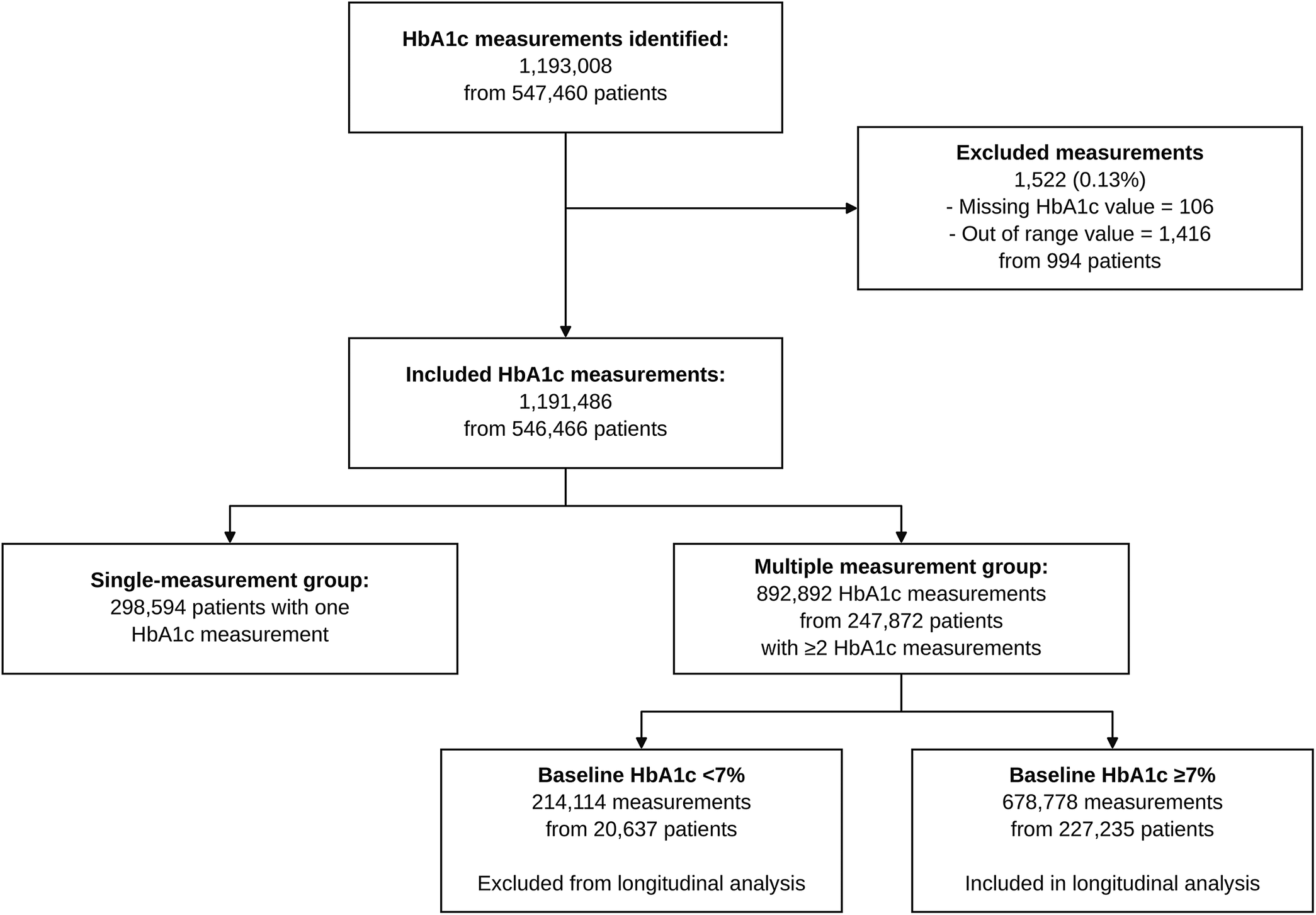
A total of 1,193,008 HbA1c test records from 547,460 adult patients were identified. After exclusion of 1,522 records (0,13%), comprising 106 with missing and 1,416 with out-of-range HbA1c values, 1,191,486 measurements from 546,466 patients were included in the analysis (Figure 1).
Flow diagram showing selection of HbA1c measurements and patients included in the single measurement and longitudinal analyses.

Figure 1. Long description
Flow diagram. In total, 1,193,008 HbA1c measurements from 547,460 patients were identified. Of these, 1,522 measurements (0.13%) from 994 patients were excluded, 106 with a missing HbA1c value and 1,416 with an out-of-range value. The remaining 1,191,486 measurements from 546,466 patients were included. These were divided into a single-measurement group of 298,594 patients with one HbA1c measurement, and a multiple measurement group of 892,892 measurements from 247,872 patients with two or more HbA1c measurements. The multiple measurement group was further divided by baseline HbA1c. Patients with a baseline HbA1c below 7% (214,114 measurements from 20,637 patients) were excluded from the longitudinal analysis, and patients with a baseline HbA1c of 7% or above (678,778 measurements from 227,235 patients) were included in the longitudinal analysis.
The number of HbA1c measurements per patient ranged from 1 to 31. More than half of patients (54.6%) had a single HbA1c measurement only during the study period (Table 1). Among these patients, the majority (75.1%) had an HbA1c <7%, while 24.9% had an HbA1c ≥7% and no follow-up test in the NHLS database within the study period. Single HbA1c measurements were distributed across all study periods, with 40.7% pre-pandemic, 35.1% during the pandemic, and 24.2% post-pandemic, reflecting, in part, the unequal duration of the periods (38.8, 24.3, and 8.9 months, respectively). The proportion with HbA1c ≥7% was 25.8% pre-pandemic, 22.8% during the pandemic, and 26.5% post-pandemic, with a modest reduction during the pandemic.
Cohort characteristics and HbA1c testing patterns by study period

Table 1. Long description
Columns show the pre-pandemic (January 2017 to March 2020; 38.8 months), pandemic (March 2020 to April 2022; 24.3 months) and post-pandemic (April to December 2022; 8.9 months) periods, and the total. In total, 547,460 patients were identified and 546,466 were included after exclusions. Patients with a single measurement numbered 121,443 (40.7%) pre-pandemic, 104,809 (35.1%) during the pandemic and 72,342 (24.2%) post-pandemic, a total of 298,594 (54.6% of included patients). Among these patients, HbA1c was below 7% in 90,096 (74.2%), 80,901 (77.2%) and 53,199 (73.5%), respectively (total 224,196; 75.1%), and 7% or above in 31,347 (25.8%), 23,908 (22.8%) and 19,143 (26.5%) (total 74,398; 24.9%).
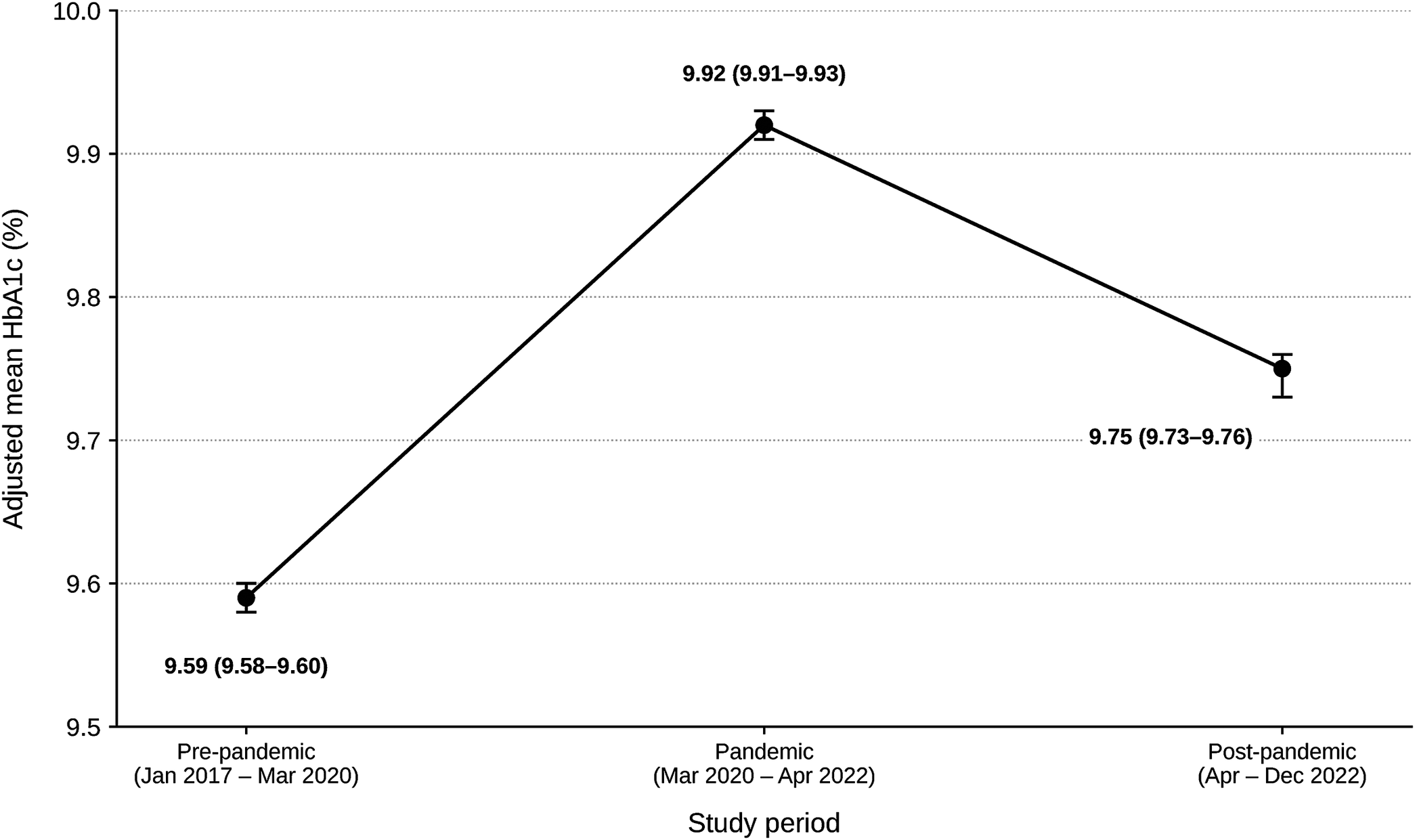
Line graph with study period on the horizontal axis and adjusted mean HbA1c (%) on the vertical axis, scaled from 9.5 to 10.0. Three points, each with a 95% confidence interval error bar, are joined by a line. Adjusted mean HbA1c was 9.59% (95% CI 9.58 to 9.60) in the pre-pandemic period (January 2017 to March 2020), rose to 9.92% (95% CI 9.91 to 9.93) during the pandemic period (March 2020 to April 2022), and fell to 9.75% (95% CI 9.73 to 9.76) in the post-pandemic period (April to December 2022), remaining above the pre-pandemic level. Estimates are from a linear mixed-effects model in patients with a baseline HbA1c of 7% or above and at least two measurements.
Notes: *See Figure 1 for exclusion details.
† Percentages sum across periods. Patients with ≥2 measurements are not assigned to a single study period as measurements may span multiple periods.
‡ Percentages sum within each period.
HbA1c: Glycated hemoglobin.
Adherence to guideline-recommended HbA1c testing intervals was low across all study periods. In the pre-pandemic period, 3.3% of repeat tests were performed within the recommended interval, while 85.9% were performed later than recommended; the proportion classified as too late was higher among patients with a preceding HbA1c ≥7% (89.4%) than among those with a preceding HbA1c <7% (77.7%). This pattern persisted across all periods. During the pandemic, 2.4% of tests were performed at an appropriate interval, and 89.4% were too late; post-pandemic figures were 2.7% and 88.7%, respectively (Table 2).
HbA1c testing interval adherence by HbA1c category and study period

Table 2. Long description
Values are n (%) for pre-pandemic, pandemic and post-pandemic periods. Preceding HbA1c below 7% (totals 78,846; 76,699; 42,918): too soon (under 176 days) 15,422 (19.6), 11,326 (14.8), 6,382 (14.9); appropriate (176 to 190 days) 2,172 (2.8), 1,586 (2.1), 807 (1.9); too late (over 190 days) 61,252 (77.7), 63,787 (83.2), 35,729 (83.2). Preceding HbA1c 7% or above (totals 190,643; 174,562; 81,298): too soon (under 84 days) 13,574 (7.1), 9,255 (5.3), 4,282 (5.3); appropriate (84 to 98 days) 6,683 (3.5), 4,556 (2.6), 2,552 (3.1); too late (over 98 days) 170,386 (89.4), 160,751 (92.1), 74,464 (91.6). Overall (totals 269,489; 251,261; 124,216): too soon 10.8%, 8.2%, 8.6%; appropriate 3.3%, 2.4%, 2.7%; too late 85.9%, 89.4%, 88.7%.
Adherence was classified at the level of individual test intervals from the second visit onwards.
Each interval was assigned to the study period in which the later test was performed.
HbA1c: Glycated hemoglobin.
In the longitudinal analysis restricted to patients with baseline HbA1c ≥7% and at least two measurements, the mixed-effects model included 678,778 observations from 227,235 patients (41.6% of the 546,466 patients in the full cohort); these findings should not be generalized beyond this restricted, repeat-tested group. Compared with the pre-pandemic period, HbA1c increased by 0.33% (95% CI 0.32 to 0.34) during the pandemic and remained 0.15% (95% CI 0.14 to 0.17) above pre-pandemic levels in the available 8-month post-pandemic observation window. Adjusted mean HbA1c increased from 9.59% pre-pandemic to 9.92% during the pandemic and decreased to 9.75% post-pandemic (Figure 2).
Adjusted mean HbA1c (%) by study period in patients with a baseline HbA1c ≥7% and repeated measurements. Points show estimated marginal means from a linear mixed-effects model (678,778 observations from 227,235 patients) adjusted for facility location (metropolitan or non-metropolitan), sequential test number, and testing interval, evaluated at mean covariate values. Error bars show 95% confidence intervals. Study periods: pre-pandemic, January 1, 2017 to March 25, 2020; pandemic, March 26, 2020 to April 5, 2022; post-pandemic, April 6 to December 31, 2022 (8 months).
CI: Confidence intervals.

To identify factors independently associated with glycemic control, a linear mixed-effects model was fitted (Table 3). Higher HbA1c levels were associated with the pandemic and post-pandemic periods, as well as with non-metropolitan facility location. Patients at non-metropolitan facilities had HbA1c values that were, on average, 0.075% higher than those tested at metropolitan facilities. Each successive test was associated with a 0.086% lower HbA1c on average. Testing interval length showed a statistically significant negative association with HbA1c (−0.00013% per day, 95% CI −0.00015 to −0.00011), although the magnitude of this association was clinically negligible.
Linear mixed-effects model: factors associated with HbA1c and adjusted mean HbA1c by study period

Table 3. Long description
Model in patients with a baseline HbA1c of 7% or above; coefficients are HbA1c (%) with 95% CI. Compared with the pre-pandemic period, HbA1c was 0.33 higher during the pandemic (0.32 to 0.34) and 0.15 higher post-pandemic (0.14 to 0.17). Non-metropolitan facility location was associated with 0.075 higher HbA1c than metropolitan location (0.058 to 0.092). Each sequential test was associated with 0.086 lower HbA1c (-0.090 to -0.083), and each additional day between tests with 0.00013 lower HbA1c (-0.00015 to -0.00011). Adjusted mean HbA1c was 9.59% (9.58 to 9.60) pre-pandemic, 9.92% (9.91 to 9.93) during the pandemic and 9.75% (9.73 to 9.76) post-pandemic.
Discussion
This study describes HbA1c testing patterns and glycemic control in the Western Cape public sector across the COVID-19 pandemic. Two principal findings emerged. Testing-interval adherence was poor and largely unchanged throughout the study period, and glycemic control among patients with suboptimal baseline HbA1c worsened during the pandemic, with no full recovery in the available post-pandemic window. Non-metropolitan facility location was also associated with higher HbA1c after adjustment for the other variables in the model. These findings are consistent with the pandemic compounding pre-existing weaknesses in diabetes monitoring in this setting, although the routine laboratory data used here cannot establish the underlying mechanisms.
Adherence to guideline-recommended HbA1c testing intervals was poor across all 3 study periods and did not vary substantially between them, suggesting that the monitoring deficiencies observed during the pandemic were not primarily attributable to lockdown disruption. These findings align with data from other South African provinces. Kone et al. analyzed 705,597 HbA1c results from 511,781 patients tested at public health care facilities in Gauteng between 2015 and 2018, using broader adherence windows (up to 12 months for HbA1c <7%, 6 months for HbA1c ≥7%); they found that only 5% of patients met recommended testing intervals, with 62% tested too late, and the most poorly controlled patients often did not receive a single follow-up test over the 4-year period.Reference Kone, Cassim and Maposa 21 Suboptimal testing frequency has also been documented in high-income settings, though to a lesser extent. Driskell et al. examined 519,664 HbA1c requests from 115,730 patients in United Kingdom (UK) general practice between 2001 and 2011 and found that 51% of repeat requests fell outside guideline-recommended intervals.Reference Driskell, Holland and Hanna 22 The pre-pandemic non-adherence documented in the current study, with 85.9% of repeat tests performed later than recommended, appears considerably higher than the rates reported in the UK; however, this comparison is limited by the narrower adherence window applied in the present study. Despite this, the persistently poor pre-pandemic adherence documented here is consistent with the observation that publication of national guidelines alone has not been sufficient to drive improvements in HbA1c testing frequency in the South African public sector.Reference Kone, Cassim and Maposa 21
Findings on how glycemic control changed during the pandemic have been inconsistent across other studies. Holland et al., using laboratory data from 6 UK sites including 1.68 million patients, estimated that delayed monitoring during the pandemic was associated with an increase in HbA1c of approximately 0.2-0.3% (2-3 mmol/mol) among patients whose testing was postponedReference Holland, Heald and Stedman 18; similar to the 0.33% pandemic-period increase observed in the present study. A Spanish study that included a population of 340,000 compared HbA1c testing and mean HbA1c across 2020 restriction periods against the same periods in 2019.Reference Palanca, Quinones-Torrelo and Girbés 17 Among patients tested in both years, mean HbA1c during full lockdown was significantly lower than in 2019 (7.26% vs. 7.50%, P < 0.0001),Reference Palanca, Quinones-Torrelo and Girbés 17 indicating improved glycemic control; however, this paired-subgroup design excluded anyone not tested in both years and therefore cannot capture deterioration among those not retested. This contrasts with the deterioration in glycemic control observed here. We hypothesize that this difference may relate to limited access to alternative models of care, such as telemedicine and structured outreach in the Western Cape public sector, where patients rely largely on facility-based care; however, this could not be examined with the available data. A South African study across 11 health districts in KwaZulu-Natal compared two 10-month periods before and during the pandemic and found a significant increase in mean HbA1c (8.6% to 8.8%, P < 0.001); however, that comparison was cross-sectional rather than longitudinal.Reference Severaj and Gounden 16 This study extends the literature by following individual patients over time across an 8-month post-pandemic period.
The persistence of elevated HbA1c into the 8-month post-pandemic window, against a pre-pandemic baseline well above 7%, may have clinical relevance. Stratton et al., in the UK Prospective Diabetes Study (UKPDS) 35 observational analysis of patients with confirmed type 2 diabetes, reported that each 1% reduction in HbA1c was associated with a 37% reduction in microvascular complications and a 21% reduction in diabetes-related mortality, with no lower threshold of benefit.Reference Stratton, Adler and Neil 23 Brennan et al., using the same NHLS infrastructure in a comparable population, found a 24% higher adjusted hazard of chronic kidney disease progression among patients with HbA1c >7%.Reference Brennan, Kileel and Khoza 24 Together, these comparator studies suggest that an HbA1c increase of this size, sustained in a population already above target, has been linked to higher risk of renal and microvascular complications, highlighting the importance of restoring consistent HbA1c monitoring in this setting.
The higher HbA1c associated with non-metropolitan facility location is consistent with well-documented inequalities in access to health care between metropolitan and non-metropolitan areas in South Africa, including greater distances to facilities and fewer skilled health care workers, although distance to care and staffing levels were not assessed in this study.Reference Boake and Mash 25 Within the longitudinal model cohort, 35.6% of observations were from non-metropolitan facilities. A related pattern was observed at the facility level in Gauteng, where patients attending primary health care facilities were significantly less likely to achieve glycemic control than those attending hospitals,Reference Kone, Cassim and Maposa 21 which may reflect differences in clinical case-mix and resource availability between facility types.
This study has several strengths. It draws on one of the largest population-based laboratory datasets used to examine HbA1c monitoring in sub-Saharan Africa, encompassing over 1.19 million measurements from more than 546,000 patients over 6 years. The longitudinal design, adjusted mixed-effects modelling, and interval-level adherence classification provide a more detailed characterization of monitoring patterns than previously reported in this region, and the inclusion of an 8-month post-pandemic phase enables preliminary assessment of recovery trajectories not available from earlier South African studies.
Limitations
Several limitations should be noted. The analysis is based solely on laboratory data, without access to clinical records, treatment regimens, or comorbidities. Clinical diagnoses of diabetes were not available, and patients in the longitudinal analyses were identified by a baseline HbA1c ≥7%, which may not correspond to a formal clinical diagnosis in all cases. Including patients without a confirmed clinical diagnosis could affect the apparent monitoring deficit, as some HbA1c tests in this group may have been requested for screening rather than for ongoing diabetes monitoring, and a single screening test would not necessarily indicate an adherence gap. The findings are limited to the Western Cape public sector and may not generalize to the private sector or other provinces. The dataset does not permit differentiation between type 1 and type 2 diabetes or identification of pregnant women, and the 8-month post-pandemic observation period may be insufficient to capture the full extent of recovery. The 14-day window used to classify testing as appropriate is narrow and would be expected to yield lower adherence than broader windows, although comparisons between periods are less affected than the absolute estimates. The absence of formal sensitivity analyses to test this and other operational choices is a further limitation. Several design features may also have influenced the period estimates, including regression to the mean in a cohort selected on an elevated baseline HbA1c, the shorter post-pandemic period, informative retesting, and intervals spanning a period boundary to a single period. Finally, no information was available on patients’ reasons for non-attendance, which limits interpretation of whether the identified monitoring gaps reflect patient, clinician, or system-level factors.
Conclusion
The findings of this study are consistent with the COVID-19 pandemic compounding a substantial pre-existing gap in HbA1c monitoring in the Western Cape public sector. Among patients with a baseline HbA1c ≥7% and at least two measurements, glycemic control had not fully recovered eight months after restrictions were lifted. The higher HbA1c associated with non-metropolitan facility location, together with the high baseline glycemic burden in this population, is concerning. Based on established evidence linking sustained HbA1c elevation to microvascular complication risk, the downstream implications for renal and cardiovascular outcomes in this population warrant serious attention. Diabetes monitoring in the South African public sector should not be treated as a service that can be suspended during a crisis and resumed unchanged afterwards. Building resilience into NCD care is likely to require structural investment that operates continuously. Approaches that may contribute, and that warrant formal evaluation, include decentralized HbA1c testing at the primary care level, integration of monitoring into existing community-based programs, and health care infrastructure that does not depend entirely on patients initiating contact with facilities during periods of system-wide disruption.
Acknowledgment
None.
Author contributions
ECK and AEZ conceptualized the study; the methodology was developed by ECK, AEZ, and TME; statistical analysis was conducted by TME; the original draft was prepared by ECK; review and editing were carried out by AEZ, RTE, and APK. ECK is the guarantor. All authors have read and agreed to the published version of the manuscript.
Funding statement
This research received no specific grant from any funding agency in the public, commercial, or not-for-profit sectors.
Competing interests
RTE has received consulting fees and honoraria for lectures and educational events from Abbott South Africa, BD Africa, and Roche South Africa, and has received travel support from Auto Bio, Wondfo, the European Federation of Clinical Chemistry and Laboratory Medicine (EFLM), and the International Federation of Clinical Chemistry and Laboratory Medicine (IFCC), all unrelated to the submitted manuscript. All other authors have no competing interests to declare.




 Open access

