Democracy promotion has become one of the key elements of Western foreign policy since the Cold War ended, but Western states have not consistently pushed autocratic governments toward liberalization. This variation in Western pressure had important consequences for the spread of democracy: where consistent pressure was applied the chances of democratization were greatest and where democracy promotion was sidelined by other concerns the chances of democratization were much lower.Footnote 1
So how do outside actors, especially those from the West, decide between promoting democracy and condoning authoritarianism in a country? Scholars have posited that Western states face a trade-off between their desire to promote democracy and their own national interests.Footnote 2 Previous research has shown that in economically and politically important countries the West has been more willing to overlook repression.Footnote 3 Likewise, incumbents who have made preliminary moves toward democracy and those who have maintained good relations with the West have felt less pressure to liberalize.Footnote 4 In other words, the West promotes democracy less consistently when the state in question is important and the incumbent is someone the West wants to keep in power.
In this paper we bring opposition parties into the study of democracy promotion. We argue that the calculus of outside actors depends not on their absolute bias toward the incumbent regime, but their relative bias toward the incumbent regime and its challengers.Footnote 5 That is, the decision to promote political liberalization depends on who is likely to replace the incumbent. If the most likely challenger to replace the incumbent harbors suspicious attitudes toward democracy and international cooperation, then outsiders will be more likely to turn a blind eye to the incumbent's electoral manipulation. We propose that in the post-Cold War period the most “dangerous” challengers from the West's perspective have been Islamic political parties, by which we mean parties seeking to increase the role of Islam in political life.Footnote 6 Islamic parties often contest elections in the geostrategically important Middle East and North Africa (MENA) region and have proved electorally viable in several countries, including Turkey, Morocco, and Tunisia.Footnote 7 The Islamic parties’ hawkish views on Israel and the USA, combined with doubts about these parties’ commitment to democracy have made them threatening to outsiders.Footnote 8 A crucial factor exacerbating this problem is Islamist terrorist attacks. In countries targeted by violent Islamist groups both domestic and international actors will have greater doubts about Islamic parties’ willingness and ability to restrain radicals. Therefore, we expect that international observers will tolerate electoral manipulation more when facing the combination of an Islamic opposition party and an ongoing Islamist terrorist campaign.Footnote 9
As illustration consider the 1995 and 2000 presidential elections in Tanzania. The two elections are similar in that the main opposition party was the Civic Union Front (CUF), which primarily represents Muslims and faces accusations by the incumbent party Chaca Cha Mapinduzi (CCM) of religious extremism.Footnote 10 In both elections the ruling party won and the CUF claimed fraud.Footnote 11 Moreover, respected international monitors also considered both elections as flawed.Footnote 12 Yet whereas none of the international monitors endorsed the 1995 election, in 2000 two of the four monitors announced that they considered election quality acceptable. The key difference, we argue, was the 1998 Al-Qaeda attacks against US embassies in Kenya and Tanzania, which killed more than 200 people and brought Al-Qaeda to the attention of the US government. The attacks highlighted the threat of religious fundamentalism in Africa and led to counterterrorism cooperation between Tanzania and the US.Footnote 13 In short, by 2000 Tanzania was a country where an Islamic opposition party contested elections and Islamist terrorists were active. We explore whether in other countries under similar circumstances international election monitors display an anti-Islamic bias in their evaluations.
We test this hypothesis in the context of election monitoring, a core component of democracy promotion. We find that, conditional on the extent of electoral irregularities, international monitors are more likely to endorse an outcome if the incumbent regime faces both an Islamic challenger and an ongoing Islamist terror campaign. If a country is not suffering from any terrorism, or existing terrorist groups are non-Islamist, then we do not observe any bias against Islamic opposition parties. We further present evidence that this pattern of behavior is displayed only by Western monitors and is absent for non-Western monitoring organizations. We show that the bias existed prior to the 11 September 2001 attacks, but becomes stronger after 9/11, when the War on Terror began and stopping radical Islam became a priority for the West. In sum, our findings support the idea that Islamist terrorism makes Islamic parties suspect in the eyes of Western observers and leads them to overlook electoral fraud committed against Islamic challengers.
Our paper contributes to the literature on foreign interventions in domestic affairs and the literature on election observer bias. Domestic sovereignty is a frequently violated norm. For instance, during the Cold War the US and the Soviet Union used their economic and military power to destabilize each other's allies and prop up their own.Footnote 14 After the Cold War direct military interventions became less common and elections have become the legitimate method of changing governments. In this context foreign powers could help their allies remain in power by giving funding to their favored candidate, making promises of aid conditional on their ally's victory, or ignoring electoral abuses committed by their ally.Footnote 15 We contribute to this important literature by examining how violent groups can influence outsiders’ perceptions of political candidates (e.g., Islamic opposition parties) and affect international actors’ incentives to endorse or reject fraudulent elections.
With regard to the literature on election observer bias, we build on Kelley's work.Footnote 16 Like Kelley, we argue that whether international monitors endorse an election or not does not solely depend on its quality, but also on the interests of their member states, donors,Footnote 17 or other tangential organizational norms.Footnote 18 We expand Kelley's work by looking at a previously ignored election-specific factor in this literature—that is, the type of electoral challenger.Footnote 19
Election Monitor Bias, Islamic Opposition, and Islamist Terrorism
We first theorize which factors can influence an election monitor's decision to endorse or reject an election outcome. We then argue that in the post-Cold War era distrust toward Islamic parties has made election monitors more likely to endorse fraudulent elections in which Islamic opposition parties challenge the incumbent. Finally, we argue that the threat perception of Islamic parties is heightened by domestic and international Islamist terrorism.
The Trade-Off Between Stability and Democracy Promotion
The basic premise of our argument is that election quality is not the only factor international monitors take into consideration when deciding whether to endorse or oppose an election outcome. Election monitors also consider the interests of member states or major donors.Footnote 20 In particular, we argue that election monitors face a trade-off between democracy promotion and international stability in the post-Cold War period. Whereas stable countries present more opportunities for cooperation, democratization brings new groups into politics and can be turbulent.Footnote 21 Although fears of communist takeovers have disappeared with the end of the Cold War, decision makers continue to recognize the tension between stability and democratizationFootnote 22 because negative evaluations may destabilize a regime in the aftermath of elections.Footnote 23
A monitor's preference for stability depends essentially on its bias toward the incumbent relative to alternatives. The choice between endorsing a problematic election and rejecting it is equivalent to a choice between continuing relations with the incumbent versus supporting an alternative and establishing a new relationship. So the better the relations with the incumbent, the more concerned a monitor's key donors might be about upsetting political and economic relations, and the more likely the monitor is to endorse an election.Footnote 24 However, outsiders’ fondness for the incumbent is not the only relevant factor here. Their views toward the challengers also matter.Footnote 25 If challengers include parties with unfriendly ideologies and militant wings, combined with a significant chance of gaining power, then the importance of maintaining stability increases. A monitor may support an authoritarian regime not because the incumbent provides any real benefits, but because destabilizing him/her may bring to power an even worse actor—from the perspective of key members or donors.Footnote 26 In short, the calculus of monitors inevitably includes who the opposition parties are and whether they have a significant chance of gaining power through elections.
Islamic Parties’ Political Goals and Credibility Problem
In the post-Cold War era many scholars see Islamic opposition parties as a threat to political stability because they are popular and espouse potentially disruptive political goals. There are several explanations for why Islamic movements are better than other groups at gaining popularity.Footnote 27 First, Islamic parties’ strong emphasis on honesty and fairness appeals especially to people who live in poor and often corrupt societies.Footnote 28 Second, Islamic political parties are usually related to grassroots organizations that provide local public goods, which in turn lend them a good reputation.Footnote 29 Third, Islamic parties have often been allowed to exist while other forms of non-state groups were repressed.Footnote 30 Hence, their ideological appeal, grassroots service, and reputation for good governance make Islamic parties electorally viable and dangerous to unpopular incumbents.
In addition to their popularity, Islamic parties’ domestic and foreign policy goals also raise concerns. In foreign policy, potential problems are that most Islamic parties have mentioned jihad in their party platforms and opposed Israel, a close ally of the West and the US in particular.Footnote 31 Coupled with Huntington's famous “clash of civilizations” thesis,Footnote 32 these party platforms have raised the suspicion that if Islamic parties come to power they may pursue aggressive policies toward the West and its allies, much like postrevolution Iran has done.Footnote 33 In domestic politics, some have suspected that Islamic parties pretend to be democratic and compete in elections until they achieve the power to use more forceful methods.Footnote 34 If true, this could have severe negative consequences for international actors, especially in the MENA region, which is geostrategically important for the West.
This does not mean that Islamic political parties are seen as a dire threat to democracy at all times and places. Our main point is that there has been mistrust toward Islamic movements that is difficult to dispel. Whether this mistrust creates bias in election monitors’ evaluations is influenced by other contextual factors, most importantly, Islamist terrorism.
Islamist Terrorism and Heightened Threat Perception
We expect Islamic parties’ credibility problem and outsiders’ bias toward them to be more severe in countries where Islamist terrorist groups operate. Islamist terrorism can have this effect by magnifying the perceived threat of Islamic parties’ electoral participation.
First, terrorism discredits moderates, which is one of the primary goals of violent extremists and they are more likely to succeed when outsiders do not have much trust toward the moderates to begin with.Footnote 35 Note that these effects do not require the terrorist group to be very large or the violent campaign to be sustained for long. Even a small group of terrorists can have a considerable impact because cognitive mechanisms, such as availability bias, lead people to overreact to threats.Footnote 36
Moreover, incumbents have often used Islamist terrorist attacks as an opportunity to repress and weaken a powerful challenger under the guise of counterterrorism.Footnote 37 In Tanzania, following the controversial 2000 election mentioned in the introduction, government security forces used force to suppress demonstrations against electoral fraud resulting in at least thirty people killed and hundreds injured. Tanzanian officials claimed that their response was justified because “protests had been encouraged by Islamist fundamentalists with ties to Osama bin Laden … [and they were] an attempted coup d'etat,” but a Human Rights Watch report contradicts this account.Footnote 38 Outside observers may be receptive to such government claims because Islamic opposition parties often have ties to violent Islamist groupsFootnote 39 and outsiders lack the intelligence capabilities and mandate to conduct independent investigations in these countries.
In short, Islamic opposition parties, especially in combination with Islamist terrorism, may be perceived by the West to present a greater threat to stability than most other challengers. As foreign governments care more about keeping Islamists out of power, they can also push election monitors to be more tolerant to incumbents who electorally suppress Islamic parties. Combining these arguments leads to our main prediction: if an election-monitoring organization values stability over democratization, then it will be more tolerant toward fraud in elections involving an Islamic challenger and Islamist terrorism than those without Islamic opposition or non-Islamist terror. As we argue that the West is more likely to value stability over democratization, we expect Western monitors to be significantly more lenient toward fraud committed against Islamic opposition parties than non-Western observers.
So far we have discussed the role of domestic terrorism but transnational Islamist terrorism can also heighten threat perceptions. The primary example of transnational Islamist terrorism are the 9/11 attacks, which changed the course of US foreign policy. The attacks on 9/11 demonstrated terrorists’ ability to inflict large-scale attacks in Western countriesFootnote 40 and “reinforced the apprehensions of the US foreign policy establishment about all Islamists.”Footnote 41 After 9/11, an Islamic party with ties to radicals is not only a threat to its own country's stability but also a potential supporter of global terrorism. Given these new risks, in the post-9/11 era we expect the relative importance of stability to increase and election monitors to become more tolerant toward fraud committed against Islamic opposition parties, especially when the country in question has an ongoing Islamist terrorist campaign.
Research Design
Data
Our unit of analysis is an organization-election between 1990 and 2004, that is, an election judged by a monitoring organization from January 1991 to December 2004. We limit our analysis to the post-Cold War period, as geopolitical concerns of the West during the Cold War overshadowed the stability-democracy tradeoff crucial to our argument and election monitoring became an international norm during that period.Footnote 42 Monitoring organizations include intergovernmental (IGOs) and nongovernmental organizations (NGOs) that publish their reports within three months of an election, based on collected information from in-country observers before, during, and after a poll. Later we distinguish between Western and non-Western organizations based on their membership (for IGOs) or the location of their head office (for NGOs).Footnote 43
Our outcome measure denotes whether an organization endorses the election outcome or not. This dichotomous variable, acceptable, reflects an organization's summary assessment. It is a dichotomous version of the three-level election quality variable in the Dataset on International Election Monitoring (DIEM).Footnote 44 Acceptable takes the value of 1 only if the monitor's report explicitly endorses the outcome and 0 if the report was either ambiguous about the quality of an election or deemed it unacceptable.Footnote 45
Our measure of electoral irregularities is the problems variable from the DIEM,Footnote 46 which ranges from 0 (“no problems”) to 3 (“major problems”). This variable is comprehensive in scope, including problems in the country's legal framework, problems in the pre-election period, and the election day itself. By including this variable we are able to estimate the effect of Islamic opposition parties, Islamist terror, and their interaction on an organization's endorsement of an election, conditional on the extent of electoral problems an organization identified. If monitors made their decision to endorse or reject an election exclusively on the extent of electoral problems, then the coefficient estimates of all other variables should be close to 0 and statistically insignificant.
Data on Islamic opposition parties are based on a list of all Islamic parties between 1968 and 2008, where an Islamic party is defined as a party that “seeks to increase the role of Islam in political life.”Footnote 47 To arrive at our islamic opposition party variable, we identified all Islamic parties out of government on Kurzman and Naqvi's list.Footnote 48 This dichotomous variable is coded 1 if there is an Islamic opposition party in the country and 0 otherwise.Footnote 49
Our terrorism measures are based on the RAND Database of Worldwide Terrorism IncidentsFootnote 50, which compiles data on terrorism from around the world for the entire period we study. Following Jones and Libicki, we distinguish between Islamist and non-Islamist organizations in this database and calculate, for each election, the number of killings committed by Islamist and non-Islamist groups in that country in the preceding year.Footnote 51 These numbers, islamist terrorism and non-islamist terrorism, are our primary measures of terrorist activity.Footnote 52
Although our hypothesis is about the interaction of islamic opposition and islamist terrorism we also control for non-islamist terrorism and its interaction with islamic opposition. This is necessary to ensure that our islamist terrorism variable does not simply capture a country's overall political instability.
As controls we include a number of country-and election-specific variables. We include the percentage of a country's muslim populationFootnote 53 to capture cultural factors that may be correlated both with the level of electoral fraud and the rise of Islamic challengers. We control for a country's overall level of democracy using the polity2 variable from the Polity IV data setFootnote 54 to isolate the effect of electoral fraud on monitors’ endorsements. We also include indicators for first multiparty, transitional, postconflict, and postcoup elections from the DIEM.Footnote 55 Kelley has shown that monitors are more likely to endorse such elections and Islamic challengers are more likely to emerge in these settings.Footnote 56 By a similar logic we also control for the change in democracy in the last year.Footnote 57 We include infant mortality rateFootnote 58 as a measure of a country's well-being, which may again be correlated with both fraud and the presence of Islamic parties. We also control for pre-election violence as reported in the DIEM, which may be correlated with terrorist campaigns and electoral misconduct.Footnote 59 Our legislative election variableFootnote 60 distinguishes between different types of elections because those may differ in terms of opposition groups’ participation and electoral fraud.
Finally, we include four measures of donor interest. The first is the logged value of a country's oil production because oil is a strategically valuable commodity and its production is correlated with both Islamic party presence and electoral fraud.Footnote 61 We also use a country's (logged) total trade and total gdp, which capture a country's importance for global trade and market size.Footnote 62 Our fourth measure is former colony, which is coded 1 for former colonies of France and the UK, 0 otherwise.Footnote 63 Overall, our sample includes elections from ninety-three countries and twenty-one organizations over fourteen years. Of the 511 organization-elections, an Islamic opposition was present in thirty-eight (i.e., 7%).
Statistical Model
We estimate linear regression models, which are as good as nonlinear models at estimating marginal effectsFootnote 64 and, importantly, allow us to include country fixed effects to control for time-invariant country-specific factors without sacrificing sample size.Footnote 65 We estimate the following equation:
 $$\eqalign{{\smallcaps {\rm ACCEPTABLE}} & = \beta _0 + \beta _1\,{\smallcaps {\rm PROBLEMS}} + \beta _2\,{\smallcaps {\rm ISLAMIC\;OPPOSITION}} \cr & \quad + \beta _3\,{\smallcaps {\rm ISLAMIST\, TERRORISM}} + \beta _4\,{\smallcaps {\rm NON\hbox{-}ISLAMIST\;TERRORISM}} \cr & \quad + \beta _5\,{\smallcaps {\rm ISLAMIST\;TERRORISM}} \times {\smallcaps {\rm ISLAMIC\;OPPOSITION}} \cr &\quad + \beta _6\,{\smallcaps {\rm NON\hbox{-}ISLAMIST\;TERRORISM}} \times {\smallcaps {\rm ISLAMIC\;OPPOSITION}} \cr & \quad+ \; {\bi X}\beta + {\rm \varepsilon}.} $$
Our argument predicts β 5 to be positive and statistically significant.
Results
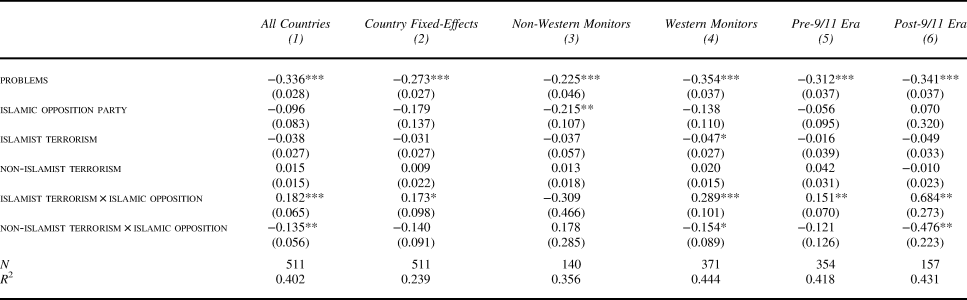
Models 1 and 2 in Table 1 show the estimates for monitors’ election evaluations (pooled and with country-fixed effects). In models 3 and 4 we separate the sample into non-Western and Western monitors to show that the effects are driven mainly by Western monitors. In models 5 and 6 we show that the effects are stronger after the September 11 attacks. All models include the full list of country-and election-specific controls. Standard errors are clustered at the country level.
Impact of Islamist terrorism on election monitors’ Islamic opposition bias

Notes: All regressions include the following control variables: muslim population percentage, level of democracy (polity), change in level of democracy, infant mortality rate, first multi-party election indicator, transitional election indicator, post-civil war election indicator, pre-election violence indicator, legislative election indicator, former colony indicator, country's logged oil production, total trade, total gdp, and postcoup election indicator. Country-clustered robust s.e. in parentheses. * p < .10, ** p < .05, *** p < .01.
Consistent with our theory, the interaction between islamic opposition and islamist terrorism has a positive effect on monitors’ evaluations in both models 1 and 2. This indicates that in countries with an Islamic opposition party, election monitors become more likely to endorse an election as the level of Islamic terrorism increases. Since our models take the underlying level of irregularities into account, this evidence suggests that monitors display greater bias against Islamic movements in countries with Islamist terrorist groups. Note that the coefficient sizes do not differ greatly between models 1 and 2, even though in the latter we include country fixed-effects to absorb all time-invariant country-specific differences such as culture and colonial history. The stability of the coefficient suggests that our finding is quite robust and that the estimated effect in model 1 is predominately a result of within- rather than between-country variation.
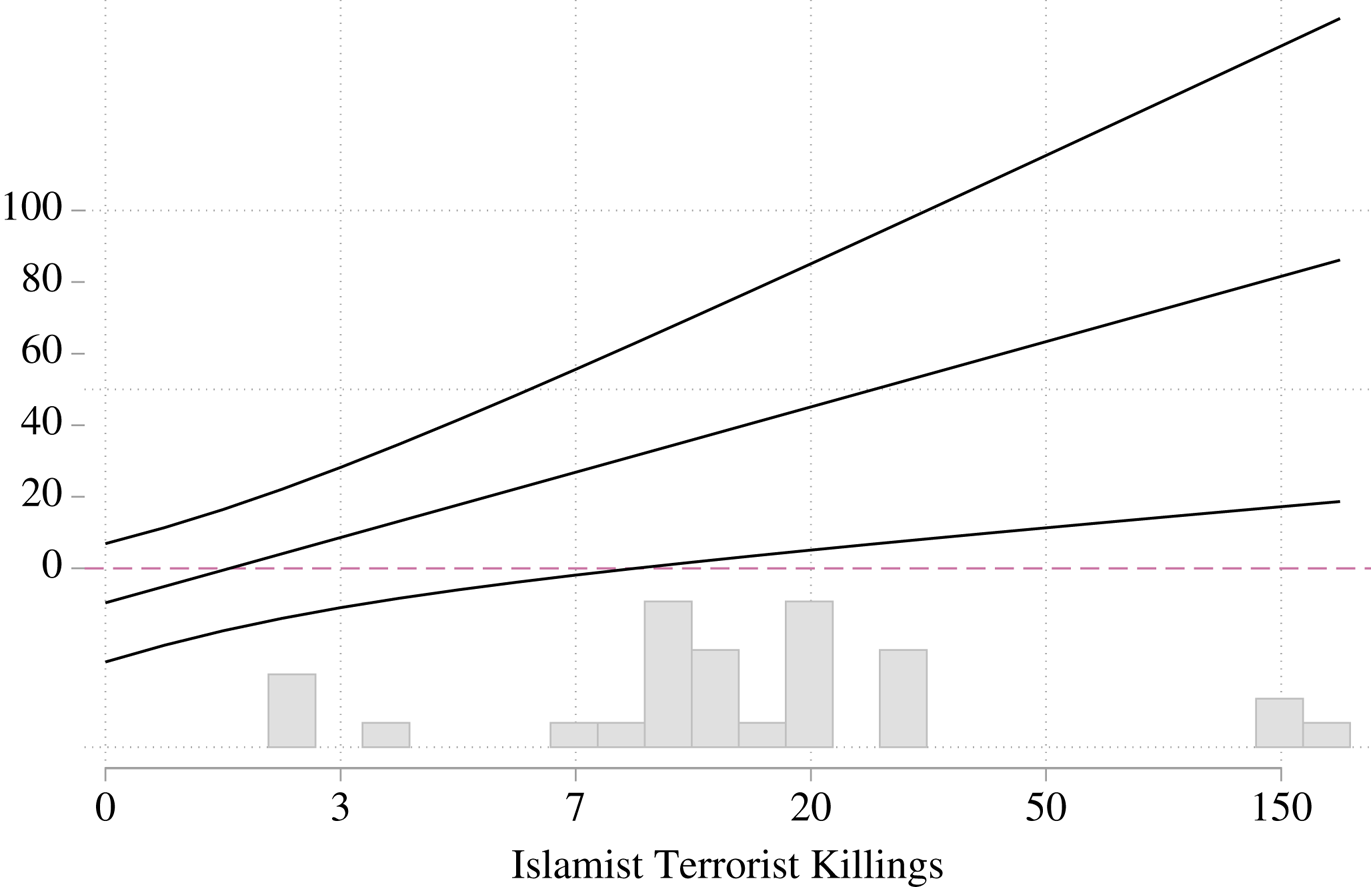
To get a better sense of size we calculate marginal effects based on model 1. Figure 1 shows the marginal effect of Islamic opposition participation for different levels of Islamist terrorism on the probability of endorsement by international monitors with 95 percent confidence intervals. The histogram in the bottom shows the distribution of islamist terrorism in our sample.
Marginal effects of Islamic terrorism and Islamic opposition participation

Note that the presence of an Islamic opposition party does not seem to matter much if there is no Islamist terrorism. The marginal effect of Islamic opposition participation is about negative ten percentage points if there is no ongoing Islamist terrorist campaign, but the confidence interval for this estimate includes 0. We observe the most dramatic effect when Islamic opposition parties and Islamist terrorists are jointly present. In a country that suffered ten casualties to Islamist terrorism in the preceding year the marginal effect of Islamic opposition participation is about thirty percentage points. As the number of Islamist terrorist killings reach about fifty the marginal effect of Islamic opposition reaches seventy percentage points, making an endorsement virtually certain.
Returning to Table 1, in models 3 to 6 we explore variation between election monitors and across time.Footnote 66 Models 3 and 4 show that this anti-Islamic bias is absent in judgments of non-Western election monitors but displayed by Western observers. For non-Western monitors the main coefficient of interest, islamist terrorism × islamic opposition, switches signs and is imprecisely estimated. In contrast, the regression coefficients for Western monitors are similar to those in models 1 and 2: in particular, islamist terrorism × islamic opposition has a large positive impact on Western monitors’ endorsements. These results support our argument that Western organizations are especially concerned about the danger Islamic movements pose to stability and that these concerns, when compounded by Islamist terrorism, will influence their evaluations of election quality.
Models 5 and 6 show that this bias gets stronger after 2001, when the 9/11 attacks on the US magnified the threat posed by radical Islam. While the estimate for islamist terrorism × islamic opposition is consistently positive, the coefficient in model 6 is almost five times as large, indicating that the impact of the combination of Islamic opposition and terrorism on electoral endorsement is significantly larger in the post-9/11 era. Interestingly, all other coefficients related to terrorism in model 6, except for islamist terrorism × islamic opposition are negative, suggesting that outside observers do not become more tolerant to fraud by incumbents fighting terrorism in general; they become more likely to endorse elections only where Islamic opposition parties and Islamist terrorism are jointly present.Footnote 67
Robustness
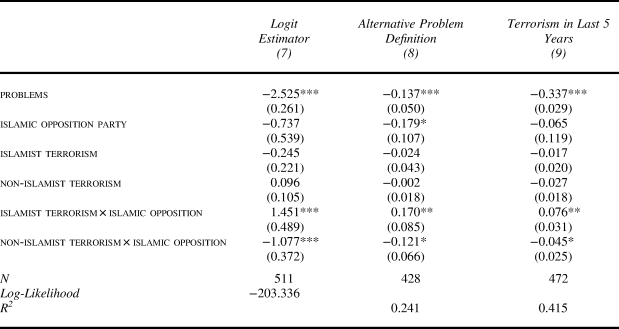
Our findings are quite robust. Table 1 reports linear probability models, but given the dichotomous nature of our dependent variable some might consider a Logit estimator a more appropriate choice. Model 7 in Table 2 shows that the Logit estimator produces qualitatively similar effects.Footnote 68 Logit analyses on the differences between Western and non-Western monitors and pre-and post-9/11 eras are provided in Appendix Tables A.6 and A.7. The appendix also includes tests using a three-category version of our dependent variable and the Ordered Logit estimator (see Appendix Table A.5). Our results hold in every case.
Robustness of Monitors’ Islamic Opposition Bias

Notes: All regressions include the full set of control variables listed in the notes of Table 1. Country-clustered robust s.e. in parentheses. * p < .10; ** p < .05; *** p < .01.
Next, we assess the implications of incumbents strategically choosing the level of fraud. An incumbent favoured by outsiders may commit more fraud in order to take advantage of their bias. Our model accounts for this by controlling for a monitor's own assessment (problems). However, it is possible that election monitors adjust their reporting of irregularities to justify their summary evaluation. For this reason, we re-estimate our model using a measure of electoral irregularities obtained from a different source, the National Elections in Democracies and Autocracies (NELDA) data set.Footnote 69 For maximum coverage we focus on two indicators of electoral fairness: whether opposition leaders were prevented from running and whether the government harassed the opposition. Adding these two variables gives us a three-level index on the extent of electoral irregularities. Model 8 in Table 2 shows that our main finding is robust to replacing monitors’ problems measure with this alternative, which suggests that strategic reporting of underlying irregularities is not biasing our findings.
So far we have measured terrorist activity by counting the number of killings in the year before elections. A one-year window may be shorter than what observers use to assess the threat of radical Islam in a country. All of our results are robust to counting the number of killings in the last five years (model 9 of Table 2). We also look at the number of attacks as a measure of terrorist activity. Although our estimates on the full sample remain similar, differences between subsamples are no longer statistically significant. From this discrepancy we infer that outsiders pay more attention to the deadliness of terrorist activity than to its frequency (see Appendix Table A.26).
Despite controlling for potential confounders, we cannot rule out the possibility that unobservable factors lead us to mistakenly identify a significant association between our key variables. To assess the likelihood that our observed effect is solely due to selection bias, we follow a procedure proposed by Altonji, Elder, and Taber and adapted to linear regressions by Bellows and Miguel.Footnote 70 We calculate the absolute ratio of the coefficient estimated in a full model with all controls to the difference between the coefficient of the full model and the one obtained from a restricted model, controlling only for problems. The result indicates how much greater the effect of potential unobservables would need to be relative to the included observables in order for the coefficient estimate to be 0. Table 3 presents the ratios on the main interaction of interest for the four main models in Table 1. None of the six ratios presented in Table 3 are smaller than 1 and they range from 1.86 to 14.22, with a median ratio of 2. Hence, the selection effect of any unobservables would have to be at least 1.86 times greater than selection on observables and, across all four models, almost two times greater. This makes it unlikely that the estimated effect of islamist terrorism × islamic opposition can be fully attributed to omitted variable bias.
Using selection on observables to assess the bias from unobservables (Table 1)

We conducted several additional robustness checks that we summarize here. Details are provided in the appendix. First, we show in Appendix Figures A.2 to A.5 that our findings are not driven by a specific election or country: re-running our analyses while excluding one election or country at a time does not change our findings. Likewise, omitting from the sample the following types of observations does not weaken our results: countries with a small Muslim population (and therefore without a realistic chance of Islamic parties emerging) (see Appendix Table A.8); elections that are noncompetitive (and therefore without a need for outsiders to worry about opposition victory) (see Appendix Table A.9); countries that experienced very high levels of Islamist terrorism recently (see Appendix Table A.10); countries where the incumbent has hostile relations with donor countries (and therefore outsiders’ concern for stability is low) (see Appendix Table A.11). Including additional measures of donor preference (e.g., similarity of UN voting profiles) for the incumbent does not change our findings either (see Appendix Table A.12).
Second, we conduct a series of tests related to how monitor organizations select which elections to observe. To test whether differences in organizations that attend elections with and without Islamic parties are driving our findings, we include monitor fixed effects to purge “between-observer” variation; our results shown in Appendix Table A.13 continue to hold based purely on “within-observer” variation. By a similar logic, might our result be due to strategic monitoring decisions? If observers avoid problematic elections in friendly regimes so that they will not have to write a critical report, then that would make it harder for us to find a discrepancy between their summary judgement and their list of observed irregularities.Footnote 71 Nevertheless, we run a Heckman selection model, which separately estimates the probability of an organization observing an election (selection stage) and, if the election is observed, the evaluation of its quality (outcome stage).Footnote 72 To satisfy the identification requirement we include in the first-stage global election count, which is the annual number of elections held in countries that are not full democracies. The rationale for this variable is that an organization is less likely to observe a particular election in a more crowded year because monitoring missions are costly and observer organizations have limited resources. As shown in Appendix Table A.15 our main variable, islamist terrorism × islamic opposition, continues to raise the likelihood of endorsement, but it does not seem to have an effect at the selection stage.
Third, it is possible that monitoring organizations are reluctant to contradict each other. We conduct two analyses to check whether this kind of “bandwagoning” behavior drives our results. We cluster standard errors by election to account for correlation at the election level. We then design a test based on the assumption that bandwagoning is more likely within clusters of Western and non-Western organizations than across them. For each election we randomly select one Western and one non-Western organization that observed that election and run our analysis on this subsample.Footnote 73 The threat of bandwagoning inflating our estimates should be smaller in this subsample. Our findings shown in Appendix Tables A.16 and A.17 continue to hold in both tests.
Fourth, Kelley's DIEM starts in 1984.Footnote 74 Although our theory applies primarily to the post-Cold War period when donors’ concern for democracy is relatively higher, we check and show that our findings are similar if we extend the analysis to 1984 (see Appendix Table A.18).
Fifth, the results are robust to using an alternative measure of islamic opposition party based on the Database of Political Institutions.Footnote 75 This is a more restricted measure because it codes the religious identity of only the largest opposition party in a country and excludes political parties that are banned. Nevertheless, we continue to find similar patterns using this alternative measure (see Appendix Table A.19).
Sixth, we check that there is a linear interaction effect, that is, the effect of Islamic opposition parties is greater for higher levels of Islamist terrorism as hypothesized. We show in Appendix Tables A.20–A.22 that the interaction effect is stronger for high levels of Islamist terrorism compared to low and zero Islamist terrorism.
Finally, we test whether IGOs and NGOs evaluate elections with Islamic parties differently but we do not find significant differences. NGOs are often more independent than IGOs, but still have close ties to donor states through funding and leadership.Footnote 76 Consequently, it is not surprising that NGO and IGO monitors share similar concerns regarding stability and democracy in elections (see Appendix Table A.23).
Conclusion
We investigate which factors determine outside observers’ decision to endorse or reject an election's outcome. We provide empirical evidence that election observers in the post-Cold War period are more likely to accept problematic elections in which Islamic opposition parties participate while an Islamist terrorist campaign is ongoing. We show that this conditional bias is particularly strong for Western observers. We also show that the effect has become stronger after 2001, when the USA began its War on Terror.
Together these findings provide important clues about the powerful political forces that influence even seemingly independent observers of democratic processes. In countries mired by violent Islamist terrorist campaigns, many Western observers saw Islamic opposition parties as a risk to stability and this led observers to endorse elections that they would otherwise reject. This observation resembles the trade-offs Western countries perceived between promoting democracy and maintaining friendly regimes during the Cold War. The broad lesson is that when “taking sides in other people's elections,”Footnote 77 outsiders’ calculus is based not only on their relations with the incumbent, but their relative bias toward the incumbent and the challengers.
Our work has important policy implications in light of recent work on what makes voters believe election monitors. Bush and Prather present evidence that voters are less likely to believe the assessment of monitors that are seen as biased.Footnote 78 If voters recognize that international monitors have a bias against Islamic opposition parties, this recognition will undermine monitors’ credibility and reduce their ability to inform voters about election quality. Regardless of the validity of suspicions about Islamic parties, outsiders should consider separating election monitoring and combating extremism to avoid unwanted outcomes.
With regard to future research, it will be interesting to see if our theory applies to other forms of outside interventions in elections.Footnote 79 For instance, Kersting and Kilby show that World Bank lending responds to upcoming elections in borrowing countries.Footnote 80 A testable implication of our theory is that World Bank lending should be quicker and more generous in countries with an Islamic challenger and an ongoing Islamist terrorist campaign. Second, our research raises the question of how non-Western powers such as Russia and China perceive different types of challengers as these powers intervene in elections in other countries. Third, our research highlights the important effect terrorist groups can have when an ideologically related party is participating in elections. It will be fruitful to explore when political parties disown ideologically related violent groups and what strategies they use to signal their credibility to domestic and international audiences.
Supplementary Material
Supplementary material for this article is available at <https://doi.org/10.1017/S002081831900033X>.
Acknowledgments
We thank Carly Beckerman, Inken von Borzyskowski, Florian Foos, Emre Hatipoglu, Mohsin Hossain, Judith Kelley, Nikolay Marinov, and Elizabeth Nugent as well as participants at the “Election Fraud and Monitoring” panel at EPSA 2015 and the miniconference on “Great Powers and Democracy” at APSA 2016 for generous and helpful feedback on earlier versions of the paper.