- HPT
W. Gs. Hellinga and Lotte Hellinga-Querido, Fifteenth-century printing types of the Low Countries, Amsterdam 1966
- ILC
Gerard van Thienen and John Goldfinch, Incunabula printed in the Low Countries: a census, Nieuwkoop 1999
- Liber authenticus
Liber authenticus sacratissimae utriusque sexus christifidelium confraternitatis septem dolorum beatae Mariae virginis nuncupatae (City Archives, Brussels, ms 3413)
- NK
Wouter Nijhoff and M. E. Kronenberg, Nederlandsche bibliographie van 1500 tot 1540, The Hague 1923–61. All translations are our own
In 1482, at the age of twenty-five, Mary, duchess of Burgundy (1457–82), died after a fall from her horse. This human tragedy set in motion a chain of urban revolts that would last a decade and would have a profound impact on the political future of the Burgundian territories in the Low Countries. The conflict basically centred around the question of how to define rulership and, more particularly, how to define the relationship between the subjects and their prince in this highly urbanised region: would the Low Countries remain a loose personal union of territories and cities with strong regional and local privileges or would they be ruled as a unified territory by an autocratic prince? Mary's son and heir, Philip the Fair (1478–1506), was only a small child at the time of the duchess's fatal accident, but he was considered to be the prince naturel by all parties.Footnote 1 These parties, the county of Flanders in particular, did not agree, however, on who should assume the regency during the minority of the prince: Mary's ambitious but foreign widower, Maximilian of Austria (1459–1519), or a regency council with representatives from the nobility and the cities. Eventually, frictions between Maximilian and the Flemish regency council evolved into open war. In the following years, other Burgundian territories entered the war, factional strife broke out and treaties were constantly made and broken. Finally, Maximilian's overwhelming military force ended the conflict in 1492. Philip, still a teenager, was inaugurated in his various territories in 1494.Footnote 2
Maximilian's troops could conquer the Burgundian territories, but could the hearts and minds of its inhabitants be conquered as well? Far too little attention has been paid to the coordinated efforts that Maximilian of Austria (King of the Romans in 1486 and emperor-elect in 1508) and Philip the Fair made in the years following the wars to pacify urban society and to appropriate its institutions and its media for political and dynastic purposes.Footnote 3 It will be argued that the propagation of the devotion of the Seven Sorrows of the Virgin Mary played a crucial part in this larger strategy. It may come as no great surprise that the court resorted to religious imagery to communicate with its subjects. In 1430 the Burgundian duke Philip the Good (1396–1467) had instituted the Order of the Golden Fleece, which from its very inception was successful in tying high-born nobles to the dynasty through an elaborate mix of biblical and chivalric symbolism.Footnote 4 Even more explicitly, devotion had already been used in urban contexts by other contemporary rulers in order to forge political allegiances. Medici Florence is an evident example, with among others the cult of the Magi.Footnote 5 Particularly relevant for the discussion is the institution – with the direct support of Maximilian's father Emperor Frederick iii (1415–93) – of the confraternity of the rosary in Cologne in 1475, in thanksgiving for the ending of the year-long siege of Neuss.Footnote 6 The devotion of the Seven Sorrows was directly inspired by the rosary devotion, but it was more overtly political and exploited an even greater array of old and new media to attract worshippers. The ultimate goal of this devotional interaction was to create within the Low Countries, and more particularly in their core regions (Flanders, Brabant, Holland and Zeeland), a large spiritual and emotional community that identified with the Burgundian-Habsburg dynasty and its ideology of peace and territorial unity. This strategy of creating political allegiance through devotional communication was successful, albeit temporary, because it tapped into real psychological needs and made clever use of existing urban networks.
Meditation: images and texts
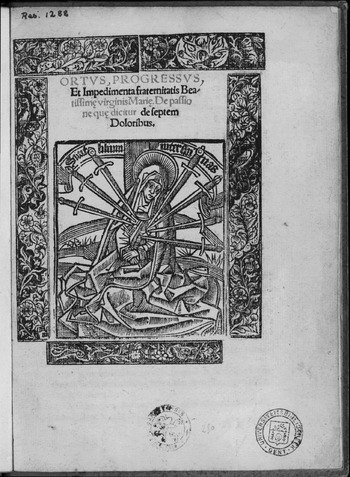
Whereas the sorrowing Virgin had been an object of devotion for centuries, there can be no doubt that the institution of the cult of the Seven Sorrows of the Virgin Mary was a deliberate act, undertaken by clerics with close ties to the Burgundian-Habsburg rulers.Footnote 7 The devotion was created by the cleric Jan van Coudenberge (d.1521), a secretary of Philip the Fair.Footnote 8 In a history of the confraternity of the Seven Sorrows that he wrote in 1519 at the request of Charles v (1500–58), Van Coudenberge relates how near the end of the rebellions against Maximilian of Austria, when the Low Countries were divided by civil war, many depressed people had found solace by meditating upon the pains and fears that the Holy Virgin had suffered for her only son (see Figure 1). Thereupon, Van Coudenberge had decided to commission copies of icons of the Virgin by St Luke that he put on display in the three churches with which he had a personal relationship as dean and pastor: the collegiate churches of Abbenbroek in Holland and Reimerswaal in Zeeland and of St Saviour in Bruges.Footnote 9 A poet was hired to compose a Latin verse describing the seven principal Sorrows of the Virgin: Simeon's prophecy (namely, that a sword would pierce Mary's soul), the flight into Egypt, the loss of the twelve-year-old Christ in the temple, the bearing of the cross, the crucifixion, the deposition and the entombment).Footnote 10
Johannes de Coudenberge, Ortus, progressus et impedimenta fraternitatis beatissime virginis Marie de passione que dicitur de septem doloribus, Antwerp: Michiel Hillen van Hoochstraten, 23 Nov. 1519, title page (University Library, Ghent, Res. 1288).

Apparently, the new Marian devotion immediately attracted worshippers. This caught the attention of Petrus de Manso (Peter Verhoeven, d.1523), the confessor of the Windesheim convent of Thabor near Malines, the court's preferred city of residence.Footnote 11 After visiting the churches of Abbenbroek and Reimerswaal, De Manso wrote in Latin to his friend and patron Jan van Coudenberge, on 20 January 1492, proposing a more thorough but simply-worded explanation of each of the Virgin's Sorrows. In addition, after the contemplation of each sorrow, the devotee was encouraged to recite a Pater Noster and an Ave Maria. In De Manso's view, this devotional framework would be an aid to the believer's private veneration of the Virgin's Sorrows, and also a support for the spread of the devotion.Footnote 12
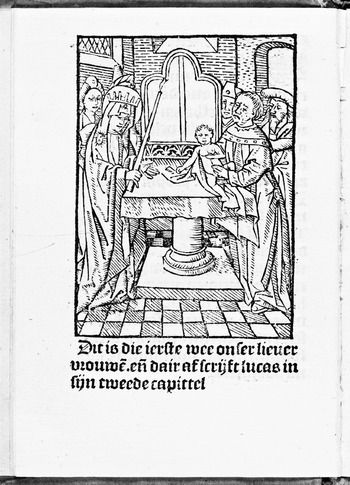
Thus, at this early stage, two clerics, one directly and one indirectly attached to the court, collaborated to devise a meditative devotion focusing upon the Virgin's compassion for Christ and with the stated aim of offering solace to distressed people. In fact, Van Coudenberge's later account of a general feeling of depression at the end of the wars was likely very near to the truth.Footnote 13 The wars indeed had a devastating effect on local economies and on the social fabric.Footnote 14 In these difficult times, people were looking for succour and there is evidence that the new medium of the printing press (first introduced in the Low Countries in 1473) was used extensively by those eager to supply this demand: in this very period, vernacular printed books on spiritual solace became very popular.Footnote 15 One of these, a handbook devoted to the new devotion of the Seven Sorrows, was printed in Antwerp by Gheraert Leeu (c. 1445–92) on 14 July 1492, two weeks before the wars finally ended.Footnote 16 Leeu's edition begins with woodcuts that reproduce St Luke's portraits of the Virgin that Van Coudenberge had had copied and hung in the churches of Abbenbroek and Reimerswaal. There follows a Dutch paraphrase of the explanatory texts De Manso had written in his letter to Van Coudenberge, supplemented by woodcuts illustrating each of the Virgin's Sorrows (see Figure 2).Footnote 17 Thus, as Leeu notes on the work's title page, even illiterate adherents can participate in the devotion's exercises, ‘since images are the books of lay people’.Footnote 18 Through the mediation of the printing press, the devotion of the Seven Sorrows was thus tied no longer to Van Coudenberge's personal churches nor to his own clerical clientele but could now be marketed to a large audience of literate and semi-literate believers.Footnote 19
The first Sorrow of the Virgin (Simeon's prophecy) in Dit es een seer deuote salige ende profitelicke ghedenckenisse van den vij. weeden oft droefheyden onser lieuer vrouwen, Antwerp: Gheraert Leeu, 14 July 1492 (Royal Library, The Hague, 150 F 21).

According to Van Coudenberge, the new devotion soon became so successful that it was decided to establish a confraternity with as few rules as possible and no admission fee, so that everyone could join. After gaining approval from his clerical advisors, his preceptor Frans van Busleiden (d. 1502) and his Dominican confessor Michel François de Lille (Michael Francisci de Insulis, 1435–1502), Philip the Fair, at that time still an unemancipated teenager, offered to be patron of the new prayer community.Footnote 20 The statutes of the confraternity were published by Gheraert Leeu in a second handbook, likely printed in the second half of 1492. This text explicitly refers to Philip the Fair's patronage on the title page, states the obligations and the benefits of the confraternity at the outset, and reprints the paraphrases of De Manso's explanatory texts again complemented by the same woodcuts.Footnote 21 The fact that Leeu's editions followed so quickly upon the respective initiatives taken by the devotion's promoters suggests that there must have been at least an incentive from the court to print them.Footnote 22 One piece of suggestive evidence is an undated letter from Leeu to Philip the Fair published in a Latin compendium on the confraternity, further containing Petrus de Manso's original letter and the office and mass that he composed.Footnote 23
In quick succession, between 1494 and around 1501, four more vernacular handbooks devoted to the Seven Sorrows were printed in the Low Countries.Footnote 24 On 12 September 1494 the Collaciebroeders (Brothers of the Common Life) in Gouda printed a reissue of Leeu's devotional manual of 14 July 1492, using both his type and his woodblocks.Footnote 25 In Delft meanwhile the printer Christiaen Snellaert brought out one dated 17 July 1494, which was reissued four years later (16 March 1498 n.s.).Footnote 26 Decked out with a title page showing a woodcut of the Mater Dolorosa under the title Vanden seuen droefheden ofte weeden onser lieuer vrouwen, this book presents an interesting co-mingling of the Leeu's two handbooks of 1492. While by and large it reprints Leeu's 14 July devotional text, with woodcuts from other sources, Snellaert also included the material on the brotherhood and its statutes from Leeu's second 1492 publication. Finally Henrick Eckert van Homberch brought out an undated handbook (c. 1501).Footnote 27 Also a reprinting of Leeu's 14 July 1492 manual, Eckert's version differs from it in two significant ways. First he omitted two sections of text and condensed two openings into one. Second, and more important, Eckert inserted at the end of this small volume a sequence of nine prayers addressed to Christ deriving from the mass of Gregory the Great, complemented by a woodcut depicting the mystery. This unusual departure from the tradition now established of illustrated handbooks devoted to the Seven Sorrows proved to be a sign of things to come, for in just a few years small volumes that combined Christ's Passion and the Virgin's Sorrows would begin to be printed.Footnote 28
Compassion: a political confraternity
The initiators of the confraternity of the Seven Sorrows of the Virgin Mary did not have to look hard to find appropriate models for their undertaking. As is explicitly stated in the statutes of 1492, and repeated in Snellaert's edition of 1494, the direct model was the confraternity of the rosary. This confraternity had been founded by Jakob Sprenger (c. 1436–95) in the Dominican convent in Cologne in 1475, after the year-long siege of Neuss by the Burgundian duke Charles the Bold (1433–76) had been successfully raised by the emperor Frederick iii. Within seven years the confraternity could claim 100,000 members.Footnote 29 The memory of this episode must have had a strong but equivocal resonance at Philip the Fair's court, since the combattants in 1475 were his grandfathers. Yet, on the conceptual level, there was also a direct connection. Michel François de Lille, who collaborated from the outset in the conception of the Seven Sorrows confraternity, had directly contributed to the establishment of the rosary confraternity in his own convent in Cologne. During his years at the Sorbonne and at the Dominican convent of Douai, François de Lille had been a faithful disciple of Alain de la Roche (Alanus de Rupe, 1428–75), one of the strongest promoters of the rosary devotion and the founder of its first confraternity (Douai, c. 1470). But unlike De la Roche, François de Lille had clear ideas about how to market the rosary devotion to a large lay audience.Footnote 30 The success of the confraternity in Cologne, and of similar rosary confraternities established elsewhere soon after, was due in large part to its new, flexible model of association that defied the rules and expectations of traditional religious brotherhoods. Its attraction lay in the fact that it encouraged members to recite the rosary and meditate simultaneously on the life of Christ without prescribing a fixed manner, time or place to do so. In the same sense, it did not discriminate on the basis of gender or social status: anyone could become a member without charge. In dialogue with the changing devotional needs of the laity, the rosary confraternity introduced a new form of religious experience, which was at once collective and private.Footnote 31
The rosary devotion was successful in the Low Countries too: chapters of the confraternity were established, and very soon illustrated handbooks published in Latin.Footnote 32 Maximilian of Austria supported it, but he became even more engaged in the establishment of yet another confraternity, namely that of St George (1493) that sought support for a new crusade.Footnote 33 Philip's advisors must have realised that the popular rosary devotion was none the less somewhat tainted by its reference to a Burgundian defeat and that the overtly military devotion of St George patronised by Maximilian (an extension of the knighthood established by his father in 1468) was not likely to evince much enthusiasm within broad segments of the population of the Low Countries. Despite all efforts, in the eyes of a large section of his subjects Maximilian of Austria remained a foreigner, the antithesis of his son, the ‘natural prince’ Philip the Fair, and of his late wife, the tragic Mary.Footnote 34 Well aware of this fact, Maximilian continued to exploit the visual image of Duchess Mary after her death.Footnote 35 For the same reasons Maximilian's and Philip's clerical advisors promoted the devotion of the Seven Sorrows. The fact is that the devotion encouraged worshippers to fuse the image of the sorrowing Virgin Mary with that of the late duchess and, thereby, identify with both. The Burgundian heiress Mary had not only suffered a sorrowful death herself, but her only son Philip had endured ordeals such as being left motherless at the age of three and a half, being held hostage for a couple of years by the Ghent rebels and seeing his territories divided by rebellion and civil strife.Footnote 36 The devotion of the Seven Sorrows not only foregrounded Christ's Passion but also his childhood.Footnote 37 A vernacular poem (c. 1506/24), attributed to the rhetorician Hendrik Maes and entitled ‘Praise to the sorrowing Mother of our Lord’ supports this interpretation. The poet uses the terms ‘Lord’, ‘Mother’ and ‘Mary’ in a double sense, thereby referring both to the Virgin and Christ and to Mary and Philip of Burgundy.Footnote 38
In her essay on the visual imagery of the sorrowing Virgin, Carol Schuler argues that the Virgin Mary functioned both as a mediator and as a model for participation in the Passion of Christ. Through the Virgin the worshipper could feel compassion for Christ and, at the same time, could learn to express this compassion.Footnote 39 The confraternity of the Seven Sorrows brought this devotional technique of compassio from the heavenly to the political realm. This becomes very clear from a Dutch text of 1511, a privilege issued by Maximilian of Austria and his grandson Charles (the future Charles v) to the promoters of a chapter of the confraternity of the Seven Sorrows that had been instituted in Brussels in 1499. This privilege, which makes special mention of the support for the devotion of the regent Margaret of Austria, relates
how during the tribulation and discord that came to our Low Countries soon after the decease of … lady Mary of Burgundy … the devout confraternity of the Seven Sorrows of Our Blessed Lady the mother of God sprang up and arose, to which many good people immediately adhered in protection of us, Maximilian, of our children and for the common welfare of our territories.
Concurring with Van Coudenberge that through the intercession of the Virgin the wars in the Low Countries had come to an end, this text directly refers to the devotion's aim of compassio with the dynasty and its united territories, without referring to the Seven Sorrows in detail nor mentioning the Passion of Christ at all.Footnote 40
As the 1511 text continues, those who registered in the confraternity were not only desirous of heaven and of the protection of their own souls, but did so to support the princes and to promote common welfare, good understanding and friendship among the Burgundian territories, their cities and their subjects.Footnote 41 Indeed the confraternity differed considerably from most other confraternities in the Low Countries as its aim was not to offer to a relatively small group of laymen and laywomen a forum for religious sociability but rather – as an overtly political variant on the confraternity of the rosary – to create a large spiritual community that directly supported the dynasty and its ideology of peace and territorial unity.Footnote 42 In fact, as its promoters saw it, the confraternity formed one undivided community of worshippers, with, for practical reasons, chapters in different churches. It was no coincidence that these chapters were instituted in churches in the different core principalities of the Low Countries: in 1492 in Abbenbroek and Leiden in Holland, in Reimerswaal in Zeeland, in Antwerp in Brabant and in the Thabor convent near Malines, and, in the following years, in Bruges in Flanders, in Haarlem, Delft and The Hague in Holland, in Brussels in Brabant and again in Malines (a seigniory in direct possession of the dynasty).Footnote 43
It is not surprising that the religious institutions governed by Jan van Coudenberge and Petrus de Manso were among the first to establish a chapter of the confraternity. Furthermore, on 23 April 1493, the chapter in Bruges was solemnly instituted in the church of St Saviour (where Van Coudenberge was pastor) and was celebrated with a general procession, public preaching and a banquet.Footnote 44 Later that year, Philip the Fair showed his appreciation by appointing noble representatives in the Bruges chapter and consenting to have its chapel adorned in his name.Footnote 45 There is other evidence that the court was directly involved in the establishment of the chapters of the confraternity. Jan van Coudenberge was a member of the commission that in 1497 investigated the credentials of a new chapter in the church of St Rombout in Malines.Footnote 46 Most controversial was probably the institution of the Haarlem chapter in the monastery of the Carmelites that was traditionally patronised by the influential Brederode family which had taken up arms against Maximilian of Austria during the wars. In commemoration of its defeat, Maximilian had financially supported the monastery in the execution of a series of panel paintings (c. 1486/91), featuring the counts of Holland with Maximilian as last count.Footnote 47 The establishment of a Seven Sorrows chapter in this monastery (before or in 1494) can be considered a similar reminder of the supremacy of Maximilian and his dynasty.
Arguably, the ultimate goal of the promoters of the devotion of the Seven Sorrows was to offer devotees a political confession to adhere to, in the sense that worshippers who took up the practice of meditating on the Seven Sorrows also subscribed to the political ideal of peace and territorial unity in the Low Countries under the guidance of the Burgundian-Habsburg dynasty. At first sight, however, it was much more about numbers than about deep conviction. It was amazingly easy to become and remain a member of the confraternity. Members did not have to contribute financially; indeed the statutes specifically stipulate that no fees whatsoever were to be paid. One only had to meditate (or let someone else meditate for him) upon the Sorrows and to recite seven Pater Nosters and seven Ave Marias twice a week. Occasionally omitting to do this was no sin, but devotees who attracted new members were rewarded with extra indulgences. In fact, one did not even have to be alive to benefit from the confraternity's merits: the statutes allowed the registration of deceased persons (on the condition that a living person performed the spiritual exercises).Footnote 48 The concern for numbers is manifest in the only extant membership list, namely the register of the Brussels chapter, where the cumulative total of members was noted annually. In its first year (1499) the register listed 6,085 new members, both living and deceased (members of the dynasty and other nobles not included) although formal registration was not even mandatory.Footnote 49 However, arithmetic went hand in hand with the efforts to build what Barbara Rosenwein recently called an ‘emotional community’, in the sense that through its simple spiritual exercises the devotion encouraged modes of emotional feeling and expression.Footnote 50 The theme of the sorrowing Virgin not only aroused fear and pain but also provided comfort and assurances for the future: worshippers knew that the compassionate Virgin would look after mankind.Footnote 51 Since, in the particular case of the Low Countries, the Virgin had given a clear sign of her compassion by ending the wars, the devotion very cleverly encouraged the private experience of the mixed emotions of fear and joy to create a stronger emotional bond with the dynasty.
As was the case with the rosary confraternity, the Seven Sorrows devotion combined private and collective religious experience. With the promise of gaining extra indulgences, the brothers and sisters of the confraternity were encouraged (but not obliged) to attend mass on the days respectively following the feasts of the Purification and the Assumption and, in particular, the mass of the Seven Sorrows, to be held around the feast of the Annunciation.Footnote 52 While the devotion was becoming accepted by more and more church institutions and religious orders,Footnote 53 the liturgy was elaborated through the composition of many divine offices.Footnote 54 This movement was closely monitored by the court. Philip the Fair instructed his preceptor and counsellor Frans van Busleiden and his confessor François de Lille, among other learned men, to evaluate these offices and masses with a view to selecting one to be set to music. They chose as most suitable that written by Petrus de Manso. Thereupon, in around 1495, a competition was sponsored to find the best musical setting. A jury principally headed by Busleiden and François de Lille selected the plainchant setting composed by Petrus Duwez, who by this time had been a singer in the Burgundian-Habsburg chapel for nearly thirty years.Footnote 55 From then on, therefore, the devotion not only benefited from consecrated altars and chapels dedicated to the veneration of the Sorrows. Sung offices including a mass approved by the court also assured the public worship of confraternity members on specific feast days associated with the Virgin.Footnote 56
Polemics: reinforcing the community
On the feast of the Annunciation (25 March) 1494, a play in Dutch on the Seven Sorrows was staged on the marketplace of Malines. Together with many townsmen, Philip the Fair and his court were present. The play, that included tableaux vivants with scenes taken from the Old Testament, lasted for five hours and was probably conceived as a dramatised sermon with two expositors explaining each sorrow. According to Jan van Coudenberge, the audience was extremely moved. People cried exceedingly out of compassion with the Virgin, no one was bored or unruly – not even young Philip – no one desired the play to end. Everyone – Philip included – insisted on a new performance. The new staging, a few days later (3 April), brought a huge influx of spectators.Footnote 57 Unmistakably, thus, the first performance of a play on the Seven Sorrows had been intended to create and enforce an emotional community, this time by encouraging public expression of extreme devout feelings. Whereas adherence to the confraternity made one a member of a large virtual emotional community through meditation and prayer and thus largely through private feeling, the shared experience of the audience of a Seven Sorrows play made this emotional community more direct, more palpable and more real.Footnote 58
At the same time, the play made it clear that not everyone supported the new devotion: it not only explained the Sorrows but also carefully rejected the arguments of its opponents. It has to be underlined that at least from 1494 onwards (approximately coinciding with the beginning of Philip the Fair's independent rule), the devotion became the object of intense polemics. Some theologians and priests raised objections to the biblical justification of the nature and number of the Virgin's Sorrows. In 1494 François de Lille wrote a Latin polemical treatise, comparable to a defence he had written in 1476 for the rosary confraternity,Footnote 59 refuting these objections and defending the devotion and the confraternity.Footnote 60 Beginning at around the same time attempts were made to have the devotion receive ecclesiastical recognition and to have the statutes of the confraternity gain apostolic approval. Efforts were made to procure the approbation of local religious authorities and bishops, particularly the bishop of Utrecht to whose diocese the collegiate churches of Abbenbroek and Reimerswaal belonged. With this goal in mind letters were written in Philip's name to Bishop David of Burgundy.Footnote 61 Likewise, letters were written to Pope Alexander vi to solicit confirmation of the confraternity and its statutes. In his bull dated 26 October 1494, the pope ordered an investigation of the confraternity,Footnote 62 although this was not carried out until February 1497, by Paulus de Porta, dean of the collegiate church of Renaix (Flanders), residing in the university town of Louvain.Footnote 63 On 13 February 1497 De Porta issued letters patent granting apostolic confirmation of the confraternity and its original six statutes.Footnote 64 Significantly, however, and in response to the entreaties of the confraternity's founders, he included an additional statute, one that permitted donations to be made for the benefit of the divine office of the Seven Sorrows celebrated on its feast day, of the yearly masses to be said for the souls of deceased confraternity members, of the maintenance of chapels and altars dedicated to the devotion, but again stipulating that no fees be allowed for enrolling in the confraternity or upon leaving it. The more strongly worded condemnation of anyone trying to make financial profit from the confraternity was now the seventh and final statute.Footnote 65
Despite papal confirmation of the confraternity's statutes, or perhaps because of it, opposition to the devotion was not quelled, but rather persisted. Whether the court's political exploitation of the cult had something to do with the polemics remains unclear. In any case, opposition seems not to have deterred the spread of the devotion. From its beginnings, its promoters had used a whole array of interrelated media to attract worshippers such as paintings, Latin poetry, vernacular meditation texts, woodcuts, preaching, processions, supplemented by divine offices and religious music. In this new polemical context, two new media became prominent – miracles and vernacular theatre – which may well have been largely responsible for the devotion's continuing success among large segments of the population. At the same time, regional differences in the uses of these media reveal the distinctions in religious culture between, on the one hand, the large cities of Flanders and Brabant and, on the other hand, the smaller towns of Holland and Zeeland. Around 1500 Brabant and Flanders were characterised by a well-developed public sphere with an emphasis on civic ritual.Footnote 66 There, and to a lesser degree in Holland, the new medium of vernacular theatre was successfully turned to account.Footnote 67 Miracles meanwhile were the most effective medium for propagation in Holland and Zeeland, where the privileged spaces for devotional experience were the convents, the parish churches and the private homes of the laity.Footnote 68
Manifestation: the miracle cults
Michel François de Lille's treatise in defence of the devotion of the Seven Sorrows, the Quodlibetica, includes an account of three miracles said to have occurred at the collegiate church of Abbenbroek sometime before August 1494.Footnote 69 During the years 1495 and 1496 he received further reports of other miracles that had been effected by Our Lady of the Seven Sorrows both at Abbenbroek and at Haamstede in Zeeland.Footnote 70 After François de Lille's death in 1502, Jan van Coudenberge became the recipient of similar reports.Footnote 71 Around this time, the church of St Hippolyte in Delft (Holland), with its miraculous statue of the sorrowing Virgin and Christ (a pietà), developed into a regional pilgrimage centre.Footnote 72 All these reports were published in three Latin miracle books, respectively in c. 1501, 1510 and 1519, as well as in one miracle book in Dutch in 1503.Footnote 73 In addition, the miracles were celebrated with processions and incorporated in vernacular sermons held in the mother churches on special feast days (for example, the Feast of the Miracles in Delft on 1 October expanded to a thirteen-day celebration in 1514).Footnote 74 They were proclaimed in other devotional centres too, such as the church of St Saviour in Bruges.Footnote 75 The proclamation of the miracles, both in print and orally, was clearly intended to strengthen support for the devotion and counter attacks upon it.Footnote 76 Although most miracle narratives are simple stories of illness and adversity, some also unambiguously prescribe modes of devotion or warn detractors.Footnote 77 For example, a woman, struck by paralysis, faithfully followed the rules of the confraternity, and was delivered from her affliction on the day that she read with even more dedication a vernacular book of meditations on the Seven Sorrows.Footnote 78 Another woman, who suffered from frequent falls, promised to visit the church of St Hippolyte in Delft and to meditate daily according to the rules of the confraternity. This was effective until she started to neglect her spiritual exercises.Footnote 79 Another woman was punished with a burning tongue after she had openly criticised the devotion.Footnote 80 The intended audience of the printed miracle collections (most of them in Latin) cannot have been very large. Yet the church wardens of St Hippolyte used the printing press on a much broader scale to advertise the Delft cult. Between 1506/7 and 1514 at least 2,650 single-leaf prints with images of the sorrowing Virgin and a short caption referring to the local cult (available in three versions) were distributed to devotees, probably both as a souvenir of their offerings to the miraculous statue and as a means to facilitate their meditations at home.Footnote 81
The development of the miracle cults in Holland and Zeeland was not only supported by François de Lille and Van Coudenberge through the publication of the miracle collections but also more directly by the rulers themselves. Margaret of Austria (1480–1530), who was regent (1507–15) in the Low Countries during her nephew Charles's minority and who seems to have been as active a promoter of the devotion as her late brother Philip the Fair, visited the church of St Hippolyte in Delft in 1515 and offered a golden heart to be kept near the miraculous statue.Footnote 82 In the same year, Dirck Adamsz van der Burch (d. 1531), the local chaplain of the altar of the Seven Sorrows, was appointed princely chaplain.Footnote 83 Yet, despite this encouragement, the evidence for Delft suggests that both administrators and devotees (mostly women) considered the miraculous cult of the Seven Sorrows before all else as a local or, at the most, a regional devotion and, thereby, inevitably lost touch with its original message of territorial unity.Footnote 84 It has to be underlined that miracles were unstable and tricky media.Footnote 85 In the case of Delft, the miracles guaranteed the cult's overwhelming success until about 1520, but at the same time they allowed worshippers to both collectively and privately appropriate the devotion's rationale.Footnote 86 In this respect, from the court's point of view, reliance on vernacular theatre proved to be a much more sophisticated strategy.
Persuasion: vernacular theatre
Since the middle of the fifteenth century, popular theatre in Flanders and Brabant had been increasingly dominated by the chambers of rhetoric, gilds, mainly of laymen devoted to the practice of the vernacular art of rhetoric.Footnote 87 Some of these became intensely engaged in the promotion of the devotion of the Seven Sorrows. The play staged twice in Malines in the spring of 1494 was performed by the local chamber, the Peony.Footnote 88 It was written by their playwright Hendrik Maes, a canon of the collegiate church of St Rombout (d. 1512), who in 1497 would become one of the initiators of the chapter of the confraternity in this church.Footnote 89 On 4 July 1494 a play on the Seven Sorrows was performed, likely by the local rhetoricians, in Leiden in the churchyard of St Peter where a chapter of the confraternity had been established in 1492.Footnote 90 In 1495 one of Antwerp's chambers, the Marigold, staged a similar play.Footnote 91 In the following years many other chambers of rhetoric in Brabant, Flanders and to a lesser degree Holland staged plays on the Seven Sorrows, increasingly so in small towns. None of the play texts are extant, but there is evidence enough that different compositions circulated. In 1497 Seven Sorrows plays were performed in Brussels, Bergen op Zoom (Brabant) and Gouda (Holland).Footnote 92 In 1499 a Seven Sorrows play extending over no less than two days was staged in the Flemish town of Aalst.Footnote 93 On Annunciation day 1502, the chamber of rhetoric of Blankenberge (Flanders) performed tableaux vivants and a play in praise of the devotion.Footnote 94 Plays were also staged by the rhetoricians of Tielt (1508, 1513) and Roeselare (1512) in Flanders.Footnote 95 Although there is little information on the particulars, it is evident that the local clergy was often involved. In 1518/19 Br Anthony, a Carmelite, was remunerated for his direction of a play on the Seven Sorrows in the market place of Geraardsbergen (Flanders).Footnote 96
There is more information on the large Brabantine cities of Antwerp and Brussels where chambers of rhetoric not only staged plays on the Seven Sorrows but were also involved in the establishment and the maintenance of chapters of the confraternity. In 1492 a chapter of the confraternity was instituted in the church of Our Lady in Antwerp. The choice of Antwerp as a stronghold of the devotion was not surprising since the city owed its rapid economic rise in large part to its unconditional loyalty to Maximilian of Austria throughout the wars.Footnote 97 Although the exact circumstances of the establishment of this chapter are unknown, in all likelihood the chapel of the Antwerp artists' gild of St Luke was selected from the outset as its seat. According to gild sources, a chapter of the confraternity in this chapel was officially recognised in 1495.Footnote 98 Moreover, given Van Coudenberge's initial plan to promote the devotion by putting copies of the icons of the Virgin painted by St Luke on display, it is very likely that board members of the Antwerp gild of St Luke seized quickly upon this opportunity to give their chapel more grandeur.Footnote 99
The artists' gild of St Luke shared its chapel with Antwerp's principal chamber of rhetoric, the Gillyflowers. Footnote 100 In the early 1490s this chamber frequently competed in literary competitions outside Antwerp, thereby forging networks that would be very useful to the court after the conclusion of the wars. In 1493 the chamber was one of the participants at a meeting in Malines of the Dutch-speaking chambers of rhetoric presided over by Philip the Fair where the ambitious plan (which never really materialised) for a princely chamber of rhetoric was unfolded.Footnote 101 For this occasion the chamber had crafted a wagon with a wooden citadel of Antwerp on which St Luke painting the Virgin's portrait was seated.Footnote 102 In the same year, the chamber attended the bilingual competition organised by the Brussels chamber, the Lily. It was also closely involved in the festivities surrounding the visit of Maximilian of Austria and Philip the Fair to Antwerp in 1494.Footnote 103 In 1496 the Gillyflowers received official permission from Philip the Fair to organise a large interregional theatre competition,Footnote 104 which was attended by chambers from Brabant, Flanders, Holland and Zeeland. In this way, it brought into practice the ideal of cultural unity in the Low Countries (or at least of its core territories).Footnote 105 The Gillyflowers must have been more deeply involved in the spreading of the devotion of the Seven Sorrows than the scarce sources reveal, since the printer Govaert Bac (d. c. 1515), one of its deans, was responsible for two Latin publications relating to the cult.Footnote 106
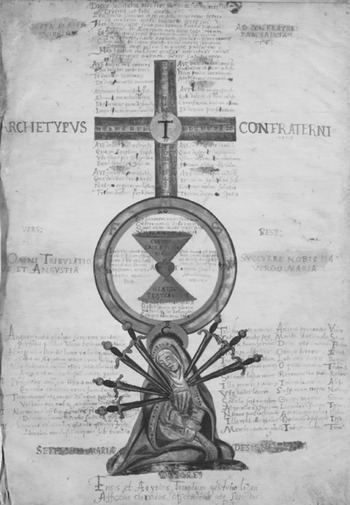
While relations between the Antwerp rhetoricians and the court are not exactly clear, more information is available for the Brussels chambers of rhetoric. Since the 1480s its leading rhetoricians had had many contacts with court officials such as the maître d'hôtel, memorialist and poet Olivier de La Marche (c. 1426–1502).Footnote 107 Representing respectively the city and the court, these men collaborated on the organisation of entry ceremonies and numerous other public court festivals.Footnote 108 In 1493 the Brussels Lily attended the meeting of chambers of rhetoric in Malines presided over by Philip the Fair and organised a bilingual (Dutch-French) rhetorician competition. Although the Lily honoured the Virgin Mary as its patron, there are no indications that the chamber was from the outset involved in the promotion of the devotion of the Seven Sorrows.Footnote 109 This changed in 1497, when two of its leading rhetoricians, Jan Smeken (d. 1517) and Jan Pertcheval (d. 1523), received the commission to write a new play on the Seven Sorrows.Footnote 110 According to Jan van Coudenberge's later account, this play, like the one written by Hendrik Maes in 1494, was wildly popular.Footnote 111 In any case, the rhetoricians of the Lily intensified their involvement by establishing, in early 1499, a chapter of the confraternity of the Seven Sorrows in the Church of St Géry in Brussels (see Figure 3).Footnote 112 Besides being highly successful among the Brussels population within the first years of its institution, the chapter boasted the formal membership of rulers, high nobles and courtiers such as Philip the Fair, Maximilian of Austria, Margaret of Austria, Jan van Coudenberge, Frans van Busleiden and Olivier de La Marche. Philip the Fair gave to the chapel a beautifully crafted bench as an enduring reminder of his devotion.Footnote 113 In 1507 the Lily merged with another Brussels chamber, the Violet, to create the Garland of Mary, which continued to promote the devotion of the Seven Sorrows by recruiting new members. One of its initiatives was the organisation of an annual procession whose explicit aim was to pray for the dynasty and its territories and ‘to bring the people to a more fervent devotion’. During the procession, the crowd was instructed in rhetorical verses on the nature and meaning of the Seven Sorrows.Footnote 114 These continuing efforts were rewarded with the privilege of 1511 from Maximilian and his grandson Charles. The princes decided to reinforce their patronage of the devotion by recognising the Brussels chapel of the confraternity as a princely chapel, and by according to the rhetoricians of the Garland of Mary the status of princely servants in the duchy of Brabant.Footnote 115
Liber authenticus sacratissimae utriusque sexus christifidelium confraternitatis septem dolorum beatae Mariae virginis nuncupatae (City Archives of Brussels, ms 3413, fo. 2r).

Chambers of rhetoric were able to address large audiences of townsmen and townswomen with their vernacular plays on the Seven Sorrows. The evidence suggests that, at least in the case of the plays written by Hendrik Maes and by Jan Smeken and Jan Pertcheval, the content had been approved by the court. Unfortunately, since the play texts have been lost, it is impossible to assess how, and to what extent, religious instruction and dynastic propaganda were interwoven. However, other rhetorician plays from the same period have survived that are emphatically ‘Burgundian’ in tone and propound precisely the message that can be ascribed to the lost Seven Sorrows plays.Footnote 116 At the same time, by their active interregional contacts (especially in the 1490s), chambers of rhetoric brought into practice the ideology of peace and unity in the Low Countries and, given their broad social recruitment and large audiences, made it palpable to large segments of the population.Footnote 117 Moreover, the first chambers of rhetoric in Holland and Zeeland (c. 1480–90) were instituted precisely in those milieus that supported this political ideology.Footnote 118 Engaging some chambers of rhetoric for the propagation of the devotion of the Seven Sorrows, therefore, was one of the court's cleverest and most innovative strategies. Yet this medium was not without its risks. In the long run, as had happened earlier with the miracle cults, the court and the clergy lost their grip on the vernacular theatre, in this case because it proved to be as effective in spreading Reformation ideas as it had been in promoting a highly politically charged Marian devotion.Footnote 119
In the early 1490s many people in the Low Countries were war-weary and longing for spiritual solace. A few clerics directly and indirectly belonging to the Burgundian-Habsburg court seized upon this mood and created a devotion that offered ordinary believers the opportunity to meditate privately upon the pains and fears of the Virgin and to find assurances for the future. The princes soon realised the political benefits of this devotion, since – besides enhancing Marian piety – it pleaded for peace and territorial unity and even encouraged people to identify with the sufferings of the ducal family, in particular those of the late Duchess Mary of Burgundy and her only son, Duke Philip the Fair. Under the patronage of Philip a confraternity of the Seven Sorrows of the Virgin Mary was established that borrowed its flexible model from the Cologne rosary confraternity and that was instituted in many churches in the different Burgundian core territories. At the same time controversial and comfortingly simple, the devotion's ultimate goal was to create a spiritual league that would underpin the ruling dynasty. After having redeemed the inhabitants of the Low Countries from the purgatory of civil war, the Virgin of the Seven Sorrows became the patroness of a new emotional community of men and women who had previously had little in common apart from their prince. At least indirectly, the devotion seems to have contributed to a new spiritual climate. Philip the Fair's rule (1494–1506) and the regency of his sister Margaret of Austria (1507–15) were generally perceived as a Golden Age of peace (both internally and externally) and prosperity.Footnote 120 Precisely for these reasons, the devotion was rekindled in the early seventeenth century by the Archdukes Albert and Isabella (1598–1621) in their attempt to heal the southern Low Countries after the trauma of religious war and division.Footnote 121
The cult of the Seven Sorrows was remarkable in its objectives but even more so in its extensive exploitation of communication techniques. The devotion's rapid and overwhelming success around 1500 was due, on the one hand, to the use of a whole array of traditional and new media, including paintings, Latin poetry, vernacular meditation texts, woodcuts, preaching, processions, divine offices, religious music, miracles and theatre, and, on the other hand, to its promoters' ability to make use of existing urban networks, such as those of the early vernacular printers and of the chambers of rhetoric. It is important to stress that this was no one-way communication and that some of these media – miracles and theatre in particular – allowed for constant input and appropriation by ordinary believers. In the end, the devotion of the Seven Sorrows of the Virgin Mary reveals much about the vibrant but paradoxical religious culture of the Low Countries on the brink of the Reformation: increasingly elaborate public ritual went hand in hand with a growing privatisation of devotional experience. Yet even these individual acts of piety were often inextricably bound up with politics.