Implications
This is the first work on the effects of genotype and feeding strategy (low-forage or high-forage diet) on Alentejana and Barrosã meat sensory attributes. The results obtained are new and can be used in further decisions including how meat from these breeds should be produced and marketed.
Introduction
The sensory traits influence the consumers’ perceived quality and acceptability of food products (Bredahl, Reference Bredahl2004). Beef palatability is determined by tenderness, juiciness and flavour (Neely et al., Reference Neely, Lorenzen, Miller, Tatum, Wise, Taylor, Buyck, Reagan and Savell1998). Flavour desirability differences are related to the amount and composition of intramuscular fat (IMF; Fisher et al., Reference Fisher, Enser, Richardson, Wood, Nute, Kurt, Sinclair and Wilkinson2000). In addition, the IMF content plays an important role in juiciness and tenderness of cooked beef at the time of consumption (Smith et al., Reference Smith, Tatum and Belk2008; Hocquette et al., Reference Hocquette, Gondret, Baéza, Médale, Jurie and Pethick2010). Of these attributes, flavour is often rated as crucial but is also the least understood and further studies are needed to better understand the factors that influence meat flavour development (Myers et al., Reference Myers, Scramlin, Dilger, Souza, McKeith and Killefer2009). Beyond flavour, consumers consider tenderness to be a major factor influencing consumers’ perception of taste (Voges et al., Reference Voges, Mason, Brooks, Delmore, Griffin, Hale, Henning, Johnson, Lorenzen, Maddock, Miller, Morgan, Baird, Gwartney and Savell2007) and acceptability of meat (Calkins and Hodgen, Reference Calkins and Hodgen2007).
In the last 20 years, the European Union (EU) policies, with the objective of developing sustainable agriculture systems and maintaining biodiversity in rural areas, created the opportunity of meat from Portuguese cattle breeds to be commercialised with a ‘certification of origin’, known as Protected Denomination of Origin (PDO). Alentejana (AL)-PDO meat is the most important commercial Portuguese PDO meat (1051 carcass tonnes in 2005, which represent more than 40% of the total PDO meat produced in Portugal) while Barrosã (BA)-PDO meat is the most important commercial Portuguese PDO veal (249 carcass tonnes in 2005, corresponding to 10% of the total PDO meat produced in Portugal; Oliveira, Reference Oliveira2007). When the meat from these breeds is not marketed with a PDO label, it reaches the commercial meat chain as undifferentiated meat and, thus, loses the added value obtained with its commercial differentiation. The PDO-labelled beef is perceived by consumers as healthy meat with higher palatability. Labels can facilitate the repeat of purchases when there is satisfaction and therefore become reliable extrinsic cues used as a search attribute during purchasing (Bernués et al., Reference Bernués, Olaizola and Corcoran2003). In Portugal, consumers use label for both the perception of intrinsic quality cues and for inference of quality expectations (Banovic et al., Reference Banovic, Grunert, Barreira and Fontes2010). Furthermore, Portuguese consumers of quality-labelled beef perceive the breed within a production region as an indicator of enhanced quality (Banovic et al., Reference Banovic, Grunert, Barreira and Fontes2009). The consumers’ specific preferences and attitudes towards ‘Alentejana’ and ‘Barrosã’ meat not produced under PDO rules and thus without a PDO label are not well known. However, a previous study found that consumers perceived national branded beef as better on all quality cues and quality aspects than imported branded beef (Banovic et al., Reference Banovic, Grunert, Barreira and Fontes2010). Moreover, AL and BA meat are in general perceived by consumers as having a high eating quality and its commercial differentiation and labelling, even outside the PDO specifications, could have economic relevance and should be further investigated. However, its assertion in the market would depend on achieving the increased expectations that consumers express in relation to a differentiated label, particularly with respect to its sensory characteristics. This could be achieved by increasing the knowledge about the factors involved in AL and BA meat sensory quality. Some studies suggest that consumers are willing to pay a higher price for guaranteed tender beef (Shackelford et al., Reference Shackelford, Wheeler, Meade, Reagan, Byrnes and Koohmaraie2001; Chambaz et al., Reference Chambaz, Scheeder, Kreuzer and Dufey2003) and research so far has been performed in order to predict meat palatability (flavour, juiciness and tenderness) and to establish a direct relationship between pricing and eating quality (Polkinghorne et al., Reference Polkinghorne, Philpott, Gee, Doljanin and Innes2008; Smith et al., Reference Smith, Tatum and Belk2008). These studies promoted the implementation of assertive beef quality grading standards, such as the Meat Standards Australia grading system, based on the knowledge of determinant factors of meat quality (live-animal factors, carcass-handling factors and carcass-trait constraints). The ultimate question is how to predict meat quality obtained according to a certain production system, such as the ones used to produce beef in Portugal. In contrast to other countries (Polkinghorne et al., Reference Polkinghorne, Philpott, Gee, Doljanin and Innes2008; Smith et al., Reference Smith, Tatum and Belk2008), no system of meat eating quality assurance exists in Portugal. Due to their economical relevance, several studies were conducted in order to characterise AL and BA meats from a nutritional point of view (Alfaia et al., Reference Alfaia, Ribeiro, Lourenço, Quaresma, Martins, Portugal, Fontes, Bessa, Castro and Prates2006; Costa et al., Reference Costa, Roseiro, Partidário, Alves, Bessa, Calkins and Santos2006; Alfaia et al., Reference Alfaia, Castro, Martins, Portugal, Alves, Fontes, Bessa and Prates2007; Costa et al., Reference Costa, Costa, Lopes, Alfaia, Bessa, Roseiro and Prates2011). However, little is known about the factors involved in meat sensory quality among these Portuguese breeds. The BA breed is phylogenetically and phenotypically distinct from the AL breed (Beja-Pereira et al., Reference Beja-Pereira, Alexandrino, Bessa, Carretero, Dunner, Ferrand, Jordana, Laloe, Moazami-Goudarzi, Sanchez and Canon2003). Hence, differences in genetic regulation related to fatty acid (FA) deposition between breeds can be expected. Furthermore, it is well known that diet is one of the most important contributors to meat eating quality. A greater understanding of how feeding impacts the AL and BA meat attributes would aid in further decisions including how meat from AL and BA breeds should be produced and marketed.
Herein, a study using AL and BA breeds, under controlled environmental conditions, was conducted in order to clarify the effect of breed and diet (low and high levels of forage) on meat palatability.
Material and methods
Animals and meat samples
A total of 40 males from two different cattle breeds, 20 AL (266 ± 45.8 kg live weight ± s.d.) and 20 BA (213 ± 16.3 kg live weight ± s.d.) fed two distinct diets (low-forage (LF) and high-forage (HF) diet) ad libitum, based on 70%/30% and 30%/70% of concentrate and maize forage, respectively (Table 1), were selected. The bovines were allocated from 11 months to 18 months of age (the commercial slaughter age of young bulls in Portugal) in eight adjacent pens, two pens per breed and experimental diet, in Unidade de Recursos Genéticos, Reprodução e Melhoramento Animal – INRB, I. P. facilities (39°17′17.63″ latitude North, 8°44′23.86″ longitude West, 73 m above sea level). The experiment was held from April to November 2009. From the trial, one AL from the HF diet was removed due to illness. Animals were slaughtered in an INRB experimental slaughterhouse following standard handling procedures. After being stunned with a captive bolt, animals were dressed and carcasses were suspended from the Achilles tendon; 1 h on average after stunning and exsanguination, carcasses were chilled under commercial conditions at 4°C for 8 days. Afterwards, longissimus lumborum (Ll; L1 to L3: 1st to 3rd lumbar vertebrae) and semitendinosus (St; distal region) muscles were removed from the left half of the chilled carcass and sliced into 2.5-cm-thick steaks for sensory evaluation and shear force measurements. Steaks were vacuum packed and stored at −18°C until analysis. For lipid assays, samples of 200 g were excised from Ll (L4 to L6) and from the proximal region of the St muscle and stored under vacuum at −18°C, until analysis. Before chemical analyses, the samples were trimmed of visible adipose and connective tissues and minced.
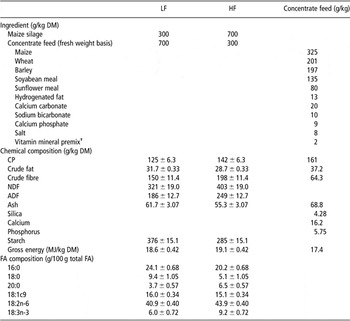
Chemical composition of the experimental diets

LF = low-forage diet; HF = high-forage diet; DM = dry matter; NDF = neutral detergent fibre; ADF = acid detergent fibre; FA = fatty acid.
LF: 70%/30% of concentrate (n = 3) and maize forage (n = 3), respectively.
HF based on 30%/70% of concentrate and maize forage, respectively (n = 3). Diets (HF and LF); chemical and fatty acid compositions: values ± standard error of means.
†Vitamin mineral premix contained per kg: 5000 IU vitamin A, 1000 IU vitamin D3, 20 IU vitamin E, 0.16 mg citric acid, 9.5 mg Fe, 110.6 mg Zn, 52.5 mg Mn, 0.3 mg Mo, 0.53 mg Co, 0.11 mg Se, 6.75 mg I, 25.0 mg BHT and 0.16 mg etoxiquin.
These muscles were selected due to their divergent growth patterns and functionalities in vivo (the St muscle flexes the leg and extends the thigh while the Ll has a postural function of the axial musculature (Sandoval y Col, 1986)) and also because they represent meat cuts of different expected eating qualities and economical values (loin and round, correspondingly).
Feed analysis
Feed distributed to the young bulls was sampled at the beginning, middle and end of the trial. Feed samples were analysed for ash (Association of Official Analytical Chemists (AOAC, 1990), Kjeldahl N (AOAC, 1990) and starch (Clegg, Reference Clegg1956). The crude fat was determined by extracting the sample with petroleum ether using an automatic soxhlet extractor (Gerhardt Analytical Systems, Königswinter, Germany). NDF and ADF were determined according to Van Soest et al. (Reference Van Soest, Robertson and Lewis1991). Diet gross energy content was measured using an adiabatic bomb calorimeter (Parr 1261, Parr Instrument Company, Moline, IL, USA). Fatty acid methyl esters (FAME) of feed lipids were prepared using one-step extraction transesterification with toluene and heptadecanoic acid (17:0) as an internal standard, according to the procedure of Sukhija and Palmquist (Reference Sukhija and Palmquist1988).
Shear force measurements
A total of 10 frozen steaks were thawed in a room with controlled temperature (T = 15°C) for 12 h and cooked in a plate grill (65/70 FTES Electric Griddle, Modelar Catering Equipment, Italy) at 250°C, until they reached an internal temperature of 71°C, which was monitored by an internal thermocouple (Lufft C120, München, Germany). Cooking losses (CL) were determined by calculating the difference in weight before and after thermal processing, and 1 h after cooling, 8 to 10 cores parallel to muscle fibre direction with 1 cm2 of section were taken from each steak. Shear force (kg) was measured in a texture analyser (TA-tx2i Texture Analyser, Stable Micro Systems, Surrey, UK) equipped with a Warner–Bratzler shear device with a 30 kg compression load cell and a crosshead speed of 300 mm/min. Data were collected using specific software (Texture Expert Exceed, Stable Micro Systems, Surrey, UK). Peak shear force measurements of cores from each steak were recorded and averaged to obtain a single Warner–Bratzler shear force (WBSF) value for each steak.
Trained sensory panel analysis
For each session of trained sensory panel (TSP) analysis, 10 frozen steaks were thawed and cooked using the same conditions as those for shear force measurements. Every steak was weighed, trimmed of any external connective tissue and cut into 2 × 2 × 2 cm3 samples and maintained at 60°C in heated plaques, until tasting.
In all, twelve trained panellists of beef performed the sensory analysis in eight sessions (four sessions for each muscle). The assessors were selected and trained according to Cross et al. (Reference Cross, Moen and Stanfield1978). Samples were randomly distributed across sessions and the attributes retained were tenderness (defined as the opposite of the force required to bite through the sample with the molars), juiciness (the amount of liquid drained from the sample during the initial chews), flavour (the intensity with which the beef sample is recognised as distinctly bovine meat rather than any other species of meat) and overall acceptability (the perception of how the meat is palatable taking into account the aforementioned attributes). The scale applied in the sensory analysis was structured into eight points, one (extremely dry, weak or positive) and eight (extremely tender, juicy, strong or negative) representing the minimum and maximum scores of tenderness, juiciness, flavour and overall acceptability, respectively.
Determination of FA composition
Muscle samples were lyophilised (−60°C and 2.0 hPa) until a constant weight using a lyophilisator Edwards Modulyo (Edwards High Vacuum International, Crawley, West Sussex, UK), maintained desiccated at room temperature and analysed within 2 weeks. Lyophilised meat samples were weighed (250 mg), in duplicate, into screw teflon-lined cap tubes. IMF was extracted two times with methylene chloride–methanol (2:1 v/v) instead of chloroform and methanol according to the method of Folch and Stanley (Reference Folch and Stanley1957), and measured gravimetrically, in duplicate, by weighting the fatty residue obtained after solvent evaporation. Lipids (40 to 100 mg IMF/g dry matter) were converted into FAME as described by Raes et al. (Reference Raes, De Smet and Demeyer2001). The FAME solution was used for the analysis of FA composition using gas chromatography using an Agilent 6890 Series II gas chromatograph (Agilent Technologies Inc., Palo Alto, CA, USA) fitted with a flame ionisation detector. FAME were separated on a fused-silica capillary column (CP-Sil 88; 100 m × 0.25 mm i.d., 0.2 μm film thickness; Chrompack, Varian Inc., Walnut Creek, CA, USA) as described by Alves and Bessa (Reference Alves and Bessa2009), coated with a cyanopropylpolysiloxane stationary phase, using a split/splitless injection system (split ratio of 1 : 50) and helium as carrier gas at a flow rate of 1.0 ml/min. After injection (1 μl), the initial oven temperature was 100°C (held for 1 min), then increased to 150°C at 50°C/min (held for 20 min), then increased by 1°C/min to 190°C (held for 5 min) and finally increased by 1°C/min to 200°C (held for 35 min). The injection and detector temperatures were set at 250°C and 280°C, respectively. The identification of peaks was accomplished by comparing the retention time of peaks from samples with those of FAME standard mixtures. The quantification of FAME was based on the internal standard technique, using nonadecanoic acid (19:0) as an internal standard, and on the conversion of relative peak areas into weight percentages. FA composition was expressed in gravimetric contents (mg/100 g of fresh muscle).
Statistical analysis
Diet chemical composition data were analysed by one-way ANOVA using the GLM procedure of SAS (SAS Institute, Cary, NC, USA). Data from meat sensory and nutritional parameters were analysed using the Proc Mixed procedure of SAS considering the animal as the experimental unit. The model included the fixed effects of breed and diet, as well as the respective interactions. The interactions were included in the model only when significant. When significant effects were detected, differences between means were further analysed by the PDIFF option of SAS. Pearson's correlation coefficients were calculated in order to elucidate the possible associations between meat traits and major FA (>1% w/w). These correlation coefficients were obtained using the STATISTICA software (StatSoft Inc., 2004, Tulsa, OK, USA). All data were reported as means with their standard errors of the mean (s.e.m.).
Results
Feed composition
The chemical and FA composition of experimental diets are presented in Table 1. Crude fat (P < 0.01) and starch (P < 0.05) were higher in the LF diet when compared with the HF diet. The inverse trend was observed for crude fibre (P < 0.05) and NDF (P < 0.05) components. Differences between diets were also detected in the FA composition. While the levels of 16:0 (P < 0.05) and 18:0 (P < 0.05) FA were higher in the LF diet, the levels of 20:0 (P < 0.05), 18:2n-6 (P < 0.01) and 18:3n-3 (P < 0.05) FA were higher in the HF diet.
Meat quality characteristics
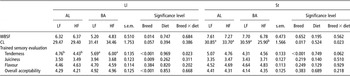
Meat quality characteristics from Ll and St muscles are presented in Table 2. The Ll muscle from the AL breed had higher values of shear force than the BA breed (P < 0.05). Conversely, the St muscle from the latter had the highest percentage of CL (P < 0.05). This parameter was also affected by the breed × diet interaction (P < 0.05). Table 2 shows that the Ll muscle from BA had higher tenderness (P < 0.001), juiciness (P < 0.01) and overall acceptability (P < 0.001) scores than AL. A significant breed × diet interaction (P < 0.001) was observed for Ll muscle tenderness. The highest score was observed in the BA produced in the HF diet while the lowest occurred in the AL finished with the same diet. Regarding the St muscle, breed was a source of variation in tenderness scores (P < 0.001). In contrast to the Ll muscle, the highest tenderness scores for the St muscle were observed in the AL breed.
WBSF (kg), CL (%) and sensory panel scores of Ll and St muscles from AL and BA bulls fed on LF or HF diet

WBSF =Warner–Bratzler shear force; CL = cooking loss; Ll = longissimus lumborum; St = semitendinosus; AL = Alentejana; BA = Barrosã; LF = low-forage diet; HF = high-forage diet; s.e.m. = standard error of means.
Means in the same row with different superscripts are statistically different (P < 0.05); the significance value is shown in the table when P ⩾ 0.001.
IMF composition
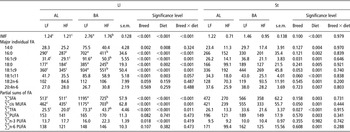
The FA composition expressed as mg/100 g of fresh muscle is displayed in Table 3. The IMF varied widely in the Ll muscle (P < 0.001), with the AL offering a leaner loin than the BA, but not in the St muscle. The latter had higher levels of 16:1c9 (P < 0.05) FA and trans fatty acids (∑TFA; P < 0.05) in the BA breed than in the AL breed.
IMF content (g/100 g of fresh muscle) and FA composition (mg/100 g of fresh muscle) of Ll and St muscles from AL and BA bulls fed on LF or HF diet

IMF = intramuscular fat; FA = fatty acid; Ll = longissimus lumborum; St = semitendinosus; AL = Alentejana; BA = Barrosã; LF = low-forage diet; HF = high-forage diet; s.e.m. = standard error of means; SFA = saturated fatty acids; MUFA = monounsaturated fatty acids; TFA = trans fatty acids; PUFA = polyunsaturated fatty acids.
SFA = 12:0 + 14:0 + i15:0 + ai15:0 + 15:0 + i16:0 + 16:0 + i17:0 + a17:0 + 17:0 + 18:0 + 20:0 + 21:0; MUFA = 14:1c9 + 16:1c7 + 16:1c9 + 17:1c9 + 18:1t6 + t8 + 18:1t9 + 18:1t10 + 18:1t11 + 18:1c9 + 18:1c11 + 18:1c12 + 18:1c13 + 18:1t16 + c14 + 18:1c15 + 20:1c11; TFA = 18:1t6 + t8 + 18:1t9 + 18:1t10 + 18:1t11 + 18:1t16 + c14; PUFA = n-3 PUFA + n-6 PUFA + 18:2c9t11 + 20:3n-9); n-3 PUFA = 18:3n-3 + 20:3n-3 + 20:5n-3 + 22:5n-3 + 22:6n-3; n-6 PUFA = 18:2n-6 + 18:3n-6 + 20:2n-6 + 20:3n-6 + 20:4n-6 + 22:2n-6 + 22:4n-6; Means in the same row with different superscripts are statistically different (P < 0.05); the significance value is shown in the table when P ⩾ 0.001.
Regarding the Ll muscle, the BA breed had higher amounts of 14:0 (P < 0.01), 16:0 (P < 0.001), 16:1c9 (P < 0.001), 18:0 (P < 0.001), 18:1c9 (P < 0.001) and 18:1c11 (P < 0.001) than the AL breed. The same pattern was observed for the sum of saturated fatty acids (∑SFA; P < 0.001), cis monounsaturated fatty acids (∑cis MUFA; P < 0.001), ∑TFA (P < 0.001) and n-3 polyunsaturated fatty acids (∑n-3 PUFA; P < 0.05).
The diet exerted an influence on the IMF content (P < 0.001) and on the amounts of 14:0 (P < 0.01), 16:0 (P < 0.01), 16:1c9 (P < 0.01), 18:0 (P < 0.01), 18:1c9 (P < 0.01), 18:1c11 (P < 0.01), ∑SFA (P < 0.01), ∑cis MUFA (P < 0.01) and ∑TFA (P < 0.001) in both Ll and St muscles. Moreover, the levels of ∑n-3 PUFA (P < 0.001) in the Ll muscle and 18:2n-6 (P < 0.01), 20:4n-6 (P < 0.01), ∑n-6 PUFA (P < 0.01) and ∑PUFA (P < 0.01) in the St muscle were influenced by diet. A significant breed × diet interaction was detected for the amounts of 16:0 (P < 0.001), 16:1c9 (P < 0.01), 18:0 (P < 0.001), 18:1c9 (P < 0.01), ∑SFA (P < 0.001), ∑cis MUFA (P < 0.01) and ∑TFA (P < 0.001) only in the Ll muscle.
Correlation between meat traits
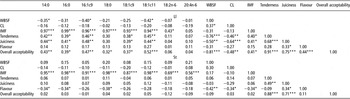
The correlation coefficients (r) found among IMF, FA, WBSF, CL and TSP traits in Ll and St muscles from AL and BA young bulls are shown in Table 4.
Pearson's correlation coefficients between IMF (g/100 g of fresh muscle), major FA (mg/100 g of fresh muscle), shear force (WBSF, kg), CL (%) and sensory panel scores in Ll and St muscles from AL and BA bulls fed on LF or HF

IMF = intramuscular fat; FA = fatty acid; WBSF =Warner–Bratzler shear force; CL = cooking loss; Ll = longissimus lumborum; St = semitendinosus; AL = Alentejana; BA = Barrosã; LF = low-forage diet; HF = high-forage diet.
*P < 0.05; **P < 0.01; ***P < 0.001.
Regarding the Ll muscle, moderately (0.7 ⩾ r ⩾ 0.3) negative correlations were observed between WBSF and the following FA, 14:0 (P < 0.05), 16:1c9 (P < 0.05) and 18:1c11 (P < 0.05). Further, strongly (r > 0.7) negative correlations were found between WSBF and tenderness (P < 0.001), juiciness (P < 0.001) and overall acceptability (P < 0.001). The CL parameter was negatively correlated with WBSF (P < 0.05), tenderness (P < 0.01), juiciness (P < 0.001) and overall acceptability (P < 0.01). The level of IMF was strongly correlated with 14:0 (P < 0.001), 16:0 (P < 0.001), 16:1c9 (P < 0.001), 18:0 (P < 0.001), 18:1c9 (P < 0.001), 18:1tc11 (P < 0.001) and moderately correlated with 18:2n-6 (P < 0.01), tenderness (P < 0.01), juiciness (P < 0.05) and overall acceptability (P < 0.05). Several positive correlations were observed between tenderness and 14:0 (P < 0.01), 16:0 (P < 0.05), 16:1c9 (P < 0.01), 18:1c9 (P < 0.05), 18:1tc11 (P < 0.01), juiciness (P < 0.001) and overall acceptability (P < 0.001). The juiciness was positively correlated with 14:0 (P < 0.01), 16:0 (P < 0.05), 16:1c9 (P < 0.01), 18:1c9 (P < 0.05), 18:1tc11 (P < 0.01), flavour (P < 0.05) and overall acceptability (P < 0.001). The latter was positively correlated with the levels of 14:0 (P < 0.01), 16:0 (P < 0.05), 16:1c9 (P < 0.01), 18:0 (P < 0.05), 18:1c9 (P < 0.05), 18:1tc11 (P < 0.001) and flavour (P < 0.001). A similar trend between IMF and FA contents was observed for the St muscle. The level of IMF was strongly correlated with several FA: 14:0 (P < 0.001), 16:0 (P < 0.001), 16:1c9 (P < 0.001), 18:0 (P < 0.001), 18:1c9 (P < 0.001) and 18:1c11 (P < 0.001) but moderately with others, such as 18:2n-6 (P < 0.001) and 20:4n-6 (P < 0.001) in the St muscle. Negative correlations were observed between flavour intensity and the values of 14:0 (P < 0.05), 16:0 (P < 0.05), 18:0 (P < 0.05), WBSF (P < 0.01), CL (P < 0.05) and IMF (P < 0.05). Juiciness was positively correlated with tenderness (P < 0.01), flavour (P < 0.05) and overall acceptability (P < 0.001). A positive correlation was observed between tenderness and overall acceptability (P < 0.001).
Discussion
Meat sensory traits
Toughness is one of the determinant factors of meat quality and a common cause of unacceptability in meat products. Studies from Huffman et al. (Reference Huffman, Miller, Hoover, Wu, Brittin and Ramsey1996) using beef aged for 7 days at 2°C have indicated that tenderness is the single most important palatability trait for determining overall steak acceptability. The WBSF is routinely used by researchers as an objective measurement of meat tenderness (Wheeler et al., Reference Wheeler, Shackelford, Johnson, Miller, Miller and Koohmaraie1997; Rhee et al., Reference Rhee, Wheeler, Shackelford and Koohmaraie2004). The WBSF and tenderness ratings evaluated by TSP in Ll muscle from BA and AL breeds are within the values obtained by Rhee et al. (Reference Rhee, Wheeler, Shackelford and Koohmaraie2004) and Dikeman et al. (Reference Dikeman, Pollak, Zhang, Moser, Gill and Dressler2005) for longissimus aged at 2°C until 14 days post mortem and cooked to an internal temperature of 71°C. However, the WBSF in the St muscle was higher that the mean values found by the latter author. The effect of fat on tenderness might be related to the quantity of IMF (Sañudo et al., Reference Sañudo, Alfonso, Sánchez, Delfa and Teixeira2000; Cuvelier et al., Reference Cuvelier, Clinquart, Hocquette, Cabaraux, Dufrasne, Istasse and Hornick2006). In our study, the muscle with a lower IMF value was considered the toughest.
The effect of breed on meat sensory quality has been studied by Wheeler et al. (Reference Wheeler, Cundiff, Shackelford and Koohmaraie2005). These authors compared seven beef breed types and found genotype effects on the WBSF in longissimus muscle. However, these effects were not confirmed by TSP. In contrast, in a study of eating quality traits among and within 14 breeds, Dikeman et al. (Reference Dikeman, Pollak, Zhang, Moser, Gill and Dressler2005) concluded the existence of important genetic effects on sensory traits. Wheeler et al. (Reference Wheeler, Shackelford and Koohmaraie1996) and Otremba et al. (Reference Otremba, Dikeman, Milliken, Stroda, Unruh and Chambers1999) reported correlation values of −0.68 and −0.85, respectively, with TSP between WBSF and overall tenderness ratings for longissimus steaks. Regarding the Ll muscle, the values for tenderness rating and WBSF were lower and higher, respectively, in the AL breed than in the BA breed. This finding was unexpected due to differences in the carcass maturity between breeds. When compared with BA, the AL is a large frame size and late-maturing breed. It is known that carcass maturity is an important contributor to meat quality, as advancing maturity is often associated with a decline in meat tenderness (Hanson et al., Reference Hanson, Erickson, Calkins, Klopfenstein, Milton and Klemesrud1998). The strongly negative correlation found between tenderness and WBSF was very similar to the one reported by Dikeman et al. (Reference Dikeman, Pollak, Zhang, Moser, Gill and Dressler2005). However, the relationship between tenderness scores and WBSF observed for the Ll muscle was not confirmed in the St muscle. The TSP had punctuated the St muscle from AL with a higher tenderness rating than BA. Moreover, no differences were found for the WBSF value and no significant correlation was recorded between tenderness scores and the WBSF value. Despite being the muscle studied in the vast majority of beef palatability research (Wheeler et al., Reference Wheeler, Shackelford, Johnson, Miller, Miller and Koohmaraie1997; Killinger et al., Reference Killinger, Calkins, Umberger, Feuz and Eskridge2004; Dikeman et al., Reference Dikeman, Pollak, Zhang, Moser, Gill and Dressler2005; Wheeler et al., Reference Wheeler, Cundiff, Shackelford and Koohmaraie2005; Smith et al., Reference Smith, Tatum and Belk2008), mainly due to its economical relevance and easy access, our study confirms that the results obtained for longissimus muscle cannot be extrapolated to the rest of the meat cuts/muscles. Tenderness and tenderness-related traits are highly variable within and among beef muscles. This is related to differences in proteolysis, rigour shortening and/or connective tissue properties (Rhee et al., Reference Rhee, Wheeler, Shackelford and Koohmaraie2004). In fact, biceps femoris and semimembranosus have been suggested as better muscle indicators of overall muscle tenderness (Simões et al., Reference Simões, Mendes and Lemos2005).
Flavour and juiciness are attributes that also contribute to the eating quality of beef. Although many factors can influence these attributes, the level of IMF plays a crucial role (Killinger et al., Reference Killinger, Calkins, Umberger, Feuz and Eskridge2004; Hocquette et al., Reference Hocquette, Gondret, Baéza, Médale, Jurie and Pethick2010). Fat content and composition have been shown to affect meat palatability, including flavour (as reviewed by Calkins and Hodgen, Reference Calkins and Hodgen2007). The development of meat flavour occurs through the Maillard reaction and lipids’ oxidation, which are influenced by cooking temperature. Although lipid oxidation is often associated with the development of off-flavours, cooking-induced oxidation may release desirable volatile flavours and likely creates compounds that influence the Maillard reaction in desirable ways (Elmore and Mottram, Reference Elmore and Mottram2006). Thus, the study of the relationships between muscle fat content and composition and beef flavour is important to understand the factors involved in the development of desirable flavours in beef (Campo et al., Reference Campo, Nute, Wood, Elmore, Mottramand and Enser2003). The IMF content was correlated with tenderness, juiciness and overall acceptability in Ll muscle and negatively correlated with flavour in the St muscle. Similarly, positive correlations between IMF content, tenderness and overall acceptability were described in the longissimus muscle by Dryden and Marchello (Reference Dryden and Marchello1970). In this research, the Ll muscle had a higher IMF content and higher tenderness, juiciness and overall acceptability ratings in the BA breed than in the AL breed. These results were not observed in the St muscle, which could be related to its low IMF content (1%). Indeed, if the amount of IMF does not exceed 1%, it may have a negative impact on the sensory quality of meat (Partida et al., Reference Partida, Olleta, Sañudo, Albertí and Campo2007).
The results from consumers’ palatability ratings obtained from strip loin revealed a highly positive correlation between flavour and juiciness (Platter et al., Reference Platter, Tatum, Belk, Chapman, Scanga and Smith2003). According to those authors, small changes in sensory ratings for flavour influenced the overall acceptability of steaks to a huge extent. Similarly, Rhee et al. (Reference Rhee, Wheeler, Shackelford and Koohmaraie2004) reported a positive correlation between these traits in Ll but not in St muscle. In this study, juiciness and flavour were significantly correlated in both Ll and St muscles.
The effect of forage feeding on beef flavour was reviewed by Melton (Reference Melton1990). Beef from steers fed high-energy, corn-containing diets for at least 90 days, compared with beef from leaner steers fed corn silage, usually has a more desirable or an intense beefy flavour. In contrast, Resconi et al. (Reference Resconi, Campo, Font i Furnols, Montossi and Sañudo2010) found that beef odour and beef flavour intensities were negatively associated with the energy content of the diets. However, unlike this study, animals with high growth rates were slaughtered at a younger age than the others. This aspect might have influenced the results obtained by those authors.
Melton (Reference Melton1983) discussed the possibility that an increased intensity of undesirable flavours could be associated with the thermal oxidation of PUFA. Forage-fed beef can experience decreased flavour acceptance due to volatiles from fat oxidation and chlorophyll derivatives (Griebenow et al., Reference Griebenow, Martz and Morrow1997). This was not observed in AL and BA breeds. Differences between diets on IMF from Ll and St muscle were unaccompanied by different TSP ratings. Neither Ll nor St muscles’ flavour were affected by diet. Panellists in triangular tests characterised 18:1 as ‘oily’, while 18:2 scored most for ‘cooking oil’ and 18:3 for ‘fishy’ and ‘linseed’ (Campo et al., Reference Campo, Nute, Wood, Elmore, Mottramand and Enser2003). However, in the presence of cysteine and ribose, similar meaty aromas were recorded. The concentration of 18:1 FA has been related to desirable flavour ratings (Dryden and Marchello, Reference Dryden and Marchello1970; Duckett et al., Reference Duckett, Wagner, Yates, Dolezal and May1993). Westerling and Hedrick (Reference Westerling and Hedrick1979) reported a positive correlation between 18:1 concentration and flavour scores in longissimus muscle. Under the conditions of our experiment, none of the FA studied were significantly associated with Ll flavour, which is in line with the findings of Camfield et al. (Reference Camfield, Brown, Lewis, Rakes and Johnson1997). However, the FA in the bibliographic references were expressed as weight percentage (% w/w) instead of absolute values (mg FA/100 g fresh meat), which makes the comparison of results difficult.
In our study, the levels of SFA, 14:0 and 16:0, and MUFA, 16:1c9, 18:1c9 and 18:1c11, were significantly and positively correlated to juiciness, tenderness and overall acceptability in the Ll muscle. These correlations were not observed in the St muscle, which may be related to its low IMF content. Nonetheless, negative correlations were observed for the St muscle between flavour and 14:0, 16:0 and 18:0 FA contents. Similar relationships were reported by Westerling and Hedrick (Reference Westerling and Hedrick1979) in longissimus muscle. These authors found negative correlations between 16:0 and 18:0 FA (expressed as weight percentage) and flavour scores, but not significantly associated with juiciness or tenderness attributes. In addition, a negative correlation was noted by those authors between the 18:2 percentage and flavour scores in the longissimus muscle. The levels of PUFA can affect meat flavour due to an increased development of flavour volatiles during cooking, through lipid oxidation. In a study by Fisher et al. (Reference Fisher, Enser, Richardson, Wood, Nute, Kurt, Sinclair and Wilkinson2000), meat with the highest concentration of 18:2 and 20:4 FA had a low score for lamb flavour and overall liking. This was not observed in our study as the levels of 18:2n-6 and 20:4n-6 FA were not significantly correlated with the traits evaluated by the TSP in either muscle.
IMF content and FA composition
The effect of breed on the FA composition was more pronounced in the Ll than in the St muscle, which could be attributed to their distinct physiological functions (movement for St and posture for Ll) and fibre profile. Results from another Portuguese breed revealed that the Ll has higher proportions of oxidative and type I fibres and lower percentages of IIB fibres than the St muscle (Costa et al., Reference Costa, Roseiro, Bessa, Padilha, Partidário, Marques de Almeida, Bessa, Calkins and Santos2008).
The BA is considered an early-maturing breed when compared with the AL. It seems reasonable that the LF scheme could have exacerbated the deposition of IMF to a larger extent in the BA breed than in the AL breed. Indeed, it is known that the level of energy available in the diet influences largely carcass fat deposition in early-maturing breeds (Brosh et al., Reference Brosh, Aharoni, Levy and Holzer1995; Aldai et al., Reference Aldai, Murray, Oliván, Martínez, Troy, Osoro and Nájera2006). In agreement, our research group found that BA had a higher level of cod fat expressed as g/kg carcass weight (P < 0.01) and lower slaughter weight than the AL breed (A.S.H. Costa et al., 2011, personal communication). In addition, the dissection of the leg revealed that BA had the highest amounts of subcutaneous (P < 0.10) and intermuscular fat (P < 0.05; A.S.H. Costa et al., 2011, personal communication). These findings suggest that the maturity level might be a determinant factor in differences in the IMF content and composition between AL and BA breeds. Indeed, it was observed that the IMF content and composition could be widely influenced by genotype (Cuvelier et al., Reference Cuvelier, Clinquart, Hocquette, Cabaraux, Dufrasne, Istasse and Hornick2006; Aldai et al., Reference Aldai, Nájera, Dugan, Celaya and Osoro2007). Furthermore, the latter found that the IMF profile is more influenced by breed than other fat depots, such as intermuscular fat. In a study using longissimus thoracis (Lt) muscle from Belgian Blue, Limousin and Aberdeen Angus young bulls, the level of IMF was directly proportional to SFA and MUFA contents while the PUFA concentration (values expressed in mg FA/100 g muscle) remained practically unaffected by the IMF content (Cuvelier et al., Reference Cuvelier, Clinquart, Hocquette, Cabaraux, Dufrasne, Istasse and Hornick2006). It is known that as the deposition of fat increases, the ∑SFA and ∑MUFA contents increase faster than the ∑PUFA content (De Smet et al., Reference De Smet, Katleen and Daniel2004). Indeed, variations in the IMF content are related to differences in triacylglycerols and not in phospholipid contents. Phospholipids are particularly rich in PUFA, whereas triacylglycerols contain much lower levels of PUFA. Thus, as the IMF content increases, the level of triacylglycerols increases much more than that of phospholipids and the PUFA concentration in IMF decreases due to a dilution effect (De Smet et al., Reference De Smet, Katleen and Daniel2004; Costa et al., Reference Costa, Roseiro, Bessa, Padilha, Partidário, Marques de Almeida, Bessa, Calkins and Santos2008).
These findings could explain the differences observed between AL and BA in the IMF content and composition from Ll muscle. As found by Cuvelier et al. (Reference Cuvelier, Clinquart, Hocquette, Cabaraux, Dufrasne, Istasse and Hornick2006) for Lt muscle, Ll from the BA breed had the highest IMF content and the highest SFA and MUFA contents. In contrast to Ll, differences in the FA composition between AL and BA breeds were slight in St muscle, likely due to its lower content of IMF.
The diet influenced extensively the FA contents both in Ll and in the St muscle. Although diets had the same gross energy, the changes in rumen fermentation, small intestinal digestion and availability of net energy between experimental groups may be attributable to the differences found in the starch and crude fibre contents and, therefore, could explain the results obtained. When compared with the HF diet, the LF diet produced more propionate in the rumen and/or more glucose in the small intestine from undegradable starch. This is expected to promote lipogenesis through insulin production (van Eenaeme et al., Reference van Eenaeme, Istasse, Gabriel, Clinquart, Maghuin-Rogister and Bienfait1990). In fact, animals fed on the LF diet had higher levels of plasmatic insulin than their counterparts fed on the HF diet (P < 0.05, A.S.H. Costa et al., 2011, personal communication). This increased glucose availability might be accountable for the differences in the quantity and composition of the IMF (Smith and Crouse, Reference Smith and Crouse1984). Thus, the LF diet was expected to lead to an increase in FA synthesis within intramuscular adipocytes, especially of SFA and MUFA, and consequently to an increase in the IMF content of the meat (Pethick et al., Reference Pethick, Harper and Oddy2004). In general, this pattern was observed in this study. Indeed, both Ll and St muscles from animals fed on the LF diet had a higher IMF content than those raised on a HF diet.
Conclusions
Meat sensory attributes (tenderness, juiciness and flavour), nutritional parameters (fat composition and content) and image linked to subjective considerations (animal welfare and natural production systems as PDO certification) determine consumers’ perceived quality. Control of meat quality and more particularly its sensory and nutritional parameters is important for beef producers and retailers to cater to consumers’ preferences. The results obtained in this study have shown that AL and BA meats have distinct sensory attributes. Furthermore, diet was an important source of variation on meat fat content and composition in both breeds. However, despite its effect on fat composition, forage level had a minor effect on AL and BA meat palatability. These results may help to explain the differences in eating quality between AL and BA meats often perceived by consumers.
Acknowledgements
This research was supported by the Fundação para a Ciência e a Tecnologia (FCT) through an individual fellowship to Paulo Costa (SFRH/BPD/46135/2008) and to Ana S. H. Costa (SFRH/BD/61068/2009). Paula A. Lopes is a researcher from the programme ‘Ciência 2008’ from FCT. We are grateful to EZN slaughterhouse staff, particularly to Paula Menezes, for her help with carcass data and meat sample collection. We acknowledge Chris Calkins from the University of Nebraska for his helpful comments.