1. Introduction
The Weather Underground, the notorious clandestine violent organization in the United States, issued a political statement in 1974 outlining its strategy for combatting the US state apparatus: “At this early stage in the armed and clandestine struggle, our forms of combat and confrontation are few and precise … By beginning the armed struggle, the awareness of its necessity will be furthered…. Action teaches the lessons of fighting and demonstrates that armed struggle is possible.”Footnote 1 As this statement suggests, individuals or groups may use targeted violence at the beginning of a conflict as an attempt to signal to society the need for broad-based violence against the state. This signal can incite broader revolution or civil war by changing peoples' beliefs about the state and increasing support for purveyors of violence. In short, the Weather Underground's statement suggests that acts of terrorism might be designed to spur civil war.
Once civil war has erupted, terrorism may have a different purpose. In Peru in the 1980s and 1990s, the Shining Path, an insurgent organization that nearly destroyed the state, used extreme violence against civilians to ensure compliance both within the organization and among the population, as well as to target the government. Ponciano del Pino claims that beyond terrorizing other citizens, “increased ruthlessness of violence employed against the population was meant to terrorize, block, and paralyze the initial currents of resistance within the Shining Path.”Footnote 2 According to Stathis Kalyvas, terrorism is synonymous with “[r]esorting to violence in the context of a civil war in order to achieve compliance.”Footnote 3
At the conclusion of a war, terrorism may be used for yet another reason. During and after the peace negotiations that ended the Angolan civil war, for example, incidents of terrorism increased dramatically. Terrorism in this context may be used by actors to shape the outcome of the peace process or to possibly end this dialogue. Thus, groups might use terror to spoil the peace process,Footnote 4 sometimes “exacerbat[ing] doubts on the target side that the moderate opposition groups can be trusted to implement the peace deal and will not renege on it later on.”Footnote 5
These cases exemplify the prominent use of terrorism before, during, and after civil war in a diverse set of conflicts worldwide. Surprisingly, studies of the terrorism-civil war nexus are rareFootnote 6 when compared to the myriad studies that explicitly or implicitly treat the two phenomena as distinct forms of political violence.Footnote 7 Past literature on the onset, duration, or resolution of civil wars scarcely mentions terrorism.Footnote 8 Terrorism literature also avoids grappling with the relationship between these forms of violence, exploring instead general political and economic explanations for the number of terrorist attacksFootnote 9 or modalities of attacksFootnote 10 while implicitly assuming little or no association with civil war.
The disconnect between the terrorism and civil war literatures may not be unique within the study of political violence and contentious politics, more generally.Footnote 11 Indeed, scholars often privilege the study of one form of contention over another. We thus find many examples of isolated studies of riots,Footnote 12 terrorism,Footnote 13 genocides and massacres,Footnote 14 protests,Footnote 15 and repression.Footnote 16 Although we do not consider all of these possibilities together, the overlap between civil wars and terrorism that we identify suggests that there may be a greater coincidence of many types of violent and non-violent forms of contention during different phases of conflict than scholars now consider in their studies. While this overlap may seem evident to some, it is puzzling that most scholars continue to ignore these connections in their theoretical and empirical work.
If terrorism and civil war (and perhaps other varieties of violence) are separated only by artificial, analytic boundaries, then crucial dynamics of government-opposition contention may be excluded by construction. Yet, the consequences of treating the two as distinct may be nontrivial. Indeed, a number of recent studiesFootnote 17 suggest that we must engage ambiguities and avoid studying specialties of violence. We therefore ask the following questions in this paper: To what extent do terrorism and civil war overlap? What are the precise temporal and spatial patterns in the overlap?
Drawing on the rapid increase in strategic approaches in both the civil war and terrorism literatures,Footnote 18 we explore and in limited ways extend existing expectations about the uses of terrorism before, during, and after civil wars. Using newly geo-referenced terrorism data, we then map the intersection of terrorist events and civil war zones worldwide to determine the extent to which they coincide. Particularly, we examine terrorism during civil war, prior to war, and after war to identify the temporal and spatial overlaps. Following a global descriptive analysis, we consider six exploratory case examples—Argentina, Bangladesh, El Salvador, Lebanon, Mozambique, and Peru—to illustrate the claims we are making and also indicate possibilities for future inquiry.Footnote 19
The results of the analysis indicate that there is substantial overlap between terrorism and civil war generally. The data show that most incidents of terrorism take place in the geographic regions where civil war is occurring and during the ongoing war. A much smaller portion of these incidents occur prior to war, after war, or in zones not experiencing war. These patterns are consistent with the timing indicated by strategic approaches to terrorism, which we consider in detail.
In the country examples that we examine, terrorism occurs mainly during civil wars, but in Latin America the next most frequent occurrence of terrorism is during the pre-war period, suggesting that terrorism may be used to spur broader violence in some regions but not others. This pattern occurs primarily during the Cold War, whereas in the post-Cold War cases terrorism becomes more frequent after civil wars end in comparison to the pre-war period. These temporal and regional results are suggestive and similar to recent workFootnote 20 that shows that patterns in internal conflict vary since the end of the Cold War.
The georeferenced terrorism data are from the Global Terrorism Database and capture terrorist activity from 1970–2004.Footnote 21 We use conflict zone data from Jan Ketil Rød and supplement it with geographic data from the Uppsala Conflict Database.Footnote 22 Although these data are among the best available, they nonetheless have some limitations. In developing the research design, we provide a detailed discussion of the strengths and weaknesses of the data, and we also carry out several sensitivity analyses, such as disaggregating conflict zone and terrorist event type.
Our analysis has a number of conceptual, theoretical, and policy implications, which we raise here and return to in the conclusion. First and foremost, the current analytic divisions between civil wars and terrorism may be counterproductive and even misleading when scholars and policymakers strive to understand conflict processes. Second, following recent calls by Sidney Tarrow and Stathis Kalyvas to better understand the nature and types of violence,Footnote 23 our analysis suggests that other forms of violent and non-violent action may need to be considered together to understand how contentious politics operate more generally. Third, geospatial modeling techniques are a powerful tool to bring together a wide variety of seemingly different types of violence into a single analysis. Geospatial modeling has been used in political science,Footnote 24 but mostly to construct spatial (and sometimes temporal) lags of variables of interest. Spatial methodologies could be used in the study of contentious politics in innovative and substantively insightful ways. More generally, they could be used to examine a wide variety of substitutable political strategies, such as various means of mobilizing voters. Finally, we expect that this analysis could inform policymakers about the risks of different combinations of violence and help them construct solutions appropriate to pre-, during-, and post-war situations. For example, our analysis reveals that since the end of the Cold War, more terrorism has occurred at the end of war rather than at the beginning, highlighting the challenge that third-party peace operations face.
Because the focus of this paper is empirical, we begin from strategic approaches that suggest how and when terrorism and civil war should occur jointly. Following this discussion, we proceed to an examination of patterns of overlap in civil wars and terrorism worldwide. We supplement the global view with six exploratory case studies, and then discuss a number of extensions and sensitivity analyses. We conclude with an extended discussion of the conceptual, theoretical, and policy implications from the analysis that underscores our main point that scholars and policymakers need to consider different varieties of violence together rather than separately as has been standard practice.
2. Terrorism and Civil War: Strategy, Actors, Phases
The rationalist approach to conflict has been applied to interstate war,Footnote 25 civil war,Footnote 26 and, to a lesser extent, terrorism.Footnote 27 While there are diverse arguments that fall under this rubric, most rationalist claims regarding conflict generally, and terrorism specifically, assume that violence is due, at least in part, to a breakdown in bargaining among actors.Footnote 28 States and dissidents desire a particular policy outcome but cannot achieve that outcome due to information or commitment problems. This leads actors to pursue a number of strategies to attempt to resolve bargaining failures and achieve their desired outcomes.
Scholars have traditionally been fragmented in their application of the rationalist approach, considering a variety of actors in isolation. Our claim is that different varieties of violence may actually fit within a similar strategic approach. Thus, whereas the key actors in conflict are variably referred to as dissidents, rebels, insurgents, terrorists, and revolutionaries, among others, and are often treated separately, they may follow a similar strategic logic in their choices to use violence. Indeed, the strategy of terrorism may occur as part of a larger war either in provoking, prolonging, or spoiling it. Andrew Kydd and Barbara Walter contend that terrorism is a form of costly signaling about what terrorists will do to achieve their desired outcomes.Footnote 29 They offer five strategies of terrorism: provocation, attrition, intimidation, outbidding, and spoiling. These strategies may occur at different times before, during, and after war.
Provocation involves using the superior force of the state against itself, a form of political jujitsu. As David Lake argues, in the course of a conflict, terrorism is used “to provoke the target into a disproportionate response, radicalize moderates, and build support for its ambitious goals over the long term.”Footnote 30 This suggests terrorism will occur at the beginning of a violent conflict or before civil war to provoke the state, build support and capacity, and thus challenge the state. Terrorism is generally considered a strategy of the weak and thus one that should occur as a group builds capacity rather than as a primary tool between comparable enemies. Whether terrorism might occur once civil war has begun or after the conflict subsides is unclear.
Attrition relates to the need for a violent group to signal strength and resolve to its opponent. As Kydd and Walter note, Robert Pape's work demonstrates how suicide terrorism can impose extreme costs on an opponent while signaling the strength of the group using the tactic.Footnote 31 Pape's claim is that suicide terror campaigns are most likely to occur against democratic occupiers. Attrition arguments suggest that this tactic may be used to spark a conflict or maintain it, but there should be little reason for the use of terrorism after the conflict ends.
Intimidation refers to violence by insurgents directed at members of the population. The objective of intimidation is control. While violence during conflicts can serve many functions, Kalyvas claims that insurgent violence directed towards civilians “to generate compliance constitutes a central aspect of the phenomena.”Footnote 32 This reason for terrorism most likely applies to violence during civil wars. When both states and insurgents are struggling to maintain territory and control, this type of violence should peak. In contrast, dominance by one side should lead to less intimidation or coercive violence to control the population.Footnote 33
Mia Bloom suggests that suicide terrorism is a tactic used when groups find themselves in competition for public support.Footnote 34 Kydd and Walter and Bloom call this strategy of terrorism outbidding.Footnote 35 Bloom argues that this logic applies to the use of suicide terrorism in competitive environments characterized by hurting stalemates or conflicts that have endured.Footnote 36 Outbidding should then apply to violence during civil war. It is unclear whether outbidding should occur prior to or after the conflict ends.
Kydd and Walter also argue that terrorism is used to “spoil the peace,” or to cast doubt on the credibility of peace processes and negotiations.Footnote 37 Spoilers have an interest in maintaining conflict and provoking violence from the state. If Kydd and Walter are correct, terrorism should occur after civil wars end as groups who do not like the bargain struck between moderates will attempt to derail the peace process.Footnote 38 Terrorism may occur during the civil war as well as during periods of negotiation or lulls in violence.
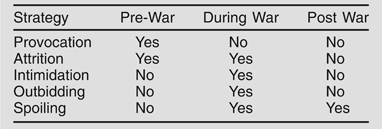
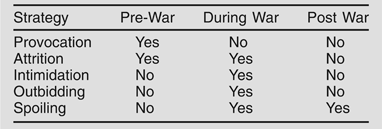
In sum, terrorism is likely to occur during ongoing civil wars in four of the five strategic reasons for terrorism. Terrorism is expected prior to civil war in two of the five strategies. Only one of the five (spoiling), expects terrorism to occur after civil war ends. Table 1 summarizes the above discussion and provides context for when terrorism should occur in relation to civil war.
When to Expect Strategies of Terrorism
In contrast to this strategic approach, which potentially allows for the overlap of terrorism and civil war, most scholars still view each as distinct forms of violence. As Nicholas Sambanis notes, “it is not as useful to view civil war outcomes as the result of deep-seated and hardly changing structural conditions as it is to observe the links among different forms of political violence and to analyze the dynamics of conflict escalation and the transition from one form of violence to another.”Footnote 39 Sambanis thus suggests that terrorism and civil war are like water and ice, connected but different forms created under different conditions. In his later work, Sambanis refines this distinction and offers a typology to explore the differences between these forms of violence.Footnote 40 He confines his analysis to the use of terrorism as a strategy exclusively outside of civil war and finds differences in factors that explain the use of terrorism as opposed to civil war. Sambanis identifies an important facet of terrorism by suggesting that there are really multiple terrorisms or a variety of reasons for the use of this form of political violence.Footnote 41 Our interest is broader as we want to understand the use of this tactic inside (during) or outside (before and after) of civil war. Sambanis rejects this approach citing Charles Tilly on the difficulty in understanding the use of terrorism across multiple contexts.Footnote 42 If terrorism and civil war are complex but overlapping processes, we cannot ignore this nexus and instead need to explain the connections.
Kalyvas rightly claims that, “civil wars are not binary conflicts but complex and ambiguous processes that foster an apparently massive, though variable, mix of identities and actions.”Footnote 43 Violence can result from national and local concerns, and have both political and private motivations. With this diversity in mind, dissident groups sometimes coerce others by punishing and killing civilians. Kalyvas cites Jeffrey Race in explaining how in the case of the Vietnam War, the Vietcong “use terrorism to instill fear. In a hamlet they will pick out a couple of people who they say cooperate with the Americans, and shoot them, to set an example … After they kill a few people, the whole hamlet is afraid and the Vietcong can force them to cooperate.”Footnote 44 This appears to be something akin to Kydd and Walter's concept of intimidation.Footnote 45 Kalyvas seems hesitant to include terrorism in the domain of his theory suggesting that terrorism might be violence used during peace rather than violence used during civil war. For Kalyvas, this difference between violence in and out of war is a difference in degree not in kind and suggests that “terrorism involves violence on a much lower scale than civil war.”Footnote 46
Addressing the same question, but with a different argument, others claim that the distinction between terrorism and civil war lies in recognizing that certain actors are terrorists whereas others are insurgents in civil war. An “actor-based” method of separating terrorism from insurgents or civil war relies on labeling participants rather than their actions. For Ignacio Sanchez-Cuenca and Luis De La Calle Robles, guerrillas or insurgents differ from terrorists in that guerrillas/insurgents hold territory, depend on the support of the population, are not clandestine, and create larger amounts of violence and, therefore, should be considered distinctly as separate actors.Footnote 47 Sanchez-Cuenca and De La Calle Robles label most other terrorism explanations “action-based,” because terrorism is defined as an action or event that does not depend on making distinctions among types of actors. It usually involves being defined as violence or threats of violence against civilians to persuade an audience in pursuit of a goal. They contend that an actor-based approach is better than an action-based approach, but this actor-based approach places terrorism and insurgency into separate conceptual containers that cannot overlap by definition.Footnote 48
If we conceptualize choices in a strategic framework, we can explain group actions without resorting to the reification of certain kinds of actors. As Tilly argues, “social scientists who attempt to explain sudden attacks on civilian targets should doubt the existence of a distinct, coherent class of actors (terrorists) who specialize in a unitary form of political action (terror) and thus should establish a separate variety of politics (terrorism).”Footnote 49 We concur, and therefore consider terrorism to be a strategy or tactic implemented by groups against an established state.Footnote 50 Acts of terrorism are likely to occur in and out of war, but are likely to be closely related to broader conflicts. Furthermore, Tarrow, in his critique of several prominent studies, argues
by hiving off civil wars from other forms of contention, quantitative scholars of civil wars risked reifying the category of civil war and downplaying the relationship between insurgencies and “lesser” forms of contention. Escalation to civil war from nonviolent contention or from less lethal forms of violence; transitions from civil wars to post-civil war conflict; co-occurrence between core conflicts in civil wars and the peripheral violence they trigger—none of these was exhaustively examined in these studies.Footnote 51
While only reviewing four studies, Tarrow's conclusion applies well to the larger civil war and terrorism literatures, and supports our arguments thus far. We now turn to the setup for our central analysis: determining to what extent terrorism and civil war overlap along with precise temporal and spatial patterns of the overlap.
3. An Empirical Inquiry of the Conceptual Problem
Thus far, we have discussed why terrorism and civil war are not altogether different phenomena. Strategic approaches indicate that civil war and terrorism should overlap, and the overlap also depends on the time period. Of the five mechanisms posited by Kydd and Walter,Footnote 52 four of them suggest that terrorism should occur during ongoing civil wars. There are fewer expectations for terrorism outside of civil war, but even they suggest that terrorism may occur immediately preceding or following war. We now identify conceptual distinctions between terrorism and civil war, and then use a geographic approach to examine whether terrorist events are civil war related, either prior to, during, or after civil war. We first investigate some global patterns for these associations, then we turn to exploring these processes within six countries.
3.1 Terrorism and Civil War: Measuring the Concepts
Terrorism is usefully defined as “the threatened or actual use of illegal force and violence by a non-state actor to attain a political, economic, religious or social goal through fear, coercion or intimidation.”Footnote 53 This definition is useful for two reasons. First, it is consistent with an emerging consensus among scholars of terrorism (See Tore Bjørgo).Footnote 54 Second, this definition utilized by the developers of the Global Terrorism Database (GTD) is reflected in the way the data are measured for use in the project. The GTD contains 61,637 terror events worldwide from 1970–1997 and an additional 7,154 from 1998–2004 collected separately and using a slightly different definition. The data cover both domestic and transnational terrorist events perpetrated by a diverse set of opposition groups against a variety of civilian, military, and government targets. Compared to other data sets on terrorism, such as ITERATE,Footnote 55 the GTD contains at least five times as many events, making it the most comprehensive source of terrorism data available.Footnote 56
While others have provided lengthy discussions about defining terrorism,Footnote 57 that is not our purpose here. Instead, we identify a few areas where the two concepts of terrorism and civil war have divergence to establish their uniqueness. Most definitions of civil war require that violence is carried out by both parties in a conflict (rebels and government), that the violence exceeds a given death threshold, and that the violence is sustained over some period of time.Footnote 58 In contrast, conceptualizations of terrorism typically focus on non-state actors, their motivation for violence, and the audience for their violence.
We use a definition for civil war that is also similar to previous conceptualizations and is utilized by the Uppsalla Conflict Database. The civil war data we use are based on the ViewConflicts software by Rød, which is based on the Uppsala Conflict Database.Footnote 59 UCDP defines armed conflict as: “… a contested incompatibility that concerns government and/or territory where the use of armed force between two parties, of which at least one is the government of a state, results in at least 25 battle-related deaths in one calendar year.” We use this definition because it confines its focus to the joint-production of battle-related violence, which should be considered separately from terrorism because terrorist violence is typically carried out by non-state actors against other non-state actors where some message of threat, intimidation, or coercion is communicated to a target beyond the immediate victims.Footnote 60
While we hope to address Tarrow's call to understand the co-occurrence of violence, studying terrorism in the context of civil war (or before or after) is complicated not only by conceptual issues but also by data limitations.Footnote 61 This paper centers on the question of similarity between civil war and terrorism. Clearly, not all terrorism is related to civil wars (or vice versa). Terrorist events in the United States such as the Oklahoma City bombing, for example, are not related to a civil war. Even terrorist events within a country engaged in a civil war may not be related to that war. Not all terrorist events in India, for example, are related to the conflict in Kashmir or other large-scale Indian violence. Instead, many terrorist events can occur for other reasons such as the pursuit of limited policy change. This presents the problem of how to associate terrorist events with civil wars. In many cases, the groups perpetrating terrorism are identified in the data, and we can determine whether they are also rebel groups engaged in a civil war. In other cases, however, the perpetrators are not coded. To compound the problem of group identification, multiple groups could carry out, or claim credit for, a single attack. A group that did not, in fact, perpetrate the attack could nonetheless claim credit for the attack in an attempt to increase its status. Thus, relying exclusively on an actor-based identification strategy is problematic.
To identify which terrorist events are associated with civil war in a uniform and systematic way, we coded geographic coordinates for most of the terrorist events in the GTD 1.1 and 2.0 (about 50,000 of the events).Footnote 62 The geo-referenced terrorist events contain the latitude and longitude of each event based on the city in which the event occurred or the city to which the event was closest. Once geo-coded, we merged the terrorist event codes with armed conflict data and identified terrorism as being conflict-related if it occurred in the civil war zone during the the civil war, prior to the war but in a location that was later part of the war, or following the war in a location that was previously part of the war.Footnote 63
In general, overlaying the data in such a way makes us confident that we are classifying the terrorist events more accurately: terrorism occurring in civil war zones during ongoing civil wars is likely to be related to the civil war. This approach is fairly conservative because terrorist events related to the civil war could also occur outside of the civil war zone, and our initial approach does not capture these events. The Moscow theater bombing and the Beslan school attack in Russia are both examples of terrorist behavior clearly related to the civil war in Chechnya, but taking place outside of the conflict zones.Footnote 64
Other precautions with the data need to be considered. As Sambanis, Drakos and Gofas, and others identify, there can be reporting biases that influence the identification of terrorism.Footnote 65 Drakos and Gofas argue that autocracies may systematically underreport terrorism as they have incentives to mitigate reports of unrest or restrict their presses from doing so. While we note the possibility of this so-called under-reporting bias, our selection of cases varies by degree of democracy, which should lessen the impact of this source of bias.
Sambanis suggests that in the fog of civil war it might be difficult to disentangle terrorism from other forms of political violence.Footnote 66 This is also a source of potential bias in our data as events during war may succumb to an over-reporting bias. Genocidal or criminal acts, for example, may be incorrectly categorized as terrorist violence. These problems are mitigated in a few ways. Over-reporting bias should not influence the time period before and after war. Furthermore, over-reporting bias should be fairly constant across our cases and thus represent a form of inflation during the civil war period. As long as this bias is moderate and not extreme, it should not have a dramatic influence on our exercise here as we are not estimating regression coefficients.
As Kalyvas aptly argues, there is a difference between civil war and violence in civil war.Footnote 67 Certainly violence that fits the definition of terrorism—utilized by dissident groups to instill fear, directed at an audience separate from the victim, and used for some larger political gain—is used in civil war.Footnote 68 Because we should see this tactic of violence used in civil war, some of it may be misinterpreted thus overestimating its occurrence. By using the Uppsala definition of armed conflict, however, terrorist attacks should not be included and therefore should not be capturing something fundamentally similar. While our main analysis includes all events, we further refine the analyses to explicitly exclude government and military targets and find that the patterns are strikingly similar to the main results. These results can be found in the Appendix. We consider other sensitivity analyses below to address some of the potential difficulties in the data.
3.2 Patterns of Civil Wars and Terrorism
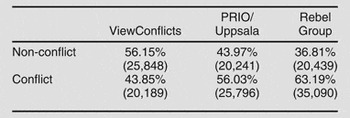
We consider the percentage of terrorist events that are conflict related based on three different definitions. First, we report the overlap between terrorist events and civil war zones based on ViewConflicts followed by the overlap with conflict zones as defined by the PRIO/Uppsala Armed Conflict Data.Footnote 69 Finally, we consider terrorist events that occur in a conflict zone defined by either Rød or Uppsala as well as whether the perpetrator of the terrorist event is defined as a rebel group by David Cunningham or Uppsala.Footnote 70 For terrorism occurring prior to, or following civil wars, we identify whether the event occurred in an area that later became a civil war zone or that was previously a civil war zone.
Table 2 reports the descriptive statistics for these relationships.Footnote 71 The percentage of events occurring in conflict zones (before, during, and after) as defined by Rød is roughly 44%, which is the lowest estimate. Based on the PRIO/Uppsala conflict zones and the estimate that includes rebel groups, the percentages of war-related terrorism are 56% and 63% respectively. Although each of these measures is likely an estimate with some error, they nonetheless demonstrate just how prevalent terrorism is in the context of civil war. Roughly half or more of terrorist events occur during ongoing civil war. We also calculated the overlap by considering the size of the conflict zones relative to non-conflict zones, along with how much terrorism occurs in each. There is nearly five times as much land not involved in civil war, which means that the patterns we identify are even more concentrated given the context. These basic patterns are thus consistent with the strategic explanations identified above, which predict that four of the five strategies should occur during war.
Percentage of War-Related Terrorist Events

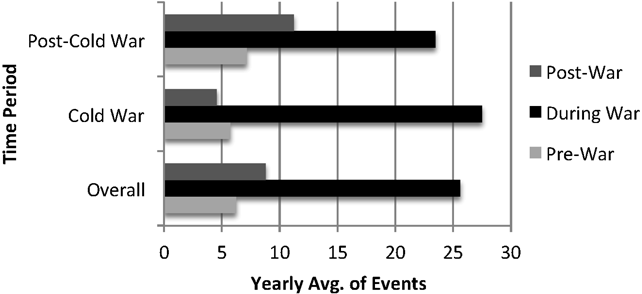
Because Table 2 does not disaggregate the events by time period, Figure 1 shows the average number of terrorist events that occur during a war, in the five years prior to a war onset, and in the five years after the war onset. We further separate this by Cold War and Post-Cold War periods. The results confirm the basic finding above that terrorism occurs frequently during ongoing civil wars. The average number of events per year during a conflict is over 23. The overlap between terrorism during the pre-war period and later conflict zones is mixed. During the Cold War, terrorism occurred more often prior to the civil war than after the war. But in the post-Cold War period, the relationship flips and terrorism occurs more frequently following civil wars than before them. As Kalyvas and Balcells argue, the end of the Cold War saw a dramatic reduction in both state financing of rebel movements and a subsequent decline in irregular or guerrilla style civil wars.Footnote 72 Because the plurality of civil wars in the post-Cold War era involve parties of more similar levels of capabilities, terrorism may be likely to follow the cessation of war as the losing party still can muster resources for violence.
Average number of terrorist events by period: Pre, during, post war

A final perspective on the terrorism-civil war relationship considers simply whether a civil war experienced at least one terrorist event. Examining all civil wars, we find that 68 (73%) experience at least one terrorist event while the other 25 (27%) in our sample do not experience a terrorist event. Thus, by any of these approaches, a common story emerges: terrorism is strongly associated with civil war.
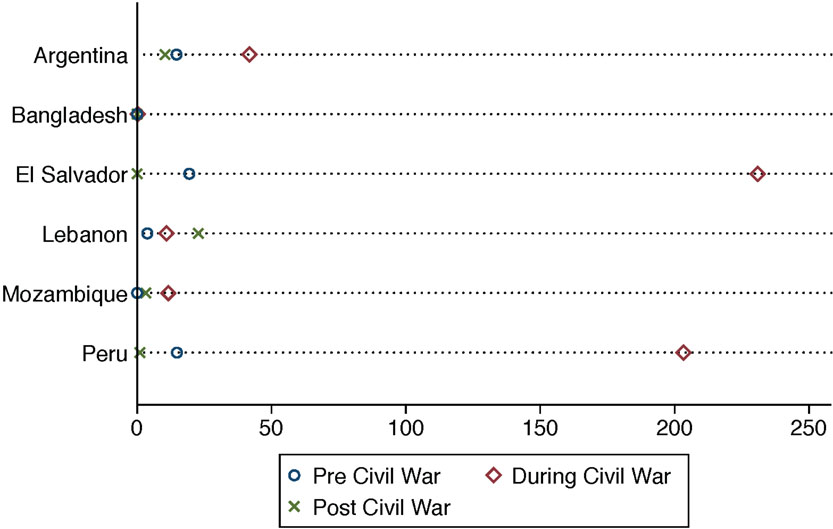
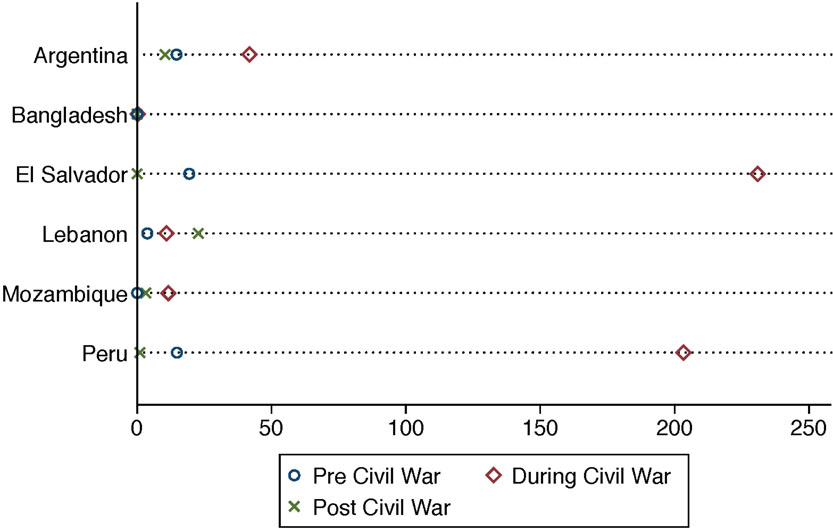
In the next section, we explore the relationship between terrorism and civil war within six countries across the periods before, during, and after civil war. To preview, Figure 2 provides a dot plot of the average number of terrorist attacks per year in civil war zones across our six countries. Each diamond represents average attacks per year during civil war, each “x” represents the average attacks per year after war ends, and each circle represents the average attacks per year in the period prior to civil war. In each of the countries except Lebanon, attack levels are highest during civil war. The pattern is most pronounced in the Latin American cases. In the case of Lebanon's civil war that ended as the Cold War concluded, terrorist attacks following the war increased as Hezbollah represented a strong challenge to a weak Lebanese government.
Average number of terrorist events by country: Pre, during, post war
4. Case Comparisons
We created a series of country maps with three separate temporal periods to better visualize the connections between civil war and terrorism. Each map contains the political boundaries of a state with a civil war zone overlayed. We then displayed the geographic distribution of these attacks (a) before the civil war, (b) during the civil war, and (c) after the civil war.
As Gerring notes, case selection in small sample research is critical. In large samples, the goal is always random selection to ensure representativeness of the sample to the population. Random selection in small samples, however, can create biased inferences.Footnote 73 Instead of trying to confirm a particular hypothesis, our goal here is exploratory, which is a particular strength of this case-comparison strategy.Footnote 74 The cases needed for this exploration should provide a range of values for the key variable of interest (temporal period or pre, during, post civil war).Footnote 75
We used several criteria to select cases to investigate. First, the country experienced a civil war sometime between 1970 and 2004, which is the range for which we have coded geographic information for the GTD. Second, we selected cases where variation in levels of violence occur over time. A country, such as Colombia, is excluded if it is engaged in civil war during the entire time-period, thus precluding an examination of pre- and post-war terrorism. Third, we selected countries with variation in Gross Domestic Product: the GDP per capita values vary from $400 (Bangladesh 1972, 1973) to $6,000 (Argentina 1978–1982). Fourth, the countries vary by region, covering Southeast Asia, the Middle East, Central America, South America, and Africa. Finally, the countries had varying levels of democracy prior to civil war and after. Based on these selection criteria, we chose to focus on Argentina, Bangladesh, El Salvador, Lebanon, Mozambique, and Peru.Footnote 76 These cases are not to be considered case studies, or as what Gerring defines as “an intensive study of a single unit with an aim to generalize across a larger set of units.”Footnote 77 Instead, these cases can be considered exploratory probes, a more concise descriptive discussion than a case study, that help identify the degree of overlap between terrorism and civil war and aid in generating future directions for research.
Table 3 displays the country selected, the country's region, the country's GDP based on the range of countries that have experienced civil war,Footnote 78 the level of democracy according to the Polity scale prior to civil war, and the level of democracy according to the Polity scale after civil war. We briefly discuss each case in turn to show that regardless of the variation among these key predictors of violence (democracy, region, GDP), similar patterns in the uses of terrorism emerge.Footnote 79 We also identify some disagreement across the cases and suggest some possible explanations and areas for further investigation.
Case Comparison

4.1 Terrorism Before, During, and After Civil War
Argentina: High Development, S. America, Autocracy → Autocracy
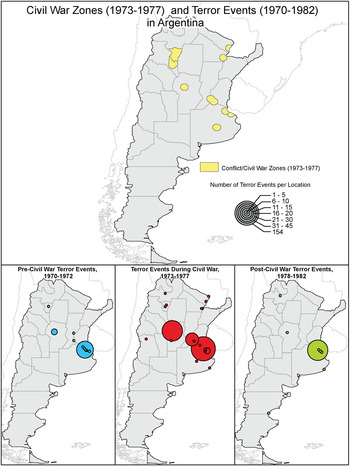
A civil war occurred in Argentina from 1973–1977. Figure 3 shows the distribution of terrorist events before, during, and after the war.Footnote 80
Argentina: Pre, during, and post civil war terrorism

During the pre-war years that we considered (1970–1972), 44 terrorist events occurred in areas that were later part of the civil war. The average number of pre-war terrorist events over these years was 14.667. The pre-war terrorist violence reflected the tenuous coalition of left- and right-wing extremists supporting Peron, which generated substantial violence in the country. During the years that Argentina was undergoing civil war (1973–1977), 209 terrorist events occurred in areas that were part of the civil war. The average number of terrorist events over these years was 41.8, a substantial level of terror waged in response to what is often called the “Dirty War”. In the five years following the war (1978–1982), there were 52 terrorist events in regions that were once part of the civil war. This averages to 10.4 terrorist events a year in the post-war period, still a substantial amount of terrorism, even if lower than pre-war averages. But post-war attempts to continue violence failed as parties fractured and were neutralized by the military junta.Footnote 81
Terror events were thus more prevalent during the Argentine civil war and consisted of a variety of tactics, including assassinations, kidnappings, and arson, committed by a wide variety of groups. The pre-war years witnessed the second highest levels of terrorist violence and the post-war years experienced the fewest terrorist attacks. These data suggest that terrorism might be most important as a tactic used to carry out the war. This is consistent with the timing that characterizes four of the five strategies of terrorism (all but provocation). But there appears to be evidence that terrorism may have contributed to civil war onset as well. Pro-Peronist groups resorted to violence to provoke the government and pave the way for Peron's return in the early seventies, which is consistent with the provocation and attrition strategies.Footnote 82 The post-war period experienced the smallest amount of terrorist violence, perhaps casting doubt on the spoiling strategy. The Argentine military junta collapsed in 1983 after an ill-fated war against the British. This conflict may have contributed to a relative lack of terrorism events in 1981–1982. These results are indicative of the global trends identified above. During the Cold War, most terrorism occurred during civil wars, followed by the pre-war period, and then the post-war period.
Bangladesh: Low Development, Asia, Democracy → Weakened Democracy
A civil war occurred in Bangladesh from 1975–1992. Figure 4 shows the distribution of terrorist events before, during, and after the war.
Bangladesh: Pre, during, and post war terrorism

During the pre-war years that we considered (1972–1973), 0 terrorist events occurred in areas that were later part of the civil war. The dearth of pre-war terrorism was likely due to the recent date of independence, which did not give opposition groups much time to mobilize for extensive terrorism. During the years that Bangladesh was undergoing civil war (1974–1992), 5 terrorist events occurred in areas that were part of the civil war zone. A reasonable amount of terrorism existed in the country, but the civil war zone was extremely small during the war. It was confined largely to the Chittagong Hill Tracts,Footnote 83 and indigenous groups did not opt for high levels of one-sided violence against civilians in these areas. The average number of terrorist events over these years was 0.263. In the five years following the war (1993–1998), despite a tenuous process of peace negotiations, there were 0 terrorist events in regions that were once part of the civil war, reflecting the general propensity against terrorism.
In contrast to the Argentine civil war, relatively little terrorism occurred in Bangladesh. While the frequency of events across time and space was much less than Argentina, the patterns were roughly similar. While only five terrorist events occurred in an area that had civil war, all of them occurred during the war, rather than before or after. This suggests some limited support for the timing that characterizes four of the five strategies of terrorism (excluding provocation), specifically, that terrorism is a tactic used frequently during civil war and far less outside of this context.
El Salvador: Middle Development, C. America, Autocracy → Democracy
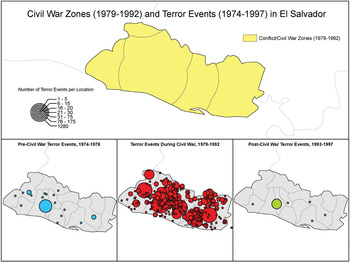
A civil war occurred in El Salvador from 1979–1992. Figure 5 shows the distribution of terrorist events before, during, and after the war.
El Salvador: Pre, during, and post war terrorism

During the pre-war years that we considered (1974–1978), 97 terrorist events occurred in areas that were later part of the civil war. This was a period in El Salvador of mobilization among dissident groups who opposed the increasingly repressive nature of the state.Footnote 84 The average number of pre-war terrorist events over these years was 19.4. During the years that El Salvador was undergoing civil war (1979–1992), 3,002 terrorist events occurred in areas that were inside the civil war zone. The average number of terrorist events over these years was 231. The Farabundo Marti National Liberation Front (FMLN), the umbrella rebel organization in El Salvador, initially sought a conventional victory over the state and almost achieved this by 1983, but U.S. financial assistance allowed the armed forces to fight the FMLN to a stalemate.Footnote 85 This shift in capabilities is one factor that likely led to increased use of terrorism by the FMLN. In the five years following the war (1993–1997), there were 36 terrorist events in regions that were once part of the civil war. This averages to 4 terrorist events a year in the post-war period.Footnote 86
Evidently, a substantial amount of terrorism occurred in El Salvador before and during the civil war. The post-war period experienced some attacks, albeit far fewer. The greatest frequency of terrorism occurred during the war itself, similar to Argentina and Bangladesh. As in the case of Argentina, the next most frequent time period for terrorism is the pre-war period. These results are consistent with the timing that characterizes four of the five strategies of terrorism (excluding provocation) for during-war terrorism, and the two strategies of terrorism that point to terrorism prior to war (provocation and attrition). Very little violence followed the end of the civil war, perhaps due to the robust negotiated settlement reached by the parties and third party involvement in overseeing the peace.Footnote 87 The motivation for using terrorism to spoil the peace was diminished as the FMLN transitioned its struggle through formal institutions and established itself as a viable political party in the early 1990s.Footnote 88
Lebanon: Middle/High Development, M. East, Democracy → Unstable
A civil war occurred in Lebanon from 1975–1990. Figure 6 shows the distribution of terrorist events before, during, and after the war.
Lebanon: Pre, during, and post war terrorism

During the pre-war years that we considered (1970–1974), 19 terrorist events occurred in areas that were later part of the civil war. During the early seventies in Lebanon, much was changing in the country. Lebanon's demographics changed with many Palestinian refugees coming from Jordan, including an increased PLO presence in Southern Lebanon.Footnote 89 This increased PLO presence served to upset the political balance and push the country towards greater turmoil, and also led to less stability as the PLO became less able to control many of its various factions.Footnote 90 The average number of pre-war terrorist events over these years was 3.8. During the years that Lebanon was undergoing civil war (1975–1990), 175 terrorist events occurred in areas that were part of the civil war. The average number of terrorist events over these years was 11. The war was marked by the involvement of many different parties both from within Lebanon as well as from Israel and Syria. Some of these groups formed and adopted terrorist tactics in their struggle against the Lebanese regime or, in the case of Hezbollah, against Israel. In the five years following the war (1991–1995), there were 91 terrorist events in regions that were once part of the civil war. This averages to 22.8 terrorist events a year in the post-war period; perhaps high for a country that successfully implemented its peace agreement, although the implementation was unconventional as Syria played a prominent role and compelled much of the transition.Footnote 91
Lebanon follows the pattern identified throughout our analysis in that the greatest number of terrorist events occurred during the war. But it deviates from the other cases in that the average number of events is higher in the post-war period than in the pre-war or war periods. The post-war average number of terrorist events is nearly double the average during the war and is about five times higher than in the pre-war period. The pattern in Lebanon is consistent with the timing of spoiling strategies. Amal, the most prominent Shia organization at the time, re-emerged after the Israeli invasion of Lebanon in 1978. Hezbollah, aided by Iran and Syria, also emerged and blossomed under the shadow of war with Israel in 1982. These groups vied for support within the Shia community in Lebanon. While Amal primarily took part in institutional politics following the end of the civil war, Hezbollah established itself in the parliament and continued violent resistance.Footnote 92 Patterns of terrorism in Lebanon are thus consistent with the timing that characterizes four of the five strategies of terrorism (excluding provocation) and, furthermore, appear consistent with the post-war spoiling strategy's timing, despite Lebanon's ability to survive the violence and successfully implement peace. The difference between the pre- and post-war periods in Lebanon is mostly consistent with the findings in the global data overview above that in the post-Cold War period, terrorism occurs more frequently following war than before.
Mozambique: Low Development, Africa, Autocracy → Democracy
A civil war occurred in Mozambique from 1977–1992. Figure 7 shows the distribution of terrorist events before, during, and after the war.
Mozambique: Pre, during, and post war terrorism

During the pre-war years that we considered (1972–1976), 0 terrorist events occurred in areas that were later part of the civil war. During the years that Mozambique was undergoing civil war (1977–1992), 156 terrorist events occurred in areas that were part of the civil war. The average number of terrorist events over these years was 9.8. These numbers reflect the frequent use of violence against civilians that came to characterize RENAMO throughout the war and served a number of symbolic, utilitarian, and recruitment purposes.Footnote 93 In the five years following the war (1993–1997), there were 13 terrorist events in regions that were once part of the civil war. This averages to 3.25 terrorist events a year in the post-war period, a substantial decrease likely due to UN peacekeeping as well as pressure on RENAMO from former allies, such as South Africa.Footnote 94 Terrorism did occur, nonetheless, as transitional apprehensions vacillated, but none of the additional terrorist violence was successful at spoiling the peace agreement.
Overall, Mozambique had fairly low levels of terrorism. It follows the general pattern of more frequent terrorism during war, consistent with the timing that characterizes the strategies of terrorism (except provocation). In contrast to Argentina, Bangladesh, and El Salvador, more terrorism occurred following the civil war in Mozambique than before. Like Lebanon, these data are consistent with the global descriptive statistics (see Figure 1), which show that terrorism is more likely following war than before especially in the post-Cold War period. This relationship is consistent with the timing identified in the spoiling strategy. According to João Honwana, “the lengthy peace negotiations revealed that neither party [FRELIMO or RENAMO] had much confidence in the other's good faith.”Footnote 95 Terrorism during this period may thus be related to this commitment problem in implementing peace.Footnote 96
Peru: Middle Development, S. America, Democracy → Weak Autocracy
A civil war occurred in Peru from 1981–1999. Figure 8 shows the distribution of terrorist events before, during, and after the war.
Peru: Pre, during, and post war terrorism

During the pre-war years that we considered (1976–1980), 74 terrorist events occurred in areas that were later part of the civil war. The average number of pre-war terrorist events over these years was 14.8. During the years that Peru was undergoing civil war (1981–1999), 3,659 terrorist events occurred in areas that were part of the civil war. The average number of terrorist events over these years was 203.3. In the five years following the war (2000–2004), there were 5 terrorist events in regions that were once part of the civil war. This averages to 1 terrorist event a year in the post-war period.
An enormous number of terrorist events occurred in Peru; the vast majority of the events happened during the ongoing civil war, consistent with the timing that characterizes the strategies of terrorism (except provocation). In describing the Shining Path's strategy during the conflict, Carlos Degregori suggests that “… [the] Shining Path made a show of displaying its coercive capabilities to the peasantry. From the beginning, senderistas included a measure of terror.”Footnote 97 This illustrates the intimidation strategy of terrorism, in particular. Violence against civilians was used to ensure compliance and to scare peasants into changing their support from the regime to the Shining Path. Frequent bombings and attacks in the capital, Lima, directed at elites and the government were more indicative of an attrition strategy.Footnote 98 In contrast to other Latin American revolutionary movements that primarily targeted the military, only 17% of the Shining Path's attacks were directed at the police or military.Footnote 99
The next most frequent time period for terrorism is the pre-war period. Again, the Shining Path explicitly directed violence against peasants to ensure compliance and build support prior to their attempts to take the capital or eventually bring down the regime. Peru's pre-war attack levels are similar to Argentina and El Salvador, which both experienced more terrorism pre-war and less following the war's end. Peru's pattern of terrorist violence, as it relates to pre- and post-war terrorism, deviates from the overall global pattern, in which terrorism occurs more frequently after wars during the post-war period, though it is consistent with the global patterns for the Cold War era. It appears that there might be a regional trend whereby terrorist violence is used to provoke and fight wars in Latin America, especially during the Cold War. In the Peruvian case, the downfall of Guzman, the supreme leader of the Shining Path to whom some supporters attributed god-like qualities, helped cripple the organization more quickly and likely reduced violence levels after the end of the conflict.
4.2 Extensions: Target Selection and Attack Magnitude
Some of the terrorism data likely includes more than what is narrowly considered terrorism. If the terrorism data are simply capturing what we might otherwise consider as battle event data, then the findings reported above would be less informative. To be confident that the data are capturing violence against non-military and non-government targets, we explicitly separated the two from the attacks on civilians and mapped them separately (See Appendix Figures). These additional maps do not disaggregate by time (pre-, during-, and post-war periods), but by category and show that patterns of non-military and non-government targets are quite similar to those reported above. Thus, even a very narrow definition of both civil war and terrorism yields similar results and lends support to the argument that the two overlap considerably.
In studies of terrorismFootnote 100 and riotsFootnote 101, event counts rather than casualties are the primary units of observation. Because we also use events as the unit of observation, it raises the question of whether the overlap we find between terrorism and civil war is a product of this choice. One way to investigate this possibility further is to consider whether mapping fatalities rather than events leads to different inferences. Before considering this alternative, we note that terrorism does not need to lead to casualties in order to be effective. Indeed, many terrorism scholars and terrorists have contended that effective terrorism kills few people, but sends a threatening message to a target audience.Footnote 102 We nonetheless consider this possibility and display the results in the Appendix. The results are quite similar to those reported in the main text, indicating that terrorist fatalities, like events generally, are more common during civil war than either before or after the conflict.
5. Conclusion: Using Geography To Understand Contentious Politics
We set out with two goals—to examine to what extent terrorism and civil war overlap and to identify precise temporal and spatial patterns in the overlap. Our data examination corroborates Tilly's notion that, “[m]ost uses of terror actually occur as complements or as byproducts of struggles in which participants—often including the so-called terrorists—are engaging simultaneously or successively in other more routine varieties of political claim making.”Footnote 103 The overall descriptive statistics suggest that terrorism is most prevalent during war, followed by the post-war period. The least active period for terrorism is the pre-war period. The six exploratory case comparisons all support the global statistics illustrating the importance of terrorism during wartime. Across these cases, terrorism occurs more often prior to the war's beginning than following the war's end in Argentina, El Salvador, and Peru. Bangladesh, Lebanon, and Mozambique all had higher levels of post-war terrorism, which is at least partially connected to the post-Cold War era.
Finally, we find a change in patterns of violence from the Cold War period to the period following. According to Kalyvas and Balcells, the decline in outside support from the superpowers following the end of the Cold War led to a change in how these conflicts are fought.Footnote 104 Instead of insurgent, irregular warfare as the dominant kind of civil war, the post Cold War period is witnessing an increase in unconventional warfare by both the state and insurgents as each has seen their capabilities decline with fewer outside sponsors.Footnote 105 This systemic change could also help us understand the shift in the patterns of terrorism. Since rebel groups cannot seek material support from a sympathetic superpower, the resort to terrorism prior to war might be expected to increase. In fact, this is what we see in our aggregate data.
Overall, the global patterns and specific cases demonstrate the tight connection between terrorism and civil war. Studies of civil war and terrorism have historically produced islands of cumulative knowledge but have rarely been integrated. As Sambanis suggests,Footnote 106 the most-cited explanations for civil warFootnote 107 are silent about the relationship between this form of violence and crime, terrorism, coups, genocide, etc. Ben Most and Harvey Starr suggest a similar problem with research related to foreign policy. Just as states can choose from a menu of tactics when dealing with other states, insurgent organizations may use different strategies given varied conditions. As Most and Starr claim, the implication is “that all of the behaviors that tend to be studied in fragmented fashion need to be conceived from the outset not as separate and distinct phenomena, the understanding of which will eventually be integrated but rather as commensurable behaviors or component parts of abstract conceptual puzzles.”Footnote 108 Although civil war and terrorism are by no means the only choices available to violent or nonviolent opponents of the state, these are two of the most prominent disconnected portions of the study of violent politics that could usefully be integrated.
A next logical step will be to apply this approach to violent protests, riots, ethnic conflict, and other related forms of political violence.Footnote 109 To accomplish this task, a more careful assessment of the contexts that give rise to terrorism is warranted. We have primarily considered the pre-war, war, and post-war periods descriptively. Other factors could be considered, such as whether terrorism events and homicides are spatially autocorrelated, and whether terrorism tends to occur in urban versus rural areas as some scholars and practitioners of violence have suggested.
The patterns observed in this study likely also extend beyond the domain of violence to other social movement behaviors such as strikes,Footnote 110 protests,Footnote 111 and nonviolent resistanceFootnote 112. Indeed, terrorism is just one tactic used by extreme individuals and groups who typically engage in a rich repertoire of oppositional activities. Whereas scholars often do not consider different types of violence together, they devote even less attention to understanding the mix of violent and nonviolent activities. We are thus left in much the same situation that concerned Tarrow several years ago: scholars continue to specialize in analyzing certain specialties of violence.Footnote 113 Most importantly, this isolation overlooks why these types of violence may coexist and cannot explain when these phenomena are complements or substitutes.
This problem is evident in studies of why oppositional groups succeed or fail as they often focus on a single tactic such as Robert Pape's analysis of suicide terrorism or Max Abrahms study of why terrorism does not work.Footnote 114 Recent work by Page Fortna explicitly attempts to explain success of insurgent groups that do or do not use terrorism and provides an example of how blending terrorism and civil war can help begin to unpack the relationship among these forms of violence.Footnote 115 Greater attention to the reasons for violence against civilians during wartimeFootnote 116 may further expand our understanding of the overlap in different varieties of violence.
We expect that descriptive geospatial analysis and more sophisticated geostatistical models hold significant promise for clarifying the similarities and differences among the wide variety of violent and nonviolent forms of resistance. If scholars devote attention to mapping each of the different violent and nonviolent strategies that groups use, then careful spatio-temporal comparisons will be possible. For example, was terrorism a strategy used in the Rwandan genocide? Did terrorism precede or follow it? Did terrorism occur inside or outside of the zones most affected by the genocide? To what extent is terrorism associated with ethnic rioting in India or predominantly non-violent protests in the Middle East? These are some questions that could be addressed using our approach as well as more sophisticated geospatial modeling.
Beyond the study of contentious politics as we have discussed it, we expect that mapping could enrich the more general study of political geography in ways not currently exploited. The study of voter mobilization, for example, might benefit from a careful geospatial analysis of the wide variety of tactics used to “get out the vote”. Indeed, carefully mapping television, radio, and newspaper coverage along with direct mailers, personal contact, and other forms of campaigning could offer crucial insights into the effects of more complex combinations of strategies that are missed in studies of individual interventions.
These results and the mapping approach we employ could inform policy discussions about the optimal means of addressing opposition movements. They indicate, for example, that wars are complex processes in which terrorism occurs frequently. Moreover, terrorism is occurring much more frequently as wars reach the resolution phases, which has implications for how states engage in conflict management. As with Kalyvas, understanding and engaging the complexity is vital if policymakers are to act and react in optimal ways.Footnote 117 The findings further indicate that strategies overly focused on addressing a particular type of violence, such as U.S. strategies in Afghanistan to curb the occurrence of terrorism, may be insufficient to deal with the complexities of the conflict. Some of these complexities are evident in the evolution of conflict in Iraq, which started as an interstate conflict, changed to a transnational insurgency that used terrorism alongside other means, and then resulted in an internationalized intrastate war between the government and different ethnic groups. Again, targeting terrorism alone in this situation is an insufficient conflict management tool.
Despite substantial attention to war in both the scholarly and policy arenas, we worry that the unwillingness or inability to systematically address the complexity of conflict has seriously hindered and will continue to hinder our understanding of the dynamics of war and peace. The analysis in this paper calls out for integration and offers a way forward by analyzing spatial and temporal patterns in different types of contentious politics.
Supplementary Materials
Replication Materials http://journals.cambridge.org/pps2012008
Appendix Information http://journals.cambridge.org/pps2012009