1. Introduction
The issue of the balance that teachers should seek between using the target language (TL) and the students’ first language (L1) in the second language classroom is controversial. The controversy concerns not so much the value of using the TL since, as Turnbull & Arnett (Reference Turnbull and Arnett2002: 211) conclude after their review of studies in several countries, ‘there is near consensus that teachers should aim to make maximum use of the TL’. It concerns rather the role (if any) that the L1 can perform. Here opinions differ and there is little consensus. Positions range from insistence on total exclusion of the L1, towards varying degrees of recognition that it may provide valuable support for learning, either directly (e.g. as an element in a teaching technique or to explain a difficult point) or indirectly (e.g. to build positive relationships or help manage learning). There is similar variation in teachers’ actual practice. For example, studies have regularly found a range from total exclusion (which is rare) to as much as 90% use of the L1, even amongst teachers in apparently similar teaching situations and even when the teachers are native speakers of the TL. To varying degrees, too, teachers may regard their use of the L1 as acceptable or have a sense of guilt at ‘not using the TL enough’.
There are of course many situations where a teacher uses the TL all the time because he or she cannot speak the students’ L1. The most familiar instance of this is when native-speaker teachers of English travel abroad to teach their own language. It is sometimes even suggested that a covert reason why the ‘English only’ message has been so strongly supported within Western methodological traditions has been to protect the status of the native-speaker teacher and in so doing, to support neo-colonial control (see e.g. Phillipson Reference Phillipson1992; Auerbach Reference Auerbach1993). In a wider context, these situations can provide useful insights into the strategies available for maximizing the use of the TL but they are not themselves the focus of this paper. This paper is concerned with situations in which teacher and students do share a first language, as in most primary- and secondary-school systems throughout the world, so that the teacher makes real decisions regarding L1 and TL use.
Furthermore, the focus in this paper is on ‘foreign-language’ contexts (such as ELT in China or Korea) where (a) the classroom is the main or only source of students’ exposure to the TL and (b) learners aim to use the language mainly in monolingual TL situations. It is not on ‘majority-language’ contexts (such as ESL in Australia or the USA), where bilingual competence (e.g. the ability to code-switch appropriately) is a goal or the exclusion of a learner's L1 may have negative influences on his or her sense of well-being and identity (see e.g. Auerbach Reference Auerbach1993). Again, however, insights into the role of affective factors in majority-language contexts can also help to illuminate foreign-language contexts.
Finally, the focus is on the teacher's use of the TL or L1 rather than on students’ use. The students’ use of the TL is a major issue in itself, particularly in the context of modern communicative methods which depend on students using it in group work as well as whole-class interaction. It also presents a major challenge, since studies have consistently found that students resort to their L1 as soon as they can and rarely initiate TL exchanges themselves (see e.g. Meiring & Norman Reference Meiring and Norman2002; Carless Reference Carless2008; also Crichton Reference Crichton2009 on how the teacher's appropriate use of the TL may encourage student use). Indeed it is such a major issue and challenge that it requires a separate paper.
The development of this paper is as follows. First it will look at the present situation regarding teachers’ use of the TL and L1 as reflected in recommendations and policy on the one hand and teachers’ actual practice on the other. Then it will make suggestions for a framework of principles to guide the integration of the L1 into the second language classroom without endangering the primary status of the TL. Finally, it will consider strategies for maximizing the use of the TL.
2. Teachers’ use of the L1 and TL: the present situation
In this section we will compare what language teaching principles and policy say on this topic and teachers’ actual practice as shown in reports and observations.
2.1 In the safe houses of principles and policy
The main rationale for advocating maximal use of the TL (the ‘monolingual principle’) is that for most students, the classroom is the only opportunity they have for exposure to the language. Hawkins (Reference Hawkins1987: 97–98) compares foreign language teaching to ‘gardening in the gale’ – the teacher plants seeds but these are constantly blown away between lessons – and so it is essential to maximize the learners’ exposure in the limited class time available. This argument is given additional strength by Krashen's (Reference Krashen1985) influential argument that languages are learnt most effectively when learners are exposed to lots of ‘comprehensible input’ in contexts of real communication. As Turnbull (Reference Turnbull2001: 532) puts it, in most foreign language contexts ‘the teacher is most often the sole linguistic model for the students and is therefore their main source of TL input’. A related reason is that by using the TL in the classroom not only as a ‘target’ to be learnt but also for other purposes, students are more likely to perceive it as a useful medium for communication and develop more positive motivation to learn it. As pointed out in Littlewood (Reference Littlewood1981: 45), ‘many learners are likely to remain unconvinced by our attempts to make them accept the foreign language as an effective means of satisfying their communicative needs, if we abandon it ourselves as soon as such needs arise in the immediate classroom situation’. A further reason commonly mentioned in the context of some methods (e.g. the direct method and audio-lingual method) has been that students need to ‘think in the TL’ and avoid interference from it, and that this can only occur if the TL and the L1 are kept as separate as possible. More recently, however, the notion that the two languages can (or should) be compartmentalized in this way has been questioned (e.g. by Cook Reference Cook2001; Butzkamm Reference Butzkamm2003).
For these and other reasons, since the grammar-translation approach was first challenged in the late 19th century, the monolingual principle has permeated every language teaching method that has found widespread official support. This emerges clearly from even a cursory look at surveys of recent developments such as those in Littlewood (Reference Littlewood and Spolsky1999), Larsen-Freeman (Reference Larsen-Freeman2000) and Richards & Rodgers (Reference Richards and Rodgers2001). Apart from a few ‘alternative’ methods such as Community Language Learning and Suggestopedia, there has been a general avoidance in methodological discussions (though not necessarily in classroom practice, of course) of techniques which use the students’ L1 and an emphasis on the importance of using the TL as the normal means of classroom communication.
At the level of national policy, the monolingual principle has been embodied in the guidelines of many countries. In Hong Kong, for example, the current English Language Curriculum Guide (Primary 1 – 6) (Curriculum Development Council 2004: 109) urges teachers to create ‘a language-rich environment [which] incorporates, for example, the use of English in all English lessons and beyond: teachers should teach English through English and encourage learners to interact with one another in English’. In modern foreign language teaching in the UK, the National Curriculum documents of the 1990s advocated total exclusion of the L1 but recent revisions have shown a ‘gradual shift in policy . . . to a measured inclusion of the mother tongue’ (Meiring & Norman Reference Meiring and Norman2002: 28) for planned purposes such as raising language awareness and helping learning through comparisons between the TL and L1. The Ministry of Education of Mainland China adopted a similar position in its experimental English syllabus for full-time high-school English classrooms published in 2000, stipulating that English teachers should use English ‘as much as possible’ in the English classroom, but recognizing that the L1 may be used for purposes ‘such as explaining or translating abstract English words and expressions, or special English structures’ (Ministry of Education of the PRC 2000). In South Korea, where there has traditionally been extensive use of the L1 in language teaching, the government has now adopted a policy of ‘Teaching English through English’ (TETE). The 1999 revision of the National Curriculum for English envisages a gradual increase of TETE to the point where English will be the only language used in elementary- and secondary-school English classes (see e.g. Jeon Reference Jeon2008; Kang Reference Kang2008; S.-Y. Kim Reference Kim2008).
In spite of these strong recommendations from the realms of principles and policy, we will see in the next section that many observational studies and surveys of classroom practice offer a different picture.
2.2 What proportion of TL and L1 do teachers use in their lessons?
Evidence from a variety of contexts shows that there is a wide discrepancy between official recommendations and the practice actually observed or reported in classrooms. For example, Turnbull (reported in Turnbull Reference Turnbull2001; Turnbull & Arnett Reference Turnbull and Arnett2002) analyzed the L1 and TL ‘functional units’ in the discourse of four teachers of French in Canadian secondary schools. He found that the use of L1 (English) ranged from 28% to 76%. S.-H. Kim & Elder (Reference Kim and Elder2005) examined the discourse of seven native-speaker secondary-school teachers of Japanese, Korean, German and French in New Zealand and found a range from 12% to 77% use of the students’ L1 (English). In South Korea, Liu et al. (Reference Liu, Ahn, Baek and Han2004) calculated the percentage of L1 (Korean) and TL words in the lessons of thirteen high-school teachers of English and found that their use of L1 ranged from only 10% (in a ‘model lesson’ intended to demonstrate TETE) to 90%. The overall average was 40% use of L1, but in view of the special nature of the data (the teachers supplied their own audio recordings), the researchers suggest that the teachers’ own estimate of 68% use of L1 may give a more reliable picture of their day-to-day practice. These and other studies support the conclusion reached by Macaro (Reference Macaro1997: 96) in summing up the results of several studies, including his own detailed investigations of TL and L1 use by secondary-school teachers in the UK, that exclusive or near-exclusive use of the TL ‘is rarely encountered in any learning context apart from [classrooms with mixed L1 learners]’.
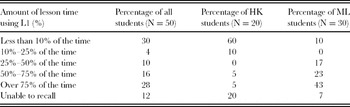
The studies reported above are based on self-report or observation, neither of which gives an accurate picture of a teacher's actual, day-to-day behavior. To provide a third perspective, we asked 50 second-year tertiary students from Hong Kong (HK) and Mainland China (ML) to recall the percentage of classroom time their teachers had spent using the L1 (Cantonese or Putonghua) in junior-secondary-school English lessons. The results, presented in Table 1, are similar to those found in the studies described above.
Percentage of lesson time using the L1 in HK and ML classrooms.

At one extreme, students recalled instruction which was almost exclusively TL-based; at the other, instruction which was heavily L1-based. As well as significant variation within each group, which may be due to factors such as those mentioned below (in section 2.3), there was significant variation between the HK and ML groups, suggesting variation between the cultures of teaching and learning. This emerges even more clearly when we consider the average overall percentage of L1 use that the students recalled: for the HK group, this was 20%; for the ML group, it was 64%. (One ML student wrote an explanatory note on her questionnaire: ‘In China we teach English through the medium of Chinese’.)
In her interviews with 59 modern foreign language teachers in the UK, Mitchell (Reference Mitchell1988: 28) noted some of the effects of this discrepancy between theory (or policy) and practice: ‘It appears that this is an issue about which methodologists have succeeded in inducing a sense of guilt in teachers, if nothing else; almost a third of this sample seemed almost to feel they were making an admission of unprofessional conduct, in “confessing” to low levels of FL use’. These teachers were in general agreement that the TL should be used ‘as much as possible’ (but not necessarily exclusively). This echoes Turnbull & Arnett's (Reference Turnbull and Arnett2002: 211) more general claim, mentioned above, about the ‘near consensus’ that maximum use of TL should be the goal. It also leads us to the question to be considered in the next section: When and why do teachers decide (or feel compelled) to use the L1?
2.3 When do teachers use the L1?
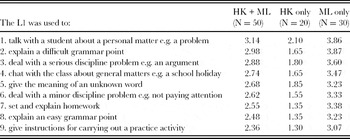
The 50 students from HK and ML mentioned above were also asked to recall the purposes for which their English teachers were most likely to use the L1 (Cantonese or Putonghua). From a list of nine purposes (drawn from a survey of the literature), they were asked to indicate on a four-point scale whether their teachers used the L1 ‘always’ (= 4 in the analysis), ‘sometimes’, ‘seldom’ or ‘never’ (= 1). There was also an option ‘I forget’ (which was chosen only four times in total). Table 2 lists the purposes in the order of mean for the whole group (N = 50). It also gives the separate means for the HK group and the ML group.
Means of purposes for English teachers using the L1 in HK and ML classrooms.

The most common purposes, both overall and for each separate group, fall into the following three categories:
• establishing constructive social relationships;
• communicating complex meanings to ensure understanding and/or save time (‘explaining difficult grammar’ for the ML group, ‘giving the meaning of unknown words’ for the HK group);
• maintaining control over the classroom environment.
The importance of these purposes is confirmed (in whole or in part) by other studies. For example, the teachers in Macaro's (Reference Macaro1997) study liked to use the L1 for relationship building, explaining difficult grammar, and disciplining. The teachers interviewed Mitchell (Reference Mitchell1988) also mentioned explaining (grammar and meanings) and disciplining as the two most common reasons for using L1; also important were providing background information and giving non-routine activity instructions. Like Mitchell, Liu et al. (Reference Liu, Ahn, Baek and Han2004) found that explaining difficult grammar and vocabulary was the most common reason for using L1. Qian (Reference Qian and Beaven2009) found that two primary-school teachers of English in Beijing switched to L1 for reasons which she classified as either ‘methodological’ (e.g. translating, clarifying, highlighting, efficiency) or ‘social’ (e.g. praising, encouraging, disapproving).
These three dimensions of pedagogical communication – establishing constructive relationships, ensuring understanding, and maintaining a disciplined environment – provide necessary scaffolding for classroom student learning and it may not be surprising if teachers have recourse to the L1 to establish them. On the other hand, since they are so essential, they also provide an ideal framework for TL communication and input, motivated by real communicative needs. A large percentage of teachers feel that they ought to use these opportunities for TL communication more. So again we may ask: What are the factors that explain why, so often, they do not do so? What are the constraints that often lead teachers to use the L1 even when they feel ‘guilty’ for doing so?
Many individual contextual factors are mentioned in the literature, e.g. pressure of exams and class size, but the factor that is mentioned most frequently is the students’ language proficiency. For some teachers interviewed by Mitchell (Reference Mitchell1988), for example, ‘the norm of FL use was too much for lower sets on “ability” grounds’ (p. 28), and similar views were expressed by teachers in Macaro's (Reference Macaro1997) study. The same constraint is mentioned in several studies of the introduction of TETE in South Korea (e.g. S.-Y. Kim Reference Kim2002, Reference Carless2008; Liu et al. Reference Liu, Ahn, Baek and Han2004; Jeon Reference Jeon2008; Kang Reference Kang2008). In many of these studies, some teachers have also mentioned lack of confidence in their own TL proficiency. However, native-speaker teachers too have often been found to use a high proportion of L1, e.g. in the studies by Polio & Duff (Reference Polio and Duff1994) and S.-H. Kim & Elder (Reference Kim and Elder2005).
Underlying these and other pragmatic factors which lead teachers to use the L1 is what Meiring & Norman (Reference Meiring and Norman2002: 32) describe as the ‘comforting effect’ and ‘psychological reassurance’ that learners receive from being able to relate learning to the familiar mother tongue. Meiring & Norman's comments about school-age learners are also echoed by the adult learners in Brooks-Lewis's (Reference Brooks-Lewis2009) study, who responded very positively to the inclusion of the L1 in their foreign language learning. Depriving students completely of this support by immersing them in a strange environment, where they feel disoriented and powerless, has been identified as one possible source of demotivation, especially for students with more limited proficiency (see e.g. Stables & Wikely Reference Stables and Wikely1999 in the UK; S.-Y. Kim Reference Kim2008 in Korea; also Crichton Reference Crichton2009 on how skilled teachers can overcome this).
3. A framework of principles for integrating the L1 in the second language classroom
Messages which support using the L1 are often accompanied by a warning that if we ‘license’ the use of the L1 in the foreign language classroom by taking away positive pressures to use the TL, this might ‘lead to an overuse of the L1 by many teachers’ (Turnbull Reference Turnbull2001: 536, referring also to Cook Reference Cook2001; these two publications played an important role in reviving the debate). Butzkamm (Reference Butzkamm2003) has been a strong advocate for the value of the L1 for many years but stresses that the aim is not to take away time from TL use but to help to ‘establish it as the general means of communication in the classroom’; the L1 ‘launches, as it were, the pupils’ canoes into the foreign-language current, which then grabs hold of them and carries them safely downstream’ (pp. 32–33).
The aim, then, is not to open the floodgates of L1 use but to use it in a principled way by developing ‘deliberate tactics . . . chosen to maximize learning opportunities’ (Cameron Reference Cameron2001: 213). In this section, we will suggest a framework for such a principled approach. It is based on two distinctions made in the previous literature:
• S.-H. Kim & Elder (Reference Kim and Elder2005) distinguish between ‘core goals’ (teaching the target language) and ‘framework goals’ (managing the classroom situation) as a basis for analyzing teachers’ use of the L1 and TL.
• Pennington (Reference Pennington1995) distinguishes between teachers’ ‘compensatory use’ of the L1 (responding to a perceived problem) and ‘strategic use’ (serving a pedagogical purpose).
Both of these distinctions overlap (for example, classroom management serves framework goals but also, if the TL is used, provides valuable input for core language learning goals; explaining grammar in the L1 may be seen as either a planned strategy or a compensatory response to a communication problem). However, they provide possible orientation for teachers in developing a strategic framework for L1 and TL use. Table 3 illustrates how this framework may serve to highlight key domains in which the L1 may be used (or minimized).
A framework for a principled approach.

3.1 Use of the L1 to achieve core goals
This domain focuses on specific techniques and tasks designed to help students internalize, comprehend and produce the TL.
3.1.1 Strategic use of the L1 as a planned aid to achieve language learning goals
There are a large number of potentially valuable teaching techniques that deliberately exploit the L1 as a basis for learning but which, especially in the light of the ‘monolingual principle’ and during the ‘communicative revolution’, have fallen into widespread neglect. Only a small illustrative selection can be mentioned here but many more can be found in the works cited.
• At the presentation stage, the L1 can be an efficient way of clarifying the meanings of words, structures or utterances, so that students can progress more quickly to the more important stage of active use and internalization. For example, Butzkamm (Reference Butzkamm2003) and Dodson (Reference Dodson1972) use a ‘sandwich technique’ for presenting dialogues: each new utterance is presented in the sequence TL – L1 – TL. In presenting structures, comparison between the TL and the L1 can help understanding and increase confidence by creating links between the new and the familiar (also furthering students’ general language awareness).
• At the practice stage, a key component of the ‘bilingual method’ (Dodson Reference Dodson1972, further developed in Butzkamm Reference Butzkamm2003; Butzkamm & Caldwell Reference Butzkamm and Caldwell2009) is the drill-like use of L1 stimuli to elicit equivalent target structures. An important feature is that equivalence lies not at the word level but at the level of meaning: meanings are implanted into the learner's cognitive system and then re-expressed through the TL. A similar principle underlies the wider use of interpretation and translation as tools for learning (see e.g. Allford Reference Allford and Pachler1999; Munro Reference Munro1999). The L1 stimulus ‘makes demands on the learner's meaning system and creates a need for this to be extended and enlarged’ (Munro1999: 7). This can compensate for a weakness of monolingual communicative activities, in which students are rarely compelled to use complex structures because they can use communication strategies to avoid them (see e.g. Seedhouse Reference Seedhouse1999).
• At the production stage, teachers may design activities in which students start from situations of L1 use and these serve as input or stimuli for TL use. For example, students may interview friends or family in the L1 and produce written portraits for a TL readership; or brainstorm ideas for a story in the security of the L1 and later write it in the TL; or write about their own lives first in the L1 and then in the TL. Auerbach (Reference Auerbach1993) suggests other ideas and argues for the value of such activities as a natural bridge between L1 and TL, as well as a source of security and ownership over learning. A rich and varied collection of more than 100 activities which involve both L1 and TL use can be found in Deller & Rinvolucri (Reference Deller and Rinvolucri2002). Duff (Reference Duff1989) gives an equally rich collection of learning activities which involve translating English texts into the students’ L1.
Further ideas on how the L1 can be used as a resource at different stages of learning can be found in Atkinson (Reference Atkinson1993) and Butzkamm & Caldwell (Reference Butzkamm and Caldwell2009).
3.1.2 Compensatory use of the L1 as an ad hoc ‘crutch’ to achieve language learning goals
In the activities discussed above, L1 use is planned as a basis for strategies which systematically exploit its potential as an aid to learning. On other occasions, the L1 may be used in an unplanned, ad hoc way to deal with communication difficulties that arise, e.g. as the teacher tries to explain new structures or meanings. However, there is no clear dividing line between planned strategic use and the ad hoc use of the L1. Indeed as a teacher learns more about the students and their capabilities, he or she will anticipate such difficulties more often at the planning stage and either decide to use the L1 in a planned way or develop an alternative communicative strategy.
As the teacher develops more confidence and more effective communication strategies, and as the students gain more TL experience, this is a domain in which we might expect L1 use to be gradually reduced in favour of other, TL-based strategies.
3.2 Use of the L1 to achieve framework goals
We now enter the domain of ‘framework goals’ i.e. creating the affective and material conditions for learning. However, as indicated above, attending to these goals also provides a valuable context for input and meaningful communication.
3.2.1 Strategic use of the L1 for affective and interpersonal support
Reference has already been made to the ‘reassuring’ role of the L1 and to the alienation that its exclusion can cause for some learners. This aspect is highlighted especially for ESL learners in ‘majority-language’ contexts, e.g. in Australia (Wigglesworth Reference Wigglesworth2002) and the USA (Auerbach Reference Auerbach1993), but is also relevant to other contexts. In the Hong Kong study referred to earlier (sections 2.2 and 2.3), ‘talking with a student about a personal matter e.g. a problem’ was the most common use of L1. For the HK group, it was the only use which scored above 2 (2.10; the other uses were all 1.65 or below) and for the ML group it scored 3.85, i.e. almost ‘always’. This frequency may of course be due not only to affective considerations but also to the unpredictable, often complex nature of such communication.
This is one of the many aspects of language teaching where criteria conflict and no ‘recipe-style’ solution is possible. If we consider the affective aspect, there will be many situations where the L1 scores higher in value. If we consider the pedagogical aspect, then the same situations offer precisely the kinds of situation for ‘real communication’ that the classroom often lacks. The choice of L1 or TL must depend on the nature of the specific situation, topic and (most important) student(s) involved, including their proficiency and the extent to which they feel ‘at home’ with the language. As with the compensatory use of the L1 discussed above, growing confidence and experience are likely to lead teachers to expand the scope of the TL as a natural medium for communication in this domain, while recognizing the importance of the L1 as a source of security and support.
3.2.2 Compensatory use of the L1 as an aid to classroom management
Here the focus is not so much on affective factors as on the pragmatic aspects of setting up a context for learning, including opening and closing lessons, managing transitions between episodes, giving instructions for activities and maintaining disciplined behavior. The latter can, of course, cover many events, from routine disruptions (‘John, pay attention’) to more serious crises which belong equally appropriately in the affective domain discussed above.
Mitchell's (Reference Mitchell1988: 31) report on the wide differences in teachers’ views summarizes the issues involved in using the L1 or the TL for managerial purposes: ‘A few had effectively dismissed the possibility of using the FL for managerial purposes as a time-wasting intrusion into the “real work”; a few were committed to making it the communicative norm and were confident that the pupils could cope and that they would benefit’. But most of them ‘were scattered along a continuum between these two points, accepting that it is appropriate, and usually feasible, to use the FL at least for simple organizational matters, but often not doing much more than this’. These views reflect the competing aims and expectations in this domain. On the one hand, as S.-H. Kim & Elder (Reference Kim and Elder2005: 377) point out, it ‘may provide learners with opportunities for “natural” communication and negotiation of meaning using the TL’. On the other hand, our natural communicative instincts create a strong temptation to ignore these opportunities, in order to save time, avoid confusion and maintain contact with the class. This is especially the case when the teacher is tired and/or the students uncooperative (mutual comprehension depends on effort from both sides).
In the light of what we know about the conditions for developing communicative competence, the importance of this domain as a context for meaningful communication cannot be denied and there is obvious benefit to students when teachers establish the TL as the norm. In the final section we will look at some strategies which may help to do this.
4. Strategies for maximizing TL use
This paper has focused predominantly on the role of the L1 in supporting language learning but, as indicated earlier, the discussion takes place against a backdrop of almost universal agreement that teachers should make maximal use of the TL. Atkinson (Reference Atkinson1993) wrote a book which suggests many positive uses of the L1 but he still warns that the L1 is ‘probably the single biggest danger in any monolingual class’ if it reduces the use of the TL. Even such a strong advocate of the role of the L1 as Butzkamm (Reference Butzkamm2003; Butzkamm & Caldwell Reference Butzkamm and Caldwell2009) sees his proposals as helping to temper ‘the tough day-to-day battle that teachers have to endure in trying to establish an FL atmosphere among their pupils’ (Butzkamm Reference Butzkamm2003: 32).
4.1 The teacher's own determination and confidence
The term ‘day-to-day battle’ highlights a factor that emerges frequently in interviews with teachers: the importance of simple determination. There is constant temptation to abandon our ‘deliberate tactics’ and ‘judicious principles’ in favour of the easy way, which is of course always the L1. Soon we may open the L1 floodgates until ‘what one could call a near free for all’ (Turnbull Reference Turnbull2001: 535) results. To steer a course between this situation and the dogmatic banishment of the L1 is one of the major challenges in language teaching.
Pachler, Evans & Lawes (Reference Pachler, Evans and Lawes2007: 31) stress, in their advice to teachers in the UK, that establishing the TL as the main language ‘requires, particularly in the early stages of FL learning, complete commitment and consistency on the part of the teacher’ based on a ‘long-term view of language learning’. A teacher in her first year of teaching in Hong Kong described how she accepted the challenge. She persisted gently but firmly with her average proficiency students, answering them in English when they spoke to her in Cantonese, using conscious strategies to make herself clear, until English became the natural medium (Lee Yeelam, personal communication).
There are several reports that the increased experience which comes from a long-term view also leads teachers themselves to become more confident in using the TL. For example, an important finding in S.-Y. Kim's (Reference Kim2008) survey of Korean teachers of English, conducted after five years of TETE, is that ‘the more English they use, the less anxiety they feel’ (p. 67). Similarly, in Hong Kong, Lai (Reference Lai1996) found that a majority of pre-service students increased in confidence in using the TL as they gained in experience.
4.2 Communication strategies
Communicating successfully in the TL depends not only on the nature of the task and the message that has to be communicated, but also on the teacher's effective use of communication strategies. Mitchell (Reference Mitchell1988: 148) found in her classroom observations that most teachers used the L1 sometimes but ‘those [teachers] who were most successful in maintaining the norm of FL use for classroom communication also used a wide repertoire of other strategies for conveying meaning’. These included repetition, substituting an item with similar meaning, explaining in simpler terms, contrasting with items from a similar lexical set, exemplification and giving clues. Teachers may also gain valuable insights from studies of the modified speech which adults use when speaking to children (see e.g. Macaro Reference Macaro1997: 92–95 for examples) and research into the compensatory strategies which learners themselves often use to bridge gaps in linguistic knowledge (paraphrase, gestures, pictures and so on; see e.g. Tarone & Yule Reference Tarone and Yule1989: 109–113 for examples). Especially in early stages of experience, TL communication strategies are important enough to deserve attention as an aspect of initial lesson planning in order to meet anticipated difficulties.
4.3 ‘Starting simple’
Many earlier methods such as the Direct Method or the Structural–Situational Approach adopted techniques which made it comparatively easy to avoid the L1 right from the start. But with many techniques today (such as information-exchange tasks or role-plays), even if the task itself is simple, the instructions or explanations are sometimes so complex that using only the TL can lead to problems.
In contexts where the L1 is the normal medium of instruction in foreign language teaching but teachers aim to increase TL use, an important strategy is to use it first for tasks which are already very familiar to students (so that they have the relevant schemata to help comprehension) or which require only simple TL. In Korea, for example, S.-Y. Kim (Reference Kim2008: 68) advises teachers seeking to implement the TETE policy to explore ‘which types of tasks call for easy English’ in order to ‘gradually introduce teachers to the use of English in their classes’. Also in Korea, Lee (Reference Lee2007) asked teachers and students which tasks they found most suitable and accessible with TETE. The results suggest that teachers should start with tasks in which students ‘are already familiar with the content through previous exposure’ (p. 349), e.g. reviewing the previous class, summing up the class and checking comprehension. On the same principle, the TL can be used for classroom management first in routine situations which occur regularly and where the meanings are predictable. Some textbooks and handbooks include specific phrases which can be taught for such purposes (e.g. for English: Atkinson Reference Atkinson1993 and Slattery & Willis Reference Slattery and Willis2001; for modern foreign languages in the UK: Halliwell & Jones Reference Halliwell and Jones1991).
5. Conclusion
The L1 can be ‘the single biggest danger’ in the foreign language classroom (Atkinson Reference Atkinson1993: 13) if it threatens the primacy of the TL or ‘the most important ally a foreign language can have’ if it is used ‘systematically, selectively and in judicious doses’ (Butzkamm Reference Butzkamm2003: 30, 36).
The terms ‘systematic’, ‘selective’ and ‘judicious’ occur again and again in discussions but what do they really mean? At present they have to be interpreted mainly through an individual teacher's intuition. We may hope that future research will help us to interpret them more precisely. The framework of principles in section 3 of this paper may serve as orientation in this. For example, in the domain of ‘core goals’: Which L1-based techniques are most helpful at different stages of learning? Which TL-based techniques are most suited to accustom teachers and students gradually to a TL-only environment, if they now rely on the L1 (as e.g. in many Chinese and Korean contexts)? In the domain of ‘framework goals’: What strategies can best help to establish TL-use as the basis for classroom relationships, while maintaining the psychological support on which learning also depends? How should we approach the apparent dilemma that exclusive TL-use is capable both of motivating learners (by establishing the TL as a medium of communication) and demotivating them (by creating a sense of disorientation)? In the domain of teacher education: If maximal use of the TL is a valuable goal, how can we persuade teachers of this and motivate them to work towards it? How can we best equip teachers with the necessary proficiency and strategies that it involves? And hovering over all these questions: Can we demonstrate reliable links between particular patterns of L1 and TL use and students’ actual progress in language learning?
These questions and many others will ensure that the issue of using the L1 and the TL in the foreign language classroom will long remain a focus of debate.
William Littlewood taught languages at secondary schools in the UK before taking up a post in teacher education in Swansea, Wales. He moved to Hong Kong in 1991 and has worked there since then. He is now involved in pre- and in-service teacher education in the Department of English at the Hong Kong Institute of Education. He has published widely in areas related to language teaching, and his books and articles have been used in teacher education in many countries.
Baohua Yu is a post-doctoral research fellow at the University of New South Wales. She obtained her Ph.D. degree from the University of Hong Kong and has been involved in teaching English as a foreign language and researching on international students’ adaptation and language acquisition for several years. Her major fields of research are applied linguistics, cross-cultural psychology and research methodology.