The arterial switch operationReference Jatene, Fontes and Paulista1 has become the preferred procedure for surgical management of transposition, defined as the combination of concordant atrioventricular with discordant ventriculo-arterial connections.Reference Blume and Wernovsky2–Reference Mussatto and Wernovsky6 While the postoperative management of these patients is usually straightforward, a small proportion of infants still experience a complicated and prolonged postoperative course. A recent study suggests that longer postoperative cardiac intensive care unit length of stay is independently associated with worse cognitive function at 8 years of age.Reference Newburger, Wypij and Bellinger7 While residual cardiac and haemodynamic abnormalities increase the risk of readmission to the hospitalReference Mackie, Gauvreau, Newburger, Mayer and Erickson8 and are likely to prolong postoperative length of stay following the arterial switch operation, supportive data are lacking.Reference Brown, Ridout, Goldman, Hoskote and Penny9 We reviewed, therefore, our experience with the arterial switch operation from January, 1997, to July, 2003, in order to determine what factors, including residual cardiac and haemodynamic abnormalities, are associated with a prolonged postoperative course.
Materials and Methods
We reviewed the records of all children undergoing the arterial switch operation at our institution from January, 1997, to July, 2003. Approval was granted by the Institutional Review Board at the Cincinnati Children’s Hospital Medical Center. Due to the retrospective nature of our study, the need for informed consent was waived. We reviewed hospital records, preoperative cardiac catheterizations, operative notes, and echocardiographic reports up to 12 months following discharge from hospital. The endpoint for length of stay was defined prospectively as the day at which the patient met the criterions for discharge from the cardiac intensive care unit, specifically breathing comfortably on supplemental oxygen via a nasal cannula at 1 litre per minute or less, with fractional inhaled oxygen less than or equal to 0.30; stable and normal haemodynamics, heart rate, and blood pressure, and receiving only oral medications. We used the number of days in the cardiac intensive care unit, rather than the number of hours, in order to avoid any potential differences in time of discharge due to extraneous factors, such as nursing issues, bed availability, discharge in the middle of the night, and so on.
We recorded and analyzed anatomic factors, including presence of a ventricular septal defect, obstruction within the aortic arch due to coarctation or interruption, or abnormal coronary arterial anatomy. We also recorded and analyzed preoperative factors, including prematurity, birth weight, age at surgery, presence of extracardiac anomalies, preoperative length of stay, and the need for inotropic support, mechanical ventilatory support, or prostaglandin E1 on the morning of surgery. Intraoperative factors were also taken into account, including the surgeon, the total time spent on cardiopulmonary bypass, and the periods of aortic cross-clamping and circulatory arrest. Finally, we analyzed postoperative factors, such as postoperative bleeding, cardiac tamponade, chylothorax, pneumothorax, infection, diaphragmatic paralysis, presence of seizures or other complications involving the central nervous system, history of feeding difficulties, need for inotropic support, obtaining a score on the first 3 postoperative days as well as the length of time inotropic support was required, duration of mechanical ventilatory support, need for extracorporeal life support or inhaled nitric oxide, fluid balance recorded from the hourly intake as opposed to output on the first two postoperative days, the ratio of PaO2 to FIO2 on these days, as well as the oxygenation index and dynamic lung compliance on these days. We also looked for the presence of residual cardiac and haemodynamic abnormalities. The P/F ratio was calculated from saturations of oxygen measured via pulse oximetry and arterial PaO2 obtained from an indwelling arterial line and represented the lowest value measured on the first 2 postoperative days. The index of oxygenation was calculated as (Mean Airway Pressure × FIO2)/PaO2. Dynamic lung compliance was calculated as the Expiratory tidal volume/(peak inspiratory pressure – positive end-expiratory pressure). Again, the lowest values measured on the first 2 postoperative days were used for both the index and dynamic lung compliance.
Bleeding complications were defined as uncontrolled mediastinal bleeding requiring surgical intervention despite correction of coagulopathy or thrombocytopaenia. Infections were prospectively defined as any positive blood, urinary, or respiratory culture; sepsis syndrome, defined according to the International Pediatric Sepsis Consensus Conference guidelines;Reference Goldstein, Giroir and Randolph10 infections at surgical sites, defined according to the Centers for Disease Control and Prevention;Reference Horan, Gaynes, Martone, Jarvis and Emori11, Reference Mangram, Horan, Pearson, Silver and Jarvis12 catheter-associated bloodstream infections and ventilator-associated pneumonia, defined according to the National Nosocomial Infections Surveillance System.Reference Richards, Edwards, Culver and Gaynes13, Reference Levy, Ovadia and Erez14 We prospectively defined residual cardiac and haemodynamic abnormalities as one or more of the following: greater than or equal to moderate regurgitation of the systemic atrioventricular valve;Reference Snider, Serwer and Ritter15 greater than or equal to moderate regurgitation of an arterial valve; greater than or equal to moderate ventricular dysfunction or dilation;Reference Snider, Serwer and Ritter15 residual coarctation with peak Doppler gradient 30 mm Hg or greater; right ventricular hypertension defined as greater than half left ventricular pressure; greater than or equal to moderate residual shunts at the atrial or ventricular level; or arrhythmias which required treatment with medications and/or temporary pacing. Residual cardiac and haemodynamic lesions were noted on postoperative echocardiographic studies performed during the first week following surgery. Low cardiac output syndrome was defined as tachycardia, hypotension, low urinary output of less than 0.5 millilitres per kilogram body weight per hour, acidosis, and clinical signs of tissue hypoperfusion despite maximal inotropic support, the latter taken as greater than 5 micrograms per kilogram body weight per minute dopamine AND 0.5 micrograms per kilogram body weight per minute milrinone.Reference Hoffman, Wernovsky and Atz16 In order to quantify inotropic support both preoperatively and postoperatively, we calculated an inotropic score as the sum of all inotropic doses, correcting for potency, taking dopamine, dobutamine, and amrinone as 1, milrinone as 15, and epinephrine as 100, as previously described.Reference Hoffman, Wernovsky and Atz16, Reference Wernovsky, Wypij and Jonas17
Analysis of data
We analysed the findings using SigmaStat for Windows Version 3.11 software (Systat Software, Inc, San Jose, CA). Data is described as frequencies, medians with ranges, and means with standard error of the mean, where appropriate. We chose to analyze factors that were associated with a prolonged postoperative cardiac intensive care unit length of stay, rather than total cardiac intensive care unit length of stay, in order to avoid confounding factors associated with the timing of surgery, such as scheduling, the availability of the surgeon, and so on. Correlation analyses were performed to determine which factors were associated with prolonged postoperative cardiac intensive care unit length of stay using the Spearman approach and univariate regression. For purposes of building models, variables which were associated with postoperative cardiac intensive care unit length of stay at a p-value less than or equal to 0.10 were then included in a list of potential independent risk factors in stepwise linear regression analysis, taking length of stay as the dependent variable. A p-value less than or equal to 0.05 was considered significant.
Results
Characteristics of the patients
During the period of study, the same 2 surgeons performed 61 arterial switch operations. Of the patients, 41 (67.2%) were male and 20 female (32.8%), having a mean weight at birth of 3.53 plus or minus 0.07 kilograms, with a range from 2.0 to 5.3 kilograms. In 5 (8%) of the infants, birth had been premature, at less than 34 weeks gestation, while additional extra-cardiac anomalies were present in another 5 infants (8%), including renal agenesis, choanal atresia, congenital hydrocephalus, and contractures of the legs.
The ventricular septum was intact in 32 infants (52%).Reference Jaggers, Cameron, Herlong and Ungerleider18 Associated cardiac anomalies included a ventricular septal defect in 29 infants (48%), coarctation of the aorta in 5 infants (8%), and interruption of the aortic arch at the isthmus in 2 infants (3%). The Taussig-Bing malformation was present in 8 infants (13%).Reference Walters 3rd, Mavroudis, Tchervenkov, Jacobs, Lacour-Gayet and Jacobs19 The arterial trunks were oriented in relatively anterior to posterior direction in 54 infants (89%), but were side-to-side in 7 infants (11%). The coronary arteries were arranged in the usual pattern, with the left anterior descending and left circumflex arising from the sinus#1, and the right coronary from the sinus#2 in 43 infants (70%). The circumflex artery arose from the sinus#2 in 6 infants (10%), there was a solitary artery arising from sinus#2 in 4 infants (7%), a solitary artery arising from sinus#1 in 3 infants (5%), origin of the left and circumflex arteries from sinus#2 with a retropulmonary course, and origin of the right coronary artery from sinus#1 in 2 infants, the so-called inverted pattern in 1 infant, in which the right coronary artery takes origin from sinus#1, and the anterior interventricular and circumflex arteries from sinus#2 (1%), an intramural course of the left coronary artery in 1 infant (1%), and anomalous origin of the left coronary artery from the pulmonary trunk in 1 infant (1%).Reference Yacoub and Radley Smith20
Preoperative management
Balloon atrial septostomy was performed in 42 infants (69%), with 95% of the procedures performed at the bedside under echocardiographic guidance. Persistent ventilatory support was needed for 13 infants (21%), 21 infants (34%) remained ductal-dependent on prostaglandin E1, and 12 infants (20%) remained on inotropic support on the morning of surgery. The median inotropic scoreReference Hoffman, Wernovsky and Atz16, Reference Wernovsky, Wypij and Jonas17 in these 12 infants was 5. Nitric oxide by inhalation was administered to 3 infants, and one required mechanical cardiac support preoperatively for pulmonary hypertension.
Surgical management
The median age at surgery was 6 days, with a range from 2 to 138 days. The arterial switch operation was performed as previously describedReference Jatene, Fontes and Paulista1, Reference Yacoub and Radley Smith20–Reference Lecompte, Neveux and Leca22 with few modifications. Briefly, arterial switch operation was performed using moderate hypothermic cardiopulmonary bypass at 28 degrees celsius, using bicaval cannulation and no circulatory arrest. The arterial duct was ligated upon initiation of cardiopulmonary bypass. Myocardial protection was induced with blood cardioplegia given in antegrade fashion. The right atrium was opened and the atrial and ventricular septal defects, if present were closed via this exposure. Subsequent doses of retrograde blood cardioplegic solution were delivered at 20 minute intervals through the remainder of the period of aortic cross clamping. After coronary arterial translocation and aortic reanastomosis, the defect in the posteriorly positioned new pulmonary trunk resulting from coronary arterial harvest was repaired with a pantaloon-shaped patch of autologous pericardium. Dopamine and milrinone infusions were routinely initiated prior to weaning from bypass.Reference Hoffman, Wernovsky and Atz16 All infants underwent conventional ultrafiltration during rewarming, and modified ultrafiltration after separation from cardiopulmonary bypass. In cases with obstruction of the aortic arch, we used deep hypothermia at 18°C, and a brief period of circulatory arrest while augmenting the aortic arch with a homograft or pericardial patch.Reference Planche, Serraf, Comas, Lacour-Gayet, Bruniaux and Touchot23, Reference Pocar, Villa, Degandt, Mauriat, Pouard and Vouhe24
Since August, 2000, we have adopted the practice of routine administration of methylprednisolone at 30 milligrams per kilogram body weight intravenously 6 hours before surgery.Reference Schroeder, Pearl, Schwartz, Shanley, Manning and Nelson25 This regime was used in 18 infants (28.6%). Length of stay was not significantly different between infants who received preoperative corticosteroids compared to those infants who did not, with medians of 11 days versus 9 days, respectively (p-value equal to 0.8). The median periods of cardiopulmonary bypass and aortic cross-clamping were 210 minutes, with an interquartile range of 180 to 247 minutes, and 125 minutes, with the interquartile range from 105 to 156 minutes, respectively. In 2 infants, we used deep hypothermic circulatory arrest, with a median arrest time of 50 minutes. Delayed sternal closure was needed in 7 infants (11%). We were unable to wean 1 infant from cardiopulmonary bypass. This baby was placed on mechanical cardiac support for 3 days. Cardiac function recovered completely, and the infant was tracheally extubated and transferred to the cardiology ward from the cardiac intensive care unit after 14 days.
Postoperative management
Infants were sedated with fentanyl at 5 to 10 micrograms per kilogram body weight per hour, or morphine sulfate at 0.1 millgrams per kilogram body weight per hour, and mechanically ventilated with a Servo 300 ventilator (Siemens Medical Solutions USA, Inc, Malvern, PA) in a synchronized intermittent mandatory ventilation, volume control mode with tidal volume set at 10 to 15 millilitres per kilogram body weight, using positive end-expiratory pressures of 4 to 5 centimetres of water and inspiratory times from 0.6 to 0.8 seconds. Baseline fractional inhalation of oxygen was adjusted to maintain systemic oxygen saturation between 93 and 99%, and ranged from 0.30 to 0.60. The baseline ventilator rate was adjusted to maintain normal pH and partial pressures of carbon dioxide. Mechanical ventilatory support was weaned by the respiratory therapist according to our local protocol, and tracheal extubation was performed following successful completion of a spontaneous breathing trial. Infants required a median of 76 hours, with a range from 24 to 248 hours, of mechanical ventilation post-operatively. Initial tracheal extubation failed in 2 infants, who required an additional 24 hours of mechanical ventilation.
All infants received dopamine at 3 to 10 micrograms per kilogram body weight per minute and milrinone 0.3 to 0.75 micrograms per kilogram body weight per minute. Epinephrine at 0.03 to 0.2 micrograms per kilogram body weight per minute, and calcium chloride at 10 to 20 milligrams per kilogram body weight per hour were administered to augment cardiac output and maintain adequate systemic blood pressure as necessary. Inotropic support was required for a median of 3 days, with a range from 2 to 11 days. Our practice is to continue inotopic support with low doses of agents, generally milrinone at 0.5 micrograms per kilogram body weight per minute, and dopamine at from 3 to 5 micrograms per kilogram body weight per minute, until after tracheal extubation. Once an infant is extubated, inotropic support is rapidly weaned and discontinued. Temporary pacing was needed for 16 infants (26%), and was achieved using epicardial pacing wires to maintain an adequate heart rate and cardiac output.
Enteral feedings were initiated prior to surgery in 37 infants (59%), and re-initiated a median of 2 days following surgery, with a median of 3 days required to establish full enteral nutrition. We discharged 11 infants (18%) to home on nasogastric feedings. The remaining patients required a median of 5 days to establish full enteral feedings by mouth.
Complications
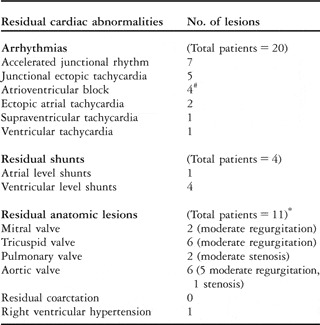
There were no perioperative deaths, and all 61 infants were discharged from hospital. Median length of stay in hospital, on the cardiac intensive care unit, and in the postoperative cardiac intensive care unit were 15 days, 8 days, and 5 days, respectively. We noted 42 residual cardiac abnormalities in 27 infants (44%) (Table 1). Postoperative arrhythmias developed in 20 children (33%), all resolving by the time of discharge from the cardiac intensive care unit. Low cardiac output syndrome was diagnosed in 24 (39%) children. A chylothorax developed in the postoperative period in 2 infants, requiring drainage via chest tubes, while 4 children developed a pneumothorax, also needing drainage through chest tubes. Seizures occurred in 3 children, one of whom was found to have mild hydrocephalus on a subsequent computerized tomographic scan of the head. These 3 children were treated with Phenobarbital, and remained free of seizures until discharged from hospital. Infectious complications were seen in 13 children (21%), including 4 cases of culture-negative surgical wound infection and 9 cases of sepsis syndrome. Only one of these children had a positive blood culture, namely Enterococcus faecalis. Additional surgical procedures were needed in 9 children prior to discharge. These included delayed sternal closure in 7 children, as well as re-exploration for post-operative bleeding in 2 children.
42 residual cardiac abnormalities were noted in 27 patients.

#One patient developed 1st degree atrioventricular block, one patient developed 2nd atrioventricular block, and two patients developed complete atrioventricular block.
*Eight patients in this group also had co-existing arrhythmias and/or residual atrial-level or ventricular-level shunts.
Factors associated with postoperative length of stay in the cardiac intensive care unit
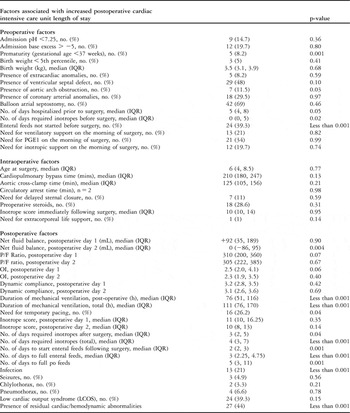
Not surprisingly, there was a significant linear correlation between postoperative length of stay and the duration of postoperative mechanical ventilatory support, with a Spearman correlation coefficient equal to 0.72, the p-value being less than 0.001, as well as the duration of inotropic support, with the Spearman correlation coefficient equal to 0.54, and the p-value less than 0.001. Similarly, there was a significant linear correlation between postoperative length of stay in the intensive care unit and the number of days before enteral feeds were initiated following surgery, with the Spearman correlation coefficient equal to 0.64, and the p-value less than 0.001, the number of days before full enteral feeds were established, with a Spearman correlation coefficient equal to 0.66, and p-value less than 0.001, and the number of days before full oral feeds were established, the Spearman correlation coefficient being equal to 0.54, and the p-value less than 0.001. Several factors were correlated with an increased stay in the cardiac intensive care unit on univariate analysis (Table 2). Pre-operative factors that were highly significant included prematurity (p-value equal 0.001), presence of obstruction within the aortic arch (p-value equal 0.03), the number of days requiring inotropic support prior to surgery (p-value equal 0.02), and lack of initiation of enteral feeding prior to surgery (p-value less than 0.001). Not surprisingly, the pre-operative length of stay was also associated with a prolonged post-operative length of stay (p-value equal 0.05). The length of cardiopulmonary bypass, and times of aortic cross-clamping or circulatory arrest, was not associated with prolonged post-operative length of stay. In addition, there was no significant difference in length of stay between the two surgeons. Post-operative factors that were highly significant included the ratio of P to F (p-value equal 0.07), and the oxygenation index (p-value equal 0.06) on the first postoperative day, net fluid balance on the second postoperative day (p-value equal 0.004), and the duration of mechanical ventilation, both postoperatively and in total duration (both p-values less than 0.001). Also highly significant were the need for temporary pacing (p-value equal 0.04), and the number of days requiring inotropic support, again both postoperatively (p-value equal 0.04) and in total duration (p-value less than 0.001). Feeding problems were also significantly associated with prolonged length of stay, including the total number of days before initiating enteral feeding (p-value less than 0.001) and the total number of days to establish full oral feedings (p-value equal 0.001). Finally, infectious complications (p-value less than 0.001) and the presence of residual cardiac and haemodynamic abnormalities (p-value less than 0.001) were highly associated with prolonged postoperative length of stay on the cardiac intensive care unit.
Factors associated with increased postoperative length of stay in the cardiac intensive care unit (by univariate analysis) following the arterial switch operation.

All factors associated with an increased postoperative length of stay as identified on univariate analysis with a p-value less than or equal to 0.2 were subsequently included in a stepwise multiple regression analysis. Prematurity (p-value equal 0.012), infectious complications (p-value less than 0.001), the number of days requiring inotropic support prior to surgery (p-value equal 0.04), the net fluid balance on the second postoperative day (p-value equal 0.004), and the number of days before enteral feeds was initiated following surgery (p-value equal to 0.01) all proved significant. Previous studies have suggested that low cardiac output syndrome is an independent risk factor for prolonged cardiac intensive care unit length of stay following cardiopulmonary bypass.Reference Brown, Ridout, Goldman, Hoskote and Penny9 We repeated stepwise multivariate regression analysis, combining low cardiac output syndrome with residual cardiac and haemodynamic abnormalities. The factors identified above remained independent predictors of prolonged stay.
Discussion
The arterial switch operation has now become the procedure of choice for surgical management of transposition, due to excellent perioperative and long-term morbidity and mortality. For example, the Congenital Heart Surgeons Society reported survival rates at 1 month, 1 year, and 5 years of 84%, 82%, and 82%, respectively in 513 infants, 383 with an intact ventricular septum and 129 with an associated ventricular septal defect.Reference Kirklin, Blackstone, Tchervenkov and Castaneda26 Several large centres have confirmed these results, including our own, with all our current patients surviving to be discharged from hospital, and remaining alive at 1 year of follow-up.Reference Williams, McCrindle and Ashburn4, Reference Serraf, Lacour-Gayet and Bruniaux27–Reference Brown, Park and Turrentine33 There remains a subset of infants, nonetheless, in which the postoperative course following the arterial switch operation is prolonged. This may have long term consequences, including less favourable long-term cognitive outcome.Reference Newburger, Wypij and Bellinger7 In our series, prematurity, infectious complications, the number of days requiring inotropic support prior to surgery, the net fluid balance on the second postoperative day, and a delay in initiating enteral feeds were all independently associated with a prolonged length of stay in the cardiac intensive care unit.
Dibardino and colleaguesReference Dibardino, Allison, Vaughn, McKenzie and Fraser34 recently reported that lower weight at operation, lower birth weight, and the presence of extracardiac anomalies were significant risk factors for prolonged stay both in the cardiac intensive care unit and hospital after the arterial switch operation. Consistent with these data, we also found prematurity to be independently associated with prolonged length of stay in our cardiac intensive care unit. Lower birth weight, and lower weight on the day of surgery, were not, however, associated with prolonged length of stay in our series, though this may have been a reflection of the small number of patients in this category. Even with a risk for prolonged postoperative stay, the available data strongly suggest that early operation is preferable in this group of patients, in order to minimize the risk of early surgical morbidity and mortality.Reference Soongswang, Adatia, Newman, Smallhorn, Williams and Freedom35–Reference Roussin, Belli and Bruniaux37
The presence of associated cardiac defects, such as coarctation or a ventricular septal defect, and the need for preoperative mechanical ventilatory support have also been associated with reported prolongation of the length of stay in intensive care following the arterial switch operation.Reference Dibardino, Allison, Vaughn, McKenzie and Fraser34, Reference Norwood, Dobell, Freed, Kirklin and Blackstone38 Consistent with these reports, we also noted obstruction in the aortic arch to be associated with prolonged stay in intensive care, this being identified on univariate analysis, but not on subsequent multivariate analysis. Our results support the notion that singlestage primary repair of transposition with obstruction of the aortic arch is associated with acceptable morbidity, and remains the procedure of choice.Reference Pocar, Villa, Degandt, Mauriat, Pouard and Vouhe24
Mackie and colleaguesReference Mackie, Gauvreau, Newburger, Mayer and Erickson8 noted that residual cardiac and haemodynamic abnormalities increased the risk for readmission to the hospital following either arterial switch operation or the Norwood procedure. While it seems intuitive that such residual abnormalities would increase the length of stay, supportive data are lacking. Given the potential adverse effects of increased stay in intensive care on long-term neurologic outcome,Reference Newburger, Wypij and Bellinger7 factors that prolong the postoperative course should be vigorously identified and minimized whenever feasible. While relatively common in our series, seen in almost half, such residual abnormalities were not independently associated with prolonged length of stay. We did, however, use a relatively liberal definition of residual lesions, which may have biased our results. Even when we included low cardiac output syndrome as a residual abnormality, the results of our analysis did not change. Regardless, we continue to stress that residual abnormalities should be suspected in children with a relatively complicated or difficult postoperative course following the arterial switch operation.
Feeding difficulties were also independently associated with prolonged stay in our intensive care unit. One potential limitation of our series is the fact that feeding difficulties were defined prospectively by an increased number of days to initiate enteral feedings. As such, feeding difficulties would be anticipated to be statistically associated with a prolonged length of stay. Nevertheless, difficulty in establishing a normal feeding routine remains a significant concern in discharge planning following neonatal cardiac surgery. Early introduction of oral feedings in preterm infants accelerates the time necessary for transition from tube to oral feeding.Reference Simpson, Schanler and Lau39, Reference Medoff-Cooper, McGrath and Schults40 These findings support our preference to initiate tube, or preferably oral, enteral feedings during the preoperative period whenever feasible.
Postoperative infectious complications were also significantly associated with increased postoperative stay in intensive care. Cardiopulmonary bypass, likely in combination with ischaemia-reperfusion injury, hypothermia, and surgical trauma, elicits an inflammatory response that is characterized by activation of the complement cascade, release of endotoxin, activation of leukocytes and the vascular endothelium, and release of proinflammatory cytokines.Reference Tarnok and Schneider41, Reference Wan, LeClerc and Vincent42 The administration of preoperative corticosteroids to attenuate this proinflammatory response has become relatively commonplace nowadays in most congenital heart centres.Reference Schroeder, Pearl, Schwartz, Shanley, Manning and Nelson25, Reference Checchia, Bronicki, Costello and Nelson43 Myocardial dysfunction and tissue injury after cardiac surgery arises primarily from this cardiopulmonary bypass-related inflammatory response.Reference Wan, LeClerc and Vincent42 In addition, cardiopulmonary bypass elicits a complex humoral and cellular-mediated immune response which may result in a transient and relative state of immune suppression, often referred to as “immunoparalysis”.Reference Tarnok and Schneider41, Reference Allen, Hoschtitzky and Peters44–Reference Allen, Peters and Goldman46 For example, whole blood obtained from children following cardiopulmonary bypass stimulated ex vivo with lipopolysaccharide results in markedly diminished proinflammatory cytokine production,Reference Allen, Hoschtitzky and Peters44 consistent with the phenomenon known as “endotoxin tolerance”.Reference Cavaillon and Adib-Conquy47, Reference Cavaillon, Adrie, Fitting and Adib-Conquy48 Pertinent to the present discussion, this state of immunoparalysis may result in an increased risk of nosocomial infections in children undergoing cardiac surgery for palliation or repair of congenital cardiac malformations.Reference Levy, Ovadia and Erez14, Reference Mehta, Cunningham, Colella, Alferis and Weiner49–Reference Tan, Sun, Zhu, Zhang, Li and Shu51 Of note, the effect of preoperative administration of corticosteroids on the incidence of postoperative infections is not known, and the number of infants who received corticosteroids in the current study was too small, at 28.6%, definitively to address this question. Given the implications, we strongly advocate implementing measures targeted at reducing the incidence of postoperative infections, such as ventilator-associated pneumonia, catheter-associated bloodstream infections, urinary tract infections, and sternal wound infections.
Cardiopulmonary bypass frequently results in systemic capillary leak, especially in neonates and young infants.Reference Maehara, Novak, Wyse and Elliot52–Reference Stiller, Sonntag and Dahnert54 The postoperative net fluid balance is frequently used as a crude measure of capillary leak. In our series, the net fluid balance on the second postoperative day was independently associated with an increased length of stay in the cardiac intensive care unit. This data suggests that further research on the early recognition and treatment of capillary leak is warranted, and may result in improved outcomes following cardiopulmonary bypass.Reference Abrahamov, Erez and Tamariz55–Reference Schroth, Plank and Meissner58
In conclusion, we have analysed our experience with the arterial switch operation performed at our institution over a period of approximately 6 years. Factors independently associated with prolonged postoperative stay in cardiac intensive care included prematurity, need for inotropic support prior to surgery, difficulty in feeding, evidence of systemic capillary leak on the second postoperative day, and postoperative infectious complications. Given the association between prolonged postoperative stay in the cardiac intensive care unit and cognitive outcome,Reference Newburger, Wypij and Bellinger7 these factors should be minimized whenever possible. Future research designed to minimize the impact of capillary leak and postoperative infectious complications is warranted. In addition, based on these results, our practice has evolved to initiate enteral feedings in the preoperative period if feasible, and to resume enteral feedings as soon as possible following surgery.
Acknowledgements
Our work was supported by the Cincinnati Children’s Research Foundation and NIH KO8 GM077432 (DSW). It was presented at the 33rd Annual Critical Care Congress, Society of Critical Care Medicine, Orlando, FL. February 19-25, 2004 and previously published in abstract form Crit Care Med 2004; 31(Suppl):A219. We thank Phil Khoury for his assistance with statistical analysis of the data, and thank Jeff Pearl and Steve Schwartz for reviewing the manuscript and offering helpful comments. Finally, we would like to thank the nurses, respiratory therapists, and physicians who provide care for our patients every day in the cardiac intensive care unit.