Glossary of acronyms
- ACCHOs
Aboriginal community-controlled health organisations
- ACF
Advocacy coalition framework
- AMSs
Aboriginal medical services
- CTG
‘Close the Gap’
- MSA
Multiple streams approach
- NACCHO
National Aboriginal community-controlled health organisation
- NATSIHP
National Aboriginal and Torres Strait Islander Health Plan 2013– 2023
- NATSIHEC
National Aboriginal and Torres Strait Islander Health Equality Council
- NHLF
National Health Leadership Forum
- NIRA
National Indigenous Reform Agreement
- SAG
Ministerial stakeholder advisory group
- SDIH
Social determinants of Indigenous health
- SDH
Social determinants of health
1. Introduction
Background
Australians have among the highest average life expectancy in the world (Australian Institute of Health and Welfare [AIHW], 2016), but significant health inequities persist between Aboriginal and non-Indigenous Australians. Aboriginal people on average experience lower life expectancy and higher rates of chronic disease and disability than non-Indigenous Australians (AIHW, 2016).
An understanding of Aboriginal people's health requires appreciation of the Aboriginal definition of health, which incorporates ‘the social, emotional and cultural well-being of the whole community’ (Office for Aboriginal and Torres Strait Islander Health, 1989). Scholars on Aboriginal health have emphasised the ‘Social Determinants of Indigenous Health,’ (SDIH) which encapsulates a human-rights-based approach to health, recognition of Indigenous cultures, the health effects of racism, and past and contemporary impacts of colonisation (Carson et al., Reference Carson, Dunbar, Chenhall and Bailie2007; O'Donnell and MacDougall, Reference O'Donnell, MacDougall, Keleher and McDougall2016). This adds another dimension to the more commonly-acknowledged suite of social determinants of health (SDH), for which there has been mounting evidence (Commission on the Social Determinants of Health, 2008; Marmot et al., Reference Marmot, Allen, Bell, Bloomer and Goldblatt2012). It is therefore crucial to examine how race is framed during policy development.
Community control in decision-making and self-determination are important principles for Aboriginal Australians, as reflected in the UN Declaration on the Rights of Indigenous Peoples (United Nations General Assembly, 2007). Community control is important as a process for empowerment and can lead to improved health outcomes (Donato and Segal, Reference Donato and Segal2013). The self-determination movement for Aboriginal Australians accelerated in the 1970s and led to the first national Aboriginal health organisation and formation of Aboriginal Community Controlled Health Organisations (ACCHOs), where Aboriginal people govern and manage their health services. The National Aboriginal Community Controlled Health Organisation (NACCHO) was formed as the umbrella organisation for ACCHOs in 1992 and there are now over 150 ACCHOs across Australia (NACCHO, 2016). Community control interacts with race and the distinctive social determinants of past and present colonisation.
In 2005, the Aboriginal and Torres Strait Islander Social Justice Commissioner's Report highlighted persistent inequalities in health status and the need for a human-rights-based approach to health (Human Rights and Equal Opportunity Commission, 2005). From this, an advocacy campaign to ‘Close the Gap’ (CTG) emerged in 2006, comprised of over 40 Aboriginal and other peak organisations and expert advisers. This campaign called for an Australian health equality plan with specific targets. A 2008 National Aboriginal Health Equality Summit produced a ‘Statement of Intent’ to develop a plan of action to achieve health equality between Aboriginal and non-Indigenous Australians, signed by the then Prime Minister and Leader of the Opposition and CTG campaign leaders.
The Australian government's response to this campaign included the 2008 National Indigenous Reform Agreement (NIRA) policy, also known as the ‘Closing the Gap’ Agreement, which set targets for closing or reducing gaps in: life expectancy, child mortality, and educational and employment outcomes. The national Labor government also established the National Aboriginal and Torres Strait Islander Health Equality Council in 2008 (decommissioned in 2014) to advise on ‘Closing the Gap’ policy.
Aboriginal leaders regarded consultations with Aboriginal people in development of the NIRA and other national policies at the time as inadequate, and hoped this would be rectified in the development of a new health equality plan (Donato and Segal, Reference Donato and Segal2013). Thus the development of the National Aboriginal and Torres Strait Islander Health Plan 2013–2023 (NATSIHP) during 2012–13 emerged within this context of a strong human-rights-based advocacy campaign. The process through which the NATSIHP was developed contrasted with that of previous policies. Strong networks of Aboriginal health policy actors outside and inside government engaged with government leaders and bureaucrats from the outset and, through these processes, were able to construct policy to recognise SDIH and incorporate key principles that have been previously called for by Aboriginal leaders but resisted by government policy makers (Carson et al., Reference Carson, Dunbar, Chenhall and Bailie2007). These principles were health equality and a human-rights approach, Aboriginal community control and engagement, partnership, accountability, the centrality of Aboriginal Australians’ cultures to health, and commitment to address racism in the health system (Australian Government, 2013).
A key question addressed by this paper is ‘What factors within the policy development process facilitated, or presented barriers to, social determinants of Indigenous health (SDIH) getting onto the policy agenda?’
Justification for policy theories used
This paper builds on previous research published in this journal which identified national policy on Closing the Gap circa 2012–13 as a successful example of policy where the SDH were explicitly identified and actions proposed to address several key determinants (Fisher et al., Reference Fisher, Baum, MacDougall, Newman and McDermott2016).
We adopt a ‘complementary approach’ to using policy theory, employing a range of theories and frameworks to elucidate the policy agenda setting process (Cairney, Reference Cairney2013). The aim of this approach is not to synthesise theories but to use different conceptual lenses to provide different perspectives, and compare insights. This is an approach often used in case-study-based policy research, rather than aiming at testing hypotheses based on theory (Cairney, Reference Cairney2013).
The different perspectives adopted are the Advocacy Coalition Framework (ACF) (Sabatier and Weible, Reference Sabatier, Weible and Sabatier2007; Sabatier and Jenkins-Smith, Reference Sabatier, Jenkins-Smith and Sabatier1999), Multiple Streams Approach (MSA) (Kingdon, Reference Kingdon2011), policy framing (van Hulst and Yanow, Reference van Hulst and Yanow2016), critical constructionism (Bacchi, Reference Bacchi1999) and ideas from implementation studies (Hill, Reference Hill2009). Taken together, these theories incorporate different understandings of the policy process. For example, the MSA (Kingdon, Reference Kingdon2011) analyses policy processes in terms of policy actors, whilst Bacchi's ‘what's the problem’ approach focuses on policy discourses and the silences in policy debates.
The ACF (Sabatier and Weible, Reference Sabatier, Weible and Sabatier2007) refers to the role of coordinated advocacy coalitions in policy change. Advocacy coalitions are composed of specialists (e.g. legislators, public servants, interest group leaders, researchers) operating in a policy sub-system with shared ‘deep core beliefs’ and ‘causal perceptions’ about problems, their importance, and policy preferences. The ACF regards the stability of coalitions over time, based on shared beliefs, as crucial in their ability to influence policy change, which usually occurs over a lengthy period (e.g. a decade). The NATSIHP sits within the Aboriginal health policy area, which may be considered as a ‘mature policy subsystem’ comprised of a ‘semi-autonomous community’ of individuals and policy networks (Sabatier and Jenkins-Smith, Reference Sabatier, Jenkins-Smith and Sabatier1999) who have sought to influence the Aboriginal health policy agenda over a decade or more. Our analysis will complement other recent work on discourse among the policy networks influencing development of the NATSIHP (Browne et al., Reference Browne, de Leeuw, Gleeson, Adams, Atkinson and Hayes2017).
The Multiple Streams Approach (MSA) (Kingdon, Reference Kingdon2011; Zahariadis, Reference Zahariadis and Sabatier2007) sees policy as a choice in a situation of ambiguity, where there are many competing ways to see a problem or the same circumstances. There is a political struggle to control ambiguity, and policy is the result of several factors within a system (Zahariadis, Reference Zahariadis and Sabatier2007). In Kingdon's (Reference Kingdon2011) approach, policy agenda setting is based on the extent to which three separate streams –problems, policies and politics – do or don't come together. Policy entrepreneurs utilise critical periods as windows of opportunity to bring the three separate streams together and set policy agenda. Policy entrepreneurs may be individuals or groups, and have more success when they have access to the three streams, including policy makers (Zahariadis, Reference Zahariadis and Sabatier2007) and politicians. Economic context and budgets influence the way policy options rise and fall on policy agendas (Kingdon, Reference Kingdon2011).
Policy framing analysis (van Hulst and Yanow, Reference van Hulst and Yanow2016) and a critical constructivist approach (Bacchi, Reference Bacchi1999) were also adopted to understand how the SDIH have been highlighted as central themes in NATSIHP. According to Zahariadis (Reference Zahariadis and Sabatier2007), in the constructivist approach there is no ‘political struggle’ of ambiguity but rather a process of persuasion and constructing meaning. Similarly, a policy framing (van Hulst and Yanow, Reference van Hulst and Yanow2016) approach not only focuses on the way in which issues are selected, named and categorised (i.e. the policy frame), but also upon the dynamic processes through which ‘definitions of situations’ are negotiated and policy frames constructed. However, in Bacchi's (Reference Bacchi1999) critical constructivist approach, what becomes policy is not just a matter of negotiation between competing groups, because she also asks who is present and absent at the policy table, drawing attention to the silences in policy debates and evidence that does not reach the status of ‘policy problem’. We combine the above theories to show how networks of representatives from Aboriginal health organisations used a window of opportunity to challenge conventional problem definitions and policy framing, and adopt new paradigms to place SDIH at the centre of an Australian Aboriginal health policy for the first time.
Finally, ideas from implementation studies are used to capture initial concerns about the NATSIHP not being put into action after a change in government. The two key approaches to researching policy implementation are a ‘top down’ and ‘bottom up’ approach. The ‘top down’ approach is associated with rational policy making processes where there are distinct ‘stages’ including policy agenda setting, development, implementation and evaluation (Hill, Reference Hill2009). Conversely, the bottom-up approach does not adhere to a linear, ‘stages’ view of policy formulation and implementation but rather focuses on role and influence of those implementing policy on-the-ground (Hill, Reference Hill2009).
2. Methods
This paper is based on previous research where eight individual policies (in four policy areas) were selected as case studies to examine: What factors within policy development processes facilitate or present barriers to social determinants of health (SDH) getting onto the policy agenda? Case study policies were selected as examples of good practice on SDH in Australian health policy, based on previous research analysing the content of 266 Australian national or state/territory government strategic health policies current in 2012–13. Methods for analysis, described in detail elsewhere (Fisher et al., Reference Fisher, Baum, MacDougall, Newman and McDermott2015), examined each policy to assess the extent to which it recognised evidence on, and proposed strategies to address, SDH (outside of access to health care). We selected eight case-study policies from four policy areas where relatively good practice on SDH was evident: Aboriginal health, nutrition and physical activity, child and youth health, and health promotion.
To understand policy development, we interviewed senior-level policy actors in each relevant jurisdiction who were directly involved in development of the policy in question. Potential participants were contacted with the consent of each relevant health department. We used snowballing to contact further participants until satisfied we had interviewed all the main actors involved, or reached data saturation (56 interviews across eight case studies). This paper reports on interviews from one of these policy case studies on the NATSIHP, with ten senior-level policy actors directly involved in development of the policy: three from within government and seven from non-government organisations (NGOs) active on issues in Aboriginal health.
The interview asked about factors that led up to and influenced the decision to develop the policy, and about the policy development process. We asked participants about the problem/s the policy was intended to solve, how and why evidence on SDH was taken into account during policy development, engagement with other policy sectors as part of the process, and any pressures for ‘lifestyle drift’ (Popay et al., Reference Popay, Whitehead and Hunter2010). We asked participants to describe their role, the role of other actors who were especially influential and political circumstances affecting the policy process at different stages.
Interview recordings were transcribed and participants given the opportunity to review the transcript. A coding framework was established based upon key themes from policy theory on agenda setting, which included: problem definition, policy options and political context; windows of opportunity; and the role of policy actors as possible policy entrepreneurs. Drawing on Kingdon's (Reference Kingdon2011) specialist policy communities and Lewis's work on policy networks (Lewis, Reference Lewis2005), we created codes to identify the role of groups of actors with a shared policy perspective. We also coded for factors affecting the incorporation of action on SDH in the policy and any pressures for ‘lifestyle drift’. NVivo was used to apply the coding framework and organise data. Ethics approval for this research was obtained from the Flinders University Social and Behavioural Research Ethics Committee.
3. Results
The policy community and policy entrepreneurs
In this first section we consider the role of the policy community and policy entrepreneurs (Kingdon, Reference Kingdon2011) in the development of NATSIHP and the background context to this Plan. The advocacy of the CTG campaign appeared instrumental in setting the policy agenda for a new approach to Aboriginal health, and development of the NATSIHP following the end of the previous national Aboriginal health policy. We found the ACF (Sabatier and Jenkins-Smith, Reference Sabatier, Jenkins-Smith and Sabatier1999) useful for examining the role of the campaign, as its participants demonstrated attributes of an advocacy coalition working as a coordinated political alliance across professions and institutions, including government, professional organisations, universities and NGOs, for almost 10 years. This campaign is key to understanding consultation structures associated with the development of the Plan, including the National Aboriginal and Torres Strait Islander Health Equality Council (NATSIHEC), an advisory group appointed by the then Minister for Aboriginal Health, and ways in which problems were represented within policy debates.
The Close the Gap Campaign, which consists of some 30-odd organisations which are the relevant Aboriginal and Torres Strait Islander health peak bodies. . . formed in 2007 and it advocated for. . . closing the health and life expectancy [gap] within a generation. . . The. . . campaign also produced what was known as the National Aboriginal Health Equality Targets . . . our Closing the Gap mantra became government policy. I1, non-govt
There had been advice provided to the government of the day by a number of different stakeholders including NATSIHEC. . . about the need to still continue to prioritise effort around Aboriginal people's health. I10, public servant
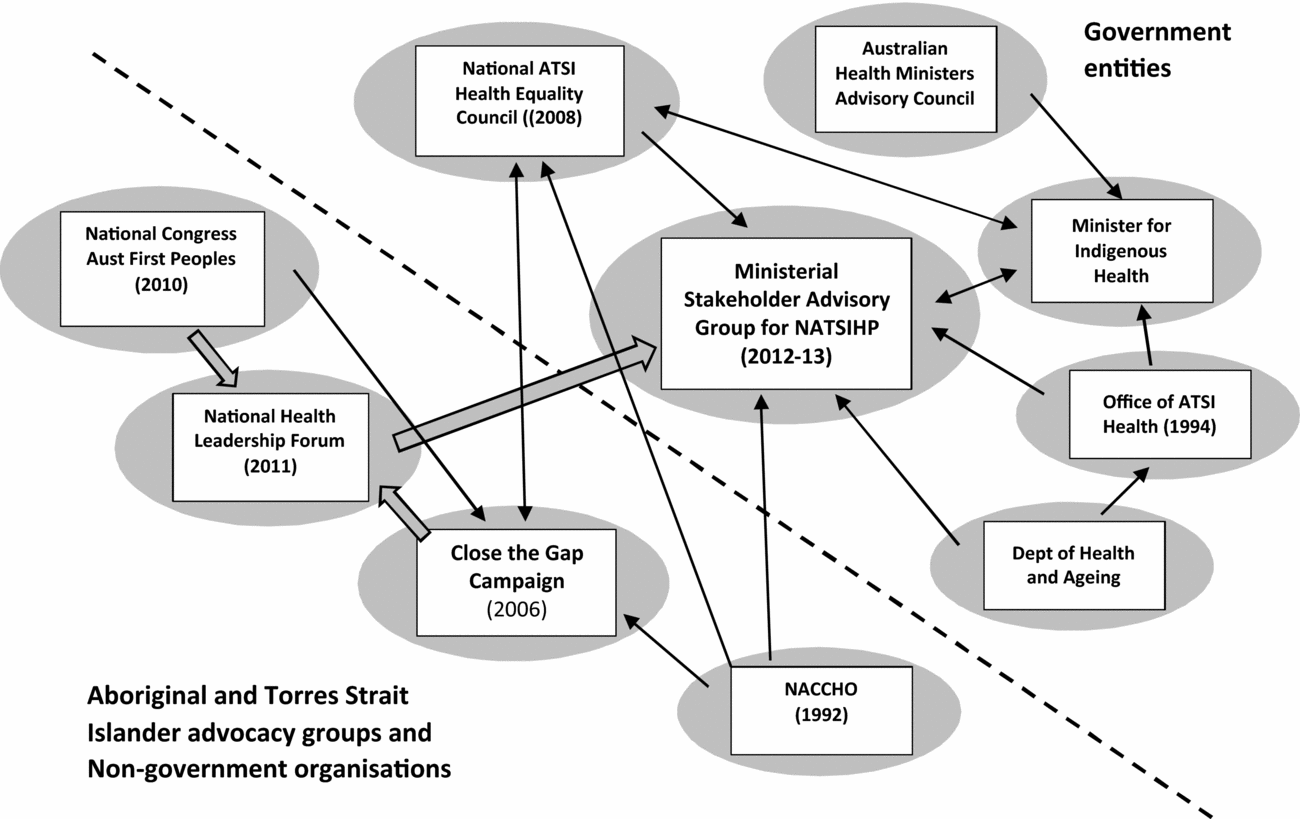
In Kingdon's (Reference Kingdon2011) MSA, individual policy entrepreneurs or groups wait for ‘windows of opportunity’, such as a change in government, in order to push their perception of problems and their policy proposals. In this example, it appeared that Aboriginal leadership groups which emerged from the Close the Gap (CTG) campaign acted as policy entrepreneurs (see Figure 1).
Organisations and networks involved in development of the NATSIHP

We found a much more communitarian and iterative approach to policy agenda setting between Aboriginal groups and government than that suggested by Kingdon. The CTG campaign advocated to reduce or eliminate inequities in Aboriginal health, which led to the government response of signing the 2008 Statement of Intent and subsequently establishing the National Indigenous Reform Agreement (NIRA). The NATSIHP built upon the CTG campaign and government responses.
So we had the Close the Gap Campaign running for some time, a very successful campaign, it continues, so the Aboriginal health leadership were central to that campaign, so all of the peak bodies. Tom Calma as the Social Justice Commissioner at the time got that agreed as a pre-election commitment by Labor and then in 2008 of course there was the Statement of Intent signed by both sides with the Aboriginal health leadership and a whole bunch of others, the AMA and any number of other organisations. So that was the political and policy context for the new Labor government and within that Statement of Intent that governments and opposition signed up to there was a commitment to develop a long term plan. I7, non-govt
Figure 1 indicates the key networks, groups and individuals contributing to the development of NATSIHP. Arrows indicate the relationships between groups and individuals (based on information from interviewees and the Department of Health and Ageing). When the initial decision to develop a new national Aboriginal health policy was made in 2011, Aboriginal health leadership from the CTG campaign strategically and authoritatively repositioned itself for policy engagement by establishing the National Health Leadership Forum (NHLF). The NHLF was coordinated by the National Congress of Australia's First Peoples (National Congress), established in 2010 as an independent company to advocate for the rights of Aboriginal people. NACCHO took a leading role on both the NHLF and the NATSIHEC. Our interviewees explain how members of the CTG campaign advocacy coalition moved strategically, as policy entrepreneurs, to exploit the opportunity to influence the policy opened by the government's decision to develop a new Aboriginal health policy:
What better way to create a partnership interface at the national level, than have the Aboriginal organisations that are already working collegiately through the Close the Gap Campaign, to form a separate group whose sole purpose is to be a partnership interface and to work closely with government in the development of policy at the national level, given that they're all the relevant national health peak bodies. . .We sort of proposed this to government and said we want to work with you. We want to form with our partnership group, which ended up becoming known as the National Health Leadership Forum. I1, non-govt
One of the things which I think really worked in the government's favour was that the Aboriginal health leadership was really coordinated and well positioned. We were meeting regularly through our structures and developing our common agenda – what we agree on, making sure we were strong and connected. I4, non-govt
Partnership with government
Community control and partnership with government emerged as a priority within the policy development process. The Minister overseeing Aboriginal affairs established the Ministerial Stakeholder Advisory Group (SAG) to lead development of the Plan (see Figure 1), co-chaired by the Department of Health and Ageing and National Congress and supported by staff from the Office of Aboriginal and Torres Strait Islander Health. The SAG included two members from the NHLF and worked closely with the NATSIHEC, which also advised the Minister for Aboriginal Health on development of the NATSIHP. An interviewee explained how the NATSIHEC conceived its role as a Ministerial advisory body, as distinct from other groupings such as the NHLF, thus:
The. . . NATSIHEC. . . the primary role. . . was around providing the strongest possible evidence to the Minister. . . so it was just sort of an evidence-based line. The SAG. . . had to be across and interested in evidence, but it was about getting a range of players around the table to develop the Plan. I7, non-govt
The approach adopted, one of Aboriginal organisations and government working in partnership from the outset to develop the policy, was seen by Aboriginal informants as an important strengthening of their role compared with previous processes. Results from community consultation processes were fed back into a drafting process involving Indigenous leaders and government actors.
I just think it was something fairly new for the bureaucracy. It was relatively new for most people in the room who were Aboriginal representatives as well. We were developing the first draft with the bureaucracy, with the government. I4, non-govt
There was a team of us in the Department and there was a team of people who were from the stakeholder advisory groups and we basically sat down and wrote it, drawing from the submissions, drawing from the consultation. I6, public servant
The government also organised 17 community consultation sessions around the country, as well as strategic roundtable discussions and expert advisory groups. Aboriginal leadership groups actively supported the community consultations and worked to build community trust by co-chairing sessions, advising on culturally appropriate venues, encouraging attendance and developing written submissions.
The government's consultation process. . . confronted hard core cynicism. . . We had said ‘look, can you try and get them [the meetings] to Aboriginal community-controlled sites rather than big hotels and giving them the money. . . They could see [X], our co-chair, introducing it. You know, there was a large presence of Aboriginal leadership at the government consultation sites and we were ringing round. . . We said ‘look, we're part of this. We're going to give it a good shot. Will you show up?’ I8, non-govt
The problem identified within the policy and policy representations
In this section we explore how the problems identified within the NATSIHP policy were framed or represented within policy debates, according to policy actors. We also consider how evidence and feedback from consultations influenced the definition of problems to be addressed within policy.
Social determinants of Indigenous health approach
There was broad consensus on a SDH perspective among Aboriginal health policy actors, which was tied to the on-going CTG campaign and its human-rights-based approach. The fundamental problem defined by CTG was the health inequities – the gap – between Aboriginal people and non-Indigenous Australians. The SDH perspective was considered as not new but a reframing of issues previously recognised by advocates and government, and reflecting how ACCHOs and Aboriginal Medical Services (AMSs) operated.
From day one it was conceived of or agreed by all parties that you can't just look at health in isolation and an Aboriginal and Torres Strait Islander health plan needs to fit with and be congruent with the broader government agenda and also fully address the social determinants. I1, non-govt
. . . the AMSs have been set up to be more than just health services, more than doctor services, so the [SDH] frame is a very natural one for Aboriginal people and organisations and it's been around a long time. I7, non-govt
. . . the [CTG campaign] and Closing the Gap policy framework I think very much drove the philosophy and principles, you know, trying to get equality as the outcome. I3, non-govt
However, whilst interviewees including public servants spoke of a shared SDH perspective, its meaning was negotiated through the development of the NATSIHP between Aboriginal leadership, public servants and the Minister. Initially, Aboriginal perspectives appeared to be more silent within policy debates (Bacchi, Reference Bacchi1999) at a senior level and representations of individual responsibility for social problems were resisted by members of the policy community. The role of a publicly recognised, authoritative Aboriginal leadership in negotiating acceptance of evidence along with the need for a SDIH framework resulted in shifting the policy frame. Aboriginal leadership groups established what Kingdon (Reference Kingdon2011) calls a ‘claim to a hearing’ – an acknowledged right to be listened to by those with power to effect change. Tensions also appeared to be resolved through the support of evidence and extensive consultation.
I think it shifted. I think initially a lot of the dialogue was around personal responsibility and that kind of ‘how do we make people take responsibility for their health?’ There was a bit of that in the early discourse, policy discourse, and that's when we're coming in [saying] ‘hang on, you need to take a social determinants approach to this.’ I8, non-govt
There was widespread acknowledgement of a more nuanced perspective on the SDH in the NATSIHP when compared with previous Aboriginal health plans including, in particular, recognition of a Social Determinants of Indigenous Health (SDIH) perspective (O'Donnell and MacDougall, Reference O'Donnell, MacDougall, Keleher and McDougall2016). This SDIH approach could be considered a ‘belief system’, with perceptions of the policy problem along with solutions (Sabatier and Jenkin-Smith, Reference Sabatier, Jenkins-Smith and Sabatier1999), adopted through the NATSIHP, but also expressed in the lived experience of many Aboriginal participants. The adoption of a SDIH approach was enabled by Aboriginal leaders and organisations raising problems such as racism and the importance of culture and rights within the policy development process, and by public servants’ contact with Aboriginal community members through the wider consultation.
With them [the bureaucrats] speaking to the broader range of community members they actually could see social determinants, the living, breathing side of social determinants, and what was missing and what was needed if we wanted to achieve that, other than just documents with social determinants written into them. I4, non-govt
Human rights framework
Interviewees discussed the centrality of a human-rights-based approach to health. This was also the approach taken by the CTG campaign. Some referred to Australia being signatory to the UN Declaration on the Rights of Indigenous Peoples (UN General Assembly, 2007). However, inclusion of an Aboriginal rights-based approach in the NATSIHP was not driven by the Declaration as such but by arguments made by National Congress and members of the NHLF within the policy development process, despite initial resistance from some government actors.
[W]here we had differences of opinion was around some wording on. . . things around the Declaration on Rights of Indigenous Peoples and can we mention the word ‘rights’ in the plan? That's where we did get quite a lot of pushback from the Department and indeed the Minister's office, but again if you've got some highly respected individuals and legitimate bodies like the Close the Gap Steering Committee and the NHLF saying the same things, which we all were, they had very little choice and not really anywhere to go in arguing against some of that. I3, non-govt
Recognition of the impact of racism upon health
Non-government actors reported initial resistance to using the term ‘racism’ and explained this in terms of government reluctance to accept, or explicitly name, racism as a feature of the health system. Much evidence heard directly from Aboriginal people about their lived experiences of racism was seen as instrumental in overcoming this resistance. When asked about inclusion of racism as a focus for action in the final policy, government actors acknowledged feedback from consultations but did not describe this as a point of contention during policy development.
So the government were, I wouldn't say denying racism, but they struggled with the word. . . they would kind of talk about ‘non-discriminatory behaviours’ and what not. It was very Orwellian at some stage there. I8, non-govt
There was also significant evidence received during the consultation process. . . They spoke about the importance of housing; they spoke about the importance of racism. I1, non-govt
I think what came out of the consultations. . . was they welcomed the fact that we were wanting to talk about the broader impacts on Indigenous people's health. . . So when you talk to Indigenous people they. . . will talk to you about the impact that racism has had on them all during their lives. I10, public servant
Aboriginal culture at the centre and a strengths-based approach
The NATSIHP took a strengths-based approach to addressing health inequalities, which has been defined as follows:
“Rather than focusing on deficits, a strengths-based approach . . . recognises and builds on the strengths, resilience, assets and resources of individuals, families, organisations and communities.” (Battams et al., Reference Battams, Roche, Duvnjak, Trifonoff and Bywood2010: 7)
When talking about the strengths-based approach adopted, some interviewees suggested that the focus should be less on the ‘health gap’ and more on the strength of communities and evidence for what works to address the SDIH. Aboriginal participants also argued strongly for the centrality of culture in the plan. A narrow focus on health inequities was seen as reinforcing a deficit view, although a strengths-based approach was also seen to have potential limitations such as downplaying problems of alcohol and drug abuse.
Social determinants provides a framework but doesn't go sufficiently far enough for us and that's why, in negotiating the new Health Plan, we have culture as central and at a fairly important point in the development, a couple of us essentially said ‘if culture is not central to the wellbeing of our people into the future this is going to be a game changer,’ that. . . having culture in the frame . . . is non-negotiable. I7, non-govt
It took a pretty strengths-based approach to things. . . I think that's why it was sophisticated, because all the evidence around these sorts of things in lots of ways points to and is written from within a deficit model and so reframing deficit into strengths was a really key feature of this policy process. . . I5, non-govt
Role of evidence and feedback on government programmes in defining the problem
Interviewees’ accounts recognised different forms of evidence as influential in the process including the Aboriginal and Torres Strait Islander Health Performance Framework (Australian Government, 2016), submissions from organisations; and academic research. Most interviewees agreed that all parties recognised and used evidence on health inequities and SDH in development of the policy from the outset: for example education, housing and employment. Members of the Aboriginal health coalition argued that ‘narrative’ evidence from Aboriginal people about their experiences, heard during consultations, increased awareness and understanding of SDIH including impacts of racism, especially for government actors. Interviewees argued that such evidence made the importance of culture or the impacts of racism more real and vivid in the minds of policy actors, which then facilitated policy discussion on those topics.
[Social determinants of health] certainly formed the frame for us . . . [in] the discussion paper for the development of the health plan . . . the very first heading is ‘The Determinants of Health.’ I9 public servant
. . .[That] narrative evidence. . . was quite influential in supporting our case. . . it deepened our understanding of what the issues and the impacts were, particularly around tradition and culture; racism was a big word. The Department people latched onto that. . . the narrative was what facilitated the honest and frank conversation about racism. I8 non-govt
Political stream and window of opportunity
In this section we discuss the political context and windows of opportunity that led to the establishment of NATSIHP. The political context included bipartisan support for the CTG campaign, the then Labor government's commitment to finalising the NATSIHP and to a partnership approach for its development, and the active support of the relevant Minister, who engaged both with policy actors and community members via the consultation. Thus, using Kingdon's (Reference Kingdon2011) terms, an alignment developed between the politics stream through the Minister, the policy community and problems as expressed by stakeholders, creating a window of opportunity for policy change. The political support for the Plan also influenced community acceptance of it – or what Kingdon (Reference Kingdon2011) called the ‘community mood’. However, there was some tension between the desire of Aboriginal leaders for the partnership approach to be extended into joint ownership of the policy outcome, and political ownership of the policy by the Minister and government in power.
I think people felt like it was a jointly-owned plan, but in there it really is indicative of what Australian government want to see happen with Aboriginal people; and even though it's written in an Aboriginal context and referenced to Aboriginal people's experiences, and Torres Strait Islander experiences of course, it's an Australian government document and so I think the final point of contention was we went through this shared process to come up with a single organisation outcome. I5, non-govt
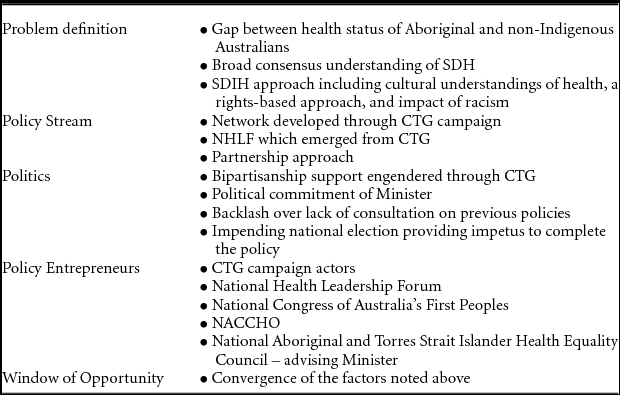
In Table 1 we apply the MSA to capture key factors identified in our analysis as shaping the agenda-setting phase of the NATSIHP.
Policy agenda setting for the NATSIHP using the MSA

Implementation
It was striking that, although our interviews clearly targeted the NATSIHP policy development process, and did not examine implementation, implementation concerns were raised by the majority of interviewees. Concerns expressed about the (at the time, future) implementation of the NATSIHP included criticism that it was a broad framework rather than a plan with specific goals and committed funding. Participants saw implementation as important because it related to questions of trust, and willingness to be involved in consultation over the NATSIHP, given concerns that previous policy had not been implemented. Some concerns arose from the prospect of a new government coming into power that had not been involved in the Plan's development, and Aboriginal leaders were keen to seek bipartisan support for it.
I think we were able to get largely what we argued for. The biggest thing is not having an implementation plan and associated funds identified right from the outset. I3, non-govt
A plan needs to have what you're going to do, when you're going to do it, how much you're going to spend on it, who's going to be responsible for it, how you're going to measure it. That is not what this document is; it's a strategic framework even though it's called a Health Plan. That was probably a tension that made it difficult. I9, public servant
There were also concerns about potential competition between programme funding areas and the health sector bureaucracy not being able to ‘lever’ other sectors and jurisdictions to implement a SDIH approach. Cross-sectoral structures and the involvement of various jurisdictions were not necessarily in place to support the implementation of the policy.
It's tougher-going around an implementation plan for social determinants of health; how do you address that at a nationally coordinated level within the COAG structure or whatever it's going to be? We haven't got one of them yet. I8, non-govt
I don't think the groundwork had been put in at the governmental level with and amongst the jurisdictions, so all of that early laying of the groundwork at every level, including Minister levels, hadn't been done. I7, non-govt
4. Discussion
This case study tells a positive story of the successful development of a strategic health plan for Aboriginal Australians which was centrally based on the SDIH, including recognition of human rights and culture and the impact of racism upon health and wellbeing, along with other conventional SDH. The Plan represents a paradigm change by, for the first time, explicitly recognising the health effects of racism in an Australian Aboriginal health policy, and includes a vision for promoting health equality and eliminating racism. This recognition of racism was a major step beyond previous policy documents which only cursorily mentioned the context of racism for Aboriginal health (National Aboriginal and Torres Strait Islander Health Council, 2003).
Our analysis shows how policy theory and frameworks elucidate those factors that enabled social determinants of Indigenous health to not only form a backdrop to a policy but remain at its heart. Key factors for success included the long-term advocacy of the CTG campaign network leading to a partnership approach to policy development, the extensive consultation process with Aboriginal communities, and a supportive political context.
Kingdon (Reference Kingdon2011) suggests that policy communities are largely fragmented, explaining unstable policy agendas. He predicts that closer policy networks are more likely to get policy proposals on policy agendas. All the interviewees we spoke to argued that a tightly-knit policy community evolved through the ‘Close the Gap’ campaign (Browne et al., Reference Browne, de Leeuw, Gleeson, Adams, Atkinson and Hayes2017). The CTG campaign fits the definition of an advocacy coalition by operating over an extended period and sustaining ‘core policy beliefs’ (Sabatier and Jenkins-Smith, Reference Sabatier, Jenkins-Smith and Sabatier1999). It also conformed to Kingdon's (Reference Kingdon2011) notion of powerful networks operating within a policy stream. However, there was little evidence for competing advocacy coalitions. Sabatier and Jenkins-Smith (Reference Sabatier, Jenkins-Smith and Sabatier1999) claimed that different advocacy coalitions compete to influence government in order to embed their belief system in policy. The broad SDH approach in the NATSIHP was supported by a strong single advocacy coalition that formed through CTG and actively cultivated and maintained shared beliefs around SDIH, the centrality of culture and rights, and the importance of a strength-based approach to policy action. These core beliefs were able to decisively influence policy when groups within the CTG coalition actively repositioned themselves to establish a partnership approach to develop a new Aboriginal health policy. This is the first time that there has been such a strong partnership approach between government and Aboriginal health leadership, and this was a crucial factor in the adoption of such a specific SDIH approach in the Plan.
Our analysis also showed that the wide consultations undertaken with Aboriginal communities as part of the policy development process were instrumental in cementing a recognition of SDH and SDIH, including racism, as central problems to be addressed by the new Health Plan. These matters became more vivid and real to bureaucrats and decision makers who heard directly from members of Aboriginal communities during consultations.
The political context surrounding these events (influenced by the CTG Campaign) included the role of a supportive Minister for Aboriginal Health who attended many of the community consultations, and the prior bipartisan support for addressing health inequities affecting Aboriginal people, expressed in the 2008 Statement of Intent. The work of the Aboriginal and Torres Strait Islander Social Justice Commissioner (within the Australia Human Rights Commission) provided impetus to establish the CTG Campaign. The national apology to the ‘Stolen Generations’ made by the then Prime Minister, Kevin Rudd, in 2008 is also likely to have influenced the broader ‘community mood’ (Kingdon Reference Kingdon2011) and public support for action on health inequities affecting Aboriginal people.
Key networks acted as policy entrepreneurs and evolved throughout the process – from the larger CTG network to the more focused National Health Leadership Forum (NHLF) (Browne et al., Reference Browne, de Leeuw, Gleeson, Adams, Atkinson and Hayes2017). The policy entrepreneurs were close to the ‘problem stream’ and issues faced by their communities. Previous research has indicated the importance of Aboriginal health workers’ proximity and accountability to their communities (Roche et al., Reference Roche, Duraisingam, Trifonoff, Battams, Freeman, Tovell, Weetra and Bates2013) and the same may apply to Aboriginal health leaders. The key Minister responsible for Aboriginal Affairs was also close to the ‘problem stream’ having attended consultations, further enabling an alignment of problems, policies and politics.
In the MSA, the policy network engages in political struggle in an attempt to control ambiguity, ‘provide meaning and identity, and to pursue self-interest’ (Zahariadis, Reference Zahariadis and Sabatier2007: 69). In the ACF, advocacy coalitions attempt to have their core policy beliefs reflected within policy. In this study, there was negotiation over meaning (e.g. culture, racism, SDIH) – pivotally led by the NHLF, but also driven by numerous other stakeholder and community member interactions (Browne et al., Reference Browne, de Leeuw, Gleeson, Adams, Atkinson and Hayes2017) – which built on the ‘claim to be heard’ (Kingdon Reference Kingdon2011) established by Aboriginal leadership. There was thus a dynamic and shifting process of policy framing (van Hulst and Yanow, Reference van Hulst and Yanow2016). The dominant coalition of Aboriginal leadership groups was engaged in negotiation with public servants/the Minister over meaning (e.g. culture) and language (e.g. racism versus discrimination) as part of a wider enterprise to ensure that Aboriginal perspectives were not policy embroidery, but embedded within its central tenets. There were examples of ‘non-negotiables’ presented by Aboriginal policy actors, such as the recognition of culture.
The iterative process through which policy framing occurred can inform the development of other policy. Such a partnership approach, involving NGO leadership groups within a sector, needs to be used more widely to develop and implement SDH approaches. There should be strong applicability wherever the supportive factors we have identified exist (if in nascent form) and there is a desire to move policy to a more-nuanced incorporation of the SDH. Those interested in pursuing such an approach could consider the potential in actions such as: the formation of campaigning coalitions among like-minded NGOs; building a core of shared beliefs on SDH and health inequities; advocacy in the media and among the wider community; strategically timely engagement with political leaders and policy development processes; and adoption of a strengths-based approach to policy development. In Australia the Social Determinants of Health Alliance has adopted some of these approaches, but with limited influence on public policy so far. Such activity offers opportunity for further study of the success, or otherwise, of such organised advocacy on policy implementation processes.
The iterative process through which policy framing occurred can also inform the development of theory and frameworks such as the ACF and MSA. The ACF suggests a number of pre-requisites for professional fora leading to the successful negotiation and implementation of agreements across advocacy coalitions (Sabatier and Weible, Reference Sabatier, Weible and Sabatier2007). Whilst the MSA discusses framing, including the use of emotion as a strategy of policy entrepreneurs (Zahariadis, Reference Zahariadis and Sabatier2007), it is also limited in its ability to explain shifts in policy framing occurring through negotiation where there is a single advocacy coalition. Van Hulst and Yanow (Reference van Hulst and Yanow2016) talk about storytelling as an important method of persuasion for framing shifts, which extends beyond ‘problem definition.’ In this case study there was much ‘storytelling’ of problems in the accounts and views of Aboriginal people. Thus evidence was no longer merely detached information but something rendered more real and challenging for public servants through access to personal exemplars. Persuasive power may also have been enhanced by connection to lived context – at times ‘in situ’ in a community setting – along with the evidentiary consolidation made possible where repeated affirmations arose from exposure to a range of informants, who returned to variations of the same issues over and over again.
The extensive consultation process for NATSIHP demonstrated a ‘bottom up’ or partnership approach to policy making, but also highlighted the need for ‘top-down’ coordination across many sectors and the resources required for its implementation. Concerns about implementation reflected an understanding that, whilst it was important to recognise broad policy intent to address SDIH, it was another thing to act on the plan. Cross-sectoral structures linking levels of government and sectors, and promoting local linkages, will be required for the effective implementation of the NATSIHP and other policies trying to address SDH.
The study highlighted the potential benefits of bipartisan political support from political leaders and parties to progress policy, and it remains the case in 2018 that both major parties in Australia continue to support the Closing the Gap targets. However, in this case the national political cycle (the ‘politics stream’) also helped to explain a hiatus that occurred between policy development and implementation, with the national Labor government losing an election shortly after the NATSIHP was finalised, and the incoming Liberal-Coalition government being slow to commit to a funded implementation plan.
Implementation of NATSIHP and the SDIH approach taken should be a focus for future research, given the limited progress on Closing the Gap targets. Australia is not on track to close the life expectancy gap within a generation, and is also behind on targets pertaining to education, reading, writing, numeracy and employment (Australian Government, 2016). Structures and processes for implementing COAG's NIRA could also be a focus for future research. Successful policy implementation has been linked to the extent of linkages across organisations and departments at a local level (Pressman and Widavsky, Reference Pressman and Widavsky1984).
5. Conclusion
This research highlighted the successful advocacy for the NATSIHP plan which recognises the SDIH, and provided some evidence for the advocacy coalition framework. The Close the Gap campaign played a key role in NATSIHP's development and associated leadership structures. The SDIH was developed through an iterative process, with ‘policy frames’ shifting paradigms from a broad SDH towards a SDIH approach that recognised Aboriginal culture, a human-rights-based approach, the health effects of racism, past and current consequences of colonisation and a strengths-based approach. The way in which policy framing shifts occur where there are dominant advocacy coalitions could be better incorporated into policy network theory and frameworks. However, despite the SDIH approach and strong Aboriginal leadership and partnership approach, some issues such as justice were not taken up within NATSIHP. Whilst considered to be a successful statement of intent, the plan also lacked implementation strategies and funding commitment at the time of our research. The local implementation of NATSIHP as a cross-sectoral national strategy is an avenue for future study.
Conflicts of interest
Some members of the research team were involved in advocacy for the Close the Gap campaign and are members of the PHAA which is a member of Close the Gap, as well as the Social Determinants of Health Alliance.
Acknowledgments
The research informing this paper was funded by the Australian Research Council [DP120101510]. The funder had no role in the collection, analysis and interpretation of data, the writing of this article, or the decision to submit it for publication.