Introduction
Preventive and therapeutic vaccination in definitive or intermediate hosts is an ongoing effort that includes diverse strategies for control of neglected parasitic tropical diseases (NTD) such as malaria, leishmaniasis, Chagas disease, soil-transmitted helminthiasis (STH) and schistosomiasis (Patarroyo et al., Reference Patarroyo, Bermúdez and Moreno-Vranich2012; Beaumier et al., Reference Beaumier, Gillespie, Hotez and Bottazzi2013). Among these, STHs caused by the hookworms Ancylostoma duodenale and Necator americanus, Ascaris lumbricoides and Trichuris trichiura are leading causes of morbidity worldwide (>600 million cases each). Moreover, other helminths, such as Ascaris suum or Trichuris suis, infect domestic hosts, such as pigs, and are considered a veterinary health problem. Although protozoan infections by kinetoplastids such as Leishmania sp. and Trypanosoma cruzi have a lower impact (10–12 million cases each) in this NTD list (Beaumier et al., Reference Beaumier, Gillespie, Hotez and Bottazzi2013), these are also considered an important health problem. In this article we review the current status of approaches to study protective host responses and immunization strategies aimed at developing vaccines against Trichinella spiralis infection, which is the most widespread Trichinella species, causing trichinellosis in humans and pigs, which globally exhibits similar burdens to kinetoplastid-caused infections.
Estimating the impact of transmission of pig-to-human trichinellosis
Trichinellosis is transmitted to humans by domestic or wild animals by eating meat contaminated with encysted first-stage larvae. Upon activity of digestive enzymes in the host's stomach, the larvae are released, migrate to the small intestine while they mature and finally harbour in the epithelial cell syncytium where they moult and develop into male/female adults within a period of 30 h. Approximately 5 days after mating, newborn larvae are released continuously from female worms until the worms are expelled from the intestine. Newborn larvae that are released in the gut migrate to striated muscle, where they encapsulate and induce the formation of the nurse cell–larvae complex (NCLC), a process that takes around 17 days to be completed. Encysted larvae may survive as long as 25 years in living hosts, in a silent state underlying a tightly controlled inflammatory response around the NCLC (Beiting et al., Reference Beiting, Gagliardo, Hesse, Bliss, Meskill and Appleton2007). Transmission to humans involves the consumption of raw or undercooked meat and its derivatives from domestic (dog, horse, pig) and wild (walruses, wild boars, badgers, bears) animals, with the latter being major reservoirs of this parasite's biomass in contrast to other nematode infections (Pozio, Reference Pozio2013).
The genus Trichinella is comprised of nine species and three genotypes divided into two clades that infect more than 100 species of mammals, birds and reptiles. Of these, six species and one genotype have been detected in human infections (Pozio & Zarlenga, Reference Pozio and Zarlenga2013). However, the zoonosis, trichinellosis, caused by T. spiralis is an eventually fatal infection among a broad range of mammalian hosts, and human outbreaks have been observed in the past two centuries in up to 55 countries (Pozio, Reference Pozio2007; Murrell & Pozio, Reference Murrell and Pozio2011). In fact, it is estimated that around 11 million people are infected by Trichinella sp. worldwide (except Antarctica) (Dupouy-Camet, Reference Dupouy-Camet2000), and recent surveys suggest an emerging or re-emerging trend for human trichinellosis (Dupouy-Camet, Reference Dupouy-Camet2000; Pozio, Reference Pozio2007). Of note: pork has the highest consumption rate of any meat by humans (the 2015 forecast is 1 billion pigs) and the demand for its derivatives has increased over recent decades, particularly in fast-growing economies. Half of the pigs are produced under industrial farming conditions, where Trichinella testing occurs; however, the other half of pork production occurs in backyard and free-ranging conditions, without specific testing, and these conditions account for the largest portion of Trichinella sp. biomass (Pozio, Reference Pozio2014). In this context, the design of control strategies for trichinellosis should include preventing pig-to-human transmission. Therefore the development of therapeutic and prophylactic resources intended for definitive and/or intermediate hosts has been approached using experimental infections in rodent species that are the best-characterized models.
Immunobiology of trichinellosis
The life cycle of T. spiralis involves three main stages – infective/muscle larvae, newborn larvae and adults – that display stage-specific antigens with the ability to differentially modulate host responses (Liu et al., Reference Liu, Wang, Fu, Li, Wu, Le Rhun, Chen and Boireau2007; Yépez-Mulia et al., Reference Yépez-Mulia, Montaño-Escalona, Fonseca-Liñán, Muñoz-Cruz, Arizmendi-Puga, Boireau and Ortega-Pierres2009). Also, innate immunity does not usually block the establishment and development of infective larvae to mature adults or the production of the newborn larvae. In this scenario, mucosal and systemic immunity orchestrate protective host responses, and the former has an effect against all three stages while the latter affects the migrating larvae as well as NCLC formation and maintenance. The resistance of the NCLC is partially explained by the production of regulated levels of interleukin (IL)-10 and transforming growth factor (TGF)-β, which influence the surrounding inflammation levels (Beiting et al., Reference Beiting, Gagliardo, Hesse, Bliss, Meskill and Appleton2007). Thus, prophylactic vaccination aimed at inducing mucosal immunity in the small intestine would be more relevant, since the worms live at this site.
Trichinella spiralis adult worm expulsion is regulated mainly by CD4+/T-helper 2 (Th2) cytokines and depends on IL-4/IL-13 production, since their inhibition extends parasite survival (Finkelman et al., Reference Finkelman, Shea-Donohue, Morris, Gildea, Strait, Madden, Schopf and Urban2004). While eosinophilia is a hallmark of parasite infection, both in peripheral blood and tissue, in T. spiralis-infected mice (Bruschi et al., Reference Bruschi, Korenaga and Watanabe2008), blocking IL-5 does not prevent host protection (Herndon & Kayes, Reference Herndon and Kayes1992; Dixon et al., Reference Dixon, Blanchard, Deschoolmeester, Yuill, Christie, Rothenberg and Else2006). It has been reported that eosinophils from the jejunum may undergo apoptosis once the T. spiralis infection is cleared (Bruschi et al., Reference Bruschi, Korenaga and Watanabe2008). Interestingly, eosinophils are able to kill larvae in vitro and they contribute to resistance to the systemic phase, as the number of larvae in the muscles is almost doubled under eosinophil depletion (Grove et al., Reference Grove, Mahmoud and Warren1977; Gurish et al., Reference Gurish, Humbles, Tao, Finkelstein, Boyce, Gerard, Friend and Austen2002). More recently, a strikingly distinct role for eosinophils in vivo has been reported, as larvae are established in the muscle during eosinophilia, and larval viability is compromised in eosinophil-deficient mice (Fabre et al., Reference Fabre, Beiting, Bliss, Gebreselassie, Gagliardo, Lee, Lee and Appleton2009). Further work proposed that in chronic murine trichinellosis, parasite growth and survival are supported by eosinophils, which promote accumulation of Th2 (IL-4+) cells and prevent nitric oxide synthase (iNOS) induction in macrophages and neutrophils (Gebreselassie et al., Reference Gebreselassie, Moorhead, Fabre, Gagliardo, Lee, Lee and Appleton2012). Eosinophils have been proposed to have an immunoregulatory role in nematode infections as these cells may expand dendritic cells and CD4+ cells to produce IL-10 which, in turn, inhibits iNOS (Huang et al., Reference Huang, Gebreselassie, Gagliardo, Ruyechan, Lee, Lee and Appleton2014). Another immune mechanism involves the production of immunoglobulin E (IgE), which promotes parasite expulsion from the small intestine (Gurish et al., Reference Gurish, Bryce, Tao, Kisselgof, Thornton, Miller, Friend and Oettgen2004). Although treatment of mice with IL-9 enhanced infection-induced jejunal muscle hypercontractility and accelerated worm expulsion, this cytokine does not seem to play a protective role, since its blockage did not impair host protection (Khan et al., Reference Khan, Richard, Akiho, Blennerhasset, Humphreys, Grencis, Van Snick and Collins2003).
At the gastrointestinal level, infection by T. spiralis promotes a rapid and reversible expansion of the mucosal mast-cell population in the intestinal epithelium. This response is dependent on T cells and it requires the Th2 cytokines IL-4 and IL-13 (Urban et al., Reference Urban, Schopf, Morris, Orekhova, Madden, Betts, Gamble, Bird, Donaldson, Else and Finkelman2000; Helmby & Grencis, Reference Helmby and Grencis2002; Scales et al., Reference Scales, Ierna and Lawrence2007). The response is propagated through the IL-4 receptor α (IL-4Rα) by activating STAT6 (signal transducer and activator of transcription 6) (Finkelman et al., Reference Finkelman, Shea-Donohue, Morris, Gildea, Strait, Madden, Schopf and Urban2004; Knight et al., Reference Knight, Brown and Pemberton2008). Consistently, it has been shown that STAT6-deficient mice display impaired IL-4- and IL-13-driven signalling, concomitant with a reduced mast-cell hyperplasia (Urban et al., Reference Urban, Schopf, Morris, Orekhova, Madden, Betts, Gamble, Bird, Donaldson, Else and Finkelman2000; Khan et al., Reference Khan, Blennerhasset, Ma, Matthaei and Collins2001a, Reference Khan, Vallance, Blennerhassett, Deng, Verdu, Matthaei and Collinsc). Mast cells in T. spiralis-infected mice are negatively regulated by the Th1-type cytokine IL-18, thereby delaying worm expulsion (Helmby & Grencis, Reference Helmby and Grencis2002). Transcriptomic analyses performed on the jejunal epithelial compartment from T. spiralis-infected and -uninfected mice (Urban et al., Reference Urban, Schopf, Morris, Orekhova, Madden, Betts, Gamble, Bird, Donaldson, Else and Finkelman2000) revealed that, in mast cells from these animals, the most highly up-regulated transcripts were B-chimases, which include mouse mast-cell protease-1 (Mcpt-1) and -2 (Mcpt-2).
Intestinal infections are usually associated with a high accumulation of fluid in the gut lumen, which is also a hallmark of T. spiralis primary and secondary infections. Indeed, increased muscle contractility and fluid accumulation have been shown to promote worm expulsion (Madden et al., Reference Madden, Yeung, Zhao, Gause, Finkelman, Katona, Urban and Shea-Donohue2004). Augmentation of fluid accumulation is due to increased epithelial secretion (STAT6-dependent prostaglandins and histamines), enteric nerves and increased paracellular epithelial permeability, which may explain the diarrhoea, electrolyte and protein loss that develop during Trichinella infections (Field, Reference Field2003). In this context, it was suggested initially that mast-cell B-chimases were responsible for the increased paracellular permeability (Scudamore et al., Reference Scudamore, Thornton, McMillan, Newlands and Miller1995) and further work demonstrated that the deletion of the mcpt-1 gene was associated with delayed T. spiralis worm expulsion (Knight et al., Reference Knight, Wright, Lawrence, Paterson and Miller2000), which supported its role in host protection.
In recent studies macrophages have been reported to play a role in the Th2-type response mediating host defence against T. spiralis infection (Dzik et al., Reference Dzik, Gołos, Jagielska, Zielinski and Wałajtys-Rode2004). In particular, alternatively activated macrophages (AAMΦ) have been detected using the marker arginase-1. AAMΦ also produce other molecules, including IL-4Rα, chitinase and Fizz family members (ChaFFs), chitinases, FIZZ1/RELMα (found in inflammatory zone/resistin-like molecule alpha) Ym1 (also known as CHI3L3 (chitinase-3-like protein 3) or ECF-L (eosinophil chemotactic factor-L)) and Amcase (acidic mammalian chitinase), among others. Thus it is conceivable that AAMΦ may contribute to control of Th1-driven responses, hence promoting a polarized Th2-type profile (Kreider et al., Reference Kreider, Anthony, Urban and Gause2007).
Intestinal infection by T. spiralis also induces Th2 immune responses mediated by IL-4 and IL-13 as well as goblet-cell hyperplasia and increased mucus secretion (Moncada et al., Reference Moncada, Kammanadiminti and Chadee2003; Knight et al., Reference Knight, Pemberton, Robertson, Roy, Wright and Miller2004, Reference Knight, Brown and Pemberton2008). Although goblet cells may be abrogated by the Th1-type cytokines and IL-27 (Khan et al., Reference Khan, Blennerhassett, Deng, Gauldie, Vallance and Collins2001b) during acute intestinal infection, these cells secrete high levels of mucins. Mucins (MUC) are monomers composed of polypeptide backbones glycosylated at serine and threonine residues and linked by disulphide bridges to form a layer of mucus that coats and protects the epithelium (Knight et al., Reference Knight, Brown and Pemberton2008). This layer is largely composed of MUC1, MUC2, MUC3, MUC17, trefoil factor peptides (TFF), intelectin 2 (a galactofuranose-binding lectin, also produced by intestinal Paneth cells), resistin-like molecule beta (RELMβ) and Fc-gamma binding protein (Fcγbp) (Kim & Ho, Reference Kim and Ho2010). In particular, MUC2 plays an important role in host protection, since Muc2-deficient mice strains display a significantly delayed worm expulsion when infected by the whipworm Trichuris muris, and a good correlation with an increase of MUC2 expression was found in resistant mice (Hasnain et al., Reference Hasnain, Wang, Ghia, Haq, Deng, Velcich, Grencis, Thornton and Khan2010). Likewise, an increase of MUC3 and RELMβ was determined by transcriptome analyses of T. spiralis-infected mice (Urban et al., Reference Urban, Schopf, Morris, Orekhova, Madden, Betts, Gamble, Bird, Donaldson, Else and Finkelman2000). Further proteomic analyses carried out on T. spiralis-infected mice showed increased levels of intelectin-2 (Pemberton et al., Reference Pemberton, Knight, Wright and Miller2004a, Reference Pemberton, Knight, Gamble, Colledge, Lee, Pierce and Millerb). In fact RELMβ was identified as one of the most highly up-regulated transcripts during T. spiralis infection (Knight et al., Reference Knight, Pemberton, Robertson, Roy, Wright and Miller2004) and, based on experimental data obtained in mice infected with T. muris and Strongyloides stercoralis, it was suggested that RELMβ has potential anti-parasitic activity, since it binds to chemosensory components of nematodes (Artis et al., Reference Artis, Wang, Keilbaugh, He, Brenes, Swain, Knight, Donaldson, Lazar, Miller, Schad, Scott and Wu2004). Thus, goblet-cell products, such as RELMβ and intelectins, may contribute to worm expulsion by altering mucus composition or by a direct anti-parasitic function (Knight et al., Reference Knight, Brown and Pemberton2008). Consistently, in the lumen-dwelling parasites Nippostrongylus brasiliensis and Heligmosomoides polygyrus expulsion by RELMβ is either spontaneous or induced by IL-4 (Herbert et al., Reference Herbert, Yang, Hogan, Groschwitz, Khodoun, Munitz, Orekov, Perkins, Wang, Brombacher, Urban, Rothenberg and Finkelman2009). In contrast, RELMβ does not contribute to immunity against the gut-dwelling parasite T. spiralis. Although MUC5 is not produced in the intestinal mucosa, it has been reported that its absence caused a significant delay in the expulsion of two gut-dwelling nematodes (T. spiralis and N. brasiliensis) (Hasnain et al., Reference Hasnain, Evans, Roy, Gallagher, Kindrachuk, Barron, Dickey, Wilson, Wynn, Grencis and Thornton2011).
Different intestinal regions may display specific regulatory responses upon Trichinella infection. Indeed, recent studies have shown that IL-17 levels and Th17 cells were increased in the jejunum of T. spiralis-infected mice 2 weeks post-infection. Further, it has been reported that jejunal muscle contractions elicited by acetylcholine were enhanced by IL-17 in a dose-dependent manner (Fu et al., Reference Fu, Wang, Tong, Pan, Long, Qian and Hou2009). Also, jejunal tissue displays a swollen and oedematous appearance during worm expulsion.
A Th2-type response involving IL-4/IL-13 signalling may increase epithelial cell resistance and Na+-linked glucose absorption, leading to increased levels of luminal fluids (Madden et al., Reference Madden, Yeung, Zhao, Gause, Finkelman, Katona, Urban and Shea-Donohue2004). As mentioned above, during T. spiralis infection AAMΦ may contribute to Th2-polarized host response by controlling the Th1 response, while in other intestinal parasites, such as N. brasiliensis, AAMΦ may also affect intestinal physiology by promoting smooth muscle contractility (Zhao et al., Reference Zhao, Urban, Anthony, Sun, Stiltz, van Rooijen, Wynn, Gause and Shea-Donohue2008). Several studies involving mast-cell depletion in mice have shown that mast cells are crucial for worm expulsion and intestinal epithelial cell permeability during T. spiralis infection (Ha et al., Reference Ha, Reed and Crowle1983; Alizadeh & Murrell, Reference Alizadeh and Murrell1984; Donaldson et al., Reference Donaldson, Schmitt, Huntley, Newlands and Grencis1996; Finkelman et al., Reference Finkelman, Shea-Donohue, Morris, Gildea, Strait, Madden, Schopf and Urban2004). The serine protease mMcpt1 also plays a role, as mMcpt1-deficient mice were unable both to increase their epithelial permeability and to expel worms normally (Knight et al., Reference Knight, Wright, Lawrence, Paterson and Miller2000, Reference Knight, Brown and Pemberton2008). This observation was confirmed in rats (Suzuki et al., Reference Suzuki, Sasaki, Takagi, Sato and Ueda2008). Increased paracellular permeability is likely mediated by mMcpt1 degradation of intercellular junctional proteins, such as occludin located at tight junctions (McDermott et al., Reference McDermott, Bartram, Knight, Miller, Garrod and Grencis2003).
In summary, the Th2 response is of crucial importance during T. spiralis infection, particularly at the intestinal level, since the Th2 cytokines, such as IL-4 and IL-9, promote mastocytosis (Finkelman et al., Reference Finkelman, Shea-Donohue, Morris, Gildea, Strait, Madden, Schopf and Urban2004). In fact IL-9 transgenic mice displayed both increased mast-cell populations and intestinal permeability (Faulkner et al., Reference Faulkner, Humphreys, Renauld, Van Snick and Grencis1997; Temann et al., Reference Temann, Ray and Flavell2002, Reference Temann, Laouar, Eynon, Homer and Flavell2007). During the first hours after infection, basophils and mast cells are important suppliers of Th2 cytokines, and their activation may occur by IgE cross-linking. As the immune response progresses, the Th2 cytokines seem to be important in increasing the susceptibility to mast-cell mediators such as mMcpt1 (Strait et al., Reference Strait, Morris, Smiley, Urban and Finkelman2003; Finkelman et al., Reference Finkelman, Shea-Donohue, Morris, Gildea, Strait, Madden, Schopf and Urban2004). Therefore, Th2 cytokines may act on mast cells during T. spiralis infection by promoting both mast-cell activation and hyperplasia, as well as by modulating intestinal functions such as mucin secretion and paracellular permeability.
Vaccine development against T. spiralis infection
Induction of therapeutic and protective responses in T. spiralis infections should activate both innate and acquired immunological mechanisms in order to: (1) block the establishment of infective larvae at the intestinal epithelium; (2) interrupt the development of larvae to adult worms, hence production of newborn larvae (NBL); (3) prevent the migration of NBL to avoid NCLC formation; and (4) expel adult worms from the intestine
In trichinellosis, host–parasite interplay is complicated by the T. spiralis life cycle, which includes a diversity of stage-specific antigens, immune evasion strategies and modulatory effects on host responses. These features make it challenging to achieve effective protective responses. Nevertheless the development of effective mucosal and systemic immune responses is required to control the intestinal phase of the parasite, by promoting the expulsion of adults and preventing NBL release and their migration to the muscle. In this context, during the past two decades most efforts have been focused on immunizing hosts against T. spiralis infection using progressively more refined parasite components. These efforts began with complex parasite extracts and more recently have included recombinant proteins or epitope-based immunogens.
Induction of protective immunity by whole extracts and excretory–secretory products
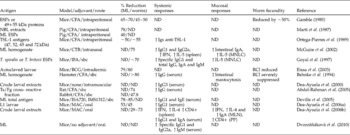
It has been observed consistently that whenever whole-larval extracts are used there is better host protection than when using any isolated parasite antigen, as seen by the reduction in larval or adult worm burden (Behnke et al., Reference Behnke, Dehlawi, Rose, Spyropoulos and Wakelin1994; Dea-Ayuela et al., Reference Dea-Ayuela, Martinez-Fernandez and Bolas-Fernandez2000, Reference Dea-Ayuela, Rama-Iñiguez, Torrado-Santiago and Bolas-Fernandez2006a, Reference Dea-Ayuela, Rama-Iñiguez and Bolas-Fernándezb; Eissa et al., Reference Eissa, el-Azzouni, Baddour and Boulos2003; Deville et al., Reference Deville, Pooter, Aucouturier, Lainé-Prade, Cote, Boireau and Vallée2005) (table 1). These responses are within the rage of 50–80% protection in most cases. These studies have included mainly mice, rats and hamsters: from these reports it is known that (a) mouse strains varied in response to Trichinella infection (low and high responders) (Robinson et al., Reference Robinson, Bellaby and Wakelin1995); (b) rats are rapid responders, since they exhibit worm expulsion within approximately 2 weeks, although there are also faster (BN) and slower (F344) responder strains (Suzuki et al., Reference Suzuki, Sasaki, Takagi, Sato and Ueda2008); and (c) although T. spiralis intestinal infections in pigs and humans are more prolonged than those observed in mice and rats (Murrell, Reference Murrell1985), the most important features of human infections are mirrored in these rodents that are also natural hosts for T. spiralis. The mouse strain most widely used has been the BALB/c strain and the outcome of these studies has been quite useful for understanding host immunity against T. spiralis infections.
Immunization protocols and immunological/parasitological responses using whole extracts and purified antigens of T. spiralis.

BCG, Bacille Calmette–Guerin; CFA, complete Freund's adjuvant; CTB, cholera toxin subunit B; ESPs, excretory–secretory products; Fg, Fasciola gigantica; IFA, incomplete Freund's adjuvant; IFN, interferon; IL, interleukin; IMS1312, Montanide IMS1312; ISA720, Montanide ISA720; MAC, methacrylic acid copolymer; ML, muscle larvae; MLN, mesenteric lymph nodes; MNLC, mesenteric lymph node cells; NBL, newborn larvae; ND, not determined; PP, Peyer's patches; RCI, reproductive capacity index (ratio of the total number of larvae recovered from an animal to the number of larvae administered); sbc, subcutaneous; Ts, Trichinella spiralis; TSL-1, T. spiralis antigens-group 1 from muscle larvae.
In this context, mucosal immune responses have been analysed in experimental models immunized initially with whole-larval extracts. These studies have shown increased Th1 (interferon-gamma (IFN-γ)) and Th2 (secretory immunoglobulin A (sIgA)) responses from mesenteric lymph nodes as well as an increase in CD4+ lymphocyte numbers in Peyer's patches (Dea-Ayuela et al., Reference Dea-Ayuela, Rama-Iñiguez and Bolas-Fernández2006b) and intestinal mastocytosis (Behnke et al., Reference Behnke, Dehlawi, Rose, Spyropoulos and Wakelin1994). A number of reports have also shown the activation of systemic immune responses, as indicated by elevated levels of total and specific IgG, IgA, IgM, IgG1, IgE (Th1 response) (Behnke et al., Reference Behnke, Dehlawi, Rose, Spyropoulos and Wakelin1994; Goyal et al., Reference Goyal, Bolas-Fernandez and Wakelin1997; McGuire et al., Reference McGuire, Chan and Wakelin2002; Abdel-Rahman et al., Reference Abdel-Rahman, Abouel Ezz and Abdel Megeed2005; Deville et al., Reference Deville, Pooter, Aucouturier, Lainé-Prade, Cote, Boireau and Vallée2005; Dea-Ayuela et al., Reference Dea-Ayuela, Rama-Iñiguez, Torrado-Santiago and Bolas-Fernandez2006a, Reference Dea-Ayuela, Rama-Iñiguez and Bolas-Fernándezb; Dvorožňáková et al., Reference Dvorožňáková, Hurníková and Kołodziej-Sobocińska2011), IgG2a (Th2 response) (McGuire et al., Reference McGuire, Chan and Wakelin2002; Dvorožňáková et al., Reference Dvorožňáková, Hurníková and Kołodziej-Sobocińska2011) and even by the increase of IgG3, a subclass isotype considered as a carbohydrate epitope-associated immunoglobulin (Dea-Ayuela et al., Reference Dea-Ayuela, Martinez-Fernandez and Bolas-Fernandez2000). In spite of their relatively high levels of protection, whole-larval extracts may display some toxicity or immunopathogeny derived from an exacerbated Th2 response, an aspect not yet addressed. Trichinella spiralis antigens-group 1 from muscle larvae (TSL1 antigens) and excretory–secretory products (mainly composed of the 49, 53, 57 and 65 kDa T. spiralis antigens; Bolás-Fernandez & Corral Bezara, Reference Bolás-Fernandez and Corral Bezara2006) have exhibited good protection against T. spiralis (Ortega-Pierres et al., Reference Ortega-Pierres, Muñiz, Coral-Vázquez and Parkhouse1989); nevertheless, more refined vaccine formulations, which include different adjuvants, purified antigens, recombinant proteins and synthesized epitopes, have subsequently been evaluated.
Adjuvants and immunization routes used in the induction of protection against T. spiralis
Adjuvants have been used to enhance the humoral and/or cell-mediated immune responses against T. spiralis antigens, as well as to protect the antigens from being diluted, degraded and eliminated by the host (Stills, Reference Stills2005). Thus various adjuvants have been tested in these studies, including the following: IFA (incomplete Freund's adjuvant), CFA (complete Freund's adjuvant), Bacille Calmette–Guerin (BCG), methacrylic acid copolymers, MontanideTM IMS1312 and MontanideTM ISA720 (Ortega-Pierres et al., Reference Ortega-Pierres, Muñiz, Coral-Vázquez and Parkhouse1989; Behnke et al., Reference Behnke, Dehlawi, Rose, Spyropoulos and Wakelin1994; Goyal et al., Reference Goyal, Bolas-Fernandez and Wakelin1997; Dea-Ayuela et al., Reference Dea-Ayuela, Martinez-Fernandez and Bolas-Fernandez2000, Reference Dea-Ayuela, Rama-Iñiguez, Torrado-Santiago and Bolas-Fernandez2006a, Reference Dea-Ayuela, Rama-Iñiguez and Bolas-Fernándezb; McGuire et al., Reference McGuire, Chan and Wakelin2002; Eissa et al., Reference Eissa, el-Azzouni, Baddour and Boulos2003; Deville et al., Reference Deville, Pooter, Aucouturier, Lainé-Prade, Cote, Boireau and Vallée2005) (table 1). While CFA, a water-in-oil (W/O) emulsion that contains heat-killed and dried mycobacterial cells, has been widely used and is the most effective adjuvant for experimental antibody production, its use has been limited lately due to the side-effects and variety of lesions that it causes. These lesions include granulomas at the injection site, liver, kidney and sub-pleura, as well as necrotizing dermatitis (Billiau & Matthys, Reference Billiau and Matthys2001; Stills, Reference Stills2005). Similarly, the use of cholera toxin, which also enhances antigenicity of Trichinella sp. extracts, causes gastrointestinal disorders (Williams et al., Reference Williams, Hirst and Nashar1999). Thus, alternative adjuvants have emerged and these have been evaluated in experimental trichinellosis over the past few years. These include other W/O emulsions such as ISA (incomplete Seppic adjuvants), IFA (with the same composition as CFA except that this does not contain mycobacteria) and aqueous formulations with nanoparticles such as MontanideTM IMS1312 (commercialized by Seppic (Paris, France), contains an injectable pharmaceutical mineral oil and a refined emulsifier derived from mannitol and purified oleic acid of vegetable origin), and copolymers of methacrylic acid (based on dimethylaminoethyl methacrylate and neutral methacrylic acid esters). Although the latter are very promising, the efficiency of immunization still depends on the delivery route and the type of antigen used to trigger significant antibody responses.
Indeed, vaccine delivery encompasses: (1) administration of the vaccine formulation to specific sites of the body; and (2) delivery of the antigen to, and activation of, relevant cells of the immune system. The infection model with Trichinella initially involves the intestinal mucosal compartment, which targets the induction of local immune responses. Therefore the routes of antigen delivery should involve mucosal tissues or should be deposited directly in accessible mucosal surfaces. An optimal mucosal vaccine strategy can activate local innate immune responses that translate into the generation of neutralizing sIgA Abs, polyfunctional CD8+ cytotoxic T-lymphocytes (CTLs) in effector target sites, and CD4+T-cell effector memory responses, whereas systemic vaccine strategies are much less effective in eliciting the compartmentalized mucosal immunity necessary for these protective responses. In addition, mucosal vaccines can offer needle-free delivery, thereby improving accessibility, safety and cost-effectiveness (for a review, see Belyakov & Ahlers, Reference Belyakov and Ahlers2009). Thus, in Trichinella vaccination, mucosal immunization through oral or intranasal routes can be more effective, and these routes can induce generalized mucosal immune responses not only at the portals of entry of this parasite but in distant mucosal effector sites as well, although additional constraints on mucosal compartmentalization are evidently dependent upon the adjuvant and the antigen delivery vehicle
In some recent studies the importance of selecting adjuvants to improve vaccine efficacy has been highlighted. Pioneer studies using Trichinella excretory–secretory (TES) products administered subcutaneously in high- and low-responder mice did not show a direct influence of adjuvants such as CFA, alum or commercial preparations (ISCOMTM or TitermaxTM) on the qualitative profile of antigen-specific antibodies, IL-5 and IFN-γ, although quantitative levels were higher (Robinson et al., Reference Robinson, Bellaby and Wakelin1994). Other studies with Montanide-ISA adjuvants (water-in-oil, W/O; oil-in-water, O/W, and multiphasic) and microbeads demonstrated that the use of adjuvants enhanced immune responses against T. spiralis L1 antigens (L1) when administered subcutaneously in mice, since elevated humoral responses were observed with all the adjuvants tested. However, IgG1 and IgG2a levels increased to a greater extent when using microbeads and W/O emulsions containing mineral oil instead of metabolizable oils (Aucouturier et al., Reference Aucouturier, Deville, Perret, Vallée and Boireau2001). Furthermore, in female OF1 mice immunized with total soluble antigens of T. spiralis muscle larvae (ML), two types of Montane adjuvants were tested: ISA70 (W/O emulsion) and IMS1312VG (nanoparticles) along with aluminium hydroxide (alum) and saline as control adjuvant and vehicle, respectively. The three adjuvants contributed to the induction of significantly higher levels of anti-T. spiralis IgG1 and IgE antibodies, as compared to saline. In these assays Montane formulations have the highest response. In terms of protection measured by the determination of ML burdens, a more drastic decrease in ML was observed when ISA70 was used, while animals treated with alum and IMS1312VG had a higher number of ML, demonstrating the utility of W/O emulsions in enhancing protection against Trichinella (Deville et al., Reference Deville, Pooter, Aucouturier, Lainé-Prade, Cote, Boireau and Vallée2005). In a different approach, microparticles of methacrylic acid copolymers (Eudragit) were used as a delivery system for L1 total antigens and Trichinella excretory–secretory antigens (TES), in order to avoid tolerance to their oral administration and to target antigens at the mucosal lymphoid organs (Dea-Ayuela et al., Reference Dea-Ayuela, Rama-Iñiguez, Torrado-Santiago and Bolas-Fernandez2006a, b). These particles are biocompatible as they exhibit resistance to acidic pH but deliver antigens in the neutral and basic pH range, enabling access of antigen to parenteral/systemic compartments. In these studies female BALB/c and NIH mice were orally vaccinated with larval antigens microencapsulated in Eudragit T100, then mucosal and systemic immune cell populations and cytokines were evaluated. In the vaccinated mice, increased levels of IFN-γ in spleen and mesenteric lymph nodes were observed, while low levels of splenic IL-4, CD4+ and CD19+ cells were detected in these animals, as compared with the non-vaccinated controls. These changes were associated with increased CD4+ cells and decreased CD19+ cells in Peyer's patches (PP). Somatic and TES-specific serum IgG1, IgA and mesenteric lymph node (MLN) IgA were elevated in the immunized mice. Regarding protection, in mice strains both L1- and TES-containing microcapsules provoked a reduction of adult worms at days 3–9 post-infection, although female fecundity was not affected. Nevertheless, protection at the intestine was 45% and 53% at the muscle stage. These observations suggest that the presence of balanced local and systemic Th1/Th2 responses. Thus, formulations with different and complex antigen preparations in mice of a distinct background will produce partial protection.
Recombinant proteins and subunit epitopes used to induce protective responses against T. spiralis
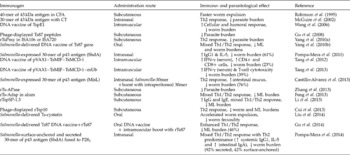
In recent years genetic engineering, including recombinant DNA technology and genome-wide sequencing, has provided useful strategies for the identification and characterization of molecules with potential use in the so-called second- and third-generation vaccines. Some sequences coding for molecules involved in the host–Trichinella relationship have been cloned from the incompletely annotated, 64-megabase T. spiralis genome containing approximately 15,800 open reading frames (Mitreva et al., Reference Mitreva, Jasmer, Zarlenga, Wang, Abubucker, Martin, Taylor, Yin, Fulton, Minx, Yang, Warren, Fulton, Bhonagiri, Zhang, Hallsworth-Pepin, Clifton, McCarter, Appleton, Mardis and Wilson2011). These have been used to design second-generation vaccines, based on either recombinant T. spiralis proteins or on peptide epitopes expressed by live and attenuated vectors, such as Salmonella sp., which are exposed on the bacterial surface by means of bacterial autotransporters (table 2).
Second- and third-generation vaccines used in experimental T. spiralis infections in mice.

APase, aminopeptidase; CFA, complete Freund's adjuvant; CT, cholera toxin; ISA106, Montanide ISA106; ISA720, Montanide ISA720; MCD-1, multi-cystatin domain-1; MIF, migration inhibitory factor; MisL, autotransporter MisL; ML, muscle larvae; mUb, mouse ubiquitin; P283, three copies of the minimal binding domain of Cd3; Pmy, paramyosin; pVAX1, plasmid VAX1; r, recombinant; ShdA, autotransporter ShdA; Ts, Trichinella spiralis; Ts-Adsp and TspSP-1.3, T. spiralis serine proteases; Tsp10, T. spiralis 31 kDa antigen.
Regarding recombinant proteins or synthesized peptides, while these may be immunogenic, their immunogenicity may be enhanced by using an adjuvant that will either lengthen their half-life or increase innate immune responses. An example is T. spiralis paramyosin, which is not only a structural protein but also has a protective role for the worm, preventing its attack by host complement components. For example, C9 has been cloned and used as a vaccine in conjunction with CFA, to immunize BALB/c mice prior to challenge with T. spiralis ML. In the immunized animals IgG-specific antibodies with a concomitant Th1/Th2 response associated with a 36% reduction in ML burden were induced (Yang et al., Reference Yang, Yang, Gu, Li, Wei, Wang, Boireau and Zhu2008). Due to the CFA toxicity, other adjuvants such as MontanideTM ISA206 and ISA720 were also tested, producing similar levels of reduction in ML burdens (34 and 36%, respectively). Likewise, a Th1/Th2 response was induced using these formulations (Yang et al., Reference Yang, Gu, Yang, Wei, Wang, Cui, Pan, Li and Zhu2010a).
In a similar approach, enzymes from T. spiralis have been used as prophylactic antigens. Aminopeptidase, a 54.7 kDa cytosolic protein located at the cuticle and in internal organs of ML, NBL, adults and pre-encapsulated larvae, was cloned, purified in a recombinant form from Escherichia coli and used to immunize BALB/c mice before challenge with infective larvae. In these assays intestinal protection of 38% (reduction of adult worm burden) and systemic protection of 59% (reduction in ML burden) were determined (Zhang et al., Reference Zhang, Wang, Li and Cui2013). In two independent studies, two serine protease-like proteins from T. spiralis were obtained in recombinant form and used to immunize BALB/c mice, which were then challenged with infective larva. One of these, referred to as rTs-Adsp, was given together with alum adjuvant and this scheme induced a mixed Th1 (IFN-γ, IL-2)–Th2 (IL-4, IL-10 and IL-13) response, with the latter predominating. High levels of anti-rTsAdsp IgG and IgE and a reduction of 46% in ML burden (Feng et al., Reference Feng, Wu, Wang, Bai, Shi, Tang, Liu, Song, Boireau, Wang, Zhao and Liu2013) were detected. The other serine protease, referred to as TspSP-1.3, had a higher expression in ML and adult worms as compared with NBL and, when used to immunize mice, also induced higher IgG and IgE antibody levels and mixed Th1/Th2 responses along with a 39% reduction in ML burden (Li et al., Reference Li, Yao, Pan, Liu, Hu, Wu and Zhou2013).
In recent studies the potential efficacy of peptide vaccines administered via mucosal (oral or intranasal) routes has been tested. However, in these cases there was a need to use adjuvants, and even one or more boosts, to enhance antigen-specific humoral and cellular responses. An example of these studies is the immunogenic 30-mer peptide (residues 210–239; Gold et al., Reference Gold, Despommier and Buck1990) from the T. spiralis 43 kDa antigen, which is a member of the TSL-1 antigen family that in an earlier study was administered intranasally to NIH mice together with cholera toxin as adjuvant. This immunization protocol induced high titres of serum IgG and intestinal IgA and a Th2 cytokine profile, associated with a modestly accelerated adult expulsion by day 8 post-infection (McGuire et al., Reference McGuire, Chan and Wakelin2002). As an alternative strategy, this 30-mer was expressed in the surface of attenuated Salmonella enterica serovar Typhimurium SL3261 by cloning into a plasmid containing the ShdA autotransporter, and the transformed bacteria were given intranasally to BALB/c mice prior to challenge with infective larva. Vaccinated mice exhibited a 61% reduction in intestinal worms and a Th2 response involving anti-30mer IgG1 antibodies along with increased IL-5 levels (Pompa-Mera et al., Reference Pompa-Mera, Yépez-Mulia, Ocaña-Mondragón, García-Zepeda, Ortega-Pierres and González-Bonilla2011). An improvement of this vaccination strategy included the use of the 30-mer peptide cloned in frame with the MisL autotransporter to express the peptide on the surface of attenuated Salmonella. Further, these bacteria were given intranasally to BALB/c mice followed by an intraperitoneal boost with the recombinant 30-mer. Antibodies induced by this immunization were directed towards the ML surface. Vaccinated mice displayed a Th2-type response and, importantly, a greater reduction of intestinal burden of adult worms (76%) along with enhanced mucus production that entrapped adults, thus preventing parasite attachment and promoting their expulsion (Castillo-Alvarez et al., Reference Castillo-Alvarez, Vaquero-Vera, Fonseca-Liñán, Ruiz-Pérez, Villegas-Sepúlveda and Ortega-Pierres2013). This strategy showed a better protection induced by immunizing and boosting the animals with the 30-mer peptide prior to infection with T. spiralis muscle larvae. Furthermore, recent studies with this 30-mer peptide, now fused to three copies of the molecular adjuvant P28 (minimal binding domain of C3d that, upon interaction with B cells, triggers a Th2 response) expressed in the attenuated strain of S. enterica, was either displayed on the bacterial surface or secreted. The results demonstrate that displayed 30-mer induced higher IgG1 titres in BALB/c mice when compared to secreted peptide. In contrast, secreted 30-mer promoted a higher degree of earlier mucosal anti-30mer IgA levels and IL-5 secretion by cells of Peyer's patch. Likewise, greater protection was obtained with the secreted peptide (92% in adult worm reduction) compared to that obtained with the surface-anchored peptide (42%) (Pompa-Mera et al., Reference Pompa-Mera, Arroyo-Matus, Ocaña-Mondragón, González-Bonilla and Yépez-Mulia2014).
Other peptides, such as the 40-mer comprising residues 40–80 of the 43 kDa glycoprotein, included in the TSL-1 antigens, induced a partial protective effect promoting accelerated worm expulsion in infected mice (Robinson et al., Reference Robinson, Bellaby and Wakelin1995). Also, other Salmonella typhimurium strains with modified regulons for sensor kinases (PhoP/PhoQ null mutants), which are markedly attenuated in BALB/c mice, are effective vaccines with T. spiralis antigens such as cystatin-like protein (Ts-cystatin). In these studies, mice immunized with Ts-cystatin displayed a mixed Th1/Th2 response without systemic protection; however, adult expulsion was accelerated by 10% and worm fecundity was dramatically decreased (91%), suggesting a role for Ts-cystatin in Trichinella resistance to rapid expulsion by the infected host (Liu et al., Reference Liu, Wang, Bai, Liu, Wu, Zhao, Sun, Yu, Su, Wang, Wang and Liu2014).
Another strategy to express recombinant proteins and epitopes is the construction and screening of phage-display peptide libraries to find immunogenic peptides with antibodies. The monoclonal antibody 5A3, which recognizes the Ts87 protein, an excreted-secreted product from T. spiralis worms, was used to select four phage clones that, in turn, were used to subcutaneously immunize BALB/c mice (Gu et al. Reference Gu, Li, Zhu, Yang, Li, Liu, Yu and Li2008). Of these, two phage clones induced specific anti-Ts87 antibodies and when these clones were co-administered, a 28.7% worm burden reduction was obtained. This approach was also used to identify T7 phage clones expressing recombinant Tsp10, a polypeptide localized at the stichosome of infective larvae with the ability to bind to mouse epithelial cells. Mice immunized with phage T7-Tsp10 displayed noticeably high reductions of adult worms (62%) and ML (78%) burdens and a predominant Th2 response after challenge with ML (Cui et al., Reference Cui, Ren, Liu, Wang, Zhang and Wang2013). These data strongly support this approach as promising to achieve effective protection against T. spiralis infection using single peptides.
DNA vaccines against T. spiralis
The third-generation vaccines are made of plasmids containing sequences coding for foreign proteins, which upon injection and access to host cells are translated, processed and expressed on their surface, promoting antibody responses, cytotoxic T-lymphocyte activation and Th1-type cytokines. DNA vaccines are usually well tolerated and thereby safe for use in the induction of protection in experimental trichinellosis (table 2). In a murine model using BALB/c mice, a DNA vaccine (plasmid PcDNA3-TspE1) designed with a sequence coding for a 31 kDa-sized T. spiralis antigen (sharing 98% identity to the 45–50 kDa antigen from infective larvae) was injected intramuscularly. This preparation induced a cellular response associated with 37% reduction of adult worms at the intestine (Wang et al., Reference Wang, Cui, Wei, Han, Zhang and Li2006). Another DNA vaccine was engineered for delivery by an attenuated Salmonella typhimurium strain SL7207 that was transformed with an expression plasmid (pVAX1) encoding the aforementioned Ts87 protein. After oral administration of this vaccine, the BALB/c mice expressed the Ts87 protein at mesenteric lymph nodes and showed an intestinal IgA and a balanced systemic Th1 (IFN-γ)/Th2 (IL-5, IL-6 and IL-10) response. Challenge with muscle larva resulted in a 29% reduction in adult worm burden and a 34% reduction in ML burden (Yang et al., Reference Yang, Zhang, Yang, Chen, Cui and Zhu2010b).
In addition, a heterologous vaccination regimen using Ts87 DNA vaccine to prime, combined with rTS87 protein boost, along with homologous DNA–DNA or protein–protein prime/boost protocols, was evaluated in BALB/c mice. Interestingly, the DNA prime/protein boost protocol induced an enhanced Th1/Th2 mixed response that surpassed that obtained with homologous prime/boost protocols. ML burdens were diminished by the heterologous regimen by 46%, while for homologous (DNA and protein) protocols it was 36% and 24%, respectively (Gu et al., Reference Gu, Zhan, Yang, Yang, Zhao, Wang, Yang, Bi, Wang and Zhu2014). This study showed the usefulness of DNA vaccines combined to recombinant proteins to potentiate both immunogenicity and protection towards a given antigen. In another approach, the pVAX1 plasmid vector was used to express both the macrophage migration inhibitory factor (MIF) (TsMIF) and a multi-cystatin-like domain protein (MCD-1) of T. spiralis (TsMCD-1), which is a pro-inflammatory factor from intracellular stages of adult worms. These recombinant plasmids were given to BALB/c mice and it was observed that the co-expression of TsMIF and TsMCD-1 produced more serum IFN-γ and enhanced CD4+ and CD8+T-cell levels compared to the response observed for either DNA vaccine on its own. The immunization with pVAX1–TsMIF–TsMCD-1 reduced worm burdens by 23% (Tang et al., Reference Tang, Xu, Yan, Song and Li2012). This latter plasmid, now containing a third component (mouse ubiquitin, mUb) in order to promote antigen ubiquitination and presentation by major histocompatibility complex I (MHCI) to induce stronger Th1-type responses, was tested again as a DNA vaccine in BALB/c mice. Animals vaccinated with pVAX1–TsMIF–TsMCD-1–mUb certainly increased IFN-γ levels and T-cell cytotoxicity and, moreover, showed a greater degree of reduction in worm burden (39%) than that in the absence of mUb (Tang et al., Reference Tang, Xu, Yan, Song and Li2013).
Based on the data reported on vaccination against T. spiralis, it is still difficult to conclude that DNA vaccines could have advantages over recombinant proteins/epitope-based peptides, or vice-versa. This comparison is difficult because different groups have employed different antigens, routes of infection and parameters for assessment of vaccine effectiveness. Thus a certain level of standardization would represent a great improvement to compare the antigens used.
Perspectives on Trichinella vaccination
Up to now, the efficacy of Trichinella proteins used for vaccination has been optimally adapted to rodent species, therefore these require verification in pigs and in the human setting, so that parasite effects can be reproduced by these or other Trichinella molecules containing the minimal effective parasite-encoded motifs required to interact with key host molecules. Furthermore, in T. spiralis-derived therapeutic agents, the molecular motifs that are responsible for protection from immunopathology should be identified, and the host pathways that are targeted likewise defined.
Most importantly, one has to keep in mind that in order to eliminate parasites from the gut, the immune response induced by vaccines must disable, degrade and dislodge the parasites (Maizels et al., Reference Maizels, Hewitson and Smith2012). Disabling parasites can be achieved by neutralizing antibodies, and by components such as resistin-like molecule-β. Cumulative damage to the parasite can be achieved by granulocyte attack promoted by antibodies or complement/serum components, as well as mast-cell or eosinophil responses. Also macrophages and neutrophils may release nitric oxide. Further dislodging of parasites can be achieved by making the intestinal tract unbearable. In this process, alarmins IL-25 and IL-13 play an important role by promoting changes in intestinal structure and function. IL-13 also induces a switch from the predominant MUC2 to MUC5ac, which is required for normal expulsion of intestinal parasites (Hasnain et al., Reference Hasnain, Evans, Roy, Gallagher, Kindrachuk, Barron, Dickey, Wilson, Wynn, Grencis and Thornton2011). Interestingly, the participation of the innate immune response through epithelial cells, by expressing alarmins such as IL-25 and IL-33 (Scalfone et al., Reference Scalfone, Nel, Gagliardo, Cameron, Al-Shokri, Leifer, Fallon and Appleton2013) when the parasite has caused tissue damage, has been demonstrated to be crucial for triggering a Th2 response, as alarm-driven innate lymphocytes are then recruited and release IL-4 and IL-13, thereby promoting an early Th2-skewed response.
Interestingly, most of these mechanisms are activated upon Trichinella infection. As mentioned above, Trichinella induces a polarized Th2-type response, which is protective and responsible for parasite expulsion (Allen & Maizels, Reference Allen and Maizels2011). Although CD4+ Th2 cells are key players in this type of immune response, other non-T cells also contribute to enhance Th2-type immunity (Allen & Maizels, Reference Allen and Maizels2011). Thus, activation of a Th2-type immunity by defined parasite antigens should be a priority. In this context, other parasite antigens, different from the ones already used, may be tested. Thus, antigens such as cystatins, serpins and glycans, which could influence antigen processing, presentation and subsequent T-cell polarization, could be tested. These antigens have been shown, in many parasites, to trigger an innate and adaptive immunity response in a tuned orchestration followed by an induction of B- and T-regulatory cells to ameliorate the damage to the host and to the parasite. Further specific adult parasite antigens may also be tested to induce this type of response.
Whenever recombinant proteins are used, special attention should be paid to avoid incorrectly folded proteins and/or lack of critical post-translational modifications, particularly glycans (e.g. tyvelose), that are attached to several of the native parasite antigens and that have been shown to be immunogenic. Therefore, improvements in the protection induced by recombinant proteins could be achieved using methods for single-point attachment of polysaccharides and oligosaccharides to protein carriers. Indeed, contemporary approaches involve synthetic oligosaccharides with linker or tether chemistry designed for compatibility with synthetic strategies. Improvements for vaccination against Trichinella could also include genes encoding molecules with adjuvant- or immunomodulating activity, and multi-epitope formulations. Most importantly, one has to keep in mind that a good vaccine must stimulate protective immune responses that will play a role in limiting parasite proliferation in hosts infected by Trichinella.
Conclusions
Approaches to vaccination against T. spiralis primarily using murine experimental models have used a wide range of strategies that include whole extracts and excretory–secretory products, recombinant proteins, epitopes–peptides and DNA vaccines, along with various adjuvants and different routes of antigen administration.
In general, the levels of protection observed in most experimental trials may not be sufficient to provide full disease control. Thus critical analysis is required to assess whether partially effective vaccines against T. spiralis may be useful for the protection of both individuals and whole populations. Their usefulness in the agricultural sector should be defined to minimize the economic impact of the disease.
To eliminate parasites while minimizing unwanted collateral effects during Trichinella infection results in redundancy and parallelism between innate and adaptive effector responses, and the prominence of regulatory populations and mechanisms to focus and restrain host immunity. Clearly, more basic research on the molecular nature and function of selected Trichinella antigens is needed. Specifically, there is a need to evaluate whether potential vaccine candidates have protection-inducing qualities that outperform the immune response of natural, primary infection. These approaches will provide insights for the proposal of new strategies for the control of infections caused by Trichinella.
Acknowledgements
We are grateful to Alex Paredez and Mark Viney for their help with English language and Arturo Perez Taylor for editorial assistance.
Financial support
This work was supported in part by CONACyT grant no. G38523-M.
Conflict of interest
None.