

Introduction (DJM)
Funded by the European Research Council, the Trans-Sahara Project involves investigation of a broad range of markers affecting early historic societies in terms of socio-economic development and cultural contact. The geographical scope of the project ranges across the Sahara desert and into the more densely inhabited lands bordering the desert to the north, south and east. However, the key focus of the work is on providing a broader context and understanding of the achievements of Garamantian civilisation in the region known as Fazzan (south-west Libya). The Garamantes were an early civilisation, broadly contemporaneous with the Graeco-Roman Mediterranean societies (see Mattingly Reference Mattingly, Mattingly, Daniels, Dore, Edwards and Hawthorne2003; Reference Mattingly, Mattingly, Daniels, Dore, Edwards and Hawthorne2007; Reference Mattingly, Mattingly, Daniels, Dore, Edwards and Hawthorne2010; Reference Mattingly, Mattingly, Daniels, Dore, Edwards, Leone and Thomas2013).
There are four main themes of the Trans-Sahara Project, each encapsulated into a workgroup with a series of defined sub-projects:
Workgroup 1: Urbanisation and state formation
Workgroup 2: Trade
Workgroup 3: Mobile technologies
Workgroup 4: Human mobility and identity
This article relates to the work of the two post-doctoral researchers working on the third theme, but it also has significant implications for the Trade theme. Chloë Duckworth is focusing on the composition of ancient glasses and evidence for trade with the Mediterranean and other glass-producing areas, as well as assessing possible evidence of early glass working in the Sahara. Aurélie Cuénod has started a programme of analysis of ancient metals with the aim to better understand its trade within the Trans-Saharan area, but also the metal-working technologies used by the Garamantes.
This paper presents the results of their initial semi-quantitative analysis using micro X-Ray Fluorescence (μXRF) of 28 copper-base objects and 14 glass samples from sites in Libya. Most of the glass and copper alloy samples come from Fazzan, the Saharan territory of the Garamantes, but two of the glass samples and 12 of the metal samples are from the Roman and Islamic settlement at Ghirza in the Libyan pre-desert (cf. Figure 1). This site provides an important initial point of comparison with the data from the central Sahara. For both the copper alloys and glass, this preliminary set of analyses is the first step in a larger analytical programme that will include the quantitative analysis of the chemical composition of a wider array of glass objects and copper alloys, but also the study of iron objects and slag. Nonetheless, in view of the lack of comparable μXRF work from Libya, we think it worth presenting the results from this first stage of research. The objects reported on here were for the most part complete objects for which a non-destructive analytical technique was preferred.
Map of western Libya, showing location of key sites mentioned in the article. Shaded relief copyright 2014 Esri (M. Sterry).

Analysis of glass samples (CND)
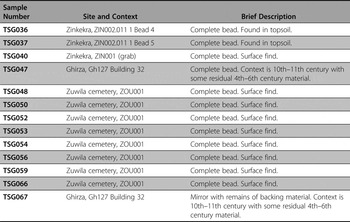
This section reports on the non-destructive, micro X-Ray Fluorescence (μXRF) analysis of 12 glass objects from Charles Daniels’ excavation and survey work in the Fazzan (three from Zinkekra and nine from Zuwila: see Mattingly Reference Mattingly, Mattingly, Daniels, Dore, Edwards and Hawthorne2007; Reference Mattingly, Mattingly, Daniels, Dore, Edwards and Hawthorne2010), and two from the excavations at Ghirza (Brogan and Smith Reference Brogan and Smith1984). As already mentioned, this is part of a larger programme of chemical analysis of glasses from in and around the Libyan Sahara, and the Wadi al-Ajal in particular, undertaken as a part of the Trans-Sahara Project. The majority of the glasses earmarked for chemical analysis under this programme were already fragmentary and could be sampled without major loss of information to the object. Where complete objects had been recovered, however, these were selected for non-destructive analysis using μXRF. Table 1 lists all the objects subjected to this non-destructive analysis. The specimens from Zinkekra and Zuwila were surface finds or recovered in topsoil, and thus lack a more precise archaeological context. Their dating is discussed further below.
Objects analysed by µXRF as part of the Trans-Sahara Project, henceforth referred to by their sample (TSG) numbers.

We can see glasses as providing information on two distinct production processes: the fusing of the glass from its raw materials, and the working of a fused glass into shape. Only chemical analysis provides the means to address the first stage; to determine the recipes and/or constituent materials used in the primary production of glass; to ascertain what technological choices were made; and in some cases to determine the period and geographical region in which the glasses were fused from their raw ingredients.
Analytical methodology
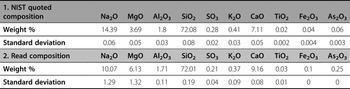
The experiments were conducted with a Horiba XGT-7000 micro X-ray fluorescence spectrometer, housed in the School of Archaeology and Ancient History, University of Leicester. The equipment features an energy-dispersive X-ray detector and a mono-capillary system, which minimises the effects of taking measurements from uneven surfaces. Measurements were taken under full vacuum. A soda-lime-silica glass standard (NIST SRM 620) of known composition was used in order to optimise the analytical technique. The set-up developed from this and used for the remaining results was as follows: beam diameter 100 μm, voltage 50 kV, current 1 mA, acquisition time 150 s and process time 4. The results returned for the standard under optimal conditions are presented in Table 2, by comparison with the quoted composition.
The quoted composition of the NIST glass standard SRM 620 (1), by comparison with the readings obtained under the final optimised set-up (2). The glass standard composition is based on the results of a cooperative analytical programme; the uncertainty represents the maximum variation estimated between different samples of the reference material. The results have been normalised to 100%.

It is immediately apparent on reading Table 2 that the results for the lighter (lower atomic number) elements, particularly Na and Mg (presented in the results as oxides, Na2O and MgO, as this is how they are coordinated in glasses), are both less accurate (i.e. correspond less closely to the quoted values) and less precise (i.e. more variable from one reading to the next). Because the XRF software automatically normalises results to 100%, this also has the effect of a relative increase in the quantities of heavier elements (a factor which can be exacerbated by matrix effects).
Despite this, the results are generally good for a semi-quantitative technique, though with the caveat that when analysing archaeological objects rather than a flat, polished glass standard, the uneven surface topography of the beads and mirror analysed will have further decreased detection of the lightest elements, most notably sodium (Na). Sodium is also commonly depleted at glass surfaces due to corrosion phenomena. This combination of factors probably accounts for the very low detection of soda (Na2O) in the objects analysed. It is also possible that they did not contain any soda, of course, but this is deemed unlikely for a number of reasons: historical context; detection of K2O; and the quantities of SiO2 and CaO detected, all of which are consistent with soda-lime-silica glasses. Finally, preliminary analyses of other material from Fazzan and Ghirza with electron microprobe analysis as part of the ongoing analytical programme reveal that all were made with alkali fluxes in which soda was predominant.
Glass mirror from Ghirza (TSG067)
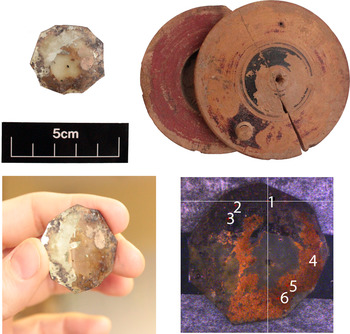
The first item to be discussed is a complete glass mirror recovered from Building 32 at Ghirza, shown in Figure 2. Also found in Building 32 were several fragmentary mirrors, from which a small piece has been taken for quantitative analysis using electron microprobe analysis (EPMA) and Laser Ablation Inductively Coupled Plasma Mass Spectrometry (LA-ICP-MS), and several items which were probably mirror boxes, an example of which is also illustrated in Figure 2. The original construction of Building 32 is dated to between the fourth and sixth centuries AD, but it was thereafter abandoned and not reoccupied until the tenth century; this second phase spanned the later tenth and early eleventh centuries on the evidence of pottery, glazed pottery, and coins (Brogan and Smith Reference Brogan and Smith1984, 81). It disturbed the first phase, so that in addition to the tenth and eleventh century remains it contains a relatively large amount of residual (fourth to sixth century) material. During this second phase there are also some indications – among them the large number of mirror boxes – that the building was used as a warehouse or shop.
Complete, slightly convex glass mirror (top and bottom left) and painted cedar wood mirror box (top right), both from Building 32 at Ghirza. The image on the bottom right was taken in the XRF chamber, and shows the locations of the six points analysed: three on the lead backing, and three on the rust-coloured accretion.

The analysis of the mirror thus had two principal objectives: to discover to which compositional category the glass belonged (and whether this best fitted with the fourth to sixth or, as suspected, the tenth to eleventh centuries) and to determine the composition of the backing material. Various metals have been used as backing materials for glass mirrors, in order to provide the necessary reflectivity. The process of applying the backing is known as ‘silvering’ due to a later practice involving the use of silver with mercury for amalgamation, but examples made with lead, tin and antimony are all known. Glass mirrors have been made since at least the first century AD (Pliny states that they were invented in Sidon, Natural History 36.66), and there is an early third-century mention of their backing with tin by Alexander of Aphrodisias (mentioned in Problem 1; see Forbes Reference Forbes1966, 188), though few archaeological examples are known from this time. Historical references to the use of lead as a backer can be found from as early as the thirteenth century in Johannes Peckham's treatise on optics, Johannis Pisani Perspectiva communis (mentioned in Beckmann Reference Beckmann and Henry1846).
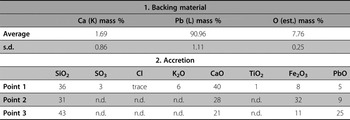
The mirror back was analysed in two areas (see Figure 2): the first was the area on which the backing material remained; the second was an area of accretions which have a rusted, orange appearance. The results for the accretion, shown in Table 3, were highly variable between points, reflecting its heterogeneity. There is at least some iron oxide present, which is to be expected given its rusty, orange appearance. Also present were lead (presumably from the backing material: see below) and sulphur. The SiO2 and CaO content associated with the accretion may be related to the glass beneath or to corrosion effects on the glass. The presence of iron could suggest that this mirror was originally housed in a metal, rather than a wooden box, but it may alternatively relate to the burial environment.
µXRF results for the backing material and accretion on the reverse of the mirror, TSG067. The results shown for the backing material are the average of three separate point analyses, with standard deviation. Because of the heterogeneity of the accretion these data are shown in full rather than as averages and standard deviations. All results have been normalised to 100%. s.d. = standard deviation. n.d. = none detected. Due to complications arising from the surface condition and curvature of the materials analysed, the normalised results for the accretion have been rounded up to the nearest whole number for anything present ≥0.5 wt. %, and to the first decimal place for anything present <0.5 wt. %.

The backing material for the mirror was found to be relatively pure lead, contaminated by calcium. Some oxidation may also have occurred at the surface, but as O is too light to be detected by XRF it is impossible to tell: the indication of its presence here is due to the automatic calculation of the results as oxides by the XRF software (which was optimised to deal with glasses).
Kock and Sode (Reference Kock and Sode2002) report on modern ethnographic parallels for the production of lead-backed glass mirrors, in a technological tradition still practiced in India. A large bubble of glass would be blown, perhaps 50–60 cm in diameter, and let to cool slightly before adding, on the inside, some molten lead (which has the advantage of a low melting point) and turning the bubble to coat the inside surface with the metal. The cooled and coated mirror glass would later be cut to shape by hand. It is worth noting that all features of the mirror analysed (lead backing, slightly convex shape, cut edges) are consistent with this practice. Few archaeological examples of glass mirror production sites are known, but a possible archaeological parallel for the Ghirza mirror comes from an urban glass workshop located in Murcia, Spain, and dated by archaeomagnetism to between AD 1100 and 1200. Here, the remains of several furnaces associated with glass production were uncovered, along with one furnace containing the remains of galena (PbS) and lead metal, and several mirror fragments backed by ‘relatively pure’ lead (Carmona et al. Reference Carmona, Angeles Villegas, Jiménez, Navarro and García-Heras2009, 439–42).
In order to determine the composition of the glass to which the lead backing was affixed, three points were analysed on the front of the mirror, from the area with no traces of backing material or corrosion in order to minimise contamination. The results are presented in Table 4.
Results of analysis of the front of the mirror, TSG067. The results given are the average of three point analyses, the degree of variation between these indicated by the standard deviation. All results have been normalised to 100%. s.d. = standard deviation. The normalised results have been rounded up to the nearest whole number for anything present ≥0.5 wt. %, and to the first decimal place for anything present <0.5 wt. %.

Two features of these results are surprising. The first is the very high MnO content. Manganese can be used as an oxidising agent and glass decolourant (to compensate for the effects of impurities such as iron and sulphur), but for that purpose quantities of anything from 0.5% to 2% should suffice (opinions differ on the maximum amount of MnO that could have been unintentionally introduced as a contaminant in the raw ingredients; here we follow Brill Reference Brill and Bass2009, 461, who places it at 0.2% for Islamic glasses). Higher manganese is often related to coloured glasses in shades of black or purple (for example, a purple glass with 8.54% MnO from Raqqa, Syria: Henderson et al. Reference Henderson, McLoughlin and McPhail2004, 443), but colourless or tinted glasses with up to c. 5% MnO are known (see Duckworth et al. Reference Duckworth, Córdoba de la Llave, Faber, Govantes Edwards and Henderson2014). It is important to note that the reported quantity of MnO may have been somewhat inflated by matrix effects in the glass and by the automatic normalisation of results, discussed above. It is hypothesised that the manganese was deliberately added in order to counter the strong colouring effects of the iron.
Another feature of these results is the lead content, which is surprisingly high for a colourless glass. This will be discussed below with reference to the other glasses analysed, as it seems to be a feature of them all and is potentially very interesting. In any case, the lead and potassium contents of this glass, along with the high magnesium, suggest a date in the Islamic, rather than the Roman period at Ghirza (this is the case even if we multiply the contents by c. 0.8 in order to account for a hypothesised <20% loss of light elements from the glass total). In combination with the stratigraphic evidence discussed above, we can thus surmise that the mirror belongs to the tenth or early eleventh century.
Bi-chrome glass bead from Ghirza (TSG047)
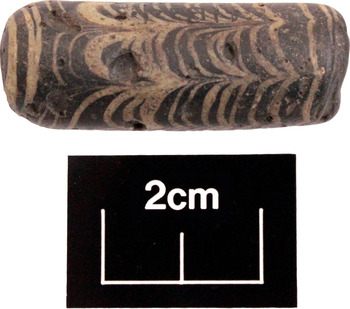
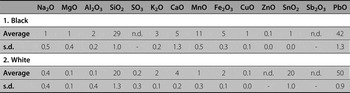
A bi-chrome black glass bead with applied white trails (shown in Figure 3), also belonging to Period 2 at Building 32 at Ghirza (discussed above), was selected for analysis. The results are summarised in Table 5.
Detail of bi-chrome black glass bead with applied white trails from Ghirza.

Results of spot analyses of bichrome glass bead TSG047, from Ghirza Building 32. Each result (black area and white area) is the average of three point analyses. All results have been normalised to 100%. s.d. = standard deviation. n.d. = none detected. The normalised results have been rounded up to the nearest whole number for anything present ≥0.5 wt. %, and to the first decimal place for anything present <0.5 wt. %.

It is apparent that the black glass was coloured by MnO and Fe2O3; whereas the white glass was coloured by SnO2. Both black and white glass were also found to be high in lead. Based on this, it is possible that the white glass was originally a lead-tin yellow, but this alone is not sufficient to explain the elevated PbO content of this glass. Taken at face value, the results suggest 42% and 50% PbO in the two colours of glass in the bead, by comparison with only 29% and 20% SiO2 respectively, providing PbO:SiO2 ratios of 1.45:1 and 2.5:1. These are broadly comparable with contemporary known lead-silica glasses (for example, from Brill Reference Brill1999: Serçe Limanı glasses 3576 and 3577 at 2.19:1 and 1.92:1). On the other hand, the detection of 2–3% K2O may indicate a lead-soda-silica system. A small proportion of Na2O and K2O is sometimes found in lead-silica glasses, but more usually they feature a rather simpler composition, with few if any traces of the alkali oxides. It is of course impossible to be certain on this matter without quantitative analysis, due to the difficulties of detecting lighter elements discussed above. Nonetheless, it is apparent that, as with the mirror from Ghirza, the glasses from which this bead was made contained relatively high amounts of lead which cannot be put down solely to colouring. Also in common with the mirror, they seem to have rather high Fe2O3 and MnO, the former at least being indicative of fairly impure raw ingredient sources. Al2O3 was also detected in both the black and white glasses from this bead, corroborating the idea of impure raw ingredients (particularly sand source).
Collection of glass beads from Zinkekra and Zuwila, Fazzan
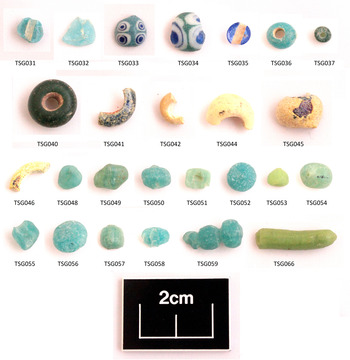
The final set of material to be discussed is that composed of glass beads from two sites in Fazzan: the escarpment settlement at Zinkekra, and the cemetery at Zuwila. None are from securely dated contexts: they were recovered from either surface collection survey or were found in topsoil. As can be seen in Figure 4, this collection of beads includes some fragmentary examples which are currently undergoing quantitative analysis.
Beads collected as surface finds or excavated at Zinkekra (TSG031-40); excavated at Jarma (TSG041-6) and collected as surface finds from the cemetery at Zuwila (TSG048-66); all part of the work of Charles Daniels in Fazzan. All fragmentary beads shown here have been sampled for quantitative analysis and were not analysed by µXRF.

The beads from Zuwila all feature somewhat heterogeneous, green fabrics, some with streaks in different shades of green (e.g. TSG049) and a number with a cloudy, semi-opaque appearance. This may be an indication that the beads resulted from low temperature re-melting or recycling (<c. 700°C), in which the various glasses included in the batch remained viscous enough to prevent full miscibility. In addition, all are malformed in some way: in some cases, the thread holes have closed during formation rendering the beads useless for stringing (e.g. TSG050, TSG052); in others, the beads are misshapen or asymmetrical (e.g. TSG054). TSG066 appears to be a drawn cane from which beads could be sliced, but the thread hole has fully closed at one end, and has a ‘squashed’ appearance (also seen in TSG053, which is very similar in colour) at the other.
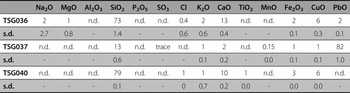
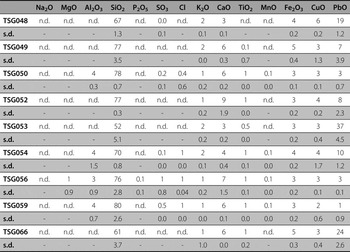
The analytical results are reported in Tables 6–7. The beads from Zinkekra will be discussed first. Bead TSG040, a wound bead coloured sea green by a combination of copper (probably deliberately added) and iron (more likely to be an impurity), was the only glass analysed which was not found to contain any PbO. Bead TSG036 was found to contain a small amount of PbO and relatively high CuO, which along with Fe2O3 is probably responsible for its blue-green colour. TSG037 has a most interesting composition, probably falling into the lead-silica system, with a reported 82% PbO and 13% SiO2. All three are wound beads, but they have little else in common with one another, and their chemistry suggests that they may vary greatly in date.
Results of analyses of the glass beads from Zinkekra. Each set of results was obtained by averaging two point analyses. All results have been normalised to 100%. s.d. = standard deviation. n.d. = none detected. The normalised results have been rounded up to the nearest whole number for anything present ≥0.5 wt. %, and to the first decimal place for anything present <0.5 wt. %.

Results of analyses of the glass beads from Zuwila. Each set of results was obtained by averaging two point analyses. All results have been normalised to 100%. s.d. = standard deviation. n.d. = none detected. The normalised results have been rounded up to the nearest whole number for anything present ≥0.5 wt. %, and to the first decimal place for anything present <0.5 wt. %.

In contrast, the beads from Zuwila could be argued to form some sort of a set. Although they are far from compositionally consistent, all contained relatively high Fe2O3 (≥3%) and CuO (≥2%). Copper was commonly employed as a colorant, but the iron content implies a somewhat ‘dirty’ composition, in keeping with the heterogeneous appearance of the glasses. The most variable compositional feature of these glasses is the lead content, which ranges from 1% to 37%. Although we must of course take into account the fact that the results are semi-quantitative only, it is possible to say two important things about these glasses: that they contained significant lead, iron and copper; and that the amount of lead in particular varied greatly from one glass to the next. Preliminary electron microprobe analysis of some fragmentary beads from Jarma (including TSG044, TSG045 and TSG051 shown in Figure 4) also indicates variable levels of PbO, from 0.12 to 32.5 wt.%.
As the beads from Zuwila were non-diagnostic and were recovered from surface collection of a Garamantian cemetery adjacent to a major Garamantian and Islamic settlement, it is difficult to say to which period(s) they belong, though the majority of high lead glasses where the lead is not associated with strongly coloured or opaque glasses do not pre-date the late first millennium AD (see below). In any case, it is interesting to consider where the beads were made: were they imported in bulk, and these unusable examples discarded on receipt, or do they represent the unusable products of a local technology?
Discussion of the lead content of the glasses analysed
The reader should be aware that before the Early Modern period we know of three main types of high lead glasses outside of China and East Asia, all broadly contemporary and occurring in the very late first millennium and the first few centuries of the second millennium AD. These are: lead-silica (also known as Islamic high lead); lead-soda-silica; and lead-potash-silica (also known as Central European lead glass). Lead-silica glasses, usually with over 60–70% PbO by weight form an established, albeit rather rare category of glass in the Islamic and medieval European worlds. Although lead has been employed in relatively low levels as a colourant/opacifier from the earliest production of glass, lead-soda-silica glasses, with PbO contents ranging anywhere between c. 20% and 60% (and intermediate lead glasses with c. 5–20% PbO), are rarely encountered, and to the best of the authors’ knowledge, only recent analytical work on material from the Iberian Peninsula and parts of North Africa has started to throw up evidence of these glasses appearing in anything but sporadic and isolated instances (see the discussion in Duckworth et al. Reference Duckworth, Córdoba de la Llave, Faber, Govantes Edwards and Henderson2014). Lead-potash-silica glasses are encountered in Medieval Europe and are thought to be the result of adding lead to raw or recycled potash glasses made with tree ash (Mecking Reference Mecking2013).
Assuming that the beads from Zuwila are related to one another (on the basis of their shared heterogeneity, colour range and find location), two explanations for the lead content of the glasses are set forth:
-
1. The variable lead content of the different glasses is the result of recycling. For example, if lead-silica and soda-lime-silica glasses were mixed together in various proportions in an uncontrolled manner we might expect a range of compositions similar to those encountered.
-
2. The lead was being deliberately added to the glasses as a separate ingredient, either during their formation from raw materials, or during the recycling of soda-lime-silica glasses.
Recycling seems a plausible explanation. The heterogeneous appearance of some of the beads, with streaks of different coloured glasses running parallel to the direction of working (as can be most clearly seen macroscopically in TSG049), is taken as an indication of the mixing of two glasses, though it can also reflect the addition of colourants/opacifiers at low temperature. The malformation of the glasses from Zuwila may also be explained by the recycling hypothesis: lead alters the viscosity of glasses, lowering the temperature at which they can be melted and worked. This may be an advantage where the glassworker is aware of the amount of lead present and the consequent working properties of the glasses, but could be disastrous if glasses of unknown composition were mixed together. If the lead was entering the glasses through recycling of poorly sorted glasses, perhaps from a range of sources, the amount present in a given glass would presumably vary, resulting in lack of predictability and the malformation of the sorts seen in the Zuwila glasses.
On the other hand, when proposing recycling we must always consider end members. The question which arises is, if people were producing high lead glasses from a poorly mixed combination of (a) lead-silica and (b) soda-lime-silica glasses, why are lead-silica glasses so poorly represented in the current corpus of known glass compositions? The explanation for the observed composition may relate as much to research and sampling bias as to any real pattern in the archaeological data, and only further analysis can begin to address it. As well as a geographical research bias, it could be argued that our understanding is prejudiced by the analytical bias toward vessel glass; as noted by Krueger (Reference Krueger2006, 225) lead-silicate glasses, at least in Europe, were more likely to be used in the production of artificial gems, enamel, beads, finger rings, bracelets and mosaic tesserae than for vessel glass.
We might also point to the possible recycling of lead-backed mirrors such as the one from Ghirza as one source of lead in glass: as noted by Kock and Sode (Reference Kock and Sode2002, 89), in the traditional glass mirror production of Kapadvanj, North India, the lead-coated globe is broken into rough chunks and any that are either too thick or insufficiently coated are returned to the furnace to be used in the next mirror. This process may thus account for the lead content of the mirror, but it is unlikely that it could account for the high overall proportion of glasses containing >3% PbO unless mirrors only were being recycled.
The second explanation suggested above, that lead could have been deliberately added to soda-lime-silica glasses as a separate ingredient, has been put forth here as a result of previous research on tenth- and eleventh-century glasses from Córdoba, Spain (Duckworth et al. Reference Duckworth, Córdoba de la Llave, Faber, Govantes Edwards and Henderson2014), and practices noted for glasses of entirely different ‘base’ compositions in thirteenth-century northern Europe (Mecking Reference Mecking2013). The reasons for adding lead might have included ‘bulking out’ the volume of glass, increasing its brilliance and reflectivity, and as discussed above, lowering its melting and working temperatures.
It should be noted that the two explanations – addition of lead and recycling of lead glasses – are not necessarily mutually exclusive. Lead may have been added to pre-formed glasses in one location, and these later recycled along with other glasses in another. Whatever the case, it is clear that there is much to be learnt from the analysis of technological practice outside what are perceived to be the ‘core’ glass production centres. In particular, North Africa and the Iberian Peninsula need to be better represented in studies of glass composition.
Metal analysis (AC)
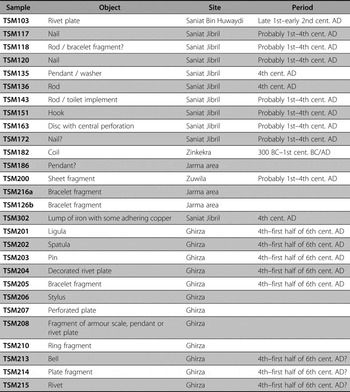
Sixteen of the 28 metal objects analysed were recovered in Fazzan during the excavations led by Charles Daniels in the 1960s and for the most part have been briefly described by Tagart and Mattingly (Reference Tagart and Mattingly2010). The majority come from Saniat Jibril, a satellite settlement just east of the Garamantian capital Jarma (Table 8). This site presented an unusual concentration of slag and small copper alloy fragments as well as remains of hearths. This evidence has led to its identification as a production centre involving metal-working (Schrüfer-Kolb Reference Schrüfer-Kolb2007, 448–52). By analysing the metal from this site, it is hoped that we will gain a better understanding of the type of production that took place there and the source of the metal used in this industry. While some of the copper-base objects from Saniat Jibril are stratified, others are surface finds and are presented here with a tentative date of first to fourth century AD, as this is the known span of occupation of the site. The other objects from Fazzan, of which some are stratified and others not, come from the cemeteries of Saniat Bin Huwaydi and Zuwila, the capital Jarma and the escarpment settlement of Zinkekra.
Copper-base objects analysed by µXRF as part of the Trans-Sahara Project, henceforth referred to by their sample (TSM) numbers.

The other 12 objects reported on here come from the site of Ghirza (Brogan and Smith Reference Brogan and Smith1984). The context of their recovery is in some cases unclear and therefore their dating proved difficult. Five of the objects however are relatively securely attributed to Period 1 of the occupation of Building 32, which spans from the fourth to the first half of the sixth centuries AD.
Analytical methodology
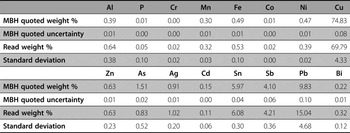
The analyses of the copper-base samples were conducted on the same equipment as the one described above for the glass. However, the conditions used differed slightly: we chose a beam diameter of 10 μm, a voltage of 50 kV, a current of 1 mA, an acquisition time of 100s and process time of 6. Three standards from MBH Analytical Ltd (one bronze, one brass and one leaded copper) were analysed under these conditions. The results are given in Tables 9–11 and compared with the given compositions. They show the average of multiple runs and have been automatically normalised to 100% by the analytical software.
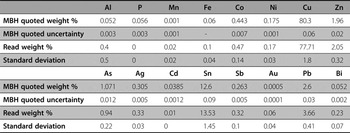
Quoted (certified) and read composition of the MBH Analytical Ltd bronze standard 32X SN7. The read value is the average of 3 runs, normalised to 100%.

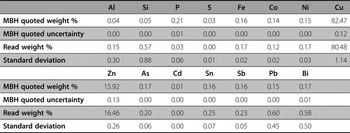
Quoted (certified) and read composition of the MBH Analytical Ltd brass standard 31X B22. The read value is the average of 4 runs, normalised to 100%.

Quoted (certified) and read composition of the MBH Analytical Ltd leaded copper standard 32X LB17. The read value is the average of 4 runs, normalised to 100%.

As can be seen in these tables, the results obtained for elements present at levels under 0.1 weight % in the sample are far from accurate (with relative errors typically greater than 100% and results sometimes up to an order of magnitude too high). For elements present in quantities above 0.1%, however, the accuracy is in a much more acceptable range with relative errors typically under 15% for most elements. The element that is most problematic here is lead, for which the weight percentage is systematically overestimated, and quite imprecise (high standard deviations). This lack of precision is not surprising given that, in a cast leaded copper, the lead solidifies as globules of almost pure lead. This heterogeneity means that the analysis of separate spots on the samples is likely to yield different results.
While these considerations, and especially the over-estimation of lead, have to be kept in mind when interpreting the results, this method appears to be satisfactory to determine the type of alloys represented and to start to give an idea of the minor elements that might be present in the metal, although these will have to be checked by using a more quantitative technique, with better detection limits and better accuracy for elements present in low quantities.
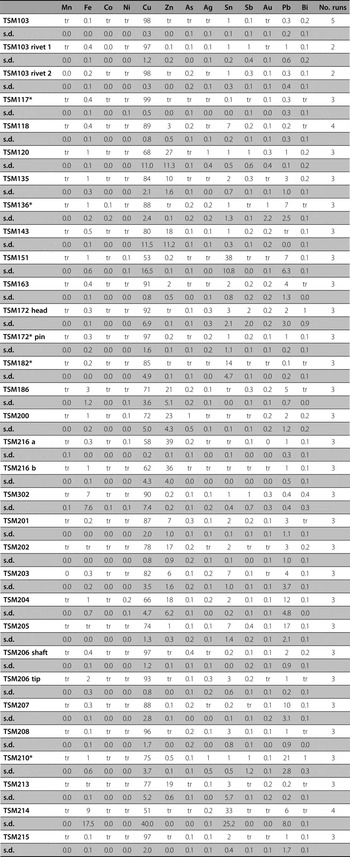
The objects chosen for μXRF analysis were for the most part complete objects that could not be sampled. Most were covered in a corrosion layer and small inconspicuous areas had to be cleaned with a scalpel in order to analyse the metal itself rather than the corrosion. Except for a few cases (marked by an asterisk in the first column of Table 12) the results given represent the analysis of the surface of the object, which are not necessarily representative of the bulk of the object. This can be due to the segregation of certain elements during the casting of the objects, to the preferential corrosion of some elements over others near the surface of the object or to deep-rooted intergranular corrosion products that cannot be removed by cleaning the surface. These considerations add to the necessity of interpreting these results as semi-quantitative only. A recent study comparing the results of pXRF analysis of the surface of a set of copper-base objects with the EPMA analysis of their core has indeed shown that a careful assessment of the surface conditions of objects is as important as the assessment of the limitations of the instrumentation in determining the quality of the analytical data, as a number of mechanisms are responsible for changes in composition that will be picked up by surface analysis, even on a surface cleaned to sound metal (Orfanou and Rehren Reference Orfanou and Rehren2014).
Analytical results of µXRF analysis of copper alloy samples from Fazzan and Ghirza. Each set was obtained by averaging the results of several runs (number given in the last column). The results were normalised to 100%. Items marked with * in column 1 indicate objects for which the analysis was performed on a fracture surface rather than on the outside surface of the object, thus representing the metal at the core rather than on the surface of the object. Given the limitations due to the instrumentation and to the surface conditions of the objects, values <0.1 wt. % are given as traces (tr), anything present ≥0.1 and <0.5 wt. % has been rounded up to the first decimal place, and anything present ≥0.5 wt. % to the nearest whole number. s.d. = standard deviation.

Main alloying elements: tin, lead and zinc
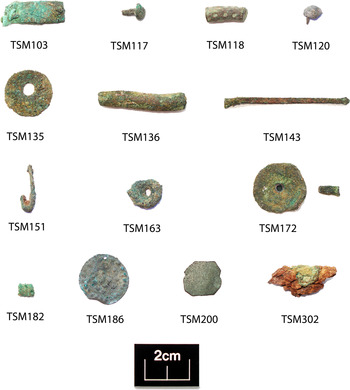
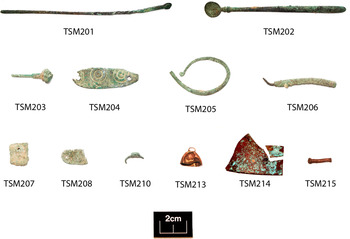
The analyses of metalwork recovered in Fazzan (see Figures 5 and 7) and at Ghirza (Figure 6) reveal that a great variety of alloy types were used in both areas: unalloyed copper, tin-bronzes, leaded copper and brass were all found within the small set of objects studied here.
Objects from Fazzan analysed by µXRF.

Objects from Ghirza analysed by µXRF.

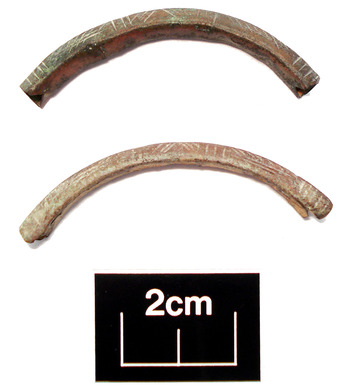
Bracelet fragments from the Jarma area.

For the sites in Fazzan this variety can be illustrated by the following numbers: four out of the 16 analysed objects have more than 2% tin, four have more than 2% lead and eight have more than 2% zinc, while four have less than 2% of all three alloying elements. These numbers add up to more than 16 as some of the objects present more than one alloying element at once, as discussed below. This diversity is perhaps not surprising given the variety of different object types and of contexts in which these were recovered, but echoes one of the characteristics of the Garamantian civilisation which is a great diversity in various aspects of their culture and identity (Mattingly Reference Mattingly, Mattingly, Daniels, Dore, Edwards and Hawthorne2010, 523–30).
So far we have found no obvious correlation between the type of object analysed and the alloying elements, nor between the fabrication technique (cast or sheet metal) and type of alloys used. This aspect will however be investigated further when more data becomes available, as it could help understand potential technological choices made by the Garamantes or whoever made these objects.
Twelve objects from Ghirza were also analysed for comparative purposes. Here again, we found a variety of alloys: five had more than 2% tin, eight had more than 2% lead and five had more than 2% zinc. Ternary alloys are also very common. This picture is not dissimilar to that of Fazzan, though perhaps with lead being slightly more ubiquitous, which could be a reflection of the slightly later date of Ghirza.
The earliest object, a small coil from Zinkekra dated from the third century BC to the first century AD (TSM182), has a composition that stands out as markedly different from the rest of the metal analysed so far. It is made of a relatively high tin bronze (14% Sn) with no other alloying or minor elements aside from a very small percentage of iron. This tin percentage is at the high end of the range for known Iron Age and Roman metalwork elsewhere (see for example Dungworth Reference Dungworth1997; Ponting and Segal Reference Ponting and Segal1998; Ponting Reference Ponting2002), however, given the high standard deviation on this particular measurement, it is possible that it would fall closer to the maximum of the known distribution of tin contents. This relatively high tin percentage and the lack of any traces of other alloying elements are likely to indicate that this object comes from a primary alloying event, rather than from the recycling or mixing of alloys, which appears to have been common in metal from the later periods. Of course this single object is not enough to derive a chronological pattern for the practice of mixing, but this will be an aspect that will be further investigated when more objects are analysed.
Early evidence for the circulation of brass in the Sahara
Given the small number of objects analysed and the fact that many are surface finds dated to the first to fourth century AD, it is difficult to assess with any precision when brass first appears in Fazzan. It is nevertheless clear that it was an important part of the metal in circulation by the fourth century at the latest. Although isolated finds with elevated zinc contents occur from third to first millennium BC contexts in the Near East (Thornton Reference Thornton, La Niece, Hook and Craddock2007) and the Mediterranean (Craddock Reference Craddock1978), brass only started to be produced in significant quantities in the first century BC by the Romans (Craddock Reference Craddock1978). The circulation of brass through the Sahara, with the metal probably originating in North Africa, is known to have been a relatively common occurrence from the second half of the first millennium AD, as attested by the finding of brass objects at various West African sites (Bourhis and Briard Reference Bourhis and Briard1979; McIntosh Reference McIntosh1995; Fenn et al. Reference Fenn, Killick, Chesley, Magnavita, Ruiz, Magnavita, Koté, Breunig and Idé2009). In the early second millennium AD, it is clear that brass was extensively traded through the Sahara, as shown by the presence of more than 2000 brass ingots abandoned by a caravan between the eleventh and thirteenth centuries AD at the Ma'den Ijafên (Monod Reference Monod1969). Little is known however about brass trade in earlier periods. The find of a brass bracelet in a grave in which a sample of organic material was dated by radiocarbon to between the first century BC and the fifth century AD at Kissi in Burkina Faso is remarkable, but could be the result of gift exchange rather than organised trade (Fenn et al. Reference Fenn, Killick, Chesley, Magnavita, Ruiz, Magnavita, Koté, Breunig and Idé2009). In this context, the presence of brass in seemingly significant quantities in Fazzan in first to fourth century AD contexts is very interesting as it potentially pushes back the Saharan brass trade to the first half of the first millennium in the northern Sahara at least. It is unclear at present whether this represents an organised trade in brass objects, scrap metal or possibly ingots, or whether it is the result of a more incidental exchange of material. If the former is true however, then the importation of what was presumably Roman brass into Fazzan would add to the great quantity of Roman goods already known to have been imported from Tripolitania in the Classic Garamantian period, such as a striking quantity of ceramic vessels and amphorae (Mattingly Reference Mattingly, Mattingly, Daniels, Dore, Edwards and Hawthorne2010, 310–38; Reference Mattingly, Mattingly, Daniels, Dore, Edwards, Leone and Thomas2013, 325–48).
It is worth noting here the brass content of the two bracelet fragments TSM216a and TSM216b (Figure 7). These fragments are triangular in section and made of a strip of bent sheet metal incised on the outside with a decorative geometric pattern. Their exact provenance is unclear: it seems from Charles Daniels’ archives that they were found somewhere in the vicinity of Jarma, perhaps in Jarma itself or in Saniat Jibril. Their level of corrosion was much lower than that of the other items. The XRF analysis revealed that they contained respectively approximately 39% and 36% zinc. This content would seem to indicate a date later than the nineteenth century AD. Indeed, until the sixteenth century brass was made by the cementation process in which finely divided metallic copper was heated with charcoal and zinc oxide in a closed crucible at about 1000°C. Using this method, the maximum amount of zinc obtainable in the resulting brass is 28%, regardless of the amount of zinc oxide added to the crucible (see, for example, Craddock Reference Craddock1985). Changes in brass making from the sixteenth century onwards and notably the use of metallic zinc rather than zinc oxide resulted in an increase in that maximum and Craddock estimated that brasses with more than 33% zinc are unlikely to be earlier than the nineteenth century (Craddock Reference Craddock1985, 19).
Discussion on the recycling and mixing of copper alloys
During field work in Fazzan, the site of Saniat Jibril revealed a high concentration of small fragments of copper-base metal, as well as a number of hearths in which copper is thought to have been worked in close spatial association with iron. This evidence has been interpreted as a possible indication that scrap metal was collected, recycled and reworked at the site (Schrüfer-Kolb Reference Schrüfer-Kolb2007). Moreover, copper ingot moulds were found at Jarma (Mattingly Reference Mattingly, Mattingly, Daniels, Dore, Edwards, Leone and Thomas2013, 462; 811–13). Given the lack of copper ores in the vicinity of Fazzan this may indicate the production of ingots from the re-melting of scrap, for use in Fazzan or for redistribution on the Trans-Saharan trade routes.
The study of the main alloy types can also add to the discussion on metal recycling. Indeed, amongst the variety of alloys found in this assemblage, there are a number of ternary alloys: objects that present not just one of the alloying elements that are tin, lead, or zinc, but two at the same time. While this can be the result of the deliberate addition of more than one alloying element (for example the addition of lead to brass to make it better suited to casting), or reflect the use of impure ores (zinc ores with some amount of lead were for example common – Craddock Reference Craddock1985), it is likely, in some cases at least, to relate to the mixing of different alloys. The object TSM118 for example, which is a decorated fragment of rod or bracelet from Saniat Jibril, has about 7% tin and 3% zinc. These levels seem too high to represent an accidental occurrence due to the use of impure ores but they appear too low to represent a deliberate alloying event. A more likely explanation for the composition of this metal would be the mixing of bronze to brass in a recycling event. Indeed if a bronze with no zinc is mixed with a brass with no tin, not only will the tin and zinc contents be diluted by the addition of the other metal, but zinc in particular will be lost through volatilisation. The practice of mixing of bronze and brass has been shown by Craddock (Reference Craddock1978) and more recently by Pollard et al. (Reference Pollard, Bray, Gosden, Wilson and Hamerow2015) to have been commonly practised in the Roman world. It is therefore difficult to tell whether the Fazzan objects presenting a mixed alloy signature were imported as such or whether the mixing was carried out in Fazzan. It can however probably be asserted that brasses showing a high zinc content (such as the nail TSM120 from Saniat Jibril with approximately 27% zinc) were not modified after they were first smelted and were used in Fazzan directly in the form they were imported in.
A note on the minor elements present in the metal
As explained above, one should refrain from over-interpreting the data produced for this study given its semi-quantitative nature. However, it is possible to observe that iron seems to be the minor element present in highest quantities in this group of objects. Iron is commonly present in Roman metal (see for example Dungworth Reference Dungworth1997). It enters the copper at the smelting stage and can come from the ore or the flux, but can also be added to brass produced by the cementation process when iron-containing zinc oxide ores are used. Iron is therefore not a good indication of copper provenance, but can give some indication of the smelting process in use. This area will be explored in more detail when quantitative data is available.
Arsenic, antimony, silver and nickel are better suited to study the provenance of the copper and provide a good basis for comparison with published compositional data from other sites, as they have historically been reported on quite systematically. In both the Fazzan and the Ghirza samples, arsenic, antimony and silver are sometimes present but do not normally exceed a few tenths of a percent. Nickel on the other hand seems to generally be absent (or present under <0.1%). These trends will be checked and put into context in the next stages of this project. It is hoped that compositional analysis, along with Lead Isotopes Analysis will help define the provenance of the copper used in Fazzan, as well as shedding light on how copper was traded throughout the Sahara.
Conclusion (DJM, AC, CND)
Any conclusions drawn from this round of analysis must of course be tentative. μXRF is primarily an exploratory technique and cannot provide the quantitative information required for cross-comparison between data sets from different laboratories and analytical techniques. This means that the contextualisation of the results in particular is difficult.
On the other hand, it has provided some crucial first steps to a deeper understanding of aspects of trade and technology as revealed by key archaeological sites in the Libyan Desert and pre-desert. For metals, the study of alloy type has revealed two important points. Firstly, the presence of what seems to be a significant number of objects containing zinc in Fazzan indicates that brass circulated in the northern Sahara in the first half of the first millennium AD, and could be the precursor to trade farther south in the later part of the millennium. Secondly, the presence in the assemblage of ternary alloys, probably made by mixing different types of scrap metal, indicates the use of recycled metal, which – given the evidence at Saniat Jibril – may have been in part carried out in Fazzan.
For glasses, μXRF has enabled the identification of: the basic glass compositions (most seem to be soda-lime-silica with varying proportions of lead); the metal oxides used to colour or decolour them; the level of impurities such as iron; and the metal backing of the mirror, which was also found to be lead. The high lead content of several of the beads might suggest a date for these in the Islamic period, though the lower percentages of lead (<c. 15%) could result from recycling of lead-opacified Roman glasses, and there are also scattered examples of the addition of lead to Roman glasses for purposes other than coloration (see for example Mommsen et al. Reference Mommsen, Bruning, Dittman, Hein, Rosenberg and Sarrazin1997). In any case, it is suggested that a research bias towards the East Mediterranean and Europe (and arguably also towards glass vessels) has coloured our view of the development of glass production technology. Local working and compositional ‘tinkering’ such as recycling or the addition of lead to glass batches are just as interesting as large-scale industrial production such as that witnessed on the Syro-Palestinian coast and in Egypt, not least for their closer relationship to the work of the individual and our understanding of technological transmission. Furthermore, such compositional markers, coupled with a more nuanced detection and discussion of evidence for recycling, have great potential in tracing the long distance movement of both glass and glass technological practice.
In summary, the analytical work outlined above has provided a great deal of ‘food for thought’ and avenues for further analysis. It will now be crucial to build up larger databanks of material recovered from Libya and other parts of Saharan and Sub-Saharan Africa, in order to contextualise the few results available to date for those areas outside of direct Mediterranean influence. At least some of this contribution will come from the Trans-Sahara Project. Key directions for our ongoing research include the use of quantitative techniques to establish the trace and minor elements in metals and glasses, and potentially of isotope work, for example lead isotope analysis in order to better approach the questions of provenance and recycling.
Acknowledgements
The Trans-Sahara Project is funded by a European Research Council Advanced Grant (reference 269418) for David Mattingly. The support and advice of the ERC scientific officer, Domenico Usai, is gratefully acknowledged. Thanks are also due to Ian Whitbread for facilitating access to and use of the XRF machine.