Introduction
Brain-derived neurotrophic factor (BDNF) is involved in brain morphological plasticity.Reference Ninan 1 – Reference McAllister, Katz and Lo 4 In depression, meta-analytic results have shown low serumReference Bocchio-Chiavetto, Bagnardi and Zanardini 5 – Reference Molendijk, Spinhoven, Polak, Bus, Penninx and Elzinga 8 and plasma concentrationsReference Bocchio-Chiavetto, Bagnardi and Zanardini 5 of BDNF in drug-naive patients compared to healthy controls, and increased BDNF concentrations after treatment with antidepressants.Reference Bocchio-Chiavetto, Bagnardi and Zanardini 5 – Reference Molendijk, Spinhoven, Polak, Bus, Penninx and Elzinga 8 Other meta-analyses found reduced peripheral blood levels of BDNF in bipolar disorderReference Fernandes, Molendijk and Kohler 9 and in drug-naive and medicated individuals with schizophrenia,Reference Green, Matheson, Shepherd, Weickert and Carr 10 suggesting that BDNF may be a useful marker of psychiatric disorders in adult populations.
Studies in children and adolescents have shown conflicting results. Although some studies showed alterations in BDNF concentrations in children with obsessive–compulsive disorder (OCD),Reference Simsek, Gencoglan, Yuksel, Kaplan and Alaca 11 attention deficit-hyperactivity disorder (ADHD),Reference Shim, Hwangbo and Kwon 12 and depression,Reference Pallavi, Sagar and Mehta 13 other studies did not show differences in BDNF concentrations between patients and controls with OCD,Reference Colak Sivri, Bilgic and Kilinc 14 bipolar disorder,Reference Cevher Binici, Inal Emiroglu, Resmi and Ellidokuz 15 or ADHD.Reference Bilgic, Toker, Isik and Kilinc 16 In a younger population, concentrations of serum BDNF were found to be higher among those at ultra-high risk for psychosis compared to a healthy control group.Reference Yee, Lee and Lee 17 Further studies of serum BDNF as a marker of psychopathology in children and adolescents are needed.
A growing literature reports structural brain changes related to serum BDNF concentrations, and psychiatric illnesses,Reference Inal-Emiroglu, Resmi and Karabay 18 – Reference Rizos, Papathanasiou and Michalopoulou 21 with conflicting results. In individuals with schizophrenia, higher peripheral blood concentrations of BDNF have been correlated with thinner prefrontal cortical thicknessReference Zugman, Pedrini and Gadelha 20 and increased hippocampal volume.Reference Rizos, Papathanasiou and Michalopoulou 21 However, other studies of individuals with bipolar disorder showed no correlation between BDNF concentrations and hippocampal volumes in children,Reference Lauxen Peruzzolo, Anes and Kohmann Ade 22 and no association between BDNF and gray matter volumes in adults.Reference Poletti, Aggio and Hoogenboezem 23 In 1 study, peripheral BDNF concentrations and brain volumes (including cortical areas) were correlated negatively in bipolar offspring but positively in healthy controlsReference Mansur, Brietzke and McIntyre 19 ; suggesting the need for larger studies investigating interactive effects between psychopathology and serum BDNF in predicting brain volumes.
A likely interactive effect on brain development has been supported in genetic studies. We identified thicker parietal and occipital lobes and prefrontal cortices in typically developing (TD) Met carriers compared to Val homozygotes, but also an interaction between the Val66Met genotype and a psychiatric diagnosis (PD), such that Met carriers with a PD showed thicker medial and lateral temporal cortices, and thinner bilateral prefrontal cortices.Reference de Araujo, Zugman and Swardfager 24 Studies have also found effects of genotype on cortical and subcortical volumes in TD childrenReference de Araujo, Zugman and Swardfager 24 – Reference Jasinska, Molfese and Kornilov 26 and in children at risk for depressionReference Wheeler, Felsky and Viviano 27 and other psychiatric disorders.Reference de Araujo, Zugman and Swardfager 24 However, reports of relationships between BDNF genotype and serum concentrations have been conflicting. Although a meta-analysis found no significant association between serum BDNF concentrations and the BDNF Val66Met polymorphism,Reference Terracciano, Piras and Lobina 28 higher concentrations of serum BDNF in Met allele carriers were associated with male sex,Reference Bus, Arias-Vasquez, Franke, Prickaerts, de Graaf and Voshaar 29 depression,Reference Caldieraro, McKee and Leistner-Segal 30 and anxiety,Reference Moreira, Fabiao and Bittencourt 31 and some studies showed lower serum BDNF concentrations related to the Met allele.Reference Lotrich, Albusaysi and Ferrell 32 , Reference Ozan, Okur, Eker, Eker, Gonul and Akarsu 33 These findings suggest the need to determine if serum BDNF concentrations are related to a PD and to brain structure in childhood and early adolescence, and to examine sex-specific associations.
The main objectives of this study were to determine, in 2 large samples, if there are replicable differences between BDNF serum concentrations between TD children and adolescents and those with a PD, and to identify relationships between serum BDNF concentrations and neuroanatomical markers (cortical thickness, and volumes of the hippocampus and amygdala). Given effects of the BDNF genotype on these outcomes observed previously, BDNF serum concentrations were also examined in relation to the BDNF genotype. Based on an interaction between sex and genotype on BDNF concentrations in 548 older subjects (age range 50-72 years old, mean age 62.8 ± 5.4 years, 267 males),Reference Bus, Arias-Vasquez, Franke, Prickaerts, de Graaf and Voshaar 29 gender interactions were also considered.
Methods
Participants
All data were acquired with the approval of the Ethical Committee of the School of Medicine, University of São Paulo. Written consent was obtained from all parents or their legal guardians, and all children provided verbal assent. The Ethical Committee of the Federal University of São Paulo approved the study.
Participants were drawn from the Brazilian school-based high-risk cohort (HRC) study for the Development of Childhood Psychiatric Disorders. For a detailed description of HRC sampling, see Salum et al.Reference Salum, Gadelha and Pan 34 Fifty-seven schools from 2 Brazilian cities, São Paulo and Porto Alegre, participated. In Brazil, parents are required to register their children in a local school. On school registry day, we invited biological parents of 6- to 12-year-old children at these schools to participate in the study. Biological parents (87.3% mothers) answered the family history screeningReference Weissman, Wickramaratne, Adams, Wolk, Verdeli and Olfson 35 for 8012 families, representing 9937 children. From this pool, the HRC was created by combining 2 strata (n = 2511). The first stratum included a sample of randomly selected subjects, the “random group” (n = 958). The second stratum, the “high-risk group” (n = 1553), included youth at risk for psychopathology, selected using a validated prioritization algorithm.Reference Salum, Gadelha and Pan 34 Only 1 child per family was included. The baseline evaluation included a household lay interview with a biological parent (94.5% mothers), including extensive risk factor and psychopathology evaluations.
Clinical assessment
We used a structured psychiatric interview, the Brazilian Portuguese versionReference Fleitlich-Bilyk and Goodman 36 of the Development and Well-Being Assessment (DAWBA,Reference Goodman, Ford, Richards, Gatward and Meltzer 37 see http://www.dawba.info), to ascertain psychiatric diagnoses according to DSM-IV criteria. The wide range of psychiatric diagnoses observed by the DAWBA questionnaire was categorized by a variable named “any disorder” indicating the presence or absence of any psychiatric illness. We used a categorical approach to psychiatric disorders to facilitate comparisons to previous studies, given that the majority used case–control designs. The multivariate analyses were conducted with this variable as a covariate.
The estimated intelligence quotient (IQ) was evaluated using 2 tests from the Wechsler Intelligence Scale for Children,Reference Wechsler 38 the vocabulary and block subtests, and computed scores using the Tellegen and BriggsReference Tellegen and Briggs 39 method, according to the correspondent Brazilian norms.Reference Figueiredo 40
Magnetic resonance imaging acquisition, biological samples, and BDNF genotyping
The HRC study involved magnetic resonance imaging (MRI) scans performed in a subsample of the subject population. Subjects who completed household and school evaluations were eligible for participation, following the same procedure employed during the screening phase. From the pool of 2511 subjects, a subsample of 750 children and adolescents underwent MRI; 540 (267 in Porto Alegre and 273 in São Paulo) of these also agreed to have their blood collected. This phase occurred approximately 6 to 8 months after the clinical household interview.
We used 1.5 T MRI systems (GE Signa HDX and GE Signa HD, G.E., USA) at 2 sites, with the same protocols and the following T1-weighted image parameters: TR = 10.916 ms, TE = 4.2 ms, thickness = 1.2 mm, flip angle = 15°, NEX = 1, matrix size = 256 × 192, FOV = 245 mm, bandwidth = 122.109, yielding 156 axial slices.
Blood samples were obtained after MRI acquisition. After blood processing, serum was stored at −80 °C, and BDNF levels were quantified by sandwich ELISA following the manufacturer’s instructions (cat. no. CYT306; Millipore, Billerica, MA). Briefly, after blood was withdrawn, the samples were centrifuged at 2000g for 10 minutes and the serum was frozen (−80 °C) until placed on microtiter plates and diluted 1:75 in sample diluents. The standard curve ranged from 7.8 to 500 ng/ml BDNF. After that, the plates were washed 4 times with wash buffer and incubated for 3 hours at room temperature (after adding the biotinylated mouse antihuman BNDF monoclonal antibody diluted 1:1000 with sample diluents). A fifth washing took place and then a second incubation with streptavidin-horseradish conjugated solution of peroxidase (diluted 1:1000) for 1 hour at room temperature was performed. Finally, BDNF concentrations were determined with absorbance set at 450 nm, and the standard curve resulted in a graph that showed a direct relationship between BDNF concentrations and the corresponding ODs (absorbances).
The genotyping procedure was conducted in blood or saliva (for children that refused to have their blood collected) using the SNParray Infinium HumanCore Array BeadChip (Illumina, San Diego, CA) at the Center for Applied Genomics at the Children’s Hospital of Philadelphia (USA) according to the manufacturer’s instructions. The Val66Met genotypes were extracted using a PLINK 1.9 script (open-source toolset at http://pngu.mgh.harvard.edu/purcell/plink/).Reference Purcell, Neale and Todd-Brown 41 BDNF genotyping for this sample has been described elsewhere in more detail.Reference de Araujo, Zugman and Swardfager 24
MRI processing and statistical analyses
Image processing and analyses were performed using an automated, nonbiased, atlas-based Bayesian segmentation method, applied in FreeSurfer v.5.1 (http://surfer.nmr.mgh.harvard.edu/).Reference Fischl 42 Volumes of subcortical structures (ie, amygdala and hippocampus) were also extracted from FreeSurfer.
The graphical Query Design Estimate Contrast interface of FreeSurfer was used to model and test the parameters of a general linear model (GLM) at each vertex across the cortical surface. The correlation between serum BDNF levels and cortical thickness was considered the response variable, while sex, age, IQ, and site were considered nuisance variables. Results were corrected for multiple comparisons using the false discovery rate (pFDR < .05).
For purposes of replicability, GLM analyses were conducted separately by site. The first sample comprised a group of 273 individuals from 1 city (São Paulo) and the replication sample comprised a group of 267 participants from the other city (Porto Alegre). These sample sizes provide at least 90% power to detect small effect sizes (f 2 ≥ .04) at a 2-sided alpha = .05.
A GLM was used to test the correlations between BDNF concentrations and the selected brain structures. The amygdala and the hippocampus were chosen due to the key role that BDNF seems to play in the neurobiological mechanisms involved in anxiety disordersReference Ninan 1 , Reference Soliman, Glatt and Bath 43 – Reference Green, Corsi-Travali and Neumeister 45 ; in addition, the action of BDNF in these regions may be directly implicated in the synaptic regulation of affective disorders.Reference Ninan 1 These volumes were entered as outcome variables, with serum BDNF levels (main predictor of interest), and other measures (age, the presence of any psychiatric disorder, intracranial volume, IQ, and sex) as covariates. Statistical significance was set at p < .05 and, to control for multiple comparison testing, we used Bonferroni corrections (p-value = .0125, .05/4). To assess our second objective, we conducted an interaction analysis between sex and Val66Met polymorphism in a univariate GLM, corrected for the same covariates used in the main analysis, with serum BDNF levels as the dependent variable.
Analyses were performed with SPSS for Windows (version 21.0; SPSS, Chicago, IL).
Results
Five hundred and forty individuals enrolled in the HRC, aged 7 to 14 years, participated in the BDNF and neuroimaging substudies. To establish replicability, Sao Paulo was considered the discovery sample (n = 273) and Porto Alegre the replication sample (n = 267) a priori. Demographics and clinical, biomarker, and imaging data are presented in Table 1.
Demographics and clinical characteristics of the sample; p value refers to the differences between male and female in each city.

Abbreviations: IQ, intelligence quotient; PD, psychiatric diagnosis; SD, standard deviation; TD, typically developing.
* p < .05.
Mean serum BDNF concentration was 24.25 (SD 12.39) ng/ml for the discovery sample and 30.79 (SD 8.37) ng/ml for the replication sample. There was a significant difference in BDNF serum concentrations between males and females in the discovery sample (22.07 [SD 10.16] and 27.10 [SD 14.38] ng/ml, respectively; p = .001) but not in the replication sample (p = .231).
There was no difference between PD and TD groups in serum BDNF concentrations in the discovery sample (t test = −.428; p = .669) or in the replication sample (t test = −1.813; p = .071).
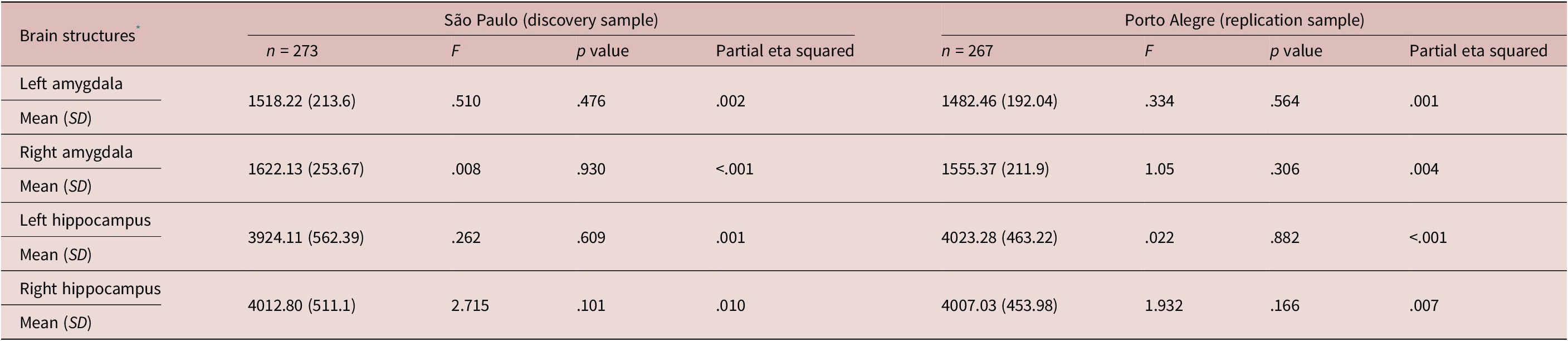
There was no association between serum BDNF concentration and subcortical volumes (Table 2) or overall cortical thickness in the discovery sample or in the replication sample (p > .05).
BDNF effect on brain structures (amygdala and hippocampus).

The analyses were conducted controlling sex, age, IQ, intracranial volume, and any psychiatric disorder; p value refers to BDNF effects on brain structures.
Abbreviation: SD, standard deviation.
* vol in mm3.
For comparisons between BDNF genotype and BDNF serum concentrations, 6 participants from the replication center were excluded due to genotyping failure. No significant differences in serum BDNF concentrations were found between Met carriers (22.92 [SD 10.66] ng/ml) and Val homozygote carriers (24.68 [SD 12.9] ng/ml, p = .315) in the discovery sample (n = 273; Met carriers = 67, Val homozygotes = 206), or between Met carriers (30.47 [SD 9.32] ng/ml) and Val/Val carriers (30.89 [SD 8.07] ng/ml, p = .730) in the replication sample (n = 261; Met carriers = 63, Val homozygotes = 198; see Table 3 for details).
BDNF serum concentrations (ng/ml) and Val66Met genotype.

p value refers to differences in BDNF between genotypes of males and females.
Abbreviation: SD, standard deviation.
Variance in BDNF concentrations was not explained by interaction effects between Val66Met and sex, or between Val66Met and a PD, in the discovery sample (genotype × sex F = .125, p = .724, partial eta squared < .001; genotype × PD F = 2.466, p = .118, partial eta squared = .009) or in the replication sample (genotype × sex F = .112, p = .739, partial eta squared < .001; genotype × PD F = .278, p = .599, partial eta squared = .001).
Discussion
This study found a lack of evidence to support any association between serum BDNF concentrations and the diagnosis of a mental disorder in children and adolescents. There were no associations between serum BDNF concentrations and volumes of cortical or subcortical brain structures, and no correlations between serum BDNF concentrations and cortical thickness. Findings were negative in the TD and PD subgroups, and in subgroups of boys and girls. In addition, we found no differences in serum BDNF concentrations between Met carriers and Val homozygote carriers at both sites, and no interactions between Val66Met, sex, and psychiatric diagnoses in predicting serum BDNF concentrations.
Although in adults with schizophrenia, BDNF has been associated with cortical thicknessReference Zugman, Pedrini and Gadelha 20 , Reference Song, Quan and Lv 46 and hippocampal volume,Reference Rizos, Papathanasiou and Michalopoulou 21 the literature investigating the relationship between peripheral concentrations of BDNF and brain structures in children and adolescents remains scant. Although an association between peripheral BDNF concentrations and brain volumes and cortical areas was observed in a study of bipolar offspring and healthy controls,Reference Mansur, Brietzke and McIntyre 19 another study did not find differences between BDNF serum concentrations and hippocampal volume in children and adolescents diagnosed with bipolar disorder.Reference Lauxen Peruzzolo, Anes and Kohmann Ade 22
Other studies have observed Val66Met effects on cortical and subcortical brain regions in TD childrenReference de Araujo, Zugman and Swardfager 24 – Reference Jasinska, Molfese and Kornilov 26 and children diagnosed with psychiatric disorders.Reference de Araujo, Zugman and Swardfager 24 , Reference Wheeler, Felsky and Viviano 27 In previous analyses from the present cohort, we identified an association between the Val66Met genotype and brain cortical maturation in children and adolescents with TD Met carriers showing thicker parietal, occipital, and prefrontal cortices compared to Val homozygotes, and PD Met carriers presenting thicker right temporal cortex.Reference Wheeler, Felsky and Viviano 27 Moreover, this previous study showed a significant genotype × PD interaction, with PD Met carriers presenting thinner bilateral prefrontal cortices than Val homozygote carriers and TD Met carriers. The present findings suggest that those relationships are not related to peripheral BDNF concentrations.
Jasinska et alReference Jasinska, Molfese and Kornilov 26 found larger right hippocampal volume and greater cortical thickness in lateral occipital/parietal regions, and Hashimoto et alReference Hashimoto, Fukui and Takeuchi 25 observed greater regional gray matter volume related to the BDNF Val66Met polymorphism (Met allele carriers) in TD children. Although those studies did not investigate associations between the genotypes and serum BDNF concentrations, studies conducted in adult populations have suggested correlations between peripheral BDNF and Val66Met polymorphisms, with higher serum concentrations of BDNF in Met allele carriers associated with male sex,Reference Bus, Arias-Vasquez, Franke, Prickaerts, de Graaf and Voshaar 29 depression,Reference Caldieraro, McKee and Leistner-Segal 30 and anxiety.Reference Moreira, Fabiao and Bittencourt 31
Previously, a clinical studyReference Bus, Arias-Vasquez, Franke, Prickaerts, de Graaf and Voshaar 29 found significant interactions between sex and Val66Met genotype on serum BDNF levels, with Met carriers showing higher BDNF than Val homozygotes only in males. In this present study, with the purpose of replicating this finding, we tested the interaction between sex and Val66Met and the interaction between psychiatric diagnoses and BDNF genotype on serum BDNF concentrations. Although 1 sample showed differences between boys and girls in serum BDNF concentrations (higher levels in girls), this was not associated with genotypes. Our results are in contrast with the results of Bus et al,Reference Bus, Arias-Vasquez, Franke, Prickaerts, de Graaf and Voshaar 29 and some methodological differences between samples may explain the divergent results. For example, while in the study of Bus and colleagues the age of the subjects ranged from 50 to 72 years, our study was conducted in a population of children and adolescents.
The lack of evidence to support an association between cortical thickness and serum BDNF levels does not preclude a role of BDNF in cortical maturation (evidence of absence, see Altman and BlandReference Altman and Bland 47 ); however, given the small effect sizes observed, the present findings suggest that serum BDNF offers little as a relevant biomarker in this context. Lower concentrations of the mature BDNF peptide have been observed in major depressive disorder,Reference Yoshida, Ishikawa and Niitsu 48 but higher serum concentrations have been observed in bipolar disorder in comparison with healthy controls.Reference Mansur, Brietzke and McIntyre 19 , Reference Poletti, Aggio and Hoogenboezem 23 Future studies might reassess cortical and subcortical features in relation to the mature BDNF peptide.
This study is one of the first to investigate the relationships between serum BDNF concentrations and brain development in healthy and psychiatrically diagnosed children and adolescents. The findings are strengthened by a large sample size obtained from a community-based cohort, and by a replication sample. Several limitations should be considered. The cross-sectional design does not permit causal inference; future studies might explore longitudinal associations. The operational definition of a PD group encompassed multiple diagnoses, which may have obscured relationships with individual psychiatric diagnoses. Although BDNF concentrations can differ between serum and plasma, only serum concentrations were available. As another potential limitation, inflammatory biomarkers that have been related to psychiatric disorders were not considered, but they could influence serum BDNF. These interactions might be explored in future studies.
Conclusion
In conclusion, serum BDNF concentrations were not related to cortical or subcortical volumes, or to psychopathology, in the 2 largest samples of children and adolescents investigated to date. Furthermore, analyses testing interactions between Val66Met and sex or psychiatric diagnoses did not detect effects on serum BDNF concentrations, suggesting that serum concentrations are unrelated to the effects of the BDNF system on anatomical and behavioral neurodevelopment. Serum BDNF did not seem to be a useful marker for tracking developmental changes in brain and behavior in early life.
Acknowledgments
This study was supported by the National Institute of Developmental Psychiatry for Children and Adolescents (INPD) (Grants: CNPq 465550/2014-2 and FAPESP 2014/50917-0) and in part by the Coordenação de Aperfeiçoamento de Pessoal de Nível Superior - Brasil (CAPES) - Finance Code 001.
Celia Maria de Araujo received scholarship from Brazilian National Council for Scientific and Technological Development (CNPq) (142296/2014-7) and from Coordenação de Aperfeiçoamento de Pessoal de NÚvel Superior - Brasil (CAPES) (PDSE - 88881.135297/2016-01).
Walter Swardfager acknowledges support from the Department of Psychiatry, Sunnybrook Health Sciences Centre, from the Centre for Collaborative Drug Research, and from the Department of Pharmacology & Toxicology, University of Toronto. Andrea Jackowski received grants from the São Paulo Research Foundation (FAPESP) (2013/08531-5; 2016/04983-7) and the Brazilian National Council for Scientific and Technological Development (CNPq) (312984/2014-6 and 442026/2014-5). Sintia Iole Belangero received a grant from FAPESP (2014/07280-1).
Conflicts of Interest
None.