INTRODUCTION
Length of stay (LOS) in psychiatric hospitals is of interest to patients, their families, clinicians, service administrators and funding bodies. The prolonged admission of some patients can reduce access to inpatient care for others, and can result in acute psychiatric patients receiving care in inappropriate settings, such as the emergency departments of general hospitals (Forero et al. Reference Forero, Hillman, McCarthy, Fatovich, Joseph and Richardson2010). Health funders and service administrators are responsible for ensuring that the limited number of costly inpatient beds is efficiently and effectively employed. Patients and their advocates are concerned about the negative effects of very long admissions, as well as the lack of access to inpatient care and the effect of premature discharge. A better understanding of the way psychiatric hospital beds are utilized has the potential to reduce costs and improve care.
Most studies of LOS in mental health services have examined associations between LOS and the demographic, diagnostic and behavioural variables of patients, looking for episode-cost correlations (Herr et al. Reference Herr, Abraham and Anderson1991; Caton & Gralnick, Reference Caton and Gralnick1987; Huntley et al. Reference Huntley, Cho, Christman and Csernansky1998). This body of research has demonstrated that psychiatric diagnosis is a poor predictor of LOS (Creed et al. Reference Creed, Tomenson, Anthony and Tramner1997; McCrone & Phelan, Reference McCrone and Phelan1994) and that adding demographic and other patient variables only modestly increases the extent to which the LOS of individuals can be predicted (Huntley et al. Reference Huntley, Cho, Christman and Csernansky1998). Service and hospital factors also influence LOS (Kiesler et al. Reference Kiesler, Simpkins and Morton1990). Variation in LOS between hospitals is partly explained by differences in their patient populations (Oiesvold et al. Reference Oiesvold, Saarento, Sytema, Christiansen, Göstas, Lönnerberg, Muus, Sandlund and Hansson1999), although the reason for differences in LOS between hospitals has received less attention than factors affecting the LOS of individual patients. A recent study of twenty service units of a large psychiatric hospital found that 13% of the variation in LOS could be explained by patient factors and 28% was due to differences in services (Frick et al. Reference Frick, Rehm, Frischker and Cording1999). The decline in LOS in the last three decades suggests that non-patient factors, such as the improved effectiveness of psychiatric treatment, changes to mental health laws and the availability of treatment in the community are important determinates of LOS (Mechanic et al. Reference Mechanic, McAlpine and Olfson1998; Hudson, Reference Hudson2004). However, despite the finding that non-patient and institutional factors have a strong influence on LOS, and the use of measures of LOS in funding models, there are no generally agreed ways of describing or reporting the distribution of LOS to allow a meaningful comparison of performance between units and over time.
The first issue about which there is no general agreement is the time frame used to measure LOS. LOS can be calculated using prospective measures of the hospital stays of patients admitted during a defined sampling period, or retrospectively by examining the LOS of patients discharged over a given period of time. The prospective method has the advantage of including every patient, but data collection is inevitably delayed until the last patients are discharged. Estimates taken from the LOS of discharged patients produce contemporaneous data, but exclude some long-stay patients and underestimate LOS unless the sampling period is significantly longer than the usual LOS (Hanson, Reference Hanson1973).
The second issue about which there is no agreement concerns the mathematical measures used to describe LOS. The most readily understood measure of LOS is the arithmetic mean or average. The average LOS may be accompanied by a measure of the distribution of LOS such as the standard deviation. Sometimes average LOS is calculated by dividing the number of discharges by the available bed-days, but this assumes 100% bed occupancy and does not provide a measure of the distribution of LOS such as the standard deviation. Average LOS, whether it is calculated prospectively, retrospectively or by the number of bed-days divided by the number of discharges, is likely to be inflated or skewed by a small proportion of patients with long LOS (Frick et al. Reference Frick, Rehm, Frischker and Cording1999; Hanson, Reference Hanson1973; Priest et al. Reference Priest, Fineberg, Merson and Kurian1995). Hanson (1973) examined the LOS distribution among groups of patients admitted to two psychiatric hospitals in Pennsylvania in the 1960s and early 1970s and in Warwick in England in the 1880s, and concluded that LOS distributions were normally distributed after a logarithmic transformation of the LOS and thus were best described by a log-normal distribution. In a more recent study of LOS in a London general hospital psychiatric unit, Priest et al. (1995) found an exponential type distribution. Priest et al. (1995) suggested that the gradient of the log transformed LOS could be used to calculate a rate of discharge and argued that the median LOS was preferable to average LOS as an indicator of the rate of patient discharge because it was not affected by outlying values. However, median LOS also has significant limitations as a measure of LOS because it only provides meaningful information about the LOS of the 50% of patients with the shortest LOS and provides limited information about the remainder of the distribution unless the LOS distribution is known to be exponential. Moreover, in services where the greatest number of discharges occur within 24 hours, the median LOS will be zero.
Distributions with more zero values than expected in a normal distribution, and with a right skew of a minority with large values, is a well recognised problem in data generated in mental health settings (Delucchi & Bostrom, Reference Delucchi and Bostrom2004). Excessive zero values and right skew have been has been described in studies of the duration of untreated psychosis (Large et al. Reference Large, Nielssen, Slade and Harris2008), in the scoring of a variety of psychometric tests (Delucchi & Bostrom, Reference Delucchi and Bostrom2004) as well as in relation to LOS (Marazzi et al. Reference Marazzi, Paccaud, Ruffieux and Beguin1998). Manning & Mullahy (2001) described this type of distribution as having a ‘non-trivial fraction of zero values’ and a positively skewed empirical distribution of non-zero values characterised by a ‘heavy tail’. Such distributions pose several statistical problems. First, parametric tests such as analysis of variance and t-tests rely on the assumption of normal distribution, which might not be achieved by logarithmic transformation of the data. Second, non-parametric tests relying on ranking tend to suffer from a reduction in statistical power when large numbers of data points have the same value, for example a value of zero (Delucchi & Bostrom, Reference Delucchi and Bostrom2004; Manning & Mullahy, Reference Manning and Mullahy2001). Third, the usual measures of central tendency including average and median do not adequately describe such distributions. The mean LOS has particular problems because LOS distributions might have differing average LOS as a result of differences in the proportion of zero values (i.e. less than 1 day) or because of differences in the number of long stay patients, rather than the time spent in hospital by the majority of hospitalised patients.
In this study, we examined the distribution of LOS in a representative sample of twelve acute psychiatric units attached to general hospitals located in rural, regional, suburban and inner-city areas of New South Wales (NSW), Australia, in order to identify alternative approaches to describing LOS.
Following earlier research that used logarithmically transformed values to analyse LOS distributions, we examined the LOS based on a three component model: (i) the group of discharges within one day; (ii) a rate of discharge derived from the logarithmically transformed LOS values for a group considered to be the main body of discharges; (iii) an examination of the group of discharges with a very long LOS.
Our objective was to clarify the meaning of current measures of LOS and to consider the use of a modified median LOS, calculated after the removal of patients staying less than a day.
METHODS
NSW Area Health Service administrative regions routinely record the length of every episode of inpatient care in mental health facilities. As part of a quality improvement project, LOS data from twelve acute general hospital psychiatric units were examined. The data came from units managed by three separate Area Health Service regions: the South Eastern and Illawarra Area Health Service (SEIAHS), the Northern Sydney Central Coast Area Health Service (NSCCAHS) and the Greater Southern Area Health Service (GSAHS). The 12 service units (equivalent to psychiatric wards) were located in inner urban (units E and H), suburban (units B, C, G, and I) regional cities (units D, F, J and L) and rural areas (units A and K). All of the units were attached to general hospitals and there were no units from within free-standing psychiatric hospitals. However, the units varied significantly in regard to their functional relationships with other admitting units. Four units (E, G, H and J) were co-located with 4 to 6 bed psychiatric emergency care centres (PECCs) next to emergency departments. PECC units are designed to accommodate patients needing a brief hospital stay (Brakoulias et al. Reference Brakoulias, Mandali, Seymour, Sammut and Starcevic2010). The units differed in their access to long stay beds in stand-alone psychiatric hospitals. Four units (B, C, F and J) had access to nearby long stay and rehabilitation wards and two other units (A and K) could refer patients to a separate long stay ward managed by the same area health service. Unit E differed from the others in that it had more beds, (50 beds, compared with between 20 and 30 beds in the other units), and was co-located with a university and some tertiary referral psychiatric services.
The data were collated for discharges during the calendar year 2008. No data was collected regarding re-admitted patients and each episode of inpatient care was examined separately. De-identified LOS data (a single figure for LOS for each episode of care with no identifying demographic or clinical information) was obtained with the approval of each Area Health Service. One year was used as the sample period in order to minimise the effect of the exclusion of long-stay patients. For the purpose of the study, admissions for any part of a 24-hour period were regarded as having a LOS of one day.
A three-step planned analysis was performed. First, the untransformed and natural logarithm (ln) transformed LOS for each discharge was plotted on the X (horizontal) axis of a scatter plot against the cumulative proportion of the patients from that unit who had been discharged by the time of that LOS plotted on the Y (vertical) axis. The extent to which the untransformed distributions conformed to a reference exponential distribution, and the extent to which the ln transformed distributions conformed to a reference normal distribution, were measured with separate one sample Kolmogorov-Smirnov tests.
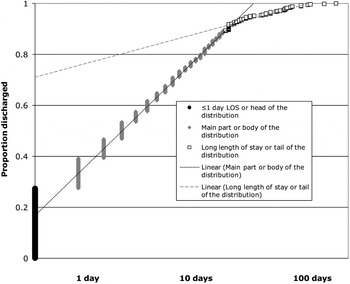
Second, the components of the transformed distributions of LOS were examined by visual inspection. The boundary between the head and body was defined by the patients in the head having a LOS of one day or less. The boundary between the body and the tail of very delayed discharges was estimated for each sample by (i) discarding the LOS data points in the boundary region (not exceeding 5% of data points); (ii) separately estimating two lines of best fit using the least square linear regression below and above the boundary region; (iii) identifying the LOS value at the point of intersection (see Fig. 3). This method requires some subjective judgement, but is preferable to an arbitrary definition of long LOS because any given length of stay might be a statistical outlier in one unit but not another. We then calculated the proportion of discharges and occupied bed-days in each part of the LOS distribution and examined the variation in the between-unit proportion of all discharges in the head and tail of the distribution with a chi-square contingency table.
Third, parametric and non-parametric measures of central tendency were calculated for each distribution. Parametric measures included the average LOS (arithmetic mean) and its standard deviation. Skewness was calculated by the third standardised moment method. An alternative mean, the geometric mean, was calculated using exp (mean of ln LOS), that is, e raised to the power of the arithmetic mean of the ln LOS. The geometric mean is a good measure of central tendency if the data set has a log-normal distribution. Differences in the LOS between hospitals were assessed using an analysis of variance (ANOVA) of ln transformed LOS with post hoc Tukey tests data.
Median LOS and the 1st and 3rd quartiles were included as non-parametric measures. A modified median was calculated for patients who stayed in hospital for longer than a day. Non-parametric testing of differences in the LOS between hospitals was performed with a Kruskal-Wallis test using untransformed data.
RESULTS
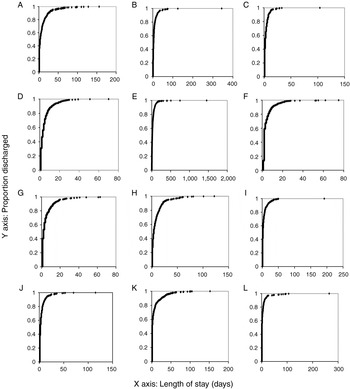
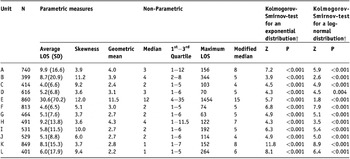
A plot of the cumulative proportion of patients discharged against LOS in days in Figure 1 demonstrates a severely right skewed distribution and a significant proportion of patients with a LOS of 1 day in all units. Single sample Kolmogorov-Smirnov tests comparing the distributions to reference distributions found that in each case the distribution could not be considered to be either exponential or log-normal, even after the exclusion of patients admitted for one day or less (Table 1).
Distribution of length of stay in 12 acute psychiatric units

Descriptive statistical measures of LOS, tests of skew, and of exponential and log-normal distributions

†Kolmogorov-Smirnov-tests also found that the LOS distributions did not conform to exponential or log-normal, after removal of LOS values of ≤1 day
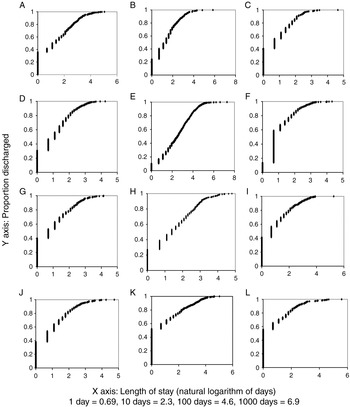
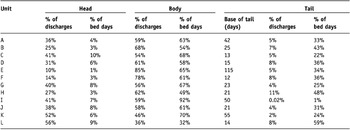
Inspection of the ln transformed LOS confirmed that the LOS distributions were complex and could be thought of as having three components: (i) a group of discharges of ≤1 day; (ii) the majority of discharges represented linearly, suggesting this section of the distribution was exponential before transformation; (iii) a tail distribution of admissions with a much longer LOS. These elements are illustrated in Figures 2 and 3 (unit H) and numerically for all twelve units in Table 2.
Natural logarithm (ln) transformed distribution of length of stay in 12 acute psychiatric units

Illustration (unit H) of the head, body and tail of the ln LOS distribution with fitted lines indicating the rate of discharges in the body and tail

Service utilisation associated with the head, body and tail of the LOS distribution

The units had a proportion of discharges within 24 hours (those with an LOS ≤ 1 day), referred to as the head of the distribution. The proportion of discharges in the head of the distribution varied from 10% to 56% (unit average = 34%, Chi-square = 676, df = 11 p<0.0005). These admissions occupied between 1% and 10% of total bed-days (unit average = 6%) (Table 2).
A dotted diagonal line in Figure 3 represents the main distribution of LOS. This group contained the majority of discharges and is referred to as the main part or body of the distribution. There appeared to be a linear relationship between the ln LOS and the cumulative proportion of discharged patients. Hence, the modified median is an indicator of the time taken for a patient in this group to have a 50% chance of being discharged irrespective of how long they have already been in hospital. The median has been recommended as a measure of the rate of discharge and in this sample of studies, the modified median ranged from 4 to 15 days (Priest et al. Reference Priest, Fineberg, Merson and Kurian1995). This should be distinguished from the rate of discharges per mental health unit that is highly dependent on the unit’s number of beds and can be defined as the number of discharges in a given unit divided by any given period of time.
All but one unit (Unit I) had a group of patients discharged at a much slower rate than the main distribution. Unit I had a single patient whose LOS was approximately 4 times longer than the patient with the next longest LOS. This group is referred to as the tail of the distribution and is represented by a more gradually sloping section extending to the top right of the ln transformed distributions in Figure 2. There was a significant between-unit difference in the proportion of long LOS patients (0–11%, unit average = 6%, Chi-square = 107, df = 11, p<0.0005). This group occupied between 1 and 59% (unit average 33%) of all available bed-days (Table 2).
The modified median was similar to the average LOS in most units, although in Unit E it was 51% shorter and in Unit B it was 43% shorter. The exclusion of very short stay patients meant the modified median was longer than the median, and in units A,C,F,G,I,J,K & L it was more than twice as long as the median. In units K and L the modified medians were 8 and 6 days respectively, compared to the median figure of 1 day for these units.
Parametric and non-parametric measures of the distribution of LOS in the 12 acute units are recorded in Table 1. There were highly statistically significant differences in the LOS between units determined by ANOVA of ln transformed LOS values (df = 11, 7098, F = 106.5, P<0.0005) despite the statistical assumptions for ANOVA regarding normality of the distributions not being met, reflecting clinically significant differences in LOS between the units and the very large number of data points included in the study. Post hoc Tukey tests with an alpha of P = 0.05 found that units C,G,I,J,K & L were a homogeneous subset, as was the overlapping subset of units C,D,F,G,J,K & L. Units A, B & H comprised a third homogenous subgroup and unit E had a significantly longer LOS than other units. The Kruskal-Wallis test (which has a reduced statistical power when compared to an ANOVA due to its use of ranked rather than actual LOS values), also confirmed significant differences in the LOS between the units (Chi-Square = 817, df = 11, P<0.0005).
DISCUSSION
None of the distributions of LOS from the acute unit conformed to a normal, exponential or log-normal distribution. Instead, they were similar to the distributions found in other mental health patient samples, with ‘non-trivial proportion of zero-values’ from patients discharged within one day, and a ‘right skew’ and a ‘heavy tail’ (Manning & Mullahy, Reference Manning and Mullahy2001) from a small proportion of very long stay patients. The results of this study indicate the need for a new way to describe LOS in order to provide a meaningful description of the rate at which patients are returned to community care and a reliable comparison between units and the performance of units over time. The distributions of LOS in each of these units could be divided into three parts, a ‘head’ of admissions of less than a day, a ‘body’ conforming to an exponential distribution and a ‘tail’ distribution of long stay patients. Separating the components of LOS in this way might prove to be a useful way of examining the LOS of individual units – particularly in units where prolonged LOS appears to indicate a lack of efficiency. Furthermore, a modified median calculated after the exclusion of short stay patients would allow the comparison of performance of units with varying proportions of brief admissions.
The head of the distribution represents admissions of less than one day. These patients might have been clinically re-assessed as being fit for discharge or had recovered from short-term problems such as an acute situational crisis or intoxication. The number of short stay admissions could be influenced by the local availability of a PECC unit, designed to provide care through very short acute admissions or the presence of an effective community service and other services that might allow the diversion of patients from hospital admission. The rural units had the highest proportion of patients with an LOS of less than one day, which could be due to a preference to admit patients with short-term problems who would have been dealt with as outpatients in health areas with a greater range of services, or in PECC units.
The second part of the distribution includes the bulk of patients who are admitted for a period of between two days and several weeks, and whose rate of discharge can be calculated using a modified median LOS. The beginning of this part of the distribution is readily defined as a LOS of more than one day. The boundary between the body conforming to an exponential distribution, and the tail of long stay patients is less readily defined, but is not needed when calculating a modified median. However, we argue that a very long LOS could be better determined by the visual inspection of each distribution for an inflection point rather than using an arbitrary definition of a long stay patient (such as three or six months) that might not indicate a particularly long stay in that unit.
The types of patients in each part of the distribution also differ. A recent case-controlled study suggested that patients who were admitted for longer than a day were more likely to be males who expressed an intention to commit suicide or to harm someone else, were homeless, had no health insurance, had a history of psychiatric hospitalisation, and were more likely to have diagnoses of substance abuse disorder, psychotic disorder and significant psychiatric co-morbidity (Park et al. Reference Park, Park, Siefert, Abraham, Fry and Silvert2009). There have been similar findings in studies of factors associated with a longer than average LOS. For example, Huntley found that patients with longer LOS were more likely to have schizophrenia, more previous admissions, a primary diagnosis of a mood disorder, older age and a secondary diagnosis of substance abuse disorder (Huntley et al. Reference Huntley, Cho, Christman and Csernansky1998).
The final part of the distribution includes those with a prolonged LOS. Lelliot et al. (1994) examined a national sample of patients who had been in National Health Service facilities in the UK from 6 to 36 months and found two main groups: a younger group of predominantly single men with schizophrenia and a history of serious violence, and an older group of predominantly married or previously married women, more often with a diagnosis of affective disorder or dementia who had poor social function, limited social support and risk factors for self-harm. The authors concluded that more than half of these patients remained in hospital because no suitable accommodation could be found (Lelliott & Wing, Reference Lelliott and Wing1994). More recent research has shown that prior violence, severity of illness and need for re-housing independently predicted a hospital stay of more than six months (Tulloch et al. Reference Tulloch, Fearon and David2008). Although the patients in this third group make up a small proportion of discharges, they take up a large proportion of available bed-days. A comparison of the tails of LOS distributions could help identify where alternative services should be developed, as most of the very long stay patients do not require the intensive treatment and close support available in an acute psychiatric unit for the duration of their admission.
The division of LOS distribution into a head, body and tail has face validity because similar subcategories of patients have been identified in earlier studies. There were considerable differences in social circumstances of the patient populations admitted to each of the twelve units in this study, as well as differences in the range of services available to provide care outside the hospital and in the way the services were set up to treat patients with short term problems. Differences between the types of mental health units and the communities in which they are located are likely to limit the validity of numerical measure of LOS as a measure of unit performance. However, the method we describe calculating a modified mean LOS is more reliable than either the mean or the median LOS, and the approach we propose of breaking down the distribution of LOS into component parts might assist in the better examination of the complexities of LOS issues in individual mental health units.
Acknowledgment
We thank Dr Peter Arnold, Sydney, for his assistance in the preparation of the manuscript, and Mr Swadesh B. Singh, Area Mental Health Clinical Information Project Coordinator, South Eastern Sydney and Illawarra Area Health Service and Mr Glen Bowcock, Mental Health Information Systems Manager, Mental Health Drug and Alcohol, Northern Sydney Central Coast Area Health Service for their assistance with the raw data.