


Introduction
Psychological professional trainees (PFTs) frequently report poor wellbeing during training, with evidence suggesting that many experience burnout even before entering the qualified workforce (Owen et al., Reference Owen, Crouch-Read, Smith and Fisher2021; Pakenham and Stafford-Brown, Reference Pakenham and Stafford-Brown2012). Excessive stress and burnout impact negatively on several outcomes relevant to PFTs, including academic learning (Pascoe et al., Reference Pascoe, Hetrick and Parker2020), clinical effectiveness (Delgadillo et al., Reference Delgadillo, Saxon and Barkham2018), and both professional and academic conduct (Barnett et al., Reference Barnett, Baker, Elman and Schoener2007; Tindall et al., Reference Tindall, Fu, Tremayne and Curtis2021).
In the UK, recent years have seen significant expansion both in the number of psychological professionals in the workforce, and the number of distinct psychological professional roles (Kell and Self, Reference Kell and Self2024). Psychological professions in England are classified into a taxonomy of 21 roles, consisting of psychologist (e.g. clinical psychologist), psychological therapist (e.g. cognitive behavioural therapist), psychological practitioner (e.g. psychological wellbeing practitioner), and associate or assistant (e.g. clinical associate in psychology) roles (Whittington, Reference Whittington2024). Psychological professional trainees undertake a wide variety of work. Whilst many are trained to work primarily according to a cognitive behaviour therapy (CBT) framework with regard to their clinical work, there is significant variation between the expectations and responsibilities of the different groups, and the requirements of their training. Psychological wellbeing practitioners, for example, are typically employed in a single service throughout their training, and are trained to deliver a relatively circumscribed set of low-intensity CBT interventions in NHS Talking Therapies services (NHS England, Reference England2025). Clinical psychologists, on the other hand, receive a broader training across a range of therapeutic modalities, move between multiple placements across the training period, and are also trained in developing skills in leadership and research (Rosaira and Tiplady, Reference Rosaira and Tiplady2024). Nonetheless, a range of evidence indicates significant overlap across psychological professions when considering the challenges faced in training. For example, challenges associated with self-doubt or imposter syndrome, the responsibility of clinical work, or holding dual roles as a student and mental health practitioner concurrently have been reported in trainees across psychologist, therapist and practitioner roles (e.g. Owen et al., Reference Owen, Crouch-Read, Smith and Fisher2021; Pakenham and Stafford-Brown, Reference Pakenham and Stafford-Brown2012; Richardson, Reference Richardson, Trusty and George2020).
Psychological professional trainees are often in a first professional role and are typically young, with over half of the psychological professional workforce aged under 40 (Whittington, Reference Whittington2024) and over half of applicants to Clinical Psychology doctoral training programmes aged between 25 and 29 (Clearing House, Reference House2021). Importantly, poor wellbeing during training and beyond has been associated with high staff turnover (National Collaborating Centre for Mental Health, 2018) and an increased intention to leave the NHS amongst psychological professionals (Summers et al., Reference Summers, Morris, Bhutani, Rao and Clarke2021). Therefore, interventions to support trainee wellbeing and encourage flexible, adaptive approaches to work have the potential to be of significant value.
In a recent systematic review, we evidenced that interventions and teaching strategies for supporting trainee wellbeing can be effective and are valued by trainees themselves (Owen et al., Reference Owen, Biggart, Fisher, Figueredo, Al-Rousi, Colvin-Jarvis, Williamson and Sanderson2025). However, studies in the field were heterogeneous and of mixed quality. Few studies had a clear theoretical underpinning or rationale for why and how the intervention would be effective in the given population, and few outlined how the intervention had been tailored for the population of interest. These are important short-comings, with several researchers cautioning against attempts to improve wellbeing without first considering what it means to the target population (Annas, Reference Annas2004; Fave et al., Reference Fave, Brdar, Wissing, Araujo, Solano, Freire, Hernández-Pozo, Jose, Martos, Nafstad, Nakamura, Singh and Soosai-Nathan2016), or designing interventions without consideration of how they might function in the specific context (Hamling et al., Reference Hamling, Jarden, Jarden and Synard2020; Skivington et al., Reference Skivington, Matthews, Simpson, Craig, Baird, Blazeby, Boyd, Craig, French, McIntosh, Petticrew, Rycroft-Malone, White and Moore2021). In this paper we develop a stakeholder and theory-informed intervention with a clearly articulated theory of change, to fill an important gap in the literature.
The COM-B model (Michie et al., Reference Michie, van Stralen and West2011) provided the underpinning theory of behaviour and behaviour change, and key stakeholders (psychological professional trainees and professional trainers) were involved throughout. The intervention development process built on findings of earlier research led by the current research team and others, and was conducted with trainees across multiple psychologist, psychological therapist and psychological practitioner professions. The wider literature regarding the nature and causes of poor wellbeing during training (e.g. ‘imposter syndrome’ and perfectionism (Jones et al., Reference Jones, Thompson, Galvin, Griffiths and Morris2017; Richardson et al., Reference Richardson, Trusty and George2020)) was also carefully considered, to ensure that the intervention could be designed to address known challenges experienced by trainees.
Careful consideration was given to understanding how the intervention would function in the context for which it was designed. In keeping with findings from the systematic review (in which lack of adaptation of interventions to the trainee context functioned as a barrier to intervention success (Owen et al., Reference Owen, Biggart, Fisher, Figueredo, Al-Rousi, Colvin-Jarvis, Williamson and Sanderson2025)), consideration was given to what trainees would know, what they might want or need from an intervention, and how this would fit in alongside their wider training in a hybrid clinical/university setting. Finally, in keeping with relevant guidance and recommendations (Skivington et al., Reference Skivington, Matthews, Simpson, Craig, Baird, Blazeby, Boyd, Craig, French, McIntosh, Petticrew, Rycroft-Malone, White and Moore2021), a programme theory for the intervention was articulated early in intervention development, and refined throughout the intervention development process.
Study objectives
The objectives of this study were to design a psychological intervention intended to support wellbeing in psychological professional trainees, using an underpinning theory that matched PFTs’ experiences of wellbeing. Key research questions addressed throughout the study process were:
-
(1) How to design an intervention that builds on existing evidence and supports the wellbeing of PFTs?
-
(2) What do key stakeholders (current trainees, and professional trainers working on training programmes) consider most important in intervention design?
-
(3) What would be the theory of change for an intervention designed for this purpose?
Method
Design
This theory and stakeholder-informed intervention development study was guided by the MRC framework for developing and evaluating complex interventions (Skivington et al., Reference Skivington, Matthews, Simpson, Craig, Baird, Blazeby, Boyd, Craig, French, McIntosh, Petticrew, Rycroft-Malone, White and Moore2021a). The research was underpinned by a worldview of pragmatism (Gillespie, Reference Gillespie2024), with an emphasis on ‘doing what works’ to answer the questions of the research in a practically useful manner (Creswell and Plano Clark, Reference Creswell and Plano Clark2018). The study proceeded in a pre-determined manner set out in a study protocol. This protocol is available in the Supplementary material (file ‘Supplementary material 4’).
Intervention development and design
Drawing on findings from our research regarding interventions designed to support trainee wellbeing (Owen et al., Reference Owen, Biggart, Fisher, Figueredo, Al-Rousi, Colvin-Jarvis, Williamson and Sanderson2025) and how psychological professionals thrive in their roles (Vivolo et al., Reference Vivolo, Owen and Fisher2024), a decision was made by the primary researcher to base the intervention on acceptance and commitment therapy (ACT) prior to stakeholder involvement (Hayes et al., Reference Hayes, Strosahl and Wilson2012a; Hayes et al., Reference Hayes, Strosahl and Wilson2012b). Although some evidence of effectiveness was found for interventions based on a range of therapeutic approaches including mindfulness, wellness plans, CBT, stress-management workshops, ACT and more (Owen et al., Reference Owen, Biggart, Fisher, Figueredo, Al-Rousi, Colvin-Jarvis, Williamson and Sanderson2025), ACT was selected for this study to establish a strong theoretical rationale for the intervention and close alignment between how wellbeing is conceptualised by the intervention approach and the target population. In several of our earlier studies with psychological professional trainees and qualified staff, connecting with and embodying personal values has been described as central to wellbeing and positive functioning in the role (Vivolo et al., Reference Vivolo, Owen and Fisher2024). Additionally, trainees and professionals across the psychological professions have described how ‘imposter syndrome’ (Owen et al., Reference Owen, Crouch-Read, Smith and Fisher2021), perfectionism (Richardson et al., Reference Richardson, Trusty and George2020) and self-criticism (Jones et al., Reference Jones, Thompson, Galvin, Griffiths and Morris2017) are barriers to enjoying and performing fully in their roles. As ACT emphasises moving towards what people value even in the face of difficult internal thoughts and feelings, and takes a normalising and non-pathologising stance towards such thoughts and feelings (Hayes et al., Reference Hayes, Strosahl and Wilson2012a; Hayes et al., Reference Hayes, Strosahl and Wilson2012b), ACT was considered to be a strong fit for this population, and a therapeutic approach for which there was a strong theoretical rationale. We also decided to incorporate some elements of compassion-based approaches, as compassion-based ideas had also shown some evidence of effectiveness in our review, and appeared well-suited to supplementing efforts to address the common trainee issues of self-criticism and perfectionism (Jones et al., Reference Jones, Thompson, Galvin, Griffiths and Morris2017; Richardson et al., Reference Richardson, Trusty and George2020). Furthermore, drawing from our systematic review, it was also decided that the intervention would include choice for trainees, that it would be experiential, delivered in a group format, and tailored specifically to the context of PFTs, given the ways in which these features had been identified as facilitators of intervention success (Owen et al., Reference Owen, Biggart, Fisher, Figueredo, Al-Rousi, Colvin-Jarvis, Williamson and Sanderson2025). As an inherently experiential approach, with a wide range of techniques that would facilitate options and choice for trainees, ACT was considered a useful model for the intervention.
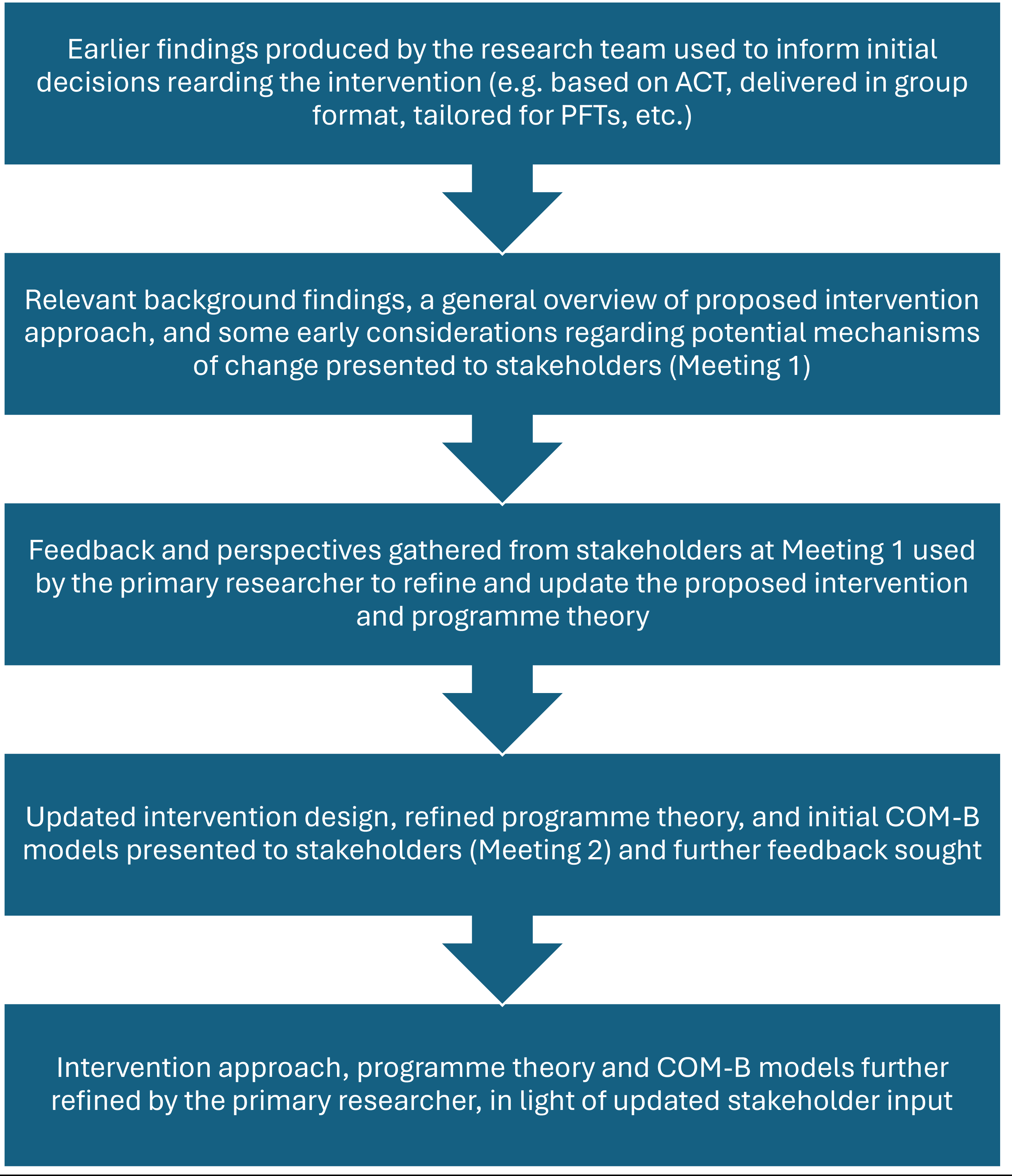
Whilst these theory and evidence-informed decisions provided the guiding structure for the intervention design, the detail and form of the intervention was shaped throughout subsequent stakeholder meetings. To ensure that stakeholder time was used most effectively, stakeholders were involved early, but after the decision to use ACT had been taken. This decision was based on the findings of our review which had suggested that whilst multiple therapeutic approaches could be effective in this population, intervention implementation issues were central to their efficacy. Given the strong theoretical rationale for selecting ACT described above, stakeholder input was prioritised for informing the important contextual details (such as where and when to offer the intervention, intervention length, and how particular ACT tasks might be received) that the review had identified as influential for intervention effectiveness. An outline of this process is presented in Fig. 1. In keeping with MRC guidance, a programme theory for the intervention was outlined early in intervention development, and subsequently refined throughout through stakeholder input (Skivington et al., Reference Skivington, Matthews, Simpson, Craig, Baird, Blazeby, Boyd, Craig, French, McIntosh, Petticrew, Rycroft-Malone, White and Moore2021). Details of how the stakeholders were involved are outlined below.
Overview of the intervention development process.

Theory of behaviour
The COM-B model (Michie et al., Reference Michie, van Stralen and West2011) was used to provide an underpinning theory of behaviour and behaviour change for this study. The model describes how behaviour (B) is the result of an adequate combination of capability (C), opportunity (O), and motivation (M) to perform that given behaviour. In the model, capability, opportunity and motivation can be further divided into two. Capability includes both physical and psychological (knowledge and understanding) capability to perform a particular behaviour. Opportunity refers to anything external that facilitates, impedes, prompts or makes the behaviour possible. Opportunity is conceptualised as consisting of both physical opportunity (e.g. the environment in which one operates) and social opportunity (e.g. the social and cultural context that constrains or facilitates behaviour). Motivation, defined by Michie and colleagues as ‘brain processes that energise and direct behaviour’ (Michie et al., Reference Michie, van Stralen and West2011, p. 4) encompasses both automatic motivation (e.g. impulses, habits, and emotionally driven behaviour) and reflective motivation (e.g. conscious volition, choice and intention).
Michie and colleagues have noted how behaviour change interventions are frequently designed without paying sufficient attention to the target behaviour, the target population, or the context in which the intervention will be delivered. (Michie et al., Reference Michie, van Stralen and West2011). During intervention development, the COM-B model was used as an underpinning model of behaviour, and conceptual framework for thinking about the factors that might impede or facilitate the desired behavioural change.
To minimise requirements on participants (trainees and professional trainers) contributing to the co-production of this intervention, participants were not required or expected to be familiar with COM-B before joining the study, and the model was not used to constrain or actively direct discussions. However, the primary researcher was consistently using this model to organise and systematically shape thinking about how the intervention should function. In practice, this included writing detailed notes following each intervention development meeting regarding ideas that had been discussed relevant to future participants’ capability, opportunity and motivation to enact the target behaviours. It also meant discussing with stakeholders about what target behaviours needed to be.
Throughout intervention development, the COM-B model was also used to identify potential barriers to implementing an intervention, and to map factors that might facilitate or impede the behaviour change necessary for such an intervention to work. Consequently, the COM-B model in this study was used in a deliberate and contained manner, promoting a systematic and theoretically underpinned approach to the design of the intervention, but without relying on the extensive resources or range of choices that the associated Behaviour Change Wheel has been criticised for requiring (Webb et al., Reference Webb, Foster and Poulter2016). For details of the collaboratively completed COM-B analyses, see Tables 1 and 2.
Setting
The research was conducted at a university in England with a well-established portfolio of applied training programmes in clinical psychology and psychological therapies.
Participants and recruitment
A group was convened using purposive sampling from current psychological professional trainees, and professional trainers employed to teach on psychological professional training programmes at the primary researcher’s employing institution. Staff from a departmental wellbeing interest group were invited, given their interest and experience in the area. Student reps from across all five different psychological professions trained at the participating university were invited, to promote gathering of a diversity of perspectives that covered training pathways and academic levels. A total of 10 participants were invited and agreed to participate. Two trainees (one PWP trainee and one high-intensity CBT trainee) withdrew shortly before beginning due to clashes with academic workload, meaning a total of eight participants took part in the two meetings. For both meetings, three participants were current trainees, and five were professional trainers. Participants included six females and two males, aged 26–35 (n=2), 36–45 (n=3), 46–55 (n=2), and 56–65 (n=1). Participants described their ethnicity in terms aligned to the Office for National Statistics (ONS) categories of Asian/Asian-British, Black/African/Caribbean/Black-British, Mixed/multiple ethnic groups, and White. A total of two participants reported following a religion, and seven reported having no disability. Participants were associated with a range of psychological professions (as either trainees or staff), including clinical psychology (n=3), clinical associates in psychology (n=2), high-intensity therapy (n=1), and psychological wellbeing practitioners (n=2). For pragmatic reasons, meetings were hosted by the primary researcher, a Programme Director for a psychological practitioner training programme running in the university in which the research was carried out. In recognition of the dual roles played by the primary researcher (as staff member, researcher, and intervention lead) efforts were made throughout all stages of the research (including in recruitment materials and during intervention development meetings) to promote an environment that facilitated open discussion and reduced power imbalances. Participants were encouraged to speak freely and were reminded that there were no particular answers being looked or hoped for.
Meetings
Following the intervention development protocol, two rounds of meetings (each 2 hours) were held. To maximise stakeholder input, Meeting 1 was planned in the early stages of formulating ideas about the intervention. Meeting 2 took place approximately 2 months after Meeting 1. This was deliberate to allow the primary researcher time to work-up ideas following Meeting 1, building from stakeholders’ earlier involvement. To facilitate involvement from busy and full-time employed staff and trainees, multiple time slots were offered for each round of meetings. Three iterations of Meeting 1 were held (attended by two or three participants each time), and two iterations of Meeting 2 were held (with five participants attending the first iteration, and three the second).
The purpose of meetings was to gather stakeholder perspectives on intervention design. Where contrasting perspectives were presented, these were explored through discussion where possible, and the primary researcher balanced multiple perspectives against wider literature during intervention design. The primary researcher made extensive use of note-taking and reflection, and immediately after each meeting, wrote out and reflected on ideas raised, examining how ideas put forward related to each other, and to wider published literature. A record of notes was maintained to promote transparency of process.
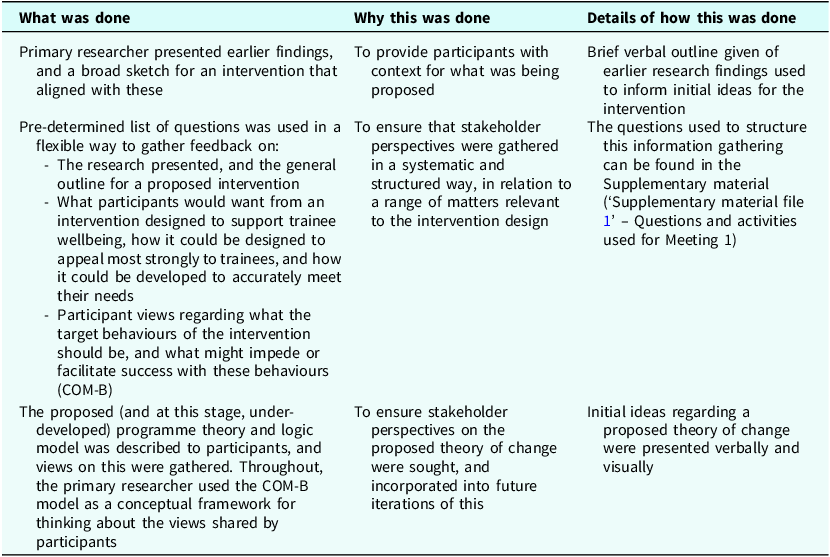
Meeting 1.

Meeting 1 Long description
A table with columns titled “What was done”, “Why this was done”, and “Details of how this was done” detailing research steps, including presenting findings, gathering structured feedback, and outlining a proposed theory of change.
Meeting 2.

Meeting 2 Long description
The table has three columns: What was done, Why this was done, and Details of how this was done. It contains four rows detailing the intervention development process. Row 1: A comprehensive description of the challenges the intervention was intended to address was presented to participants to provide them with a detailed overview of the specific challenges and the rationale for the intervention. A brief review of the literature on trainee wellbeing was presented. Row 2: For each target behaviour, a COM-B analysis constructed by the primary researcher to reflect the views shared by stakeholders in Meeting 1 was presented to participants to gather feedback on ideas regarding what might influence trainees' capability, opportunity, and motivation. Summaries of content described in Meeting 1 as relevant to trainee capability, opportunity, and motivation were presented and discussed with stakeholders. Row 3: Examples of resources were shared with participants to seek feedback on specific materials that had been designed for the intervention. Examples of these resources are included in the Supplementary Material. Row 4: Pre-defined questions and small group discussions were used to encourage participants to reflect on what had been shared, feedback on it, and help to further refine the ideas presented to ensure that stakeholder perspectives were gathered in a systematic and structured way.
Results
As a result of the systematic and theory-informed process described above, an ACT-based group intervention for psychological professional trainees was developed in collaboration with key stakeholders. Key target behaviours were identified in collaboration with stakeholders, and a COM-B analysis formulated.
COM-B
In the tables below, the COM-B analyses developed over the course of the two meetings are presented. Through discussion with stakeholders, two separate target behaviours were identified: (1) attend the ACT-based wellbeing workshop, and (2) engage with between-session practice of ACT techniques, and factors that may influence capability, opportunity and motivation to carry them out were outlined. These factors reflect the contributions of stakeholders, and were generated through discussions in the intervention development meetings. As examples, participants spoke about the need for interventions to be developed in ways that were accessible in the context of busy training schedules, and suggested that offering sessions to professions individually would increase the acceptability and feasibility of the intervention. COM-B was used by the primary researcher as an organising framework for making sense of such findings, considering for example how profession-specific delivery was described as making trainees feel more comfortable with the prospect of attending and sharing openly (impacting ‘Motivation’) and making it easier to offer sessions at times that better suited the needs of all intended participants (enhancing ‘Opportunity’). Features of how the COM-B analyses generated here shaped the finished intervention (e.g. regarding session length, intervention duration, online and profession-specific delivery, and trainee-adapted content) can be identified throughout the ‘Intervention outline’ and ‘Theory of change’ sections below.
Intervention content
The intervention was carefully designed to address commonly reported stressors in the literature on PFT wellbeing (see Table 3), and to support wellbeing in terms aligned with how psychological professionals and trainees describe positive functioning in their roles (Vivolo et al., Reference Vivolo, Owen and Fisher2024). Both stakeholder feedback and relevant research were used to inform decisions about all details of the intervention. As an example, earlier research has highlighted how connecting with values through work is important for psychological professional wellbeing (Vivolo et al., Reference Vivolo, Owen and Fisher2024) and has drawn attention to the ways in which work and training (in preparation) feature as important avenues through which values are embodied. At the same time, wider research in the field and stakeholder input to this study suggests that self-doubt and self-criticism in the role can often render efforts to connect with those values difficult (e.g. Owen et al., Reference Owen, Cross, Mergia and Fisher2022). In this context, a range of techniques identified as helpful for getting psychological distance for challenging thoughts (e.g. cognitive defusion techniques) and moving towards values even in the face of such thoughts (e.g. the ACT Matrix) were drawn upon. To help inform the theory of change, explicit consideration was also given by intervention stakeholders to how such techniques were expected to bring about change, and how such change would be assessed.
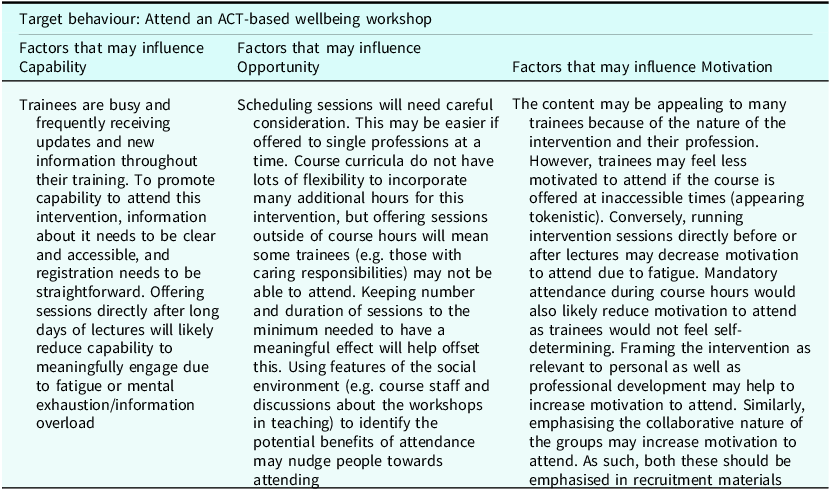
COM-B analysis for the target behaviour of attending an ACT-based wellbeing workshop

Table 1 Long description
This table outlines factors influencing Capability, Opportunity, and Motivation for attending an ACT-based wellbeing workshop. It emphasizes clear information for capability, flexible scheduling for opportunity, and framing personal relevance and collaboration to boost motivation.
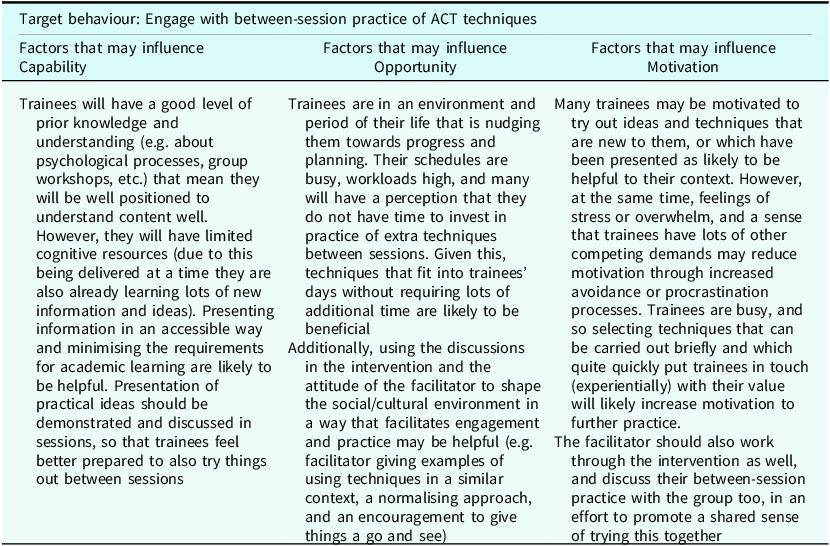
COM-B analysis for the target behaviour of engaging with between-session practice of ACT techniques

Table 2 Long description
This table outlines factors influencing Capability, Opportunity, and Motivation for engaging with between-session practice of ACT techniques. It emphasizes presenting practical ideas clearly, integrating brief exercises into busy schedules, and fostering a supportive, shared environment.
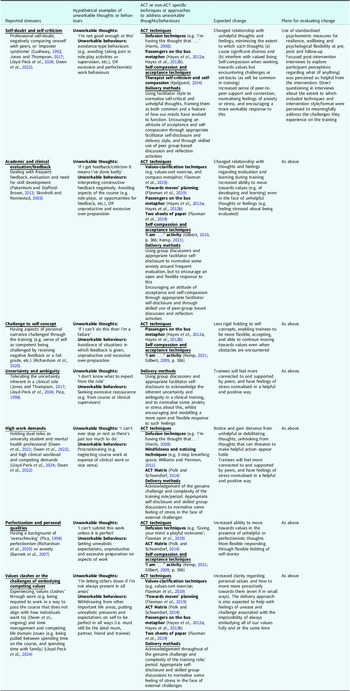
Literature-informed review of stressors reported by trainees, and proposed ways of addressing them

Table 3 Long description
This table maps reported stressors and unworkable thoughts/behaviours to ACT techniques, delivery methods, expected changes, and evaluation plans. Key areas addressed include self-doubt, feedback, high work demands, and value clashes..
The content of this table reflects the prominent stressors and challenges reported by trainees identified in the published literature. For each set of stressors, hypothetical examples of the types of thoughts or behaviours associated with them are provided to help give a context to what may be being addressed. The techniques considered helpful for addressing these challenges, the ways in which change was expected to be brought about, and the plans developed for assessing such change are also detailed in an effort to support the development and refinement of the theory of change. This content was refined through discussion with stakeholders.
References are provided for all techniques. However, techniques have been adapted and presented in specific ways tailored to the context and challenges of PFTs in particular. Examples of adapted resources are presented in the Supplementary material: file 2A (adapted Passengers on the bus hand out) and file 2B (Therapist self-criticism hand-out).
Passengers on the bus metaphor: a complete ACT metaphor combing all six key ACT processes, including (1) Separating the unhelpful thoughts from the person having them (defusion), (2) Learning that we’re more than our unhelpful thoughts (self-as-context), (3) Learning to tune into our own responding (present moment awareness), (4) Identifying what’s important for us down the road (values clarification), (5) Taking steps towards our values even in the face of unhelpful thoughts, etc. (committed action), and (6) Learning to make some room for unhelpful thoughts and feelings (acceptance).
Therapist self-criticism and self-compassion (Kjelgaard, Reference Kjelgaard2014): video and discussion point aimed at normalising self-critical thoughts and encouraging self-compassion in therapists.
Defusion techniques: (e.g. ‘I’m having the thought that …’ (Harris, Reference Harris2008) or ‘giving the mind a playful nickname’ (Flaxman et al., Reference Flaxman, Mcintosh and Oliver2019) cognitive techniques to achieve psychological distance from content of the mind).
Mindfulness and noticing techniques: (e.g. 3-step breathing space; Williams and Penman, Reference Williams and Penman2011) experiential noticing techniques designed to support getting good at noticing the activity of the mind).
Values-clarification techniques: values-sort exercise to clarify important personal values, and compass metaphor to support the idea of values as a behaviour guide (Flaxman et al., Reference Flaxman, Mcintosh and Oliver2019).
‘Towards moves’ planning (Flaxman et al., Reference Flaxman, Mcintosh and Oliver2019): written plan to support trainees to make moves towards training related values.
ACT Matrix (Polk and Schoendorf, Reference Polk and Schoendorf2014): written technique to support trainees in identifying when unhelpful thoughts/feelings might get in the way of acting in accordance with values, and to get more skilled at identifying ways to move towards values in the presence of such thoughts.
Two sheets of paper (Flaxman et al., Reference Flaxman, Mcintosh and Oliver2019): visual representation designed to encourage an approach of being driven more by values than unhelpful thoughts/feelings.
‘I am …’ activity (Kemp, Reference Kemp2021; Gilbert, Reference Gilbert2009, p. 386): designed to help people see the multiplicity of self-stories they have for themselves, and to hold onto self-stories ‘lightly’ without being unhelpfully constrained by them.
Stakeholders reviewed multiple aspects of the developed intervention at two separate time points, including reviewing several hand-outs and slides in their finalised form, reviewing the proposed theory of change at both meetings, and informing discussions regarding where, when and for how long the intervention should run. The resultant intervention draws on features of existing ACT protocols (Flaxman et al., Reference Flaxman, Mcintosh and Oliver2019), established ACT techniques (Harris, Reference Harris2008), and elements of compassion-focussed approaches (Gilbert, Reference Gilbert2009), whilst also creating new resources and materials specifically for the PFT context. All examples and techniques have been adapted for the specific PFT context (e.g. PFT specific examples).
Intervention outline
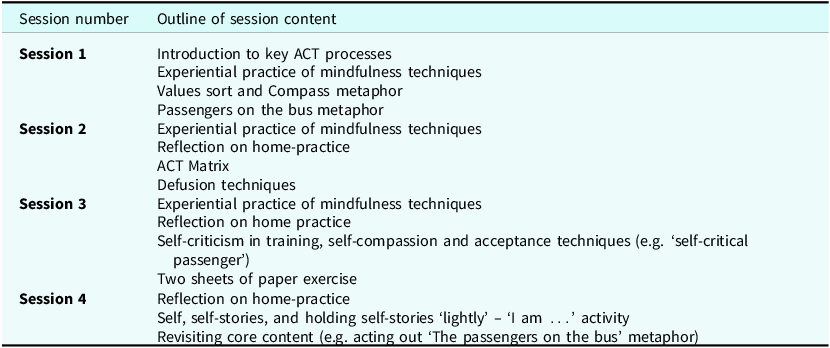
In keeping with TIDieR guidelines (Hoffmann et al., Reference Hoffmann, Glasziou, Boutron, Milne, Perera, Moher, Altman, Barbour, Macdonald, Johnston, Kadoorie, Dixon-Woods, McCulloch, Wyatt, Phelan and Michie2014), comprehensive details regarding the planned intervention are outlined in this paper. ‘Thriving in training: an Acceptance and Commitment Therapy (ACT) group wellbeing intervention for psychological professional trainees’ is a psychological intervention designed to improve wellbeing in trainee psychological professionals. The intervention is underpinned by the COM-B model of behaviour change (Michie et al., Reference Michie, van Stralen and West2011) and has been developed based on principles and techniques from ACT (Hayes et al., Reference Hayes, Strosahl and Wilson2012a; Hayes et al., Reference Hayes, Strosahl and Wilson2012b). In smaller ways, ideas from compassion-focused therapy (Gilbert, Reference Gilbert2009) have also been drawn on. As demonstrated in Table 3, these approaches were selected due to the potential they have for addressing the specific stressors reported by trainees, and the way in which their underlying assumptions align with accounts of wellbeing and positive functioning in the role given by psychological professionals and trainees. The techniques used throughout the intervention and an overview of session content are described in Tables 3 and 4. Examples of study materials are provided in Supplementary material (files ‘2A’ and ‘2B’). The intervention is delivered remotely (via Teams) in order to be accessible to trainees over a large geographical region. It has been designed to be delivered over four sessions, each 2 hours in length, and each consisting of facilitator-led content on ACT, experiential practice of ACT techniques, and group discussion. All four sessions are designed to take place over a period of approximately 6 weeks, with individual sessions typically scheduled between 1 and 3 weeks apart. It is designed to be delivered by one person, who may be a core member of staff on the training programme on which trainees are studying. It is assumed that group facilitators have a strong foundational knowledge of ACT, and experience delivering group-based interventions or psycho-educational workshops. For an outline of the intervention, see Table 4.
Overview of intervention content by session

Table 4 Long description
A table outlining the content of a psychological intervention program across four sessions. The table has two columns: Session number and Outline of session content. It has four rows, each corresponding to a session. Row 1: Session 1, Introduction to key ACT processes, Experiential practice of mindfulness techniques, Values sort and Compass metaphor, Passengers on the bus metaphor. Row 2: Session 2, Experiential practice of mindfulness techniques, Reflection on home-practice, ACT Matrix, Defusion techniques. Row 3: Session 3, Experiential practice of mindfulness techniques, Reflection on home practice, Self-criticism in training, self-compassion and acceptance techniques (e.g., 'self-critical passenger'), Two sheets of paper exercise. Row 4: Session 4, Reflection on home-practice, Self, self-stories, and holding self-stories 'lightly' - 'I am ...' activity, Revisiting core content (e.g., acting out 'The passengers on the bus' metaphor).
Theory of change
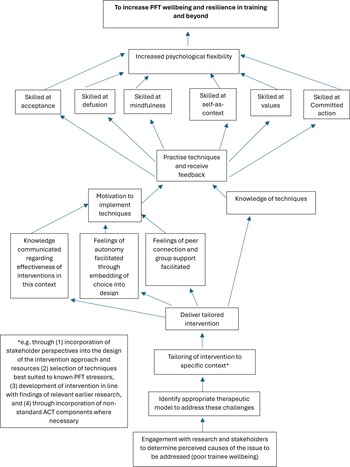
A visual (Fig. 2) and narrative account of the theory of change for the intervention are presented below. The process of establishing a theory of change supports the identification of key assumptions underpinning the approach, and visual depictions provide a succinct overview of intended pathways to change (Anderson, Reference Anderson2009). Whilst it has been acknowledged that visual representations of a theory of change necessarily simplify often complex processes (PHE, 2018), they nonetheless provide a useful framework for defining testable expectations about how an intervention will function. Theories of change typically begin by establishing the intended outcome, and then working backwards to systematically set out the necessary pre-conditions and earlier outcomes for this to be achieved (Anderson, Reference Anderson2009). This process has been completed for the current intervention, and is detailed below in Fig. 2. A narrative description which expands this is then presented.
Theory of change.

Assumptions of the theory of change
-
(1) That an adapted form of ACT is well suited to meeting the demands of trainees;
-
(2) That an intervention tailored to individuals in this way can make meaningful differences to trainee wellbeing despite not altering the often objectively challenging circumstances within which they are working/training;
-
(3) That implementing techniques practically is necessary to bring the desired change;
-
(4) That trainee motivation will be enhanced by the provision of some degree of choice/autonomy in features of the intervention, and by peer support and collaboration;
-
(5) That belief in the effectiveness of interventions for addressing PFT challenges is needed to engage in the intervention;
-
(6) That given sufficient support and information, trainees will be willing to engage with the intervention and practice techniques;
-
(7) That increasing psychological flexibility will support improved wellbeing and resilience outcomes.
Theory of change: narrative description
The intervention purpose is to improve wellbeing and resilience in PFTs. Based on the literature, it is assumed that using an adapted ACT-based intervention tailored to the PFT context will help to increase psychological flexibility in trainees, and that this will help to produce improved wellbeing and resilience. The main driver of outcomes therefore is assumed to be an increase in psychological flexibility. A range of important pre-conditions are assumed to be necessary to support this. Based on earlier literature, stakeholder perspectives gathered during the intervention development process, and anecdotal evidence from training, it is predicted that in order for trainees to engage fully with the intervention (and therefore to have the opportunity to benefit from it) they will need to feel supported by the course/organisation, have the opportunity to learn together with peers, feel some degree of choice or autonomy over features of the intervention, and have a realistic sense of hope or optimism about the potential for individual-level action to lead to change.
Implementing this intervention requires a range of resources, including staff/researcher time. In keeping with the delivery of many well-established features of training in this area (e.g. self-practice/self-reflection, or reflective practice groups) it is expected that the intervention be delivered by core members of training staff where there are those with adequate understanding to do so. It will also require the investment of time and energy from trainees themselves (to attend the sessions, and to implement techniques in between). On the basis of existing literature and the stakeholder meetings within this intervention development study, it is being assumed that trainees will have relatively little time and capacity to do so, so the intervention has been designed to be as brief as possible, whilst being sufficiently intense to be considered likely (according to relevant literature) to bring about a positive change. Techniques have also been selected that typically require little or no additional time in a trainee’s day to practise (i.e. noticing a self-critical ‘passenger’ during daily activity, or identifying ‘towards moves’ in daily action).
All stages of the intervention will take place in a context in which trainees will be working clinically and receiving their clinical training, and the relationship between the intervention and context will likely be bi-directional and complex. Demands on trainee time due to academic and clinical workload for example might influence the extent to which trainees feel able to attend sessions or practise techniques. At the same time, the training context will provide multiple situations in which intervention ideas can be practised. Similarly, ideas and techniques learned in the intervention may influence trainees’ experience of the training itself (i.e. increased flexibility and committed action as a result of the intervention may encourage trainees to periodically step back a little more from the demands of training, to give more time and space to self-care or other important life areas such as family).
Discussion
This paper outlines the process followed in the development of ‘Thriving in training: an Acceptance and Commitment Therapy (ACT) group wellbeing intervention for psychological professional trainees’. As such, it contributes to the development and advancement of cognitive-behavioural theory and practice, by setting out the processes underpinning and the theoretical rationale for the development of this ACT-based intervention. It also responds to calls in the literature for more consistent reporting of intervention development processes (Hoddinott, Reference Hoddinott2015) and consideration of how interventions will be delivered and experienced in real-world training settings (Duncan et al., Reference Duncan, O’Cathain, Rousseau, Croot, Sworn, Turner, Yardley and Hoddinott2020). Guided by the MRC framework for developing and evaluating complex interventions (Skivington et al., Reference Skivington, Matthews, Simpson, Craig, Baird, Blazeby, Boyd, Craig, French, McIntosh, Petticrew, Rycroft-Malone, White and Moore2021) and adhering to guidance regarding the reporting of intervention development studies (Duncan et al., Reference Duncan, O’Cathain, Rousseau, Croot, Sworn, Turner, Yardley and Hoddinott2020) and intervention details (Hoffman et al., Reference Hoffmann, Glasziou, Boutron, Milne, Perera, Moher, Altman, Barbour, Macdonald, Johnston, Kadoorie, Dixon-Woods, McCulloch, Wyatt, Phelan and Michie2014), the study reflects an effort to move the literature regarding PFT wellbeing interventions forward. Whilst a large number of earlier studies have reported outcome data, the field includes few attempts to detail the procedures followed when developing an intervention, or to theorise how an intervention would be expected to function successfully in context. Similarly, little attention has been paid in prior work to understanding how trainees experience wellbeing (as a reduction in stress, or an increase in meaning, for example), or to attempt to align interventions with this contextually shaped outcome in mind. These are important gaps in the field that the current study seeks to address.
In keeping with findings of prior research indicating that many of the challenges and stresses experienced by PFTs are shared across multiple psychological professions (Owen et al., Reference Owen, Crouch-Read, Smith and Fisher2021; Pakenham and Stafford Brown, Reference Pakenham and Stafford-Brown2012; Richardson, Reference Richardson, Trusty and George2020), the intervention was developed to be applicable for trainees across the psychological professions, including those who deliver CBT in various forms.
Whilst acknowledging the many and important differences between the training requirements of different psychological professions, the stakeholder input to this study, and much of the wider research drawn upon in its development indicate that there is much shared regarding what is experienced as challenging during the training period. In keeping with this, the process described here has drawn on research with trainees across a wide range of psychological professions to inform its development (e.g. Owen et al., Reference Owen, Biggart, Fisher, Figueredo, Al-Rousi, Colvin-Jarvis, Williamson and Sanderson2025; Vivolo et al., Reference Vivolo, Owen and Fisher2024).
Notably, many training programmes across the psychological professions will already dedicate some of the curriculum to considering issues relating to self-care, personal practice, or reflection. Many of the existing approaches in this area will already draw on some of the delivery methods used in the current intervention and described in Table 3. In some specific ways therefore, the developed intervention may have at least some overlap with aspects of existing provision, and it could be used to supplement or replace existing practice, as considered appropriate by course staff. Whilst not intended to replace the educational benefits associated with some forms of personal practice such as self-practice/self-reflection (Bennett-Levy and Lee, Reference Bennett-Levy and Lee2014), the intervention does respond to a concern identified in some aspects of the literature that many of the existing offers on supporting personal wellbeing during training are experienced by trainees as either too abstract or insufficiently practical (Owen et al., Reference Owen, Biggart, Fisher, Figueredo, Al-Rousi, Colvin-Jarvis, Williamson and Sanderson2025).
With trainee wellbeing an important area of concern given the known influence of wellbeing on clinical effectiveness (Delgadillo et al., Reference Delgadillo, Saxon and Barkham2018), academic learning (Pascoe et al., Reference Pascoe, Hetrick and Parker2020), and intention to stay in post (Summers et al., Reference Summers, Morris, Bhutani, Rao and Clarke2021), this theory-, evidence- and stakeholder-informed intervention has the potential to be an important and valuable addition to the literature.
Strengths and limitations
Stakeholder input was central to this study, and provided critical insight regarding how the intervention was expected to function in practice. This represents a key strength to this study. Stakeholders reflected a diversity of viewpoints, representing a range of professional backgrounds and demographic and ethnic characteristics. Despite this, an important limitation relates to the fact that explicit attempts were not made to explore in-depth the specific challenges experienced uniquely by trainees from ethnic minority backgrounds. Whilst the challenges the intervention seeks to address are drawn from literature including a wide range of PFTs, and participants in this study fed back in detail both on how the identified challenges were reflective of their experience and the extent to which the intervention was considered well-suited to addressing them, wider evidence demonstrating that ethnic minorities experience a range of unique stressors both in study and work (Rhead et al., Reference Rhead, Harber-Aschan, Onwumere, Polling, Dorrington, Ehsan and Hatch2024; Stoll et al., Reference Stoll, Yalipende, Bryom, Hatch and Lempp2022) suggest that this would be an important area for future work to focus on.
It is notable that the recruitment of trainees to the process was more challenging than the recruitment of staff. In total, three current trainees attended both meetings, with two further trainees having expressed an interest in taking part, but dropping out shortly before the meetings. The reason given by trainees for dropping out was that they did not have enough time, or felt already too busy with the demands of their training. This in itself was considered as an important piece of information that helped feed into and inform aspects of how the intervention was designed. The fact that trainees across two separate professions had been interested to take part, but found themselves unable to find the time to do so meant that careful consideration was given to how any intervention would sit around and be received in the context of such a busy and time-stretched training period. It also highlights an important limitation, in that only two professional training roles were represented by trainees (Clinical Psychology and Clinical Associates in Psychology) despite the intervention being developed with the intention of being appropriate for trainees across the psychological professions. The views and experiences of trainees across other professional training programmes will therefore need to be carefully considered and included in the evaluation of the intervention itself. Nonetheless, it is worth noting that professional staff represented views across five separate psychological professions. Additionally, we chose not to recruit workplace supervisors to take part as intervention stakeholders. This decision was driven in part by pragmatic considerations regarding the feasibility of finding suitable time slots for stakeholders from multiple different settings within a limited time frame, but also partly due to the fact that all of the included professional training staff were also current or past workplace supervisors. As such, it was considered that professional training staff would be able to offer perspectives that reflected considerations of both positions. Nonetheless, we acknowledge the important limitation of not having stakeholders included specifically for the perspective of workplace supervisors.
As noted already, participants for this study were recruited from trainees and professional staff, all of whom hold busy full-time academic/clinical posts. As such, efforts were made throughout to make participation as accessible as possible, by minimising demands for taking part (e.g. by keeping the number of intervention development meetings down to a minimum, minimising any requirements for preparation ahead of meetings, and using the COM-B model in a contained and focused way). Whilst a further limitation therefore potentially relates to the more contained and focused use of the COM-B model (as opposed to the more comprehensive Behaviour Change Wheel (BCW)) it is noteworthy that this was considered likely to facilitate trainee and staff participation, by avoiding the extensive time and resource implications others in the field have noted that the BCW has required (Webb et al., Reference Webb, Foster and Poulter2016).
Plans for the evaluation of this intervention were determined in advance, with a focus on evaluating the acceptability and feasibility of the intervention, as well as testing the theory of change presented here. The intervention was recently delivered to trainees across five separate psychological professions (education mental health practitioners, clinical associates in psychology, clinical psychologists, high-intensity cbt therapists, and psychological wellbeing practitioners). A mixed-methods evaluation was used to explore factors relating to acceptability and feasibility (e.g. recruitment rates, retention, data completion, and trainee perspectives regarding how they experienced taking part in the context of real-world training), as well as to look for signals of efficacy by exploring change in outcomes of interest (e.g. psychological flexibility, wellbeing, stress, and resilience). Findings of this evaluation are currently under review for publication.
Conclusion
It has been noted that until recently, the processes and decision-making sitting behind the development of complex interventions has rarely been reported (Hoddinott, Reference Hoddinott2015). The current intervention development study has followed best-practice guidance on the processes and reporting of intervention development studies (Duncan et al., Reference Duncan, O’Cathain, Rousseau, Croot, Sworn, Turner, Yardley and Hoddinott2020), to describe in detail the steps followed in the development of ‘Thriving in training: an Acceptance and Commitment Therapy (ACT) group wellbeing intervention for psychological professional trainees’. The acceptability and feasibility evaluation of this intervention has been written up in a separate paper currently being prepared for peer review.
Key practice points
-
(1) This paper has described the processes followed in developing an intervention to support wellbeing in psychological professional trainees.
-
(2) Stakeholder perspectives and a body of wider theory and research were used to design the intervention to be acceptable to trainees, and implementable in the context of real-world training, generating evidence and knowledge with practical implications for those involved in training psychological professionals.
-
(3) The COM-B model of behaviour was used to provide an over-arching framework for understanding how to support effective behaviour change through the intervention.
-
(4) The developed intervention aims to fill important gaps in the trainee wellbeing literature, by detailing the processes followed in developing this intervention, and setting out a clear and testable theory of change.
Supplementary material
To view supplementary material for this article, please visit https://doi.org/10.1017/S1754470X26100750
Data availability statement
The data that support the findings of this study are available from the corresponding author upon reasonable request.
Acknowledgements
None.
Author contributions
Joel Owen: Conceptualization (lead), Data curation (lead), Formal analysis (lead), Investigation (lead), Project administration (lead), Writing - original draft (lead); Laura Biggart: Conceptualization (equal), Investigation (equal), Supervision (equal), Validation (equal), Writing - review & editing (equal); Paul Fisher: Conceptualization (equal), Investigation (equal), Supervision (equal), Validation (equal), Writing - review & editing (equal); Naoko Kishita: Conceptualization (equal), Investigation (equal), Supervision (equal), Validation (equal), Writing - review & editing (equal); Kristy Sanderson: Conceptualization (equal), Investigation (equal), Supervision (equal), Validation (equal), Writing - review & editing (equal).
Financial support
This study is supported by the National Institute for Health and Care Research (NIHR) Applied Research Collaboration East of England (NIHR ARC EoE) at Cambridgeshire and Peterborough NHS Foundation Trust. The views expressed are those of the author(s) and not necessarily those of the NIHR or the Department of Health and Social Care.
Competing interests
There are no competing interests to declare.
Ethical standards
Ethical approval for this study was sought and obtained via the Research Ethics Committee at the employing university of the research team (ETH2425-0273). Authors have abided by the ethical principles of the BPS and BABCP. Participants confirmed consent to take part, and for findings to be published.


 Open access


Comments
No Comments have been published for this article.