Introduction
Late-life depression (LLD) is defined as a clinical diagnosis of major depressive disorder (MDD) according to DSM-IV criteria, occurring in late life typically after 60 years of age, although younger criteria have been applied (Aizenstein et al. Reference Aizenstein, Andreescu, Edelman, Cochran, Price, Butters, Karp, Patel and Reynolds2011; Barch et al. Reference Barch, D'Angelo, Pieper, Wilkins, Welsh-Bohmer, Taylor, Garcia, Gersing, Doraiswamy and Sheline2012; Korten et al. Reference Korten, Comijs, Lamers and Penninx2012). LLD has been associated with structural brain changes in gray and white matter, with both atrophy and the appearance of white-matter hyperintensities [WMH, areas of white-matter damage visible on T2-weighted magnetic resonance imaging (MRI)] independently influencing diagnoses of depression (Kumar et al. Reference Kumar, Mintz, Bilker and Gottlieb2002; Bae et al. Reference Bae, MacFall, Krishnan, Payne, Steffens and Taylor2006; Ballmaier et al. Reference Ballmaier, Narr, Toga, Elderkin-Thompson, Thompson, Hamilton, Haroon, Pham, Heinz and Kumar2008). Research has indicated that white-matter damage associated with vascular disease may be a core mechanism in developing and/or maintaining depressive symptoms among older adults (Alexopoulos et al. Reference Alexopoulos, Meyers, Young, Campbell, Silbersweig and Charlson1997a , Reference Alexopoulos, Buckwalter, Olin, Martinez, Wainscott and Krishnan2002b ; Krishnan, Reference Krishnan2002). WMH are prevalent in LLD and show different patterns across brain regions compared to healthy controls (HC), with frontal regions being particularly implicated (Fujikawa et al. Reference Fujikawa, Yamawaki and Touhouda1993; Taylor et al. Reference Taylor, MacFall, Steffens, Payne, Provenzale and Krishnan2003; Herrmann et al. Reference Herrmann, Le Masurier and Ebmeier2008).
Despite evidence for the role of white-matter damage, a study that examined LLD treatment responders and non-responders found no difference in WMH between groups (Janssen et al. Reference Janssen, Hulshoff Pol, Schnack, Kok, Lampe, de Leeuw, Kahn and Heeren2007). As both groups in this study were depressed, this may explain their equivalent WMH. Alternatively, WMH may lack the sensitivity to detect subtle damage to white matter prior to development of frank lesions (O'Sullivan et al. Reference O'Sullivan, Summers, Jones, Jarosz, Williams and Markus2001; Charlton et al. Reference Charlton, Schiavone, Barrick, Morris and Markus2010b ). Diffusion tensor imaging (DTI), a technique used to quantify water diffusion in tissue, is more sensitive to tissue damage than the presence of WMH and can detect damage even in normal appearing white matter (O'Sullivan et al. Reference O'Sullivan, Summers, Jones, Jarosz, Williams and Markus2001; Charlton et al. Reference Charlton, Schiavone, Barrick, Morris and Markus2010b ). A series of DTI studies by Taylor and colleagues noted lower white-matter integrity in regions of interest (ROIs) in frontal white matter and the cingulum in LLD compared to age-matched controls using fractional anisotropy (FA; Taylor et al. Reference Taylor, MacFall, Payne, McQuoid, Provenzale, Steffens and Krishnan2004; Bae et al. Reference Bae, MacFall, Krishnan, Payne, Steffens and Taylor2006). FA quantifies the degree of water diffusion anisotropy in a voxel and is higher in organized white-matter fibers. FA was found to be lower in frontal white matter and cingulum ROIs placed in patients who did not respond to treatment compared to responders (Alexopoulos et al. Reference Alexopoulos, Kiosses, Choi, Murphy and Lim2002a , Reference Alexopoulos, Murphy, Gunning-Dixon, Latoussakis, Kanellopoulos, Klimstra, Lim and Hoptman2008). The DTI metrics of axial (AD) and radial diffusion (RD) can also be examined (Song et al. Reference Song, Sun, Ramsbottom, Chang, Russell and Cross2002; Sun et al. Reference Sun, Neil and Song2003). RD is presumed to represent the integrity of myelin, and is lower in healthy tissue; RD in prefrontal white matter is lower in LLD compared to controls (Shimony et al. Reference Shimony, Sheline, D'Angelo, Epstein, Benzinger, Mintun, McKinstry and Snyder2009). AD is assumed to represent axonal integrity, although both higher and lower values have been associated with axonal damage (Budde et al. Reference Budde, Xie, Cross and Song2009; Metwalli et al. Reference Metwalli, Benatar, Nair, Usher, Hu and Carew2010). Mean diffusivity (MD), another common DTI metric, represents tissue complexity; it is lower in highly organized white-matter tracts. Few studies have applied these sensitive metrics to a detailed investigation of white-matter tract integrity in LLD.
The white-matter tracts of the cingulum and the uncinate fasciculi have been hypothesized to be particularly important in MDD, as they connect regions implicated in mood regulation, including the prefrontal cortex, cingulate and hippocampal gyri (Zhang et al. Reference Zhang, Leow, Ajilore, Lamar, Yang, Joseph, Medina, Zhan and Kumar2012). In the cingulum, short U-shaped fibers connect the cingulate cortex, frontal, temporal, parietal and occipital cortices (Catani & Thiebaut de Schotten, Reference Catani and Thiebaut de Schotten2008). ROIs placed within the cingulum have demonstrated lower FA values in patients with LLD compared to HC (Bae et al. Reference Bae, MacFall, Krishnan, Payne, Steffens and Taylor2006) and FA values correlate with depression severity in middle-aged individuals with persistent depression after acute coronary syndrome (Rapp et al. Reference Rapp, Rieckmann, Lessman, Tang, Paulino, Burg and Davidson2010). The uncinate fasciculus connects the anterior temporal lobe (including the parahippocampal gyrus) with medial and lateral orbitofrontal cortices (Catani & Thiebaut de Schotten, Reference Catani and Thiebaut de Schotten2008); WMH within this tract correlate with depressive severity in multiple sclerosis (Pujol et al. Reference Pujol, Bello, Deus, Martí-Vilalta and Capdevila1997).
To date, few studies have examined white-matter integrity across whole white-matter tracts in LLD. One study that extracted the left and right uncinate fasciculi found no differences in FA values between LLD patients and HC (Taylor et al. Reference Taylor, MacFall, Gerig and Krishnan2007). However, a recent study from our group exploring white-matter integrity across the lifespan (30–65 years) of MDD, identified lower white-matter integrity (lower FA and higher RD) in the right uncinate fasciculus but not the left (Zhang et al. Reference Zhang, Leow, Ajilore, Lamar, Yang, Joseph, Medina, Zhan and Kumar2012). No group differences were noted in the right or left cingulum or with MD and AD metrics (Zhang et al. Reference Zhang, Leow, Ajilore, Lamar, Yang, Joseph, Medina, Zhan and Kumar2012). The age range presented in the Zhang et al. (Reference Zhang, Leow, Ajilore, Lamar, Yang, Joseph, Medina, Zhan and Kumar2012) study was 30–65 years, with only a small proportion of the sample being considered LLD. A recent literature search has not identified any other studies that have examined the integrity of these white-matter tracts in LLD. In addition to the associations between tract integrity and mood regulation, the cingulum and the uncinate fasciculus are also associated with cognitive function, including abilities impaired in LLD such as learning and memory and executive function (Alexopoulos et al. Reference Alexopoulos, Meyers, Young, Kakuma, Silbersweig and Charlson1997b ; Elderkin-Thompson et al. Reference Elderkin-Thompson, Mintz, Haroon, Lavretsky and Kumar2006). Among healthy older adults the integrity of both the cingulum and the uncinate fasciculi have been associated with memory and executive function but the same pattern has not yet been demonstrated in LLD (Kennedy & Raz, Reference Kennedy and Raz2009; Charlton et al. Reference Charlton, Barrick, Markus and Morris2010a ; Metzler-Baddeley et al. Reference Metzler-Baddeley, Jones, Belaroussi, Aggleton and O'Sullivan2011).
By examining an entire tract rather than ROIs, differences in integrity along the tract are included, this may provide greater sensitivity for detecting white-matter damage associated with LLD. This process may also limit problems with image co-registration and pre-processing common in voxel-based DTI analyses. The aim of the current study was to examine white-matter integrity of the cingulum and the uncinate fasciculi in untreated LLD and to explore associations with the cognitive difficulties common among older depressed populations (Elderkin-Thompson et al. Reference Elderkin-Thompson, Mintz, Haroon, Lavretsky and Kumar2006; Barch et al. Reference Barch, D'Angelo, Pieper, Wilkins, Welsh-Bohmer, Taylor, Garcia, Gersing, Doraiswamy and Sheline2012). We hypothesized that white-matter integrity would be compromised (i.e. lower FA and higher MD and RD values) within the cingulum and uncinate fasciculi of LLD patients compared to age-matched HC. Furthermore, we hypothesized that white-matter integrity within these tracts would be associated with both depression severity and cognitive abilities that rely on integration of information across distributed cognitive networks, such as memory and executive function.
Method
Participants
Data were collected as part of a program of research investigating depression and diabetes across the lifespan at the University of Illinois at Chicago (UIC), Department of Psychiatry. All studies were approved by the UIC Institutional Review Board and conducted in accordance with the Declaration of Helsinki. All participants gave informed consent.
The LLD group included non-demented adults aged ⩾60 years with a clinical diagnosis of MDD; HC were non-demented, non-depressed adults aged ⩾60 years. Individuals were recruited through community outreach (newspaper, radio and television advertisements) and completed a preliminary telephone screen. Exclusion criteria for all participants were not having English as a first language, current or past history of brain disorders (dementia, stroke, seizure, etc.), history of head injury or loss of consciousness, sleep apnea, present or past history of substance abuse or dependence, or current psychotropic medication use including antidepressant medication. Thus, LLD subjects were medication free so that we could study depressed mood in an untreated state. In the LLD group, present or past history of an Axis I psychiatric diagnosis other than MDD was also an exclusion criterion. HC had no current or previous diagnosis of an Axis I psychiatric disorder.
After passing the telephone screen, participants completed a detailed evaluation including cognitive [Mini-Mental State Examination (MMSE; Folstein et al. Reference Folstein, Folstein and McHugh1975)] and affective [Structured Clinical Interview for DSM-IV (SCID; Spitzer et al. Reference Spitzer, Williams, Gibbon and First1992)] screens for final inclusion determination. Measures were administered by a trained research assistant, followed by an evaluation by a board-certified (A.K.) or board-eligible (O.A.) psychiatrist who completed the Hamilton Depression Rating Scale (HAMD; Hamilton, Reference Hamilton1960). Raters were blind to telephone screen information. Final inclusion criteria for healthy older participants included absence of symptoms of depression based on the SCID and a score of < 8 on the HAMD. For MDD individuals, the inclusion criterion was a score of ⩾15 on the HAMD. All participants were native English speakers and had an MMSE score > 24. Although the MMSE is often used as a screen for risk of dementia, it may be insensitive to early stages of the disease; therefore, if any individual demonstrated a cognitive profile (based on the neuropsychological assessment described here) that suggested impaired function, they were also excluded from the study. As described in the following exclusion criteria, no participant was excluded for this reason. All participants completed the Center for Epidemiological Studies Depression Scale (CESD; Radloff, Reference Radloff1977) as a subjective measure of depressive symptomatology. Participants received an assessment of vascular risk using the Framingham Stroke Risk Profile (FSRP) score (Wolf et al. Reference Wolf, D'Agostino, Belanger and Kannel1991).
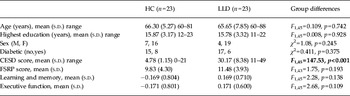
The initial screening was attended by 133 individuals aged ⩾60 years. Of these, 34 individuals were excluded based on screen results: 15 had past substance abuse/dependence, five had English as a second language, three were on contra-indicative medication, five had exclusionary psychiatric diagnoses, two had suffered a previous sustained loss of consciousness and four had sleep apnea. Of the 99 individuals who passed the screen, 62 had DTI data available for analysis (MDD, n = 23; HC, n = 39). Within the LLD sample, only three participants had late-onset MDD, that is age of onset after 60 years. Given the unbalanced nature of our groups, individuals from the HC group were selected to match the MDD group on age, education level and sex; thus the groups were matched and controlling for covariates in the analysis was not required. The final sample (n = 46) included 23 LLD and 23 HC (see Table 1 for details). Individuals with diabetes were included in both groups [LLD, n = 6, mean glycosylated hemoglobin (hA1c) = 6.37 (range 5.3–6.9), mean duration of diagnosis = 55 (range 6–156) months; HC, n = 8, mean hA1c = 7.5 (range 6.5–8.7), mean duration of diagnosis = 130 (range 8–240) months]. The number of participants within each group with diabetes was small and unsuitable for statistical analysis, but the data suggest that the duration of diabetes is of longer standing and possibly more severe among HC compared to the LLD group. Within the whole sample, 10 individuals (LLD = 3, HC = 7) overlapped with a previously reported sample (Zhang et al. Reference Zhang, Leow, Ajilore, Lamar, Yang, Joseph, Medina, Zhan and Kumar2012); for transparency, the results that overlapped with previous analyses are reported in Supplementary Tables online with these individuals excluded from analyses; any differences between results are noted in Tables 2 and 3.
Demographic variables for HC and LLD groups

HC, Healthy controls; LLD, late-life depression; M, male; F, female; CESD, Center for Epidemiological Studies Depression Scale; FSRP, Framingham Stroke Risk Profile; s.d., standard deviation.
Bold items p < 0.05.
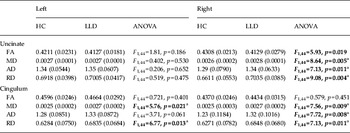
Differences between HC and LLD groups by WM tract and DTI parameters

HC, Healthy controls; LLD, late-life depression; WM, white matter; DTI, diffusion tensor imaging; FA, fractional anisotropy; MD, mean diffusivity; AD, axial diffusivity; RD, radial diffusivity.
Bold items p < 0.05.
a Result remains significant if previously analyzed individuals are removed. All results remain significant after false discovery rate (FDR) multiple comparison correction.
Correlations between WM tract integrity and cognition for HC

WM, White matter; HC, healthy controls; LLD, late-life depression; FA, fractional anisotropy; MD, mean diffusivity; AD, axial diffusivity; RD, radial diffusivity.
Bold items p < 0.05.
Neuropsychological assessment
Qualifying participants attended a second visit when a comprehensive neuropsychological assessment was administered by a trained research assistant (on average 1.17 weeks after the depression assessments). Learning and memory and executive function were selected as abilities hypothesized to be associated with the extracted white-matter tracts and were assessed using the following measures. Learning and memory: the California Verbal Learning Test – Second Edition (CVLT-II; Delis et al. Reference Delis, Kramer, Kaplan and Ober2000) short and long delay free recall; and free recall measures from the Wechsler Memory Scale – Third Edition (WMS-III; Wechsler et al. Reference Wechsler, Wycherley, Benjamin, Callanan, Lavender, Crawford and Mockler1998) Logical Memory I and II and also Visual Reproduction I and II. Executive function: Category Switching total correct from the Delis–Kaplan Executive Function System (DKEFS) battery (Delis et al. Reference Delis, Kaplan and Kramer2001); the Trail Making Test B time to completion (Army Individual Test Battery, 1944); the Stroop Interference Score (Golden, Reference Golden1978); the Backwards Digit Span raw score from WAIS-III (Wechsler, Reference Wechsler1997); and the Self-Ordered Pointing Task (SOPT; Petrides & Alivistatos, Reference Petrides and Alivistatos2002) Total Errors. Raw scores were transformed into z scores using the mean and standard deviation of the whole sample. z scores were coded so that high scores reflected good performance across all variables and were collated to produce a mean score for the two cognitive domains. Cronbach's α values were computed to assess how well the variables measured each latent construct. These values were considered good, indicating that each variable measured a unidimensional latent construct (learning and memory, α = 0.862; executive function, α = 0.768).
MRI acquisition
All brain MRI data were acquired on a Philips Achieva 3.0-T scanner (Philips Medical Systems, The Netherlands) using an eight-channel sensitivity encoding (SENSE) head coil. Subjects were positioned comfortably in the scanner and fitted with soft ear plugs, and foam pads were used to minimize head movement. For each individual, DTI images were acquired using a single-shot spin–echo echo–planar imaging sequence [field of view (FOV) = 240 mm, voxel size = 0.83 × 0.83 × 2.2 mm3, repetition time (TR) = 6994 ms, echo time (TE) = 71 ms, flip angle = 90°]. Sixty-seven contiguous slices aligned to the anterior commissure–posterior commissure line were collected in 32 gradient directions (b = 700 s/mm2) and in one scan with minimally diffusion weighting (b 0 image). The SENSE parallel imaging technique (reduction factor = 2.5) reduced scanning time to approximately 4 min. Individuals attended for an MRI scan on average 3.67 weeks after the neuropsychological assessment.
Image analysis
Image analysis methods are described in brief here (for further details, see Zhang et al. Reference Zhang, Leow, Ajilore, Lamar, Yang, Joseph, Medina, Zhan and Kumar2012). Visual inspection of all image data was conducted to ensure good quality; data with artifacts from movement or other causes were excluded. Participants were not excluded based on the presence of WMH, which are commonly observed among older adults. All diffusion-weighted images (32 gradient directions) were co-registered to the b 0 image using the automatic image registration (AIR) algorithm with affine transformation to minimize eddy currents (Woods et al. Reference Woods, Grafton, Holmes, Cherry and Mazziotta1998). Diffusion tensor calculations and fiber tracking were carried out using DtiStudio (Laboratory of Brain Anatomical MRI, Johns Hopkins Medical Institute, USA; Jiang et al. Reference Jiang, van Zijl, Kim, Pearlson and Mori2006). At each voxel, the signals from the 32 diffusion-weighted images were fitted to obtain the six elements of the diffusion tensor and diagonalized to obtain three eigenvalues (λ 1, λ 2, λ 3) and three eigenvectors (v 1, v 2, v 3). Four measures of white-matter integrity were calculated: FA, MD, AD and RD. To recap, FA quantifies the relative degree of water diffusion anisotropy and is lower when damage occurs; MD represents tissue complexity and RD integrity of myelin, both metrics increase with damage; AD is thought to represent axonal integrity, both higher and lower values have been noted in damaged tissue.
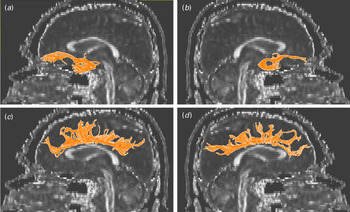
Fiber tracking was performed using the fiber assignment by continuous tractography (FACT) method (Jiang et al. Reference Jiang, van Zijl, Kim, Pearlson and Mori2006). For each subject, tractography was first performed on the whole brain by initiating tracts at each voxel; tracking was stopped when FA fell below 0.15 or the tract angle became larger than 60°. To extract specific tracts, ROIs were carefully delineated by an experienced operator (A.Z.) and fibers passing between ROIs were retained. The uncinate fasciculus was extracted as described by Wakana et al. (Reference Wakana, Caprihan, Panzenboeck, Fallon, Perry, Gollub, Hua, Zhang, Jiang, Dubey, Blitz, van Zijl and Mori2007), the most posterior coronal slice in which the temporal lobe separated from the frontal lobe was identified, and two ROIs were placed encompassing (1) the entire temporal lobe and (2) the entire frontal lobe. The cingulum was extracted with a single cigar-shaped ROI delineating the contour of the cingulum, as described by Catani & Thiebaut de Schotten (Reference Catani and Thiebaut de Schotten2008). Fig. 1 shows examples of the extracted tracts. After the tracts were extracted, metrics were calculated for the mean values of MD, FA, AD and RD along the total length of each tract using an in-house program.
Examples of extracted tracts: (a) left and (b) right uncinate; (c) left and (d) right cingulum.

All tract extractions were performed by a single operator. To ensure accuracy, inter- and intra-rater reliability was determined on a subset of five randomly selected subjects. Intraclass correlation coefficients (ICCs) were obtained for the FA values for each tract and revealed good reliability (inter-rater: ICC = 0.800, p = 0.013; intra-rater: ICC = 0.972, p < 0.001). Furthermore, all reconstructed fibers were visually inspected for quality assurance by an experienced psychiatrist and image analyst. None of the scans were considered unusable.
Statistical analyses
ANOVAs were used to explore group differences in white-matter tract integrity and cognitive function. Correlational analyses were used to explore the associations between white-matter tract integrity and CESD scores, FSRP scores and cognitive function. Multiple comparison correction was performed using false discovery rate (FDR).
Results
Demographic variables
No significant group differences were observed in age (F 1,45 = 0.109, p = 0.742), education level (F 1,45 = 0.008, p = 0.928), sex (χ 2 = 1.08, p = 0.245), hA1c levels (F 1,44 = 0.102, p = 0.751), number of individuals with diabetes (χ 2 = 0.411, p = 0.375) or FSRP score (F 1,43 = 1.75, p = 0.193). No group differences in demographics were seen if previously reported individuals were excluded.
Group differences in white-matter tract integrity
Significant group differences were noted in white-matter integrity of the right uncinate fasciculus (FA, MD, AD, RD), left cingulum (MD, RD) and right cingulum (MD, AD, RD); see Table 2 for full details. After FDR correction, all group differences remained significant. Excluding previously reported individuals did not alter these significant results (see online Supplementary Table S1 for full details).
Correlations between white-matter integrity and depression severity
For the whole sample (LLD and HC combined), depression severity as measured by the CESD correlated significantly with white-matter integrity in the right uncinate fasciculus (FA: r = −0.351, p = 0.018; MD: r = 0.462, p = 0.001; AD: r = 0.422, p = 0.003; RD: r = 0.475, p = 0.001) and the right (MD: r = 0.469, p = 0.001; AD: r = 0.481, p = 0.001; RD: r = 0.451, p = 0.002) and left (MD: r = 0.435, p = 0.003; AD: r = 0.392, p = 0.007; RD: r = 0.446, p = 0.002) cingulum. No significant associations were observed in the left uncinate fasciculus. After FDR correction for multiple comparisons, all correlations remained significant. When correlations were explored for each group separately, the correlations in the HC group did not reach significance; in the LLD group only RD in the left uncinate fasciculus significantly correlated with CESD scores (r = 0.446, p = 0.033). Online Supplementary Table S2 shows data excluding previously reported individuals.
Correlations between white-matter integrity and vascular risk
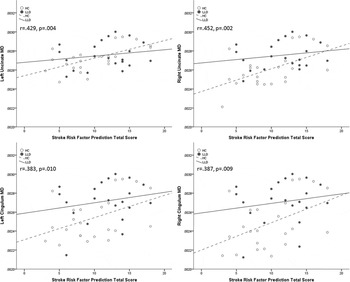
Vascular risk measured by the FSRP Total score correlated significantly with white-matter integrity in the bilateral uncinate fasciculus and cingulum for MD, AD and RD metrics across the whole sample (left uncinate, MD: r = 0.429, p = 0.004; AD: r = 0.385, p = 0.010; RD: r = 0.433, p = 0.003; right uncinate, MD: r = 0.452, p = 0.002; AD: r = 0.450, p = 0.002; RD: r = 0.437, p = 0.003; left cingulum, MD: r = −0.383, p = 0.010; AD: r = 0.472, p = 0.001; RD: r = 0.320, p = 0.034; right cingulum, MD: r = −0.387, p = 0.009; AD: r = 0.423, p = 0.004; RD: r = 0.353, p = 0.019). Fig. 2 shows scatterplots for FSRP by MD data for each white-matter tract. No significant results were observed with FA data. All results remain significant after FDR multiple comparison correction. Separate analysis for each group shows that significant correlations were driven by FSRP–white-matter integrity correlations in the HC group whereas no significant correlations were observed in the LLD group.
Scatterplots for Framingham Stroke Risk Profile (FSRP) scores and mean diffusivity (MD) values in the bilateral uncinate fasciculus and cingulum. HC, Healthy controls; LLD, late-life depression.

Correlations between white-matter integrity and cognitive function
Across the whole sample, no significant correlations were observed between white-matter tract integrity and cognitive function. For HC, learning and memory correlated with metrics of white-matter integrity in the bilateral uncinate fasciculi (left: MD, RD; right: MD, AD, RD) and bilateral cingulum (left: MD, AD, RD; right: MD, AD). White-matter integrity metrics in the right uncinate fasciculus (MD, AD, RD) and left cingulum (AD) correlated with executive function performance (see Table 3 for details). In the LLD group, executive function correlated significantly with FA in the left uncinate fasciculus only, and no significant correlations were observed with learning and memory. Of note, these results did not remain significant after correcting for multiple comparisons with FDR.
Discussion
In this study we identified lower white-matter integrity in the bilateral cingulum and right uncinate fasciculus of individuals with LLD compared to age-matched HC. The uncinate fasciculi and the cingulum have been hypothesized to play an important role in MDD as they connect key gray-matter regions associated with depression, including areas of the prefrontal cortex, cingulate cortex and temporal lobe; our findings support the importance of these tracts in LLD (Sheline et al. Reference Sheline, Sanghavi, Mintun and Gado1999; Ballmaier et al. Reference Ballmaier, Toga, Blanton, Sowell, Lavretsky, Peterson, Pham and Kumar2004, Reference Ballmaier, Narr, Toga, Elderkin-Thompson, Thompson, Hamilton, Haroon, Pham, Heinz and Kumar2008). Within the cingulum, higher MD, RD and AD were observed in LLD compared to HC whereas group differences in FA were not as robust as for other DTI metrics; this may suggest that specific changes in white matter such as demyelination and axonal damage may be present in this tract in LLD and be more significant than general alterations in white-matter integrity. Previous studies using ROI analyses have demonstrated lower FA in the cingulum in LLD compared to HC (Bae et al. Reference Bae, MacFall, Krishnan, Payne, Steffens and Taylor2006; Rapp et al. Reference Rapp, Rieckmann, Lessman, Tang, Paulino, Burg and Davidson2010), but no studies have examined the integrity of the whole cingulum bundle in LLD. In a previous analysis across the lifespan (30–65 years), white-matter integrity (FA, MD, AD, RD) of the cingulum did not differ between MDD and matched controls, which may suggest that the cingulum is particularly vulnerable in LLD (Zhang et al. Reference Zhang, Leow, Ajilore, Lamar, Yang, Joseph, Medina, Zhan and Kumar2012). In the right uncinate fasciculus a similar pattern was observed across all DTI metrics (FA, MD, AD, RD) and this tract may be vulnerable to both demyelination and axonal damage in LLD. Results demonstrating the importance of the right temporal lobe and its connections are consistent with both our previous work examining the uncinate fasciculus and studies of grey-matter volume and function in younger adults with MDD (Bremner et al. Reference Bremner, Narayan, Anderson, Staib, Miller and Charney2000, Reference Bremner, Vythilingam, Vermetten, Vaccarino and Charney2004; Zhang et al. Reference Zhang, Leow, Ajilore, Lamar, Yang, Joseph, Medina, Zhan and Kumar2012). It is worth noting that a previous study found no differences in FA values in the uncinate fasciculus between LLD patients and controls, although other DTI metrics were not examined (Taylor et al. Reference Taylor, MacFall, Gerig and Krishnan2007).
Across the whole sample, severity of depression as measured by CESD scores correlated significantly with white-matter integrity in the right uncinate fasciculus and bilateral cingulum. Although similar patterns of correlations were observed in the two groups, few associations reached statistical significance for the groups separately. For the LLD group, only the correlation between RD in the left uncinate fasciculus reached statistical significance. The results are somewhat consistent with previous ROI analyses. One previous study of euthymic older adults demonstrated a significant correlation between depressive symptoms and reduced white-matter integrity in a large ROI including the cingulum (Lamar et al. Reference Lamar, Charlton, Morris and Markus2010), whereas a study of LLD found no significant correlation between depression severity and integrity of the anterior cingulum (Bae et al. Reference Bae, MacFall, Krishnan, Payne, Steffens and Taylor2006). Differences in results may be due in part to variance in white-matter integrity along white-matter tracts, and therefore the regions selected may impact the results. Examining whole tracts as in the current study may allow us to explore more accurately the effect of white-matter disruption on mood.
Analysis of both group differences and correlations with CESD demonstrated significant results in the right but not the left uncinate fasciculus, whereas the cingulum results were significant bilaterally. As the uncinate connects temporal and frontal regions, the unilateral pattern of associations may reflect rightward differences associated with depression in associated regions. Previous studies have demonstrated reductions in grey-matter volume in left and right (trend only) hippocampi in MDD compared to HC (Shah et al. Reference Shah, Ebmeier, Glabus and Goodwin1998; Bremner et al. Reference Bremner, Narayan, Anderson, Staib, Miller and Charney2000). Furthermore, HC but not LLD were shown to activate the right hippocampus and the anterior cingulate cortex during a verbal memory task (Bremner et al. Reference Bremner, Vythilingam, Vermetten, Vaccarino and Charney2004). These results suggest that the right temporal lobe may be particularly affected in MDD and our results suggest that this pattern may also occur in LLD.
White-matter damage has been highly associated with vascular risk (O'Sullivan et al. Reference O'Sullivan, Summers, Jones, Jarosz, Williams and Markus2001; Charlton et al. Reference Charlton, Schiavone, Barrick, Morris and Markus2010b ) and this pattern was observed in our HC group. Thus, the association between vascular risk and white-matter integrity seen across the whole sample was largely driven by the HC group. Our finding of no association between vascular risk and LLD does not directly support a vascular basis for depression in our sample, the majority of whom (20/23) had had a depressive episode in their youth. In this sample, where individuals have early onset depression but are now older, multiple factors (both neurochemical and grey-matter changes observed in young adult MDD and vascular changes associated with aging) could impact neuronal networks and may reflect an increased risk due to multiple mechanisms for damage.
Cognitive impairments observed in LLD have been hypothesized to be associated with vascular damage (Alexopoulos et al. Reference Alexopoulos, Meyers, Young, Campbell, Silbersweig and Charlson1997a ). However, in our LLD sample only FA in the left uncinate fasciculus correlated with executive function, but did not survive multiple comparison correction. Similar results were noted in a recent study of medicated, largely in-remission LLD patients, where FA values in the uncinate fasciculus correlated with executive function but not episodic memory (Sexton et al. Reference Sexton, McDermott, Kalu, Herrmann, Bradley, Allan, Le Masurier, MacKay and Ebmeier2012). Among HC, the predicted correlations between white-matter tract integrity and cognition were observed with integrity of the bilateral uncinate fasciculus and cingulum associated with learning and memory across the DTI metrics (MD, AD, RD). This is in keeping with previous healthy aging studies (Charlton et al. Reference Charlton, Barrick, Markus and Morris2010a ; Metzler-Baddeley et al. Reference Metzler-Baddeley, Jones, Belaroussi, Aggleton and O'Sullivan2011) but the results were not robust and did not survive FDR multiple comparison correction. Given that white-matter tract integrity is lower in the LLD group compared to HC, the lack of associations in the LLD group may reflect the impact of gross white-matter damage on typical white-matter cognition associations in this sample. Alternatively, in LLD, other notable brain changes, such as grey-matter changes (Lamar et al. Reference Lamar, Charlton, Zhang and Kumar2012), may have a greater impact on cognition than white-matter integrity. All associations with cognition should be treated with caution as they did not survive multiple comparison correction.
We acknowledge several study limitations. The sample size is modest, with 23 individuals in each group; nevertheless, significant results are observed in the hypothesized tracts of interest. Both groups included individuals with diabetes (LLD n = 6; HC n = 8), which may affect the findings. However, a post-hoc analysis of tract integrity in diabetic (n = 14) versus non-diabetic (n = 32) individuals (not reported) did not reveal any significant group differences. This suggests that the presence of individuals with diabetes has not affected the reported findings. The small number of individuals with late-onset LDD (n = 3) meant that analysis of age-of-onset effects were not possible. Analyses using depression rating scores should also be treated with some caution, as they reflect a single time-point in what is a fluctuating disorder. Furthermore, DTI metrics are highly associated with one another and can all be interpreted as reflecting integrity of white matter, although debate is ongoing regarding the underlying microstructure reflected by AD and RD (Wheeler-Kingshott & Cercignani, Reference Wheeler-Kingshott and Cercignani2009). Demyelination has been strongly associated with RD and axonal damage with AD (Song et al. Reference Song, Sun, Ramsbottom, Chang, Russell and Cross2002, Reference Song, Yoshino, Le, Lin, Sun, Cross and Armstrong2005; Budde et al. Reference Budde, Kim, Liang, Russell, Cross and Song2008, Reference Budde, Xie, Cross and Song2009; Metwalli et al. Reference Metwalli, Benatar, Nair, Usher, Hu and Carew2010), but may reflect other damage to white matter in addition to these factors (Wheeler-Kingshott & Cercignani, Reference Wheeler-Kingshott and Cercignani2009). Studies of AD measures in particular have shown inconsistent results across human and animal models of axonal degeneration (Budde et al. Reference Budde, Xie, Cross and Song2009; Metwalli et al. Reference Metwalli, Benatar, Nair, Usher, Hu and Carew2010). The AD results presented here are consistent with data from other human studies (Metwalli et al. Reference Metwalli, Benatar, Nair, Usher, Hu and Carew2010) but should be treated with some caution.
Conclusions
In the current study we explored specific white-matter tracts hypothesized to play a role in depression severity and associated cognitive difficulties in late life. White-matter integrity was found to be lower in LLD compared to age-matched controls in the right uncinate fasciculus and bilateral cingulum. White-matter integrity in these tracts correlated with depression severity across the whole sample. To our knowledge this is the first study to demonstrate reduced integrity of specific white-matter tracts in LLD compared to age-matched controls; significant results were observed despite the modest sample size. We suggest that the hypothesized association between white-matter integrity and severity of depressive symptoms in LLD can be extended along a continuum into healthy aging, where it may prove useful for monitoring risk for developing vascular depression, although further research is necessary to clarify these potential associations.
Supplementary material
For supplementary material accompanying this paper visit http://dx.doi.org/10.1017/S0033291713001980.
Acknowledgments
Funding for this study was provided by the National Institute of Mental Health (NIMH) 7RO1 MH073989-04 (A.K.). We acknowledge the assistance of the Mood Disorders Team for participant screening and assessment.
Declaration of Interest
None.