

In reference to the archaeological dialect or even subject matter, the term “healing” has not received much attention. Much of the literature addressing healing in the context of Native American and Euro-American relations comes from the field of Native American and Indigenous studies. Such themes include behavioral and psychological health and healing, traditional healing, healing as a component of violence and trauma, ongoing healing resulting from effects of colonialism and imperialism, and healing methods as preventative and protective measures (Coyhis and Simonelli Reference Coyhis and Simonelli2008; Heart and Deschenie Reference Heart and Deschenie2006; Mehl-Madrona Reference Mehl-Madrona2011; Whitbeck Reference Whitbeck2006). Community-based, repatriation, and reburial projects are critical avenues archaeologists have used to address communal healing issues with Native American and Indigenous communities (Atalay Reference Atalay2012, Reference Atalay2019; Colwell-Chanthaphonh Reference Colwell-Chanthaphonh, Little and Shackel2007; Merrill et al. Reference Merrill, Ladd, Ferguson, Cruwys, Downer, Feest, Frisbie, Herold, Jones, Layton and Zimmerman1993; Schaepe et al. Reference Schaepe, Angelbeck, Snook and Welch2017; Simpson Reference Simpson2009; Thornton Reference Thornton, Fforde, Hubert and Turnball2003).
Others have examined the ongoing legacies of archaeological research with Native American and Indigenous communities, and they argue that reconciliation and healing are necessary issues for which archaeologists working in collaborative contexts should strive. One example is John Welch's collaborative work with the White Mountain Apache Tribe at Fort Apache Historic District, which works to assist the tribe in efforts to transform the colonial legacies of the fort from a place of past Apache pacification and cultural erasure to a place of reconciliation (Welch and Riley Reference Welch and Riley2001; Welch et al. Reference Welch, Mahoney and Riley2000). Recognizing Fort Apache as a place of contemporary healing and reconciliation by focusing on Ndee (Apache) understandings of the past not only challenges dominant narratives often written by non-Ndee individuals but foregrounds self-determination as a critical tool to destabilize Western anthropological-archaeological knowledge systems. Within Ndee worldviews, we think self-determination is driven by Ndee cultural institutions that contribute to healing and overall community well-being. Because such traditional institutional knowledge has been bestowed on Ndee people since time immemorial by the creator, a focus on hádńdín (cattail pollen; Typha spp.) as an institution is critical. Such a focus may help archaeologists better understand the pervasive and unique braiding of Ndee cultural tool sets working together to protect Nígosdzán (Mother Earth) as well as how Nígosdzán works to protect and care for the people through an ongoing reciprocal bond of relationality.
Through cultural acts including blessings with hádńdín for protection and continued well-being, White Mountain Apache Historic Preservation staff perpetuate tradition into archaeological practice both on and off Ndee trust lands. Discussions of these forms of healing and practice between Ndee cultural heritage resource advisors-managers-archaeologists bring to life the interconnectedness of such traditions, including the “institution” of hádńdín, and how it permeates all features of Ndee lifeways and culture. Because such associations infuse all components of Ndee life, discussions in reference to the use of hádńdín in contemporary archaeological contexts by Ndee individuals for protection provide useful analogies that demonstrate connections beyond archaeological discussions. Therefore, we chose to focus this article on contemporary forms of healing as practice within Ndee cultural heritage resource management, particularly through use of hádńdín. We feel that such a discussion can help archaeologists better understand the cultural complexities of living communities’ ties to the past and present, the ways Ndee cultural resource managers maintain such connections today, and they ways Ndee tools work to keep connections in balance for the benefit of Ndee communities and beyond.
NDEE INSTITUTIONS AND TRADITIONAL HEALING
If a simple definition of epistemology is “ways of knowing” (Yellow Bird Reference Yellow Bird, Wilson and Bird2005:29), then there cannot be one way to define a Ndee epistemology in reference to healing and medicine. We agree with Cree scholar Shawn Wilson's point in reference to Indigenous epistemologies that “it is important to recognize that the epistemology includes entire systems of knowledge and relationships” (Reference Wilson2008:74). In their article titled “A Gathering of Native American Healers: Exploring the Interface of Indigenous Tradition and Professional Practice,” Moorehead and colleagues reported that “relationships to all manifested as the most common theme in defining effective traditional healing practices” (Reference Moorehead, Gone and December2015:388; emphasis in original).
Following such statements concerning relationality, although there is a heavy reliance on spiritual practitioners or “Medicine Men”—diyin—in Ndee communities, many community members find continued everyday healing and protection in daily relationships underscored by individual and community prayer. Such reciprocal relationships are also found within other Ndee institutions, including the Na’í’ees—girl's puberty ceremony—commonly referred to as the “Sunrise Ceremony.” Ndee institutions can work together collectively to ensure and maintain senses of Gózhó (beauty, balance, and harmony) within the world. For example, both hádńdín and the Na’í’ees are institutional frameworks given by creator, at the beginning of time, that rely on each other in integral and reciprocal ways. The institution of the Na’í’ees not only re-creates the origin of the Ndee within the world but commemorates the holiness of Ndee women (Golston Reference Golston1996:25). A major part of this commemoration is the use of hádńdín throughout the ceremony for blessings, guidance, healing, and prayer, as well as to help ensure overall protection. In this sense, both institutions have been working together from the time of creation to maintain Ndee health, livelihood, and well-being. The bonded power of these institutions provides a powerful example of relationality across time and space that drives Ndee divine law as an institutional and cyclical framework beyond epistemological explanation.
Considering the complex, distinctive, and diverse relationships White Mountain Apache people have to the collective universe, Ms. Burnette and I think the term “Ndee institutions” more adequately explains such ongoing relationships to the past and present rather than the term “epistemology.” Such knowledge was handed down by the creator as established law at the origin of White Mountain people, and it continues to define us. Cultural foundations such as blessings and healing with hádńdín are always present as powerful institutions shaping all features of Ndee life.
WESTERN APACHE
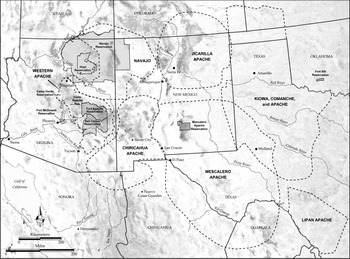
Western Apache tribal nations have recognized an ongoing presence in the U.S. Southwest since time immemorial (Welch and Ferguson Reference Welch and Ferguson2005:1; Figure 1). The name “Western Apache” was coined by anthropologists to designate Ndee groups “whose twentieth-century reservations are in Arizona and their immediate historical predecessors” (Basso Reference Basso and Ortiz1983:487). Goodwin (Reference Goodwin1942) separated Western Apache tribes into five geographic groups: San Carlos, White Mountain, Cibecue, Southern Tonto, and Northern Tonto. These groups are further divided into a series of territorial units of differing size and organization, including “groups,” “bands,” and “local groups” (Goodwin Reference Goodwin1942:6).
Ndee Territory. (Map adapted from Welch et al. Reference Welch, Herr, Laluk, Mills and Fowles2017.)

Although the U.S. government divided the Western Apache people into different federally recognized tribes with separate reservations, traditional Apache band and clan relations bind them together as a cultural group (Welch and Ferguson Reference Welch and Ferguson2005:77). Furthermore, as Welch and Ferguson (Reference Welch and Ferguson2005:184) point out, “Most adult Apaches recognize kinship with members of at least one other Apache tribe. Bonds to land and family cut across Apache reservation borders.” This statement underscores the unique and dynamic bonds all Ndee people hold to lands and each other, despite present-day geographical constraints and tribal affiliation. Such cross-cultural Ndee bonds ensure the ongoing reliance on Ndee institutions such as the use of hádńdín.
NDEE AVOIDANCE
For Ndee communities, various cultural institutions ensure that the cross-cultural bonds connecting Western Apache communities are also very much alive in cultural institutions practiced by various Ndee nations in the U.S. Southwest. One of the primary tenets recognized and actively adhered to by Ndee communities is “avoidance.” Similar to Navajo cultural practices concerning the past (Thompson Reference Thompson2011; Two Bears Reference Two Bears2006, Reference Two Bears and Silliman2008), Western Apache communities rigorously attempt to avoid visiting and working in areas marked by past materials and other forms of past human presence. As Welch and Ferguson state,
Ndee cultural principles mandate the respectful avoidance all things relating to the deceased. Ndee regard the disturbance or removal of most cultural heritage sites—especially remains or objects associated with deceased persons—as foolhardy and dangerous. Suffering may visit those who fail to respect graves, objects, or other sites associated with Apache or non-Apache ancestors [Reference Welch and Ferguson2005:11].
Furthermore, as Welch and colleagues (Reference Welch, Altaha, Hoerig and Riley2009:151) suggest, “Ndee teachings mandate respect for all ancient places, objects, and intangibles, affirming avoidance as the highest form of respect.” The institution of avoidance underscores why it is necessary for Ndee cultural heritage resource experts-managers to protect themselves, their family, and their community from the past through the institution of hádńdín. Because Ndee cultural specialists are required to engage in activities that may compromise individual and community well-being, they need alternative ways to protect themselves and maintain states of Gózhó in the world. Consequently, other cultural institutions come into play to protect against potential “death disease” and other forms of sickness that can inflict great harm if the past is not approached in appropriate and respectful ways.
BENRITA “MAE” BURNETTE AND I
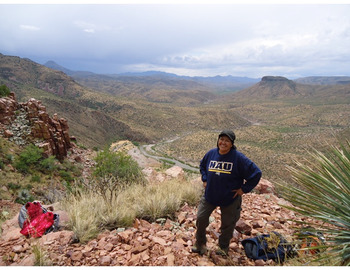
Benrita “Mae” Burnette and I have known each other for many years. We initially met after the White Mountain Apache Tribe Historic Preservation Officer Mark Altaha hired her permanently as a cultural resource advisor for the White Mountain Apache Tribe Heritage Program (Figure 2). I consider her a dear colleague as well as a dear friend. Her prayers, knowledge, and advice have helped me tackle many life obstacles and contributed to who I am today. We are also related by our matrilineal clan—a powerful bond within Ndee belief systems that recognizes a close, family-like relationship between Ndee community members who can be but are not usually bound by blood (Goodwin Reference Goodwin1942:97). She comes from a legacy of healers ranging from her father Ryan Burnette, a prominent diyin, to her brothers, who include Bruce Burnette, a highly respected singer and diyin. Ms. Burnette continues to pass her knowledge on to Ndee youth through various summer programs, which include visits to important watersheds and restoration of spring sites on White Mountain Apache trust lands. She has been involved in heritage work for many years, and she has countless experiences working and dealing with non-Ndee archaeologists, anthropologists, and researchers.
White Mountain Apache Cultural Heritage Resource Expert Benrita “Mae” Burnette. (Photo by Nicholas Laluk. On file at White Mountain Apache Tribe Heritage Program.)

For this article, Ms. Burnette and I thought that sit-down discussions were most appropriate. The informal discussions primarily occurred at the Arrowhead Café in Fort Apache Historic District, and they often included an interweaving of dialogue about our personal lives, joking about past stories, and healing-related topics. Ms. Burnette and I have talked many times in the past about the legacies of archaeological practices on our reservation, the ethics of non-Ndee archaeologists and researchers coming onto our trust lands, and the benefits—if any—our tribe has received from past archaeological-anthropological work. In reference to healing, we understand that our ancestors called on a richness of practices and beliefs that we might not ever fully understand, but certain components of the past have been preserved and passed down that continue to define us as White Mountain Apache people.
The legacies of past archaeological research on White Mountain lands has, at times, created suspicion regarding the motivations of non-Ndee researchers wanting to conduct archaeological research on the reservation. Both Ms. Burnette and I, however, believe that such mistrust can be countered, to an extent, through appropriate following of Ndee cultural institutions and the recognition of the interconnectedness of everything that cares for, honors, protects, and respects Nígosdzán for the future. Researchers can learn much from forming better understandings of Ndee in field approaches to the past that emphasize both Ndee and non-Ndee community well-being and that stress healing and cycles of relationality that go beyond standardized archaeological practice and reasoning.
HÁDŃDÍN: INTER-NDEE IMPORTANCE
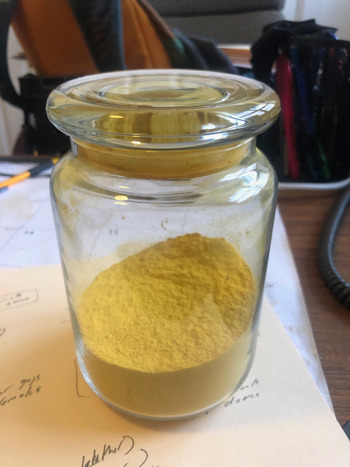
Within the U.S. Southwest, various Ndee groups utilize hádńdín Footnote 1 for a variety of ceremonial and protective purposes (Figure 3). In his work with the Chiricahua Apache, Morris Opler (Reference Opler1969:64) noted that the meaning and associations of pollen) make it the most important ritual substance to the Apache. Opler goes on to explain the process of harvesting and collecting pollen with further emphasis on the overall importance: “It is used as a blessing, much the same way Catholics use holy water, by sprinkling or touching a small amount onto the person or object being blessed” (Opler Reference Opler1969:100).
Hádńdín in ground powder form. (Photograph by Nicholas Laluk. On file White Mountain Apache Tribe Heritage Program.)

In his work with the Mescalero Apache Tribe in southern New Mexico, Martin Ball (Reference Ball2000) suggests that pollen is best seen as a tool for the ecological exchange of spiritual/environmental power through prayer and the powers of creation through the four directions. A major component of Mescalero prayers is praying for the ecological integrity of the local environment—“bringing blessings for everything here on mother earth” (Ball Reference Ball2000:98). Ball's recognition of the importance of reciprocal exchange underpinning power relations between spiritual and environmental contexts effectively highlights the meaning of pollen within Ndee contexts and the overall significance of pollen as a powerfully sacred substance. As Ball (Reference Ball2000:96–97) suggests in reference to pollen, “Its use enhances prayer and, by being applied to people or objects, is understood to have power to bless whatever it is applied to.”
In Western Apache contexts, communities have long used cattails to heal, cure, and maintain balance. In his 1892 manuscript, Captain John Bourke discusses hoddentin—the pollen of the tule, the sacrificial powder of the Apache (Bourke Reference Bourke1892:499). Bourke's hoddentin discussion focuses on various ceremonies, including the Na’í’ees; the Snake Dance Ceremony; offerings of pollen to animals, the sun, moon, fire; the four directions; and various curing and healing rites. Bourke also states, “I have never seen an Apache without a little bag of hoddentin when it was possible for him to get it” (Reference Bourke1892:506). In his work with the late Eva Watt, anthropologist Keith Basso notes that cattail pollen, or yellow powder, was a “ubiquitous element in all Western Apache Prayers and ceremonies” (Watt and Basso Reference Watt and Basso2004:307). As Ms. Burnette points out, “Pollen is very strong medicine for us. It's part of our lives. We who believe in our traditional ways. It's our life. I bless myself before I go anywhere.”
Similar to Bourke's (Reference Bourke1892:501) observation that “no Apache would, if it could be avoided go on the warpath without a bag of this precious powder somewhere upon his person,” Ndee cultural heritage resource experts at White Mountain feel the same way about going into the field during contemporary times. Because the past and “death disease” can act on you and the community in negative ways and potentially cause harm, the proper precautions have to be followed to ensure that the world remains in balance and near states of Gózhó.
WESTERN APACHE INTERGENERATIONAL KNOWLEDGE: HÁDŃDÍN PERSISTS
Given the intergenerational associations of hádńdín to all forms of Ndee prayer, blessings, and ceremonies, I wanted to work with Ms. Burnette to learn more about the overall importance of hádńdín as an Ndee institution—particularly some of the specifics concerning protection and healing. I know that various Ndee individuals still carry small buckskin bags of hádńdín on their person wherever they go, myself included. Some pouches are also filled with other items that Ndee individuals feel are extremely necessary for continued individual, family, and community well-being. Knowing that Ms. Burnette carries a pouch with her everywhere she goes, I was interested in the other types of items she may have for protection. Ms. Burnette told me, “My pouch has an eagle feather that my dad blessed, pollen, crystal, turquoise stone, hematite, and arrowhead (white one for female). Black is for male but males can have either color arrowhead. Can be any kind of black rock.” Her response got me thinking about historical period (Buskirk Reference Buskirk1986) and contemporary documentation (Welch and Ferguson Reference Welch and Ferguson2005) of Ndee individuals purposefully collecting certain items for protection.
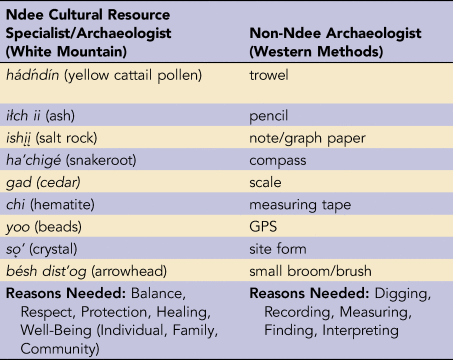
In my own experience, I have been taught that certain items such as quartz crystals, projectile points, beads, and stones are extremely effective at keeping badness away due to the power and prayers gathered within them. Thinking about the collective power of the protective and healing components within Ms. Burnette's own medicine pouch and what she carries in her field pack, we started talking about how these necessary Ndee “tools” and their associated uses are quite different from the tools non-Ndee archaeologists typically bring to the field. Although we might also use such tools at times, the reasons for the “Ndee tool kit” are quite different from the reasons for utilizing general archaeological field tools. Moreover, in reference to White Mountain's own cultural heritage resource management practices, which stress “least impact” methods, such non-Ndee archaeological tool forms are, for the most part, not very useful when it comes to healing, protection, and achieving a state of Gózhó.
NDEE TOOL KIT
Although subtle variations exist between different Ndee groups, contemporary healing and well-being practices recognize other “tools” that the creator has bestowed on Ndee people since time immemorial (Table 1). At White Mountain, tools such as hádńdín, bésh dist'og (arrowheads), iłch ii (ash), ishįį (salt), ha'chigé (snakeroot), gad (cedar), chi (hematite), yoo (beads), and sǫ’ (crystals) personify and bring to life the Ndee institutions of “respect” and “avoidance”—as opposed to the standard non-Ndee archaeological tool kit, with its goals of “science” and “data.” Individual tool kits can be a combination of these items or selected as appropriate/needed at the discretion of the individual. For White Mountain Apache heritage program personnel, such cultural tools are required not only for individual, family, and community protection but also for true cultural healing to continue.
Ndee versus Non-Ndee Field Tools.

THE POWER OF THE NDEE TOOL KIT AND COLLECTIVE WORKINGS OF HÁDŃDÍN
Although avoidance is an extremely important cultural tenet, it has been noted that Ndee individuals collected—and still collect—various items from Ancestral Pueblo sites. As discussed in a cultural affiliation study of White Mountain Apache lands in the early 2000s,
One culturally sanctioned exception is the collection of black, red, and white stones and beads from ruins for use in religious activities like the Sunrise Ceremony. Colored stones and beads from archaeological sites are ground with corn and pollen and used in blessings for the people [Welch and Ferguson Reference Welch and Ferguson2005:80].
In reference to other items within the protective Ndee tool kit—particularly sǫ’, chi, ha'chigé, and bésh dist'og—I asked Ms. Burnette if the powers of such items always worked individually or collectively. Her response was that “the crystal, hematite, and arrowhead work together” by protecting the individual. She added that “the bitterroot (snake root) should be chewed up and spit on yourself. It should also be tied to your shoes to keep snakes away. It also helps with allergies and colds too.” Here, Ms. Burnette's statement not only demonstrates the relationality of Ndee tools gaining power from each other and working together for protection, but because she touches on the healing and curing abilities of ha'chigé for allergies and colds, this demonstrates an instilled mindset of relationality that encompasses community well-being beyond generalized perceptions.
Ms. Burnette and I both agree that as Ndee archaeologists and cultural heritage resource managers, the importance and multifaceted nature of hádńdín or other tool kit components signals a level of collective healing and well-being that goes beyond what appears to be in-field prayers or blessings. For example, on numerous field projects both on and off Ndee trust lands, we have caught the wandering eyes of archaeologists looking at us as we apply hádńdín to ourselves before field visits or project-related activities. Ms. Burnette tells an amusing story of being at a store when a lady saw pollen on her face and tried to rub it off. The lady asked her if she was a painter. Such an experience foregrounds the overall power of hádńdín as an institution by highlighting that non-Ndee surficial speculation and perception falls short of the full meanings of hádńdín.
Because hádńdín has played an integral role within the holistic Ndee worldviews since creation, the use of hádńdín by Ndee cultural heritage resource experts in archaeological practice forces non-Ndee archaeologists to consider the broader psychological and social implications of their work as well, which may lead to additional forms of healing (Long et al. Reference Long, Tecle and Burnette2003). For example, what may look like simple protection practices (placing hádńdín on clothing and body parts) conducted at archaeological sites and other places of the past by Ndee cultural heritage resource experts is actually the maintenance and renewal of a whole institution experienced from birth. As Bourke (Reference Bourke1892) notes, small bags of pollen were often fastened to the cradleboards of Apache babies. Such intergenerational commitments to Ndee institutions help sustain the Ndee way of life and provide windows into other realms of Ndee worldviews.
In their work confronting ecological deterioration on White Mountain Apache lands, Long and colleagues (Reference Long, Tecle and Burnette2003) suggest that guiding principles—including individual, social, community, and world health—are interwoven at any stage of research on White Mountain Apache lands. Such interweaving is also present in discussions of Ndee archaeological practices as seen through a powerful analogy in Ms. Burnette's amusing story about the woman who thought she was a painter. In our conversation about individuals who observed us blessing ourselves but missed the entirety of meaning, Ms. Burnette said,
I think it's like springs. Springs are sacred. Kids blessing springs first, and people wonder what is going on. They want to be blessed too. What is the reason? It is to protect mother nature, but there is more to it. The spring flows to Salt River. Whatever blessing you said. Blessing (pollen) is flowing to Salt River. Once it gets to a riffle, the pollen will be tested. If it disperses, it has worked. If it continues, it hasn't worked yet and needs to keep going until it finds the right riffle to work. To me, the prayer is answered at the riffle.
This analogy powerfully foregrounds the need to go beyond superficial observation and reasoning, and it shows the unique paths that blessings and prayers have to follow to be fulfilled. The person, hádńdín, prayer, spring, and river are all collectively working together as Nígosdzán to provide overall healing and well-being to Ndee communities. More specifically in reference to archaeology, I asked Ms. Burnette if there are occurrences comparable to riffles at sites that signal that such prayers and blessings have been heard by the creator and are working. Ms. Burnette stated,
Pollen protects at the archaeological site. When you stand there and pray and put pollen on, you will feel a light breeze. To me, that's like an angel using its feather to fan you or the lord above blowing air on you. You will be protected. At an archaeological site, if you feel a breeze, you will be protected. When you put pollen on your shoes and you walk around the brush, if it's not there, that means its working, the brush has taken it and it has gone back to the land.
Like blessings and prayers offered to springs, certain protocols from Nígosdzán and the creator ensure that protection is being done right and that hádńdín is being redistributed back to the world. Here, the cyclical nature of the application of hádńdín demonstrates connections beyond pre- and post-archaeological-project blessings that touch on deeper social and psychological meanings. Because hádńdín is considered to be both alive and a person, the relationality of hádńdín to everything grounds it as an Ndee institution and a perpetual medicine used for healing, blessing, and well-being that has continued to cycle since the time of creation.
CONCLUSION
This article does not explain the links between Ndee ancestors, healing, and medicine through archaeological materials. Nor does it apply non-Ndee archaeological theory and methodology to explain the Ndee past. Instead, as contemporary Indigenous Ndee archaeologists and cultural heritage resource managers living and working within our communities, we explain that healing is very much tied to the past and is alive today in many ways that maintain harmony and balance. If “restoring harmony is the healing process,” as Rybak and Decker-Fitts (Reference Rybak and Decker-Fitts2009:339) suggest, then the application of White Mountain Ndee institutions of blessings, prayers, and overall protection put into practice by Ndee archaeologists and cultural heritage resource experts is a necessary component for anyone conducting Ndee archaeological research both on and off Ndee trust lands. Reorienting archaeological attention to Indigenous personal experiences and institutions that define and hold together communities can help archaeologists see the bigger cyclical interrelations of everything working together for goals of community well-being.
Ultimately, archaeologists should work with Native American communities in harmonious ways that foreground essential Native and Indigenous institutions of community and overall well-being that ensure constant healing practices. Ms. Burnette and I have explained our lived, everyday realities working among our family, friends, and Ndee colleagues with goals to achieve senses of Gózhó (beauty, balance, and harmony through constant acknowledgment to Nígosdzán). But true healing can only be achieved through recognizing Ndee links to everything, and by maintaining institutions such as “the pollen way.” As Ms. Burnette suggests, “At archaeological sites, the pollen is there to protect you as you walk Mother Earth. Can't take it for granted (pollen). It is very sacred.”
Acknowledgments
We would like to thank our White Mountain Apache Tribal Council for approving the Tribal Resolution giving permission to publish this research in Advances in Archaeological Practice. We would like to thank the White Mountain Apache Tribe Historic Preservation Office for supporting this project. We would like to thank Beverly Malone for assisting and clarifying some Ndee tool kit translations. We would also like to thank Maren Hopkins for providing the Spanish translations for the abstract and key terms. Finally, we would like to thank Mark Agostini and Josh Schnell for inviting us to present an early version of this article at the 2019 Society for American Archaeology Annual Meeting in Albuquerque, New Mexico.
Data Availability Statement
All field notes and copies of photographs remain the property of the White Mountain Apache Tribe. They are archived at the White Mountain Apache Tribe Historic Preservation Program: Historic Preservation Office Program, PO Box 1032, Fort Apache, AZ 85926.