Introduction
Epidemiological and clinical research suggests that depression is associated with a host of cardiovascular conditions (Hare et al. Reference Hare, Toukhsati, Johansson and Jaarsma2014). Depression is common in cardiac patients, while depressive symptoms also predict future cardiovascular disease (Nicholson et al. Reference Nicholson, Kuper and Hemingway2006; Hare et al. Reference Hare, Toukhsati, Johansson and Jaarsma2014). A variety of mechanisms underlying this association have been postulated (Grippo & Johnson, Reference Grippo and Johnson2009; Nemeroff & Goldschmidt-Clermont, Reference Nemeroff and Goldschmidt-Clermont2012).
Disturbed autonomic nervous system (ANS), including decreased parasympathetic and/or increased sympathetic tone, may be one pathway linking depression and negative cardiac outcomes (Stapelberg et al. Reference Stapelberg, Hamilton-Craig, Neumann, Shum and McConnell2012). Heart rate variability (HRV) is non-invasive technique estimating ANS characteristics (Task Force of the European Society of Cardiology and The North American Society of Pacing and Electrophysiology, 1996). Low HRV indicative of diminished vagal cardiovascular modulations is a known predictor of cardiac morbidity and mortality, and an indicator of stress vulnerability and low capacity for parasympathetic inhibition of autonomic arousal in emotional regulation (Task Force of the European Society of Cardiology and The North American Society of Pacing and Electrophysiology, 1996; Thayer et al. Reference Thayer, Ahs, Fredrikson, Sollers and Wager2012).
A number of epidemiological and clinical studies have shown depression to be associated with unfavourable HRV indices, notably reduced cardiac vagal modulation (Rottenberg, Reference Rottenberg2007; Licht et al. Reference Licht, de Geus, Zitman, Hoogendijk, van Dyck and Penninx2008, Reference Licht, de Geus, van Dyck and Penninx2010; Kemp et al. Reference Kemp, Quintana, Gray, Felmingham, Brown and Gatt2010; Dauphinot et al. Reference Dauphinot, Rouch, Kossovsky, Pichot, Dorey, Krolak-Salmon, Laurent, Roche and Barthélémy2012; Brunoni et al. Reference Brunoni, Kemp, Dantas, Goulart, Nunes, Boggio, Mill, Lotufo, Fregni and Benseñor2013). For example, a meta-analysis of clinical studies demonstrated that relative to controls, physically healthy unmedicated patients with major depressive disorder displayed reduced vagal HRV indices (Kemp et al. Reference Kemp, Quintana, Gray, Felmingham, Brown and Gatt2010). In a more recent double-blind, randomized, placebo-controlled trial, moderately to severely depressed unmedicated patients with low cardiovascular risk profile had lower HRV compared with controls (Brunoni et al. Reference Brunoni, Kemp, Dantas, Goulart, Nunes, Boggio, Mill, Lotufo, Fregni and Benseñor2013). There is epidemiological evidence that the depression–HRV relationship is partly or fully driven by use of antidepressants (Licht et al. Reference Licht, de Geus, Zitman, Hoogendijk, van Dyck and Penninx2008, Reference Licht, de Geus, van Dyck and Penninx2010; Kemp et al. Reference Kemp, Brunoni, Santos, Nunes, Dantas, Carvalho de Figueiredo, Pereira, Ribeiro, Mill, Andreão, Thayer, Benseñor and Lotufo2014; O'Regan et al. Reference O'Regan, Kenny, Cronin, Finucane and Kearney2015). However, this does not apply to unmedicated participants (Kemp et al. Reference Kemp, Quintana, Gray, Felmingham, Brown and Gatt2010; Brunoni et al. Reference Brunoni, Kemp, Dantas, Goulart, Nunes, Boggio, Mill, Lotufo, Fregni and Benseñor2013).
Although the association between HRV and depression has been studied extensively, the directionality of the HRV–depression relationship has received less attention. Possible mechanisms exist for a bidirectional relationship. On the one hand, chronic exposure to stressful experiences and prolonged negative emotions have been shown to lead to increased sympathetic and reduced parasympathetic modulation (Grippo & Johnson, Reference Grippo and Johnson2009), suggesting that depression may precede low HRV. On the other hand, other evidence supports the possibility that low HRV precedes depression. Namely, (1) reduced modulation of vagal activity and HRV leads to a variety of conditions associated with increased allostasis and poor health (Thayer & Sternberg, Reference Thayer and Sternberg2006); (2) vagal stimulation, associated with HRV increase (Zhang et al. Reference Zhang, Popovic, Bibevski, Fakhry, Sica, Van Wagoner and Mazgalev2009) improves mood and reduces depressive symptoms severity both in humans and animals (Vonck et al. Reference Vonck, Raedt, Naulaerts, De Vogelaere, Thiery, Van Roost, Aldenkamp, Miatton and Boon2014); (3) rats with complete disconnection of abdominal vagal afferents displayed reduced innate negative emotional behaviour compared with controls (Klarer et al. Reference Klarer, Arnold, Günther, Winter, Langhans and Meyer2014); and (4) reduced vagal HRV indices has been shown to predict a more pernicious course of depression (Chambers & Allen, Reference Chambers and Allen2002; De Guevara et al. Reference De Guevara, Schauffele, Nicola-Siri, Fahrer, Ortíz-Frágola, Martínez-Martínez, Cardinali and Guinjoan2004). Rottenberg (Reference Rottenberg2007) has argued that prospective study designs should be used to test the potential aetiological role of the ANS in depression in individuals with no history of depression.
The Whitehall II study is a large longitudinal population-based cohort study in which short-term HRV and cognitive symptoms of depression were measured repeatedly over a 10-year interval. This has enabled us to prospectively examine whether decreased HRV predicts subsequent incident depressive symptoms in non-depressed individuals, and whether depressive symptoms predict subsequent HRV reductions. Additionally, we also evaluated to what extent potential longitudinal associations were influenced by covariates including sociodemographic and lifestyle factors, cardiometabolic condition and medication use.
Method
Study population
The Whitehall II study is an ongoing cohort study of subjects initially employed by the British civil service originally set up to explore the degree and causes of the social gradient in morbidity and mortality. The target population was all London-based office staff, aged 35–55 years. A total of 10 308 subjects (3413 women, response rate of 73%) were initially recruited between 1985 and 1988 (Marmot & Brunner, Reference Marmot and Brunner2005). After the baseline examination, follow-up medical examinations have taken place approximately every 5 years. HRV recordings were made at the fifth (1997–1999), seventh (2002–2004) and ninth (2007–2009) data collection phases. The University College London ethics committee approved the study and participants gave informed consent. Whitehall II data, protocols and other metadata are available to bona fide researchers for research purposes (data sharing policy is available at http://www.ucl.ac.uk/whitehallII/data-sharing).
The present study included participants with data on cognitive symptoms of depression and HRV at phase 5 (1997–1999) or phase 9 (2007–2009). Mean follow-up was 10.5 years (range 8.9–12.3 years). Phase 5 is used as the baseline and phase 9 as the follow-up. The number of participants who had data on cognitive symptoms of depression and HRV was 912 women and 2224 men at baseline, and 1207 women and 3335 men at follow-up. The sample size for the prospective analysis ranged from 2334 (644 women) to 2276 (602 women) dependent on the completeness of covariate data.
HRV measurements
Details on the assessment of heart rate and HRV in Whitehall II can be found elsewhere (Hemingway et al. Reference Hemingway, Shipley, Brunner, Britton, Malik and Marmot2005; Britton et al. Reference Britton, Shipley, Malik, Hnatkova, Hemingway and Marmot2007). Briefly, 5 min supine resting 12-lead electrocardiograms (ECGs) were obtained after 5 min of rest. At phases 5 and 9, Kardiosis™ ECG acquisition module (Tepa, Inc., Turkey) and Getemed ECG recorder (Getemed Teltow, Germany) were used, respectively. The sampling frequencies and outputs of the different devices were comparable. Using an automatic algorithm (Acar et al. Reference Acar, Savelieva, Hemingway and Malik2000), normal sinus-rhythm QRS complexes suited for a reliable HRV analysis were identified. Although in short-term recordings obtained at standardized conditions, spectral HRV analysis is the preferred method (Task Force of the European Society of Cardiology and The North American Society of Pacing and Electrophysiology, 1996), in this study HRV was analysed in both the time- and frequency-domain. Time-domain measures included the standard deviation of all normal-to-normal RR intervals (SDNN) and root mean square of successive differences of normal-to-normal RR intervals (RMSSD). Frequency-domain components were computed using a Blackman–Tukey algorithm. The low-frequency (LF-HRV), 0.04 to 0.15 Hz, and high-frequency (HF-HRV), 0.15 to 0.4 Hz, spectral power was obtained. The RMSSD and HF-HRV reflect parasympathetic modulation. The interpretation of LF-HRV is controversial but most evidence suggests that it reflects both parasympathetic and sympathetic modulations. Under particular circumstances, it may be influenced by different regulatory mechanisms including, among others, respiration and baroreflex control (Task Force of the European Society of Cardiology and The North American Society of Pacing and Electrophysiology, 1996; Bernardi et al. Reference Bernardi, Wdowczyk-Szulc, Valenti, Castoldi, Passino, Spadacini and Sleight2000; Lahiri et al. Reference Lahiri, Kannankeril and Goldberger2008; Goldstein et al. Reference Goldstein, Bentho, Park and Sharabi2011; Reyes del Paso et al. Reference Reyes del Paso, Langewitz, Mulder, van Roon and Duschek2013).
Depressive symptoms
Symptoms of depression were measured using a four-item scale derived from the 30-item General Health Questionnaire (GHQ; Goldberg & Hillier, Reference Goldberg and Hillier1979). The GHQ is used to detect minor psychiatric disorders, including depressive disorder, suitable for use in general population samples (Goldberg, Reference Goldberg1972). The 30-item GHQ was validated within the Whitehall II study (Stansfeld et al. Reference Stansfeld, Head and Marmot1998) based on principal components factor analysis and a comparison with the seven-item severe depression subscale from the 28-item GHQ. The depression symptom score includes the following four items: ‘been thinking of yourself as a worthless’, ‘felt that life is entirely hopeless’, ‘felt that life isn't worth living’ and ‘found at times you couldn't do anything because your nerves were too bad’ (Cronbach's α = 0.88). Responses to these items were on a four-point Likert scale (0 = ‘not at all’, 1 = ‘no more than usual’, 2 = ‘rather more than usual’, and 3 = ‘much more than usual’), giving a range of 0 to 12. A sum score was calculated and, as previously, a total score of 4 or more was used to define cognitively based symptoms of depression (Stansfeld et al. Reference Stansfeld, Head and Marmot1998). The test–retest reliability was r = 0.78 in a subsample of 286 participants who repeated the GHQ within 1 month (Stansfeld et al. Reference Stansfeld, Head, Fuhrer, Wardle and Cattell2003). The respondents were considered as having a depressive episode if they scored ⩾4 on the GHQ depression subscale or reported the use of prescribed antidepressant medication (Stansfeld et al. Reference Stansfeld, Head, Fuhrer, Wardle and Cattell2003).
Covariates
Relevant confounders that have been previously shown to be associated with HRV and depression (Huikuri et al. Reference Huikuri, Ma, Airaksinen, Seppa, Puukka and Ra1998; Rennie et al. Reference Rennie, Hemingway, Kumari, Brunner, Malik and Marmot2003; Hemingway et al. Reference Hemingway, Shipley, Brunner, Britton, Malik and Marmot2005; Marmot & Brunner, Reference Marmot and Brunner2005; Schroeder et al. Reference Schroeder, Chambless, Liao, Prineas, Evans, Rosamond and Heiss2005; Britton et al. Reference Britton, Shipley, Malik, Hnatkova, Hemingway and Marmot2007) were included as covariates and were obtained from phase 5 unless otherwise stated. Sociodemographic characteristics included age (mean), ethnicity (white v. other) and civil service employment grade. Lifestyle factors included leisure-time physical activity, alcohol consumption and smoking habits, and were assessed by self-completed questionnaires. Participants were asked how often they took part in moderate and vigorous exercise such as walking, cycling, sports, gardening, housework and home maintenance. Those participants undertaking less than 1 h per week of vigorous physical activity or less than 2.5 h per week of moderate physical activity did not meet World Health Organization recommendations (2010) and were defined as exercising little or none (Sabia et al. Reference Sabia, Nabi, Kivimaki, Shipley, Marmot and Singh-Manoux2009). Alcohol consumption in the past week was expressed in units of alcohol (1 unit = 8 g), and ⩾14 units/week in women and ⩾21 units/week in men were categorized as high consumption. Smoking habits were categorized as non/ex/current smoker. Cardiometabolic conditions were assessed as the presence of any of the following chronic diseases or health-related conditions: diagnosed coronary heart disease (CHD) including heart failure, stroke, diabetes, hypertension (use of hypertensive medication or blood pressure ⩾140/90 mmHg) and obesity (body mass index, BMI ⩾30 kg/m2). Blood pressure and BMI were assessed according to standard guidelines. Medication use included any prescribed medication within the last 14 days. Antidepressant medication use both at phase 5 and 9 was recorded separately, as previous studies have shown antidepressant treatment to influence the HRV–depression association (Licht et al. Reference Licht, de Geus, Zitman, Hoogendijk, van Dyck and Penninx2008, Reference Licht, de Geus, van Dyck and Penninx2010; O'Regan et al. Reference O'Regan, Kenny, Cronin, Finucane and Kearney2015).
Statistical analysis
Linear and logistic regressions were used to explore cross-sectional and prospective associations between HRV and depression symptoms. Heart rate and HRV measures were used as continuous variables. Depressive symptoms were used as a continuous and categorical variable for cross-sectional and prospective analyses, respectively. Models were adjusted for age and ethnicity since they are known to influence HRV (Task Force of the European Society of Cardiology and The North American Society of Pacing and Electrophysiology, 1996; Hemingway et al. Reference Hemingway, Shipley, Brunner, Britton, Malik and Marmot2005; Britton et al. Reference Britton, Shipley, Malik, Hnatkova, Hemingway and Marmot2007). Results are presented as odds ratios (ORs) or unstandardized regression coefficients (β) with 95% confidence intervals (CIs). The level of statistical significance was set at p ⩽ 0.05. Intentionally, we have not corrected the p values for multiple comparisons (Rothman, Reference Rothman1990, Reference Rothman2014; Saville, Reference Saville1990). HRV values were logarithmically transformed prior to analyses to handle their skewed distributions. Depression score was also skewed but none of the transformations (log, square-root, cubic, square, inverse and others) provided normal distribution of data so results are presented in terms of raw depression scores, for ease of interpretation. The results of both cross-sectional and prospective analyses were virtually unchanged when depression score was log or square-root transformed (data not shown).
Cross-sectional analyses, undertaken among participants with no antidepressant medication use, were assessed by linear regression both at phase 5 and phase 9. The first prospective model, using binary logistic regression, examined whether HRV at phase 5 (1997–1999) was associated with incident depressive symptoms at phase 9 (2007–2009), while adjusting for depressive symptoms score at phase 5 (1997–1999). This analysis focused on participants without depression at phase 5 baseline, i.e. participants with GHQ score ⩾4 or those reporting antidepressant medication use at phase 4 (1995–1996) and 5 (1997–1999) were excluded. Cases of incident depressive symptoms at follow-up were defined as participants having GHQ score ⩾4 or reporting use of antidepressant medication at phase 9 (2007–2009). In the second prospective model, linear regression explored the association between depressive symptoms at phase 5 (1997–1999) and HRV measures at phase 9 (2007–2009), while adjusting for HRV at phase 5 (1997–1999). Cases of incident depressive symptoms at baseline (phase 5) were defined as participants having GHQ score ⩾4 or reporting antidepressant medication use at phase 5.
Analyses were not constrained to participants with complete data on HRV measures and cognitive symptoms of depression at both phases. To ensure that sample differences did not account for differences in results, models were repeated using the same sample for all analyses. This had little effect on the pattern of associations, so results are presented using all the available data for each analysis.
In order to assess the predictive ability of HRV measures we used receiver operator characteristic (ROC) analysis to generate the area under the ROC curve (area under the curve; AUC). The ROC curves plot the positive fraction, or sensitivity against the false-positive fraction (1 – specificity) by varying the threshold value for the test. The ROC curve indicates the probability of a true-positive result as a function of the probability of a false-positive result for all possible threshold values. The AUC is a quantitative measure of selectivity: 0.5 indicates that the test results are no better than those obtained by chance, whereas an area of 1.0 indicates a perfectly sensitive and specific test.
The contribution of the covariates to the association between HRV and symptoms of depression was explored in logistic regression models. To the basic model adjusted for age, sex and ethnicity each of the following sets of factors were individually included: employment grade, lifestyle factors, cardiometabolic condition and medication use. Subsequently, a model adjusted for all covariates was used. All analyses were computed in STATA (version 12; StataCorp LP, USA).
Ethical standards
All procedures contributing to this work comply with the ethical standards of the relevant national and institutional committees on human experimentation and with the Helsinki Declaration of 1975, as revised in 2008.
Results
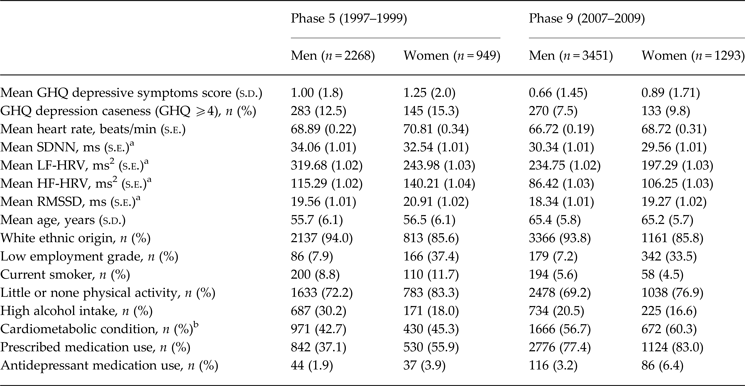
Of the 10 308 participants at phase 1 (1985–1988), 306 died before the start of HRV data collection at phase 5 (1997–1999). Table 1 presents the descriptive characteristics of participants with data on both depressive symptoms and HRV either at phase 5 baseline or phase 9 follow-up. At both phases, there were more males (70.5 and 72.6%) and the majority of participants were of white origin. Average levels of depressive symptoms and heart rate, RMSSD and HF-HRV were higher (p ⩽ 0.005) and LF-HRV lower (p ⩽ 0.001) in women than in men. Women included a higher proportion of participants from ethnic minorities and were more likely to be from the lower employment grades. On average, twice as many women than men were taking antidepressant medication. Compared with phase 5, at phase 9 there was about one-third higher proportion of women and men taking antidepressant medication and consequently lower average levels of depressive symptoms.
Correlates of HRV and depressive symptoms at phase 5 (1997–1999) and phase 9 (2007–2009) by sex

HRV, Heart rate variability; GHQ, General Health Questionnaire; s.d., standard deviation; s.e., standard error; SDNN, standard deviation of all intervals between R waves with normal-to-normal conduction; LF-HRV, low-frequency HRV; HF-HRV, high-frequency HRV; RMSSD, root mean square of successive differences of normal-to-normal RR intervals.
a Age-adjusted geometric mean and s.e.
b Presence of any of the following cardiometabolic conditions: diagnosed coronary heart disease including heart failure, stroke, diabetes, hypertension and/or obesity.
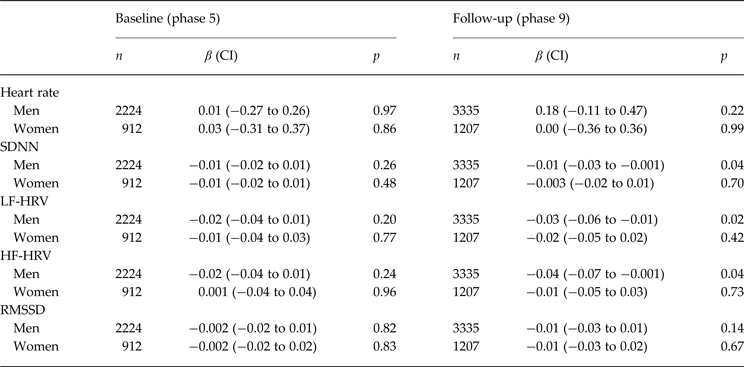
Table 2 shows the cross-sectional associations between HRV measures and depressive symptoms at baseline (phase 5) and follow-up (phase 9) in participants not using antidepressant medication. In these subjects, depressive symptoms score was not significantly associated with heart rate or HRV at baseline. In the cross-sectional analyses at follow-up, higher depressive symptoms score was significantly associated with lower SDNN (β = −0.01, p = 0.04), LF-HRV (β = −0.03, p = 0.02) and HF-HRV (β = −0.04, p = 0.04) among men, but not among women. At both phases, there were no significant associations between depressive symptoms score and heart rate or RMSSD in both sexes.
Cross-sectional relationship of heart rate and HRV measures with depressive symptoms at phase 5 (1997–1999) and phase 9 (2007–2009) in individuals without antidepressant use

HRV, Heart rate variability; CI, confidence interval; SDNN, standard deviation of all intervals between R waves with normal-to-normal conduction; LF-HRV, low-frequency HRV; HF-HRV, high-frequency HRV; RMSSD, root mean square of successive differences of normal-to-normal RR intervals.
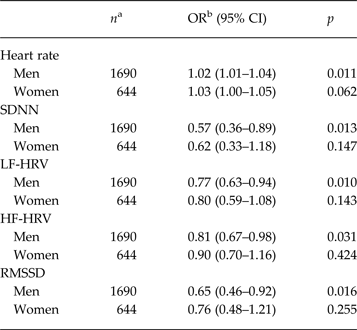
Table 3 and Fig. 1 present the results from the prospective logistic analysis estimating associations between HRV at baseline (phase 5) and depressive symptoms at follow-up (phase 9). Results indicated that among men without a depressive episode at phase 4 (1995–1996) and phase 5 (1997–1999), HRV at baseline (phase 5) predicted incident depressive symptoms at follow-up (phase 9). Specifically, lower heart rate and higher SDNN, RMSSD, LF-HRV and HF-HRV were associated with lower likelihood of depressive symptoms (heart rate: OR 1.02, 95% CI 1.01–104, p = 0.011; SDNN: OR 0.57, 95% CI 0.36–0.89, p = 0.013; LF-HRV: OR 0.77, 95% CI 0.63–0.94, p = 0.010; HF-HRV: OR 0.81, 95% CI 0.67–0.98, p = 0.031; RMSSD: OR 0.65, 95% CI 0.46–0.92, p = 0.016). For example, for men, the odds of elevated depressive symptoms or antidepressant medication use at follow-up decreased by 35% for every unit increase in log-transformed RMSSD or by 19% for every unit increase in log-transformed HF-HRV. Age-adjusted arithmetic and geometric means of heart rate and HRV measures at phase 5 for those men who developed depressive symptoms at follow-up (n = 106) compared with those who did not (n = 1584) are as follows: for heart rate 71.7 v. 68.4 beats per min; for SDNN 30.9 v. 34.8 ms2; for LF-HRV 259.5 v. 338.1 ms2; for HF-HRV 95.6 v. 121 ms2; for RMSSD 17.1 v. 20 ms2. The ROC curve analysis yielded AUC of 0.72 (95% CI 0.67–0.78) for SDNN and 0.73 (95% CI 0.67–0.79) for heart rate, LF-HRV, HF-HRV and RMSSD. For women, the predictive effect of heart rate or HRV in incident depressive symptoms did not reach the statistically significant level (p ⩾ 0.062), although the HRV associations were similar to those in men (AUC 0.67–0.69, 95% CI 0.60–0.76).
Prospective association between heart rate and HRV measures at phase 5 (1997–1999) and depressive symptoms at phase 9 (2007–2009)

HRV, Heart rate variability; OR, odds ratio, CI, confidence interval; SDNN, standard deviation of all intervals between R waves with normal-to-normal conduction; LF-HRV, low-frequency HRV; HF-HRV, high-frequency HRV; RMSSD, root mean square of successive differences of normal-to-normal RR intervals.
a Participants without depressive episode at phase 4 and 5 (General Health Questionnaire ⩾4 or use of antidepressant medication).
b ORs adjusted for age, ethnicity and depressive symptoms score at phase 5.
Table 4 presents the results from the adjusted prospective logistic analyses assessing the contribution of the five sets of covariates to the association between HRV at baseline and cognitive symptoms of depression at follow-up in men. None of the covariates, individually or in combination, accounted for more than a relatively small part of the association (4.95% for SDNN, 1.95% for HF-HRV and 3.76% RMSSD in combination of all covariates). In women, covariate adjustment did not alter the non-significant association between HRV at baseline and depressive symptoms at follow-up (data not shown).
Adjusted prospective association between heart rate and HRV at phase 5 (1997–1999) and depressive symptoms at phase 9 a (2007–2009) in men

HRV, Heart rate variability; OR, odds ratio; CI, confidence interval; SDNN, standard deviation of all intervals between R waves with normal-to-normal conduction; LF-HRV, low-frequency HRV; HF-HRV, high-frequency HRV; RMSSD, root mean square of successive differences of normal-to-normal RR intervals.
a Men without depressive episode at phase 4 and 5 (GHQ ⩾4) or use of antidepressant medication).
b Model 1 (n = 1690): analysis adjusted for age, ethnicity and cognitive symptoms of depression score at phase 5; model 2 (n = 1684): model 1 + socio-economic status; model 3 (n = 1676): model 1 + smoking, physical inactivity, high alcohol intake; model 4 (n = 1690): model 1 + cardiometabolic condition (diagnosed coronary heart disease including heart failure, stroke, diabetes, hypertension and obesity); model 5 (n = 1690): model 1 + prescribed medication use; model 6 (n = 1670): all covariates.
Baseline heart rate and heart rate variability (HRV) (1997–1999) and risk of incidence depressive symptoms 10 years later (2007–2009) in men and women without depressive episode at baseline. The figure shows that higher levels of heart rate and HRV measures are associated with higher and lower risk, respectively, of incidence depressive symptoms. Odds ratios are adjusted for age, ethnicity and depressive symptoms score at phase 5. SDNN, Standard deviation of all intervals between R waves with normal-to-normal conduction; LF-HRV, low-frequency HRV; HF-HRV, high-frequency HRV; RMSSD, root mean square of successive differences of normal-to-normal RR intervals.

The examination of cognitive symptoms of depression at baseline (phase 5) as predictors of heart rate and HRV measures at follow-up (phase 9) did not reveal any significant association in either sex (p > 0.348) (data not shown).
Discussion
Based on a large community sample, our investigation suggests that cognitive symptoms of depression are associated with HRV independently of antidepressant medication use, in both cross-sectional and longitudinal associations. Over a 10-year period, we found that in individuals without depressive symptoms, lower heart rate and higher SDNN, LF-HRV, HF-HRV and RMSSD predicted subsequent incident depressive symptoms. This association was independent of sociodemographic and lifestyle factors, cardiometabolic condition and/or medication use and baseline cognitive symptoms of depression. Depressive symptoms did not predict subsequent levels of heart rate or HRV. Results suggest that disturbances of cardiac autonomic status, particularly low vagal modulation, precede depressive symptoms.
The findings in the cross-sectional analyses at phase 9 are consistent with previous clinical and epidemiological studies showing an inverse association of HRV with depressive symptoms or major depressive disorder independently of antidepressant treatment (Kemp et al. Reference Kemp, Quintana, Gray, Felmingham, Brown and Gatt2010; Dauphinot et al. Reference Dauphinot, Rouch, Kossovsky, Pichot, Dorey, Krolak-Salmon, Laurent, Roche and Barthélémy2012; Brunoni et al. Reference Brunoni, Kemp, Dantas, Goulart, Nunes, Boggio, Mill, Lotufo, Fregni and Benseñor2013). Although the significant cross-sectional association was observed only at phase 9, the cross-sectional effect is nevertheless present, suggesting that antidepressant use does not fully drive the relationship between HRV and depression as some authors report in other studies (Licht et al. Reference Licht, de Geus, Zitman, Hoogendijk, van Dyck and Penninx2008, Reference Licht, de Geus, van Dyck and Penninx2010; Kemp et al. Reference Kemp, Brunoni, Santos, Nunes, Dantas, Carvalho de Figueiredo, Pereira, Ribeiro, Mill, Andreão, Thayer, Benseñor and Lotufo2014; O'Regan et al. Reference O'Regan, Kenny, Cronin, Finucane and Kearney2015). We believe that the cross-sectional association at phase 5 was not significant due to smaller sample size at phase 5 compared with phase 9. As seen in Table 2, regression coefficients for some HRV measures (e.g. SDNN and LF-HRV in men) did not change much from phase 5 to phase 9, but they were significant in phase 9 only. In order to further explore the cross-sectional association between HRV and depressive symptoms we conducted an analysis using data from phase 7. Results indicated similar size of the regression coefficients between depressive symptoms and HRV measures and significant associations in men (data not shown). This supports the presence of the overall cross-sectional association between HRV and depressive symptoms independently of antidepressant treatment.
A number of previous studies have tested whether lower vagal HRV indices among depressed individuals predict a more pernicious course of disorder (Chambers & Allen, Reference Chambers and Allen2002; De Guevara et al. Reference De Guevara, Schauffele, Nicola-Siri, Fahrer, Ortíz-Frágola, Martínez-Martínez, Cardinali and Guinjoan2004). To our knowledge, the predictive effect of HRV on incident depression in a large sample of general population without depressive symptoms at baseline has not been investigated before. The cognitive symptoms of depression can be regarded as a part of the prodromal phase of major depressive disorder and therefore can be considered as a significant risk indicator of major depressive disorder (Cuijpers & Smit, Reference Cuijpers and Smit2004). Our results suggest that low HRV and vagal modulation, as reflected by decreased RMSSD and HF-HRV, play an aetiological role in incident depression rather than contributing to the later stages of depression development among men. As seen in Table 3 the odds of depressive symptoms at follow-up decreased by 43% for every unit increase in log-transformed SDNN and by 35 and 19% for every unit increase in log-transformed RMSSD and HF-HRV. Additionally, ROC analysis revealed a high sensitivity and specificity (0.72–0.73) of heart rate and HRV measures for the prediction of incidence cognitive symptoms of depression in men. Findings indicate that the contribution of ANS disturbance to depressive symptoms is quite large.
The findings on the predictive effect of HRV in depression generation in men accords with the study by Gimeno et al. (Reference Gimeno, Kivimäki, Brunner, Elovainio, De Vogli, Steptoe, Kumari, Lowe, Rumley, Marmot and Ferrie2009). Over a period of 12 years within the Whitehall II population, inflammatory markers were shown to precede subsequent cognitive symptoms of depression while depressive symptoms did not precede subsequent average levels of inflammatory markers (Gimeno et al. Reference Gimeno, Kivimäki, Brunner, Elovainio, De Vogli, Steptoe, Kumari, Lowe, Rumley, Marmot and Ferrie2009). As the ANS plays a homoeostatic role in relation to the inflammatory response (Tracey, Reference Tracey2002), and lower HRV has been shown to predict inflammation (Jarczok et al. Reference Jarczok, Koenig, Mauss, Fischer and Thayer2014), our results are complementary to earlier work (Gimeno et al. Reference Gimeno, Kivimäki, Brunner, Elovainio, De Vogli, Steptoe, Kumari, Lowe, Rumley, Marmot and Ferrie2009). The predictive effects of HRV, and inflammation, respectively, on future depressive symptoms were independent of potential covariates and stronger in men than in women. A possible alternative interpretation accounting for the lack of predictive association between depressive symptoms and subsequent physiological functioning (as indexed by average levels of HRV) in our study may be the long period of follow-up and narrow scope of the depression measure. Assessment of neuro-vegetative symptoms, which might more readily be expected to be associated with physiological disturbances, may have produced stronger cross-sectional association and potentially evidence of bidirectional association between HRV and depression.
Our findings of aetiological significance of HRV in depression generation are in agreement with polyvagal theory and the neuro-visceral integration model (Porges, Reference Porges1995; Thayer & Lane, Reference Thayer and Lane2000). According to these theories the affective and social behaviour in mammals is dependent on the ability to regulate visceral homoeostasis, including control of heart, mediated by vagal signalling (Porges, Reference Porges1995; Rottenberg, Reference Rottenberg2007; Thayer et al. Reference Thayer, Ahs, Fredrikson, Sollers and Wager2012). Findings of neuroimaging studies (Thayer et al. Reference Thayer, Ahs, Fredrikson, Sollers and Wager2012) have indeed shown low HRV and vagal modulation to be associated with number of brain regions, including prefrontal cortex and amygdala, that are involved in emotional dysregulation. Insufficient vagal functioning may therefore have a direct impact on emotion and social communication, which can in turn manifest as cognitive symptoms of depression or major depressive disorder (Rottenberg, Reference Rottenberg2007). Therefore the well-known association between depressive symptoms and cardiac health may be due in part to disturbed ANS and low vagal modulation, rather than depression per se. Based on results of our and previous studies, low HRV and vagal modulation may be risk factors for both depression and CHD. Vagal pathways could therefore be intervention targets. For instance, it has been shown that enhancing vagal cardiac modulation, by physical activity or vagal stimulation, have favourable effects on HRV, emotions or cardiac health (Soares-Miranda et al. Reference Soares-Miranda, Sattelmair, Chaves, Duncan, Siscovick, Stein and Mozaffarian2014; Vonck et al. Reference Vonck, Raedt, Naulaerts, De Vogelaere, Thiery, Van Roost, Aldenkamp, Miatton and Boon2014).
It is unclear why the prospective association was significant only among men and not among women even though it was in the expected direction. As the number of men was nearly three times larger than of women, it may be possible that increasing a sample size in women would lead to narrower CIs and probably to a significant HRV–depression association. Another possible explanation is that sex differences in the neural control of the heart and in achieving homoeostasis may have made an impact on our observations (Smetana & Malik, Reference Smetana and Malik2013). On average, women have reduced sympathetic and increased parasympathetic modulation of heart rate relative to men as well as different biological ways of responding to stress (Hassan et al. Reference Hassan, Li, Brumback, Lucey, Bestland, Eubanks, Fillingim and Sheps2008). Furthermore, depression has been shown to manifest differently in men and women; relative to men, women show more somatic symptoms of depression (Silverstein et al. Reference Silverstein, Edwards, Gamma, Ajdacic-Gross, Rossler and Angst2013). It is possible that we were not able to detect depression in some women due to the scale used to assess depression.
In our data the associations between HRV and depressive symptoms were not explained by potential covariates. By adjusting for cardiometabolic condition (the presence of diagnosed CHD, stroke, diabetes, hypertension and/or obesity) we were able to control for the possibility that our observed associations were due to confounding by physical illness and pre-existing illness at baseline. These adjustments explained a maximum of 1.5% of the HRV–depression association. Similarly, medication use within the last 2 weeks as well as lifestyle factors and socio-economic status had little effect on the association. After simultaneous adjustments for all mentioned covariates the association remained virtually unchanged (explained a maximum of 2% of the association).
A key strength of our investigation is the use of longitudinal data with two measurements of HRV assessed over a decade in a non-clinical setting. Repeated measures of short-term HRV allow us to attribute HRV to parasympathetic or/and sympathetic modulation and generally to cardiac autonomic status. Limitations include that the GHQ depression scale used is only a part of the seven-item depression scale of the 28-item GHQ. GHQ depression is also best considered to be a measure of depressive symptoms, and should not be equated with clinically diagnosed depression (Stansfeld et al. Reference Stansfeld, North, White and Marmot1995). It is essentially a measure of self-reported depressive symptoms and, although reliable, it does not indicate the severity of depression. There is also the issue that we measured depressive symptoms at a single point in time 10 years after the original assessment. Since depression is episodic, it could be that we have not picked up depressive problems that occurred at other times during this period. We also cannot rule out the contribution of device effects as different recording equipment was used to measure HRV at each phase. However the HRV protocols were consistent across all data collection phases. We also did not use any autonomic provocative manoeuvre which may limit the HRV data comparisons. Finally, the Whitehall II study is an occupational-based cohort, and is therefore healthier on average than the general population. However, aetiological findings from the Whitehall II cohort have been shown to be comparable with other population-based studies (Batty et al. Reference Batty, Shipley, Tabák, Singh-Manoux, Brunner, Britton and Kivimäki2014).
In summary, our findings suggest that low HRV and vagal modulation may underlie deficits in self-regulation in those with depression and may be implicated in the generation of depressive episodes. Improvement in cardiac vagal modulation has potentially important future applications on the treatment of depression.
Acknowledgements
The Whitehall II study is supported by grants from: the Medical Research Council; British Heart Foundation; Health and Safety Executive; Department of Health; National Heart, Lung and Blood Institute (HL36310; US National Institutes of Health; NIH); National Institute on Aging (NIH); Agency for Health Care Policy Research (HS06516); and the JD and CT MacArthur Foundation Research Networks on Successful Midlife Development and Socio-economic Status and Health. V.K.J. was supported by a University of Ostrava Award (SGS23/LF/2015) and by a Young Investigator of Moraviansilesian region award (02679/2014/RRC). A.S. is supported by the British Heart Foundation.
Declaration of Interest
None.