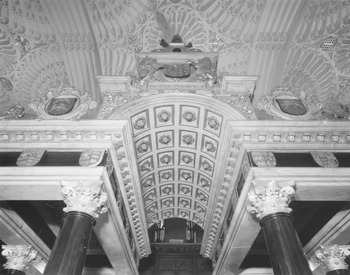
The monuments to Elizabeth Tudor and her cousin Mary Stuart in the Henry VII chapel at Westminster Abbey are among Britain's most important sites of memory, visited by millions of tourists each year. Memories of the two queens are significant to national and religious identities, to organizations historically associated with them, and to individuals influenced by the romanticism engendered by popular biographies and films. At their tombs such memories find material expression, and particular ideas about their lives and deaths are reinscribed upon public consciousness. On the four hundredth anniversary of Elizabeth's death, for example, representatives of the abbey, Westminster school, Trinity College, Dublin, and Jesus College, Oxford, institutions that she founded or refounded, gathered at her tomb. Similarly, the “Marie Stuart Society” visits Mary Stuart's sepulchre every December to mark her birthday by laying flowers at her monument.Footnote 1
The impact of the monuments upon popular and official conceptions of British history is no accident but rather the result of a careful strategy dreamed up by James VI and I and his councillors. When James ascended the English throne in 1603, he faced the politically awkward task of legitimizing a new dynasty. On the one hand, he had to assert the Stuart claim to the kingdom of England, while, on the other, he had to demonstrate continuity with the Tudor monarchs. This raised a major dilemma. Only two decades earlier, James's English predecessor, Elizabeth, had executed his mother, the deposed queen of Scotland. The king's dilemma was further complicated by his immediate family history, especially his occupation of his mother's throne in her lifetime and her alleged role in his father's murder. As many historians have shown, James—and his subjects—grappled with these issues in a variety of ways: the king's promotion of himself as a peacemaker, the possibility of formal union between the two realms, an emphasis on the return to male rule, the publication of histories of Elizabeth's reign and Mary's life, and the promotion of the new reign as a cultural renaissance.Footnote 2 The construction of tombs for Elizabeth and Mary was one of the most enduring ways in which James attempted to deal with his contradictory history. The story is a remarkable one, in which a king attempted to fashion the memory of two queens. This article interrogates the content and context of the two monuments, in order to decode how the new king and his councillors rewrote his family history and thus the history of his kingdoms. At the same time, it offers a methodology for interpreting early modern tombs, balancing analysis of production and patronage with examination of their content and reception.
Early modern historians have focused on how royal tombs construct meaning and on their contribution to the dynastic fictions necessary to legitimize and maintain the monarchy's political power.Footnote 3 Nigel Llewellyn has argued that the “two bodies” theory of kingship is the key to unlocking the function of monuments. While royal tombs acknowledge the decay of the monarch's mortal flesh, above all else they emphasize continuity. They are a link in the chain of power, smoothing over the passage of the crown from the death of one monarch to the coronation of the next.Footnote 4 David Howarth has demonstrated how royal tombs—both those built and those that were only proposed—were used by the Tudors and Stuarts to authenticate change as well as to enhance the splendor of monarchy.Footnote 5
A major problem for both interpretations is the absence of a monument to any monarch between Elizabeth and Victoria, besides a tablet in France commemorating the unfortunate James II. If tombs are so significant a weapon in the armory of royal propaganda and dynastic continuity, then why are there no monuments to mark the restoration of monarchy in 1660, the “revolution” of 1688, or the change to a new royal family in 1714, let alone a tombstone for James VI and I himself? Thomas Cocke has recently suggested that memorials were not really necessary to the emotive power of royal mystique, as seventeenth- and eighteenth-century visitors frequently acknowledged their awe at the presence of so much “royal dust” in the chapel. According to this line of argument, after the 1610s, the abbey's fame as a royal cemetery was not dependent on the presence of new monuments.Footnote 6
An alternative method is to recast the tombs that were actually built as extraordinary objects, objects that convey deliberate, specific messages—not formulaic, self-evident statements—about the continuity of kingship or the nature of royal power. Monuments could be read in this way as memorials to discontinuity, which actually emphasize change in order to make it seem natural and divinely ordained, rather than contingent on conquest, diplomacy, or genetic accident.
Such an approach invites a reappraisal of the tombs of Elizabeth Tudor and Mary Stuart, one that examines their production and interprets every aspect of their contents in detail. No comprehensive survey of this kind exists. Llewellyn and Howarth have touched on the significance of the effigies created for Mary and Elizabeth but not the inscriptions that accompany them. Adam White has painstakingly catalogued the careers of the masons who produced the monuments but not the role of the royal ministers who employed them.Footnote 7 Several scholars have drawn attention to the location of the monuments and the mortal remains they purport to contain. Howarth has argued that the tombs represent the “greatest diplomatic triumph in the history of the royal funerary monument,” a claim supported by the translation of Mary's body to Westminster and James's own, uncommemorated burial in the chapel's center. Above all, Julia Walker has recovered the long-forgotten fact that Elizabeth's own body was also moved from its original position next to Henry VII to the north aisle where her sister Mary Tudor was buried.Footnote 8 The geography of royal interment is crucial to understanding how the two monuments were to legitimize and foreground James's role as peacemaker in two kingdoms. What follows extends the work of Walker and others by studying every element of the tombs. A crucial but hitherto neglected area is heraldry, which plays a key role in constructing authority through its (mis)representation of lineage; here James faced a particularly difficult problem in dealing with his mother's marriages and finding a place for his father.
This article builds on earlier scholarship by bringing together all the known information about the two monuments. I begin by reviewing the circumstances in which King James and his ministers commissioned the tombs, revealing not only the justification for commemorating Elizabeth and Mary but also their divergent investments in how the queens should be remembered. Contrary to Walker, I argue that James did not set out to marginalize Elizabeth; rather, he refused to consider her memory without making provision for his mother. This is followed by a detailed comparison of the inscriptions, heraldry, images, form, and location of the tombs. I conclude with an examination of the removal of the bodies of both queens to their new vaults in the abbey. The account thereby offers a uniquely detailed window into the process of commissioning and constructing a monument in early modern England. By teasing out the dynastic and religious messages the monuments and their makers communicate to us, this article demonstrates the extent to which James hoped to rewrite the past in his own image.
Queen Elizabeth died on 24 March 1602/3. Her physical death was but the first step in a complex, risky process through which her titles and estates were bestowed upon a successor. Her passing did not exactly fit the prevailing model of a “good death,” principally because the queen left no will and testament to provide for the succession.Footnote 9 In contrast to the other Tudor monarchs, Elizabeth did not provide directions as to the manner of her funeral and the place of her burial, nor instructions about a possible monument. Perhaps the only indication about such matters was her famous quip of 1559 in answer to the Commons’ petition that she marry, “And in the end this shalbe for me sufficient that a marble stone shall declare that a queen having reigned such a time lived and died a virgin.”Footnote 10 In any event, the succession and Elizabeth's funeral fell to her councillors, who within hours of her death arranged the proclamation of the new monarch as James I of England.Footnote 11
Once informed of his inheritance, James set out for his new capital, while preparations began for the first royal burial and coronation seen in England in forty-five years. Elizabeth's funeral was set for 28 April 1603, and James was careful not to approach London until her body lay in the grave.Footnote 12 The official explanation for the king's absence was related to the theory of the monarch's two bodies: until the mortal body of the late queen was buried, the presence of the new king's living body would cause a conflict of interest for subjects who wished to mourn one monarch's passing as well as rejoice at a new monarch's accession.Footnote 13 As Jennifer Woodward has demonstrated, not everyone was convinced by this explanation. The Venetian ambassador observed that James refused to wear mourning and attend the funeral even though “he knows that the Queen wore strict mourning when she took the life of his mother.”Footnote 14 An alternative explanation is that James and his queen, Anne, were so traumatized by grief at the death of their son Robert in 1602, that they never attended another funeral again, including those of their other children Sophia (1606), Mary (1607), and Henry (1612).Footnote 15
The actual funeral was little different in form from those of Elizabeth's brother and sister. In accordance with tradition, both Edward and Mary Tudor had a hearse and effigy on display in the abbey, surrounded by heraldic banners. What differentiated Elizabeth's funeral from those of her immediate predecessors was its scale. The magnificent funeral procession was marred only by the refusal of Arbella Stuart to act as chief mourner for her cousin; the marchioness of Northampton took her place in her capacity as the realm's senior noblewoman. The body was carried to the abbey and buried in Henry VII's chapel. The funeral hearse was left on display, as recorded by the Venetian ambassador: “The coffin will lie for a month under a catafalque, and on it is the Queen's effigy, carved in wood and coloured so faithfully that she seems alive. She will then be laid near the bones of Edward the Sixth, her brother, in the earth, not in a vault, at the foot of the high altar and at the head of the tomb of Henry VII, her grandfather, a small structure of such richness and beauty that even a hundred years ago it cost sixty thousand crowns.”Footnote 16 A month seems to have been the normal time for an effigy and hearse to remain on display; in any case, the effigy survived to join other royal statues in the abbey, while the hearse was almost certainly removed before the new king's coronation in July 1603. Contrary to the ambassador's account, Elizabeth's body was laid to rest in the vault under the tomb of Henry VII, behind the altar.Footnote 17 The last of the Tudors would rest, appropriately, alongside the first.
The choices concerning Elizabeth's funeral, burial, and possible monument were built upon sixteenth-century precedents for the commemoration of one monarch by his or her successor. Within a decade of his accession, Henry VIII had completed his father's magnificent burial chapel at Westminster Abbey, including Pietro Torrigiano's central monument for Henry VII and Elizabeth of York. The Tudor dynasty thus established itself visually at Westminster as the climax of a monumental line of descent, running from Edward the Confessor's shrine, under the chapel of the Lancastrian king Henry V, to the tomb of Henry VII.Footnote 18 Despite commissioning a tomb from Torrigiano in 1519, and later appropriating the herculean monument begun by Cardinal Wolsey, Henry VIII himself was never commemorated in permanent form. He was buried in the choir at St. George's Windsor alongside his most successful wife, Jane Seymour, and surrounded by the Knights of the Garter. Edward VI left instructions that his father's monument be completed, but his wishes were never carried out.Footnote 19 In 1553 Edward himself was buried by his half-sister Mary according to the Protestant rites still in force but under the high altar of the Henry VII chapel, arguably the most unreformed position in the building. In turn, Elizabeth buried Mary in the north aisle of the chapel. Henry Machyn recorded how, on 16 April 1561, the altars of the abbey were taken down, “and the stones cared wher quen Mare was bered.”Footnote 20 The Catholic queen was thus buried under not just one but all the altar stones of the abbey. Elizabeth's burial with her grandfather in the center of the chapel at Westminster Abbey, and the completion of a monument within four years of her death, is suggestive of the determination of James and his councillors to rectify the failings of Henry VIII's children to memorialize their father and each other.
James's accession and Elizabeth's burial did nothing to resolve the conundrum of the memory of Mary Stuart. As many historians have pointed out, how could he present his mother in a positive light in the kingdom whose sovereign had executed her only sixteen years earlier, and when he himself had not seen her since his first birthday?Footnote 21 Yet, with his predecessor put to rest on such a grand scale, James could hardly ignore his own mother. Elizabeth might have left the memory and body of Anne Boleyn well alone, but she was arguably unconventional in so doing. Henry VII had obtained considerable papal indulgences for his mother Margaret Beaufort, and her memory was enshrined in a noble bronze tomb placed by her grandson Henry VIII in the south aisle of his father's chapel, complete with an epitaph by Erasmus.Footnote 22 Mary Tudor had asked in her will that the remains of Catherine of Aragon, her mother, be translated from Peterborough to be buried with her at Westminster, although the request was not performed.Footnote 23
Mary Stuart's decapitated remains had been laid in earth at Peterborough Cathedral, not far from Catherine of Aragon, some six months after death. Elizabeth disregarded Mary's own desire to be buried at St. Denis in Paris alongside her first husband, the king of France.Footnote 24 Her funeral was orchestrated by Elizabeth and her council in a ritual that cost £1,371.5s.8d, including £10 for her grave, payments for hanging Peterborough Cathedral with forty-eight escutcheons of her arms, the lead for her extraordinarily heavy coffin, and a hearse of some twenty square feet.Footnote 25 No effigy was used, nor was a monument erected, though her funeral helm, sword, and shield remained on display until 1643.Footnote 26 Camden recalled, thirty years later in his history of Elizabeth's reign, that a temporary epitaph was hung on the wall near the grave but hastily removed owing to its controversial content. This Latin text was identical to one printed in 1587 as a preface to Adam Blackwood's Martyre de Marie Stuart.Footnote 27 The epitaph reviewed the queen's life, and the profound consequences of her “barbarous and tyrannical death” for all monarchs, before drawing the reader's attention to the grave itself: “A strange and unheard kinde of grant [tomb] is here extant, in which the living are included with the dead, for with the ashes of this blessed MARY (divae Mariae), know thou that the Maiestie of all Kings and Princes lye here depressed and violated; and because the Regall secret doth sufficiently admonish Kings of their dutie, O Traveller I say no more.”Footnote 28 This reinvention of Mary as a sacred figure lent itself to her son's beliefs about divine monarchy, though the royal, saintly title of the Latin, “diva Maria,” was highly questionable. Camden's history attempted to redeem her from the stain of treason by blaming the events leading to her conviction and execution on her overzealous supporters and those intent on restoring the Roman discipline to England.Footnote 29 James's concern for his mother's memory was expressed as soon as was decently possible after his coronation. On 14 August 1603 he sent his herald William Dethick to Peterborough cathedral with “a rich pall of velvet embrodered with the armes of the mighty princesse Mary Queene of Scotts” and a letter instructing the bishop of Peterborough to have it placed on her grave. The bishop acquiesced, and both he and the dean preached sermons for the occasion. The act may be read as compensation for his absence at her first funeral and as one of many attempts to put her troubled history to rest.Footnote 30
It was not until March 1603/4, the first anniversary of his accession, that the king considered plans for a monument to Elizabeth. Significantly, this was also the time of his first English parliament, when he would emphasize his masculinity and his inheritance of multiple kingdoms. It appears that this initial plan was not adopted, and, a year later, a new strategy was instigated. The initiative came not from the king directly but from Robert Cecil, then Viscount Cranborne, who took the bold step of negotiating a contract for the queen's monument without the king's approval. Although James subsequently authorized the plans, he was not pleased, as Thomas Lake reported to Cranborne on 1 March 1604/5: “In the matter of the toombe his mate made difficulty saying he had not been made acquainted with it. But I shewed him the smalenes of the somme and that your l. had bargained with a workeman alredye which I thought you had not don without acquainting his highnes with it. So he passed it, but with this addition that he hoped when there was more store of money others should be remembred which your lo. may ghesse whom he meant.”Footnote 31 In the king's mind, Elizabeth might be allowed a tomb at royal expense, but its true cost must be a matching monument to redeem his mother's memory.
Cranborne, however, replied to Lake on 4 March, expressing satisfaction that his former mistress would be commemorated:
For ye Bill for ye Tomb or rather for a small monumentary stone for ye late Q. ye Favour to bestow it came from his My about 12 months since at Grenwch, at wch Tyme another matter woork and of another manner of Chardge, was resolved on, and Order given since for stone owt of Italy wch we look for evry weeke and yt shall likewise go on, as is befitting ye Circumstances of such a Business wherin such a k. shewes care to a P’sonadge of yt Eminency and deareness, when yt is beginning to go onward (for wch we have divers moddells alredy cutting) then shall neyther Exchequer nor London have a Peny but we will have it rather then faile.Footnote 32
That same day the king commanded the exchequer to pay up to £600 for a tomb for the late queen, noting that articles commissioning the monument had already been drawn up between the treasurer, workmen, and Cranborne. It was Cecil, in his capacity as principal secretary, to whom the king explicitly committed “the ordering, and performing” of the tomb. The king, continuing in an unusually miserly mood, ordered that the materials for the monument were to be taken from the royal works, “as we understand that there remaineth in our storehouse of Whitehall both white Marble and Touch stone which are very convenient to be used for the working and framing of this Tombe.”Footnote 33 Cranborne's letter to Lake went on to celebrate the honor James brought to himself in his resolve to provide a memorial for his predecessor, before revealing his own passion for the late queen's memory: “It doth my hart good to falsify yt blynd Prophesy, yt sayd none of k. Henry ye 8ts children shold ever be buried, wth any Memory, in wch ye trewth will appeare as It hath don in other things.”Footnote 34 News of the commission soon spread. On 11 April 1605 Edmund Lassells wrote from Greenwich to his master, the earl of Shrewsbury, that “His Matie hath commanded tow statlye tombes to be begun att Westminster, one for the Queen Elsabeth, an other for his Maiestie's mother.”Footnote 35
It is therefore certain that from the very beginning, James's commemorative vision included two monuments, although due to Cranborne's intervention Elizabeth's sepulchre was contracted nine months before and completed well in advance of Mary’s. Elizabeth and her sister Mary Tudor were to rest in the north aisle of the chapel of Henry VII. Meanwhile, Mary Stuart's tomb was built in the south aisle of the chapel in opposition to Elizabeth’s, a political balancing act and a logical response to existing monuments. Mary's aunt and mother-in-law, Margaret Douglas, lay to the west of the chosen site, while Margaret Beaufort's lay to the east. Margaret Douglas was mother of a king of Scotland, Margaret Beaufort was mother of a king of England, and Mary Stuart would rest in between them as mother of a king of both Scotland and England. As Maurice Howard, Walker, and others have noted, James's commemorative projects transformed the north aisle into the mausoleum of barren Tudor (and later Stuart) women, while the south aisle stood for fertility and continuity. By placing his mother's tomb next to that of Henry VII's pious mother, James identified himself with his great-great-grandfather, also the founder of a new dynasty, and mapped the Stuart family over the geography established by the Tudors.Footnote 36
The chief workman on Elizabeth's tomb was Maximilian Poutrain, alias Colt, a native of Arras who was living in London by 1595. Colt received installments in payment for his work in April 1605, October 1605, November 1606, and March 1606/7.Footnote 37 His success with the queen's tomb brought him further royal patronage, including appointment in July 1608 as master carver to the king. He also completed a range of commissions for the Cecil family, most notably Robert Cecil's own double-effigy monument at Hatfield.Footnote 38
Colt had finished the stonework for Elizabeth's monument by 17 March 1606/7, when the earl of Salisbury signed contracts worth £110 above the original sum to have it gilded and fenced.Footnote 39 Richard Patrick, a blacksmith later employed elsewhere in the abbey, received £95 for making an iron grille around the monument.Footnote 40 John de Critz, Colt's uncle by marriage and the king's serjeant painter, was eventually paid £100 for gilding and heraldry. Nicholas Hilliard complained to Cecil that he might have done a better job, “because as a Goldsmith I understand howe to set foorthe & garnishe a pece of stone woork not wth muche gylding to hyde the beawty of the stone, but where it may grace the same and no more.” Hilliard believed his patron had asked him to do the work, “thinking the woork had bene of yor L: cost,” but subsequently discovered that the task fell to de Critz by right of his royal appointment.Footnote 41 This incident illustrates the tension between Salisbury's ongoing supervision of the project and its actual status as a royal commission. By 28 August 1607 the government was able to calculate the entire cost of the late queen's funeral and commemoration. While the monument was relatively expensive for the period—the stone alone was valued at £200—at a cost of £965 it represented less than 6 percent of the total sum spent on the queen's memory, a stunning £17,301.5s.6d.Footnote 42
Mary's tomb proceeded more slowly than Elizabeth’s, though whether the delay was intentional is unclear. On 19 April 1606 an order was issued to pay the king's master mason, Cornelius Cure, £825.10s for “framing, making, erecting and finishing” the monument, plus costs for materials in the form of white marble, touch, and raunce. In contrast to the warrant for Elizabeth's monument, which mentioned only Cecil, this order was in the name of three men, the Lord Treasurer (Thomas Sackville), the earl of Salisbury (Cecil) and the earl of Northampton (Henry Howard). The king's instructions to the group mentioned a contract with Cure signed “January last,” suggesting that the tomb was formally approved in January 1605/6.Footnote 43 An undated note in the Cecil Papers mentions a plan for the tomb that had been prepared for the king's approval at a cost of about £2,000. This, together with the sum allowed for Cure's fee and the larger number of people involved in the project, suggests that from the outset James intended the monument to be substantially larger than Elizabeth’s.Footnote 44
Cure was Colt's senior in both years and rank. His father William had been brought to England from Holland by Henry VIII to work on the palace of Nonsuch. Through Lord Burghley's patronage, Cure was appointed royal master mason in 1596 and may well have been responsible for the senior Cecil's own tomb at Stamford.Footnote 45 Cure received his first installment of £200 in May 1606, with subsequent payments following in July and November and a bill for stone in November 1607.Footnote 46
The year 1606 must have been a busy one in Westminster workshops, with both Cure and Colt paid simultaneously for work on the two tombs. Elizabeth's monument was probably completed at some point during 1606; later that year Camden released a third edition of his guide to the abbey, updated to include her newly inscribed epitaph. The state of Elizabeth's monument during the visit of James's brother-in-law, King Christian of Denmark, is not known. When Christian visited the abbey with his nephew, the Prince of Wales, on Friday, 1 August 1606, the two proceeded to “the Chappell royall of Henry the seaventh, to behold the monuments, against whose comming the Image of Queene Elizabeth, and certaine other images of former kings & queenes, were newly beautified, amended, and adorned with royall vestures, but he tooke most notice of S. Edwards shrine, and therewithall admired the whole Architecture and fabrication.”Footnote 47 The refurbished “images” were not the recently commissioned royal tombs but rather the effigies used on royal funeral hearses. These included that of Elizabeth and six of her predecessors, Edward III, Henry VII, Henry V, and their wives. Richard Neile, the dean of Westminster, oversaw the repairs at a cost to the king of £72.12s.3d, including a sum for the construction of a special wooden press that has ensured their survival to this day.Footnote 48 The abbey accounts for 1606 also record the laying of a marble stone some eleven feet in length to complete the grave of Queen Anne of Cleves, Henry VIII's fourth wife, whom Mary Tudor had buried in 1557.Footnote 49 One suspects that James and his dean were popular with the abbey staff for beautifying long-neglected royal memorials, as well as building new ones.Footnote 50
The six-year gap between the completion of Elizabeth's monument in 1606 and that of Mary Stuart in 1612 was partly caused by the death of Cure in 1608 or 1609. Cure's son William took over the project and, according to White, frequently failed to complete tombs on time. In December 1609, the younger Cure was paid £108.16s for “five stones of white marble, containing 136 feet,” and received a final payment for his labor in honor of his father's contract in August 1613.Footnote 51 Finishing touches were provided in 1614, when Thomas Bickford was paid £195 for erecting an iron grate, and in May 1616, when James Mauncy was paid the considerable sum of £265 “in full satisfaction of the charges of painting and gilding” the tomb.Footnote 52 The full cost of the queen of Scots’ tomb cannot be accurately gauged, owing to the lack of comprehensive accounts, but the total for labor and materials was at least £1,554, some £600 more than was expended upon Elizabeth’s.Footnote 53
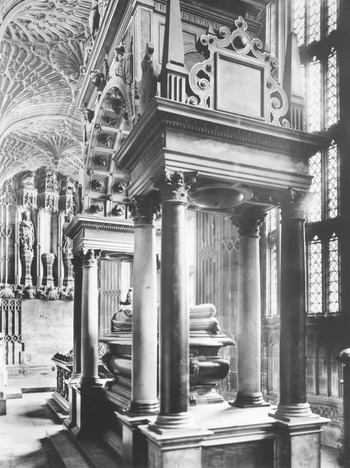
Once completed, how did the tombs represent the lives, deaths, and memory of Elizabeth Tudor and Mary Stuart? The two monuments adopted virtually identical forms. Each queen was represented by a life-size effigy recumbent under a canopy supported by two pavilions composed of pillars of the Corinthian order, the whole taking the ancient form of a triumphal arch. The note of victory over death was already well established in English monuments, as a way of replacing the prayers for the souls of the dead that the Reformation had swept away. This drew on the precedent of renaissance tombs in Italy and elsewhere, which displayed inscriptions and sculptures praising the virtuous dead for their deeds in life. In the case of the two queenly tombs, the imperial arches represent several triumphs. In accordance with the tradition derived from Horace and revived by Petrarch, fame trumped death; Elizabeth's queenship was, owing to Henry VIII's proclamation of the royal supremacy, promoted in imperial terms as without challenge in her kingdoms; Mary's triumph was as much over life as death, through her son's accession to the throne of her greatest rival. There was no subtlety in this final triumph, for Mary's tomb, while somewhat narrower than Elizabeth’s, was considerably taller and longer (see fig. 1).Footnote 54
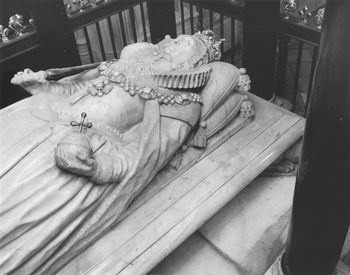
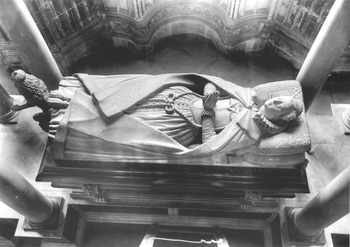
The two statues achieve quite distinct effects. Elizabeth's face is very likely copied from a death mask or her funeral effigy, as the “mask of youth” fiction of her last decades is removed to portray her as the elderly woman she was. The details of Mary's face, ruff, and cap appear to be copies of the only portrait taken during her long period in captivity, an image that quickly became the most popular visual representation of the queen of Scots. Elizabeth's garb clearly represents her as a queen, complete with orb, scepter, and crown, in precisely the state in which her funeral effigy would have appeared (fig. 2). Mary's relies more on necessary fiction—her head is firmly on her shoulders. She wears a bonnet, not a crown, while her hands, free from regalia, are clasped in prayer. Both effigies are cut from white stone, Elizabeth's lying on a simple slab supported by four lions. Mary’s, however, reclines on a majestic sarcophagus of black stone, throwing her white effigy into relief (fig. 3). This contrast is heightened by the use of white stone for the four pillars of the tomb's canopy nearest the body, while the triumphal arch soars far higher over her body than does Elizabeth’s. Overall, as Howarth has elaborated, Mary is depicted as a pure, innocent woman cut down in the prime of life, free from the stains of Protestant propaganda.Footnote 55 The depiction of Mary as an innocent victim is furthered by the use of color: black for the sarcophagus, white for the effigy, black for the outer set of four pillars, white for the inner. In the spandrels of the arch on either side are four angels, two females to the north and two males to the south, each holding a wreath and a palm branch, iconography associated not only with fame but also with innocence and martyrdom. Elizabeth, in contrast, is represented alone as a grand old queen who has peacefully concluded her allotted days, still holding the reins of power.
Several inscriptions provide explicit interpretations of the tombs’ visual messages. All are in Latin, and incised or painted in Roman capitals. Elizabeth's epitaph is inscribed in large lettering on two main panels mounted prominently on the east and west ends of her monument. A further four small panels on the base of the tomb contain short inscriptions that draw the reader's attention to the human remains deposited under the tomb. One pair gives Elizabeth's dates, while the other pair provides the only indication that her sister Mary lies under the monument, indeed, the only record in the entire chapel that Mary Tudor ever existed: “partners in throne and grave, here lie we sisters Elizabeth and Mary, in hope of the resurrection” (regno consortes & urna, hic obdormimus Elizabetha et Maria
—Tomb of Mary, queen of Scots, Westminster Abbey. © Crown copyright. NMR. Reproduced by permission of English Heritage.

—Effigy of Elizabeth I, Westminster Abbey. © Crown copyright. NMR. Reproduced by permission of English Heritage.

sorores in spe resurrectionis).Footnote 56 The authorship of Elizabeth's epitaph is unknown, although Camden or Salisbury are likely candidates.
Mary Stuart's epitaphs are by far the longer, with roughly three times as much text as those for Elizabeth.Footnote 57 The inscription, white lettering incised into the black sarcophagus and base, is separated into two parts, the first of which is a prose epitaph on the south. Its pointed message and length may be read as compensation for the troubled circumstances of Mary's life and death. The second text, distributed across four panels on the north side, is a series of twenty elegiac couplets. The epitaph and elegy were composed by the earl of Northampton, Henry Howard, who had corresponded with Mary Stuart during the 1580s, owned some five portraits of her, and had been imprisoned repeatedly by Elizabeth on account of his identification with Mary's cause. Two features of Northampton's life informed his elegy. First, while he outwardly conformed to the Church of England, Northampton
—Effigy of Mary, queen of Scots, Westminster Abbey. © Crown copyright. NMR. Reproduced by permission of English Heritage.

retained Catholic sympathies and was secretly received into the Roman Catholic Church in February 1614. Second, he was convinced that power and virtue came through birth alone, not wealth or experience. His text was accordingly a reflection on the queen of Scots’ noble nature as revealed in her life and death.Footnote 58
A comparison of the two queens’ epitaphs reveals how James, the patron, if not author, reconfigured their lives to his own ends. Each of the two panels commemorating Elizabeth begins with the word “memoriae,” conventionally inviting remembrance of the late queen's fame, character, and deeds. The epitaphs present her as an active ruler, praising her domestic and foreign achievements: she “restored religion to its primitive sincerity,” “refined coin to its true value,” “defeated Spain's fleet,” and “pacified Ireland” (religione ad primaevam sinceritatem restaurata … moneta ad iustum valorem reducta … hispanica classe profligata, hibernia … pacata). Her personal attributes are presented in terms not dissimilar to those of the gentry and nobility, valorizing her piety and learning. Elizabeth's distinction as a female monarch was explained by the claim that she was “a prince incomparable, [endowed] with regal virtues above her sex” (regiisq[ue] virtutibus supra sexum principi incomparabili). In contrast, Mary's existence was filtered through two frames of reference—her family relationships and her suffering and death in England. Mary's queenship was a status providentially ordained by birth and marriage, not an earthly role and responsibility. Elizabeth was also presented as a mother, but only in the role of “parent” of her kingdom, “patriae parenti,” a phrase clumsily modified of necessity from the “pater patriae” more easily assumed by male rulers.
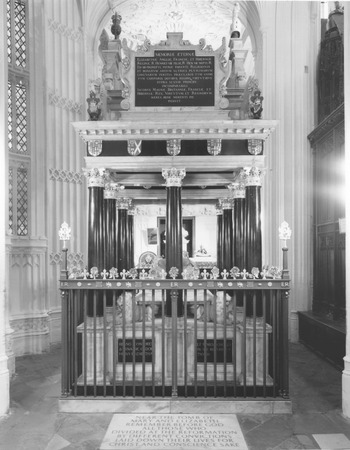
The two epitaphs were identical, nevertheless, in their representation of James. Political and spiritual child of one queen (he was Elizabeth's godson), and biological son of the other, the king was portrayed as superior to them both. The tablet on the west end of Elizabeth's tomb concluded with acknowledgment of James's commemorative deed and his inheritance of her kingdoms: “James, king of Great Britain, France, and Ireland, heir to her virtues and kingdoms, to her so well-deserving, dutifully erected this” (Jacobus Magnae Britanniae, Franciae, et Hiberniae Rex, Virtutum, et Regnorum haeres, bene merenti pie posuit). The placement of this inscription stressed James's greater title, replacing Elizabeth's “Angliae” with the new “Magnae Britanniae” he had assumed by royal proclamation in October 1604 (fig. 4).
The epitaphs on Mary's tomb praised James directly, the elegy describing him as “James, whom Pallas, the Muses, Diana, and the Fates honor” (Iacobum, quem Pallas, Musae, Delia, Fata Colunt). England's new Stuart dynasty became Mary's redemption and victory over fate. The succession of her son to England's throne was also alluded to metaphorically: “thus the pruned vine groans more fruitful with grapes, and the cut, radiant jewel glitters gracefully” (Sic vitis succisa gemit foecundior uvis sculptaque purpureo, gemma decore micat). Mary's death and ambitions were, again, redeemed in the person of her son, for “[Commending] to her son James the hope of a kingdom and posterity … she exchanged the lot of a transitory life for the eternity of a heavenly kingdom” (Iacobo filio spem regni, & posteritatis … vitae caducae sortem, cum coelestis regni perennitate com[m]utavit).
As Fuller recognized in 1655, Northampton's elegy for Mary ended with a clever reworking of the famous lines used on the tomb of the English empress Matilda at Bec-Hellouin Abbey Church. The original (Ortu magna, viro major, sed maxima partu, / hic jacet Henrici filia, sponsa, parens [Great by birth, greater by marriage, but greatest by offspring, / here lies the daughter, wife and mother of Henry]) was transformed into “Magna viro, maior natu, sed maxima partu; / conditur hic regum filia, sponsa, parens” (Great by marriage, greater by birth, but greatest by offspring, / Here is buried the daughter, wife, and mother of kings).Footnote 59 While Mary Stuart was considered more honorable in her birth than in her marriages, the text drew attention to her greatest achievement, the production of a son and heir whose titles would exceed her own.
Whereas Elizabeth's epitaph briefly described her passing as that of “a septuagenarian quietly freed by death” (placida morte septuagenaria soluta), the theme of death overshadowed Mary's epitaph. This was, after all, the point of her tomb—to resolve the historical, dynastic, and political problems posed by her execution. The inscription left no doubt about the manner of her death: “she was struck
—Tomb of Elizabeth I, Westminster Abbey. © Crown copyright. NMR. Reproduced by permission of English Heritage.

down by the axe, a dangerous example to kings” (infesto regibus exemplo, securi percutitur). Her violent death was couched as a sacrifice comparable to those of Israel under God's covenant with Abraham, a theme leading to a direct criticism of Mary's cousin and judge, Elizabeth. The elegiac couplets included a series of petitions, which effectively attacked Elizabeth's councillors and parliament, before expressing an ultimately misguided hope for Mary's royal posterity:
In using the feminine form of the Latin “christus” to represent Mary as the “anointed” queen, Northampton's elegy was almost blasphemous, comparing her to Jesus Christ himself. The effect was compounded by the most prominent texts on the tomb, two tablets on either end inscribed in large lettering with quotations from 1 Peter 2: “Christus pro nobis passus est relinquens exemplum ut sequamini vestigia eius. Qui cum malediceretur non maledicebat cum pateretur non comminabatur tradebat autem iudicanti iuste” (Christ suffered for us, leaving an example so that you should follow his footsteps. He did not abuse as he was abused; he did not lie when he was questioned; but he surrendered to the one who judges righteously). This Mary Stuart was messianic in her forbearance, unjustly accused yet always truthful, and an example to disciples in future generations through her redemptive suffering. Where Mary's epitaph implied she was already enjoying the martyr's reward in heaven, Elizabeth's was far more cautious. Elizabeth merely lay on earth awaiting the resurrection, as described in the phrase “she left here her mortal relics, until at Christ's command they rise immortal” (mortales reliquias, dum christo iubente resurgant immortales … deposuit).
Mary's inscription dwelt at great length on the theme of ancestry and kinship. Elizabeth's tomb briefly rehearsed her genealogy, naming only her progenitors Henry VIII, Henry VII, and Edward IV. In contrast, Mary's epitaph made labored, though truthful, claims about her lineage: “She was sprung from truly royal and most ancient stock, connected by paternal and maternal kin with the greatest princes of all Europe” (Stirpe vere regia & antiquissima prognata erat, maximis totius Europae principib[u]s, agnatione, & cognatione coniuncta). The epitaph described Mary as the queen of Scots and queen dowager of France and then more problematically proclaimed her to be “sole heir” (haeredis unicae) of Henry VII.Footnote 60 This assertion, which virtually denied Elizabeth's legitimacy and certainly dispensed with the claims of Arbella Stuart or the earl of Hertford, was backed by the description of Mary's English grandmother Margaret as “the elder born daughter” (maiori natu filiae) of Henry VII. The Stuart claim to the English throne was phrased to shore up James's accession; thus, Mary was “sure and undoubted heiress to the crown of England while she lived, and mother of James, the most mighty sovereign of Great Britain” (coronae Angl[iae] du[m] vixit certae, & indubitatae haeredis, et Iacobi Magnae Brittaniae monarchae potentissimi matris).
Marriage and children were, of course, absent from Elizabeth's epitaph. Contrary to her wishes as expressed in 1559, it made no reference to the queen's virginity, instead describing her variously as a daughter, prince, queen, conqueror, and triumpher. The only suggestion of a reproductive, feminine role appeared in the phrase “she was the nurse of religion and learning” (religionis et bonarum artium altrici). Yet, while Mary's epitaphs made much of her marriage to the king of France, they avoided altogether any mention of her marriage to Henry Darnley, let alone the abortive union with the earl of Bothwell. The omission left James's paternity unclear; moreover, the epitaph failed to explain his acquisition of the Scottish crown during his mother's lifetime. Nevertheless, by these silences Mary was made to appear in the best light possible. Pope Benedict XIV noted in the eighteenth century that the queen of Scots would have been a strong candidate for canonization, if only it could be definitively established that she had no involvement in the murder of her second husband.Footnote 61
Darnley's absence from the inscription on Mary's tomb was partially compensated by his prominence on the monument for his own mother, Margaret, immediately to the south. The countess of Lennox's memorial had been erected in 1578 by her servant and executor Thomas Fowler immediately following her death. Margaret's monument made much of her son Henry's role in the family fortunes, depicting his kneeling figure surmounted by a crown. A genealogical inscription, primarily designed to show that Margaret left only two grandchildren to posterity, pointed out that “Henry second sonne to this lady was K. of Scotts and Father to James the 6 now King,” before recalling abruptly that “this Henry was murthered at the age of 21 years.” The south end of this monument bore the arms of Matthew Stuart, earl of Lennox, and of the tomb's subject, Margaret Douglas, but the north end (facing Mary Stuart's monument) prominently displayed the arms of their son Henry impaling those of the queen of Scots. Although James had no role in the construction of the Lennox tomb, its convenient location and message about his father's status and lineage provided a foil to his mother's monument. Indeed, the barbed message about Darnley's murder was overshadowed and blunted by the grand tomb for Mary Stuart, whose death was presented as far more grievous.Footnote 62
The heraldry on Mary's tomb was relatively sparse and uncontroversial. Around the frieze on each pavilion were two groups of eight shields, the first eleven depicting the Scottish royal line from William I (“the Lion”) to James IV, followed by Mary's maternal grandparents, her parents James V and Mary of Guise, two shields for her own marriages, and finally the arms borne by her son James. Four larger shields repeated the arms of the queen's parents and paternal grandparents, and her unions with the French king and Darnley. The shields at the summit of the tomb predictably showed the royal arms of Scotland. The armorial bearings thus demonstrated Mary's right by birth to the crown of Scotland and by marriage to France.Footnote 63 What is significant is the lack of emphasis on Mary's claim to the English throne. The only substantial heraldic gesture in this direction was the presence of four unicorns at the corners of the monument's central canopy, a parallel to the four lions on Elizabeth's tomb; one unicorn bore a thistle for Scotland, another a fleur-de-lis for France, while two bore roses representing her Tudor ancestors.Footnote 64
The armorials displayed on Elizabeth's tomb were far more subversive. Her genealogy was represented by a series of several small shields running around the entablatures of the two pavilions below the central arch. That on the west end began with the shield of Edward the Confessor, then traced Elizabeth's descent through the English monarchs ending with the arms of Henry VIII and Anne Boleyn.Footnote 65 The genealogy on the eastern canopy was broken into four parts. Two provided further descents from Edward III, one to show the link from John of Gaunt to Margaret Beaufort, and the other to bring in the remaining line from Lionel, duke of Clarence to Anne Mortimer. The third set, discretely located on the interior frieze of the canopy, showed five shields accounting for the queen's otherwise unmentioned Boleyn and Howard ancestors. The remaining three shields, on the southern frieze of the western canopy, depict three generations of descent from Henry VII, through the impaled arms of Margaret Tudor and Archibald Douglas, Margaret Douglas and Matthew Stuart, and, finally, Henry Stuart and Mary, queen of Scots. These have no legitimate place on Elizabeth's tomb, for they illustrate not her lineage, but that of her successor. James used them to demonstrate that, just as he had an undoubted claim on the Scottish throne through his mother, so too he could claim the English throne through his English-born father.Footnote 66
The heraldic usurpation of Elizabeth's tomb was completed by the two largest shields at the summit of the canopy. That on the south side conventionally presents Elizabeth's armorial bearings and motto. The parallel shield on the north side, however, shows Scotland impaling France and England, presumably representing the marriage of James IV of Scotland and Margaret Tudor, accompanied by James's motto “blessed are the peacemakers” (beati pacifici). Even those visitors who cannot read heraldry can still observe the thistle which crowns the Scottish arms on this English queen's tomb (fig. 5). On the corners of the monument's canopy
—Detail of heraldry on tomb of Elizabeth I, Westminster Abbey. © Crown copyright. NMR. Reproduced by permission of English Heritage.

were a portcullis, a fleur-de-lis, a rose, and a harp, while the base displayed insignia for Wales, Ireland, Cornwall, and Chester, paralleling the emblems and banners carried at her funeral.Footnote 67 The heraldic message of the tomb is threefold. First, it illustrates Elizabeth's right to the English throne by virtue of her royal lineage. Second, it asserts James's place as her legitimate successor through his double descent from Henry VII. Finally, it represents James's claim to be ruler over the entire Atlantic archipelago.
As each tomb was finished, its completion was marked by the transferral of the subject's remains to its vault. Disinterment was a rare and disturbing event in early modern England; to undertake it twice indicates the seriousness of James's resolve to shape public memory. As Colt finished his tomb first, Elizabeth's was the first body to be moved. In 1606, the queen's corpse was taken out of the vault under Henry VII's tomb in the center of the chapel and laid to rest on Mary Tudor's coffin in a crypt in the north aisle. Walker has brought this remarkable occurrence to historians’ attention by discovering a payment in the abbey's records for the cost of moving her body.Footnote 68 A further entry in the abbey treasurer's accounts for 1606 leaves no doubt about her findings. This records a payment of 46s.4d. explicitly for “remouing of Q. Elizabeth her bodie from under H: ye Vijth his tombe to the place where her monum[en]t nowe standeth.”Footnote 69
It is less clear that the disinterment of Queen Elizabeth was a mark of disrespect. The translation of her remains enabled due reverence to be paid at the site of her new, grand monument, rather than subsuming her memory beneath that of her grandfather. As Walker herself points out, contemporary commentators were well aware that Elizabeth had initially been buried in one vault and her monument constructed at another. The same commentators did not suggest that the new king's action was in any way unjust.Footnote 70 If there was any disrespect to Elizabeth, hardly likely under Cecil's supervision, it was produced not by moving her body, but by moving her cousin's to a larger vault and monument in the opposite aisle. James's action granted an equality to the two queens that Elizabeth never recognized and brought them in closer physical proximity in death than they had ever achieved in life. It might be argued that Elizabeth was now identified as a Tudor woman, not as a Tudor, through removal of her body from her grandfather's grave to that of her sister. Nevertheless, there was only one small inscription on the base of her tomb to indicate Mary Tudor's presence at all. If anyone's memory was dishonored as a result of James's tombs, it was Mary Tudor’s; her existence was altogether absent from the heraldry and imagery.Footnote 71
The translation of Mary Stuart's body from Peterborough to Westminster was far more radical than moving Elizabeth's body from one vault in her grandfather's chapel to another. For, in an act replete with contradictions, the queen of Scots was buried in the place most sacred to the regime that had executed her. On 28 September 1612 James wrote to the bishop, dean, and chapter of Peterborough informing them of the royal will. His letter is the only surviving justification for all these commemorative acts: “wee thinke it appertaynes to the duetie wee owe to our deerest mother that like honour shouldbe done to hir bodye & like monument be extant of hir as to others hirs & our Progenitors have beene used to be done, and our selves have alreadie perfourmed to our deere Sister the late Queene Elizabethe.” The desire to pay his mother the same respects given to their ancestors, and to James's “sister,” was in accordance with contemporary ideals. A hint that something more was taking place came in the next phrase: “Wee have co[m]maunded a Memoriall of hir to be made in our Churche of Westminster, the place where the Kings & Queenes of this Realme are usually interred.” Was Mary Stuart, queen of France and Scotland but not England, to be accorded the same honor as the sovereigns of “this Realme”? The king went on to note that it was “inconvenient” that his mother's body and tomb should be in different places. Finally, he commanded the cathedral officers to allow the pall over the grave to be used to cover his mother's body as it was moved.Footnote 72
The letter was delivered to the bishop and one of the prebends of Peterborough by Neile, who had recently become bishop of Coventry and Lichfield. He was an obvious choice for the task. Apart from his strong rapport with the king, Neile was intimately acquainted with the monuments to both queens from his five years as dean of Westminster, in which time he would have overseen the removal of Elizabeth's remains. The Peterborough authorities considered the whole affair significant enough to file the king's letter and to place a copy on display at Mary's former grave where it could still be read in the nineteenth century.Footnote 73
Mary's body was duly exhumed on 4 October 1612, carried to London, and interred in the abbey on 8 October. The cost was not inconsiderable. Neile's expenses came to a total of £178.19s.2d, while one Michael Stockdale was paid 2s.6d. to ring the bells of St. Margaret's Westminster as the queen's body was reburied.Footnote 74 Edmund Howes recorded the arrival of the queen's body in his extensions to Stow's Annales. The archbishop of Canterbury, bishop of Rochester, dean of Westminster, earl of Worcester, Lord Chancellor, and Lord Privy Seal went out and “mette the corps at Clarken-well, about 6 a clocke in the evening, and from thence with plentie of Torch-lights, brought the bodie of the sayde Queene unto the chappell royall at Westminster, and on the South side thereof it was there enterred that night, where the King had builded a most royall Tombe for her, where she now resteth.”Footnote 75
Writing two days later, the earl of Northampton provided Viscount Rochester with further details, praising the king for completing his filial duty, and emphasizing the queen's popular repute: “though we brought hir in verie late to shunne concurse yet the people in the streetes and out of the windowes caste their eies upon the passage manie notinge and with admiration the iustice of god and the piety of a matchelesse son that brought hir into that place with honor from which she had been former in former times repelled with tiranny.”Footnote 76 Northampton's account of the actual interment brought on a rush of emotion at the memory of the queen of Scots, although his tears were tempered by “lookinge one that cherefull son which nowe shines.” His flights of fancy led him to interpret every element of the translation of the corpse as evidence of God's blessing on the redemption of Mary's memory: “One thing I noted also which to a well conceaving thought might seeme an effecte of providence that in the chappell wherin the countesse of Richimonde this great Quenes great grandmother was enterred no more rowme was left then that only which conteind the Royall corpse neither in that rowme when the coffine came to be put in was thear 3 inchis of latitude to spare, theas dimensiones provinge as I said that howsoever tyranny for a while had borne a stroke yet this place was preservid and kept for hir.”Footnote 77 James's commemorative design, not divine providence alone, had clearly worked in Northampton's case, for Mary's monument and vault were tailor-built to accommodate her coffin and deliberately designed to situate the tombs of Margaret Beaufort and the countess of Lennox as supporters to her own. Northampton went on in the same epistle to reveal the political realities and divisions that simmered underneath the tomb project, by railing at length against both Robert and William Cecil for their role in Mary's death.
The reburial of Mary's body was almost certainly timed to coincide with the wedding of her granddaughter, the princess Elizabeth, to Frederick, count palatine of the Rhine.Footnote 78 A marriage contract had been signed in May 1612 and may have served as a spur to complete the tomb, following the precedent of the Danish king's 1606 visit to the abbey monuments. On 16 October 1612 Frederick landed at Gravesend, for the first royal wedding in England since 1554.Footnote 79 One can imagine James's pleasure at the thought of seeing his family history successfully rewritten and his dynastic future ensured with the dead installed in their proper places and the living on the brink of creating a new generation. Any such pleasure was short-lived, however, for within days of Mary Stuart's translation and his prospective brother-in-law's arrival, the Prince of Wales fell ill. Then, on 6 November 1612, the young Henry died. The new vault in the south aisle of the royal chapel was put to an unexpected use in December 1612 when the prince's coffin was laid alongside his grandmother's remains.Footnote 80 The Prince of Wales was never permanently memorialized, although verse epitaphs and printed accounts of his funeral abounded after his death. His magnificent hearse and effigy remained on display for a short period but appear to have been removed as mourning was put aside to allow the royal wedding to proceed.
The lack of a tomb for the Prince of Wales contrasted with the treatment of his infant sisters’ memory. James and Anne's daughter, Sophia, had died in June 1606 only one day after her birth. She was buried with full honors in the royal chapel in a new vault just to the east of Elizabeth's monument. Colt, who had presumably just completed his share of the work on the queen's tomb, was contracted by Salisbury on 17 March 1606/7 to provide a monument for the princess, at a cost of not more than £140.Footnote 81 This simple but eye-catching memorial took the form of a baby in its cot, a powerful archetype subsequently replicated across the kingdom.Footnote 82 As Thomas Fuller put it, Sophia was “represented sleeping in her cradle, wherewith vulgar eyes, especially of the weaker sex, are more affected (as level to their cognizance, more capable of what is pretty than what is pompous) than with all the magnificent monuments in Westminster.”Footnote 83 The Latin inscription attempted to comfort the grieving royal parents in a conceit describing Sophia as “the royal rosebud prematurely plucked by fate … in order that she might flower anew in the rose garden of Christ” (rosula regia praepropero fato decerpta … ut in Christi rosario reflorescat).
One tragedy was compounded by another when the king's two-year-old daughter Mary died on 16 September 1607. This death was especially grievous, as Mary had been the first child of a sovereign born in the kingdom of England since 1537. She was buried alongside her sister with minimal ceremony, reflecting parental grief and in counterpoint to the vast scale of her christening in 1605, though the abbey was still paid a sum equivalent to that for the funeral of a countess.Footnote 84 Colt was commissioned to provide his third royal monument, conceived as a foil to Sophia’s. Princess Mary was depicted as a young girl reclining on her side, watching over her sister's cot. Once again a Latin inscription emphasized the contrast of her parents’ grief with her happy state in the afterlife: “received into heaven, I found joy for myself and left longing with my parents” (in coelum recepta mihi gaudium inveni parentibus desiderium reliqui). The pair of tombs was complete by December 1608, and Colt received a total of £215 for his work.Footnote 85
The construction of tombs for two infant daughters is indicative of the energy James and Salisbury committed to the task of repackaging the royal family history. But Prince Henry's burial in 1612 exposed the memorial fiction the king and his ministers had constructed over the preceding decade. The geography of interment, separating barren and fertile, women and men, was upset as the young prince was placed with his Stuart grandmother. The fiction would be further undercut as the seventeenth century progressed and literally dozens of Stuart royal infants were interred in Mary Stuart's vault, to the point where a second chamber had to be constructed.Footnote 86 The public contrast between barren and fertile was reasserted in 1674, however, when Charles II ordered the newly discovered remains of the supposed “princes in the tower” to be buried in the north aisle, where a commemorative tablet was erected.
When James himself died in 1625, no funeral monument was erected to his memory, but he hardly needed one of his own. In 1603, his mother lay buried in Peterborough with only minimal commemoration, while his predecessor was interred in her grandfather's tomb leaving no plans for a memorial. Over a period of ten years, incorporating the disinterment of two bodies and the construction of four monuments, James rewrote the history of his family and kingdoms. In so doing he publicized his name and fame across the royal chapel at Westminster Abbey. The inscriptions and heraldry depicted James as heir of Elizabeth's virtues, redeemer of his mother's execution, the successor of both women, and their superior in the title “king of Great Britain.” The relocation of the physical remains of the two queens brought James's mother into the spotlight as Elizabeth's equal, while the greater cost and height of Mary's tomb suggested she had outdone her rival in the end. Finally, James's own burial in the vault of Henry VII placed him at the center of the chapel and apex of the dynasty.
James could not have rewritten history so thoroughly without the commitment of his councillors, though they brought divided allegiances to the scheme. Robert Cecil was a critical force in the erection of the monuments for Elizabeth, Mary, and the Stuart princesses but was especially keen to promote the memory of the Tudor queen whose reign was so important to his own family history. Henry Howard followed Mary Stuart's tomb through from contract to completion and by his eulogizing transformed it into a vehicle for the expression of a nascent royalist Catholic discourse. Salisbury and Northampton evidently shared a passion for monumental commemoration, the former employing Colt on his own tomb at Hatfield, and the latter the king's master mason Nicholas Stone for a monument at Dover. Northampton even followed the king's lead in remedying the tragedies of his own family history when, in 1614, he removed the remains of his father, the earl of Surrey, from the Tower of London to the Howard mausoleum at Framlingham.Footnote 87 Behind the scenes, the Arminian cleric Richard Neile played a leading role in tidying up the dust of history as dean of Westminster and, later, as the bishop entrusted with the translation of Mary Stuart's remains. Nevertheless, it was James, the embodiment of union and self-styled peacemaker, who insisted from the beginning of his reign that both Elizabeth and Mary would be remembered in stone.
The monuments were indeed potent sites of memory, capable of bearing multiple layers of meaning, although these were not always in line with the intentions of their patron. Each tomb had lasting impact on the British imagination, whether English or Scottish, Protestant or Catholic. Elizabeth's epitaph was printed by William Camden in his catalogue of the abbey tombs from the moment of its unveiling in 1606. Images of her tomb began to circulate in print and were hung in churches; one graced the pages of Henry Holland's Heroologia as early as 1620.Footnote 88 Mary and her monument initially received less public attention but may have become a site of subterranean memories. A Scottish Catholic, Thomas Dempster, who may have been appointed royal historiographer by James in 1616, even claimed in 1627 that “her bones, translated to the burial ground of the kings of England at Westminster, are famed for miracles.”Footnote 89
Yet the monuments were by no means the only way of shaping memory, nor would their version of events always triumph over others. Many London parishes displayed their own verse epitaphs in honor of Elizabeth that were famously recorded by Stow and his successors in the Survey of London. As Walker has shown, these contained quite different versions of the queen's life than that found at the abbey.Footnote 90 Moreover, monuments were not necessary when other media could be used to create or legitimize an identity for posterity, or when there was no controversy that required resolution after death. One reason why James needed no funerary monument was because he had built a memorial of sorts just north of the Abbey in the form of the Banqueting House at Whitehall, complete with its grand images of divine kingship in testimony to his dynastic visions.Footnote 91 No monument was erected for Queen Anne or the Prince of Wales, but perhaps none was needed since material proof of continuity from Tudor to Stuart, from Scotland to England had already been established. The funerals for the relatively uncontroversial queen cost at least £19,000, surely a sum large enough for honor's sake.Footnote 92 Grief at Henry's premature death was so great that none could envisage what sort of permanent object might sufficiently replace him. As Anthony Munday put it, “A Monument all of pure gold were toe little for a Prince of such high hope and merit.”Footnote 93
When James conceived of commemorating his mother and his English predecessor together, he recognized the potency of gathering together their mortal remains under one roof, framed by representations of their lives in his own terms. Like many early modern people, James understood that a representation of the past did not need to reflect reality; instead, a representation might change public memory, and create new realities. Monuments were a powerful form for achieving this, communicating information diversely through their position, size, inscriptions, heraldry, effigies, and materials. Their messages were empowered by the proximity of the actual bodies of those they portrayed. The tragedy of James's monumental project at Westminster Abbey is that he could not control how the tombs of Mary Stuart and Elizabeth Tudor would be variously understood by his own and future generations, unable to read Latin or heraldry and unable or unwilling to perceive his guiding hand at work. Nor, fatally, were the poetic warnings of his mother's monument sufficient to save James's own son from the executioner's axe.