





Early life stress and disrupted stress system functioning are associated with increased risk for both anxiety and externalizing problems (Brieant et al., Reference Brieant, Cai, Ip, Holt-Gosselin and Gee2025; Chong et al., Reference Chong, Gordis, Hunter, Amoh, Strully, Appleton and Tracy2022; Koss & Gunnar, Reference Koss and Gunnar2018). However, our understanding of why some youth develop one presentation rather than the other remains limited. Addressing this question is further complicated by the overlap among anxiety and externalizing problems, likely related to shared features such as negative emotionality and disturbances in threat processing (Beauchaine & Hinshaw, Reference Beauchaine and Hinshaw2020; Brieant et al., Reference Brieant, Cai, Ip, Holt-Gosselin and Gee2025; Pasion et al., Reference Pasion, Macedo, Paiva, Patrick, Krueger and Barbosa2023). This study aims to clarify how stress system responding, particularly within the hypothalamic–pituitary–adrenal (HPA) axis, may interact with a history of early (i.e., before age 6) exposure to potentially traumatic events (PTEs) to shape the development of anxiety and externalizing problems in middle childhood and adolescence. Critically, this study also applies methodological strategies to address challenges related to capturing multiple aspects of HPA axis reactivity and the overlap among anxiety and externalizing problems.
HPA axis functioning and psychopathology
The HPA axis is involved in both the mammalian stress response and in maintaining allostasis across several physiological systems in daily functioning (Gunnar & Quevedo, Reference Gunnar and Quevedo2007; Koss & Gunnar, Reference Koss and Gunnar2018). Activity of the HPA axis can be examined in regard to basal levels, diurnal patterns, or reactivity to stressors (Gunnar & Quevedo, Reference Gunnar and Quevedo2007; Klimes-Dougan et al., Reference Klimes-Dougan, Hastings, Granger, Usher and Zahn-Waxler2001). Basal activity and reactivity of the HPA axis theoretically serve different functions (i.e., general environmental sensitivity and maintaining allostasis vs. mobilization of resources to a particular stressor; Koss & Gunnar, Reference Koss and Gunnar2018; Shirtcliff et al., Reference Shirtcliff, Vitacco, Graf, Gotisha, Merz and Zahn-Waxler2009) and may interact with different neurobiological factors (e.g., availability of high affinity mineralocorticoid and low affinity glucocorticoid receptors in the hypothalamus, respectively; Heim & Nemeroff, Reference Heim and Nemeroff2001; Koss & Gunnar, Reference Koss and Gunnar2018). The current study focuses on two indices of cortisol reactivity to a laboratory social stressor. The first captures total cortisol output across the task (i.e., area under the curve with respect to ground, AUCg) and includes information regarding an individual’s basal cortisol levels in addition to change during the task. The other calculates pure change in cortisol levels across the task (i.e., area under the curve with respect to increase, AUCi).
HPA axis reactivity has been positively associated with anxiety and externalizing problems independently, as well as their co-occurrence (Chong et al., Reference Chong, Gordis, Hunter, Amoh, Strully, Appleton and Tracy2022; Juruena et al., Reference Juruena, Eror, Cleare, Young and Kim2020; Koss & Gunnar, Reference Koss and Gunnar2018). However, negative associations between HPA axis reactivity and externalizing problems are also commonly supported (Hawes et al., Reference Hawes, Brennan and Dadds2009; Koss & Gunnar, Reference Koss and Gunnar2018; Shirtcliff et al., Reference Shirtcliff, Vitacco, Graf, Gotisha, Merz and Zahn-Waxler2009), and overall patterns are considered mixed. Environmental experiences of stress and adversity, including trauma, may be important contextual factors that explain this variability (Beauchaine & Hinshaw, Reference Beauchaine and Hinshaw2020; Chong et al., Reference Chong, Gordis, Hunter, Amoh, Strully, Appleton and Tracy2022; Doom et al., Reference Doom, Rozenman, Fox, Phu, Subar, Seok and Rivera2021).
Early PTEs, the HPA axis and psychopathology
PTEs occur at the highest rates within the first five years of life (Lieberman et al., Reference Lieberman, Chu, Horn and Harris2011; US Department of Health and Human Services, 2025), and over a quarter of children are the victim or witness of a PTE by age four (Briggs-Gowan et al., Reference Briggs-Gowan, Carter, Clark, Augustyn, McCarthy and Ford2010). These early PTEs may be particularly impactful due to rapid emotional and physiological development during this developmental period (De Young et al., Reference De Young, Kenardy and Cobham2011). Although prior work has broadly supported interactions among childhood PTE exposure, HPA axis functioning, and risk for both anxiety and externalizing symptoms, the directionality of these relations remain difficult to untangle (Beauchaine & Hinshaw, Reference Beauchaine and Hinshaw2020; Chong et al., Reference Chong, Gordis, Hunter, Amoh, Strully, Appleton and Tracy2022; Doom et al., Reference Doom, Rozenman, Fox, Phu, Subar, Seok and Rivera2021). Of note, we chose to focus on anxiety, rather than depression or broad internalizing problems, as both anxiety and externalizing problems are particularly characterized by differences in threat responding (Dillon et al., Reference Dillon, Rosso, Pechtel, Killgore, Rauch and Pizzagalli2014; Lebowitz et al., Reference Lebowitz, Gee, Pine and Silverman2018; Pasion et al., Reference Pasion, Macedo, Paiva, Patrick, Krueger and Barbosa2023; Peng et al., Reference Peng, Knotts, Young, Bookheimer, Nusslock, Zinbarg and Craske2023), which is also impacted by PTE exposure (McLaughlin & Gabard-Durnam, Reference McLaughlin and Gabard-Durnam2022) and reflected in HPA axis reactivity (Gunnar & Quevedo, Reference Gunnar and Quevedo2007).
The Adaptive Calibration Model (ACM; Del Giudice et al., Reference Del Giudice, Ellis and Shirtcliff2011) provides a framework, based upon life history theory, to understand these complexities. Specifically, the ACM suggests that associations between stress system activity and anxiety and externalizing problems are curvilinear and dependent on contextual factors, which would result in null or inconsistent findings when youth’s experiences of threat and stress are not considered (Del Giudice et al., Reference Del Giudice, Ellis and Shirtcliff2011; Schwartz et al., Reference Schwartz, Calvi, Allen and Granger2023). Within non-threatening, supportive environments, the ACM theorizes that individuals’ stress systems are likely to be highly sensitive (e.g., elevated HPA axis activity) to allow for individuals to maximally benefit from environmental inputs (i.e., a sensitive profile). Individuals within these conditions are also expected to adopt prosocial and cooperative behavioral strategies and be well regulated. As such, in this environment, HPA axis reactivity would be expected to be unrelated or negatively related to anxiety and externalizing problems. However, within stressful and threatening contexts, the ACM proposes that HPA axis reactivity will also become elevated to allow individuals to orient to, respond to, and cope effectively with frequent threats (i.e., a vigilant profile). Within these threatening contexts, individuals are expected to adopt emotional and behavioral strategies associated with either approach (e.g., externalizing problems) or avoidance (e.g., anxiety) of threat, which would be reflected in positive associations between HPA axis reactivity and these symptoms. Therefore, estimating linear associations between HPA axis reactivity, anxiety, and externalizing problems without considering whether this was occurring in a low- or high-threat context would likely result in null or inconsistent findings depending on the sample (Del Giudice et al., Reference Del Giudice, Ellis and Shirtcliff2011; Schwartz et al., Reference Schwartz, Calvi, Allen and Granger2023).
The ACM also predicts opposing patterns of associations between HPA axis activity and externalizing problems depending on the level of threat experienced. In environments characterized by persistent or extreme levels of stress, threat, and limited resources, it is theoretically advantageous for individuals to be less physiologically responsive to threat to conserve resources and protect against neurotoxic effects of chronic HPA axis activation, and to avoid cooperative actions that could be disadvantageous (i.e., unemotional profile; Del Giudice et al., Reference Del Giudice, Ellis and Shirtcliff2011). Therefore, within elevated threat contexts, the ACM predicts a positive association between HPA axis reactivity and externalizing problems, but this is theorized to become a negative association at extreme levels of threat. The ACM does not make differential predictions related to basal or overall HPA axis activity relative to specific HPA axis reactivity. However, hypoactive HPA axis functioning is thought to promote fearlessness and sensation-seeking due to disruptions in punishment-based learning processes, which would typically socialize individuals away from engaging in externalizing behaviors (Blair, Reference Blair1999; Coren, Reference Coren1999). Notably, this may reflect a process in which children’s blunted reactivity (e.g., when experiencing consequences for their behaviors), rather than blunted overall HPA axis activity, promotes the development of externalizing behaviors.
Several studies have broadly supported ACM-predicted profiles of stress system and emotional-behavioral functioning calibrated by context from early childhood through adolescence (Del Giudice et al., Reference Del Giudice, Hinnant, Ellis and El-Sheikh2012; Ellis et al., Reference Ellis, Del Giudice, Shirtcliff, Beauchaine and Hinshaw2017; Lin et al., Reference Lin, Kidwell, Kerig, Crowell and Fortuna2021; Perhamus et al., Reference Perhamus, Perry, Murray-Close and Ostrov2026), but this literature can be expanded in several critical ways. First, many of these prior studies have focused on broad experiences of adversity rather than PTEs specifically, or have been unclear regarding which construct was measured (Hosseini-Kamkar et al., Reference Hosseini-Kamkar, Varvani Farahani, Nikolic, Stewart, Goldsmith, Soltaninejad and Leyton2023). A recent meta-analysis identified that DSM-5 defined childhood PTEs (i.e., exposure to actual or threatened death, serious injury, or sexual violence) versus broader childhood adversity show different patterns of associations with HPA axis functioning, suggesting that examinations of PTE-specific associations are needed (Hosseini-Kamkar et al., 2021). Furthermore, most prior work has focused on maltreatment or trauma experienced throughout childhood (e.g., Kuhlman et al., Reference Kuhlman, Geiss, Vargas and Lopez-Duran2018). However, experiences occurring during infancy and early childhood may be particularly impactful for both later mental health and HPA axis functioning (De Young et al., Reference De Young, Kenardy and Cobham2011; Keiley et al., Reference Keiley, Howe, Dodge, Bates and Pettit2001; Kuhlman et al., Reference Kuhlman, Vargas, Geiss and Lopez-Duran2015). Finally, our understanding is further complicated by measurement challenges in capturing the absence of traumatic experiences (McGuire et al., Reference McGuire, Singh and Jackson2024, Reference McGuire, Smith and Kilpatrick2025), using a variety of measurements of HPA axis reactivity which often conflate information regarding basal activity and reactivity (Burt & Obradović, 2013), and challenges in capturing unique and shared associations between externalizing problems and anxiety given their high levels of co-occurrence (Brieant et al., Reference Brieant, Cai, Ip, Holt-Gosselin and Gee2025; Kuhlman et al., Reference Kuhlman, Geiss, Vargas and Lopez-Duran2018).
Current study
The present study aims to shed additional light on whether HPA axis functioning’s associations with anxiety and externalizing problems may vary depending on youth’s exposure to early PTEs (or the lack of any PTE exposure) in a manner consistent with ACM theory, while addressing key limitations of prior work. First, true PTEs (rather than general adversity) were captured using reports from multiple informants using a semi-structured clinical interview. This practice aims to address concerns regarding the use of single-informant or questionnaire-based assessments of PTE exposure (Cooley & Jackson, Reference Cooley and Jackson2022; Siereau et al., Reference Sierau, Brand, Manly, Schlesier-Michel, Klein, Andreas, Garzon, Keil, Binser, von Klitzing and White2017; Zhang et al., Reference Zhang, Xu, Hong, Liu and Liao2022) and to minimize contamination of the “no PTE” group (McGuire et al., Reference McGuire, Singh and Jackson2024). Although this binary comparison provides a theoretically driven contribution to the literature, binary categorization of PTE exposure has inherent limitations (McGuire et al., Reference McGuire, Singh and Jackson2024, Reference McGuire, Smith and Kilpatrick2025). Therefore, we also conduct post hoc models examining whether the intensity of early PTE exposure moderates associations between HPA axis activity and mental health functioning.
Second, to address limitations of common indices of HPA axis reactivity, which often rely on difference scores and may conflate information regarding basal activity and reactivity (Burt & Obradović, Reference Burt and Obradović2013), we use two well-established and widely used formulas (Pruessner et al., Reference Pruessner, Kirschbaum, Meinlschmid and Hellhammer2003) that provide unique information regarding overall cortisol output (AUCg) relative to specific reactivity (AUCi). This allows us to test whether early PTE exposure may interact differently with overall HPA axis functioning in the context of stress (i.e., overall output including basal levels) relative to the change in HPA axis functioning within a stressful context (i.e., “pure” reactivity) to shape outcomes.
Finally, to disentangle differential associations with externalizing and anxiety symptoms (Brieant et al., Reference Brieant, Cai, Ip, Holt-Gosselin and Gee2025; Kuhlman et al., Reference Kuhlman, Geiss, Vargas and Lopez-Duran2018), we consider severity and directionality (Essex et al., Reference Essex, Klein, Cho and Kraemer2003) of symptoms in addition to traditional domain-specific levels. This involves the creation of two orthogonal variables, one reflecting overall level of symptoms (i.e., severity), and the other reflecting the predominance of one symptom domain over the other (i.e., directionality; Essex et al., Reference Essex, Klein, Cho and Kraemer2003). This approach allows for the examination of what symptom domains share and what differentiates them while mitigating loss of power and unreliable findings due to multicollinearity (Essex et al., Reference Essex, Klein, Cho and Kraemer2003). Furthermore, severity and directionality scores capture overall symptom severity/comorbidity and a youth’s predominant presenting problem, respectively, providing additional information beyond that included within isolated symptom domain scores (Marceau et al., Reference Marceau, Yu, Knopik, Ganiban and Neiderhiser2022). By considering symptom domains independently, consistent with empirical tradition, and within the context of severity and directionality, we hope to improve our understanding of whether HPA axis activity interacts with early PTE exposure to shape overall risk for psychopathology, levels of anxiety or externalizing symptoms specifically, and/or the predominant presentation that youth may develop.
In sum, the present study examines whether associations between HPA axis reactivity, as indexed by overall output (AUCg) and pure change (AUCi) in response to a stressor, anxiety, and externalizing problems may be moderated by early PTE exposure in a manner consistent with the ACM. We expected, for those exposed to early PTEs, higher AUCg would be associated with greater levels of both anxiety and externalizing problems (and overall symptom severity). Furthermore, we expected elevated AUCi to be associated with higher levels of anxiety and attenuated AUCi to be associated with greater externalizing problems, which would also be reflected in a negative association between AUCi and symptom directionality. Consistent with the ACM, we expected associations between HPA axis reactivity (AUCg and AUCi) and anxiety and externalizing symptoms to be non-significant or negative for youth who had never been exposed to trauma. Moderating effects of trauma are examined first as group differences between binary early PTE-exposed and never-exposed groups, followed by a post hoc examination of effects of cumulative early PTE exposure among those with at least one endorsed early PTE for associations in which a group difference was found. Models were tested concurrently and over two years in middle childhood to adolescence, which is a developmental period characterized by increased risk for the onset of stress-related psychopathology (Cicchetti & Rogosch, Reference Cicchetti and Rogosch2002). No hypotheses were made regarding differences between concurrent and longitudinal models; rather, these were conducted separately to explore whether HPA axis reactivity’s associations with psychopathology were limited to being contemporaneous, or whether they also predicted greater adoption of these emotional and behavioral strategies over time, as the ACM predicts.
Methods
Participants and procedures
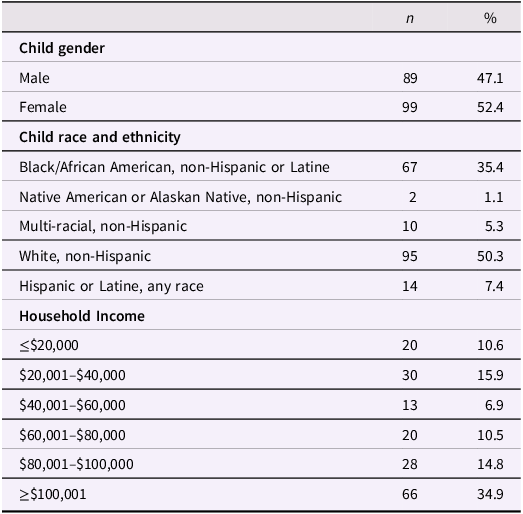
This study uses a subsample (N = 189, M age = 10.96 years, range = 8–15 years; Table 1) of youth from the Charleston Resiliency Monitoring (CHARM) study, an NIMH-funded investigation of risk for threat-related psychopathology in a community sample. All study procedures were approved by the Medical University of South Carolina Institutional Review Board and all participants provided written informed consent and assent. This study uses data collected at the initial lab visit (T1) and last lab visit, two years later (T2). A total of 364 children were recruited through advertisements in schools, pediatric clinics, and the general community. Eligibility criteria included enrollment in 3rd, 6th, or 9th grade, aged 7–16, having a caregiver able to participate, and English proficiency. Exclusion criteria included psychosis or evidence of a developmental delay or functional impairment that would interfere with participating.
Sample characteristics

Table 1. Long description
The table presents the characteristics of a sample of youth from the Charleston Resiliency Monitoring study. It includes data on child gender, child race and ethnicity, and household income. The table has 11 rows and 3 columns. The columns are labeled n, %, and the rows are labeled with different categories. Row 1: Child gender, Male, n 89, 47.1 percent. Row 2: Child gender, Female, n 99, 52.4 percent. Row 3: Child race and ethnicity, Black/African American, non-Hispanic or Latine, n 67, 35.4 percent. Row 4: Child race and ethnicity, Native American or Alaskan Native, non-Hispanic, n 2, 1.1 percent. Row 5: Child race and ethnicity, Multi-racial, non-Hispanic, n 10, 5.3 percent. Row 6: Child race and ethnicity, White, non-Hispanic, n 95, 50.3 percent. Row 7: Child race and ethnicity, Hispanic or Latine, any race, n 14, 7.4 percent. Row 8: Household Income, less than or equal to 20,000, n 20, 10.6 percent. Row 9: Household Income, 20,001 to 40,000, n 30, 15.9 percent. Row 10: Household Income, 40,001 to 60,000, n 13, 6.9 percent. Row 11: Household Income, 60,001 to 80,000, n 20, 10.5 percent. Row 12: Household Income, 80,001 to 100,000, n 28, 14.8 percent. Row 13: Household Income, greater than or equal to 100,001, n 66, 34.9 percent.
Note. One participant was missing all demographic variables, 12 participants missing household income; percentages may not add to 100.
This study included participants who had either experienced a PTE before age 6 (n = 107) or had never experienced a PTE at the baseline assessment (n = 82). PTE exposure status was determined through consideration of both caregiver and youth report on a semi-structured clinical interview. If either the caregiver or youth reported that they had experienced a PTE prior to age 6, they were included in the early PTE group. If both caregiver and youth reported that the youth had never experienced a PTE (before or after the age of 6), they were included in the no PTE group. The subsample included in this study did not differ from the full sample in regard to age [t(363) = −0.94, p = .17, Cohen’s d = 0.10], gender [ χ 2(1) = 1.69, p = .21, Cramér’s V = .07], race [ χ 2(5) = 5.25, p = .39, Cramér’s V = .12], or ethnicity [ χ 2(1) = .88, p = .35, Cramér’s V = .05]. However, the subsample had a higher average household income than the full sample [t(339) = −2.79, p = .006, Cohen’s d = 3.96]. Bivariate differences by trauma group were also examined. Early PTE group membership was less likely for White participants [ χ 2(4) = 10.00, p = .04, Cramér’s V = .23], and this group had lower average household income than the no trauma group [t(172.12) = 3.65, p < .001, Cohen’s d = .54].
Measures
PTE exposure (T1)
Early PTE exposure was assessed using the UCLA Posttraumatic Stress Disorder Reactivity Index (UCLA-PTSD-RI; Kaplow et al., Reference Kaplow, Rolon-Arroyo, Layne, Rooney, Oosterhoff, Hill, Steinberg, Lotterman, Gallagher and Pynoos2020; Steinberg et al., Reference Steinberg, Brymer, Decker and Pynoos2004). Youth and caregivers were separately asked whether the youth had experienced a comprehensive list of PTEs and, if so, the age(s) of the experience(s). PTEs included serious accidental injury, illness/medical trauma, community violence, domestic violence, school violence, physical assault (not by a caregiver), physical abuse/maltreatment (by a caregiver), neglect, emotional abuse/psychological maltreatment, caregiver impairment/interference, separation from a caregiver, bullying victimization, sexual violence, natural disaster, abduction or kidnapping, war or political violence, violent/traumatic loss, forced displacement, and witnessed suicide or prior suicide attempt. A PTE was considered endorsed if the youth and/or caregiver reported that the youth was a victim or direct witness of the event (see Siciliano et al., Reference Siciliano, Korom, Adams, Chapman, Hall, Perhamus, Bounoua, Bernard, Amaya and Danielson2026 for additional details). If a PTE was endorsed, the caregiver and/or youth was then asked the age(s) at which the PTE was experienced. A cumulative PTE exposure score was generated by summing the total number of ages and PTEs experienced before age 6 (e.g., a participant who experienced neglect at ages 2 and 3 and sexual abuse at age 5 would receive a Cumulative PTE score of 3).
Anxiety (T1, T2)
Youth self-reported past week anxiety on the Patient-Reported Outcomes Measurement Information System (PROMIS) Pediatric Anxiety Short Form v2.0 (Bevans et al., Reference Bevans, Gardner, Pajer, Becker, Carle, Tucker and Forrest2018; Pilkonis et al., Reference Pilkonis, Choi, Reise, Stover, Riley, Cella and Group2011). This uses a well-validated and normed index of 8 items rated on a 5-point scale ranging from Never to Almost Always (see healthmeasures.net). The scale demonstrated good internal consistency at both time points in the present study (Cronbach’s α = .89–.93).
Externalizing (T1, T2)
Externalizing problems were measured using youth report on the Externalizing subscale of the Brief Problems Checklist (Chorpita et al., Reference Chorpita, Reise, Weisz, Grubbs, Becker and Krull2010). Prior work has supported its factor structure and convergent and divergent validity (Chorpita et al., Reference Chorpita, Reise, Weisz, Grubbs, Becker and Krull2010; Parent et al., Reference Parent, Dale, McKee and Sullivan2021). Youth responded to 6 items on a 3-point scale from Not true to Very true which were averaged. The scale demonstrated adequate internal consistency in the present study (Cronbach’s α = .70–.71).
Cortisol reactivity (T1)
A developmentally adapted Trier Social Stress Test (TSST; Kirschbaum et al., Reference Kirschbaum, Pirke and Hellhammer1993; Kudielka et al., Reference Kudielka, Hellhammer, Kirschbaum, Harmon-Jones and Winkielman2007) was administered. Participants gave a three-minute speech to a camera to audition for a TV show about kids their age while a judge watched. Saliva was collected using SalivaBio Oral Swabs per standard procedures. Two salivettes were collected each at the following times: immediately before and after the TSST, 20 minutes following the TSST, and three additional samples approximately 15 minutes apart following TSST completion. Saliva was assayed for cortisol using the Salimetrics Cortisol Enzyme Immunoassay Kit (Salimetrics, State College, PA). The sensitivity of the kit is<0.007 μg/dL; assay range is 0.012–3.000 μg/dL. Participants were screened for fever or acute illness, and lab visits were rescheduled if participants were ill. Samples with values above 3 SDs from the mean were winsorized (28 samples across 18 participants). AUCg and AUCi were calculated using standard formulas (Pruessner et al., Reference Pruessner, Kirschbaum, Meinlschmid and Hellhammer2003). Both are trapezoidal formulas that calculate the area under the cortisol trajectory. AUCg does so from zero (i.e., includes information regarding basal levels), whereas AUCi does so relative to the initial cortisol baseline (i.e., reflects change across the task; Khoury et al., Reference Khoury, Gonzalez, Levitan, Pruessner, Chopra, Basile, Masellis, Goodwill and Atkinson2015; Pruessner et al., Reference Pruessner, Kirschbaum, Meinlschmid and Hellhammer2003).
Covariates
Self-reported gender, pubertal status, and time between cortisol collection and awakening were included as covariates. Youth self-reported their pubertal status using the Pubertal Development Scale: Physical Development (PDS; Petersen et al., Reference Petersen, Crockett, Richards and Boxer1988), which includes 5 questions about physical pubertal development on a 4-point scale from Not yet started to Seems completed. An “I don’t know” option was also presented and counted as missing. Items were averaged to create an overall pubertal development score. Pubertal status was included rather than age due to pubertal changes in HPA axis functioning (Koss & Gunnar, Reference Koss and Gunnar2018). The time of collection of the first saliva sample was subtracted from self-reported child wake-up time to create a continuous “time since awakening” variable. This variable was significantly correlated with both AUCg (r = −.50, p < .001) and AUCi (r = −.29, p < .001) and was included as a covariate to account for diurnal changes in cortisol (Koss & Gunnar, Reference Koss and Gunnar2018).
Analytic plan
Path models were conducted within Mplus Version 8.11 (Muthén & Muthén, 1998–2026) using the maximum likelihood estimator with robust standard errors (MLR). Well-established formulas were used to create two orthogonal variables, one reflecting overall level of symptoms (i.e., severity), and the other reflecting the predominance of one symptom domain over the other (i.e., directionality; Essex et al., Reference Essex, Klein, Cho and Kraemer2003). Severity scores are calculated using an average of z-scores across domains (i.e., [zexternalizing + zanxiety]/2), whereas directionality scores were created by taking the half difference of symptom domains (i.e., [zexternalizing − zanxiety]/2). Anxiety, externalizing, cortisol reactivity, and covariates were standardized; severity and directionality variables were not standardized due to the meaningful nature of the scales of the original variables. AUCg and AUCi models were conducted separately; symptom domain models (i.e., anxiety and externalizing) and severity/directionality models were also conducted separately. Concurrent analyses were conducted followed by longitudinal analyses. Cortisol reactivity (AUCg or AUCi) was regressed onto time since awakening and all variables were regressed onto gender and puberty. Psychopathology variables (i.e., anxiety and externalizing or severity and directionality, controlling for T1 levels in longitudinal models) were then regressed onto cortisol reactivity. Model fit was assessed using a likelihood χ2 test (p > .05 indicates good fit), comparative fit index (CFI; >.95 suggests good fit), the standardized root mean square residual (SRMR; <.05 represents good fit), and the root mean square error of approximation (RMSEA; <.06 indicate close fit; Browne & Cudeck, Reference Browne and Cudeck1992; Hu & Bentler, Reference Hu and Bentler1999; Steiger, Reference Steiger1990).
To examine differences by trauma group, PTE exposure (0 = no PTE, 1 = at least one early PTE) was added as a grouping variable (see supplemental materials for analyses without trauma included). Paths of interest (psychopathology regressed onto cortisol reactivity) were constrained to equality. Modification indices (MIs) were examined to sequentially free paths for which releasing the constraint across groups would result in a significant improvement in model fit following standard procedures (Whittaker, Reference Whittaker2012; Yoon & Millsap, Reference Yoon and Millsap2007). Significant group differences were then probed for effects of early cumulative PTE exposure using path models. Participants with a score of at least one on the cumulative PTE exposure variable were included. Main effects of cumulative PTE exposure and cortisol reactivity were entered, followed by their interaction. Predictor variables were standardized prior to the creation of interaction terms. Significant interaction terms were probed using simple slopes at ± 1 SD from the mean (Aiken & West, Reference Aiken and West1991) using MODEL CONSTRAINT.
Results
Preliminary analyses
Prior to primary analyses, variables were examined for violations of normality assumptions. Outliers were winsorized to ± 3 SDs from the mean (Kline, Reference Kline2016). Analyses were conducted to examine patterns of missingness. The most substantial missing data was for cortisol reactivity (n = 145, 77.72% of the sample, had usable AUCg and AUCi data). Missingness was due to task non-completion (n = 12), having only partial usable cortisol data across the task (n = 17), or substantial deviations from the protocol in the timing of cortisol sample collection that precluded the construction of AUC variables (n = 15). Missing data on the remaining T1 variables was minimal (maximum n = 4) and retention to T2 was excellent (87.3% had T2 questionnaire data). Those with missing cortisol data were more likely to be non-Hispanic [ χ 2(1) = 4.49, p = .03, Cramér’s V = .15]. Rates of missing data at T2 were higher for those who identified as Black/AfricanAmerican [ χ 2(4) = 15.12, p = .004, Cramér’s V = .28], had lower household income [t(175) = 3.68, p < .001, Cohen’s d = .84], had more advanced T1 pubertal status [t(184) = −2.06, p = .02, Cohen’s d = −.46], and belonged to the early PTE group [ χ 2(1) = 6.42, p = .01, Cramér’s V = .18]. Those with missing T2 data did not differ in T1 levels of externalizing problems, anxiety, severity, directionality, AUCg, or AUCi (ps = .45−.88). Therefore, data was considered missing at random (MAR) and was accommodated using full information maximum likelihood (FIML; Little, 2013).
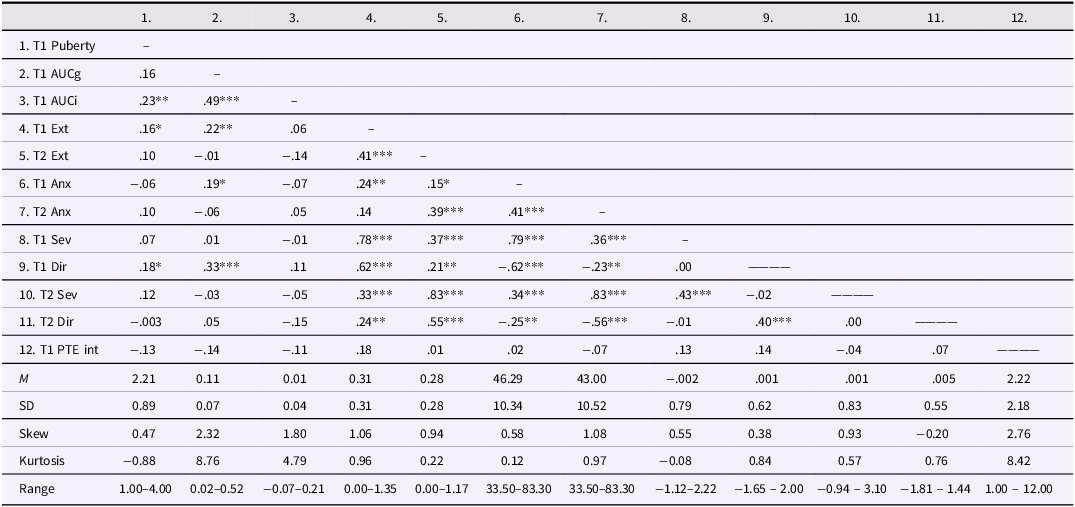
Correlations and descriptive statistics are presented in Table 2. AUCg was positively correlated with T1 anxiety and externalizing, as well as T1 directionality (reflecting that higher AUCg was associated with greater predominance of externalizing problems). Both anxiety and externalizing problems demonstrated moderate stability from T1 to T2, as did symptom severity and directionality. Variables were also examined for gender differences. Girls reported significantly higher levels of anxiety at both T1 [t(184) = −2.31, p = .02, Cohen’s d = −.34] and T2 [t(163) = −2.65, p = .009, Cohen’s d = −.41] relative to boys. Unexpectedly, girls also reported higher levels of T2 externalizing problems relative to boys [t(163) = −2.34, p = .02, Cohen’s d = −.36]. Likewise, T2 severity was significantly higher for girls relative to boys [t(162) = −3.10, p = .002, Cohen’s d = −.49]. Gender was included as a covariate in all models.Footnote 1
Bivariate correlations and descriptive statistics
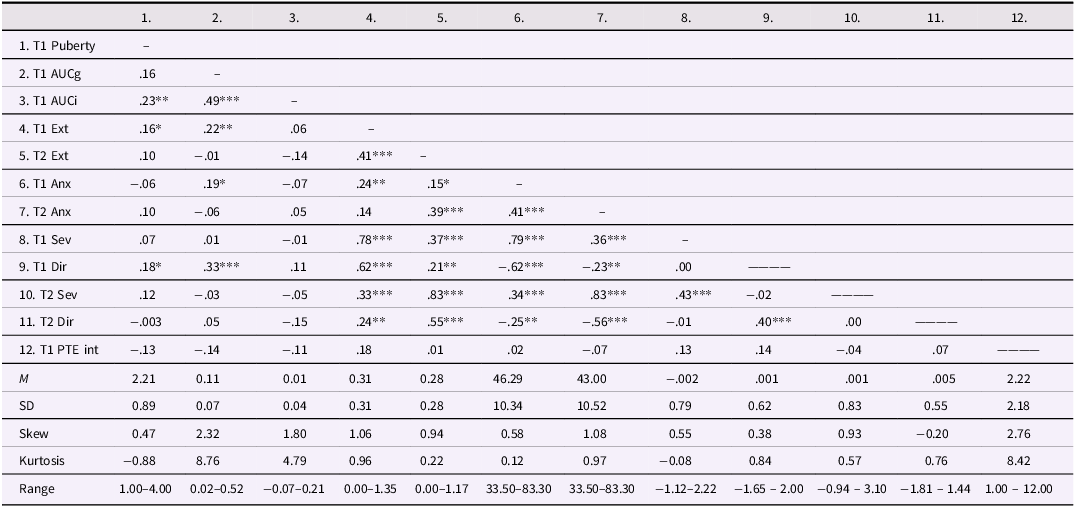
Table 2. Long description
The table presents bivariate correlations and descriptive statistics for various psychological variables. It includes 12 rows and 12 columns, with row labels and column headers indicating different variables and their correlations. The table also provides mean (M), standard deviation (SD), skewness, kurtosis, and range for each variable. Notable trends include positive correlations between T1 AUCg and T1 anxiety, externalizing, and directionality. Both anxiety and externalizing problems show moderate stability from T1 to T2. Gender differences are also examined, with girls reporting higher levels of anxiety, externalizing problems, and severity at T2 compared to boys.
Note. T1 = Time 1, T2 = Time 2, AUCg = cortisol area under the curve with respect to ground, AUCi = cortisol area under the curve with respect to increase, Ext = externalizing, Anx = anxiety, Sev = severity, Dir = directionality; positive directionality values reflect a predominance of externalizing problems over anxiety, and negative values reflect the reverse; PTE int = Early PTE intensity, calculated for those with at least 1 early PTE, early PTE correlations use natural log-transformed values, descriptives are observed values. *p < .05, **p < .01, ***p < .001.
Bivariate differences by trauma group were also examined. At the bivariate level, youth who had experienced early PTEs reported higher levels of externalizing problems at T2 [t(157.61) = −3.15, p = .002, Cohen’s d = −.48], and a more predominantly externalizing presentation (i.e., directionality) at both T1 [t(183) = −2.07, p = .02, Cohen’s d = −.31] and T2 [t(162) = −2.11, p = .02, Cohen’s d = −.31]. Early PTE-exposed youth also reported significantly greater symptom severity at T2 [t(162) = −2.00, p = .047, Cohen’s d = −.35]. Groups did not significantly differ in AUCg or AUCi (ps = .73−.996) or anxiety levels (ps = .40−.43). Cumulative early PTE exposure (for those with at least one endorsed PTE) was not significantly correlated with any key variables of interest (ps = .11−.90).
Primary analyses
Figures depicting final path models for all primary analyses are available in supplemental materials (Figures S1–S8).
AUCg
Anxiety and externalizing. The constrained concurrent model demonstrated adequate fit [χ 2(9) = 12.16 p = .20; RMSEA = .06; CFI = .96; SRMR = .05]. An examination of MIs indicated that freeing the association between AUCg and externalizing problems would significantly improve model fit (MI = 4.26). With this path freed, the model provided excellent fit to the data [χ 2(8) = 7.41, p = .49; RMSEA = .00; CFI = 1.00; SRMR = .03], and no additional theoretically meaningful significant MIs emerged. Consistent with hypotheses, the association between AUCg and externalizing problems was significant and positive in the early PTE group (B = .31, SE = .10, p = .002), and non-significant in the no trauma group (B = −.02, SE = .12, p = .87; Figure 1). However, counter to hypotheses, there was a negative association between AUCg and anxiety in both groups (B = −.22, SE = .07, p < .001). The post hoc model examining main effects of cumulative PTE exposure and AUCg provided good fit [χ 2(3) = 0.73, p = .87; RMSEA = .00; CFI = 1.00; SRMR = .01]Footnote 2 . Both cumulative PTE exposure (B = .22, SE = .09, p = .02) and AUCg (B = .31, SE = .12, p = .01) predicted higher levels of externalizing problems. Adding their interaction worsened model fit and was not significant (B = .13, SE = .08, p = .08).
Group-specific concurrent associations between AUCg and externalizing problems.
Note. T1 = Time 1, AUCg = Area under the curve with respect to ground, SD = Standard deviation. Model-implied values using unstandardized regression coefficients. **p < .01.

The constrained longitudinal model provided good fit [χ2(13) = 13.69, p = .40; RMSEA = .02; CFI = 1.00; SRMR = .04], and no significant MIs emerged suggesting no moderation by PTE group. Effects of AUCg on change in externalizing (B = −.06, SE = .07, p = .42) and anxiety (B = −.02, SE = .08, p = .84) were non-significant.
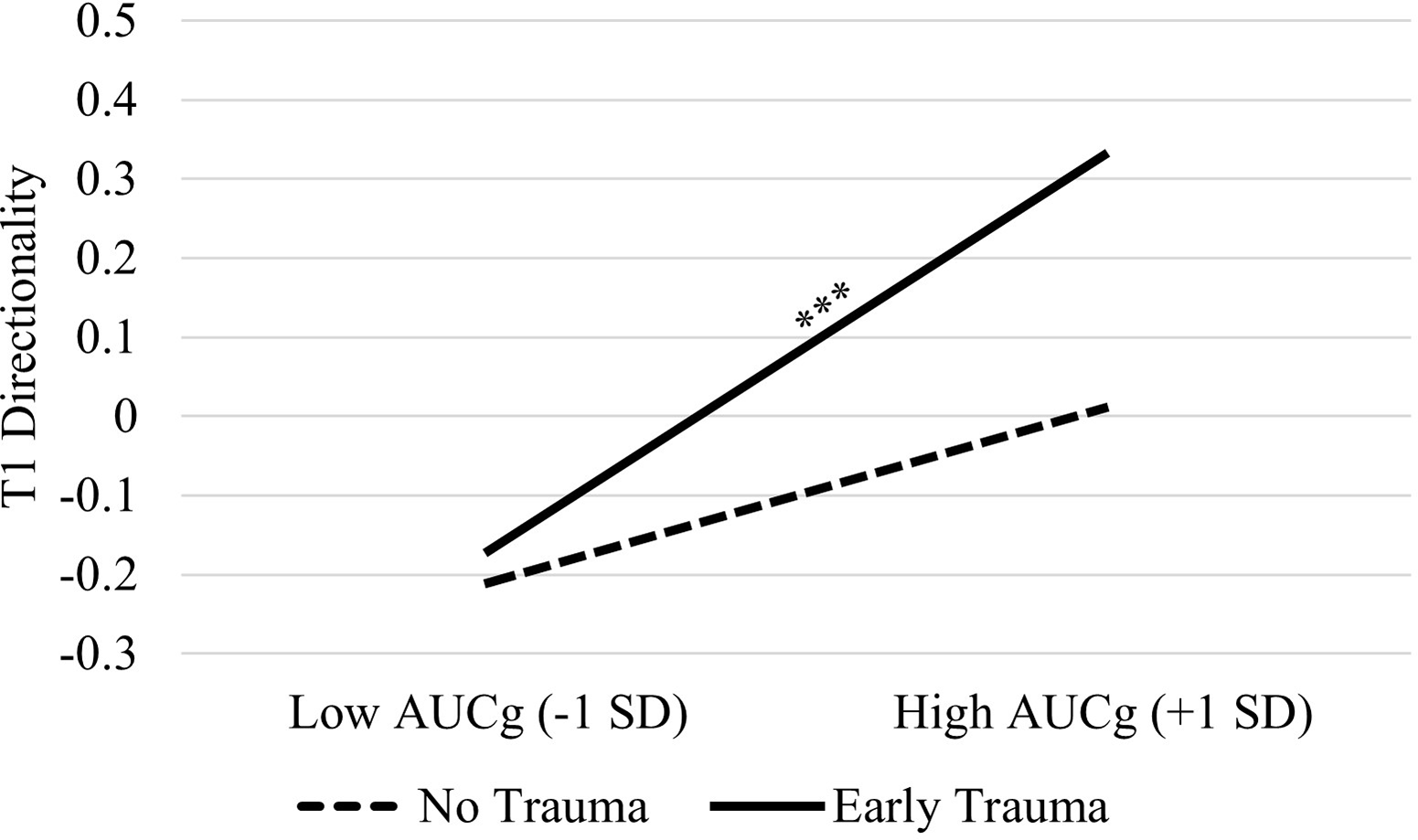
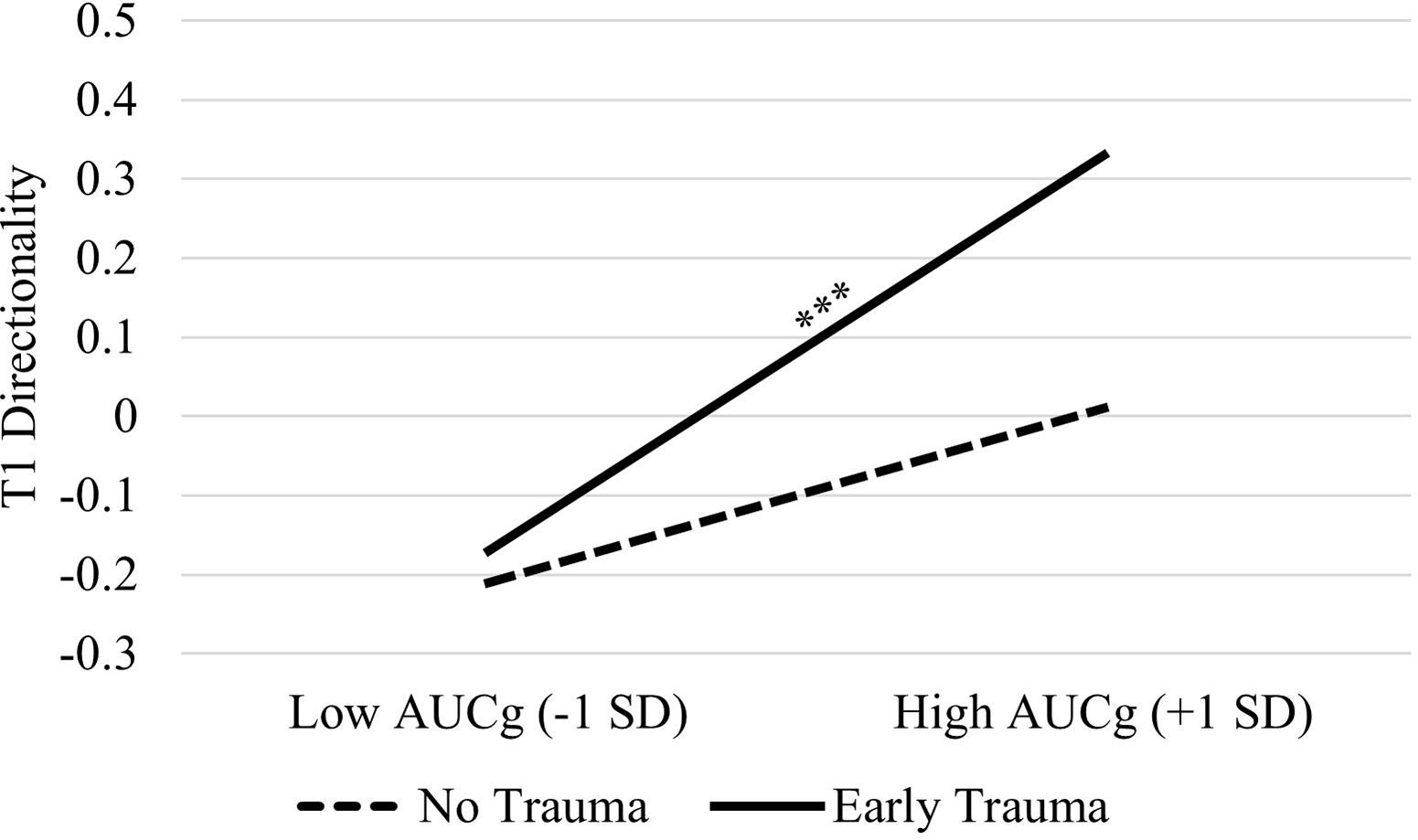
Severity and directionality. The constrained concurrent model provided good fit [χ 2(9) = 12.14 p = .21; RMSEA = .06; CFI = .95; SRMR = .05]. A significant MI emerged for freeing the association between AUCg and T1 directionality to vary by PTE group (MI = 4.56). With this path freed, the model continued to demonstrate good fit [χ 2(8) = 10.00 p = .26; RMSEA = .05; CFI = .97; SRMR = .04] and no additional significant MIs emerged. A significant positive association between AUCg and directionality emerged specifically within the early PTE group (B = .25, SE = .05, p < .001) suggesting that greater AUCg was associated with a greater predominance of externalizing problems over anxiety (and lower AUCg was associated with the reverse) for those exposed to early PTEs (Figure 2). The association between AUCg and directionality was non-significant within the no PTE group (B = .11, SE = .07, p = .12), and associations between AUCg and T1 severity were non-significant (B = −.05, SE = .06, p = .44). The post hoc model testing main effects of cumulative PTE exposure and AUCg on T1 directionality provided good fit [χ 2(3) = 0.73, p = .87; RMSEA = .00; CFI = 1.00; SRMR = .01]. As in the multiple-group model, AUCg was positively associated with directionality (B = .25, SE = .07, p < .001). Effects of cumulative PTE exposure on symptom directionality (B = .25, SE = .07, p = .10) were non-significant. Likewise, the interaction effect was non-significant (B = −.01, SE = .06, p = .87).
Group-specific concurrent associations between AUCg and symptom directionality.
Note. T1 = Time 1, AUCg = Area under the curve with respect to ground, SD = Standard deviation. Model-implied values using unstandardized regression coefficients. Positive directionality denotes predominance of externalizing problems, negative reflects predominance of anxiety. ***p < .001.
The constrained longitudinal model provided excellent fit [χ 2(13) = 12.94.83, p = .45; RMSEA = .00; CFI = 1.00; SRMR = .05]. No theoretically meaningful significant MIs emerged, and effects of AUCg on change in severity (B = −.03, SE = .06, p = .65) and directionality (B = −.02, SE = .04, p = .66) were non-significant.
AUCi
Anxiety and externalizing. The constrained concurrent model demonstrated good fit [χ 2(9) = 8.54 p = .48; RMSEA = .00; CFI = 1.00; SRMR = .04] and no significant MIs emerged Associations between AUCi and externalizing (B = .09, SE = .07, p = .25) and anxiety (B = −.06, SE = .07, p = .39) were both non-significant.
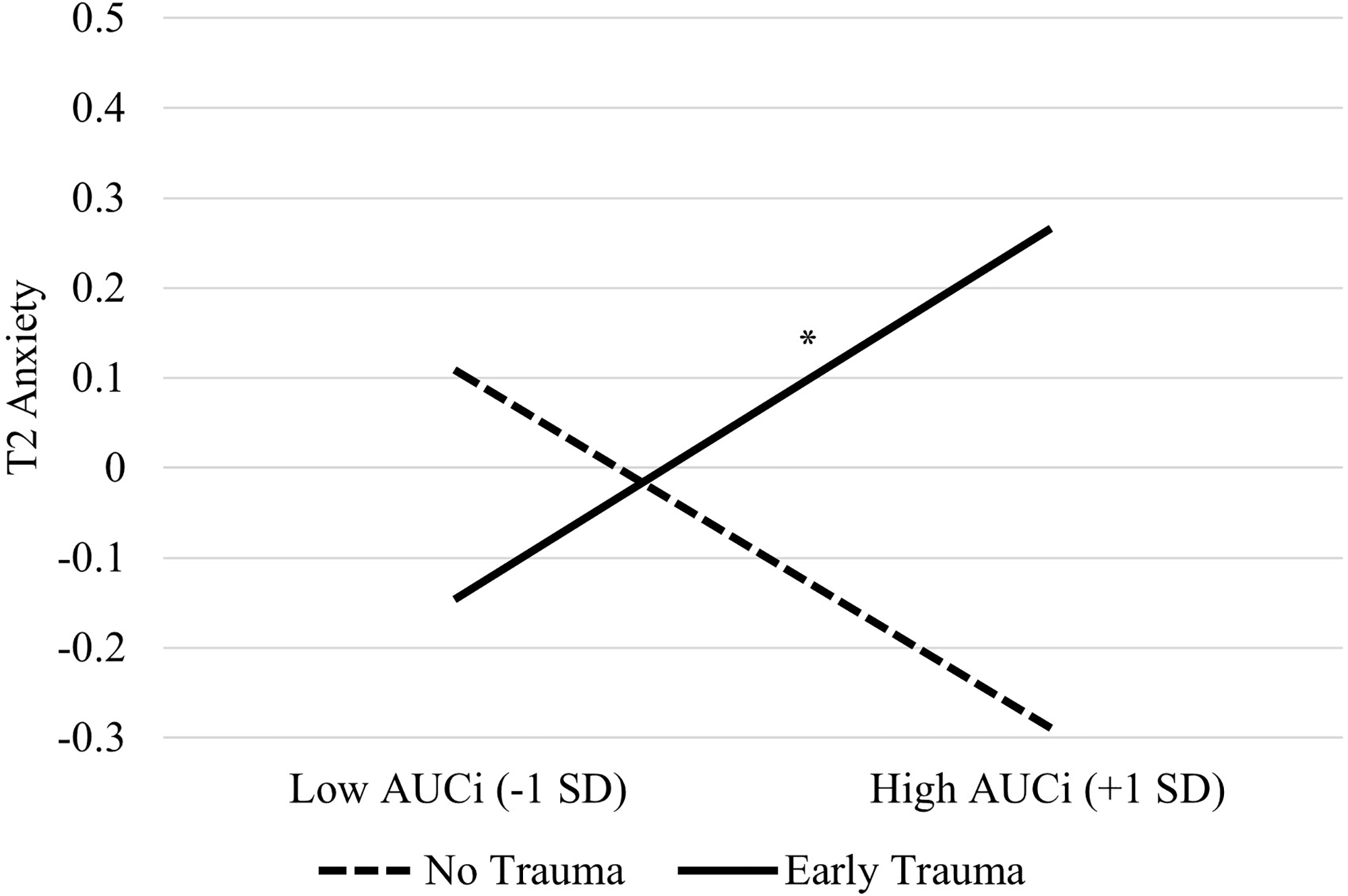
The constrained longitudinal model provided adequate fit [χ 2(13) = 9.23, p = .10; RMSEA = .08; CFI = .95; SRMR = .05]. The largest theoretically meaningful MI suggested freeing the association between AUCi and anxiety (MI = 7.98). With this path freed, the model showed excellent fit [χ 2(12) = 7.46, p = .49; RMSEA = .00; CFI = .1.00; SRMR = .04] and no additional theoretically significant MIs remained. Consistent with hypotheses, in the no PTE group, AUCi was significantly negatively associated with anxiety (B = −.20, SE = .09, p = .03) although the association was non-significant in the early PTE group (B = .20, SE = .11, p = .06; Figure 3). Associations between AUCi and change in externalizing were non-significant (B = −.11, SE = .08, p = .14). The post hoc model testing main effects of cumulative PTE exposure and AUCi provided good fit [χ 2(5) = 3.15, p = .68; RMSEA = .00; CFI = .1.00; SRMR = .03]. Effects of both AUCi (B = .18, SE = .11, p = .11) and cumulative PTE exposure (B = −.008, SE = .09, p = .93) on change in anxiety were non-significant. The addition of the interaction term worsened model fit, and the interaction effect on change in anxiety was non-significant (B = −.08, SE = .07, p = .23).
Group-specific longitudinal associations between AUCi and anxiety symptoms.
Note. T2 = Time 2, AUCi = Area under the curve with respect to increase, SD = standard deviation. AUCi is measured at Time 1. Model-implied values using unstandardized regression coefficients. Time 1 anxiety is controlled. *p < .05.

Severity and directionality. The constrained concurrent model provided good fit [χ 2(9) = 8.22, p = .51; RMSEA = .00; CFI = .1.00; SRMR = .04]. No significant theoretically meaningful MIs emerged, and associations between AUCi and severity (B = .007, SE = .06, p = .91) and directionality (B = .07, SE = .04, p = .06) were non-significant.
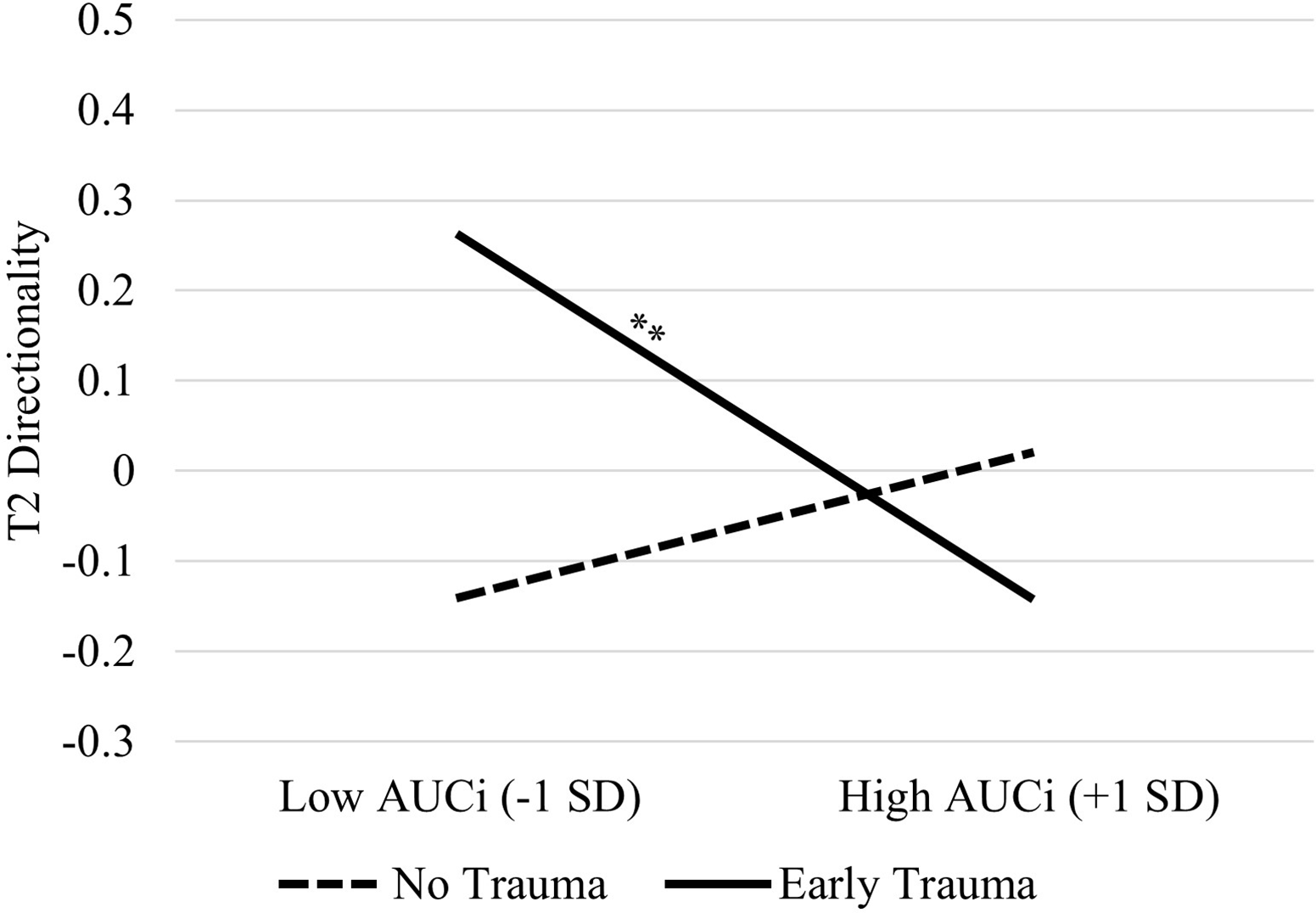
The constrained longitudinal model provided adequate fit [χ 2(13) = 20.01, p = .09; RMSEA = .08; CFI = .93; SRMR = .06]. MIs suggested freeing the association between AUCi and T2 directionality (MI = 10.94) which resulted in a model with good fit [χ 2(12) = 8.84, p = .72; RMSEA = .00; CFI = 1.00; SRMR = .04]. Consistent with hypotheses, blunted AUCi predicted an increasingly externalizing presentation from T1 to T2 in the early trauma group (B = −.20, SE = .07, p = .005; Figure 4). The association was not significant in the no trauma group (B = .08, SE = .05, p = .10). AUCi did not significantly predict change in overall symptom severity in either group (B = −.05, SE = .06, p = .43). The post hoc model examining effects of cumulative early PTE exposure and AUCi provided good fit [χ 2(5) = 3.08, p = .69; RMSEA = .00; CFI = .1.00; SRMR = .03]. Consistent with the multiple-group model, AUCi was negatively associated with change in symptom directionality (B = −.19, SE = .08, p = .01), but no effect of cumulative early PTE exposure emerged (B = −.05, SE = .05, p = .31). The addition of the interaction effect worsened model fit and was non-significant (B = −.02, SE = .04, p = .54).
Group-specific longitudinal associations between AUCi and symptom directionality.
Note. T2 = Time 2, AUCi = Area under the curve with respect to increase, SD = standard deviation. AUCi is measured at Time 1. Model-implied values using unstandardized regression coefficients. Time 1 directionality is controlled. Positive directionality denotes predominance of externalizing problems, negative reflects predominance of anxiety. **p < .01.

Discussion
This present study examined whether associations between overall output (AUCg) and change in (AUCi) HPA axis reactivity with anxiety and externalizing problems differed by exposure to early PTEs in a manner consistent with the ACM (Del Giudice et al., Reference Del Giudice, Ellis and Shirtcliff2011). We aimed to address limitations of prior work by providing a robust categorization of both the presence of early PTEs and a lack of PTEs, disentangling effects related to both overall and change in HPA axis activity in the context of social stress, and by examining shared and unique impacts on anxiety and externalizing problems as captured within symptom severity and directionality in addition to independent symptom domains. Consistent with ACM theory, we expected AUCg to be positively associated with both anxiety and externalizing problem domains, as well as overall symptom severity, for youth exposed to early PTEs. Among early PTE-exposed youth, we also expected AUCi to be positively associated with anxiety and negatively associated with externalizing problems. Likewise, we expected a negative association between AUCi and symptom directionality, such that lower AUCi would be associated with a predominantly externalizing presentation and higher AUCi would be associated with a predominantly anxious presentation. These associations were expected to be stronger at more extreme levels of cumulative early PTE exposure, as tested within post hoc models. Consistent with the ACM, we expected associations between HPA axis reactivity and anxiety and externalizing symptoms to be non-significant or negative for youth who had never been exposed to trauma. Across concurrent and longitudinal analyses, hypotheses were partially supported.
Consistent with hypotheses, elevated overall cortisol output (AUCg) was concurrently associated with higher levels of externalizing problems among youth exposed to early PTEs. This is consistent with ACM theory, which suggests that, in the context of elevated threat and stress (reflected in early PTEs), elevated HPA axis activity reflects a greater orientation to frequent threats, and the adoption of relevant emotional and behavioral strategies to respond to these threats, including aggression and anger (i.e., externalizing problems). This finding also aligns with bio-psycho-social models of the development of externalizing problems after trauma (McLaughlin & Lambert, Reference McLaughlin and Lambert2017). However, contrary to hypotheses, AUCg was also concurrently negatively associated with anxiety in both groups. A negative association between AUCg and anxiety was expected within the no PTE group, as the ACM predicts that elevated HPA axis activity within supportive contexts may promote the development of emotion regulation and cooperative behavioral strategies (Del Giudice et al., Reference Del Giudice, Ellis and Shirtcliff2011). Unexpectedly, a negative association with anxiety emerged within the early PTE group as well and was reflected in a positive concurrent association between AUCg and symptom directionality (i.e., elevated AUCg was associated with a predominance of externalizing problems, and low AUCg was associated with a predominance of anxiety). This is contrary both to ACM theory and prior work that has found positive associations between AUCg and internalizing problems (Hartman et al., Reference Hartman, Hermanns, de Jong and Ormel2013), although blunted corticosterone reactivity has been found among mice bred for high anxiety behavior (Sotnikov et al., Reference Sotnikov, Wittmann, Bunck, Bauer, Deussing, Schmidt, Touma, Landgraf and Czibere2014). That no associations emerged with overall symptom severity within the early PTE group was also unexpected, as prior work has found elevated HPA axis activity associated with anxiety and comorbid internalizing and externalizing problems in the context of early adversity (Koss & Gunnar, Reference Koss and Gunnar2018). Overall, these conflicting findings speak to the inconsistent HPA axis and psychopathology literature, and complex nature of associations between cortisol reactivity and socioemotional functioning, particularly in community samples.
In longitudinal models, consistent with hypotheses, attenuated cortisol reactivity (AUCi) predicted an increasingly externalizing presentation, whereas elevated cortisol reactivity predicted an increasingly anxious presentation, specifically for the early PTE-exposed group. Also consistent with hypotheses, elevated AUCi predicted decreases in anxiety for the no PTE group. These are novel findings and align with ACM theory (Del Giudice et al., Reference Del Giudice, Ellis and Shirtcliff2011), theoretical models of anxiety emphasizing hyperreactivity to stress and threat (Heim & Nemeroff, Reference Heim and Nemeroff2001; Lebowitz et al., Reference Lebowitz, Gee, Pine and Silverman2018; Pasion et al., Reference Pasion, Macedo, Paiva, Patrick, Krueger and Barbosa2023), and models of externalizing problem development emphasizing hyporeactivity in high-stress contexts (Beauchaine & Hinshaw, Reference Beauchaine and Hinshaw2020; Del Giudice et al., Reference Del Giudice, Ellis and Shirtcliff2011; Koss & Gunnar, Reference Koss and Gunnar2018). As conceptualized within the ACM and discussed above, HPA axis activity’s associations with anxiety are expected to differ based on early context – for those in low threat contexts the theory would predict negative or no associations with anxiety, whereas within stressful contexts physiological reactivity may increase the salience of stressful events, leading to the development of emotional and behavioral patterns characterized by vigilance toward and avoidance of potential threat in the environment (i.e., anxiety; Del Giudice et al., Reference Del Giudice, Ellis and Shirtcliff2011; Heim & Nemeroff, Reference Heim and Nemeroff2001; Juruena et al., Reference Juruena, Eror, Cleare, Young and Kim2020). By contrast, those with attenuated reactivity who are exposed to high levels of threat may, due to disrupted fear learning processes, ultimately be socialized toward, rather than away from, engaging in externalizing problems (Del Giudice et al., Reference Del Giudice, Ellis and Shirtcliff2011; Waller & Wagner, Reference Waller and Wagner2019).
That elevated overall cortisol output, but attenuated reactivity, was associated with externalizing problems among youth exposed to early PTEs is a novel finding. Prior work has found support for both hyper- and hypo-reactivity of the HPA axis predicting higher levels of externalizing problems broadly (Alink et al., Reference Alink, van IJzendoorn, Bakermans-Kranenburg, Mesman, Juffer and Koot2008) and among trauma-exposed youth (Chong et al., Reference Chong, Gordis, Hunter, Amoh, Strully, Appleton and Tracy2022). This study suggests that a possible explanation for these mixed findings is that they reflect different aspects of HPA axis functioning, such that elevated overall HPA axis activity, but blunted reactivity in response to a stressor, predicts increased risk for the development of externalizing problems among trauma-exposed youth. This is an exciting possibility, which also aligns with biological models suggesting basal activity and the stress response functions of the HPA axis may align with differing underlying physiological characteristics (Henckens et al., Reference Henckens, Klumpers, Everaerd, Kooijman, Van Wingen and Fernández2016) and empirical work suggesting that these measures of HPA axis activity load onto distinct factors (Khoury et al., Reference Khoury, Gonzalez, Levitan, Pruessner, Chopra, Basile, Masellis, Goodwill and Atkinson2015). However, given the novelty of these findings, replication efforts are needed.
Unexpectedly, associations between AUCg and socioemotional functioning emerged only in concurrent models, whereas associations between AUCi and symptoms emerged only in longitudinal models. The key difference between these two indices is that AUCg includes information regarding the cortisol levels at baseline (i.e., how far from 0 a person’s cortisol values are at the start of the task), whereas AUCi does not include this information. Within the context of a laboratory social stress task, it is possible that these baseline levels are impacted by a youth’s current levels of anxiety and externalizing tendencies (i.e., the participant’s emotional state during the lab visit), resulting in stronger associations between AUCg and concurrent functioning. AUCi is thought to be a “pure” reactivity indicator (Khoury et al., Reference Khoury, Gonzalez, Levitan, Pruessner, Chopra, Basile, Masellis, Goodwill and Atkinson2015) and therefore may better capture how individuals react to day-to-day situations. In this case, AUCi may be a better indicator of the likelihood of the adoption of emotional and behavioral strategies over time, which is the emphasis of the ACM. However, replication is needed.
Importantly, although some effects emerged with symptom domains, several patterns of findings, especially within the early PTE group, reached significance only when examining symptom directionality. This may reflect decreased power due to shared variance when these constructs are included as separate variables and supports the use of directionality scores to examine unique associations among overlapping constructs (Essex et al., Reference Essex, Klein, Cho and Kraemer2003, Reference Essex, Shirtcliff, Burk, Ruttle, Klein, Slattery, Kalin and Armstrong2011), which has been a challenge for the empirical literature aiming to distinguish between risk for internalizing and externalizing symptoms (Brieant et al., Reference Brieant, Cai, Ip, Holt-Gosselin and Gee2025). In addition to increased power, directionality scores also provide unique insight regarding the predominant presentation (Marceau et al., Reference Marceau, Yu, Knopik, Ganiban and Neiderhiser2022) which may also align with clinical decision making practices. For instance, when youth present for treatment with multiple areas of concern, it is common for clinicians to focus on a “primary” presenting problem. Directionality scores, representing the predominance of one symptom domain over the other, may better capture symptoms in the way that clinicians and others conceptualize cases and therefore increase the ecological validity of findings. As the use of severity and directionality scores remains limited within the literature, additional consideration of the utility of this approach, especially when capturing overlapping but distinct constructs such as anxiety and externalizing symptoms, remains an important future direction.
Finally, no interactions emerged between cumulative early PTE exposure and HPA axis activity across concurrent or longitudinal models. This means we did not find evidence for the ACM’s prediction that elevated HPA axis activity would be associated with externalizing problems at in elevated threat, but that blunted activity would predict externalizing problems within extreme threat. This may be due to the limited sample size included in these models and limited variability in cumulative early PTE exposure within our sample. Specifically, among those with at least one early PTE reported (n = 107), 55.1% (n = 59) had a cumulative early PTE exposure score of one, and 20.6% (n = 22) had a score of two, leaving just n = 26 (24.3%) with any score greater than two. This is not unexpected given our use of a community sample not enriched for risk for PTE exposure, but likely did limit our ability to detect differences in associations occurring at moderate vs. extreme threat contexts. Future work with PTE-exposed samples is needed to address these questions.
Limitations
Given the study design and retrospective report of early trauma experiences, we were unable to test the possibility that early PTE exposure may have impacted HPA axis activity, which may have in turn promoted the development of psychopathology symptoms. Short- and long-term impacts of maltreatment and stressful environments on HPA axis functioning are well established (e.g., Miller et al., Reference Miller, Chen and Parker2011), although studies that also consider downstream effects on socioemotional functioning are limited, and findings remain complex and difficult to disentangle (Beauchaine & Hinshaw, Reference Beauchaine and Hinshaw2020). Additional work is needed in this area. Furthermore, in this secondary data analysis we did not examine whether participants experienced later PTEs in addition to early PTEs (although those in the no trauma group had never experienced a PTE), or whether additional PTEs occurred between T1 and T2. As acute relative to chronic exposure to stress and trauma may have differential effects on HPA axis and socioemotional functioning (Koss & Gunnar, Reference Koss and Gunnar2018), future studies should examine whether the present study’s findings differ based on additional trauma exposure. Likewise, as different types of PTEs (e.g., threat vs. deprivation; intentional vs. non-intentional) may have differential associations with both HPA axis and socioemotional functioning (Brieant et al., Reference Brieant, Cai, Ip, Holt-Gosselin and Gee2025; Kuhlman et al., Reference Kuhlman, Geiss, Vargas and Lopez-Duran2018; McLaughlin et al., Reference McLaughlin, Sheridan and Lambert2014), additional studies should consider whether current findings are specific to particular PTE exposure types. These two limitations may also explain why HPA axis reactivity did not differ by trauma group in these analyses. Relatedly, although the study’s use of multiple informants to capture early PTE exposure is a strength and consistent with best practices, a robust literature suggests meaningful informant differences in reports of childhood PTEs (Cooley & Jackson, Reference Cooley and Jackson2022; Siereau et al., Reference Sierau, Brand, Manly, Schlesier-Michel, Klein, Andreas, Garzon, Keil, Binser, von Klitzing and White2017; Zhang et al., Reference Zhang, Xu, Hong, Liu and Liao2022). The central goal of the present study was to thoroughly capture any early PTE exposure through the use of multiple informants, which is particularly relevant for early life events. Therefore, a thorough examination of effects of informant discrepancies and concordance was outside the scope of the current study but remains an important direction for future work.
This study also used broad measures of both externalizing problems and anxiety. However, prior work suggests that different aspects of externalizing problems may be characterized by hyper- and hypo-reactivity (Frick & Morris, Reference Frick and Morris2004), and both trauma exposure and HPA axis reactivity may be differentially associated with different anxiety presentations (Favarelli et al., Reference Faravelli, Lo Sauro, Lelli, Pietrini, Lazzeretti, Godini and Ricca2012). A more nuanced examination of the study’s hypotheses would include these multiple aspects of both externalizing problems and anxiety.
Although we chose to focus on middle childhood to adolescence due to rapid developmental changes and increased incidence of psychopathology (Cicchetti & Rogosch, Reference Cicchetti and Rogosch2002), this is also a developmental period characterized by biological development which may confound findings. In particular, the pubertal recalibration hypothesis (DePasquale et al., Reference DePasquale, Herzberg and Gunnar2021; Gunnar et al., Reference Gunnar, DePasquale, Reid, Donzella and Miller2019) suggests that individuals may “recalibrate” their HPA axis functioning during this developmental period to better align with current environments. Therefore, individuals’ HPA axis activity may be less impacted by early PTE exposure, and more impacted by current levels of environmental stress or more proximal PTE exposure, as they progress through puberty. We opted to include pubertal status as a covariate to account for this possibility, but future work is needed including pubertal status as a predictor or moderator of associations between PTE exposure, HPA axis functioning, and socioemotional functioning. Additionally, although cortisol values were thoroughly examined for outliers, our screening protocol did not formally assess for the presence of endocrine disorders, which may have introduced additional error.
Finally, our study focused specifically on HPA axis activity, but the ACM predicts coordination across the HPA axis, sympathetic nervous system, and parasympathetic nervous systems (Del Giudice et al., Reference Del Giudice, Ellis and Shirtcliff2011). Therefore, this study should be considered guided by ACM theory, rather than a thorough test of the theory, and future work incorporating additional indices of stress system reactivity is needed.
Conclusions
Despite these limitations, the present study has several novel findings with implications for future work. Findings emphasize the importance of considering contextual levels of threat, including early PTE exposure, when examining associations between HPA axis reactivity and psychopathology, consistent with tenets of the ACM (Del Giudice et al., Reference Del Giudice, Ellis and Shirtcliff2011). The specific pattern of findings was complex and depended on whether models examined concurrent or longitudinal associations, and whether they examined symptom domains or directionality. Findings suggest the potential for differential impacts of overall and reactivity-specific aspects of HPA axis functioning in response to stress in shaping emotional and behavioral health outcomes and highlights the importance of considering both unique and overlapping aspects of externalizing problems and anxiety. With replication, these findings could have important implications for both prevention and intervention efforts for vulnerable youth exposed to early PTEs.
Supplementary material
The supplementary material for this article can be found at https://doi.org/10.1017/S0954579426101771.
Data availability
Data on key variables for the parent study are available on the NIMH Data Archive (nda.nih.gov). As per the agreement with MUSC IRB and study informed consent process, a selective dataset that is specific to this secondary analysis are available from the authors upon reasonable request and approval. Analytic code and a variable list for the manuscript are available on the Open Science Framework at https://osf.io/59j73.
Acknowledgments
We thank the CHARM project staff and participants for their contributions.
Funding statement
This research was supported by the National Institute of Mental Health (NIMH; R01MH112209) to CKD. Manuscript preparation for GP, RS, and CB was supported by the NIMH (T32MH018669; MPI: Danielson & Kilpatrick) and for CKD by the National Intitute of General Medical Sciences (Building Resilience through innovative Interventions to promote Growth & Health after Trauma COBRE; 1P20GM156709-01; PI: Danielson). The content is the responsibility of the authors and does not necessarily represent official views of funding agencies.
Competing interests
None.
Pre-registration statement
This secondary data analysis was not pre-registered.



 Open access

