Introduction
The Daito Islands, consisting of Minamidaito, Kitadaito, and Okidaito Islands are isolated coral atolls situated in the northern Philippine Sea. They are jurisdictionally part of Okinawa Prefecture, but lie approximately 360 km to the east of the capital Naha on main Okinawa Island in the Ryukyu Archipelago. The geological history of these remote islands is different from that of the islands of the Ryukyus, as these islands have moved away from the equator to their present-day locations and have been uplifting since the Pliocene (Hanzawa, Reference Hanzawa1940; Knez et al., Reference Knez, Slabe and Urushibara-Yoshino2017; Ohde and Elderfield, Reference Ohde and Elderfield1992). Due to their unique karstic topography and the long-term isolation of the Daito Islands, it is hypothesised that their deep-sea ecosystems may have ecological niches that support the persistence of relict or endemic taxa, particularly those adapted to stable environmental conditions over geological time scales. However, the marine diversity of the Daito Islands is relatively understudied and has been limited only to the identification of shallow-water taxa such as fishes (Nonaka, Reference Nonaka2004; Koeda et al., Reference Koeda, Yoshino and Tachihara2013, Reference Koeda, Chiba and Motomura2015), crustaceans (Weese et al., Reference Weese, Fujita and Santos2013; Yoshida et al., Reference Yoshida, Hirose and Hirose2014), ascidians (Hirose, Reference Hirose2014), and scleractinian corals (Nomura et al., Reference Nomura, Baird and Suzuki2023; Nonaka, Reference Nonaka2004; Yabe et al., Reference Yabe, Sugiyama and Eguchi1936).
In 2024, the KM24-03 Leg 2 cruise of the Japan Agency for Marine-Earth Science and Technology (JAMSTEC) surveyed the cnidarian faunal diversity in the deeper waters below 200 m of the Daito Islands (Bacharo et al., Reference Bacharo, Bergman, Kise, Sentoku, Yokooka, Ohno, Tsuchida, Fujiwara and Reimer2024). As the area and its marine fauna are poorly known, the scientific goals of the cruise were to locate submarine caves or crevices, and to provide baseline diversity information on the deep-sea taxa (e.g., Osteichthyes (Sato et al., Reference Sato, Ito, Fujiwara and Koeda2025), Nemertea (Hookabe et al., Reference Hookabe, Manzano, Jimi, Kise, Reimer, Tsuchida and Fujiwara2025), Polychaeta (Jimi et al., Reference Jimi, Hookabe, Shiraki, Yokooka, Woo, Tsuchida and Fujiwara2024), etc.) as part of the on-going ‘Deep Sea Archaic Refugia in Karst (D-ARK’ project. We address a crucial biodiversity information gap by providing the first records of some deep-sea coral species found in this area. This short report encompasses in situ observations of the surveyed deep-sea corals found in the Daito Islands, as well as an illustration of the collected Octocorallia and Antipatharia specimens that are known as key habitat-forming taxa in deep-sea ecosystems capable of supporting a myriad of associated fauna (Wagner et al., Reference Wagner, Luck and Toonen2012; Watling et al., Reference Watling, France, Pante and Simpson2011).
Materials and methods
Study area, field observations, and sampling
The KM24-03 Leg 2 cruise was conducted in the waters around Minamidaito and Kitadaito islands, Okinawa, Japan, situated in the northern Philippine Sea (Figure 1). Field observations of the surveyed area were conducted using KM-ROV (3.6 m × 3.2 m × 2.3 m) and ROV Crambon (1.2 m × 0.8 m × 0.7 m). Benthic specimens were collected using a manipulator and/or a slurp gun installed on the ROVs. Specimens were kept in a collection box or tight-sealed canisters during the dives, and after ascent to the surface they were unloaded and immediately placed in a bucket filled with filtered cold seawater and stored in a cold room. This was followed by observations of the appearances and behaviour of the specimens while still alive. All visible associated organisms were separated from the host and similarly examined. These methods were applied to all collected specimens, which led us to retrieve an additional and unexpected coral fragment found amongst sediment samples collected onboard the ROV Crambon. All specimens were preserved in 99% ethanol afterwards and have been deposited at the University of the Ryukyus Museum Fujukan (RUMF).
Map of Japan (A), with an inset showing Okinawa Prefecture (except for Sakishima Islands) (B), and a magnified view highlighting the location of the collecting sites in the Daito Islands (C) where the coral specimens were collected.

Morphological examinations
The terminologies and standard procedures provided in Nonaka and Hayashibara (Reference Nonaka and Hayashibara2021), Cairns (Reference Cairns2016), and Opresko et al. (Reference Opresko, Tracey and Mackay2014) were followed in the examination of the morphological characters of the Coralliidae, Primnoidae, and Antipatharia specimens, respectively. The sclerites of octocorals and the proteinaceous skeleton of the black coral were removed from the tissues using commercial bleach solution and examined with a Tabletop SEM-EDS TM4000PlusII (Hitachi High-Tech, Japan). Morphometric measurements of the polyps and the skeletal features were made using ImageJ (Schneider et al., Reference Schneider, Rasband and Eliceiri2012).
DNA extraction, PCR amplification, and sequencing
DNA was extracted from specimens using a DNAeasy Blood & Tissue Kit (QIAGEN, Tokyo, Japan) following the manufacturer’s protocol. Amplified mitochondrial gene regions, primers used, and PCR conditions set are provided in Table 1. An AllTaq Master Mix Kit (QIAGEN, Tokyo, Japan) was utilised in PCR amplification. Cleaning and purification of the amplified PCR products were performed with Exonuclease I–Shrimp Alkaline Phosphatase (ExoSAP). Direct sequencing in both directions was conducted at FASMAC (Kanagawa, Japan).
List of target regions, primers, and polymerase chain profiles (PCR) used

Phylogenetic analyses
Raw sequences were checked, trimmed, and assembled using Genious Prime. A total of 34 nad5-IGR-nad1 (IgrN) sequences for Antipatharia, 15 MutS-like protein (msh) sequences for Primnoidae, and 11 msh sequences for Coralliidae were downloaded from GenBank (Supplementary Table S1). Using the same software, alignments for each group were generated using the MAFFT alignment (Katoh et al., Reference Katoh, Misawa, Kuma and Miyata2002) in default settings. Each of these alignments were then tested using jModelTest version 2.1.10 (Posada, Reference Posada2008). Maximum likelihood (ML) was chosen as the base tree for likelihood calculations. From the livelihood value, the Akaike Information Criterion (AIC) (Akaike, Reference Akaike1974) was then calculated. Using this output, GTR + I for the Primnoidae alignment, HKY + G for the Coralliidae alignment, and TPM3uf + G for the Antipatharia alignment were selected and used in constructing ML phylogenetic trees using PhyML with 1,000 bootstrap replicates in Geneious Prime. Viewing and editing of trees was done using TreeViewer (Bianchini and Sánchez‐Baracaldo, Reference Bianchini and Sánchez‐Baracaldo2024). Following Hillis and Bull (Reference Hillis and Bull1993), the following bootstrap support values were considered: 95% as high, 70–94% as moderate, and <70% as low. The sequences generated and analysed in this study were deposited in GenBank under the following accession numbers: PV550970, PV550971, and PV550972.
Results and discussion
In-situ observations
Our in-situ observations of the ROV dives revealed that the non-scleractinian corals in the Daito Islands occupied the niches inside small caves and crevices (Figure 2A and B), as well as niches around and outside the caves. The former results are similar to the explored and known marine caves and crevices in the Mediterranean (Gerovasileiou and Bianchi, Reference Gerovasileiou and Bianchi2021) in that the hollow spaces found in the deep-sea of the Daito Islands offer refugia for deep-sea organisms such as bony fishes (Sato et al., Reference Sato, Ito, Fujiwara and Koeda2025) and anthozoans (Bacharo et al., Reference Bacharo, Bergman, Kise, Sentoku, Yokooka, Ohno, Tsuchida, Fujiwara and Reimer2024; this study). Coral colonies were spotted in either dense aggregations (Figure 2E), in patches (Figure 2B), or occurring solitarily (Figure 2A, C, and D). The most predominant group observed during the surveys was family Primnoidae, which is considered as one of the habitat-forming taxa in deep-sea benthic communities of the northern Pacific (Etnoyer and Morgan, Reference Etnoyer, Morgan, Freiwald and Roberts2005; Matsumoto et al., Reference Matsumoto, Iwase, Imahara and Namikawa2007).
Deep-sea corals observed at the Daito Islands. (A) octocoral colony inside a hole in a limestone wall at 539 m, (B) whip-like bamboo coral and other branching octocorals inside a cave-like structure at 337 m, (C and D) octocoral colonies at 762 and 867 m, respectively, (E) dense aggregations of primnoid octocorals at 405 m.

Our in-situ observations also revealed evidence of anthropogenic activities extending to the depths where these colonies were found, as indicated by the presence of marine litter and abandoned fishing gear (Figure 3). Detached remains of coral colonies were also found entangled with the latter (Figure 3A). Proposals for inclusion of this area in regional marine protected areas (MPAs) would help protect the deep-sea anthozoans thriving in this area, such as the family Primnoidae, which are known to have a delicate skeletal structure (Cairns, Reference Cairns2016, Reference Cairns2021).
Deep-sea debris observed at the Daito Islands as indicated by red arrowheads. (A) fishing gears entangled with detached coral remains at 1006 m, (B) fishing gear near the collection site of the red coral Pleurocorallium inutile at 385 m, (C) fishing lines tied around coral rubbble at 461 m, and (D) a tin drink can at 475 m.

Taxonomy
A total of three non-scleractinian coral specimens were collected, subsequently examined and illustrated in the present study. These include the octocorals Callogorgia cf. korema and Pleurocorallium inutile, and the black coral Acanthopathes undulata.
Phylum Cnidaria Hatschek, 1888
Subphylum Anthozoa Ehrenberg, 1834
Class Octocorallia Haeckel, 1866
Order Scleralcyonacea McFadden, van Ofwegen & Quattrini, 2022
Family Primnoidae Milne Edwards, 1857
Genus Callogorgia Gray, 1858
Callogorgia cf. korema (Bayer and Stefani, Reference Bayer and Stefani1989)
Material examined: RUMF-ZG-05497 (JAMSTEC Specimen No. 117591; On-board Cruise ID: KM-ROV #270 Cn05), off NE Kitadaito Island, Philippine Sea (25° 57.33′ N 131° 20.62′ E), 433 m, 7 May 2024, Coll. JD Reimer, A Sentoku, H Kise, KBB Bacharo.
Diagnosis: Colony uniplanar (Figure 4A and B). Branches alternating (Figure 4A and B). Terminal branches measuring less than 4 cm, dichotomous. Polyps measuring 1.04 mm (0.72–1.26 mm) in length, arranged in whorls of three (Figure 4D) or occurring in pairs (Figure 4C), directed upwards. Opercular scales usually have a single pointed tip (Figure 4F) with serrated lateral edges measuring 356 μm (298–391 μm). Coenenchymal scales are irregular and flat (Figure 4E).
Callogorgia cf. korema (A) colony in situ (B) specimen fragment, (C) polyps in whorls of three, (D) polyp pair, (E) coenenchymal scales, (F) opercular scales.

Remarks: Based on morphological and molecular data, the specimen fits well within the genus Callogorgia. The morphologies of the branching pattern, determinate length of the terminal branches, and polyp length resemble those of C. korema and C. tuberculata (Versluys, Reference Versluys1906). However, the specimen differs from the latter by having a more pointed opercular tip (Figure 4F). Our phylogenetic analysis (Figure 5) pinpointed that the present specimen is closely related to a C. korema specimen that was collected from New Caledonia at 200–300 m (GenBank accession number: KP324341 from Taylor and Rogers, Reference Taylor and Rogers2015).
A maximum likelihood-based phylogenetic tree of the genus Callogorgia based on msh sequences, rooted to Callozostron acantodes (KP324329). Highlighted taxon represents the specimen reported in this study.

Geographical distribution and depth: The genus Callorgia has been reported in the Indo-Pacific at 106–960 m, from the Caribbean and Gulf of Mexico at 82–732 m, and from off Brazil at 137–965 m (Sánchez et al., Reference Sánchez, Dueñas, Rowley, Gonzalez-Zapata, Vergara, Montaño-Salazar, Calixto-Botía, Gómez, Abeytia, Colin, Cordeiro, Pérez, Loya, Puglise and Bridge2019). Specifically, the species C. korema was described from New Caledonia, and has also been reported from the adjacent Norfolk Ridge (Cairns, Reference Cairns2016, Reference Cairns2021). This study potentially documents this species in the northwestern Pacific Ocean, specifically from Kitadaito Island, Japan, at 433 m.
Family Coralliidae Lamouroux, 1812
Genus Pleurocorallium Gray, 1867
Pleurocorallium inutile (Kishinouye, Reference Kishinouye1903)
Material examined: RUMF-ZG-05498 (JAMSTEC Specimen No. 117573, On-board cruise ID: KM-ROV # 269 Cn03), off NW Minamidaito Island, Philippine Sea, (25° 52.11′ N 131° 12.73′ E), 385 m, 6 May 2024, Coll. JD Reimer, A Sentoku, H Kise, KBB Bacharo.
Diagnosis: The specimen in preserved material is whitish in colour and brownish on some branch parts (Figure 6B). Parts of some branches anastomose (Figure 6B). Autozooids are small, having an average diameter of 1.4 mm (1.0–1.9 mm) and are distributed irregularly throughout the branches. The autozoids mainly contain 6-radiates (Figure 6C) measuring 42.8 μm (33.6–51.0 μm), whereas the coenenchyme predominantly contains double club sclerites (Figure 6D) measuring 50.0 μm (46.0–53.0 μm). An unidentified Corallizoanthus sp. zoantharian (Figure 6A), as well as Polychaeta and Platyhelminthes, were found to be in association with the specimen.
Pleurocorallium inutile (A) colony in-situ showing the whitish colony covered with bright yellow zoantharians, (B) specimen fragment, (C) multi-radiate sclerites, and (D) double club sclerites.

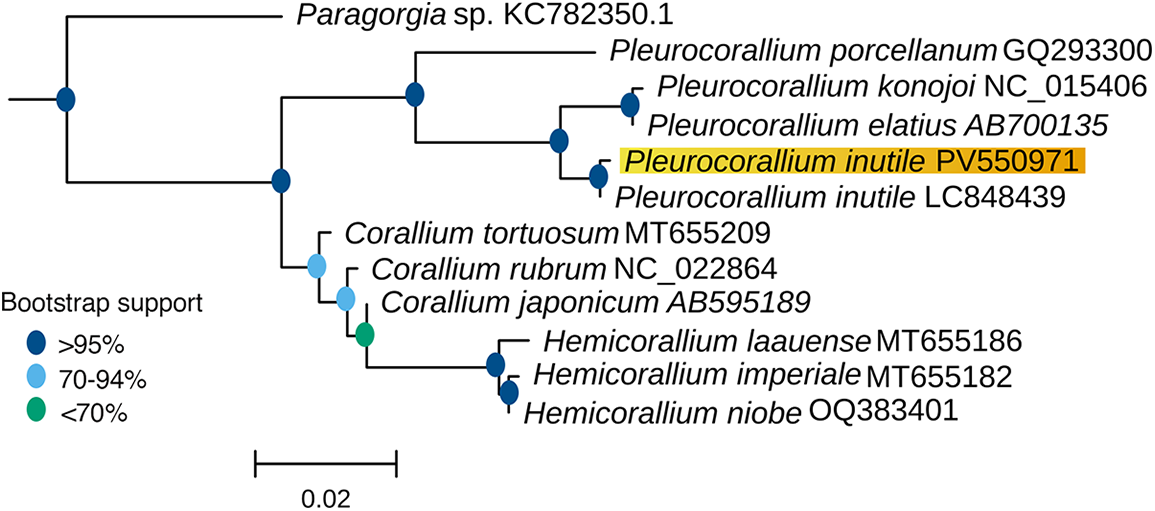
Remarks: The present specimen is morphologically similar to the few other P. inutile specimens reported from the northwestern Pacific by having anastomosing branches, and whose coenenchyme is predominantly filled with double club sclerites (Kishinouye, Reference Kishinouye1903; Nonaka and Muzik, Reference Nonaka and Muzik2016; Tu et al., Reference Tu, Dai and Jeng2012). Similar to examined specimens from previous studies (Nonaka and Muzik, Reference Nonaka and Muzik2016; Tu et al., Reference Tu, Dai and Jeng2012), our collected P. inutile specimen also had a symbiotic association with an unidentified Corallizoanthus sp. In the original description of the type, it was noted that some kind of commensal ‘Actinea’ was found on the branches (Kishinouye, Reference Kishinouye1903); it has been suspected that this could potentially have been a zoantharian (Reimer et al., Reference Reimer, Nonaka, Sinniger and Iwase2008). Given that many zoantharian species are likely obligate symbionts of specific cnidarian hosts (Kise et al., Reference Kise, Santos, Fourreau, Iguchi, Goto and Reimer2023), the Corallizoanthus association with P. inutile has been hypothesised to be ecologically diagnostic (Nonaka and Muzik, Reference Nonaka and Muzik2016). Based on our phylogenetic analysis (Figure 7), the present specimen clustered in the same clade with another P. inutile that was collected at an unknown depth in Tanegashima Island, Kagoshima, Japan (GenBank accession number: LC848439 from Takata et al., Reference Takata, Nonaka, Xia, Kikuchi, Gibu and Yasuda2025).
A maximum likelihood-based phylogenetic tree of the family Coralliidae based on msh sequences, rooted to Paragorgia sp. (KC782350). Highlighted taxon represents the species reported in this study.

Geographical distribution and depth: The genus Pleurocorallium has been reported from the Indo-Pacific at 116–463 m (Sánchez et al., Reference Sánchez, Dueñas, Rowley, Gonzalez-Zapata, Vergara, Montaño-Salazar, Calixto-Botía, Gómez, Abeytia, Colin, Cordeiro, Pérez, Loya, Puglise and Bridge2019). P. inutile specifically was originally described from Kashiwajima Island, Kochi (Kishinouye, Reference Kishinouye1903), and has been recorded in Taiwan (Tu et al., Reference Tu, Dai and Jeng2012), Okinawa Island at 245 m (Nonaka and Muzik, Reference Nonaka and Muzik2016), and now from Minamidaito Island, Japan at 385 m (present study).
Class Hexacorallia Haeckel, 1896
Order Antipatharia Milne-Edwards and Haime, 1857
Family Aphanipathidae (Opresko, Reference Opresko2004)
Genus Acanthopathes (Opresko, Reference Opresko2004)
Acanthopathes undulata (van Pesch, Reference van Pesch1914)
Material examined: RUMF-ZG-05499 (JAMSTEC Specimen No. 117613; On-board Cruise ID: ROV Crambon #43 Cn01), off NE Kitadaito Island, Philippine Sea (25° 57.37′ N 131° 20.56′ E), 200–400 m, 8 May 2024, Coll. N Jimi.
Diagnosis: The colony is branching (Figure 8A). Polyps measure 0.6 mm (0.59–0.84 mm) in transverse diameter and are spaced 0.80 mm (0.64–0.97 mm) apart. The skeletal spines are acicular, smooth and unequal in size (Figure 8B–E). Polypar spines measure 0.29 mm (0.18–0.37 mm) while abpolypar spines measure 0.20 mm (0.16–0.23 mm), and are spaced 0.17 mm (0.12–0.20 mm) apart.
Acanthopathes undulata. (A) specimen fragment, (B) branch, diameter 0.24 mm, (C) branch, diameter 0.18 mm, (D) branch, diameter 0.61 mm, and (E) close up view of the smooth surface of the skeletal spine.

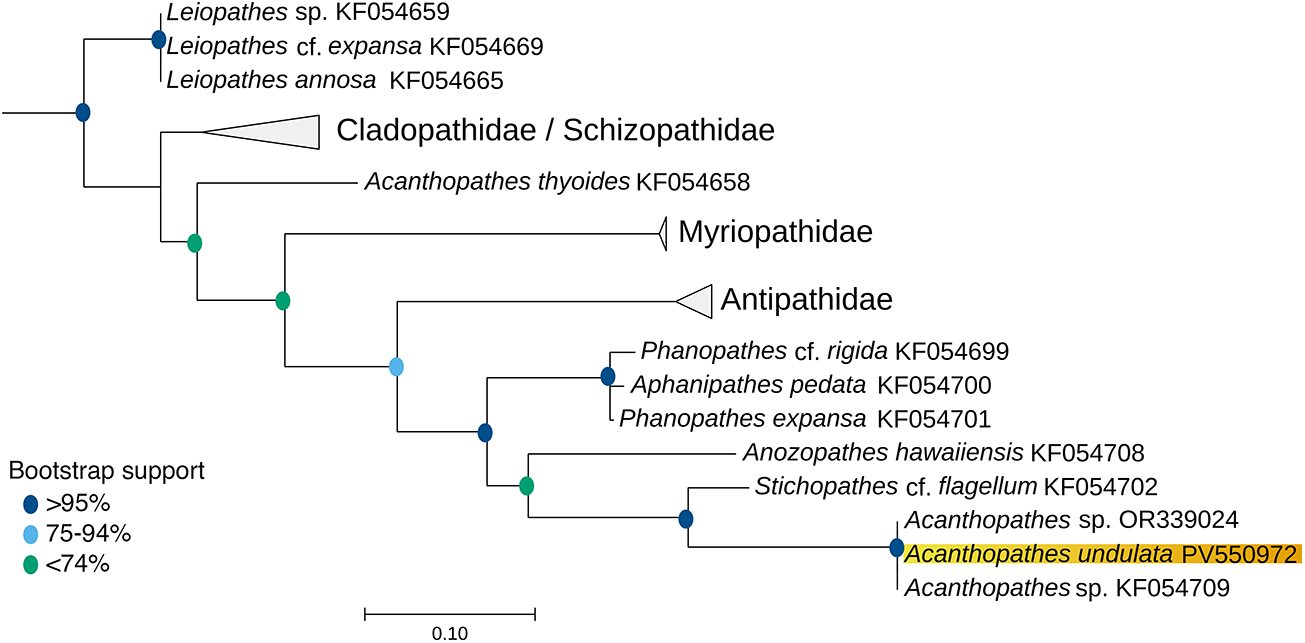
Remarks: This particular specimen was serendipitously collected while the ROV Crambon was gathering some sand and meiofauna across various depths around Kitadaito Island during dive CRB No. 43. Based on molecular data and the presence of anisomorphic skeletal spines, we confirmed the specimen belongs to the genus Acanthopathes. Previous research has suggested that the genus Acanthopathes is polyphyletic, with clades scattered across two different families (Brugler et al., Reference Brugler, Opresko and France2013), which was also apparent in the phylogenetic tree we generated in this study (Figure 9). The sequences of the present specimen clustered with members of the family Aphanipathidae (Figure 9). Smooth to slight tuberculation of the spines has been reported in some species of the genus Acanthopathes (Opresko, Reference Opresko2004). Morphological examination of our small specimen revealed that it is A. undulata, as it is similar to the original description provided by van Pesch (Reference van Pesch1914), with spines appearing smooth, although the current specimen differs by having smaller spine height, rarely reaching beyond 0.37 mm. Based on our phylogenetic analysis (Figure 9), the present specimen nested in the same clade as Acanthopathes specimens from Hawai’i (GenBank accession number: KF054709; Brugler et al., Reference Brugler, Opresko and France2013) and the Red Sea (GenBank accession number: OR339024; Vicario et al., Reference Vicario, Terraneo, Chimienti, Maggioni, Marchese, Purkis, Eweida, Rodrigue and Benzoni2024). The former has been identified as A. undulata (Wagner, Reference Wagner2015), whereas no formal designation has yet been made to the species identity of the latter.
A maximum likelihood-based phylogenetic tree of the order Antipatharia based on IgrN sequences. The original tree consisted of 36 taxa and was rooted internally with the family Leiopathidae. Highlighted taxon represents the species reported in this study.

Geographical distribution and depth: Originally described from the Solor Strait, Indonesia, at 113 m (van Pesch, Reference van Pesch1914). Subsequently reported from the Mariana Islands at 116 to 146 m (Grigg and Eldredge, Reference Grigg and Eldredge1975) and the Hawaiian Archipelago at 30 to 269 m (Wagner, Reference Wagner2015). This is the first report of this species in the northwestern Pacific.
Conclusions
This study provides the first documentation of the deep-water non-scleractinian coral species from the Daito Islands in Okinawa, Japan, revealing the unique topographic environment they occupy and the habitat they provide. Our sampling efforts in this understudied area expand the currently known geographic distributions of the octocorals Callogorgia cf. korema and Pleurocorallium inutile, as well as of the black coral Acanthopathes undulata. More stringent protection is warranted for the conservation of the fragile and slow-growing species we have found in the area that can form the bases of marine animal forests (Orejas et al., Reference Orejas, Carreiro-Silva, Mohn, Reimer, Samaai, Allcock and Rossi2022).
Supplementary material
The supplementary material for this article can be found at https://doi.org/10.1017/S0025315425100817.
Acknowledgements
We are grateful to researchers and staff of the KM24-03 Leg 2 cruise and the operation team behind KM-ROV for their support in specimen collection. We also thank the captain and crew of R/V Kaimei. We acknowledge Leah Ann Bergman (JAMSTEC) for providing post-expedition support and Bryan Gabriel P. Tan (University of the Ryukyus) for helping in taking ex situ photographs of the specimens. We thank the two anonymous referees for their comments and suggestions that improved the earlier version of this manuscript.
Author contributions
H.K., A.S., J.D.R., and Y.F. conceptualised the research. K.B.B.B., H.K., A.S., H.Y., S.T., Y.F., and J.D.R. conducted in situ observations and collected specimens. K.B.B.B. conducted SEM imaging. K.B.B.B. and K.V. conducted molecular work. K.B.B.B. performed data analyses and visualisation. Y.F. secured funding. J.D.R. contributed reagents. Y.F. and J.D.R. provided supervision. K.B.B.B. wrote the manuscript. All authors read, reviewed, and approved the manuscript.
Funding
Y.F. was supported by the Ocean Shot Research Grant Program. The Ocean Shot Research Grant Program of the Ocean Policy Research Institute of the Sasakawa Peace Foundation (OPRI-SPF) is supported by the Nippon Foundation. K.B.B.B. acknowledges The Nippon Foundation-Nekton Ocean Census Programme (https://oceancensus.org/) for supporting his participation in the KM24-03 Leg 2 JAMSTEC Expedition. Additionally, K.B.B.B. was supported by a Japanese Government scholarship (Monbukagakusho: MEXT).
Competing interests
The authors declare none.
Data availability
The data supporting the findings of this study are available in the paper.
Ethics standards
The research protocol used in this study received approval from the Research Safety Committee of the Japan Agency for Marine-Earth Science and Technology. All applicable international and national guidelines for the care and use of animals were adhered in this study.