More than half a century after the path-breaking investigation of racial and ethnic voting by Columbia University researchers Berelson, Lazarsfeld and McPhee, identity remains an important explanatory variable for scholars of political behaviour.Footnote 1 Identities have been shown to be powerful predictors of vote choice, party identification, political participation and attitudes on public policies – with the result being that individuals who share an identity can exhibit remarkable levels of cohesion with regard to political activities and beliefs. This is true not only for racial and ethnic identity (where we would expect the simultaneous intergenerational transmission of identity and attitudes to play a strong role in fostering group cohesiveness) but also for those identities that tend to be chosen over the course of the life span. In the United States, these include: trade-union membership, military veteran status, becoming a ‘born-again’ Christian and identifying as lesbian, gay or bisexual (LGB).
Understanding how political cohesion develops among those sharing identities that can be acquired rather than inherited has important implications for our conception of how these groups translate their numbers into political influence. The conventional wisdom is that such cohesion arises due to mobilization processes that activate the salience of a group identity and make it relevant to political behaviour. These circumstances can strengthen identity; they can lead identifiers to agree upon a shared political meaning of their group membership; and they can cause identifiers to perceive their fate as objectively or symbolically tied to that of the group. Although identity group leaders often catalyse and encourage these efforts, mobilization need not be a ‘top-down’ process: intra-group contact and acculturation into group communities can have similar effects. Thus defined, mobilization has been recognized by scholars across the spectrum of research on political behaviour as a key mechanism that fashions group identities into political blocs.
But by focusing on identity mobilization (and therefore what happens after an identity is acquired), the literature on group political cohesion has left the development of group identities (and thus what happens before an identity is acquired) largely unexamined.Footnote 2 In doing so, scholars have overlooked a simple but powerful mechanism that can be just as important as mobilization in explaining group political distinctiveness. This mechanism is selection, the process by which stable characteristics that are truly ‘unmoved movers’ – the indelible aspects of one's background and upbringing – help to determine whether a person self-selects into membership of a politically relevant group. Because these background characteristics themselves determine political attitudes, they can partially explain the political cohesiveness associated with – and often incorrectly believed to be solely the effect of – group membership. Groups can thus be composed of identifiers who vote cohesively for reasons having as much to do with shared individual backgrounds as they do with group interests. The result may be a loss of leverage for the group at the policy-making table. To the extent that group members are loyal partisans for reasons that antecede the acquisition of group identity – and therefore are less easily moved by appeals to group interests – it becomes more difficult for group leaders to make a credible threat to withhold support from their allies in order to win policy concessions.
In this article, I provide evidence for this selection mechanism with analyses of the identity acquisition and political behaviour of lesbian, gay and bisexual Americans.Footnote 3 Gay identity presents a particularly difficult test case for the existence of a selection mechanism: unlike other identities, gay identity is not passed down from parents to their offspring. Nevertheless, gay people in the United States exhibit high degrees of political cohesiveness, even on issues that have nothing to do with gay rights. This would, therefore, appear to present a case where (as scholars of gay politics have presumed) cohesion must be attributed to mobilization – including intra-group contact, co-ordination by gay leaders and acculturation into gay communities. However, I show that because those who identify as gay come from distinctly less traditional and more cosmopolitan backgrounds than the general population, a substantial amount of the differences in voting behaviour and political views between LGBs and the general population can instead be explained by a selection effect. The fact that selection effects are found for gay identity (where there is essentially zero correlation between parental and offspring identity) suggests that they almost surely play important roles in the cohesiveness associated with group identities that can be shared by parents and their children.
These findings highlight the importance of considering identities as both causes and effects of distinctive political attitudes. They indicate that care must be taken to avoid automatically ascribing group cohesiveness to the mobilizing efforts of group leaders or to interests that are shared by group members. Finally, they suggest that group leaders face both opportunities and challenges when they seek to co-ordinate their members’ votes and other political activities. In the case of gay voters, these findings help explain why LGBs are consistent supporters of the Democratic party's candidates, regardless of the strength of their support for gay rights, and thus provide some new insight into why legislators have been slow to change policy in a direction favoured by gay rights advocates.
The Political Distinctiveness of Self-Identified Lesbians, Gays and Bisexuals
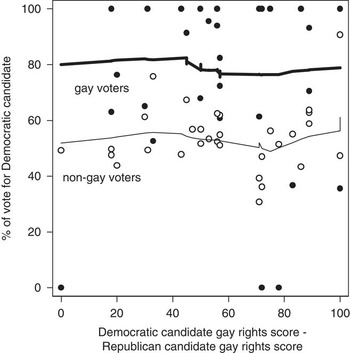
Since measures of lesbian, gay and bisexual identity first appeared in political surveys conducted with representative samples of Americans in the early 1990s, self-identified LGBs have been found to exhibit consistently distinctive political behaviour and attitudes. They are more likely to consider themselves Democrats and liberals than the general population, and they hold distinctive views on the legal recognition of same-sex relationships – as well as a host of issues that have nothing to do with gay rights.Footnote 4 It is not surprising, therefore, that gay voters are strong supporters of Democratic presidential and congressional candidates.Footnote 5 But what is notable is that over the past two decades this support has been consistent regardless of the extent to which the Democratic party and its legislators have supported policy change aligned with the interests of gay voters. Figure 1 displays exit-poll data from the thirty Senate elections between 1990 and 2006 for which exit-poll data are available in which both candidates had prior service in either the Senate or the House of Representatives, and thus both had cast a series of roll-call votes on gay rights that were rated on a scale of zero to 100 by the Human Rights Campaign, a gay lobby group. The horizontal axis in Figure 1 is the Democratic candidate's score minus the Republican candidate's score; the vertical axis is the percentage of the two-party vote won by the Democratic candidate. The points on the graph plot the gay and non-gay vote in each of the elections; smoothed lines are drawn to show the patterns of data. The graph indicates that gay voters’ support for Senate candidates varied little with the candidates’ differences in their records on gay rights: on average, about 80 per cent of the gay vote went to the Democratic candidate in these races whether the gap between the rivals’ voting records on gay rights was large or small.Footnote 6
Vote for Senate in elections where both candidates had gay-rights roll-call voting scores, 1990–2006

The explanation why self-identified gay people are so politically cohesive in ways that cannot entirely be explained by self-interest begins with the critical distinction between the ascribed trait of same-sex attraction and the acquired identity of calling oneself gay, lesbian or bisexual. While the preponderance of the evidence is that the degree to which one is sexually attracted to those of the same sex is a trait that is fixed at birth or in early childhood, being gay is a chosen identity – an identity acquired among a non-random subset of those endowed with the trait of same-sex attraction. Recent research suggests that the trait of homosexuality is associated with physiological traits such as brain structure, left-handedness, and even hair-whorl patterns.Footnote 7 Self-identified gay people report experiencing ‘confusion’ or ‘sensitization’ as they realize that they are different from their heterosexual peers – often at a very early age.Footnote 8 Taken as a whole, these findings indicate that the degree to which one experiences attraction to members of one's own sex is a nearly immutable trait that generally manifests itself prior to any identity that one adopts in response to it. But while sexual orientation is unchangeable, research indicates that whether one responds to this trait by acquiring a gay identity is subject to a fair amount of individual choice and cultural and temporal variation. Like all identities, gay identity is a social construction that is particular to our place and time.Footnote 9 A main goal of organized gay advocacy efforts, which have existed in the United States only since the 1950s, has been to transform society's understanding of homosexuality from a deviant behaviour to an acceptable identity.Footnote 10 Scholars of sexuality have found important distinctions among the concepts of sexual attraction, sexual behaviour and self-professed sexual orientation or sexual identity, and many people who are attracted to others of their own sex or have same-sex sexual partners still consider themselves heterosexual.Footnote 11
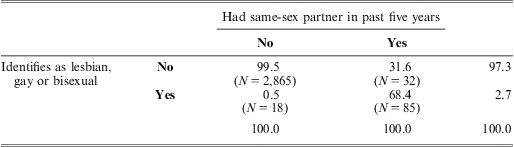
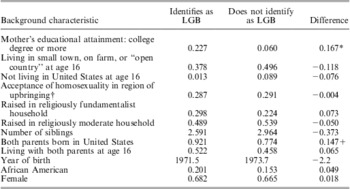
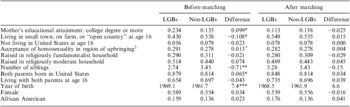
Important distinctions between sexual behaviour and gay identity can be seen in recent data drawn from the General Social Survey (GSS), a biennial survey that asks its nationally representative sample of American adults about their sexual behaviour and (since 2008) whether they identify as lesbian, gay or bisexual. As shown in Table 1, among the small sample (N = 117) of respondents who told the GSS in either 2008 or 2010 that they had a sexual partner of the same sex in the past five years, nearly one-third did not identify as lesbian, gay or bisexual. Furthermore, the pattern of identification among these respondents is decidedly non-random. Analyses (shown in Table 2) find that among those with same-sex sexual partners, those identifying as LGB are significantly more likely to have a college-educated mother and have parents who were both born in the United States. Additional substantial (but not statistically significant) differences suggest that those identifying as gay may have fewer siblings, may be more likely to have been raised in the United States, and may be more likely to have been raised in a city or suburb (instead of a small town or farm) than those not identifying as gay.Footnote 12 Research is scarce on what determines whether someone who is homosexual adopts a gay identity, but these data suggest that those raised in less traditional, more cosmopolitan backgrounds are more likely to translate their same-sex attraction into identifying as lesbian, gay or bisexual. As will be shown, this screening process plays a profound role in making gay Americans into such a politically cohesive group.
Same-Sex Sexual Activity and LGB Identification
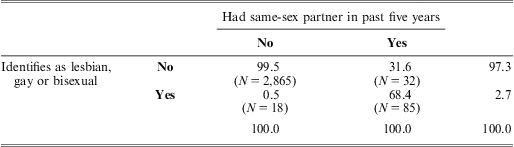
Notes: Source for data: General Social Survey, 2008 and 2010. Cells contain weighted percentages and unweighted number of cases (in parentheses).
Background Characteristics of Those Reporting Same-Sex Partners in Past Five Years, by LGB Identification

Notes: N ranges from 110 to 117 depending on availability of valid data on background characteristics. Differences are statistically significantly different from zero at +p < 0.10, *p < 0.05; **p < 0.01; ***p < 0.001.
†Proportion of residents in region where respondent reported living at age 16 that agreed that homosexuality is ‘not wrong at all’ in GSS surveys since 1973.
Source for data: General Social Survey, 2008 and 2010.
Explaining Group Political Cohesion
In seeking to explain the political distinctiveness of groups fashioned out of chosen identities – including lesbians, gays and bisexuals – scholars have looked to a half-century of survey research on group political cohesion that began with Berelson, Lazarsfeld and McPhee's presidential election study of Elmira, N.Y., voters. They noted the tendencies of blacks, Jews and other ethnic minorities to vote cohesively and discovered that this tendency was heightened to the extent that ethnic voters had strong ethnic identities.Footnote 13 Since then, two broad points have emerged in research on group identity and political cohesiveness. First, group membership does not necessarily imply group identity (nor the politically cohesive views that can accompany an identity). An oft-cited example is economic class: many people whose income and life circumstances would by objective criteria qualify them as ‘working class’ nevertheless do not identify that way, and they do not share the distinctive political behaviour and attitudes associated with those who do.Footnote 14 Second, shared group identity (and even shared political interests) does not necessarily imply distinctive group political behaviour: some additional factor is needed to give the identity political meaning. For example, those who identify themselves as living with a disability are less likely to participate in politics than the general population, but this participation gap appears to be offset to the extent that individuals see their disability through the prism of the disability rights movement.Footnote 15
The Conventional Wisdom: Group Political Cohesion Requires Group Mobilization
Because neither shared objective circumstances nor shared subjective identity are sufficient conditions for group political distinctiveness, scholars have generally viewed group political cohesion as requiring ongoing co-ordination, contact or acculturation – in other words, a mobilization of group members – that makes salient their group identity.Footnote 16 The microfoundations of this theory come from studies in political psychology, which have found that groups become politically cohesive when group identity is strong;Footnote 17 when identifiers agree upon a shared political meaning for their group membership, such as what it means to be ‘American’ or ‘European’Footnote 18 and when identifiers objectively or symbolically perceive their fate as tied to that of the group.Footnote 19
The few published empirical studies that document gay people's attitudes and political behaviour have followed in this vein by asserting, but rarely demonstrating, that some sort of group mobilization is responsible for gay political distinctiveness. In his pioneering study of gay voting behaviour, Hertzog proposes that ‘group consciousness’ is responsible for LGBs’ distinctive voting patterns but does not specify how such consciousness comes about.Footnote 20 Bailey argues that gay political distinctiveness is made possible by a ‘subculture’ in which LGBs develop networks and social ties with one another in American cities, but he does not substantiate this claim with any data.Footnote 21 Similarly, Sherrill speculates that the ‘formation of political consciousness requires discussion and the development of a shared sense of conditions and grievances’ among lesbians and gays and suggests that conditions like these are found mostly in large cities and university towns where demographic data suggest lesbians and gays are most concentrated.Footnote 22 In a study examining the question of gay political distinctiveness with survey data of LGBs, Schaffner and Senic show that LGBs’ preferences for the Democratic party and its candidates are heightened to the extent that they are concerned about obtaining employee benefits for same-sex partners.Footnote 23 Some research has shown that LGBs with stronger involvement in the gay community are more politically distinctive.Footnote 24 But, so far, no research has rigorously taken into account the fact that while homosexuality is an ascriptive trait, identifying as lesbian, gay or bisexual is a decision with important implications for individuals’ political affiliations and attitudes.
An Overlooked Mechanism: Selection
A careful consideration of the nature of acquired identities suggests a simple but overlooked mechanism that can generate group political cohesion even in the absence of mobilization among those who have chosen a common group identity. This is selection, a process in which the background characteristics that predict whether an individual selects a group identity also predict his or her political views, leading these views to be correlated with, but not caused by, identification with the group. The notion of selection underscores the importance of establishing the extent to which an identity is chosen or transmitted from parent to offspring. When identities are inherited, any distinctive political beliefs can rightly be considered either causally proximate to, or consequences of, these identities. By contrast, chosen identities can be effects in their own right. An observation of this sort was made by the ‘Michigan school’ authors of The American Voter, who speculated that the true influence of group membership was probably much stronger for inherited identities than chosen identities, as members of chosen identity groups are ‘recruited and come to identify with the group on the basis of pre-existing beliefs and sympathies’.Footnote 25 The fact that gay people consistently support Democratic candidates and are distinctively liberal on a range of issues may thus be due partially to a selection effect: given that those who respond to same-sex attraction by acquiring a gay identity come from distinctive backgrounds – less traditional, more cosmopolitan backgrounds that are themselves strong predictors of liberal political attitudes – it may be that those backgrounds are at least partially responsible for gay political distinctiveness.
Unfortunately, comprehensive measures of background characteristics are typically not included in standard political surveys, meaning that the multivariate analyses carried out with most survey data will fail to estimate selection effects properly. For example, a typical estimate of the impact of identity on, say, vote choice that fails to condition on upbringing and background characteristics but includes standard controls such as income, educational attainment, ideology and party identification can be biased in two ways. By omitting the first set of characteristics, the analysis will fail to consider important antecedents of identity acquisition and can incorrectly ascribe those antecedents’ effects on the dependent variable to the identity itself. Including the standard controls, which can all be considered ‘post-treatment variables’, that is they are all possible consequences of the acquisition of the identity, does not correct for this problem. Controlling for these post-treatment variables that themselves affect political views and behaviour will typically result in biased estimates of the true size of selection effects.Footnote 26 Thus, many standard datasets and estimation strategies are not appropriate for a true assessment of selection effects.
Testable Hypotheses
If selection is at work in making a group's members politically distinctive, the ceteris paribus differences in political views between group members and the general population should be reduced after conditioning on the effects of background characteristics that shape identity choice and are also known to be determinants of political views. In addition, if selection effects are present, it should be the case that group members are distinct from non-group members from the moment they identify with the group and thus the development of political cohesion should not require the mobilization processes that can accompany the passage of time, contact with group members or receipt of co-ordinating messages from group leaders.
Data
To explore the extent to which selection accounts for gay political cohesiveness, I have analysed the two most comprehensive sources of survey data drawn from representative samples of Americans that permit statistically powerful comparisons of gays’ political preferences with those of the general population. The first dataset is the GSS Cumulative File, which is the source of the data in Tables 1 and 2. In addition to asking respondents questions about their upbringing, their sexual behaviour and gay identity, the GSS also asks its respondents about their voting decisions and political views. The pooled data from the 2008 and 2010 surveys yield 3,286 cases that are valid on all the upbringing variables. In these two surveys, 107 of these respondents identify as lesbian, gay or bisexual. The second source of data was used to construct Figure 1, and comes from the national exit polls conducted in presidential and congressional elections by the Voter News Service (VNS) from 1990 through 2002, and its successor, the National Election Pool (NEP) from 2004 through 2008. Although the set of questions from this dataset is much less rich (it is typically administered via a single sheet of paper to voters as they leave the polls on election day), it has a very large sample of LGB voters: the pooled dataset created from nine administrations of the survey includes 1,971 voters who identify as lesbian, gay or bisexual. Both surveys make laudable, but necessarily imperfect, attempts to contend with the social desirability effects that can lead survey respondents to under-report gay identity. The GSS includes its questions about gay identity in a confidential, self-administered component of its in-person survey. In the VNS/NEP, voters fill out a paper questionnaire as they leave polling places and deposit them, unseen, in a box.
Results
As was seen in Table 2, the GSS incorporates a particularly rich battery of questions about the upbringing of its respondents, including questions about their parents’ education levels, their parents’ place of birth and the number of their siblings, as well as a series of questions that specifically ask respondents to recall their lives at age 16, including their religious upbringing, the region and size of place where they were living and whether they were living with both parents at the time. The power of questions about these characteristics for identifying selection effects is twofold. First, none of these characteristics can themselves be selected; rather, every American is assigned in a quasi-random fashion to a realization of the joint distribution of these variables. Second, these conditions are located so early in the chain of causality that they can only be causes and never the effects of the decision to identify as lesbian, gay or bisexual. These characteristics are thus true ‘unmoved movers’ of both the acquisition of gay identity and of political attitudes, and thus they are ideal predictors for use in tests of the selection hypothesis.
The Effect of Upbringing on Identification as Lesbian, Gay or Bisexual
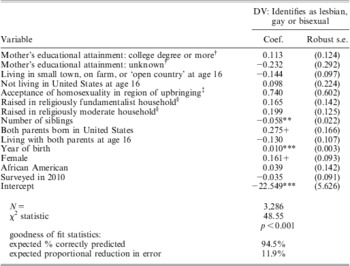
As the hypothesis would lead us to expect – and in line with the differences among those with same-sex partners between gay and non-gay identifiers shown in Table 2 – these background characteristics indeed play a significant role in determining whether someone from the general population identifies as lesbian, gay or bisexual. A probit model (shown in Table 3) finds that these background characteristics are jointly significant predictors of gay identity in a dataset that includes the entire adult population of the United States, and that the model yields a wide range of predictions.Footnote 27 For example, an American born in 1980 who at age 16 lived in a New England suburb and was raised by a college-educated mother in a liberal religious tradition is estimated to have a 4.6 per cent chance of identifying as lesbian, gay or bisexual (leaving all other variables set to their actual values). By contrast, someone from a small town in the East South Central region, born in 1950, raised in a fundamentalist religious tradition, and whose mother did not have a college education has only a 1.0 per cent chance of coming out as gay.Footnote 28 Not surprisingly, the differences in the background characteristics between self-identified LGBs and the rest of the adult population can be substantial. These differences, displayed in the left-hand columns of Table 4, reflect the screening process shown earlier in Table 2. Gay people are nearly twice as likely to have a college-educated mother as heterosexuals. They are also significantly younger, less likely to have been raised in a small town and more likely to have fewer siblings, to have been raised in a region whose residents found homosexuality morally acceptable and to have been raised by parents who were both born in the United States.
Predictors of Identification as Lesbian, Gay or Bisexual among All American Adults (Probit)

Notes: Estimates generated using weights for non-response supplied by GSS. +p < 0.10, *p < 0.05; **p < 0.01; ***p < 0.001. †Base category for these variables: mother's educational attainment less than college degree. ‡Proportion of residents in region where respondent reported living at age 16 that agreed that homosexuality is ‘not wrong at all’ in GSS surveys since 1973. §Base category for these variables: raised in religiously liberal household.
Source for data: General Social Survey, 2008 and 2010.
Comparing the Background Characteristics of Gay and Straight Americans

Notes: Table displays means of treated and control groups and their differences before and after matching using genetic algorithm. Differences between treated and controls before matching are statistically significantly different from zero at +p < 0.10, *p < 0.05; **p < 0.01; ***p < 0.001.
‡ Proportion of residents in region where respondent reported living at age 16 agreeing that homosexuality is ‘not wrong at all’ in GSS surveys since 1973.
Source for data: General Social Survey, 2008 and 2010.
Evidence of Selection Effects
The selection hypothesis will be confirmed if, after taking account of this non-random manner in which Americans come to identify as lesbian, gay or bisexual, observed differences in political views between gay and non-gay people are diminished. I examine the extent to which selection effects explain five variables on which gay people exhibit distinctive behaviour and views: vote for president, party identification, ideology, attitudes on same-sex marriage and (as an example of an issue that has nothing to do with gay rights) attitudes on environmental issues. Because the backgrounds of gay and non-gay Americans differ so markedly, the estimates obtained from standard multiple regression techniques can depend substantially on assumptions about the form of the function mapping these covariates to the dependent variables.Footnote 29 Therefore, I employ a variety of techniques to obtain estimates of the differences between gays’ and non-gays’ political views that are less reliant on assumptions of functional form. Following the terminology of the counterfactual tradition, I designate those identifying as gay as the ‘treatment’ group and those not identifying as gay the ‘control’ group. The estimand of interest in these analyses is the average treatment effect: the average difference in views and behaviour between gays and non-gays in the population after conditioning upon the background characteristics listed in Table 4. To the extent that there are additional unobserved background characteristics that contribute to selection, which are also correlated with liberal political views, these estimates should be considered the upper bounds on the true size of the ceteris paribus differences between gays and non-gays, and thus conservative estimates of the size of selection effects.Footnote 30
To ensure that the results are not dependent on a particular technique, I compare estimates yielded by three different methods that are widely employed in the literature. Each of the three methods conditions on the same set of background characteristics listed in Tables 2, 3 and 4. The first set of analyses consists of probit regressions in which the dependent variable is predicted with background characteristics and the gay identity variable – with one important difference from the typical regression approach. Estimates of the probability of identifying as gay (generated from the model in Table 3) are employed as a propensity score, all observations are classified into strata based on this score, and in the regressions all covariates are interacted with indicator variables for each stratum. The coefficients on the gay identifier variable and its interactions with the strata indicators are used to estimate strata-specific differences on the dependent variable between gays and non-gays. Finally, these differences are averaged over all strata (weighted by the relative size of each stratum) to calculate the effect for the entire population. The advantage of this approach, which is analytically equivalent to a procedure known as ‘subclassification and regression’, is that because the propensity score varies relatively little within each stratum, the differences between LGBs and non-LGBs are estimated among cases that are relatively similar and the estimate is, therefore, less dependent upon assumptions of functional form.Footnote 31 The second technique matches treated and control cases most like one another according to the Mahalanobis distance metric (a standard measure of the extent of the dissimilarity between cases in a multivariate dataset) using nearest-neighbour matching with replacement.Footnote 32 This method proceeds by calculating how different each of these matched pairs’ political views are and then averaging these differences across all matched observations. The third technique generates estimates in a similar manner, except that it employs a genetic algorithm to identify matches that result in treated and control groups whose characteristics are as balanced as possible.Footnote 33 Given that matches must be found for every treated and control case, the matching techniques achieve good balance on the covariates; the balance statistics achieved by genetic matching are shown in the right-hand columns of Table 4.
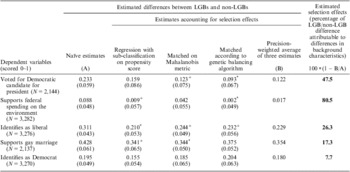
Estimates of selection effects are displayed in Table 5. The left-hand column of the table (column A) shows the difference observed between treated and controls before conditioning on background characteristics – also known as the ‘naïve estimate’ – for each of the five dependent variables. The following three columns display estimates obtained after accounting for selection effects using each of the three techniques. For each of the five dependent variables these estimates are reassuringly similar to one another and no technique consistently yields high or low estimates, suggesting that the results are not being driven by the choice of a particular method. To summarize the results, I calculate an average (shown in Column B) in which each estimate is weighted by its precision (i.e., the inverse of its estimated standard error). The size of the selection effect is determined by considering this average as a proportion of the naïve estimate, and is thus calculated as

Estimates of Selection Effects Attributable to Background Characteristics

Notes: Estimates accounting for selection effects are significantly less than naïve estimates at +p < 0.10, *p < 0.05 (one-tailed tests). Estimated standard errors (robust, where applicable, to heteroscedasticity) shown in parentheses. Subclassification and regression conducted with four strata. In calculating these predictions, all other variables were held constant at their actual values across all observations using the margins routine in Stata 11.1; the average prediction is reported. Matching estimates obtained after exact matching on year of survey; estimates are regression bias-adjusted.
Source for data: General Social Survey, 2008 and 2010.
As shown in Table 5, these selection effects are significant and substantial, with important implications for gays’ voting behaviour and attitudes.Footnote 34 According to the naïve estimate, gay Americans are 23 percentage points more likely than non-gay people to support Democratic candidates in presidential elections. Although scholars have generally attributed this gap to gays’ self-interest made salient by mobilization efforts, the analysis here reveals that nearly half of this observed difference (47.5 per cent) can instead be attributed to differences in upbringing between gays and straights: if Americans from every background were equally likely to identify as gay, the presidential voting gap would be only about 12 percentage points. Similarly, the observed nine-point difference between gays and non-gays on the environment would shrink to two points – and the 31-point gap on identification as a liberal diminished to 23 points – if upbringing had no effect on the decision to come out as gay. Even on the topic of same-sex marriage – an issue where gays’ self-interest is indisputable – selection accounts for a substantial share (17 per cent) of the gap between gay and straight opinion. The notable exception to this pattern is the consistent lack of significant selection effects across estimations found regarding party identification, indicating that many gay people whose upbringing would typically be associated with Republican party identification ultimately abandon that party and become Democrats. Given the remarkable persistence of party identification throughout the life span, this degree of abandonment of parental party identification is highly unusual.Footnote 35 The clear differences in the positions taken by the two parties on gay rights appears to cause many gay voters raised in Republican households to update their party identification rationally over time – a process that very well may be encouraged by mobilization.Footnote 36 In sum, however, these analyses offer strong support for the claim that the distinctive attitudes of lesbians, gays and bisexuals can be attributed in part to selection, and in some cases, substantially so.
Accounting for Mobilization
As a second test, I revisit each of the five dependent variables discussed above with analyses conducted with VNS/NEP exit-poll data. The advantage of this dataset is that it includes variables that are indirect measures of mobilization, providing an additional opportunity to assess whether mobilization is necessary to produce gay political cohesion. Three VNS/NEP variables can be considered proxies for mobilizing processes. The variable age serves a proxy for acculturation into the gay community: the youngest gay voters are least likely to have experienced such acculturation. The variable % of precinct identifying as LGB serves as an indirect measure for intra-group contact. Construction of this variable is made possible by the multistage-cluster sampling design of the exit polls (in which voters from a nationally representative sample of precincts are surveyed at random as they leave the polls on election day). Aggregating the exit-poll data by precinct provides estimates of the prevalence of gay identity within a relatively small group of people living in a well-defined geographic area.Footnote 37 All things being equal, gay people are less likely to have intra-group contact in precincts where there are fewer gay voters. Finally, the variable first-time voter is a direct measure of participation in politics. Gay people who are first-time voters have less experience taking part in the political process and are thus less likely to have been exposed to mobilizing messages from gay leaders and organizations. Therefore, our confidence that gay political cohesion happens in the absence of mobilization will be bolstered if significant gay–straight differences persist among the youngest voters, among voters living in precincts with few gay people and among first-time voters – all of them categories of voters who, we can surmise, are least likely to have been exposed to mobilization processes.
To perform this analysis, I again employ the subclassification and regression technique described earlier with exit-poll data to predict vote for president, party identification, ideology and attitudes to same-sex marriage and to environmental issues.Footnote 38 Gay identity is included as a regressor, as well as a voter's age, whether he or she is voting for the first time, and the proportion of voters in the voter's precinct identifying as lesbian, gay or bisexual – all of which are interacted with gay identity in order to estimate gay–straight differences. Controls are included for year of survey as well as all the variables available in the survey that are causally prior to the decision to identify as gay: gender, race and ethnicity. Strata j = 1 … J are defined based on a propensity score derived by regressing gay identity on voters’ gender, race, ethnicity and age. All of the regressors are then interacted with strata-specific indicator terms Sij, yielding the following estimated model for each respondent i in stratum j:
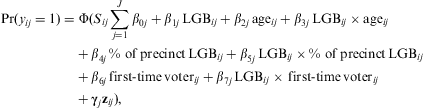
where z represents the vector of controls.
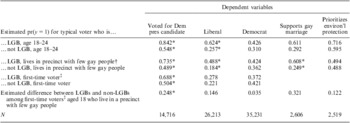
Table 6 displays predictions derived from these regressions, which are calculated as before by averaging the predictions over all the strata. The table displays estimations of the gay–straight differences among the youngest voters (those aged between 18 and 24 at the time they voted), those living in a precinct where there are very few voters who identify as LGB (ranging from 0.6 to 2.3 per cent of voters, depending on data availability) and first-time voters. These results generally indicate that gay voters are substantially and statistically significantly different from straight voters with regard to voting and political views from an early age, from the moment they begin participating in electoral politics, and even if they are one of the few people in their immediate vicinity identifying as gay. The one exception to this pattern is consistent with the findings seen with the GSS data in Table 5: identification with the Democratic party. As we would expect, given the lack of selection effects on gays’ distinctive pattern of partisan affiliation, no significant differences are found to exist on this variable between unmobilized gays and their straight counterparts. The bottom row of the table examines whether differences between gay and heterosexual voters persist in all three circumstances where gays have had the least amount of opportunity to be mobilized. Here (again, with the exception of Democratic party identification), the differences are substantial, ranging from 12 to 32 percentage points. Thus, from the moment they come of age, from the moment they begin participating in electoral politics and regardless of where they live, voters who identify as gay tend to vote more Democratic and hold political attitudes that are more liberal than those of similarly situated voters who do not. As a group, gay voters are in many ways politically cohesive before they experience much in the way of mobilization.
Determinants of Party Identification, Ideology and Policy Attitudes

Notes: Cells contain predictions yielded by subclassification and regression models described in text. Presidential vote, liberal and Democrat models estimated with five strata; gay marriage and environmentalism models estimated with three strata. In calculating predictions, all other variables were held constant at their actual values across all observations using the margins routine in Stata 11.1; the average prediction is reported.
*LGB/non-LGB difference is estimated to be significantly greater than zero, p < 0.05 (two-tailed test).
†Defined as the lowest recorded density of gay voters among the precincts analysed in the model (0.6 per cent for presidential vote, liberal and Democrat models; 2.3 per cent for same-sex marriage model; 1.0 per cent for environmentalism model).
‡First-time voter data are not available for the gay marriage and environmentalism models.
Source for data: Voter News Service/National Exit Pool (VNS/NEP), 1990–2008.
Conclusion
The findings presented here show how upbringing can serve as a selection mechanism that affects identity acquisition – and therefore leads identifiers to engage in cohesive voting behaviour and share distinct political attitudes in the absence of mobilization. As an identity that is hardly ever passed down from parents to offspring, gay identity is both a particularly difficult test case of this hypothesis and rare opportunity to cleanly observe selection effects at work. The acquisition of other identities over the life span – such as trade union member, born-again Christian, military veteran or feminist – is often at least partially the consequence of parental identity. Since measures of parental identity on these dimensions are almost never included in standard political surveys (and, therefore, cannot be incorporated as controls into estimates), typical estimates are likely to understate these selection effects. The fact that such large effects are found in the case of lesbians, gays and bisexuals suggests that sizeable selection effects may be at work in shaping cohesion among many of America's most important voting blocs.
Accounting for the impact of selection effects on political cohesion is thus critical for a complete understanding of the nature and consequences of acquired identities, which as hallmarks of modernity are becoming ever more central to the organization of society and politics worldwide.Footnote 39 Most of the research has focused on how such identities are made salient via mobilization processes rather than considering how they come to be acquired in the first place.Footnote 40 Mobilization effects play an important role in developing group political cohesion (as it appears to do in the case of gay Americans’ identification with the Democratic party), but the findings here indicate that proper identification of these effects requires a richer estimation strategy than conditioning on a standard set of control variables and presuming that any remaining correlation between identity and political attitudes is due to mobilization.
The findings here are relevant not only to those who study identity formation but also to scholars interested in how identity groups achieve policy change through the political process. The fact that identity acquisition can be so heavily influenced by selection can both help and hinder group leaders in their efforts to win policy concessions. Selection effects can create ‘incidental alliances’ between the rank-and-file members of different groups that are in place regardless of elites’ actions. As a group, gay voters are natural allies with other liberal causes, regardless of whether gay leaders mobilize them to become so. But these mechanisms also provide a new explanation for why some identity groups – including LGBs and born-again Christians – are subject to ‘electoral capture’, a phenomenon in which a group's votes are taken for granted by one political party, largely uncontested by the other, and as a result the group's leverage is diminished.Footnote 41 In this framework, the party that ignores the captured group does so in part because granting policy concessions to the group will split the party's coalition. However, the analysis here suggests that electoral capture may be reinforced by selection effects, which make group members less responsive to appeals to their group interest, and thus can make it difficult for group leaders to make a credible threat to mobilize group members to align themselves in new ways – as was seen in Figure 1, which shows that Republican candidates gain few gay votes by matching their Democratic opponents’ platforms on gay rights. This sort of partisan loyalty may serve as an additional explanation why changes in public policy on gay rights have lagged behind changes in public opinion.Footnote 42 Clearly, a thorough understanding of group political cohesion – and more generally the dynamics of group politics – must take into account the fact that leaders are both aided and constrained by their group members’ enduring political beliefs.
In 1999, Timothy Cook concluded his review of what he called the ‘first wave’ of empirical political science on gay politics by noting that ‘we do not fully understand the extent to which the self-adoption of a sexual identity is a political act, or at least has implications for a person's political understanding and political activities.’Footnote 43 The findings presented here take a step towards explaining the implications of the adoption of gay identity and find that its effect on vote choice and attitudes are of significant size. Interestingly, these results suggest that the political cohesion of gay Americans may depend just as much on the continued strength of upbringing as a predictor of gay identity as on the positions taken by the two parties on gay rights. Until a day arrives when those with the trait of same-sex attraction are equally likely to identify as gay regardless of where they grew up or how they were raised, an unusual proportion of gay people should continue to identify as liberal and vote for Democratic candidates – even if the current gulf between the two parties on gay rights shrinks.