Man cannot help feeling a little ashamed of their cousin-german the Ape. His close yet grotesque and clumsy semblance of the human form is accompanied by no gleams of higher instinct.
“Our Nearest Relations,” All the Year Round 28 May 1859
Hurrah the monkey book has come
–Charles Darwin, letter to Huxley, 26 Feb. 1863
In March of 1861, Thomas Henry Huxley was regularly drawing crowds of six hundred working-class men to Piccadilly for his Thursday night anatomy lectures. In a letter to his wife, Huxley reported that his evolutionary message was a success: “By next Friday evening they will all be convinced that they are monkeys” (L. Huxley, ed. 1: 205). Two years later, the notes from these lectures would make up the core of his popular work of comparative anatomy, Evidence as to Man's Place in Nature.
Like its author, Man's Place in Nature has been somewhat miscast thanks to its participation in the larger evolutionary debate of the 1860s. For much of the twentieth century, historians took their cue from Huxley's reputation as “Darwin's bulldog,” reading Man's Place as an extension of the subject Darwin famously avoided in The Origin of Species when he promised only that in the future “light will be thrown on the origin of man and his history” (647).Footnote 1 Huxley himself influenced this view of the book's Darwinian origins through his revisions to the 1894 reprint.Footnote 2 Over the past forty years, scholars have come to reconsider this reading in the light of Huxley's ambivalence toward theories of progressive development, including Darwin's. As Adrian Desmond, Peter Bowler, Mario Di Gregorio and others contend, Man's Place in Nature has far more to do with disproving his rival Richard Owen than with “advancing Darwinian attitudes toward biological sciences” (Di Gregorio 156).Footnote 3 Read as a work of taxonomy, Man's Place in Nature responds to Owen's attempts to argue for a difference between humans and apes based on physiological structure. It does so by discrediting several supposed anatomical barriers separating human from animal through a detailed structural comparison of the hand, foot, and brain of a gorilla to those of a human. In 1979, Stephan Jay Gould wrote in praise of Huxley for compelling us to think of the difference between human and animal as a difference of degree rather than of kind (50).
In an effort to further this critical reevaluation of Man's Place in Nature, this essay will explore the significant and until now unrecognized impact on Huxley's composition of another, less eminent Victorian: Paul Belloni Du Chaillu. Du Chaillu was a French-American explorer, whose eyewitness accounts of gorillas in the wild were the first reported by a Westerner. In 1861 he arrived in London bearing valuable specimens and tall tales of violent gorillas that he transformed into hugely popular public lectures. In the same year, John Murray, Darwin's publisher, released Explorations and Adventures in Equatorial Africa, Du Chaillu's narrative of his three years spent traveling the west coast of Africa and collecting specimens. The animal Victorians encountered there was a brute, a monster with “fiercely-glaring large deep gray eyes, and a hellish expression of face, which seemed . . . like some nightmare vision” (Du Chaillu 97). In its descriptions and its illustrations of this largest of the anthropoid apes, humankind's closest relation in the animal kingdom, Explorations has, in the words of one scholar, “only terrible things to report” (Voss 217).
Thus in 1862 when Huxley sat down at his desk to compile and edit the lectures that would become the text of Man's Place in Nature he faced an immediate problem in Du Chaillu and the gorilla of popular imagination. How to convince his readers, in particular the “uninstructed” ones, for whom the physiological evidence might not be enough, that they should be placed among the apes?Footnote 4 Though studies of Man's Place have argued for a more complex understanding of Huxley's rhetorical agenda, not enough attention has been paid to the text itself, particularly the first chapter, in which Huxley surveys the historical treatment of the so-called “man-like apes.” It is in this chapter, I will argue, that Huxley attempts to recast the apes of Du Chaillu by emphasizing their more familiar, more domestic qualities.Footnote 5 At the same time, Huxley reframes the acts of violence at the center of Du Chaillu's stories – the CRACK of the rifle, the death of the rampaging man-ape – removing the heroic hunter from the scene and forcing the reader both to witness the act of violence and to recognize himself in the gestures of the ape.
The first section of this essay will provide a discussion of Explorations and Adventures in Equatorial Africa, specifically its author's influential characterizations of the newly discovered gorilla. Reading Man's Place in Nature as, in part, a response to Du Chaillu's text, this essay will analyze the rhetorical strategies that Huxley employs to convince men that they are monkeys. Focusing chiefly on the first chapter, I will argue that Man's Place in Nature is a surprisingly complex narrative, engaging with our sympathies in novelistic ways that run counter to the unemotional, detached perspective of the professional scientist that Huxley advocated and with which he is identified. More significantly, by uncovering the place of Du Chaillu in Man's Place in Nature, we see that Huxley's “monkey book” is not merely a zoological inquiry into the human, nor a defense of Darwin, but a more subtle argument waged on moral grounds, one that compels the reader to see the danger and violence inherent in the act of dividing man from animal.
I. “I felt almost like a murderer”: Encounters with Du Chaillu and the Gorilla of Popular Imagination
Huxley's skill as rhetorician requires his reader to adopt a critical stance, particularly in those moments where he appears most flippant. Such is the case when Huxley explains his decision to use the gorilla, rather than the chimpanzee, for his comparison of anatomical structures. He is simply appealing to popular sentiment:
It is quite certain that the Ape which most nearly approaches man, in the totality of its organization, is either the Chimpanzee or the Gorilla; and as it makes no practical difference, for the purposes of my present argument, which is selected for comparison, on the one hand, with Man, and on the other hand, with the rest of the Primates, I shall select the latter (so far as its organization is known) – as a brute now so celebrated in prose and verse, that all must have heard of him, and have formed some conception of his appearance. (Huxley, Man's Place in Nature 76)
Huxley's breezy indifference as to which ape to choose for the twenty-eight pages of comparative anatomy that follows, his argument so strong that he could support it using “either” ape, should be viewed with some skepticism. His deference toward a public fascinated by the recently discovered gorilla is of importance to the “purposes” of his argument. By referring to it as a “brute,” Huxley is certainly tweaking the consciences of those imagined critics to whom he will give voice later in the chapter: those individuals whose vanity will prevent them from ever accepting the conclusions of his study. At the same time, he acknowledges what, for most if not all of his readers, is the dominant impression of the gorilla.
In 1847, Thomas Savage, an Episcopalian missionary working in West Africa, published the first descriptions of what he named Troglodytes gorilla.Footnote 6 However, Savage never encountered a gorilla in the wild. His account of its behavior is entirely secondhand.Footnote 7 In his Memoir on the Gorilla, first published in 1859 as an appendix to On the Classification and Geographical Distribution of the Mammalia, Sir Richard Owen credits a letter from Savage with first drawing his attention to this “large species of chimpanzee.” Though he admits, in an aside, that the gorilla “offers the nearest approach to man of any known ape, recent or fossil” (87), Owen argues that the anatomical evidence, particularly the brain casing, is sufficient enough to justify his classification of man in a separate subclass: “Man is the sole species of his genus, the sole representative of his order and his subclass. Thus I trust has been furnished the confutation of the notion of a transformation of the ape into man” (103). One imagines Owen, the most eminent Victorian anatomist at the time, brushing together his hands in triumphant relief. Crisis safely averted. Six months later, the publication of The Origin of Species would render that triumph moot.
Historians of science locate much of the impetus for Huxley's writing of Man's Place in his disagreement with Owen over the latter's interpretation of the gorilla's physiology. Owen argued that the human brain possessed several unique features not found in the brains of apes: these included enlarged cerebral hemispheres, a posterior lobe, and the “hippocampus minor,” a ridge running along the floor of the lateral ventricle. According to Owen, these characteristics and “the peculiar mental powers . . . associated with this highest form of the brain, and their consequences” (qtd. in Di Gregorio 135) warranted the creation of a new sub-class of mammals, in which humans stood alone: the “Archencephala” (“ruling brain”). However, as Huxley and others argued, these supposedly distinctive features were not at all specific to humans, but could be found in the dissected brains of chimpanzees and gorillas. Huxley accused Owen of blatantly ignoring this evidence, and the resulting “hippocampus minor controversy” played out in the press and in the lecture halls.Footnote 8 Eventually, it was resolved when, in 1862, William Flower's public dissection of a monkey brain proved Huxley correct.Footnote 9
In his allusion to the gorilla's celebrity in “prose and verse,” Huxley refers not only to his well-publicized clashes with Owen – most memorably captured in a poem published in Punch entitled “Monkeyana” and “authored” by a gorilla in the zoological gardensFootnote 10 – but to Du Chaillu's popular Explorations and Adventures in Equatorial Africa, in which its author claimed to be the first Westerner to encounter a gorilla firsthand. Before turning to a discussion of Explorations and its depictions of the gorilla, it is necessary to give a brief overview of the controversy surrounding Du Chaillu's work, in particular its questionable veracity.
Not long after the publication of Explorations, questions began to arise over its author's assertions – for instance, his immodest claim to have “brought down” two eagles from eighty yards with a single shot of his double-barreled shotgun. More serious were the attacks of John Edward Gray printed in the Athenaeum. Gray was the head of the British Museum's zoological department, and his criticism of Explorations may have stemmed at least in part from his dissatisfaction with Owen, who served as a patron of sorts to Du Chaillu, providing him with his initial entrée into London's scientific community.Footnote 11 At least one of Gray's accusations proved accurate. He noted the striking similarity between the frontispiece of Explorations and an earlier illustration of a gorilla accompanying the French naturalist Isadore Geoffery Saint-Hilliare's description of the animal, published in volume 10 of the Archives du Muséum in 1858. Indeed, the only difference between the two sketches is that in Du Chaillu's frontispiece, a conveniently placed tree limb obscures the gorilla's genitalia (Figure 14). In 1862, the novelist and explorer William Winwood Reade, who had spent five months the previous year attempting to follow Du Chaillu's route through West Africa, published several articles and letters claiming that Du Chaillu “shot neither leopards, buffaloes, nor gorillas,” and that Explorations, a “mélange of truth and fiction,” was actually “prepared by a gentleman well known in the New York literary world” (662–63).Footnote 12
“The Gorilla.” Frontispiece from Paul Du Chaillu, Explorations and Adventures in Equatorial Africa (London: John Murray, 1861).

Regardless of whether Du Chaillu had help with its composition, Explorations and Adventures in Equatorial Africa was an immediate success; in its first two years it sold ten thousand copies in England alone.Footnote 13 As Stuart McCook notes, despite its unreliability, “[f]or the next sixty years most people who did field work on the gorilla took the Explorations as their starting point” (195). For nonscientist readers, Du Chaillu's lurid descriptions and illustrations firmly established an image of the gorilla as a monster, an image that future scientists, nature writers, and conservationists would spend years attempting to overturn.Footnote 14 Huxley's attempt in Man's Place in Nature to deemphasize or recast these scenes is just the first in a long line of such efforts.
Explorations and Adventures is over five hundred pages long, and despite its scientific pretensions, it is at its core, a travelogue. In many ways it adheres to what Harriet Ritvo describes as the generic conventions of the big game hunting narrative: “A first-person narrator was invariably at the center of the story. His dominating position was consolidated both by the inevitably reiterated ‘I’ and by the predictably chronological structure of the narrative” (257–58). Plotted like a picaresque novel, these narratives placed particular emphasis on “the difficulties and dangers encountered by the hunter in order to magnify his eventual triumph” (257). In Explorations, Du Chaillu's narrator remains front-and-center, in large part due to his repeated insistence upon the uniqueness of the experiences he relates. In the preface, he adopts the tone of a carnival barker, ushering his reader into a strange and unfamiliar world: “In this comparatively narrow belt is found that monstrous and ferocious ape, the gorilla. Here, too, and here only, is the home of the very remarkable nest-building ape, the Troglodytes calvus, and nshiego mbouve of the natives” (v). Though ostensibly referring to Gabon as the “comparatively narrow belt,” Du Chaillu might just as well be speaking of the narrative itself; in this way, he immediately establishes an authority over the descriptions to follow.
Ritvo argues that the hunter in these narratives functions as both “the ideal and the definitive type of the empire builder . . . the harbinger of civilization” (254), and throughout Explorations Du Chaillu gives voice to imperialist fantasies. After reaching the summit of a large mountain, a half-starved Du Chaillu pauses to contemplate the distant peaks of the Sierra del Crystal:
I began to think how this wilderness would look if only the light of Christian civilization could once be fairly introduced among the black children of Africa. I dreamed of forests giving way to plantations of coffee, cotton, and spices; of peaceful negroes going to their contented daily tasks; of farming and manufactures; of churches and schools; and, luckily raising my eyes heavenward at this stage of my thoughts, saw pendent from the branch of a tree beneath which I was sitting an immense serpent, evidently preparing to gobble up this dreaming intruder on his domains. (83)
Du Chaillu quickly dispatches the serpent – “taking good aim, [I] shot my black friend through the head” (83) – but the moment seems meant to startle the reader who might be indulging in similar fantasies. The effect is paradoxical: the reader, like the explorer, must be ever on the alert; however, unlike the explorer, we are novices, in need of a guide. In this way, Du Chaillu establishes over us a particular kind of narratorial hold in which we identify with him and are reliant upon him. This relationship will come to influence the reader's encounters with the monstrous gorilla.
Not long after the scene with the snake, Du Chaillu recognizes the tracks of a family of gorillas, and as he and his men divide up into a hunting party, the author can barely contain his excitement: “Here was I now, it seemed, on the point of meeting face to face that monster whose ferocity, strength, and cunning the natives had told me so much; an animal scarce known to the civilized world, and which no white man before had hunted” (84). Again, Du Chaillu highlights the singularity of his perspective, while heightening the anticipation of his readers. In pursuit of his quarry, the narrator reveals himself to be more big game hunter than naturalist: “it was with no little emotion that I now turned again toward the prize at which I had been hoping for years to get a shot” (85). In this instance, Du Chaillu is unsuccessful. His party flushes a company of gorillas, and as the animals flee to safety, Du Chaillu emphasizes their humanlike appearance: “We fired, but hit nothing . . . . I protest I felt almost like a murderer when I saw the gorilla this first time. As they ran – on their hind legs – they looked fearfully like hairy men; their heads down, their bodies inclined forward, their whole appearance like men running for their lives” (86). From this vantage point, just behind the barrel of Du Chaillu's rifle, the gorillas appear humanlike in their desperation to escape death. However, the reader is prevented from identifying too closely with his simian counterpart: first through the narrator's half-hearted “protest” by which he simultaneously admits feeling regret and undermines that admission by suggesting he felt almost but not exactly like a murderer. This preemptive move halts the reader's judgment. Then, once the gorillas appear, we see only their retreating forms. The face-to-face encounter that Du Chaillu imagines, with its potential for equality and understanding, gives way to the realities of the hunt. In this way, the first-person perspective of Explorations and Adventures attempts to limit the direction of its reader's sympathies.
When Du Chaillu does finally come face to face with the male gorilla it lives up to his and our expectations:
He stood about a dozen yards from us, and was a sight I think never to forget. . . . He was not afraid of us. He stood there, and beat his breast with his huge fists till it resounded like an immense bass-drum, which is their mode of offering defiance; meantime giving vent to roar after roar . . . His eyes began to flash fiercer fire as we stood motionless on the defensive, and the crest of short hair which stands on his forehead began to twitch rapidly up and down, while his powerful fangs were shown as he again sent forth a thunderous roar. And now truly he reminded me of nothing but some hellish dream creature – a being of that hideous order, half man half beast, which we find pictured by old artists in some representations of the infernal regions. He advanced a few steps – then stopped to utter the hideous roar again – advanced again, and finally stopped when at a distance of about six yards from us. And here, as he began another of his roars and beating his breast in rage, we fired, and killed him. (98–101)
Du Chaillu's gorilla is truly monstrous (Figure 15). Significantly, his description of the animal's display strips away any early impressions of its humanity, in part by fragmenting its body. Each action – the flashing eyes, the twitching crest, the bared fangs – occurs on its own, independent of its subject's consent. The gorilla does not flash its eyes; the eyes flash themselves; its does not show its fangs; its fangs are shown. In effect, Du Chaillu closes off any attempt to understand the gorilla's motivations. Its gestures signify only rage. Du Chaillu and his men remain cornered “motionless on the defensive.” What once felt almost like murder now reads as self-defense.
“Death of the Gorilla.” Illustration from Paul Du Chaillu, Explorations and Adventures in Equatorial Africa (London: John Murray, 1861), 486.
Explorations and Adventures includes a number of gorilla hunts that end similarly: the male gorilla beating its chest as it advances, the hunter patiently waiting to fire. For Du Chaillu it is only after the shot is fired, in the “hideous death-cry, half roar, half shriek,” that he recognizes the human in the animal. At one point in the narrative he speculates about the death-cry that “announces his safety to the hunter, yet tingles his ears with a dreadful note of human agony. It is this lurking reminiscence of humanity, indeed, which makes one of the chief ingredients of the hunter's excitement in his attack of the gorilla” (398). What Du Chaillu suggests here, in an honest and disturbing moment, is that through the experience of killing a gorilla one has the opportunity to experience the sensation of committing homicide. As in the earlier hunting scene, the emphasis is on the sensation. The gorilla's death-cry “tingles [the] ears” of the hunter pulling the trigger and of the reader turning the page. Later in the same passage, Du Chaillu speaks in the passive, disembodied voice of an instruction manual to describe the point of attack: “At last the opportunity comes; and now the gun is quickly raised, a moment's anxious aim at the vast breadth of the beast, and then pull trigger” (398). Here in the final clause, Du Chaillu pulls his own rhetorical trigger, employing the imperative tense to transform his reader into the hunter.
However, if killing a gorilla is almost like murder, then it is murder righteously done. Du Chaillu goes to great lengths throughout Explorations to portray the gorilla as inherently evil, “entirely and constantly an enemy to man” (399), and this aspect of his characterization is crucial. After a male gorilla kills one of his hunters, Du Chaillu gets his revenge on what he imagines to be the very same animal. As he awaits the “advance of the hideous monster,” Du Chaillu imagines himself in the position of the poor defenseless hunter: “his remorseless enemy, who came upon him, not with a sudden spring like a leopard, but with a slow, vindictive certainty which is like fate” (351). Unlike the leopard, which hunts by instinct, the gorilla is motivated by revenge. (Apparently Du Chaillu does not recognize the irony of his own position.) As in the earlier recollection, the gorilla is cast in mythic terms: “In the dim half light of the ravine, his features working with rage, his gloomy, treacherous, mischievous gray eyes, his rapidly-agitated, and frightful, satyr-like features had a horrid look, enough to make one fancy him really a spirit of the damned” (351). In Du Chaillu's formulation, the gorilla's humanity is inextricably tied to its monstrousness. Like the criminal, the attacking gorilla is defined wholly by its action. Once that action stops, once the attack is thwarted, a moment of reflection demonstrates the humanity of the figure (Figure 16).
“My First Gorilla.” Illustration from Paul Du Chaillu, Explorations and Adventures in Equatorial Africa (London: John Murray, 1861), 100.
In his treatment of the ape as both monster and criminal, Du Chaillu treads on familiar ground. Both Julia Voss and Gowan Dawson speculate that his gorillas owe a debt to the long literary and artistic tradition of the women-stealing ape.Footnote 15 Though Explorations does include an account of one such kidnapping story (86–87), it is couched in qualifiers meant to distinguish it from the author's own more trustworthy accounts. Appearing in a section under the heading “Gorilla stories,” the tale is told to Du Chaillu by one of his men, who describes the raping gorilla as “inhabited by a spirit.” At this, Du Chaillu notes condescendingly, “[his] explanation was received with a general grunt of approval” (87). In one of the later chapters, in which the author breaks from his dramatic narrative to attempt a more sober, scientific analysis, he explicitly rejects the legendary accounts of gorillas stealing women or strangling “unsuspecting passers-by,” calling such reports “agreeable delusions” (394).
Whether or not it is fair to blame Du Chaillu for passing along these “delusions,” their impact, alongside his graphic descriptions and illustrations, establishes man's closest relation in the animal kingdom as a thuggish creature, incapable of domestication. Significantly, Explorations also implies that this relationship is most evident in the African natives. Although, at one point, he notes the “vast chasm which lies between even the most inferior forms of the human race and the most superior of the apes” (425), as the quotation suggests, there is no disguising Du Chaillu's belief in the gradation of races. In many respects, Explorations provides a less-insidious version of the common trope through which racism enters into and is conflated within the man/animal debate. In the works of many nineteenth-century anatomists, Africans were frequently placed as an “intermediate” between Europeans and monkeys, the evidence often based on a comparison of skeletons.Footnote 16 While no anatomist, Du Chaillu appears to be a devotee of phrenology. He writes of the cannibal Fan tribe that their heads narrow “into a kind of a peak or sugar-loaf [which] indicates a low scale of intelligence” (94). The science of skull reading, with its fatalistic emphasis on the link between brain proportion and behavior, seems to underlie his other descriptions of the natives. Throughout Explorations, Du Chaillu repeatedly refers to Africans as liars and thieves, driven to act by innate temptation. After threatening to kill any villager who dares steal his belongings, Du Chaillu reflects that, despite their protestations of honesty, “I knew their temptations, poor fellows! and had more confidence in their faith that I would certainly kill the thief than in their good resolutions” (200).
Similarly, when the author takes possession of two young male apes on separate occasions, Joe Gorilla and Tommy, Du Chaillu describes both animals as untamable and deceitful. Of Joe, he writes that the gorilla “would come sometimes quite readily to eat out of my hand, but while I stood by him would suddenly – looking me all the time in the face to keep my attention – put out his foot and grasp at my leg” (247). Tommy, a young male “nshiego,” has a “thieving disposition” and is careful to avoid detection; his last heist is of a bottle of the author's scotch (Du Chaillu informs us that Tommy “showed an extraordinary fondness for strong drink” [332]). Du Chaillu notes that despite repeated floggings, which “indeed, brought [Tommy] to the conviction that it was wrong to steal,” the ape “could never resist the temptation” (331). In this way, Joe and Tommy come to resemble the many portrayals of Africans in Explorations.
In what is meant to be a humorous moment, more revealing perhaps than its author intended, Du Chaillu quotes his men poking fun at him after Tommy's capture. Pointing to the ape's white face, the hunters laugh at Du Chaillu:
“Look, Chelly,” said they, calling me by the name I was known among them, “look at your friend. Every time we kill gorilla, you tell us look at your black friend. Now, you see, look at your white friend.” Then came a roar at what they thought a tremendous joke. “Look! he got straight hair, all same as you. See white face of your cousin from the bush! He is nearer to you than gorilla is to us.” . . . “Yes,” said I, “but when he gets old his face is black; and do you see his nose, how flat it is, like yours.” Whereat there was a louder laugh than before. (330)
While it appears on its surface to be a depiction of Du Chaillu's good nature and self-effacing sense of humor, the scene shines an important light on its author's true perspective on the similarity between gorillas and humans. For Du Chaillu, the color and muzzle of the gorilla indicate a closer degree of similarity with the black African tribesman than with the white Western explorer. By rendering his hunter's speech in pidgin, Du Chaillu emphasizes his own position of power, as someone who can communicate with the natives; simultaneously, he strips the speech of its power by making the speaker sound foolish. This scene, alongside the depictions of attacking gorillas and thieving natives, establishes a version of the same link between apes and Africans found in the racial science writings of Charles White, Robert Knox, and James Hunt.Footnote 17 Though less authoritative, its message is no less clear.
For the reader of Explorations and Adventures in Equatorial Africa, the gorilla of popular imagination emerges as a figure both remote and close by, a fearful intermingling of African savage and East End murderer. The implications of such a characterization become evident in a brief literary sketch of the gorilla that appeared in All the Year Round in May of 1859. Entitled “Our Nearest Relation” the essay draws heavily on Owen's Memoir on the Gorilla and, as in Explorations, its depiction of the ape emphasizes its homicidal instinct and shameful otherness. The essayist, Anne Gilchrist, writes: “in those gloomy forests, the natives will first discover the proximity of a gorilla by the sudden mysterious disappearance of one of their companions.” The gorilla, reaching down from his branch, “seizes the hapless wretch by the throat, draws him up into the boughs, and, as soon as his struggles have ceased, drops him down, a strangled corpse” (113). Just as Du Chaillu does in Explorations and Adventures, Gilchrist relies on the reader to supply an urban subtext; thus, we read “gloomy forests” as “gloomy streets,” and the “strangled corpse” confirms our fears of venturing too far into London's nether world.
When Gilchrist assures her readers that they “cannot help feeling a little ashamed of their cousin-german the Ape” the feeling she refers to is not a pang of sympathetic identification, but an expression of disgust at one's poor relative. This is a cousin we would rather not acknowledge. As George Levine notes, the essay also uses the gorilla to tell a “moral metaphor” (127), championing the lowly honeybee for having “our type of industry and skill” (Gilchrist 114). Continuously productive and highly specialized in its craft despite “its insignificant head,” the busy bee also provides the reader with a more suitable stand-in for the working classes. In contrast, the gorilla holds a space for all of the reader's anxieties over the uneducated and unemployed, wasting away in the theatres and gin palaces:
[T]his apex in the pyramid of the brute creation, this near approach to the human form, what can it do? The great hands have no skill but to clutch and strangle; the complex brain is kindled by no divine spark; there, amid the unwholesome luxuriance of a tropical forest, the creature can do nothing but pass its life in fierce, sullen isolation – eat, drink, and die? (114–15).
In its condemnation of the gorilla, the passage establishes a divide between the human and the animal that is moral rather than anatomical. In its suggestive language, the passage also has the effect of dehumanizing those men and women who might appear similarly, innately immoral. For T. H. Huxley, it is precisely this type of rhetoric – in which moral argument disguises itself as science – that requires a strong and decisive response. In his first published response to Owen, in 1861, Huxley draws a distinction between moralists and “students of physical science” (Scientific Memoirs 2: 471). That distinction was at the center of his hugely influential educational reforms in the 1870s and 80s, and we find it at the heart of his argument in Man's Place in Nature. Toward the end of the second chapter of Man's Place in Nature, Huxley compliments Linnaeus on the latter's “sagacious foresight” in grouping man under the same order as the apes. After reflecting on the “extraordinary gradations” visible among the seven primate families, Huxley concludes: “It is as if nature herself had foreseen the arrogance of man, and with Roman severity had provided that his intellect, by its very triumphs, should call into prominence the slaves, admonishing the conqueror that he is but dust” (103).
By this point in Huxley's argument, railing against human arrogance has become something of a commonplace. Yet, the metaphor he chooses to deploy here expands the terms of the man/ape discussion to take in the larger historical moment: his rhetorical freeing of the slaves a reflection of his position regarding the American Civil War, then in its third year. Although he frequently wrote in support of Abolition and spoke out against the polygenist argument, particularly as espoused by anthropologist James Hunt, Huxley does not explicitly address the racial political overtones of the man/animal debate in Man's Place in Nature.Footnote 18 Yet, the more one studies the narrative itself, the more these overtones begin to emerge. In the scientific logic of Owen and his supporters, Huxley recognizes the harsh cry of the moralist, whose claims for humanity require that some humans be excluded from that category. However, despite his claims for scientific objectivity over moral sentiment, Huxley nevertheless works in a moral register throughout the first chapter of Man's Place in Nature in order to engage the sympathies of his readers. In other words, Huxley needed to ensure that they did not feel “ashamed of their cousin-german the Ape.”
II. “It may be truth but it is not evidence”: Domesticating the Man-like Ape
Evidence as to Man's Place in Nature is divided into three chapters. The first chapter, “On the Natural History of the Man-like Apes,” contains a historical record of accounts written by various adventurers and naturalists describing their encounters with the four species of old world apes: the gibbon, the orang, the chimpanzee, and the gorilla. Most studies of Man's Place pay its first chapter only a cursory glance, in part, one presumes, because it consists largely of quotations taken from other people's writings about apes.Footnote 19 Those scholars that do take seriously the chapter's relationship to Huxley's larger project tend to focus too narrowly on its provocative aspects; in doing so, they fail to recognize the ways in which Huxley actually softens and sentimentalizes the brutish gorillas found in Du Chaillu.Footnote 20 Through its careful use of prior accounts of human-ape encounters, this first chapter plays a crucial role in Huxley's larger argument. Before removing the anatomical barriers that separate humans from apes, Huxley must address the psychological barriers that prevent his readers from adjusting to this new reality.
On the face of it, Huxley's decision to quote from the accounts of other explorers and naturalists, going as far back as the early seventeenth century, is hardly unique. In nearly every nineteenth-century study of the anthropoid apes – including the works of Owen, Savage, and Du Chaillu – the author contextualizes his analysis by including, interpreting, and often dismissing the accounts of his predecessors.Footnote 21 However, Huxley's historical survey differs in several key ways, each one reflecting his concern with the public's perception of the man-like ape. In its prominent position, at the beginning of Man's Place in Nature and its title, “On the Natural History of the Man-like Apes,” the chapter shows Huxley turning his critical gaze away from the apes in nature, toward the apes in writing. This is, after all, the space in which his readers will have had their first ape encounter: not in an equatorial jungle, nor necessarily in a lecture hall, but on the printed page. Similarly, the extent to which he allows some writers to speak, while silencing others, most notably Du Chaillu, suggests Huxley's desire to serve as the curator of this archive. Before discussing the ways in which Huxley domesticates the violent gorillas of popular imagination, we need to make a case for why Man's Place in Nature should be read as a response to Explorations and Adventures.
In the first chapter Huxley makes a number of direct and indirect allusions to Du Chaillu that provide support for such a reading. He begins the chapter with a poetic evocation of myth in which he recalls with wonder the way “ancient traditions” often contain a prevision of the truth:
Ovid foreshadowed the discoveries of the geologist: the Atlantis was an imagination, but Columbus found a western world: and though the quaint forms of Centaurs and Satyrs have an existence only in the realms of art, creatures approaching man more nearly than they in essential structure, and yet as thoroughly brutal as the goat's or horse's half of the mythical compound, are now not only known but notorious (22).
With this brief discourse on the authenticity of myth, Huxley makes several clear allusions to Du Chaillu: the centaur's “half” echoes Du Chaillu's frequent descriptions of the gorilla as “half-man half-beast”; the reference to notoriety serves as a reminder to the reader of the controversy surrounding Explorations. Here, in his introduction, Huxley implicitly casts Du Chaillu's accounts as mythology foreshadowing true discovery. In the case of the man-like apes, that discovery will not occur in the field, but in the lab, under the knowing and objective eye of Huxley's anatomist.
As in this first instance, Huxley alludes to Du Chaillu at a number of points in the chapter in order to discredit the already maligned explorer. In what may be the most frequently quoted line from Man's Place, Huxley explains his decision to leave out Du Chaillu's accounts because of their “present state of unexplained and apparently inexplicable confusion.” He writes: “It may be truth, but it is not evidence” (62). It is a good line and a self-referential one that further distinguishes Du Chaillu's book from Huxley's, in which “evidence” is part of the full title. Having earlier credited Dr. Savage's observations from the 1847 monograph “to which so very little has really been added” (57), Huxley again files Du Chaillu's reports under the heading of myth-making:
It is not a little surprising that the assertions of a recent traveler, who, so far as the Gorilla is concerned, really does very little more than repeat, on his own authority, the statements of Savage and [Henry A.] Ford, should have met with so much and such bitter opposition. If subtraction be made of what was known before, the sum and substance of what M. Du Chaillu has affirmed as a matter of his own observation respecting the Gorilla, is, that, on advancing to the attack, the great brute beats his chest with his fists. I confess I see nothing very improbable, or very much worth disputing about, in this statement. (61)
Huxley's dismissal of Du Chaillu is brief and devastating. His mock surprise at the fuss over the credibility of Explorations underscores the very charges leveled against its author, namely, that he bowdlerizes and embellishes the accounts of others. Again, as in the earlier passage, Huxley suggests that Du Chaillu's reports may be best understood not as falsehoods, but as mythology. His gorillas, “great brute[s]” that beat their fists against their chests, are simply imaginative exaggerations of the truth. The sheer popularity of Explorations required that Huxley explain its omission from his survey. In doing so, he is able to stress the difference between an “ordinary explorer or collector” such as Du Chaillu and a more professional naturalist such as Alfred Russell Wallace.Footnote 22
Having dispatched Du Chaillu, Huxley still faced the problem of Du Chaillu's gorillas, specifically their impact on popular imagination. Therefore, in his capacity as curator, Huxley arranges the man-like ape archive in order to remake the meaning of its contents. Most notably, he removes or deemphasizes those representations of the ape as a violent aggressor. In doing so, he attempts to reorient the Victorian reader toward less frightening, more sympathetic images of his simian relations: as mothers and children.
Huxley begins his domestication of the man-like apes by quoting from what he calls the “oldest trustworthy and definite accounts” of a chimpanzee or gorilla, an extract written by an Englishman named Andrew Battell and included in Samuel Purchas's multi-volume collection Hakluytus Posthumus or Purchas his Pilgrimes, contayning a History of the World in Sea Voyages and Lande Travells, by Englishmen and others, published in 1625. In the extract, Battell describes the behavior of the “pongo,” a confusing term used at different times by different naturalists to designate the chimpanzee or the gorilla or both. From the extract, it is unclear if Battell actually witnesses the behavior that he describes: “The young Pongo hangeth on his mother's belly with his hands fast clasped about her, so that when the countrie people kill any of the females they take [captive] the young one, which hangeth fast upon his mother. When they die among themselves, they cover the dead with heaps of boughs and wood, which is found in the forest” (qtd. in Man's Place in Nature 25). In contrast to the scenes in Explorations – in which the reader's perspective is tightly controlled by Du Chaillu's first-person narrator – Huxley's curator appears nowhere in the frame. In what will become a pattern, Huxley provides no moral gloss on this passage, no invocation directing the reader to see himself in the pongo. Instead that recognition flashes out upon us through Battell's matter-of-fact rendering of both the young ape refusing to leave its mother and the burial ritual. In what we come to recognize as another pattern linking this to the other extracts, the hunter/explorer often exploits the ape's human-like behavior in order to kill it. In this case, it is because their grief is so evident and paralyzing that the young apes become easy targets.
Though he appears to be letting his sources speak for themselves, Huxley quite consciously shapes each extract from behind the scenes. Evidence of his edits can be seen in a long quotation from William Smith's A New Voyage to Guinea dating from 1744, in which Smith describes his encounters with a “mandrill,” which Huxley later assures us is really a chimpanzee, while traveling in Sierra Leone. In his edit of the extract, Huxley makes a cut just after Smith compares the chimp's behavior to that of a human child: “They never go upon all-fours, like apes; but cry, when vexed or teased, like children . . .” (qtd. in Man's Place in Nature 30). Only upon returning to Smith's original text do we see how significant that cut is to our understanding of Huxley's strategy. In the very next sentence, Smith continues: “It is said, that the Males often attack and use Violence to the Black Women whenever they meet them alone in the Woods: They are generally very snotty-nosed, and take great Delight in scraping it down from their Noses to their Mouths” (Smith 52). In this bizarre juxtaposition, the familiar salacious image of the ape as a woman-stealing sexual aggressor is combined with a rather disgusting report of its poor hygiene. By cutting these sentences from Smith's narrative, Huxley keeps the reader's gaze focused on the more pleasing image of the ape-as-child. Thus, subtly, Huxley ensures that the violent and offensive gorillas of Du Chaillu, foreshadowed here in Smith's secondhand account, do not disrupt the far more sympathetic image of the young apes that cry when teased, “like children.”
At this point, Huxley cuts to a later section of Smith's travelogue, in which the author describes being given a baby chimpanzee as a pet and placing it under the care of one of the slaves on board. His descriptions of the animal's behavior, it “being a very tender sort,” further humanize the creature. Smith then recalls the following scene:
Whenever I went off the deck the sailors began to teaze it – some loved to see its tears and hear it cry; others hated its snotty-nose; one who hurt it, being checked by the negro that took care of it, told the slave he was very fond of his country-woman, and asked him if he should not like her for a wife? To which the slave very readily replied, “No, this no my wife; this a white woman – this fit wife for you.” This unlucky wit of the negro's I fancy, hastened its death, for next morning it was found dead under the windlass.” (qtd. in Man's Place in Nature 30)
This scene, again with no comment from Huxley other than the correction of Smith's use of the term “mandrill,” places the emphasis squarely on the encounter between the white sailor and the slave. The sailor's joke, eerily similar to the one Du Chaillu tells at the expense of his hunters, is of a kind with the more scientific writings regarding the supposed closeness between apes and Africans. When the sailor is confronted with the possibility of the ape as a fellow white human, his response is a violent one. Yet, the murder of the chimpanzee only throws into greater relief the scene of potential violence: the killing of the slave, for whose “wit” the ape is made to pay. With his use of the gender-neutral pronoun “it,” Smith briefly and inadvertently contributes to our sense that it is the slave who is killed and left under the windlass, our confusion regarding the pronoun and its referent causing us to reread the sentence and thus re-encounter the scene.
In his inclusion of this scene, Huxley provides the reader with one example of what can happen when a white man comes face-to-face with an unfamiliar and uncomfortable reality: first, in the animal that resembles a human, and second, in the slave who questions his animal-ness. Here, the sailor proves incapable of facing this new reality. In order to reassert his mastery over the slave, the sailor attempts to convince him of his animal-ness; when that fails, and his own humanity gets called into question, he kills Smith's chimpanzee. Of the three figures in this scene, only the white man commits violence, an attack that, pace Du Chaillu, is almost like murder. Through the course of the story, the chimpanzee changes from child to wife and, finally, to innocent victim, in the wrong place at the wrong time. In these ways, the extract from Smith's narrative further serves Huxley's agenda, turning the ape into a sympathetic figure with whom his readers can identify.
Throughout the chapter, Huxley continues to use the writing of other naturalists to portray the man-like apes in domestic, even sentimental, situations. After arguing that historical evidence supports four distinct genera of old world apes – Simia (Orangs), Hylobates (Gibbons), Troglodytes (Chimpanzee), and Gorilla – Huxley begins sketching the appearance and habits of each ape, combining his own knowledge of their forms with the field observations of mostly contemporary naturalists including Savage, Wallace, and Alfred Duvaucel. These sketches, each five to six pages in length and accompanied by an illustration of the animal from one of Huxley's sources, all build to a scene in which one of the naturalists narrates an experience of the animal at its most human.
In the section on gibbons, Huxley quotes a Mr. George Bennett, who describes a gibbon in his possession with a habit for stealing a bar of soap. Once, when Bennett catches him in the act, he waits until his gibbon is halfway across the cabin before issuing a gentle admonishment, at which point the animal returns the soap. Bennett reflects: “There was certainly something more than instinct in that action: he evidently betrayed a consciousness of having done wrong both by his first and last actions – and what is reason if that is not an exercise of it?” (qtd. in Man's Place in Nature 45). Bennett's narrative serves as a counterpoint to Du Chaillu's story of “poor Tommy.” In that account, Tommy's theft of the alcohol and his inability to transcend instinct align him with the similarly treacherous and immoral Africans. What seems like a potential moment for recognition becomes instead a moment of division, with Du Chaillu and the reader on one side and the thieving apes/natives on the other. In contrast, Bennett credits his gibbon with rational thought. Since Aristotle's Politics, philosophers have argued that it is the human's capacity for reason that separates him/her from other animals. While dismantling the false anatomical barriers between humans and apes remains his primary challenge, Huxley recognizes that other barriers, arising out of other disciplines, have informed his readers. In his role as editor, Huxley allows Bennett's question – “What is reason if that is not an exercise of it?” – to dangle in the white space between sections, confronting the reader with its unspoken answer.
In his sketch of the chimpanzee, Huxley presents his most significant revision of the ape attack as described by Du Chaillu. In an extract that runs for nearly a page and a half, Huxley quotes Savage describing the impressive intelligence of the animals and the “remarkable degree” of affection the mothers display for their young. The encounter he narrates is of a mother and her young “discovered” by a group of humans: “Her first impulse was to descend with great rapidity, and make off into the thicket, with her mate and female offspring. The young male remaining behind, she soon returned to the rescue. She ascended and took him in her arms, at which moment she was shot, the ball passing through the fore-arm of the young one, on its way to the heart of the mother.” (qtd. in Man's Place in Nature 55). In this extract, Savage's narrator is barely visible. His own presence in the scene is obscured, apparent only when we consider the passively phrased “she was shot,” and ask: who pulled the trigger? Or, at least: who watched while someone else pulled the trigger? In the “heroic” accounts of Du Chaillu, the first-person narrator dominates the scene, obscuring the reader's field of perception. In Savage's narrative, the reader recognizes himself twice over: first, in the pathetic image of the defenseless mother, then in the cruel actions of the faceless hunter. Our identification with the explorer in this scene brings with it a sense of shame. Categorically different from the shame referred to in the essay in All the Year Round, the reader's emotion flows directly out of the experience of witnessing an act of wanton cruelty.
Such a feeling is deepened by the next paragraph, in which Savage provides a second “case” of a mother chimp and its offspring: “As [the hunter] took aim, she motioned with her hand, precisely in the manner of a human being, to have him desist and go away” (qtd. in Man's Place in Nature 55). Here Savage directly calls attention to the chimpanzee's humanity, and he does so again several sentences later: “When shot, they give a sudden screech, not unlike that of a human being in sudden and acute distress” (qtd. in Man's Place in Nature 55). A look back at the original monograph reveals just how actively Huxley shapes these quotations for his own ends. First, in Savage's text the phrase reads, “not very unlike that of a human being” (“Observations” 386, my italics). Huxley removes a qualifier that is syntactically awkward, but significant nevertheless. It further confuses what should be a straightforward statement: the chimp sounds like a human. By pruning the sentence in this way, Huxley untangles its meaning. Second, by breaking the quotation at this point, Huxley avoids the following sentence from Savage's narrative: “In their gambols, [the chimpanzee's] cry is like the whoop of a native” (“Observations” 386). With his omission of this sentence, Huxley prevents the reader from only equating the man-like apes with a particular, less civilized version of humanity. In order to convince his white readers that they are monkeys, he must make sure that his monkeys make convincing enough whites.
Huxley deploys scenes from other writers in the same way he will later deploy the metaphor of the slaves of man admonishing the conqueror for his arrogance. Here is the humbling aspect of Linnaeus's original classification transformed by Huxley's recognition that with that humbling must come a powerful sense of sympathy. This is not the briefly “sickening realization,” that comes with the shooting of a charging gorilla (DuChaillu 323); nor is it the shame attending the acknowledgment of our simian cousins. In those instances, the sensation works to further divide the human from the animal. Here, in Huxley's treatment of the defenseless mother and child, that division is bridged.
III. Conclusion: The Reader's Place in Man's Place in Nature
As this essay shows, the first chapter of Man's Place in Nature is far more important to his larger project than Huxley admits when, in the next chapter, he describes it simply as a history of “those singular creatures” (67). The title of the second chapter, “On the Relations of Man to the Lower Animals,” indicates the more strictly scientific aspect of the middle of his work. Yet, the word “relations” signals not only an evolutionary view of man's ancestry, though this is certainly the meaning to which his readers immediately responded. Rather, it is the second meaning of the word, man's relationship to the lower animals, that requires new thinking. What Huxley describes in that first paragraph of Chapter Two as the “question of questions for mankind . . . the ascertainment of the place which Man occupies in nature and of his relations to the universe of things,” (64) is one that has been answered countless times, Huxley reminds us, by “theologians and moralists, historians and poets, impressed by a sense of the responsibilities of mankind, awed by a just prevision of the great destinies in store for the only earthly being of practically unlimited powers” (Scientific Memoirs 2: 471). In thus summarizing several millennia of intellectual history, Huxley emphasizes the arrogance that compels humans to distinguish themselves from the other animals. The Italian philosopher Giorgio Agamben has written that such distinctions, the historical operations of the “‘anthropological machine’ of Western thought” (26), have allowed humans to justify acts of unspeakable violence and cruelty.Footnote 23 What Huxley does in Man's Place is Nature is to suspend that operation, at least temporarily.
Just before entering into the heart of his comparison of limbs and trunks and teeth and brains, having allowed other writers to describe man's encounter with his man-like ancestors, Huxley finally sets down his own version:
Brought face to face with these blurred copies of himself, the least thoughtful of men is conscious of a certain shock, due, perhaps, not so much to disgust at the aspect of what looks like an insulting caricature, as to the awakening of a sudden and profound mistrust of time-honoured theories and strongly rooted prejudices regarding his own position in nature, and his relations to the under-world of life. (67)
Huxley's interpretation of this moment recasts the face-to-face encounters of Du Chaillu, but here the violence is only metaphoric: with a shock the human awakens to the emptiness at the center of “time-honoured theories.” Is it that these apes are “blurred copies” that they deliver such a shock? The terms “man” and “animal” collapse in on each other, and rather than attempt to make immediate sense of them again, the reader waits, allowing the sense of a new healthy mistrust to seep in. Presumably this is the attitude Huxley has in mind when he describes his own agnostic point of view: “the only obligation accepted is to have the mind always open to conviction” (“Agnosticism” 272).
Whether his readers were able to maintain such an open mind – or, more accurately, a mind open to Huxley – about the gorilla seems unlikely. Images of the monstrous, rampaging gorilla continued to proliferate well into our own century; and though he may have helped to further discredit Du Chaillu within the scientific community, Huxley seems to have had little impact on the explorer's popularity, at least among the wider reading public. Du Chaillu continued to fill lecture halls and published a sequel to Explorations in 1867, to be followed by a number of well-selling children's books (Figure 17).Footnote 24 While our understanding of Man's Place in Nature and its impact may always be colored by its historical and historigraphical relationship to Darwin, and by its author's campaign to professionalize the sciences, this essay has attempted to show the subtle and surprising strategies that Huxley uses to engage the sympathies of a wider audience. In those strategies, we find the outline of an ethical case for future human-animal relations.
“Meeting the Gorilla.” Illustration from Paul Du Chaillu, Stories of the Gorilla Country: Narrated for Young People (New York: Harper and Brothers, 1870), 271.
Later on in Man's Place in Nature, Huxley will ask the reader to temporarily “disconnect our thinking selves from the mask of humanity”
let us imagine ourselves scientific Saturnians, if you will, fairly acquainted with such animals as now inhabit the Earth, and employed in discussing the relations they bear to a new and singular “erect and featherless biped,” which some enterprising traveler, overcoming the difficulties of space and gravitation, has brought from that distant planet for our inspection, well preserved, may be, in a cask of rum. (75)
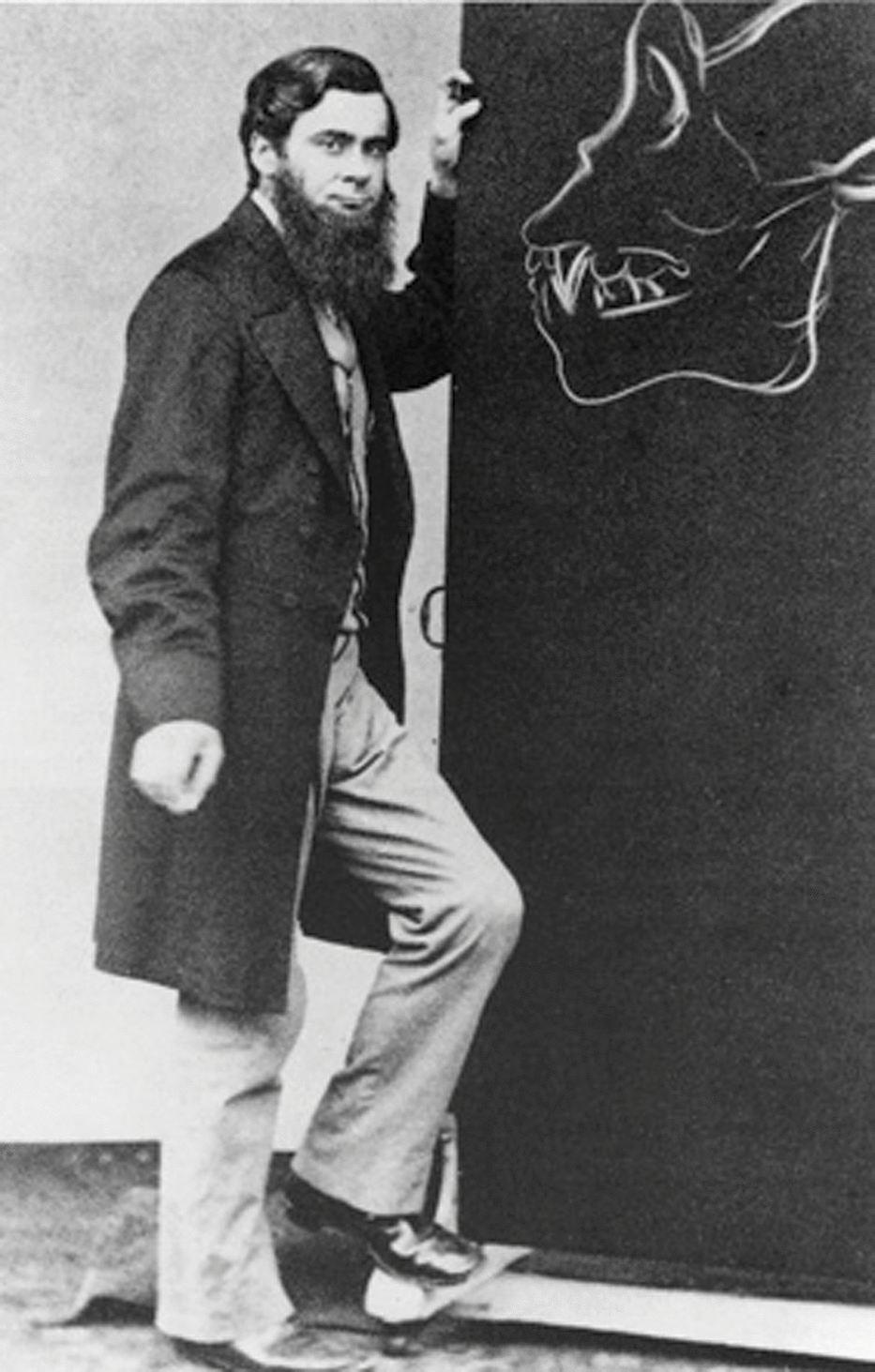
Surely for Huxley such a possibility represents the ideal scientific perspective. If humans could only imagine themselves as taxonomists from another planet; if we could only see ourselves in the “erect and featherless biped” enclosed within those quotation marks. Yet, as this essay attempts to show, Huxley recognized the difficulty of adopting such a perspective. In order to bring his reader face to face with those “blurred copies of himself,” Huxley needed to appeal to his pathos as well as his logos. By transforming the monstrous gorillas of Du Chaillu into the fiercely maternal apes of Man's Place in Nature, he eases the reader's journey into this new and unfamiliar place (Figure 18).
Photography of Thomas Henry Huxley with a sketch of a gorilla. c. 1870.