Introduction
Peter Maxwell Davies' Mr Emmet Takes a Walk is a study of the mind of a suicide. Emmet's mind betrays him and leads him inexorably towards the act of self destruction, but as the opera progresses it becomes open to question whether Emmet is entirely the agent of his own fate or is being driven by forces he feels he cannot control. In the process, the work confronts the listener with the means by which an individual can reach a strange normalization of the violent act of suicide, in part by exploring the tensions that exist between Emmet's relationships with people and his relationship with music.
The role of shared cultural values in shoring up an individual's sense of self is implicit in Mr Emmet in ways that exploit one of Davies' trademark compositional strategies: use of quotation. This is not the first time Davies has used musical quotation to underscore questions about a character's mental stability, of course. Ruud Welten asserts that in Eight Songs for a Mad King ‘the loss of [the king's] subjectivity is manifested in the juxtapositions of quotations from different musical traditions and in the collapse of univocal expression’; and while the ‘musical traditions’ which underlie the musical cross-references in Mr Emmet Takes a Walk are not as diverse as they are in Eight Songs, Davies utilises quotation to much the same effect in articulating Emmet's breakdown of subjectivity.Footnote 1
For Mr Emmet to succeed on an emotional level we (as audience) have to collude with his preparations for suicide. This demands that we must also be ‘prepared’: we need to know the significance of the musical gestures derived from the quoted musical sources that Davies uses. While these sources might not always be immediately identifiable in the work (only two are named in the libretto), the very clear tonal basis that they provide and the resulting increase in accessibility of Davies' musical idiom invites us to enter Emmet's world through musical objects that may resonate with our previous musical experiences. As the opera progresses we come to recognise these musical gestures through Davies's deployment of them. In this way the composer invites us to engage more directly with the main character, and in so doing to confront our own notions and assumptions about suicide. Thus, only when we are prepared will the significance of Emmet's musical journey to his death be entirely understood. How Davies effects that preparation for both Emmet and the audience is the subject of this article.
Background to the opera
Mr Emmet Takes a Walk was written in 1999 for performance by the contemporary music group Psappha at the 2000 St Magnus Festival in Orkney. It was a joint commission of the St Magnus Festival, Psappha and Muziektheater Transparant. In terms of plot, the work takes us through what is ostensibly Mr Emmet's last walk, leading up to his suicide, and it gradually becomes clear that the other ‘characters’ in this opera might be as much projections of his troubled psyche as ‘real’ people whom he has actually encountered. As the opera proceeds it becomes increasingly apparent that Emmet's mind betrays him.
The work received a rather mixed response from critics, being described on the one hand as ‘purposeful, fluent and well-made … persistently and … enduringly haunting’,Footnote 2 and on the other as ‘creepily well-mannered … well-calculated if melodically anonymous’. ‘They [Mr Emmet and Eight Songs for a Mad King] don't burn with the conviction of his successful opera The Lighthouse’.Footnote 3 At the time the composer declared categorically: ‘This will be my last music-theatre work’.Footnote 4 In the context of that stated intention, there are elements of his approach to the work that represent a pulling-together of some of the preoccupations of the past, but, typically for Davies, as we shall see, these are reconfigured to accommodate the particular nature of the drama as it unfolds. The choice of topic for his ‘last’ music theatre work might also be significant from a symbolic point of view: given his love of metaphor, Davies perhaps thought of the work as ‘killing off’ his connection with music theatre.
Most significantly, Mr Emmet engages with two broad themes explored in Davies' music theatre works written between 1965 and 1999: madness and betrayal. Indeed, betrayal as a concept looms large in many of his works, particularly those of the 1960s and 1970s – supremely, Taverner, but also in non-theatrical works such as Black Pentecost and the Yellow Cake Review. In Davies' works, betrayal is not just effected by external agents; it can also be the mind of the individual that betrays. So it is in Eight Songs for a Mad King, where the King views himself as betrayed by his people and by his advisers, although in the end he is betrayed by his own mind which allows him to declare finally that ‘the King is dead’. In The Lighthouse the three lighthouse keepers apparently go mad from the isolation. Blighted by their own fevered imaginations they come to believe that external forces generated by their past lives are seeking them out to destroy them, although ultimately whether they collectively commit suicide by drowning or are killed by the relief crew is kept vague. Although betrayed initially at the altar, it is Miss Donnithorne's mind which betrays her by freezing that moment in time and leading her to madness and finally to implied death offstage. However, none of these works in which the mind has betrayed the individual culminate in a planned suicide, as is the case in Mr Emmet. It is perhaps in The Martyrdom of St Magnus, written in 1977, that Davies came nearest to exploring the process leading to self-sacrifice, since martyrdom might be considered a form of suicide. There, as in Mr Emmet, outside ‘forces’ seem to play a role: the external pressure operating on Magnus is his sense of what is ‘best’ for his people, although the actual driving force is the naked ambition of Earl Håkon. In Mr Emmet, although the title character is undoubtedly betrayed by his mind, the dream-like ambiguity of the libretto allows the audience (like Emmet himself) to project other forms of betrayal, as we shall see.
The thematic elements of madness (or mental instability) and betrayal are linked to Davies' use of musical process. In formal terms, the score labels Mr Emmet Takes a Walk as a ‘Dramatic Sonata’, and one might be forgiven for believing that this implied form was an example of what Whittall has referred to as the classicizing aspect of Davies' musical personality.Footnote 5 However, in the course of an interview that accompanies the CD of the work, Davies revealed to Paul Driver that the musical structuring was actually dictated by librettist David Pountney.Footnote 6 Davies' adaptation of Pountney's use of the formal archetype ‘Sonata’ suggests that a certain hierarchical organising principle will be found at work in the musical argument. But while such an organising principle might suit Davies' ‘classicizing tendency’, there is rather more to be understood about why and how he manipulates the various aspects of this formal structure. Davies' manipulation (and undermining) of sonata form's conventions express the idea of betrayal, both in his use of unusual subgenres (the exposition deploys operatic forms such as trio, recitative, and arioso in place of first and second subjects), and in the reappearance of the introduction within the development, rather than in the recapitulation. Davies takes the formal idea as a framework to express the persistence of the past within the present, and to convey the sense of the action coming back full circle to its starting point.Footnote 7 (Indeed, the form may have appealed to Davies' penchant for allusion and irony: it is not unlikely that recapitulation, in its meaning of ‘back to the head’, forces us to focus on Emmet's head, which he is shortly to lose.) Thus, Davies used Pountney's original conception of traditional sonata form as a structuring device to articulate relationships between events and characters, as will be discussed in due course.Footnote 8
The sonata's structure, as labelled in the score, can be described as follows:
The Exposition is in five sections: Introduction (a musical representation of Emmet's last walk); Duet; Recit.; Arioso; Cabaletta; Trio.
The Development (entitled Development – Encounters) takes the form of a series of alternating episodes and interludes: Episode 1 – The Piano, Interlude 1; Episode 2 – The Park, Interlude 2; Episode 3 – The Hotel Room, Interlude 3; Episode 4 – The Mountain, Interlude 4; Episode 5 – The Teacher, followed by the Torch Song, Interlude 5.
There follows the Recapitulation as ‘a Monologue’, and the Coda.
The instrumental Introduction presents most of the thematic ideas which will be developed in the course of the work. Taking his cue from references in Pountney's libretto, Davies generated his thematic material from quotations from works by Bach, Mozart, Schumann and Gabrieli, which are used to initiate recollection ‘of the cultural background not only of Emmet himself but also, I think, of all of us’.Footnote 9 The Introduction, marked ‘alla marcia funebre’, intermingles musical material borrowed from these four composers and is cut into by the pre-recorded sound of a train passing across the performing area, horn blaring.Footnote 10 The train horn will only be heard again in this way at the end, after Emmet's suicide has taken place. The two train events therefore act as a framing device within which the narrative evolves.Footnote 11 Davies has remarked that the ‘figure of the train horn … is worked upon and used in the music in all sorts of places’, and in their discussion Driver and Davies draw a parallel with the composer's use of the offstage horn in The Lighthouse, which at first acts as the fog warning siren but latterly comes to represent the cry of the beast.Footnote 12 It is Driver who refers to this particular idea (appropriately for the work's nominal form) as ‘coming full circle’.Footnote 13
The opening Duet introduces Ka and Todd, ostensibly cleaners working in a railway station. However, as the action progresses it appears that these two are just one representation of the ‘male’ and ‘female’ characters who interact with Emmet during the course of the drama. Emmet enters for the first time in the Recitative which precedes the arioso, his first words, ‘Am I lost’, setting the context for what is to come. It becomes clear that Emmet is there to finalise some kind of contract in relation to industrial cleaning equipment designed to facilitate ‘long-term progress’.
In the Development section, which is organised into five Episodes, Emmet has a series of encounters with individuals who, for the most part, appear to be connected either to his past or to the progress of the contract, although as the work develops these individuals are perceived to be symbolic. In the first Episode – The Piano – we learn that Emmet is to meet with Mr Gabor at a café in the park in order to finalise the contract, and he also encounters a Security Guard who interrogates him as to the contents of his briefcase. Episode 2 – The Park – begins with Emmet meeting The Woman as a result of an advert, and as the Episode proceeds we are made increasingly aware that the encounter is emotionally unsatisfying. In Episode 3 – The Hotel Room – Emmet is waiting in an increasingly hot and stifling hotel room to hear about the contract from Mr Gabor. The Episode concludes with a visit to the room by what the score labels the ‘ominous’ figure of the Heating Engineer. In Episode 4 – The Mountain – Emmet finds himself on a Mountain struggling to reach the top and meets the Old Crone whom he subsequently calls Mother. Episode 5 – The Teacher/The Torch Song – begins with the ‘remembrance’ of a piano lesson and a demanding piano teacher and leads on to a cabaret scene where Emmet accompanies the cabaret singer Varoomschka who sings a Love/Death song. Emmet finally meets Mr Gabor at a celebration in Emmet's honour. Each of the Episodes is followed by a spoken interlude in which Emmet makes lists, usually of ‘things to do’.
The short Recapitulation is a Monologue by Emmet, which offers a ‘recapitulation’ inasmuch as the theme which represents Emmet returns in its most fully developed form, and the musical accompaniments reference the Bach and Schumann quotations that have permeated the work: here Emmet reaches the final moments of his walk and reflects on the arrangements he has made for what he is about to do. Following the train horn, which signifies the suicide that has taken place, there is a short Coda in which the cleaners Ka and Todd consider that it is ‘not every day that someone takes the trouble to make friends with death’.
It is the mind that betrays …
At its best, musical theatre challenges perceptions of how the world is for individuals or groups, and it can interrogate society's prevailing attitudes. The 1960s was a particularly fertile period for artists of all genres to engage in the discussion of fundamental human and political values. Works such as Henze's Essay on Pigs (1968) and The Long Laborious Road to the House of Natasha Ungeheuer (1971), Davies' Missa Super L'homme Armé (1968) and Eight Songs for a Mad King (1969) did just that. When it was first performed in 1969, Eight Songs was considered to be, in Alan William's words, ‘radical in both its attitude to musical tradition and in its representation of madness’.Footnote 14 As a work of art, it contributed to the lively and impassioned debate taking place at that time concerning society's treatment of madness and lunacy. Davies' Eight Songs engaged in a musical critique of society's attitude to the condition, and as result it gained a degree of notoriety that persists to the present time.
If Mr Emmet picks up some persistent themes in Davies' oeuvre, how might it be seen to engage with the social critique that has also been a feature of Davies' work? In choosing the subject of suicide, Pountney and Davies certainly hit on a theme that would resonate with modern society, albeit uneasily: if the statistics are to be believed, anything between ‘40 and 80 per cent of the population’ has, at some point, entertained suicidal thoughts, so Mr Emmet's situation might be uncomfortably close to reality.Footnote 15 Davies calls Emmet a ‘modern everyman’, demonstrating his understanding of the potential for the character's identity to touch a nerve with the audiences.Footnote 16
A desire to retain both the audience's sympathy and a ‘shock value’ might explain why Pountney and Davies never make absolutely clear what Emmet's intentions actually are until the end of the work – there are no apparent ‘suicidal thoughts’, and life for Emmet has the appearance of normality. But aspects of Emmet's behaviour do suggest the opera's creators' careful consideration of the habits of mind of a suicide. An attention to detail is, perhaps, one such habit. Michel Foucault described suicide as an act of ‘limitless pleasure whose patient preparation, with neither rest nor predetermination, will illuminate the entirety of your life’.Footnote 17 In a 1979 essay he wrote that suicide was ‘the simplest of pleasures’, and that one ought to prepare for the act of suicide ‘bit by bit, decorate it, arrange the details, find the ingredients, imagine it, choose it, get advice on it, shave it into a work without spectators, one which exists only for oneself, just for that shortest little moment of life’.Footnote 18 In Mr Emmet echoes of these sentiments are heard most obviously in Pountney's libretto through the lists of things to do which punctuate the Development section, and particularly in the arrangements which Emmet details in the Recapitulation as he approaches the suicide.
Emmet also seems to fit a more traditional definition of suicide. Classifications of types and reasons for suicide are still founded on the work of the nineteenth-century sociologist Émile Durkheim. His four categories of suicide continue to be referenced today: anomic suicide, produced through anomie or normlessness, occurring, for example, when there is a sudden change in a person's relationship with society, a mismatch between personally held values and those of either society or a controlling group; egoistic suicide, when an individual becomes focused on him- or herself and loses connection or ties with normal social groupings; altruistic suicide, caused by individuality too integrated into social groupings, for example, where feeling for the ‘common good’ outweighs personal survival instincts; and fatalistic suicide, which is ‘the end result of excessive regulation or intensive coercion’.Footnote 19
In The Martyrdom of St Magnus, Magnus, in giving himself up for martyrdom, sacrifices himself in what in Durkheim's terms might effectively be thought of as a form of ‘altruistic’ suicide, as the force working on him is the sense of ‘what is right’ for his people, although there is also the suggestion of a divine agent operating. Emmet's act, on the other hand, is undoubtedly ‘egoistic’ self-destruction: no one gains by Emmet's suicide, and it appears that the audience is left to bear the burden, as Foucault said, of seeing ‘suicide as nothing but superficial traces, solitude, awkwardness, and unanswered cries. These people can't help but ask “why?”: the only question about death that shouldn't be asked’.Footnote 20
For all their attention to the psychological plausibility of their protagonist's behaviour, Pountney and Davies also explore their subject in more ‘operatic’ fashion (though this too has elements of psychological credibility). In earlier operas, fate is often utilised as a catalyst for the plot, whether in the deus ex machina of the seventeenth and eighteenth centuries or the pathetic fallacy of the nineteenth.Footnote 21 The operatic canon is replete with examples of suicides, usually female, contributing to Catherine Clément's view of opera as ‘the undoing of women’.Footnote 22 The list of male suicides, although fewer in number, includes Ernani, Edgardo (Lucia di Lammermoor), Werther (Massenet), Samson, and Wozzeck. Almost all the suicides in opera are the direct result of some external pressure operating on the individual throughout the course of the work: inconsolable grief, a solemn pledge, unrequited love, dishonour.
It is perhaps surprising, given the attention to psychological plausibility, that old-fashioned fate or the role of an external force should also be important in this opera, but both librettist and composer invoke the idea in various ways. As rational, non-suicidal individuals, we might well wish to ascribe everything to the mind betraying itself, and, as I suggested at the outset, this is a central message of the opera, but Pountney and Davies have also implied that Emmet's mind may be being directed by something beyond him. In his programme note, Pountney asserts that the work was conceived as:
a cross between a black comedy, a thriller and a psychological study, the baritone sings the part of Mr Emmet, whilst the other two singers take a multitude of roles, but turn out to represent the same figure or, one might say, force.Footnote 23
Pountney's libretto suggests that different forces are working upon Emmet's mind. Often these take human shape, specifically in the form of the different characters Emmet encounters. But these forces are also more general: ‘Society’ pressures him to conform and to succeed, and then there is the rather darker suggestion of his pursuit of a contract with death.
Davies was clearly happy to reinforce this interpretation when, as a response to Paul Driver, he asserts that the suicide is ‘pre-ordained’.Footnote 24 And music also plays a role in this fatalist narrative. Throughout the work, Pountney and Davies imply that it is in music that Emmet roots himself: it is only music that offers him consolation. The omnipresence of music in Emmet's life is expressed through the use of musical quotations throughout the work, and through the identification of Emmet and his unseen mother with the cello and piano respectively. At the climax of the work music also ‘betrays’ Emmet and becomes the force which impels him towards his suicide – symbolised by the cello accompanying him onstage during his final walk.Footnote 25
Of course, as mentioned above, the role of fate is also a theme for Davies in other works, such as The Martyrdom of St Magnus, since Magnus feels impelled to submit to his inevitable fate, and in The Lighthouse, where the lighthouse keepers' individual past lives catch up with them. Davies has always sought to express such ideas through musical means in order to amplify the libretto, and often through the specific use of quotations from musical source material. Indeed, Davies' use of musical quotation has never been gratuitous – there is always a point to the inclusion of borrowed material in his works. As I will show in the next section, Davies uses specific musical devices in Mr Emmet Takes a Walk to suggest more about Emmet's mental state and the ‘mind games [that he plays] with himself’ in ‘his terrible predicament’; he also uses devices, and in particular a fate motif, to express the inevitability of Emmet's suicide.Footnote 26 Emmet's relationships with people are shown to have broken down and even though his relationship with music (expressed in part through the quotations) appears to be constant, the fate motif will suggest otherwise.
Kaleidoscopic musical quotation
Davies' programme note states that initially he conceived the work as an exploration of that split-second ‘out-of-time-moment’ when one sees one's life ‘pass before one's eyes’, but that during composition different interpretations began to be suggested. As mentioned earlier, Davies borrowed material from four specific composers and worked the quotations into the fabric of the musical texture to suggest thoughts passing through Emmet's mind as he contemplates suicide, implying an apparently constant relationship with music itself, while also suggesting Emmet's inability to create satisfactory (human) relationships. Davies gives no indication of what the alternate readings of the portrayed events might be, leaving that for the audience to decide, but in his programme note he uses the metaphor of a ‘kaleidoscope’, which creates the notion of fragments of different shapes or ideas temporarily joined to make a pattern before dissolving only to create another pattern. This metaphor then appears to colour the way in which he describes the use of different source quotations in the work: instruments ‘assemble’ the Bach F minor Prelude in a ‘blurred focus’; the Bach ‘twists’ easily into Mozart and Schumann; the quotations … ‘grow from one into the other’, ‘assembled out of basic common rhythmic and intervallic material’.Footnote 27
In earlier music theatre works Davies deliberately confronted the audience with musical objects which, while familiar in musical content and/or in style, frequently pastiched or parodied originals such that the frames of reference evoked by the musical ideas created an unsettling and sometimes disturbing disjuncture between the ‘serious’ musical argument and the parodied/pastiched material. The blatant juxtaposition of opposing styles was deliberately intended, on one level, to disorientate the audience, and produce a strong reaction.Footnote 28 Such was, and still is, the case with respect to the Handel pastiche/parodies in Eight Songs, the Victorian ballad-type songs in The Lighthouse, and the pop music take-offs in Resurrection. In his non-music-theatre works perhaps the most striking example of the idea is found in St Thomas Wake: Foxtrot for Orchestra (1969).
In his later works Davies moved away from this aggressive juxtaposition of styles towards a more embedded, pan-tonal approach to the integration of materials. The fifth and sixth symphonies both use pre-existing tonal works by Davies himself as source material, in addition to his typical plainsong-related, serially-derived workings, while Job and The Jacobite Rising, which also integrate borrowed material, were written in an extended tonal idiom, as is Mr Emmet Takes a Walk.Footnote 29 In his programme note for Mr Emmet Davies wrote:
… there is no stylistic purity in Mr. Emmet: the musical styles change as the texts suggests [sic.]. As in all my music-theatre works, some of the music is emphatically tonal, with very obvious key centres, I trust giving clarity by defining points along the line of argument.Footnote 30
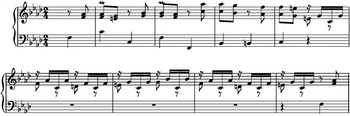
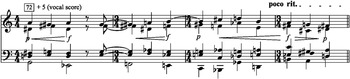
In Mr Emmet, the musical antecedent material is so well integrated into the whole that it takes a musically well-educated listener to unpick some of the quotations in the texture, still more to interpret their significance. The use of embedded musical references, while clearly arising in part from indications found in the libretto, creates problems in reading ‘meaning’ into the musical text, even when (and perhaps especially when) the actual sources are known. This is because it becomes clear that, while borrowed motifs are chosen for their dramatic symbolism, they might also be selected through an associative process in musical terms. The direct allusions in Pountney's libretto to Bach and Schumann defined the source composers but not the exact works that might be referenced. The choice of the F-tonality Prelude from Book Two of Das Wohltemperierte Klavier, which provides the most distinctive and recurrent motif, may have been conditioned by the Mozart and Schumann fragments, which both begin on that pitch.Footnote 31 The quoted extracts from the Prelude are quite clearly stated on the piano just towards the end of the Trio, the final section of the Exposition, when Emmet announces ‘I have to go’, much to the relief of Ka and Todd (Ex. 1). The score indicates that the piano is to be remotely operated in some way so that it appears to play by itself: a ‘triggered’ memory, in effect.Footnote 32 If the choice of the Prelude in F was in part prompted by the Mozart and Schumann quotations, it is also made to carry its own symbolic weight. Davies often couches ideas in terms of musical metaphors. The ‘walking bass’ of the Prelude is used to represent Emmet's ‘actual’ walk with which the work begins. As the opera progresses it becomes apparent that the piano carries multiple layers of significance, which I will explore later, and the reasons for Davies' choice of a Bach Prelude (and its partner Fugue) then become more obvious.
Bach, Prelude in F minor, Das Wohltemperierte Klavier, Book 2

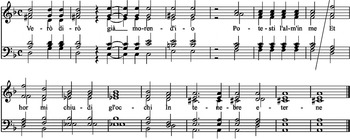
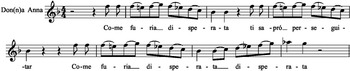
The other quotations have clearer associations. The Andrea Gabrieli quotation, according to Davies, was suggested by the text of the final chorus of that composer's music for Edipo tiranno (1585) ‘and now I close my eyes in eternal darkness’ (‘Et hor mi chiudi gl'occhi in tenebre eterne’) (Ex. 2) and Davies may well be suggesting an obsessional relationship with his mother on Emmet's part, as we will see.Footnote 33 The Mozart reference is a quotation from one of Donna Anna's retorts to Don Giovanni in the opening scene of that opera: ‘like a desperate Fury I will know how to pursue you’ (‘Come furia disperata ti sapró perseguitar’) (Ex. 3). Throughout the work, Fate is therefore given expression by Davies' use of the Mozart both in its original tonal form and in chromatically altered versions. The walking bass of the Bach might also be interpreted as the past stalking Emmet, and can therefore be related to the use of the Mozartean ‘fate’ motif. Pountney's idea of an external ‘force’ has thus been interpreted musically by Davies in part through his integration into the texture of this ‘external power’ motif, the unnamed ‘fury’ becoming part of Emmet's journey to extinction.
Gabrieli, Edipo Tiranno, choro quarto (bars 239–267)

Mozart, Don Giovanni, Act I, scene 1

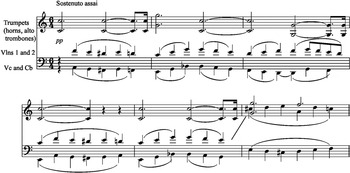
The fourth tonal resource that Davies uses is derived from Schumann's second symphony, written at a time of mental depression between 1845 and 1846, which illness delayed its completion by some months. Davies' choice of this particular work might have been connected to his knowledge of the circumstances of its composition. He may have chosen the quotation itself because of similarities in detail to the Mozart excerpt, particularly in the quaver movement, which twists round on itself with chromatic inflexions (Ex. 4). The principal link between the Mozart and the Schumann is specifically the descending scale (Mozart, bar 23; Schumann 35) and its use may be read as having the effect of reinforcing the idea that Fate is ‘all-pervasive’. The motif itself is also ambiguous in that the brass instruments sound a clear tonic-dominant motif, which is contradicted by the chromatic writing in the strings. The effect is one of tonal confusion and this may also have been an important factor in Davies' choice of extract.
Schumann, opening of Symphony no. 2

Davies' use of quoted musical sources fulfils a double function. By coming ‘to the surface’ from time to time, they emphasise the importance of music to Mr Emmet. At the same time, they also serve to prefigure his ‘inevitable’ fate, and, as I will shortly explore, they are the agents through which his final ‘betrayal’ is effected. Thus the quoted material suggests symbolic (semiotic) meaning for key points in the unfolding drama and in the following sections I discuss some of the ways in which such meaning is evoked, particularly through the instrumental commentaries on the sung texts, as well as by some aspects of the vocal setting.
The ‘Emmet Theme’
The composer's programme notes often contain material germane to an understanding of a particular work, and those for Mr Emmet are no exception. In his note, Davies amplifies his statement that his is ‘only one interpretation’ of the events by adding that ‘the text revealed, in the course of composition, a criss-crossing of reality, dream and waking fantasy’, so that it is unclear in the action whether Emmet's encounters are real, the product of his unconscious mind, or creations of his imagination.Footnote 34 Because the opera as a whole represents Emmet's thoughts during his last walk, the various meetings and interactions between Emmet and other characters in the opera are not necessarily to be taken literally. These encounters may represent flashbacks to real meetings that took place, but if they were not real meetings then perhaps the characters are products of Emmet's unconscious, symbolising his fears, anxieties or insecurities. However, they could also be fantasies, wished-for but never realised events (for example, a contract never concluded, a relationship with a woman never realised). Davies and Pountney deliberately switch between these three frames of reference (real, the unconscious symbolic, imaginary) to obfuscate a linear interpretation of the events. Emmet's encounter with The Woman might be real (Episode 2 – the Park), with the Old Crone he calls ‘mother’, imaginary (Episode 4 – The Mountain), and the Heating Engineer in the hotel room (Episode 3 – Hotel room) symbolic. But each could be something else – an imaginary Woman, a symbolic Crone, a real Heating Engineer.
The dramatic and theatrical representation of the other characters in the opera is crucial to that obfuscation, and to music's role in fusing the ‘real’ with the symbolic. In the Exposition, apart from Emmet, the only characters to appear are the cleaners Ka and Todd. These two individuals become all the other characters encountered in the Development section. In fact, all the characters, bar one, that Emmet encounters in the Development section are unnamed: they are archetypal figures. Even Varoomschka, the cabaret singer whom Emmet accompanies on the piano in the final Episode of the Development, and who appears to have a specific identity, turns out to be named after a cartoon character of the 1970s created by John Kent, whose eponymous strip in The Guardian satirised contemporary political issues by putting awkward questions into the mouth of the clichéd naïve blonde.Footnote 35 She is thus also a ‘type’ rather than an individual. The only character in the Development who has an identity designated by surname is Mr. Gabor.Footnote 36 Although Emmet apparently has a conversation with him on the telephone, the only time he appears is at the end of the Development when he arrives with the contract. Even at this point his exact identity is unclear: he could in fact be Todd the cleaner, or perhaps he is the Devil (the Faustian overtones of the contract then become obvious), and thus not real but symbolic.
Emmet himself first appears at the end of the second section of the Exposition, the duet between the cleaners Ka and Todd. In a passage that Davies terms Recit., Ka and Todd stop dancing when they notice Emmet, and Ka tells him: ‘This is a security area’. Thereafter, his first three responses each emphasise a minor third (or its inversion), which will become an important interval in the thematic idea that Davies generates to accompany significant points in Emmet's narrative (Ex. 5).Footnote 37 The pitch sequence C, A, G recurs several times in this Recitative (‘I thought you’, ‘I agree’) and these same pitches reappear later in the Exposition, at the beginning of the Trio when Ka and Todd discuss the character of Emmet between themselves.
Emmet's first entrance (in the Recit. At the end of the Duet – Exposition no. 2)Footnote 38

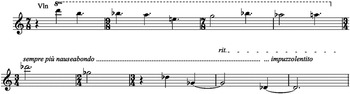
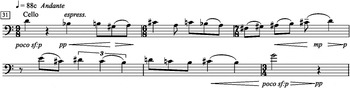
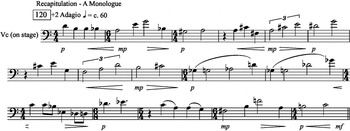
Emmet's first ‘solo’ at the beginning of the Arioso, seen in the context of the Sonata Exposition, could be construed as occurring at the point of the ‘weaker’ second subject, thus acting as a signifier for an interpretation of his character (Ex. 6). This seems a likely interpretation since Emmet's starting pitch of B acts as a quasi-dominant to the opening of the work, based around F; Davies often uses the tritone relationship to express what might be termed a ‘natural’ dominant.Footnote 39 The pitch sequence in Ex. 6 is significant, as it becomes the basis of the thematic idea that eventually evolves into the ‘Emmet theme’; but here is simply a descending, largely chromatic, sequence of pitches under an inverted D pedal. The interval sequence on the phrase ‘who I am’ (dropping min third/rising minor seventh) is the same as that heard earlier when Emmet, on his first entrance, says: ‘I'm here on business’ (Ex. 5). A clear indication of its motivic importance occurs in the Trio that concludes the Exposition. As Todd and Ka discuss what they think of Emmet, the violin plays the same pitch collection as Ex. 5 (D, E, G, A♭, A, B♭, B) and the passage concludes with a series of quasi dominant/tonic descents, (D♭, G♭), probably derived from the brass idea at the opening of Schumann's second symphony (Ex. 7, compare with Ex. 4). The violinist is asked to perform this ‘sempre più nauseabondo … impuzzolentito’ (always more nauseating … stunk out (polluted)): a strange instruction to the player, and one probably imperceptible to the listener. (Is this a suggestion of Todd and Ka's dislike of Emmet, or of the onset of death already? Is Emmet already decaying even though still alive? In live performance should this be made obvious to the audience, and if so, how?) Emmet's ‘theme’ subsequently recurs in several places and is significantly extended in Episode 1 – The Piano (Ex. 8), and in Episode 4 – The Mountain, where he encounters the Old Crone. The final appearance of the ‘Emmet theme’ occurs as a cello accompaniment to his Monologue in the short Recapitulation that charts his walk to suicide. By this point it is clear that the cello is symbolic of Emmet himself – he wants ‘a good home for it’ (Episode 5) – and at the end of the work the closed piano and black cello case are all that remain, but both instruments are now mute, a point to which we will return. In the Recapitulation, Emmet's theme is developed to include unambiguous tonal triads, suggesting perhaps through a kind of clichéd musical resolution both that he has ‘become one’ with his recurrent ‘theme’ and that he has accepted his fate (Ex. 9).
Emmet's first solo – the Arioso (Exposition no. 3)

Violin ‘commentary’ on ‘Emmet theme’ in the Trio – Exposition no. 5

Development Episode 1 – The Piano: cello part developing ‘Emmet theme’

Emmet's final journey – Recapitulation – A Monologue: ‘Emmet's theme’

Kaleidoscopic formal construction
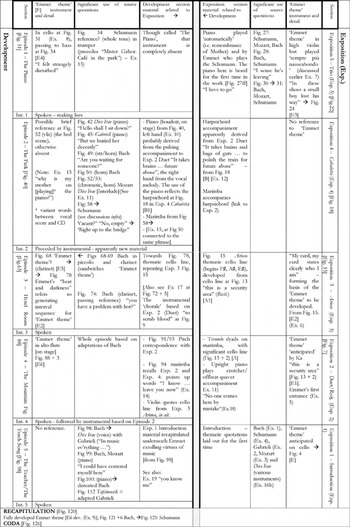
Just as the kaleidoscope forms an apt metaphor for Davies' treatment of thematic material, so its refraction of the same material in different guises can be seen in formal terms. I mentioned above Davies' exploitation of sonata form characteristics to express the persistence of the past within the present, and perhaps his eye to the punning irony of the notion of ‘recapitulation’ in its emphasis on return to ‘the head’. More specifically, an examination of the score shows that Davies constructs the Development section so as to return the action to where it started. It can be read structurally in two ways: first as a means of further elaborating the ‘Emmet theme’ (see Exx. 6–9), taking it from the Exposition towards its complete expression in the Recapitulation; and second, as an elaborate, but perceivable, structural retrograde leading towards the same point. This dualism is expressed in Table 1, which also shows how the borrowed sources are embedded in each section. It is read from bottom right upward and in an arch shape down to bottom left.
Exposition and Development – MrEmmet Takes a Walk
[Key: Emmet theme (E1–6); A and B represent structural thematic ideas with local importance]

The five sections of the Development parallel, in reverse order, those of the Exposition, not with direct repetition but through the use of shared material or instrumentation. Thus by the end of the Development section the narrative has been brought back to its starting point, as though everything has happened in that moment when ‘one's life passes before one's eyes’. The Recapitulation thereafter functions not as a ‘return’ but as the continuation of the narrative to the final inescapable conclusion. Emmet's ‘progress’ is expressed by the developing thematic references associated with him, usually found on the cello, leading towards their fullest form in the Recapitulation.
It is worth saying a little more about the importance of particular instruments in Mr Emmet, as instrumentation plays a significant part in signalling the Development's palindromic structure.Footnote 40 In conversation with Paul Driver, Davies said that he wanted to suggest that the ‘players are perhaps working inside Emmet's head as memories, as stimuli, but very much as live characters…’.Footnote 41 The cello then is almost certainly to be identified with Emmet himself as it often carries material related to the Emmet theme (see Ex. 5 and Table 1), and the piano with ‘Mother’, as will be explored later. The alto flute, which joins Emmet and the Old Crone (whom he later calls Mother) in Episode 4 of the Development, may be a sort of neutral ‘bridge’ joining the two characters. Episode 5 brings players onto the stage to play the Tafelmusik, which accompanies the final part of the Development section, taking them into the heart of the action – the embodiment, as it were, of music itself in Emmet's mind.Footnote 42
After the Introduction, in which all the musical references that will be used in the course of the work are presented, none is heard in identifiable form again until the Trio, the fifth and last section of the Exposition. From Exposition 2 (Duet) to Exposition 4 (Arioso) the focus is instead on the initial development of the character of Emmet and the thematic material associated with him. In addition, the importance of the cello is established through various thematic ideas not directly relatable to Emmet at this point, but suggesting a significant function for the instrument, as previously discussed.
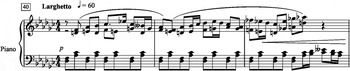
As significant as the cello are the keyboard instruments, especially the piano. In the opening Duet the piano plays a crotchet/offbeat-quaver rhythm accompaniment to the duet between Ka and Todd, creating a quaver pulsation that will recur at various key points (for example Fig. 40 in Development Episode 2), making an aural reference point (Ex. 10). The piano's second appearance, playing ‘automatically’ in Exposition 5 (Trio), coincides with the first clear statement of the Bach, Mozart and Schumann since the Introduction. Episode 1 of the Development is entitled The Piano, but the title is (deliberately) misleading since the piano does not play at all in the Episode. Rather, it begins Episode 2 with a solo. The piano's absence in Episode 1 is formally significant because the palindromic structure would lead us to expect it here. One interpretation of its absence may be because the instrument is connected to Emmet's mother – we will shortly learn that his mother played it. As the opera proceeds, it becomes clear that his mother is already dead, so that the absence of the piano in Episode 1 may represent her absence symbolically in Emmet's mind, or it may simply be a metaphor for death. It also serves as a premonition of Emmet's abandonment by music that is developed later in the work.
Mr Emmet – Pulsing accompaniment with adapted duet melody from Exposition 2, on piano

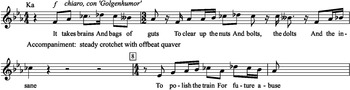
In Episode 3, as Emmet becomes more agitated in the heat of the hotel room, the accompaniment from Fig. 72, first on strings then on electronic organ, makes an explicit reference back to Ka's and Todd's duet at the start of the work where they refer to scrubbing blood from a wall. The implication may be that this will have to be done after Emmet's suicide, although the allusion is rather oblique. However, a more explicit reference to Emmet's means of suicide appears in the material apparently related to the phrase ‘It takes brains…’, originally heard in Exposition 2 (Duet) at Fig. 7+3 (Ex. 11). This material recurs in highly varied form in Exposition 4 (Cabaletta) at Fig. 18 accompanied by marimba (Ex. 12). At its third incarnation, in Episode 2 of the Development (at Figs. 43–44), it begins to take on associations with death. Emmet asks The Woman ‘Why is my mother on the piano?’ in ascending minor thirds (the generating Emmet interval) (Ex. 13) and the ensuing conversation points towards emotional repression associated with his mother and perhaps with her death:
Emmet: Why is my mother on the piano?Footnote 43
Woman: Refreshing her memories.
Emmet: But we buried her decently.
Woman: Of course. But you couldn't bury the piano.
Emmet: We buried everything, year after year.
Mr Emmet – Ka's line from Exposition 2, Duet: ‘It takes brains …’

Mr Emmet – Harpsichord right hand line at Fig. 18 in Exposition 4 (Cabaletta)

Mr Emmet – Development Episode 2: ‘Why is my mother on the piano?’

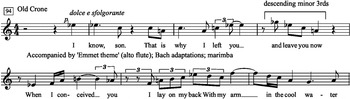
Hidden within the underlying musical texture are cross-references to the pulsing accompaniment of Exposition 2 (Figs 7–9), an adapted version of Ka's and Todd's melody, and the Dies Irae: all are implicit references either to a train or to death. Is ‘Mother’ suggesting Emmet's means of suicide, or has his mother's death set off the process in his mind that will lead to his own? These various links finally become explicitly connected with ‘Mother’ in Episode 4 of the Development, when the Old Crone's vocal line and accompaniment suggest multiple cross-references (as indicated in Table 1), both thematically and instrumentally to the Emmet theme and to material from the Exposition 2 Duet and Exposition 3 Arioso, culminating in her abandonment of Emmet with the words ‘I know son. That's why I left you, and leave you now’ on a descending sequence of minor thirds (Ex. 14).
Mr Emmet – the Old Crone leaves Emmet (Development Episode 4)

Some of the places where the borrowed musical material ‘comes to the surface’ have already been discussed, but in the context of the work as a whole the key sections for quotation are Episodes 2 and 5 of the Development, the first of these being associated with Emmet's relationship with The Woman and the latter with his relationship with Music. In Episode 2 we hear reference to all four of the quotations as well as the Dies Irae, while in the fifth Episode only the Schumann is missing (and it will return in the Recapitulation – Monologue). It is perhaps significant that the Bach is heard in every episode of the Development except the first (since the piano is missing from the first Episode it is not surprising that the Bach is also absent). In the Recapitulation it is the first of the quoted works to be heard again, albeit briefly, at five bars before Fig. 122 as Emmet hears Bach on the radio (‘Bach. I am very calm’).
As discussed earlier, Emmet's final walk, in the Recapitulation, is accompanied by the solo cellist, whom Davies instructs to share the stage with him, as the alto flute did in Episode 4. The thematic material is an extended elegy based on Emmet's opening statement about his identity (‘My card states clearly, clearly who I am. The relevant facts, the facts, the necessary items’) in the Exposition 3 Arioso (Exx 6–9), although, as the Table indicates, the cello first stated the prototype of this thematic idea in the Introduction (Exposition no. 1 Fig. 3+2→Fig. 4).Footnote 44 This concluding cello solo of the Recapitulation builds on the version first heard in Development Episode 1 (The Piano (Fig. 31)), accompanying Emmet's monologue there, but in pitch terms it is more directly developmental of the alto flute version in Episode 4. Despite the temporary importance of flute in Episode 4, the cello's important role throughout, either in carrying ‘Emmet's theme’ itself or in providing an essential bass (as in Exposition 3 Arioso/Episode 3, and in the ‘ground bass’ of Development Episode 3), suggests that it is to be equated with Emmet himself. The cello could be construed as Emmet's doppelgänger, his alter ego, his soul. The work ends with the walls opening out to reveal the piano with its lid shut and a black cello case on top of it. We do not know whether the case is the cello's (Emmet's?) coffin, or whether the cello is actually inside at all. Music is silenced, dead; its soul has departed.
Emmet's signs of trauma: six moments
The absence or silencing of music may be pointedly staged at the end of the opera, but Davies also marks its absence in vocal terms at points of crisis. Davies has never returned to the excesses of vocal text-expression that characterised the portrayal of King George in Eight Songs. However, there are certain vocal techniques that he has retained in order to indicate the emotional or mental state of the individual. The most common of these, Sprechstimme and upward glissando, often appear together. Davies uses the former for particular emphasis on text carrying intense emotion, and the latter for the expression of greater extremes of an emotional state, to indicate turmoil, fanaticism or intense mental agitation. In The Lighthouse, almost every phrase ending that Blazes sings, when images of his past misdeeds appear to haunt him – ‘there it is again, by the door,/hhh! It's only a heap of oilskins./No! It's getting up, rising from the floor!/It's coming here, it's moving in’– ends with an upward glissando.Footnote 45 Likewise, in The Martyrdom of St Magnus, Scene 6, when Håkon receives the heralds bringing three offers from Magnus, the last of which is his offer of martyrdom, he responds with upward glissandi on significant phrase endings: ‘this I refuse’, ‘he must come at once to the stone at the hillside’. As this is the only time Håkon is seen in the opera, the vocal setting suggests a degree of hysteria and anxiety in his personality. This is mirrored in the character of the Military Officer – also encountered only once (in Scene 8) and to be sung by the same individual who sings HåkonFootnote 46 – who Davies suggests through the use of both Sprechstimme and glissandi is similarly ‘out of control’, as he exclaims ‘hooks of your trade, in stainless steel’, ‘he is, after all … an animal, like other men’, and ‘put the noose around his throat’.
The use of such expressionistic writing in Mr Emmet is very sparing, suggesting that Davies does not want to paint the character as simply mentally disturbed, but rather to retain the possibility that his actions have a rational underpinning. This would be in keeping with current understanding of the mind of suicides, which proposes that there is a certain logic to the cognitive processes involved. Writing in their textbook, Abnormal Psychology, Gerald Davison and John Neale suggest that:
Many contemporary mental health professionals regard suicide in general as an individual's attempt at problem solving conducted under considerable stress and marked by consideration of a very narrow range of alternatives of which self-annihilation appears the most viable.Footnote 47
Nonetheless, Davies does display his trusted techniques in telling ways in this work. There are six places where Emmet's disturbed mental state is either exposed or suggested through the use of Sprechstimme and/or glissando; their musical contextualisation – and especially the use of quoted material – would seem to give particular weight to these moments as insights into Emmet's character and representations of his fate. It should be added that, in addition to these displays of emotion, there are five occasions when the disembodied voice (the thinking brain) of Emmet is heard – by way of prerecording – making lists of things to do. The ‘logic’ and lack of emotionality of this voice contrasts with the varying degrees of emotional turmoil displayed in the outbursts. Davies refers to these as Emmet's ‘guilt lists’ which he makes ‘to take his mind off the suicide’.Footnote 48 We will turn now to a discussion of the six expressions of Emmet's mental turmoil.
Outburst 1: ‘do you understand?’
The first outburst occurs at the end of the Trio (Exposition no. 5) with Ka and Todd, where, apoplectico, he cries in Sprechstimme with an upward glissando, ‘do you understand?’ [Fig. 27]. On the face of it this is a real enough situation: Emmet is talking with the cleaners about the inevitability of progress and is frustrated at their apparent inability to understand. It is followed immediately by a derived version of the ‘furia disperata’ motif (Ex. 3). While this could be a ‘real life’ conversation, the Mozart reference, itself decontextualised within the key (F minor) of the Bach prelude, suggests that Emmet is being driven not just by an overzealous work ethic but by a force beyond himself. Since it appears that he cannot communicate on any level with the two cleaners, the Trio represents one of the first clear indications in the work that he cannot form meaningful connections with others. His is (or will be) an egotistical suicide which is characterised by the feeling of being ‘alienated from others, cut off from the social supports that are important to keep [him] functioning adaptively as [a] social [being]’.Footnote 49 However, this schism between Emmet and others will only be fully perceived in retrospect after we have observed his relationships – or lack of them – with other people.
Outburst 2: ‘I am a little unbalanced’, ‘I must hurry’
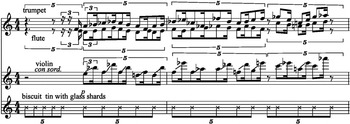
The second outburst occurs during Emmet's interaction with the waiter in The Park (Development Episode 2). Emmet declares ‘I am a little unbalanced’ – physically, but, by implication, mentally – and Sprechstimme is used at the phrase end, with an upwards glissando. Later in the same scene, Emmet says ‘I must hurry’, using upwards glissando [between Figs. 49 and 50 and at Fig. 52]. Once again this appears to be a ‘real’ encounter – that is, an encounter between Emmet and a real, if unnamed, person, in this case a ‘very formally dressed waiter’. The interaction is in two parts, the second being a repeat with elaborations of the first, framing Emmet's first meeting with The Woman and before the bedroom scene. The key phrase uttered by Emmet, ‘I am a little unbalanced’, is ostensibly a comment on the weight of the case he is carrying, but is also a metaphor for emotional instability (but not ‘madness’ as such, even though the word ‘unbalanced’ has that implication). At this point it is the derived versions of the Bach prelude which underpin the thematic references, but in the repeat from Fig. 50 they are overlaid with a nervous, erratic, quasi-tonal quintuplet hocket idea played on the flute, trumpet and violin, accompanied by a steady quintuplet quaver tattoo, beaten out on a biscuit tin filled with glass shards (Ex. 15).Footnote 50 Several musical metaphors for a lack of balance are being evoked here: the instrumentation has the flute at the bottom of the texture, rather than at the top, as might be expected; the quintuplet rhythm is ‘unbalanced’ in relation to the prevailing 4-crotchet metre heard in the lower instruments; the rhythm itself is discontinuous in these three pitched instruments and therefore unpredictable and out of balance. Taken together they imply agitation within the mind of Emmet and, combined with the scratching pianissimo undercurrent of the biscuit tin (calculated to set teeth on edge), perhaps makes this an example of what Davies referred to as the ‘criss-crossing of reality, dream and waking fantasy’.Footnote 51
Mr Emmet, Fig. 50, trumpet, flute, violin and percussion parts

Emmet's last Sprechstimme expression, ‘I must hurry’, leads into the Development's second orchestral interlude, which represents frantic sexual activity. Once more, the ‘furia disperata’ motif haunts Emmet in a chromatically distorted form on the horn (Fig. 52+4ff) and, as before, the Bach prelude motif underpins the texture. However, the Interlude (at Fig. 52) actually begins with an adapted version, on cello, of a quotation from the Dies Irae that was first heard in the bass during the Introduction (Fig. 1+6). This motif is further adapted to become the dominant melodic feature of the first part of this Interlude (it also includes a veiled reference to the Bach source in the falling triplet figure) (Examples 16a–d). This Interlude is a ‘little death’ in the Renaissance sense and, as in the Renaissance, it can also be interpreted as death stalking Emmet even at the time of greatest intimacy. Indeed, Episode 2 is pervaded by the expression of an intimate connection that is less than satisfactory, perhaps fatal. This is not the first occurrence of the Dies Irae in this Episode: as Emmet meets the woman for the first time (‘Shall I sit down’ – Fig. 42) the piano plays a densely harmonised version. The significance of this will be discussed later in relation to the (unseen) character of Mother. It leads directly to Emmet's third outburst.
Dies Irae plainchant

Mr Emmet, adapted Dies Irae chant from Introduction leading to Fig. 2

Mr Emmet, Dies Irae adapted version from Interlude 2 (Fig. 52)

Mr Emmet, Dies Irae second adapted version from Interlude 2 (Fig. 53)

Outburst 3 – ‘where the old red bricks flake, flake, flake … I must run’
Later in the same Episode, while in bed with The Woman, Emmet dwells on the ‘red brick flake’, using an upward glissando followed by Sprechstimme; shortly after, the episode ends with ‘I must run’, using upward glissando (between Figs 59 and 60, and at 62). Directly after the implied sex act, Emmet asks The Woman why she chose bed first, rather than the other options: ‘a walk in the Himalyas’, ‘on safari’ or ‘work in the garden’. She responds ‘it was uppermost in my mind’, to which Emmet replies ‘uppermost? No the attic is empty’. The sequence of six pitches he sings is exactly the same as his first entry in the opera, ‘Am I lost? Excuse me’ (Recit. after Fig. 13), a look back which might suggest both slighting comment on The Woman's self-understanding and that Emmet himself is as lost in this relationship as he was physically lost at the beginning of the work. Davison and Neale remark that for suicides there is ‘a discrepancy between high expectations for intimacy and a reality that falls short…’, and the rest of this encounter with The Woman emphasises just such a disjunction between expectation and reality: Emmet seeks intimacy and, at the same time, is not satisfied by it or evades it.Footnote 52 This is most obvious in his exchange with The Woman, in which he counters her stilted attempt at intimacy with word play: she ventures ‘This feels very near, Is this as near as one is allowed?’, to which he responds ‘This is not near’; she tries ‘close’ and he replies ‘close but not near’.
Even before he says this, we perceive through the music that Emmet's mind is elsewhere: Davies' setting suggests that he is already thinking about the means of suicide. After his comment that the attic is empty, the Schumann theme is heard in alt on violin and piccolo – perhaps relating the empty attic to Emmet's mind being filled only with thoughts of suicide. Immediately the text expresses the first (conscious) reference by Emmet to a train, although still only by implication: ‘then it would scream along through the cutting, right up to the bridge where the old red bricks flake, flake, flake, flake with ev'ry passing tremor’. His two previous outbursts were underpinned by Mozart and Bach references respectively, but here it is Schumann that provides the underlying commentary first very high as indicated, and then in the bass.Footnote 53 On one level this encounter with The Woman could be referring to the past – guilt at an affair – or it could be that he has imagined the whole thing. The Schumann quotations, lying at opposite ends of the musical texture, suggest that this encounter is subordinated to the thoughts of suicide that occupy his mind. The Episode ends with Emmet crying out in his sleep ‘it is the raven for the sixth time, I must run’, ending with a rising Sprechstimme.Footnote 54 Fate has been given a presence in Emmet's mind as the raven.
Outbursts 4 and 5: ‘I am waiting in this heat! Well it's hot in here’ and ‘Hungarian Melodrama’: ‘Standing on sev'ral towels. Sudden ignition – spontaneous combustion – a sheet of flame. When will this bloody engineer get his arse up…’
In Episode 3, The Hotel Room, Emmet is ‘waiting in this heat! Well it's hot in here’, a phrase that uses upward glissando followed by shouted Sprechstimme [between Figs 73 and 74]. This is linked to the next, and most violent outburst: ‘Hungarian melodrama … standing on sev'ral towels. Sudden ignition – spontaneous combustion – a sheet of flame. When will this bloody engineer get his arse up?’, which uses shouted Sprechstimme with an upward glissando on ‘towels’ [Figs 80 to 82]. This Episode and the next (The Mountain) can be construed as premonitions of Hell and anticipations of Paradise respectively. The Faustian associations of the ever-hotter hotel room where Emmet waits for the preparation of the ‘contract’ are obvious – and become explicit with the appearance of the ‘ominous figure’ of the Heating Engineer (another incarnation of the cleaner Todd, as it turns out). The symbolism of heat, the Engineer's low voice, and the looming contract suggest, if not the Devil, then some kind of harbinger of death, the human incarnation of the raven from Emmet's dream.
Two musical ideas provide a constant undercurrent for this Episode: they are seen together in Ex. 17. The bass line is effectively a ground bass for the first half of the Episode, even though it is subject to alteration in both pitch and metre, and is also occasionally absent. As Emmet becomes increasingly agitated by the heat (from Fig. 72 onwards) the bass line is joined by a chorale-like idea in the strings (seen in the upper parts of Ex. 17), which transfers to brass and organ at Fig. 73 and accompanies all of Emmet's Sprechstimme outbursts at this point. The connection between these two ideas and the borrowed material is not clear, but the chorale idea has been heard once before, at Figure 9 in the opening Exposition Duet between Ka and Todd (a major third lower), when they say ‘To scrub/Blood From a wall/Is not at all the same technique/As to rub/A brass/Or cut the grass/Or any other/Menial task’. The chorale idea connects this literal reference to ‘blood’ to Emmet's figurative use of the term in Episode 3, forming an emotional association between the two moments: in Episode 3 Emmet's increasing anger and frustration culminate in his blowing his top as he shouts con tutta forza, ‘When will the bloody engineer get his arse up?’. (Or was it just that Davies decided that the ‘bloody engineer’ reference was just too good a textual cross-reference to ignore?) The absence of obvious references to borrowed material at this point in the unfolding drama would seem to signify the distancing of Emmet's consciousness from the music that means so much to him. Elsewhere, music is a source of solace to him; here he finds none.
Mr Emmet, brass ‘chorale’ at Fig. 72+5

The following Episode (4) represents a brief respite from the tension and mental anguish of the previous encounters. The promise of a view of ‘Paradise’ from the top of the mountain becomes the basis for his meeting with the Old Crone, whom he subsequently identifies as ‘Mother’ despite the fact that he previously referred (in Episode 2) to the latter as ‘decently buried’. There is perhaps a suggestion here that whereas earlier Emmet could only access the memory of his mother through the disembodied piano playing in his mind, now he has a physical encounter with her (still ambiguously, since he initially sees her only as an Old Crone). Significantly then, there are no Sprechstimme outbursts from Emmet in this Episode, which may imply something about his relationship with his mother. Instead of carrying just her bundle as she requested, Emmet responds that he had better carry her. As he picks up his mother and her bundle he asks where she is going, and she responds: ‘To the summit, to see the ocean of [sic] the far side’. After a short while she becomes too heavy for him, even though her bundle has been abandoned en route, and so he leaves her. But then, immediately, he abandons his ascent of the mountain.Footnote 55 He has turned his back on both ‘Mother’ and, symbolically, on life's journey. Having abandoned ‘Mother’ on the way up the mountain, he will soon also symbolically reject music, his only consolation, in the final outburst that occurs near the beginning of Episode 5.
Outburst 6: ‘Damn Perfection’
In the Development, Episode 5, The Teacher/The Torch Song, Emmet's response to the commands of the piano teacher – ‘damn perfection’ – are shouted Sprechstimme. At the beginning of the Fifth Episode, Emmet, sitting at the piano (but not playing it), extols the joy of music: ‘in music ev'rything finds its proper place/And its proportion./I could have centred myself here,/Within sounds I could laugh at it all…’. Underneath this, the accompaniment plays with each of the thematic sources in a varied recapitulation of the Introduction, but now all the thematic material is on the piano only – perhaps again a remembrance of Mother. Two distinct references to death are combined here. As Emmet begins to praise music, the Gabrieli is heard, its text being implicit. But more significantly perhaps, Emmet's sung phrase is the adaptation of the Dies Irae heard in Episode 2. So in one sense Emmet has returned to where he started, but this is still the Development section, and thus it is a ‘false’ Recapitulation. This structural idea of a misplaced Recapitulation, with all its associations of the undermining of neat conclusions and certainties, finds its thematic analogue in Davies' setting of Emmet's complacent clichés about music (‘in music ev'rything finds its proper place’) to the Dies Irae. Davies' setting at once comments ironically on such commonplace views (which would not, one imagines, find space in his compositions) and provides a multi-layered commentary on Emmet's chimerical view of life.
Up to this point all the recapitulated Introduction material has been on piano alone, played not by Emmet but ‘automatically’. The recapitulation of this material ends with Emmet's comment ‘Within these sounds I could laugh at it all, Especially Mr Gabor’. Immediately, the piano part moves to adaptations of the Bach, which form the basis of a piano lesson where even Emmet's love of music is undermined by the aggressive commands of the (male) teacher, though we never actually see Emmet play. His outburst (‘Damn perfection’), as he slams the piano lid in frustration at his inability to play ‘perfectly’, is illustrated by the Bach quotation degenerating into trite repetitions of the same figure. The once-perfect Bach, with all its accrued associations from earlier in the opera, has been distorted both rhythmically and melodically: rhythmically, it recalls various quaver/semiquaver rhythms which have recurred throughout Mr Emmet (including those in Ex. 15) and melodically, the rising arpeggios are inverted so that all progressions are downward.Footnote 56 Music thus has also betrayed him and itself becomes a non-human force driving him to self-destruction.
Emmet's ‘abandonment’ of and by music heralds the final break with anything that might keep him alive. Thus the final song of the opera, The Torch Song (sung by Varoomschka accompanied by Emmet and following on directly from the piano lesson), is a love song for death: ‘love is a miracle/But death is truly divine’. The Tafelmusik, which leads on from this, emphasises Emmet's acceptance of the inevitability of self-destruction. The Gabrieli chorus on which it is based has been turned into background music for a ‘last supper’ where Emmet, with Varoomschka, finally meets Gabor at a candlelit table, apparently for a celebration at which he is the guest. It is at this point that the significance of the musical quotation is finally realised. The text of the original Gabrieli here is not ‘and now I close my eyes in eternal darkness’ as Davies' programme note states, but ‘already dying I…’.Footnote 57 Emmet is in the process of dying, and has been since the beginning of the work. The contract is signed and sealed.
The End of Emmet
Paul Driver suggested to Davies that in Mr Emmet, as in other works, he is engaged in a kind of ‘social critique’, and drew a parallel between Mr Emmet's progress towards suicide and the walls closing in on the protagonist in Resurrection.Footnote 58 Driver's observation was a useful one: the influence of social pressure on individuals is a theme in Davies' work. In The Doctor of Mydffai the main character is subject to similar societal pressures, and although he does not take his own life his death is still the result of these pressures. Pountney and Davies' most recent opera collaboration, Kommilitonen (2010), clearly explores this idea in depth, contrasting collusion with and resistance to malign social pressures.Footnote 59
In Mr Emmet Takes a Walk, self-determination operates in part through the invisible pressure from society that identifies success and happiness with constant achievement, progress at any cost, and submission of the self to the group's norms. In his first exchange with Ka and Todd we find Emmet promoting and colluding with an unspecified ideal as providing the impetus for change and progress, as he tells them ‘It's rational, Constructive, Long term Development’. The message is that societal coercion is a force through which life is shaped, whether preserved or annihilated: the same force that appears to be driving change is also driving Emmet.
The paradox for Emmet is that while he may assert that he feels in control of his life, every encounter he has undermines the meaning of his existence. In the Exposition and Development sections all Emmet's human ‘engagements’ result in some kind of failure, and each becomes a situation over which he has no real control. He cannot persuade the cleaners, satisfy The Woman, control the heat in his room, sustain the burden of carrying ‘Mother’, or play the piano well enough. Ultimately, he cannot even recognise that the party in Episode 5 is for him, nor does he know exactly what he is doing: ‘am I telling a joke?’. Slowly all connection with social normality is stripped away until finally Music itself fails him – his apparent lifeline has been severed. Seemingly in control of his own death, and following the (Foucauldian) line that suicide should be patiently prepared, he makes lists, five in all.Footnote 60 We do not know whether these lists represent reality or not. It is only in the lists that the possibility of ‘significant others’ in his life is suggested (Interlude 1: ‘Things to remember … my wife’; Interlude 5 ‘put forget-me-nots beside their bed’ – are there children?). So the lists, part of Emmet's preparation for suicide, may also be (for the audience) his only contact with reality.
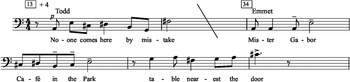
The key to understanding the different forces that operate on Emmet throughout the work hinges on how we perceive the interrelationships of the various characters. We are initially encouraged to think of Todd and Ka as ‘real’ characters and their roles exactly as defined: that of cleaners. Only as the opera proceeds does it become obvious that they represent all males and all females that appear in the opera. A defining moment, which then makes sense of all the other characters, occurs when we are led finally to perceive that Todd and Gabor are one and the same person (rather than simply being sung by the same individual).Footnote 61 Davies does provide an early clue to this relationship through virtually identical pitch sequences for Todd's first statement to Emmet ‘No one comes here by mistake’ (Recit.) and Emmet's response to the phone conversation regarding his meeting with Gabor, where he repeats ‘Mister Gabor, Café in the Park’ (Ex. 18). Another connection between the male characters becomes evident when Gabor speaks for the first time (Ex. 19). Up to this point the only character whose vocal line has gone so low has been the Heating Engineer who may be, as I have suggested, a representation of the Devil, or at least some malevolent force. Thus, there is a connection between Gabor and the Heating Engineer. Through these interconnections, Davies and Pountney seem to imply that every encounter with a male character in the work is not ‘real’, but always in some way symbolic.
Mr Emmet – pitch correspondence between Todd's phrase (Fig. 13+4) and Emmet's reference to Gabor (Fig. 34)

Mr Emmet, Gabor's first statement Fig. 115

We are likewise led to question whether every female character is not actually some ‘version’ of Emmet's mother, and furthermore whether Emmet views his mother as the overriding force impelling him towards his act of suicide. Rather than Fate being the ‘desperate fury’ pursuing him in his mind perhaps it is she (Mother) who is the ‘furia disperata’. Davies suggests this particularly in the Second Episode where the adapted Dies Irae is played on the piano as Emmet meets The Woman for the first time. When The Woman responds to Emmet's ‘why is my mother on the piano’ with ‘refreshing her memories’ we understand that the piano playing automatically is a memory of his mother's playing. The Woman, on the other hand, seems at this point to be the femme fatale. However in Episode 4 as Emmet finally encounters ‘Mother’ in the form of the Old Crone, we realise that all the female characters are multiple expressions of the same individual – Ka, The Woman, and ‘Mother’ are one and the same.Footnote 62 Perhaps, through his use of the quotation from Gabrieli's Edipo tiranno, Davies intends the informed listener to read more into the Oedipal associations than even this suggests.
CONCLUSION
Contextualizing this work in relation to his earlier text-based works, it is possible to view Mr Emmet as a piece as much about betrayal as Eight Songs, Taverner or Caroline Mathilde. While there is never any suggestion in either Pountney's text or Davies' music of madness as such, it is clear that this is a study of a disturbed mind: it is Emmet's own mind that betrays him – it is ‘a little unbalanced’, as he says. In Eight Songs, Davies made the mad King a character whose impact was deliberately calculated to be immediate and challenging on a number of levels, not least through his highly exaggerated vocal pyrotechnics. Mr Emmet, though much more subtle as a character, is equally disturbing – not because of the outrageousness of his behaviour, but because of its apparent normality. In Mr Emmet, the musical clues to the title character's state of mind have to be sought in the thematic gestures, and in their coordination with the text and with each other. Davies has chosen to incorporate perceivable (as distinct from embedded but not immediately perceivable) references to the source materials at key places in the course of the work, where their function and meaning can be interpreted.Footnote 63 These gestures then have to be viewed in the context of the structural unity of the work as a way of demonstrating the accumulating nature of Emmet's trauma that leads to his suicide. What Davies has attempted with this work is to embed the thematic borrowings within the conventions of sonata form in ways which reflect upon the story as it unfolds.
As a work, Mr Emmet seems to embody the notion that, like a well-ordered life, suicide should be prepared effectively as a work of art in its own right.Footnote 64 In charting the breakdown of a mind, Mr Emmet is perhaps therefore a more psychologically unsettling work than its expressionistic predecessors, Eight Songs and Miss Donnithorne's Maggot. It is a more introverted and serious study of suicide, free from the elements of parody which some believe trivialised the composer's earlier music-theatre works, and especially Eight Songs. Indeed, Davies' study of Emmet has an almost deliberate avoidance of the more outrageous musical gestures that characterised earlier musical theatre works.
When, in Eight Songs, the King declares ‘I am not ill … I am nervous’, the musical text immediately turns into a series of sung parodies which create dislocation by engrafting twentieth-century popular styles onto the originals (such as passages from The Messiah). The parodies have at least three effects: they emphasise the ludicrousness of the King's behaviour; they suggest his tenuous hold on normality; and the music becomes the means to express the ‘disintegration of his subjectivity’, leading him to commit the ultimate musical sin – smashing the violin.Footnote 65 In Eight Songs the blatant parodies express, in musical terms, the outward appearance and behaviour of the King. In Mr Emmet, on the other hand, the musical references are used to express the complexities of Emmet's inner thought processes. The symbolic gestures ‘infect’ reality and their manifestations (the occurrences of the pre-existing musical material) become internalised; that is, they become embedded in Emmet's thought processes. In short, the quoted music is not an outward expression of his state of mind but an integral part of it. The quotations are fragments on which the drama depends and which reside in Emmet's mind. They are not obvious parodies, as they were in Eight Songs; they are insidious, hidden, distorted, pervasive and unpredictable, like the inner workings of the disturbed mind.