Implications
Grazing practices can be directed by government support to achieve public good outcomes, for example, increased biodiversity in uplands, improved nitrogen utilisation in lowlands, reduced greenhouse gas (GHG) emissions from livestock and improved nutritional quality of their meat. Strategies designed to enhance biodiversity generally result in increased GHG emissions per unit of product due to the associated extensive grazing, whereas unfavourable changes in GHG emissions per unit of product may conceal more favourable changes in emissions per unit of grazed land area or per landholding. The key message is that a holistic approach is needed to accommodate trade-offs between competing goals.
Introduction
Permanent grassland is the largest agricultural land use option in Ireland, accounting for 80% of land area (Rath and Peel, Reference Rath and Peel2005). Grassland also dominates in UK agriculture although cereal production accounts for 18% of the agricultural land area here (Rath and Peel, Reference Rath and Peel2005). Thus, grassland makes a significant contribution to nutrient supply in rearing and finishing systems for red meat production in the United Kingdom and Ireland. However, a number of emerging issues have begun to impact significantly on the future of pasture-based livestock systems. These include food security, environmental policies and consumer requirements.
Until recently, food security has not been regarded as a significant problem. However, an increasing global population with an increasing demand for meat has, when coupled with environmental changes, placed global food security back firmly on the political agenda (Gregory, Reference Gregory2010). European policies such as the EC Water Framework Directive (2000) and the EC Nitrates Directive (1991) also have major implications for grassland farms in terms of nutrient management. Moreover, maintaining biodiversity has become a key focus of agri-environmental schemes. In addition, climate change continues to grow in importance, particularly in view both of the contribution that agriculture makes to overall environmental emissions and of the target reductions in greenhouse gas (GHG) emissions set by the United Kingdom (Committee on Climate Change, 2008).
Impact of grazing on biodiversity and environmental characteristics of hill and uplands
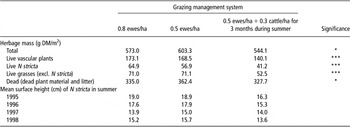
The EC Habitats Directive (1992) addressed the issue of a continuing deterioration of Europe's natural habitats, much of which was attributed to development and agricultural intensification. One strategy through which biodiversity might be enhanced is a reduction in the level of intensification. However, Milne (Reference Milne1996) argued cogently that a range of grazing intensities needs to be used on the hills and uplands of the United Kingdom in order to achieve significant environmental benefits. To date, studies of the effects of excluding sheep from hill vegetation have produced mixed and occasionally contradictory results with Welch and Rawes (Reference Welch and Rawes1964) and Rawes (Reference Rawes1981) noting a decline both in species numbers and in compositional stability of Cumbrian uplands after, respectively, 8 years and 24 years protection from grazing by sheep, while Hill et al. (Reference Hill, Evans and Bell1992) found early changes to vegetation but almost no invasion by new plant species in a similar 25-year study in the Welsh uplands. Holland et al. (Reference Holland, Waterhouse, Robertson and Pollock2008) noted that there was only limited research data on the effect of reduced sheep numbers on hill pastures and, in particular, on seasonal herbage mass and investigated the impact of stocking rate on herbage mass and pasture height of Nardus stricta grazed by ewes at stocking rates of either 0.8 or 0.5 ewes/ha or at a stocking rate of 0.5 ewes/ha, but with cattle also grazing at 0.3/ha for 3 months during the summer. The results of this trial (Table 1) demonstrated that sheep grazing at either stocking rate resulted in similar herbage mass and similar sward composition, whereas reducing stocking rate resulted in greater surface height. Introducing cattle grazing during the summer resulted in significantly lower herbage mass and surface height and decreased the amount of live vascular plant material (Nardus stricta and other grasses) relative to when grazed only by sheep. Overall, the study suggested that in an all-year-round grazing system, combined grazing by sheep and cattle will be a more effective way of creating structural change within Nardus stricta grasslands, than will grazing by sheep alone. It also showed that reducing sheep stocking rate, with or without summer grazing by cattle, led to small changes only in plant structure and plant biodiversity, while cattle grazing added some weed species.
Effect of grazing management systems on mean values of herbage mass within a Nardus stricta grassland in western Scotland (Holland et al., Reference Holland, Waterhouse, Robertson and Pollock2008)

DM = dry matter.
High grazing pressure by sheep undoubtedly causes significant degradation of upland heath, but Critchley et al. (Reference Critchley, Adamson, McLean and Davies2008) stressed the importance of economic viability in using cattle as a supplementary conservation aid in upland areas. They compared the effects of sheep-only and mixed cattle-plus-sheep grazing regimes on vegetation and on livestock performance over 4 years on 103 ha of degraded wet upland heath. In that study, cows were able to regain body condition before calving and could be used, with sheep, to remove biomass without detriment to livestock performance, but the authors pointed out that the stocking levels used in the work may not be sustainable every year. Despite a reduction of M. caerulea (Purple Moorgrass) biomass, there was no evidence that heathland vegetation was restored after 4 years leading Critchley et al. (Reference Critchley, Adamson, McLean and Davies2008) to conclude that restoration of heathland by grazing alone will probably require longer timescales. They advised that agri-environment schemes should avoid prescribing stocking levels. A reduction in grazing intensity and reliance on traditional rather than commercial breeds has often been recommended to meet biodiversity and production goals in sustainable grazing systems in Europe. However, in trials across Europe (United Kingdom, Italy, France and Germany) moderate or light grazing of mixed extensive pastures using traditional and commercial breeds of cattle and sheep, gave no consistent live weight gain response and there was no advantage of traditional breeds over commercial breeds (Isselstein et al., Reference Isselstein, Griffith, Pradel and Venerus2007). Grazing intensity affected the vegetation diversity but in a site-specific fashion, as dictated by the initial vegetation (Scimone et al., Reference Scimone, Rook, Garel and Sahin2007).
Large impacts on invertebrate and bird species can arise from small changes in vegetation. As an example, a loss of short grass is a critical factor in reducing bird diversity at lower stocking rates of sheep (Vickery et al., Reference Vickery, Tallowin, Feber, Askeraki, Atkinson, Fuller and Brown2001; Evans et al., Reference Evans, Redpath, Evans, Elston and Dennis2005). Wright et al. (Reference Wright, Pakeman, Dennis, Dalziel and Milne2006) reviewed the effects of cattle grazing of unimproved habitats on vegetation, birds, mammals and invertebrates. They concluded that cattle were less selective in their grazing behaviour than other domestic herbivores, leading to a different impact on unimproved, semi-natural habitats and the establishment of a structurally more diverse sward – a result of a reduction in cover by tussock-forming species that creates more niches for plant regeneration. At the time of that review, for many habitats there was little specific information on the effects of grazing by cattle but for habitats for which there was empirical evidence, grazing by cattle was observed to be neutral or beneficial, provided that best practice was followed. The review also showed that cattle grazing is always likely to be detrimental on blanket bog (Calluna) and on raised lowland bog due to the damage caused by poaching and consumption of Calluna sp.
More recently, Umstatter et al. (Reference Umstatter, Waterhouse and Holland2009) evaluated the grazing behaviour of Charolais, Luing (a composite of native British breeds) and Angus × Limousin cows, and their calves, grazing a hill environment in Scotland. The cows were turned out together but organised themselves into two herds. Angus × Limousin and Luing cows occupied the slightly steeper slopes more often than did the Charolais cows. All breeds performed well on the hill and there were no indications of poor welfare in any breed. The differences in foraging behaviour between the breeds suggested that each breed may have a different impact on biodiversity. Similar findings have been observed with grazing sheep. However, in their review, Rook et al. (Reference Rook, Dumont, Isselstein, Osoro, Wallis DeVries, Parente and Mills2004) found little evidence of breed differences in grazing preferences. Likewise, Fraser et al. (Reference Fraser, Davies, Vale, Nute, Hallett, Richardson and Wright2009) recorded no differences in the impact of grazing by native and continental cross steers while Dumont et al. (Reference Dumont, Rook, Coran and Röver2007) found few differences in the diet choices made by commercial and traditional breeds of cattle.
Table 2 presents results from a study by McCloskey et al. (Reference McCloskey, McAdam and Carson2009a) in which Blackface and Swaledale, Cheviot, Lleyn and Texel cross Blackface ewes grazed six different hill areas in Northern Ireland. Blackface and Swaledale × Blackface ewes selected habitats such as blanket bog, wet heath and degraded wet heath more often than Texel × Blackface, Lleyn × Blackface and Cheviot × Blackface. In the same study, spatial separation between ewes was evaluated and showed (Table 3) that Blackface ewes had a larger within-breed spatial distribution than the other breeds on free-ranging hill conditions while Lleyn and Texel cross Blackface ewes showed a higher preference to be closer to members of their own breeds (McCloskey et al., Reference McCloskey, McAdam and Carson2009b). When habitat preferences were mapped, Blackface ewes were seen to have grazed over a more extensive area than Texel × Blackface ewes. These studies indicate that modern sheep breeds and their crosses, often referred to as hill or lowland types, retain behaviours applicable to the environments in which they recently co-evolved. Such behaviours can be used to manage biodiversity in these environments.
Percentage (%) time spent grazing in each habitat by Scottish Blackface and crossbred ewes grazing in hill areas in Northern Ireland from June to October 2007 (McCloskey et al., Reference McCloskey, McAdam and Carson2009a)

na = not available.
Means within columns sharing the same superscript are not statistically significant at P < 0.01.
Average distance (m) between Blackface and crossbred ewes (McCloskey et al., Reference McCloskey, McAdam and Carson2009b)

Means with different superscripts indicate significant differences at P < 0.05.
Strategies to reduce the environmental impacts, specifically of nitrogen, in lowland and upland grazing systems
Most lowland grazing systems are managed intensively, with high animal productivity per hectare being the key objective (Luo et al., Reference Luo, de Klein, Ledgard and Saggar2010). Additional nutrients are also applied to improved grassland in upland systems and, given the harsher growing conditions and shorter growing season in such areas, these applications are often crucial for maintaining overall system productivity. In line with this view, Fothergill et al. (Reference Fothergill, Davies and Morgan2001) and Marriott et al. (Reference Marriott, Fothergill, Jeangros, Scotton and Louault2004) demonstrated substantial negative effects on sward carrying capacity and animal performance when such additional nutrients are withdrawn.
The inputs of resources, and of N-fertilisers in particular, can be substantial and can result in a large N surplus, which is lost through leaching as nitrate or as gaseous N emissions. Such losses have negative economic and environmental impacts.
Matching protein supply to an animal's requirements, balancing and synchronising the ruminal carbohydrate N supply, and increasing the proportion of rumen undegradable protein in the diet, can all reduce N losses. Research shows that grassland management practices that change the composition of the diet are effective, but with variable degrees of success and suitability. For example, extending grass re-growth, as a mechanism to reduce forage protein content, also reduces herbage digestibility and animal performance. Moreover, the application of N-fertilisers increases the concentration of N in the herbage but reduces the proportion of true protein in the short term. Increasing the use of legumes is a more sensible option and is discussed later in this review.
High-sugar grasses can, at least in theory, improve N utilisation by grazing cattle through correcting the occasionally asynchronous rumen availability of water soluble carbohydrate (WSC) and nitrogenous compounds that limits production and causes elevated excretion of urinary N with all of the associated negative economic and environmental implications.
Improvements in intake of, or animal production from, different grass varieties may, in some cases, be a response to a higher herbage WSC concentration (MacRae et al., Reference MacRae, Smith, Dewey, Brewer, Brown and Walker1985; Moorby et al., Reference Moorby, Evans, Scollan, MacRae and Theodorou2006) but this has not always been shown. Thus, when varieties of perennial ryegrasses of similar digestibility were offered free-choice to grazing cattle (Jones and Roberts, Reference Jones and Roberts1991), those varieties with higher WSC content were grazed more. However, O'Kiely et al. (Reference O'Kiely, Conaghan, Howard, Moloney and Black2005) found no difference in the 154-day finishing performance of steers grazing grass swards differing by 12 g WSC/kg dry matter (DM). Similarly, Taweel et al. (Reference Taweel, Tas, Smit, Elgersma, Dijkstra and Tamminga2006) saw no effect on intake or milk production by dairy cows offered ryegrass diets differing by 32 g WSC/kg DM.
Howard et al. (Reference Howard, O'Kiely, Moloney and O'Mara2007) zero-grazed cattle on grass to which different levels of sucrose had been added and found a response in growth rate that was higher than predicted on the basis of the increased intake of energy. This suggested that the additional sugar may have improved the synchrony of energy and nitrogen supply in the rumen, as previous studies have shown that this increases the efficiency of microbial protein synthesis (Johnson, Reference Johnson1976; Hoover and Stokes, Reference Hoover and Stokes1991). Despite much effort on evaluating high-sugar grasses fed in combination with clover and other high-protein forages, evidence of benefits in N-use efficiency is, thus far, equivocal with, in practice, few grass varieties making much difference. Furthermore, animal trials have not shown a universal or consistent increase in N utilisation, even though urinary N excretion is, mostly, reduced. A limitation to assuring greater repeatability in the outcome of such trials is finding cultivars of sufficiently high and consistently high WSC concentration.
Two major inefficiencies in the cycling of N in grazed pastures are linked to the high protein content of pasture (when compared with the dietary requirement of the animal), as a consequence of which, concentrations of excreted N in urine patches can be as high as 500 kg N/ha for sheep and 1000 kg N/ha for cattle (Di and Cameron, Reference Di and Cameron2002). The amount of urine N excreted is one of the most important determinants of N losses from grassland and a key challenge facing lowland farmers is to reduce urinary N losses as well as reducing N excretion.
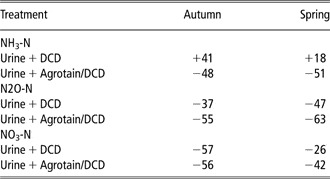
One option by which N losses from urine deposition can be reduced, is the addition of nitrification inhibitors to the soil. One such inhibitor is dicyandiamide (DCD), which has been shown to reduce N losses (as nitrous oxide and nitrate-N) from grazing pastures. However, the deposition of urine in grazing systems also leads to volatilisation of ammonia. Ammonia is not a GHG but it produces nitrous oxide through nitrification and denitrification (Martikainen, Reference Martikainen1985). DCD reduces nitrous oxide emissions and the amount of nitrate leached, but it increases ammonia volatilisation (Zaman and Blennerhassett, Reference Zaman and Blennerhassett2010). However, this can be addressed by including a urease inhibitor (Agrotain®; Agrotain International, St Louis, MO, USA) along with DCD in order to slow down urea hydrolysis and, in turn, reduce gaseous emissions of ammonia and nitrous oxide and reduce nitrate leaching (Zaman and Blennerhassett, Reference Zaman and Blennerhassett2010; Table 4). In the latter study, pasture production and N uptake were both increased by the inclusion of DCD and a urease inhibitor.
Percentage change in ammonium-N (NH3-N), nitrous oxide-N (N2O-N) and nitrate-N (NO3–N) after autumn and spring application of urine with Agrotain® and DCD (Zaman and Blennerhassett, Reference Zaman and Blennerhassett2010)

DCD = dicyandiamide.
DCD applied at 7 kg/ha; Agrotain® applied at 1 l/ha.
Nutrient losses from grazing systems can also be reduced by the appropriate management of fertiliser applications. For example, the nitrous oxide flux that arises from applying calcium ammonium nitrate fertilisers, increases as soil water content increases (Department for Environment, Food and Rural Affairs (DEFRA), 2004). Furthermore, the form of fertiliser N has been shown to influence N2O emissions (Bouwman et al., Reference Bouwman, Boumans and Batjes2002; Watson et al., Reference Watson, Laughlin and McGeogh2009). Avoiding applications of inorganic N-fertiliser when ground conditions are wet, and giving due consideration to the chemical form of the N-fertiliser, can help reduce N losses from grazing systems. Generally, the positive relationship between the level of N applied and total nitrate losses means that any system that reduces N inputs will reduce nitrate losses (Watson et al., Reference Watson, Jordan, Lennox, Smith and Steen2000).
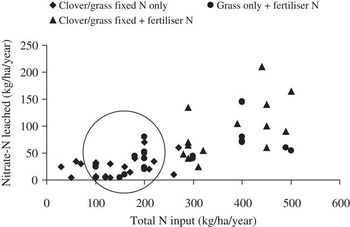
The introduction of clover into grass swards also can reduce N losses. However, the amount of nitrate leached from grazed grass-clover swards is similar to that from grass-only swards receiving the same amount of fertiliser N input as that biologically fixed by clover (Ledgard et al., Reference Ledgard, Schils, Eriksen and Luo2009). Figure 1 illustrates the relationship between total N input (either fixed by clover or added as fertiliser N) and the nitrate-N leached. The circled area shows an overlap of N leaching values estimated from pastures with or without clover presence, at similar N inputs. However, because the amount of N-fertiliser applied to grass/clover swards is usually lower than that applied to grass-only swards, there is less leaching of N from grass/clover swards.
Effect of inclusion of white clover in grass swards on nitrate-N leaching (Ledgard et al., Reference Ledgard, Schils, Eriksen and Luo2009).

Increased interest in realising the potential of nutrients found in livestock manure has followed naturally in the wake of rising fertiliser cost. Smith and Chambers (Reference Smith and Chambers1998) estimated that the 73 million tonnes of livestock manures produced annually in the United Kingdom represents a resource of 280 000 tonnes N, 50 000 tonnes phosphorus (P) and 250 000 tonnes potassium (K). Numerous research studies have evaluated mechanisms by which the nutrient utilisation from livestock manures can be improved. Results presented in Table 5 demonstrate that use of the ‘trailing shoe’ application technique improves grass yield and fertiliser efficiency relative to either ‘splash plate’ or ‘band spreading’ of livestock slurry (Frost et al., Reference Frost, Gilkinson and Binnie2007). This is mainly a result of reduced ammonia losses. Wulf et al. (Reference Wulf, Maeting and Clemens2002) noted that ammonia levels were reduced by up to 50% when the trailing shoe was used rather than the splash plate. Soil and climatic conditions can also significantly impact upon nutrient utilisation. Hansen (Reference Hansen1996) reported that applications of solid manure to compacted soil resulted in DM yields 30% lower than obtained on uncompacted soils. Accordingly, it is critical that good soil conditions are maintained in order to optimise nutrient utilisation. In addition, slurry and solid manure should be spread at times of the year when the nutrients can be utilised efficiently (Scottish Agricultural College, 2010).
Effect of manure spreading system on N efficiency (Frost et al., Reference Frost, Gilkinson and Binnie2007)

DM = dry matter.
Data from 2 and 3 years of study.
Mitigation strategies to reduce GHG emissions
It is well established that increasing the level of concentrates in the diet reduces methane emissions, both as a proportion of energy intake and when expressed per unit of meat or milk output (Martin et al., Reference Martin, Morgavi and Doreau2009). This is supported by modelling exercises that demonstrate that mitigation strategies to reduce the carbon footprint of red meat production systems are more effective in high output, rapid finishing systems using cereal inputs. Hyslop (Reference Hyslop2008) demonstrated that shorter duration, intensive finishing systems have the potential to reduce the carbon footprint of suckler beef production by up to 28%. Similarly, Dawson (Reference Dawson2010) compared the carbon footprint of a long-keep steer system in which cattle were offered grazed grass in the summer and grass silage in the winter, with an intensive bull system in which bulls were housed throughout their lives and offered concentrates ad libitum, and showed that the carbon footprint of the bulls (expressed as CO2e per kg carcass weight) was approximately half that of the steers (Table 6).
Carbon footprint of four dairy-origin beef rearing and finishing systems (Dawson, Reference Dawson2010)

a,b,c,dMeans with different superscripts differ significantly (P < 0.05).
The challenge to grass-based livestock systems is to achieve levels of animal performance similar to the high levels achievable in intensive cereal-based systems. In the modelling exercise undertaken by Dawson (Reference Dawson2010), the carbon footprint of an intensive bull system was also compared with the carbon footprint of a forage/concentrate-based bull system in which bulls were grazed in their first summer and then housed and offered grass silage and concentrates until slaughter. The carbon footprint of both systems was similar (Table 6) indicating that it is possible to reduce the carbon footprint of beef production through the optimum use of forage.
Another mechanism through which the carbon footprint of grass-based systems can be reduced is the inclusion of white clover in grass swards. Using data presented in Table 6, but assuming that inclusion of clover results in a reduction in inorganic fertiliser inputs, grass-clover swards have the potential to reduce GHG emissions by almost 20% relative to a grass-only sward fertilised with 150 kg N/ha annually. These data are supported by the study by Ledgard et al. (Reference Ledgard, Schils, Eriksen and Luo2009) which demonstrated an 11% reduction in GHG emissions from a production system based on a grass/white clover sward relative to those from a perennial ryegrass-based sward receiving 160 kg N/ha. However, while lucerne may be beneficial in reducing methane emissions, the N-use efficiency associated with this forage is known to be poor. This again highlights the danger of considering environmental aspects individually and emphasises the need for a more holistic approach to managing grassland systems.
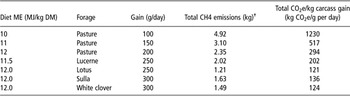
Improving diet quality has also been shown to reduce methane emissions. Emissions from a range of forage types of increasing quality (expressed as metabolisable energy (ME)/kg DM) were measured by Waghorn and Clark (Reference Waghorn and Clark2006). When expressed as CO2e/carcass gain (g/day), the results demonstrated that as pasture quality improved, methane emissions per carcass gain (g/day) decreased. For the most part, this reflected the improved performance of the lambs (Table 7). The data from this study also showed that forages such as lucerne, lotus, sulla and white clover reduced methane emissions, due to the improved quality of the forages (MJ ME/kg DM). It is important to note that some of the beneficial effects of alternative forages such as lucerne, sulla/red clover/chicory and lotus on reducing methane emissions have been attributed to their chemical compositions, for example, the high ratio of non-structural carbohydrate: neutral detergent fibre in sulla and chicory and the presence of condensed tannins in sulla and lotus (Ramirez-Restrepo and Barry, Reference Ramirez-Restrepo and Barry2005).
Effect of forage quality and forage type on methane emissions from lambs growing from 25 to 40 kg live weight using data from Waghorn and Clark (Reference Waghorn and Clark2006)

ME = metabolisable energy; DM = dry matter.
†Methane emissions are expressed as gross emissions over the growing period.
The ability of grassland to sequester carbon has also been put forward as a key strategy to partly mitigate GHG emissions from the livestock sector (Soussana et al., Reference Soussana, Tallec and Blanfort2010). Jones and Donnelly (Reference Jones and Donnelly2004) noted that carbon sequestration rates for permanent grasslands ranged from 0.2 to 0.6 tonnes carbon/ha per year (equivalent to 0.7 to 2.2 tonnes CO2e/ha per year) according to management, while the conversion from arable to grassland significantly increased carbon sequestration to 8 tonnes carbon/ha per year (29 tonnes CO2e/ha per year). However, they also noted that while temperate grassland soils can sequester relatively large amounts of carbon, this is dependent on the management of the soil and there is uncertainty about how long this can be sustained and whether there is an upper limit to carbon storage. Soussana et al. (Reference Soussana, Tallec and Blanfort2010) also argued that soil carbon sequestration is reversible and vulnerable to disturbance, biodiversity loss and climate change.
Effects of grazing on the nutritional quality of red meat
The benefits of grass-based systems of beef production for some meat quality attributes are well recognised (Scollan et al., Reference Scollan, Hocquette, Nuernberg, Dannenberger, Richardson and Moloney2006). Compared to grain feeding, pasture feeding has been shown to increase the contents of omega-3 fatty acids, conjugated linoleic acids and vitamin E in red meat, thereby favouring longer shelf life. However, there are variable reports of the effects on fresh meat colour and meat tenderness (Scollan et al., Reference Scollan, Dewhurst, Moloney and Murphy2005).
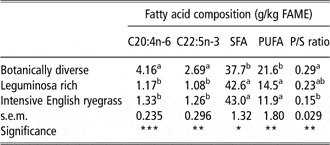
Much of the literature in this area relates to improved pastures consisting, mostly, of a perennial ryegrass monoculture. The increasing interest of consumers in environmental issues and in the origin and methods of production of their food, has led to a growing preference for meat and milk from pasture-based systems, for example, those labelled as PDO (Protected Denominations of Origin) or PGI (Protected Geographic Indications; Moloney et al., Reference Moloney, Fievez, Martin, Nute and Richardson2008). Botanically diverse pastures or unimproved pastures are central to many of these production systems. However, relatively little information is available on the differences in production quality between botanically diverse pastures and improved pastures of mostly perennial ryegrass. Some research confirms that meat from animals grazing botanically diverse pastures has higher concentrations of ‘healthy’ fatty acids such as polyunsaturated fatty acids (PUFA) or a higher PUFA/SFA (saturated fatty acid) ratio (Lourenco et al., Reference Lourenco, Van Ranst, De Smet, Raes and Fievez2007; Table 8). However, animals grazing botanically diverse pastures generally have poorer conformation scores and lower fatness but this does not seem to affect eating quality (Fraser et al., Reference Fraser, Davies, Vale, Nute, Hallett, Richardson and Wright2009). In studies with lambs grazing a range of forage types that included saltmarsh, heather and moorland, meat from lambs that grazed heather and moorland had higher flavour scores and lower abnormal flavour/odour scores than meat from control lambs produced through a perennial ryegrass-based system (Whittington et al., Reference Whittington, Dunn, Nute, Richardson and Wood2006).
Fatty acid composition of intramuscular fat from lambs grazing botanically diverse pastures (Lourenco et al., Reference Lourenco, Van Ranst, De Smet, Raes and Fievez2007)

FAME = fatty acid methyl esters; SFA = saturated fatty acids; PUFA = polyunsaturated fatty acids; P/S = polyunsaturated/saturated fatty acids.
a,bWithin a column, means with different superscripts differ significantly (P < 0.05).
Trade-offs and synergies: implications for policy and socio-economics
The grazing pattern of livestock in hill environments is determined by the choice of animal species, or combination of species and breed, with hardy breeds exhibiting more extensive grazing behaviour and grazing a wider variety of plant species.
Published research provides an evidence base that supports the use of native hill breeds for year-round grazing of indigenous grasslands. For the uplands, where research shows that withdrawal of inputs has food security implications, or for seasonal grazing and/or mixed grazing of the hills, a need for native breeds is not apparent. It is important to recognise the balance between biodiversity, animal productivity and carbon footprint. Many upland areas can, with appropriate nutrient inputs, sustain moderate levels of animal performance and although the carbon footprint/kg carcass will be higher relative to lowland intensive systems, there are benefits both for food security and for human health from grass-based meat production. If government policy is targeted towards maintaining or enhancing biodiversity in upland areas, then lower animal productivity and a higher carbon footprint may be acceptable, when seen against the benefits in terms of biodiversity. However, if food security issues rise up the agenda, the uplands will have an important role to play because of the extent of the land area involved, the worthwhile responses to improved grasses and the potential for using genetically superior livestock to utilise this grassland efficiently.
Nitrogen losses from grassland can be reduced by adopting proven slurry-spreading technologies and best management practices when applying inorganic and organic N-fertilisers, but consideration also needs to be given to the use of nitrification inhibitors in combination with urease inhibitors and lower N input grass-based systems. GHG emissions can be reduced by the production of high-quality pastures which, when coupled with the use of grazing animals with improved genetic potential, will result in high output rapid finishing systems with reducing carbon footprint/kg carcass gain. Alternative forages (especially grass/white clover swards) also have potential to reduce GHG emissions through reduced inputs of inorganic fertiliser and there are additional beneficial effects possible from the chemical constituents in the forages. However, it is important to recognise that reducing the environmental impact of grass-based systems of red meat production, and adopting mitigation strategies to reduce GHG emissions, are intrinsically linked. Reducing nitrate leaching from grass-based systems and reducing the carbon footprint of red meat production can both be achieved by appropriate management of inorganic/organic fertilisers.
Summary
It is important to retain flexible options for the future in order, for example, to be able to increase overall productivity by integrating hill or upland farming with lowland arable activity through the movement of livestock from hill areas to the lowlands in winter (Morgan-Davies et al., Reference Morgan-Davies, Waterhouse, Pollock and Holland2008). Furthermore, there are large potential reductions to be made in GHG emissions from replacing N-fertiliser use with animal manure and clover-derived N on arable farms, together with carbon sequestration opportunities in the lighter, low carbon, arable soils due to continuous cropping.
Although grass-based systems of red meat production deliver benefits in terms of meat fatty acid composition, variable effects on meat tenderness have been reported. Thus, meat from animals grazed on botanically diverse pastures contains higher concentrations of ‘healthy’ fatty acids but there is limited data on the sensory characteristics of meat from such pastures. A key challenge for grass-based systems of red meat production is the authentication of meat products from these production systems and using this to develop marketing initiatives.
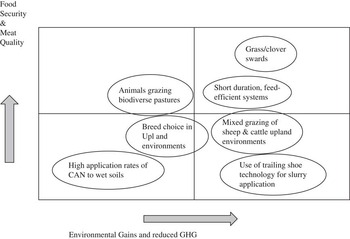
In the context of a pan-European political environment in which governments are seeking to develop strategies to encourage the production of red meat with a lower carbon footprint, improved health attributes and positive effects on biodiversity (while, at the same time, ensuring food security), a matrix diagram (Figure 2) can be a useful way to schematically summarise how these factors interact and can help identify practices that might best meet their strategic goals. Initiatives that fall within the upper right side of the matrix can be considered as more likely to meet all goals while those in the lower left side of the matrix are unlikely to meet any of the goals. The matrix also highlights the danger and inadequacy of considering each parameter in isolation. Thus, for example, policies that aim to achieve environmental gains by encouraging specific breeds in an upland environment may not achieve the goal of food security or meat quality due to the lower productivity characteristic of animals in these environments. Conversely, short-duration, feed efficient systems of production are more likely to meet all or most of the goals. Overall, the key message is that an integrated approach needs to be taken when developing policy due to linkages between the factors involved.
A matrix chart showing the interactions between food security, meat quality, environmental gains and reduced greenhouse gas emissions for grass-based systems of red meat production.

Acknowledgements
The authors acknowledge the assistance and advice from Dr Catherine Watson (AFBI), Dr Scott Laidlaw (AFBI), Ms Christina Umstatter (SAC), Ms Eileen McCloskey (Queen's University, Belfast and AFBI), Dr Tony Waterhouse (SAC) and Dr David Younie (SAC).