Most Americans lack any substantial degree of ideological sophistication (Kinder Reference Kinder1998), yet they often manage to express coherent views across a range of issues. The conventional explanation for this is that people rely on judgmental shortcuts (e.g., Sniderman, Brody, and Tetlock Reference Sniderman, Brody and Tetlock1991). These “heuristics” permit individuals with sufficient political sophistication to sort and filter incoming messages to form relatively consistent views that align with preexisting values (Zaller Reference Zaller1992).
If the key cueing device in such models is the source credibility heuristic (Mondak Reference Mondak1993), how do people who lack the time and ability to become actual policy experts have the time and capacity to figure out which policy experts are credible? How does this theory explain the coherence some have found in the views of those with limited political knowledge (Goren Reference Goren2004)?
We approach these two questions with the perspective offered by Mary Douglas (Reference Douglas1982) and Aaron Wildavsky's (Reference Wildavsky1987) cultural theory. In brief, we argue that most peoples neither have the time, inclination, and ability to derive policy positions from abstract ideological principles, nor do they have the inclination or resources at-hand to sort through the empirical claims advanced in technical policy debates. Instead, as Wildavsky (Reference Wildavsky1987, 8) said, “ordinary folk” use the orienting force of culture “to generate miles of preferences” from only “inches of fact.”
To make the case for this conception of public opinion, we begin with a theoretical overview of how this process, which we call the Wildavsky Heuristic Model, relates to existing accounts of mass political opinion, particularly those featuring ideology. Then, we test some of this model's core propositions using original national survey data, and finally, we draw out the theoretical and practical implications of those results.
THEORETICAL BACKGROUND
For Wildavsky (Reference Wildavsky1987), the deeper mechanism explaining mass political opinion was culture. Wildavsky drew on an earlier model developed by anthropologist Mary Douglas (Reference Douglas1982), who argued that people's “worldviews” fell along two cross-cutting dimensions, “group” and “grid.” As translated into opposing orientations, the group dimension represents the clash between those who prize individual liberty versus those who count on group solidarity and strong institutions to meet collective needs. The grid dimension measures the pervasiveness and significance of social differentiation within a way of life, with one view celebrating such distinctions and the other view taking an egalitarian stand against them. Although the two dimensions are cross-cutting, they are also interrelated. Cultural theory posits that the effect of holding outlooks located at one end or the other of either dimension critically depends on where a person's outlooks appear along the other dimension (Douglas Reference Douglas1982; Mamadouh Reference Mamadouh1999). Much previous work has shown the general utility of this conceptualization of cultural worldviews (e.g., Dake and Wildavsky Reference Dake and Wildavsky1990; Jenkins-Smith and Smith Reference Jenkins-Smith, Smith, Coyle and Ellis1994; Kahan et al. Reference Kahan, Braman, Gastil and Slovic2007; Peters and Slovic Reference Peters and Slovic1996).
Juxtaposed with other accounts of public opinion, the Wildavsky Heuristic Model argues that cultural orientation determines the valence of our affective response to policy proposals (Sniderman, Brody, and Tetlock Reference Sniderman, Brody and Tetlock1991), guides the selective search for and receptivity to information (Graber Reference Graber2004), informs perceptions of which advocates are credible (Lupia Reference Lupia and Kuklinski2002), and stocks the inventories of considerations we draw on when asked to take a policy stand on some contested issue (Zaller Reference Zaller1992).
In related experimental work with national samples (Kahan and Braman Reference Kahan and Braman2003; Kahan et al. Reference Kahan, Braman, Gastil and Slovic2007), we unpack various kinds of mechanisms of “cultural cognition” in the Wildavsky Heuristic Model. Here, we demonstrate some of the consequences that these cultural shortcuts have in reasoning for mass political opinion on public policy issues. Our data and analysis provide consistent support for the Wildavsky Heuristic Model: Cultural orientations have clear, strong, and predicted effects on each policy issue; those effects are substantially stronger than those obtained by the liberal-conservative measure; and culture's impact diminishes only slightly at lower levels of political knowledge, whereas one's political self-identification generally becomes an insignificant predictor at a low level of political knowledge.
Our analysis and argument rely on a large and diverse set of policy items.Footnote 1 First, we include a set of issues expected to elicit parallel reactions from both cultural dimensions, with those with individualist and egalitarian orientations having contrasting directions of correlation. Opposition to strict gun laws, affirmative action, tough carbon emission standards, universal health care, and the estate tax should correlate positively with individualism but negatively with egalitarianism (Kahan and Braman Reference Kahan and Braman2003). Individualism and egalitarianism, however, are not categorically opposing dimensions of one's worldview. For instance, government wiretapping should correlate negatively with both individualism and egalitarianism: These policies give power to centralized authorities and sacrifice personal liberty (Shaw et al. Reference Shaw, Shapiro, Lock and Jacobs1998) as do other collective military endeavors (Verweij Reference Verweij1995), such as the surge in Iraq. Support for gay rights, in contrast, should correlate positively with individualism and egalitarianism: these rights enhance personal liberty by eroding long-established, traditional moral codes (Douglas and Wildavsky Reference Douglas and Wildavsky1982). Again, we expect that across all these issues, cultural worldviews will account for differences in views at both high and low levels of political sophistication.
SURVEY MEASURES
To test these hypotheses, Knowledge Networks collected an online survey sample of 1,572 adult US residents in May, 2007.Footnote 2 To assess policy attitudes, survey respondents were asked whether they strongly, modestly, or slightly supported or opposed a series of proposed policies or laws (see full list in figure 1).
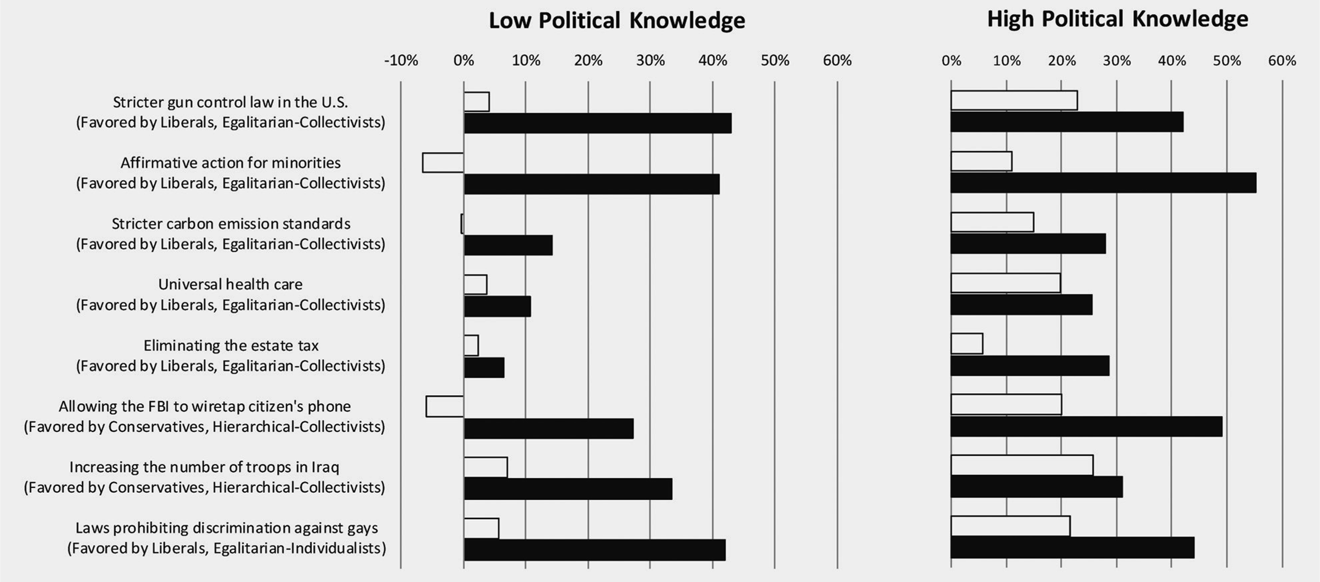
Gaps in Policy Support Levels between Liberal versus Conservative Respondents (white bar) Compared to Opposing Cultural Orientations (black bar) for Eight Different Policy Issues at Low and High Political Knowledge Levels
Note. To compare levels of policy support at low and high political knowledge levels, this graphic uses a WHITE BAR to show the opinion gap between respondents who are one SD below the mean liberal-conservative self-identification (i.e., relatively liberal) to one SD above the mean (i.e., relatively conservative). Just below each liberal-conservative opinion gap is a BLACK BAR showing the comparable gap between opposing cultural groups, as described in each row of the table. The full wording for “wiretap” item is “allowing the FBI to wiretap a US citizen's phone without a warrant if the FBI suspects that the citizen might be communicating with terrorists.”

To measure cultural orientations, we asked respondents for their level of agreement with a series of 24 values statements (for details, see Kahan et al. Reference Kahan, Braman, Gastil and Slovic2007). Because the cultural orientations were not conceptualized as uncorrelated, mean item scores (rather than factor scores) were used to generate reliable measures of egalitarian-hierarchy (alpha = .82) and individualism-solidarism (alpha = .79).Footnote 3
For liberal-conservative self-labeling, the survey uses a standard item: “When it comes to politics, do you usually think of yourself as extremely liberal, liberal, slightly liberal, moderate, or middle of the road, slightly conservative, conservative, extremely conservative, or have you not thought much about this?” From this, a seven-point Conservative scale was created, with seven denoting “extremely conservative” (M = 4.33; SD = 1.68).Footnote 4
A set of nine items was used to distinguish lower from higher levels of political expertise (Delli Carpini and Keeter Reference Delli Carpini and Keeter1996). Between 43% and 85% of respondents correctly answered each question, and we obtained a reliable Knowledge scale (alpha = .74) that ranged from zero to nine correct answers (M = 6.06; SD = 2.32). For comparisons of low- versus high-knowledge respondents, we trichotomized respondents into approximately equally sized lowest, moderate, and highest knowledge groups, although in this article we compare only those respondents with low and high political knowledge.Footnote 5
Finally, demographic measures were included as control variables in the analyses. Ethnicity was recoded into four categories to create two dummy-variables: white, non-Hispanic (n = 1347), Hispanic (n = 223), African American (n = 188), with the remainder set including 104 respondents. Education, gender, age, and household income were all measured with conventional one-item scales.
RESULTS
To test the predictiveness of cultural worldviews, the two worldview scales were entered as independent variables with the aforementioned demographics and liberal-conservative self-identification in a logistic regression model. A previous version of this article presents the full results of these regressions (Gastil et al. Reference Gastil, Braman, Kahan and Slovic2005), but here we provide an overview of the key findings in a more concise and straightforward, visual format. As many methodological texts have stressed (e.g., King, Tomz, and Wittenberg Reference King, Tomz and Wittenberg2000), the most meaningful expression of statistical data often involves graphical display of differences. In this case, we display the gap in policy attitudes between respondents at distinct points in a distribution.
Thus, figure 1 shows the relative size of the opinion gap between liberals and conservatives versus cultural opposites at different levels of political knowledge. More precisely, the figure demonstrates the effect of adjusting liberal-conservative self-identification from one standard deviation (SD) below the mean (i.e., a relatively liberal respondent) versus one SD above the mean (i.e., relatively conservative), after controlling for the other variables in regression. For each policy item at low versus high political knowledge, the white bar represents the mean difference between liberal and conservative respondents, and the black bar shows the combined effects of the two cultural worldview measures, as described in the hypotheses. (Although we leave confidence intervals out of this graphic, note that the liberal-conservative gap consistently fails to reach conventional statistical significance at low political knowledge.)
To take the top row in figure 1 as one example, on gun control the attitude gap between a prototypical self-described liberal and conservative is considerable, but only if the respondents have a high level of political knowledge. At a high knowledge level, support for stricter gun laws is 23 percentage points higher for liberals than conservatives. Without such knowledge, however, the gap shrinks to non-significance (i.e., with the confidence interval overlapping the zero vertical axis).
By contrast, the combined effect of cultural orientation on gun control attitudes is substantially larger at any level of political knowledge. Whether possessing or lacking a sophisticated understanding of politics and government, egalitarian collectivists support stricter gun control at a rate between 42 and 43 points higher than do hierarchical individualists.
In response to these results, one might object to the difference in how liberalism-conservativism is measured, as compared to culture. Because the cultural orientations are operationalized as multi-item scales and liberal-conservative orientation is conventionally measured with a single item, some readers might object that any results we found could also be explained by this difference in measurement method. To allay this concern, we completed a parallel analysis using only a single item from each culture scale, and the pattern of results was essentially the same. The liberal-conservative item performed the same as in the main analyses. Although the predictive power of cultural orientation was attenuated overall, it remained a stronger predictor than the liberal-conservative indicator. Also, it was only slightly more likely than the full-length scales to decrease in magnitude from high- to low-political knowledge groups.
These data provide clear and consistent support for the Wildavsky Heuristic Model: Cultural orientations have clear and strong effects on each issue, and those effects are substantially stronger than those obtained by the liberal-conservative measure. Furthermore, culture's impact diminishes only slightly at lower levels of political knowledge, whereas one's political self-identification becomes unimportant at low levels of political knowledge.
DISCUSSION
Taken together, these results show that cultural worldviews better predict political opinions on policy issues than do conventional conservative-liberal self-identification. The differences are most stark for the least politically sophisticated respondents. In the data presented here, cultural worldviews generally were able to predict positions of low-knowledge individuals on all policy issues, confirming Wildavsky's (Reference Wildavsky1987) assertion that the immersion in cultural ways of life endows individuals with materials and aptitudes that substitute for more intensive engagement in political matters.
The Wildavsky Heuristic Model suggests that cultural values do generate major divisions of opinion on a range of issues—not just among partisans or elites but also among moderate citizens of meager political sophistication. The Wildavsky Heuristic Model explains how citizens who lack the political sophistication necessary to recognize and use partisan or ideological heuristics can still array into opposing factions on political matters. Our data suggest that preferences for policies or persons flow from their resonance with preexisting cultural orientations.
Although average citizens lack the sophistication to reason ideologically, our evidence corroborates Wildavsky's supposition that individuals make up for this limitation through a cultural facility that requires little political expertise. This result, in turn, links to the myriad findings that show how individuals rely on affective and cognitive heuristics in forming their political opinions. Culture, on this account, is the orienting force behind these heuristics: The readily accessible meanings it supplies, and the networks of trust that it establishes, determine what affective response individuals experience toward various policies and whom they trust and defer to on contested policy matters.
As to culture versus “ideology,” our data fortifies Jacoby's (Reference Jacoby2002, 135) doubts about the appropriateness of treating “liberal-conservative identification [as] truly an ideology in the first place.” Rather, we interpret this self-identification as an expression of affinity or repulsion to the “keywords” of liberal and conservative. We should not view cultural orientation as being the equivalent of an ideology, a concept that has a useful and specific meaning, if only for political elites.
Wildavsky (Reference Wildavsky1987, 17–18) hoped to establish a “research program on political culture [that] would seek to increase our understanding of how opposed visions of the good life are selected, sustained, altered, and rejected” and how those different visions shape policy views and preferences more powerfully than “wealth, technology, class, self-interest, tradition, you name it.” We believe that the findings presented here take a major step in that direction by clearly showing how cultural worldviews orient mass political opinion.